Williams Syndrome (Williams–Beuren syndrome) — Disease Characteristics Research Report
Target disease: Williams syndrome / Williams–Beuren syndrome (WBS)
Evidence sources used here: peer‑reviewed primary studies (2022–2024 prioritized where available), a high‑citation expert disease primer/review (Nature Reviews Disease Primers, 2021), and ClinicalTrials.gov trial records. Evidence is aggregated disease-level literature and clinical-trial registry information rather than individual EHR-derived data.
1. Disease Information
1.1 Concise overview
Williams syndrome (WS; Williams–Beuren syndrome, WBS) is a multisystem neurodevelopmental disorder caused by a recurrent hemizygous microdeletion at chromosome 7q11.23, typically ~1.6 Mb, deleting ~25 genes, and associated with characteristic cognitive-behavioral features (notably hypersociability and visuospatial construction deficits) plus cardiovascular disease (classically supravalvar aortic stenosis), endocrine/metabolic issues (including infantile hypercalcemia), and additional multisystem manifestations. (kippenhan2023dorsalvisualstream pages 1-2, kozel2021williamssyndrome pages 4-6)
1.2 Key identifiers and codes
- OMIM (syndrome): 194050 (Williams syndrome / Williams–Beuren syndrome) (kippenhan2023dorsalvisualstream pages 1-2, luo2024prenataldiagnosisultrasound pages 1-2)
- OMIM (reciprocal duplication syndrome): 7q11.23 duplication syndrome 609757 (luo2024prenataldiagnosisultrasound pages 1-2)
- Orphanet / ICD‑10 / ICD‑11 / MeSH / MONDO: Not explicitly stated in the retrieved full texts used for this report; therefore, these identifiers cannot be asserted from the current evidence set.
1.3 Synonyms and alternative names
- Williams syndrome (WS)
- Williams–Beuren syndrome (WBS)
- 7q11.23 deletion syndrome (used in prenatal CNV literature) (luo2024prenataldiagnosisultrasound pages 1-2)
1.4 Information provenance
Information is derived from aggregated resources: cohort studies (e.g., 231 children in China; NIH ophthalmic cohort), expert reviews, and trial registries. (li2022clinicalphenotypesstudy pages 1-2, huryn2023novelophthalmicfindings pages 1-1, NCT06087757 chunk 1)
2. Etiology
2.1 Disease causal factors
Primary cause: germline hemizygous microdeletion at 7q11.23 (contiguous gene deletion). Typical sizes reported include ~1.6 Mb (with ~25 genes) and commonly ~1.5–1.8 Mb containing ~28 genes (kippenhan2023dorsalvisualstream pages 1-2, carvalho2024diagnosisof7q11.23 pages 1-2).
Gene content: representative deleted genes include ELN (elastin), LIMK1, GTF2I, GTF2IRD1, DNAJC30, FZD9, and others. (kippenhan2023dorsalvisualstream pages 1-2, luo2024prenataldiagnosisultrasound pages 1-2)
2.2 Risk factors
- Genetic risk: the causal lesion is the 7q11.23 deletion itself. No environmental susceptibility loci or polygenic risk factors were explicitly quantified in the retrieved evidence.
- Clinical risk modifiers (cardiovascular severity): coronary artery involvement/anomalies are implicated in sudden death risk; coronary anomalies have been reported in ~17% of WBS patients (wessel2004riskofsudden pages 2-3).
2.3 Protective factors
No protective genetic or environmental factors were identified in the retrieved evidence.
2.4 Gene–environment interactions
No explicit gene–environment interaction studies were identified in the retrieved evidence.
3. Phenotypes
3.1 Phenotype spectrum (with examples and frequencies)
A large pediatric cohort study (China, n=231) provides useful frequency estimates: * Facial dysmorphism: 100% * Neurodevelopmental disorder: 91.8% * Cardiovascular anomalies: 85.7% * Hoarseness: 87.4% * Short stature: 46.9% * Inguinal hernia: 47.2% * Hypercalciuria: 29.1% * Hypercalcemia: 9.1% * Subclinical hypothyroidism: 26.4%; hypothyroidism 7.4% (li2022clinicalphenotypesstudy pages 1-2)
Ophthalmic deep phenotyping (NIH cohort n=57 WBS) provides multisystem detail with explicit rates: * Stellate iris: 52.6% (30/57) * Retinal arteriolar tortuosity: 89.5% (51/57) * Strabismus: 29.8% (17/57) * Additional quantitative retinal findings: hypopigmented retinal deposits and broad foveal pit contour were frequent (huryn2023novelophthalmicfindings pages 1-1, huryn2023novelophthalmicfindings pages 1-2)
Prenatal phenotype spectrum (small single-center cohort, 7 deletion fetuses): * Ultrasound abnormalities: 6/7 * Intrauterine growth restriction: 3/7 * Cardiovascular abnormalities: 4/7 (including VSD and aortic narrowing) (luo2024prenataldiagnosisultrasound pages 1-2)
3.2 Age of onset, severity, progression
WS/WBS is typically congenital/early-onset with developmental manifestations identified in infancy/childhood. Developmental evaluation in a pediatric unit cohort noted that at first assessment, delays were present in motor and/or language domains in most children (6/12 motor delay; 4/12 language delay; 2/12 global delays). (baysal2023developmentalcharacteristicsof pages 1-4)
3.3 Neurobehavioral and cognitive phenotype (current understanding)
A 2023 longitudinal neuroimaging study reiterates that WS is “typified by increased social drive (often termed ‘hypersociability’) and severe visuospatial construction deficits,” and shows intraparietal sulcus (IPS) structural and functional anomalies stable across development, supporting enduring gene-driven neurodevelopmental effects. (kippenhan2023dorsalvisualstream pages 1-2)
3.4 Suggested HPO terms (examples)
(Representative; not exhaustive) * Supravalvular aortic stenosis (HP:0001671) * Peripheral pulmonary artery stenosis (HP:0004926) * Hypertension (HP:0000822) * Hypercalcemia (HP:0003072) * Hypercalciuria (HP:0003130) * Short stature (HP:0004322) * Inguinal hernia (HP:0000023) * Hypothyroidism (HP:0000821) * Intellectual disability / global developmental delay (HP:0001249 / HP:0001263) * Hypersociability / overly friendly behavior (no single perfect HPO term; can be proxied by Abnormal social behavior (HP:0000733)) * Strabismus (HP:0000486)
4. Genetic / Molecular Information
4.1 Causal genomic abnormality
- Type: recurrent germline copy-number deletion at 7q11.23 (contiguous gene syndrome) (kippenhan2023dorsalvisualstream pages 1-2, carvalho2024diagnosisof7q11.23 pages 1-2)
- Typical size: ~1.6 Mb; reported ranges in cohorts include 1.43–1.78 Mb (prenatal SNP-array series) (luo2024prenataldiagnosisultrasound pages 1-2, kippenhan2023dorsalvisualstream pages 1-2)
4.2 Key genes within the deleted interval and functional consequences
- ELN haploinsufficiency: central to the “elastin arteriopathy” and arterial stenoses typical of WS; dose sensitivity of elastin is emphasized in prenatal and cardiovascular discussions (lv2023prenataldiagnosisof pages 3-4).
- LIMK1: implicated in dorsal visual stream/visuospatial deficits; rare shorter deletions including LIMK1 show similar (smaller) IPS deficits (kippenhan2023dorsalvisualstream pages 1-2).
- GTF2I / GTF2IRD1: transcription-factor genes within the interval; multi-omics disease modeling notes prior work restoring GTF2I levels to rescue phenotypes, indicating mechanistically relevant transcriptional dysregulation (mihailovich2024multiscalemodelinguncovers pages 1-2).
4.3 Variant classification and population frequency
For the canonical syndrome, pathogenicity is usually established at the CNV level (pathogenic recurrent microdeletion). Allele frequencies for the deletion in population databases were not extractable from the retrieved evidence.
4.4 Epigenetic information
No WS-specific epigenetic signatures were identified in the retrieved evidence set.
5. Environmental Information
No consistent non-genetic causal environmental factors are established for WS/WBS in the retrieved evidence; the disorder is primarily genetic (7q11.23 deletion). (kippenhan2023dorsalvisualstream pages 1-2)
6. Mechanism / Pathophysiology
6.1 Cardiovascular / vascular pathophysiology (causal chain)
Trigger: ELN-containing 7q11.23 deletion → elastin (tropoelastin) haploinsufficiency → impaired arterial wall elastin assembly/remodeling → arterial stiffness and stenoses (e.g., SVAS, peripheral pulmonary stenosis) → morbidity/mortality risks including myocardial ischemia and sudden death risk, especially peri-anesthesia when coronary perfusion is vulnerable. (lv2023prenataldiagnosisof pages 3-4, horowitz2002coronaryarterydisease pages 1-2)
Suggested GO terms (examples): * extracellular matrix organization (GO:0030198) * elastic fiber assembly (GO:0048251) * vascular smooth muscle cell proliferation (GO:0048659)
Suggested CL terms (examples): * vascular smooth muscle cell (CL:0000192) * endothelial cell (CL:0000115)
6.2 Neurodevelopmental mechanisms (2023–2024 developments)
Multi-omics neuronal modeling (2024, JCI): Using patient-derived and isogenic induced neurons integrating transcriptomics/translatomics/proteomics, investigators report “7q11.23 dosage–dependent symmetrically opposite dynamics in neuronal differentiation and intrinsic excitability,” and identify dosage-sensitive mTOR pathway dysregulation where “phosphorylated RPS6 (p‑RPS6) [is] downregulated in WBS and upregulated in 7Dup,” while p‑4EBP changes in the opposite direction due to changes in total 4EBP, supporting mechanistically actionable relays in NDDs. (mihailovich2024multiscalemodelinguncovers pages 1-2)
Brain systems / candidate genes: Longitudinal MRI studies show stable dorsal-stream/IPS anomalies from childhood into adulthood, supporting an enduring genetic mechanism; LIMK1 hemideletion and haplotype effects are associated with IPS structure/function and inferred expression. (kippenhan2023dorsalvisualstream pages 1-2)
Suggested GO terms (examples): * neurogenesis (GO:0022008) * synaptic signaling (GO:0099536) * regulation of TOR signaling (GO:0032006) * ribosome biogenesis (GO:0042254)
Suggested CL terms (examples): * cortical neuron (CL:0000540) * glutamatergic neuron (CL:0000679)
7. Anatomical Structures Affected
7.1 Organ/system level
- Cardiovascular system: aorta (SVAS), pulmonary arteries, coronary arteries, systemic vasculature; hypertension monitoring is recommended as part of care pathways (kozel2021williamssyndrome pages 4-6, wessel2004riskofsudden pages 2-3).
- Central nervous system: neurodevelopmental circuitry including dorsal visual stream/intraparietal sulcus (kippenhan2023dorsalvisualstream pages 1-2).
- Eye/retina: stellate iris, retinal arteriolar tortuosity, foveal structural differences (huryn2023novelophthalmicfindings pages 1-1).
- Renal/genitourinary: nephrocalcinosis risk and urinary tract anomalies are sufficiently common to justify ultrasound screening and nephrology involvement in guidelines (kozel2021williamssyndrome pages 4-6, kozel2021williamssyndrome pages 6-9).
7.2 Suggested UBERON terms (examples)
- aorta (UBERON:0000947)
- coronary artery (UBERON:0001621)
- pulmonary artery (UBERON:0002049)
- retina (UBERON:0000966)
- intraparietal sulcus (not always in UBERON; can map to parietal cortex structures)
8. Temporal Development
- Onset: congenital; developmental and cardiovascular features often identified in infancy/early childhood; prenatal ultrasound may show IUGR/cardiac abnormalities in some cases but is nonspecific (luo2024prenataldiagnosisultrasound pages 1-2).
- Progression/course: many cardiovascular interventions occur early; one review indicates that among those undergoing first intervention, 75% occur by age 5 (collins2018cardiovasculardiseasein pages 3-5). Neurobehavioral anomalies can be stable across development as shown by longitudinal MRI evidence (kippenhan2023dorsalvisualstream pages 1-2).
9. Inheritance and Population
- Inheritance pattern: WS is typically due to a de novo microdeletion event, but the condition is generally described as autosomal dominant in the sense that the deletion is a dominant pathogenic lesion (case literature uses “autosomal dominant”) (carvalho2024diagnosisof7q11.23 pages 1-2).
- Epidemiology: incidence commonly cited as ~1 in 7,500 live births/newborns (baysal2023developmentalcharacteristicsof pages 1-4, luo2024prenataldiagnosisultrasound pages 1-2).
- Sex ratio: not extractable from the retrieved evidence set.
10. Diagnostics
10.1 Clinical recognition
Clinical suspicion often arises from the combination of congenital heart disease (SVAS/PPAS), characteristic facial features, growth/developmental profile, and endocrine/metabolic issues such as hypercalcemia/hypercalciuria. (kozel2021williamssyndrome pages 4-6, li2022clinicalphenotypesstudy pages 1-2)
10.2 Genetic testing (recommended approach)
- Preferred confirmatory test for WS/WBS: chromosomal microarray (array CGH / CMA); a 2021 expert primer states that FISH “has now been superseded” by microarray for confirmation (kozel2021williamssyndrome pages 4-6).
- Historical test: targeted FISH detection of the 7q11.23 deletion remains referenced in some clinical cohorts (baysal2023developmentalcharacteristicsof pages 1-4).
10.3 Differential diagnosis and “when it is not Williams syndrome” (SVAS workup)
A 2024 JAHA cohort of WS-negative SVAS shows that when WS is excluded: * CMA had 0% diagnostic yield for non-WS SVAS causes. * Sequencing had high yield (overall diagnostic yield ~62% among those sequenced), and ELN single-gene sequencing was especially productive (e.g., 17/22 positive in one analysis slice; and 20/39 diagnostic in cohort-wide ELN sequencing). Authors recommend first test after negative WS evaluation should be ELN sequencing or a panel including ELN. (stephens2024genetictestingfor pages 4-5, stephens2024genetictestingfor pages 1-2)
10.4 “Summary of investigations” visual evidence
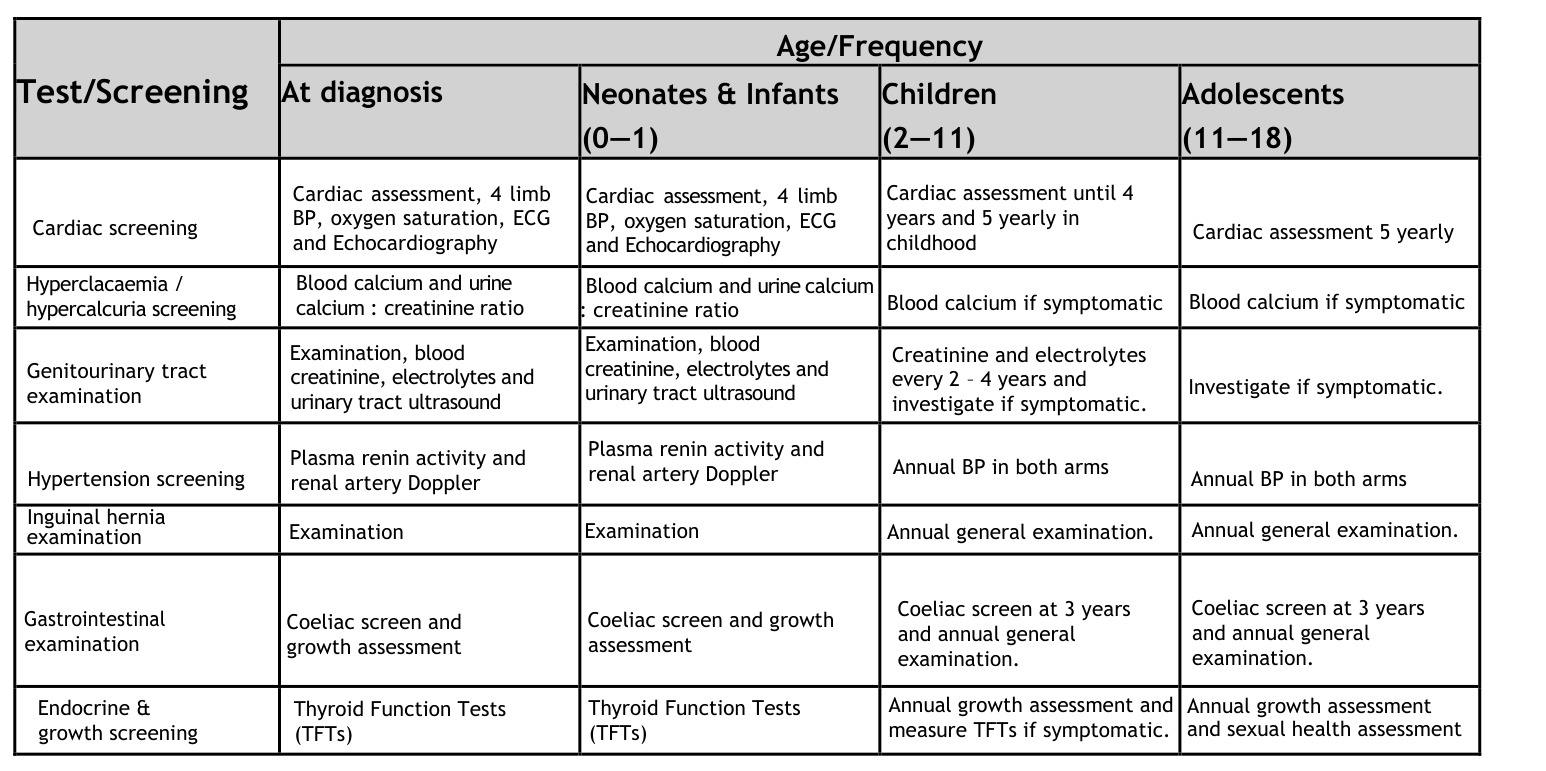
A management/surveillance table (“Summary of Investigations for Children with Williams Syndrome”) was retrieved as an image from the 2021 disease primer and can be used as a longitudinal diagnostic/surveillance checklist. (kozel2021williamssyndrome media 780874a7)
11. Outcome / Prognosis
11.1 Sudden death and anesthesia-related risk
A classic cohort study (293 WBS patients; 5,190 patient-years) estimated sudden cardiac death incidence at about ~1 per 1,000 patient-years, substantially higher than the general population, with coronary artery involvement as a key suspected contributor. (wessel2004riskofsudden pages 2-3, wessel2004riskofsudden pages 1-2)
Case literature documents anesthesia-related deaths during procedures in children with WS/SVAS and emphasizes preoperative evaluation for coronary disease. (horowitz2002coronaryarterydisease pages 1-2)
11.2 Outcomes after cardiovascular surgery/interventions
- STS Congenital Heart Surgery Database analysis reports overall in-hospital mortality 5% and major adverse cardiac events 9% in children with WS undergoing cardiovascular surgery, with higher risk in procedures involving coronary repair and combined outflow tract repairs. (hornik2015adversecardiacevents pages 11-15)
- A cardiovascular review reports survival after SVAS repair of approximately 90% at 5 years and ~82% at 20 years (as summarized in that review), and notes peri-anesthetic complication rates in some series (e.g., 11% anesthetic administrations with cardiac complication; mortality reported ~0.9% in one cited study). (collins2018cardiovasculardiseasein pages 3-5)
11.3 Quality of life
Direct quantitative QoL instruments (e.g., SF‑36/EQ‑5D) were not extractable from the retrieved evidence set; however, adaptive functioning weaknesses (daily living, motor) and maladaptive behaviors are reported in pediatric cohorts and are relevant to long-term functioning. (baysal2023developmentalcharacteristicsof pages 1-4)
12. Treatment
12.1 Real-world clinical management (expert consensus style)
A 2021 disease primer provides a practical monitoring and treatment approach: * Hypercalcemia (infancy): stepwise therapy including IV fluids, loop diuretics (frusemide), low-calcium diet, avoiding vitamin D supplementation, and IV bisphosphonates (often pamidronate) for resistant cases; 5–10% of infants may require therapy. (kozel2021williamssyndrome pages 4-6) * Hypertension/renovascular disease: annual BP monitoring; initial management favors medical therapy under nephrology; angioplasty/surgical reconstruction not first-line in this guidance. (kozel2021williamssyndrome pages 6-9) * Developmental/behavioral: early multidisciplinary developmental assessment and therapies (speech/language, OT, physiotherapy, psychology) are recommended. (kozel2021williamssyndrome pages 6-9) * Adult surveillance: periodic cardiac and renal monitoring, and symptom-driven calcium testing. (kozel2021williamssyndrome pages 17-18)
MAXO term suggestions (examples): * antihypertensive therapy (MAXO:0000747) * echocardiography (MAXO:0000758) * chromosomal microarray analysis (MAXO:0001226) (term availability may vary) * physical therapy (MAXO:0000012) * speech therapy (MAXO:0000010) * bisphosphonate therapy (MAXO:0000720) (for hypercalcemia; mapping may vary)
12.2 Experimental / clinical trials (recent and ongoing)
- Clemastine (myelination-oriented repurposing): Phase 2 trial NCT06087757, started 2024‑04‑01, open-label with blinded randomized withdrawal/crossover; aims to assess effects on neurocognitive/motor/behavioral deficits (NCT06087757 chunk 1).
- URL: https://clinicaltrials.gov/study/NCT06087757
- Minoxidil for arterial wall hypertrophy: NCT00876200 (completed). Trial record links to a placebo-controlled RCT publication (PMID 31138170) (NCT00876200 chunk 2).
- URL: https://clinicaltrials.gov/study/NCT00876200
- CBT for anxiety: NCT03827525, small program evaluating anxiety outcomes and QoL proxy measures (NCT03827525 chunk 1).
- URL: https://clinicaltrials.gov/study/NCT03827525
13. Prevention
- Primary prevention: not generally applicable because WS is primarily caused by a genomic deletion.
- Secondary prevention: early diagnosis and systematic surveillance to prevent complications (e.g., hypertension, nephrocalcinosis, cardiac events) is emphasized in expert management guidance (kozel2021williamssyndrome pages 4-6).
- Tertiary prevention: multidisciplinary follow-up to mitigate developmental, cardiovascular, endocrine, and renal complications (kozel2021williamssyndrome pages 6-9).
14. Other Species / Natural Disease
No naturally occurring veterinary Williams syndrome analogs were identified in the retrieved evidence set.
15. Model Organisms
A 2023 CRISPR/Cas9 mouse model carrying a large Williams-syndrome critical region deletion (including Ncf1) reports cardiovascular and neurobehavioral phenotypes paralleling human disease, including elongated/tortuous aorta and vascular extracellular-matrix disorganization in coronary and brain vessels, plus hypersociability and gait/craniofacial changes. (azzouzi2023vascularabnormalitiesin pages 1-3, azzouzi2023vascularabnormalitiesin pages 3-5)
Key quantitative findings (summary table)
Table (click to expand)
| Domain | Finding (with numbers) | Population/Study | Year | URL |
|---|---|---|---|---|
| Genetic lesion | Canonical WS/WBS lesion is a hemizygous 7q11.23 microdeletion of ~1.6 Mb deleting ~25 genes; representative genes include ELN, LIMK1, GTF2I, GTF2IRD1, DNAJC30, FZD9, STX1A (kippenhan2023dorsalvisualstream pages 1-2, carvalho2024diagnosisof7q11.23 pages 1-2) | Neurodevelopmental/imaging and case-report literature on WS/WBS | 2023–2024 | https://doi.org/10.1186/s11689-023-09493-x ; https://doi.org/10.33448/rsd-v13i5.45910 |
| Genetic lesion | Prenatal cohort observed deletion sizes 1.43–1.78 Mb encompassing 29 OMIM genes, including ELN, DNAJC30, GTF2IRD1, GTF2I (luo2024prenataldiagnosisultrasound pages 1-2) | 7 fetuses with 7q11.23 deletion identified by SNP-array | 2024 | https://doi.org/10.1186/s12884-024-06920-2 |
| Epidemiology / incidence | Frequently cited incidence/prevalence estimate: ~1 in 7,500 live births/newborns for WS/WBS (baysal2023developmentalcharacteristicsof pages 1-4, luo2024prenataldiagnosisultrasound pages 1-2) | Developmental cohort/review statements and prenatal review | 2023–2024 | https://doi.org/10.55730/1300-0144.5701 ; https://doi.org/10.1186/s12884-024-06920-2 |
| Phenotype frequencies: broad pediatric cohort | In 231 Chinese children: facial dysmorphism 100.0%; neurodevelopmental disorder 91.8%; hoarseness 87.4%; cardiovascular anomalies 85.7%; inguinal hernia 47.2%; short stature 46.9%; hypercalciuria 29.1%; subclinical hypothyroidism 26.4%; hypercalcemia 9.1%; hypothyroidism 7.4% (li2022clinicalphenotypesstudy pages 1-2) | Single-center retrospective cohort of 231 children with WS in China | 2022 | https://doi.org/10.1002/mgg3.2069 |
| Phenotype frequencies: adaptive/developmental profile | In 12 genetically confirmed patients: delayed fine/gross motor domains in 6/12, language delay in 4/12, and delays in all domains in 2/12; mean age at review 54.6 ± 32.5 months, first developmental clinic presentation 15.0 ± 11.5 months (baysal2023developmentalcharacteristicsof pages 1-4) | Developmental-behavioral pediatric cohort | 2023 | https://doi.org/10.55730/1300-0144.5701 |
| Phenotype frequencies: ophthalmic | In 57 WBS patients: stellate iris 30/57 (52.6%); retinal arteriolar tortuosity 51/57 (89.5%); axial length <20.5 mm in 24 eyes (21.8%); axial length 20.5–22.0 mm in 38 eyes (34.5%); hypopigmented retinal deposits OD 29/57, OS 27/57; broad foveal pit contour OD 44/55, OS 42/51 (huryn2023novelophthalmicfindings pages 1-1) | NIH deep-phenotyping ophthalmic study | 2023 | https://doi.org/10.1136/bjophthalmol-2022-321103 |
| Phenotype frequencies: ophthalmic (additional quantitative data) | In the same ophthalmic cohort: strabismus 17/57 (29.8%); 10 esotropia, 7 exotropia; prior strabismus surgery 15; amblyopia 8; BCVA ranged 20/20 to 20/80 OD and 20/20 to 20/400 OS (huryn2023novelophthalmicfindings pages 1-2) | NIH deep-phenotyping ophthalmic study | 2023 | https://doi.org/10.1136/bjophthalmol-2022-321103 |
| Phenotype frequencies: prenatal ultrasound | In 7 deletion fetuses, 6/7 had ultrasound abnormalities; 3/7 had intrauterine growth restriction; 4/7 had cardiovascular abnormalities, including 2 VSD, 1 aortic narrowing, 1 supravalvular pulmonary stenosis (luo2024prenataldiagnosisultrasound pages 1-2) | Single-center prenatal SNP-array cohort | 2024 | https://doi.org/10.1186/s12884-024-06920-2 |
| Diagnostics / confirmation | Historically FISH confirmed the 7q11.23 deletion, but expert review notes FISH has been superseded by chromosomal microarray / array CGH for routine confirmation of WS (kozel2021williamssyndrome pages 4-6) | Expert disease primer / management review | 2021 | https://doi.org/10.1038/s41572-021-00276-z |
| Diagnostics / confirmation | Developmental cohort states 99% of patients have a submicroscopic deletion detectable by FISH (baysal2023developmentalcharacteristicsof pages 1-4) | Pediatric developmental cohort summary | 2023 | https://doi.org/10.55730/1300-0144.5701 |
| Diagnostics / SVAS when WS excluded | In WS-negative SVAS cohort (n=61 with testing data available): CMA performed in 44/61 and was nondiagnostic; sequencing performed in 47/61 with overall diagnostic yield 29/47 (62%); ELN sequencing diagnostic in 20/39 (51%) (stephens2024genetictestingfor pages 1-2) | Retrospective cohort of patients with SVAS after negative WS evaluation | 2024 | https://doi.org/10.1161/jaha.123.034048 |
| Diagnostics / SVAS algorithmic yield | Same study reports 0% CMA diagnostic yield and 62% sequencing diagnostic yield; among ELN single-gene sequencing, 17/22 (77%) were positive, supporting ELN-first or multigene panel/exome after negative WS testing (stephens2024genetictestingfor pages 4-5, stephens2024genetictestingfor pages 7-8, stephens2024genetictestingfor pages 5-7) | Retrospective SVAS cohort and proposed testing algorithm | 2024 | https://doi.org/10.1161/jaha.123.034048 |
| Clinical trials | NCT06087757 clemastine Phase 2 trial: 30 participants, ages 6–30, ACTIVE_NOT_RECRUITING; primary completion estimated May 2026 (NCT06087757 chunk 1) | Clemastine Treatment in Individuals With Williams Syndrome | 2024 | https://clinicaltrials.gov/study/NCT06087757 |
| Clinical trials | NCT00876200 minoxidil trial: 21 participants, Phase 2, COMPLETED; targeted arterial wall hypertrophy in children with Williams-Beuren syndrome (NCT00876200 chunk 2) | Efficacy of Minoxidil in Children With Williams-Beuren Syndrome | 2009 / linked publication 2019 | https://clinicaltrials.gov/study/NCT00876200 |
| Clinical trials | NCT03827525 CBT/anxiety study: estimated enrollment 5 adults; 9 CBT sessions over ~5 months with follow-up to month 8 (NCT03827525 chunk 1) | Cognitive and Behavioral Therapy of Anxiety in Williams Syndrome | 2019 | https://clinicaltrials.gov/study/NCT03827525 |
Table: This table compiles key numeric findings for Williams syndrome / Williams-Beuren syndrome across genetics, epidemiology, phenotype frequencies, diagnostic yield, and active or completed clinical trials. It is designed as a quick-reference evidence summary for knowledge-base curation.
Limitations of this report (evidence availability)
- Orphanet, ICD‑10/ICD‑11, MeSH, and MONDO identifiers were not present in the retrieved full texts; thus they are not provided here.
- Some important 2023–2024 outcomes papers (e.g., long-term post-surgical survival cohorts) were listed as unobtainable by the retrieval system in this run, so prognosis is supported primarily by older cohort data and registry analyses available in full text here.
References
-
(kippenhan2023dorsalvisualstream pages 1-2): J. Shane Kippenhan, Michael D. Gregory, Tiffany Nash, Philip Kohn, Carolyn B. Mervis, Daniel P. Eisenberg, Madeline H. Garvey, Katherine Roe, Colleen A. Morris, Bhaskar Kolachana, Ariel M. Pani, Leah Sorcher, and Karen F. Berman. Dorsal visual stream and limk1: hemideletion, haplotype, and enduring effects in children with williams syndrome. Journal of Neurodevelopmental Disorders, Aug 2023. URL: https://doi.org/10.1186/s11689-023-09493-x, doi:10.1186/s11689-023-09493-x. This article has 4 citations and is from a peer-reviewed journal.
-
(kozel2021williamssyndrome pages 4-6): Beth A. Kozel, Boaz Barak, Chong Ae Kim, Carolyn B. Mervis, Lucy R. Osborne, Melanie Porter, and Barbara R. Pober. Williams syndrome. Nature Reviews Disease Primers, 7:1-22, Jun 2021. URL: https://doi.org/10.1038/s41572-021-00276-z, doi:10.1038/s41572-021-00276-z. This article has 326 citations.
-
(luo2024prenataldiagnosisultrasound pages 1-2): Xiaojin Luo, Hongyan Niu, Fei Zhou, Xiaohang Chen, Yuanyuan Pei, Weiqiang Liu, and Fengxiang Wei. Prenatal diagnosis, ultrasound findings and pregnancy outcome of 7q11.23 deletion and duplication syndromes: what are the fetal features? BMC Pregnancy and Childbirth, Nov 2024. URL: https://doi.org/10.1186/s12884-024-06920-2, doi:10.1186/s12884-024-06920-2. This article has 1 citations and is from a peer-reviewed journal.
-
(li2022clinicalphenotypesstudy pages 1-2): Fang‐fang Li, Wei‐jun Chen, Dan Yao, Lin Xu, Ji‐yang Shen, Yan Zeng, Zhuo Shi, Xiao‐wei Ye, Dao‐huan Kang, Bin Xu, Jie Shao, and Chai Ji. Clinical phenotypes study of 231 children with williams syndrome in china: a single‐center retrospective study. Molecular Genetics & Genomic Medicine, Sep 2022. URL: https://doi.org/10.1002/mgg3.2069, doi:10.1002/mgg3.2069. This article has 19 citations and is from a peer-reviewed journal.
-
(huryn2023novelophthalmicfindings pages 1-1): Laryssa A Huryn, Taylor Flaherty, Rosalie Nolen, Lev Prasov, Wadih M Zein, Catherine A Cukras, Sharon Osgood, Neelam Raja, Mark D Levin, Susan Vitale, Brian P Brooks, Robert B Hufnagel, and Beth A Kozel. Novel ophthalmic findings and deep phenotyping in williams-beuren syndrome. The British Journal of Ophthalmology, 107:1554-1559, Jun 2023. URL: https://doi.org/10.1136/bjophthalmol-2022-321103, doi:10.1136/bjophthalmol-2022-321103. This article has 10 citations.
-
(NCT06087757 chunk 1): Prof. Doron Gothelf MD. Clemastine Treatment in Individuals With Williams Syndrome. Sheba Medical Center. 2024. ClinicalTrials.gov Identifier: NCT06087757
-
(carvalho2024diagnosisof7q11.23 pages 1-2): Natalia Dayane Moura Carvalho, Vania Mesquita Gadelha Prazeres, and Cleiton Fantin Rezende. Diagnosis of 7q11.23 deletion in a patient from manaus, amazonas with williams-beuren syndrome: case report. Research, Society and Development, 13:e14713545910, May 2024. URL: https://doi.org/10.33448/rsd-v13i5.45910, doi:10.33448/rsd-v13i5.45910. This article has 0 citations.
-
(wessel2004riskofsudden pages 2-3): Armin Wessel, Verena Gravenhorst, Reiner Buchhorn, Angela Gosch, Carl‐Joachim Partsch, and Rainer Pankau. Risk of sudden death in the williams–beuren syndrome. American Journal of Medical Genetics Part A, 127A:234-237, Jun 2004. URL: https://doi.org/10.1002/ajmg.a.30012, doi:10.1002/ajmg.a.30012. This article has 186 citations.
-
(huryn2023novelophthalmicfindings pages 1-2): Laryssa A Huryn, Taylor Flaherty, Rosalie Nolen, Lev Prasov, Wadih M Zein, Catherine A Cukras, Sharon Osgood, Neelam Raja, Mark D Levin, Susan Vitale, Brian P Brooks, Robert B Hufnagel, and Beth A Kozel. Novel ophthalmic findings and deep phenotyping in williams-beuren syndrome. The British Journal of Ophthalmology, 107:1554-1559, Jun 2023. URL: https://doi.org/10.1136/bjophthalmol-2022-321103, doi:10.1136/bjophthalmol-2022-321103. This article has 10 citations.
-
(baysal2023developmentalcharacteristicsof pages 1-4): ŞENAY GÜVEN BAYSAL, FEYZULLAH NECATİ ARSLAN, MEHMET AKİF BÜYÜKAVCI, FATMA HİLAL YAĞIN, CEMAL EKİCİ, ZEYNEP ESENER, and DERYA DOĞAN. Developmental characteristics of williams-beuren syndrome and evaluation of adaptive behavioral skills. Turkish Journal of Medical Sciences, 53:1348-1357, Oct 2023. URL: https://doi.org/10.55730/1300-0144.5701, doi:10.55730/1300-0144.5701. This article has 5 citations.
-
(lv2023prenataldiagnosisof pages 3-4): Xin Lv, Xiao Yang, Linlin Li, Fagui Yue, Hongguo Zhang, and Ruixue Wang. Prenatal diagnosis of 7q11.23 microdeletion: two cases report and literature review. Medicine, 102(43):e34852, Oct 2023. URL: https://doi.org/10.1097/md.0000000000034852, doi:10.1097/md.0000000000034852. This article has 9 citations and is from a peer-reviewed journal.
-
(mihailovich2024multiscalemodelinguncovers pages 1-2): Marija Mihailovich, Pierre-Luc Germain, Reinald Shyti, Davide Pozzi, Roberta Noberini, Yansheng Liu, Davide Aprile, Erika Tenderini, Flavia Troglio, Sebastiano Trattaro, Sonia Fabris, Ummi Ciptasari, Marco Tullio Rigoli, Nicolò Caporale, Giuseppe D’Agostino, Filippo Mirabella, Alessandro Vitriolo, Daniele Capocefalo, Adrianos Skaros, Agnese Virginia Franchini, Sara Ricciardi, Ida Biunno, Antonino Neri, Nael Nadif Kasri, Tiziana Bonaldi, Rudolf Aebersold, Michela Matteoli, and Giuseppe Testa. Multiscale modeling uncovers 7q11.23 copy number variation–dependent changes in ribosomal biogenesis and neuronal maturation and excitability. Journal of Clinical Investigation, Jul 2024. URL: https://doi.org/10.1172/jci168982, doi:10.1172/jci168982. This article has 8 citations and is from a highest quality peer-reviewed journal.
-
(horowitz2002coronaryarterydisease pages 1-2): Peter E. Horowitz, Salman Akhtar, John A. Wulff, Fadel Al Fadley, and Zohair Al Halees. Coronary artery disease and anesthesia-related death in children with williams syndrome. Journal of cardiothoracic and vascular anesthesia, 16 6:739-41, Dec 2002. URL: https://doi.org/10.1053/jcan.2002.128407, doi:10.1053/jcan.2002.128407. This article has 72 citations and is from a peer-reviewed journal.
-
(kozel2021williamssyndrome pages 6-9): Beth A. Kozel, Boaz Barak, Chong Ae Kim, Carolyn B. Mervis, Lucy R. Osborne, Melanie Porter, and Barbara R. Pober. Williams syndrome. Nature Reviews Disease Primers, 7:1-22, Jun 2021. URL: https://doi.org/10.1038/s41572-021-00276-z, doi:10.1038/s41572-021-00276-z. This article has 326 citations.
-
(collins2018cardiovasculardiseasein pages 3-5): II R Thomas Collins. Cardiovascular disease in williams syndrome. Current Opinion in Pediatrics, 30:609–615, Oct 2018. URL: https://doi.org/10.1097/mop.0000000000000664, doi:10.1097/mop.0000000000000664. This article has 165 citations and is from a peer-reviewed journal.
-
(stephens2024genetictestingfor pages 4-5): Sara B. Stephens, Tyler Novy, Gabrielle N. Spurzem, Benjamin Jacob, Taylor Beecroft, Emily Soludczyk, Beth A. Kozel, Justin Weigand, and Shaine A. Morris. Genetic testing for supravalvar aortic stenosis: what to do when it is not williams syndrome. Journal of the American Heart Association, Apr 2024. URL: https://doi.org/10.1161/jaha.123.034048, doi:10.1161/jaha.123.034048. This article has 7 citations.
-
(stephens2024genetictestingfor pages 1-2): Sara B. Stephens, Tyler Novy, Gabrielle N. Spurzem, Benjamin Jacob, Taylor Beecroft, Emily Soludczyk, Beth A. Kozel, Justin Weigand, and Shaine A. Morris. Genetic testing for supravalvar aortic stenosis: what to do when it is not williams syndrome. Journal of the American Heart Association, Apr 2024. URL: https://doi.org/10.1161/jaha.123.034048, doi:10.1161/jaha.123.034048. This article has 7 citations.
-
(kozel2021williamssyndrome media 780874a7): Beth A. Kozel, Boaz Barak, Chong Ae Kim, Carolyn B. Mervis, Lucy R. Osborne, Melanie Porter, and Barbara R. Pober. Williams syndrome. Nature Reviews Disease Primers, 7:1-22, Jun 2021. URL: https://doi.org/10.1038/s41572-021-00276-z, doi:10.1038/s41572-021-00276-z. This article has 326 citations.
-
(wessel2004riskofsudden pages 1-2): Armin Wessel, Verena Gravenhorst, Reiner Buchhorn, Angela Gosch, Carl‐Joachim Partsch, and Rainer Pankau. Risk of sudden death in the williams–beuren syndrome. American Journal of Medical Genetics Part A, 127A:234-237, Jun 2004. URL: https://doi.org/10.1002/ajmg.a.30012, doi:10.1002/ajmg.a.30012. This article has 186 citations.
-
(hornik2015adversecardiacevents pages 11-15): Christoph P. Hornik, Ronnie Thomas Collins, Robert D.B. Jaquiss, Jeffrey P. Jacobs, Marshall L. Jacobs, Sara K. Pasquali, Amelia S. Wallace, and Kevin D. Hill. Adverse cardiac events in children with williams syndrome undergoing cardiovascular surgery: an analysis of the society of thoracic surgeons congenital heart surgery database. The Journal of Thoracic and Cardiovascular Surgery, 149:1516-1522.e1, Jun 2015. URL: https://doi.org/10.1016/j.jtcvs.2015.02.016, doi:10.1016/j.jtcvs.2015.02.016. This article has 66 citations.
-
(kozel2021williamssyndrome pages 17-18): Beth A. Kozel, Boaz Barak, Chong Ae Kim, Carolyn B. Mervis, Lucy R. Osborne, Melanie Porter, and Barbara R. Pober. Williams syndrome. Nature Reviews Disease Primers, 7:1-22, Jun 2021. URL: https://doi.org/10.1038/s41572-021-00276-z, doi:10.1038/s41572-021-00276-z. This article has 326 citations.
-
(NCT00876200 chunk 2): Efficacy of Minoxidil in Children With Williams-Beuren Syndrome. Hospices Civils de Lyon. 2009. ClinicalTrials.gov Identifier: NCT00876200
-
(NCT03827525 chunk 1): Cognitive and Behavioral Therapy of Anxiety in Williams Syndrome. University Hospital, Montpellier. 2019. ClinicalTrials.gov Identifier: NCT03827525
-
(azzouzi2023vascularabnormalitiesin pages 1-3): Hamid el Azzouzi, Laurens W.J. Bosman, Lieke Kros, Nicole van Vliet, Yanto Ridwan, Stéphanie Dijkhuizen, Erika Sabel-Goedknegt, Bastian S. Generowicz, Manuele Novello, Emma Kretschmann, Morrisen Snoeren, Danique Broere, Rocco Caliandro, Sebastiaan K.E. Koekkoek, Pieter Kruizinga, Vera van Dis, Haibo Zhou, Hui Yang, Changyang Zhou, Ingrid van der Pluijm, Jeroen Essers, and Chris I. De Zeeuw. Vascular abnormalities in heart and brain are associated with cardiovascular and neurological symptoms in a novel mouse model for williams syndrome. bioRxiv, Oct 2023. URL: https://doi.org/10.1101/2023.10.30.564727, doi:10.1101/2023.10.30.564727. This article has 0 citations.
-
(azzouzi2023vascularabnormalitiesin pages 3-5): Hamid el Azzouzi, Laurens W.J. Bosman, Lieke Kros, Nicole van Vliet, Yanto Ridwan, Stéphanie Dijkhuizen, Erika Sabel-Goedknegt, Bastian S. Generowicz, Manuele Novello, Emma Kretschmann, Morrisen Snoeren, Danique Broere, Rocco Caliandro, Sebastiaan K.E. Koekkoek, Pieter Kruizinga, Vera van Dis, Haibo Zhou, Hui Yang, Changyang Zhou, Ingrid van der Pluijm, Jeroen Essers, and Chris I. De Zeeuw. Vascular abnormalities in heart and brain are associated with cardiovascular and neurological symptoms in a novel mouse model for williams syndrome. bioRxiv, Oct 2023. URL: https://doi.org/10.1101/2023.10.30.564727, doi:10.1101/2023.10.30.564727. This article has 0 citations.
-
(stephens2024genetictestingfor pages 7-8): Sara B. Stephens, Tyler Novy, Gabrielle N. Spurzem, Benjamin Jacob, Taylor Beecroft, Emily Soludczyk, Beth A. Kozel, Justin Weigand, and Shaine A. Morris. Genetic testing for supravalvar aortic stenosis: what to do when it is not williams syndrome. Journal of the American Heart Association, Apr 2024. URL: https://doi.org/10.1161/jaha.123.034048, doi:10.1161/jaha.123.034048. This article has 7 citations.
-
(stephens2024genetictestingfor pages 5-7): Sara B. Stephens, Tyler Novy, Gabrielle N. Spurzem, Benjamin Jacob, Taylor Beecroft, Emily Soludczyk, Beth A. Kozel, Justin Weigand, and Shaine A. Morris. Genetic testing for supravalvar aortic stenosis: what to do when it is not williams syndrome. Journal of the American Heart Association, Apr 2024. URL: https://doi.org/10.1161/jaha.123.034048, doi:10.1161/jaha.123.034048. This article has 7 citations.