Williams Syndrome
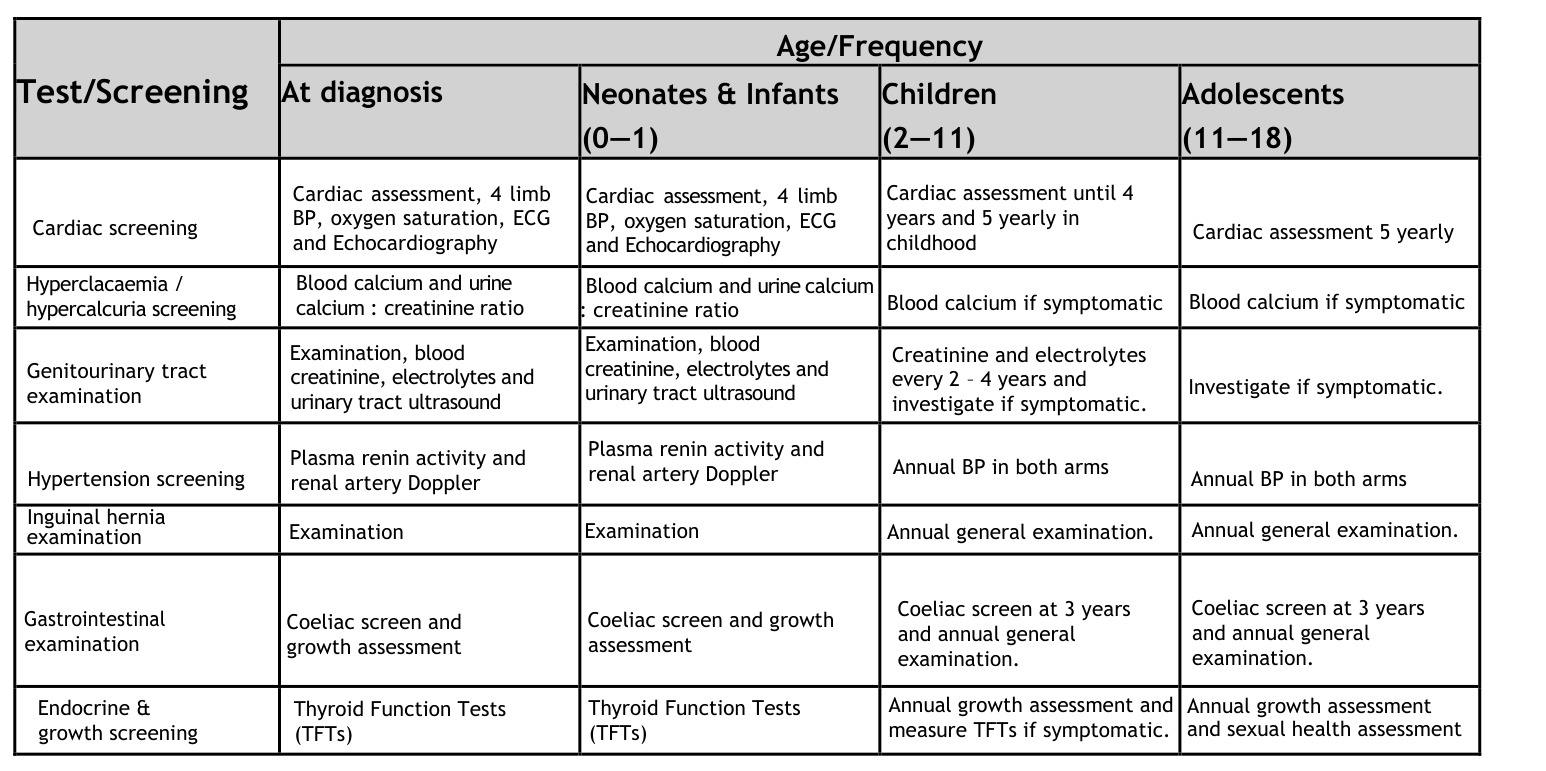
Williams syndrome (Williams-Beuren syndrome) is a rare multisystem neurodevelopmental disorder caused by a recurrent ~1.5-1.8 Mb contiguous-gene microdeletion at chromosome 7q11.23 that removes approximately 25-27 genes, including ELN (elastin). Hemizygous loss of ELN produces a generalized elastin arteriopathy, most characteristically supravalvular aortic stenosis, while combined dosage reduction across the interval produces a variable neurodevelopmental, behavioral, craniofacial, connective-tissue, endocrine, gastrointestinal, renal, ocular, and auditory phenotype. GTF2I/GTF2IRD1 and LIMK1 are among the better-supported contributors to social-behavioral and visuospatial phenotypes, respectively, but many individual gene-to-phenotype routes remain unresolved. Hallmarks include hypersociability, mild-to-moderate intellectual disability with severe visuospatial-construction weakness, distinctive facies, growth and feeding difficulty, and age-dependent calcium and other endocrine abnormalities.
Ask OpenScientist
Ask a research question about Williams Syndrome. OpenScientist will conduct autonomous deep research using the Disorder Mechanisms Knowledge Base and PubMed literature (typically 10-30 minutes).
Do not include personal health information in your question. Questions and results are cached in your browser's local storage.
Inheritance
1Show evidence (4 references)
Discussions and Knowledge Gaps
5Show evidence (1 reference)
Show evidence (2 references)
Show evidence (3 references)
Show evidence (1 reference)
Show evidence (1 reference)
Pathophysiology
8Show evidence (1 reference)
Show evidence (2 references)
Show evidence (1 reference)
Show evidence (2 references)
Show evidence (1 reference)
Show evidence (1 reference)
Show evidence (2 references)
Show evidence (2 references)
Pathograph
Phenotypes
35Cardiovascular 3
Show evidence (1 reference)
Show evidence (1 reference)
Show evidence (1 reference)
Digestive 3
Show evidence (1 reference)
Show evidence (1 reference)
Show evidence (1 reference)
Ear 2
Show evidence (1 reference)
Show evidence (1 reference)
Endocrine 1
Show evidence (1 reference)
Head and Neck 2
Show evidence (1 reference)
Show evidence (1 reference)
Metabolism 2
Show evidence (2 references)
Show evidence (1 reference)
Musculoskeletal 2
Show evidence (1 reference)
Show evidence (1 reference)
Nervous System 6
Show evidence (2 references)
Show evidence (1 reference)
Show evidence (1 reference)
Show evidence (1 reference)
Show evidence (1 reference)
Show evidence (1 reference)
Voice 1
Show evidence (1 reference)
Growth 1
Show evidence (1 reference)
Other 12
Show evidence (2 references)
Show evidence (1 reference)
Show evidence (1 reference)
Show evidence (1 reference)
Show evidence (1 reference)
Show evidence (1 reference)
Show evidence (1 reference)
Show evidence (1 reference)
Show evidence (1 reference)
Show evidence (2 references)
Show evidence (1 reference)
Show evidence (1 reference)
Genetic Associations
5Show evidence (2 references)
Show evidence (1 reference)
Show evidence (1 reference)
Show evidence (1 reference)
Show evidence (1 reference)
Medical Actions
8Show evidence (2 references)
Show evidence (2 references)
Show evidence (1 reference)
Show evidence (2 references)
Show evidence (1 reference)
Show evidence (1 reference)
Show evidence (1 reference)
Show evidence (1 reference)
Diagnosis
4Show evidence (2 references)
Show evidence (4 references)
Show evidence (3 references)
Show evidence (2 references)
Progression
3Show evidence (2 references)
Show evidence (2 references)
Show evidence (2 references)
Prevalence
1Show evidence (1 reference)
Epidemiology
1Show evidence (1 reference)
Differential Diagnoses
3Conditions with similar clinical presentations that must be differentiated from Williams Syndrome:
- Syndrome-specific examination and sequencing of RASopathy, JAG1/NOTCH2, NF1, and lipid-disorder genes distinguish these alternatives.
- The WBSCR deletion, hypersociability/visuospatial profile, and characteristic facies support Williams syndrome.
Show evidence (1 reference)
- Hemideletion of the WBSCR establishes Williams syndrome; hemiduplication establishes 7q11.23 microduplication syndrome.
- Hypersociability and visuospatial-construction weakness favor Williams syndrome, whereas speech delay and autism favor duplication.
Show evidence (2 references)
Related Datasets
1Clinical Trials
2Show evidence (1 reference)
Show evidence (1 reference)
Experimental Models
2Show evidence (1 reference)
Show evidence (1 reference)
Show evidence (1 reference)
Show evidence (1 reference)
Animal Models
3Show evidence (2 references)
Show evidence (1 reference)
Show evidence (1 reference)
Source YAML
click to showname: Williams Syndrome
creation_date: "2026-06-03T00:00:00Z"
synonyms:
- Williams-Beuren syndrome
- WBS
- deletion 7q11.23
description: >-
Williams syndrome (Williams-Beuren syndrome) is a rare multisystem
neurodevelopmental disorder caused by a recurrent ~1.5-1.8 Mb contiguous-gene
microdeletion at chromosome 7q11.23 that removes approximately 25-27 genes,
including ELN (elastin). Hemizygous loss of ELN produces a generalized
elastin arteriopathy, most characteristically supravalvular aortic stenosis,
while combined dosage reduction across the interval produces a variable
neurodevelopmental, behavioral, craniofacial, connective-tissue, endocrine,
gastrointestinal, renal, ocular, and auditory phenotype. GTF2I/GTF2IRD1 and
LIMK1 are among the better-supported contributors to social-behavioral and
visuospatial phenotypes, respectively, but many individual gene-to-phenotype
routes remain unresolved. Hallmarks include hypersociability, mild-to-moderate
intellectual disability with severe visuospatial-construction weakness,
distinctive facies, growth and feeding difficulty, and age-dependent calcium
and other endocrine abnormalities.
category: Mendelian
parents:
- Chromosomal microdeletion syndrome
- Congenital heart disease
- Neurodevelopmental disorder
disease_term:
preferred_term: Williams syndrome
term:
id: MONDO:0008678
label: Williams syndrome
references:
- reference: PMID:20301427
title: "Williams Syndrome."
tags:
- GeneReviews
- reference: "url:https://pmc.ncbi.nlm.nih.gov/articles/PMC9437774/"
title: "Williams syndrome - PMC"
- reference: PMID:34140529
title: "Williams syndrome."
- reference: PMID:36168091
title: "Clinical phenotypes study of 231 children with Williams syndrome in China: A single-center retrospective study."
- reference: PMID:35760456
title: "Novel ophthalmic findings and deep phenotyping in Williams-Beuren syndrome."
- reference: PMID:39007270
title: "Multiscale modeling uncovers 7q11.23 copy number variation-dependent changes in ribosomal biogenesis and neuronal maturation and excitability."
- reference: PMID:26333794
title: "7q11.23 Duplication syndrome: Physical characteristics and natural history."
- reference: PMID:37633900
title: "Dorsal visual stream and LIMK1: hemideletion, haplotype, and enduring effects in children with Williams syndrome."
- reference: PMID:25791950
title: "Adverse cardiac events in children with Williams syndrome undergoing cardiovascular surgery: An analysis of the Society of Thoracic Surgeons Congenital Heart Surgery Database."
- reference: PMID:12796854
title: "Mutational mechanisms of Williams-Beuren syndrome deletions."
- reference: PMID:38591341
title: "Genetic Testing for Supravalvar Aortic Stenosis: What to Do When It Is Not Williams Syndrome."
- reference: PMID:39291481
title: "Clinical Care for Cardiovascular Disease in Patients With Williams-Beuren Syndrome."
- reference: PMID:20049703
title: "Induced chromosome deletions cause hypersociability and other features of Williams-Beuren syndrome in mice."
- reference: PMID:20926892
title: "Induced chromosome deletion in a Williams-Beuren syndrome mouse model causes cardiovascular abnormalities."
- reference: PMID:25027326
title: "Heterozygous deletion of the Williams-Beuren syndrome critical interval in mice recapitulates most features of the human disorder."
- reference: PMID:27509850
title: "A human neurodevelopmental model for Williams syndrome."
- reference: PMID:31011227
title: "Neuronal deletion of Gtf2i, associated with Williams syndrome, causes behavioral and myelin alterations rescuable by a remyelinating drug."
inheritance:
- name: Autosomal dominant inheritance
description: >-
Williams syndrome is inherited in an autosomal dominant manner. The vast
majority of cases arise de novo from a recurrent 7q11.23 deletion mediated
by non-allelic homologous recombination between flanking low-copy repeats.
Recurrence is extremely low when neither parent has clinical findings,
although rare recurrence has been reported in phenotypically normal parents;
an affected individual has a 50% chance of transmitting the deletion. Once
the familial deletion is known, prenatal and preimplantation genetic testing
are possible.
inheritance_term:
preferred_term: autosomal dominant inheritance
term:
id: HP:0000006
label: Autosomal dominant inheritance
evidence:
- reference: PMID:20301427
reference_title: "Williams Syndrome."
supports: SUPPORT
evidence_source: HUMAN_CLINICAL
snippet: >-
WS is an autosomal dominant disorder. Most individuals diagnosed with WS
have the disorder as the result of a de novo 1.5- to 1.8-Mb 7q11.23
deletion; rarely, an individual with WS has an affected parent.
explanation: >-
GeneReviews confirms autosomal dominant inheritance with predominantly
de novo origin of the 7q11.23 deletion.
- reference: PMID:20301427
reference_title: "Williams Syndrome."
supports: SUPPORT
evidence_source: HUMAN_CLINICAL
snippet: >-
Each child of an individual with WS has a 50% chance of inheriting the
7q11.23 deletion and being affected. Once the WS-causing 1.5- to 1.8-Mb
7q11.23 deletion has been identified in an affected family member,
prenatal and preimplantation genetic testing are possible.
explanation: >-
GeneReviews quantifies transmission risk and confirms reproductive-testing
options after the causal deletion is identified.
- reference: url:https://pmc.ncbi.nlm.nih.gov/articles/PMC9437774/
reference_title: "Williams syndrome - PMC"
supports: SUPPORT
evidence_source: HUMAN_CLINICAL
snippet: >-
The recurrence risk for couples where neither parent has clinical findings
of WS is extremely low
explanation: >-
The expert review directly characterizes recurrence risk when both parents
are clinically unaffected.
- reference: url:https://pmc.ncbi.nlm.nih.gov/articles/PMC9437774/
reference_title: "Williams syndrome - PMC"
supports: SUPPORT
evidence_source: HUMAN_CLINICAL
snippet: >-
However, there are rare reports of recurrence in phenotypically normal
parents.
explanation: >-
The expert review bounds sibling recurrence after an apparently de novo
deletion while noting rare recurrence in clinically unaffected parents.
expressivity: VARIABLE
genetic:
- name: Recurrent WBSCR deletion at 7q11.23
notes: >-
The usual molecular lesion is a heterozygous 1.55-Mb deletion generated by
unequal recombination between highly homologous centromeric and medial
low-copy repeats; a minority have a larger approximately 1.84-Mb deletion.
evidence:
- reference: PMID:12796854
reference_title: "Mutational mechanisms of Williams-Beuren syndrome deletions."
supports: SUPPORT
evidence_source: HUMAN_CLINICAL
snippet: >-
Most patients (95%) exhibit a 1.55-Mb deletion caused by recombination
between centromeric and medial block B copies, which share approximately
99.6% sequence identity along 105-143 kb.
explanation: >-
Breakpoint mapping directly establishes the common deletion size and its
low-copy-repeat-mediated recombination mechanism.
- reference: PMID:12796854
reference_title: "Mutational mechanisms of Williams-Beuren syndrome deletions."
supports: SUPPORT
evidence_source: HUMAN_CLINICAL
snippet: >-
only four patients (5%) displayed a larger deletion ( approximately 1.84
Mb) caused by recombination between centromeric and medial block A copies.
explanation: >-
The same breakpoint study documents the less common, larger recurrent
deletion and its alternative low-copy-repeat blocks.
- name: ELN haploinsufficiency from 7q11.23 deletion
notes: >-
Hemizygous deletion of ELN (elastin) at 7q11.23 causes elastin
haploinsufficiency, the basis of the generalized arteriopathy and
connective-tissue manifestations of Williams syndrome.
gene_term:
preferred_term: ELN
term:
id: hgnc:3327
label: ELN
evidence:
- reference: PMID:34140529
reference_title: "Williams syndrome."
supports: SUPPORT
evidence_source: HUMAN_CLINICAL
snippet: >-
Genotype-phenotype evidence is strongest for ELN, the gene encoding
elastin, which is responsible for the vascular and connective tissue
features of WS
explanation: >-
The expert review identifies ELN as the best-established interval-gene
contributor to vascular and connective-tissue disease.
- name: GTF2I haploinsufficiency
notes: >-
GTF2I dosage reduction is implicated, together with GTF2IRD1 and other
interval genes, in intellectual ability, social functioning, anxiety, and
altered neurodevelopment, but it is not a sufficient explanation for the
full Williams syndrome behavioral phenotype.
gene_term:
preferred_term: GTF2I
term:
id: hgnc:4659
label: GTF2I
evidence:
- reference: PMID:34140529
reference_title: "Williams syndrome."
supports: SUPPORT
evidence_source: HUMAN_CLINICAL
snippet: >-
for the transcription factor genes GTF2I and GTF2IRD1, which are known to
affect intellectual ability, social functioning and anxiety
explanation: >-
The review supports a bounded, shared contribution from GTF2I and
GTF2IRD1 rather than assigning the entire behavioral phenotype to GTF2I.
- name: GTF2IRD1 haploinsufficiency
notes: >-
GTF2IRD1 dosage reduction is implicated, together with GTF2I and other
interval genes, in intellectual ability, social functioning, and anxiety;
attribution of specific manifestations to GTF2IRD1 alone remains uncertain.
gene_term:
preferred_term: GTF2IRD1
term:
id: hgnc:4661
label: GTF2IRD1
evidence:
- reference: PMID:34140529
reference_title: "Williams syndrome."
supports: SUPPORT
evidence_source: HUMAN_CLINICAL
snippet: >-
for the transcription factor genes GTF2I and GTF2IRD1, which are known to
affect intellectual ability, social functioning and anxiety
explanation: >-
The review supports a bounded, shared contribution from GTF2IRD1 and
GTF2I while leaving single-gene attribution uncertain.
- name: LIMK1 haploinsufficiency
notes: >-
LIMK1 regulates actin-cytoskeleton dynamics and is associated with the
characteristic visuospatial-construction deficit, although the phenotype is
modified by broader interval dosage and allelic background.
gene_term:
preferred_term: LIMK1
term:
id: hgnc:6613
label: LIMK1
evidence:
- reference: PMID:37633900
reference_title: "Dorsal visual stream and LIMK1: hemideletion, haplotype, and enduring effects in children with Williams syndrome."
supports: SUPPORT
evidence_source: HUMAN_CLINICAL
snippet: >-
We investigated the impacts of hemideletion and haplotype variation of
LIMK1, a gene hemideleted in WS and linked to neuronal maturation and
migration, on the structure and function of the dorsal stream
explanation: >-
Longitudinal human imaging directly evaluates LIMK1 hemideletion and
haplotype effects in the dorsal visual stream.
prevalence:
- population: Worldwide
measure_type: BIRTH_PREVALENCE
prevalence_class: BAND_1_5_PER_10000
rate_per_100000: 13.33
notes: >-
The most widely cited epidemiologic estimate is 1 in 7,500 live births,
normalized here to 13.33 per 100,000 live births. The review notes sparse
epidemiologic data across populations, so this should not be interpreted as
a precisely measured universal rate.
evidence:
- reference: url:https://pmc.ncbi.nlm.nih.gov/articles/PMC9437774/
reference_title: "Williams syndrome - PMC"
supports: SUPPORT
evidence_source: HUMAN_CLINICAL
snippet: >-
which reports a prevalence of 1 in 7,500 live births
explanation: >-
The expert review identifies the denominator and explicitly anchors it to
live births.
progression:
- phase: Infant multisystem presentation
age_range: Birth through 30 months
notes: >-
Feeding and oral-motor difficulty, poor weight gain, hypotonia and motor
delay, a murmur from arterial stenosis, and distinctive facies often prompt
recognition. Clinically actionable hypercalcemia is concentrated in later
infancy and the second year of life.
evidence:
- reference: PMID:20301427
reference_title: "Williams Syndrome."
supports: SUPPORT
evidence_source: HUMAN_CLINICAL
snippet: >-
Hypotonia and hyperextensible joints can result in delayed attainment of
motor milestones. Feeding difficulties often lead to poor weight gain in
infancy.
explanation: >-
GeneReviews defines the early motor and feeding trajectory.
- reference: url:https://pmc.ncbi.nlm.nih.gov/articles/PMC9437774/
reference_title: "Williams syndrome - PMC"
supports: SUPPORT
evidence_source: HUMAN_CLINICAL
snippet: >-
is seen in 5–10% of children with WS and when present usually occurs
between 6 and 30 months of age
explanation: >-
The expert review supplies the age window for clinically important
hypercalcemia.
- phase: Childhood neurodevelopmental and cardiovascular course
age_range: Early childhood through adolescence
notes: >-
Developmental delay, the characteristic cognitive profile, hypersociability,
anxiety, attention problems, sound sensitivity, and school support needs
become clearer. Pulmonary arterial stenosis often becomes less prominent,
while aortic stenosis may improve, remain stable, or worsen.
evidence:
- reference: url:https://pmc.ncbi.nlm.nih.gov/articles/PMC9437774/
reference_title: "Williams syndrome - PMC"
supports: SUPPORT
evidence_source: HUMAN_CLINICAL
snippet: >-
While pulmonary artery stenoses often improves with age, narrowing on the
aortic side may stay the same, improve or worsen with time.
explanation: >-
The review distinguishes the typical age trajectories of pulmonary and
aortic arterial lesions.
- reference: PMID:37633900
reference_title: "Dorsal visual stream and LIMK1: hemideletion, haplotype, and enduring effects in children with Williams syndrome."
supports: SUPPORT
evidence_source: HUMAN_CLINICAL
snippet: >-
IPS structural (p < 10-4 FDR corrected) and functional (p < .05 FDR
corrected) anomalies previously reported in adults were confirmed in
children with WS, and, consistent with an enduring genetic mechanism,
were stable from early childhood into adulthood.
explanation: >-
Longitudinal imaging shows persistence of the dorsal-stream phenotype.
- phase: Lifelong vascular and adult metabolic surveillance
age_range: Adulthood and later life
notes: >-
Elastin arteriopathy and hypertension require lifelong follow-up even when
childhood pulmonary lesions improve. Insulin resistance or abnormal glucose
tolerance, thyroid disease, hearing loss, anxiety, and musculoskeletal
limitation remain important adult health needs, but long-term natural-history
data in older adults are limited.
evidence:
- reference: url:https://pmc.ncbi.nlm.nih.gov/articles/PMC9437774/
reference_title: "Williams syndrome - PMC"
supports: SUPPORT
evidence_source: HUMAN_CLINICAL
snippet: >-
Surveillance of stenosis occurs through regular examinations by a
cardiologist and associated imaging and should continue throughout an
individual's lifetime.
explanation: >-
The expert review explicitly recommends lifelong vascular surveillance.
- reference: PMID:20301427
reference_title: "Williams Syndrome."
supports: SUPPORT
evidence_source: HUMAN_CLINICAL
snippet: >-
Oral glucose tolerance tests in adults should start at age 20 years.
explanation: >-
GeneReviews identifies an adult metabolic-surveillance milestone.
pathophysiology:
- name: Recurrent Low-Copy-Repeat-Mediated 7q11.23 Deletion
biological_scale: MOLECULAR
mechanism_confidence: ESTABLISHED
description: >-
Highly homologous low-copy repeats flanking the Williams-Beuren syndrome
critical region misalign during meiosis and undergo non-allelic homologous
recombination. The recurrent heterozygous deletion makes ELN and the other
interval genes hemizygous; it is the initiating lesion rather than a direct
assignment of every manifestation to a single gene.
evidence:
- reference: PMID:12796854
reference_title: "Mutational mechanisms of Williams-Beuren syndrome deletions."
supports: SUPPORT
evidence_source: HUMAN_CLINICAL
snippet: >-
Three large region-specific low-copy repeat elements (LCRs), composed of
different blocks (A, B, and C), flank the WBS deletion interval and are
thought to predispose to misalignment and unequal crossing-over, causing
the deletions.
explanation: >-
Patient breakpoint mapping establishes the flanking genomic architecture
and unequal-recombination origin of the deletion.
downstream:
- target: ELN Haploinsufficiency
causal_link_type: DIRECT
description: The deletion removes one ELN copy.
evidence:
- reference: PMID:20926892
reference_title: "Induced chromosome deletion in a Williams-Beuren syndrome mouse model causes cardiovascular abnormalities."
supports: SUPPORT
evidence_source: MODEL_ORGANISM
snippet: >-
ELN transcript levels were reduced by 38-41% in Wbs mice lacking one
copy of the ELN gene.
explanation: >-
A full-interval deletion model directly confirms reduced ELN dosage.
- target: Neurodevelopmental Interval-Gene Haploinsufficiency
causal_link_type: DIRECT
description: The same deletion removes one copy of multiple dosage-sensitive neurodevelopmental genes.
evidence:
- reference: url:https://pmc.ncbi.nlm.nih.gov/articles/PMC9437774/
reference_title: "Williams syndrome - PMC"
supports: SUPPORT
evidence_source: HUMAN_CLINICAL
snippet: >-
Deletion size is similar across most individuals with WS and leads to
loss of one copy of 25-27 genes on chromosome 7q11.23.
explanation: >-
The expert review directly establishes multigene hemizygosity.
- name: ELN Haploinsufficiency
biological_scale: MOLECULAR
mechanism_confidence: ESTABLISHED
description: >-
Hemizygous loss of ELN reduces elastin transcript and protein dose. This is
the best-established single-gene contribution in Williams syndrome and is
sufficient to produce familial supravalvular-aortic-stenosis-like vascular
disease outside the contiguous-gene syndrome.
genes:
- preferred_term: ELN
term:
id: hgnc:3327
label: ELN
biological_processes:
- preferred_term: Elastic fiber assembly
term:
id: GO:0048251
label: elastic fiber assembly
modifier: DECREASED
evidence:
- reference: PMID:34140529
reference_title: "Williams syndrome."
supports: SUPPORT
evidence_source: HUMAN_CLINICAL
snippet: >-
Genotype-phenotype evidence is strongest for ELN, the gene encoding
elastin, which is responsible for the vascular and connective tissue
features of WS
explanation: >-
The expert review identifies ELN dosage loss as the strongest interval
gene-to-phenotype relationship.
- reference: PMID:20926892
reference_title: "Induced chromosome deletion in a Williams-Beuren syndrome mouse model causes cardiovascular abnormalities."
supports: SUPPORT
evidence_source: MODEL_ORGANISM
snippet: >-
ELN transcript levels were reduced by 38-41% in Wbs mice lacking one copy
of the ELN gene.
explanation: >-
The interval-deletion mouse directly demonstrates the expected reduction
in ELN expression from loss of one copy.
downstream:
- target: Disrupted Elastic Fiber Architecture
causal_link_type: DIRECT
description: Reduced elastin dose impairs elastic-sheet formation and organization.
evidence:
- reference: PMID:20926892
reference_title: "Induced chromosome deletion in a Williams-Beuren syndrome mouse model causes cardiovascular abnormalities."
supports: SUPPORT
evidence_source: MODEL_ORGANISM
snippet: >-
Finally, histological sections showed disorganized and fragmented
elastin sheets in Wbs mice
explanation: >-
Histology directly links the interval deletion and reduced ELN dose to
abnormal elastic-sheet architecture.
- name: Disrupted Elastic Fiber Architecture
biological_scale: TISSUE
mechanism_confidence: ESTABLISHED
description: >-
Reduced elastin produces fragmented, disorganized elastic sheets and abnormal
tissue mechanics. In elastic arteries this changes wall strain and the cues
governing vascular smooth-muscle-cell growth and remodeling; in other tissues
it contributes to connective-tissue manifestations.
cell_types:
- preferred_term: Vascular smooth muscle cell
term:
id: CL:0000359
label: vascular associated smooth muscle cell
biological_processes:
- preferred_term: Extracellular matrix organization
term:
id: GO:0030198
label: extracellular matrix organization
modifier: ABNORMAL
evidence:
- reference: PMID:20926892
reference_title: "Induced chromosome deletion in a Williams-Beuren syndrome mouse model causes cardiovascular abnormalities."
supports: SUPPORT
evidence_source: MODEL_ORGANISM
snippet: >-
These mice also had a 10-20% increase in mean blood pressure and
significantly reduced circumferential cyclic strain (p < 0.001). Finally,
histological sections showed disorganized and fragmented elastin sheets
explanation: >-
The deletion model jointly demonstrates abnormal elastin architecture,
altered wall mechanics, and hypertension.
downstream:
- target: Vascular Smooth-Muscle Remodeling and Arterial Narrowing
causal_link_type: INDIRECT_UNKNOWN_INTERMEDIATES
description: >-
Increased vascular smooth-muscle-cell proliferation and migration secondary
to reduced elastin is a proposed explanation for arterial narrowing; the
causal intermediates and their vascular-bed specificity remain unresolved.
evidence:
- reference: url:https://pmc.ncbi.nlm.nih.gov/articles/PMC9437774/
reference_title: "Williams syndrome - PMC"
supports: SUPPORT
evidence_source: OTHER
snippet: >-
Segmental stenoses are thought to develop through increased proliferation
and migration of vascular smooth muscle cells due to a reduction or lack
of elastin.
explanation: >-
The expert synthesis explicitly presents proliferation and migration as
a proposed rather than established explanation.
- target: Joint Hypermobility
causal_link_type: INDIRECT_UNKNOWN_INTERMEDIATES
description: Reduced elastic-tissue integrity contributes to connective-tissue laxity.
evidence:
- reference: PMID:34140529
reference_title: "Williams syndrome."
supports: SUPPORT
evidence_source: OTHER
snippet: >-
Genotype-phenotype evidence is strongest for ELN, the gene encoding
elastin, which is responsible for the vascular and connective tissue
features of WS
explanation: >-
ELN is linked to the connective-tissue phenotype, but this source does
not resolve the specific route to joint hypermobility.
- target: Inguinal Hernia
causal_link_type: INDIRECT_UNKNOWN_INTERMEDIATES
description: Reduced elastic-tissue integrity may predispose to hernia.
evidence:
- reference: url:https://pmc.ncbi.nlm.nih.gov/articles/PMC9437774/
reference_title: "Williams syndrome - PMC"
supports: SUPPORT
evidence_source: OTHER
snippet: >-
Other common connective tissue features of WS may also be linked to
elastin insufficiency, such as periumbilical or inguinal hernias
explanation: >-
The expert review labels the ELN-to-hernia relationship as a possible
connective-tissue link, so the edge remains indirect and partial.
- name: Vascular Smooth-Muscle Remodeling and Arterial Narrowing
biological_scale: TISSUE
mechanism_confidence: PROVISIONAL
description: >-
Williams syndrome arteries can show focal or long-segment stenosis within a
globally narrow, thick-walled vasculature. Increased vascular smooth-muscle-cell
proliferation and migration secondary to reduced elastin is a proposed
cellular explanation rather than an established remodeling sequence.
cell_types:
- preferred_term: Vascular smooth muscle cell
term:
id: CL:0000359
label: vascular associated smooth muscle cell
biological_processes:
- preferred_term: Smooth muscle cell proliferation
term:
id: GO:0048659
label: smooth muscle cell proliferation
modifier: INCREASED
evidence:
- reference: url:https://pmc.ncbi.nlm.nih.gov/articles/PMC9437774/
reference_title: "Williams syndrome - PMC"
supports: SUPPORT
evidence_source: OTHER
snippet: >-
Common features include focal or long-segment stenosis (narrowing) of the
large elastic arteries in the setting of a globally narrow and thick-walled
vasculature.
explanation: >-
The expert review establishes the human arterial morphology but does not
specify one cellular remodeling mechanism.
- reference: url:https://pmc.ncbi.nlm.nih.gov/articles/PMC9437774/
reference_title: "Williams syndrome - PMC"
supports: SUPPORT
evidence_source: OTHER
snippet: >-
Segmental stenoses are thought to develop through increased proliferation
and migration of vascular smooth muscle cells due to a reduction or lack
of elastin.
explanation: >-
This supports the structured proliferation annotation only as a proposed
model and motivates provisional confidence for the node.
downstream:
- target: Supravalvular Aortic Stenosis
causal_link_type: DIRECT
evidence:
- reference: PMID:39291481
reference_title: "Clinical Care for Cardiovascular Disease in Patients With Williams-Beuren Syndrome."
supports: SUPPORT
evidence_source: HUMAN_CLINICAL
snippet: >-
Supravalvar aortic stenosis and peripheral pulmonary artery stenosis are
the most common stenotic lesions in WBS
explanation: >-
The cardiovascular consensus review identifies the two dominant arterial
stenoses.
- target: Peripheral Pulmonary Artery Stenosis
causal_link_type: DIRECT
evidence:
- reference: PMID:39291481
reference_title: "Clinical Care for Cardiovascular Disease in Patients With Williams-Beuren Syndrome."
supports: SUPPORT
evidence_source: HUMAN_CLINICAL
snippet: >-
Supravalvar aortic stenosis and peripheral pulmonary artery stenosis are
the most common stenotic lesions in WBS
explanation: >-
The cardiovascular consensus review identifies pulmonary artery stenosis
as a core lesion.
- target: Coronary Artery Stenosis
causal_link_type: DIRECT
evidence:
- reference: PMID:39291481
reference_title: "Clinical Care for Cardiovascular Disease in Patients With Williams-Beuren Syndrome."
supports: SUPPORT
evidence_source: HUMAN_CLINICAL
snippet: >-
other stenoses often occur, including stenoses of the coronary arteries.
explanation: >-
The cardiovascular review explicitly documents coronary stenosis.
- target: Renal Artery Stenosis
causal_link_type: DIRECT
evidence:
- reference: PMID:20301427
reference_title: "Williams Syndrome."
supports: SUPPORT
evidence_source: HUMAN_CLINICAL
snippet: >-
Surgery may be required for supravalvar aortic or pulmonary artery
stenosis, mitral valve insufficiency, and/or renal artery stenosis.
explanation: >-
GeneReviews confirms renal artery stenosis within the clinical
arteriopathy; vascular-bed-specific intermediates are not resolved here.
- target: Hypertension
causal_link_type: INDIRECT_KNOWN_INTERMEDIATES
evidence:
- reference: PMID:20926892
reference_title: "Induced chromosome deletion in a Williams-Beuren syndrome mouse model causes cardiovascular abnormalities."
supports: SUPPORT
evidence_source: MODEL_ORGANISM
snippet: >-
These mice also had a 10-20% increase in mean blood pressure and
significantly reduced circumferential cyclic strain
explanation: >-
The deletion model links altered arterial mechanics to higher blood pressure.
- target: Retinal Arteriolar Tortuosity
causal_link_type: INDIRECT_UNKNOWN_INTERMEDIATES
evidence:
- reference: PMID:35760456
reference_title: "Novel ophthalmic findings and deep phenotyping in Williams-Beuren syndrome."
supports: SUPPORT
evidence_source: HUMAN_CLINICAL
snippet: >-
Furthermore, retinal arteriolar tortuosity may provide future insight
into systemic vascular findings in WBS.
explanation: >-
The study proposes a systemic vascular relationship but does not resolve
the causal path, so this edge remains indirect and partial.
- name: Neurodevelopmental Interval-Gene Haploinsufficiency
biological_scale: MOLECULAR
mechanism_confidence: ESTABLISHED
description: >-
The recurrent deletion simultaneously reduces dosage of GTF2I, GTF2IRD1,
LIMK1, FZD9, BAZ1B, STX1A, and other interval genes. Their effects branch
into partly separable social-behavioral, visuospatial, neuronal-maturation,
and metabolic mechanisms; this node denotes the shared multigene input and
deliberately does not assign unrelated multisystem features to a generic
neurocognitive pathway.
genes:
- preferred_term: GTF2I
term:
id: hgnc:4659
label: GTF2I
- preferred_term: GTF2IRD1
term:
id: hgnc:4661
label: GTF2IRD1
- preferred_term: LIMK1
term:
id: hgnc:6613
label: LIMK1
evidence:
- reference: PMID:34140529
reference_title: "Williams syndrome."
supports: SUPPORT
evidence_source: HUMAN_CLINICAL
snippet: >-
for the transcription factor genes GTF2I and GTF2IRD1, which are known to
affect intellectual ability, social functioning and anxiety
explanation: >-
The expert review identifies GTF2I/GTF2IRD1 as established contributors
while preserving the syndrome's multigene basis.
downstream:
- target: GTF2I-Linked Myelination and Social-Behavior Circuit Dysfunction
causal_link_type: DIRECT
evidence:
- reference: PMID:31011227
reference_title: "Neuronal deletion of Gtf2i, associated with Williams syndrome, causes behavioral and myelin alterations rescuable by a remyelinating drug."
supports: SUPPORT
evidence_source: MODEL_ORGANISM
snippet: >-
selective deletion of Gtf2i in the excitatory neurons of the forebrain
caused neuroanatomical defects, fine motor deficits, increased
sociability and anxiety.
explanation: >-
A cell-type-specific mouse deletion directly resolves a Gtf2i-dependent
neural and behavioral branch.
- target: LIMK1-Linked Dorsal-Stream Dysfunction
causal_link_type: DIRECT
evidence:
- reference: PMID:37633900
reference_title: "Dorsal visual stream and LIMK1: hemideletion, haplotype, and enduring effects in children with Williams syndrome."
supports: SUPPORT
evidence_source: HUMAN_CLINICAL
snippet: >-
In the short hemideletion cohort, IPS deficits similar to those in WS
were found, although effect sizes were smaller than those found in WS
for both structural and functional findings.
explanation: >-
Short deletions that included LIMK1 reproduced the dorsal-stream
abnormality, although they do not isolate LIMK1 from every nearby gene.
- target: Dosage-Sensitive Neuronal Maturation and Excitability
causal_link_type: DIRECT
evidence:
- reference: PMID:39007270
reference_title: "Multiscale modeling uncovers 7q11.23 copy number variation-dependent changes in ribosomal biogenesis and neuronal maturation and excitability."
supports: SUPPORT
evidence_source: IN_VITRO
snippet: >-
Here we uncovered 7q11.23 dosage-dependent symmetrically opposite
dynamics in neuronal differentiation and intrinsic excitability.
explanation: >-
Patient-derived and isogenic neurons connect interval dose to cellular
maturation and excitability.
- name: GTF2I-Linked Myelination and Social-Behavior Circuit Dysfunction
biological_scale: CELLULAR
mechanism_confidence: PROVISIONAL
description: >-
Reduced GTF2I dosage in forebrain excitatory neurons changes transcriptional
programs involved in oligodendrocyte maturation and myelination, reducing
myelin thickness and axonal conductivity in models. This provides a
testable relay to social disinhibition and anxiety, but it is not established
as the sole human mechanism.
genes:
- preferred_term: GTF2I
term:
id: hgnc:4659
label: GTF2I
cell_types:
- preferred_term: Neuron
term:
id: CL:0000540
label: neuron
evidence:
- reference: PMID:31011227
reference_title: "Neuronal deletion of Gtf2i, associated with Williams syndrome, causes behavioral and myelin alterations rescuable by a remyelinating drug."
supports: SUPPORT
evidence_source: MODEL_ORGANISM
snippet: >-
mutant mice had reduced mature oligodendrocyte cell numbers, reduced
myelin thickness and impaired axonal conductivity. Restoring myelination
properties with clemastine or increasing axonal conductivity rescued the
behavioral deficits.
explanation: >-
Perturbation and rescue evidence supports a causal myelination relay in
the mouse model.
downstream:
- target: Overfriendliness
causal_link_type: DIRECT
evidence:
- reference: PMID:31011227
reference_title: "Neuronal deletion of Gtf2i, associated with Williams syndrome, causes behavioral and myelin alterations rescuable by a remyelinating drug."
supports: SUPPORT
evidence_source: MODEL_ORGANISM
snippet: >-
selective deletion of Gtf2i in the excitatory neurons of the forebrain
caused neuroanatomical defects, fine motor deficits, increased
sociability and anxiety.
explanation: >-
The conditional model directly reproduces increased sociability.
- target: Anxiety
causal_link_type: DIRECT
evidence:
- reference: PMID:31011227
reference_title: "Neuronal deletion of Gtf2i, associated with Williams syndrome, causes behavioral and myelin alterations rescuable by a remyelinating drug."
supports: SUPPORT
evidence_source: MODEL_ORGANISM
snippet: >-
selective deletion of Gtf2i in the excitatory neurons of the forebrain
caused neuroanatomical defects, fine motor deficits, increased
sociability and anxiety.
explanation: >-
The conditional model directly reproduces anxiety-like behavior.
- name: LIMK1-Linked Dorsal-Stream Dysfunction
biological_scale: TISSUE
mechanism_confidence: PROVISIONAL
description: >-
LIMK1 hemideletion and haplotype variation are associated with dorsal
visual-stream structure and function, especially in the intraparietal
sulcus. The cellular intermediates leading to the severe
visuospatial-construction deficit remain unresolved.
genes:
- preferred_term: LIMK1
term:
id: hgnc:6613
label: LIMK1
cell_types:
- preferred_term: Neuron
term:
id: CL:0000540
label: neuron
evidence:
- reference: PMID:37633900
reference_title: "Dorsal visual stream and LIMK1: hemideletion, haplotype, and enduring effects in children with Williams syndrome."
supports: SUPPORT
evidence_source: HUMAN_CLINICAL
snippet: >-
In the short hemideletion cohort, IPS deficits similar to those in WS were
found, although effect sizes were smaller than those found in WS for both
structural and functional findings.
explanation: >-
Shorter hemideletions that included LIMK1 reproduced the intraparietal
sulcus phenotype, while leaving room for contributions from neighboring genes.
- reference: PMID:37633900
reference_title: "Dorsal visual stream and LIMK1: hemideletion, haplotype, and enduring effects in children with Williams syndrome."
supports: SUPPORT
evidence_source: HUMAN_CLINICAL
snippet: >-
IPS gray matter volume (pdiscovery < 0.05 SVC, preplication = 0.0015) and
imputed LIMK1 expression (pdiscovery = 10-15, preplication = 10-23) varied
according to LIMK1 haplotype.
explanation: >-
Replicated haplotype-associated differences strengthen the specific LIMK1
link while the overall syndrome mechanism remains provisional.
downstream:
- target: Impaired Visuospatial Constructive Cognition
causal_link_type: INDIRECT_UNKNOWN_INTERMEDIATES
evidence:
- reference: PMID:37633900
reference_title: "Dorsal visual stream and LIMK1: hemideletion, haplotype, and enduring effects in children with Williams syndrome."
supports: SUPPORT
evidence_source: HUMAN_CLINICAL
snippet: >-
Previous studies have linked visuospatial problems in WS with
alterations in the dorsal visual processing stream.
explanation: >-
The clinical-imaging literature links dorsal-stream disruption to the
characteristic visuospatial deficit, with intermediate steps unresolved.
- name: Dosage-Sensitive Neuronal Maturation and Excitability
biological_scale: CELLULAR
mechanism_confidence: PROVISIONAL
description: >-
Multi-omics modeling of patient-derived and isogenic induced neurons shows
that 7q11.23 copy-number dosage produces symmetrically opposite changes in
neuronal differentiation and intrinsic excitability between Williams syndrome
(deletion) and the reciprocal 7q11.23 duplication. The hemideletion is
associated with dysregulation of the mTOR pathway (downregulated
phosphorylated RPS6) and of ribosomal biogenesis, providing a candidate
mechanistically actionable relay linking gene dosage to altered neuronal
maturation.
cell_types:
- preferred_term: Induced neuron
term:
id: CL:0000540
label: neuron
biological_processes:
- preferred_term: Regulation of TOR signaling
term:
id: GO:0032006
label: regulation of TOR signaling
modifier: ABNORMAL
- preferred_term: Ribosome biogenesis
term:
id: GO:0042254
label: ribosome biogenesis
modifier: ABNORMAL
evidence:
- reference: PMID:39007270
reference_title: "Multiscale modeling uncovers 7q11.23 copy number variation-dependent changes in ribosomal biogenesis and neuronal maturation and excitability."
supports: SUPPORT
evidence_source: IN_VITRO
snippet: >-
Consistently, we found phosphorylated RPS6
(p-RPS6) downregulated in WBS and upregulated in 7Dup.
explanation: >-
Patient-derived and isogenic induced-neuron modeling shows dosage-sensitive
mTOR pathway dysregulation (downregulated p-RPS6) in Williams-Beuren
syndrome, a candidate neurodevelopmental mechanism.
- reference: PMID:39007270
reference_title: "Multiscale modeling uncovers 7q11.23 copy number variation-dependent changes in ribosomal biogenesis and neuronal maturation and excitability."
supports: SUPPORT
evidence_source: IN_VITRO
snippet: >-
Our work demonstrates the importance of multiscale disease modeling across
molecular and functional layers, uncovers the pathophysiological relevance
of ribosomal biogenesis in a paradigmatic pair of NDDs, and uncouples the
roles of p-RPS6 and p-4EBP as mechanistically actionable relays in NDDs.
explanation: >-
The abstract explicitly identifies ribosomal biogenesis as
pathophysiologically relevant in the reciprocal 7q11.23 dosage models.
downstream:
- target: Intellectual Disability
causal_link_type: INDIRECT_UNKNOWN_INTERMEDIATES
evidence:
- reference: PMID:39007270
reference_title: "Multiscale modeling uncovers 7q11.23 copy number variation-dependent changes in ribosomal biogenesis and neuronal maturation and excitability."
supports: SUPPORT
evidence_source: IN_VITRO
snippet: >-
Copy number variation (CNV) at 7q11.23 causes Williams-Beuren syndrome
(WBS) and 7q microduplication syndrome (7Dup), neurodevelopmental
disorders (NDDs) featuring intellectual disability
explanation: >-
The cellular findings are mechanistically relevant to intellectual
disability, but human causal intermediates remain unresolved.
phenotypes:
- category: Cardiovascular
name: Supravalvular Aortic Stenosis
description: >-
Narrowing of the aorta just above the aortic valve, the most characteristic
cardiovascular lesion of Williams syndrome, resulting directly from elastin
arteriopathy.
phenotype_term:
preferred_term: Supravalvular aortic stenosis
term:
id: HP:0004381
label: Supravalvular aortic stenosis
evidence:
- reference: PMID:20301427
reference_title: "Williams Syndrome."
supports: SUPPORT
evidence_source: HUMAN_CLINICAL
snippet: >-
cardiovascular disease (supravalvar aortic stenosis, peripheral pulmonary
stenosis, hypertension)
explanation: >-
GeneReviews lists supravalvar aortic stenosis as a core cardiovascular
feature of Williams syndrome.
- reference: url:https://pmc.ncbi.nlm.nih.gov/articles/PMC9437774/
reference_title: "Williams syndrome - PMC"
supports: SUPPORT
evidence_source: HUMAN_CLINICAL
snippet: >-
cardinal features including but not limited to cardiovascular disease
(characteristically stenosis of the great arteries and most notably supravalvar
aortic stenosis)
explanation: >-
The expert review identifies supravalvar aortic stenosis as the most
characteristic cardiovascular cardinal feature of Williams syndrome.
- category: Cardiovascular
name: Peripheral Pulmonary Artery Stenosis
description: >-
Narrowing of the peripheral pulmonary arteries, another manifestation of
the generalized elastin arteriopathy, often present in infancy and may
improve over time.
phenotype_term:
preferred_term: Peripheral pulmonary artery stenosis
term:
id: HP:0004969
label: Peripheral pulmonary artery stenosis
evidence:
- reference: PMID:20301427
reference_title: "Williams Syndrome."
supports: SUPPORT
evidence_source: HUMAN_CLINICAL
snippet: >-
cardiovascular disease (supravalvar aortic stenosis, peripheral pulmonary
stenosis, hypertension)
explanation: >-
GeneReviews lists peripheral pulmonary stenosis as a core cardiovascular
feature of Williams syndrome.
- category: Cardiovascular
name: Hypertension
description: >-
Arterial hypertension is common across the lifespan in Williams syndrome,
related to diffuse arteriopathy and, in some cases, renal artery stenosis.
phenotype_term:
preferred_term: Hypertension
term:
id: HP:0000822
label: Hypertension
evidence:
- reference: PMID:20301427
reference_title: "Williams Syndrome."
supports: SUPPORT
evidence_source: HUMAN_CLINICAL
snippet: >-
cardiovascular disease (supravalvar aortic stenosis, peripheral pulmonary
stenosis, hypertension)
explanation: >-
GeneReviews lists hypertension among the core cardiovascular features of
Williams syndrome.
- category: Cardiovascular
name: Coronary Artery Stenosis
description: >-
Coronary ostial or arterial stenosis is a less common but high-risk component
of the generalized arteriopathy and contributes to myocardial ischemia and
periprocedural cardiovascular risk.
phenotype_term:
preferred_term: Coronary artery stenosis
term:
id: HP:0005145
label: Coronary artery stenosis
evidence:
- reference: PMID:39291481
reference_title: "Clinical Care for Cardiovascular Disease in Patients With Williams-Beuren Syndrome."
supports: SUPPORT
evidence_source: HUMAN_CLINICAL
snippet: >-
other stenoses often occur, including stenoses of the coronary arteries.
explanation: >-
The cardiovascular consensus review explicitly includes coronary artery
stenosis in the Williams syndrome arteriopathy.
- category: Cardiovascular
name: Sudden Cardiac Death
description: >-
Sudden cardiac death risk is markedly elevated in Williams syndrome, with
most reported events occurring in the periprocedural period. Available
evidence does not support assigning the outcome to coronary stenosis alone.
phenotype_term:
preferred_term: Sudden cardiac death
term:
id: HP:0001645
label: Sudden cardiac death
evidence:
- reference: PMID:39291481
reference_title: "Clinical Care for Cardiovascular Disease in Patients With Williams-Beuren Syndrome."
supports: SUPPORT
evidence_source: HUMAN_CLINICAL
snippet: >-
The risk of sudden cardiac death is markedly higher than the general
population, with most events occurring in the periprocedural period.
explanation: >-
The cardiovascular consensus review establishes the elevated risk and its
predominantly periprocedural timing.
- category: Cardiovascular
name: Renal Artery Stenosis
description: >-
Renal artery stenosis is part of the generalized arteriopathy, can contribute
to renovascular hypertension, and may require targeted imaging and surgical
management when clinically significant.
phenotype_term:
preferred_term: Renal artery stenosis
term:
id: HP:0001920
label: Renal artery stenosis
evidence:
- reference: PMID:20301427
reference_title: "Williams Syndrome."
supports: SUPPORT
evidence_source: HUMAN_CLINICAL
snippet: >-
Surgery may be required for supravalvar aortic or pulmonary artery
stenosis, mitral valve insufficiency, and/or renal artery stenosis.
explanation: >-
GeneReviews directly identifies renal artery stenosis as a Williams
syndrome vascular lesion that may require intervention.
- category: Neurologic
name: Intellectual Disability
description: >-
Most individuals have mild to moderate intellectual disability with a
distinctive cognitive profile featuring relative strength in verbal and
auditory rote skills and marked weakness in visuospatial construction.
phenotype_term:
preferred_term: Intellectual disability
term:
id: HP:0001249
label: Intellectual disability
evidence:
- reference: PMID:20301427
reference_title: "Williams Syndrome."
supports: SUPPORT
evidence_source: HUMAN_CLINICAL
snippet: >-
Williams syndrome (WS) is characterized by developmental delay,
intellectual disability (usually mild), a specific cognitive profile,
unique personality characteristics
explanation: >-
GeneReviews documents intellectual disability (usually mild) with a
specific cognitive profile as a core feature.
- reference: url:https://pmc.ncbi.nlm.nih.gov/articles/PMC9437774/
reference_title: "Williams syndrome - PMC"
supports: SUPPORT
evidence_source: HUMAN_CLINICAL
snippet: >-
a specific
cognitive and behavioural profile that includes intellectual disability and
hypersociability
explanation: >-
The expert review confirms intellectual disability as part of the specific
cognitive-behavioral profile of Williams syndrome.
- category: Neurologic
name: Impaired Visuospatial Constructive Cognition
description: >-
Severe difficulty constructing or reproducing spatial configurations is a
hallmark cognitive-domain weakness despite relative verbal strengths.
phenotype_term:
preferred_term: Impaired visuospatial constructive cognition
term:
id: HP:0010794
label: Impaired visuospatial constructive cognition
evidence:
- reference: PMID:37633900
reference_title: "Dorsal visual stream and LIMK1: hemideletion, haplotype, and enduring effects in children with Williams syndrome."
supports: SUPPORT
evidence_source: HUMAN_CLINICAL
snippet: >-
Clinically, WS is typified by increased social drive (often termed
"hypersociability") and severe visuospatial construction deficits.
explanation: >-
The longitudinal dorsal-stream study directly identifies severe
visuospatial-construction impairment as a characteristic phenotype.
- category: Neurologic
name: Generalized Hypotonia
description: >-
Infantile hypotonia is common and contributes to feeding difficulties and
motor delay in early childhood.
phenotype_term:
preferred_term: Generalized hypotonia
term:
id: HP:0001290
label: Generalized hypotonia
evidence:
- reference: PMID:20301427
reference_title: "Williams Syndrome."
supports: SUPPORT
evidence_source: HUMAN_CLINICAL
snippet: >-
Hypotonia and hyperextensible joints can result in delayed attainment of
motor milestones.
explanation: >-
GeneReviews documents hypotonia contributing to delayed motor milestones.
- category: Behavioral
name: Overfriendliness
description: >-
A hallmark of the Williams syndrome personality is excessive sociability
and overfriendliness toward strangers, part of the unique personality
profile that distinguishes the disorder.
phenotype_term:
preferred_term: Overfriendliness
term:
id: HP:0100025
label: Overfriendliness
evidence:
- reference: PMID:37633900
reference_title: "Dorsal visual stream and LIMK1: hemideletion, haplotype, and enduring effects in children with Williams syndrome."
supports: SUPPORT
evidence_source: HUMAN_CLINICAL
snippet: >-
Clinically, WS is
typified by increased social drive (often termed "hypersociability") and severe
visuospatial construction deficits.
explanation: >-
The study explicitly characterizes Williams syndrome by increased social
drive ("hypersociability"), directly supporting the overfriendliness
phenotype.
- category: Behavioral
name: Attention Deficit Hyperactivity Disorder
description: >-
Attention-deficit/hyperactivity disorder is a recognized behavioral
manifestation and an important target of individualized management.
phenotype_term:
preferred_term: Attention deficit hyperactivity disorder
term:
id: HP:0007018
label: Attention deficit hyperactivity disorder
evidence:
- reference: PMID:20301427
reference_title: "Williams Syndrome."
supports: SUPPORT
evidence_source: HUMAN_CLINICAL
snippet: >-
individualized behavioral counseling and medications, especially for
attention-deficit/hyperactivity disorder and anxiety
explanation: >-
GeneReviews identifies ADHD as a behavioral manifestation requiring
individualized management in Williams syndrome.
- category: Behavioral
name: Anxiety
description: >-
Anxiety, including generalized anxiety and specific phobias, is a recognized
feature despite the characteristic overfriendly social drive.
phenotype_term:
preferred_term: Anxiety
term:
id: HP:0000739
label: Anxiety
evidence:
- reference: PMID:20301427
reference_title: "Williams Syndrome."
supports: SUPPORT
evidence_source: HUMAN_CLINICAL
snippet: >-
individualized behavioral counseling and medications, especially for
attention-deficit/hyperactivity disorder and anxiety
explanation: >-
GeneReviews identifies anxiety as a behavioral manifestation requiring
individualized management in Williams syndrome.
- category: Endocrine
name: Hypercalcemia
description: >-
Hypercalcemia is a recognized endocrine feature. Clinically actionable cases
are concentrated between 6 and 30 months and may cause irritability and poor
oral intake, although some cases are detected incidentally.
phenotype_term:
preferred_term: Hypercalcemia
term:
id: HP:0003072
label: Hypercalcemia
evidence:
- reference: PMID:20301427
reference_title: "Williams Syndrome."
supports: SUPPORT
evidence_source: HUMAN_CLINICAL
snippet: >-
endocrine abnormalities (early puberty, hypercalcemia, hypercalciuria,
hypothyroidism)
explanation: >-
GeneReviews lists hypercalcemia among the endocrine abnormalities of
Williams syndrome.
- reference: url:https://pmc.ncbi.nlm.nih.gov/articles/PMC9437774/
reference_title: "Williams syndrome - PMC"
supports: SUPPORT
evidence_source: HUMAN_CLINICAL
snippet: >-
While some children with hypercalcaemia are irritable and show poor oral
intake, other cases are detected incidentally.
explanation: >-
The expert review describes the variable clinical presentation; its
6-to-30-month age window is also represented in progression.
- category: Endocrine
name: Hypercalciuria
description: >-
Excess urinary calcium excretion is a recognized renal-endocrine finding and
is monitored because it can coexist with hypercalcemia or nephrocalcinosis.
phenotype_term:
preferred_term: Hypercalciuria
term:
id: HP:0002150
label: Hypercalciuria
evidence:
- reference: PMID:20301427
reference_title: "Williams Syndrome."
supports: SUPPORT
evidence_source: HUMAN_CLINICAL
snippet: >-
endocrine abnormalities (early puberty, hypercalcemia, hypercalciuria,
hypothyroidism)
explanation: >-
GeneReviews lists hypercalciuria among the endocrine abnormalities of
Williams syndrome.
- category: Endocrine
name: Precocious Puberty
description: >-
Early puberty is a recognized endocrine manifestation and may be treated
with a gonadotropin-releasing hormone agonist.
phenotype_term:
preferred_term: Precocious puberty
term:
id: HP:0000826
label: Precocious puberty
evidence:
- reference: PMID:20301427
reference_title: "Williams Syndrome."
supports: SUPPORT
evidence_source: HUMAN_CLINICAL
snippet: >-
endocrine abnormalities (early puberty, hypercalcemia, hypercalciuria,
hypothyroidism)
explanation: >-
GeneReviews lists early puberty among the endocrine abnormalities of
Williams syndrome.
- category: Endocrine
name: Hypothyroidism
description: >-
Hypothyroidism occurs in Williams syndrome and warrants periodic thyroid
function surveillance.
phenotype_term:
preferred_term: Hypothyroidism
term:
id: HP:0000821
label: Hypothyroidism
evidence:
- reference: PMID:20301427
reference_title: "Williams Syndrome."
supports: SUPPORT
evidence_source: HUMAN_CLINICAL
snippet: >-
endocrine abnormalities (early puberty, hypercalcemia, hypercalciuria,
hypothyroidism)
explanation: >-
GeneReviews lists hypothyroidism among the endocrine abnormalities of
Williams syndrome.
- category: Gastrointestinal
name: Feeding Difficulties
description: >-
Feeding difficulties in infancy often lead to poor weight gain and may
benefit from feeding therapy.
phenotype_term:
preferred_term: Feeding difficulties in infancy
term:
id: HP:0008872
label: Feeding difficulties in infancy
evidence:
- reference: PMID:20301427
reference_title: "Williams Syndrome."
supports: SUPPORT
evidence_source: HUMAN_CLINICAL
snippet: >-
Feeding difficulties often lead to poor weight gain in infancy.
explanation: >-
GeneReviews documents infantile feeding difficulties leading to poor
weight gain.
- category: Gastrointestinal
name: Constipation
description: >-
Constipation is common across all ages in Williams syndrome and requires
aggressive management.
phenotype_term:
preferred_term: Constipation
term:
id: HP:0002019
label: Constipation
evidence:
- reference: PMID:20301427
reference_title: "Williams Syndrome."
supports: SUPPORT
evidence_source: HUMAN_CLINICAL
snippet: >-
Constipation should be aggressively managed at all ages.
explanation: >-
GeneReviews highlights constipation as a recurrent manifestation
requiring management at all ages.
- category: Musculoskeletal
name: Joint Hypermobility
description: >-
Joint laxity and hypermobility are connective-tissue manifestations that can
contribute to delayed motor milestones; range-of-motion therapy is used to
prevent or ameliorate contractures.
phenotype_term:
preferred_term: Joint hypermobility
term:
id: HP:0001382
label: Joint hypermobility
evidence:
- reference: PMID:20301427
reference_title: "Williams Syndrome."
supports: SUPPORT
evidence_source: HUMAN_CLINICAL
snippet: >-
Hypotonia and hyperextensible joints can result in delayed attainment of
motor milestones.
explanation: >-
GeneReviews documents hyperextensible joints, a connective-tissue
manifestation of elastin deficiency.
- category: Gastrointestinal
name: Inguinal Hernia
description: >-
Inguinal hernia is a frequent connective-tissue manifestation in childhood
and may reflect reduced elastic-tissue integrity.
phenotype_term:
preferred_term: Inguinal hernia
term:
id: HP:0000023
label: Inguinal hernia
frequency: FREQUENT
evidence:
- reference: PMID:36168091
reference_title: "Clinical phenotypes study of 231 children with Williams syndrome in China: A single-center retrospective study."
supports: SUPPORT
evidence_source: HUMAN_CLINICAL
snippet: >-
The incidence of short stature (46.9%), inguinal hernia (47.2%),
hypercalciuria (29.10%), hypercalcemia (9.1%)
explanation: >-
Inguinal hernia occurred in 47.2% of this 231-child cohort, supporting a
FREQUENT classification.
- category: Craniofacial
name: Abnormal Facial Shape
description: >-
A distinctive, age-evolving facial gestalt is nearly universal, with
childhood peri-orbital fullness, broad forehead, full cheeks, long philtrum,
and small chin; the face often elongates later.
phenotype_term:
preferred_term: Abnormal facial shape
term:
id: HP:0001999
label: Abnormal facial shape
frequency: VERY_FREQUENT
evidence:
- reference: PMID:36168091
reference_title: "Clinical phenotypes study of 231 children with Williams syndrome in China: A single-center retrospective study."
supports: SUPPORT
evidence_source: HUMAN_CLINICAL
snippet: >-
All WS exhibited facial dysmorphism (100.0%).
explanation: >-
Facial dysmorphism was present in all 231 children in this cohort.
- category: Craniofacial
name: Long Philtrum
description: >-
A long philtrum is part of the distinctive "elfin" facial gestalt of
Williams syndrome.
phenotype_term:
preferred_term: Long philtrum
term:
id: HP:0000343
label: Long philtrum
evidence:
- reference: url:https://pmc.ncbi.nlm.nih.gov/articles/PMC9437774/
reference_title: "Williams syndrome - PMC"
supports: SUPPORT
evidence_source: HUMAN_CLINICAL
snippet: >-
Prominent features in infants and young children include a broad forehead,
peri-orbital fullness, flat bridge of the nose, full cheeks, long philtrum,
and a small delicate chin.
explanation: >-
The expert clinical review directly names long philtrum among the
childhood facial features.
- category: Craniofacial
name: Periorbital Fullness
description: >-
Periorbital fullness with full cheeks contributes to the characteristic
facial appearance.
phenotype_term:
preferred_term: Periorbital fullness
term:
id: HP:0000629
label: Periorbital fullness
evidence:
- reference: url:https://pmc.ncbi.nlm.nih.gov/articles/PMC9437774/
reference_title: "Williams syndrome - PMC"
supports: SUPPORT
evidence_source: HUMAN_CLINICAL
snippet: >-
Prominent features in infants and young children include a broad forehead,
peri-orbital fullness, flat bridge of the nose, full cheeks, long philtrum,
and a small delicate chin.
explanation: >-
The expert clinical review directly names peri-orbital fullness among the
childhood facial features.
- category: Hearing
name: Hyperacusis
description: >-
Heightened sensitivity to sound is a recognized component of the broader
Williams syndrome sound-sensitivity phenotype.
phenotype_term:
preferred_term: Hyperacusis
term:
id: HP:0010780
label: Hyperacusis
evidence:
- reference: url:https://pmc.ncbi.nlm.nih.gov/articles/PMC9437774/
reference_title: "Williams syndrome - PMC"
supports: SUPPORT
evidence_source: HUMAN_CLINICAL
snippet: >-
Sound sensitivities include one or more of the following: hyperacusis,
odynacusis, auditory allodynia and auditory fascinations.
explanation: >-
The expert review directly includes hyperacusis within the Williams
syndrome sound-sensitivity spectrum.
- category: Dental
name: Dental Malocclusion
description: >-
Malocclusion is common in Williams syndrome and frequently warrants
orthodontic management.
phenotype_term:
preferred_term: Dental malocclusion
term:
id: HP:0000689
label: Dental malocclusion
evidence:
- reference: PMID:20301427
reference_title: "Williams Syndrome."
supports: SUPPORT
evidence_source: HUMAN_CLINICAL
snippet: >-
Orthodontic referral
should be considered for malocclusion.
explanation: >-
GeneReviews recommends orthodontic referral for malocclusion as a
recognized dental manifestation of Williams syndrome.
- category: Growth
name: Short Stature
description: >-
Growth deficiency with short stature is a recognized feature of Williams
syndrome and was present in roughly half of a large pediatric cohort.
phenotype_term:
preferred_term: Short stature
term:
id: HP:0004322
label: Short stature
frequency: FREQUENT
evidence:
- reference: PMID:36168091
reference_title: "Clinical phenotypes study of 231 children with Williams syndrome in China: A single-center retrospective study."
supports: SUPPORT
evidence_source: HUMAN_CLINICAL
snippet: >-
The incidence of short stature (46.9%), inguinal hernia
(47.2%), hypercalciuria (29.10%), hypercalcemia (9.1%)
explanation: >-
A single-center cohort of 231 children with Williams syndrome reported
short stature in 46.9%, supporting a FREQUENT (30-79%) classification.
- category: Otolaryngologic
name: Hoarse Voice
description: >-
A hoarse or low-pitched voice was one of the most frequent phenotypes in a
large pediatric cohort. A connective-tissue link has been proposed, but the
disease-specific mechanism remains unresolved.
phenotype_term:
preferred_term: Hoarse voice
term:
id: HP:0001609
label: Hoarse voice
frequency: VERY_FREQUENT
evidence:
- reference: PMID:36168091
reference_title: "Clinical phenotypes study of 231 children with Williams syndrome in China: A single-center retrospective study."
supports: SUPPORT
evidence_source: HUMAN_CLINICAL
snippet: >-
The majority had
neurodevelopmental disorder (91.8%), hoarseness (87.4%) and cardiovascular
anomalies (85.7%).
explanation: >-
Hoarseness was present in 87.4% of 231 children with Williams syndrome,
supporting a VERY_FREQUENT (80-100%) classification.
- category: Ophthalmologic
name: Stellate Iris
description: >-
A stellate (star-like) iris pattern is a characteristic ocular feature of
Williams syndrome, observed in just over half of patients in a deep
phenotyping study and not seen in isolated elastin-mediated SVAS.
phenotype_term:
preferred_term: Stellate iris
term:
id: HP:0012775
label: Stellate iris
frequency: FREQUENT
evidence:
- reference: PMID:35760456
reference_title: "Novel ophthalmic findings and deep phenotyping in Williams-Beuren syndrome."
supports: SUPPORT
evidence_source: HUMAN_CLINICAL
snippet: >-
Stellate iris
and retinal arteriolar tortuosity were noted in 30 (52.6%) and 51 (89.5%) WBS
patients, respectively.
explanation: >-
Deep ophthalmic phenotyping of 57 Williams-Beuren syndrome patients found
stellate iris in 52.6%, supporting a FREQUENT classification.
- reference: PMID:35760456
reference_title: "Novel ophthalmic findings and deep phenotyping in Williams-Beuren syndrome."
supports: SUPPORT
evidence_source: HUMAN_CLINICAL
snippet: >-
Of the five patients with SVAS, none had stellate iris or broad foveal pit
contour while 2/5 had retinal arteriolar tortuosity.
explanation: >-
The comparator group supports stellate iris as a clue favoring the full
Williams-Beuren deletion over isolated elastin-mediated SVAS.
- category: Ophthalmologic
name: Retinal Arteriolar Tortuosity
description: >-
Tortuosity of the retinal arterioles is a very common ocular vascular
finding in Williams syndrome and may reflect the systemic elastin
arteriopathy in the retinal vasculature.
phenotype_term:
preferred_term: Retinal arteriolar tortuosity
term:
id: HP:0001136
label: Retinal arteriolar tortuosity
frequency: VERY_FREQUENT
evidence:
- reference: PMID:35760456
reference_title: "Novel ophthalmic findings and deep phenotyping in Williams-Beuren syndrome."
supports: SUPPORT
evidence_source: HUMAN_CLINICAL
snippet: >-
Stellate iris
and retinal arteriolar tortuosity were noted in 30 (52.6%) and 51 (89.5%) WBS
patients, respectively.
explanation: >-
Retinal arteriolar tortuosity was present in 89.5% of patients in the deep
phenotyping cohort, supporting a VERY_FREQUENT classification.
- category: Renal
name: Nephrocalcinosis
description: >-
Nephrocalcinosis can develop in Williams syndrome, related to hypercalcemia
and hypercalciuria, and warrants nephrology referral and renal imaging
surveillance.
phenotype_term:
preferred_term: Nephrocalcinosis
term:
id: HP:0000121
label: Nephrocalcinosis
evidence:
- reference: PMID:20301427
reference_title: "Williams Syndrome."
supports: SUPPORT
evidence_source: HUMAN_CLINICAL
snippet: >-
refer to a nephrologist for management of
nephrocalcinosis, persistent hypercalcemia, and/or hypercalciuria.
explanation: >-
GeneReviews documents nephrocalcinosis as a renal complication requiring
nephrology management in Williams syndrome.
- category: Neurologic
name: Global Developmental Delay
description: >-
Developmental delay across motor and language domains is identified in
infancy and childhood and is a core neurodevelopmental manifestation.
phenotype_term:
preferred_term: Global developmental delay
term:
id: HP:0001263
label: Global developmental delay
evidence:
- reference: PMID:20301427
reference_title: "Williams Syndrome."
supports: SUPPORT
evidence_source: HUMAN_CLINICAL
snippet: >-
Williams syndrome (WS) is characterized by developmental delay,
intellectual disability (usually mild), a specific cognitive profile,
unique personality characteristics
explanation: >-
GeneReviews directly identifies developmental delay as a defining
manifestation without converting a broader neurodevelopmental-disorder
frequency into a global-developmental-delay frequency.
- category: Hearing
name: Hearing Impairment
description: >-
Hearing loss is a recognized manifestation of Williams syndrome managed as
in the general population; annual hearing evaluation is part of the
surveillance schedule.
phenotype_term:
preferred_term: Hearing impairment
term:
id: HP:0000365
label: Hearing impairment
evidence:
- reference: PMID:20301427
reference_title: "Williams Syndrome."
supports: SUPPORT
evidence_source: HUMAN_CLINICAL
snippet: >-
Treatment of hypertension, sleep disorders, ocular manifestations,
recurrent otitis media, hearing loss, dental issues, hypothyroidism, and
insulin resistance does not differ from that in the general population.
explanation: >-
GeneReviews lists hearing loss among the manifestations of Williams
syndrome requiring treatment, and hearing evaluation is part of the
recommended surveillance schedule.
- category: Otolaryngologic
name: Recurrent Otitis Media
description: >-
Recurrent otitis media occurs in Williams syndrome and is managed as in the
general population.
phenotype_term:
preferred_term: Recurrent otitis media
term:
id: HP:0000403
label: Recurrent otitis media
evidence:
- reference: PMID:20301427
reference_title: "Williams Syndrome."
supports: SUPPORT
evidence_source: HUMAN_CLINICAL
snippet: >-
Treatment of hypertension, sleep disorders, ocular manifestations,
recurrent otitis media, hearing loss, dental issues, hypothyroidism, and
insulin resistance does not differ from that in the general population.
explanation: >-
GeneReviews lists recurrent otitis media among the manifestations of
Williams syndrome requiring management.
- category: Neurologic
name: Sleep Disturbance
description: >-
Sleep disorders are a recognized feature of Williams syndrome and are
treated as in the general population.
phenotype_term:
preferred_term: Sleep disturbance
term:
id: HP:0002360
label: Sleep disturbance
evidence:
- reference: PMID:20301427
reference_title: "Williams Syndrome."
supports: SUPPORT
evidence_source: HUMAN_CLINICAL
snippet: >-
Treatment of hypertension, sleep disorders, ocular manifestations,
recurrent otitis media, hearing loss, dental issues, hypothyroidism, and
insulin resistance does not differ from that in the general population.
explanation: >-
GeneReviews lists sleep disorders among the manifestations of Williams
syndrome requiring treatment.
- category: Endocrine
name: Insulin Resistance
description: >-
Insulin resistance and impaired glucose tolerance emerge in Williams
syndrome, prompting the recommendation to begin oral glucose tolerance
testing in adulthood.
phenotype_term:
preferred_term: Insulin resistance
term:
id: HP:0000855
label: Insulin resistance
evidence:
- reference: PMID:20301427
reference_title: "Williams Syndrome."
supports: SUPPORT
evidence_source: HUMAN_CLINICAL
snippet: >-
Treatment of hypertension, sleep disorders, ocular manifestations,
recurrent otitis media, hearing loss, dental issues, hypothyroidism, and
insulin resistance does not differ from that in the general population.
explanation: >-
GeneReviews directly lists insulin resistance as a Williams syndrome
manifestation requiring standard treatment.
diagnosis:
- name: Molecular confirmation of the 7q11.23 WBSCR deletion
description: >-
Confirm the clinical suspicion by demonstrating a heterozygous 1.5-1.8-Mb
deletion of the Williams-Beuren syndrome critical region. Chromosomal
microarray detects typical and atypical copy-number losses without requiring
a prior syndrome-specific suspicion; targeted FISH, MLPA, or polymorphic-marker
testing can confirm the recurrent deletion when Williams syndrome is suspected.
diagnosis_term:
preferred_term: molecular genetic testing
term:
id: NCIT:C19770
label: Molecular Analysis
results: A heterozygous WBSCR deletion on chromosome 7q11.23 establishes the diagnosis.
evidence:
- reference: PMID:20301427
reference_title: "Williams Syndrome."
supports: SUPPORT
evidence_source: HUMAN_CLINICAL
snippet: >-
The diagnosis of WS is established by identification of a heterozygous
1.5- to 1.8-Mb deletion of the Williams-Beuren syndrome critical region
(WBSCR) on chromosome 7q11.23.
explanation: >-
GeneReviews states the definitive molecular diagnostic criterion.
- reference: url:https://pmc.ncbi.nlm.nih.gov/articles/PMC9437774/
reference_title: "Williams syndrome - PMC"
supports: SUPPORT
evidence_source: HUMAN_CLINICAL
snippet: >-
The most widely used laboratory methods available to detect the 7q11.23
microdeletion include FISH, polymorphic microsatellite markers, multiplex
ligation-dependent probe amplification (MLPA) and chromosomal microarray
analysis (CMA).
explanation: >-
The expert review identifies accepted deletion-detection methods.
- name: Cardiovascular assessment and lifelong arteriopathy surveillance
description: >-
Baseline cardiology evaluation characterizes SVAS, pulmonary and other
arterial stenoses. Blood pressure should be measured in both arms and at
least one leg; a persistent elevation or pressure differential prompts
targeted cardiovascular and renovascular imaging. Follow-up is at least
annual through age five and every two to three years thereafter, with more
frequent individualized review for known disease. Anesthesia consultation
and electrocardiography are recommended before sedation or surgery because
coronary and hemodynamic risk may be occult.
diagnosis_term:
preferred_term: echocardiography
term:
id: NCIT:C16525
label: Echocardiography Test
results: Defines stenosis location and severity, ventricular effects, blood-pressure burden, and procedural risk.
evidence:
- reference: url:https://pmc.ncbi.nlm.nih.gov/articles/PMC9437774/
reference_title: "Williams syndrome - PMC"
supports: SUPPORT
evidence_source: HUMAN_CLINICAL
snippet: >-
Blood pressure should be measured in both arms and at least one leg due to
possible right arm flow acceleration (the so-called Coanda effect) and/or
coarctation of the aorta
explanation: >-
The expert review specifies limb blood-pressure assessment in Williams
syndrome.
- reference: url:https://pmc.ncbi.nlm.nih.gov/articles/PMC9437774/
reference_title: "Williams syndrome - PMC"
supports: SUPPORT
evidence_source: HUMAN_CLINICAL
snippet: >-
If consistent blood pressure elevations or pressure differentials (in the
arms or as an arm-leg discrepancy, respectively) are detected, additional
imaging of the heart and ascending aorta (by echocardiography) and the
renal/abdominal vasculature (by Doppler ultrasonography, CT angiography or
MRI/MR angiography) should be considered
explanation: >-
The review recommends targeted cardiovascular and renovascular imaging
when limb measurements suggest hypertension or a pressure gradient.
- reference: PMID:20301427
reference_title: "Williams Syndrome."
supports: SUPPORT
evidence_source: HUMAN_CLINICAL
snippet: >-
cardiology evaluation for elastin arteriopathy at least annually until age
five years and every two to three years thereafter
explanation: >-
GeneReviews provides the routine age-stratified cardiology schedule.
- reference: PMID:20301427
reference_title: "Williams Syndrome."
supports: SUPPORT
evidence_source: HUMAN_CLINICAL
snippet: >-
Anesthesia consultation and electrocardiogram is recommended prior to
sedation and surgical procedures.
explanation: >-
GeneReviews directly supports preprocedural risk assessment.
- name: Calcium, renal, thyroid, and glucose surveillance
description: >-
Check serum calcium every four to six months before age two and every two
years thereafter; monitor thyroid function yearly through age three and every
two years thereafter. Annual assessment includes spot urine calcium-to-creatinine
ratio and urinalysis; renal and bladder ultrasound is recommended every ten
years, and adult oral glucose tolerance testing begins at age 20.
diagnosis_term:
preferred_term: serum calcium measurement
term:
id: NCIT:C61020
label: Serum Calcium Measurement
results: Detects age-dependent hypercalcemia, hypercalciuria/nephrocalcinosis, thyroid dysfunction, and adult dysglycemia.
evidence:
- reference: PMID:20301427
reference_title: "Williams Syndrome."
supports: SUPPORT
evidence_source: HUMAN_CLINICAL
snippet: >-
Children younger than age two years should have serum calcium studies
every four to six months. Thyroid function should be checked yearly until
age three years and every two years thereafter.
explanation: >-
GeneReviews supplies the pediatric calcium and thyroid schedule.
- reference: PMID:20301427
reference_title: "Williams Syndrome."
supports: SUPPORT
evidence_source: HUMAN_CLINICAL
snippet: >-
measurement of serum concentration of calcium every two years; cardiology
evaluation for elastin arteriopathy at least annually until age five years
and every two to three years thereafter; and renal and bladder ultrasound
examination every ten years. Oral glucose tolerance tests in adults should
start at age 20 years.
explanation: >-
GeneReviews provides the later-life calcium, renal-imaging, and glucose
surveillance intervals.
- reference: PMID:20301427
reference_title: "Williams Syndrome."
supports: SUPPORT
evidence_source: HUMAN_CLINICAL
snippet: >-
calcium-to-creatinine ratio in spot urine, and urinalysis should be
performed annually.
explanation: >-
GeneReviews directly supports annual urine calcium and urinalysis
surveillance.
- name: Annual medical, vision, and hearing surveillance with developmental reassessment
description: >-
Perform annual medical, vision, and hearing evaluation. Reassess development,
school and adaptive function, anxiety/ADHD, and other mental-health needs
over time so therapies, educational supports, and sensory interventions can
be adjusted promptly.
diagnosis_term:
preferred_term: clinical evaluation
term:
id: NCIT:C124351
label: Clinical Evaluation
results: Identifies changing neurodevelopmental, psychiatric, visual, and auditory support needs.
evidence:
- reference: PMID:20301427
reference_title: "Williams Syndrome."
supports: SUPPORT
evidence_source: HUMAN_CLINICAL
snippet: >-
Medical evaluation, vision screening, hearing evaluation, measurement of
blood pressure in both arms, calcium-to-creatinine ratio in spot urine,
and urinalysis should be performed annually.
explanation: >-
GeneReviews explicitly recommends annual medical, visual, hearing, blood
pressure, and renal screening.
- reference: PMID:20301427
reference_title: "Williams Syndrome."
supports: SUPPORT
evidence_source: HUMAN_CLINICAL
snippet: >-
Early intervention programs, special education programs, and vocational
training address developmental disabilities
explanation: >-
GeneReviews supports longitudinal developmental and educational services;
the record does not assign these reassessments a fixed annual interval.
differential_diagnoses:
- name: ELN-related familial supravalvular aortic stenosis
description: >-
Heterozygous ELN sequence variants or intragenic deletions can cause an
arteriopathy resembling the cardiovascular component of Williams syndrome
without the typical WBSCR multigene deletion and full neurodevelopmental,
facial, endocrine, and multisystem phenotype.
distinguishing_features:
- A negative Williams-syndrome deletion study with a diagnostic ELN variant favors isolated ELN-related SVAS.
- A 7q11.23 WBSCR deletion plus the characteristic multisystem phenotype favors Williams syndrome.
evidence:
- reference: PMID:38591341
reference_title: "Genetic Testing for Supravalvar Aortic Stenosis: What to Do When It Is Not Williams Syndrome."
supports: SUPPORT
evidence_source: HUMAN_CLINICAL
snippet: >-
Of these, 39 of 47 underwent ELN sequencing, 20 of 39 (51%) of whom had a
diagnostic variant.
explanation: >-
In patients with SVAS and negative Williams syndrome evaluation, ELN
sequencing had the highest single-gene diagnostic yield.
- name: Other genetic syndromes presenting with supravalvular aortic stenosis
description: >-
Noonan syndrome, Alagille syndrome, neurofibromatosis type 1, and homozygous
familial hypercholesterolemia can enter the differential when SVAS is the
presenting feature and Williams syndrome testing is negative.
distinguishing_features:
- Syndrome-specific examination and sequencing of RASopathy, JAG1/NOTCH2, NF1, and lipid-disorder genes distinguish these alternatives.
- The WBSCR deletion, hypersociability/visuospatial profile, and characteristic facies support Williams syndrome.
evidence:
- reference: PMID:38591341
reference_title: "Genetic Testing for Supravalvar Aortic Stenosis: What to Do When It Is Not Williams Syndrome."
supports: SUPPORT
evidence_source: HUMAN_CLINICAL
snippet: >-
Other diagnoses made by gene sequencing were Noonan syndrome (3 PTPN11,
1 RIT1), Alagille syndrome (3 JAG1), neurofibromatosis (1 NF1), and
homozygous familial hypercholesterolemia (1 LDLR1).
explanation: >-
The Williams-negative SVAS cohort directly documents these molecular
alternatives.
- name: 7q11.23 microduplication syndrome
description: >-
The reciprocal copy-number gain overlaps in intellectual disability, anxiety,
ADHD, and facial dysmorphism but prominently features speech/language disorder;
autism also occurs, and separation anxiety or social phobia contrasts with
the social disinhibition typical of Williams syndrome. Copy-number testing
directly distinguishes deletion from duplication.
distinguishing_features:
- Hemideletion of the WBSCR establishes Williams syndrome; hemiduplication establishes 7q11.23 microduplication syndrome.
- Hypersociability and visuospatial-construction weakness favor Williams syndrome, whereas speech delay and autism favor duplication.
evidence:
- reference: PMID:26333794
reference_title: "7q11.23 Duplication syndrome: Physical characteristics and natural history."
supports: SUPPORT
evidence_source: HUMAN_CLINICAL
snippet: >-
Developmental delay or intellectual disability, ASD or features of ASD,
language delay or disorder, and/or severe speech delay have been noted in
almost all case reports of individuals with Dup7.
explanation: >-
The direct duplication-syndrome natural-history study documents the
neurodevelopmental, speech/language, and autism overlap.
- reference: PMID:26333794
reference_title: "7q11.23 Duplication syndrome: Physical characteristics and natural history."
supports: SUPPORT
evidence_source: HUMAN_CLINICAL
snippet: >-
Compared to WS in which social disinhibition is common, individuals with
Dup7 are more likely to have separation anxiety or social phobia
explanation: >-
The cohort review supplies a clinically useful social-behavioral contrast
between the reciprocal deletion and duplication syndromes.
treatments:
- name: Cardiovascular Surgery for Supravalvular Aortic Stenosis
description: >-
Surgical repair of clinically significant supravalvular aortic stenosis or
other arterial stenoses to relieve obstruction. Anesthesia consultation and
electrocardiogram are recommended prior to sedation and surgical procedures
given the elevated peri-procedural cardiovascular risk.
therapeutic_modality: SURGERY
treatment_term:
preferred_term: Surgical Procedure
term:
id: NCIT:C15329
label: Surgical Procedure
evidence:
- reference: PMID:20301427
reference_title: "Williams Syndrome."
supports: SUPPORT
evidence_source: HUMAN_CLINICAL
snippet: >-
Surgery may be required for supravalvar aortic or pulmonary artery
stenosis, mitral valve insufficiency, and/or renal artery stenosis.
explanation: >-
GeneReviews indicates surgical repair may be required for supravalvar
aortic stenosis and other vascular lesions in Williams syndrome.
- reference: PMID:25791950
reference_title: "Adverse cardiac events in children with Williams syndrome undergoing cardiovascular surgery: An analysis of the Society of Thoracic Surgeons Congenital Heart Surgery Database."
supports: SUPPORT
evidence_source: HUMAN_CLINICAL
snippet: >-
In this multicenter analysis, MACE occurred in 9% of patients with
WS undergoing cardiac surgery.
explanation: >-
A Society of Thoracic Surgeons database analysis quantifies the elevated
peri-procedural risk: major adverse cardiac events occurred in 9% of
Williams syndrome patients undergoing cardiovascular surgery, with higher
risk in coronary repair, underscoring the need for careful perioperative
planning.
- name: Calcium and Vitamin D Management
description: >-
Dietary modification is used for hypercalcemia. Pediatric multivitamins
should be avoided because these preparations contain vitamin D; dietary
restriction and supplementation decisions should be individualized to avoid
both worsening hypercalcemia and unnecessary long-term deficiency.
therapeutic_modality: BEHAVIORAL
treatment_term:
preferred_term: dietary intervention
term:
id: NCIT:C15447
label: Dietary Intervention
evidence:
- reference: PMID:20301427
reference_title: "Williams Syndrome."
supports: SUPPORT
evidence_source: HUMAN_CLINICAL
snippet: >-
Treatment of hypercalcemia may include diet modification, oral
corticosteroids, and/or intravenous pamidronate.
explanation: >-
GeneReviews describes diet modification as a primary management approach
for hypercalcemia in Williams syndrome.
- reference: PMID:20301427
reference_title: "Williams Syndrome."
supports: SUPPORT
evidence_source: HUMAN_CLINICAL
snippet: >-
Agents/circumstances to avoid: Multivitamins for children, because all
pediatric multivitamin preparations contain vitamin D.
explanation: >-
GeneReviews drug-safety warning: pediatric multivitamins (vitamin D
containing) should be avoided to prevent exacerbating hypercalcemia.
- name: Pharmacologic Treatment of Significant Hypercalcemia
description: >-
Persistent or clinically significant hypercalcemia may require oral
corticosteroids and/or intravenous pamidronate with specialist monitoring,
separate from dietary management.
therapeutic_modality: SMALL_MOLECULE
treatment_term:
preferred_term: Pharmacotherapy
term:
id: NCIT:C15986
label: Pharmacotherapy
evidence:
- reference: PMID:20301427
reference_title: "Williams Syndrome."
supports: SUPPORT
evidence_source: HUMAN_CLINICAL
snippet: >-
Treatment of hypercalcemia may include diet modification, oral
corticosteroids, and/or intravenous pamidronate.
explanation: >-
GeneReviews directly identifies corticosteroids and intravenous
pamidronate as pharmacologic options.
- name: Antihypertensive Therapy
description: >-
Standard pharmacologic management is used for arterial hypertension in
Williams syndrome. Disease-specific evidence does not establish a best drug
class, so therapy is individualized to vascular anatomy and hemodynamics.
therapeutic_modality: SMALL_MOLECULE
treatment_term:
preferred_term: Pharmacotherapy
term:
id: NCIT:C15986
label: Pharmacotherapy
evidence:
- reference: PMID:20301427
reference_title: "Williams Syndrome."
supports: SUPPORT
evidence_source: HUMAN_CLINICAL
snippet: >-
Treatment of hypertension, sleep
disorders, ocular manifestations, recurrent otitis media, hearing loss, dental
issues, hypothyroidism, and insulin resistance does not differ from that in the
general population.
explanation: >-
GeneReviews indicates hypertension in Williams syndrome is treated as in
the general population, i.e., with standard antihypertensive pharmacotherapy.
- reference: url:https://pmc.ncbi.nlm.nih.gov/articles/PMC9437774/
reference_title: "Williams syndrome - PMC"
supports: SUPPORT
evidence_source: OTHER
snippet: >-
Currently, there is no expert consensus on the best antihypertensive
medication for individuals with WS
explanation: >-
The expert review makes the disease-specific evidence gap explicit,
supporting individualized drug selection.
- name: Developmental and Rehabilitative Therapies
description: >-
Early intervention with speech-language, physical, occupational, feeding,
and sensory integration therapies addresses the developmental disabilities
of Williams syndrome; phonics methods are recommended for teaching reading.
therapeutic_modality: BEHAVIORAL
treatment_term:
preferred_term: Rehabilitation
term:
id: NCIT:C15315
label: Rehabilitation
evidence:
- reference: PMID:20301427
reference_title: "Williams Syndrome."
supports: SUPPORT
evidence_source: HUMAN_CLINICAL
snippet: >-
programs include
speech-language, physical, occupational, feeding, and sensory integration
therapies as well as hippotherapy; phonics methods are recommended to teach
reading.
explanation: >-
GeneReviews describes the multidisciplinary rehabilitative therapy program
used to address developmental disabilities in Williams syndrome.
- name: Behavioral and Psychiatric Management
description: >-
Individualized psychological or psychiatric assessment, behavioral
counseling, environmental and educational supports, and medication when
indicated address anxiety, phobias, ADHD, and other mental-health needs.
therapeutic_modality: BEHAVIORAL
treatment_term:
preferred_term: Supportive care
term:
id: NCIT:C15747
label: Supportive Care
evidence:
- reference: PMID:20301427
reference_title: "Williams Syndrome."
supports: SUPPORT
evidence_source: HUMAN_CLINICAL
snippet: >-
Psychological and psychiatric evaluation and treatment provide
individualized behavioral counseling and medications, especially for
attention-deficit/hyperactivity disorder and anxiety.
explanation: >-
GeneReviews directly recommends individualized behavioral and medication
management for ADHD and anxiety.
- name: Range-of-Motion Therapy for Contracture Prevention
description: >-
Regular range-of-motion exercise and physical therapy are used to prevent or
reduce joint contractures as musculoskeletal stiffness emerges with age.
therapeutic_modality: BEHAVIORAL
treatment_term:
preferred_term: Rehabilitation
term:
id: NCIT:C15315
label: Rehabilitation
evidence:
- reference: PMID:20301427
reference_title: "Williams Syndrome."
supports: SUPPORT
evidence_source: HUMAN_CLINICAL
snippet: >-
Range of motion exercises are recommended to prevent or ameliorate joint
contractures.
explanation: >-
GeneReviews directly recommends range-of-motion exercise.
- name: Gonadotropin-Releasing Hormone Agonist for Early Puberty
description: >-
Endocrinology-directed gonadotropin-releasing hormone agonist therapy may be
used when early puberty is clinically significant.
therapeutic_modality: PEPTIDE
treatment_term:
preferred_term: Pharmacotherapy
term:
id: NCIT:C15986
label: Pharmacotherapy
evidence:
- reference: PMID:20301427
reference_title: "Williams Syndrome."
supports: SUPPORT
evidence_source: HUMAN_CLINICAL
snippet: >-
Early puberty may be treated with a gonadotropin-releasing hormone agonist.
explanation: >-
GeneReviews directly states this endocrine treatment option.
epidemiology:
- name: Birth prevalence estimate
description: >-
A Norwegian epidemiologic study reported approximately 1 in 7,500 live
births. This is represented quantitatively in the structured prevalence
section and is not treated as an incidence rate.
evidence:
- reference: url:https://pmc.ncbi.nlm.nih.gov/articles/PMC9437774/
reference_title: "Williams syndrome - PMC"
supports: SUPPORT
evidence_source: HUMAN_CLINICAL
snippet: >-
Williams syndrome (WS) is a relatively rare microdeletion disorder that occurs
in as many as 1:7,500 individuals.
explanation: >-
The Nature Reviews Disease Primers review reports the commonly cited
occurrence estimate; the structured record uses the review's explicit
live-birth denominator.
animal_models:
- species: Mus musculus
genotype: Heterozygous complete or complementary partial deletion of the chromosome 5G2 region syntenic to human WBSCR
description: >-
Chromosome-engineered complete- and half-deletion mice reproduce different
subsets of growth, craniofacial, motor, acoustic-startle, sociability,
cognitive, cardiovascular, and brain phenotypes. They enable interval
dissection but do not fully reproduce the severity or anatomy of human
disease.
associated_phenotypes:
- Hypersociability
- Motor-coordination impairment
- Growth delay and craniofacial abnormalities
- Mild hypertension and arterial-wall thickening
evidence:
- reference: PMID:20049703
reference_title: "Induced chromosome deletions cause hypersociability and other features of Williams-Beuren syndrome in mice."
supports: SUPPORT
evidence_source: MODEL_ORGANISM
snippet: >-
Increased sociability and acoustic startle response are associated with
PD, and cognitive defects with DD. Both PD and D/P males are growth-retarded,
while skulls are shortened and brains are smaller in DD and D/P.
explanation: >-
Complementary half deletions partition behavioral, growth, and brain
phenotypes across the interval.
- reference: PMID:25027326
reference_title: "Heterozygous deletion of the Williams-Beuren syndrome critical interval in mice recapitulates most features of the human disorder."
supports: SUPPORT
evidence_source: MODEL_ORGANISM
snippet: >-
Heterozygous mutant mice showed postnatal growth delay with reduced body
weight and craniofacial abnormalities such as small mandible. The
cardiovascular phenotype was only manifested with borderline hypertension,
mildly increased arterial wall thickness and cardiac hypertrophy.
explanation: >-
The complete-deletion model reproduces multisystem features but also shows
its comparatively mild vascular phenotype.
- species: Mus musculus
genotype: Heterozygous deletion of the chromosome 5G2 region syntenic to the human WBSCR including Eln
description: >-
The Wbs deletion mouse tests how interval loss changes Eln expression,
elastic-sheet organization, arterial strain, and blood pressure in vivo.
genes:
- preferred_term: ELN
term:
id: hgnc:3327
label: ELN
associated_phenotypes:
- Reduced ELN expression
- Fragmented arterial elastin sheets
- Reduced circumferential cyclic strain
- Hypertension
evidence:
- reference: PMID:20926892
reference_title: "Induced chromosome deletion in a Williams-Beuren syndrome mouse model causes cardiovascular abnormalities."
supports: SUPPORT
evidence_source: MODEL_ORGANISM
snippet: >-
The deletion of Eln in this Wbs mouse model results in lower gene
expression, hypertension, reduced cyclic strain, and fragmented elastin sheets.
explanation: >-
The study summarizes the linked molecular, structural, mechanical, and
hemodynamic readouts.
- species: Mus musculus
genotype: Conditional Gtf2i deletion in forebrain excitatory neurons
description: >-
Cell-type-restricted Gtf2i loss produces social, anxiety, motor, myelin, and
conduction phenotypes and permits pharmacologic or conductivity rescue,
testing a bounded GTF2I-dependent neural mechanism.
genes:
- preferred_term: GTF2I
term:
id: hgnc:4659
label: GTF2I
associated_phenotypes:
- Increased sociability and anxiety
- Reduced mature oligodendrocytes and myelin thickness
- Impaired axonal conductivity
evidence:
- reference: PMID:31011227
reference_title: "Neuronal deletion of Gtf2i, associated with Williams syndrome, causes behavioral and myelin alterations rescuable by a remyelinating drug."
supports: SUPPORT
evidence_source: MODEL_ORGANISM
snippet: >-
Restoring myelination properties with clemastine or increasing axonal
conductivity rescued the behavioral deficits.
explanation: >-
Rescue experiments support a causal myelination/conductivity relay in this
specific mouse model.
experimental_models:
- name: Williams syndrome patient-derived neural progenitors and cortical neurons
experimental_model_type: IPSC_DERIVED_MODEL
organism:
preferred_term: human
term:
id: NCBITaxon:9606
label: Homo sapiens
tissue_term:
preferred_term: cerebral cortex
term:
id: UBERON:0000956
label: cerebral cortex
cell_types:
- preferred_term: neural progenitor cell
term:
id: CL:0011020
label: neural progenitor cell
- preferred_term: neuron
term:
id: CL:0000540
label: neuron
cell_source: Dental-pulp-cell-derived patient and typically developing control iPSCs, including an atypical partial-deletion line
culture_system: Two-dimensional neural progenitor and layer V/VI cortical-neuron differentiation
conditions:
- Typical Williams syndrome WBSCR deletion
- Atypical partial WBSCR deletion
- Typically developing control
publication: PMID:27509850
description: >-
Patient-derived cells model neural-progenitor viability and cortical-neuron
morphology, synapses, calcium activity, and network connectivity; atypical
deletion and FZD9 perturbation narrow one progenitor-survival phenotype.
modeled_mechanisms:
- target: Dosage-Sensitive Neuronal Maturation and Excitability
description: >-
The model measures WBSCR-dose-associated progenitor apoptosis and altered
neuronal morphology and activity.
evidence:
- reference: PMID:27509850
reference_title: "A human neurodevelopmental model for Williams syndrome."
supports: SUPPORT
evidence_source: IN_VITRO
snippet: >-
Neural progenitor cells in Williams syndrome have an increased doubling
time and apoptosis compared with typically developing neural progenitor
cells.
explanation: >-
The patient-derived model directly demonstrates an early cellular phenotype.
evidence:
- reference: PMID:27509850
reference_title: "A human neurodevelopmental model for Williams syndrome."
supports: SUPPORT
evidence_source: IN_VITRO
snippet: >-
layer V/VI cortical neurons derived from Williams syndrome were
characterized by longer total dendrites, increased numbers of spines and
synapses, aberrant calcium oscillation and altered network connectivity.
explanation: >-
The study defines the mature-neuron readouts reproduced by the model.
- name: Patient-derived and isogenic 7q11.23 dosage-series induced neurons
experimental_model_type: IPSC_DERIVED_MODEL
organism:
preferred_term: human
term:
id: NCBITaxon:9606
label: Homo sapiens
cell_types:
- preferred_term: neuron
term:
id: CL:0000540
label: neuron
cell_source: Patient-derived and CRISPR-engineered isogenic WBSCR duplication, diploid-control, and deletion iPSCs
culture_system: Induced-neuron differentiation with transcriptomic, translatomic, proteomic, and electrophysiologic profiling
conditions:
- 7q11.23 hemideletion
- Diploid isogenic control
- 7q11.23 hemiduplication
publication: PMID:39007270
description: >-
An allelic dosage series isolates WBSCR copy number from genetic background
and resolves opposite neuronal-differentiation, excitability, ribosomal, and
mTOR-pathway states.
modeled_mechanisms:
- target: Dosage-Sensitive Neuronal Maturation and Excitability
description: The system directly tests copy-number dose across molecular and functional layers.
evidence:
- reference: PMID:39007270
reference_title: "Multiscale modeling uncovers 7q11.23 copy number variation-dependent changes in ribosomal biogenesis and neuronal maturation and excitability."
supports: SUPPORT
evidence_source: IN_VITRO
snippet: >-
By integrating transcriptomics, translatomics, and proteomics of
patient-derived and isogenic induced neurons, we found that genes related
to neuronal transmission follow 7q11.23 dosage
explanation: >-
The study defines the isogenic dosage-series design and its neuronal
transmission readout.
evidence:
- reference: PMID:39007270
reference_title: "Multiscale modeling uncovers 7q11.23 copy number variation-dependent changes in ribosomal biogenesis and neuronal maturation and excitability."
supports: SUPPORT
evidence_source: IN_VITRO
snippet: >-
Here we uncovered 7q11.23 dosage-dependent symmetrically opposite dynamics
in neuronal differentiation and intrinsic excitability.
explanation: >-
The induced-neuron series directly demonstrates copy-number-dependent
functional dynamics.
discussions:
- discussion_id: gap_ws_interval_gene_attribution_and_variability
prompt: >-
Which deleted interval genes, background modifiers, and environmental factors
determine the marked person-to-person variability of cardiovascular,
neurobehavioral, endocrine, and other multisystem manifestations?
kind: KNOWLEDGE_GAP
status: OPEN
attaches_to:
- pathophysiology#Recurrent Low-Copy-Repeat-Mediated 7q11.23 Deletion
- pathophysiology#Neurodevelopmental Interval-Gene Haploinsufficiency
rationale: >-
Most individuals share a very similar deletion, yet severity varies widely.
ELN and GTF2I/GTF2IRD1 have bounded genotype-phenotype support, but many other
interval genes and modifier pathways remain provisional; treating the entire
phenotype as a unitary contiguous-gene mechanism would overstate current evidence.
evidence:
- reference: url:https://pmc.ncbi.nlm.nih.gov/articles/PMC9437774/
reference_title: "Williams syndrome - PMC"
supports: SUPPORT
evidence_source: OTHER
snippet: >-
Phenotypic variability is considerable for all cardinal features of WS,
but the specific sources of this variability remain unknown.
explanation: >-
The expert review explicitly identifies unexplained phenotypic variability
as a research priority.
- discussion_id: gap_ws_vascular_model_fidelity
prompt: >-
Which experimental system can reproduce the focal hourglass-type human SVAS
lesion while retaining mature elastin mechanics and the multicellular,
hemodynamic environment needed to test disease-modifying therapies?
kind: HUMAN_MODEL_MISMATCH
status: OPEN
attaches_to:
- pathophysiology#Disrupted Elastic Fiber Architecture
- pathophysiology#Vascular Smooth-Muscle Remodeling and Arterial Narrowing
rationale: >-
The complete-deletion mouse has only borderline hypertension and mild arterial
wall thickening rather than the characteristic severe human focal SVAS. Simple
cell cultures cannot reproduce multicellular arterial geometry, pulsatile flow,
or mechanically mature elastic lamellae, limiting translation of rescue claims.
proposed_experiments:
- experiment_id: exp_ws_isogenic_perfused_artery_model
name: Isogenic perfused human arterial model of focal Williams syndrome stenosis
description: >-
Compare 7q11.23-deletion and isogenic corrected human iPSC-derived arterial
constructs containing endothelial cells and vascular smooth muscle cells
under pulsatile flow and prolonged elastin maturation. Prespecify regional
lumen caliber, wall thickness, elastic-lamella architecture, and smooth-muscle
proliferation and migration as separate readouts, and benchmark focality
against human Williams syndrome imaging and deletion-mouse vessels.
controls:
- name: Isogenic deletion-corrected arterial constructs
description: >-
Corrected constructs undergo the same differentiation, maturation, geometry,
and pulsatile-flow protocol as deletion constructs.
- name: Static and flow-matched geometry controls
description: >-
These controls separate deletion-dependent focal narrowing from diffuse
wall thickening or geometry-induced flow artifacts.
decision_criterion: >-
The platform resolves the human-model mismatch only if deletion constructs
reproducibly develop focal, hourglass-type narrowing rather than diffuse
thickening alone, with prespecified regional lumen loss and thick-wall or
elastic-lamella changes that are absent or corrected in isogenic controls.
Diffuse thickening without focal stenosis preserves the mismatch and weakens
the proposed smooth-muscle remodeling explanation.
would_support:
- pathophysiology#Disrupted Elastic Fiber Architecture
- pathophysiology#Vascular Smooth-Muscle Remodeling and Arterial Narrowing
would_refute:
- pathophysiology#Vascular Smooth-Muscle Remodeling and Arterial Narrowing
evidence:
- reference: url:https://pmc.ncbi.nlm.nih.gov/articles/PMC9437774/
reference_title: "Williams syndrome - PMC"
supports: SUPPORT
evidence_source: OTHER
snippet: >-
animal models (usually mice) may imperfectly match human disease outcomes
explanation: >-
The expert review flags imperfect translation from animal models; the
accompanying mouse evidence documents the mild vascular phenotype.
- reference: PMID:25027326
reference_title: "Heterozygous deletion of the Williams-Beuren syndrome critical interval in mice recapitulates most features of the human disorder."
supports: SUPPORT
evidence_source: MODEL_ORGANISM
snippet: >-
The cardiovascular phenotype was only manifested with borderline
hypertension, mildly increased arterial wall thickness and cardiac hypertrophy.
explanation: >-
The complete-deletion mouse shows a much milder vascular phenotype than
severe human stenotic disease.
- discussion_id: gap_ws_periprocedural_sudden_death_mechanism
prompt: >-
Which combination of coronary anatomy, outflow obstruction, perfusion
pressure, anaesthesia, and other factors causes the excess periprocedural
sudden-death risk in Williams syndrome?
kind: KNOWLEDGE_GAP
status: OPEN
attaches_to:
- phenotypes#Sudden Cardiac Death
- phenotypes#Coronary Artery Stenosis
- pathophysiology#Vascular Smooth-Muscle Remodeling and Arterial Narrowing
rationale: >-
Elevated sudden-death risk is established, but events can occur with minimal
stenosis and the expert review names multiple possible risk factors. The
phenotype therefore remains outside a single coronary-stenosis causal edge
until their independent and joint contributions are resolved.
evidence:
- reference: PMID:39291481
reference_title: "Clinical Care for Cardiovascular Disease in Patients With Williams-Beuren Syndrome."
supports: SUPPORT
evidence_source: HUMAN_CLINICAL
snippet: >-
The risk of sudden cardiac death is markedly higher than the general
population, with most events occurring in the periprocedural period.
explanation: >-
The cardiovascular consensus review establishes the outcome and its
concentration around procedures.
- reference: url:https://pmc.ncbi.nlm.nih.gov/articles/PMC9437774/
reference_title: "Williams syndrome - PMC"
supports: SUPPORT
evidence_source: OTHER
snippet: >-
although some individuals with only minimal stenosis suffered sudden death
in the setting of anaesthesia.
explanation: >-
Sudden death despite minimal stenosis argues against treating stenosis
severity as a sufficient causal explanation.
- reference: url:https://pmc.ncbi.nlm.nih.gov/articles/PMC9437774/
reference_title: "Williams syndrome - PMC"
supports: SUPPORT
evidence_source: OTHER
snippet: >-
This severe outcome may be influenced by various risk factors, including
anatomical anomaly of the coronaries and reduction in perfusion pressure
at induction and/or maintenance of anaesthesia.
explanation: >-
The review identifies coronary anatomy and procedural perfusion as possible,
not singularly established, contributors.
- discussion_id: gap_ws_distal_multisystem_phenotype_mechanisms
prompt: >-
Which interval genes and tissue-specific pathways connect the recurrent
deletion to the craniofacial, auditory, gastrointestinal, growth, motor,
developmental, dental, ocular, and sleep phenotypes that lack resolved
causal intermediates?
kind: KNOWLEDGE_GAP
status: OPEN
attaches_to:
- phenotypes#Generalized Hypotonia
- phenotypes#Attention Deficit Hyperactivity Disorder
- phenotypes#Feeding Difficulties
- phenotypes#Constipation
- phenotypes#Abnormal Facial Shape
- phenotypes#Long Philtrum
- phenotypes#Periorbital Fullness
- phenotypes#Hyperacusis
- phenotypes#Dental Malocclusion
- phenotypes#Short Stature
- phenotypes#Hoarse Voice
- phenotypes#Stellate Iris
- phenotypes#Global Developmental Delay
- phenotypes#Hearing Impairment
- phenotypes#Recurrent Otitis Media
- phenotypes#Sleep Disturbance
rationale: >-
These phenotype associations are clinically supported, but the current
evidence does not identify claim-matched disease-specific intermediates for
causal edges. They are intentionally retained as unwired observations rather
than assigned to the nearest broad neurodevelopmental or elastin pathway.
evidence:
- reference: PMID:34140529
reference_title: "Williams syndrome."
supports: SUPPORT
evidence_source: OTHER
snippet: >-
Mounting evidence also ascribes phenotypic consequences to the deletion of
BAZ1B, LIMK1, STX1A and MLXIPL, but more work is needed to understand the
mechanism by which these deletions contribute to clinical outcomes.
explanation: >-
The Primer abstract explicitly separates emerging interval-gene attribution
from the unresolved mechanisms linking those genes to clinical outcomes.
- discussion_id: gap_ws_endocrine_and_symptom_specific_mechanisms
prompt: >-
Which WBSCR dosage pathways cause infantile hypercalcemia, hypercalciuria,
thyroid dysfunction, early puberty, and adult insulin resistance, and do
standard symptom-directed treatments engage the same mechanisms in Williams
syndrome as in the general population?
kind: KNOWLEDGE_GAP
status: OPEN
attaches_to:
- phenotypes#Hypercalcemia
- phenotypes#Hypercalciuria
- phenotypes#Precocious Puberty
- phenotypes#Hypothyroidism
- phenotypes#Nephrocalcinosis
- phenotypes#Insulin Resistance
rationale: >-
These are established clinical associations with defined surveillance, but
the entry intentionally leaves them outside the neurocognitive mechanism
graph because disease-specific molecular intermediates and therapeutic
targets remain unresolved.
evidence:
- reference: url:https://pmc.ncbi.nlm.nih.gov/articles/PMC9437774/
reference_title: "Williams syndrome - PMC"
supports: SUPPORT
evidence_source: OTHER
snippet: >-
clinicians manage specific symptoms in individuals with WS (such as
hypertension, anxiety, and hypercalcaemia) using medications and
interventions that have been developed for these indications in the
general population, without knowing if the mechanism of disease in WS is
the same.
explanation: >-
The expert review directly states the disease-mechanism uncertainty behind
symptom-directed care.
clinical_trials:
- name: NCT00876200
phase: PHASE_II
status: COMPLETED
description: >-
Randomized, placebo-controlled trial evaluating minoxidil to stimulate
elastin synthesis and improve cardiovascular structure (carotid intima-media
thickness) in children with Williams-Beuren syndrome.
target_phenotypes:
- preferred_term: Supravalvular aortic stenosis
term:
id: HP:0004381
label: Supravalvular aortic stenosis
- preferred_term: Hypertension
term:
id: HP:0000822
label: Hypertension
evidence:
- reference: clinicaltrials:NCT00876200
reference_title: "The Efficacy of Minoxidil in Children With Williams-Beuren Syndrome: a Randomized Clinical Trial."
supports: SUPPORT
evidence_source: OTHER
snippet: >-
according to
animal studies, minoxidil seems to increase arterial elastin content by
decreasing elastase activity in these tissues.
explanation: >-
The trial tests minoxidil as a pharmacological agent to stimulate elastin
expression and counter the elastin-deficiency arteriopathy of WBS.
- name: NCT06087757
phase: PHASE_II
status: ACTIVE_NOT_RECRUITING
description: >-
Double-blind placebo-controlled trial assessing clemastine, a remyelination-
promoting agent, for social, motor, and cognitive abnormalities in
individuals with Williams syndrome.
target_phenotypes:
- preferred_term: Intellectual disability
term:
id: HP:0001249
label: Intellectual disability
evidence:
- reference: clinicaltrials:NCT06087757
reference_title: "Clemastine Treatment in Individuals With Williams Syndrome- a Double-blind Placebo Control to Assess the Safety and Efficacy"
supports: SUPPORT
evidence_source: OTHER
snippet: >-
The main translational objective will be to test the effectiveness of Clemasntine on neurocognitive and other associated abnormalities in individuals with Williams syndrome.
explanation: >-
The trial evaluates clemastine for the neurocognitive and associated
abnormalities of Williams syndrome.
datasets:
- accession: ega:EGAS50000001214
title: Analysis of transcriptomic landscape of iPSC-derived neurons in Williams Syndrome
description: To analyse the transcriptomic changes in iPSC-derived neuronal cells derived from individuals with Williams syndrome vs. controls at different stages of neuronal maturation. This was done to better understand how the deletion responsible for WS alters neuronal development thereby resulting in the characteristic WS phenotype
organism:
preferred_term: human
term:
id: NCBITaxon:9606
label: Homo sapiens
notes: 'European Genome-phenome Archive study, matched because the disease is named in the study''s own title ("Williams Syndrome"); description-level mentions were not accepted. EGA study_type: RNASeq. Controlled access -- data require a Data Access Agreement. EGA metadata retrieved 2026-08-01.'
References & Deep Research
References
17Deep Research
1Williams Syndrome (Williams–Beuren syndrome) — Disease Characteristics Research Report
Target disease: Williams syndrome / Williams–Beuren syndrome (WBS)
Evidence sources used here: peer‑reviewed primary studies (2022–2024 prioritized where available), a high‑citation expert disease primer/review (Nature Reviews Disease Primers, 2021), and ClinicalTrials.gov trial records. Evidence is aggregated disease-level literature and clinical-trial registry information rather than individual EHR-derived data.
1. Disease Information
1.1 Concise overview
Williams syndrome (WS; Williams–Beuren syndrome, WBS) is a multisystem neurodevelopmental disorder caused by a recurrent hemizygous microdeletion at chromosome 7q11.23, typically ~1.6 Mb, deleting ~25 genes, and associated with characteristic cognitive-behavioral features (notably hypersociability and visuospatial construction deficits) plus cardiovascular disease (classically supravalvar aortic stenosis), endocrine/metabolic issues (including infantile hypercalcemia), and additional multisystem manifestations. (kippenhan2023dorsalvisualstream pages 1-2, kozel2021williamssyndrome pages 4-6)
1.2 Key identifiers and codes
- OMIM (syndrome): 194050 (Williams syndrome / Williams–Beuren syndrome) (kippenhan2023dorsalvisualstream pages 1-2, luo2024prenataldiagnosisultrasound pages 1-2)
- OMIM (reciprocal duplication syndrome): 7q11.23 duplication syndrome 609757 (luo2024prenataldiagnosisultrasound pages 1-2)
- Orphanet / ICD‑10 / ICD‑11 / MeSH / MONDO: Not explicitly stated in the retrieved full texts used for this report; therefore, these identifiers cannot be asserted from the current evidence set.
1.3 Synonyms and alternative names
- Williams syndrome (WS)
- Williams–Beuren syndrome (WBS)
- 7q11.23 deletion syndrome (used in prenatal CNV literature) (luo2024prenataldiagnosisultrasound pages 1-2)
1.4 Information provenance
Information is derived from aggregated resources: cohort studies (e.g., 231 children in China; NIH ophthalmic cohort), expert reviews, and trial registries. (li2022clinicalphenotypesstudy pages 1-2, huryn2023novelophthalmicfindings pages 1-1, NCT06087757 chunk 1)
2. Etiology
2.1 Disease causal factors
Primary cause: germline hemizygous microdeletion at 7q11.23 (contiguous gene deletion). Typical sizes reported include ~1.6 Mb (with ~25 genes) and commonly ~1.5–1.8 Mb containing ~28 genes (kippenhan2023dorsalvisualstream pages 1-2, carvalho2024diagnosisof7q11.23 pages 1-2).
Gene content: representative deleted genes include ELN (elastin), LIMK1, GTF2I, GTF2IRD1, DNAJC30, FZD9, and others. (kippenhan2023dorsalvisualstream pages 1-2, luo2024prenataldiagnosisultrasound pages 1-2)
2.2 Risk factors
- Genetic risk: the causal lesion is the 7q11.23 deletion itself. No environmental susceptibility loci or polygenic risk factors were explicitly quantified in the retrieved evidence.
- Clinical risk modifiers (cardiovascular severity): coronary artery involvement/anomalies are implicated in sudden death risk; coronary anomalies have been reported in ~17% of WBS patients (wessel2004riskofsudden pages 2-3).
2.3 Protective factors
No protective genetic or environmental factors were identified in the retrieved evidence.
2.4 Gene–environment interactions
No explicit gene–environment interaction studies were identified in the retrieved evidence.
3. Phenotypes
3.1 Phenotype spectrum (with examples and frequencies)
A large pediatric cohort study (China, n=231) provides useful frequency estimates: * Facial dysmorphism: 100% * Neurodevelopmental disorder: 91.8% * Cardiovascular anomalies: 85.7% * Hoarseness: 87.4% * Short stature: 46.9% * Inguinal hernia: 47.2% * Hypercalciuria: 29.1% * Hypercalcemia: 9.1% * Subclinical hypothyroidism: 26.4%; hypothyroidism 7.4% (li2022clinicalphenotypesstudy pages 1-2)
Ophthalmic deep phenotyping (NIH cohort n=57 WBS) provides multisystem detail with explicit rates: * Stellate iris: 52.6% (30/57) * Retinal arteriolar tortuosity: 89.5% (51/57) * Strabismus: 29.8% (17/57) * Additional quantitative retinal findings: hypopigmented retinal deposits and broad foveal pit contour were frequent (huryn2023novelophthalmicfindings pages 1-1, huryn2023novelophthalmicfindings pages 1-2)
Prenatal phenotype spectrum (small single-center cohort, 7 deletion fetuses): * Ultrasound abnormalities: 6/7 * Intrauterine growth restriction: 3/7 * Cardiovascular abnormalities: 4/7 (including VSD and aortic narrowing) (luo2024prenataldiagnosisultrasound pages 1-2)
3.2 Age of onset, severity, progression
WS/WBS is typically congenital/early-onset with developmental manifestations identified in infancy/childhood. Developmental evaluation in a pediatric unit cohort noted that at first assessment, delays were present in motor and/or language domains in most children (6/12 motor delay; 4/12 language delay; 2/12 global delays). (baysal2023developmentalcharacteristicsof pages 1-4)
3.3 Neurobehavioral and cognitive phenotype (current understanding)
A 2023 longitudinal neuroimaging study reiterates that WS is “typified by increased social drive (often termed ‘hypersociability’) and severe visuospatial construction deficits,” and shows intraparietal sulcus (IPS) structural and functional anomalies stable across development, supporting enduring gene-driven neurodevelopmental effects. (kippenhan2023dorsalvisualstream pages 1-2)
3.4 Suggested HPO terms (examples)
(Representative; not exhaustive) * Supravalvular aortic stenosis (HP:0001671) * Peripheral pulmonary artery stenosis (HP:0004926) * Hypertension (HP:0000822) * Hypercalcemia (HP:0003072) * Hypercalciuria (HP:0003130) * Short stature (HP:0004322) * Inguinal hernia (HP:0000023) * Hypothyroidism (HP:0000821) * Intellectual disability / global developmental delay (HP:0001249 / HP:0001263) * Hypersociability / overly friendly behavior (no single perfect HPO term; can be proxied by Abnormal social behavior (HP:0000733)) * Strabismus (HP:0000486)
4. Genetic / Molecular Information
4.1 Causal genomic abnormality
- Type: recurrent germline copy-number deletion at 7q11.23 (contiguous gene syndrome) (kippenhan2023dorsalvisualstream pages 1-2, carvalho2024diagnosisof7q11.23 pages 1-2)
- Typical size: ~1.6 Mb; reported ranges in cohorts include 1.43–1.78 Mb (prenatal SNP-array series) (luo2024prenataldiagnosisultrasound pages 1-2, kippenhan2023dorsalvisualstream pages 1-2)
4.2 Key genes within the deleted interval and functional consequences
- ELN haploinsufficiency: central to the “elastin arteriopathy” and arterial stenoses typical of WS; dose sensitivity of elastin is emphasized in prenatal and cardiovascular discussions (lv2023prenataldiagnosisof pages 3-4).
- LIMK1: implicated in dorsal visual stream/visuospatial deficits; rare shorter deletions including LIMK1 show similar (smaller) IPS deficits (kippenhan2023dorsalvisualstream pages 1-2).
- GTF2I / GTF2IRD1: transcription-factor genes within the interval; multi-omics disease modeling notes prior work restoring GTF2I levels to rescue phenotypes, indicating mechanistically relevant transcriptional dysregulation (mihailovich2024multiscalemodelinguncovers pages 1-2).
4.3 Variant classification and population frequency
For the canonical syndrome, pathogenicity is usually established at the CNV level (pathogenic recurrent microdeletion). Allele frequencies for the deletion in population databases were not extractable from the retrieved evidence.
4.4 Epigenetic information
No WS-specific epigenetic signatures were identified in the retrieved evidence set.
5. Environmental Information
No consistent non-genetic causal environmental factors are established for WS/WBS in the retrieved evidence; the disorder is primarily genetic (7q11.23 deletion). (kippenhan2023dorsalvisualstream pages 1-2)
6. Mechanism / Pathophysiology
6.1 Cardiovascular / vascular pathophysiology (causal chain)
Trigger: ELN-containing 7q11.23 deletion → elastin (tropoelastin) haploinsufficiency → impaired arterial wall elastin assembly/remodeling → arterial stiffness and stenoses (e.g., SVAS, peripheral pulmonary stenosis) → morbidity/mortality risks including myocardial ischemia and sudden death risk, especially peri-anesthesia when coronary perfusion is vulnerable. (lv2023prenataldiagnosisof pages 3-4, horowitz2002coronaryarterydisease pages 1-2)
Suggested GO terms (examples): * extracellular matrix organization (GO:0030198) * elastic fiber assembly (GO:0048251) * vascular smooth muscle cell proliferation (GO:0048659)
Suggested CL terms (examples): * vascular smooth muscle cell (CL:0000192) * endothelial cell (CL:0000115)
6.2 Neurodevelopmental mechanisms (2023–2024 developments)
Multi-omics neuronal modeling (2024, JCI): Using patient-derived and isogenic induced neurons integrating transcriptomics/translatomics/proteomics, investigators report “7q11.23 dosage–dependent symmetrically opposite dynamics in neuronal differentiation and intrinsic excitability,” and identify dosage-sensitive mTOR pathway dysregulation where “phosphorylated RPS6 (p‑RPS6) [is] downregulated in WBS and upregulated in 7Dup,” while p‑4EBP changes in the opposite direction due to changes in total 4EBP, supporting mechanistically actionable relays in NDDs. (mihailovich2024multiscalemodelinguncovers pages 1-2)
Brain systems / candidate genes: Longitudinal MRI studies show stable dorsal-stream/IPS anomalies from childhood into adulthood, supporting an enduring genetic mechanism; LIMK1 hemideletion and haplotype effects are associated with IPS structure/function and inferred expression. (kippenhan2023dorsalvisualstream pages 1-2)
Suggested GO terms (examples): * neurogenesis (GO:0022008) * synaptic signaling (GO:0099536) * regulation of TOR signaling (GO:0032006) * ribosome biogenesis (GO:0042254)
Suggested CL terms (examples): * cortical neuron (CL:0000540) * glutamatergic neuron (CL:0000679)
7. Anatomical Structures Affected
7.1 Organ/system level
- Cardiovascular system: aorta (SVAS), pulmonary arteries, coronary arteries, systemic vasculature; hypertension monitoring is recommended as part of care pathways (kozel2021williamssyndrome pages 4-6, wessel2004riskofsudden pages 2-3).
- Central nervous system: neurodevelopmental circuitry including dorsal visual stream/intraparietal sulcus (kippenhan2023dorsalvisualstream pages 1-2).
- Eye/retina: stellate iris, retinal arteriolar tortuosity, foveal structural differences (huryn2023novelophthalmicfindings pages 1-1).
- Renal/genitourinary: nephrocalcinosis risk and urinary tract anomalies are sufficiently common to justify ultrasound screening and nephrology involvement in guidelines (kozel2021williamssyndrome pages 4-6, kozel2021williamssyndrome pages 6-9).
7.2 Suggested UBERON terms (examples)
- aorta (UBERON:0000947)
- coronary artery (UBERON:0001621)
- pulmonary artery (UBERON:0002049)
- retina (UBERON:0000966)
- intraparietal sulcus (not always in UBERON; can map to parietal cortex structures)
8. Temporal Development
- Onset: congenital; developmental and cardiovascular features often identified in infancy/early childhood; prenatal ultrasound may show IUGR/cardiac abnormalities in some cases but is nonspecific (luo2024prenataldiagnosisultrasound pages 1-2).
- Progression/course: many cardiovascular interventions occur early; one review indicates that among those undergoing first intervention, 75% occur by age 5 (collins2018cardiovasculardiseasein pages 3-5). Neurobehavioral anomalies can be stable across development as shown by longitudinal MRI evidence (kippenhan2023dorsalvisualstream pages 1-2).
9. Inheritance and Population
- Inheritance pattern: WS is typically due to a de novo microdeletion event, but the condition is generally described as autosomal dominant in the sense that the deletion is a dominant pathogenic lesion (case literature uses “autosomal dominant”) (carvalho2024diagnosisof7q11.23 pages 1-2).
- Epidemiology: incidence commonly cited as ~1 in 7,500 live births/newborns (baysal2023developmentalcharacteristicsof pages 1-4, luo2024prenataldiagnosisultrasound pages 1-2).
- Sex ratio: not extractable from the retrieved evidence set.
10. Diagnostics
10.1 Clinical recognition
Clinical suspicion often arises from the combination of congenital heart disease (SVAS/PPAS), characteristic facial features, growth/developmental profile, and endocrine/metabolic issues such as hypercalcemia/hypercalciuria. (kozel2021williamssyndrome pages 4-6, li2022clinicalphenotypesstudy pages 1-2)
10.2 Genetic testing (recommended approach)
- Preferred confirmatory test for WS/WBS: chromosomal microarray (array CGH / CMA); a 2021 expert primer states that FISH “has now been superseded” by microarray for confirmation (kozel2021williamssyndrome pages 4-6).
- Historical test: targeted FISH detection of the 7q11.23 deletion remains referenced in some clinical cohorts (baysal2023developmentalcharacteristicsof pages 1-4).
10.3 Differential diagnosis and “when it is not Williams syndrome” (SVAS workup)
A 2024 JAHA cohort of WS-negative SVAS shows that when WS is excluded: * CMA had 0% diagnostic yield for non-WS SVAS causes. * Sequencing had high yield (overall diagnostic yield ~62% among those sequenced), and ELN single-gene sequencing was especially productive (e.g., 17/22 positive in one analysis slice; and 20/39 diagnostic in cohort-wide ELN sequencing). Authors recommend first test after negative WS evaluation should be ELN sequencing or a panel including ELN. (stephens2024genetictestingfor pages 4-5, stephens2024genetictestingfor pages 1-2)
10.4 “Summary of investigations” visual evidence
A management/surveillance table (“Summary of Investigations for Children with Williams Syndrome”) was retrieved as an image from the 2021 disease primer and can be used as a longitudinal diagnostic/surveillance checklist. (kozel2021williamssyndrome media 780874a7)
11. Outcome / Prognosis
11.1 Sudden death and anesthesia-related risk
A classic cohort study (293 WBS patients; 5,190 patient-years) estimated sudden cardiac death incidence at about ~1 per 1,000 patient-years, substantially higher than the general population, with coronary artery involvement as a key suspected contributor. (wessel2004riskofsudden pages 2-3, wessel2004riskofsudden pages 1-2)
Case literature documents anesthesia-related deaths during procedures in children with WS/SVAS and emphasizes preoperative evaluation for coronary disease. (horowitz2002coronaryarterydisease pages 1-2)
11.2 Outcomes after cardiovascular surgery/interventions
- STS Congenital Heart Surgery Database analysis reports overall in-hospital mortality 5% and major adverse cardiac events 9% in children with WS undergoing cardiovascular surgery, with higher risk in procedures involving coronary repair and combined outflow tract repairs. (hornik2015adversecardiacevents pages 11-15)
- A cardiovascular review reports survival after SVAS repair of approximately 90% at 5 years and ~82% at 20 years (as summarized in that review), and notes peri-anesthetic complication rates in some series (e.g., 11% anesthetic administrations with cardiac complication; mortality reported ~0.9% in one cited study). (collins2018cardiovasculardiseasein pages 3-5)
11.3 Quality of life
Direct quantitative QoL instruments (e.g., SF‑36/EQ‑5D) were not extractable from the retrieved evidence set; however, adaptive functioning weaknesses (daily living, motor) and maladaptive behaviors are reported in pediatric cohorts and are relevant to long-term functioning. (baysal2023developmentalcharacteristicsof pages 1-4)
12. Treatment
12.1 Real-world clinical management (expert consensus style)
A 2021 disease primer provides a practical monitoring and treatment approach: * Hypercalcemia (infancy): stepwise therapy including IV fluids, loop diuretics (frusemide), low-calcium diet, avoiding vitamin D supplementation, and IV bisphosphonates (often pamidronate) for resistant cases; 5–10% of infants may require therapy. (kozel2021williamssyndrome pages 4-6) * Hypertension/renovascular disease: annual BP monitoring; initial management favors medical therapy under nephrology; angioplasty/surgical reconstruction not first-line in this guidance. (kozel2021williamssyndrome pages 6-9) * Developmental/behavioral: early multidisciplinary developmental assessment and therapies (speech/language, OT, physiotherapy, psychology) are recommended. (kozel2021williamssyndrome pages 6-9) * Adult surveillance: periodic cardiac and renal monitoring, and symptom-driven calcium testing. (kozel2021williamssyndrome pages 17-18)
MAXO term suggestions (examples): * antihypertensive therapy (MAXO:0000747) * echocardiography (MAXO:0000758) * chromosomal microarray analysis (MAXO:0001226) (term availability may vary) * physical therapy (MAXO:0000012) * speech therapy (MAXO:0000010) * bisphosphonate therapy (MAXO:0000720) (for hypercalcemia; mapping may vary)
12.2 Experimental / clinical trials (recent and ongoing)
- Clemastine (myelination-oriented repurposing): Phase 2 trial NCT06087757, started 2024‑04‑01, open-label with blinded randomized withdrawal/crossover; aims to assess effects on neurocognitive/motor/behavioral deficits (NCT06087757 chunk 1).
- URL: https://clinicaltrials.gov/study/NCT06087757
- Minoxidil for arterial wall hypertrophy: NCT00876200 (completed). Trial record links to a placebo-controlled RCT publication (PMID 31138170) (NCT00876200 chunk 2).
- URL: https://clinicaltrials.gov/study/NCT00876200
- CBT for anxiety: NCT03827525, small program evaluating anxiety outcomes and QoL proxy measures (NCT03827525 chunk 1).
- URL: https://clinicaltrials.gov/study/NCT03827525
13. Prevention
- Primary prevention: not generally applicable because WS is primarily caused by a genomic deletion.
- Secondary prevention: early diagnosis and systematic surveillance to prevent complications (e.g., hypertension, nephrocalcinosis, cardiac events) is emphasized in expert management guidance (kozel2021williamssyndrome pages 4-6).
- Tertiary prevention: multidisciplinary follow-up to mitigate developmental, cardiovascular, endocrine, and renal complications (kozel2021williamssyndrome pages 6-9).
14. Other Species / Natural Disease
No naturally occurring veterinary Williams syndrome analogs were identified in the retrieved evidence set.
15. Model Organisms
A 2023 CRISPR/Cas9 mouse model carrying a large Williams-syndrome critical region deletion (including Ncf1) reports cardiovascular and neurobehavioral phenotypes paralleling human disease, including elongated/tortuous aorta and vascular extracellular-matrix disorganization in coronary and brain vessels, plus hypersociability and gait/craniofacial changes. (azzouzi2023vascularabnormalitiesin pages 1-3, azzouzi2023vascularabnormalitiesin pages 3-5)
Key quantitative findings (summary table)
| Domain | Finding (with numbers) | Population/Study | Year | URL |
|---|---|---|---|---|
| Genetic lesion | Canonical WS/WBS lesion is a hemizygous 7q11.23 microdeletion of ~1.6 Mb deleting ~25 genes; representative genes include ELN, LIMK1, GTF2I, GTF2IRD1, DNAJC30, FZD9, STX1A (kippenhan2023dorsalvisualstream pages 1-2, carvalho2024diagnosisof7q11.23 pages 1-2) | Neurodevelopmental/imaging and case-report literature on WS/WBS | 2023–2024 | https://doi.org/10.1186/s11689-023-09493-x ; https://doi.org/10.33448/rsd-v13i5.45910 |
| Genetic lesion | Prenatal cohort observed deletion sizes 1.43–1.78 Mb encompassing 29 OMIM genes, including ELN, DNAJC30, GTF2IRD1, GTF2I (luo2024prenataldiagnosisultrasound pages 1-2) | 7 fetuses with 7q11.23 deletion identified by SNP-array | 2024 | https://doi.org/10.1186/s12884-024-06920-2 |
| Epidemiology / incidence | Frequently cited incidence/prevalence estimate: ~1 in 7,500 live births/newborns for WS/WBS (baysal2023developmentalcharacteristicsof pages 1-4, luo2024prenataldiagnosisultrasound pages 1-2) | Developmental cohort/review statements and prenatal review | 2023–2024 | https://doi.org/10.55730/1300-0144.5701 ; https://doi.org/10.1186/s12884-024-06920-2 |
| Phenotype frequencies: broad pediatric cohort | In 231 Chinese children: facial dysmorphism 100.0%; neurodevelopmental disorder 91.8%; hoarseness 87.4%; cardiovascular anomalies 85.7%; inguinal hernia 47.2%; short stature 46.9%; hypercalciuria 29.1%; subclinical hypothyroidism 26.4%; hypercalcemia 9.1%; hypothyroidism 7.4% (li2022clinicalphenotypesstudy pages 1-2) | Single-center retrospective cohort of 231 children with WS in China | 2022 | https://doi.org/10.1002/mgg3.2069 |
| Phenotype frequencies: adaptive/developmental profile | In 12 genetically confirmed patients: delayed fine/gross motor domains in 6/12, language delay in 4/12, and delays in all domains in 2/12; mean age at review 54.6 ± 32.5 months, first developmental clinic presentation 15.0 ± 11.5 months (baysal2023developmentalcharacteristicsof pages 1-4) | Developmental-behavioral pediatric cohort | 2023 | https://doi.org/10.55730/1300-0144.5701 |
| Phenotype frequencies: ophthalmic | In 57 WBS patients: stellate iris 30/57 (52.6%); retinal arteriolar tortuosity 51/57 (89.5%); axial length <20.5 mm in 24 eyes (21.8%); axial length 20.5–22.0 mm in 38 eyes (34.5%); hypopigmented retinal deposits OD 29/57, OS 27/57; broad foveal pit contour OD 44/55, OS 42/51 (huryn2023novelophthalmicfindings pages 1-1) | NIH deep-phenotyping ophthalmic study | 2023 | https://doi.org/10.1136/bjophthalmol-2022-321103 |
| Phenotype frequencies: ophthalmic (additional quantitative data) | In the same ophthalmic cohort: strabismus 17/57 (29.8%); 10 esotropia, 7 exotropia; prior strabismus surgery 15; amblyopia 8; BCVA ranged 20/20 to 20/80 OD and 20/20 to 20/400 OS (huryn2023novelophthalmicfindings pages 1-2) | NIH deep-phenotyping ophthalmic study | 2023 | https://doi.org/10.1136/bjophthalmol-2022-321103 |
| Phenotype frequencies: prenatal ultrasound | In 7 deletion fetuses, 6/7 had ultrasound abnormalities; 3/7 had intrauterine growth restriction; 4/7 had cardiovascular abnormalities, including 2 VSD, 1 aortic narrowing, 1 supravalvular pulmonary stenosis (luo2024prenataldiagnosisultrasound pages 1-2) | Single-center prenatal SNP-array cohort | 2024 | https://doi.org/10.1186/s12884-024-06920-2 |
| Diagnostics / confirmation | Historically FISH confirmed the 7q11.23 deletion, but expert review notes FISH has been superseded by chromosomal microarray / array CGH for routine confirmation of WS (kozel2021williamssyndrome pages 4-6) | Expert disease primer / management review | 2021 | https://doi.org/10.1038/s41572-021-00276-z |
| Diagnostics / confirmation | Developmental cohort states 99% of patients have a submicroscopic deletion detectable by FISH (baysal2023developmentalcharacteristicsof pages 1-4) | Pediatric developmental cohort summary | 2023 | https://doi.org/10.55730/1300-0144.5701 |
| Diagnostics / SVAS when WS excluded | In WS-negative SVAS cohort (n=61 with testing data available): CMA performed in 44/61 and was nondiagnostic; sequencing performed in 47/61 with overall diagnostic yield 29/47 (62%); ELN sequencing diagnostic in 20/39 (51%) (stephens2024genetictestingfor pages 1-2) | Retrospective cohort of patients with SVAS after negative WS evaluation | 2024 | https://doi.org/10.1161/jaha.123.034048 |
| Diagnostics / SVAS algorithmic yield | Same study reports 0% CMA diagnostic yield and 62% sequencing diagnostic yield; among ELN single-gene sequencing, 17/22 (77%) were positive, supporting ELN-first or multigene panel/exome after negative WS testing (stephens2024genetictestingfor pages 4-5, stephens2024genetictestingfor pages 7-8, stephens2024genetictestingfor pages 5-7) | Retrospective SVAS cohort and proposed testing algorithm | 2024 | https://doi.org/10.1161/jaha.123.034048 |
| Clinical trials | NCT06087757 clemastine Phase 2 trial: 30 participants, ages 6–30, ACTIVE_NOT_RECRUITING; primary completion estimated May 2026 (NCT06087757 chunk 1) | Clemastine Treatment in Individuals With Williams Syndrome | 2024 | https://clinicaltrials.gov/study/NCT06087757 |
| Clinical trials | NCT00876200 minoxidil trial: 21 participants, Phase 2, COMPLETED; targeted arterial wall hypertrophy in children with Williams-Beuren syndrome (NCT00876200 chunk 2) | Efficacy of Minoxidil in Children With Williams-Beuren Syndrome | 2009 / linked publication 2019 | https://clinicaltrials.gov/study/NCT00876200 |
| Clinical trials | NCT03827525 CBT/anxiety study: estimated enrollment 5 adults; 9 CBT sessions over ~5 months with follow-up to month 8 (NCT03827525 chunk 1) | Cognitive and Behavioral Therapy of Anxiety in Williams Syndrome | 2019 | https://clinicaltrials.gov/study/NCT03827525 |
Table: This table compiles key numeric findings for Williams syndrome / Williams-Beuren syndrome across genetics, epidemiology, phenotype frequencies, diagnostic yield, and active or completed clinical trials. It is designed as a quick-reference evidence summary for knowledge-base curation.
Limitations of this report (evidence availability)
- Orphanet, ICD‑10/ICD‑11, MeSH, and MONDO identifiers were not present in the retrieved full texts; thus they are not provided here.
- Some important 2023–2024 outcomes papers (e.g., long-term post-surgical survival cohorts) were listed as unobtainable by the retrieval system in this run, so prognosis is supported primarily by older cohort data and registry analyses available in full text here.
References
-
(kippenhan2023dorsalvisualstream pages 1-2): J. Shane Kippenhan, Michael D. Gregory, Tiffany Nash, Philip Kohn, Carolyn B. Mervis, Daniel P. Eisenberg, Madeline H. Garvey, Katherine Roe, Colleen A. Morris, Bhaskar Kolachana, Ariel M. Pani, Leah Sorcher, and Karen F. Berman. Dorsal visual stream and limk1: hemideletion, haplotype, and enduring effects in children with williams syndrome. Journal of Neurodevelopmental Disorders, Aug 2023. URL: https://doi.org/10.1186/s11689-023-09493-x, doi:10.1186/s11689-023-09493-x. This article has 4 citations and is from a peer-reviewed journal.
-
(kozel2021williamssyndrome pages 4-6): Beth A. Kozel, Boaz Barak, Chong Ae Kim, Carolyn B. Mervis, Lucy R. Osborne, Melanie Porter, and Barbara R. Pober. Williams syndrome. Nature Reviews Disease Primers, 7:1-22, Jun 2021. URL: https://doi.org/10.1038/s41572-021-00276-z, doi:10.1038/s41572-021-00276-z. This article has 326 citations.
-
(luo2024prenataldiagnosisultrasound pages 1-2): Xiaojin Luo, Hongyan Niu, Fei Zhou, Xiaohang Chen, Yuanyuan Pei, Weiqiang Liu, and Fengxiang Wei. Prenatal diagnosis, ultrasound findings and pregnancy outcome of 7q11.23 deletion and duplication syndromes: what are the fetal features? BMC Pregnancy and Childbirth, Nov 2024. URL: https://doi.org/10.1186/s12884-024-06920-2, doi:10.1186/s12884-024-06920-2. This article has 1 citations and is from a peer-reviewed journal.
-
(li2022clinicalphenotypesstudy pages 1-2): Fang‐fang Li, Wei‐jun Chen, Dan Yao, Lin Xu, Ji‐yang Shen, Yan Zeng, Zhuo Shi, Xiao‐wei Ye, Dao‐huan Kang, Bin Xu, Jie Shao, and Chai Ji. Clinical phenotypes study of 231 children with williams syndrome in china: a single‐center retrospective study. Molecular Genetics & Genomic Medicine, Sep 2022. URL: https://doi.org/10.1002/mgg3.2069, doi:10.1002/mgg3.2069. This article has 19 citations and is from a peer-reviewed journal.
-
(huryn2023novelophthalmicfindings pages 1-1): Laryssa A Huryn, Taylor Flaherty, Rosalie Nolen, Lev Prasov, Wadih M Zein, Catherine A Cukras, Sharon Osgood, Neelam Raja, Mark D Levin, Susan Vitale, Brian P Brooks, Robert B Hufnagel, and Beth A Kozel. Novel ophthalmic findings and deep phenotyping in williams-beuren syndrome. The British Journal of Ophthalmology, 107:1554-1559, Jun 2023. URL: https://doi.org/10.1136/bjophthalmol-2022-321103, doi:10.1136/bjophthalmol-2022-321103. This article has 10 citations.
-
(NCT06087757 chunk 1): Prof. Doron Gothelf MD. Clemastine Treatment in Individuals With Williams Syndrome. Sheba Medical Center. 2024. ClinicalTrials.gov Identifier: NCT06087757
-
(carvalho2024diagnosisof7q11.23 pages 1-2): Natalia Dayane Moura Carvalho, Vania Mesquita Gadelha Prazeres, and Cleiton Fantin Rezende. Diagnosis of 7q11.23 deletion in a patient from manaus, amazonas with williams-beuren syndrome: case report. Research, Society and Development, 13:e14713545910, May 2024. URL: https://doi.org/10.33448/rsd-v13i5.45910, doi:10.33448/rsd-v13i5.45910. This article has 0 citations.
-
(wessel2004riskofsudden pages 2-3): Armin Wessel, Verena Gravenhorst, Reiner Buchhorn, Angela Gosch, Carl‐Joachim Partsch, and Rainer Pankau. Risk of sudden death in the williams–beuren syndrome. American Journal of Medical Genetics Part A, 127A:234-237, Jun 2004. URL: https://doi.org/10.1002/ajmg.a.30012, doi:10.1002/ajmg.a.30012. This article has 186 citations.
-
(huryn2023novelophthalmicfindings pages 1-2): Laryssa A Huryn, Taylor Flaherty, Rosalie Nolen, Lev Prasov, Wadih M Zein, Catherine A Cukras, Sharon Osgood, Neelam Raja, Mark D Levin, Susan Vitale, Brian P Brooks, Robert B Hufnagel, and Beth A Kozel. Novel ophthalmic findings and deep phenotyping in williams-beuren syndrome. The British Journal of Ophthalmology, 107:1554-1559, Jun 2023. URL: https://doi.org/10.1136/bjophthalmol-2022-321103, doi:10.1136/bjophthalmol-2022-321103. This article has 10 citations.
-
(baysal2023developmentalcharacteristicsof pages 1-4): ŞENAY GÜVEN BAYSAL, FEYZULLAH NECATİ ARSLAN, MEHMET AKİF BÜYÜKAVCI, FATMA HİLAL YAĞIN, CEMAL EKİCİ, ZEYNEP ESENER, and DERYA DOĞAN. Developmental characteristics of williams-beuren syndrome and evaluation of adaptive behavioral skills. Turkish Journal of Medical Sciences, 53:1348-1357, Oct 2023. URL: https://doi.org/10.55730/1300-0144.5701, doi:10.55730/1300-0144.5701. This article has 5 citations.
-
(lv2023prenataldiagnosisof pages 3-4): Xin Lv, Xiao Yang, Linlin Li, Fagui Yue, Hongguo Zhang, and Ruixue Wang. Prenatal diagnosis of 7q11.23 microdeletion: two cases report and literature review. Medicine, 102(43):e34852, Oct 2023. URL: https://doi.org/10.1097/md.0000000000034852, doi:10.1097/md.0000000000034852. This article has 9 citations and is from a peer-reviewed journal.
-
(mihailovich2024multiscalemodelinguncovers pages 1-2): Marija Mihailovich, Pierre-Luc Germain, Reinald Shyti, Davide Pozzi, Roberta Noberini, Yansheng Liu, Davide Aprile, Erika Tenderini, Flavia Troglio, Sebastiano Trattaro, Sonia Fabris, Ummi Ciptasari, Marco Tullio Rigoli, Nicolò Caporale, Giuseppe D’Agostino, Filippo Mirabella, Alessandro Vitriolo, Daniele Capocefalo, Adrianos Skaros, Agnese Virginia Franchini, Sara Ricciardi, Ida Biunno, Antonino Neri, Nael Nadif Kasri, Tiziana Bonaldi, Rudolf Aebersold, Michela Matteoli, and Giuseppe Testa. Multiscale modeling uncovers 7q11.23 copy number variation–dependent changes in ribosomal biogenesis and neuronal maturation and excitability. Journal of Clinical Investigation, Jul 2024. URL: https://doi.org/10.1172/jci168982, doi:10.1172/jci168982. This article has 8 citations and is from a highest quality peer-reviewed journal.
-
(horowitz2002coronaryarterydisease pages 1-2): Peter E. Horowitz, Salman Akhtar, John A. Wulff, Fadel Al Fadley, and Zohair Al Halees. Coronary artery disease and anesthesia-related death in children with williams syndrome. Journal of cardiothoracic and vascular anesthesia, 16 6:739-41, Dec 2002. URL: https://doi.org/10.1053/jcan.2002.128407, doi:10.1053/jcan.2002.128407. This article has 72 citations and is from a peer-reviewed journal.
-
(kozel2021williamssyndrome pages 6-9): Beth A. Kozel, Boaz Barak, Chong Ae Kim, Carolyn B. Mervis, Lucy R. Osborne, Melanie Porter, and Barbara R. Pober. Williams syndrome. Nature Reviews Disease Primers, 7:1-22, Jun 2021. URL: https://doi.org/10.1038/s41572-021-00276-z, doi:10.1038/s41572-021-00276-z. This article has 326 citations.
-
(collins2018cardiovasculardiseasein pages 3-5): II R Thomas Collins. Cardiovascular disease in williams syndrome. Current Opinion in Pediatrics, 30:609–615, Oct 2018. URL: https://doi.org/10.1097/mop.0000000000000664, doi:10.1097/mop.0000000000000664. This article has 165 citations and is from a peer-reviewed journal.
-
(stephens2024genetictestingfor pages 4-5): Sara B. Stephens, Tyler Novy, Gabrielle N. Spurzem, Benjamin Jacob, Taylor Beecroft, Emily Soludczyk, Beth A. Kozel, Justin Weigand, and Shaine A. Morris. Genetic testing for supravalvar aortic stenosis: what to do when it is not williams syndrome. Journal of the American Heart Association, Apr 2024. URL: https://doi.org/10.1161/jaha.123.034048, doi:10.1161/jaha.123.034048. This article has 7 citations.
-
(stephens2024genetictestingfor pages 1-2): Sara B. Stephens, Tyler Novy, Gabrielle N. Spurzem, Benjamin Jacob, Taylor Beecroft, Emily Soludczyk, Beth A. Kozel, Justin Weigand, and Shaine A. Morris. Genetic testing for supravalvar aortic stenosis: what to do when it is not williams syndrome. Journal of the American Heart Association, Apr 2024. URL: https://doi.org/10.1161/jaha.123.034048, doi:10.1161/jaha.123.034048. This article has 7 citations.
-
(kozel2021williamssyndrome media 780874a7): Beth A. Kozel, Boaz Barak, Chong Ae Kim, Carolyn B. Mervis, Lucy R. Osborne, Melanie Porter, and Barbara R. Pober. Williams syndrome. Nature Reviews Disease Primers, 7:1-22, Jun 2021. URL: https://doi.org/10.1038/s41572-021-00276-z, doi:10.1038/s41572-021-00276-z. This article has 326 citations.
-
(wessel2004riskofsudden pages 1-2): Armin Wessel, Verena Gravenhorst, Reiner Buchhorn, Angela Gosch, Carl‐Joachim Partsch, and Rainer Pankau. Risk of sudden death in the williams–beuren syndrome. American Journal of Medical Genetics Part A, 127A:234-237, Jun 2004. URL: https://doi.org/10.1002/ajmg.a.30012, doi:10.1002/ajmg.a.30012. This article has 186 citations.
-
(hornik2015adversecardiacevents pages 11-15): Christoph P. Hornik, Ronnie Thomas Collins, Robert D.B. Jaquiss, Jeffrey P. Jacobs, Marshall L. Jacobs, Sara K. Pasquali, Amelia S. Wallace, and Kevin D. Hill. Adverse cardiac events in children with williams syndrome undergoing cardiovascular surgery: an analysis of the society of thoracic surgeons congenital heart surgery database. The Journal of Thoracic and Cardiovascular Surgery, 149:1516-1522.e1, Jun 2015. URL: https://doi.org/10.1016/j.jtcvs.2015.02.016, doi:10.1016/j.jtcvs.2015.02.016. This article has 66 citations.
-
(kozel2021williamssyndrome pages 17-18): Beth A. Kozel, Boaz Barak, Chong Ae Kim, Carolyn B. Mervis, Lucy R. Osborne, Melanie Porter, and Barbara R. Pober. Williams syndrome. Nature Reviews Disease Primers, 7:1-22, Jun 2021. URL: https://doi.org/10.1038/s41572-021-00276-z, doi:10.1038/s41572-021-00276-z. This article has 326 citations.
-
(NCT00876200 chunk 2): Efficacy of Minoxidil in Children With Williams-Beuren Syndrome. Hospices Civils de Lyon. 2009. ClinicalTrials.gov Identifier: NCT00876200
-
(NCT03827525 chunk 1): Cognitive and Behavioral Therapy of Anxiety in Williams Syndrome. University Hospital, Montpellier. 2019. ClinicalTrials.gov Identifier: NCT03827525
-
(azzouzi2023vascularabnormalitiesin pages 1-3): Hamid el Azzouzi, Laurens W.J. Bosman, Lieke Kros, Nicole van Vliet, Yanto Ridwan, Stéphanie Dijkhuizen, Erika Sabel-Goedknegt, Bastian S. Generowicz, Manuele Novello, Emma Kretschmann, Morrisen Snoeren, Danique Broere, Rocco Caliandro, Sebastiaan K.E. Koekkoek, Pieter Kruizinga, Vera van Dis, Haibo Zhou, Hui Yang, Changyang Zhou, Ingrid van der Pluijm, Jeroen Essers, and Chris I. De Zeeuw. Vascular abnormalities in heart and brain are associated with cardiovascular and neurological symptoms in a novel mouse model for williams syndrome. bioRxiv, Oct 2023. URL: https://doi.org/10.1101/2023.10.30.564727, doi:10.1101/2023.10.30.564727. This article has 0 citations.
-
(azzouzi2023vascularabnormalitiesin pages 3-5): Hamid el Azzouzi, Laurens W.J. Bosman, Lieke Kros, Nicole van Vliet, Yanto Ridwan, Stéphanie Dijkhuizen, Erika Sabel-Goedknegt, Bastian S. Generowicz, Manuele Novello, Emma Kretschmann, Morrisen Snoeren, Danique Broere, Rocco Caliandro, Sebastiaan K.E. Koekkoek, Pieter Kruizinga, Vera van Dis, Haibo Zhou, Hui Yang, Changyang Zhou, Ingrid van der Pluijm, Jeroen Essers, and Chris I. De Zeeuw. Vascular abnormalities in heart and brain are associated with cardiovascular and neurological symptoms in a novel mouse model for williams syndrome. bioRxiv, Oct 2023. URL: https://doi.org/10.1101/2023.10.30.564727, doi:10.1101/2023.10.30.564727. This article has 0 citations.
-
(stephens2024genetictestingfor pages 7-8): Sara B. Stephens, Tyler Novy, Gabrielle N. Spurzem, Benjamin Jacob, Taylor Beecroft, Emily Soludczyk, Beth A. Kozel, Justin Weigand, and Shaine A. Morris. Genetic testing for supravalvar aortic stenosis: what to do when it is not williams syndrome. Journal of the American Heart Association, Apr 2024. URL: https://doi.org/10.1161/jaha.123.034048, doi:10.1161/jaha.123.034048. This article has 7 citations.
-
(stephens2024genetictestingfor pages 5-7): Sara B. Stephens, Tyler Novy, Gabrielle N. Spurzem, Benjamin Jacob, Taylor Beecroft, Emily Soludczyk, Beth A. Kozel, Justin Weigand, and Shaine A. Morris. Genetic testing for supravalvar aortic stenosis: what to do when it is not williams syndrome. Journal of the American Heart Association, Apr 2024. URL: https://doi.org/10.1161/jaha.123.034048, doi:10.1161/jaha.123.034048. This article has 7 citations.