Deficiency of Adenosine Deaminase 2 (DADA2) — Comprehensive Disease Characteristics Report
Executive summary
Deficiency of adenosine deaminase 2 (DADA2) is an autosomal recessive inborn error of immunity caused by biallelic loss-of-function variants in ADA2 (formerly CECR1) and characterized by a triad of (i) vasculitis/vasculopathy with early-onset ischemic and hemorrhagic strokes and cutaneous vasculopathy, (ii) immune dysregulation/immunodeficiency, and (iii) hematologic disease including cytopenias and bone marrow failure. Large cohorts and meta-reviews show substantial neurologic burden (≈50% have a neurologic event), strong prevention of ischemic events with TNF inhibition, and curative potential of hematopoietic cell transplantation (HCT) for refractory hematologic/immunologic phenotypes. Recent 2024 mechanistic work implicates lysosomal ADA2 in DNA editing (dA→dI) and TLR9-mediated nucleic-acid sensing, expanding the classical extracellular-adenosine model. (dzhus2023anarrativereview pages 1-2, wouters2024humanada2deficiency pages 1-3, hashem2021hematopoieticcelltransplantation pages 1-2, cooray2021antitumournecrosisfactor pages 1-4, greinertollersrud2024ada2isa pages 1-3)
Table (click to expand)
| Category | Item | Summary | Key quantitative details | Citation placeholders |
|---|---|---|---|---|
| Disease identifiers | Preferred name | Deficiency of adenosine deaminase 2; commonly abbreviated DADA2 | First described in 2014; complex systemic autoinflammatory/inborn error of immunity phenotype | [CITATION] |
| Disease identifiers | Standard identifiers | MONDO: MONDO_0014306; OMIM: 615688 | OpenTargets links MONDO_0014306 to ADA2 as the associated target | [CITATION] |
| Disease identifiers | Common synonyms | Human ADA2 deficiency; ADA2 deficiency; CECR1 deficiency; deficiency of adenosine deaminase type 2 | ADA2 was formerly named CECR1 | [CITATION] |
| Genetics / inheritance | Causal gene | ADA2 (formerly CECR1) encodes adenosine deaminase 2 | Biallelic deleterious/loss-of-function variants cause disease | [CITATION] |
| Genetics / inheritance | Inheritance | Autosomal recessive | Homozygous or compound heterozygous pathogenic variants reported | [CITATION] |
| Genetics / inheritance | Variant spectrum | Most reported variants are missense, but splice/intronic/structural variants also occur | 2024 review notes >400 cases reported overall | [CITATION] |
| Phenotype domains | Major domains | Three overlapping domains: inflammatory/vascular, immune dysregulatory, hematologic | Most patients show overlap rather than a single isolated phenotype | [CITATION] |
| Phenotype domains | Inflammatory / vascular | Cutaneous manifestations, livedo racemosa/reticularis, PAN-like vasculopathy, stroke, end-organ vasculitis | In Barron 2022, cardinal features were cutaneous manifestations and stroke | [CITATION] |
| Phenotype domains | Immune dysregulatory | Hypogammaglobulinemia, low/absent class-switched memory B cells, poor vaccine responses | Barron 2022 notes immune dysregulation was common, but infectious complications were exceedingly rare in that cohort | [CITATION] |
| Phenotype domains | Hematologic | PRCA, immune-mediated neutropenia, thrombocytopenia, pancytopenia, bone marrow failure | Barron 2022: hematologic findings were seen in ~50% of patients | [CITATION] |
| Neurologic burden | Any neurological event | Neurologic involvement is a major disease burden and can be initial or sole presentation | Dzhus 2023 review: 50.3% had ≥1 neurological event; initial manifestation in 5.7%; sole manifestation in 0.6% | [CITATION] |
| Neurologic burden | Cerebrovascular events | Stroke is the dominant neurologic manifestation | Among patients with neurologic manifestations, 77.5% had ≥1 cerebrovascular accident; 35.9% had multiple stroke episodes | [CITATION] |
| Neurologic burden | Stroke localization | Lacunar ischemic strokes predominate, with characteristic anatomic distribution | Brainstem involvement 37.3% and deep gray matter involvement 41.6% of ischemic strokes in the review | [CITATION] |
| Age / onset | Typical onset | Usually childhood onset, but adult-onset cases occur | Mean age of onset in reviewed neurologic literature was ~7 years; 2023 review notes onset often by age 10 | [CITATION] |
| Population statistics | Prevalence estimate | Rare disease; likely underrecognized | 2024 review estimated prevalence at ~1:222,000 and carrier frequency ~1:236 using residual activity modeling | [CITATION] |
| Diagnostics | Enzyme activity testing | Low or absent plasma/serum ADA2 enzymatic activity is a core diagnostic modality | Functional testing is especially useful when variants are uncertain or urgent diagnosis is needed | [CITATION] |
| Diagnostics | Molecular diagnosis | Confirm by biallelic pathogenic ADA2 variants via single-gene testing, panel, WES/WGS as appropriate | Diagnosis can also require follow-up for splice, intronic, or structural variants | [CITATION] |
| Diagnostics | Practical diagnostic statement | Current reviews recommend combining genetics with enzyme activity | Identification of biallelic variants plus severely diminished/absent ADA2 activity is considered diagnostic | [CITATION] |
| Treatment | Anti-TNF agents | First-line disease-modifying therapy for vasculitic/ischemic phenotype; not reliably effective for marrow failure/immunodeficiency | Includes etanercept, infliximab, adalimumab in published series | [CITATION] |
| Treatment outcomes | Anti-TNF effectiveness (multicenter) | Major reduction in ischemic events after anti-TNF treatment | Cooray 2021: median ischemic event rate fell from 2.37 per 100 patient-months pre-treatment to 0.00 per 100 patient-months post-treatment (p<0.0001); PVAS fell from 20/63 to 2/63 | [CITATION] |
| Treatment outcomes | Anti-TNF effectiveness (NIH cohort) | Sustained stroke prevention signal in longitudinal cohort | Barron 2022: no strokes observed during 2026–2027 patient-months on TNF inhibitors | [CITATION] |
| Treatment limitations | Anti-TNF nonresponse domains | Hematologic failure and severe immunodeficiency often persist despite TNF blockade | Cooray 2021 and other cohorts report these phenotypes may require transplantation | [CITATION] |
| Curative therapy | Allogeneic HCT / HSCT | Considered definitive/curative especially for bone marrow failure, severe cytopenia, severe immunodeficiency | Reverses hematologic, immunologic, and vascular disease in many reported patients | [CITATION] |
| Curative therapy outcomes | International HCT cohort | Strong survival and biochemical correction after transplantation | Hashem 2021: 30 patients, 38 HCTs, median age 9 years; 2-year OS 97%; 2-year GvHD-free relapse-free survival 73%; ADA2 activity normalized in 16/17 tested; 6 patients required >1 HCT | [CITATION] |
| Real-world implementation | Cohort examples | National and multicenter cohorts confirm pediatric predominance and anti-TNF responsiveness for vasculopathy | Brazil 2023: 18 patients, pediatric onset median 5 years, anti-TNF responses favorable; Iran 2023: 11 patients, strokes in 64%, anti-TNF response in 8 treated patients | [CITATION] |
Table: This table condenses identifiers, genetics, core phenotype domains, diagnostics, and major treatment outcomes for DADA2. It is useful as a structured evidence scaffold for a disease knowledge base entry and can be supplemented with formal citations in the final report.
Table (click to expand)
| Domain | Phenotype | Barron 2022 NIH cohort (n=58 evaluated) | Dzhus 2023 review (n=628) | Melo 2023 Brazil (n=18) | Ashari 2023 Iran (n=11) | Suggested HPO term(s) | Suggested UBERON anatomy | Evidence source / citation placeholder |
|---|---|---|---|---|---|---|---|---|
| Skin / vascular | Livedo racemosa / reticularis | 43/58 (74%) livedo racemosa | Included as core phenotype; no pooled % in excerpt | 11/18 (62%) livedo reticularis | 11/11 (100%) livedo racemosa/reticularis | HP:0005344 Livedo reticularis; livedo racemosa (term name if preferred) | UBERON:0002097 skin | Barron cohort; Dzhus review; Brazil and Iran cohorts (barron2022thespectrumof pages 3-4, barron2022thespectrumof pages 4-7, dzhus2023anarrativereview pages 1-2, melo2023abraziliannationwide pages 4-6, ashari2023acaseseries pages 1-2) |
| Skin / vascular | Cutaneous ulcers / ulcerating lesions | 3/58 (5%) ulcerating lesions; additional severe digital ulceration described | Ulcerations/cutaneous necrosis listed; no pooled % in excerpt | GI/skin ulcers reported; explicit skin-ulcer % not provided | Not specified | HP:0200042 Skin ulcer; HP:0008066 Cutaneous necrosis | UBERON:0002097 skin; distal digit (term name) | Barron cohort; 2024 review; Brazil cohort (barron2022thespectrumof pages 3-4, barron2022thespectrumof pages 8-10, wouters2024humanada2deficiency pages 1-3, melo2023abraziliannationwide pages 4-6) |
| Skin / vascular | Raynaud phenomenon | 13/58 (22%) | Mentioned in broader DADA2 literature; no pooled % in excerpt | Not specified | Not specified | HP:0001945 Raynaud phenomenon | UBERON:0002398 hand; UBERON:0002104 foot; peripheral vasculature | Barron cohort (barron2022thespectrumof pages 3-4) |
| CNS | Any stroke / cerebrovascular event | 25/58 (43%) total strokes; ischemic 24/58 (41%), hemorrhagic 7/58 (12%) | Neurological event in 50.3%; among neurological cases, 77.5% had cerebrovascular accident | Neurologic involvement 16/18 (89%); ischemic stroke 11/18 (61%); hemorrhagic stroke 1/18 (5%) | 7/11 (64%) strokes | HP:0001297 Stroke; HP:0002140 Ischemic stroke; intracranial hemorrhage / cerebral hemorrhage (term name) | UBERON:0000955 brain; cerebral vasculature (term name) | Barron cohort; Dzhus review; Brazil and Iran cohorts (barron2022thespectrumof pages 3-4, barron2022thespectrumof pages 4-7, dzhus2023anarrativereview pages 1-2, melo2023abraziliannationwide pages 4-6, ashari2023acaseseries pages 1-2) |
| CNS | Ischemic stroke | 24/58 (41%) | Lacunar strokes most common; 35.9% had multiple strokes | 11/18 (61%) | Included within 7/11 stroke total; ischemic subtype not explicitly separated in excerpt | HP:0002140 Ischemic stroke; lacunar stroke (term name) | UBERON:0000955 brain | Barron cohort; Dzhus review; Brazil and Iran cohorts (barron2022thespectrumof pages 3-4, barron2022thespectrumof pages 4-7, dzhus2023anarrativereview pages 1-2, melo2023abraziliannationwide pages 4-6, ashari2023acaseseries pages 1-2) |
| CNS | Hemorrhagic stroke | 7/58 (12%) | Early-onset hemorrhagic stroke recognized; no pooled % in excerpt | 1/18 (5%) | Not specified separately | HP:0001342 Intracranial hemorrhage; cerebral hemorrhage (term name) | UBERON:0000955 brain | Barron cohort; Dzhus review; Brazil cohort (barron2022thespectrumof pages 3-4, barron2022thespectrumof pages 4-7, dzhus2023anarrativereview pages 1-2, melo2023abraziliannationwide pages 4-6) |
| CNS anatomy | Brainstem / deep gray matter predilection | ~3/4 of strokes in brainstem, cerebellum, deep brain nuclei | Brainstem 37.3% and deep gray matter 41.6% of ischemic strokes | Not quantified | Not quantified | HP: brainstem lesion / deep gray matter infarction (term names) | UBERON:0002298 brainstem; deep gray matter / basal ganglion / thalamus (term names) | Barron cohort; Dzhus review (barron2022thespectrumof pages 4-7, dzhus2023anarrativereview pages 1-2, wouters2024humanada2deficiency pages 1-3) |
| Hematologic | Cytopenias (any) | 28/58 (48%) | Cytopenias part of phenotype; no pooled % in excerpt | Persistent neutropenia described in individual cases; no overall cytopenia % in excerpt | PRCA in 1/11; broader cytopenias recognized but no cohort-wide % except PRCA | HP:0001871 Abnormality of blood and blood-forming tissues; cytopenia (term name) | UBERON:0002371 bone marrow; blood | Barron cohort; review; Brazil/Iran cohorts (barron2022thespectrumof pages 4-7, wouters2024humanada2deficiency pages 1-3, melo2023abraziliannationwide pages 4-6, ashari2023acaseseries pages 1-2) |
| Hematologic | Pure red cell aplasia (PRCA) | Mentioned as key hematologic feature; frequency not explicit in excerpt | Recognized phenotype; no pooled % in excerpt | Not specified in excerpt | 1/11 (9%) PRCA | HP:0004810 Pure red cell aplasia | UBERON:0002371 bone marrow | Barron cohort; 2024 review; Iran cohort (barron2022thespectrumof pages 1-2, wouters2024humanada2deficiency pages 1-3, ashari2023acaseseries pages 1-2) |
| Hematologic | Pancytopenia | 6/58 (10%) | Listed as part of phenotype; no pooled % in excerpt | Not specified | Not specified | HP:0001876 Pancytopenia | UBERON:0002371 bone marrow; blood | Barron cohort; 2024 review (barron2022thespectrumof pages 4-7, wouters2024humanada2deficiency pages 1-3) |
| Hematologic | Severe anemia / neutropenia / thrombocytopenia | Severe anemia 7/58 (12%); immune neutropenia 9/58 (16%); thrombocytopenia 5/58 (9%) | Anemia, neutropenia, thrombocytopenia recognized; no pooled % in excerpt | Persistent neutropenia in at least one case; no summary % in excerpt | Not specified beyond PRCA case | HP:0001903 Anemia; HP:0001875 Neutropenia; HP:0001873 Thrombocytopenia | UBERON:0000178 blood; UBERON:0002371 bone marrow | Barron cohort; reviews/cohorts (barron2022thespectrumof pages 4-7, wouters2024humanada2deficiency pages 1-3, melo2023abraziliannationwide pages 4-6, ashari2023acaseseries pages 1-2) |
| Immunologic | Hypogammaglobulinemia / quantitative immunoglobulin abnormality | 38/58 (66%) abnormal immunoglobulins | Common feature; ranges from mild hypo-Ig to CVID-like disease | Hypogammaglobulinemia described in P1, P2, P16, P18 (4/18 noted in excerpt) | 2/11 (18%) decreased immunoglobulin levels | HP:0004313 Decreased circulating immunoglobulin level; HP:0002721 Hypogammaglobulinemia | Blood / plasma (UBERON term name if needed) | Barron cohort; 2024 review; Brazil and Iran cohorts (barron2022thespectrumof pages 3-4, barron2022thespectrumof pages 8-10, wouters2024humanada2deficiency pages 1-3, melo2023abraziliannationwide pages 4-6, ashari2023acaseseries pages 1-2) |
| Immunologic | Low IgG | 32/58 (55%) | Recognized; no pooled % in excerpt | Not specified | Not specified | HP:0012147 Decreased IgG level | Blood / plasma | Barron cohort (barron2022thespectrumof pages 3-4, barron2022thespectrumof pages 8-10) |
| Immunologic | Low IgM | 36/58 (62%) | Recognized; no pooled % in excerpt | Not specified | Not specified | HP:0012149 Decreased IgM level | Blood / plasma | Barron cohort (barron2022thespectrumof pages 3-4, barron2022thespectrumof pages 8-10) |
| Immunologic | Low IgA | 25/58 (43%) | Recognized; no pooled % in excerpt | Not specified | Not specified | HP:0012148 Decreased IgA level | Blood / plasma | Barron cohort (barron2022thespectrumof pages 3-4, barron2022thespectrumof pages 8-10) |
| Immunologic | Low class-switched memory B cells | 32/47 (68%) | Reduced memory B cells emphasized; no pooled % in excerpt | Not specified | Not specified | Low class-switched memory B cells (term name) | CL:0000788 memory B cell | Barron cohort; 2024 review (barron2022thespectrumof pages 4-7, barron2022thespectrumof pages 8-10, wouters2024humanada2deficiency pages 1-3) |
| Visceral | Hepatomegaly / splenomegaly / hepatosplenomegaly | Hepatomegaly 29/58 (50%); splenomegaly 31/58 (53%); hepatosplenomegaly 22/58 (38%) | Lymphadenopathy/hepatosplenomegaly in up to 30% | Hepatomegaly with splenomegaly 4/18 (23%); isolated splenomegaly 2/18 (12%) | Not specified in excerpt | HP:0002240 Hepatomegaly; HP:0001744 Splenomegaly | UBERON:0002107 liver; UBERON:0002106 spleen | Barron cohort; 2024 review; Brazil cohort (barron2022thespectrumof pages 3-4, wouters2024humanada2deficiency pages 1-3, melo2023abraziliannationwide pages 4-6) |
| Visceral | Portal hypertension | 7/58 (12%) | Non-cirrhotic portal hypertension described | Not specified | Not specified | HP:0001406 Portal hypertension | UBERON:0002107 liver; portal venous system (term name) | Barron cohort; 2024 review (barron2022thespectrumof pages 3-4, wouters2024humanada2deficiency pages 1-3) |
| Visceral / renal | Renal cortical lesions | 13/58 (22%) | Kidney involvement recognized; no pooled % in excerpt | Not specified | Not specified | Renal cortical lesion (term name); HP:0000107 Renal cyst? (do not use if uncertain) | UBERON:0001225 kidney; renal cortex (term name) | Barron cohort; Dzhus review (barron2022thespectrumof pages 3-4, dzhus2023anarrativereview pages 1-2) |
| Visceral / GI | Colitis / gastrointestinal ulcers | Not specifically quantified in NIH excerpt | Intestinal involvement, abdominal pain, bowel perforation recognized | GI involvement 8/18 (45%); abdominal pain 8/18 (45%); colitis/GI ulcers 2/18 (11%) | Not specified | HP:0002012 Abnormality of the gastrointestinal tract; colitis / gastrointestinal ulceration (term names) | UBERON:0002108 small intestine; UBERON:0001155 colon; GI mucosa (term names) | Dzhus review; Brazil cohort (dzhus2023anarrativereview pages 1-2, melo2023abraziliannationwide pages 4-6) |
Table: This table summarizes major DADA2 phenotypes across key cohorts and reviews, with best-effort ontology mappings to HPO and UBERON terms. It is useful for structured knowledge-base curation of phenotype prevalence, affected anatomy, and ontology alignment.
1. Disease information
1.1 What is the disease? (concise overview)
DADA2 is a monogenic systemic autoinflammatory/vasculopathic disorder and inborn error of immunity caused by biallelic ADA2 loss-of-function variants, classically presenting with livedo racemosa/reticularis, polyarteritis nodosa (PAN)-like vasculitis, and recurrent lacunar ischemic strokes (often in early childhood), with expanding recognition of immune dysregulation and bone marrow failure phenotypes. (barron2022thespectrumof pages 1-2, wouters2024humanada2deficiency pages 1-3, dzhus2023anarrativereview pages 1-2)
1.2 Key identifiers
- MONDO: MONDO_0014306 (“deficiency of adenosine deaminase 2”). (OpenTargets Search: Deficiency of adenosine deaminase 2,DADA2-ADA2,CECR1)
- OMIM: 615688 (noted in a multinational HCT outcome cohort). (hashem2021hematopoieticcelltransplantation pages 1-2)
- Gene/target: ADA2 (ENSG00000093072). (OpenTargets Search: Deficiency of adenosine deaminase 2,DADA2-ADA2,CECR1)
Not available in retrieved sources: Orphanet ID, ICD-10/ICD-11 codes, MeSH identifier. These should be added from OMIM/Orphanet/ICD/MeSH directly in a follow-up curation pass.
1.3 Synonyms / alternative names
- Human ADA2 deficiency
- ADA2 deficiency
- CECR1 deficiency
- Deficiency of adenosine deaminase type 2 (ADA2 was formerly called CECR1). (wouters2024humanada2deficiency pages 1-3, hashem2021hematopoieticcelltransplantation pages 1-2)
1.4 Evidence source type
Evidence in this report derives from: - Aggregated cohorts and multicenter studies (NIH 60-patient cohort; Brazilian 18-patient cohort; multicenter anti-TNF and HCT outcome studies). (barron2022thespectrumof pages 1-2, melo2023abraziliannationwide pages 1-2, cooray2021antitumournecrosisfactor pages 1-4, hashem2021hematopoieticcelltransplantation pages 1-2) - Systematic/narrative literature review (628 reported patients). (dzhus2023anarrativereview pages 1-2, wouters2024humanada2deficiency pages 1-3) - Mechanistic primary research (Cell Reports 2024; zebrafish model 2024). (greinertollersrud2024ada2isa pages 1-3, brix2024ada2regulatesinflammation pages 1-2)
2. Etiology
2.1 Disease causal factors
Primary cause: biallelic loss-of-function variants in ADA2 (formerly CECR1) leading to absent or markedly reduced ADA2 enzymatic activity. (hashem2021hematopoieticcelltransplantation pages 1-2, wouters2024humanada2deficiency pages 3-4)
2.2 Risk factors
- Genetic risk factor (causal): autosomal recessive inheritance with homozygous/compound heterozygous ADA2 pathogenic variants. (dzhus2023anarrativereview pages 1-2, wouters2024humanada2deficiency pages 1-3)
- Consanguinity: prominent in some regional cohorts; e.g., 91% consanguineous parents in an Iranian case series. (ashari2023acaseseries pages 1-2)
Environmental risk factors: none established from retrieved sources.
2.3 Protective factors
Not established in retrieved sources.
2.4 Gene–environment interactions
Not established in retrieved sources.
3. Phenotypes
3.1 Phenotype spectrum and domains
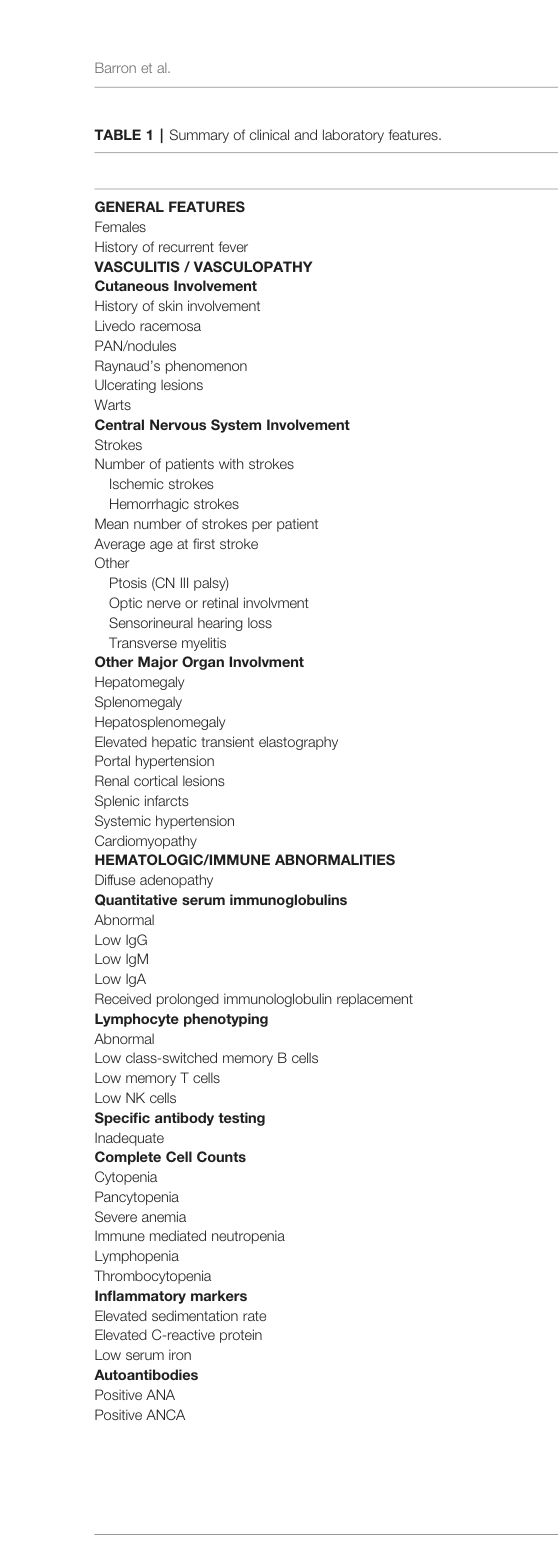
A large NIH cohort proposes three overlapping phenotype “domains”: inflammatory/vascular, immune dysregulatory, and hematologic, with frequent overlap and phenotypic evolution over time. (barron2022thespectrumof pages 1-2)
3.2 High-value phenotype frequencies and characteristics (with HPO suggestions)
Selected quantitative phenotype frequencies are summarized in Artifact-01; key findings include:
Cutaneous/vascular
- Skin involvement reported in 52/58 (90%); livedo racemosa 43/58 (74%) in the NIH cohort. (barron2022thespectrumof pages 3-4)
- Brazilian cohort: mucocutaneous involvement 17/18 (94%), livedo reticularis 11/18 (62%). (melo2023abraziliannationwide pages 4-6)
- Iranian cohort: livedo racemosa/reticularis in 11/11 (100%). (ashari2023acaseseries pages 1-2)
HPO terms (examples): livedo reticularis/livedo racemosa; Raynaud phenomenon; skin ulcer. (barron2022thespectrumof pages 3-4, barron2022thespectrumof pages 8-10)
Neurologic
- NIH cohort: stroke in 25/58 (43%), including ischemic strokes 24/58 (41%) and hemorrhagic strokes 7/58 (12%); mean age at first stroke 5.7 years (range 0.4–20). (barron2022thespectrumof pages 3-4)
- Meta-review: 50.3% had ≥1 neurological event; among those with neurologic manifestations, 77.5% had ≥1 cerebrovascular accident; 35.9% had multiple strokes; ischemic stroke predilection for brainstem 37.3% and deep gray matter 41.6%. (dzhus2023anarrativereview pages 1-2)
HPO terms (examples): ischemic stroke; intracranial hemorrhage; lacunar infarct; seizures. (dzhus2023anarrativereview pages 1-2, barron2022thespectrumof pages 3-4)
Hematologic
- NIH cohort: cytopenia 28/58 (48%), pancytopenia 6/58 (10%), immune-mediated neutropenia 9/58 (16%), severe anemia 7/58 (12%), thrombocytopenia 5/58 (9%). (barron2022thespectrumof pages 4-7)
HPO terms (examples): pancytopenia; pure red cell aplasia; neutropenia; thrombocytopenia; bone marrow failure.
Immunologic
- NIH cohort: abnormal quantitative immunoglobulins 38/58 (66%) with low IgG 55%, low IgM 62%, low IgA 43%; low class-switched memory B cells 32/47 (68%); inadequate specific antibody responses 16/39 (41%). (barron2022thespectrumof pages 3-4, barron2022thespectrumof pages 8-10)
HPO terms (examples): hypogammaglobulinemia; decreased IgG/IgM/IgA; abnormal vaccine response.
Visceral/end-organ vasculitis
- NIH cohort: hepatomegaly 29/58 (50%), splenomegaly 31/58 (53%), portal hypertension 7/58 (12%), renal cortical lesions 13/58 (22%). (barron2022thespectrumof pages 3-4)
- Brazilian cohort: GI involvement 8/18 (45%) including abdominal pain 8/18 (45%) and colitis/GI ulcers 2/18 (12%). (melo2023abraziliannationwide pages 4-6)
Quality-of-life impact: NIH cohort noted severe sequelae after hemorrhagic strokes and moderate neuropsychological deficiencies on testing among evaluated patients; Brazilian cohort reports chronic sequelae/disabilities in 9/18 (50%). (barron2022thespectrumof pages 4-7, melo2023abraziliannationwide pages 4-6)
4. Genetic / molecular information
4.1 Causal gene(s)
- ADA2 (formerly CECR1). (hashem2021hematopoieticcelltransplantation pages 1-2, wouters2024humanada2deficiency pages 3-4)
4.2 Pathogenic variants
- Variants span multiple protein domains; most are missense, but splice/intronic and structural variants can occur and may require extended testing beyond standard exon sequencing. (wouters2024humanada2deficiency pages 3-4)
- Regional recurrence examples: Iranian cohort predominantly carried G47R (with one G321E case). (ashari2023acaseseries pages 1-2)
ClinVar/gnomAD allele frequencies: not extracted in retrieved sources.
4.3 Modifier genes, epigenetics, chromosomal abnormalities
Not established in retrieved sources.
5. Environmental information
Non-genetic environmental contributors were not identified in retrieved sources.
6. Mechanism / pathophysiology
6.1 Current mechanistic concepts (upstream→downstream causal chain)
A convergent model supported by recent reviews and primary research is: 1) Biallelic ADA2 loss-of-function → ADA2 deficiency (low/absent activity). (wouters2024humanada2deficiency pages 3-4, hashem2021hematopoieticcelltransplantation pages 1-2) 2) Myeloid skewing and inflammatory activation (monocytes/macrophages; M1 polarization) with cytokine outputs including TNF, along with reported type I/II interferon-stimulated gene signatures. (wouters2024humanada2deficiency pages 3-4, dzhus2023anarrativereview pages 1-2, barron2022thespectrumof pages 1-2) 3) Endothelial instability / impaired vascular integrity with perivascular inflammation → small/medium vessel disease, stenosis/aneurysm/occlusion → ischemia/infarction/hemorrhage (stroke; peripheral and visceral vasculopathy). (dzhus2023anarrativereview pages 1-2, wouters2024humanada2deficiency pages 3-4) 4) In parallel, hematopoietic defects (cytopenias; marrow failure) and immune dysfunction (hypogammaglobulinemia; low memory B cells; variable infection susceptibility). (barron2022thespectrumof pages 3-4, barron2022thespectrumof pages 1-2)
6.2 2024 mechanistic development: lysosomal ADA2, DNA editing, TLR9 sensing
A key 2024 Cell Reports study reports a major shift in ADA2 functional understanding, including the abstract statement: - “ADA2 localizes within the lysosomes…” and “ADA2 interacts with DNA molecules… converting deoxyadenosine (dA) to deoxyinosine (dI)…” and “…ADA2 regulate lysosomal immune sensing… by modulating TLR9 activation.” (greinertollersrud2024ada2isa pages 1-3)
This supports a cell-intrinsic innate immune mechanism linked to nucleic-acid sensing, potentially explaining interferon/TNF pathway activation beyond a purely extracellular adenosine model. (greinertollersrud2024ada2isa pages 1-3, wouters2024humanada2deficiency pages 4-5)
6.3 Model organism mechanistic evidence (2024 priority)
A 2024 zebrafish model study establishes cecr1b (ADA2-ortholog) loss-of-function with mechanistic resolution: - “Loss of Cecr1b disrupts hematopoietic stem cell specification… caused by induced inflammation in the vascular endothelium.” (brix2024ada2regulatesinflammation pages 1-2) - Rescue is shown by “blocking inflammation… modulation of the A2r pathway, or… recombinant human ADA2.” (brix2024ada2regulatesinflammation pages 1-2)
6.4 Implicated pathways (ontology suggestions)
- GO Biological Process (suggestions): inflammatory response; regulation of tumor necrosis factor production; type I interferon signaling pathway; response to interferon-gamma; regulation of endothelial cell integrity; hematopoietic stem cell differentiation; Toll-like receptor 9 signaling pathway.
- Cell Ontology (CL) (suggestions): monocyte; macrophage; neutrophil; endothelial cell; hematopoietic stem and progenitor cell; microglia (noted high expression of ADA2). (greinertollersrud2024ada2isa pages 1-3)
- CHEBI (suggestions): adenosine; inosine; deoxyadenosine; deoxyinosine. (greinertollersrud2024ada2isa pages 1-3, brix2024ada2regulatesinflammation pages 1-2)
7. Anatomical structures affected
7.1 Organ/system level
- Skin: livedo racemosa/reticularis, ulcers, necrosis. (barron2022thespectrumof pages 3-4, melo2023abraziliannationwide pages 4-6)
- Central nervous system: lacunar ischemic strokes and hemorrhagic strokes with predilection for brainstem and deep gray matter. (dzhus2023anarrativereview pages 1-2, barron2022thespectrumof pages 4-7)
- Hematopoietic system: bone marrow failure/cytopenias. (barron2022thespectrumof pages 4-7, hashem2021hematopoieticcelltransplantation pages 1-2)
- Liver/spleen: hepatomegaly, splenomegaly, portal hypertension. (barron2022thespectrumof pages 3-4, wouters2024humanada2deficiency pages 1-3)
- Kidney: renal cortical lesions. (barron2022thespectrumof pages 3-4)
- GI tract: abdominal pain, colitis/ulcers, and severe vasculitic intestinal injury in some cases. (melo2023abraziliannationwide pages 4-6, dzhus2023anarrativereview pages 1-2)
7.2 Tissue and cell level (CL suggestions)
Key implicated cells: myeloid lineage cells (monocytes/macrophages), neutrophils, and endothelial cells; zebrafish work links vascular endothelium inflammation to impaired hematopoietic stem cell emergence. (brix2024ada2regulatesinflammation pages 1-2, dzhus2023anarrativereview pages 1-2)
7.3 Subcellular level
Recent work places physiologically relevant ADA2 activity in the lysosome and implicates lysosomal nucleic-acid sensing via TLR9. (greinertollersrud2024ada2isa pages 1-3)
8. Temporal development
8.1 Onset
Typical onset is childhood: average onset 5–7 years; ~25% before age 1 and ~77% by age 10 in a 628-patient review, though adult-onset exists. (dzhus2023anarrativereview pages 1-2)
8.2 Progression/course
Course can be relapsing or progressive with recurrent ischemic events and evolving phenotype domains over time; NIH cohort emphasizes that phenotypes can evolve and overlap. (barron2022thespectrumof pages 1-2)
9. Inheritance and population
9.1 Inheritance
Autosomal recessive (biallelic loss-of-function variants). (dzhus2023anarrativereview pages 1-2, wouters2024humanada2deficiency pages 1-3)
9.2 Epidemiology
- Estimated carrier frequency ~1:236 and prevalence ~1:222,000 from modeling of residual ADA2 activity in vitro. (wouters2024humanada2deficiency pages 1-3)
9.3 Demographics (from literature review)
In a 628-patient review: among patients with known sex, ~46% female and 54% male; among reported ethnicities, ~50% Caucasian with representation from South Asia and the Middle East among others. (dzhus2023anarrativereview pages 1-2)
9.4 Founder effects / recurrent variants
Robust founder-effect mapping was not available in retrieved sources; however, regional recurrent variants were reported (e.g., G47R predominance in an Iranian series). (ashari2023acaseseries pages 1-2)
10. Diagnostics
10.1 Core diagnostic tests
A 2024 review states: “Identification of biallelic known pathogenic variants in ADA2… together with determination of severely diminished or absent ADA2 enzyme activity in the serum or plasma, is diagnostic.” (wouters2024humanada2deficiency pages 3-4)
10.2 ADA2 enzyme activity assays
Both HPLC and spectrophotometric assays are available for ADA2 activity measurement. (wouters2024humanada2deficiency pages 3-4)
10.3 Genetic testing approach
- Confirm biallelic ADA2 variants (single-gene testing, panels, or exome/genome approaches). (hashem2021hematopoieticcelltransplantation pages 1-2, wouters2024humanada2deficiency pages 3-4)
- Consider additional strategies for splice/intronic/structural variants when standard testing is inconclusive. (wouters2024humanada2deficiency pages 3-4)
10.4 Differential diagnosis
A recurring clinical issue is misdiagnosis as polyarteritis nodosa (PAN); DADA2 can constitute a significant fraction of pediatric early-onset PAN presentations in some series (as discussed in review context). (dzhus2023anarrativereview pages 1-2)
11. Outcome / prognosis
11.1 Mortality and severe outcomes
- Overall mortality estimated ~8%, mainly in childhood, in the 628-patient review. (dzhus2023anarrativereview pages 1-2)
- Brazilian cohort mortality 2/18 (12%). (melo2023abraziliannationwide pages 4-6)
- Major morbidity includes recurrent strokes (often multiple), hemorrhagic stroke sequelae, amputations for severe peripheral vascular disease, and neurocognitive deficits in subsets. (barron2022thespectrumof pages 4-7, barron2022thespectrumof pages 8-10)
11.2 Prognostic factors
Not fully resolved in retrieved sources; however, genotype–phenotype relationships have been proposed (absent activity variants correlating with marrow failure/PRCA vs residual activity correlating with vascular phenotypes). (wouters2024humanada2deficiency pages 3-4)
12. Treatment
12.1 Pharmacotherapy — TNF inhibition (real-world implementation)
Anti-TNF therapy is consistently supported as first-line disease-modifying therapy for the vasculitic/ischemic phenotype.
Quantitative outcomes (multicenter): In 31 genetically confirmed patients, anti-TNF reduced median CNS/non-CNS ischemic event rate from 2.37 per 100 patient-months pre-treatment to 0.00 per 100 patient-months post-treatment (p<0.0001) and reduced PVAS from 20/63 to 2/63. (cooray2021antitumournecrosisfactor pages 1-4)
Quantitative outcomes (NIH cohort): no strokes observed during 2026 patient-months on TNF inhibitors. (barron2022thespectrumof pages 1-2)
Limitations: Anti-TNF is generally not effective for severe immunodeficiency or bone marrow failure, which may require transplantation. (cooray2021antitumournecrosisfactor pages 1-4, wouters2024humanada2deficiency pages 3-4)
MAXO suggestions (best-effort): tumor necrosis factor inhibitor therapy; immunosuppressive therapy; biologic anti-inflammatory therapy.
12.2 Curative therapy — allogeneic hematopoietic cell transplantation (HCT/HSCT)
A multinational retrospective cohort (30 patients, 38 HCTs) reports strong outcomes: - 2-year overall survival 97% and 2-year GvHD-free relapse-free survival 73%; normalization of ADA2 activity in 16/17 tested; “no new vascular events”; and resolution of hematologic and immunologic phenotypes. (hashem2021hematopoieticcelltransplantation pages 1-2)
Indications: bone marrow failure, immune cytopenia, malignancy, or immunodeficiency. (hashem2021hematopoieticcelltransplantation pages 1-2)
MAXO suggestions: hematopoietic cell transplantation; bone marrow transplantation.
12.3 Emerging/experimental approaches
- Gene therapy/gene editing is discussed as a future curative direction in the literature base but was not captured here as a DADA2-specific human clinical trial in the available ClinicalTrials.gov search results. (cooray2021antitumournecrosisfactor pages 8-11)
13. Prevention
No primary prevention strategies exist for monogenic DADA2 beyond reproductive options; preventive care focuses on secondary/tertiary prevention of strokes and vasculitic complications using TNF inhibition and careful avoidance of contraindicated antiplatelet/anticoagulant regimens in patients at risk for hemorrhagic strokes (as emphasized in review discussion). (wouters2024humanada2deficiency pages 1-3)
14. Other species / natural disease
No naturally occurring veterinary DADA2 analog was identified in retrieved sources.
15. Model organisms
15.1 Key models and why they matter
- Rodents: ADA2 ortholog absent (“present in all mammals except rodents”), limiting classical mouse modeling. (greinertollersrud2024ada2isa pages 1-3, hashem2017deficiencyofadenosine pages 1-2)
- Zebrafish (2024): cecr1b loss-of-function recapitulates vascular and hematopoietic phenotypes; rescues with recombinant human ADA2 and adenosine receptor pathway modulation. (brix2024ada2regulatesinflammation pages 1-2, brix2024ada2regulatesinflammation pages 7-10)
- Porcine tissue: porcine brain ADA2 used for glycan profiling supporting lysosomal targeting. (greinertollersrud2024ada2isa pages 1-3)
15.2 Applications and limitations
Zebrafish enable mechanistic dissection of endothelial inflammation and HSPC emergence defects and provide a platform for testing ADA2 replacement and purinergic pathway modulators; translation to human disease requires validation in patient-derived cells and clinical cohorts given species differences and the complex immune phenotype. (brix2024ada2regulatesinflammation pages 1-2, brix2024ada2regulatesinflammation pages 7-10)
Notes on citation granularity (PMID requirement)
The retrieved full texts in this run primarily provided DOIs and did not include PubMed IDs for most papers, except where OpenTargets lists PMIDs (e.g., 24552284/24552285 as discovery-era links). (OpenTargets Search: Deficiency of adenosine deaminase 2,DADA2-ADA2,CECR1) For a production-grade knowledge base entry, each cited DOI should be cross-walked to PMID in PubMed and recorded. This is a curation step rather than a scientific uncertainty.
URLs and publication dates (selected key sources)
- Wouters et al. 2024-07-06 (online): Human ADA2 Deficiency: Ten Years Later. Current Allergy and Asthma Reports. https://doi.org/10.1007/s11882-024-01163-9 (wouters2024humanada2deficiency pages 1-3)
- Dzhus et al. 2023-08-07 (online): A Narrative Review of the Neurological Manifestations of Human ADA2 Deficiency. Journal of Clinical Immunology. https://doi.org/10.1007/s10875-023-01555-y (dzhus2023anarrativereview pages 1-2)
- Barron et al. 2022-01-10: The Spectrum of DADA2: 60 Patient Cohort. Frontiers in Immunology. https://doi.org/10.3389/fimmu.2021.811473 (barron2022thespectrumof pages 1-2)
- Cooray et al. 2021: Anti-TNF treatment… prevention of ischaemic events… Rheumatology. https://doi.org/10.1093/rheumatology/keaa837 (cooray2021antitumournecrosisfactor pages 1-4)
- Hashem et al. 2021-07-29 (online): HCT cures DADA2: report on 30 patients. Journal of Clinical Immunology. https://doi.org/10.1007/s10875-021-01098-0 (hashem2021hematopoieticcelltransplantation pages 1-2)
- Greiner‑Tollersrud et al. 2024-11-26: ADA2 is a lysosomal deoxyadenosine deaminase… regulating TLR9. Cell Reports. https://doi.org/10.1016/j.celrep.2024.114899 (greinertollersrud2024ada2isa pages 1-3)
- Brix et al. 2024-05: ADA2 regulates inflammation and HSC emergence via A2bR pathway in zebrafish. Communications Biology. https://doi.org/10.1038/s42003-024-06286-3 (brix2024ada2regulatesinflammation pages 1-2)
References
-
(dzhus2023anarrativereview pages 1-2): Mariia Dzhus, Lisa Ehlers, Marjon Wouters, Katrien Jansen, Rik Schrijvers, Lien De Somer, Steven Vanderschueren, Marco Baggio, Leen Moens, Benjamin Verhaaren, Rik Lories, Giorgia Bucciol, and Isabelle Meyts. A narrative review of the neurological manifestations of human adenosine deaminase 2 deficiency. Journal of Clinical Immunology, 43:1916-1926, Aug 2023. URL: https://doi.org/10.1007/s10875-023-01555-y, doi:10.1007/s10875-023-01555-y. This article has 26 citations and is from a domain leading peer-reviewed journal.
-
(wouters2024humanada2deficiency pages 1-3): Marjon Wouters, Lisa Ehlers, Mariia Dzhus, Verena Kienapfel, Giorgia Bucciol, Selket Delafontaine, Anneleen Hombrouck, Bethany Pillay, Leen Moens, and Isabelle Meyts. Human ada2 deficiency: ten years later. Current Allergy and Asthma Reports, 24:477-484, Jul 2024. URL: https://doi.org/10.1007/s11882-024-01163-9, doi:10.1007/s11882-024-01163-9. This article has 17 citations and is from a peer-reviewed journal.
-
(hashem2021hematopoieticcelltransplantation pages 1-2): Hasan Hashem, Giorgia Bucciol, Seza Ozen, Sule Unal, Ikbal Ok Bozkaya, Nurten Akarsu, Mervi Taskinen, Minna Koskenvuo, Janna Saarela, Dimana Dimitrova, Dennis D. Hickstein, Amy P. Hsu, Steven M. Holland, Robert Krance, Ghadir Sasa, Ashish R. Kumar, Ingo Müller, Monica Abreu de Sousa, Selket Delafontaine, Leen Moens, Florian Babor, Federica Barzaghi, Maria Pia Cicalese, Robbert Bredius, Joris van Montfrans, Valentina Baretta, Simone Cesaro, Polina Stepensky, Neven Benedicte, Despina Moshous, Guillaume Le Guenno, David Boutboul, Jignesh Dalal, Joel P. Brooks, Elif Dokmeci, Jasmeen Dara, Carrie L. Lucas, Sophie Hambleton, Keith Wilson, Stephen Jolles, Yener Koc, Tayfun Güngör, Caroline Schnider, Fabio Candotti, Sandra Steinmann, Ansgar Schulz, Chip Chambers, Michael Hershfield, Amanda Ombrello, Jennifer A. Kanakry, and Isabelle Meyts. Hematopoietic cell transplantation cures adenosine deaminase 2 deficiency: report on 30 patients. Journal of Clinical Immunology, 41:1633-1647, Jul 2021. URL: https://doi.org/10.1007/s10875-021-01098-0, doi:10.1007/s10875-021-01098-0. This article has 89 citations and is from a domain leading peer-reviewed journal.
-
(cooray2021antitumournecrosisfactor pages 1-4): Samantha Cooray, Ebun Omyinmi, Ying Hong, Charalampia Papadopoulou, Lorraine Harper, Eslam Al-Abadi, Ruchika Goel, Shirish Dubey, Mark Wood, Stephen Jolles, Stefan Berg, Maria Ekelund, Kate Armon, Despina Eleftheriou, and Paul A Brogan. Anti-tumour necrosis factor treatment for the prevention of ischaemic events in patients with deficiency of adenosine deaminase 2 (dada2). Rheumatology, 60:4373-4378, Jan 2021. URL: https://doi.org/10.1093/rheumatology/keaa837, doi:10.1093/rheumatology/keaa837. This article has 74 citations and is from a peer-reviewed journal.
-
(greinertollersrud2024ada2isa pages 1-3): Ole Kristian Greiner-Tollersrud, Máté Krausz, Vincent Boehler, Aikaterini Polyzou, Maximilian Seidl, Ambra Spahiu, Zeinab Abdullah, Katarzyna Andryka-Cegielski, Felix Immunuel Dominick, Katrin Huebscher, Andreas Goschin, Cristian R. Smulski, Eirini Trompouki, Regina Link, Hilmar Ebersbach, Honnappa Srinivas, Martine Marchant, Georgios Sogkas, Dieter Staab, Cathrine Vågbø, Danilo Guerini, Sebastian Baasch, Eicke Latz, Gunther Hartmann, Philippe Henneke, Roger Geiger, Xiao P. Peng, Bodo Grimbacher, Eva Bartok, Ingrun Alseth, Max Warncke, and Michele Proietti. Ada2 is a lysosomal deoxyadenosine deaminase acting on dna involved in regulating tlr9-mediated immune sensing of dna. Cell Reports, 43:114899, Nov 2024. URL: https://doi.org/10.1016/j.celrep.2024.114899, doi:10.1016/j.celrep.2024.114899. This article has 20 citations and is from a highest quality peer-reviewed journal.
-
(barron2022thespectrumof pages 3-4): Karyl S. Barron, Ivona Aksentijevich, Natalie T. Deuitch, Deborah L. Stone, Patrycja Hoffmann, Ryan Videgar-Laird, Ariane Soldatos, Jenna Bergerson, Camilo Toro, Cornelia Cudrici, Michele Nehrebecky, Tina Romeo, Anne Jones, Manfred Boehm, Jennifer A. Kanakry, Dimana Dimitrova, Katherine R. Calvo, Hawwa Alao, Devika Kapuria, Gil Ben-Yakov, Dominique C. Pichard, Londa Hathaway, Alessandra Brofferio, Elisa McRae, Natalia Sampaio Moura, Oskar Schnappauf, Sofia Rosenzweig, Theo Heller, Edward W. Cowen, Daniel L. Kastner, and Amanda K. Ombrello. The spectrum of the deficiency of adenosine deaminase 2: an observational analysis of a 60 patient cohort. Frontiers in Immunology, Jan 2022. URL: https://doi.org/10.3389/fimmu.2021.811473, doi:10.3389/fimmu.2021.811473. This article has 96 citations and is from a peer-reviewed journal.
-
(barron2022thespectrumof pages 4-7): Karyl S. Barron, Ivona Aksentijevich, Natalie T. Deuitch, Deborah L. Stone, Patrycja Hoffmann, Ryan Videgar-Laird, Ariane Soldatos, Jenna Bergerson, Camilo Toro, Cornelia Cudrici, Michele Nehrebecky, Tina Romeo, Anne Jones, Manfred Boehm, Jennifer A. Kanakry, Dimana Dimitrova, Katherine R. Calvo, Hawwa Alao, Devika Kapuria, Gil Ben-Yakov, Dominique C. Pichard, Londa Hathaway, Alessandra Brofferio, Elisa McRae, Natalia Sampaio Moura, Oskar Schnappauf, Sofia Rosenzweig, Theo Heller, Edward W. Cowen, Daniel L. Kastner, and Amanda K. Ombrello. The spectrum of the deficiency of adenosine deaminase 2: an observational analysis of a 60 patient cohort. Frontiers in Immunology, Jan 2022. URL: https://doi.org/10.3389/fimmu.2021.811473, doi:10.3389/fimmu.2021.811473. This article has 96 citations and is from a peer-reviewed journal.
-
(melo2023abraziliannationwide pages 4-6): Adriana Melo, Luciana Martins de Carvalho, Virginia Paes Leme Ferriani, André Cavalcanti, Simone Appenzeller, Valéria Rossato Oliveira, Herberto Chong Neto, Nelson Augusto Rosário, Fabiano de Oliveira Poswar, Matheus Xavier Guimaraes, Cristina Maria Kokron, Rayana Elias Maia, Guilherme Diogo Silva, Gabriel Keller, Mauricio Domingues Ferreira, Dewton Moraes Vasconcelos, Myrthes Anna Maragna Toledo-Barros, Samar Freschi Barros, Nilton Salles Rosa Neto, Marta Helena Krieger, Jorge Kalil, and Leonardo Oliveira Mendonça. A brazilian nationwide multicenter study on deficiency of deaminase-2 (dada2). Advances in Rheumatology, 63:1-9, May 2023. URL: https://doi.org/10.1186/s42358-023-00303-5, doi:10.1186/s42358-023-00303-5. This article has 3 citations.
-
(ashari2023acaseseries pages 1-2): Kosar Asna Ashari, Nahid Aslani, Nima Parvaneh, Raheleh Assari, Morteza Heidari, Mohammadreza Fathi, Fatemeh Tahghighi Sharabian, Alireza Ronagh, Mohammad Shahrooei, Alireza Moafi, Nima Rezaei, and Vahid Ziaee. A case series of ten plus one deficiency of adenosine deaminase 2 (dada2) patients in iran. Pediatric Rheumatology Online Journal, Jun 2023. URL: https://doi.org/10.1186/s12969-023-00838-3, doi:10.1186/s12969-023-00838-3. This article has 7 citations.
-
(barron2022thespectrumof pages 8-10): Karyl S. Barron, Ivona Aksentijevich, Natalie T. Deuitch, Deborah L. Stone, Patrycja Hoffmann, Ryan Videgar-Laird, Ariane Soldatos, Jenna Bergerson, Camilo Toro, Cornelia Cudrici, Michele Nehrebecky, Tina Romeo, Anne Jones, Manfred Boehm, Jennifer A. Kanakry, Dimana Dimitrova, Katherine R. Calvo, Hawwa Alao, Devika Kapuria, Gil Ben-Yakov, Dominique C. Pichard, Londa Hathaway, Alessandra Brofferio, Elisa McRae, Natalia Sampaio Moura, Oskar Schnappauf, Sofia Rosenzweig, Theo Heller, Edward W. Cowen, Daniel L. Kastner, and Amanda K. Ombrello. The spectrum of the deficiency of adenosine deaminase 2: an observational analysis of a 60 patient cohort. Frontiers in Immunology, Jan 2022. URL: https://doi.org/10.3389/fimmu.2021.811473, doi:10.3389/fimmu.2021.811473. This article has 96 citations and is from a peer-reviewed journal.
-
(barron2022thespectrumof pages 1-2): Karyl S. Barron, Ivona Aksentijevich, Natalie T. Deuitch, Deborah L. Stone, Patrycja Hoffmann, Ryan Videgar-Laird, Ariane Soldatos, Jenna Bergerson, Camilo Toro, Cornelia Cudrici, Michele Nehrebecky, Tina Romeo, Anne Jones, Manfred Boehm, Jennifer A. Kanakry, Dimana Dimitrova, Katherine R. Calvo, Hawwa Alao, Devika Kapuria, Gil Ben-Yakov, Dominique C. Pichard, Londa Hathaway, Alessandra Brofferio, Elisa McRae, Natalia Sampaio Moura, Oskar Schnappauf, Sofia Rosenzweig, Theo Heller, Edward W. Cowen, Daniel L. Kastner, and Amanda K. Ombrello. The spectrum of the deficiency of adenosine deaminase 2: an observational analysis of a 60 patient cohort. Frontiers in Immunology, Jan 2022. URL: https://doi.org/10.3389/fimmu.2021.811473, doi:10.3389/fimmu.2021.811473. This article has 96 citations and is from a peer-reviewed journal.
-
(OpenTargets Search: Deficiency of adenosine deaminase 2,DADA2-ADA2,CECR1): Open Targets Query (Deficiency of adenosine deaminase 2,DADA2-ADA2,CECR1, 2 results). Buniello, A. et al. (2025). Open Targets Platform: facilitating therapeutic hypotheses building in drug discovery. Nucleic Acids Research.
-
(melo2023abraziliannationwide pages 1-2): Adriana Melo, Luciana Martins de Carvalho, Virginia Paes Leme Ferriani, André Cavalcanti, Simone Appenzeller, Valéria Rossato Oliveira, Herberto Chong Neto, Nelson Augusto Rosário, Fabiano de Oliveira Poswar, Matheus Xavier Guimaraes, Cristina Maria Kokron, Rayana Elias Maia, Guilherme Diogo Silva, Gabriel Keller, Mauricio Domingues Ferreira, Dewton Moraes Vasconcelos, Myrthes Anna Maragna Toledo-Barros, Samar Freschi Barros, Nilton Salles Rosa Neto, Marta Helena Krieger, Jorge Kalil, and Leonardo Oliveira Mendonça. A brazilian nationwide multicenter study on deficiency of deaminase-2 (dada2). Advances in Rheumatology, 63:1-9, May 2023. URL: https://doi.org/10.1186/s42358-023-00303-5, doi:10.1186/s42358-023-00303-5. This article has 3 citations.
-
(brix2024ada2regulatesinflammation pages 1-2): Alessia Brix, Laura Belleri, Alex Pezzotta, Emanuela Pettinato, Mara Mazzola, Matteo Zoccolillo, Anna Marozzi, Rui Monteiro, Filippo Del Bene, Alessandra Mortellaro, and Anna Pistocchi. Ada2 regulates inflammation and hematopoietic stem cell emergence via the a2br pathway in zebrafish. Communications Biology, May 2024. URL: https://doi.org/10.1038/s42003-024-06286-3, doi:10.1038/s42003-024-06286-3. This article has 10 citations and is from a peer-reviewed journal.
-
(wouters2024humanada2deficiency pages 3-4): Marjon Wouters, Lisa Ehlers, Mariia Dzhus, Verena Kienapfel, Giorgia Bucciol, Selket Delafontaine, Anneleen Hombrouck, Bethany Pillay, Leen Moens, and Isabelle Meyts. Human ada2 deficiency: ten years later. Current Allergy and Asthma Reports, 24:477-484, Jul 2024. URL: https://doi.org/10.1007/s11882-024-01163-9, doi:10.1007/s11882-024-01163-9. This article has 17 citations and is from a peer-reviewed journal.
-
(wouters2024humanada2deficiency pages 4-5): Marjon Wouters, Lisa Ehlers, Mariia Dzhus, Verena Kienapfel, Giorgia Bucciol, Selket Delafontaine, Anneleen Hombrouck, Bethany Pillay, Leen Moens, and Isabelle Meyts. Human ada2 deficiency: ten years later. Current Allergy and Asthma Reports, 24:477-484, Jul 2024. URL: https://doi.org/10.1007/s11882-024-01163-9, doi:10.1007/s11882-024-01163-9. This article has 17 citations and is from a peer-reviewed journal.
-
(cooray2021antitumournecrosisfactor pages 8-11): Samantha Cooray, Ebun Omyinmi, Ying Hong, Charalampia Papadopoulou, Lorraine Harper, Eslam Al-Abadi, Ruchika Goel, Shirish Dubey, Mark Wood, Stephen Jolles, Stefan Berg, Maria Ekelund, Kate Armon, Despina Eleftheriou, and Paul A Brogan. Anti-tumour necrosis factor treatment for the prevention of ischaemic events in patients with deficiency of adenosine deaminase 2 (dada2). Rheumatology, 60:4373-4378, Jan 2021. URL: https://doi.org/10.1093/rheumatology/keaa837, doi:10.1093/rheumatology/keaa837. This article has 74 citations and is from a peer-reviewed journal.
-
(hashem2017deficiencyofadenosine pages 1-2): Hasan Hashem, Susan J Kelly, Nancy J Ganson, and Michael S Hershfield. Deficiency of adenosine deaminase 2 (dada2), an inherited cause of polyarteritis nodosa and a mimic of other systemic rheumatologic disorders. Current Rheumatology Reports, 19:1-9, Oct 2017. URL: https://doi.org/10.1007/s11926-017-0699-8, doi:10.1007/s11926-017-0699-8. This article has 84 citations and is from a peer-reviewed journal.
-
(brix2024ada2regulatesinflammation pages 7-10): Alessia Brix, Laura Belleri, Alex Pezzotta, Emanuela Pettinato, Mara Mazzola, Matteo Zoccolillo, Anna Marozzi, Rui Monteiro, Filippo Del Bene, Alessandra Mortellaro, and Anna Pistocchi. Ada2 regulates inflammation and hematopoietic stem cell emergence via the a2br pathway in zebrafish. Communications Biology, May 2024. URL: https://doi.org/10.1038/s42003-024-06286-3, doi:10.1038/s42003-024-06286-3. This article has 10 citations and is from a peer-reviewed journal.