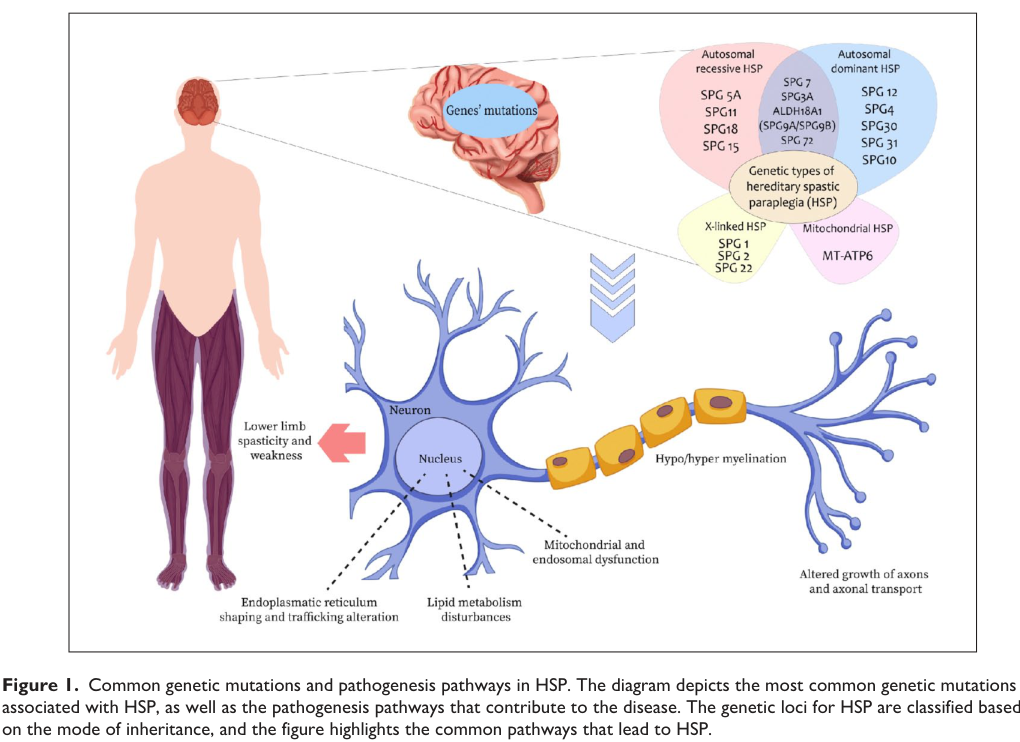
Hereditary Spastic Paraplegia
Hereditary spastic paraplegia (HSP) is a clinically and genetically heterogeneous group of inherited neurodegenerative disorders unified by length-dependent distal axonal degeneration of the corticospinal-tract upper motor neurons, maximal at the distal ends of the longest central nervous system axons in the thoracic spinal cord, with accompanying degeneration of the fasciculus gracilis (dorsal column) sensory fibers. More than 80 spastic paraplegia (SPG) genetic loci have been described, encoding proteins with diverse functions including axonal transport (SPAST/spastin microtubule severing), endoplasmic reticulum morphogenesis (ATL1/atlastin-1, SPAST/spastin, REEP1), mitochondrial quality control and oxidative phosphorylation (SPG7/paraplegin), and lipid/membrane and lysosomal-endosomal trafficking (SPG11/spatacsin). Despite this molecular diversity, the converging pathology is relatively selective corticospinal-tract axonopathy producing the shared clinical syndrome of progressive lower-limb spasticity and weakness with hyperreflexia and extensor plantar responses. HSP is divided clinically into "pure" (uncomplicated) forms, in which spasticity and weakness of the legs with subtle dorsal-column impairment and urinary urgency are the only features, and "complex" (complicated) forms, in which spastic paraplegia is accompanied by additional neurologic or systemic features such as thin corpus callosum, cognitive decline, peripheral neuropathy, ataxia, or distal amyotrophy.
Ask OpenScientist
Ask a research question about Hereditary Spastic Paraplegia. OpenScientist will conduct autonomous deep research using the Disorder Mechanisms Knowledge Base and PubMed literature (typically 10-30 minutes).
Do not include personal health information in your question. Questions and results are cached in your browser's local storage.
Inheritance
2Show evidence (2 references)
Show evidence (1 reference)
Subtypes
18Show evidence (1 reference)
Show evidence (2 references)
Show evidence (1 reference)
Show evidence (2 references)
Show evidence (2 references)
Show evidence (1 reference)
Show evidence (1 reference)
Show evidence (4 references)
Show evidence (2 references)
Show evidence (3 references)
Show evidence (2 references)
Show evidence (2 references)
Show evidence (4 references)
Show evidence (5 references)
Show evidence (2 references)
Show evidence (2 references)
Show evidence (3 references)
Show evidence (2 references)
Pathophysiology
13Show evidence (3 references)
Show evidence (4 references)
Show evidence (3 references)
Show evidence (3 references)
Show evidence (6 references)
Show evidence (2 references)
Show evidence (3 references)
Show evidence (5 references)
Show evidence (3 references)
Show evidence (1 reference)
Show evidence (3 references)
Show evidence (2 references)
Show evidence (1 reference)
Pathograph
Phenotypes
14Genitourinary 1
Show evidence (1 reference)
Limbs 2
Show evidence (1 reference)
Show evidence (1 reference)
Musculoskeletal 3
Show evidence (1 reference)
Show evidence (1 reference)
Show evidence (1 reference)
Nervous System 8
Show evidence (2 references)
Show evidence (1 reference)
Show evidence (1 reference)
Show evidence (1 reference)
Show evidence (1 reference)
Show evidence (1 reference)
Show evidence (1 reference)
Show evidence (1 reference)
Genetic Associations
18Show evidence (1 reference)
Show evidence (1 reference)
Show evidence (1 reference)
Show evidence (1 reference)
Show evidence (1 reference)
Show evidence (2 references)
Show evidence (1 reference)
Show evidence (1 reference)
Show evidence (1 reference)
Show evidence (1 reference)
Show evidence (2 references)
Show evidence (3 references)
Show evidence (1 reference)
Show evidence (1 reference)
Show evidence (1 reference)
Show evidence (1 reference)
Show evidence (3 references)
Show evidence (3 references)
Medical Actions
4Show evidence (2 references)
Show evidence (1 reference)
Show evidence (1 reference)
Show evidence (1 reference)
Related Datasets
4Source YAML
click to showname: Hereditary Spastic Paraplegia
creation_date: "2026-06-08T00:00:00Z"
category: Mendelian
description: >
Hereditary spastic paraplegia (HSP) is a clinically and genetically
heterogeneous group of inherited neurodegenerative disorders unified by
length-dependent distal axonal degeneration of the corticospinal-tract upper
motor neurons, maximal at the distal ends of the longest central nervous
system axons in the thoracic spinal cord, with accompanying degeneration of
the fasciculus gracilis (dorsal column) sensory fibers. More than 80 spastic
paraplegia (SPG) genetic loci have been described, encoding proteins with
diverse functions including axonal transport (SPAST/spastin microtubule
severing), endoplasmic reticulum morphogenesis (ATL1/atlastin-1,
SPAST/spastin, REEP1), mitochondrial quality control and oxidative
phosphorylation (SPG7/paraplegin), and lipid/membrane and lysosomal-endosomal
trafficking (SPG11/spatacsin). Despite this molecular diversity, the converging
pathology is relatively selective corticospinal-tract axonopathy producing the
shared clinical syndrome of progressive lower-limb spasticity and weakness with
hyperreflexia and extensor plantar responses. HSP is divided clinically into
"pure" (uncomplicated) forms, in which spasticity and weakness of the legs with
subtle dorsal-column impairment and urinary urgency are the only features, and
"complex" (complicated) forms, in which spastic paraplegia is accompanied by
additional neurologic or systemic features such as thin corpus callosum,
cognitive decline, peripheral neuropathy, ataxia, or distal amyotrophy.
disease_term:
preferred_term: hereditary spastic paraplegia
term:
id: MONDO:0019064
label: hereditary spastic paraplegia
references:
- reference: PMID:20301682
title: "Uncomplicated (Pure) Hereditary Spastic Paraplegia Overview."
tags:
- GeneReviews
- reference: PMID:20301339
title: "Spastic Paraplegia 4."
tags:
- GeneReviews
- reference: PMID:20301389
title: "Spastic Paraplegia 11."
tags:
- GeneReviews
- reference: PMID:20862796
title: "Spastic Paraplegia 3A."
tags:
- GeneReviews
- reference: PMID:29034544
title: "CYP2U1 activity is altered by missense mutations in hereditary spastic paraplegia 56."
- reference: PMID:31637422
title: "Mutations in PCYT2 disrupt etherlipid biosynthesis and cause a complex hereditary spastic paraplegia."
- reference: PMID:41941559
title: "KIF1A-Related Neurodevelopmental Disorder."
tags:
- GeneReviews
has_subtypes:
- name: Pure HSP
display_name: Pure (Uncomplicated) Hereditary Spastic Paraplegia
description: >
Clinical classification in which lower-extremity spasticity and weakness,
with subtle lower-extremity dorsal-column (vibration sense) impairment and
urinary urgency, are the predominant or only manifestations. Affected
individuals typically have normal life expectancy and do not develop
significant upper-extremity, bulbar, or cognitive involvement. SPG4
(SPAST) is the prototypical and single most common cause of pure autosomal
dominant HSP.
evidence:
- reference: PMID:23897027
reference_title: "Hereditary spastic paraplegia: clinico-pathologic features and emerging molecular mechanisms."
supports: SUPPORT
evidence_source: HUMAN_CLINICAL
snippet: "“uncomplicated” (characterized by lower extremity spasticity and weakness and subtle lower extremity dorsal column impairment)"
explanation: Defines the pure/uncomplicated HSP clinical category by its restricted feature set.
- name: Complex HSP
display_name: Complex (Complicated) Hereditary Spastic Paraplegia
description: >
Clinical classification in which spastic paraplegia is associated with
additional neurologic or systemic abnormalities, including dementia or
cognitive impairment, ataxia, intellectual disability, peripheral
neuropathy, distal wasting, loss of vision, epilepsy, ichthyosis, or thin
corpus callosum on neuroimaging. SPG11 (spatacsin) is a common autosomal
recessive cause of complex HSP. Correlation between the clinical
pure-versus-complex split and the underlying genetic type is imperfect,
and many genetic types can present as either form.
evidence:
- reference: PMID:23897027
reference_title: "Hereditary spastic paraplegia: clinico-pathologic features and emerging molecular mechanisms."
supports: SUPPORT
evidence_source: HUMAN_CLINICAL
snippet: "“complicated” (in which spastic paraplegia is associated with additional neurologic or systemic abnormalities including dementia, ataxia, mental retardation, neuropathy, distal wasting, loss of vision, epilepsy, or icthyosis"
explanation: Defines the complex/complicated HSP clinical category by the spectrum of additional features.
- reference: PMID:23897027
reference_title: "Hereditary spastic paraplegia: clinico-pathologic features and emerging molecular mechanisms."
supports: SUPPORT
evidence_source: HUMAN_CLINICAL
snippet: "There is imperfect correlation between clinical classification (“uncomplicated” versus “complicated”) and genetic types of HSP."
explanation: Notes that the pure-versus-complex clinical split does not map cleanly onto genetic subtype.
- name: SPG4
display_name: Spastic Paraplegia 4 (SPAST-HSP)
description: >
Autosomal dominant HSP caused by heterozygous pathogenic variants in SPAST,
encoding the microtubule-severing AAA ATPase spastin. SPG4 is the single
most common form of autosomal dominant HSP and is the prototype of pure
HSP, though dementia, ataxia, thin corpus callosum, and muscle wasting have
been reported. Onset is insidious, mostly in young adulthood, with
considerable intrafamilial variation.
genes:
- preferred_term: SPAST
term:
id: hgnc:11233
label: SPAST
inheritance:
- name: Autosomal Dominant (SPG4)
inheritance_term:
preferred_term: Autosomal dominant inheritance
term:
id: HP:0000006
label: Autosomal dominant inheritance
evidence:
- reference: PMID:20301339
reference_title: "Spastic Paraplegia 4."
supports: SUPPORT
evidence_source: HUMAN_CLINICAL
snippet: "Spastic paraplegia 4 (SPG4; also known as SPAST-HSP) \nis characterized by insidiously progressive bilateral lower-limb gait \nspasticity."
explanation: GeneReviews establishes SPG4/SPAST-HSP as a distinct autosomal dominant HSP subtype.
- name: SPG3A
display_name: Spastic Paraplegia 3A (ATL1-HSP)
description: >
Autosomal dominant HSP caused by heterozygous pathogenic variants in ATL1,
encoding atlastin-1, a dynamin-like GTPase that mediates homotypic fusion of
endoplasmic reticulum tubules. SPG3A is the most common cause of early
childhood-onset autosomal dominant HSP, with average age of onset around
four years and a relatively slow, often non-progressive course. Usually a
pure HSP, but complicated forms with axonal motor neuropathy and distal
amyotrophy (Silver syndrome phenotype) occur.
genes:
- preferred_term: ATL1
term:
id: hgnc:11231
label: ATL1
inheritance:
- name: Autosomal Dominant (SPG3A)
inheritance_term:
preferred_term: Autosomal dominant inheritance
term:
id: HP:0000006
label: Autosomal dominant inheritance
evidence:
- reference: PMID:20862796
reference_title: "Spastic Paraplegia 3A."
supports: SUPPORT
evidence_source: HUMAN_CLINICAL
snippet: "Spastic paraplegia 3A (SPG3A; also known as ATL1-HSP) \nis characterized by progressive bilateral and mostly symmetric spasticity and \nweakness of the legs."
explanation: GeneReviews establishes SPG3A/ATL1-HSP as a distinct autosomal dominant HSP subtype.
- reference: PMID:20862796
reference_title: "Spastic Paraplegia 3A."
supports: SUPPORT
evidence_source: HUMAN_CLINICAL
snippet: "The average age of onset is four years. More \nthan 80% of reported individuals manifest spastic gait before the end of the \nfirst decade of life."
explanation: Documents the characteristic early-childhood onset distinguishing SPG3A.
- name: SPG7
display_name: Spastic Paraplegia 7 (SPG7/paraplegin)
description: >
Most commonly autosomal recessive HSP caused by biallelic pathogenic
variants in SPG7, encoding paraplegin, a nuclear-encoded mitochondrial
metalloprotease (m-AAA protease) of the inner mitochondrial membrane.
SPG7-HSP frequently presents as complex HSP with cerebellar ataxia,
ophthalmoplegia/ptosis, optic atrophy, and mitochondrial cytopathy on
muscle biopsy, reflecting oxidative-phosphorylation impairment, but pure
forms also occur. Some heterozygous SPG7 variants have been associated with
dominantly transmitted disease.
genes:
- preferred_term: SPG7
term:
id: hgnc:11237
label: SPG7
inheritance:
- name: Autosomal Recessive (SPG7)
inheritance_term:
preferred_term: Autosomal recessive inheritance
term:
id: HP:0000007
label: Autosomal recessive inheritance
evidence:
- reference: PMID:9635427
reference_title: "Spastic paraplegia and OXPHOS impairment caused by mutations in paraplegin, a nuclear-encoded mitochondrial metalloprotease."
supports: SUPPORT
evidence_source: HUMAN_CLINICAL
snippet: "We found that patients from a chromosome 16q24.3-linked HSP family are homozygous \nfor a 9.5 kb deletion involving a gene encoding a novel protein, named \nParaplegin."
explanation: Original identification of recessive SPG7 caused by biallelic paraplegin mutations.
- reference: PMID:23897027
reference_title: "Hereditary spastic paraplegia: clinico-pathologic features and emerging molecular mechanisms."
supports: SUPPORT
evidence_source: HUMAN_CLINICAL
snippet: "SPG7 HSP was originally described as an autosomal recessive disorder due to homozygous or compound heterozygous SPG7/paraplegin gene mutations."
explanation: Confirms SPG7 as predominantly autosomal recessive HSP.
- name: SPG11
display_name: Spastic Paraplegia 11 (SPG11/spatacsin)
description: >
Autosomal recessive complex HSP caused by biallelic pathogenic variants in
SPG11, encoding spatacsin. SPG11 is one of the most common forms of
autosomal recessive HSP and is characteristically associated with thinning
of the corpus callosum, mild intellectual disability or progressive
cognitive decline, peripheral neuropathy, and pseudobulbar involvement.
Onset is usually in infancy or adolescence, and most affected individuals
become wheelchair-bound one or two decades after onset.
genes:
- preferred_term: SPG11
term:
id: hgnc:11226
label: SPG11
inheritance:
- name: Autosomal Recessive (SPG11)
inheritance_term:
preferred_term: Autosomal recessive inheritance
term:
id: HP:0000007
label: Autosomal recessive inheritance
evidence:
- reference: PMID:20301389
reference_title: "Spastic Paraplegia 11."
supports: SUPPORT
evidence_source: HUMAN_CLINICAL
snippet: "Spastic paraplegia 11 (SPG11) is characterized by \nprogressive spasticity and weakness of the lower limbs frequently associated \nwith the following: mild intellectual disability with learning difficulties in \nchildhood and/or progressive cognitive decline; peripheral neuropathy; \npseudobulbar involvement; and increased reflexes in the upper limbs."
explanation: GeneReviews establishes SPG11 as a distinct complex autosomal recessive HSP subtype.
- name: SPG6
display_name: Spastic Paraplegia 6 (NIPA1-HSP)
subtype_term:
preferred_term: hereditary spastic paraplegia 6
term:
id: MONDO:0010878
label: hereditary spastic paraplegia 6
description: >
Autosomal dominant HSP attributed to variants in NIPA1 (SPG6), which encodes
a magnesium transporter that associates with early endosomes and the cell
surface. The mouse equivalents of the reported human mutations lose
function when expressed in oocytes and show altered trafficking in
transfected cells, which the characterisation study proposes as the basis of
the HSP phenotype.
genes:
- preferred_term: NIPA1
term:
id: hgnc:17043
label: NIPA1
inheritance:
- name: Autosomal Dominant (SPG6)
inheritance_term:
preferred_term: Autosomal dominant inheritance
term:
id: HP:0000006
label: Autosomal dominant inheritance
evidence:
- reference: PMID:17166836
reference_title: "NIPA1(SPG6), the basis for autosomal dominant form of hereditary spastic paraplegia, encodes a functional Mg2+ transporter."
supports: SUPPORT
quote_role: BACKGROUND
evidence_source: HUMAN_CLINICAL
snippet: 'Mutations in the NIPA1(SPG6) gene, named for "nonimprinted in Prader-Willi/Angelman" has been implicated in one form of autosomal dominant hereditary spastic paraplegia (HSP), a neurodegenerative disorder characterized by progressive lower limb spasticity and weakness.'
explanation: Attributes autosomal dominant HSP to NIPA1 variants, establishing SPG6 as a gene-defined dominant subtype.
- name: SPG8
display_name: Spastic Paraplegia 8 (WASHC5/strumpellin-HSP)
subtype_term:
preferred_term: hereditary spastic paraplegia 8
term:
id: MONDO:0011339
label: hereditary spastic paraplegia 8
description: >
Autosomal dominant HSP caused by variants in WASHC5 (previous symbols SPG8
and KIAA0196, HGNC read 2026-09-25), which encodes strumpellin, a core
subunit of the WASH complex. ClinGen grades the WASHC5 relationship to
hereditary spastic paraplegia 8 as Moderate, and splits it from the
autosomal recessive Ritscher-Schinzel syndrome 1 relationship of the same
gene on grounds of inheritance pattern and clinical phenotype; WASHC5 is
bound in this knowledge base's Ritscher-Schinzel syndrome entries for that
second relationship.
genes:
- preferred_term: WASHC5
term:
id: hgnc:28984
label: WASHC5
inheritance:
- name: Autosomal Dominant (SPG8)
inheritance_term:
preferred_term: Autosomal dominant inheritance
term:
id: HP:0000006
label: Autosomal dominant inheritance
evidence:
- reference: PMID:17160902
reference_title: "Mutations in the KIAA0196 gene at the SPG8 locus cause hereditary spastic paraplegia."
supports: SUPPORT
evidence_source: HUMAN_CLINICAL
snippet: "We have identified three mutations in the KIAA0196 gene in six families that map to the SPG8 locus."
explanation: Original gene identification linking the KIAA0196 (now WASHC5) gene to the SPG8 locus in six families.
- reference: PMID:17160902
reference_title: "Mutations in the KIAA0196 gene at the SPG8 locus cause hereditary spastic paraplegia."
supports: SUPPORT
evidence_source: HUMAN_CLINICAL
snippet: "The three families previously linked to the SPG8 locus present with relatively severe, pure spastic paraplegia."
explanation: Places SPG8 in the pure (uncomplicated) rather than complex clinical category.
- reference: CGGV:assertion_26ef81c5-17e8-4d87-b7ee-627f3f083955-2024-09-30T160000.000Z
supports: SUPPORT
evidence_source: OTHER
snippet: "WASHC5 | HGNC:28984 | hereditary spastic paraplegia 8 | MONDO:0011339 | AD | Moderate | SOP10 | Syndromic Disorders Gene Curation Expert Panel | 2024-09-30T16:00:00.000Z"
explanation: ClinGen grades the WASHC5 to hereditary spastic paraplegia 8 relationship as Moderate under autosomal dominant inheritance.
- reference: CGGV:assertion_26ef81c5-17e8-4d87-b7ee-627f3f083955-2024-09-30T160000.000Z
supports: SUPPORT
evidence_source: OTHER
snippet: "Per criteria outlined by the ClinGen Lumping and Splitting Working Group, there is a difference in inheritance pattern and in clinical phenotype."
explanation: Records the basis on which ClinGen keeps WASHC5-SPG8 separate from WASHC5-Ritscher-Schinzel syndrome 1.
- name: SPG12
display_name: Spastic Paraplegia 12 (RTN2-HSP)
subtype_term:
preferred_term: hereditary spastic paraplegia 12
term:
id: MONDO:0011489
label: hereditary spastic paraplegia 12
description: >
Autosomal dominant HSP caused by variants in RTN2 (previous symbol SPG12,
HGNC read 2026-09-25), which encodes reticulon 2, a member of the reticulon
family of prototypic ER-shaping proteins. The identified alleles include a
complete deletion of RTN2 and a frameshift predicted to produce a highly
truncated protein.
genes:
- preferred_term: RTN2
term:
id: hgnc:10468
label: RTN2
inheritance:
- name: Autosomal Dominant (SPG12)
inheritance_term:
preferred_term: Autosomal dominant inheritance
term:
id: HP:0000006
label: Autosomal dominant inheritance
evidence:
- reference: PMID:22232211
reference_title: "Mutations in the ER-shaping protein reticulon 2 cause the axon-degenerative disorder hereditary spastic paraplegia type 12."
supports: SUPPORT
evidence_source: HUMAN_CLINICAL
snippet: "Applying Sanger and exome sequencing, we have now identified 3 mutations in reticulon 2 (RTN2), which encodes a member of the reticulon family of prototypic ER-shaping proteins, in families with spastic paraplegia 12 (SPG12)."
explanation: Establishes RTN2 as the SPG12 gene and names the ER-shaping protein family it belongs to.
- reference: PMID:22232211
reference_title: "Mutations in the ER-shaping protein reticulon 2 cause the axon-degenerative disorder hereditary spastic paraplegia type 12."
supports: SUPPORT
evidence_source: HUMAN_CLINICAL
snippet: "These autosomal dominant mutations included a complete deletion of RTN2 and a frameshift mutation predicted to produce a highly truncated protein."
explanation: Documents dominant inheritance and the loss-of-function allele classes reported in SPG12.
- name: SPG13
display_name: Spastic Paraplegia 13 (HSPD1/Hsp60-HSP)
subtype_term:
preferred_term: hereditary spastic paraplegia 13
term:
id: MONDO:0011532
label: hereditary spastic paraplegia 13
description: >
Autosomal dominant pure HSP associated with mutation of HSPD1 (previous
symbol SPG13, HGNC read 2026-09-25), the gene encoding the mitochondrial
chaperonin Hsp60. Two alleles have been characterised in this phenotype: a
V72I substitution identified in the family in which SPG13 was mapped, and a
c.292G > A/p.V98I allele whose purified protein has decreased ATPase
activity and a strongly reduced capacity to refold a denatured substrate.
genes:
- preferred_term: HSPD1
term:
id: hgnc:5261
label: HSPD1
inheritance:
- name: Autosomal Dominant (SPG13)
inheritance_term:
preferred_term: Autosomal dominant inheritance
term:
id: HP:0000006
label: Autosomal dominant inheritance
evidence:
- reference: PMID:11898127
reference_title: "Hereditary spastic paraplegia SPG13 is associated with a mutation in the gene encoding the mitochondrial chaperonin Hsp60."
supports: SUPPORT
evidence_source: HUMAN_CLINICAL
snippet: "Here we present genetic data indicating that SPG13 is associated with a mutation, in the gene encoding the human mitochondrial chaperonin Hsp60, that results in the V72I substitution."
explanation: Associates SPG13 with a mutation in the mitochondrial chaperonin Hsp60 gene.
- reference: PMID:11898127
reference_title: "Hereditary spastic paraplegia SPG13 is associated with a mutation in the gene encoding the mitochondrial chaperonin Hsp60."
supports: SUPPORT
evidence_source: HUMAN_CLINICAL
snippet: "SPG13, an autosomal dominant form of pure hereditary spastic paraplegia, was recently mapped to chromosome 2q24-34 in a French family."
explanation: Places SPG13 in the pure clinical category with autosomal dominant inheritance.
- reference: PMID:18400758
reference_title: "The Hsp60-(p.V98I) mutation associated with hereditary spastic paraplegia SPG13 compromises chaperonin function both in vitro and in vivo."
supports: SUPPORT
quote_role: BACKGROUND
evidence_source: HUMAN_CLINICAL
snippet: "We have previously reported the association of a mutation (c.292G > A/p.V98I) in the human HSPD1 gene that encodes the mitochondrial Hsp60 chaperonin with a dominantly inherited form of hereditary spastic paraplegia."
explanation: Names the approved gene symbol HSPD1 and a second dominantly inherited allele in this phenotype.
- name: SPG28
display_name: Spastic Paraplegia 28 (DDHD1-HSP)
subtype_term:
preferred_term: hereditary spastic paraplegia 28
term:
id: MONDO:0012256
label: hereditary spastic paraplegia 28
description: >
Autosomal recessive HSP caused by biallelic variants in DDHD1 (previous
symbol SPG28, HGNC read 2026-09-25), a member of the intracellular
phospholipase A1 gene family. ClinGen grades the relationship to autosomal
recessive hereditary spastic paraplegia as Definitive and presumes loss of
function as the mechanism.
genes:
- preferred_term: DDHD1
term:
id: hgnc:19714
label: DDHD1
inheritance:
- name: Autosomal Recessive (SPG28)
inheritance_term:
preferred_term: Autosomal recessive inheritance
term:
id: HP:0000007
label: Autosomal recessive inheritance
evidence:
- reference: PMID:23176821
reference_title: "Alteration of fatty-acid-metabolizing enzymes affects mitochondrial form and function in hereditary spastic paraplegia."
supports: SUPPORT
evidence_source: HUMAN_CLINICAL
snippet: "Here, we identified mutations in two functionally related genes (DDHD1 and CYP2U1) in individuals with autosomal-recessive forms of HSP by using either the classical positional cloning or a combination of whole-genome linkage mapping and next-generation sequencing."
explanation: Original identification of DDHD1 mutations in autosomal recessive HSP.
- reference: CGGV:assertion_0ba9bbb1-e36f-41db-9e56-23496613e46d-2022-12-01T200000.000Z
supports: SUPPORT
evidence_source: OTHER
snippet: "DDHD1 | HGNC:19714 | hereditary spastic paraplegia | MONDO:0019064 | AR | Definitive | SOP9 | Cerebral Palsy Gene Curation Expert Panel | 2022-12-01T20:00:00.000Z"
explanation: ClinGen grades the DDHD1 to hereditary spastic paraplegia relationship as Definitive under autosomal recessive inheritance.
- name: SPG31
display_name: Spastic Paraplegia 31 (REEP1-HSP)
subtype_term:
preferred_term: hereditary spastic paraplegia 31
term:
id: MONDO:0012453
label: hereditary spastic paraplegia 31
description: >
Autosomal dominant HSP caused by variants in REEP1, an endoplasmic
reticulum-shaping protein. Of the 16 mutations identified in a screen of
535 unrelated HSP patients, twelve were small insertions, deletions or
splice-site changes predicted to shift the reading frame and cause
haploinsufficiency, which that study established as the main molecular
genetic mechanism in SPG31. Most patients present with a pure spastic
paraplegia, with rare complicating features restricted to symptoms or signs
of peripheral nerve involvement.
genes:
- preferred_term: REEP1
term:
id: hgnc:25786
label: REEP1
inheritance:
- name: Autosomal Dominant (SPG31)
inheritance_term:
preferred_term: Autosomal dominant inheritance
term:
id: HP:0000006
label: Autosomal dominant inheritance
evidence:
- reference: PMID:18321925
reference_title: "REEP1 mutation spectrum and genotype/phenotype correlation in hereditary spastic paraplegia type 31."
supports: SUPPORT
quote_role: BACKGROUND
evidence_source: HUMAN_CLINICAL
snippet: "Mutations in the receptor expression enhancing protein 1 (REEP1) have recently been reported to cause autosomal dominant hereditary spastic paraplegia (HSP) type SPG31."
explanation: States the REEP1 to SPG31 gene-disease relationship with dominant inheritance.
- reference: PMID:18321925
reference_title: "REEP1 mutation spectrum and genotype/phenotype correlation in hereditary spastic paraplegia type 31."
supports: SUPPORT
evidence_source: HUMAN_CLINICAL
snippet: "Clinically most SPG31 patients present with a pure spastic paraplegia; rare complicating features were restricted to symptoms or signs of peripheral nerve involvement."
explanation: Places SPG31 in the pure clinical category, which is why it is curated on this entry rather than on the complex HSP entry.
- name: SPG62
display_name: Spastic Paraplegia 62 (ERLIN1-HSP)
subtype_term:
preferred_term: hereditary spastic paraplegia 62
term:
id: MONDO:0014302
label: hereditary spastic paraplegia 62
description: >
Autosomal recessive HSP caused by biallelic variants in ERLIN1 (previous
symbols C10orf69 and SPFH1, HGNC read 2026-09-25). ClinGen grades the
relationship as Definitive and lumps ERLIN1-related amyotrophic lateral
sclerosis into the same disease entity, noting that SPG62 can convert to
ALS. A splice-site allele reported in the first Chinese patient caused
delayed-onset pure HSP.
genes:
- preferred_term: ERLIN1
term:
id: hgnc:16947
label: ERLIN1
inheritance:
- name: Autosomal Recessive (SPG62)
inheritance_term:
preferred_term: Autosomal recessive inheritance
term:
id: HP:0000007
label: Autosomal recessive inheritance
evidence:
- reference: PMID:36100157
reference_title: "A novel homozygous mutation in ERLIN1 gene causing spastic paraplegia 62 and literature review."
supports: SUPPORT
evidence_source: HUMAN_CLINICAL
snippet: "Spastic paraplegia 62 (SPG62) caused by the endoplasmic reticulum lipid raft associated 1 (ERLIN1) gene mutation is a rare subtype of HSP."
explanation: States the ERLIN1 to SPG62 gene-disease relationship.
- reference: PMID:36100157
reference_title: "A novel homozygous mutation in ERLIN1 gene causing spastic paraplegia 62 and literature review."
supports: SUPPORT
evidence_source: HUMAN_CLINICAL
snippet: "Thus, we identified a pathogenic mutation of ERLIN1 splicing site causing delayed-onset pure HSP."
explanation: Places this ERLIN1 allele in the pure clinical category, supporting curation of SPG62 on this entry.
- reference: CGGV:assertion_d668c62f-b002-4015-a629-ecbebed40e59-2025-06-18T190000.000Z
supports: SUPPORT
evidence_source: OTHER
snippet: "ERLIN1 | HGNC:16947 | hereditary spastic paraplegia 62 | MONDO:0014302 | AR | Definitive | SOP11 | Amyotrophic Lateral Sclerosis Spectrum Disorders Gene Curation Expert Panel | 2025-06-18T19:00:00.000Z"
explanation: ClinGen grades the ERLIN1 to SPG62 relationship as Definitive under autosomal recessive inheritance.
- reference: CGGV:assertion_d668c62f-b002-4015-a629-ecbebed40e59-2025-06-18T190000.000Z
supports: SUPPORT
evidence_source: OTHER
snippet: "It is recognized that HSP62 can convert to ALS."
explanation: Records the ClinGen lumping decision that places ERLIN1-related ALS in the same disease entity as SPG62.
- name: SPG72
display_name: Spastic Paraplegia 72 (REEP2-HSP)
subtype_term:
preferred_term: hereditary spastic paraplegia 72
term:
id: MONDO:0014282
label: hereditary spastic paraplegia 72
description: >
HSP caused by variants in REEP2 (previous symbol C5orf19, HGNC read
2026-09-25), a gene closely related to the SPG31 gene REEP1. The original
report identified a heterozygous missense allele segregating in an
autosomal dominant family and a missense allele in trans with a splice-site
allele in an autosomal recessive family, so both modes of inheritance are
recorded. A later de novo missense allele in a patient with pure HSP was
only the second autosomal dominant SPG72 missense mutation described.
MONDO's editor note on this class records that it covers either dominant or
recessive inheritance because Orphanet classifies SPG72 as both.
genes:
- preferred_term: REEP2
term:
id: hgnc:17975
label: REEP2
inheritance:
- name: Autosomal Dominant (SPG72)
inheritance_term:
preferred_term: Autosomal dominant inheritance
term:
id: HP:0000006
label: Autosomal dominant inheritance
- name: Autosomal Recessive (SPG72)
inheritance_term:
preferred_term: Autosomal recessive inheritance
term:
id: HP:0000007
label: Autosomal recessive inheritance
evidence:
- reference: PMID:28491902
reference_title: "De novo REEP2 missense mutation in pure hereditary spastic paraplegia."
supports: SUPPORT
evidence_source: HUMAN_CLINICAL
snippet: "Here, we report a patient with a pure hereditary spastic paraplegia due to a de novo missense mutation (c.119T > G, p.Met40Arg) in REEP2 at a highly-conserved residue very close to another known pathogenic missense change."
explanation: Reports a de novo REEP2 allele in pure HSP, placing SPG72 in the pure clinical category.
- reference: PMID:28491902
reference_title: "De novo REEP2 missense mutation in pure hereditary spastic paraplegia."
supports: SUPPORT
evidence_source: HUMAN_CLINICAL
snippet: "This represents only the second autosomal dominant SPG72 missense mutation reported."
explanation: Supports autosomal dominant inheritance for this SPG72 allele class.
- reference: PMID:28491902
reference_title: "De novo REEP2 missense mutation in pure hereditary spastic paraplegia."
supports: SUPPORT
quote_role: BACKGROUND
evidence_source: HUMAN_CLINICAL
snippet: "A closely-related gene, REEP2, is mutated in SPG72, with both autosomal and recessive inheritances."
explanation: States that SPG72 is reported with both dominant and recessive inheritance.
- reference: PMID:24388663
reference_title: "Loss of association of REEP2 with membranes leads to hereditary spastic paraplegia."
supports: SUPPORT
evidence_source: HUMAN_CLINICAL
snippet: "Our findings illustrate how dominant and recessive inheritance can be explained by the effects and nature of mutations in the same gene."
explanation: The original REEP2 report identifies both an autosomal dominant and an autosomal recessive family and explains both modes from the nature of the alleles.
- reference: PMID:24388663
reference_title: "Loss of association of REEP2 with membranes leads to hereditary spastic paraplegia."
supports: SUPPORT
evidence_source: IN_VITRO
snippet: "The missense substitution p.Phe72Tyr, in the recessive family, decreased the affinity of the mutant protein for membranes that, together with the splice site mutation, is expected to cause complete loss of REEP2 function."
explanation: Describes the biallelic alleles in the recessive REEP2 family and their expected complete loss of REEP2 function.
- name: SPG80
display_name: Spastic Paraplegia 80 (UBAP1-HSP)
subtype_term:
preferred_term: spastic paraplegia 80, autosomal dominant
term:
id: MONDO:0032737
label: spastic paraplegia 80, autosomal dominant
description: >
Autosomal dominant juvenile-onset pure HSP caused by heterozygous
loss-of-function variants in UBAP1 (previous symbol UBAP, HGNC read
2026-09-25). The reported alleles were identified in four families of the
Japan Spastic Paraplegia Research Consortium, and a C-terminal deletion
mutant lost ubiquitin binding in vitro and could not be recruited to
endosome membranes.
genes:
- preferred_term: UBAP1
term:
id: hgnc:12461
label: UBAP1
inheritance:
- name: Autosomal Dominant (SPG80)
inheritance_term:
preferred_term: Autosomal dominant inheritance
term:
id: HP:0000006
label: Autosomal dominant inheritance
evidence:
- reference: PMID:31515522
reference_title: "UBAP1 mutations cause juvenile-onset hereditary spastic paraplegias (SPG80) and impair UBAP1 targeting to endosomes."
supports: SUPPORT
evidence_source: HUMAN_CLINICAL
snippet: "We identified three novel heterozygous loss of function mutations (c.425_426delAG, c.312delC, and c.535G>T) in the UBAP1 gene as the genetic cause of a new type of HSP (SPG80)."
explanation: Original identification of heterozygous UBAP1 loss-of-function variants as the cause of SPG80.
- reference: PMID:31515522
reference_title: "UBAP1 mutations cause juvenile-onset hereditary spastic paraplegias (SPG80) and impair UBAP1 targeting to endosomes."
supports: SUPPORT
evidence_source: HUMAN_CLINICAL
snippet: "All the patients presented identical clinical features of a pure type of juvenile-onset HSP."
explanation: Places SPG80 in the pure clinical category with juvenile onset.
- name: SPG87
display_name: Spastic Paraplegia 87 (TMEM63C-HSP)
subtype_term:
preferred_term: spastic paraplegia 87, autosomal recessive
term:
id: MONDO:0031019
label: spastic paraplegia 87, autosomal recessive
description: >
Autosomal recessive HSP caused by biallelic variants in TMEM63C (previous
symbol C14orf171, HGNC read 2026-09-25), which encodes a predicted
osmosensitive calcium-permeable cation channel. Mild intellectual
disability was present in some but not all reported individuals, so the
same gene accounts for both pure and complex presentations; the pure
presentation is the reason this subtype is recorded here.
genes:
- preferred_term: TMEM63C
term:
id: hgnc:23787
label: TMEM63C
inheritance:
- name: Autosomal Recessive (SPG87)
inheritance_term:
preferred_term: Autosomal recessive inheritance
term:
id: HP:0000007
label: Autosomal recessive inheritance
evidence:
- reference: PMID:35718349
reference_title: "TMEM63C mutations cause mitochondrial morphology defects and underlie hereditary spastic paraplegia."
supports: SUPPORT
evidence_source: HUMAN_CLINICAL
snippet: "Together, these findings identify autosomal recessive TMEM63C variants as a cause of pure and complex HSP"
explanation: Establishes biallelic TMEM63C variants as a cause of both pure and complex HSP.
- reference: PMID:35718349
reference_title: "TMEM63C mutations cause mitochondrial morphology defects and underlie hereditary spastic paraplegia."
supports: SUPPORT
evidence_source: HUMAN_CLINICAL
snippet: "Here, we identified biallelic variants in the transmembrane protein 63C (TMEM63C) gene, encoding a predicted osmosensitive calcium-permeable cation channel, in individuals with hereditary spastic paraplegias associated with mild intellectual disability in some, but not all cases."
explanation: Original identification of biallelic TMEM63C variants in HSP, with intellectual disability in only some individuals.
- name: SPG83
display_name: Spastic Paraplegia 83 (HPDL-HSP)
subtype_term:
preferred_term: spastic paraplegia 83, autosomal recessive
term:
id: MONDO:0033614
label: spastic paraplegia 83, autosomal recessive
description: >
Autosomal recessive HSP caused by biallelic variants in HPDL (previous
symbol GLOXD1, HGNC read 2026-09-27), which encodes a putative
iron-containing non-heme oxygenase that localises to mitochondria. In the
series of 25 families that established the gene, phenotypes ranged from
juvenile-onset pure hereditary spastic paraplegia to infantile-onset
spasticity with global developmental delay, so one gene accounts for both
pure and complex presentations; the juvenile-onset pure presentation is the
reason this subtype is recorded here. A later patient-registry study
separates the spectrum into severe, intermediate and mild classes with
onset in early infancy, childhood and adolescence respectively, and
correlates biallelic truncating genotypes with the severe end.
genes:
- preferred_term: HPDL
term:
id: hgnc:28242
label: HPDL
inheritance:
- name: Autosomal Recessive (SPG83)
inheritance_term:
preferred_term: Autosomal recessive inheritance
term:
id: HP:0000007
label: Autosomal recessive inheritance
evidence:
- reference: PMID:33970200
reference_title: "Biallelic variants in HPDL cause pure and complicated hereditary spastic paraplegia."
supports: SUPPORT
evidence_source: HUMAN_CLINICAL
snippet: "We report 25 families containing 34 individuals with neurological disease associated with biallelic HPDL variants. Phenotypes ranged from juvenile-onset pure hereditary spastic paraplegia to infantile-onset spasticity and global developmental delays, sometimes complicated by episodes of neurological and respiratory decompensation."
explanation: Establishes biallelic HPDL variants as a cause of HSP and records that the reported spectrum includes a juvenile-onset pure form.
- reference: PMID:40368591
reference_title: "HPDL Variant Type Correlates With Clinical Disease Onset and Severity."
supports: SUPPORT
evidence_source: HUMAN_CLINICAL
snippet: "We establish three major clinical classes: severe, intermediate, and mild, presenting onset in early infancy, childhood, and adolescence, respectively."
explanation: Source for the three clinical severity classes and their ages of onset described for this subtype.
- reference: PMID:40368591
reference_title: "HPDL Variant Type Correlates With Clinical Disease Onset and Severity."
supports: SUPPORT
evidence_source: HUMAN_CLINICAL
snippet: "Patients with biallelic truncating variants presented with severe phenotypes and earlier ages of onset."
explanation: Source for the genotype-severity correlation stated in this subtype description.
- name: SPG88
display_name: Spastic Paraplegia 88 (KPNA3-HSP)
subtype_term:
preferred_term: spastic paraplegia 88, autosomal dominant
term:
id: MONDO:0859309
label: spastic paraplegia 88, autosomal dominant
description: >
Autosomal dominant, infantile-onset pure HSP caused by heterozygous
missense variants in KPNA3 (HGNC read 2026-09-27), which encodes
karyopherin subunit alpha 3, a component of the nucleocytoplasmic transport
machinery. The report establishing the gene describes a cohort of eight
patients with a uniform clinical presentation in whom distinct heterozygous
KPNA3 missense variants segregated with the phenotype, having arisen de novo
in four of them.
genes:
- preferred_term: KPNA3
term:
id: hgnc:6396
label: KPNA3
inheritance:
- name: Autosomal Dominant (SPG88)
inheritance_term:
preferred_term: Autosomal dominant inheritance
term:
id: HP:0000006
label: Autosomal dominant inheritance
evidence:
- reference: PMID:34564892
reference_title: "Dominant KPNA3 Mutations Cause Infantile-Onset Hereditary Spastic Paraplegia."
supports: SUPPORT
evidence_source: HUMAN_CLINICAL
snippet: "Here, we set out to determine the genetic basis of an autosomal dominant, pure, and infantile-onset form of HSP in a cohort of 8 patients with a uniform clinical presentation."
explanation: States the dominant, pure and infantile-onset clinical category and the cohort size behind this subtype.
- reference: PMID:34564892
reference_title: "Dominant KPNA3 Mutations Cause Infantile-Onset Hereditary Spastic Paraplegia."
supports: SUPPORT
evidence_source: HUMAN_CLINICAL
snippet: "Distinct heterozygous KPNA3 missense variants were found to segregate with the clinical phenotype in 8 patients; in 4 of them KPNA3 variants had occurred de novo."
explanation: Records the allele class, the heterozygous state and the four de novo occurrences stated in this subtype description.
pathophysiology:
- name: Length-Dependent Corticospinal-Tract Axonal Degeneration
conforms_to: "corticospinal_tract_axonopathy#Distal Length-Dependent Degeneration of Long CNS Axons"
description: >
The unifying pathology of HSP is degeneration of the lateral corticospinal
tract axons, maximal at their distal ends in the thoracic spinal cord, with
accompanying degeneration of the fasciculus gracilis (dorsal column) sensory
fibers maximal in the cervico-medullary region. This pattern reflects a
selective vulnerability of the longest motor and sensory axons of the central
nervous system, a length-dependent distal axonopathy of the upper motor
neuron. The diverse molecular causes of HSP converge on this relatively
uniform corticospinal-tract degeneration, producing the shared clinical
syndrome of progressive lower-limb spasticity and weakness.
cell_types:
- preferred_term: Upper motor neuron (corticospinal tract)
term:
id: CL:0008048
label: upper motor neuron
- preferred_term: Betz upper motor neuron
term:
id: CL:4023052
label: Betz upper motor neuron
locations:
- preferred_term: Lateral corticospinal tract
term:
id: UBERON:0002589
label: lateral corticospinal tract
- preferred_term: Corticospinal tract
term:
id: UBERON:0002707
label: corticospinal tract
biological_processes:
- preferred_term: Neuron projection (axon) maintenance failure
term:
id: GO:1990535
label: neuron projection maintenance
modifier: DECREASED
downstream:
- target: Progressive Lower-Limb Spasticity and Weakness
evidence:
- reference: PMID:23897027
reference_title: "Hereditary spastic paraplegia: clinico-pathologic features and emerging molecular mechanisms."
supports: SUPPORT
evidence_source: HUMAN_CLINICAL
snippet: "Postmortem studies consistently identify degeneration of corticospinal tract \naxons (maximal in the thoracic spinal cord) and degeneration of fasciculus \ngracilis fibers (maximal in the cervico-medullary region)."
explanation: Establishes the consistent corticospinal-tract and dorsal-column degeneration that defines HSP neuropathology.
- reference: PMID:23897027
reference_title: "Hereditary spastic paraplegia: clinico-pathologic features and emerging molecular mechanisms."
supports: SUPPORT
evidence_source: HUMAN_CLINICAL
snippet: "HSP syndromes thus \nappear to involve motor-sensory axon degeneration affecting predominantly (but \nnot exclusively) the distal ends of long central nervous system (CNS) axons."
explanation: Supports the length-dependent distal axonopathy concept central to HSP pathogenesis.
- reference: PMID:33439395
reference_title: "Hereditary spastic paraplegia."
supports: SUPPORT
evidence_source: HUMAN_CLINICAL
snippet: "The most common neuropathological sign \nis the axonal degeneration involving the lateral corticospinal tracts in both \nthe cervical and thoracic spinal cord."
explanation: Independent review confirms lateral corticospinal-tract axonal degeneration as the dominant neuropathology.
- name: Spastin Microtubule-Severing Defect (SPG4)
genes:
- preferred_term: SPAST
term:
id: hgnc:11233
label: SPAST
conforms_to: "corticospinal_tract_axonopathy#Long-Axon Maintenance Machinery Defect"
description: >
Spastin, encoded by SPAST (SPG4), is a microtubule-severing AAA ATPase that
assembles into a hexameric ring and remodels neuronal microtubule arrays by
pulling the C-terminal tail of tubulin through its central pore to generate
a mechanical force that destabilizes the microtubule lattice. Pathogenic
SPAST variants impair this severing activity, disrupting the dynamic
microtubule cytoskeleton required for axonal transport and organelle
distribution in long corticospinal-tract axons. Spastin loss-of-function
also disrupts cytoarchitectural integrity and organellar stability
(mitochondrial and ER) in corticospinal motor neurons, contributing to
selective UMN vulnerability.
cell_types:
- preferred_term: Upper motor neuron (corticospinal tract)
term:
id: CL:0008048
label: upper motor neuron
biological_processes:
- preferred_term: Microtubule severing
term:
id: GO:0051013
label: microtubule severing
modifier: DECREASED
- preferred_term: Axonal transport
term:
id: GO:0098930
label: axonal transport
modifier: DECREASED
- preferred_term: Mitochondrion organization
term:
id: GO:0007005
label: mitochondrion organization
modifier: DECREASED
- preferred_term: Endoplasmic reticulum organization
term:
id: GO:0007029
label: endoplasmic reticulum organization
modifier: DECREASED
downstream:
- target: Length-Dependent Corticospinal-Tract Axonal Degeneration
evidence:
- reference: PMID:18202664
reference_title: "Structural basis of microtubule severing by the hereditary spastic paraplegia protein spastin."
supports: SUPPORT
evidence_source: IN_VITRO
snippet: "Spastin, the most common locus for mutations in hereditary spastic paraplegias, \nand katanin are related microtubule-severing AAA ATPases"
explanation: Identifies spastin as a microtubule-severing AAA ATPase and the most common HSP locus.
- reference: PMID:18202664
reference_title: "Structural basis of microtubule severing by the hereditary spastic paraplegia protein spastin."
supports: SUPPORT
evidence_source: IN_VITRO
snippet: "our data support a model in which spastin pulls the C terminus of \ntubulin through its central pore, generating a mechanical force that \ndestabilizes tubulin-tubulin interactions within the microtubule lattice."
explanation: Defines the molecular mechanism of spastin-mediated microtubule severing disrupted in SPG4.
- reference: PMID:42320547
reference_title: "Proteomic analysis reveals early pathological defects in corticospinal motor neurons of a spastin model of hereditary spastic paraplegia, which are improved by NU-9 treatment."
supports: SUPPORT
evidence_source: MODEL_ORGANISM
snippet: "limitations with cytoarchitectural integrity and stability of key organelles contribute to their neuronal vulnerability"
explanation: Proteomic analysis of SPASTC448Y mice reveals that spastin loss-of-function causes early cytoarchitectural defects and organellar instability contributing to corticospinal neuron vulnerability.
- reference: PMID:42320547
reference_title: "Proteomic analysis reveals early pathological defects in corticospinal motor neurons of a spastin model of hereditary spastic paraplegia, which are improved by NU-9 treatment."
supports: SUPPORT
evidence_source: MODEL_ORGANISM
snippet: "NU-9 treatment (100 mg/kg, for 100 days) significantly prevented degeneration of corticospinal axons, restored the integrity of mitochondria and endoplasmic reticulum, and reduced the presence of electron-dense accumulations in the CSMN of SPASTC448Y mice."
explanation: Demonstrates that spastin dysfunction specifically compromises mitochondrial and ER integrity in corticospinal motor neurons, and restoration of these organellar functions prevents axonal degeneration.
- name: Atlastin-1 ER Tubular Network Defect (SPG3A)
genes:
- preferred_term: ATL1
term:
id: hgnc:11231
label: ATL1
conforms_to: "corticospinal_tract_axonopathy#Long-Axon Maintenance Machinery Defect"
description: >
Atlastin-1, encoded by ATL1 (SPG3A), is a dynamin-like, integral-membrane
GTPase that mediates homotypic fusion of endoplasmic reticulum tubules and
is required for proper formation of the interconnected tubular ER network.
Most characterised ATL1 pathogenic variants impair ER-tubule fusion and network formation;
because spastin, atlastin, REEP1, and reticulon-2 interact in shaping the
tubular ER, ER-shaping defects are proposed as a shared neuropathogenic
mechanism converging on corticospinal-tract axon degeneration.
cell_types:
- preferred_term: Upper motor neuron (corticospinal tract)
term:
id: CL:0008048
label: upper motor neuron
cellular_components:
- preferred_term: Endoplasmic reticulum tubular network
term:
id: GO:0071782
label: endoplasmic reticulum tubular network
biological_processes:
- preferred_term: Endoplasmic reticulum membrane fusion
term:
id: GO:0016320
label: endoplasmic reticulum membrane fusion
modifier: DECREASED
- preferred_term: Endoplasmic reticulum tubular network organization
term:
id: GO:0071786
label: endoplasmic reticulum tubular network organization
modifier: DECREASED
downstream:
- target: Length-Dependent Corticospinal-Tract Axonal Degeneration
evidence:
- reference: PMID:19665976
reference_title: "A class of dynamin-like GTPases involved in the generation of the tubular ER network."
supports: SUPPORT
evidence_source: IN_VITRO
snippet: "we show that mammalian atlastins, which are dynamin-like, \nintegral membrane GTPases, interact with the tubule-shaping proteins. The \natlastins localize to the tubular ER and are required for proper network \nformation in vivo and in vitro."
explanation: Establishes atlastin's role in forming the tubular ER network, disrupted in SPG3A.
- reference: PMID:19665976
reference_title: "A class of dynamin-like GTPases involved in the generation of the tubular ER network."
supports: SUPPORT
evidence_source: IN_VITRO
snippet: "Since atlastin-1 mutations cause a common form of hereditary spastic paraplegia, \nwe suggest ER-shaping defects as a neuropathogenic mechanism."
explanation: Directly links atlastin-1 mutations and HSP to ER-shaping defects as the proposed mechanism.
- reference: PMID:25761634
reference_title: "ER network formation and membrane fusion by atlastin1/SPG3A disease variants."
supports: REFUTE
evidence_source: IN_VITRO
snippet: "at least two disease variants, one of which represents that most frequently identified in SPG3A HSP patients, displayed wild-type levels of activity in all assays"
explanation: Demonstrates that the most common R239C variant and other SPG3A disease variants retain normal ER fusion activity, indicating that ER fusion defects are not universally required for HSP causation.
- name: Paraplegin Mitochondrial Quality-Control and OXPHOS Failure (SPG7)
conforms_to: "corticospinal_tract_axonopathy#Long-Axon Maintenance Machinery Defect"
description: >
Paraplegin, encoded by SPG7, is a nuclear-encoded mitochondrial
metalloprotease (m-AAA protease) embedded in the inner mitochondrial
membrane, where it maintains mitochondrial protein quality by degrading
damaged or unassembled respiratory-chain subunits. Loss of paraplegin
function impairs oxidative phosphorylation; SPG7 patient cells show
fragmented mitochondria, reduced mitochondrial mass and membrane potential,
impaired oxidative phosphorylation with reduced ATP, and increased
mitochondrial oxidative stress, providing a bioenergetic mechanism for
corticospinal-tract neurodegeneration.
genes:
- preferred_term: SPG7
term:
id: hgnc:11237
label: SPG7
cell_types:
- preferred_term: Upper motor neuron (corticospinal tract)
term:
id: CL:0008048
label: upper motor neuron
biological_processes:
- preferred_term: Mitochondrial protein quality control
term:
id: GO:0141164
label: mitochondrial protein quality control
modifier: DECREASED
- preferred_term: Oxidative phosphorylation
term:
id: GO:0006119
label: oxidative phosphorylation
modifier: DECREASED
downstream:
- target: Length-Dependent Corticospinal-Tract Axonal Degeneration
evidence:
- reference: PMID:9635427
reference_title: "Spastic paraplegia and OXPHOS impairment caused by mutations in paraplegin, a nuclear-encoded mitochondrial metalloprotease."
supports: SUPPORT
evidence_source: HUMAN_CLINICAL
snippet: "Analysis of muscle biopsies from two \npatients carrying Paraplegin mutations showed typical signs of mitochondrial \nOXPHOS defects, thus suggesting a mechanism for neurodegeneration in HSP-type \ndisorders."
explanation: Links paraplegin mutations to oxidative-phosphorylation defects as the neurodegenerative mechanism in SPG7.
- reference: PMID:32973427
reference_title: "Mitochondrial Function in Hereditary Spastic Paraplegia: Deficits in SPG7 but Not SPAST Patient-Derived Stem Cells."
supports: SUPPORT
evidence_source: IN_VITRO
snippet: "SPG7 \npatient cells had increased paraplegin expression, fragmented mitochondria with \nlow interconnectivity, reduced mitochondrial mass, decreased mitochondrial \nmembrane potential, reduced oxidative phosphorylation, reduced ATP content, \nincreased mitochondrial oxidative stress, and reduced cellular proliferation."
explanation: Patient-derived SPG7 cells show the mitochondrial dysfunction phenotype underlying neurodegeneration.
- reference: PMID:32973427
reference_title: "Mitochondrial Function in Hereditary Spastic Paraplegia: Deficits in SPG7 but Not SPAST Patient-Derived Stem Cells."
supports: SUPPORT
evidence_source: IN_VITRO
snippet: "Mitochondrial dysfunction was specific to SPG7 patient cells and not present in \nSPAST patient cells, which displayed mitochondrial functions similar to control \ncells."
explanation: Demonstrates genotype-specific mitochondrial pathology, distinguishing the SPG7 mechanism from SPG4/SPAST.
- name: Tubular ER-Shaping Protein Network Defect (SPG12/SPG31/SPG72)
genes:
- preferred_term: RTN2
term:
id: hgnc:10468
label: RTN2
- preferred_term: REEP1
term:
id: hgnc:25786
label: REEP1
- preferred_term: REEP2
term:
id: hgnc:17975
label: REEP2
conforms_to: "corticospinal_tract_axonopathy#Long-Axon Maintenance Machinery Defect"
biological_scale: MOLECULAR
description: >
A group of HSP genes encode proteins that work together to shape the
endoplasmic reticulum into sheets and tubules: REEP1 (SPG31), atlastin-1
(SPG3A) and spastin (SPG4), joined by reticulon 2 (SPG12) and REEP2
(SPG72), which also belongs to that ER-shaping family and whose original
report found altered ER in fibroblasts from an affected subject. Reticulon 2
interacts with spastin through a
hydrophobic region of spastin involved in ER localisation, placing these
proteins in one interaction network, and the reticulon-2 work supports
abnormal ER morphogenesis as a pathogenic mechanism in HSP. In SPG31 the
molecular genetic mechanism is haploinsufficiency of REEP1.
cellular_components:
- preferred_term: Endoplasmic reticulum tubular network
term:
id: GO:0071782
label: endoplasmic reticulum tubular network
biological_processes:
- preferred_term: Endoplasmic reticulum tubular network organization
term:
id: GO:0071786
label: endoplasmic reticulum tubular network organization
modifier: DECREASED
downstream:
- target: Length-Dependent Corticospinal-Tract Axonal Degeneration
evidence:
- reference: PMID:22232211
reference_title: "Mutations in the ER-shaping protein reticulon 2 cause the axon-degenerative disorder hereditary spastic paraplegia type 12."
supports: SUPPORT
quote_role: BACKGROUND
evidence_source: HUMAN_CLINICAL
snippet: "Mutations in 3 genes encoding proteins that work together to shape the ER into sheets and tubules - receptor accessory protein 1 (REEP1), atlastin-1 (ATL1), and spastin (SPAST) - have been found to underlie many cases of HSP in Northern Europe and North America."
explanation: Names REEP1 among the ER-shaping proteins whose genes cause HSP, which is why REEP1 is bound on this node.
- reference: PMID:22232211
reference_title: "Mutations in the ER-shaping protein reticulon 2 cause the axon-degenerative disorder hereditary spastic paraplegia type 12."
supports: SUPPORT
evidence_source: IN_VITRO
snippet: "Our results directly implicate a reticulon protein in axonopathy, show that this protein participates in a network of interactions among HSP proteins involved in ER shaping, and further support the hypothesis that abnormal ER morphogenesis is a pathogenic mechanism in HSP."
explanation: Supports the ER-shaping interaction network and abnormal ER morphogenesis as the mechanism this node asserts.
- reference: PMID:22232211
reference_title: "Mutations in the ER-shaping protein reticulon 2 cause the axon-degenerative disorder hereditary spastic paraplegia type 12."
supports: SUPPORT
evidence_source: IN_VITRO
snippet: "RTN2 interacted with spastin, and this interaction required a hydrophobic region in spastin that is involved in ER localization"
explanation: Establishes the physical interaction that places reticulon 2 in the same ER-shaping machinery as spastin.
- reference: PMID:28491902
reference_title: "De novo REEP2 missense mutation in pure hereditary spastic paraplegia."
supports: SUPPORT
quote_role: BACKGROUND
evidence_source: HUMAN_CLINICAL
snippet: "Mutations in the REEP1 gene that encodes an endoplasmic reticulum-shaping protein are well-known causes of SPG31, a common autosomal dominant spastic paraplegia."
explanation: Independent statement that REEP1 is an ER-shaping protein and the SPG31 gene, supporting the REEP1 and REEP2 bindings here.
- reference: PMID:18321925
reference_title: "REEP1 mutation spectrum and genotype/phenotype correlation in hereditary spastic paraplegia type 31."
supports: SUPPORT
evidence_source: HUMAN_CLINICAL
snippet: "We also establish haploinsufficiency as the main molecular genetic mechanism in SPG31"
explanation: Identifies loss of one functional REEP1 copy as the molecular mechanism in this arm of the node.
- reference: PMID:24388663
reference_title: "Loss of association of REEP2 with membranes leads to hereditary spastic paraplegia."
supports: SUPPORT
evidence_source: HUMAN_CLINICAL
snippet: "REEP2 belongs to a family of proteins that shape the endoplasmic reticulum, an organelle that was altered in fibroblasts from an affected subject."
explanation: Places REEP2 in the ER-shaping protein family and reports altered ER in patient fibroblasts, so the REEP2 binding on this node rests on REEP2's own evidence rather than on its similarity to REEP1.
- name: Mitochondrial Chaperonin Hsp60 Folding Defect (SPG13)
genes:
- preferred_term: HSPD1
term:
id: hgnc:5261
label: HSPD1
conforms_to: "corticospinal_tract_axonopathy#Long-Axon Maintenance Machinery Defect"
biological_scale: MOLECULAR
description: >
HSPD1 encodes the mitochondrial chaperonin Hsp60, which with its
co-chaperonin Hsp10 folds mitochondrial matrix proteins. The V72I protein
associated with SPG13 cannot substitute for the bacterial groESgroEL
chaperonins in a complementation assay, and the purified p.V98I protein has
decreased ATPase activity with a strongly reduced capacity to refold a
denatured substrate, so the defect at this node is reduced chaperonin
folding capacity rather than a structural or transport defect.
molecular_functions:
- preferred_term: ATP-dependent protein folding chaperone
term:
id: GO:0140662
label: ATP-dependent protein folding chaperone
modifier: DECREASED
biological_processes:
- preferred_term: Protein folding
term:
id: GO:0006457
label: protein folding
modifier: DECREASED
downstream:
- target: Length-Dependent Corticospinal-Tract Axonal Degeneration
evidence:
- reference: PMID:11898127
reference_title: "Hereditary spastic paraplegia SPG13 is associated with a mutation in the gene encoding the mitochondrial chaperonin Hsp60."
supports: SUPPORT
evidence_source: IN_VITRO
snippet: "A complementation assay showed that wild-type HSP60 (also known as \"HSPD1\"), but not HSP60 (V72I), together with the co-chaperonin HSP10 (also known as \"HSPE1\"), can support growth of Escherichia coli cells in which the homologous chromosomal groESgroEL chaperonin genes have been deleted."
explanation: Shows the SPG13-associated Hsp60 protein cannot perform chaperonin function in a complementation assay.
- reference: PMID:18400758
reference_title: "The Hsp60-(p.V98I) mutation associated with hereditary spastic paraplegia SPG13 compromises chaperonin function both in vitro and in vivo."
supports: SUPPORT
evidence_source: IN_VITRO
snippet: "Here, we show that the purified Hsp60-(p.V98I) chaperonin displays decreased ATPase activity and exhibits a strongly reduced capacity to promote folding of denatured malate dehydrogenase in vitro."
explanation: Measures the reduced ATP-dependent folding-chaperone activity this node binds as DECREASED.
- name: Fatty-Acid Metabolizing Enzyme Defect with Mitochondrial Bioenergetic Failure (SPG28)
genes:
- preferred_term: DDHD1
term:
id: hgnc:19714
label: DDHD1
conforms_to: "corticospinal_tract_axonopathy#Long-Axon Maintenance Machinery Defect"
biological_scale: MOLECULAR
description: >
DDHD1 belongs to the intracellular phospholipase A1 gene family. The study
that identified DDHD1 mutations in autosomal recessive HSP showed in human
cells that the pathophysiology includes altered mitochondrial architecture
and bioenergetics with increased oxidative stress, and concluded that lipid
metabolism is a critical HSP pathway with a deleterious impact on
mitochondrial bioenergetic function. That study reported the same finding
for CYP2U1; CYP2U1 is not bound on this node because SPG56 is curated as a
complicated form on the complex hereditary spastic paraplegia entry.
biological_processes:
- preferred_term: Fatty acid metabolic process
term:
id: GO:0006631
label: fatty acid metabolic process
modifier: DECREASED
downstream:
- target: Length-Dependent Corticospinal-Tract Axonal Degeneration
evidence:
- reference: PMID:23176821
reference_title: "Alteration of fatty-acid-metabolizing enzymes affects mitochondrial form and function in hereditary spastic paraplegia."
supports: SUPPORT
evidence_source: IN_VITRO
snippet: "These genes code for two enzymes involved in fatty-acid metabolism, and we have demonstrated in human cells that the HSP pathophysiology includes alteration of mitochondrial architecture and bioenergetics with increased oxidative stress."
explanation: Establishes the fatty-acid-metabolism defect and its mitochondrial consequence in patient-derived human cells.
- reference: PMID:23176821
reference_title: "Alteration of fatty-acid-metabolizing enzymes affects mitochondrial form and function in hereditary spastic paraplegia."
supports: SUPPORT
evidence_source: IN_VITRO
snippet: "Our combined results focus attention on lipid metabolism as a critical HSP pathway with a deleterious impact on mitochondrial bioenergetic function."
explanation: States lipid metabolism as the HSP pathway this node represents.
- reference: CGGV:assertion_0ba9bbb1-e36f-41db-9e56-23496613e46d-2022-12-01T200000.000Z
supports: SUPPORT
evidence_source: OTHER
snippet: "The DDHD1 gene belongs to the intracellular phospholipase A1 gene family and is thought to be involved in mitochondrial function."
explanation: Independent statement of the enzyme family and mitochondrial involvement assigned to DDHD1 on this node.
- name: Endosomal Membrane Trafficking and Sorting Defect (SPG6/SPG8/SPG80)
genes:
- preferred_term: NIPA1
term:
id: hgnc:17043
label: NIPA1
- preferred_term: WASHC5
term:
id: hgnc:28984
label: WASHC5
- preferred_term: UBAP1
term:
id: hgnc:12461
label: UBAP1
conforms_to: "corticospinal_tract_axonopathy#Long-Axon Maintenance Machinery Defect"
biological_scale: CELLULAR
description: >
Three dominant HSP genes converge on the endosome. NIPA1 (SPG6) is a
magnesium transporter that associates with early endosomes and the cell
surface and redistributes between the two with magnesium availability.
WASHC5/strumpellin (SPG8) is a core subunit of the WASH complex, which
activates actin nucleation at endosomes; pathogenic SPG8 alleles produce
endosomal fission defects and reduce CAV1 abundance. UBAP1 (SPG80) binds ubiquitin on endosomes, and the
C-terminal deletion mutant is not recruited to endosome membranes, so loss
of UBAP1 function may perturb endosomal fusion and sorting of ubiquitinated
cargoes.
cellular_components:
- preferred_term: Early endosome
term:
id: GO:0005769
label: early endosome
biological_processes:
- preferred_term: Endosomal transport
term:
id: GO:0016197
label: endosomal transport
modifier: DECREASED
downstream:
- target: Length-Dependent Corticospinal-Tract Axonal Degeneration
evidence:
- reference: PMID:17166836
reference_title: "NIPA1(SPG6), the basis for autosomal dominant form of hereditary spastic paraplegia, encodes a functional Mg2+ transporter."
supports: SUPPORT
evidence_source: IN_VITRO
snippet: "Subcellular localization with immunofluorescence showed that endogenous NIPA1 protein associates with early endosomes and the cell surface in a variety of neuronal and epithelial cells."
explanation: Localises the SPG6 protein to early endosomes, supporting the NIPA1 binding and the early-endosome component on this node.
- reference: PMID:31911435
reference_title: "Hereditary spastic paraplegia SPG8 mutations impair CAV1-dependent, integrin-mediated cell adhesion."
supports: SUPPORT
quote_role: BACKGROUND
evidence_source: IN_VITRO
snippet: "WASHC5, commonly called strumpellin, is a core component of the Wiskott-Aldrich syndrome protein and SCAR homolog (WASH) complex that activates actin nucleation at endosomes."
explanation: Places WASHC5 in an endosomal complex, which is why the SPG8 gene is bound on this node rather than on an ER node.
- reference: PMID:31911435
reference_title: "Hereditary spastic paraplegia SPG8 mutations impair CAV1-dependent, integrin-mediated cell adhesion."
supports: SUPPORT
evidence_source: IN_VITRO
snippet: "We uncovered a decrease in CAV1 protein abundance as well as endosomal fission defects resulting from pathogenic SPG8 mutations."
explanation: Shows that SPG8 disease alleles cause an endosomal defect, not merely that the protein is endosomal.
- reference: PMID:31515522
reference_title: "UBAP1 mutations cause juvenile-onset hereditary spastic paraplegias (SPG80) and impair UBAP1 targeting to endosomes."
supports: SUPPORT
evidence_source: IN_VITRO
snippet: "The full-length UBAP1 protein is involved in endosomal dynamics in neurons, while loss of UBAP1 function may perturb endosomal fusion and sorting of ubiquitinated cargos."
explanation: Assigns UBAP1 an endosomal fusion and cargo-sorting role, supporting its binding on this node.
- reference: PMID:31515522
reference_title: "UBAP1 mutations cause juvenile-onset hereditary spastic paraplegias (SPG80) and impair UBAP1 targeting to endosomes."
supports: SUPPORT
evidence_source: IN_VITRO
snippet: "Overexpression of the UBAP1 wild type interacts directly with ubiquitin on enlarged endosomes, while the UBAP1-mutant cannot be recruited to endosome membranes."
explanation: Shows the disease allele fails to reach the endosome, the specific defect this node asserts for SPG80.
- name: Mitochondria-ER Contact Site and Organelle Morphology Defect (SPG87)
genes:
- preferred_term: TMEM63C
term:
id: hgnc:23787
label: TMEM63C
conforms_to: "corticospinal_tract_axonopathy#Long-Axon Maintenance Machinery Defect"
biological_scale: CELLULAR
description: >
TMEM63C encodes a predicted osmosensitive calcium-permeable cation channel
that localises to the endoplasmic reticulum and is particularly enriched at
mitochondria-endoplasmic reticulum contact sites. Cell-based assays assign
it a role in regulating both endoplasmic reticulum and mitochondrial
morphology, and the study reporting biallelic TMEM63C variants in HSP reads
this as further evidence that perturbed mitochondrial-endoplasmic reticulum
dynamics is a pathomolecular mechanism in motor neurone degeneration.
cellular_components:
- preferred_term: Mitochondria-associated endoplasmic reticulum membrane contact site
term:
id: GO:0044233
label: mitochondria-associated endoplasmic reticulum membrane contact site
biological_processes:
- preferred_term: Mitochondrion organization
term:
id: GO:0007005
label: mitochondrion organization
modifier: ABNORMAL
- preferred_term: Endoplasmic reticulum organization
term:
id: GO:0007029
label: endoplasmic reticulum organization
modifier: ABNORMAL
downstream:
- target: Length-Dependent Corticospinal-Tract Axonal Degeneration
evidence:
- reference: PMID:35718349
reference_title: "TMEM63C mutations cause mitochondrial morphology defects and underlie hereditary spastic paraplegia."
supports: SUPPORT
evidence_source: IN_VITRO
snippet: "Biochemical and microscopy analyses revealed that TMEM63C is an endoplasmic reticulum-localized protein, which is particularly enriched at mitochondria-endoplasmic reticulum contact sites."
explanation: Localises TMEM63C to the contact site bound as this node's cellular component.
- reference: PMID:35718349
reference_title: "TMEM63C mutations cause mitochondrial morphology defects and underlie hereditary spastic paraplegia."
supports: SUPPORT
evidence_source: IN_VITRO
snippet: "Functional in cellula studies indicate a role for TMEM63C in regulating both endoplasmic reticulum and mitochondrial morphologies."
explanation: Supports the two organelle-organization processes bound as ABNORMAL on this node.
- reference: PMID:35718349
reference_title: "TMEM63C mutations cause mitochondrial morphology defects and underlie hereditary spastic paraplegia."
supports: SUPPORT
evidence_source: HUMAN_CLINICAL
snippet: "add to the growing evidence of a fundamental pathomolecular role of perturbed mitochondrial-endoplasmic reticulum dynamics in motor neurone degenerative diseases"
explanation: States the authors' reading of this mechanism as pathomolecular in motor neurone degeneration.
- name: Erlin-1/Erlin-2 Complex Defect (SPG62)
genes:
- preferred_term: ERLIN1
term:
id: hgnc:16947
label: ERLIN1
conforms_to: "corticospinal_tract_axonopathy#Long-Axon Maintenance Machinery Defect"
biological_scale: MOLECULAR
description: >
ERLIN1 is named for its association with endoplasmic reticulum lipid rafts
and carries a conserved prohibitin (PHB) domain. A splice-site allele found
in an SPG62 patient was shown by minigene assay to delete exon 7 from the
transcript, which the reporting authors expect to change that PHB domain and
affect the function of the erlin1/2 complex.
notes: >
No ontology term is bound for the erlin complex itself: a search of GO
through the EBI Ontology Lookup Service on 2026-09-25 (runoak -i ols:go
search) for erlin returned nothing, and for prohibitin returned only
GO:0035632 mitochondrial prohibitin complex, which is a different complex.
downstream:
- target: Length-Dependent Corticospinal-Tract Axonal Degeneration
evidence:
- reference: PMID:36100157
reference_title: "A novel homozygous mutation in ERLIN1 gene causing spastic paraplegia 62 and literature review."
supports: SUPPORT
evidence_source: IN_VITRO
snippet: "Minigene experiment further confirmed the mutation c.504+1G > A could cause erroneous deletion of Exon 7 in the mRNA, which may change the conserved prohibitin (PHB) domain of erlin-1 and affect the function of erlin1/2 complex."
explanation: Ties the SPG62 splice allele to loss of the PHB domain and erlin1/2 complex function, the mechanism this node asserts.
- name: Mitochondrial Coenzyme Q10 Headgroup Biosynthesis Defect (SPG83)
genes:
- preferred_term: HPDL
term:
id: hgnc:28242
label: HPDL
conforms_to: "corticospinal_tract_axonopathy#Long-Axon Maintenance Machinery Defect"
biological_scale: MOLECULAR
description: >
HPDL is a mitochondrially localised, putative iron-containing non-heme
oxygenase that converts 4-hydroxyphenylpyruvate into 4-hydroxymandelate, an
intermediate in biosynthesis of the coenzyme Q10 headgroup in human cells.
Biallelic loss-of-function alleles therefore interrupt supply of a precursor
of the mitochondrial electron transporter coenzyme Q10, and it is that
metabolic block a 4-hydroxymandelate bypass has been proposed to relieve.
This places
SPG83 with the other mitochondrial HSP subtypes recorded on this entry
rather than with the endoplasmic-reticulum or endosomal groups.
cellular_components:
- preferred_term: Mitochondrion
term:
id: GO:0005739
label: mitochondrion
biological_processes:
- preferred_term: Coenzyme Q10 (ubiquinone) biosynthesis
term:
id: GO:0006744
label: ubiquinone biosynthetic process
modifier: DECREASED
downstream:
- target: Length-Dependent Corticospinal-Tract Axonal Degeneration
evidence:
- reference: PMID:34471290
reference_title: "The polar oxy-metabolome reveals the 4-hydroxymandelate CoQ10 synthesis pathway."
supports: SUPPORT
evidence_source: IN_VITRO
snippet: "We demonstrate that 4-HMA is produced by hydroxyphenylpyruvate dioxygenase-like (HPDL), a protein of previously unknown function in human cells. We identify 4-HMA as an intermediate involved in the biosynthesis of the coenzyme Q10 (CoQ10) headgroup in human cells."
explanation: Assigns HPDL the reaction bound as this node's biological process, in human cell lines labelled with heavy oxygen.
- reference: PMID:33970200
reference_title: "Biallelic variants in HPDL cause pure and complicated hereditary spastic paraplegia."
supports: SUPPORT
evidence_source: IN_VITRO
snippet: "(iii) HPDL localized to mitochondria, consistent with mitochondrial disease that is often associated with neurological manifestations."
explanation: Localises HPDL to the mitochondrion bound as this node's cellular component.
- reference: PMID:40368591
reference_title: "HPDL Variant Type Correlates With Clinical Disease Onset and Severity."
supports: SUPPORT
quote_role: BACKGROUND
evidence_source: OTHER
snippet: "HPDL converts 4-hydroxyphenylpyruvate acid (4-HPPA) into 4-hydroxymandelate (4-HMA), necessary for the synthesis of the mitochondrial electron transporter CoQ10."
explanation: States the enzyme identity and the downstream requirement for coenzyme Q10 that make this node's DECREASED modifier the claim it is; graded OTHER with BACKGROUND because the sentence restates established biochemistry rather than reporting this study's own measurement.
- name: Nucleocytoplasmic Transport Defect (SPG88)
genes:
- preferred_term: KPNA3
term:
id: hgnc:6396
label: KPNA3
conforms_to: "corticospinal_tract_axonopathy#Long-Axon Maintenance Machinery Defect"
biological_scale: MOLECULAR
description: >
KPNA3 encodes karyopherin subunit alpha 3. The disease-associated missense
proteins differ from wild type in expression level, subcellular distribution
and protein interaction, and the report identifying them reads this as
implicating dysfunctional nucleocytoplasmic shuttling as a pathomechanism of
HSP, which is the process bound on this node. Those deficits are described
as varying between alleles rather than as a single uniform defect, so the
process is bound as abnormal rather than as uniformly reduced.
biological_processes:
- preferred_term: Nucleocytoplasmic transport
term:
id: GO:0006913
label: nucleocytoplasmic transport
modifier: ABNORMAL
downstream:
- target: Length-Dependent Corticospinal-Tract Axonal Degeneration
evidence:
- reference: PMID:34564892
reference_title: "Dominant KPNA3 Mutations Cause Infantile-Onset Hereditary Spastic Paraplegia."
supports: SUPPORT
evidence_source: IN_VITRO
snippet: "Mutant karyopherin-α3 proteins exhibited a variable pattern of altered expression level, subcellular distribution, and protein interaction."
explanation: The cellular and biochemical result behind this node, and the reason its modifier is ABNORMAL rather than DECREASED.
- reference: PMID:34564892
reference_title: "Dominant KPNA3 Mutations Cause Infantile-Onset Hereditary Spastic Paraplegia."
supports: SUPPORT
evidence_source: IN_VITRO
snippet: "Mutant karyopherin-α3 proteins display varying deficits in molecular and cellular functions, thus, for the first time, implicating dysfunctional nucleocytoplasmic shuttling as a novel pathomechanism causing HSP."
explanation: Names nucleocytoplasmic shuttling as the affected process, which is what GO:0006913 is bound on this node to assert.
- name: Progressive Lower-Limb Spasticity and Weakness
conforms_to: "corticospinal_tract_axonopathy#Progressive Lower-Limb Spasticity and Weakness"
description: >
The convergent corticospinal-tract axonopathy produces the cardinal clinical
syndrome: insidiously progressive bilateral lower-limb spasticity and
weakness with hyperreflexia, crossed adductor signs, and extensor plantar
(Babinski) responses. Spasticity is greatest in hamstring, quadriceps,
adductor, and gastrocnemius-soleus muscles; weakness is most prominent in
iliopsoas, hamstring, and tibialis anterior. This is the shared functional
consequence of all genetic forms of HSP.
biological_processes:
- preferred_term: Neuron projection (axon) maintenance failure
term:
id: GO:1990535
label: neuron projection maintenance
modifier: DECREASED
evidence:
- reference: PMID:23897027
reference_title: "Hereditary spastic paraplegia: clinico-pathologic features and emerging molecular mechanisms."
supports: SUPPORT
evidence_source: HUMAN_CLINICAL
snippet: "Hypperreflexia, crossed adductor signs, extensor plantar responses are typically present"
explanation: Documents the pyramidal signs that result from corticospinal-tract degeneration.
phenotypes:
- name: Corticospinal tract degeneration
category: Neurologic
description: >-
Length-dependent distal degeneration of the corticospinal (upper motor neuron)
axons, maximal in the thoracic cord, is the core lesion of HSP.
phenotype_term:
preferred_term: Abnormal upper motor neuron morphology
term:
id: HP:0002127
label: Abnormal upper motor neuron morphology
evidence:
- reference: PMID:9635427
reference_title: "Spastic paraplegia and OXPHOS impairment caused by mutations in paraplegin, a nuclear-encoded mitochondrial metalloprotease."
supports: SUPPORT
evidence_source: HUMAN_CLINICAL
snippet: "Hereditary spastic paraplegia (HSP) is characterized by progressive weakness and
spasticity of the lower limbs due to degeneration of corticospinal axons."
explanation: >-
Attributes the HSP phenotype directly to degeneration of corticospinal (upper
motor neuron) axons.
- reference: PMID:23897027
reference_title: "Hereditary spastic paraplegia: clinico-pathologic features and emerging molecular mechanisms."
supports: SUPPORT
evidence_source: HUMAN_CLINICAL
snippet: "Postmortem studies consistently identify degeneration of corticospinal tract
axons (maximal in the thoracic spinal cord) and degeneration of fasciculus
gracilis fibers (maximal in the cervico-medullary region)."
explanation: >-
Neuropathological confirmation of corticospinal tract axon degeneration.
- category: Neurologic
name: Spastic Paraplegia
description: >
Progressive bilateral lower-limb gait spasticity is the cardinal and
defining feature of HSP, resulting from corticospinal-tract degeneration.
phenotype_term:
preferred_term: Spastic paraplegia
term:
id: HP:0001258
label: Spastic paraplegia
clinical_course: PROGRESSIVE
frequency: VERY_FREQUENT
evidence:
- reference: PMID:20301339
reference_title: "Spastic Paraplegia 4."
supports: SUPPORT
evidence_source: HUMAN_CLINICAL
snippet: "Spastic paraplegia 4 (SPG4; also known as SPAST-HSP) \nis characterized by insidiously progressive bilateral lower-limb gait \nspasticity."
explanation: Insidiously progressive lower-limb gait spasticity is the defining clinical feature.
- category: Neurologic
name: Lower Limb Spasticity
description: >
Increased muscle tone in the legs, greatest in hamstring, quadriceps,
adductor, and gastrocnemius-soleus muscles.
phenotype_term:
preferred_term: Lower limb spasticity
term:
id: HP:0002061
label: Lower limb spasticity
frequency: VERY_FREQUENT
evidence:
- reference: PMID:33439395
reference_title: "Hereditary spastic paraplegia."
supports: SUPPORT
evidence_source: HUMAN_CLINICAL
snippet: "Hereditary spastic paraplegias (HSPs) are a group of neurodegenerative disorders \nwhich involve the corticospinal tracts and present with distinct spasticity and \nweakness of the lower extremities."
explanation: Lower-extremity spasticity is a presenting hallmark of HSP.
- category: Neurologic
name: Lower Limb Weakness
description: >
Weakness of the legs, most prominent in iliopsoas, hamstring, and tibialis
anterior muscles; more than 50% of affected individuals have some leg
weakness.
phenotype_term:
preferred_term: Lower limb muscle weakness
term:
id: HP:0007340
label: Lower limb muscle weakness
frequency: FREQUENT
evidence:
- reference: PMID:20301339
reference_title: "Spastic Paraplegia 4."
supports: SUPPORT
evidence_source: HUMAN_CLINICAL
snippet: "More \nthan 50% of affected individuals have some weakness in the legs"
explanation: Quantifies lower-limb weakness as frequent in SPAST-HSP.
- category: Neurologic
name: Hyperreflexia
description: >
Brisk deep-tendon reflexes in the lower limbs (and frequently mild
upper-limb hyperreflexia) reflecting upper-motor-neuron involvement.
phenotype_term:
preferred_term: Hyperreflexia
term:
id: HP:0001347
label: Hyperreflexia
frequency: VERY_FREQUENT
evidence:
- reference: PMID:23897027
reference_title: "Hereditary spastic paraplegia: clinico-pathologic features and emerging molecular mechanisms."
supports: SUPPORT
evidence_source: HUMAN_CLINICAL
snippet: "Mild upper extremity hyperreflexia, without increased muscle tone, weakness, or impaired dexterity is common in subjects with uncomplicated HSP."
explanation: Hyperreflexia, including upper-limb hyperreflexia, is a typical pyramidal sign in HSP.
- category: Neurologic
name: Extensor Plantar Responses
description: >
Babinski sign (extensor plantar response) is a typical upper-motor-neuron
sign in HSP.
phenotype_term:
preferred_term: Babinski sign
term:
id: HP:0003487
label: Babinski sign
frequency: FREQUENT
evidence:
- reference: PMID:23897027
reference_title: "Hereditary spastic paraplegia: clinico-pathologic features and emerging molecular mechanisms."
supports: SUPPORT
evidence_source: HUMAN_CLINICAL
snippet: "extensor plantar responses are typically present (plantar responses may occasionally be absent)."
explanation: Extensor plantar responses are typically present, reflecting corticospinal-tract dysfunction.
- category: Neurologic
name: Impaired Vibration Sense
description: >
Mild impairment of vibration sensation at the ankles/toes, reflecting
subtle dorsal-column (fasciculus gracilis) involvement.
phenotype_term:
preferred_term: Impaired vibration sensation at ankles
term:
id: HP:0006938
label: Impaired vibration sensation at ankles
frequency: FREQUENT
evidence:
- reference: PMID:20301339
reference_title: "Spastic Paraplegia 4."
supports: SUPPORT
evidence_source: HUMAN_CLINICAL
snippet: "More \nthan 50% of affected individuals have some weakness in the legs and impaired vibration sense at the ankles."
explanation: Impaired ankle vibration sense reflects the dorsal-column involvement characteristic of HSP.
- category: Genitourinary
name: Urinary Urgency
description: >
Sphincter disturbances, particularly urinary urgency from neurogenic
bladder, are very common and occasionally a presenting feature.
phenotype_term:
preferred_term: Urinary urgency
term:
id: HP:0000012
label: Urinary urgency
frequency: FREQUENT
evidence:
- reference: PMID:20301339
reference_title: "Spastic Paraplegia 4."
supports: SUPPORT
evidence_source: HUMAN_CLINICAL
snippet: "Sphincter disturbances are very \ncommon."
explanation: Sphincter disturbances (urinary urgency) are very common in SPAST-HSP.
- category: Neurologic
name: Thin Corpus Callosum
description: >
Thinning of the corpus callosum on brain MRI is a characteristic feature of
complex HSP, most strongly associated with SPG11 but also seen in SPG3A,
SPG4, SPG7, and others.
phenotype_term:
preferred_term: Thin corpus callosum
term:
id: HP:0033725
label: Thin corpus callosum
subtype: Complex HSP
frequency: OCCASIONAL
evidence:
- reference: PMID:20301389
reference_title: "Spastic Paraplegia 11."
supports: SUPPORT
evidence_source: HUMAN_CLINICAL
snippet: "characteristic brain MRI features that include thinning of the corpus callosum."
explanation: Thin corpus callosum is a characteristic neuroimaging feature of SPG11 complex HSP.
- category: Neurologic
name: Cognitive Impairment
description: >
Mild intellectual disability with learning difficulties in childhood and/or
progressive cognitive decline, characteristic of complex HSP, especially
SPG11.
phenotype_term:
preferred_term: Cognitive impairment
term:
id: HP:0100543
label: Cognitive impairment
subtype: Complex HSP
frequency: FREQUENT
evidence:
- reference: PMID:20301389
reference_title: "Spastic Paraplegia 11."
supports: SUPPORT
evidence_source: HUMAN_CLINICAL
snippet: "mild intellectual disability with learning difficulties in \nchildhood and/or progressive cognitive decline"
explanation: Cognitive impairment is a frequent complicating feature of SPG11 complex HSP.
- category: Neurologic
name: Peripheral Neuropathy
description: >
Peripheral (often axonal motor-sensory) neuropathy is a complicating feature
in more than a dozen genetic types of HSP, including SPG11 and a subset of
SPG3A.
phenotype_term:
preferred_term: Peripheral neuropathy
term:
id: HP:0009830
label: Peripheral neuropathy
subtype: Complex HSP
frequency: OCCASIONAL
evidence:
- reference: PMID:20301389
reference_title: "Spastic Paraplegia 11."
supports: SUPPORT
evidence_source: HUMAN_CLINICAL
snippet: "peripheral neuropathy"
explanation: Peripheral neuropathy is a recognized complicating feature of SPG11.
- category: Neurologic
name: Cerebellar Ataxia
description: >
Cerebellar signs including ataxia are a complicating feature of HSP,
frequent in SPG7 and reported in SPG11.
phenotype_term:
preferred_term: Ataxia
term:
id: HP:0001251
label: Ataxia
subtype: Complex HSP
frequency: OCCASIONAL
evidence:
- reference: PMID:23897027
reference_title: "Hereditary spastic paraplegia: clinico-pathologic features and emerging molecular mechanisms."
supports: SUPPORT
evidence_source: HUMAN_CLINICAL
snippet: "ataxia in SPG7 HSP"
explanation: Ataxia is a frequent complicating feature of SPG7 complex HSP.
- category: Musculoskeletal
name: Pes Cavus
description: >
High-arched foot deformity (pes cavus) is frequent in HSP, although it may
be absent even in clearly affected individuals.
phenotype_term:
preferred_term: Pes cavus
term:
id: HP:0001761
label: Pes cavus
frequency: OCCASIONAL
evidence:
- reference: PMID:23897027
reference_title: "Hereditary spastic paraplegia: clinico-pathologic features and emerging molecular mechanisms."
supports: SUPPORT
evidence_source: HUMAN_CLINICAL
snippet: "Although pes cavus is frequent in HSP, it may be absent even in clearly affected subjects."
explanation: Pes cavus is a frequent but variable skeletal feature of HSP.
- category: Neurologic
name: Distal Amyotrophy
description: >
Distal muscle wasting (lower-motor-neuron involvement) is common in several
genetic types of HSP, notably SPG10, SPG17 (Silver syndrome), and SPG20
(Troyer syndrome), and may occur in SPG11.
phenotype_term:
preferred_term: Distal amyotrophy
term:
id: HP:0003693
label: Distal amyotrophy
subtype: Complex HSP
frequency: OCCASIONAL
evidence:
- reference: PMID:23897027
reference_title: "Hereditary spastic paraplegia: clinico-pathologic features and emerging molecular mechanisms."
supports: SUPPORT
evidence_source: HUMAN_CLINICAL
snippet: "Lower motor neuron involvement, evident as distal muscle wasting is common in a many genetic types of HSP"
explanation: Distal amyotrophy reflects lower-motor-neuron involvement in several complex HSP types.
inheritance:
- name: Autosomal Dominant
inheritance_term:
preferred_term: Autosomal dominant inheritance
term:
id: HP:0000006
label: Autosomal dominant inheritance
description: >
Autosomal dominant HSP includes the most common forms SPG4 (SPAST) and
SPG3A (ATL1). Penetrance is age-dependent and may be high (80-90% in SPG4)
or as low as 70%.
evidence:
- reference: PMID:20301339
reference_title: "Spastic Paraplegia 4."
supports: SUPPORT
evidence_source: HUMAN_CLINICAL
snippet: "SPAST-HSP is inherited in an autosomal dominant manner with \nage-related, nearly complete penetrance"
explanation: Establishes autosomal dominant inheritance with age-related penetrance for the most common HSP form.
- reference: PMID:23897027
reference_title: "Hereditary spastic paraplegia: clinico-pathologic features and emerging molecular mechanisms."
supports: SUPPORT
evidence_source: HUMAN_CLINICAL
snippet: "Genetic penetrance in autosomal dominant HSP is age-dependent, may be high (80-90% in SPG4 HSP) or as low as 70%"
explanation: Quantifies the age-dependent penetrance of autosomal dominant HSP.
- name: Autosomal Recessive
inheritance_term:
preferred_term: Autosomal recessive inheritance
term:
id: HP:0000007
label: Autosomal recessive inheritance
description: >
Autosomal recessive HSP includes SPG7 (paraplegin) and SPG11 (spatacsin),
which usually present as complex HSP and require biallelic pathogenic
variants.
evidence:
- reference: PMID:20301389
reference_title: "Spastic Paraplegia 11."
supports: SUPPORT
evidence_source: HUMAN_CLINICAL
snippet: "SPG11 is inherited in an autosomal recessive manner."
explanation: Establishes autosomal recessive inheritance for the common complex HSP form SPG11.
genetic:
- name: SPAST
gene_term:
preferred_term: SPAST
term:
id: hgnc:11233
label: SPAST
subtype: SPG4
inheritance:
- name: Autosomal Dominant
inheritance_term:
preferred_term: Autosomal dominant inheritance
term:
id: HP:0000006
label: Autosomal dominant inheritance
evidence:
- reference: PMID:18202664
reference_title: "Structural basis of microtubule severing by the hereditary spastic paraplegia protein spastin."
supports: SUPPORT
evidence_source: IN_VITRO
snippet: "Spastin, the most common locus for mutations in hereditary spastic paraplegias"
explanation: SPAST/spastin is the most common HSP gene, encoding a microtubule-severing ATPase.
- name: ATL1
gene_term:
preferred_term: ATL1
term:
id: hgnc:11231
label: ATL1
subtype: SPG3A
inheritance:
- name: Autosomal Dominant
inheritance_term:
preferred_term: Autosomal dominant inheritance
term:
id: HP:0000006
label: Autosomal dominant inheritance
evidence:
- reference: PMID:20862796
reference_title: "Spastic Paraplegia 3A."
supports: SUPPORT
evidence_source: HUMAN_CLINICAL
snippet: "The diagnosis of ATL1-HSP is established in a proband with \nsuggestive findings and almost exclusively a heterozygous pathogenic variant in \nATL1 identified by molecular genetic testing."
explanation: ATL1 heterozygous variants cause SPG3A, the common early-childhood autosomal dominant HSP.
- name: SPG7
gene_term:
preferred_term: SPG7
term:
id: hgnc:11237
label: SPG7
subtype: SPG7
inheritance:
- name: Autosomal Recessive
inheritance_term:
preferred_term: Autosomal recessive inheritance
term:
id: HP:0000007
label: Autosomal recessive inheritance
evidence:
- reference: PMID:9635427
reference_title: "Spastic paraplegia and OXPHOS impairment caused by mutations in paraplegin, a nuclear-encoded mitochondrial metalloprotease."
supports: SUPPORT
evidence_source: HUMAN_CLINICAL
snippet: "Two additional Paraplegin mutations, both resulting in a frameshift, \nwere found in a complicated and in a pure form of HSP."
explanation: SPG7/paraplegin mutations cause both pure and complicated recessive HSP.
- name: SPG11
gene_term:
preferred_term: SPG11
term:
id: hgnc:11226
label: SPG11
subtype: SPG11
inheritance:
- name: Autosomal Recessive
inheritance_term:
preferred_term: Autosomal recessive inheritance
term:
id: HP:0000007
label: Autosomal recessive inheritance
evidence:
- reference: PMID:20301389
reference_title: "Spastic Paraplegia 11."
supports: SUPPORT
evidence_source: HUMAN_CLINICAL
snippet: "The diagnosis of SPG11 is established in a proband with \ncharacteristic clinical and MRI findings and biallelic pathogenic variants in \nSPG11 identified on molecular genetic testing."
explanation: Biallelic SPG11 variants cause the common complex autosomal recessive HSP.
- name: NIPA1
gene_term:
preferred_term: NIPA1
term:
id: hgnc:17043
label: NIPA1
subtype: SPG6
relationship_type: CAUSATIVE
inheritance:
- name: Autosomal Dominant
inheritance_term:
preferred_term: Autosomal dominant inheritance
term:
id: HP:0000006
label: Autosomal dominant inheritance
evidence:
- reference: PMID:17166836
reference_title: "NIPA1(SPG6), the basis for autosomal dominant form of hereditary spastic paraplegia, encodes a functional Mg2+ transporter."
supports: SUPPORT
evidence_source: IN_VITRO
snippet: "The mouse NIPA1 mutants, T39R and G100R, corresponding to the respective human mutants showed a loss-of-function when expressed in oocytes and altered trafficking in transfected COS7 cells."
explanation: Functional consequence of the reported NIPA1 disease alleles, modelled in the mouse orthologue.
- name: WASHC5
gene_term:
preferred_term: WASHC5
term:
id: hgnc:28984
label: WASHC5
subtype: SPG8
relationship_type: CAUSATIVE
inheritance:
- name: Autosomal Dominant
inheritance_term:
preferred_term: Autosomal dominant inheritance
term:
id: HP:0000006
label: Autosomal dominant inheritance
evidence:
- reference: PMID:17160902
reference_title: "Mutations in the KIAA0196 gene at the SPG8 locus cause hereditary spastic paraplegia."
supports: SUPPORT
evidence_source: HUMAN_CLINICAL
snippet: "None of these mutations were identified in 500 control individuals."
explanation: Absence in 500 controls is the case-control argument for pathogenicity of the reported SPG8 alleles.
- reference: CGGV:assertion_26ef81c5-17e8-4d87-b7ee-627f3f083955-2024-09-30T160000.000Z
supports: SUPPORT
evidence_source: OTHER
snippet: "In summary, there is moderate evidence to support the association of WASHC5 with autosomal dominant hereditary spastic paraplegia 8."
explanation: ClinGen's summary grade for this gene-disease relationship, which is Moderate rather than Definitive.
notes: >
ClinGen notes that the mechanism of disease has not been clearly established
for WASHC5-SPG8, although haploinsufficiency has been suggested.
- name: RTN2
gene_term:
preferred_term: RTN2
term:
id: hgnc:10468
label: RTN2
subtype: SPG12
relationship_type: CAUSATIVE
inheritance:
- name: Autosomal Dominant
inheritance_term:
preferred_term: Autosomal dominant inheritance
term:
id: HP:0000006
label: Autosomal dominant inheritance
evidence:
- reference: PMID:22232211
reference_title: "Mutations in the ER-shaping protein reticulon 2 cause the axon-degenerative disorder hereditary spastic paraplegia type 12."
supports: SUPPORT
evidence_source: IN_VITRO
snippet: "Wild-type reticulon 2, but not the truncated protein potentially encoded by the frameshift allele, localized to the ER."
explanation: Functional consequence of the SPG12 frameshift allele on reticulon-2 localisation.
- name: HSPD1
gene_term:
preferred_term: HSPD1
term:
id: hgnc:5261
label: HSPD1
subtype: SPG13
relationship_type: CAUSATIVE
inheritance:
- name: Autosomal Dominant
inheritance_term:
preferred_term: Autosomal dominant inheritance
term:
id: HP:0000006
label: Autosomal dominant inheritance
evidence:
- reference: PMID:11898127
reference_title: "Hereditary spastic paraplegia SPG13 is associated with a mutation in the gene encoding the mitochondrial chaperonin Hsp60."
supports: SUPPORT
evidence_source: HUMAN_CLINICAL
snippet: "Taken together, our data strongly indicate that the V72I variation is the first disease-causing mutation that has been identified in HSP60."
explanation: The reporting authors' conclusion that this HSP60 (HSPD1) variant is disease-causing.
- name: DDHD1
gene_term:
preferred_term: DDHD1
term:
id: hgnc:19714
label: DDHD1
subtype: SPG28
relationship_type: CAUSATIVE
inheritance:
- name: Autosomal Recessive
inheritance_term:
preferred_term: Autosomal recessive inheritance
term:
id: HP:0000007
label: Autosomal recessive inheritance
evidence:
- reference: CGGV:assertion_0ba9bbb1-e36f-41db-9e56-23496613e46d-2022-12-01T200000.000Z
supports: SUPPORT
evidence_source: OTHER
snippet: "In summary, there is definitive evidence supporting the relationship between DDHD1 and autosomal recessive hereditary spastic paraplegia."
explanation: ClinGen's Definitive grade for the DDHD1 gene-disease relationship.
- name: REEP1
gene_term:
preferred_term: REEP1
term:
id: hgnc:25786
label: REEP1
subtype: SPG31
relationship_type: CAUSATIVE
inheritance:
- name: Autosomal Dominant
inheritance_term:
preferred_term: Autosomal dominant inheritance
term:
id: HP:0000006
label: Autosomal dominant inheritance
case_fractions:
- population: 535 unrelated, clinically heterogeneous HSP patients screened for REEP1 mutations and copy number variations
case_fraction_percent: 3.0
cohort_size: 535
notes: Overall REEP1 mutation rate across the whole clinically heterogeneous sample.
evidence:
- reference: PMID:18321925
reference_title: "REEP1 mutation spectrum and genotype/phenotype correlation in hereditary spastic paraplegia type 31."
supports: SUPPORT
evidence_source: HUMAN_CLINICAL
snippet: "The overall mutation rate in our clinically heterogeneous sample was 3.0%; however, in the sub-sample of pure HSP REEP1 mutations accounted for 8.2% of all patients."
explanation: Reports the REEP1 share of cases in the whole screened sample.
- population: pure HSP sub-sample of the same 535-patient screen
case_fraction_percent: 8.2
notes: >
Share within the pure HSP sub-sample; the report does not state the size of
that sub-sample, so no cohort size is recorded.
evidence:
- reference: PMID:18321925
reference_title: "REEP1 mutation spectrum and genotype/phenotype correlation in hereditary spastic paraplegia type 31."
supports: SUPPORT
evidence_source: HUMAN_CLINICAL
snippet: "in the sub-sample of pure HSP REEP1 mutations accounted for 8.2% of all patients"
explanation: Reports the higher REEP1 share of cases once the sample is restricted to pure HSP.
evidence:
- reference: PMID:18321925
reference_title: "REEP1 mutation spectrum and genotype/phenotype correlation in hereditary spastic paraplegia type 31."
supports: SUPPORT
evidence_source: HUMAN_CLINICAL
snippet: "We identified 13 novel and 2 known REEP1 mutations in 16 familial and sporadic patients by direct sequencing analysis."
explanation: Allelic series supporting REEP1 as a recurrent autosomal dominant HSP gene.
- name: ERLIN1
gene_term:
preferred_term: ERLIN1
term:
id: hgnc:16947
label: ERLIN1
subtype: SPG62
relationship_type: CAUSATIVE
inheritance:
- name: Autosomal Recessive
inheritance_term:
preferred_term: Autosomal recessive inheritance
term:
id: HP:0000007
label: Autosomal recessive inheritance
evidence:
- reference: CGGV:assertion_d668c62f-b002-4015-a629-ecbebed40e59-2025-06-18T190000.000Z
supports: SUPPORT
evidence_source: OTHER
snippet: "In summary, there is definitive evidence to support the relationship between ERLIN1 and autosomal recessive hereditary spastic paraplegia 62."
explanation: ClinGen's Definitive grade for the ERLIN1 gene-disease relationship.
- reference: CGGV:assertion_d668c62f-b002-4015-a629-ecbebed40e59-2025-06-18T190000.000Z
supports: SUPPORT
evidence_source: OTHER
snippet: "At least 8 unique variants (2 missense and 6 loss-of-function) have been reported in humans."
explanation: Allelic series underpinning the ERLIN1 grade, predominantly loss of function.
- name: REEP2
gene_term:
preferred_term: REEP2
term:
id: hgnc:17975
label: REEP2
subtype: SPG72
relationship_type: CAUSATIVE
inheritance:
- name: Autosomal Dominant
inheritance_term:
preferred_term: Autosomal dominant inheritance
term:
id: HP:0000006
label: Autosomal dominant inheritance
- name: Autosomal Recessive
inheritance_term:
preferred_term: Autosomal recessive inheritance
term:
id: HP:0000007
label: Autosomal recessive inheritance
evidence:
- reference: PMID:28491902
reference_title: "De novo REEP2 missense mutation in pure hereditary spastic paraplegia."
supports: SUPPORT
evidence_source: HUMAN_CLINICAL
snippet: "This represents only the second autosomal dominant SPG72 missense mutation reported."
explanation: Places this REEP2 allele in a small reported dominant allelic series for SPG72.
- reference: PMID:24388663
reference_title: "Loss of association of REEP2 with membranes leads to hereditary spastic paraplegia."
supports: SUPPORT
evidence_source: HUMAN_CLINICAL
snippet: "Our findings illustrate how dominant and recessive inheritance can be explained by the effects and nature of mutations in the same gene."
explanation: The original REEP2 report describes one autosomal dominant and one autosomal recessive family, which is why both inheritance modes are recorded on this gene.
- reference: PMID:24388663
reference_title: "Loss of association of REEP2 with membranes leads to hereditary spastic paraplegia."
supports: SUPPORT
evidence_source: IN_VITRO
snippet: "The missense substitution p.Phe72Tyr, in the recessive family, decreased the affinity of the mutant protein for membranes that, together with the splice site mutation, is expected to cause complete loss of REEP2 function."
explanation: Functional consequence of the biallelic REEP2 alleles in the recessive family.
- name: UBAP1
gene_term:
preferred_term: UBAP1
term:
id: hgnc:12461
label: UBAP1
subtype: SPG80
relationship_type: CAUSATIVE
inheritance:
- name: Autosomal Dominant
inheritance_term:
preferred_term: Autosomal dominant inheritance
term:
id: HP:0000006
label: Autosomal dominant inheritance
evidence:
- reference: PMID:31515522
reference_title: "UBAP1 mutations cause juvenile-onset hereditary spastic paraplegias (SPG80) and impair UBAP1 targeting to endosomes."
supports: SUPPORT
evidence_source: IN_VITRO
snippet: "Functional studies on mouse hippocampal neurons revealed that the C-terminal deletion UBAP1-mutant of our disease model had lost its ability to bind ubiquitin in vitro."
explanation: Functional consequence of a reported UBAP1 frameshift allele on ubiquitin binding.
- name: TMEM63C
gene_term:
preferred_term: TMEM63C
term:
id: hgnc:23787
label: TMEM63C
subtype: SPG87
relationship_type: CAUSATIVE
inheritance:
- name: Autosomal Recessive
inheritance_term:
preferred_term: Autosomal recessive inheritance
term:
id: HP:0000007
label: Autosomal recessive inheritance
evidence:
- reference: PMID:35718349
reference_title: "TMEM63C mutations cause mitochondrial morphology defects and underlie hereditary spastic paraplegia."
supports: SUPPORT
evidence_source: HUMAN_CLINICAL
snippet: "Together, these findings identify autosomal recessive TMEM63C variants as a cause of pure and complex HSP"
explanation: States biallelic TMEM63C variants as a cause of HSP under recessive inheritance.
- name: HPDL
gene_term:
preferred_term: HPDL
term:
id: hgnc:28242
label: HPDL
subtype: SPG83
relationship_type: CAUSATIVE
association: >-
Biallelic HPDL variants were reported in 25 families comprising 34
individuals, spanning juvenile-onset pure HSP through infantile-onset
spasticity with global developmental delay. Truncating and missense alleles
were both represented, and a later registry series correlates biallelic
truncating genotypes with the severe, early-infancy end of that range.
inheritance:
- name: Autosomal Recessive
inheritance_term:
preferred_term: Autosomal recessive inheritance
term:
id: HP:0000007
label: Autosomal recessive inheritance
evidence:
- reference: PMID:33970200
reference_title: "Biallelic variants in HPDL cause pure and complicated hereditary spastic paraplegia."
supports: SUPPORT
evidence_source: HUMAN_CLINICAL
snippet: "We report 25 families containing 34 individuals with neurological disease associated with biallelic HPDL variants. Phenotypes ranged from juvenile-onset pure hereditary spastic paraplegia to infantile-onset spasticity and global developmental delays, sometimes complicated by episodes of neurological and respiratory decompensation."
explanation: States biallelic HPDL variants as a cause of HSP under recessive inheritance, with the cohort size behind the association.
- name: KPNA3
gene_term:
preferred_term: KPNA3
term:
id: hgnc:6396
label: KPNA3
subtype: SPG88
relationship_type: CAUSATIVE
association: >-
Eight patients with a uniform autosomal dominant, pure, infantile-onset HSP
presentation each carried a distinct heterozygous KPNA3 missense variant,
which had arisen de novo in four of them.
inheritance:
- name: Autosomal Dominant
inheritance_term:
preferred_term: Autosomal dominant inheritance
term:
id: HP:0000006
label: Autosomal dominant inheritance
evidence:
- reference: PMID:34564892
reference_title: "Dominant KPNA3 Mutations Cause Infantile-Onset Hereditary Spastic Paraplegia."
supports: SUPPORT
evidence_source: HUMAN_CLINICAL
snippet: "Distinct heterozygous KPNA3 missense variants were found to segregate with the clinical phenotype in 8 patients; in 4 of them KPNA3 variants had occurred de novo."
explanation: Segregation evidence for the dominant KPNA3 to SPG88 relationship, including the de novo occurrences.
- name: ZFYVE27
gene_term:
preferred_term: ZFYVE27
term:
id: hgnc:26559
label: ZFYVE27
relationship_type: DISPUTED
inheritance:
- name: Autosomal Dominant (as reported)
inheritance_term:
preferred_term: Autosomal dominant inheritance
term:
id: HP:0000006
label: Autosomal dominant inheritance
evidence:
- reference: CGGV:assertion_f1339e37-ae1f-4ffe-8f05-fb00729de5ed-2023-02-02T190000.000Z
supports: SUPPORT
evidence_source: OTHER
snippet: "ZFYVE27 | HGNC:26559 | hereditary spastic paraplegia 33 | MONDO:0012448 | AD | Disputed | SOP9 | Cerebral Palsy Gene Curation Expert Panel | 2023-02-02T19:00:00.000Z"
explanation: ClinGen classifies the ZFYVE27 to hereditary spastic paraplegia 33 relationship as Disputed.
- reference: CGGV:assertion_f1339e37-ae1f-4ffe-8f05-fb00729de5ed-2023-02-02T190000.000Z
supports: SUPPORT
evidence_source: OTHER
snippet: "In summary, the evidence supporting the relationship between ZFYVE27 and autosomal dominant hereditary spastic paraplegia has been disputed and no valid evidence remains to support the claim."
explanation: States the basis for the Disputed grade, which is why no SPG33 subtype row is curated on this entry.
- reference: CGGV:assertion_f1339e37-ae1f-4ffe-8f05-fb00729de5ed-2023-02-02T190000.000Z
supports: SUPPORT
evidence_source: OTHER
snippet: "The population allele frequencies for the p.G191V variant identified in this family are higher than would be expected for disease-causing variants, and therefore was not scored."
explanation: Gives the specific reason the originally reported ZFYVE27 allele was discounted.
notes: >
MONDO records ZFYVE27 as the causal gene of hereditary spastic paraplegia 33
(MONDO:0012448). The gene is recorded here as DISPUTED rather than as a
subtype of this entry because ClinGen's Cerebral Palsy Gene Curation Expert
Panel graded the relationship Disputed in 2023, finding that both reported
variants are too common in the general population to be scored and that
evidence on whether the original allele impairs protein function is
conflicting.
- name: SLC33A1
gene_term:
preferred_term: SLC33A1
term:
id: hgnc:95
label: SLC33A1
relationship_type: DISPUTED
inheritance:
- name: Autosomal Dominant (as reported)
inheritance_term:
preferred_term: Autosomal dominant inheritance
term:
id: HP:0000006
label: Autosomal dominant inheritance
evidence:
- reference: PMID:19061983
reference_title: "A missense mutation in SLC33A1, which encodes the acetyl-CoA transporter, causes autosomal-dominant spastic paraplegia (SPG42)."
supports: SUPPORT
evidence_source: HUMAN_CLINICAL
snippet: "Screening of candidate genes revealed that the HSP is caused by a missense mutation in the gene for acetyl-CoA transporter (SLC33A1)."
explanation: The originating report, a single autosomal dominant pedigree, which is the whole positive case-level evidence for SPG42.
- reference: PMID:20461110
reference_title: "A total of 220 patients with autosomal dominant spastic paraplegia do not display mutations in the SLC33A1 gene (SPG42)."
supports: REFUTE
evidence_source: HUMAN_CLINICAL
snippet: "We could not identify potentially disease-causing mutations in our patients either by mutation scanning or by gene dosage analysis, as for the latter specific positive controls are not available to date."
explanation: A 220-patient replication attempt in dominant HSP found no SLC33A1 variants, contradicting a generalisable causal role.
- reference: PMID:20461110
reference_title: "A total of 220 patients with autosomal dominant spastic paraplegia do not display mutations in the SLC33A1 gene (SPG42)."
supports: REFUTE
evidence_source: HUMAN_CLINICAL
snippet: "To date, as SPG42 has still not been identified in a second, unrelated family, systematic genetic testing for SLC33A1 mutations is not recommended."
explanation: States that no second family has been reported and that testing is not recommended, the basis for grading this relationship DISPUTED.
notes: >
MONDO records SLC33A1 as the causal gene of hereditary spastic paraplegia 42
(MONDO:0012928). The gene is recorded here as DISPUTED rather than as a
subtype of this entry because the relationship rests on one Chinese pedigree
and a screen of 220 SPAST-negative dominant HSP patients found no SLC33A1
variants by either mutation scanning or dosage analysis. ClinGen has no
curation for SLC33A1 in the Gene-Disease Validity snapshot committed in
this repository.
treatments:
- name: Antispastic Pharmacotherapy (Baclofen / Tizanidine)
description: >
Oral antispastic drugs, principally baclofen and tizanidine, are used to
reduce lower-limb spasticity. Treatment is symptomatic; no therapy prevents
the underlying axonal degeneration. Note: in SPG3A (ATL1-HSP), GeneReviews
advises avoiding dantrolene because it can induce irreversible weakness
adversely affecting mobility.
treatment_term:
preferred_term: Pharmacotherapy
term:
id: NCIT:C15986
label: Pharmacotherapy
therapeutic_agent:
- preferred_term: baclofen
term:
id: CHEBI:2972
label: baclofen
- preferred_term: tizanidine
term:
id: CHEBI:63629
label: tizanidine
therapeutic_modality: SMALL_MOLECULE
target_phenotypes:
- preferred_term: Lower limb spasticity
term:
id: HP:0002061
label: Lower limb spasticity
evidence:
- reference: PMID:20301339
reference_title: "Spastic Paraplegia 4."
supports: SUPPORT
evidence_source: HUMAN_CLINICAL
snippet: "Antispastic drugs for leg spasticity"
explanation: GeneReviews recommends antispastic drugs for leg spasticity in HSP.
- reference: PMID:20862796
reference_title: "Spastic Paraplegia 3A."
supports: SUPPORT
evidence_source: HUMAN_CLINICAL
snippet: "Medical \ntreatment of spasticity may begin with oral baclofen or tizanidine"
explanation: Identifies oral baclofen or tizanidine as first-line antispastic agents.
- name: Botulinum Toxin and Intrathecal Baclofen
description: >
For severe, disabling spasticity when oral drugs are ineffective or not
tolerated, focal chemodenervation with botulinum toxin and intrathecal
baclofen via implanted pump are considered.
treatment_term:
preferred_term: Pharmacotherapy
term:
id: NCIT:C15986
label: Pharmacotherapy
therapeutic_agent:
- preferred_term: botulinum toxin type A
term:
id: CHEBI:3160
label: Botulinum toxin type A
- preferred_term: baclofen
term:
id: CHEBI:2972
label: baclofen
target_phenotypes:
- preferred_term: Lower limb spasticity
term:
id: HP:0002061
label: Lower limb spasticity
evidence:
- reference: PMID:20301339
reference_title: "Spastic Paraplegia 4."
supports: SUPPORT
evidence_source: HUMAN_CLINICAL
snippet: "Consideration of botulinum \ntoxin and intrathecal baclofen when oral drugs are ineffective and spasticity is \nsevere and disabling."
explanation: Botulinum toxin and intrathecal baclofen are reserved for severe spasticity refractory to oral drugs.
- name: Physical Therapy
description: >
Regular physiotherapy to stretch spastic muscles and prevent contractures is
a mainstay of HSP management, combined with management of foot deformities
and ankle-foot orthoses for distal weakness.
treatment_term:
preferred_term: Physical Therapy
term:
id: NCIT:C15302
label: Physical Therapy
therapeutic_modality: BEHAVIORAL
evidence:
- reference: PMID:20301339
reference_title: "Spastic Paraplegia 4."
supports: SUPPORT
evidence_source: HUMAN_CLINICAL
snippet: "regular physiotherapy \nto stretch spastic muscles and prevent contractures."
explanation: Regular physiotherapy to stretch spastic muscles and prevent contractures is standard HSP management.
- name: Anticholinergic Therapy for Urinary Urgency
description: >
Anticholinergic antispasmodic drugs such as oxybutynin are used to treat
urinary urgency from neurogenic bladder, with urodynamic evaluation to guide
treatment.
treatment_term:
preferred_term: Pharmacotherapy
term:
id: NCIT:C15986
label: Pharmacotherapy
therapeutic_agent:
- preferred_term: oxybutynin
term:
id: CHEBI:7856
label: oxybutynin
therapeutic_modality: SMALL_MOLECULE
target_phenotypes:
- preferred_term: Urinary urgency
term:
id: HP:0000012
label: Urinary urgency
evidence:
- reference: PMID:20301339
reference_title: "Spastic Paraplegia 4."
supports: SUPPORT
evidence_source: HUMAN_CLINICAL
snippet: "anticholinergic antispasmodic drugs for urinary urgency"
explanation: Anticholinergic antispasmodic drugs treat urinary urgency in HSP.
notes: >
HSP is defined and classified primarily by clinical and genetic features rather
than neuropathology; more than 80 SPG loci are now recognized. The pure-versus-complex
clinical split correlates imperfectly with genetic type, and several
genes (e.g. SPG7) may present as either autosomal dominant or autosomal
recessive disease. Drug-safety note from GeneReviews (SPG3A/ATL1-HSP):
dantrolene should be avoided as it can induce irreversible weakness adversely
affecting mobility.
Gene-defined SPG subtypes are recorded on this umbrella entry when the
literature places the form in the pure (uncomplicated) clinical category, and
are left to the separate complex hereditary spastic paraplegia entry
(MONDO:0015150) when it places them in the complex category. On that basis
SPG2 (PLP1, an X-linked leukodystrophy also covered by the
Pelizaeus-Merzbacher entry), SPG21 (Mast syndrome), SPG35 (FA2H), SPG47
(AP4B1), SPG51 (AP4E1), SPG52 (AP4S1) and SPG56 (CYP2U1) sit on the complex
entry rather than here; PLP1, FA2H and AP4B1 are already bound there. The
category rulings for SPG2, SPG21 and SPG35 are MONDO's own class definitions,
read 2026-09-25; for SPG56 it is PMID:29034544, which calls SPG56 an early
onset complicated form of HSP. AP4B1, AP4E1, AP4M1 and AP4S1 are curated by
ClinGen against a single disease entity, AP-4 deficiency syndrome
(MONDO:0100176), rather than against separate SPG numbers.
SPG50 (AP4M1, MONDO:0013048) joins SPG47, SPG51 and SPG52 on the complex
entry for the same reason: MONDO:0100176, the single AP-4 entity ClinGen
curates all four AP-4 genes against, defines their phenotypes as often
complex and as including intellectual disability, microcephaly, brain
abnormalities and seizures. SPG82 (PCYT2, MONDO:0032906) is complex on the
authority of PMID:31637422, which reports global developmental delay with
regression, spastic para- or tetraparesis, epilepsy and progressive cerebral
and cerebellar atrophy, and establishes PCYT2 as the gene of a new complex
hereditary spastic paraplegia. SPG30 (KIF1A, MONDO:0012476) is left for a
record covering the whole KIF1A spectrum rather than taken as a row here:
MONDO makes it a child of both this class and KIF1A related neurological
disorder (MONDO:0700055) and gives it two children of its own, spastic
paraplegia 30A and spastic paraplegia 30B; ClinGen curates KIF1A against
syndromic intellectual disability and against no HSP entity; the Bookshelf
index at cache/bookshelf/genereviews.csv carries exactly one KIF1A chapter,
PMID:41941559, and it is written about the gene spectrum rather than about
SPG30, describing one broad phenotypic spectrum in which progressive spastic
paraplegia sits alongside developmental delay, optic nerve atrophy, seizures
and peripheral and autonomic neuropathy; and one member of the spectrum,
HSAN2C, is curated on the
Hereditary_Sensory_and_Autonomic_Neuropathy_Type_2 entry.
Two classes that name an Aicardi-Goutieres gene as the cause of hereditary
spastic paraplegia, MONDO:0975919 (IFIH1) and MONDO:0975920 (RNASEH2B), are
represented in dismech through the Aicardi_Goutieres_Syndrome entry: IFIH1 is
bound there on the Aicardi-Goutieres syndrome 7 row (MONDO:0014367) and
RNASEH2B on the Aicardi-Goutieres syndrome 2 row (MONDO:0012429). ADAR, the
third gene carrying a class of that shape (MONDO:0979273), is bound on the
Aicardi-Goutieres syndrome 6 row (MONDO:0014007) of the same entry. ClinGen
curates each of the three genes against a type 1 interferonopathy entity, in
each case Definitive, and against no HSP entity. MONDO places all three
classes under this class alone, with no link to the type 1 interferonopathy
branch, which carries a gene-scoped class for each of the three genes
(MONDO:0700257 for RNASEH2B, MONDO:0700262 for IFIH1, MONDO:0700261 for ADAR)
and whose definitions each say that variants in the gene can present with a
variety of phenotypes.
Orphanet's own record was consulted for none of these seven concepts: five
of them carry an Orphanet cross-reference (101010, 631073, 631076, 689231,
689234) and no references_cache file exists for any of those codes, which a
bulk Orphadata refresh would be needed to create.
datasets:
- accession: ega:EGAS00001000697
title: Neuromics / RD-Connect - hereditary spastic paraplegia
description: This study contains omics datasets from the Neuromics project (www.rd-neuromics.eu) on rare neuromuscular and neurodegenerative disorders. Data includes BAM and VCF files from whole-exome sequencing and standardised phenotypic data mapped to the human phenotype ontology (HPO). In some cases proteomic, transcriptomic and metabolomic data may also be available. This study groups together datasets from individuals with a hereditary spastic paraplegia phenotype, and also includes some unaffected family members. Search under the Neuromics name to find related studies for other neuromuscular and neurodegenerative disorders.
organism:
preferred_term: human
term:
id: NCBITaxon:9606
label: Homo sapiens
notes: 'European Genome-phenome Archive study, matched because the disease is named in the study''s own title ("Hereditary Spastic Paraplegia"); description-level mentions were not accepted. EGA study_type: Other. Controlled access -- data require a Data Access Agreement. EGA metadata retrieved 2026-08-01.'
- accession: ega:EGAS00001001849
title: Whole-genome sequencing of two probands with hereditary spastic paraplegia reveals novel splice-donor region mutation and known pathogenic mutation in SPG11
description: Hereditary spastic paraplegias (SPG) are a group of heterogeneous neurodegenerative disorders, which are often presented with overlapping phenotypes such as progressive paraparesis and spasticity. To assist the diagnosis of SPG subtypes, next-generation sequencing is often used to provide supporting evidence. In this study, we report the case of two probands from the same family with SPG symptoms, including bilateral lower limbs weakness, unsteady gait, cognitive decline, dysarthria and slurring of speech since age of 14.
organism:
preferred_term: human
term:
id: NCBITaxon:9606
label: Homo sapiens
notes: 'European Genome-phenome Archive study, matched because the disease is named in the study''s own title ("Hereditary Spastic Paraplegia"); description-level mentions were not accepted. EGA study_type: Other. Controlled access -- data require a Data Access Agreement. EGA metadata retrieved 2026-08-01.'
- accession: ega:EGAS00001002006
title: HipSci HumanExome BeadChip analysis - Hereditary Spastic Paraplegia
description: The HipSci project brings together diverse constituents in genomics, proteomics, cell biology and clinical genetics to create a UK national iPS cell resource and use it to carry out cellular genetic studies. In this sub-study we performed Genotyping analysis using the Infinium HumanExome BeadChip on iPS cells generated from skin biopsies or blood samples from rare disease patients diagnosed with Hereditary Spastic Paraplegia.
organism:
preferred_term: human
term:
id: NCBITaxon:9606
label: Homo sapiens
notes: 'European Genome-phenome Archive study, matched because the disease is named in the study''s own title ("Hereditary Spastic Paraplegia"); description-level mentions were not accepted. EGA study_type: Other. Controlled access -- data require a Data Access Agreement. EGA metadata retrieved 2026-08-01.'
- accession: dbgap:phs001080
title: Genome Studies in Hereditary Spastic Paraplegia
description: Next-generation sequencing technology is opening up new opportunities to rethink the way we identify disease causing genetic variation. An early application, whole exome sequencing, has now been established by a small number of research labs, including ours. Exome sequencing allows obtaining a near complete set of protein coding genomic variation in single individuals for less than $5,000. Promising targets for exome sequencing studies are Mendelian diseases, such as hereditary spastic paraplegias (HSP).
notes: Located via OmicsDI, which aggregates across omics repositories; this record comes from dbgap. Only repositories with no other discovery route in this project and with a working accession resolver are curated from OmicsDI -- GEO, ArrayExpress, PRIDE, MetaboLights and EGA hits are excluded as duplicates of dedicated passes. Matched because the disease is named in the dataset's own title ("Hereditary Spastic Paraplegia"). Retrieved 2026-08-02.
References & Deep Research
References
7Deep Research
1Deep research results are used as seeds for research; they do not undergo the same validation as the main records and may contain errors. How we use deep research.
Question: You are an expert researcher providing comprehensive, well-cited information.
Provide detailed information focusing on: 1. Key concepts and definitions with current understanding 2. Recent developments and latest research (prioritize 2023-2024 sources) 3. Current applications and real-world implementations 4. Expert opinions and analysis from authoritative sources 5. Relevant statistics and data from recent studies
Format as a comprehensive research report with proper citations. Include URLs and publication dates where available. Always prioritize recent, authoritative sources and provide specific citations for all major claims.
Disease Characteristics Research Template
Target Disease
- Disease Name: Hereditary Spastic Paraplegia
- MONDO ID: (if available)
- Category: Mendelian
Research Objectives
Please provide a comprehensive research report on Hereditary Spastic Paraplegia covering all of the disease characteristics listed below. This report will be used to populate a disease knowledge base entry. Be thorough and cite primary literature (PMID preferred) for all claims.
For each section, suggested databases/resources are listed. These are the first places you should search for information on each topic.
1. Disease Information
Search first: OMIM, Orphanet, ICD-10/ICD-11, MeSH, PubMed
- What is the disease? Provide a concise overview.
- What are the key identifiers? (OMIM, Orphanet, ICD-10/ICD-11, MeSH, Mondo)
- What are the common synonyms and alternative names?
- Is the information derived from individual patients (e.g., EHR) or aggregated disease-level resources?
2. Etiology
- Disease Causal Factors: What are the primary causes? (genetic, environmental, infectious, mechanistic)
- Risk Factors:
Search first: PubMed, Cochrane Library, UpToDate, clinical guidelines, ClinVar, ClinGen, GWAS Catalog, PheGenI, CTD, CDC, WHO, epidemiological databases
- Genetic risk factors (causal variants, susceptibility loci, modifier genes)
- Environmental risk factors (toxins, lifestyle, occupational exposures, age, sex, family history)
- Protective Factors:
Search first: PubMed, Cochrane Library, clinical trial databases, GWAS Catalog, gnomAD, WHO, CDC, nutrition databases
- Genetic protective factors (protective variants, modifier alleles)
- Environmental protective factors (diet, lifestyle, exposures that reduce risk)
- Gene-Environment Interactions: How do genetic and environmental factors interact to influence disease?
Search first: CTD, PubMed, PheGenI, GxE databases
3. Phenotypes
Search first: HPO (Human Phenotype Ontology), OMIM, Orphanet, PubMed, clinicaltrials.gov, MedDRA, SNOMED CT, DECIPHER, LOINC
For each phenotype, provide: - Phenotype type: symptoms, clinical signs, physical manifestations, behavioral changes, or laboratory abnormalities
For symptoms/signs: HPO, OMIM, Orphanet, PubMed For behavioral changes: HPO, DSM, RDoC (Research Domain Criteria), PubMed For laboratory abnormalities: LOINC, SNOMED CT, LabTests Online, PubMed - Phenotype characteristics: Search first: OMIM, Orphanet, HPO, PubMed - Age of symptom onset (neonatal, childhood, adult-onset, late-onset) - Symptom severity (mild, moderate, severe, variable) - Symptom progression (stable, progressive, episodic, fluctuating) - Frequency among affected individuals (percentage or qualitative) - Quality of life impact: Effects on daily functioning and well-being (per-phenotype when possible) Search first: EQ-5D database, SF-36, WHO QOL databases, PubMed - Suggest HPO (Human Phenotype Ontology) terms for each phenotype
4. Genetic/Molecular Information
- Causal Genes: Gene mutations or chromosomal abnormalities responsible for disease (gene symbols, OMIM IDs)
Search first: OMIM, ClinVar, HGMD, Ensembl, NCBI Gene
- Pathogenic Variants:
- Affected genes (gene symbols, HGNC IDs) > Search first: OMIM, NCBI Gene, Ensembl, HGNC, UniProt, GeneCards
- Variant classification (pathogenic, likely pathogenic, VUS per ACMG/AMP guidelines) > Search first: ClinVar, ClinGen, ACMG/AMP guidelines, VarSome
- Variant type/class (missense, frameshift, nonsense, splice-site, structural)
- Allele frequency in population databases > Search first: gnomAD, 1000 Genomes, ExAC, TOPMed, dbSNP
- Somatic vs germline origin > Search first: COSMIC (somatic), ClinVar, ICGC, TCGA
- Functional consequences (loss of function, gain of function, dominant negative)
- Modifier Genes: Genes that modify disease severity or expression
- Epigenetic Information: DNA methylation, histone modifications, chromatin changes affecting disease
Search first: ENCODE, Roadmap Epigenomics, MethBase, DiseaseMeth
- Chromosomal Abnormalities: Large-scale genetic changes (aneuploidy, translocations, inversions)
Search first: DECIPHER, ClinVar, ECARUCA, UCSC Genome Browser
5. Environmental Information
- Environmental Factors: Non-genetic contributing factors (toxins, radiation, pollution, occupational exposure)
Search first: CTD (Comparative Toxicogenomics Database), TOXNET, PubMed, EPA databases
- Lifestyle Factors: Behavioral factors (smoking, diet, exercise, alcohol consumption)
Search first: CDC databases, WHO, PubMed, NHANES
- Infectious Agents: If applicable, pathogens causing or triggering disease (bacteria, viruses, fungi, parasites)
Search first: NCBI Taxonomy, ViPR, BV-BRC, MicrobeDB, GIDEON
6. Mechanism / Pathophysiology
- Molecular Pathways: Specific signaling cascades or biochemical pathways involved (Wnt, MAPK, mTOR, PI3K-AKT, etc.)
Search first: KEGG, Reactome, WikiPathways, PathBank, BioCyc
- Cellular Processes: Cell-level mechanisms (apoptosis, autophagy, cell cycle dysregulation, inflammation, etc.)
Search first: Gene Ontology (GO), Reactome, KEGG, PubMed
- Protein Dysfunction: How protein structure or function is altered (misfolding, aggregation, loss of function, gain of function)
Search first: UniProt, PDB (Protein Data Bank), InterPro, Pfam, AlphaFold
- Metabolic Changes: Alterations in metabolic processes (energy metabolism, lipid metabolism, amino acid metabolism)
Search first: KEGG, BioCyc, HMDB (Human Metabolome Database), BRENDA
- Immune System Involvement: Role of immune response (autoimmunity, immunodeficiency, chronic inflammation)
Search first: ImmPort, Immunome Database, IEDB, Gene Ontology
- Tissue Damage Mechanisms: How tissues/ are injured (oxidative stress, ischemia, fibrosis, necrosis)
Search first: PubMed, Gene Ontology, Reactome
- Biochemical Abnormalities: Specific molecular defects (enzyme deficiencies, receptor dysfunction, ion channel defects)
Search first: BRENDA, UniProt, KEGG, OMIM, PubMed
- Epigenetic Changes: DNA methylation, histone modifications affecting gene expression in disease
Search first: ENCODE, Roadmap Epigenomics, MethBase, DiseaseMeth
- Molecular Profiling (if available):
- Transcriptomics/gene expression changes > Search first: GEO (Gene Expression Omnibus), ArrayExpress, GTEx, Human Cell Atlas, SRA
- Proteomics findings > Search first: PRIDE, ProteomeXchange, Human Protein Atlas, STRING, BioGRID
- Metabolomics signatures > Search first: MetaboLights, Metabolomics Workbench, HMDB, METLIN
- Lipidomics alterations > Search first: LIPID MAPS, SwissLipids, LipidHome, Metabolomics Workbench
- Genomic structural features > Search first: UCSC Genome Browser, Ensembl, NCBI, dbVar, DGV
- Advanced Technologies (if applicable):
- Single-cell analysis findings (cell-type specific mechanisms, cellular heterogeneity) > Search first: Human Cell Atlas, Single Cell Portal, GEO, CELLxGENE
- Spatial transcriptomics findings > Search first: GEO, Spatial Research, Vizgen, 10x Genomics data
- Multi-omics integration results > Search first: TCGA, ICGC, cBioPortal, LinkedOmics, PubMed
- Functional genomics screens (CRISPR, RNAi) > Search first: DepMap, GenomeRNAi, PubMed, BioGRID ORCS
For each mechanism, describe: - The causal chain from initial trigger to clinical manifestation - Which mechanisms are upstream vs downstream - What cell types and biological processes are involved - Suggest GO terms for biological processes and CL terms for cell types
7. Anatomical Structures Affected
- Organ Level:
- Primary organs directly affected
- Secondary organ involvement (complications, secondary effects)
- Body systems involved (cardiovascular, nervous, digestive, respiratory, endocrine, etc.)
Search first: Uberon, FMA (Foundational Model of Anatomy), OMIM, HPO, ICD-11, MeSH, SNOMED CT
- Tissue and Cell Level:
- Specific tissue types affected (epithelial, connective, muscle, nervous)
- Specific cell populations targeted (with Cell Ontology terms)
Search first: Uberon, Human Protein Atlas, Cell Ontology, Human Cell Atlas, CellMarker, PanglaoDB
- Subcellular Level:
- Cellular compartments involved (mitochondria, nucleus, ER, lysosomes) (with GO Cellular Component terms)
Search first: Gene Ontology (Cellular Component), UniProt, Human Protein Atlas
- Localization:
- Specific anatomical sites (with UBERON terms) > Search first: FMA, Uberon, NeuroNames (for brain), SNOMED CT
- Lateralization (unilateral, bilateral, asymmetric) > Search first: HPO, clinical literature, imaging databases
8. Temporal Development
- Onset:
- Typical age of onset (congenital, pediatric, adult, geriatric)
- Onset pattern (acute, subacute, chronic, insidious)
Search first: OMIM, Orphanet, HPO, PubMed
- Progression:
- Disease stages (early, intermediate, advanced, end-stage) > Search first: Cancer Staging Manual (AJCC), WHO classifications, PubMed
- Progression rate (rapid, slow, variable)
- Disease course pattern (episodic, relapsing-remitting, progressive, stable)
- Disease duration (self-limited, chronic lifelong)
Search first: Disease registries, longitudinal cohort databases, natural history studies, PubMed, Orphanet, OMIM
- Patterns:
- Remission patterns (spontaneous, treatment-induced) > Search first: Clinical trial databases, disease registries, PubMed
- Critical periods (time windows of vulnerability or opportunity for intervention) > Search first: PubMed, developmental biology databases, clinical guidelines
9. Inheritance and Population
- Epidemiology:
- Prevalence (cases per 100,000 at given time)
- Incidence (new cases per 100,000 per year)
Search first: Orphanet, CDC, WHO, GBD (Global Burden of Disease), national registries, SEER, disease registries
- For Genetic Etiology:
- Inheritance pattern (AD, AR, X-linked, mitochondrial, multifactorial, polygenic) > Search first: OMIM, Orphanet, ClinVar, GTR (Genetic Testing Registry)
- Penetrance (complete, incomplete, age-dependent) > Search first: ClinVar, OMIM, PubMed, ClinGen
- Expressivity (variable, consistent) > Search first: OMIM, ClinVar, PubMed
- Genetic anticipation (increasing severity in successive generations) > Search first: OMIM, PubMed (especially for repeat expansion disorders)
- Germline mosaicism > Search first: ClinVar, OMIM, genetic counseling literature, PubMed
- Founder effects (population-specific mutations) > Search first: gnomAD, population genetics databases, PubMed
- Consanguinity role > Search first: OMIM, population studies, genetic counseling resources
- Carrier frequency > Search first: gnomAD, carrier screening databases, GeneReviews, GTR
- Population Demographics:
- Affected populations (ethnic or demographic groups with higher prevalence) > Search first: gnomAD, 1000 Genomes, PAGE Study, PubMed, population registries
- Geographic distribution (endemic areas, regional variation) > Search first: WHO, CDC, GBD, Orphanet, geographic epidemiology databases
- Geographic distribution of specific variants
- Sex ratio (male:female) > Search first: Disease registries, OMIM, PubMed, epidemiological databases
- Age distribution of affected individuals > Search first: CDC, disease registries, SEER, Orphanet
10. Diagnostics
- Clinical Tests:
- Laboratory tests (blood, urine, tissue chemistry, specific enzyme assays) > Search first: LOINC, LabTests Online, PubMed
- Biomarkers (proteins, metabolites, genetic markers, circulating biomarkers) > Search first: FDA Biomarker List, BEST (Biomarkers, EndpointS, and other Tools), PubMed
- Imaging studies (X-ray, CT, MRI, PET, ultrasound) > Search first: RadLex, DICOM, Radiopaedia, imaging databases
- Functional tests (pulmonary function, cardiac stress tests) > Search first: LOINC, clinical guidelines, PubMed
- Electrophysiology (EEG, EMG, ECG, nerve conduction studies) > Search first: LOINC, clinical neurophysiology databases, PubMed
- Biopsy findings (histopathology, immunohistochemistry) > Search first: SNOMED CT, College of American Pathologists resources, PubMed
- Pathology findings (microscopic examination) > Search first: SNOMED CT, Digital Pathology databases, PubMed
- Genetic Testing:
Search first: GTR (Genetic Testing Registry), GeneReviews, ClinGen
- Overview of recommended genetic testing approach
- Whole genome sequencing (WGS) utility > Search first: GTR, ClinVar, GEL (Genomics England), gnomAD
- Whole exome sequencing (WES) utility > Search first: GTR, ClinVar, OMIM, GeneMatcher
- Gene panels (which panels, which genes) > Search first: GTR, ClinVar, laboratory-specific databases
- Single gene testing > Search first: GTR, ClinVar, OMIM, GeneReviews
- Chromosomal microarray (CMA) > Search first: DECIPHER, ClinVar, dbVar, ECARUCA
- Karyotyping > Search first: Chromosome Abnormality Database, ClinVar, cytogenetics resources
- FISH > Search first: ClinVar, cytogenetics databases, PubMed
- Mitochondrial DNA testing > Search first: MITOMAP, MSeqDR, ClinVar, GTR
- Repeat expansion testing > Search first: GTR, ClinVar, repeat expansion databases, PubMed
- Omics-Based Diagnostics (if applicable):
- RNA sequencing / transcriptomics > Search first: GEO, ArrayExpress, GTEx, RNA-seq databases
- Proteomics > Search first: PRIDE, ProteomeXchange, FDA Biomarker database
- Metabolomics > Search first: MetaboLights, Metabolomics Workbench, HMDB
- Epigenomics > Search first: GEO, ENCODE, Roadmap Epigenomics, MethBase
- Liquid biopsy > Search first: COSMIC, ClinVar, liquid biopsy databases, PubMed
- Clinical Criteria:
- Standardized diagnostic criteria (DSM, ICD, society guidelines) > Search first: DSM-5, ICD-11, clinical society guidelines, UpToDate
- Differential diagnosis (other conditions to rule out, with distinguishing features) > Search first: DynaMed, UpToDate, clinical decision support systems
- Screening:
- Screening methods for asymptomatic individuals (newborn screening, carrier screening, cascade screening) > Search first: ACMG recommendations, CDC newborn screening, GTR
11. Outcome/Prognosis
- Survival and Mortality:
- Survival rate (5-year, 10-year, overall) > Search first: SEER, cancer registries, disease-specific registries, PubMed
- Life expectancy (with and without treatment if applicable) > Search first: Orphanet, disease registries, actuarial databases, PubMed
- Mortality rate > Search first: CDC, WHO, GBD, national mortality databases
- Disease-specific mortality (deaths directly attributable to disease) > Search first: Disease registries, CDC Wonder, GBD, PubMed
- Morbidity and Function:
- Morbidity (disease-related disability and health impacts) > Search first: GBD, WHO, disability databases, PubMed
- Disability outcomes (long-term functional impairments) > Search first: ICF (International Classification of Functioning), disability registries
- Quality of life measures (EQ-5D, SF-36, PROMIS, disease-specific tools) > Search first: EQ-5D database, SF-36, PROMIS, PubMed
- Disease Course:
- Complications (secondary problems: infections, organ failure, etc.) > Search first: ICD codes, disease registries, clinical databases, PubMed
- Recovery potential (likelihood and extent of recovery, with vs without treatment) > Search first: Natural history studies, rehabilitation databases, PubMed
- Prediction:
- Prognostic factors (age, disease severity, biomarkers, treatment response) > Search first: Prognostic models databases, clinical calculators, PubMed
- Prognostic biomarkers (molecular markers predicting disease course) > Search first: FDA Biomarker database, PubMed, cancer prognostic databases
12. Treatment
- Pharmacotherapy:
- Pharmacological treatments (drug names, drug classes, mechanisms of action) > Search first: DrugBank, RxNorm, ATC classification, DailyMed, FDA databases
- Pharmacogenomics (how genetic variants affect drug metabolism, efficacy, toxicity) > Search first: PharmGKB, CPIC (Clinical Pharmacogenetics), FDA Table of PGx Biomarkers
- Advanced Therapeutics:
- Gene therapy (viral vectors, CRISPR, gene replacement, gene editing) > Search first: ClinicalTrials.gov, FDA gene therapy database, ASGCT resources
- Cell therapy (stem cell transplant, CAR-T, cellular therapeutics) > Search first: ClinicalTrials.gov, FDA cell therapy database, FACT standards
- RNA-based therapies (ASOs, siRNA, mRNA therapies) > Search first: ClinicalTrials.gov, FDA approvals, PubMed
- Targeted therapies (treatments directed at specific molecular targets) > Search first: My Cancer Genome, OncoKB, ClinicalTrials.gov, FDA approvals
- Immunotherapies (checkpoint inhibitors, monoclonal antibodies) > Search first: Cancer Immunotherapy Database, FDA approvals, ClinicalTrials.gov
- Surgical and Interventional:
- Surgical interventions (types of surgery, timing, outcomes) > Search first: CPT codes, surgical registries, clinical guidelines, PubMed
- Supportive and Rehabilitative:
- Supportive care (symptom management, pain control, nutrition) > Search first: Clinical guidelines, Cochrane Library, PubMed
- Rehabilitation (physical therapy, occupational therapy, speech therapy) > Search first: Rehabilitation medicine databases, clinical guidelines, PubMed
- Experimental:
- Experimental treatments in clinical trials (with NCT identifiers if available) > Search first: ClinicalTrials.gov, EU Clinical Trials Register, WHO ICTRP
- Treatment Outcomes:
- Treatment response rates > Search first: Clinical trial databases, FDA reviews, systematic reviews, PubMed
- Side effects and adverse events > Search first: FDA Adverse Event Reporting System (FAERS), MedWatch, PubMed
- Treatment Strategy:
- Treatment algorithms (clinical pathways, decision trees) > Search first: Clinical practice guidelines, NCCN Guidelines, UpToDate
- Combination therapies > Search first: ClinicalTrials.gov, treatment guidelines, PubMed
- Personalized medicine approaches (genotype-guided treatment) > Search first: My Cancer Genome, CIViC, PharmGKB, precision medicine databases
For each treatment, suggest MAXO (Medical Action Ontology) terms where applicable.
13. Prevention
- Prevention Levels:
- Primary prevention (preventing disease occurrence: vaccination, risk factor modification) > Search first: CDC, WHO, USPSTF recommendations, Cochrane Library
- Secondary prevention (early detection and treatment: screening programs, early intervention) > Search first: USPSTF, CDC screening guidelines, WHO
- Tertiary prevention (preventing complications in those with disease) > Search first: Clinical guidelines, disease management protocols, PubMed
- Immunization: Vaccine strategies (if applicable)
Search first: CDC vaccine schedules, WHO immunization, FDA vaccine database
- Screening and Early Detection:
- Screening programs (population-based: newborn screening, cancer screening) > Search first: CDC screening programs, USPSTF, cancer screening databases
- Genetic screening (carrier screening, preimplantation genetic diagnosis, prenatal testing) > Search first: ACMG recommendations, ACOG guidelines, GTR
- Risk stratification (identifying high-risk individuals for targeted prevention) > Search first: Risk prediction models, clinical calculators, PubMed
- Behavioral Interventions: Lifestyle modifications to reduce risk
Search first: CDC, WHO, behavioral intervention databases, Cochrane Library
- Counseling: Genetic counseling (risk assessment, family planning guidance)
Search first: NSGC resources, ACMG guidelines, GeneReviews
- Public Health:
- Public health interventions (sanitation, vector control, health education) > Search first: CDC, WHO, public health databases, PubMed
- Environmental interventions (reducing environmental risk factors) > Search first: EPA databases, WHO environmental health, PubMed
- Prophylaxis: Preventive medications or procedures
Search first: Clinical guidelines, FDA approvals, PubMed
14. Other Species / Natural Disease
- Taxonomy: Species affected (with NCBI Taxon identifiers)
Search first: NCBI Taxonomy
- Breed: Specific breeds affected (with VBO identifiers if applicable)
Search first: VBO (Vertebrate Breed Ontology)
- Gene: Orthologous genes in other species (with NCBI Gene IDs)
Search first: NCBI Gene
- Natural Disease:
- Naturally occurring disease in other species (companion animals, wildlife) > Search first: OMIA (Online Mendelian Inheritance in Animals), VetCompass, PubMed
- Veterinary relevance and importance in animal health > Search first: OMIA, veterinary databases, PubMed
- Comparative Biology:
- Comparative pathology (similarities and differences across species) > Search first: OMIA, comparative pathology databases, PubMed
- Evolutionary conservation of disease mechanisms > Search first: HomoloGene, OrthoMCL, Alliance of Genome Resources
- Transmission (if applicable):
- Zoonotic potential > Search first: CDC zoonotic diseases, WHO zoonoses, GIDEON
- Cross-species susceptibility > Search first: NCBI Taxonomy, veterinary databases, PubMed
15. Model Organisms
- Model Types:
- Model organism type (mammalian, invertebrate, cellular, in vitro) > Search first: Alliance of Genome Resources, model organism databases
- Specific model systems (mouse, rat, zebrafish, Drosophila, C. elegans, yeast, cell lines, organoids, iPSCs) > Search first: MGI, RGD, ZFIN, FlyBase, WormBase, SGD, ATCC, Cellosaurus
- Induced models (drug treatment, surgical intervention, environmental manipulation) > Search first: MGI, model organism databases, PubMed
- Genetic Models:
- Types available (knockout, knock-in, transgenic, conditional, humanized) > Search first: MGI, IMPC, KOMP, EuMMCR, IMSR
- Model Characteristics:
- Phenotype recapitulation (how well model reproduces human disease features) > Search first: Model organism databases, comparative studies, PubMed
- Model limitations (aspects of human disease not captured) > Search first: Model organism databases, PubMed, review articles
- Applications:
- Research applications (what aspects of disease can be studied) > Search first: Model organism databases, PubMed
- Resources:
- Model databases > Search first: MGI, RGD, ZFIN, FlyBase, WormBase, IMSR, EMMA, MMRRC
Citation Requirements
- Cite primary literature (PMID preferred) for all mechanistic and clinical claims
- Prioritize recent reviews and landmark papers
- Include direct quotes from abstracts where possible to support key statements
- Distinguish evidence source types: human clinical, model organism, in vitro, computational
Output Format
Structure your response as a comprehensive narrative organized by the sections above. For each section, provide: - Factual content with specific details (numbers, percentages, gene names, variant nomenclature) - Ontology term suggestions (HPO, GO, CL, UBERON, CHEBI, MAXO, MONDO) where applicable - Evidence citations with PMIDs - Direct quotes from abstracts to support key claims - Clear indication when information is not available or not applicable for this disease
This report will be used to populate a disease knowledge base entry with: - Pathophysiology descriptions with causal chains - Gene/protein annotations (HGNC, GO terms) - Phenotype associations (HP terms) with frequencies - Cell type involvement (CL terms) - Anatomical locations (UBERON terms) - Chemical entities (CHEBI terms) - Treatment annotations (MAXO terms) - Evidence items with PMIDs and exact abstract quotes - Epidemiology, prognosis, diagnostic, and prevention information - Animal model descriptions with phenotype recapitulation details
Disease Characteristics Research Report: Hereditary Spastic Paraplegia (HSP)
Target disease
- Disease name: Hereditary Spastic Paraplegia (HSP) / Hereditary Spastic Paraplegias (HSPs)
- Category: Mendelian, genetically heterogeneous group of neurodegenerative disorders
- MONDO ID: Not retrieved in current evidence corpus (see Identifiers table)
Figure (evidence): A 2024 review figure summarizes HSP inheritance modes, representative genes (e.g., SPG4/SPAST, SPG3A/ATL1, SPG11, SPG7), and convergent pathogenic pathways (ER shaping/trafficking, lipid metabolism, mitochondrial/endosomal dysfunction, axonal transport). (awuah2024hereditaryspasticparaplegia media cde30dbb)
1. Disease information
1.1 Concise overview
Hereditary spastic paraplegia (HSP) refers to a group of inherited neurodegenerative disorders whose core clinical syndrome is progressive lower-limb spasticity and weakness, reflecting predominant degeneration of long corticospinal tract fibers (a “dying-back” length-dependent axonopathy). (awuah2024hereditaryspasticparaplegia pages 1-2, cipriano2025fluidbiomarkersin pages 1-2)
A current synthesis frames HSP pathobiology as the convergence of multiple cellular pathways—mitochondrial dysfunction, endoplasmic reticulum (ER) membrane remodeling, autophagy, abnormal myelination, and lipid metabolism alterations, among others—leading to corticospinal tract dysfunction. (awuah2024hereditaryspasticparaplegia pages 1-2)
1.2 Key identifiers and synonyms
A structured identifier lookup (OMIM/Orphanet/ICD/MeSH/MONDO codes) was not directly retrievable from the currently available full-text corpus in this run; therefore, the report explicitly flags missing codes rather than inferring them.
| Identifier system | Example codes/notes | Synonyms/alternate names | Comments on scope |
|---|---|---|---|
| OMIM | Not retrieved in current corpus for the HSP disease group. Evidence in current corpus supports that HSP is a genetically heterogeneous group with >80 to >90 loci/genes and includes major subtype labels such as SPG4/SPAST, SPG3A/ATL1, SPG11, and SPG7 rather than a single code in the retrieved sources (awuah2024hereditaryspasticparaplegia pages 1-2, cipriano2025fluidbiomarkersin pages 1-2, maccora2024nonpharmacologicaltreatmentof pages 1-2, faccioli2023gaitanalysispatterns pages 1-2). |
Hereditary spastic paraplegia; hereditary spastic paraplegias; hereditary spastic paraparesis; spastic paraplegia/paraparesis (awuah2024hereditaryspasticparaplegia pages 1-2, maccora2024nonpharmacologicaltreatmentof pages 1-2, faccioli2023gaitanalysispatterns pages 1-2). | Primarily a disease-group resource need; many specific OMIM subtype entries likely exist for individual SPG forms, but exact codes were not retrieved in current corpus. |
| Orphanet | Not retrieved in current corpus. Retrieved evidence supports HSP as a rare disease group with multiple Mendelian subtypes, commonly including SPG4/SPAST, SPG3A/ATL1, SPG11, and SPG7 (awuah2024hereditaryspasticparaplegia pages 1-2, cipriano2025fluidbiomarkersin pages 1-2, maccora2024nonpharmacologicaltreatmentof pages 1-2). | Hereditary spastic paraplegia; hereditary spastic paraplegias; pure HSP; complicated/complex HSP (cipriano2025fluidbiomarkersin pages 1-2, maccora2024nonpharmacologicaltreatmentof pages 1-2). | Disease-group level likely represented in Orphanet, with additional subtype records; exact Orphanet identifiers were not retrieved in current corpus. |
| ICD-10 / ICD-11 | Not retrieved in current corpus. Current evidence emphasizes phenotype-based grouping (pure vs complicated HSP) and subtype labels by SPG number/gene rather than ICD codes (cipriano2025fluidbiomarkersin pages 1-2, maccora2024nonpharmacologicaltreatmentof pages 1-2, faccioli2023gaitanalysispatterns pages 1-2). | Hereditary spastic paraplegia; hereditary spastic paraparesis (maccora2024nonpharmacologicaltreatmentof pages 1-2, faccioli2023gaitanalysispatterns pages 1-2). | Coding in ICD is expected to be broader/clinical, whereas HSP nosology in the retrieved literature is mainly gene/subtype based. |
| MeSH | Not retrieved in current corpus. No specific MeSH descriptor or tree number was provided in the retrieved evidence (awuah2024hereditaryspasticparaplegia pages 1-2, cipriano2025fluidbiomarkersin pages 1-2). | Hereditary spastic paraplegia; hereditary spastic paraplegias (awuah2024hereditaryspasticparaplegia pages 1-2, cipriano2025fluidbiomarkersin pages 1-2). | Likely a disease-group heading if present, but exact MeSH identifier was not retrieved in current corpus. |
| MONDO | Exact MONDO identifier not retrieved in current corpus. Based on disease ontology practice and the evidence that HSP is a disease group with many genetic subtypes, it is appropriate to note that MONDO likely contains a hereditary spastic paraplegia group term plus subtype terms; exact IDs were not retrieved here (awuah2024hereditaryspasticparaplegia pages 1-2, cipriano2025fluidbiomarkersin pages 1-2, awuah2024hereditaryspasticparaplegia media cde30dbb). | Hereditary spastic paraplegia; hereditary spastic paraplegias (awuah2024hereditaryspasticparaplegia pages 1-2, cipriano2025fluidbiomarkersin pages 1-2). | Disease-group term plus subtype terms expected; exact MONDO codes unavailable in current corpus. |
| SPG4 / SPAST | Common autosomal dominant HSP subtype; SPAST/SPG4 is reported as the most prevalent AD-HSP and accounts for about 40–45% of familial cases in one 2024 review; another review notes SPAST as the most common AD gene (awuah2024hereditaryspasticparaplegia pages 1-2, maccora2024nonpharmacologicaltreatmentof pages 1-2). |
Spastic paraplegia type 4; SPAST-related HSP; SPG4 (awuah2024hereditaryspasticparaplegia pages 1-2, maccora2024nonpharmacologicaltreatmentof pages 1-2). | Specific subtype/gene-defined disorder within the broader HSP group. |
| SPG3A / ATL1 | Common autosomal dominant subtype; ATL1/SPG3A is described as the second most common form and about ~7% of AD-HSP in one review; usually childhood-onset and often pure, but severe very-early-onset complex cases are reported (awuah2024hereditaryspasticparaplegia pages 1-2, brozkova2026childrenwithsuspected pages 1-2). |
Spastic paraplegia type 3A; ATL1-related HSP; SPG3A (awuah2024hereditaryspasticparaplegia pages 1-2, brozkova2026childrenwithsuspected pages 1-2). | Specific subtype/gene-defined disorder within the HSP group; usually pure childhood-onset but can be complex. |
| SPG11 | Frequent autosomal recessive subtype; one review reports SPG11 as about ~18% of HSP globally and another identifies SPG11 among the most frequent genotypes in HSP with movement disorders (awuah2024hereditaryspasticparaplegia pages 1-2, azeem2024investigatingthegenetic pages 1-2). |
Spastic paraplegia type 11; SPG11-related HSP (awuah2024hereditaryspasticparaplegia pages 1-2, azeem2024investigatingthegenetic pages 1-2). | Specific subtype/gene-defined disorder within the HSP group; often associated with complicated phenotypes. |
| SPG7 | Frequent autosomal recessive subtype; cited among common genotypes, especially in HSP with movement disorders, and often associated with adult onset, ataxia, extraocular movement abnormalities, and seizures in comparative analyses (cipriano2025fluidbiomarkersin pages 1-2, azeem2024investigatingthegenetic pages 1-2). | Spastic paraplegia type 7; SPG7-related HSP (cipriano2025fluidbiomarkersin pages 1-2, azeem2024investigatingthegenetic pages 1-2). | Specific subtype/gene-defined disorder within the HSP group; often phenotypically complex. |
Table: This table summarizes what the current evidence corpus supports about HSP naming and classification resources. It distinguishes disease-group level identifiers from major gene-defined subtypes and clearly marks identifier codes that were not directly retrieved.
Common synonyms (literature use): - “Hereditary spastic paraplegia”, “hereditary spastic paraplegias”, “hereditary spastic paraparesis”, “spastic paraplegia/paraparesis”. (maccora2024nonpharmacologicaltreatmentof pages 1-2, faccioli2023gaitanalysispatterns pages 1-2)
1.3 Classification and evidence sources
- Clinical classification (Harding): “pure” (isolated spastic paraparesis +/- urinary symptoms, mild vibration loss) vs “complex/complicated” (additional neurologic/non-neurologic features). (maccora2024nonpharmacologicaltreatmentof pages 1-2)
- Inheritance: autosomal dominant (AD), autosomal recessive (AR), X-linked, and mitochondrial forms are all described; AD is commonly reported as prominent in European/North American cohorts, and a substantial minority can be sporadic. (maccora2024nonpharmacologicaltreatmentof pages 1-2)
Evidence type: This report synthesizes aggregated disease-level resources (systematic/narrative reviews, meta-analyses, cohort studies, ClinicalTrials.gov records) rather than EHR-only sources. (awuah2024hereditaryspasticparaplegia pages 1-2, maccora2024nonpharmacologicaltreatmentof pages 1-2, faccioli2023gaitanalysispatterns pages 1-2, siow2023outcomemeasuresand pages 1-2, NCT04101643 chunk 1)
2. Etiology
2.1 Primary causal factors
HSP is primarily genetic with marked locus heterogeneity—reported as ~80+ genes/loci in recent reviews, and >90 loci in a 2025 biomarker review. (awuah2024hereditaryspasticparaplegia pages 1-2, cipriano2025fluidbiomarkersin pages 1-2)
Representative high-frequency genes/subtypes and inheritance: - SPG4 / SPAST (AD): most prevalent AD-HSP; one review estimates ~40–45% of familial cases. (awuah2024hereditaryspasticparaplegia pages 1-2) - SPG3A / ATL1 (typically AD): estimated ~7% of AD-HSP in one review; usually childhood onset, often pure. (awuah2024hereditaryspasticparaplegia pages 1-2) - SPG11 (AR): one review estimates ~18% globally, with noted geographic clustering. (awuah2024hereditaryspasticparaplegia pages 1-2) - SPG7 (AR): frequent in complex phenotypes including movement disorders. (azeem2024investigatingthegenetic pages 1-2)
A compact gene–phenotype–mechanism map based on retrieved evidence is provided below.
| Subtype (SPG#/Gene) | Inheritance (AD/AR/X/mt) | Typical phenotype (pure vs complicated; onset) | Mechanistic theme | Notes/statistics | Key citations |
|---|---|---|---|---|---|
| HSP disease group | AD, AR, X-linked, mitochondrial | Pure forms: progressive lower-limb spasticity/weakness, urinary symptoms, mild dorsal column involvement; complicated forms add ataxia, neuropathy, cognitive impairment, seizures, optic atrophy, extrapyramidal signs; onset ranges from infancy to adulthood | Convergent pathways include axonal transport defects, ER membrane shaping/trafficking, autophagy/lysosome and AP-4 trafficking defects, mitochondrial dysfunction, abnormal myelination, endosomal dysfunction, oxidative stress, and lipid metabolism abnormalities | >80 loci/genes reported; another review notes >90 genes/loci; prevalence estimates in recent reviews span 2–6/100,000 and 3–10/100,000 |
(awuah2024hereditaryspasticparaplegia pages 1-2, cipriano2025fluidbiomarkersin pages 1-2, maccora2024nonpharmacologicaltreatmentof pages 1-2, faccioli2023gaitanalysispatterns pages 1-2, awuah2024hereditaryspasticparaplegia media cde30dbb) |
| SPG4 / SPAST | AD | Usually pure HSP with slowly progressive lower-limb spasticity/weakness; non-motor features can occur; typical onset from childhood to adulthood | Microtubule severing and axonal transport/cytoskeletal maintenance | Most prevalent AD-HSP; reported as ~40–45% of familial cases and ~40% of autosomal dominant cases; most common genotype in several cohorts |
(awuah2024hereditaryspasticparaplegia pages 1-2, cipriano2025fluidbiomarkersin pages 1-2, maccora2024nonpharmacologicaltreatmentof pages 1-2, siow2023outcomemeasuresand pages 1-2, awuah2024hereditaryspasticparaplegia media cde30dbb) |
| SPG3A / ATL1 | AD; rare AR forms reported | Usually pure childhood-onset HSP with slow progression and many patients remaining ambulatory; severe very-early-onset complex cases can include axial hypotonia, spastic quadriplegia, dystonia, seizures, and intellectual disability | ER membrane shaping/fusion and axonal network organization | Second most common AD form; one review estimates ~7% of AD-HSP; 2024 report supports possible autosomal recessive SPG3A in exceptional severe cases |
(awuah2024hereditaryspasticparaplegia pages 1-2, brozkova2026childrenwithsuspected pages 1-2, awuah2024hereditaryspasticparaplegia media cde30dbb) |
| SPG11 / SPG11 | AR | Commonly complicated HSP; childhood/juvenile onset common; may include cognitive dysfunction, peripheral neuropathy, parkinsonism, dystonia, and seizures | Autophagy/lysosome and endosomal membrane trafficking | Reported as ~18% of HSP globally in one 2024 review; in HSP with movement disorders, SPG11 accounted for 23.8%; compared with SPG7 it was more strongly associated with parkinsonism, dystonia, peripheral neuropathy, and cognitive dysfunction |
(awuah2024hereditaryspasticparaplegia pages 1-2, azeem2024investigatingthegenetic pages 1-2, awuah2024hereditaryspasticparaplegia media cde30dbb) |
| SPG7 / SPG7 | AR | Often complicated HSP with adult onset; can feature ataxia, extraocular movement abnormalities, seizures, and movement disorders | Mitochondrial dysfunction | In HSP with movement disorders, SPG7 was the most frequent genotype at 31.2%; compared with SPG11 it was more often adult-onset (82.9% vs 8.5%) and more associated with ataxia and extraocular movement disturbance |
(cipriano2025fluidbiomarkersin pages 1-2, azeem2024investigatingthegenetic pages 1-2, awuah2024hereditaryspasticparaplegia media cde30dbb) |
| SPG30 / KIF1A | AD and AR reported | Spectrum ranges from mild adult-onset spastic paraplegia to very severe congenital/early-onset complicated disease with developmental delay, neuropathy, optic atrophy, epilepsy, and progressive motor decline | Kinesin-mediated anterograde axonal transport | Motor-domain missense variants are linked to more severe early phenotypes; adult-onset spastic paraplegia can be less severe; KIF1A-associated disease overlaps HSP and broader KAND spectrum | (awuah2024hereditaryspasticparaplegia pages 1-2) |
| AP-4 deficiency HSPs (e.g., SPG47 / AP4B1; SPG50 / AP4M1) | AR | Typically early-onset complicated HSP/neurodevelopmental disorder with severe motor impairment | AP-4 complex-dependent vesicle trafficking, autophagy/lysosome pathway | Emerging gene-replacement trials are active for AP4B1-related SPG47 and AP4M1-related SPG50, supporting AP-4 trafficking as a translational target | (schierbaum2025thespasticparaplegia–centers pages 5-5, NCT06692712 chunk 1, NCT06948019 chunk 2) |
| DDHD2 / SPG54 | AR | Complicated HSP with intellectual disability, speech/gait impairment, hypertonia, and inability to walk in severe cases | Lipid metabolism | 2024 family study identified homozygous nonsense variant c.985C>T (p.Arg329Ter) predicted to cause loss of function/nonsense-mediated decay |
(shafique2024identificationandanalyses pages 1-2) |
| AP4B1 / SPG47 | AR | Complicated HSP with developmental and motor impairment | AP-4 trafficking, autophagy/lysosome pathway | 2024 family study identified homozygous frameshift c.965-967delACTinsC p.(Tyr322SerfsTer14); current gene-therapy program BFB-101 targets AP4B1 deficiency |
(shafique2024identificationandanalyses pages 1-2, NCT06948019 chunk 2) |
| SPG5 / CYP7B1-associated HSP | AR | HSP with biochemical signature; can be pure or complicated | Lipid/cholesterol metabolism | SPG5 is the clearest subtype with disease-specific fluid biomarker evidence: elevated oxysterols; an interventional trial tested evolocumab with change in 27-hydroxycholesterol as primary outcome |
(cipriano2025fluidbiomarkersin pages 1-2, awuah2024hereditaryspasticparaplegia pages 20-20, NCT04101643 chunk 1) |
Table: This table summarizes the principal hereditary spastic paraplegia subtypes highlighted in the retrieved evidence, linking inheritance and phenotype with convergent pathogenic mechanisms. It is useful as a compact map of which genes dominate the current HSP landscape and which pathways are most relevant for diagnosis and therapeutic development.
2.2 Risk factors
- Genetic: causal pathogenic variants across many genes; risk is strongly determined by family history and inheritance mode. (maccora2024nonpharmacologicaltreatmentof pages 1-2)
- Consanguinity: enrichment for AR forms is evident in family-based studies; in a Pakistani cohort, identified pathogenic variants segregated as autosomal recessive in 5/8 families. (azeem2024investigatingthegenetic pages 1-2)
2.3 Protective factors / gene–environment interactions
No protective variants or robust gene–environment protective factors were retrieved in the current corpus. No specific gene–environment interaction evidence was retrieved.
3. Phenotypes (with HPO suggestions)
3.1 Core phenotype spectrum
Pure HSP (typical features): - Progressive lower-limb spasticity and weakness (upper motor neuron syndrome) (HP:0001257 Spasticity; HP:0002061 Gait disturbance; HP:0002360 Hyperreflexia) - Bladder dysfunction/urinary urgency can occur (HP:0000010 Urinary incontinence; HP:0000020 Urinary urgency) (maccora2024nonpharmacologicaltreatmentof pages 1-2)
Complicated/complex HSP (additional features; variable by genotype): - Ataxia (HP:0001251), peripheral neuropathy (HP:0009830), cognitive dysfunction (HP:0100543), epilepsy (HP:0001250), dystonia (HP:0001332), parkinsonism (HP:0001300), optic atrophy (HP:0000648), etc. (cipriano2025fluidbiomarkersin pages 1-2, faccioli2023gaitanalysispatterns pages 1-2)
A large individual participant data meta-analysis focusing on movement disorders in HSP (n=1413) found systematic genotype–phenotype differences: SPG7 and SPG11 were prominent in the HSP-with-movement-disorder subgroup. (fereshtehnejad2023movementdisordersin pages 4-5)
3.2 Onset, severity, progression
- Onset can occur at any age (childhood to adulthood), and can mimic other conditions (e.g., cerebral palsy-like presentations in unusual early-onset complex cases). (awuah2024hereditaryspasticparaplegia pages 1-2, brozkova2026childrenwithsuspected pages 1-2)
- In a Pakistani family study, onset among affected individuals ranged 1–14 years (mean 6.23, SD 3.96). (azeem2024investigatingthegenetic pages 1-2)
3.3 Quality of life and disability impact
HSP is commonly characterized as slowly progressive and not life-shortening, but with major long-term disability burden and quality-of-life impairment. (awuah2024hereditaryspasticparaplegia pages 1-2)
In a real-world Austrian cohort (n=126), functional dependence was substantial: 17.5% were wheelchair bound, and ~28.6% were unable to work (with significantly higher work disability in complicated HSP than pure HSP). (amprosi2026naturalhistoryin pages 2-4, amprosi2026naturalhistoryin pages 10-11)
4. Genetic / molecular information
4.1 Variant classes and molecular consequences
Across HSP subtypes, disease-causing variants include: - Missense and loss-of-function (LoF) variants (nonsense/frameshift/splice), and copy number variants (CNVs). (jang2026geneticlandscapeof pages 1-6, shafique2024identificationandanalyses pages 1-2)
Examples (primary literature, 2024): - SPG11 homozygous multi-exon deletion: NC000015.9:g.44894055_449028del. (shafique2024identificationandanalyses pages 1-2) - DDHD2 nonsense: c.985C>T (p.Arg329Ter). (shafique2024identificationandanalyses pages 1-2) - AP4B1 frameshift indel: c.965-967delACTinsC; p.(Tyr322SerfsTer14). (shafique2024identificationandanalyses pages 1-2)
4.2 Modifier genes / epigenetics / chromosomal abnormalities
No specific modifier-gene or epigenetic mechanism evidence was retrieved in the current corpus. Large chromosomal abnormalities were not retrieved, but subtype-relevant CNVs (gene-level) are documented (e.g., SPAST CNVs; SPG11 deletion). (jang2026geneticlandscapeof pages 1-6, shafique2024identificationandanalyses pages 1-2)
5. Environmental information
HSP is fundamentally Mendelian; no consistent environmental toxin/lifestyle/infectious triggers were retrieved as causal or modifying factors in the current corpus.
6. Mechanism / pathophysiology
6.1 Current mechanistic synthesis
Convergent mechanisms proposed in recent reviews include: - Mitochondrial dysfunction (energy failure, axonal vulnerability) (awuah2024hereditaryspasticparaplegia pages 1-2) - ER membrane remodeling and trafficking defects (e.g., ER shaping proteins; ATL1-associated mechanisms) (awuah2024hereditaryspasticparaplegia pages 1-2, awuah2024hereditaryspasticparaplegia media cde30dbb) - Autophagy/lysosomal and endosomal trafficking impairment (including AP-4 complex trafficking in early-onset complicated HSPs) (awuah2024hereditaryspasticparaplegia pages 1-2, schierbaum2025thespasticparaplegia–centers pages 5-5) - Altered lipid metabolism (including SPG5 oxysterol elevations as a disease-linked biochemical signature) (cipriano2025fluidbiomarkersin pages 1-2) - Abnormal myelination and oxidative stress pathways (awuah2024hereditaryspasticparaplegia pages 1-2)
6.2 Causal chain (generalized)
Pathogenic variant (gene-specific) → altered protein function in a convergent pathway (e.g., axonal transport / ER dynamics / mitochondrial function / autophagy / lipid homeostasis) → length-dependent corticospinal axon degeneration (“dying-back”) → progressive spastic paraparesis with possible multi-system neurologic involvement in complicated forms. (awuah2024hereditaryspasticparaplegia pages 1-2, vivarelli2025wingsofdiscovery pages 1-3)
6.3 Suggested ontology terms (mechanisms)
- GO biological processes (examples): axon transport; autophagy; ER organization; mitochondrial organization; lipid metabolic process; endosome transport.
- GO cellular components (examples): corticospinal neuron axon; endoplasmic reticulum; mitochondrion; endosome; lysosome; microtubule.
(These are ontology suggestions; specific GO IDs were not retrieved from primary sources in the current corpus.)
7. Anatomical structures affected (with ontology suggestions)
7.1 Organ/system level
- Primary system: nervous system, especially the corticospinal tracts. (awuah2024hereditaryspasticparaplegia pages 1-2)
UBERON suggestions: corticospinal tract; spinal cord; motor cortex.
7.2 Tissue/cell types
- Vulnerable populations include upper motor neurons / corticospinal projection neurons.
Cell Ontology (CL) suggestions: cortical pyramidal neuron; upper motor neuron; oligodendrocyte (myelination-related subtypes).
(These are suggestions; specific CL/UBERON IDs were not retrieved in the current corpus.)
8. Temporal development (natural history)
8.1 Onset patterns
HSP can present from infancy to adulthood; pure AD forms often show slow progression, whereas many AR forms are earlier-onset and more complex. (awuah2024hereditaryspasticparaplegia pages 1-2, maccora2024nonpharmacologicaltreatmentof pages 1-2, brozkova2026childrenwithsuspected pages 1-2)
8.2 Quantitative progression (SPRS)
A prospective Austrian cohort study (up to 5-year follow-up) quantified progression using the Spastic Paraplegia Rating Scale (SPRS): - Mean baseline SPRS 18.2 (SD 10.5) - Overall annual progression ~0.9 SPRS points/year - Faster progression in complicated vs pure HSP: 1.3 vs 0.6 SPRS points/year (p<0.001). (amprosi2026naturalhistoryin pages 1-2, amprosi2026naturalhistoryin pages 4-5)
These data support the common expert view that HSP progresses slowly, creating challenges for interventional trial endpoints and motivating biomarker and digital outcome development. (siow2023outcomemeasuresand pages 1-2, cipriano2025fluidbiomarkersin pages 1-2)
9. Inheritance and population
9.1 Epidemiology (prevalence/incidence)
Recent sources provide variable epidemiologic estimates (reflecting ascertainment, genetic testing availability, and region): - A 2023 systematic review reports European prevalence 3–10 per 100,000 and incidence estimates 1.27–9.6 per 100,000 (as reported in included literature). (faccioli2023gaitanalysispatterns pages 1-2) - A 2025 biomarker review reports prevalence often 2–6 per 100,000 (range 0.1–9.6 per 100,000) and notes registry prevalence increases over time (England/N. Ireland: 2.83/100,000 in 2000 to 6.27/100,000 in 2021). (cipriano2025fluidbiomarkersin pages 1-2)
9.2 Mode of inheritance distribution
A systematic review notes that inheritance patterns span AD/AR/X-linked/mitochondrial; in European/North American cohorts, AD is frequently highlighted and 13–40% may be sporadic. (maccora2024nonpharmacologicaltreatmentof pages 1-2)
9.3 Population genetics and founder effects
In Pakistani families, recurrent variants in FA2H and SPG11 were observed and interpreted as suggesting a possible founder effect. (azeem2024investigatingthegenetic pages 1-2)
10. Diagnostics
10.1 Clinical diagnosis and differential considerations
HSP is clinically anchored by a progressive, predominantly UMN lower-limb syndrome; complicated forms require systematic evaluation for additional neurologic features and for treatable mimics. (faccioli2023gaitanalysispatterns pages 1-2)
10.2 Genetic testing and diagnostic yield (recent data)
Key implementation point: CNV detection and broad gene coverage materially affect diagnostic yield.
- Targeted panel vs Sanger (large cohort): In a Korean series of 657 suspected HSP patients, overall PV/LPV detection was 18%; yield was 25% using a 54-gene targeted NGS panel versus 16% with Sanger sequencing. Importantly, 5% of SPAST mutations were CNVs, supporting routine CNV analysis. (jang2026geneticlandscapeof pages 1-6, jang2026geneticlandscapeof pages 11-16)
- WES in resource-limited settings (family study): In Pakistani families, WES plus segregation analysis identified pathogenic variants in 5/8 families (62.5%), all consistent with AR inheritance. (azeem2024investigatingthegenetic pages 1-2)
- CNV calling from exomes: A 2024 family study explicitly used ExomeDepth CNV calling and identified a homozygous multi-exon SPG11 deletion (example of CNVs as causal events detectable from exome data). (shafique2024identificationandanalyses pages 1-2)
10.3 Biomarkers and imaging (state of evidence)
Fluid biomarkers: A 2025 integrative review concludes that no universal biomarker spans HSP heterogeneity, but highlights downstream biomarkers reflecting shared neurodegeneration—NfL, brain-derived tau, GFAP, and soluble TREM2—and notes that SPG5 oxysterols are among the clearest disease-linked biochemical candidates. (cipriano2025fluidbiomarkersin pages 1-2)
Imaging: In the Austrian cohort, MRI was available for 76% and cerebral/cerebellar atrophy were each observed in >40% (cohort includes complicated forms); thin corpus callosum was reported in 13%. (amprosi2026naturalhistoryin pages 11-13)
11. Outcome / prognosis
11.1 Survival
A 2024 review states HSP “does not reduce a person’s lifespan” but “significantly impairs their quality of life as they age.” (awuah2024hereditaryspasticparaplegia pages 1-2)
11.2 Morbidity and disability
Natural history data demonstrate gradual but measurable progression: - Annual SPRS progression ~0.9 points/year overall, with complicated forms progressing faster. (amprosi2026naturalhistoryin pages 1-2, amprosi2026naturalhistoryin pages 4-5) - Substantial rates of assistive-device use and wheelchair dependence in real-world cohorts. (amprosi2026naturalhistoryin pages 2-4)
12. Treatment
12.1 Current standard-of-care (symptomatic, multidisciplinary)
There is broad expert consensus across recent reviews that no disease-modifying therapy currently halts or reverses HSP progression. (awuah2024hereditaryspasticparaplegia pages 1-2, maccora2024nonpharmacologicaltreatmentof pages 1-2, siow2023outcomemeasuresand pages 1-2)
A systematic review of non-pharmacological treatment emphasizes multidisciplinary symptomatic management, and lists commonly used symptom-directed medications including baclofen, tizanidine, oxybutynin, 4-aminopyridine, botulinum toxin A, and intrathecal baclofen in refractory cases. (maccora2024nonpharmacologicaltreatmentof pages 1-2)
MAXO suggestions (management actions): physical therapy; gait training; chemodenervation (botulinum toxin injection); intrathecal drug delivery (baclofen); orthotic management; genetic counseling.
12.2 Rehabilitation and real-world implementations (2023–2024 evidence)
Rehabilitation modalities studied include: electrostimulation/FES, hydrotherapy, robot-assisted gait training, balance rehabilitation, and neuromodulation. (ludovico2023thetherapeuticeffects pages 1-2, maccora2024nonpharmacologicaltreatmentof pages 2-4)
- A 2023 narrative review concluded: “Electrostimulation, magnetotherapy, hydrotherapy, PT, robot-assisted gait training, and balance rehabilitation have the potential to increase lower extremity strength and decrease spasticity in HSP patients.” (ludovico2023thetherapeuticeffects pages 1-2)
- A 2024 systematic review of non-pharmacologic interventions included 13 articles (117 patients; only 37 genetically confirmed) and found heterogeneous outcomes and generally low evidence quality, with no PROMs used in included trials. (maccora2024nonpharmacologicaltreatmentof pages 2-4, maccora2024nonpharmacologicaltreatmentof pages 6-7)
- A 2023 systematic review/meta-analysis describes HSP gait signatures (e.g., knee hyperextension, reduced ROM) and reports that interventions reducing spasticity can sometimes “unmask” weakness; evidence for intrathecal baclofen and intensive active PT/FES was described as weak but potentially beneficial short-term for gait velocity. (faccioli2023gaitanalysispatterns pages 1-2)
12.3 Emerging/interventional trials (ClinicalTrials.gov)
Gene therapy / gene replacement (AP-4 deficiency spectrum): - SPG50 (AP4M1): intrathecal MELPIDA (AAV9/AP4M1), Phase 3, recruiting; NCT06692712 (sponsor: Elpida Therapeutics). Primary endpoint includes GMFM-88 milestone-based measures; includes matched concurrent controls. (NCT06692712 chunk 1) - SPG47 (AP4B1): BFB-101 (AAV9/AP4B1), early pediatric gene transfer trial; NCT06948019 (sponsor: BlackfinBio Ltd; site includes Boston Children’s Hospital). (NCT06948019 chunk 2)
Metabolic/biochemical targeting: - SPG5: evolocumab (PCSK9 inhibitor) Phase 1/2 trial; NCT04101643; primary outcome includes change in 27-hydroxycholesterol. (NCT04101643 chunk 1)
(Other HSP trials exist in the retrieved ClinicalTrials.gov set but were not fully extracted into evidence snippets in this run.)
13. Prevention
Primary prevention of HSP (in the public-health sense) is generally not applicable for Mendelian forms; prevention focuses on genetic counseling and reproductive options.
Secondary/tertiary prevention: early recognition of complicated features, fall prevention, management of bladder symptoms, and structured rehabilitation to mitigate complications and preserve mobility. Evidence for urinary dysfunction burden and under-treatment is noted in cohort data (38% urinary dysfunction; 14% treated). (amprosi2026naturalhistoryin pages 11-13)
14. Other species / natural disease
No naturally occurring non-human HSP disease epidemiology (e.g., OMIA) was retrieved in the current corpus.
15. Model organisms
15.1 Drosophila and translational model pipelines
A 2025 review highlights Drosophila melanogaster as a powerful HSP model platform because of genetic tractability and conserved biology; it emphasizes “advanced genetic tools, including RNA interference, CRISPR/Cas9, and the GAL4/UAS system” and “high-throughput drug screening platforms” to test therapeutic candidates. (vivarelli2025wingsofdiscovery pages 1-3)
Mechanistic and translational uses include: - Modeling core HSP genes (e.g., SPAST/spastin, ATL1/atlastin, SPG7) and measuring locomotion/NMJ phenotypes, mitochondrial/ER defects, and neurodegeneration. (vivarelli2025wingsofdiscovery pages 5-7, vivarelli2025wingsofdiscovery pages 17-19) - Use of patient-specific “avatars”: “Large-scale chemical libraries, including FDA-approved drugs, can be screened in patient-specific fly models to identify compounds that rescue disease phenotypes.” (vivarelli2025wingsofdiscovery pages 22-23)
The same review frames a complementary pipeline combining fly models for rapid genetics and screening, murine models for validation in a fully myelinated CNS, and human iPSC-based cellular models for patient-specific mechanisms and higher-throughput testing. (vivarelli2025wingsofdiscovery pages 19-20)
Expert synthesis (2023–2024 emphasis)
- Key concept: HSP is best treated as a syndrome-level diagnosis with mandatory escalation to gene-informed classification, because genotype predicts complexity and can enable subtype-targeted trials (e.g., AP-4 deficiency gene therapy; SPG5 biochemical targets). (awuah2024hereditaryspasticparaplegia pages 1-2, NCT06692712 chunk 1, NCT04101643 chunk 1)
- Trial-readiness challenge: Slow progression (e.g., ~0.9 SPRS points/year overall) necessitates standardized clinical scales, digital gait endpoints, and fluid biomarkers for feasible study designs. (amprosi2026naturalhistoryin pages 4-5, siow2023outcomemeasuresand pages 1-2, cipriano2025fluidbiomarkersin pages 1-2)
- Implementation priority: Genetic workflows should include CNV detection (illustrated by SPAST CNVs and SPG11 deletions) and should be designed as tiered testing (panel → WES/WGS) as unresolved cases remain common. (jang2026geneticlandscapeof pages 1-6, shafique2024identificationandanalyses pages 1-2)
Direct abstract-supported statements (quotes)
- “Hereditary spastic paraplegia is a genetically heterogeneous neurodegenerative disorder characterised primarily by muscle stiffness in the lower limbs.” (SAGE Open Medicine review, 2024) (awuah2024hereditaryspasticparaplegia pages 1-2)
- “Hereditary spastic paraplegia (HSP) is a rare genetic disorder associated with mutations in > 80 loci designated SPG (SPastic parapleGia).” (Systematic review/IPD meta-analysis, 2023) (fereshtehnejad2023movementdisordersin pages 4-5)
- “Electrostimulation, magnetotherapy, hydrotherapy, PT, robot-assisted gait training, and balance rehabilitation have the potential to increase lower extremity strength and decrease spasticity in HSP patients.” (Narrative review, 2023) (ludovico2023thetherapeuticeffects pages 1-2)
Data gaps and limitations of this run
- Ontology identifiers (OMIM/Orphanet/ICD/MeSH/MONDO codes) were not directly retrieved from the current corpus, and are therefore explicitly marked “not retrieved” to avoid fabrication. (artifact-00)
- Several high-value 2023–2024 mechanistic and genotype-distribution primary studies exist but were not all accessible in full text in this run; the report therefore emphasizes retrieved reviews and cohorts with explicit quantitative data.
References
-
(awuah2024hereditaryspasticparaplegia media cde30dbb): Wireko Andrew Awuah, Joecelyn Kirani Tan, Anastasiia D Shkodina, Tomas Ferreira, Favour Tope Adebusoye, Adele Mazzoleni, Jack Wellington, Lian David, Ellie Chilcott, Helen Huang, Toufik Abdul-Rahman, Vallabh Shet, Oday Atallah, Jacob Kalmanovich, Riaz Jiffry, Divine Elizabeth Madhu, Kateryna Sikora, Oleksii Kmyta, and Mykhailo Yu Delva. Hereditary spastic paraplegia: novel insights into the pathogenesis and management. SAGE Open Medicine, Dec 2024. URL: https://doi.org/10.1177/20503121231221941, doi:10.1177/20503121231221941. This article has 30 citations.
-
(awuah2024hereditaryspasticparaplegia pages 1-2): Wireko Andrew Awuah, Joecelyn Kirani Tan, Anastasiia D Shkodina, Tomas Ferreira, Favour Tope Adebusoye, Adele Mazzoleni, Jack Wellington, Lian David, Ellie Chilcott, Helen Huang, Toufik Abdul-Rahman, Vallabh Shet, Oday Atallah, Jacob Kalmanovich, Riaz Jiffry, Divine Elizabeth Madhu, Kateryna Sikora, Oleksii Kmyta, and Mykhailo Yu Delva. Hereditary spastic paraplegia: novel insights into the pathogenesis and management. SAGE Open Medicine, Dec 2024. URL: https://doi.org/10.1177/20503121231221941, doi:10.1177/20503121231221941. This article has 30 citations.
-
(cipriano2025fluidbiomarkersin pages 1-2): Lorenzo Cipriano, Nunzio Setola, Melissa Barghigiani, and Filippo Maria Santorelli. Fluid biomarkers in hereditary spastic paraplegia: a narrative review and integrative framework for complex neurodegenerative mechanisms. Genes, 16:1189, Oct 2025. URL: https://doi.org/10.3390/genes16101189, doi:10.3390/genes16101189. This article has 1 citations.
-
(maccora2024nonpharmacologicaltreatmentof pages 1-2): Simona Maccora, Angelo Torrente, Vincenzo Di Stefano, Antonino Lupica, Salvatore Iacono, Laura Pilati, Antonia Pignolo, and Filippo Brighina. Non-pharmacological treatment of hereditary spastic paraplegia: a systematic review. Neurological Sciences, 45:963-976, Nov 2024. URL: https://doi.org/10.1007/s10072-023-07200-1, doi:10.1007/s10072-023-07200-1. This article has 10 citations and is from a peer-reviewed journal.
-
(faccioli2023gaitanalysispatterns pages 1-2): Silvia Faccioli, Angela Cavalagli, Nicola Falocci, Giulia Mangano, Irene Sanfilippo, and Silvia Sassi. Gait analysis patterns and rehabilitative interventions to improve gait in persons with hereditary spastic paraplegia: a systematic review and meta-analysis. Frontiers in Neurology, Sep 2023. URL: https://doi.org/10.3389/fneur.2023.1256392, doi:10.3389/fneur.2023.1256392. This article has 33 citations and is from a peer-reviewed journal.
-
(brozkova2026childrenwithsuspected pages 1-2): Dana Safka Brozkova, Jaroslava Paulasova Schwabova, Emilie Vyhnalkova, Petra Lassuthova, Alena Musilova, Ludmila Novotna, Jana Vasova, and Anna Uhrova Meszarosova. Children with suspected hereditary spastic paraplegia clearly benefit from whole exome analysis. Human Genomics, Feb 2026. URL: https://doi.org/10.1186/s40246-026-00935-w, doi:10.1186/s40246-026-00935-w. This article has 0 citations and is from a peer-reviewed journal.
-
(azeem2024investigatingthegenetic pages 1-2): Arfa Azeem, Asif Naveed Ahmed, Niamat Khan, Nikol Voutsina, Irfan Ullah, Nishanka Ubeyratna, Muhammad Yasin, Emma L. Baple, Andrew H. Crosby, Lettie E. Rawlins, and Shamim Saleha. Investigating the genetic basis of hereditary spastic paraplegia and cerebellar ataxia in pakistani families. BMC Neurology, Sep 2024. URL: https://doi.org/10.1186/s12883-024-03855-1, doi:10.1186/s12883-024-03855-1. This article has 4 citations and is from a peer-reviewed journal.
-
(siow2023outcomemeasuresand pages 1-2): Sue-Faye Siow, Dennis Yeow, Laura I. Rudaks, Fangzhi Jia, Gautam Wali, Carolyn M. Sue, and Kishore R. Kumar. Outcome measures and biomarkers for clinical trials in hereditary spastic paraplegia: a scoping review. Genes, 14:1756, Sep 2023. URL: https://doi.org/10.3390/genes14091756, doi:10.3390/genes14091756. This article has 17 citations.
-
(NCT04101643 chunk 1): Wan-Jin Chen. PCSK9 Inhibitor Treatment for Patients With SPG5. First Affiliated Hospital of Fujian Medical University. 2019. ClinicalTrials.gov Identifier: NCT04101643
-
(schierbaum2025thespasticparaplegia–centers pages 5-5): Luca Schierbaum, Vicente Quiroz, Kathryn Yang, Joshua Rong, Nicole Battaglia, Umar Zubair, Michelle Christie, Marie Davis, Daniel Calame, Matt C. Danzi, Richard S. Finkel, Joshua Burns, Donald L. Gilbert, Dararat Mingbunjerdsuk, Greg Pruitt, Norma Pruitt, John Cobb, Reza Sadjadi, Christopher R. Cashman, Craig Blackstone, John K. Fink, Michael E. Shy, Stephan Zuchner, and Darius Ebrahimi-Fakhari. The spastic paraplegia–centers of excellence research network (sp-cern). Neurology Genetics, Apr 2025. URL: https://doi.org/10.1212/nxg.0000000000200249, doi:10.1212/nxg.0000000000200249. This article has 6 citations.
-
(NCT06692712 chunk 1): Phase 3 Efficacy Study With Concurrent Control of IT MELPIDA in SPG50.Concurrent Controls.. Elpida Therapeutics SPC. 2026. ClinicalTrials.gov Identifier: NCT06692712
-
(NCT06948019 chunk 2): Safety and Efficacy of AAV9/AP4B1 (BFB-101) For Patients With AP4B1-related Hereditary Spastic Paraplegia Type 47 (SPG47). BlackfinBio Ltd. 2025. ClinicalTrials.gov Identifier: NCT06948019
-
(shafique2024identificationandanalyses pages 1-2): Anum Shafique, Ayesha Nadeem, Faiza Aslam, Humera Manzoor, Muhammad Noman, Elizabeth Wohler, P. Dane Witmer, Nara Sobreira, and Sadaf Naz. Identification and analyses of exonic and copy number variants in spastic paraplegia. Scientific Reports, Jun 2024. URL: https://doi.org/10.1038/s41598-024-64922-8, doi:10.1038/s41598-024-64922-8. This article has 0 citations and is from a peer-reviewed journal.
-
(awuah2024hereditaryspasticparaplegia pages 20-20): Wireko Andrew Awuah, Joecelyn Kirani Tan, Anastasiia D Shkodina, Tomas Ferreira, Favour Tope Adebusoye, Adele Mazzoleni, Jack Wellington, Lian David, Ellie Chilcott, Helen Huang, Toufik Abdul-Rahman, Vallabh Shet, Oday Atallah, Jacob Kalmanovich, Riaz Jiffry, Divine Elizabeth Madhu, Kateryna Sikora, Oleksii Kmyta, and Mykhailo Yu Delva. Hereditary spastic paraplegia: novel insights into the pathogenesis and management. SAGE Open Medicine, Dec 2024. URL: https://doi.org/10.1177/20503121231221941, doi:10.1177/20503121231221941. This article has 30 citations.
-
(fereshtehnejad2023movementdisordersin pages 4-5): Seyed-Mohammad Fereshtehnejad, Philip A. Saleh, Lais M. Oliveira, Neha Patel, Suvorit Bhowmick, Gerard Saranza, and Lorraine V. Kalia. Movement disorders in hereditary spastic paraplegia (hsp): a systematic review and individual participant data meta-analysis. Neurological Sciences, 44:947-959, Nov 2023. URL: https://doi.org/10.1007/s10072-022-06516-8, doi:10.1007/s10072-022-06516-8. This article has 18 citations and is from a peer-reviewed journal.
-
(amprosi2026naturalhistoryin pages 2-4): Matthias Amprosi, Elisabetta Indelicato, Andreas Eigentler, Daniel Boesch, Josef Fritz, Wolfgang Nachbauer, and Sylvia Boesch. Natural history in hereditary spastic paraplegias: real-world data from an austrian cohort. Journal of Neurology, Jan 2026. URL: https://doi.org/10.1007/s00415-025-13606-y, doi:10.1007/s00415-025-13606-y. This article has 0 citations and is from a domain leading peer-reviewed journal.
-
(amprosi2026naturalhistoryin pages 10-11): Matthias Amprosi, Elisabetta Indelicato, Andreas Eigentler, Daniel Boesch, Josef Fritz, Wolfgang Nachbauer, and Sylvia Boesch. Natural history in hereditary spastic paraplegias: real-world data from an austrian cohort. Journal of Neurology, Jan 2026. URL: https://doi.org/10.1007/s00415-025-13606-y, doi:10.1007/s00415-025-13606-y. This article has 0 citations and is from a domain leading peer-reviewed journal.
-
(jang2026geneticlandscapeof pages 1-6): Mi-Ae Jang, Ja-Hyun Jang, Byoung Joon Kim, and Duk Hyun Sung. Genetic landscape of hereditary spastic paraplegias in the korean population. Scientific Reports, May 2026. URL: https://doi.org/10.1038/s41598-026-53107-0, doi:10.1038/s41598-026-53107-0. This article has 0 citations and is from a peer-reviewed journal.
-
(vivarelli2025wingsofdiscovery pages 1-3): Rachele Vivarelli, Chiara Vantaggiato, Maria Teresa Bassi, Filippo Maria Santorelli, and Maria Marchese. Wings of discovery: using drosophila to decode hereditary spastic paraplegia and ataxias. Cells, 14:1466, Sep 2025. URL: https://doi.org/10.3390/cells14181466, doi:10.3390/cells14181466. This article has 1 citations.
-
(amprosi2026naturalhistoryin pages 1-2): Matthias Amprosi, Elisabetta Indelicato, Andreas Eigentler, Daniel Boesch, Josef Fritz, Wolfgang Nachbauer, and Sylvia Boesch. Natural history in hereditary spastic paraplegias: real-world data from an austrian cohort. Journal of Neurology, Jan 2026. URL: https://doi.org/10.1007/s00415-025-13606-y, doi:10.1007/s00415-025-13606-y. This article has 0 citations and is from a domain leading peer-reviewed journal.
-
(amprosi2026naturalhistoryin pages 4-5): Matthias Amprosi, Elisabetta Indelicato, Andreas Eigentler, Daniel Boesch, Josef Fritz, Wolfgang Nachbauer, and Sylvia Boesch. Natural history in hereditary spastic paraplegias: real-world data from an austrian cohort. Journal of Neurology, Jan 2026. URL: https://doi.org/10.1007/s00415-025-13606-y, doi:10.1007/s00415-025-13606-y. This article has 0 citations and is from a domain leading peer-reviewed journal.
-
(jang2026geneticlandscapeof pages 11-16): Mi-Ae Jang, Ja-Hyun Jang, Byoung Joon Kim, and Duk Hyun Sung. Genetic landscape of hereditary spastic paraplegias in the korean population. Scientific Reports, May 2026. URL: https://doi.org/10.1038/s41598-026-53107-0, doi:10.1038/s41598-026-53107-0. This article has 0 citations and is from a peer-reviewed journal.
-
(amprosi2026naturalhistoryin pages 11-13): Matthias Amprosi, Elisabetta Indelicato, Andreas Eigentler, Daniel Boesch, Josef Fritz, Wolfgang Nachbauer, and Sylvia Boesch. Natural history in hereditary spastic paraplegias: real-world data from an austrian cohort. Journal of Neurology, Jan 2026. URL: https://doi.org/10.1007/s00415-025-13606-y, doi:10.1007/s00415-025-13606-y. This article has 0 citations and is from a domain leading peer-reviewed journal.
-
(ludovico2023thetherapeuticeffects pages 1-2): Armando Di Ludovico, Francesca Ciarelli, Saverio La Bella, Giovanna Scorrano, Francesco Chiarelli, and Giovanni Farello. The therapeutic effects of physical treatment for patients with hereditary spastic paraplegia: a narrative review. Frontiers in Neurology, Nov 2023. URL: https://doi.org/10.3389/fneur.2023.1292527, doi:10.3389/fneur.2023.1292527. This article has 13 citations and is from a peer-reviewed journal.
-
(maccora2024nonpharmacologicaltreatmentof pages 2-4): Simona Maccora, Angelo Torrente, Vincenzo Di Stefano, Antonino Lupica, Salvatore Iacono, Laura Pilati, Antonia Pignolo, and Filippo Brighina. Non-pharmacological treatment of hereditary spastic paraplegia: a systematic review. Neurological Sciences, 45:963-976, Nov 2024. URL: https://doi.org/10.1007/s10072-023-07200-1, doi:10.1007/s10072-023-07200-1. This article has 10 citations and is from a peer-reviewed journal.
-
(maccora2024nonpharmacologicaltreatmentof pages 6-7): Simona Maccora, Angelo Torrente, Vincenzo Di Stefano, Antonino Lupica, Salvatore Iacono, Laura Pilati, Antonia Pignolo, and Filippo Brighina. Non-pharmacological treatment of hereditary spastic paraplegia: a systematic review. Neurological Sciences, 45:963-976, Nov 2024. URL: https://doi.org/10.1007/s10072-023-07200-1, doi:10.1007/s10072-023-07200-1. This article has 10 citations and is from a peer-reviewed journal.
-
(vivarelli2025wingsofdiscovery pages 5-7): Rachele Vivarelli, Chiara Vantaggiato, Maria Teresa Bassi, Filippo Maria Santorelli, and Maria Marchese. Wings of discovery: using drosophila to decode hereditary spastic paraplegia and ataxias. Cells, 14:1466, Sep 2025. URL: https://doi.org/10.3390/cells14181466, doi:10.3390/cells14181466. This article has 1 citations.
-
(vivarelli2025wingsofdiscovery pages 17-19): Rachele Vivarelli, Chiara Vantaggiato, Maria Teresa Bassi, Filippo Maria Santorelli, and Maria Marchese. Wings of discovery: using drosophila to decode hereditary spastic paraplegia and ataxias. Cells, 14:1466, Sep 2025. URL: https://doi.org/10.3390/cells14181466, doi:10.3390/cells14181466. This article has 1 citations.
-
(vivarelli2025wingsofdiscovery pages 22-23): Rachele Vivarelli, Chiara Vantaggiato, Maria Teresa Bassi, Filippo Maria Santorelli, and Maria Marchese. Wings of discovery: using drosophila to decode hereditary spastic paraplegia and ataxias. Cells, 14:1466, Sep 2025. URL: https://doi.org/10.3390/cells14181466, doi:10.3390/cells14181466. This article has 1 citations.
-
(vivarelli2025wingsofdiscovery pages 19-20): Rachele Vivarelli, Chiara Vantaggiato, Maria Teresa Bassi, Filippo Maria Santorelli, and Maria Marchese. Wings of discovery: using drosophila to decode hereditary spastic paraplegia and ataxias. Cells, 14:1466, Sep 2025. URL: https://doi.org/10.3390/cells14181466, doi:10.3390/cells14181466. This article has 1 citations.