GM1 Gangliosidosis Type 3
GM1 gangliosidosis type 3 (adult/chronic GM1 gangliosidosis) is the mildest end of the GLB1-related lysosomal beta-galactosidase deficiency spectrum, with the highest residual enzyme activity. Reduced beta-galactosidase activity leads to slow, regionally selective GM1 ganglioside accumulation predominantly in the basal ganglia, producing an adult-onset extrapyramidal movement disorder (notably dystonia, sometimes parkinsonism) and dysarthria, with minimal visceral or skeletal involvement and survival into adulthood.
Ask OpenScientist
Ask a research question about GM1 Gangliosidosis Type 3. OpenScientist will conduct autonomous deep research using the Disorder Mechanisms Knowledge Base and PubMed literature (typically 10-30 minutes).
Do not include personal health information in your question. Questions and results are cached in your browser's local storage.
Classifications
Mappings
Definitions
1Show evidence (1 reference)
Inheritance
1Pathophysiology
1Show evidence (1 reference)
Pathograph
Phenotypes
4Show evidence (1 reference)
Show evidence (1 reference)
Show evidence (1 reference)
Show evidence (1 reference)
Genetic Associations
1Show evidence (1 reference)
Medical Actions
1Show evidence (1 reference)
Diagnosis
2Show evidence (1 reference)
Show evidence (1 reference)
Progression
1Show evidence (1 reference)
Differential Diagnoses
1Conditions with similar clinical presentations that must be differentiated from GM1 Gangliosidosis Type 3:
- Near-absent enzyme activity, multisystem storage, and death by ~3 years, versus the adult-onset basal-ganglia-predominant type III.
Show evidence (1 reference)
Source YAML
click to showname: GM1 Gangliosidosis Type 3
creation_date: "2026-06-13T00:00:00Z"
description: >-
GM1 gangliosidosis type 3 (adult/chronic GM1 gangliosidosis) is the mildest end of the
GLB1-related lysosomal beta-galactosidase deficiency spectrum, with the highest residual
enzyme activity. Reduced beta-galactosidase activity leads to slow, regionally selective
GM1 ganglioside accumulation predominantly in the basal ganglia, producing an
adult-onset extrapyramidal movement disorder (notably dystonia, sometimes parkinsonism)
and dysarthria, with minimal visceral or skeletal involvement and survival into
adulthood.
category: Mendelian
disease_term:
preferred_term: GM1 gangliosidosis type 3
term:
id: MONDO:0009262
label: GM1 gangliosidosis type 3
mappings:
mondo_mappings:
- term:
id: MONDO:0009262
label: GM1 gangliosidosis type 3
mapping_predicate: skos:exactMatch
mapping_source: MONDO
mapping_justification: Primary MONDO disease identifier for this adult/chronic GM1 gangliosidosis entry.
synonyms:
- Adult GM1 gangliosidosis
- Chronic GM1 gangliosidosis
- GM1 gangliosidosis, type III
- Late-onset GM1 gangliosidosis
parents:
- sphingolipidosis
classifications:
harrisons_chapter:
- classification_value: ENDOCRINOLOGY_METABOLISM
notes: >-
An inborn error of metabolism (lysosomal storage disorder) arising from
GLB1 beta-galactosidase deficiency.
- classification_value: NEUROLOGIC
notes: >-
The adult/chronic form presents as an extrapyramidal movement disorder
(dystonia, sometimes parkinsonism), so the neurology Part is the primary
clinical home for this type.
icimd_category:
- classification_value: sphingolipid_degradation
notes: >-
ICIMD (Ferreira et al. 2021, PMID:33340416): group "Disorders of
sphingolipid degradation" under category "Disorders of complex molecule
degradation". GM1 gangliosidosis type 3 is the high-residual-activity end
of the same GLB1 beta-galactosidase deficiency, so it takes the same
ICIMD group as the infantile form.
lysosomal_storage_category:
classification_value: sphingolipidosis
notes: >-
GM1 gangliosidosis is a sphingolipidosis: beta-galactosidase deficiency
blocks catabolism of the GM1 ganglioside glycosphingolipid. In type 3 the
residual enzyme activity is highest and the storage is regionally
selective, predominantly in the basal ganglia.
evidence:
- reference: PMID:34539759
reference_title: "GM1 Gangliosidosis-A Mini-Review."
supports: SUPPORT
evidence_source: HUMAN_CLINICAL
snippet: "Absent or reduced β-galactosidase activity leads to the accumulation of β-linked galactose-containing glycoconjugates including the glycosphingolipid (GSL) GM1-ganglioside in neuronal tissue."
explanation: >-
Identifies the stored substrate as a glycosphingolipid, supporting
classification as a sphingolipidosis; the same review classifies Type
III (adult) as one of the three forms of this disorder.
pathophysiology:
- name: Partial Beta-Galactosidase Deficiency with Basal Ganglia GM1 Accumulation
conforms_to: "lysosomal_substrate_accumulation#Lysosomal Substrate Accumulation"
description: >-
Biallelic GLB1 variants leave relatively high residual lysosomal beta-galactosidase
activity. Slow, regionally selective GM1 ganglioside accumulation predominantly in the
basal ganglia produces an adult-onset extrapyramidal syndrome with comparatively little
somatic storage.
gene:
preferred_term: GLB1
term:
id: hgnc:4298
label: GLB1
cell_types:
- preferred_term: neuron
term:
id: CL:0000540
label: neuron
molecular_functions:
- preferred_term: lysosomal acid beta-galactosidase activity
term:
id: GO:0004565
label: beta-galactosidase activity
modifier: DECREASED
cellular_components:
- preferred_term: lysosome
term:
id: GO:0005764
label: lysosome
biological_processes:
- preferred_term: ganglioside catabolic process
modifier: DECREASED
term:
id: GO:0006689
label: ganglioside catabolic process
evidence:
- reference: PMID:33859490
reference_title: "GM1 Gangliosidosis: Mechanisms and Management."
supports: SUPPORT
evidence_source: HUMAN_CLINICAL
snippet: "Subsequent accumulation of GM1 ganglioside and other substrates in the lysosome impairs cell physiology and precipitates dysfunction of the nervous system."
explanation: "Reduced beta-galactosidase activity causes lysosomal GM1 accumulation and nervous-system dysfunction."
downstream:
- target: Dystonia
description: Basal-ganglia-predominant neuronal GM1 storage drives the extrapyramidal dystonia phenotype.
- target: Parkinsonism
description: Basal ganglia dysfunction can manifest as parkinsonian extrapyramidal features.
- target: Dysarthria
description: Extrapyramidal involvement contributes to speech motor dysfunction.
- target: Gait disturbance
description: Progressive extrapyramidal dysfunction produces gait disturbance.
phenotypes:
- name: Dystonia
description: >-
Dystonia is the predominant feature of adult GM1 gangliosidosis, reflecting selective
basal ganglia involvement.
phenotype_term:
preferred_term: Dystonia
term:
id: HP:0001332
label: Dystonia
evidence:
- reference: PMID:31937438
reference_title: "The natural history of Type 1 infantile GM1 gangliosidosis: A literature-based meta-analysis."
supports: SUPPORT
evidence_source: HUMAN_CLINICAL
snippet: "progressive extrapyramidal symptoms, including dystonia and gait disturbance"
explanation: Dystonia is the predominant progressive extrapyramidal feature of the Type 3 (chronic/adult) variant.
- name: Parkinsonism
description: Parkinsonian features can accompany the extrapyramidal syndrome.
phenotype_term:
preferred_term: Parkinsonism
term:
id: HP:0001300
label: Parkinsonism
evidence:
- reference: PMID:31937438
reference_title: "The natural history of Type 1 infantile GM1 gangliosidosis: A literature-based meta-analysis."
supports: SUPPORT
evidence_source: HUMAN_CLINICAL
snippet: "the Type 3 variant (chronic or adult) is characterized by later symptom onset (between 3 and 30 years of age) and progressive extrapyramidal symptoms"
explanation: Parkinsonism is part of the progressive extrapyramidal syndrome of Type 3 GM1 gangliosidosis.
- name: Dysarthria
description: Speech disturbance from extrapyramidal involvement.
phenotype_term:
preferred_term: Dysarthria
term:
id: HP:0001260
label: Dysarthria
evidence:
- reference: PMID:31937438
reference_title: "The natural history of Type 1 infantile GM1 gangliosidosis: A literature-based meta-analysis."
supports: SUPPORT
evidence_source: HUMAN_CLINICAL
snippet: "progressive extrapyramidal symptoms"
explanation: Dysarthria reflects the progressive extrapyramidal involvement of Type 3 GM1 gangliosidosis (speech-specific frequency is in the full text).
- name: Gait disturbance
description: Progressive gait disturbance accompanies the extrapyramidal syndrome.
phenotype_term:
preferred_term: Gait disturbance
term:
id: HP:0001288
label: Gait disturbance
evidence:
- reference: PMID:31937438
reference_title: "The natural history of Type 1 infantile GM1 gangliosidosis: A literature-based meta-analysis."
supports: SUPPORT
evidence_source: HUMAN_CLINICAL
snippet: "including dystonia and gait disturbance"
explanation: Gait disturbance is a documented extrapyramidal feature of Type 3 GM1 gangliosidosis.
inheritance:
- name: Autosomal recessive
inheritance_term:
preferred_term: Autosomal recessive inheritance
term:
id: HP:0000007
label: Autosomal recessive inheritance
genetic:
- name: GLB1
association: Biallelic GLB1 variants with relatively high residual beta-galactosidase activity
relationship_type: CAUSATIVE
variant_origin: GERMLINE
gene_term:
preferred_term: GLB1
term:
id: hgnc:4298
label: GLB1
evidence:
- reference: PMID:34539759
reference_title: "GM1 Gangliosidosis-A Mini-Review."
supports: SUPPORT
evidence_source: HUMAN_CLINICAL
snippet: "GM1 gangliosidosis is a progressive, neurosomatic, lysosomal storage disorder caused by mutations in the GLB1 gene encoding the enzyme β-galactosidase."
explanation: "GLB1 mutations cause GM1 gangliosidosis; higher residual activity yields the adult form."
progression:
- phase: Adult-onset chronic course
notes: >-
Type III is the adult-onset, most slowly progressive form, distinguished from the
infantile and late-infantile/juvenile forms by later onset and survival into adulthood.
evidence:
- reference: PMID:34539759
reference_title: "GM1 Gangliosidosis-A Mini-Review."
supports: SUPPORT
evidence_source: HUMAN_CLINICAL
snippet: "Type I (infantile), Type II (late-infantile and juvenile), and Type III (adult)], based on the age of onset of clinical symptoms"
explanation: "Type III is defined by adult age of onset, the latest and mildest of the three forms."
diagnosis:
- name: Beta-galactosidase enzyme assay
diagnosis_term:
preferred_term: clinical laboratory procedure
term:
id: NCIT:C25294
label: Laboratory Procedure
description: >-
Demonstration of reduced lysosomal beta-galactosidase activity; the adult form retains
higher residual activity than the infantile form.
markers: Reduced (but not absent) beta-galactosidase activity.
evidence:
- reference: PMID:34539759
reference_title: "GM1 Gangliosidosis-A Mini-Review."
supports: SUPPORT
evidence_source: HUMAN_CLINICAL
snippet: "caused by mutations in the GLB1 gene encoding the enzyme β-galactosidase"
explanation: "Beta-galactosidase activity testing underlies diagnosis."
- name: GLB1 molecular genetic testing
diagnosis_term:
preferred_term: genetic testing
term:
id: NCIT:C15709
label: Genetic Testing
description: Confirmatory biallelic GLB1 sequencing.
evidence:
- reference: PMID:34539759
reference_title: "GM1 Gangliosidosis-A Mini-Review."
supports: SUPPORT
evidence_source: HUMAN_CLINICAL
snippet: "caused by mutations in the GLB1 gene encoding the enzyme β-galactosidase"
explanation: "GLB1 sequencing provides molecular confirmation."
differential_diagnoses:
- name: GM1 gangliosidosis type 1
description: >-
The severe infantile form of GLB1 deficiency with near-absent enzyme activity and a
rapidly fatal neurodegenerative course.
disease_term:
preferred_term: GM1 gangliosidosis type 1
term:
id: MONDO:0009260
label: GM1 gangliosidosis type 1
distinguishing_features:
- Near-absent enzyme activity, multisystem storage, and death by ~3 years, versus the adult-onset basal-ganglia-predominant type III.
evidence:
- reference: PMID:34539759
reference_title: "GM1 Gangliosidosis-A Mini-Review."
supports: SUPPORT
evidence_source: HUMAN_CLINICAL
snippet: "Type I (infantile), Type II (late-infantile and juvenile), and Type III (adult)], based on the age of onset of clinical symptoms"
explanation: "The three GM1 forms are distinguished by age of onset and severity."
treatments:
- name: Supportive Care
description: >-
No FDA-approved disease-modifying therapy exists; management is supportive, including
treatment of dystonia and other movement-disorder symptoms.
treatment_term:
preferred_term: Supportive Care
term:
id: NCIT:C15747
label: Supportive Care
evidence:
- reference: PMID:33859490
reference_title: "GM1 Gangliosidosis: Mechanisms and Management."
supports: SUPPORT
evidence_source: HUMAN_CLINICAL
snippet: "Beyond palliative and supportive care, no FDA-approved treatments exist for GM1 patients."
explanation: "Care is supportive in the absence of approved disease-modifying therapy."
definitions:
- name: Clinical case definition of adult GM1 gangliosidosis
definition_type: CASE_DEFINITION
description: >-
Adult (type 3) GM1 gangliosidosis is the mildest GLB1-related beta-galactosidase
deficiency, defined by biallelic GLB1 variants with relatively high residual activity,
basal-ganglia-predominant GM1 ganglioside accumulation, and an adult-onset
extrapyramidal movement disorder.
scope: Disease-level case definition for the adult/chronic GM1 gangliosidosis subtype.
evidence:
- reference: PMID:34539759
reference_title: "GM1 Gangliosidosis-A Mini-Review."
supports: SUPPORT
evidence_source: HUMAN_CLINICAL
snippet: "GM1 gangliosidosis is a progressive, neurosomatic, lysosomal storage disorder caused by mutations in the GLB1 gene encoding the enzyme β-galactosidase."
explanation: "Anchors the case definition in GLB1/beta-galactosidase deficiency."
References & Deep Research
Deep Research
1Deep research results are used as seeds for research; they do not undergo the same validation as the main records and may contain errors. How we use deep research.
GM1 Gangliosidosis Type 3 (Adult/Chronic GM1): Disease Characteristics Research Report
Executive summary
GM1 gangliosidosis type 3 (also termed adult-onset, late-onset, or chronic GM1 gangliosidosis) is the mildest end of the GLB1-related GM1 gangliosidosis spectrum and is classically distinguished by later onset and slower progression, often with survival into adulthood. It is caused by biallelic pathogenic variants in GLB1, leading to reduced lysosomal β-galactosidase activity and accumulation of GM1 ganglioside and related substrates, with prominent neurological involvement and heterogeneous movement-disorder presentations (notably dystonia). (d’souza2024gm1gangliosidosistype pages 3-6, roy2026clinicalradiologicaland pages 1-2, casazza2026frommoleculeto pages 1-2)
| Topic | Key details | Evidence (citation id) | Publication (year; journal) | URL |
|---|---|---|---|---|
| Definition/classification | GM1 gangliosidosis type III is the adult/chronic, least severe form of GM1 gangliosidosis, a lysosomal storage disorder due to β-galactosidase deficiency; the phenotype spectrum is divided into infantile (type I), late-infantile/juvenile (type II), and adult/chronic (type III). | (d’souza2024gm1gangliosidosistype pages 3-6, sezer2021chapternineglycolipid pages 24-28, casazza2026frommoleculeto pages 1-2) | 2024; Genetics in Medicine; 2021; chapter source; 2026; Journal of Inherited Metabolic Disease | https://doi.org/10.1016/j.gim.2024.101144 |
| Identifiers | ICD-10: E75.1 for GM1 gangliosidosis; OMIM/MIM: 230650 for type III adult form; related subtype OMIMs: 230500 (type I infantile) and 230600 (type II late-infantile/juvenile). MeSH mapping available for GM1 gangliosidosis: D016537. | (zagaynova2024casereportpreimplantation pages 1-2, jubran2025novelinsightsinto pages 1-3, d’souza2024gm1gangliosidosistype pages 3-6, NCT04624789 chunk 2) | 2024; Frontiers in Genetics; 2025; Scientific Reports; 2024; Genetics in Medicine; 2020; ClinicalTrials.gov registry | https://doi.org/10.3389/fgene.2024.1344051 |
| Inheritance/causal gene | Autosomal recessive disease caused by biallelic pathogenic variants in GLB1 (chromosome 3p21.33), encoding lysosomal β-galactosidase required for degradation of GM1 ganglioside and related glycoconjugates. | (roy2026clinicalradiologicaland pages 1-2, d’souza2024gm1gangliosidosistype pages 3-6) | 2026; Tremor and Other Hyperkinetic Movements; 2024; Genetics in Medicine | https://doi.org/10.5334/tohm.1152 |
| Typical onset | Adult/chronic type III is classically described as beginning in the 2nd–3rd decade, but published ranges extend from about 3–30 years; one recent series reported median onset at 6 years (range 3–18), illustrating marked heterogeneity. | (d’souza2024gm1gangliosidosistype pages 3-6, zhang2025clinicalandgenetic pages 1-2, roy2026clinicalradiologicaland pages 1-2) | 2024; Genetics in Medicine; 2025; Frontiers in Pediatrics; 2026; Tremor and Other Hyperkinetic Movements | https://doi.org/10.1016/j.gim.2024.101144 |
| Residual enzyme activity | Type III patients typically retain approximately 5–10% residual β-galactosidase activity; severity across GM1 correlates inversely with residual enzyme activity. | (roy2026clinicalradiologicaland pages 1-2, sezer2021chapternineglycolipid pages 24-28) | 2026; Tremor and Other Hyperkinetic Movements; 2021; chapter source | https://doi.org/10.5334/tohm.1152 |
| Hallmark clinical features | Progressive movement-disorder phenotype dominated by generalized dystonia, often with prominent oromandibular/lingual/cranio-cervical involvement; dysarthria is frequent/universal in reported series; corticospinal signs are common. Adult/chronic disease may also show vertebral abnormalities, while skeletal findings can be subtle overall. | (roy2026clinicalradiologicaland pages 1-2, roy2026clinicalradiologicaland pages 2-3, sezer2021chapternineglycolipid pages 24-28, casazza2026frommoleculeto pages 1-2) | 2026; Tremor and Other Hyperkinetic Movements; 2026; Tremor and Other Hyperkinetic Movements; 2021; chapter source; 2026; Journal of Inherited Metabolic Disease | https://doi.org/10.5334/tohm.1152 |
| Imaging | Reported neuroimaging signature in type III includes bilateral posterior putaminal T2/FLAIR abnormalities and a pallidal susceptibility-weighted imaging (SWI) “wishbone” sign; broader GM1 imaging features include basal ganglia/thalamic signal changes and progressive white-matter/cerebellar/cortical involvement. | (roy2026clinicalradiologicaland pages 1-2, casazza2026frommoleculeto pages 1-2) | 2026; Tremor and Other Hyperkinetic Movements; 2026; Journal of Inherited Metabolic Disease; 2026; Journal of Inherited Metabolic Disease | https://doi.org/10.5334/tohm.1152 |
| Heterogeneity and prognosis | Type III is the mildest, slowest-progressing GM1 phenotype and is the form in which survival into adulthood is typical. Clinical expression is heterogeneous, with variable cognitive involvement and overlap with Morquio B/skeletal-predominant GLB1 disease depending on variant location/effect. | (casazza2026frommoleculeto pages 1-2, roy2026clinicalradiologicaland pages 1-2) | 2026; Journal of Inherited Metabolic Disease; 2026; Tremor and Other Hyperkinetic Movements; 2026; Journal of Inherited Metabolic Disease | https://doi.org/10.1002/jimd.70134 |
Table: This table summarizes core disease-definition, genetics, phenotype, imaging, and identifier facts for GM1 gangliosidosis type III. It is useful as a compact reference for a disease knowledge base entry and highlights both canonical adult-onset descriptions and the marked clinical heterogeneity reported in recent literature.
1. Disease information
1.1 What is the disease?
GM1 gangliosidosis is an ultra-rare, inherited lysosomal storage disorder due to deficient lysosomal β-galactosidase activity from pathogenic GLB1 variants, producing progressive neurodegeneration with marked clinical heterogeneity. Type 3 is described as the adult/chronic (least severe) form, typically presenting later than infantile and juvenile forms. (d’souza2024gm1gangliosidosistype pages 3-6, casazza2026frommoleculeto pages 1-2)
1.2 Key identifiers and codes
- ICD-10: E75.1 (GM1 gangliosidosis) (zagaynova2024casereportpreimplantation pages 1-2)
- OMIM/MIM: 230650 (GM1 gangliosidosis, adult/chronic; type III), with related subtype OMIMs 230500 (type I infantile) and 230600 (type II late-infantile/juvenile) (jubran2025novelinsightsinto pages 1-3, d’souza2024gm1gangliosidosistype pages 3-6)
- MeSH: “Gangliosidosis, GM1” (MeSH identifier shown in a GM1/gangliosidoses registry record; mapping provided) (NCT04624789 chunk 2)
- MONDO: Not found in the retrieved evidence corpus; requires external ontology lookup.
- Orphanet: Not found in the retrieved evidence corpus; requires external Orphanet lookup.
1.3 Synonyms and alternative names
Synonyms used in recent sources include “adult form”, “adult-onset”, “late-onset”, and “adult/chronic” GM1 gangliosidosis. (d’souza2024gm1gangliosidosistype pages 3-6, sezer2021chapternineglycolipid pages 24-28, casazza2026frommoleculeto pages 1-2, zagaynova2024casereportpreimplantation pages 1-2)
1.4 Evidence provenance (individual vs aggregated)
The available information in this report comes from: * Aggregated disease-level resources/reviews and natural history studies (e.g., prospective GM1 studies; biomarker reviews; therapy reviews). (d’souza2024gm1gangliosidosistype pages 3-6, casazza2026frommoleculeto pages 1-2, foster2024therapeuticdevelopmentsfor pages 5-6) * Individual patient evidence (e.g., case series describing type III dystonia-dominant phenotypes). (roy2026clinicalradiologicaland pages 1-2, roy2026clinicalradiologicaland pages 2-3) * Preclinical evidence from mouse models and other translational work. (eikelberg2020axonopathyandreduction pages 1-3, liu2024insightsintothe pages 2-5)
2. Etiology
2.1 Disease causal factors
Primary cause (genetic): biallelic pathogenic variants in GLB1 (chromosome 3p21.33), encoding lysosomal β-galactosidase, leading to insufficient enzyme activity and lysosomal substrate accumulation. (roy2026clinicalradiologicaland pages 1-2, d’souza2024gm1gangliosidosistype pages 3-6)
Inheritance: autosomal recessive is explicitly stated in type-III case series and other GM1 descriptions in the retrieved corpus. (roy2026clinicalradiologicaland pages 1-2, sezer2021chapternineglycolipid pages 24-28)
2.2 Risk factors
- Genetic risk factor: presence of biallelic pathogenic GLB1 variants (causal). (roy2026clinicalradiologicaland pages 1-2, d’souza2024gm1gangliosidosistype pages 3-6)
- No environmental or infectious risk factors are described in the retrieved evidence for type III; this is expected for a Mendelian lysosomal disease.
2.3 Protective factors
No validated protective genetic or environmental factors for GM1 type III were identified in the retrieved evidence.
2.4 Gene–environment interactions
No gene–environment interaction evidence specific to GM1 type III was identified in the retrieved corpus.
3. Phenotypes (Type III focus)
3.1 Core phenotype concepts
Type III is described as the mildest and slowest-progressing GM1 phenotype and the form in which survival into adulthood is typical. (casazza2026frommoleculeto pages 1-2)
3.2 Age of onset, severity, progression
- Type III is classically described as presenting in the 2nd–3rd decade. (d’souza2024gm1gangliosidosistype pages 3-6)
- However, multiple sources emphasize heterogeneity; one GLB1-focused type III series described type III as later onset roughly 3–30 years with residual activity, and an Indian video case series reported median onset 6 years (range 3–18) with adult presentations in the 2nd–3rd decade. (roy2026clinicalradiologicaland pages 1-2, zhang2025clinicalandgenetic pages 1-2)
3.3 Common clinical manifestations (with suggested HPO terms)
Movement disorder (dominant phenotype) * Generalized dystonia with prominent oromandibular/lingual/cranio-cervical involvement and universal dysarthria in one series. (roy2026clinicalradiologicaland pages 1-2, roy2026clinicalradiologicaland pages 2-3) * Suggested HPO: Dystonia (HP:0001332); Oromandibular dystonia (HP:0002516); Dysarthria (HP:0001260); Abnormal gait (HP:0001288).
Pyramidal/corticospinal involvement * Corticospinal signs reported in 6/8 in one series. (roy2026clinicalradiologicaland pages 1-2) * Suggested HPO: Spasticity (HP:0001257); Hyperreflexia (HP:0001347).
Parkinsonism (subset) * Parkinsonism reported in 2/8 in one type III series; broader GLB1 movement-disorder systematic review indicates frequent parkinsonism in reported GLB1 cases, though not restricted to type III. (roy2026clinicalradiologicaland pages 1-2, rodriguezantiguedad2025genotype–phenotyperelationsfor pages 9-10) * Suggested HPO: Parkinsonism (HP:0001300); Bradykinesia (HP:0002067).
Cognition/development (variable) * Cognitive dysfunction may be absent early; one series reported global developmental delay in 1 patient and intellectual disability in 4/8. (roy2026clinicalradiologicaland pages 2-3) * Suggested HPO: Intellectual disability (HP:0001249); Global developmental delay (HP:0001263).
Skeletal/vertebral involvement * Adult/chronic type III described with dystonia and vertebral abnormalities in a glycolipid disorders chapter; type III series noted no skeletal abnormalities in their cohort, illustrating variability and overlap with Morquio B depending on variant. (sezer2021chapternineglycolipid pages 24-28, roy2026clinicalradiologicaland pages 2-3) * Suggested HPO: Abnormality of the vertebral column (HP:0003468); Kyphoscoliosis (HP:0002751).
3.4 Imaging features (type III and broader GM1)
- Type III series described bilateral posterior putaminal T2/FLAIR abnormalities and pallidal SWI “wishbone” sign. (roy2026clinicalradiologicaland pages 1-2)
- Reviews note broader GM1 neuroimaging patterns: diffuse white-matter abnormalities, thalamic/basal ganglia signal changes, cortical/cerebellar atrophy, ventriculomegaly, and diffusion-based evidence of progressive white-matter microstructure loss. (casazza2026frommoleculeto pages 1-2)
- Suggested HPO: Abnormality of the basal ganglia (HP:0002134); Cerebellar atrophy (HP:0001272); Cerebral atrophy (HP:0002059); Ventriculomegaly (HP:0002119).
3.5 Quality of life and caregiver burden
A qualitative US caregiver study (patients with juvenile/late-onset GM1 and GM2) reported high rates of speech difficulties (83.3%) and mobility aid use (64.3%) among affected individuals and substantial caregiver psychological/physical/financial burden; while not limited to type III only, it reflects real-world impact of chronic/late-onset gangliosidoses. (kell2023apentasaccharidefor pages 1-2)
4. Genetic / molecular information
4.1 Causal gene
- GLB1 encodes lysosomal β-galactosidase required for GM1 ganglioside degradation; pathogenic variants cause GM1 gangliosidosis and can overlap phenotypically with Morquio B depending on residual function and substrate specificity. (roy2026clinicalradiologicaland pages 1-2, sezer2021chapternineglycolipid pages 24-28)
4.2 Pathogenic variants and genotype–phenotype correlations (type III-relevant)
- Residual β-galactosidase activity is higher in later-onset phenotypes and correlates inversely with severity and earlier onset. (d’souza2024gm1gangliosidosistype pages 3-6, sezer2021chapternineglycolipid pages 24-28)
- A type III case series notes typical residual activity of ~5–10% and provides variant examples including recurrent c.1325G>A (p.Arg442Gln) and a novel c.1022G>T (p.Gly341Val) in their cohort (n=8). (roy2026clinicalradiologicaland pages 1-2)
- A Chinese family report summarizes that GLB1 has 16 exons and that many ClinVar-listed variants are missense and frequently compound heterozygous; it describes the adult/late-onset form as generally milder and variable, with broad onset ranges reported (3–30 years). (zhang2025clinicalandgenetic pages 1-2)
Variant classification notes: one case report illustrates ACMG challenges (a homozygous GLB1 variant classified as VUS despite a consistent phenotype), emphasizing the need for enzymatic and phenotypic correlation. (srivastava2026novelgalactosidasebeta1variant pages 1-3)
4.3 Modifier genes / epigenetics / chromosomal abnormalities
No validated modifier genes, epigenetic mechanisms, or chromosomal structural abnormalities specific to GM1 type III were identified in the retrieved evidence.
5. Environmental information
No non-genetic environmental or infectious contributors were identified in the retrieved evidence; GM1 type III is a Mendelian lysosomal disorder driven by GLB1 dysfunction. (roy2026clinicalradiologicaland pages 1-2)
6. Mechanism / pathophysiology
6.1 Core biochemical defect and causal chain
GLB1 deficiency → lysosomal storage → neuronal/glial dysfunction → neurodegeneration/motor phenotype. * GM1 gangliosidosis is mechanistically linked to reduced/absent lysosomal β-galactosidase, causing lysosomal accumulation of GM1 ganglioside (and related derivatives). (casazza2026frommoleculeto pages 3-4, liu2024insightsintothe pages 1-2) * In a Glb1−/− mouse model, substrates elevated in brain include GM1 and GA1 and other lipids; storage extends into axons, with amyloid precursor protein–positive spheroids, altered axonal transport markers, and prominent gliosis. (eikelberg2020axonopathyandreduction pages 1-3)
6.2 Cellular processes and pathways implicated (recent multi-omic insight)
A 2024 single-nucleus RNA-seq study in a Glb1G455R/G455R mouse model found cell-type-specific transcriptomic changes across neurons and glia and implicated disrupted oxidative phosphorylation and neuroactive ligand–receptor interaction pathways; the authors argue neurotransmitter/circuit dysfunction may contribute more than canonical neuroinflammatory activation at the examined timepoint. (liu2024insightsintothe pages 1-2, liu2024insightsintothe pages 2-5)
6.3 Cell types and tissues (with suggested CL/UBERON/GO terms)
Key cell types (supported by snRNA-seq cell annotations): neurons, microglia, astrocytes, oligodendrocytes, OPCs, pericytes. (liu2024insightsintothe pages 2-5) * Suggested CL terms: Neuron (CL:0000540); Microglial cell (CL:0000129); Astrocyte (CL:0000127); Oligodendrocyte (CL:0000128); Oligodendrocyte precursor cell (CL:0002453); Pericyte (CL:0000669).
Primary anatomical system: CNS (brain; basal ganglia involvement prominent in imaging and phenotype). (roy2026clinicalradiologicaland pages 1-2, casazza2026frommoleculeto pages 1-2) * Suggested UBERON terms: Brain (UBERON:0000955); Basal ganglion (UBERON:0002420); Putamen (UBERON:0001874).
Suggested GO biological processes (inferred from described enrichments and mechanisms): * Synapse organization (GO:0050808); Axonogenesis (GO:0007409); Oxidative phosphorylation (GO:0006119); Autophagy (GO:0006914); Neuron projection development (GO:0031175). (liu2024insightsintothe pages 13-15, liu2024insightsintothe pages 2-5)
6.4 Biochemical abnormalities and related substrates
- GM1 and related derivatives accumulate; GA1 may increase in mouse brain via alternative pathways. (eikelberg2020axonopathyandreduction pages 1-3)
- Keratan sulfate is discussed as relevant to GLB1-related phenotypic overlap (Morquio B) and appears as a urinary biomarker in infantile disease; late-onset/type III-specific keratan sulfate behavior was not established in retrieved sources. (casazza2026frommoleculeto pages 3-4, menkovic2025persistentelevationsof pages 1-2)
7. Anatomical structures affected
7.1 Organ/system level
- Predominant involvement is neurological (CNS) with movement disorder phenotype and neuroimaging changes affecting basal ganglia and white matter. (roy2026clinicalradiologicaland pages 1-2, casazza2026frommoleculeto pages 1-2)
- Some juvenile/type II sources note potential cardiac valvular thickening; type III-specific rates were not identified in retrieved evidence. (d’souza2024gm1gangliosidosistype pages 3-6)
7.2 Tissue/cellular/subcellular level
- Lysosomal storage within neurons and axons, with glial activation/gliosis in some models. (eikelberg2020axonopathyandreduction pages 1-3)
- Subcellular compartment: lysosome (implied throughout and supported by lysosomal storage descriptions and LAMP1 use in preclinical studies). (eikelberg2020axonopathyandreduction pages 1-3, matsushima2025adenoassociatedvirusexpressing pages 17-22)
- Suggested GO-CC: Lysosome (GO:0005764).
8. Temporal development
8.1 Onset pattern
Type III is generally late childhood through adulthood with slow progression, but the clinical onset window is heterogeneous and can include childhood onset with adult presentation later. (d’souza2024gm1gangliosidosistype pages 3-6, roy2026clinicalradiologicaland pages 1-2, casazza2026frommoleculeto pages 1-2)
8.2 Progression patterns
Type III is characterized as slow/protracted; detailed staging schemas specific to type III were not identified in the retrieved corpus. (casazza2026frommoleculeto pages 1-2)
9. Inheritance and population
9.1 Epidemiology
Direct incidence/prevalence for type III specifically was not available in retrieved evidence. * A 2025 Chinese family report provides a general GM1 incidence estimate of ~1:100,000–1:200,000 newborns (not subtype-specific). (zhang2025clinicalandgenetic pages 1-2)
9.2 Population demographics / founder effects
No subtype III-specific founder variants or carrier frequencies were identified in the retrieved evidence. A type III series reported recurrent variant c.1325G>A (p.Arg442Gln) in 7/8 patients in their cohort, which may suggest local enrichment but does not establish a founder effect without population genetics analysis. (roy2026clinicalradiologicaland pages 1-2)
10. Diagnostics
10.1 Clinical tests and genetic testing (real-world implementation)
Core confirmatory approach consists of: 1) β-galactosidase enzyme assay (e.g., leukocytes/fibroblasts/DBS), and/or 2) GLB1 sequencing (molecular confirmation). (casazza2026frommoleculeto pages 1-2, d’souza2024gm1gangliosidosistype pages 3-6)
A prospective GM1 study notes diagnosis by enzyme and/or biallelic pathogenic GLB1 variants in a CLIA-certified lab. (d’souza2024gm1gangliosidosistype pages 3-6)
Newborn screening context: A biomarker review notes DBS enzymatic assays as preferred first-tier NBS method for GM1 and discusses tandem MS/MS and digital microfluidics platforms (implementation details, but not type III-specific). (casazza2026frommoleculeto pages 4-5)
10.2 Biomarkers and imaging
Fluid biomarkers (recent synthesis): * CSF GM1 ganglioside and related lysosphingolipids are described as primary substrate markers; NfL is described as “consistently elevated” and promising (disease monitoring). (casazza2026frommoleculeto pages 1-2) * A 2023 eBioMedicine paper describes a glycan/pentasaccharide biomarker H3N2b that was “more than 18-fold” elevated in patient CSF/plasma/urine and decreased following AAV gene therapy in animals and a treated patient, supporting pharmacodynamic monitoring. (kell2023apentasaccharidefor pages 2-3, kell2023apentasaccharidefor pages 1-2)
Neuroimaging biomarkers: structural MRI, MRS, and diffusion-based measures track tissue loss and microstructural deterioration; severe anatomical distortion can limit atlas-based segmentation and motivate manual/semi-automated approaches. (casazza2026frommoleculeto pages 1-2)
10.3 Differential diagnosis
Not systematically extractable for type III from the retrieved evidence corpus; however, the dominant dystonia/parkinsonism phenotype overlaps with other genetic movement disorders and lysosomal disorders (inferred by GLB1 inclusion in movement-disorder gene reviews). (rodriguezantiguedad2025genotype–phenotyperelationsfor pages 9-10)
11. Outcomes / prognosis
Type III is described as slow-progressing with survival into adulthood. (casazza2026frommoleculeto pages 1-2)
Subtype-specific survival curves and mortality statistics for type III were not identified in the retrieved evidence corpus.
12. Treatment
12.1 Current standard of care
No disease-modifying therapy is established/approved in the retrieved evidence; management is primarily supportive and symptomatic, with trial readiness emphasizing biomarkers and standardized endpoints. (casazza2026frommoleculeto pages 1-2, foster2024therapeuticdevelopmentsfor pages 5-6)
12.2 Recent developments (2023–2024 prioritized)
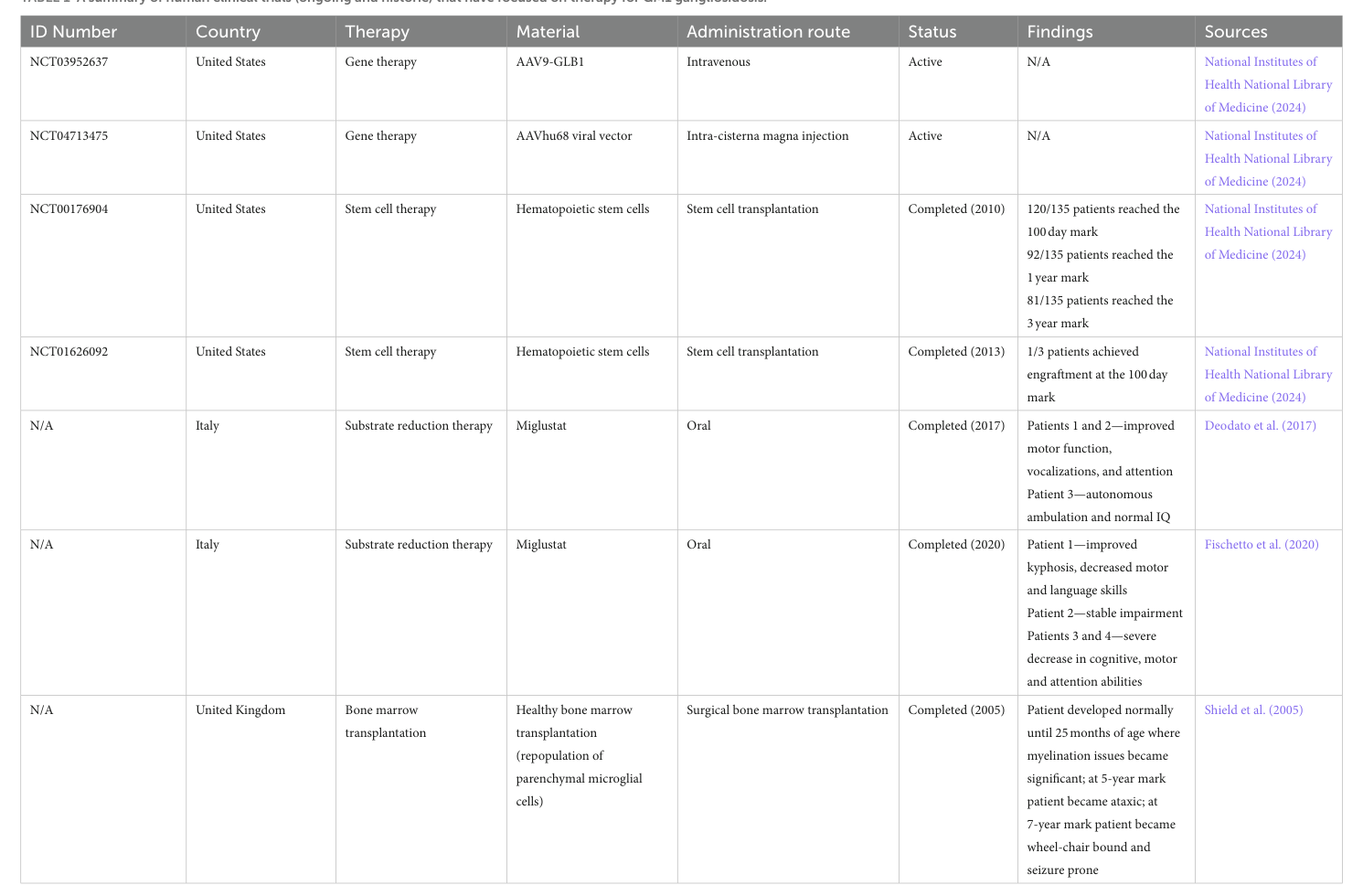
Gene therapy clinical trials (AAV-based GLB1 delivery): * A prospective GM1 type II study explicitly notes ongoing trials using gene therapy and small-molecule substrate inhibitors, citing NCT IDs NCT03952637, NCT04713475, and NCT04221451 (the latter is a substrate inhibitor trial referenced in that context). (d’souza2024gm1gangliosidosistype pages 3-6) * A 2023 review of sphingolipid disorder gene therapy lists three GM1 AAV trials and provides NCT IDs and key design features: * NCT03952637: Phase 1/2, IV AAV9-GLB1 (Type I/II). * NCT04273269: intracisternal AAVrh.10-GLB1 (listed as GM1 program; terminated per registry evidence). * NCT04713475: cisterna magna AAVhu68-GLB1 (PBGM01) (Type I/IIa). (shaimardanova2023genetherapyof pages 4-6)
ClinicalTrials.gov registry evidence (real-world implementation/status): * NCT03952637 (AAV9 IV gene transfer): recruiting (registry snapshot in retrieved trials list). (NCT04624789 chunk 2) * NCT04713475 (PBGM01 cisterna magna): active not recruiting. (NCT04624789 chunk 2) * NCT04273269 (LYSOGENE LYS-GM101): terminated. (NCT04624789 chunk 2) * NCT04320329: natural history of Morquio B and late-onset GM1 gangliosidosis (directly relevant to type III/late onset). (NCT04624789 chunk 2)
Substrate reduction therapy (SRT): A 2024 therapy review (Frontiers in Neuroscience; 2024-04-xx; https://doi.org/10.3389/fnins.2024.1392683) notes clinical investigation of oral miglustat in small cohorts and in a US infantile GM1 trial (NCT02030015) that was unsuccessful, illustrating limits of SRT as studied to date. (foster2024therapeuticdevelopmentsfor pages 5-6, casazza2026frommoleculeto pages 17-17)
Pharmacological chaperones and small molecules: A biomarker-focused review lists chaperone-like small molecules (e.g., NOEV/NOV) and discusses iPSC-enabled drug screening that identified autophagy-activating compounds reducing GM1 accumulation in vitro and in vivo (preclinical; not type III-specific). (casazza2026frommoleculeto pages 17-17)
Gene editing (research-stage): A 2023 CRISPR Journal study reports base-editing correction of GLB1 pathogenic SNVs in patient-derived fibroblasts, restoring β-galactosidase activity to therapeutic levels in vitro, supporting gene editing as a potential future strategy. (kell2023apentasaccharidefor pages 2-3)
12.3 MAXO (Medical Action Ontology) suggestions
- Supportive care / symptom management: MAXO:0000005 (medical care) (suggested)
- Enzyme activity assay / biochemical testing: MAXO:0000056 (laboratory test) (suggested)
- Gene therapy: MAXO:0001001 (gene therapy) (suggested)
- Substrate reduction therapy: MAXO:0000753 (substrate reduction therapy) (suggested)
- Genetic counseling / reproductive planning: MAXO:0000015 (genetic counseling) (suggested)
13. Prevention
Primary prevention is not applicable in the traditional sense for an autosomal recessive Mendelian disorder, but reproductive options and screening can reduce affected births in at-risk families.
- A 2024 case report describes preimplantation genetic testing for monogenic disease (PGT-M) for GLB1 variants in a family with GM1 gangliosidosis, resulting in selection/transfer of an embryo without disease-causing alleles and prenatal confirmation. (zagaynova2024casereportpreimplantation pages 1-2)
14. Other species / natural disease
Direct “natural disease” descriptions in non-human species were not extracted in detail for GM1 type III from the retrieved evidence.
However, translational biomarker and therapy work uses animal models (including cats) to evaluate biomarkers and AAV responses; the pentasaccharide biomarker H3N2b was elevated in GM1 cats and decreased after IV AAV9 treatment. (kell2023apentasaccharidefor pages 2-3)
15. Model organisms
15.1 Mouse models (mechanism and multi-omics)
- Glb1−/− mice show CNS storage, axonopathy, and gliosis with lipid elevations (GM1, GA1, sphingomyelin, phosphatidylcholine, phosphatidylserine), enabling mechanistic studies and therapy testing. (eikelberg2020axonopathyandreduction pages 1-3)
- A 2024 snRNA-seq study in a Glb1G455R/G455R mouse model provides cell-type-resolved transcriptomic changes implicating synaptic/circuit disruption and metabolic pathway perturbations. (liu2024insightsintothe pages 2-5, liu2024insightsintothe pages 1-2)
15.2 Ocular/retinal pathology model
A 2025 Scientific Reports study in Glb1−/− mice describes retinal neuronal degeneration and reactive gliosis in a murine model, supporting use for ocular manifestations and glial activation studies. (jubran2025novelinsightsinto pages 1-3)
Recent developments (2023–2024) and expert analysis highlights
- Biomarker maturation for trials: Recent reviews emphasize multimodal endpoints (CSF gangliosides/lysosphingolipids, glycans, NfL, quantitative MRI/MRS/diffusion imaging) and the need for standardized methods and genotype-stratified natural history datasets. (casazza2026frommoleculeto pages 1-2)
- Trial landscape is rapidly evolving: A 2024 therapy review summarizes active clinical-trial approaches including gene therapy and miglustat, with a consolidated trial table (Table 1) that is widely used by clinicians/researchers to track GM1 programs. (foster2024therapeuticdevelopmentsfor media 70a6c6d4)
Notable data gaps specific to GM1 type III (adult/chronic)
Despite strong mechanistic understanding of GLB1 deficiency, type III-specific epidemiology (incidence/prevalence), survival statistics, and validated biomarker cutoffs remain limited in the retrieved corpus; many robust longitudinal datasets and trial-readiness measures are focused on infantile/juvenile disease. (casazza2026frommoleculeto pages 1-2, zhang2025clinicalandgenetic pages 1-2)
URLs and publication dates (for key 2023–2024 sources cited)
- D’Souza et al., “GM1 Gangliosidosis Type II: Results of a 10-Year Prospective Study,” Genetics in Medicine, 2024-04. https://doi.org/10.1016/j.gim.2024.101144 (d’souza2024gm1gangliosidosistype pages 3-6)
- Foster et al., “Therapeutic developments for neurodegenerative GM1 gangliosidosis,” Frontiers in Neuroscience, 2024-04. https://doi.org/10.3389/fnins.2024.1392683 (foster2024therapeuticdevelopmentsfor pages 5-6)
- Liu et al., “Insights into the Pathobiology of GM1 Gangliosidosis from Single-Nucleus Transcriptomic Analysis…,” Int J Mol Sci, 2024-09. https://doi.org/10.3390/ijms25179712 (liu2024insightsintothe pages 1-2)
- Kell et al., “A pentasaccharide for monitoring pharmacodynamic response to gene therapy in GM1 gangliosidosis,” eBioMedicine, 2023-06. https://doi.org/10.1016/j.ebiom.2023.104627 (kell2023apentasaccharidefor pages 2-3)
- Kido et al., “Gene therapy for lysosomal storage diseases: Current clinical trial prospects,” Frontiers in Genetics, 2023-01. https://doi.org/10.3389/fgene.2023.1064924 (kido2023genetherapyfor pages 3-4)
- Zagaynova et al., “Case report: Preimplantation genetic testing for infantile GM1 gangliosidosis,” Frontiers in Genetics, 2024-02. https://doi.org/10.3389/fgene.2024.1344051 (zagaynova2024casereportpreimplantation pages 1-2)
Figure/Table evidence note
A therapy-trial summary table for GM1 gangliosidosis (Table 1) was directly inspected from the 2024 Frontiers in Neuroscience review and is cited here as visual evidence of the clinical trial landscape. (foster2024therapeuticdevelopmentsfor media 70a6c6d4)
References
-
(d’souza2024gm1gangliosidosistype pages 3-6): Precilla D’Souza, Cristan Farmer, Jean M. Johnston, Sangwoo T. Han, David Adams, Adam L. Hartman, Wadih Zein, Laryssa A. Huryn, Beth Solomon, Kelly King, Christopher P. Jordan, Jennifer G. Myles, Elena-Raluca Nicoli, C. Rothermel, Yoliann Mojica Algarin, Reyna L Huang, Rachel Quimby, Mosufa Zainab, Sarah Bowden, Anna Crowell, A. Buckley, Carmen Brewer, Debra S Regier, Brian P. Brooks, M. Acosta, Eva H Baker, Gilbert Vezina, Audrey Thurm, and C. Tifft. Gm1 gangliosidosis type ii: results of a 10-year prospective study. Genetics in medicine : official journal of the American College of Medical Genetics, 26:101144-101144, Apr 2024. URL: https://doi.org/10.1016/j.gim.2024.101144, doi:10.1016/j.gim.2024.101144. This article has 23 citations.
-
(roy2026clinicalradiologicaland pages 1-2): Subhajit Roy, Cheshta Arora, Vikram V. Holla, Shweta Prasad, Prashant Phulpagar, Nitish Kamble, Babylakshmi Muthusamy, Jitender Saini, Ravi Yadav, and Pramod Kumar Pal. Clinical, radiological, and genetic profiles of eight patients with combined dystonic manifestation of type-iii gm1 gangliosidosis: a video case series from india. Tremor and Other Hyperkinetic Movements, Feb 2026. URL: https://doi.org/10.5334/tohm.1152, doi:10.5334/tohm.1152. This article has 0 citations and is from a peer-reviewed journal.
-
(casazza2026frommoleculeto pages 1-2): Krista Casazza, Roberto Giugliani, Debra S. Regier, and Jeanine Jarnes. From molecule to meaning: neuronopathic biomarkers and clinical relevance in
gm1 . Journal of Inherited Metabolic Disease, Jan 2026. URL: https://doi.org/10.1002/jimd.70134, doi:10.1002/jimd.70134. This article has 3 citations and is from a peer-reviewed journal. -
(sezer2021chapternineglycolipid pages 24-28): Ö SEZER. Chapter nine glycolipid disorders. Unknown journal, 2021.
-
(zagaynova2024casereportpreimplantation pages 1-2): Valeria A. Zagaynova, Yulia A. Nasykhova, Ziravard N. Tonyan, Maria M. Danilova, Natalya M. Dvoynova, Tatyana E. Lazareva, Tatyana E. Ivashchenko, Elena S. Shabanova, Inna O. Krikheli, Elena A. Lesik, Olesya N. Bespalova, Igor Yu. Kogan, and Andrey S. Glotov. Case report: preimplantation genetic testing for infantile gm1 gangliosidosis. Frontiers in Genetics, Feb 2024. URL: https://doi.org/10.3389/fgene.2024.1344051, doi:10.3389/fgene.2024.1344051. This article has 0 citations and is from a peer-reviewed journal.
-
(jubran2025novelinsightsinto pages 1-3): L. Jubran, R. Wannemacher, Anastasiia Ulianytska, Ingo Gerhauser, Wolfgang Baumgärtner, and E. Leitzen. Novel insights into pathomechanisms of retinal neuronal degeneration and reactive gliosis in a murine model of gm1-gangliosidosis. Scientific Reports, Aug 2025. URL: https://doi.org/10.1038/s41598-025-15639-9, doi:10.1038/s41598-025-15639-9. This article has 2 citations and is from a peer-reviewed journal.
-
(NCT04624789 chunk 2): Registry Gangliosidoses. SphinCS Lyso Gemeinnutzige UG (Haftungsbeschrankt). 2020. ClinicalTrials.gov Identifier: NCT04624789
-
(zhang2025clinicalandgenetic pages 1-2): Biao Zhang, Xiao-li Huang, Xin-xin Lu, Heng-bin Huang, and Yan-an Wu. Clinical and genetic analysis of a chinese family with gm1 gangliosidosis caused by a novel mutation in glb1 gene. Frontiers in Pediatrics, Jan 2025. URL: https://doi.org/10.3389/fped.2025.1507098, doi:10.3389/fped.2025.1507098. This article has 2 citations.
-
(roy2026clinicalradiologicaland pages 2-3): Subhajit Roy, Cheshta Arora, Vikram V. Holla, Shweta Prasad, Prashant Phulpagar, Nitish Kamble, Babylakshmi Muthusamy, Jitender Saini, Ravi Yadav, and Pramod Kumar Pal. Clinical, radiological, and genetic profiles of eight patients with combined dystonic manifestation of type-iii gm1 gangliosidosis: a video case series from india. Tremor and Other Hyperkinetic Movements, Feb 2026. URL: https://doi.org/10.5334/tohm.1152, doi:10.5334/tohm.1152. This article has 0 citations and is from a peer-reviewed journal.
-
(foster2024therapeuticdevelopmentsfor pages 5-6): Dorian Foster, Lucian Williams, Noah Arnold, and Jessica Larsen. Therapeutic developments for neurodegenerative gm1 gangliosidosis. Frontiers in Neuroscience, Apr 2024. URL: https://doi.org/10.3389/fnins.2024.1392683, doi:10.3389/fnins.2024.1392683. This article has 21 citations and is from a peer-reviewed journal.
-
(eikelberg2020axonopathyandreduction pages 1-3): Deborah Eikelberg, Annika Lehmbecker, Graham Brogden, Witchaya Tongtako, Kerstin Hahn, Andre Habierski, Julia B. Hennermann, Hassan Y. Naim, Felix Felmy, Wolfgang Baumgärtner, and Ingo Gerhauser. Axonopathy and reduction of membrane resistance: key features in a new murine model of human gm1-gangliosidosis. Journal of Clinical Medicine, 9:1004, Apr 2020. URL: https://doi.org/10.3390/jcm9041004, doi:10.3390/jcm9041004. This article has 24 citations.
-
(liu2024insightsintothe pages 2-5): Sichi Liu, Ting Xie, and Yonglan Huang. Insights into the pathobiology of gm1 gangliosidosis from single-nucleus transcriptomic analysis of cns cells in a mouse model. International Journal of Molecular Sciences, 25:9712, Sep 2024. URL: https://doi.org/10.3390/ijms25179712, doi:10.3390/ijms25179712. This article has 4 citations.
-
(rodriguezantiguedad2025genotype–phenotyperelationsfor pages 9-10): Jon Rodriguez-Antiguedad, Rajasumi Rajalingam, Clara Krüger, Daniel Teixeira-dos-Santos, Christine Sun, Elias Fernandez-Toledo, Alexia Duarte, Paula Saffie-Awad, Matthew J. Barrett, Joseph L. Flanigan, Maziar Emamikhah, Neepa Patel, Marta San Luciano, Christine Cooper, Natascha Bahr, Odinachi Oguh, Alissa Buhrmann, Merle Vater, Rabea Fuchshofen, Franca Vulinovic, Maik-Iven Parreidt, Anne Weissbach, Katja Lohmann, Christine Klein, Connie Marras, and Sarah Camargos. Genotype–phenotype relations for the dystonia-parkinsonism genes glb1, slc6a3, slc30a10, slc39a14, and pla2g6: mdsgene systematic review. International Journal of Molecular Sciences, 26:4074, Apr 2025. URL: https://doi.org/10.3390/ijms26094074, doi:10.3390/ijms26094074. This article has 1 citations.
-
(kell2023apentasaccharidefor pages 1-2): Pamela Kell, Rohini Sidhu, Mingxing Qian, Sonali Mishra, Elena-Raluca Nicoli, Precilla D'Souza, Cynthia J. Tifft, Amanda L. Gross, Heather L. Gray-Edwards, Douglas R. Martin, Miguel Sena- Esteves, Dennis J. Dietzen, Manmilan Singh, Jingqin Luo, Jean E. Schaffer, Daniel S. Ory, and Xuntian Jiang. A pentasaccharide for monitoring pharmacodynamic response to gene therapy in gm1 gangliosidosis. Jun 2023. URL: https://doi.org/10.1016/j.ebiom.2023.104627, doi:10.1016/j.ebiom.2023.104627. This article has 19 citations and is from a peer-reviewed journal.
-
(srivastava2026novelgalactosidasebeta1variant pages 1-3): Preeti Srivastava, Abhishek Kumar, Shikhar Deep Jain, Ratan Kumar, Shikha Swaroop, and Tapas Sarangi. Novel galactosidase-beta-1 variant in infantile gm1 gangliosidosis: a case report. Cureus, 18 1:e102121, Jan 2026. URL: https://doi.org/10.7759/cureus.102121, doi:10.7759/cureus.102121. This article has 0 citations.
-
(casazza2026frommoleculeto pages 3-4): Krista Casazza, Roberto Giugliani, Debra S. Regier, and Jeanine Jarnes. From molecule to meaning: neuronopathic biomarkers and clinical relevance in
gm1 . Journal of Inherited Metabolic Disease, Jan 2026. URL: https://doi.org/10.1002/jimd.70134, doi:10.1002/jimd.70134. This article has 3 citations and is from a peer-reviewed journal. -
(liu2024insightsintothe pages 1-2): Sichi Liu, Ting Xie, and Yonglan Huang. Insights into the pathobiology of gm1 gangliosidosis from single-nucleus transcriptomic analysis of cns cells in a mouse model. International Journal of Molecular Sciences, 25:9712, Sep 2024. URL: https://doi.org/10.3390/ijms25179712, doi:10.3390/ijms25179712. This article has 4 citations.
-
(liu2024insightsintothe pages 13-15): Sichi Liu, Ting Xie, and Yonglan Huang. Insights into the pathobiology of gm1 gangliosidosis from single-nucleus transcriptomic analysis of cns cells in a mouse model. International Journal of Molecular Sciences, 25:9712, Sep 2024. URL: https://doi.org/10.3390/ijms25179712, doi:10.3390/ijms25179712. This article has 4 citations.
-
(menkovic2025persistentelevationsof pages 1-2): Iskren Menkovic, Monika Williams, Neelam Makhijani, Ruhan Wei, Sarah P. Young, Areeg El-Gharbawy, and Ashlee R. Stiles. Persistent elevations of alkaline phosphatase as an early indicator of gm1 gangliosidosis. Mar 2025. URL: https://doi.org/10.1016/j.ymgmr.2025.101191, doi:10.1016/j.ymgmr.2025.101191. This article has 2 citations.
-
(matsushima2025adenoassociatedvirusexpressing pages 17-22): Saki Kondo Matsushima, Yohta Shimada, Masafumi Kinoshita, Takashi Nagashima, Shinichiro Okamoto, Sayoko Iizuka, Haruna Takagi, Shunsuke Iizuka, Takashi Higuchi, Hiroyuki Hioki, Ayako M. Watabe, Hiroyuki Sonoda, Toya Ohashi, and Hiroshi Kobayashi. Adeno-associated virus expressing a blood-brain barrier–penetrating enzyme improves gm1 gangliosidosis in a preclinical model. The Journal of Clinical Investigation, Apr 2025. URL: https://doi.org/10.1172/jci180724, doi:10.1172/jci180724. This article has 1 citations.
-
(casazza2026frommoleculeto pages 4-5): Krista Casazza, Roberto Giugliani, Debra S. Regier, and Jeanine Jarnes. From molecule to meaning: neuronopathic biomarkers and clinical relevance in
gm1 . Journal of Inherited Metabolic Disease, Jan 2026. URL: https://doi.org/10.1002/jimd.70134, doi:10.1002/jimd.70134. This article has 3 citations and is from a peer-reviewed journal. -
(kell2023apentasaccharidefor pages 2-3): Pamela Kell, Rohini Sidhu, Mingxing Qian, Sonali Mishra, Elena-Raluca Nicoli, Precilla D'Souza, Cynthia J. Tifft, Amanda L. Gross, Heather L. Gray-Edwards, Douglas R. Martin, Miguel Sena- Esteves, Dennis J. Dietzen, Manmilan Singh, Jingqin Luo, Jean E. Schaffer, Daniel S. Ory, and Xuntian Jiang. A pentasaccharide for monitoring pharmacodynamic response to gene therapy in gm1 gangliosidosis. Jun 2023. URL: https://doi.org/10.1016/j.ebiom.2023.104627, doi:10.1016/j.ebiom.2023.104627. This article has 19 citations and is from a peer-reviewed journal.
-
(shaimardanova2023genetherapyof pages 4-6): Alisa A. Shaimardanova, Valeriya V. Solovyeva, Shaza S. Issa, and Albert A. Rizvanov. Gene therapy of sphingolipid metabolic disorders. International Journal of Molecular Sciences, 24:3627, Feb 2023. URL: https://doi.org/10.3390/ijms24043627, doi:10.3390/ijms24043627. This article has 34 citations.
-
(casazza2026frommoleculeto pages 17-17): Krista Casazza, Roberto Giugliani, Debra S. Regier, and Jeanine Jarnes. From molecule to meaning: neuronopathic biomarkers and clinical relevance in
gm1 . Journal of Inherited Metabolic Disease, Jan 2026. URL: https://doi.org/10.1002/jimd.70134, doi:10.1002/jimd.70134. This article has 3 citations and is from a peer-reviewed journal. -
(foster2024therapeuticdevelopmentsfor media 70a6c6d4): Dorian Foster, Lucian Williams, Noah Arnold, and Jessica Larsen. Therapeutic developments for neurodegenerative gm1 gangliosidosis. Frontiers in Neuroscience, Apr 2024. URL: https://doi.org/10.3389/fnins.2024.1392683, doi:10.3389/fnins.2024.1392683. This article has 21 citations and is from a peer-reviewed journal.
-
(kido2023genetherapyfor pages 3-4): Jun Kido, Keishin Sugawara, and Kimitoshi Nakamura. Gene therapy for lysosomal storage diseases: current clinical trial prospects. Frontiers in Genetics, Jan 2023. URL: https://doi.org/10.3389/fgene.2023.1064924, doi:10.3389/fgene.2023.1064924. This article has 46 citations and is from a peer-reviewed journal.