SETBP1 Disorder (SETBP1-related disorders) — Comprehensive Disease Characteristics Report
Target Disease
- Disease name (umbrella): SETBP1-related disorders (colloquially sometimes “SETBP1 disorder”) encompassing SETBP1 haploinsufficiency disorder (SETBP1-HD) and Schinzel–Giedion syndrome (SGS). (duis2024schinzelgiedionsyndrome pages 1-4, wang2023identificationofa pages 1-2)
1. Disease Information
1.1 Concise overview
SETBP1-related disorders are Mendelian neurodevelopmental conditions caused by germline heterozygous SETBP1 variants with distinct mechanisms and phenotypes: (i) SETBP1 haploinsufficiency disorder (SETBP1-HD) (typically loss-of-function / reduced dosage) and (ii) Schinzel–Giedion syndrome (SGS) (typically gain-of-function due to impaired degron-mediated degradation causing protein accumulation). (duis2024schinzelgiedionsyndrome pages 1-4, wang2023identificationofa pages 1-2)
1.2 Key identifiers (available in retrieved sources)
- Gene: SETBP1 (SET-binding protein 1), OMIM 611060 (duis2024schinzelgiedionsyndrome pages 23-25, wang2023identificationofa pages 1-2)
- Schinzel–Giedion syndrome (Schinzel–Giedion midface retraction syndrome): OMIM 269150 (duis2024schinzelgiedionsyndrome pages 23-25, wang2023identificationofa pages 1-2)
- SETBP1 haploinsufficiency disorder: OMIM 616078; also referred to as autosomal dominant mental retardation type 29 (MRD29) / “intellectual disability, autosomal dominant 29” (wang2023identificationofa pages 1-2)
Not found in retrieved evidence: MONDO ID, Orphanet ID, MeSH ID, ICD-10/ICD-11 codes (would require targeted retrieval from those databases).
1.3 Synonyms / alternative names
- SETBP1-HD: “SETBP1 haploinsufficiency disorder”; “intellectual disability, autosomal dominant 29”; “MRD29” (wang2023identificationofa pages 1-2, shaw2024identifyingsetbp1haploinsufficiency pages 1-2)
- SGS: “Schinzel–Giedion syndrome”; “Schinzel–Giedion midface retraction syndrome” (duis2024schinzelgiedionsyndrome pages 23-25)
- Spectrum terms: “classic SGS”, “atypical SGS”, and broader “SETBP1-related disorders” (duis2024schinzelgiedionsyndrome pages 1-4, duis2024schinzelgiedionsyndrome pages 23-25)
1.4 Evidence sources
Information below is derived from aggregated disease-level resources (GeneReviews-style chapter) and primary literature/case series; it is not from EHR-only sources. (duis2024schinzelgiedionsyndrome pages 1-4, morgan2021speechandlanguage pages 1-2)
2. Etiology
2.1 Disease causal factors
Primary cause: germline heterozygous pathogenic variants affecting SETBP1 dosage or stability/function. (duis2024schinzelgiedionsyndrome pages 1-4, wang2023identificationofa pages 1-2)
- SGS (classic): heterozygous gain-of-function missense variants clustering in a 12-bp degron hot spot in SETBP1 exon 4 encoding amino acids 868–871; variants impair ubiquitin E3 ligase recognition/degradation leading to SETBP1 overabundance. (duis2024schinzelgiedionsyndrome pages 23-25)
- SETBP1-HD (MRD29): heterozygous loss-of-function (frameshift/nonsense) variants or deletions disrupting SETBP1 expression (haploinsufficiency). Structural rearrangements disrupting SETBP1 (balanced translocations) are also a recurrent mechanism. (wang2023identificationofa pages 1-2, alesi2024structuralrearrangementsas pages 1-2)
2.2 Risk factors
For a Mendelian, typically de novo disorder, conventional environmental risk factors are not established in the retrieved literature.
- Genetic risk: de novo heterozygous pathogenic variants in SETBP1; rare parental mosaicism has been reported for SGS. (duis2024schinzelgiedionsyndrome pages 1-4, duis2024schinzelgiedionsyndrome pages 20-23)
2.3 Protective factors / gene–environment interactions
Not established in retrieved sources for these Mendelian conditions.
3. Phenotypes
3.1 SETBP1 haploinsufficiency disorder (SETBP1-HD / MRD29)
Clinical summary: mild–moderate intellectual disability and prominent speech/language impairment with associated motor and behavioral features. (shaw2024identifyingsetbp1haploinsufficiency pages 1-2)
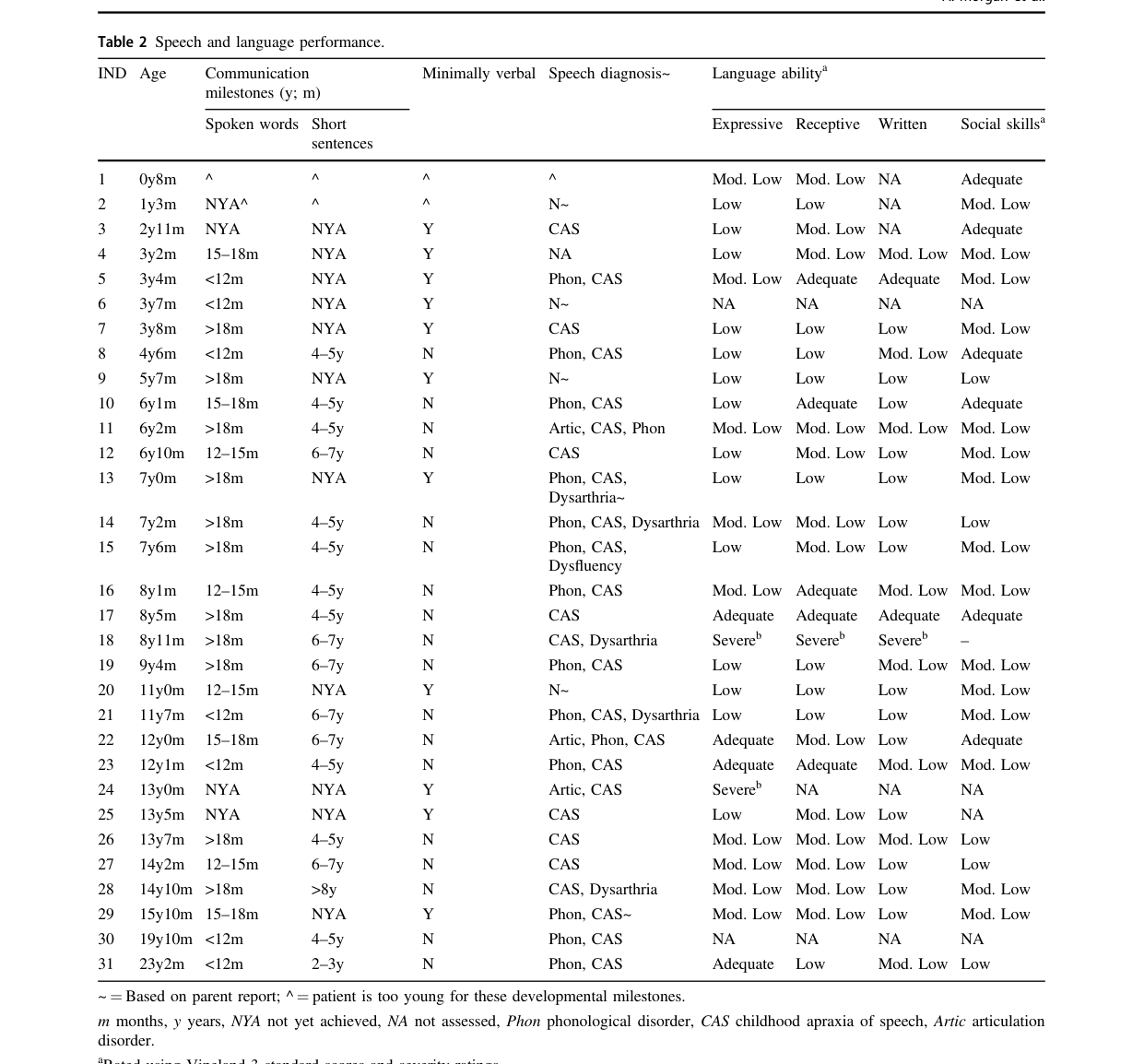
Core speech/language phenotype (human cohort data): In a cohort of 31 individuals with SETBP1 haploinsufficiency (truncating variants/deletions), childhood apraxia of speech (CAS) was the most common diagnosis (80%) and many had additional speech disorders such as phonological disorder (48%), dysarthria (16%), and others; 32% were minimally verbal and used augmentative methods (AAC/sign/gestures/devices). (morgan2021speechandlanguage pages 1-2, morgan2021speechandlanguage pages 7-8)
Neurodevelopment and associated features: gross and/or fine motor deficits were common (94%), intellectual impairment reported in 68%, attention issues were frequent (55%), and ASD diagnosis was reported in a minority despite frequent autistic traits. (morgan2021speechandlanguage pages 1-2, morgan2021speechandlanguage pages 3-5)
Recent (2024) molecular model paper phenotype statement: SETBP1-HD described as characterized by mild to moderate intellectual disability, speech and language impairment, mild motor developmental delay, behavioural issues, hypotonia, mild facial dysmorphisms, and vision impairment. (shaw2024identifyingsetbp1haploinsufficiency pages 1-2)
HPO term suggestions (non-exhaustive; based on retrieved phenotype descriptions): - Speech apraxia / CAS: HP:0002472 (Childhood onset of impaired motor planning for speech) (supported by CAS frequency) (morgan2021speechandlanguage pages 1-2) - Speech delay: HP:0000750 (shaw2024identifyingsetbp1haploinsufficiency pages 1-2) - Language impairment: HP:0002463 (morgan2021speechandlanguage pages 1-2) - Intellectual disability: HP:0001249 (shaw2024identifyingsetbp1haploinsufficiency pages 1-2) - Hypotonia: HP:0001252 (shaw2024identifyingsetbp1haploinsufficiency pages 1-2) - Motor delay: HP:0001270 (morgan2021speechandlanguage pages 1-2) - Attention deficit: HP:0007018 (morgan2021speechandlanguage pages 3-5) - Strabismus: HP:0000486 (noted in SETBP1-HD description) (duis2024schinzelgiedionsyndrome pages 12-15)
Quality-of-life/functional impact: Communication deficits can be disproportionately severe relative to other adaptive domains and often necessitate AAC and special education supports. (morgan2021speechandlanguage pages 1-2, morgan2021speechandlanguage pages 3-5)
3.2 Schinzel–Giedion syndrome (SGS)
Clinical summary: ultra-rare multisystem neurodevelopmental disorder with severe developmental impairment and congenital anomalies; classic SGS is typically caused by SETBP1 gain-of-function hotspot variants. (duis2024schinzelgiedionsyndrome pages 1-4)
Key phenotype ranges/frequencies (GeneReviews chapter excerpt): - Epilepsy 75–100% (often refractory) (duis2024schinzelgiedionsyndrome pages 7-10) - Hypotonia 75–100%, often evolving to spasticity (duis2024schinzelgiedionsyndrome pages 7-10) - Cerebral visual impairment about ~70–80% (duis2024schinzelgiedionsyndrome pages 7-10) - Hearing impairment: reported 75–100%; text notes nearly 90% (duis2024schinzelgiedionsyndrome pages 7-10) - Congenital anomalies of kidney/urinary tract (CAKUT) 75–100% (duis2024schinzelgiedionsyndrome pages 7-10) - Neoplasia risk 20–50% overall range; another excerpt notes neoplasia occurs in ~25% (neuroepithelial tumors; sacrococcygeal teratoma common) (duis2024schinzelgiedionsyndrome pages 7-10, duis2024schinzelgiedionsyndrome pages 10-12) - Microcephaly ~80%, typically postnatal (duis2024schinzelgiedionsyndrome pages 10-12)
Natural history/prognosis: life span is shortened; mortality is most often due to pneumonia (often aspiration-related), with other reported causes including sepsis, lung hypoplasia, intractable epilepsy, and sudden cardiac arrest. (duis2024schinzelgiedionsyndrome pages 10-12)
HPO term suggestions (non-exhaustive): - Severe global developmental delay: HP:0001263 (duis2024schinzelgiedionsyndrome pages 1-4) - Intellectual disability (moderate-to-profound): HP:0002342 / HP:0001249 (duis2024schinzelgiedionsyndrome pages 1-4) - Seizures (often refractory): HP:0001250 (duis2024schinzelgiedionsyndrome pages 7-10) - Hypotonia: HP:0001252 (duis2024schinzelgiedionsyndrome pages 7-10) - Spasticity: HP:0001257 (duis2024schinzelgiedionsyndrome pages 1-4) - Microcephaly: HP:0000252 (duis2024schinzelgiedionsyndrome pages 10-12) - Hydronephrosis: HP:0000126 (duis2024schinzelgiedionsyndrome pages 10-12) - Midface retrusion: HP:0011800 (duis2024schinzelgiedionsyndrome pages 4-7)
4. Genetic / Molecular Information
4.1 Causal gene
- SETBP1 (OMIM 611060) is the causal gene across the spectrum. (wang2023identificationofa pages 1-2)
4.2 Pathogenic variant classes and genotype–phenotype relationships
SGS (classic): - Typically heterozygous missense variants in a 12-bp degron hotspot (exon 4; aa 868–871) within the SKI domain; disrupt degradation → increased protein stability/accumulation (gain-of-function). (duis2024schinzelgiedionsyndrome pages 23-25) - Example hotspot variants listed in GeneReviews excerpt include p.Asp868Asn, p.Ser869Gly, p.Ile871Thr (among others). (duis2024schinzelgiedionsyndrome pages 23-25) - A 2024 case report described a non-degron variant adjacent to the hotspot (D874V) causing canonical SGS, expanding variant spectrum beyond the canonical residues. (zheng2024novelsetbp1d874v pages 1-2)
SETBP1-HD / MRD29: - Loss-of-function variants (frameshift/nonsense) and deletions; can be classified as pathogenic per ACMG in case reports. (miolo2024delayedboneage pages 2-4) - Structural rearrangements (including balanced reciprocal translocations) disrupting SETBP1 are a recurrent mechanism and may be missed by CMA/WES. (alesi2024structuralrearrangementsas pages 1-2, alesi2024structuralrearrangementsas pages 10-12)
ClinVar uncertainty burden (diagnostic bottleneck): As of 3 April 2024, 562/1,444 single-gene SETBP1 variants in ClinVar were classified as VUS (reported in Shaw et al.). (shaw2024identifyingsetbp1haploinsufficiency pages 1-2)
4.3 Inheritance
Autosomal dominant; most cases are de novo; rare familial transmission and parental mosaicism have been reported for SGS. (duis2024schinzelgiedionsyndrome pages 1-4, duis2024schinzelgiedionsyndrome pages 20-23)
4.4 Functional consequences (high-level)
- Degron hotspot variants → impaired ubiquitin E3 ligase recognition → reduced degradation → SETBP1 overabundance (SGS). (duis2024schinzelgiedionsyndrome pages 23-25)
- Loss-of-function / gene disruption → haploinsufficiency (SETBP1-HD). (wang2023identificationofa pages 1-2, alesi2024structuralrearrangementsas pages 1-2)
4.5 Modifier genes / epigenetics
Not clearly established for SETBP1-related disorders in the retrieved evidence.
5. Environmental Information
No established environmental triggers or infectious causes are described in the retrieved evidence; these are primarily genetic Mendelian disorders.
6. Mechanism / Pathophysiology
6.1 Current mechanistic understanding (2024–2025 highlights)
Human iPSC/CRISPR neurodevelopmental modelling (SETBP1-HD): CRISPR-edited isogenic iPSCs differentiated into neural lineages implicated perturbation of WNT pathway, RNA polymerase II/POL2RA pathway, and identified GATA2 as a central transcription factor in disease perturbation; gene sets related to neural forebrain development were altered. (shaw2024identifyingsetbp1haploinsufficiency pages 1-2)
Dose sensitivity and signaling (SGS vs SHD/SETBP1-HD) in forebrain progenitors: Patient-derived iPSC → forebrain neural progenitor cell models suggest extremes of SETBP1 protein dosage influence key signaling molecules such as AKT, consistent with a narrow tolerated dosage window; SETBP1 forms nuclear bodies that interact with the nuclear lamina, with a proposed role in organizing higher-order chromatin structure and influencing global gene expression. (antonyan2025reciprocalandnonreciprocal pages 1-2, antonyan2025reciprocalandnonreciprocal pages 9-12)
6.2 Tissue expression context (2024 systems biology)
GTEx analysis across 31 adult tissues found SETBP1 ubiquitously expressed (median TPM range 0.364–16.719; highest median in cervix/blood vessel/uterus; lowest in blood/bone marrow/adrenal), and SETBP1 target sets enriched for transcription regulation/DNA binding and mitochondrial function; a Shiny resource was provided for TF activity across tissues. (whitlock2024thelandscapeof pages 4-7, whitlock2024thelandscapeof pages 7-9)
6.3 Causal chain (example framing)
- SGS: degron missense variant → impaired ubiquitination/degradation → increased SETBP1 protein → downstream dysregulation of developmental programs/signaling and multisystem congenital anomalies with severe neurodevelopmental impairment and tumor predisposition. (duis2024schinzelgiedionsyndrome pages 23-25, duis2024schinzelgiedionsyndrome pages 10-12)
- SETBP1-HD: truncating variant/structural disruption → reduced SETBP1 dosage → altered transcriptional programs in neural/forebrain development (WNT/POL2RA/GATA2-associated perturbations) → speech/language and motor neurodevelopmental phenotype. (shaw2024identifyingsetbp1haploinsufficiency pages 1-2, morgan2021speechandlanguage pages 1-2)
6.4 Suggested ontology mappings
GO biological process (illustrative suggestions; to be curated with GO evidence): - WNT signaling pathway: GO:0016055 (shaw2024identifyingsetbp1haploinsufficiency pages 1-2) - Regulation of transcription by RNA polymerase II: GO:0006357 (shaw2024identifyingsetbp1haploinsufficiency pages 1-2) - Forebrain development: GO:0030900 (shaw2024identifyingsetbp1haploinsufficiency pages 1-2)
Cell types (CL suggestions, consistent with iPSC-derived neural models): - Neural progenitor cell: CL:0000047 (antonyan2025reciprocalandnonreciprocal pages 1-2) - Astrocyte: CL:0000127 (noted differentiation outputs in forebrain models) (antonyan2025reciprocalandnonreciprocal pages 2-4)
7. Anatomical Structures Affected
7.1 SGS: multisystem organs
Commonly involved systems include nervous system, kidney/urinary tract, heart, skeleton, and sensory systems (hearing/vision). (duis2024schinzelgiedionsyndrome pages 1-4, duis2024schinzelgiedionsyndrome pages 7-10)
UBERON suggestions (non-exhaustive): - Brain: UBERON:0000955 (duis2024schinzelgiedionsyndrome pages 1-4) - Kidney: UBERON:0002113 (duis2024schinzelgiedionsyndrome pages 10-12) - Heart: UBERON:0000948 (duis2024schinzelgiedionsyndrome pages 10-12)
7.2 SETBP1-HD
Primarily neurodevelopmental (speech/language, motor control), with vision issues such as strabismus reported. (shaw2024identifyingsetbp1haploinsufficiency pages 1-2, duis2024schinzelgiedionsyndrome pages 12-15)
8. Temporal Development
8.1 SGS
Often recognized in infancy due to congenital anomalies, characteristic facial features, feeding problems, hypotonia, and early-onset seizures. (duis2024schinzelgiedionsyndrome pages 1-4, duis2024schinzelgiedionsyndrome pages 4-7)
8.2 SETBP1-HD
Typically pediatric onset with early speech and motor delays; language trajectories can be markedly protracted. (morgan2021speechandlanguage pages 8-9, morgan2021speechandlanguage pages 1-2)
9. Inheritance and Population
9.1 Epidemiology
- SGS: described as ultra-rare; >50 molecularly confirmed classic cases reported to date (plus >40 historically diagnosed clinically), and five atypical SGS cases reported. (duis2024schinzelgiedionsyndrome pages 1-4, duis2024schinzelgiedionsyndrome pages 12-15)
Not found in retrieved evidence: prevalence/incidence estimates for SGS or SETBP1-HD.
9.2 Inheritance
Autosomal dominant, typically de novo, with rare inherited transmission and parental mosaicism noted (SGS). (duis2024schinzelgiedionsyndrome pages 1-4)
10. Diagnostics
10.1 Clinical diagnosis (SGS)
Classic SGS can be diagnosed clinically using published criteria (Lehman et al. 2008 referenced), but definitive diagnosis is via identifying a heterozygous SETBP1 gain-of-function variant in the exon 4 degron hotspot. (duis2024schinzelgiedionsyndrome pages 4-7)
10.2 Molecular diagnostics and recent advances
- Exome/genome sequencing: recommended broadly when SGS is suspected; most pathogenic SETBP1 variants are coding and detectable by exome sequencing. (duis2024schinzelgiedionsyndrome pages 7-10)
- Structural variant detection: 2024 evidence shows balanced rearrangements disrupting SETBP1 can be missed by CMA; optical genome mapping (OGM) + WGS can precisely map breakpoints and reconstruct complex rearrangements. In a case series of three individuals with SETBP1 disruption by structural rearrangements, 2/3 were negative by CMA because they were balanced at microarray resolution. (alesi2024structuralrearrangementsas pages 1-2, alesi2024structuralrearrangementsas pages 12-13)
- Functional variant interpretation: iPSC/CRISPR neural differentiation models are proposed to adjudicate VUS and improve diagnosis; motivated by high ClinVar VUS burden for SETBP1 (562/1,444 single-gene variants). (shaw2024identifyingsetbp1haploinsufficiency pages 1-2)
10.3 Differential diagnosis
Not systematically extracted from retrieved evidence (would require additional targeted sources).
11. Outcome / Prognosis
11.1 SGS
- Shortened lifespan; mortality often due to aspiration pneumonia, with other causes noted (sepsis, lung hypoplasia, intractable epilepsy, sudden cardiac arrest). (duis2024schinzelgiedionsyndrome pages 10-12)
- Neoplasia occurs in ~25% (range 20–50%) and drives cancer surveillance practices. (duis2024schinzelgiedionsyndrome pages 10-12, duis2024schinzelgiedionsyndrome pages 7-10)
11.2 SETBP1-HD
Outcome is variable; communication impairment is often substantial and may require AAC and intensive speech-language therapy; literacy is frequently affected. (morgan2021speechandlanguage pages 1-2, morgan2021speechandlanguage pages 7-8)
12. Treatment
12.1 Disease-modifying therapy
No curative therapy is available for SGS; management is supportive and surveillance-based. (duis2024schinzelgiedionsyndrome pages 1-4)
12.2 Supportive care (real-world implementations)
SGS: supportive multidisciplinary care and surveillance, including feeding support (tubes often necessary), PT/OT, AAC consideration, and tumor screening protocols (liver US+AFP q3mo until age 4; renal US q3mo until age 10; pelvic MRI for sacrococcygeal teratoma; monitor for leukemia). (duis2024schinzelgiedionsyndrome pages 18-20, duis2024schinzelgiedionsyndrome pages 20-23)
SETBP1-HD: early intervention with speech therapy, multimodal communication (AAC/sign), and targeted speech-motor and phonological/literacy interventions are recommended based on cohort observations of severe and persistent speech/language deficits. (morgan2021speechandlanguage pages 8-9, morgan2021speechandlanguage pages 1-2)
MAXO term suggestions (illustrative): - Speech therapy: MAXO:0000058 (therapy for communication impairment) (supported by clinical recommendations) (morgan2021speechandlanguage pages 8-9) - Augmentative and alternative communication: map to communication assistive technology intervention (needs MAXO exact term curation; concept supported) (duis2024schinzelgiedionsyndrome pages 18-20) - Surveillance imaging (renal ultrasound, liver ultrasound, MRI): preventive screening intervention (MAXO curation needed) (duis2024schinzelgiedionsyndrome pages 20-23)
12.3 Experimental therapeutics / trials
No interventional trials specifically targeting SETBP1-related neurodevelopmental disorders were identified in the retrieved clinical-trials evidence; however, a major real-world research implementation is participation in genetics-first registries (see below). (NCT01238250 chunk 1)
13. Prevention
Primary prevention is not established for de novo Mendelian disorders.
Secondary/tertiary prevention: supportive care and surveillance (particularly tumor surveillance in classic SGS; early developmental therapies and AAC for communication impairment). (duis2024schinzelgiedionsyndrome pages 20-23, morgan2021speechandlanguage pages 8-9)
Prenatal and preimplantation genetic testing are possible if a familial pathogenic variant is known; recurrence risk is usually low but increased by parental mosaicism. (duis2024schinzelgiedionsyndrome pages 20-23)
14. Other Species / Natural Disease
Not established in retrieved evidence.
15. Model Organisms
Human cell models (most directly relevant in retrieved evidence): - iPSC-derived neural differentiation models with CRISPR-introduced SETBP1 variants (SETBP1-HD modeling) used to detect pathway perturbations (WNT, POL2RA; GATA2). (shaw2024identifyingsetbp1haploinsufficiency pages 1-2) - Patient-derived iPSC forebrain neural progenitor models comparing SGS vs SHD/SETBP1-HD dose extremes (AKT signaling; nuclear bodies interacting with nuclear lamina). (antonyan2025reciprocalandnonreciprocal pages 1-2)
Non-human animal model evidence: not directly retrieved here.
Recent Developments and Latest Research (prioritizing 2023–2024)
-
Functional genomics for diagnosis (2024): Shaw et al. used isogenic CRISPR-edited iPSCs differentiated into neural cells to model SETBP1-HD variants and identified perturbed pathways (WNT, POL2RA) and GATA2-centered regulatory changes, explicitly positioned as a route to interpret VUS in the setting of substantial ClinVar uncertainty (562/1,444 single-gene SETBP1 variants as VUS on 2024-04-03). URL: https://doi.org/10.1186/s13229-024-00625-1 (published Sep 2024). (shaw2024identifyingsetbp1haploinsufficiency pages 1-2)
-
Structural variant diagnostics (2024): Alesi et al. showed that balanced chromosomal rearrangements interrupting SETBP1 can be missed by CMA and require optical genome mapping + WGS to characterize; 2/3 of reported cases were CMA-negative due to balanced architecture. URL: https://doi.org/10.1186/s40246-024-00600-0 (published Mar 2024). (alesi2024structuralrearrangementsas pages 1-2)
-
Updated clinical synthesis (2024): Duis & van Bon provide a GeneReviews-style synthesis of SGS, including quantitative phenotype ranges, tumor risk, and surveillance protocols; URL: https://doi.org/10.32388/5ng540 (Feb 2024). (duis2024schinzelgiedionsyndrome pages 7-10, duis2024schinzelgiedionsyndrome pages 20-23)
-
Tissue expression/TF activity resource (2024): Whitlock et al. provide GTEx-based quantification and a TF-activity web app (published Jan 2, 2024): https://doi.org/10.1371/journal.pone.0296328 and https://lasseignelab.shinyapps.io/gtex_tf_activity/ (whitlock2024thelandscapeof pages 7-9)
Current Applications and Real-World Implementations
Genetics-first registries / natural history data collection
Simons Searchlight (ClinicalTrials.gov NCT01238250) is a recruiting, online observational registry/natural history study that includes SETBP1 among eligible gene conditions; it collects baseline and annual longitudinal medical/behavioral/learning/developmental data and may collect biospecimens for DNA and cell-line generation. (NCT01238250 chunk 1)
Expert opinions / analysis (from authoritative sources in retrieved evidence)
- The GeneReviews-style chapter frames SGS as a severe multisystem disorder with established surveillance practices for neoplasia and organ complications, reflecting expert consensus management in rare disease genetics. (duis2024schinzelgiedionsyndrome pages 20-23, duis2024schinzelgiedionsyndrome pages 18-20)
- Morgan et al. emphasize that communication impairment is central in SETBP1 haploinsufficiency disorder and recommend early, intensive speech-language intervention and AAC for minimally verbal children. (morgan2021speechandlanguage pages 8-9, morgan2021speechandlanguage pages 1-2)
- Shaw et al. explicitly argue that functional cellular models can improve diagnostic interpretation in the face of high VUS burden for SETBP1 variants. (shaw2024identifyingsetbp1haploinsufficiency pages 1-2)
Key Statistics and Data (recent studies + core cohort)
SETBP1-HD
- Motor developmental delay frequency reported as 97% in a 2024 review/modeling paper. (shaw2024identifyingsetbp1haploinsufficiency pages 1-2)
- In a cohort of 31 individuals: CAS 80%, motor deficits 94%, intellectual impairment 68%, minimally verbal 32%, phonological disorder 48%, dysarthria 16%, autistic traits 50% (CCC-2 subset) with ASD diagnosis minority. (morgan2021speechandlanguage pages 1-2, morgan2021speechandlanguage pages 7-8)
SGS
- Epilepsy 75–100%, hypotonia 75–100%, CAKUT 75–100%, cerebral visual impairment ~70–80%, hearing impairment nearly 90%, neoplasia risk 20–50% (and ~25% in another excerpt), microcephaly ~80%. (duis2024schinzelgiedionsyndrome pages 7-10, duis2024schinzelgiedionsyndrome pages 10-12)
Visual evidence
The following table image (from Morgan et al. 2021) summarizes detailed speech/language findings across individuals with SETBP1 haploinsufficiency disorder.
(morgan2021speechandlanguage media fe1dfb06)
Notes on evidence gaps vs requested template
- MONDO/Orphanet/MeSH/ICD IDs, prevalence/incidence, and detailed differential diagnosis were not retrieved within the current evidence corpus and would require dedicated database lookups.
- PMID-specific citations were requested; however, the current tool context returned DOI-based bibliographic metadata without PMIDs for most items. Where PMIDs are essential, a follow-on PubMed-targeted retrieval step would be required.
References
-
(duis2024schinzelgiedionsyndrome pages 1-4): J Duis and BWM van Bon. Schinzel-giedion syndrome. Definitions, Feb 2024. URL: https://doi.org/10.32388/5ng540, doi:10.32388/5ng540. This article has 23 citations.
-
(wang2023identificationofa pages 1-2): Hongdan Wang, Yue Gao, Litao Qin, Mengting Zhang, Weili Shi, Zhanqi Feng, Liangjie Guo, Bofeng Zhu, and Shixiu Liao. Identification of a novel de novo mutation of setbp1 and new findings of setbp1 in tumorgenesis. Orphanet Journal of Rare Diseases, May 2023. URL: https://doi.org/10.1186/s13023-023-02705-6, doi:10.1186/s13023-023-02705-6. This article has 9 citations and is from a peer-reviewed journal.
-
(duis2024schinzelgiedionsyndrome pages 23-25): J Duis and BWM van Bon. Schinzel-giedion syndrome. Definitions, Feb 2024. URL: https://doi.org/10.32388/5ng540, doi:10.32388/5ng540. This article has 23 citations.
-
(shaw2024identifyingsetbp1haploinsufficiency pages 1-2): Nicole C. Shaw, Kevin Chen, Kathryn O. Farley, Mitchell Hedges, Catherine A. Forbes, Gareth Baynam, Timo Lassmann, and Vanessa S. Fear. Identifying setbp1 haploinsufficiency molecular pathways to improve patient diagnosis using induced pluripotent stem cells and neural disease modelling. Molecular Autism, Sep 2024. URL: https://doi.org/10.1186/s13229-024-00625-1, doi:10.1186/s13229-024-00625-1. This article has 6 citations and is from a peer-reviewed journal.
-
(morgan2021speechandlanguage pages 1-2): Angela Morgan, Ruth Braden, Maggie M. K. Wong, Estelle Colin, David Amor, Frederique Liégeois, Siddharth Srivastava, Adam Vogel, Varoona Bizaoui, Kara Ranguin, Simon E. Fisher, and Bregje W. van Bon. Speech and language deficits are central to setbp1 haploinsufficiency disorder. European Journal of Human Genetics, 29:1216-1225, Apr 2021. URL: https://doi.org/10.1038/s41431-021-00894-x, doi:10.1038/s41431-021-00894-x. This article has 56 citations and is from a domain leading peer-reviewed journal.
-
(alesi2024structuralrearrangementsas pages 1-2): V. Alesi, S. Genovese, M. C. Roberti, E. Sallicandro, S. Di Tommaso, S. Loddo, V. Orlando, D. Pompili, C. Calacci, V. Mei, E. Pisaneschi, M. V. Faggiano, A. Morgia, C. Mammì, G. Astrea, R. Battini, M. Priolo, M. L. Dentici, R. Milone, and A. Novelli. Structural rearrangements as a recurrent pathogenic mechanism for setbp1 haploinsufficiency. Human Genomics, Mar 2024. URL: https://doi.org/10.1186/s40246-024-00600-0, doi:10.1186/s40246-024-00600-0. This article has 2 citations and is from a peer-reviewed journal.
-
(duis2024schinzelgiedionsyndrome pages 20-23): J Duis and BWM van Bon. Schinzel-giedion syndrome. Definitions, Feb 2024. URL: https://doi.org/10.32388/5ng540, doi:10.32388/5ng540. This article has 23 citations.
-
(morgan2021speechandlanguage pages 7-8): Angela Morgan, Ruth Braden, Maggie M. K. Wong, Estelle Colin, David Amor, Frederique Liégeois, Siddharth Srivastava, Adam Vogel, Varoona Bizaoui, Kara Ranguin, Simon E. Fisher, and Bregje W. van Bon. Speech and language deficits are central to setbp1 haploinsufficiency disorder. European Journal of Human Genetics, 29:1216-1225, Apr 2021. URL: https://doi.org/10.1038/s41431-021-00894-x, doi:10.1038/s41431-021-00894-x. This article has 56 citations and is from a domain leading peer-reviewed journal.
-
(morgan2021speechandlanguage pages 3-5): Angela Morgan, Ruth Braden, Maggie M. K. Wong, Estelle Colin, David Amor, Frederique Liégeois, Siddharth Srivastava, Adam Vogel, Varoona Bizaoui, Kara Ranguin, Simon E. Fisher, and Bregje W. van Bon. Speech and language deficits are central to setbp1 haploinsufficiency disorder. European Journal of Human Genetics, 29:1216-1225, Apr 2021. URL: https://doi.org/10.1038/s41431-021-00894-x, doi:10.1038/s41431-021-00894-x. This article has 56 citations and is from a domain leading peer-reviewed journal.
-
(duis2024schinzelgiedionsyndrome pages 12-15): J Duis and BWM van Bon. Schinzel-giedion syndrome. Definitions, Feb 2024. URL: https://doi.org/10.32388/5ng540, doi:10.32388/5ng540. This article has 23 citations.
-
(duis2024schinzelgiedionsyndrome pages 7-10): J Duis and BWM van Bon. Schinzel-giedion syndrome. Definitions, Feb 2024. URL: https://doi.org/10.32388/5ng540, doi:10.32388/5ng540. This article has 23 citations.
-
(duis2024schinzelgiedionsyndrome pages 10-12): J Duis and BWM van Bon. Schinzel-giedion syndrome. Definitions, Feb 2024. URL: https://doi.org/10.32388/5ng540, doi:10.32388/5ng540. This article has 23 citations.
-
(duis2024schinzelgiedionsyndrome pages 4-7): J Duis and BWM van Bon. Schinzel-giedion syndrome. Definitions, Feb 2024. URL: https://doi.org/10.32388/5ng540, doi:10.32388/5ng540. This article has 23 citations.
-
(zheng2024novelsetbp1d874v pages 1-2): Jing Zheng, Meiqun Gu, Shasha Xiao, Chongzhen Li, Hongying Mi, and Xiaoyan Xu. Novel setbp1 d874v adjacent to the degron causes canonical schinzel–giedion syndrome: a case report and review of the literature. BMC Pediatrics, May 2024. URL: https://doi.org/10.1186/s12887-024-04779-y, doi:10.1186/s12887-024-04779-y. This article has 8 citations and is from a peer-reviewed journal.
-
(miolo2024delayedboneage pages 2-4): Gianmaria Miolo, Davide Colavito, Lara Della Puppa, and Giuseppe Corona. Delayed bone age in a child with a novel loss-of-function variant in setbp1 gene sheds light on the potential role of setbp1 protein in skeletal development. Molecular Syndromology, 15:167-174, Dec 2024. URL: https://doi.org/10.1159/000535057, doi:10.1159/000535057. This article has 2 citations and is from a peer-reviewed journal.
-
(alesi2024structuralrearrangementsas pages 10-12): V. Alesi, S. Genovese, M. C. Roberti, E. Sallicandro, S. Di Tommaso, S. Loddo, V. Orlando, D. Pompili, C. Calacci, V. Mei, E. Pisaneschi, M. V. Faggiano, A. Morgia, C. Mammì, G. Astrea, R. Battini, M. Priolo, M. L. Dentici, R. Milone, and A. Novelli. Structural rearrangements as a recurrent pathogenic mechanism for setbp1 haploinsufficiency. Human Genomics, Mar 2024. URL: https://doi.org/10.1186/s40246-024-00600-0, doi:10.1186/s40246-024-00600-0. This article has 2 citations and is from a peer-reviewed journal.
-
(antonyan2025reciprocalandnonreciprocal pages 1-2): Lilit Antonyan, Xin Zhang, Anjie Ni, Huashan Peng, Shaima Alsuwaidi, Peter Fleming, Ying Zhang, Amelia Semenak, Julia Macintosh, Hanrong Wu, Nuwan C Hettige, Malvin Jefri, and Carl Ernst. Reciprocal and non-reciprocal effects of clinically relevant setbp1 protein dosage changes. Human Molecular Genetics, 34:651-667, Jan 2025. URL: https://doi.org/10.1093/hmg/ddaf003, doi:10.1093/hmg/ddaf003. This article has 3 citations and is from a domain leading peer-reviewed journal.
-
(antonyan2025reciprocalandnonreciprocal pages 9-12): Lilit Antonyan, Xin Zhang, Anjie Ni, Huashan Peng, Shaima Alsuwaidi, Peter Fleming, Ying Zhang, Amelia Semenak, Julia Macintosh, Hanrong Wu, Nuwan C Hettige, Malvin Jefri, and Carl Ernst. Reciprocal and non-reciprocal effects of clinically relevant setbp1 protein dosage changes. Human Molecular Genetics, 34:651-667, Jan 2025. URL: https://doi.org/10.1093/hmg/ddaf003, doi:10.1093/hmg/ddaf003. This article has 3 citations and is from a domain leading peer-reviewed journal.
-
(whitlock2024thelandscapeof pages 4-7): Jordan H. Whitlock, Elizabeth J. Wilk, Timothy C. Howton, Amanda D. Clark, and Brittany N. Lasseigne. The landscape of setbp1 gene expression and transcription factor activity across human tissues. PLOS ONE, 19:e0296328, Jan 2024. URL: https://doi.org/10.1371/journal.pone.0296328, doi:10.1371/journal.pone.0296328. This article has 12 citations and is from a peer-reviewed journal.
-
(whitlock2024thelandscapeof pages 7-9): Jordan H. Whitlock, Elizabeth J. Wilk, Timothy C. Howton, Amanda D. Clark, and Brittany N. Lasseigne. The landscape of setbp1 gene expression and transcription factor activity across human tissues. PLOS ONE, 19:e0296328, Jan 2024. URL: https://doi.org/10.1371/journal.pone.0296328, doi:10.1371/journal.pone.0296328. This article has 12 citations and is from a peer-reviewed journal.
-
(antonyan2025reciprocalandnonreciprocal pages 2-4): Lilit Antonyan, Xin Zhang, Anjie Ni, Huashan Peng, Shaima Alsuwaidi, Peter Fleming, Ying Zhang, Amelia Semenak, Julia Macintosh, Hanrong Wu, Nuwan C Hettige, Malvin Jefri, and Carl Ernst. Reciprocal and non-reciprocal effects of clinically relevant setbp1 protein dosage changes. Human Molecular Genetics, 34:651-667, Jan 2025. URL: https://doi.org/10.1093/hmg/ddaf003, doi:10.1093/hmg/ddaf003. This article has 3 citations and is from a domain leading peer-reviewed journal.
-
(morgan2021speechandlanguage pages 8-9): Angela Morgan, Ruth Braden, Maggie M. K. Wong, Estelle Colin, David Amor, Frederique Liégeois, Siddharth Srivastava, Adam Vogel, Varoona Bizaoui, Kara Ranguin, Simon E. Fisher, and Bregje W. van Bon. Speech and language deficits are central to setbp1 haploinsufficiency disorder. European Journal of Human Genetics, 29:1216-1225, Apr 2021. URL: https://doi.org/10.1038/s41431-021-00894-x, doi:10.1038/s41431-021-00894-x. This article has 56 citations and is from a domain leading peer-reviewed journal.
-
(alesi2024structuralrearrangementsas pages 12-13): V. Alesi, S. Genovese, M. C. Roberti, E. Sallicandro, S. Di Tommaso, S. Loddo, V. Orlando, D. Pompili, C. Calacci, V. Mei, E. Pisaneschi, M. V. Faggiano, A. Morgia, C. Mammì, G. Astrea, R. Battini, M. Priolo, M. L. Dentici, R. Milone, and A. Novelli. Structural rearrangements as a recurrent pathogenic mechanism for setbp1 haploinsufficiency. Human Genomics, Mar 2024. URL: https://doi.org/10.1186/s40246-024-00600-0, doi:10.1186/s40246-024-00600-0. This article has 2 citations and is from a peer-reviewed journal.
-
(duis2024schinzelgiedionsyndrome pages 18-20): J Duis and BWM van Bon. Schinzel-giedion syndrome. Definitions, Feb 2024. URL: https://doi.org/10.32388/5ng540, doi:10.32388/5ng540. This article has 23 citations.
-
(NCT01238250 chunk 1): Online Study of People Who Have Genetic Changes and Features of Autism: Simons Searchlight. Simons Searchlight. 2010. ClinicalTrials.gov Identifier: NCT01238250
-
(morgan2021speechandlanguage media fe1dfb06): Angela Morgan, Ruth Braden, Maggie M. K. Wong, Estelle Colin, David Amor, Frederique Liégeois, Siddharth Srivastava, Adam Vogel, Varoona Bizaoui, Kara Ranguin, Simon E. Fisher, and Bregje W. van Bon. Speech and language deficits are central to setbp1 haploinsufficiency disorder. European Journal of Human Genetics, 29:1216-1225, Apr 2021. URL: https://doi.org/10.1038/s41431-021-00894-x, doi:10.1038/s41431-021-00894-x. This article has 56 citations and is from a domain leading peer-reviewed journal.
Artifacts