1. Disease Information
1.1 What is the disease?
Definition (current understanding): GeneReviews (2023) defines the term primary CoQ10 deficiency as “the group of conditions characterized by a reduction of CoQ10 levels in tissues or cultured cells associated with biallelic pathogenic variants in one of the ten genes involved in the biosynthesis of CoQ10.” (salviati2023primarycoenzymeq10b pages 1-3)
Treatability concept: Multiple recent reviews emphasize it is potentially treatable if recognized early, because once critical-organ injury (kidney/CNS) is established, recovery is limited. (mantle2023primarycoenzymeq10 pages 1-2, mantle2024efficacyandsafety pages 2-3)
1.2 Key identifiers
- MONDO: MONDO:0018151 (carmody2023themedicalaction pages 5-8)
- MAxO treatment mapping: MAXO:0010012 “coenzyme Q10 supplementation”; definition “Addition of coenzyme Q10 to the diet,” input chemical CHEBI:46245 (coenzyme Q10 / coenzyme Q); explicitly stated to treat diseases including MONDO:0018151 (carmody2023themedicalaction pages 5-8)
Not retrieved in tool evidence: OMIM disease number(s), Orphanet ORPHA code, ICD-10/ICD-11, MeSH. These likely exist but were not present in the obtained full-text extracts.
1.3 Synonyms / alternative names
- Primary coenzyme Q10 deficiency; primary CoQ10 deficiency; primary ubiquinone deficiency (salviati2023primarycoenzymeq10b pages 1-3)
1.4 Evidence source type
The knowledge base content here is derived from: - Aggregated disease-level syntheses (GeneReviews-style overview and narrative reviews) (salviati2023primarycoenzymeq10b pages 1-3, mantle2023primarycoenzymeq10 pages 1-2) - Human cohort/case-series clinical evidence (single-center cohort of genetically confirmed cases; neonatal COQ4 case series + literature review) (wahedi2024clinicalfeaturesbiochemistry pages 1-2)
2. Etiology
2.1 Disease causal factors
Genetic cause: PCoQD results from pathogenic variants in nuclear genes encoding CoQ10 biosynthesis proteins; recent sources repeatedly emphasize biallelic pathogenic variants (autosomal recessive pattern). (salviati2023primarycoenzymeq10b pages 1-3, salviati2023primarycoenzymeq10b pages 5-7)
2.2 Risk factors
- Genetic: Presence of biallelic pathogenic variants in one of the canonical CoQ10 biosynthesis genes (see below) is causal. (salviati2023primarycoenzymeq10b pages 1-3)
- Environmental: No specific environmental risk factors were identified in the retrieved evidence; by definition PCoQD is a primary genetic biosynthesis disorder.
2.3 Protective factors
No validated protective genetic variants or environmental protective exposures were identified in the retrieved evidence.
2.4 Gene–environment interactions
Not specifically described in the retrieved sources.
3. Phenotypes
3.1 Major phenotype domains (with frequencies when available)
PCoQD is clinically heterogeneous, with core involvement of the CNS, kidney, muscle, and heart. (wahedi2024clinicalfeaturesbiochemistry pages 1-2, salviati2023primarycoenzymeq10b pages 3-5)
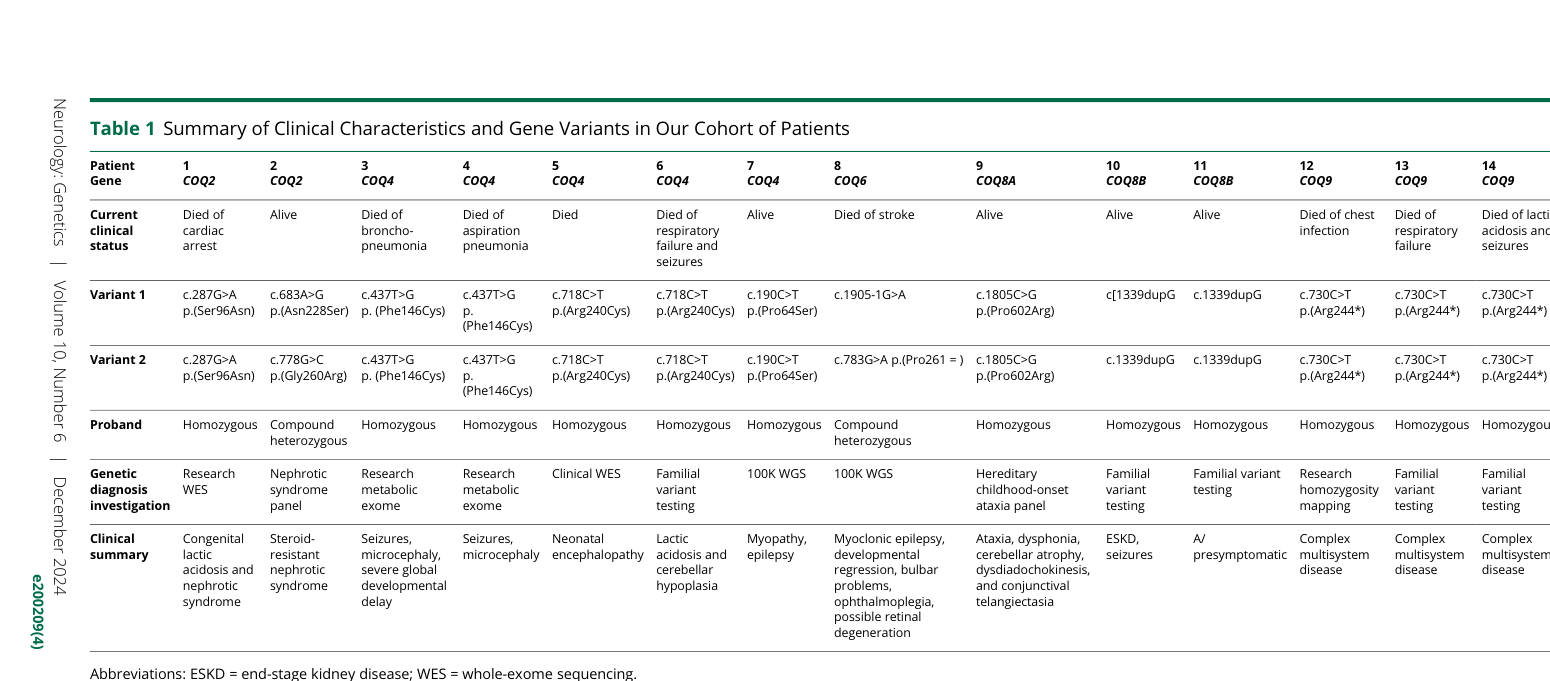
Neurologic phenotypes - Encephalopathy, developmental delay/regression, movement disorders, epilepsy, intellectual disability (munch2023neuroimaginginprimary pages 1-3) - In a 14-patient genetically confirmed cohort: seizures in 8/14 (wahedi2024clinicalfeaturesbiochemistry pages 2-3)
Renal phenotypes - Steroid-resistant nephrotic syndrome (SRNS) and progression to ESKD are key manifestations in several gene-specific forms; in the 14-patient cohort, SRNS in 3/14. (wahedi2024clinicalfeaturesbiochemistry pages 2-3)
Metabolic / laboratory phenotypes - Hyperlactatemia: 14-patient cohort had lactate elevated in 5/12 tested (wahedi2024clinicalfeaturesbiochemistry pages 2-3) - Neonatal COQ4 series: hyperlactatemia 18/24 (75%) (reported in abstract; paper retrieved but not fully evidence-extracted here beyond cohort stats in artifact) (wahedi2024clinicalfeaturesbiochemistry pages 2-3)
Neuroimaging phenotypes (MRI patterns) MRI is emphasized as central for assessing neurologic injury. The neuroimaging review states: “Brain magnetic resonance imaging (MRI) is the most important tool for diagnostic evaluation of neurological damage in individuals with CoQ10 deficiency.” (munch2023neuroimaginginprimary pages 1-3) - Common patterns across genes: leukoencephalopathy/white matter changes, cerebral/cerebellar atrophy, Leigh-like basal ganglia/brainstem lesions, stroke-like lesions, lactate peaks on MR spectroscopy. (munch2023neuroimaginginprimary pages 3-4, munch2023neuroimaginginprimary pages 10-12) - COQ8A: cerebellar atrophy is reported in 94% of patients summarized (munch2023neuroimaginginprimary pages 6-9)
3.2 Suggested HPO terms (non-exhaustive; evidence-aligned)
(These are ontology suggestions based on the described phenotypes; not explicitly enumerated in the cited papers.) - HP:0001250 Seizures; HP:0001263 Global developmental delay; HP:0001252 Muscular hypotonia; HP:0001251 Ataxia; HP:0001272 Cerebellar atrophy; HP:0004372 Status epilepticus; HP:0001257 Spasticity; HP:0001290 Generalized hypotonia; HP:0003070 Renal insufficiency; HP:0000100 Nephrotic syndrome; HP:0000510 Retinopathy; HP:0000608 Optic atrophy; HP:0001644 Cardiomyopathy.
3.3 Quality of life impact
Direct QoL instrument data (EQ-5D/SF-36/PROMIS) were not located in the retrieved evidence; however, neurological disability (developmental delay, epilepsy, ataxia) and progression to renal failure imply major functional impairment. (salviati2023primarycoenzymeq10b pages 3-5, wahedi2024clinicalfeaturesbiochemistry pages 1-2)
4. Genetic / Molecular Information
4.1 Causal genes (core list)
GeneReviews (2023) emphasizes ten genes; a neuroimaging review includes 11 disease genes (adding HPDL). (salviati2023primarycoenzymeq10b pages 1-3, munch2023neuroimaginginprimary pages 1-3)
Canonical CoQ biosynthesis genes (GeneReviews): - PDSS1, PDSS2, COQ2, COQ4, COQ5, COQ6, COQ7, COQ8A, COQ8B, COQ9 (salviati2023primarycoenzymeq10b pages 1-3)
Additional disease gene in neuroimaging review: - HPDL (munch2023neuroimaginginprimary pages 1-3)
4.2 Pathogenic variants
Variant-level catalogs (ClinVar allele frequencies; ACMG/AMP classifications per-variant; founder variants) were not extractable from the retrieved evidence chunks. However, the disease mechanism requires biallelic pathogenic variants in the relevant genes. (salviati2023primarycoenzymeq10b pages 5-7)
4.3 Modifier genes / epigenetics / chromosomal abnormalities
Not described in the retrieved sources.
5. Environmental Information
PCoQD is a primary genetic biosynthesis defect; no specific toxins, lifestyle factors, or infectious triggers were supported in the retrieved evidence.
6. Mechanism / Pathophysiology
6.1 Key concepts: CoQ10 functions
Recent reviews stress CoQ10’s roles beyond OXPHOS.
Direct abstract quote (Mantle et al., 2023, Antioxidants; Aug 2023; DOI: https://doi.org/10.3390/antiox12081652): - “Coenzyme Q10 (CoQ10) has a number of vital functions in all cells, both mitochondrial and extra-mitochondrial.” (mantle2023primarycoenzymeq10 pages 1-2)
Neuroimaging review (Mar 2023; DOI: https://doi.org/10.3390/antiox12030718) highlights: - CoQ10’s best-known role is electron transfer/ATP synthesis, but “there are many other cellular pathways that also depend on the CoQ10 supply (redox homeostasis, ferroptosis and sulfide oxidation).” (munch2023neuroimaginginprimary pages 1-3)
Biochemistry review (Jul 2023; DOI: https://doi.org/10.3390/antiox12071469): CoQ is electron acceptor for multiple dehydrogenases (DHODH, ETFDH, SQOR, etc.) and contributes to ferroptosis protection via the FSP1 system. (staiano2023biosynthesisdeficiencyand pages 1-2)
6.2 Causal chain (trigger → molecular dysfunction → tissue injury → clinical phenotype)
Upstream: biallelic pathogenic variants in CoQ biosynthesis genes → reduced CoQ10 in tissues/cultured cells. (salviati2023primarycoenzymeq10b pages 1-3)
Midstream: impaired electron transfer between respiratory chain complexes → impaired oxidative phosphorylation, reduced ATP production (especially affecting high-energy organs), plus disruption of non-bioenergetic CoQ roles (redox homeostasis, ferroptosis defense, sulfide oxidation; dehydrogenase-linked metabolism). (munch2023neuroimaginginprimary pages 1-3, staiano2023biosynthesisdeficiencyand pages 1-2)
Downstream: neurologic injury is conceptualized as involving “neuronal death, neuroinflammation and cerebral gliosis.” (munch2023neuroimaginginprimary pages 1-3)
6.3 Cellular processes and pathways (suggested ontology terms)
Evidence-based processes include: - Oxidative phosphorylation impairment; redox imbalance/oxidative stress; neuroinflammation and gliosis; ferroptosis-related defenses; sulfide oxidation dependence. (munch2023neuroimaginginprimary pages 1-3)
Suggested GO biological process terms (ontology suggestions based on described mechanisms): - GO:0006119 oxidative phosphorylation; GO:0006979 response to oxidative stress; GO:0006954 inflammatory response; GO:0097468 neuronal death; GO:0097034 glial cell activation; GO:0070228 regulation of ferroptosis; GO:1902600 hydrogen sulfide metabolic process.
Suggested CL cell types (ontology suggestions): - CL:0000540 neuron; CL:0000127 astrocyte; CL:0000129 microglial cell; CL:0002301 podocyte (for CoQ nephropathy/SRNS contexts).
7. Anatomical Structures Affected
7.1 Organ systems
- Central nervous system (encephalopathy, epilepsy, cerebellar ataxia/atrophy; MRI patterns) (munch2023neuroimaginginprimary pages 1-3, munch2023neuroimaginginprimary pages 6-9)
- Kidney (SRNS/ESKD; potentially reversible if treated early in some cases) (wahedi2024clinicalfeaturesbiochemistry pages 1-2)
- Heart (cardiomyopathy) (mantle2024efficacyandsafety pages 2-3)
- Eye/optic nerve/retina (optic atrophy/retinopathy in subsets) (mantle2024efficacyandsafety pages 2-3)
7.2 Suggested UBERON terms (ontology suggestions)
- Cerebellum (UBERON:0002037), brain (UBERON:0000955), kidney (UBERON:0002113), heart (UBERON:0000948), retina (UBERON:0000966), optic nerve (UBERON:0001778).
7.3 Subcellular localization
Primary locus of dysfunction is mitochondrial: CoQ10 is a lipid molecule of cellular membranes with key respiratory chain function. (munch2023neuroimaginginprimary pages 1-3) Suggested GO cellular component: mitochondrion (GO:0005739), inner mitochondrial membrane (GO:0005743).
8. Temporal Development
8.1 Onset
Onset is highly variable (neonatal to adulthood) across CoQ biosynthesis disorders. (munch2023neuroimaginginprimary pages 1-3)
8.2 Progression
GeneReviews summary indicates severe neonatal multisystem disease often has poor outcome, while later-onset cases show better response to high-dose supplementation. (salviati2023primarycoenzymeq10b pages 3-5)
9. Inheritance and Population
9.1 Inheritance
GeneReviews-style text emphasizes biallelic pathogenic variants (autosomal recessive). (salviati2023primarycoenzymeq10b pages 1-3)
9.2 Epidemiology
Recent pediatric-focused review states prevalence/incidence were estimated as “less than 1 per 100,000 population.” (mantle2024efficacyandsafety pages 2-3)
A different review estimated “approximately 120,000 patients worldwide,” but this appears to be a broad estimate rather than registry-derived epidemiology. (mantle2023primarycoenzymeq10 pages 1-2)
9.3 Demographics / geographic distribution
Neonatal COQ4 literature review reported that “Half of the cases are Chinese.” (wahedi2024clinicalfeaturesbiochemistry pages 2-3)
10. Diagnostics
10.1 Biochemical testing
GeneReviews (2023) indicates biochemical testing now has a limited role, used when molecular results are inconclusive or to support VUS interpretation. Key supportive findings include: - “Reduced levels of CoQ10 in skeletal muscle” - “Reduced activities of complex I+III and II+III of the mitochondrial respiratory chain on frozen muscle homogenates” (salviati2023primarycoenzymeq10b pages 5-7)
The same GeneReviews extract states plasma CoQ10 is not diagnostically useful. (salviati2023primarycoenzymeq10b pages 5-7)
A 2024 cohort used high-performance liquid chromatography quantification of CoQ10 in muscle and PBMNCs and respiratory chain enzyme assays. (wahedi2024clinicalfeaturesbiochemistry pages 1-2)
10.2 Genetic testing
Because “there are no pathognomonic blood, muscle, or imaging biomarkers of these diseases,” an “early genome-wide diagnostic approach” is recommended for expeditious diagnosis. (wahedi2024clinicalfeaturesbiochemistry pages 1-2)
In the neonatal COQ4 series, 20/24 were diagnosed by whole exome sequencing. (wahedi2024clinicalfeaturesbiochemistry pages 2-3)
10.3 Imaging
MRI is emphasized as most important for assessing neurologic damage in CoQ10 deficiency. (munch2023neuroimaginginprimary pages 1-3)
10.4 Differential diagnosis
GeneReviews excerpt notes secondary CoQ10 deficiency causes to consider, including respiratory chain defects and multiple acyl-CoA dehydrogenase deficiency. (salviati2023primarycoenzymeq10b pages 5-7)
11. Outcome / Prognosis
11.1 Prognosis statistics (recent)
Neonatal COQ4 mutation series (Frontiers in Pediatrics, Sep 2024; DOI: https://doi.org/10.3389/fped.2024.1410133): - Mortality: Chinese 9/12 (75%) vs other regions 11/12 (91.7%) (P=0.27) - Mean survival time 60.0 ± 98.0 days (95% CI 0–252 days) - CoQ10 treatment: 9/24 received CoQ10, and all 4 surviving patients received CoQ10 supplementation (wahedi2024clinicalfeaturesbiochemistry pages 2-3)
Single-center cohort (Neurology Genetics, Dec 2024; DOI: https://doi.org/10.1212/nxg.0000000000200209): - Despite high-dose CoQ10 from birth, “3 children with neonatal-onset neurologic disease died in early childhood” (wahedi2024clinicalfeaturesbiochemistry pages 1-2)
11.2 Prognostic factors
GeneReviews excerpt indicates severity/onset matters: “Children with severe multisystem CoQ10 deficiency respond poorly to treatment and generally die within the neonatal period or in the first year of life,” whereas “Individuals with later-onset disease show better response to supplementation with high-dose oral CoQ10.” (salviati2023primarycoenzymeq10b pages 3-5)
12. Treatment
12.1 Pharmacotherapy (current standard)
Oral CoQ10 supplementation is consistently described as the principal/only disease-directed therapy in recent reviews.
Direct abstract quote (Mantle & Hargreaves, Apr 2024; DOI: https://doi.org/10.3390/antiox13050530): - “The only treatment for primary CoQ10 deficiency is oral supplementation with CoQ10,” with typical doses in clinical studies “10–30 mg/kg/day.” (mantle2024efficacyandsafety pages 2-3)
Cohort dosing/outcome evidence (Dec 2024 cohort): - “oral doses of CoQ10 up to 70 mg/kg/d were needed to ameliorate neurologic features” (wahedi2024clinicalfeaturesbiochemistry pages 1-2) - “early diagnosis and treatment… (30 mg/kg/d) can reverse renal manifestations and can completely prevent kidney disease over 10 years of follow-up.” (wahedi2024clinicalfeaturesbiochemistry pages 1-2)
Adjunct therapy: - “Additional idebenone was required to control seizures in some cases” with idebenone used at 10–20 mg/kg/day in that cohort. (wahedi2024clinicalfeaturesbiochemistry pages 2-3)
12.2 Treatment monitoring / real-world implementation
PBMNC CoQ10 monitoring can demonstrate absorption and track response; the cohort reported PBMNC increases (examples) of +352%, +146% then +320%, +221% in individual patients. (wahedi2024clinicalfeaturesbiochemistry pages 2-3)
Image-based evidence: Wahedi et al. include tables summarizing patient-level dosing/outcomes and a figure showing serial PBMNC CoQ10 monitoring. (wahedi2024clinicalfeaturesbiochemistry media 455edda8, wahedi2024clinicalfeaturesbiochemistry media 782a63c5, wahedi2024clinicalfeaturesbiochemistry media 84940300)
12.3 Clinical trials landscape
A recent pediatric review notes “no formal clinical trials (randomised controlled or otherwise) have been reported” for primary CoQ10 deficiency treatment. (mantle2024efficacyandsafety pages 2-3)
12.4 Suggested MAXO terms
- MAXO:0010012 coenzyme Q10 supplementation (carmody2023themedicalaction pages 5-8)
- Additional suggested actions (ontology suggestions): antiseizure therapy; renal transplantation; ACE inhibitor therapy for proteinuria (not fully evidenced in retrieved 2023–2024 texts here).
13. Prevention
Primary prevention is not applicable in the classic public-health sense because PCoQD is inherited.
Secondary/tertiary prevention concept (early detection + early therapy): Multiple sources emphasize early diagnosis and prompt high-dose supplementation to prevent irreversible organ damage. (wahedi2024clinicalfeaturesbiochemistry pages 1-2, mantle2024efficacyandsafety pages 2-3)
Genetic counseling and cascade testing are implied by autosomal recessive inheritance, but explicit guideline text was not retrieved.
14. Other Species / Natural Disease
No naturally occurring veterinary disease analogs were identified in the retrieved evidence.
15. Model Organisms and Experimental Systems
15.1 Yeast and in vitro systems
A diagnostic-methods review states: “Most of the information about the CoQ biosynthesis pathway comes from yeast.” (rodriguezaguilera2017biochemicalassessmentof pages 1-3)
Human fibroblasts are widely used to assess CoQ10 content and functional rescue; the same review notes that “CoQ10 but not other quinones can restore mitochondrial function in deficient human fibroblasts.” (rodriguezaguilera2017biochemicalassessmentof pages 1-3)
15.2 Mouse models (examples explicitly mentioned)
- Coq9 knock-out mouse: “showed cerebral gliosis and spongiosis” (munch2023neuroimaginginprimary pages 1-3)
- Coq7 deficiency in mice: “induced a microglial metabolic reprogramming” (munch2023neuroimaginginprimary pages 1-3)
- Additional models summarized in 2024 mitochondrial disease muscle study: Pdss2 deficiency mouse, Coq7 knockout mice, Coq8a (Adck3) null mouse (slowly progressive cerebellar ataxia), Coq9 knockouts (encephalopathy), and Adck2+/− model (hernandez‐camacho2024prenatalandprogressive pages 1-2)
Recent developments and expert synthesis (2023–2024 emphasis)
- Shift toward genome-wide diagnosis: A 2024 cohort argues for early genome-wide testing because there are no pathognomonic biomarkers and because renal disease may be preventable with early treatment. (wahedi2024clinicalfeaturesbiochemistry pages 1-2)
- Dose escalation for neurologic benefit: The same cohort reports neurologic improvement sometimes requires up to 70 mg/kg/day, higher than historical “10–30 mg/kg/day” frequently cited in review literature. (wahedi2024clinicalfeaturesbiochemistry pages 1-2, mantle2024efficacyandsafety pages 2-3)
- Monitoring via PBMNC CoQ10: Serial PBMNC monitoring is increasingly used to document absorption/biological exposure in real-world clinical management. (wahedi2024clinicalfeaturesbiochemistry pages 2-3, wahedi2024clinicalfeaturesbiochemistry media 455edda8)
- Expanded mechanistic framing: Reviews emphasize non-bioenergetic roles (ferroptosis, sulfide oxidation, redox homeostasis), supporting why phenotypic heterogeneity may not be explained by ATP deficiency alone. (munch2023neuroimaginginprimary pages 1-3, staiano2023biosynthesisdeficiencyand pages 1-2)
Limitations of this report (evidence availability)
- PMIDs: Many retrieved sources were available with DOI/URL but PMIDs were not present in the extracted text chunks; therefore PMID-level citations could not be systematically provided.
- ICD/Orphanet/MeSH/OMIM numbers: Not retrieved in the available evidence extracts; MONDO and MAxO mappings were retrieved and reported. (carmody2023themedicalaction pages 5-8)
- Variant catalog details (allele frequencies; ClinVar classifications): Not available in retrieved evidence.
Key URLs (most recent/authoritative in this run)
- Wahedi et al., Neurology Genetics (Dec 2024): https://doi.org/10.1212/nxg.0000000000200209 (wahedi2024clinicalfeaturesbiochemistry pages 1-2)
- Salviati et al., GeneReviews-style overview (2023): (source text retrieved without a stable GeneReviews URL in evidence) (salviati2023primarycoenzymeq10b pages 1-3)
- Mantle et al., Antioxidants (Aug 2023): https://doi.org/10.3390/antiox12081652 (mantle2023primarycoenzymeq10 pages 1-2)
- Münch et al., Antioxidants (Mar 2023): https://doi.org/10.3390/antiox12030718 (munch2023neuroimaginginprimary pages 1-3)
- Mantle & Hargreaves, Antioxidants (Apr 2024): https://doi.org/10.3390/antiox13050530 (mantle2024efficacyandsafety pages 2-3)
- MAxO ontology paper, Med (Dec 2023): https://doi.org/10.1016/j.medj.2023.10.003 (carmody2023themedicalaction pages 5-8)
References
-
(salviati2023primarycoenzymeq10b pages 1-3): L Salviati, E Trevisson, C Agosto, M Doimo, and P Navas. Primary coenzyme q10 deficiency overview. Unknown journal, 2023.
-
(carmody2023themedicalaction pages 5-8): Leigh C. Carmody, Michael A. Gargano, Sabrina Toro, Nicole A. Vasilevsky, Margaret P. Adam, Hannah Blau, Lauren E. Chan, David Gomez-Andres, Rita Horvath, Megan L. Kraus, Markus S. Ladewig, David Lewis-Smith, Hanns Lochmüller, Nicolas A. Matentzoglu, Monica C. Munoz-Torres, Catharina Schuetz, Berthold Seitz, Morgan N. Similuk, Teresa N. Sparks, Timmy Strauss, Emilia M. Swietlik, Rachel Thompson, Xingmin Aaron Zhang, Christopher J. Mungall, Melissa A. Haendel, and Peter N. Robinson. The medical action ontology: a tool for annotating and analyzing treatments and clinical management of human disease. Med, 4:913-927.e3, Dec 2023. URL: https://doi.org/10.1016/j.medj.2023.10.003, doi:10.1016/j.medj.2023.10.003. This article has 15 citations and is from a domain leading peer-reviewed journal.
-
(wahedi2024clinicalfeaturesbiochemistry pages 1-2): Azizia Wahedi, Sniya Sudhakar, Amanda Lam, Jose Ignacio Rodriguez Ciancio, Philippa Mills, Paul Gissen, Alice Gardham, Jogesh Kapadia, Jane Hassell, Simon Heales, and Shamima Rahman. Clinical features, biochemistry, imaging, and treatment response in a single-center cohort with coenzyme q 10 biosynthesis disorders. Dec 2024. URL: https://doi.org/10.1212/nxg.0000000000200209, doi:10.1212/nxg.0000000000200209. This article has 6 citations.
-
(salviati2023primarycoenzymeq10b pages 3-5): L Salviati, E Trevisson, C Agosto, M Doimo, and P Navas. Primary coenzyme q10 deficiency overview. Unknown journal, 2023.
-
(mantle2023primarycoenzymeq10 pages 1-2): David Mantle, Lauren Millichap, Jesus Castro-Marrero, and Iain P. Hargreaves. Primary coenzyme q10 deficiency: an update. Antioxidants, 12:1652, Aug 2023. URL: https://doi.org/10.3390/antiox12081652, doi:10.3390/antiox12081652. This article has 51 citations.
-
(mantle2024efficacyandsafety pages 2-3): David Mantle and Iain Parry Hargreaves. Efficacy and safety of coenzyme q10 supplementation in neonates, infants and children: an overview. Antioxidants, 13:530, Apr 2024. URL: https://doi.org/10.3390/antiox13050530, doi:10.3390/antiox13050530. This article has 14 citations.
-
(munch2023neuroimaginginprimary pages 1-3): Juliane Münch, Jannik Prasuhn, Lucia Laugwitz, Cheuk-Wing Fung, Brian H.-Y. Chung, Marcello Bellusci, Ertan Mayatepek, Dirk Klee, and Felix Distelmaier. Neuroimaging in primary coenzyme-q10-deficiency disorders. Antioxidants, 12:718, Mar 2023. URL: https://doi.org/10.3390/antiox12030718, doi:10.3390/antiox12030718. This article has 17 citations.
-
(munch2023neuroimaginginprimary pages 3-4): Juliane Münch, Jannik Prasuhn, Lucia Laugwitz, Cheuk-Wing Fung, Brian H.-Y. Chung, Marcello Bellusci, Ertan Mayatepek, Dirk Klee, and Felix Distelmaier. Neuroimaging in primary coenzyme-q10-deficiency disorders. Antioxidants, 12:718, Mar 2023. URL: https://doi.org/10.3390/antiox12030718, doi:10.3390/antiox12030718. This article has 17 citations.
-
(salviati2023primarycoenzymeq10b pages 5-7): L Salviati, E Trevisson, C Agosto, M Doimo, and P Navas. Primary coenzyme q10 deficiency overview. Unknown journal, 2023.
-
(wahedi2024clinicalfeaturesbiochemistry pages 2-3): Azizia Wahedi, Sniya Sudhakar, Amanda Lam, Jose Ignacio Rodriguez Ciancio, Philippa Mills, Paul Gissen, Alice Gardham, Jogesh Kapadia, Jane Hassell, Simon Heales, and Shamima Rahman. Clinical features, biochemistry, imaging, and treatment response in a single-center cohort with coenzyme q 10 biosynthesis disorders. Dec 2024. URL: https://doi.org/10.1212/nxg.0000000000200209, doi:10.1212/nxg.0000000000200209. This article has 6 citations.
-
(munch2023neuroimaginginprimary pages 6-9): Juliane Münch, Jannik Prasuhn, Lucia Laugwitz, Cheuk-Wing Fung, Brian H.-Y. Chung, Marcello Bellusci, Ertan Mayatepek, Dirk Klee, and Felix Distelmaier. Neuroimaging in primary coenzyme-q10-deficiency disorders. Antioxidants, 12:718, Mar 2023. URL: https://doi.org/10.3390/antiox12030718, doi:10.3390/antiox12030718. This article has 17 citations.
-
(mantle2023primarycoenzymeq10 pages 2-4): David Mantle, Lauren Millichap, Jesus Castro-Marrero, and Iain P. Hargreaves. Primary coenzyme q10 deficiency: an update. Antioxidants, 12:1652, Aug 2023. URL: https://doi.org/10.3390/antiox12081652, doi:10.3390/antiox12081652. This article has 51 citations.
-
(hargreaves2023primarycoenzymeq10 pages 2-4): Iain Parry Hargreaves and David Mantle. Primary coenzyme q10 deficiency: an update. Unknown journal, May 2023. URL: https://doi.org/10.20944/preprints202305.1024.v1, doi:10.20944/preprints202305.1024.v1.
-
(hargreaves2023primarycoenzymeq10 pages 1-2): Iain Parry Hargreaves and David Mantle. Primary coenzyme q10 deficiency: an update. Unknown journal, May 2023. URL: https://doi.org/10.20944/preprints202305.1024.v1, doi:10.20944/preprints202305.1024.v1.
-
(munch2023neuroimaginginprimary pages 10-12): Juliane Münch, Jannik Prasuhn, Lucia Laugwitz, Cheuk-Wing Fung, Brian H.-Y. Chung, Marcello Bellusci, Ertan Mayatepek, Dirk Klee, and Felix Distelmaier. Neuroimaging in primary coenzyme-q10-deficiency disorders. Antioxidants, 12:718, Mar 2023. URL: https://doi.org/10.3390/antiox12030718, doi:10.3390/antiox12030718. This article has 17 citations.
-
(staiano2023biosynthesisdeficiencyand pages 1-2): Carmine Staiano, Laura García-Corzo, David Mantle, Nadia Turton, Lauren E. Millichap, Gloria Brea-Calvo, and Iain Hargreaves. Biosynthesis, deficiency, and supplementation of coenzyme q. Antioxidants, 12:1469, Jul 2023. URL: https://doi.org/10.3390/antiox12071469, doi:10.3390/antiox12071469. This article has 24 citations.
-
(wahedi2024clinicalfeaturesbiochemistry media 455edda8): Azizia Wahedi, Sniya Sudhakar, Amanda Lam, Jose Ignacio Rodriguez Ciancio, Philippa Mills, Paul Gissen, Alice Gardham, Jogesh Kapadia, Jane Hassell, Simon Heales, and Shamima Rahman. Clinical features, biochemistry, imaging, and treatment response in a single-center cohort with coenzyme q 10 biosynthesis disorders. Dec 2024. URL: https://doi.org/10.1212/nxg.0000000000200209, doi:10.1212/nxg.0000000000200209. This article has 6 citations.
-
(wahedi2024clinicalfeaturesbiochemistry media 782a63c5): Azizia Wahedi, Sniya Sudhakar, Amanda Lam, Jose Ignacio Rodriguez Ciancio, Philippa Mills, Paul Gissen, Alice Gardham, Jogesh Kapadia, Jane Hassell, Simon Heales, and Shamima Rahman. Clinical features, biochemistry, imaging, and treatment response in a single-center cohort with coenzyme q 10 biosynthesis disorders. Dec 2024. URL: https://doi.org/10.1212/nxg.0000000000200209, doi:10.1212/nxg.0000000000200209. This article has 6 citations.
-
(wahedi2024clinicalfeaturesbiochemistry media 84940300): Azizia Wahedi, Sniya Sudhakar, Amanda Lam, Jose Ignacio Rodriguez Ciancio, Philippa Mills, Paul Gissen, Alice Gardham, Jogesh Kapadia, Jane Hassell, Simon Heales, and Shamima Rahman. Clinical features, biochemistry, imaging, and treatment response in a single-center cohort with coenzyme q 10 biosynthesis disorders. Dec 2024. URL: https://doi.org/10.1212/nxg.0000000000200209, doi:10.1212/nxg.0000000000200209. This article has 6 citations.
-
(rodriguezaguilera2017biochemicalassessmentof pages 1-3): Juan Rodríguez-Aguilera, Ana Cortés, Daniel Fernández-Ayala, and Plácido Navas. Biochemical assessment of coenzyme q10 deficiency. Journal of Clinical Medicine, 6:27, Mar 2017. URL: https://doi.org/10.3390/jcm6030027, doi:10.3390/jcm6030027. This article has 71 citations.
-
(hernandez‐camacho2024prenatalandprogressive pages 1-2): Juan Diego Hernández‐Camacho, Cristina Vicente‐García, Lorena Ardila‐García, Ana Padilla‐Campos, Guillermo López‐Lluch, Carlos Santos‐Ocaña, Peter S. Zammit, Jaime J. Carvajal, Plácido Navas, and Daniel J.M. Fernández‐Ayala. Prenatal and progressive coenzyme q10 administration to mitigate muscle dysfunction in mitochondrial disease. Journal of Cachexia, Sarcopenia and Muscle, 15:2402-2416, Oct 2024. URL: https://doi.org/10.1002/jcsm.13574, doi:10.1002/jcsm.13574. This article has 8 citations and is from a domain leading peer-reviewed journal.