1. Disease Information
1.1 Definition and overview
X‑linked acrogigantism (X‑LAG) is a rare genetic form of pituitary gigantism in which growth hormone (GH) excess begins before epiphyseal fusion, usually during infancy, and is driven by GPR101 overexpression in pituitary tissue due to Xq26.3 duplications. It commonly presents with mixed GH–prolactin pituitary neuroendocrine tumors (PitNETs; historically “adenomas”) and/or pituitary hyperplasia, resulting in rapid linear growth and markedly elevated GH/IGF‑1 (often with hyperprolactinemia). (daly2024thegeneticpathophysiology pages 1-1, daly2024thegeneticpathophysiology pages 1-2)
Key abstract quote (expert review, 2024): “X-LAG is caused by constitutive or sporadic mosaic duplications at chromosome Xq26.3… around… GPR101…” and “GPR101 is a constitutively active receptor… to promote GH/prolactin hypersecretion.” (daly2024thegeneticpathophysiology pages 1-1)
1.2 Key identifiers (best available from retrieved sources)
- OMIM (MIM): X‑linked acrogigantism MIM: 300942 (daly2024chromatinconformationcapture pages 7-9)
- Gene: GPR101 (ENSG00000165370) (OpenTargets Search: pituitary adenoma,gigantism,acromegaly-GPR101)
- Pituitary tumor class: Pituitary adenoma / Pituitary neuroendocrine tumor (PitNET) (caruso2024casereportmanagement pages 2-4, daly2024thegeneticpathophysiology pages 1-2)
Not retrieved in current tool context: MONDO, Orphanet, ICD-10/ICD-11, MeSH identifiers.
1.3 Synonyms / alternative names
- X-linked acrogigantism (X‑LAG) (daly2024thegeneticpathophysiology pages 1-1)
- GPR101 duplication–associated pituitary gigantism (iacovazzo2016germlineorsomatic pages 1-2)
- Xq26.3 microduplication gigantism (iacovazzo2016germlineorsomatic pages 2-5)
1.4 Evidence sources
Most evidence comes from aggregated disease-level resources (reviews and cohorts) plus individual case reports with molecular and pathological detail. (daly2024thegeneticpathophysiology pages 1-1, iacovazzo2016germlineorsomatic pages 2-5, caruso2024casereportmanagement pages 2-4)
2. Etiology
2.1 Primary causal factors
Causal lesion: tandem duplications at Xq26.3 involving GPR101 that lead to marked pituitary overexpression of GPR101. (daly2024thegeneticpathophysiology pages 1-2, iacovazzo2016germlineorsomatic pages 2-5)
Dosage sufficiency (primary cohort evidence): a smallest-region case demonstrated that duplication of GPR101 alone is sufficient to cause the disease phenotype. (iacovazzo2016germlineorsomatic pages 2-5, iacovazzo2016germlineorsomatic pages 1-2)
2.2 Risk factors
- Genetic risk factor: presence of a pathogenic Xq26.3 duplication producing neo‑TAD formation and ectopic enhancer adoption leading to pituitary GPR101 misexpression (mechanistic risk). (daly2024chromatinconformationcapture pages 1-2, daly2024chromatinconformationcapture pages 6-7)
- Sex/biological context: strong female predominance in reported cohorts; sporadic males often have somatic mosaicism, affecting detection and possibly apparent frequency. (daly2024thegeneticpathophysiology pages 8-9, daly2024thegeneticpathophysiology pages 3-3)
No credible environmental/lifestyle risk factors were identified in the retrieved evidence.
2.3 Protective factors
No genetic or environmental protective factors were identified in the retrieved evidence.
2.4 Gene–environment interactions
No gene–environment interactions were identified in the retrieved evidence.
3. Phenotypes (clinical features)
3.1 Core phenotype domain and onset
- Primary phenotype: pituitary gigantism due to GH excess beginning in infancy (median onset ~18 months; diagnosis ~4 years). (daly2024thegeneticpathophysiology pages 1-2, daly2024thegeneticpathophysiology pages 8-9)
- In a large gigantism cohort, onset can be as early as 7 months. (iacovazzo2016germlineorsomatic pages 2-5)
3.2 Endocrine laboratory abnormalities
- GH: basal GH elevated in all patients in a 12‑patient X‑LAG cohort. (iacovazzo2016germlineorsomatic pages 2-5)
- IGF‑1: median ~2.9× ULN in the 2016 cohort; 2024 synthesis reports median 3.1× ULN with values up to 15.9× ULN. (iacovazzo2016germlineorsomatic pages 2-5, daly2024thegeneticpathophysiology pages 9-10)
- Prolactin: hyperprolactinemia common—10/12 (83.3%) in one cohort; 31/39 (79.5%) in a review cohort. (iacovazzo2016germlineorsomatic pages 7-9, daly2024thegeneticpathophysiology pages 9-10)
Representative pediatric case values: random GH 62 ng/mL, IGF‑1 752.1 ng/mL, prolactin 2,656 mIU/L with a pituitary mass 17×12 mm. (caruso2024casereportmanagement pages 2-4)
3.3 Imaging (pituitary MRI)
- Macroadenoma predominance: 75% macroadenomas in the 2016 cohort; 2024 review reports 82.1% macroadenomas and only 2.6% microadenomas; suprasellar extension typical, carotid sinus invasion infrequent. (iacovazzo2016germlineorsomatic pages 2-5, daly2024thegeneticpathophysiology pages 10-11)
- Pituitary hyperplasia: ~25% in the 2016 cohort; 2024 synthesis reports hyperplasia alone in 10.3% and adenoma+hyperplasia in 7.7%. (iacovazzo2016germlineorsomatic pages 2-5, daly2024thegeneticpathophysiology pages 13-14)
3.4 Pathology/histology and immunophenotype
Common findings include a mixed somatotroph–lactotroph lesion with sinusoidal/lobular architecture and low proliferative indices in most sporadic cases. (iacovazzo2016germlineorsomatic pages 5-7, caruso2024casereportmanagement pages 4-6)
- Lineage/TF: PIT‑1 positive in >90% tumor cells in a cohort; Pit‑1 positivity is described as 90–100% in synthesis. (iacovazzo2016germlineorsomatic pages 5-7, daly2024thegeneticpathophysiology pages 11-12)
- Ki‑67: typically <3% in cohort tumors; familial mother–infant pair had higher indices (5.6% and 8.5%). (iacovazzo2016germlineorsomatic pages 5-7, wiseoringer2019familialxlinkedacrogigantism pages 1-2)
- SSTR2/5: variable SSTR2a/SSTR5 staining reported in cohort tumors; a severe case showed strong SSTR2/5 expression. (iacovazzo2016germlineorsomatic pages 5-7, naves2016aggressivetumorgrowth pages 2-5)
- Other features: follicle-like structures, calcifications, fibrous bodies (CAM5.2). (iacovazzo2016germlineorsomatic pages 5-7, caruso2024casereportmanagement pages 4-6)
3.5 Quality of life impact
Direct QoL outcome data specific to X‑LAG were not retrieved; however, trials in acromegaly and GH excess commonly assess QoL and symptoms, and pediatric GH excess trials include symptom and QoL measures as endpoints. (NCT03882034 chunk 1, NCT02354508 chunk 2)
3.6 Suggested HPO terms (non-exhaustive)
- Excessive growth / gigantism: Abnormality of body height (HP:0000002), Tall stature (HP:0000098)
- Endocrine labs: Increased circulating growth hormone level (HP:0000848), Increased circulating insulin-like growth factor 1 level (HP:0030305), Hyperprolactinemia (HP:0000871)
- Tumor/anatomy: Pituitary adenoma (HP:0002893), Pituitary hyperplasia (HPO term availability varies)
- Hypopituitarism as treatment consequence: Hypopituitarism (HP:0000871 is prolactin; hypopituitarism is HP:0000863)
4. Genetic / Molecular Information
4.1 Causal gene
- GPR101 (G protein-coupled receptor 101), orphan GPCR implicated through dosage increase from duplications. (daly2024thegeneticpathophysiology pages 1-1, iacovazzo2016germlineorsomatic pages 2-5)
4.2 Pathogenic variant class and origin
- Primary pathogenic mechanism: copy-number gain (duplication) at Xq26.3 that is functionally pathogenic when it disrupts local TAD architecture (a “TADopathy”), enabling ectopic enhancer–promoter contacts and GPR101 misexpression. (daly2024chromatinconformationcapture pages 1-2, daly2024chromatinconformationcapture pages 6-7)
- Germline vs somatic: in a cohort of 12 X‑LAG patients, females had germline duplications while males had mosaic duplications. (iacovazzo2016germlineorsomatic pages 2-5)
4.3 Functional consequence
GPR101 is described as constitutively active and capable of stimulating GH (and often prolactin) hypersecretion. (daly2024thegeneticpathophysiology pages 1-1, daly2024thegeneticpathophysiology pages 5-6)
4.4 Modifier genes / epigenetics / chromosomal abnormalities
No validated modifier genes or epigenetic signatures specific to X‑LAG were identified in the retrieved evidence.
5. Environmental Information
No specific environmental, lifestyle, or infectious contributors were identified in the retrieved evidence; the condition is primarily a structural-variant driven genetic endocrine tumor syndrome. (daly2024thegeneticpathophysiology pages 1-1, iacovazzo2016germlineorsomatic pages 2-5)
6. Mechanism / Pathophysiology
6.1 Causal chain (gene → molecular → cellular → clinical)
1) Xq26.3 duplication reorganizes chromatin and can create a neo‑TAD that places the GPR101 promoter under the influence of ectopic pituitary enhancers, causing massive pituitary GPR101 overexpression. (daly2024chromatinconformationcapture pages 1-2, daly2024chromatinconformationcapture pages 6-7) 2) GPR101 constitutive activity signals through multiple G proteins including Gs and Gq/11, increasing cAMP/PKA and PLCβ/PKC pathway activity, which increases GH secretion (and often PRL). (abboud2020gpr101drivesgrowth pages 8-8, daly2024thegeneticpathophysiology pages 5-6) 3) Resulting chronic GH/IGF‑1 excess in infancy causes rapid linear growth and pituitary adenoma/hyperplasia phenotypes in humans. (daly2024thegeneticpathophysiology pages 1-2, daly2024thegeneticpathophysiology pages 9-10)
6.2 Upstream vs downstream
- Upstream: 3D genome/TAD disruption (structural variant effect) and GPR101 overexpression (daly2024chromatinconformationcapture pages 6-7)
- Downstream: PKA/PKC signaling, GH secretion, systemic IGF‑1 elevation, somatic overgrowth (abboud2020gpr101drivesgrowth pages 8-8, abboud2020gpr101drivesgrowth pages 2-3)
6.3 Cell types and tissues
- Primary tissue: anterior pituitary (adenohypophysis), particularly somatotroph and lactotroph lineages (Pit‑1 lineage). (iacovazzo2016germlineorsomatic pages 5-7, daly2024thegeneticpathophysiology pages 11-12)
Suggested Cell Ontology (CL) terms: - Somatotroph (CL:0002395) - Lactotroph (CL:0002400)
Suggested UBERON terms: - Pituitary gland (UBERON:0000007) - Anterior pituitary gland (UBERON:0002196)
6.4 Pathway and ontology suggestions
Suggested GO Biological Process terms (examples): - Regulation of hormone secretion - Growth hormone secretion - cAMP-mediated signaling - Protein kinase C-activating signaling pathway
Molecular pathway concepts: Gs/adenylyl cyclase/cAMP/PKA and Gq/PLCβ/PKC axes in pituitary secretory control (abboud2020gpr101drivesgrowth pages 8-8, abboud2020gpr101drivesgrowth pages 2-3)
6.5 Model-organism evidence
- Mouse: pituitary-targeted Gpr101 overexpression causes elevated GH/IGF‑1/PRL and overgrowth without pituitary adenoma or hyperplasia, implying GPR101 is strongly secretagogue but not sufficient for tumorigenesis in that model. (abboud2020gpr101drivesgrowth pages 2-3, abboud2020gpr101drivesgrowth pages 10-11)
7. Anatomical Structures Affected
- Primary organ: pituitary gland (macroadenoma/hyperplasia). (daly2024thegeneticpathophysiology pages 10-11)
- Secondary structures: suprasellar region/optic chiasm risk due to extension; cavernous sinus invasion can occur in severe cases. (naves2016aggressivetumorgrowth pages 2-5)
8. Temporal Development
- Onset: typically infancy, with clinical overgrowth apparent in the first 1–3 years; median onset ~18 months. (daly2024thegeneticpathophysiology pages 8-9, daly2024thegeneticpathophysiology pages 1-2)
- Course: progressive overgrowth until GH/IGF‑1 controlled; diagnostic delay of ~2–3 years is described. (daly2024thegeneticpathophysiology pages 10-11)
9. Inheritance and Population
9.1 Epidemiology (best available)
- X‑LAG accounts for ~10% of pituitary gigantism cases in reviews. (daly2024thegeneticpathophysiology pages 1-1, daly2024thegeneticpathophysiology pages 3-3)
- In a 153‑patient pituitary gigantism cohort, X‑LAG was 7.8% overall. (iacovazzo2016germlineorsomatic pages 1-2)
- Case counts: ~39–40 reported cases in the first decade after discovery (as of 2024 reviews). (daly2024thegeneticpathophysiology pages 1-1, daly2024thegeneticpathophysiology pages 8-9)
Population-level incidence/prevalence per 100,000 were not retrieved.
9.2 Inheritance pattern and penetrance
- X-linked dominant; familial transmission observed from affected mothers to sons (daly2024thegeneticpathophysiology pages 1-1, daly2024thegeneticpathophysiology pages 3-3)
- Penetrance: full penetrance described in familial cases in synthesis literature. (nadhamuni2020novelinsightsinto pages 10-11)
9.3 Sex ratio and mosaicism
- Female predominance (~77% female in a 39-patient compilation). (daly2024thegeneticpathophysiology pages 8-9)
- Sporadic males often have somatic mosaic duplication, complicating detection from blood. (daly2024thegeneticpathophysiology pages 3-3)
10. Diagnostics
10.1 Clinical tests
- Biochemical: GH suppression testing after oral glucose load (OGTT) and IGF‑1 vs age/sex norms are emphasized for suspected pituitary gigantism. (daly2024thegeneticpathophysiology pages 3-3)
- Imaging: low threshold for pituitary MRI when IGF‑1 is elevated or GH is not suppressed. (daly2024thegeneticpathophysiology pages 3-3)
10.2 Pathology
IHC/histology supportive features include GH/PRL expression patterns, Pit‑1 lineage, variable SSTR2/5, and typical low Ki‑67 in most cases. (iacovazzo2016germlineorsomatic pages 5-7)
10.3 Genetic testing strategy and mosaicism considerations
- First-line CNV detection: array/HD‑aCGH/CMA; ddPCR CNV assays can improve sensitivity. (daly2024thegeneticpathophysiology pages 3-3, iacovazzo2016germlineorsomatic pages 1-2)
- Mosaicism: blood/saliva/buccal arrays can be negative in mosaic males; ddPCR and testing other tissues (skin, pituitary tumor) can be required. (daly2024thegeneticpathophysiology pages 3-3, iacovazzo2016germlineorsomatic pages 1-2)
- Breakpoint/TAD interpretation: 4C‑seq/Hi‑C can classify duplications as pathogenic vs neutral based on whether they create a neo‑TAD and adopt ectopic enhancers. (daly2024chromatinconformationcapture pages 1-2, daly2024chromatinconformationcapture pages 7-9)
10.4 Differential diagnosis (key items)
- AIP-related pituitary gigantism
- McCune–Albright syndrome (postzygotic GNAS)
- MEN1 and Carney complex (excluded in a cohort via clinical/genetic data) (iacovazzo2016germlineorsomatic pages 1-2)
11. Outcome / Prognosis
11.1 Disease control and long-term outcomes
In a 39-patient compilation, hormonal control at last follow-up was reported in 31/39 (79.5%), but control often requires multiple modalities and comes with high endocrine morbidity. (daly2024thegeneticpathophysiology pages 13-13)
11.2 Treatment-related morbidity
- Hypopituitarism: any axis in 26/39 (66.7%); only 8/39 (20.5%) achieved control without hypopituitarism. (daly2024thegeneticpathophysiology pages 13-14)
- Radiotherapy use: 15/39 (38.5%). (daly2024thegeneticpathophysiology pages 13-14)
11.3 Aggressiveness spectrum
Although carotid sinus invasion is described as infrequent in synthesis cohorts, severe aggressive cases with cavernous sinus invasion and hydrocephalus have been reported. (daly2024thegeneticpathophysiology pages 11-12, naves2016aggressivetumorgrowth pages 2-5)
12. Treatment
12.1 Real-world treatment strategy (current understanding)
X‑LAG often requires multimodal therapy because of early age at presentation, high secretory burden, and relative resistance to first-generation somatostatin analogs. (daly2024thegeneticpathophysiology pages 13-13, daly2024thegeneticpathophysiology pages 12-13)
- Surgery (MAXO suggestion): transsphenoidal pituitary tumor resection / debulking; performed in 35/39 (89.7%) in a compilation. (daly2024thegeneticpathophysiology pages 13-13)
- Somatostatin analogs (MAXO): often inadequate for GH/IGF‑1 control; postoperative responsiveness may improve after debulking in some cases. (daly2024thegeneticpathophysiology pages 12-13)
- Dopamine agonists (MAXO): may help prolactin but little GH impact. (daly2024thegeneticpathophysiology pages 12-13)
- Pegvisomant (GH receptor antagonist; MAXO): highlighted as effective for IGF‑1 control in X‑LAG management. (daly2024thegeneticpathophysiology pages 13-14, daly2024thegeneticpathophysiology pages 12-13)
- Radiotherapy (MAXO): used in a subset (38.5%). (daly2024thegeneticpathophysiology pages 13-14)
Real-world implementation example: in a 2024 pediatric case, somatostatin analogs and cabergoline did not normalize GH/IGF‑1; pegvisomant reduced IGF‑1 but was complicated by inconsistent control and lipohypertrophy at injection sites. (caruso2024casereportmanagement pages 2-4)
12.2 Clinical trials (selected)
- Pegvisomant in pediatric GH excess: NCT03882034 (ClinicalTrials.gov, 2019) Phase 3, open-label single group, n=12, ages 2–<18; primary endpoint is % change in IGF‑1 z‑score at 12 months with efficacy target >50% decrease. URL: https://clinicaltrials.gov/study/NCT03882034 (NCT03882034 chunk 1, NCT03882034 chunk 2)
(Trials are not X‑LAG-specific but relevant to pediatric GH excess management.)
13. Prevention
No established primary prevention exists because the disorder is driven by structural variants. Prevention is primarily secondary/tertiary: - Secondary prevention: early recognition of accelerated growth in infancy/toddlerhood and rapid biochemical/MRI evaluation. (daly2024thegeneticpathophysiology pages 3-3) - Genetic counseling/prenatal context: incidentally detected GPR101 duplications require careful interpretation; 4C/Hi‑C (or validated predictors) can distinguish neutral vs pathogenic duplications to prevent unnecessary surveillance and anxiety. (daly2024chromatinconformationcapture pages 1-2, daly2024chromatinconformationcapture pages 7-9)
14. Other species / natural disease
No naturally occurring veterinary disease associations were retrieved.
15. Model organisms
- Mouse model: pituitary somatotroph-targeted Gpr101 overexpression causes GH/IGF‑1/PRL excess and overgrowth without adenoma/hyperplasia—useful for studying secretion/signaling but limited for tumorigenesis modeling. (abboud2020gpr101drivesgrowth pages 2-3, abboud2020gpr101drivesgrowth pages 10-11)
2023–2024 highlights (recent developments and expert analysis)
1) X‑LAG reframed as a “TADopathy”: 2024 Endocrine Reviews synthesizes 10 years of X‑LAG research, emphasizing chromatin architecture disruption and management challenges. Publication date: May 2024. URL: https://doi.org/10.1210/endrev/bnae014 (daly2024thegeneticpathophysiology pages 1-1) 2) Clinical chromatin conformation capture for CNV interpretation: 2024 Genome Medicine demonstrates 4C‑seq/Hi‑C can distinguish pathogenic vs neutral GPR101 duplications for counseling and prenatal interpretation. Publication date: Sep 2024. URL: https://doi.org/10.1186/s13073-024-01378-5 (daly2024chromatinconformationcapture pages 1-2, daly2024chromatinconformationcapture pages 7-9) 3) Detailed pediatric management pathway: 2024 Frontiers in Endocrinology case report provides end-to-end diagnostic and multimodal management, including 4C‑seq evidence of neo‑TAD and medical therapy challenges. Publication date: Feb 2024. URL: https://doi.org/10.3389/fendo.2024.1345363 (caruso2024casereportmanagement pages 2-4)
Data tables and visual evidence
A quantitative summary table is provided below.
Table (click to expand)
| Topic | Specific data point | Value(s) with units or percentages | Source (first author year, journal) | PMID if known | URL | Evidence type |
|---|---|---|---|---|---|---|
| Genetics/Epidemiology | Proportion of pituitary gigantism cohort with GPR101 duplication/X-LAG | 12/153 patients = 7.8%; females 10/58 = 17.2% of female gigantism cases | Iacovazzo 2016, Acta Neuropathologica Communications (iacovazzo2016germlineorsomatic pages 2-5, iacovazzo2016germlineorsomatic pages 1-2) | https://doi.org/10.1186/s40478-016-0328-1 | Human cohort | |
| Epidemiology | Share of pituitary gigantism attributable to X-LAG | ~10% of pituitary gigantism cases | Daly 2024, Endocrine Reviews (daly2024thegeneticpathophysiology pages 1-1, daly2024thegeneticpathophysiology pages 3-3) | https://doi.org/10.1210/endrev/bnae014 | Review of human cohorts | |
| Epidemiology | Total reported X-LAG cases in review cohort | 39 reported patients; ~40 cases over first 10 years since discovery | Daly 2024, Endocrine Reviews (daly2024thegeneticpathophysiology pages 1-1, daly2024thegeneticpathophysiology pages 8-9) | https://doi.org/10.1210/endrev/bnae014 | Review of human cohorts | |
| Epidemiology | Sex distribution | Female 30/39 (76.9%); male 9/39 (23.1%) | Daly 2024, Endocrine Reviews (daly2024thegeneticpathophysiology pages 8-9, daly2024thegeneticpathophysiology pages 1-2, daly2024thegeneticpathophysiology media 4af4c0f4) | https://doi.org/10.1210/endrev/bnae014 | Review of human cohorts | |
| Genetics | Germline vs mosaic pattern | Females: germline duplications; sporadic males: often somatic mosaic duplications; familial maternal transmission reported | Iacovazzo 2016, Acta Neuropathologica Communications; Daly 2016, Endocrine-Related Cancer; Daly 2024, Endocrine Reviews (iacovazzo2016germlineorsomatic pages 2-5, daly2024thegeneticpathophysiology pages 3-3) | https://doi.org/10.1186/s40478-016-0328-1 | Human cohort | |
| Genetics | Inheritance/penetrance summary | X-linked dominant; familial cases reported; full penetrance reported in familial X-LAG | Daly 2024, Endocrine Reviews; Nadhamuni 2020, Endocrine Reviews (daly2024thegeneticpathophysiology pages 13-14, nadhamuni2020novelinsightsinto pages 10-11) | https://doi.org/10.1210/endrev/bnae014 | Review of human cohorts | |
| Phenotype | Median age at onset | 18 months in review cohort; 1.9 years in 2016 cohort | Daly 2024, Endocrine Reviews; Iacovazzo 2016, Acta Neuropathologica Communications (daly2024thegeneticpathophysiology pages 8-9, iacovazzo2016germlineorsomatic pages 2-5) | https://doi.org/10.1210/endrev/bnae014 | Human cohort/review | |
| Phenotype | Median age at diagnosis | ~4 years in review cohort; 4.4 years in 2016 cohort | Daly 2024, Endocrine Reviews; Iacovazzo 2016, Acta Neuropathologica Communications (daly2024thegeneticpathophysiology pages 1-2, iacovazzo2016germlineorsomatic pages 2-5) | https://doi.org/10.1210/endrev/bnae014 | Human cohort/review | |
| Phenotype | Height excess at presentation | Median height SDS +5.4 in XLAG cohort | Iacovazzo 2016, Acta Neuropathologica Communications (iacovazzo2016germlineorsomatic pages 2-5) | https://doi.org/10.1186/s40478-016-0328-1 | Human cohort | |
| Phenotype | GH/IGF-1 excess | Basal GH elevated in all patients; median IGF-1 ~2.9× upper limit of normal | Iacovazzo 2016, Acta Neuropathologica Communications (iacovazzo2016germlineorsomatic pages 2-5) | https://doi.org/10.1186/s40478-016-0328-1 | Human cohort | |
| Tumor pathology | Macroadenoma frequency | 9/12 = 75% macroadenomas in 2016 cohort; 82.1% macroadenomas in 2024 review cohort | Iacovazzo 2016, Acta Neuropathologica Communications; Daly 2024, Endocrine Reviews (iacovazzo2016germlineorsomatic pages 2-5, daly2024thegeneticpathophysiology pages 10-11) | https://doi.org/10.1186/s40478-016-0328-1 | Human cohort/review | |
| Tumor pathology | Hyperplasia frequency | 3/12 = 25% diffuse pituitary hyperplasia in 2016 cohort; 10.3% hyperplasia and 7.7% adenoma + hyperplasia in 2024 review table | Iacovazzo 2016, Acta Neuropathologica Communications; Daly 2024, Endocrine Reviews (iacovazzo2016germlineorsomatic pages 2-5, daly2024thegeneticpathophysiology pages 13-14, daly2024thegeneticpathophysiology media 4af4c0f4) | https://doi.org/10.1186/s40478-016-0328-1 | Human cohort/review | |
| Tumor pathology | Typical tumor lineage | Mixed GH–prolactin adenoma common; mixed GH/PRL lesions 72% in review table | Daly 2024, Endocrine Reviews (daly2024thegeneticpathophysiology pages 13-14, daly2024thegeneticpathophysiology media 4af4c0f4) | https://doi.org/10.1210/endrev/bnae014 | Review of human cohorts | |
| Tumor pathology | Prolactin co-secretion / hyperprolactinemia | PRL elevated in 10/12 patients (83.3%) in 2016 cohort; prolactin co-secretion 77% in 2024 review | Iacovazzo 2016, Acta Neuropathologica Communications; Daly 2024, Endocrine Reviews (iacovazzo2016germlineorsomatic pages 2-5, daly2024thegeneticpathophysiology pages 13-14, iacovazzo2016germlineorsomatic pages 7-9) | https://doi.org/10.1186/s40478-016-0328-1 | Human cohort/review | |
| Tumor pathology | Histologic architecture | Sinusoidal/lobular architecture; mixed densely granulated somatotrophs and lactotrophs; Ki-67 usually <3% in cohort cases | Iacovazzo 2016, Acta Neuropathologica Communications (iacovazzo2016germlineorsomatic pages 5-7, iacovazzo2016germlineorsomatic pages 7-9) | https://doi.org/10.1186/s40478-016-0328-1 | Human pathology cohort | |
| Treatment outcomes | Any pituitary axis hypopituitarism after treatment | 26/39 = 66.7% had hypopituitarism affecting any axis | Daly 2024, Endocrine Reviews (daly2024thegeneticpathophysiology pages 13-14, daly2024thegeneticpathophysiology media 4af4c0f4) | https://doi.org/10.1210/endrev/bnae014 | Review of human cohorts | |
| Treatment outcomes | Radiotherapy use | 15/39 = 38.5% received radiotherapy | Daly 2024, Endocrine Reviews (daly2024thegeneticpathophysiology pages 13-14, daly2024thegeneticpathophysiology media 4af4c0f4) | https://doi.org/10.1210/endrev/bnae014 | Review of human cohorts | |
| Treatment outcomes | Control without hypopituitarism | 8/39 = 20.5% achieved control without hypopituitarism | Daly 2024, Endocrine Reviews (daly2024thegeneticpathophysiology pages 13-14, daly2024thegeneticpathophysiology media 4af4c0f4) | https://doi.org/10.1210/endrev/bnae014 | Review of human cohorts | |
| Treatment outcomes | General medical therapy response | First-generation SSA resistance common; pegvisomant often effective for IGF-1 control | Daly 2024, Endocrine Reviews (daly2024thegeneticpathophysiology pages 13-14, daly2024thegeneticpathophysiology pages 1-2) | https://doi.org/10.1210/endrev/bnae014 | Review/expert analysis | |
| Treatment outcomes | Example of real-world pediatric case | Octreotide/lanreotide and cabergoline did not normalize GH/IGF-1; pegvisomant lowered IGF-1 but control remained inconsistent and lipohypertrophy occurred | Caruso 2024, Frontiers in Endocrinology (caruso2024casereportmanagement pages 2-4) | https://doi.org/10.3389/fendo.2024.1345363 | Human case report | |
| Diagnostics | Example baseline pediatric biochemical values | Random GH 62 ng/mL; IGF-1 752.1 ng/mL; prolactin 2,656 mIU/L; pituitary mass 17 × 12 mm | Caruso 2024, Frontiers in Endocrinology (caruso2024casereportmanagement pages 2-4) | https://doi.org/10.3389/fendo.2024.1345363 | Human case report | |
| Diagnostics | Pathogenic structural criterion at GPR101 locus | Pathogenic duplications disrupt the invariant centromeric TAD boundary and create a neo-TAD enabling ectopic enhancer adoption; duplications preserving the boundary are neutral/non-pathogenic | Daly 2024, Genome Medicine (daly2024chromatinconformationcapture pages 7-9, daly2024chromatinconformationcapture pages 1-2, daly2024chromatinconformationcapture pages 6-7, daly2024chromatinconformationcapture pages 9-10) | https://doi.org/10.1186/s13073-024-01378-5 | Human genomic mechanism/clinical translational study | |
| Diagnostics | Clinical utility of 4C-seq/Hi-C | 4C-seq/Hi-C used to reclassify suspected X-LAG CNVs and discontinue unnecessary endocrine surveillance in neutral cases | Daly 2024, Genome Medicine (daly2024chromatinconformationcapture pages 7-9, daly2024chromatinconformationcapture pages 4-6) | https://doi.org/10.1186/s13073-024-01378-5 | Human translational diagnostics study | |
| Mechanism | Primary molecular lesion | Xq26.3 tandem duplication involving GPR101 with topological domain disruption and pituitary GPR101 misexpression (>1000-fold overexpression reported) | Daly 2024, Endocrine Reviews; Daly 2024, Genome Medicine (daly2024thegeneticpathophysiology pages 8-9, daly2024chromatinconformationcapture pages 1-2) | https://doi.org/10.1210/endrev/bnae014 | Human molecular/review | |
| Mechanism | Receptor signaling partners | Constitutive coupling to Gs, Gq/11, and G12/13; increases cAMP, IP1/IP3, and Rho signaling | Abboud 2020, Nature Communications; Daly 2024, Endocrine Reviews (abboud2020gpr101drivesgrowth pages 10-11, abboud2020gpr101drivesgrowth pages 1-2, daly2024thegeneticpathophysiology pages 5-6) | https://doi.org/10.1038/s41467-020-18500-x | Animal model/in vitro | |
| Mechanism | Downstream pathways | PKA and PKC activation drive GH secretion; phospho-PKC increased in mouse pituitary and human tumors with high GPR101 expression | Abboud 2020, Nature Communications (abboud2020gpr101drivesgrowth pages 10-11, abboud2020gpr101drivesgrowth pages 8-8, abboud2020gpr101drivesgrowth pages 8-9, abboud2020gpr101drivesgrowth pages 2-3) | https://doi.org/10.1038/s41467-020-18500-x | Animal model/in vitro/human tumor validation | |
| Mechanism | Secretory vs proliferative effect in model | Ghrhr-Gpr101 transgenic mice developed elevated GH, IGF-1, PRL and gigantism but no pituitary adenoma or hyperplasia | Abboud 2020, Nature Communications (abboud2020gpr101drivesgrowth pages 10-11, abboud2020gpr101drivesgrowth pages 1-2, abboud2020gpr101drivesgrowth pages 2-3) | https://doi.org/10.1038/s41467-020-18500-x | Animal model | |
| Clinical trial | Pediatric pegvisomant trial design | NCT03882034; Phase 3; open-label single-group; n=12; ages 2 to <18 years; 10 mg SC daily with dose adjustment | ClinicalTrials.gov/NICHD 2019 (NCT03882034 chunk 1, NCT03882034 chunk 2) | https://clinicaltrials.gov/study/NCT03882034 | Clinical trial | |
| Clinical trial | Pediatric pegvisomant primary endpoints | Percent change in IGF-1 z-score from baseline to 12 months; efficacy target: >50% decrease in IGF-1 z-score; safety/tolerability co-primary | ClinicalTrials.gov/NICHD 2019 (NCT03882034 chunk 1, NCT03882034 chunk 2) | https://clinicaltrials.gov/study/NCT03882034 | Clinical trial | |
| Clinical trial | Pediatric pegvisomant secondary endpoints | Normalization of age/sex-adjusted IGF-1, change in growth velocity, symptom/QoL measures, cardiac structure/function, PK studies | ClinicalTrials.gov/NICHD 2019 (NCT03882034 chunk 1, NCT03882034 chunk 2) | https://clinicaltrials.gov/study/NCT03882034 | Clinical trial |
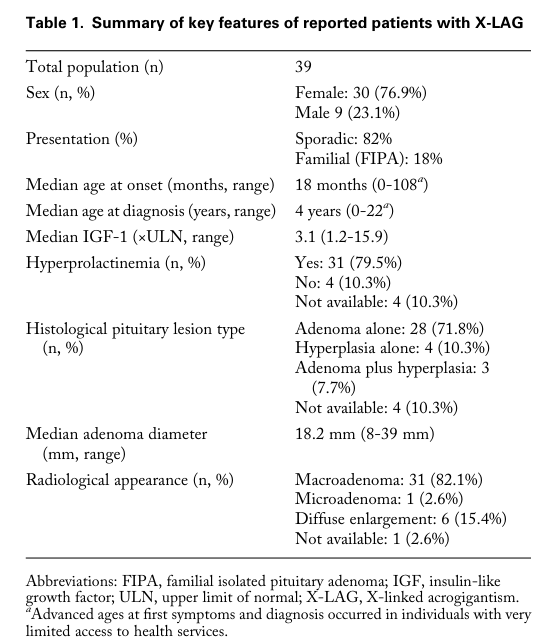
Table: This table summarizes key quantitative and mechanistic findings for GPR101/X-linked acrogigantism, used here as the closest evidence base for GPR101-related pituitary adenoma 2. It consolidates cohort statistics, pathology, mechanism, diagnostic interpretation, and relevant pediatric trial endpoints into a structured format for downstream knowledge-base use.
Cohort summary table from Daly & Beckers 2024 (Endocrine Reviews) was retrieved as an image (Table 1). (daly2024thegeneticpathophysiology media 4af4c0f4)
Key limitations of this report
- MONDO/Orphanet/ICD/MeSH identifiers were not retrieved in the current tool context; filling those would require dedicated ontology database queries.
- Some requested elements (environmental factors, QoL instruments specifically in X‑LAG, population prevalence/incidence rates) are not well established or not present in the retrieved evidence.
References
-
(daly2024thegeneticpathophysiology pages 1-1): Adrian F. Daly and Albert Beckers. The genetic pathophysiology and clinical management of the tadopathy, x-linked acrogigantism. Endocrine reviews, 45:737-754, May 2024. URL: https://doi.org/10.1210/endrev/bnae014, doi:10.1210/endrev/bnae014. This article has 16 citations and is from a domain leading peer-reviewed journal.
-
(iacovazzo2016germlineorsomatic pages 1-2): Donato Iacovazzo, Richard Caswell, Benjamin Bunce, Sian Jose, Bo Yuan, Laura C. Hernández-Ramírez, Sonal Kapur, Francisca Caimari, Jane Evanson, Francesco Ferraù, Mary N. Dang, Plamena Gabrovska, Sarah J. Larkin, Olaf Ansorge, Celia Rodd, Mary L. Vance, Claudia Ramírez-Renteria, Moisés Mercado, Anthony P. Goldstone, Michael Buchfelder, Christine P. Burren, Alper Gurlek, Pinaki Dutta, Catherine S. Choong, Timothy Cheetham, Giampaolo Trivellin, Constantine A. Stratakis, Maria-Beatriz Lopes, Ashley B. Grossman, Jacqueline Trouillas, James R. Lupski, Sian Ellard, Julian R. Sampson, Federico Roncaroli, and Márta Korbonits. Germline or somatic gpr101 duplication leads to x-linked acrogigantism: a clinico-pathological and genetic study. Acta Neuropathologica Communications, Jun 2016. URL: https://doi.org/10.1186/s40478-016-0328-1, doi:10.1186/s40478-016-0328-1. This article has 161 citations and is from a peer-reviewed journal.
-
(daly2024thegeneticpathophysiology pages 1-2): Adrian F. Daly and Albert Beckers. The genetic pathophysiology and clinical management of the tadopathy, x-linked acrogigantism. Endocrine reviews, 45:737-754, May 2024. URL: https://doi.org/10.1210/endrev/bnae014, doi:10.1210/endrev/bnae014. This article has 16 citations and is from a domain leading peer-reviewed journal.
-
(daly2024chromatinconformationcapture pages 7-9): Adrian F. Daly, Leslie A. Dunnington, David F. Rodriguez-Buritica, Erica Spiegel, Francesco Brancati, Giovanna Mantovani, Vandana M. Rawal, Fabio Rueda Faucz, Hadia Hijazi, Jean-Hubert Caberg, Anna Maria Nardone, Mario Bengala, Paola Fortugno, Giulia Del Sindaco, Marta Ragonese, Helen Gould, Salvatore Cannavò, Patrick Pétrossians, Andrea Lania, James R. Lupski, Albert Beckers, Constantine A. Stratakis, Brynn Levy, Giampaolo Trivellin, and Martin Franke. Chromatin conformation capture in the clinic: 4c-seq/hic distinguishes pathogenic from neutral duplications at the gpr101 locus. Genome Medicine, Sep 2024. URL: https://doi.org/10.1186/s13073-024-01378-5, doi:10.1186/s13073-024-01378-5. This article has 12 citations and is from a highest quality peer-reviewed journal.
-
(OpenTargets Search: pituitary adenoma,gigantism,acromegaly-GPR101): Open Targets Query (pituitary adenoma,gigantism,acromegaly-GPR101, 3 results). Buniello, A. et al. (2025). Open Targets Platform: facilitating therapeutic hypotheses building in drug discovery. Nucleic Acids Research.
-
(caruso2024casereportmanagement pages 2-4): Manuela Caruso, Diego Mazzatenta, Sofia Asioli, Giuseppe Costanza, Giampaolo Trivellin, Martin Franke, Dayana Abboud, Julien Hanson, Véronique Raverot, Patrick Pétrossians, Albert Beckers, Marco Cappa, and Adrian F. Daly. Case report: management of pediatric gigantism caused by the tadopathy, x-linked acrogigantism. Frontiers in Endocrinology, Feb 2024. URL: https://doi.org/10.3389/fendo.2024.1345363, doi:10.3389/fendo.2024.1345363. This article has 7 citations.
-
(iacovazzo2016germlineorsomatic pages 2-5): Donato Iacovazzo, Richard Caswell, Benjamin Bunce, Sian Jose, Bo Yuan, Laura C. Hernández-Ramírez, Sonal Kapur, Francisca Caimari, Jane Evanson, Francesco Ferraù, Mary N. Dang, Plamena Gabrovska, Sarah J. Larkin, Olaf Ansorge, Celia Rodd, Mary L. Vance, Claudia Ramírez-Renteria, Moisés Mercado, Anthony P. Goldstone, Michael Buchfelder, Christine P. Burren, Alper Gurlek, Pinaki Dutta, Catherine S. Choong, Timothy Cheetham, Giampaolo Trivellin, Constantine A. Stratakis, Maria-Beatriz Lopes, Ashley B. Grossman, Jacqueline Trouillas, James R. Lupski, Sian Ellard, Julian R. Sampson, Federico Roncaroli, and Márta Korbonits. Germline or somatic gpr101 duplication leads to x-linked acrogigantism: a clinico-pathological and genetic study. Acta Neuropathologica Communications, Jun 2016. URL: https://doi.org/10.1186/s40478-016-0328-1, doi:10.1186/s40478-016-0328-1. This article has 161 citations and is from a peer-reviewed journal.
-
(daly2024chromatinconformationcapture pages 1-2): Adrian F. Daly, Leslie A. Dunnington, David F. Rodriguez-Buritica, Erica Spiegel, Francesco Brancati, Giovanna Mantovani, Vandana M. Rawal, Fabio Rueda Faucz, Hadia Hijazi, Jean-Hubert Caberg, Anna Maria Nardone, Mario Bengala, Paola Fortugno, Giulia Del Sindaco, Marta Ragonese, Helen Gould, Salvatore Cannavò, Patrick Pétrossians, Andrea Lania, James R. Lupski, Albert Beckers, Constantine A. Stratakis, Brynn Levy, Giampaolo Trivellin, and Martin Franke. Chromatin conformation capture in the clinic: 4c-seq/hic distinguishes pathogenic from neutral duplications at the gpr101 locus. Genome Medicine, Sep 2024. URL: https://doi.org/10.1186/s13073-024-01378-5, doi:10.1186/s13073-024-01378-5. This article has 12 citations and is from a highest quality peer-reviewed journal.
-
(daly2024chromatinconformationcapture pages 6-7): Adrian F. Daly, Leslie A. Dunnington, David F. Rodriguez-Buritica, Erica Spiegel, Francesco Brancati, Giovanna Mantovani, Vandana M. Rawal, Fabio Rueda Faucz, Hadia Hijazi, Jean-Hubert Caberg, Anna Maria Nardone, Mario Bengala, Paola Fortugno, Giulia Del Sindaco, Marta Ragonese, Helen Gould, Salvatore Cannavò, Patrick Pétrossians, Andrea Lania, James R. Lupski, Albert Beckers, Constantine A. Stratakis, Brynn Levy, Giampaolo Trivellin, and Martin Franke. Chromatin conformation capture in the clinic: 4c-seq/hic distinguishes pathogenic from neutral duplications at the gpr101 locus. Genome Medicine, Sep 2024. URL: https://doi.org/10.1186/s13073-024-01378-5, doi:10.1186/s13073-024-01378-5. This article has 12 citations and is from a highest quality peer-reviewed journal.
-
(daly2024thegeneticpathophysiology pages 8-9): Adrian F. Daly and Albert Beckers. The genetic pathophysiology and clinical management of the tadopathy, x-linked acrogigantism. Endocrine reviews, 45:737-754, May 2024. URL: https://doi.org/10.1210/endrev/bnae014, doi:10.1210/endrev/bnae014. This article has 16 citations and is from a domain leading peer-reviewed journal.
-
(daly2024thegeneticpathophysiology pages 3-3): Adrian F. Daly and Albert Beckers. The genetic pathophysiology and clinical management of the tadopathy, x-linked acrogigantism. Endocrine reviews, 45:737-754, May 2024. URL: https://doi.org/10.1210/endrev/bnae014, doi:10.1210/endrev/bnae014. This article has 16 citations and is from a domain leading peer-reviewed journal.
-
(daly2024thegeneticpathophysiology pages 9-10): Adrian F. Daly and Albert Beckers. The genetic pathophysiology and clinical management of the tadopathy, x-linked acrogigantism. Endocrine reviews, 45:737-754, May 2024. URL: https://doi.org/10.1210/endrev/bnae014, doi:10.1210/endrev/bnae014. This article has 16 citations and is from a domain leading peer-reviewed journal.
-
(iacovazzo2016germlineorsomatic pages 7-9): Donato Iacovazzo, Richard Caswell, Benjamin Bunce, Sian Jose, Bo Yuan, Laura C. Hernández-Ramírez, Sonal Kapur, Francisca Caimari, Jane Evanson, Francesco Ferraù, Mary N. Dang, Plamena Gabrovska, Sarah J. Larkin, Olaf Ansorge, Celia Rodd, Mary L. Vance, Claudia Ramírez-Renteria, Moisés Mercado, Anthony P. Goldstone, Michael Buchfelder, Christine P. Burren, Alper Gurlek, Pinaki Dutta, Catherine S. Choong, Timothy Cheetham, Giampaolo Trivellin, Constantine A. Stratakis, Maria-Beatriz Lopes, Ashley B. Grossman, Jacqueline Trouillas, James R. Lupski, Sian Ellard, Julian R. Sampson, Federico Roncaroli, and Márta Korbonits. Germline or somatic gpr101 duplication leads to x-linked acrogigantism: a clinico-pathological and genetic study. Acta Neuropathologica Communications, Jun 2016. URL: https://doi.org/10.1186/s40478-016-0328-1, doi:10.1186/s40478-016-0328-1. This article has 161 citations and is from a peer-reviewed journal.
-
(daly2024thegeneticpathophysiology pages 10-11): Adrian F. Daly and Albert Beckers. The genetic pathophysiology and clinical management of the tadopathy, x-linked acrogigantism. Endocrine reviews, 45:737-754, May 2024. URL: https://doi.org/10.1210/endrev/bnae014, doi:10.1210/endrev/bnae014. This article has 16 citations and is from a domain leading peer-reviewed journal.
-
(daly2024thegeneticpathophysiology pages 13-14): Adrian F. Daly and Albert Beckers. The genetic pathophysiology and clinical management of the tadopathy, x-linked acrogigantism. Endocrine reviews, 45:737-754, May 2024. URL: https://doi.org/10.1210/endrev/bnae014, doi:10.1210/endrev/bnae014. This article has 16 citations and is from a domain leading peer-reviewed journal.
-
(iacovazzo2016germlineorsomatic pages 5-7): Donato Iacovazzo, Richard Caswell, Benjamin Bunce, Sian Jose, Bo Yuan, Laura C. Hernández-Ramírez, Sonal Kapur, Francisca Caimari, Jane Evanson, Francesco Ferraù, Mary N. Dang, Plamena Gabrovska, Sarah J. Larkin, Olaf Ansorge, Celia Rodd, Mary L. Vance, Claudia Ramírez-Renteria, Moisés Mercado, Anthony P. Goldstone, Michael Buchfelder, Christine P. Burren, Alper Gurlek, Pinaki Dutta, Catherine S. Choong, Timothy Cheetham, Giampaolo Trivellin, Constantine A. Stratakis, Maria-Beatriz Lopes, Ashley B. Grossman, Jacqueline Trouillas, James R. Lupski, Sian Ellard, Julian R. Sampson, Federico Roncaroli, and Márta Korbonits. Germline or somatic gpr101 duplication leads to x-linked acrogigantism: a clinico-pathological and genetic study. Acta Neuropathologica Communications, Jun 2016. URL: https://doi.org/10.1186/s40478-016-0328-1, doi:10.1186/s40478-016-0328-1. This article has 161 citations and is from a peer-reviewed journal.
-
(caruso2024casereportmanagement pages 4-6): Manuela Caruso, Diego Mazzatenta, Sofia Asioli, Giuseppe Costanza, Giampaolo Trivellin, Martin Franke, Dayana Abboud, Julien Hanson, Véronique Raverot, Patrick Pétrossians, Albert Beckers, Marco Cappa, and Adrian F. Daly. Case report: management of pediatric gigantism caused by the tadopathy, x-linked acrogigantism. Frontiers in Endocrinology, Feb 2024. URL: https://doi.org/10.3389/fendo.2024.1345363, doi:10.3389/fendo.2024.1345363. This article has 7 citations.
-
(daly2024thegeneticpathophysiology pages 11-12): Adrian F. Daly and Albert Beckers. The genetic pathophysiology and clinical management of the tadopathy, x-linked acrogigantism. Endocrine reviews, 45:737-754, May 2024. URL: https://doi.org/10.1210/endrev/bnae014, doi:10.1210/endrev/bnae014. This article has 16 citations and is from a domain leading peer-reviewed journal.
-
(wiseoringer2019familialxlinkedacrogigantism pages 1-2): Brittany K Wise-Oringer, George J Zanazzi, Rebecca J Gordon, Sharon L Wardlaw, Christopher William, Kwame Anyane-Yeboa, Wendy K Chung, Brenda Kohn, Jeffrey H Wisoff, Raphael David, and Sharon E Oberfield. Familial x-linked acrogigantism: postnatal outcomes and tumor pathology in a prenatally diagnosed infant and his mother. The Journal of clinical endocrinology and metabolism, 104:4667-4675, Oct 2019. URL: https://doi.org/10.1210/jc.2019-00817, doi:10.1210/jc.2019-00817. This article has 31 citations.
-
(naves2016aggressivetumorgrowth pages 2-5): Luciana A. Naves, Adrian F. Daly, Luiz Augusto Dias, Bo Yuan, Juliano Coelho Oliveira Zakir, Gustavo Barcellos Barra, Leonor Palmeira, Chiara Villa, Giampaolo Trivellin, Armindo Jreige Júnior, Florêncio Figueiredo Cavalcante Neto, Pengfei Liu, Natalia S. Pellegata, Constantine A. Stratakis, James R. Lupski, and Albert Beckers. Aggressive tumor growth and clinical evolution in a patient with x-linked acro-gigantism syndrome. Endocrine, 51:236-244, Feb 2016. URL: https://doi.org/10.1007/s12020-015-0804-6, doi:10.1007/s12020-015-0804-6. This article has 71 citations and is from a peer-reviewed journal.
-
(NCT03882034 chunk 1): Safety and Efficacy of Pegvisomant in Children With Growth Hormone Excess. Eunice Kennedy Shriver National Institute of Child Health and Human Development (NICHD). 2019. ClinicalTrials.gov Identifier: NCT03882034
-
(NCT02354508 chunk 2): Pasireotide in Patients With Acromegaly Inadequately Controlled With First Generation Somatostatin Analogues. Novartis Pharmaceuticals. 2015. ClinicalTrials.gov Identifier: NCT02354508
-
(daly2024thegeneticpathophysiology pages 5-6): Adrian F. Daly and Albert Beckers. The genetic pathophysiology and clinical management of the tadopathy, x-linked acrogigantism. Endocrine reviews, 45:737-754, May 2024. URL: https://doi.org/10.1210/endrev/bnae014, doi:10.1210/endrev/bnae014. This article has 16 citations and is from a domain leading peer-reviewed journal.
-
(abboud2020gpr101drivesgrowth pages 8-8): Dayana Abboud, Adrian F. Daly, Nadine Dupuis, Mohamed Ali Bahri, Asuka Inoue, Andy Chevigné, Fabien Ectors, Alain Plenevaux, Bernard Pirotte, Albert Beckers, and Julien Hanson. Gpr101 drives growth hormone hypersecretion and gigantism in mice via constitutive activation of gs and gq/11. Nature Communications, Sep 2020. URL: https://doi.org/10.1038/s41467-020-18500-x, doi:10.1038/s41467-020-18500-x. This article has 71 citations and is from a highest quality peer-reviewed journal.
-
(abboud2020gpr101drivesgrowth pages 2-3): Dayana Abboud, Adrian F. Daly, Nadine Dupuis, Mohamed Ali Bahri, Asuka Inoue, Andy Chevigné, Fabien Ectors, Alain Plenevaux, Bernard Pirotte, Albert Beckers, and Julien Hanson. Gpr101 drives growth hormone hypersecretion and gigantism in mice via constitutive activation of gs and gq/11. Nature Communications, Sep 2020. URL: https://doi.org/10.1038/s41467-020-18500-x, doi:10.1038/s41467-020-18500-x. This article has 71 citations and is from a highest quality peer-reviewed journal.
-
(abboud2020gpr101drivesgrowth pages 10-11): Dayana Abboud, Adrian F. Daly, Nadine Dupuis, Mohamed Ali Bahri, Asuka Inoue, Andy Chevigné, Fabien Ectors, Alain Plenevaux, Bernard Pirotte, Albert Beckers, and Julien Hanson. Gpr101 drives growth hormone hypersecretion and gigantism in mice via constitutive activation of gs and gq/11. Nature Communications, Sep 2020. URL: https://doi.org/10.1038/s41467-020-18500-x, doi:10.1038/s41467-020-18500-x. This article has 71 citations and is from a highest quality peer-reviewed journal.
-
(nadhamuni2020novelinsightsinto pages 10-11): Vinaya Srirangam Nadhamuni and Márta Korbonits. Novel insights into pituitary tumorigenesis: genetic and epigenetic mechanisms. Endocrine Reviews, 41:821-846, Mar 2020. URL: https://doi.org/10.1210/endrev/bnaa006, doi:10.1210/endrev/bnaa006. This article has 127 citations and is from a domain leading peer-reviewed journal.
-
(daly2024thegeneticpathophysiology pages 13-13): Adrian F. Daly and Albert Beckers. The genetic pathophysiology and clinical management of the tadopathy, x-linked acrogigantism. Endocrine reviews, 45:737-754, May 2024. URL: https://doi.org/10.1210/endrev/bnae014, doi:10.1210/endrev/bnae014. This article has 16 citations and is from a domain leading peer-reviewed journal.
-
(daly2024thegeneticpathophysiology pages 12-13): Adrian F. Daly and Albert Beckers. The genetic pathophysiology and clinical management of the tadopathy, x-linked acrogigantism. Endocrine reviews, 45:737-754, May 2024. URL: https://doi.org/10.1210/endrev/bnae014, doi:10.1210/endrev/bnae014. This article has 16 citations and is from a domain leading peer-reviewed journal.
-
(NCT03882034 chunk 2): Safety and Efficacy of Pegvisomant in Children With Growth Hormone Excess. Eunice Kennedy Shriver National Institute of Child Health and Human Development (NICHD). 2019. ClinicalTrials.gov Identifier: NCT03882034
-
(daly2024thegeneticpathophysiology media 4af4c0f4): Adrian F. Daly and Albert Beckers. The genetic pathophysiology and clinical management of the tadopathy, x-linked acrogigantism. Endocrine reviews, 45:737-754, May 2024. URL: https://doi.org/10.1210/endrev/bnae014, doi:10.1210/endrev/bnae014. This article has 16 citations and is from a domain leading peer-reviewed journal.
-
(daly2024chromatinconformationcapture pages 9-10): Adrian F. Daly, Leslie A. Dunnington, David F. Rodriguez-Buritica, Erica Spiegel, Francesco Brancati, Giovanna Mantovani, Vandana M. Rawal, Fabio Rueda Faucz, Hadia Hijazi, Jean-Hubert Caberg, Anna Maria Nardone, Mario Bengala, Paola Fortugno, Giulia Del Sindaco, Marta Ragonese, Helen Gould, Salvatore Cannavò, Patrick Pétrossians, Andrea Lania, James R. Lupski, Albert Beckers, Constantine A. Stratakis, Brynn Levy, Giampaolo Trivellin, and Martin Franke. Chromatin conformation capture in the clinic: 4c-seq/hic distinguishes pathogenic from neutral duplications at the gpr101 locus. Genome Medicine, Sep 2024. URL: https://doi.org/10.1186/s13073-024-01378-5, doi:10.1186/s13073-024-01378-5. This article has 12 citations and is from a highest quality peer-reviewed journal.
-
(daly2024chromatinconformationcapture pages 4-6): Adrian F. Daly, Leslie A. Dunnington, David F. Rodriguez-Buritica, Erica Spiegel, Francesco Brancati, Giovanna Mantovani, Vandana M. Rawal, Fabio Rueda Faucz, Hadia Hijazi, Jean-Hubert Caberg, Anna Maria Nardone, Mario Bengala, Paola Fortugno, Giulia Del Sindaco, Marta Ragonese, Helen Gould, Salvatore Cannavò, Patrick Pétrossians, Andrea Lania, James R. Lupski, Albert Beckers, Constantine A. Stratakis, Brynn Levy, Giampaolo Trivellin, and Martin Franke. Chromatin conformation capture in the clinic: 4c-seq/hic distinguishes pathogenic from neutral duplications at the gpr101 locus. Genome Medicine, Sep 2024. URL: https://doi.org/10.1186/s13073-024-01378-5, doi:10.1186/s13073-024-01378-5. This article has 12 citations and is from a highest quality peer-reviewed journal.
-
(abboud2020gpr101drivesgrowth pages 1-2): Dayana Abboud, Adrian F. Daly, Nadine Dupuis, Mohamed Ali Bahri, Asuka Inoue, Andy Chevigné, Fabien Ectors, Alain Plenevaux, Bernard Pirotte, Albert Beckers, and Julien Hanson. Gpr101 drives growth hormone hypersecretion and gigantism in mice via constitutive activation of gs and gq/11. Nature Communications, Sep 2020. URL: https://doi.org/10.1038/s41467-020-18500-x, doi:10.1038/s41467-020-18500-x. This article has 71 citations and is from a highest quality peer-reviewed journal.
-
(abboud2020gpr101drivesgrowth pages 8-9): Dayana Abboud, Adrian F. Daly, Nadine Dupuis, Mohamed Ali Bahri, Asuka Inoue, Andy Chevigné, Fabien Ectors, Alain Plenevaux, Bernard Pirotte, Albert Beckers, and Julien Hanson. Gpr101 drives growth hormone hypersecretion and gigantism in mice via constitutive activation of gs and gq/11. Nature Communications, Sep 2020. URL: https://doi.org/10.1038/s41467-020-18500-x, doi:10.1038/s41467-020-18500-x. This article has 71 citations and is from a highest quality peer-reviewed journal.