Woodhouse-Sakati Syndrome
Woodhouse-Sakati syndrome (WSS) is a rare autosomal recessive multisystem neuroendocrine disorder caused by biallelic pathogenic variants in DCAF17. DCAF17 is a nucleolar protein and a member of the DCAF family, but its normal human function and the mechanism linking its loss to the multisystem disease remain unresolved. Hypogonadism and childhood-onset progressive alopecia are characteristic; variably progressive neurologic manifestations include dystonia, dysarthria, dysphagia, sensorineural hearing loss, and intellectual disability. Diabetes mellitus, hypothyroidism, low circulating IGF-1, basal ganglia iron accumulation, and cerebral white-matter lesions are also recognized. WSS is classified within the neurodegeneration with brain iron accumulation (NBIA) spectrum, although MRI abnormalities are not universal.
Ask OpenScientist
Ask a research question about Woodhouse-Sakati Syndrome. OpenScientist will conduct autonomous deep research using the Disorder Mechanisms Knowledge Base and PubMed literature (typically 10-30 minutes).
Do not include personal health information in your question. Questions and results are cached in your browser's local storage.
Inheritance
1Show evidence (2 references)
Subtypes
2Show evidence (2 references)
Show evidence (2 references)
Mechanistic Hypotheses
1Show evidence (2 references)
Discussions and Knowledge Gaps
2Show evidence (1 reference)
Show evidence (1 reference)
Pathophysiology
4Show evidence (2 references)
Show evidence (1 reference)
Show evidence (1 reference)
Show evidence (1 reference)
Pathograph
Phenotypes
15Digestive 1
Show evidence (1 reference)
Ear 1
Show evidence (2 references)
Endocrine 4
Show evidence (2 references)
Show evidence (3 references)
Show evidence (2 references)
Show evidence (1 reference)
Genitourinary 2
Show evidence (2 references)
Show evidence (1 reference)
Integument 1
Show evidence (1 reference)
Nervous System 6
Show evidence (2 references)
Show evidence (2 references)
Show evidence (3 references)
Show evidence (1 reference)
Show evidence (2 references)
Show evidence (3 references)
Genetic Associations
1Show evidence (5 references)
Medical Actions
7Show evidence (2 references)
Show evidence (1 reference)
Show evidence (1 reference)
Show evidence (3 references)
Show evidence (3 references)
Show evidence (2 references)
Show evidence (2 references)
Diagnosis
2Show evidence (1 reference)
Show evidence (2 references)
Imaging Findings
3Show evidence (2 references)
Show evidence (2 references)
Show evidence (1 reference)
Progression
1Show evidence (3 references)
Prevalence
1Show evidence (3 references)
Differential Diagnoses
4Conditions with similar clinical presentations that must be differentiated from Woodhouse-Sakati Syndrome:
- WSS combines a movement disorder with hypogonadism and progressive alopecia.
- WSS is caused by biallelic DCAF17 variants rather than other NBIA genes.
Show evidence (1 reference)
- Perrault syndrome is defined by sensorineural hearing loss in males and females and gonadal dysgenesis in females.
- A molecular diagnosis in a Perrault-associated gene distinguishes it from biallelic DCAF17-related WSS.
Show evidence (1 reference)
- Gordon Holmes syndrome is defined by early-onset ataxia, hypogonadism, and brisk reflexes.
- Its ataxia-predominant pattern with brisk reflexes differs from the dystonia-predominant WSS pattern.
Show evidence (1 reference)
- DDON syndrome is an X-linked TIMM8A disorder characterized by early-onset deafness and dystonia.
- TIMM8A testing and X-linked inheritance distinguish DDON from DCAF17-related WSS.
Show evidence (4 references)
Clinical Trials
1Show evidence (1 reference)
Animal Models
1Show evidence (2 references)
Source YAML
click to showname: Woodhouse-Sakati Syndrome
creation_date: "2026-06-03T00:00:00Z"
description: >-
Woodhouse-Sakati syndrome (WSS) is a rare autosomal recessive multisystem
neuroendocrine disorder caused by biallelic pathogenic variants in DCAF17.
DCAF17 is a nucleolar protein and a member of the DCAF family, but its normal
human function and the mechanism linking its loss to the multisystem disease
remain unresolved. Hypogonadism and childhood-onset progressive alopecia are
characteristic; variably progressive neurologic manifestations include
dystonia, dysarthria, dysphagia, sensorineural hearing loss, and intellectual
disability. Diabetes mellitus, hypothyroidism, low circulating IGF-1, basal
ganglia iron accumulation, and cerebral white-matter lesions are also
recognized. WSS is classified within the neurodegeneration with brain iron
accumulation (NBIA) spectrum, although MRI abnormalities are not universal.
category: Mendelian
parents:
- hereditary disease
- neurodegeneration with brain iron accumulation
disease_term:
preferred_term: Woodhouse-Sakati syndrome
term:
id: MONDO:0009419
label: Woodhouse-Sakati syndrome
references:
- reference: PMID:27489925
title: "Woodhouse-Sakati Syndrome."
tags:
- GeneReviews
- reference: PMID:36721231
title: "Genetic epidemiology of Woodhouse-Sakati Syndrome in the Greater Middle East region and beyond: a systematic review."
- reference: PMID:31726291
title: "Patterns of neurological manifestations in Woodhouse-Sakati Syndrome."
- reference: PMID:35002959
title: "Case Report: A Chinese Family of Woodhouse-Sakati Syndrome With Diabetes Mellitus, With a Novel Biallelic Deletion Mutation of the DCAF17 Gene."
- reference: PMID:37895404
title: "The Successful Management of Primary Amenorrhea in Woodhouse-Sakati Syndrome: A Case Report and a Literature Review."
- reference: PMID:39342163
title: "Woodhouse-sakati syndrome with no reportable MRI findings: a case report."
- reference: PMID:38320940
title: "Woodhouse-Sakati syndrome: A review."
- reference: PMID:39239833
title: "Single-cell RNA sequencing reveals the important role of Dcaf17 in spermatogenesis of golden hamsters."
- reference: PMID:40235137
title: "Clinical and Genetic Characterization of Woodhouse-Sakati Syndrome in Iranian Patients: A Case Series."
- reference: PMID:19026396
title: "Mutations in C2orf37, encoding a nucleolar protein, cause hypogonadism, alopecia, diabetes mellitus, mental retardation, and extrapyramidal syndrome."
- reference: PMID:20507343
title: "C2orf37 mutational spectrum in Woodhouse-Sakati syndrome patients."
- reference: PMID:24464444
title: "Endocrine disorders in Woodhouse-Sakati syndrome: a systematic review of the literature."
- reference: PMID:30409855
title: "Brain MR Imaging Findings in Woodhouse-Sakati Syndrome."
- reference: PMID:31347785
title: "Woodhouse-Sakati Syndrome: First report of a Portuguese case."
- reference: PMID:34590781
title: "Expanding on the phenotypic spectrum of Woodhouse-Sakati syndrome due to founder pathogenic variant in DCAF17: Report of 58 additional patients from Qatar and literature review."
- reference: PMID:41902420
title: "Long-Term Outcomes of Deep Brain Stimulation in Woodhouse-Sakati Syndrome."
- reference: DOI:10.1159/000552786
title: "Clinical and Molecular Findings in Two Siblings with a Novel Homozygous DCAF17 Frameshift Variant and Review of the Literature– A Case Report"
- reference: PMID:32423379
title: "LARS2-Perrault syndrome: a new case report and literature review."
- reference: PMID:24355708
title: "PNPLA6 mutations cause Boucher-Neuhauser and Gordon Holmes syndromes as part of a broad neurodegenerative spectrum."
- reference: PMID:23418071
title: "The syndrome of deafness-dystonia: clinical and genetic heterogeneity."
- reference: PMID:31903733
title: "Functional analysis of a novel mutation in the TIMM8A gene that causes deafness-dystonia-optic neuronopathy syndrome."
inheritance:
- name: Autosomal recessive inheritance
inheritance_term:
preferred_term: Autosomal recessive inheritance
term:
id: HP:0000007
label: Autosomal recessive inheritance
description: >-
WSS is caused by biallelic pathogenic variants in DCAF17 and is inherited in
an autosomal recessive manner. Published families are concentrated in the
Greater Middle East, where consanguinity is common, but no population-based
prevalence comparison is available.
evidence:
- reference: PMID:27489925
reference_title: "Woodhouse-Sakati Syndrome."
supports: SUPPORT
evidence_source: HUMAN_CLINICAL
snippet: >-
WSS is inherited in an autosomal recessive manner.
explanation: >-
The GeneReviews chapter directly states the autosomal recessive
inheritance pattern.
- reference: PMID:36721231
reference_title: "Genetic epidemiology of Woodhouse-Sakati Syndrome in the Greater Middle East region and beyond: a systematic review."
supports: SUPPORT
evidence_source: HUMAN_CLINICAL
snippet: >-
Woodhouse-Sakati syndrome (WSS) is a rare, autosomal recessive genetic disorder with variable clinical manifestations mainly affecting the endocrine and nervous systems.
explanation: >-
This systematic review confirms autosomal recessive inheritance with
variable expressivity.
has_subtypes:
- name: Type 1
display_name: Type 1 (Rapidly Progressive Neurologic)
description: >-
Disabling, rapidly progressive neurological pattern (Neurological Impairment
Scale [NIS] 3-4) seen in roughly 47% of patients, with severe disability
within a mean of ~7.4 years and earlier onset of neurological manifestations
(mean 12.6 years). Type 1 has a significantly higher rate of intellectual
disability.
evidence:
- reference: PMID:31726291
reference_title: "Patterns of neurological manifestations in Woodhouse-Sakati Syndrome."
supports: SUPPORT
evidence_source: HUMAN_CLINICAL
snippet: >-
A disabling, rapidly progressive pattern (NIS of 3-4; Type 1) was noted in eighteen patients (12 males, 6 females; 47.4%) with severe disability that occurs within a mean duration of 7.4 ± 3.6 years.
explanation: >-
Bohlega 2019 defines Type 1 as the rapidly progressive, disabling
neurological pattern.
- reference: PMID:31726291
reference_title: "Patterns of neurological manifestations in Woodhouse-Sakati Syndrome."
supports: SUPPORT
evidence_source: HUMAN_CLINICAL
snippet: >-
The mean age of onset for neurological manifestations was earlier in type 1 (12.6 ± 4.5 years) compared to type 2 (18.1 ± 4.3 years). Type 1 WSS has a significantly higher rate of intellectual disability (p= <0.001).
explanation: >-
The cohort directly supports both the earlier mean neurologic onset and
greater intellectual-disability burden in Type 1.
- name: Type 2
display_name: Type 2 (Mild Neurologic)
description: >-
Absent or mild neurological involvement (Neurological Impairment Scale [NIS]
0-1) seen in roughly 53% of patients, with preserved activities of daily
living and later onset of neurological manifestations (mean 18.1 years).
evidence:
- reference: PMID:31726291
reference_title: "Patterns of neurological manifestations in Woodhouse-Sakati Syndrome."
supports: SUPPORT
evidence_source: HUMAN_CLINICAL
snippet: >-
Type 2 WSS was identified in twenty patients (8 males, 12 females; 52.6%), and showed either absent or mild neurological involvement with preserved activities of daily living (NIS of 0-1).
explanation: >-
Bohlega 2019 defines Type 2 as the mild or absent neurological
involvement pattern.
- reference: PMID:31726291
reference_title: "Patterns of neurological manifestations in Woodhouse-Sakati Syndrome."
supports: SUPPORT
evidence_source: HUMAN_CLINICAL
snippet: >-
The mean age of onset for neurological manifestations was earlier in type 1 (12.6 ± 4.5 years) compared to type 2 (18.1 ± 4.3 years).
explanation: >-
The cohort directly supports the later mean neurologic onset reported for
Type 2.
prevalence:
- population: Worldwide published literature through June 2022
measure_type: CASES_IN_LITERATURE
prevalence_class: ULTRA_RARE
notes: >-
No population-based prevalence estimate is available. A systematic review
through June 2022 identified 185 affected individuals from 97 families in
12 countries; ascertainment is concentrated in consanguineous families from
the Greater Middle East and is not a population prevalence denominator.
evidence:
- reference: PMID:36721231
reference_title: "Genetic epidemiology of Woodhouse-Sakati Syndrome in the Greater Middle East region and beyond: a systematic review."
supports: SUPPORT
evidence_source: HUMAN_CLINICAL
snippet: >-
One hundred and eighty-five patients in 97 families from 12 different countries were diagnosed with WSS.
explanation: >-
This systematic literature count documents the small published case base
but is not a population prevalence denominator.
- reference: PMID:36721231
reference_title: "Genetic epidemiology of Woodhouse-Sakati Syndrome in the Greater Middle East region and beyond: a systematic review."
supports: SUPPORT
evidence_source: HUMAN_CLINICAL
snippet: >-
Woodhouse-Sakati syndrome (WSS) is a rare, autosomal recessive genetic disorder with variable clinical manifestations mainly affecting the endocrine and nervous systems.
explanation: >-
The systematic review explicitly describes WSS as rare and supplies
independent published-case context.
- reference: DOI:10.1159/000552786
reference_title: "Clinical and Molecular Findings in Two Siblings with a Novel Homozygous DCAF17 Frameshift Variant and Review of the Literature– A Case Report"
supports: SUPPORT
evidence_source: HUMAN_CLINICAL
snippet: >-
Introduction: Woodhouse–Sakati syndrome (WSS) is an ultra-rare autosomal recessive multisystem disorder caused by biallelic pathogenic variants in DCAF17.
explanation: >-
This peer-reviewed abstract explicitly classifies WSS as ultra-rare,
supporting ULTRA_RARE independently of the separate 185-patient
literature count.
progression:
- age_range: Childhood through adulthood
notes: >-
Hair thinning begins in childhood and can progress to alopecia totalis;
hypogonadism becomes evident at puberty. Neurologic disease usually begins
in adolescence but is heterogeneous: a rapidly progressive subgroup
develops severe disability over a mean of 7.4 years, whereas another
subgroup has absent or mild neurologic involvement with preserved daily
function. Dystonia and diabetes become more prevalent with age, so an
initially mild examination does not exclude later complications.
evidence:
- reference: PMID:27489925
reference_title: "Woodhouse-Sakati Syndrome."
supports: SUPPORT
evidence_source: HUMAN_CLINICAL
snippet: >-
Virtually all individuals with Woodhouse-Sakati syndrome (WSS) have the endocrine findings of hypogonadism (evident at puberty) and progressive childhood-onset hair thinning that often progresses to alopecia totalis in adulthood
explanation: >-
GeneReviews defines the characteristic childhood-to-adult ectodermal and
pubertal endocrine course.
- reference: PMID:31726291
reference_title: "Patterns of neurological manifestations in Woodhouse-Sakati Syndrome."
supports: SUPPORT
evidence_source: HUMAN_CLINICAL
snippet: >-
A disabling, rapidly progressive pattern (NIS of 3-4; Type 1) was noted in eighteen patients (12 males, 6 females; 47.4%) with severe disability that occurs within a mean duration of 7.4 ± 3.6 years.
explanation: >-
This cohort quantifies the rapidly progressive neurologic trajectory.
- reference: PMID:24464444
reference_title: "Endocrine disorders in Woodhouse-Sakati syndrome: a systematic review of the literature."
supports: SUPPORT
evidence_source: HUMAN_CLINICAL
snippet: >-
some patients exhibited intellectual disabilities of varying severity (87 %), bilateral deafness (76 %), cervicofacial dystonia and limb pain (42 % of cases, rising to 89 % after 25 years) and diabetes (66 %, rising to 96 % after 25 years).
explanation: >-
The systematic review documents age-dependent increases in dystonia and
diabetes among published cases.
mechanistic_hypotheses:
- hypothesis_group_id: dcaf17_crl4_proteostasis_model
hypothesis_label: CRL4-DCAF17-dependent proteostasis model
status: EMERGING
description: >-
An emerging model proposes that DCAF17 acts as a CRL4 ubiquitin-ligase
substrate receptor and that loss of this function disrupts protein
degradation. The direct experimental support is limited to Dcaf17-deficient
golden-hamster spermatogenic cells. It has not established the causal bridge
to human neurologic, endocrine, auditory, or ectodermal manifestations, and
both the founding human study and a systematic endocrine review describe
DCAF17 function or WSS pathophysiology as unresolved.
evidence:
- reference: PMID:39239833
reference_title: "Single-cell RNA sequencing reveals the important role of Dcaf17 in spermatogenesis of golden hamsters."
supports: SUPPORT
evidence_source: MODEL_ORGANISM
snippet: >-
These data emphasize the significant regulatory role played by Dcaf17 in early spermatogenic cells, with many biological processes being affected, including spermatogenesis and protein degradation.
explanation: >-
The hamster model supplies organ- and cell-type-specific support for the
proposed protein-degradation arm.
- reference: PMID:24464444
reference_title: "Endocrine disorders in Woodhouse-Sakati syndrome: a systematic review of the literature."
supports: SUPPORT
evidence_source: HUMAN_CLINICAL
snippet: >-
The pathophysiology of WSS remains unclear.
explanation: >-
Human review literature explicitly bounds this model as an unresolved
hypothesis rather than an established systemic mechanism.
pathophysiology:
- name: Biallelic DCAF17 loss and nucleolar involvement
description: >-
Biallelic loss-of-function variants in DCAF17 cause WSS. The founding human
study localized the encoded protein to the nucleolus and observed a cellular
phenotype in patient lymphoblasts that implicated nucleolar dysfunction,
while explicitly describing the protein's function as unknown.
genes:
- preferred_term: DCAF17
term:
id: hgnc:25784
label: DCAF17
evidence:
- reference: PMID:19026396
reference_title: "Mutations in C2orf37, encoding a nucleolar protein, cause hypogonadism, alopecia, diabetes mellitus, mental retardation, and extrapyramidal syndrome."
supports: SUPPORT
evidence_source: HUMAN_CLINICAL
snippet: >-
We have identified a founder mutation consisting of a single base-pair deletion in C2orf37 in eight families of Saudi origin. Three other loss-of-function mutations were subsequently discovered in patients of different ethnicities.
explanation: >-
The founding human genetic study establishes multiple disease-associated
loss-of-function variants across families and ethnicities.
- reference: PMID:19026396
reference_title: "Mutations in C2orf37, encoding a nucleolar protein, cause hypogonadism, alopecia, diabetes mellitus, mental retardation, and extrapyramidal syndrome."
supports: SUPPORT
evidence_source: IN_VITRO
snippet: >-
The gene encodes a nucleolar protein of unknown function, and the cellular phenotype observed in patient lymphoblasts implicates a role for the nucleolus in the pathogenesis of this disease.
explanation: >-
This is patient-derived lymphoblast cellular evidence for nucleolar
involvement and explicitly preserves the unresolved normal function of
DCAF17.
downstream:
- target: Unresolved multisystem tissue dysfunction
description: >-
Unknown intermediates connect DCAF17 loss and nucleolar involvement to
the human multisystem phenotype.
causal_link_type: INDIRECT_UNKNOWN_INTERMEDIATES
- target: Putative CRL4-dependent proteostasis disruption
description: >-
A model-organism study supports a possible CRL4/protein-degradation arm,
but this edge has not been demonstrated in affected human tissues.
causal_link_type: UNKNOWN
hypothesis_groups:
- dcaf17_crl4_proteostasis_model
evidence:
- reference: PMID:39239833
reference_title: "Single-cell RNA sequencing reveals the important role of Dcaf17 in spermatogenesis of golden hamsters."
supports: SUPPORT
evidence_source: MODEL_ORGANISM
snippet: >-
Dcaf17, also known as DDB1- and CUL4-associated factor 17, is a member of the DCAF family and acts as the receptor for the CRL4 ubiquitin E3 ligase complex.
explanation: >-
Supports the proposed molecular role in hamster while leaving the human
disease edge unconfirmed.
- name: Putative CRL4-dependent proteostasis disruption
description: >-
Dcaf17-deficient golden-hamster spermatogenic cells show transcriptional
disruption of protein-degradation programs. This is curated as an emerging,
model-specific mechanism and not as a settled explanation for human WSS.
biological_processes:
- preferred_term: ubiquitin-dependent protein catabolic process
term:
id: GO:0006511
label: ubiquitin-dependent protein catabolic process
modifier: ABNORMAL
evidence:
- reference: PMID:39239833
reference_title: "Single-cell RNA sequencing reveals the important role of Dcaf17 in spermatogenesis of golden hamsters."
supports: SUPPORT
evidence_source: MODEL_ORGANISM
snippet: >-
These data emphasize the significant regulatory role played by Dcaf17 in early spermatogenic cells, with many biological processes being affected, including spermatogenesis and protein degradation.
explanation: >-
Directly supports altered protein-degradation programs in the model's
early spermatogenic cells.
downstream:
- target: Male infertility
description: >-
Dcaf17 deletion causes abnormal spermatogenesis and infertility in male
golden hamsters, but the study does not establish that altered
CRL4-dependent protein degradation mediates that phenotype or that this
model edge explains human male infertility.
causal_link_type: INDIRECT_UNKNOWN_INTERMEDIATES
hypothesis_groups:
- dcaf17_crl4_proteostasis_model
evidence:
- reference: PMID:39239833
reference_title: "Single-cell RNA sequencing reveals the important role of Dcaf17 in spermatogenesis of golden hamsters."
supports: SUPPORT
evidence_source: MODEL_ORGANISM
snippet: >-
deletion of Dcaf17 led to abnormal spermatogenesis and infertility
explanation: >-
The engineered hamster establishes the reproductive phenotype after
Dcaf17 deletion, but not the proposed CRL4/proteostasis intermediate or
its translation to human infertility.
- name: Unresolved multisystem tissue dysfunction
description: >-
DCAF17 loss is clinically associated with endocrine, neural, auditory, and
ectodermal disease, but the tissue-specific molecular intermediates are not
known. This node preserves phenotype connectivity without treating the
emerging hamster proteostasis result as a proven systemic human mechanism.
evidence:
- reference: PMID:24464444
reference_title: "Endocrine disorders in Woodhouse-Sakati syndrome: a systematic review of the literature."
supports: SUPPORT
evidence_source: HUMAN_CLINICAL
snippet: >-
The pathophysiology of WSS remains unclear.
explanation: >-
The review explicitly establishes the unresolved state of the disease
mechanism.
downstream:
- target: Hypogonadism
description: The intermediates producing gonadal dysfunction are unknown.
causal_link_type: INDIRECT_UNKNOWN_INTERMEDIATES
- target: Primary amenorrhea
description: The intermediates producing absent pubertal menses are unknown.
causal_link_type: INDIRECT_UNKNOWN_INTERMEDIATES
- target: Alopecia
description: The intermediates producing hair-follicle dysfunction are unknown.
causal_link_type: INDIRECT_UNKNOWN_INTERMEDIATES
- target: Progressive extrapyramidal movement disorder
description: The intermediates producing progressive movement disease are unknown.
causal_link_type: INDIRECT_UNKNOWN_INTERMEDIATES
- target: Dystonia
description: The intermediates producing dystonia are unknown.
causal_link_type: INDIRECT_UNKNOWN_INTERMEDIATES
- target: Intellectual disability
description: The neurodevelopmental intermediates are unknown.
causal_link_type: INDIRECT_UNKNOWN_INTERMEDIATES
- target: Sensorineural hearing impairment
description: The intermediates producing auditory dysfunction are unknown.
causal_link_type: INDIRECT_UNKNOWN_INTERMEDIATES
- target: Hypothyroidism
description: The intermediates producing thyroid dysfunction are unknown.
causal_link_type: INDIRECT_UNKNOWN_INTERMEDIATES
- target: Dysarthria
description: The intermediates producing dysarthria are unknown.
causal_link_type: INDIRECT_UNKNOWN_INTERMEDIATES
- target: Dysphagia
description: The intermediates producing dysphagia are unknown.
causal_link_type: INDIRECT_UNKNOWN_INTERMEDIATES
- target: Abnormal cerebral white matter morphology
description: The mechanism of progressive white-matter injury is unknown.
causal_link_type: INDIRECT_UNKNOWN_INTERMEDIATES
- target: Iron accumulation in brain
description: The mechanism of regional brain iron accumulation is unknown.
causal_link_type: INDIRECT_UNKNOWN_INTERMEDIATES
- target: Decreased circulating IGF-1 concentration
description: The mechanism of low circulating IGF-1 is unknown.
causal_link_type: INDIRECT_UNKNOWN_INTERMEDIATES
- target: Pancreatic beta cell dysfunction
description: >-
Human physiologic observations suggest impaired insulin secretion, but
the link from DCAF17 loss to beta-cell dysfunction is unknown.
causal_link_type: INDIRECT_UNKNOWN_INTERMEDIATES
evidence:
- reference: PMID:35002959
reference_title: "Case Report: A Chinese Family of Woodhouse-Sakati Syndrome With Diabetes Mellitus, With a Novel Biallelic Deletion Mutation of the DCAF17 Gene."
supports: SUPPORT
evidence_source: HUMAN_CLINICAL
snippet: >-
These findings indicate that the DCAF17 gene mutation may cause pancreatic β cell functional impairment and contribute to the development of diabetes.
explanation: >-
The authors propose beta-cell impairment from two affected individuals;
the upstream molecular intermediate remains unknown.
- name: Pancreatic beta cell dysfunction
description: >-
DCAF17 deficiency is associated with impaired pancreatic beta-cell function.
Affected individuals show reduced insulin and C-peptide release after glucose
stimulation, implicating beta-cell secretory failure in the diabetes mellitus
of WSS.
cell_types:
- preferred_term: pancreatic beta cell
term:
id: CL:0000169
label: type B pancreatic cell
biological_processes:
- preferred_term: insulin secretion
term:
id: GO:0030073
label: insulin secretion
modifier: DECREASED
evidence:
- reference: PMID:35002959
reference_title: "Case Report: A Chinese Family of Woodhouse-Sakati Syndrome With Diabetes Mellitus, With a Novel Biallelic Deletion Mutation of the DCAF17 Gene."
supports: SUPPORT
evidence_source: HUMAN_CLINICAL
snippet: >-
We found that the two patients exhibited low insulin and C-peptide release after glucose stimulation by insulin and C-peptide release tests.
explanation: >-
Reduced insulin and C-peptide responses to glucose demonstrate impaired
beta-cell secretory function in WSS patients.
downstream:
- target: Diabetes mellitus
description: >-
Beta-cell secretory failure produces insulin deficiency and diabetes
mellitus.
causal_link_type: DIRECT
evidence:
- reference: PMID:35002959
reference_title: "Case Report: A Chinese Family of Woodhouse-Sakati Syndrome With Diabetes Mellitus, With a Novel Biallelic Deletion Mutation of the DCAF17 Gene."
supports: SUPPORT
evidence_source: HUMAN_CLINICAL
snippet: >-
These findings indicate that the DCAF17 gene mutation may cause pancreatic β cell functional impairment and contribute to the development of diabetes.
explanation: >-
The authors directly link DCAF17-related beta-cell impairment to the
development of diabetes mellitus.
phenotypes:
- name: Hypogonadism
category: Endocrine
description: >-
Hypogonadism, evident at puberty, is a near-universal feature of WSS and
affects both sexes. The reported gonadotropin pattern is variable: primary
(hypergonadotropic) hypogonadism and primary amenorrhea are documented, so
the phenotype should not be restricted to hypogonadotropic disease.
phenotype_term:
preferred_term: Hypogonadism
term:
id: HP:0000135
label: Hypogonadism
frequency: VERY_FREQUENT
evidence:
- reference: PMID:27489925
reference_title: "Woodhouse-Sakati Syndrome."
supports: SUPPORT
evidence_source: HUMAN_CLINICAL
snippet: >-
Virtually all individuals with Woodhouse-Sakati syndrome (WSS) have the endocrine findings of hypogonadism (evident at puberty)
explanation: >-
GeneReviews documents hypogonadism in virtually all individuals,
supporting VERY_FREQUENT.
- reference: PMID:31347785
reference_title: "Woodhouse-Sakati Syndrome: First report of a Portuguese case."
supports: SUPPORT
evidence_source: HUMAN_CLINICAL
snippet: >-
She also had hypergonadotrophic hypogonadism associated with primary amenorrhea
explanation: >-
This genetically confirmed case demonstrates primary hypergonadotropic
hypogonadism and supports use of the broader HPO term.
- name: Alopecia
category: Integumentary
description: >-
Progressive childhood-onset hair thinning that often progresses to alopecia
totalis in adulthood is a near-universal ectodermal feature of WSS.
phenotype_term:
preferred_term: Alopecia
term:
id: HP:0001596
label: Alopecia
clinical_course: PROGRESSIVE
frequency: VERY_FREQUENT
evidence:
- reference: PMID:27489925
reference_title: "Woodhouse-Sakati Syndrome."
supports: SUPPORT
evidence_source: HUMAN_CLINICAL
snippet: >-
Virtually all individuals with Woodhouse-Sakati syndrome (WSS) have the endocrine findings of hypogonadism (evident at puberty) and progressive childhood-onset hair thinning that often progresses to alopecia totalis in adulthood
explanation: >-
GeneReviews documents progressive alopecia as a near-universal feature,
affecting virtually all individuals, supporting VERY_FREQUENT.
- name: Primary amenorrhea
category: Reproductive
description: >-
Primary amenorrhea is a recognized presentation of hypogonadism in affected
females and may be the clinical feature that prompts pubertal induction and
molecular diagnosis; its population frequency has not been established.
phenotype_term:
preferred_term: Primary amenorrhea
term:
id: HP:0000786
label: Primary amenorrhea
evidence:
- reference: PMID:37895404
reference_title: "The Successful Management of Primary Amenorrhea in Woodhouse-Sakati Syndrome: A Case Report and a Literature Review."
supports: SUPPORT
evidence_source: HUMAN_CLINICAL
snippet: >-
We report a 19-year-old Saudi female referred to the gynecology clinic at the age of 16 as a case of primary amenorrhea. The patient underwent a genetic analysis, which revealed mutations in the DCAF17 gene, confirming the diagnosis of WSS.
explanation: >-
Documents primary amenorrhea in a molecularly confirmed patient.
- reference: PMID:31347785
reference_title: "Woodhouse-Sakati Syndrome: First report of a Portuguese case."
supports: SUPPORT
evidence_source: HUMAN_CLINICAL
snippet: >-
She also had hypergonadotrophic hypogonadism associated with primary amenorrhea
explanation: >-
Independently documents primary amenorrhea with primary hypogonadism in a
genetically confirmed case.
- name: Progressive extrapyramidal movement disorder
category: Neurologic
description: >-
More than half of individuals develop progressive extrapyramidal movements,
including dystonic spasms with dystonic posturing, dysarthria, and
dysphagia.
phenotype_term:
preferred_term: Progressive extrapyramidal movement disorder
term:
id: HP:0007153
label: Progressive extrapyramidal movement disorder
frequency: FREQUENT
evidence:
- reference: PMID:27489925
reference_title: "Woodhouse-Sakati Syndrome."
supports: SUPPORT
evidence_source: HUMAN_CLINICAL
snippet: >-
More than half of individuals have the neurologic findings of progressive extrapyramidal movements (dystonic spasms with dystonic posturing with dysarthria and dysphagia)
explanation: >-
GeneReviews documents progressive extrapyramidal movements in more than
half of affected individuals, supporting FREQUENT.
- reference: PMID:31726291
reference_title: "Patterns of neurological manifestations in Woodhouse-Sakati Syndrome."
supports: SUPPORT
evidence_source: HUMAN_CLINICAL
snippet: >-
Neurological involvement was noted in 31 patients (81.5%).
explanation: >-
In a cohort of 38 genetically confirmed patients, neurological involvement
was present in 81.5%, supporting FREQUENT.
- name: Dystonia
category: Neurologic
description: >-
Dystonic spasms with dystonic posturing are the predominant movement-disorder
manifestation of the extrapyramidal syndrome in WSS.
phenotype_term:
preferred_term: Dystonia
term:
id: HP:0001332
label: Dystonia
frequency: FREQUENT
evidence:
- reference: PMID:27489925
reference_title: "Woodhouse-Sakati Syndrome."
supports: SUPPORT
evidence_source: HUMAN_CLINICAL
snippet: >-
progressive extrapyramidal movements (dystonic spasms with dystonic posturing with dysarthria and dysphagia)
explanation: >-
GeneReviews documents dystonic spasms and dystonic posturing as the
movement-disorder feature.
- reference: PMID:31726291
reference_title: "Patterns of neurological manifestations in Woodhouse-Sakati Syndrome."
supports: SUPPORT
evidence_source: HUMAN_CLINICAL
snippet: >-
Dystonia was the most common neurological manifestation (67%), followed by intellectual disability (45%) and sensorineural hearing loss (30%).
explanation: >-
In a cohort of 38 genetically confirmed patients, dystonia was the most
common neurological manifestation at 67%, supporting FREQUENT.
- name: Sensorineural hearing impairment
category: Neurologic
description: >-
Moderate bilateral postlingual sensorineural hearing loss is a common but
variably penetrant manifestation; cohort estimates range from 30% to 76%.
phenotype_term:
preferred_term: Sensorineural hearing impairment
term:
id: HP:0000407
label: Sensorineural hearing impairment
frequency: FREQUENT
evidence:
- reference: PMID:27489925
reference_title: "Woodhouse-Sakati Syndrome."
supports: SUPPORT
evidence_source: HUMAN_CLINICAL
snippet: >-
moderate bilateral postlingual sensorineural hearing loss
explanation: >-
GeneReviews documents moderate bilateral postlingual sensorineural hearing
loss as part of the neurologic findings present in more than half of
individuals.
- reference: PMID:31726291
reference_title: "Patterns of neurological manifestations in Woodhouse-Sakati Syndrome."
supports: SUPPORT
evidence_source: HUMAN_CLINICAL
snippet: >-
Dystonia was the most common neurological manifestation (67%), followed by intellectual disability (45%) and sensorineural hearing loss (30%).
explanation: >-
In a cohort of 38 genetically confirmed patients, sensorineural hearing
loss occurred in 30%, supporting FREQUENT.
- name: Intellectual disability
category: Neurologic
description: >-
Intellectual disability is variably expressed. GeneReviews describes mild
intellectual disability among common neurologic findings, whereas a
systematic review reports varying severity and the Type 1 cohort has a
significantly higher rate; no single global severity is assigned.
phenotype_term:
preferred_term: Intellectual disability
term:
id: HP:0001249
label: Intellectual disability
frequency: FREQUENT
evidence:
- reference: PMID:27489925
reference_title: "Woodhouse-Sakati Syndrome."
supports: SUPPORT
evidence_source: HUMAN_CLINICAL
snippet: >-
moderate bilateral postlingual sensorineural hearing loss, and mild intellectual disability
explanation: >-
GeneReviews documents mild intellectual disability among the neurologic
findings present in more than half of individuals.
- reference: PMID:31726291
reference_title: "Patterns of neurological manifestations in Woodhouse-Sakati Syndrome."
supports: SUPPORT
evidence_source: HUMAN_CLINICAL
snippet: >-
Dystonia was the most common neurological manifestation (67%), followed by intellectual disability (45%) and sensorineural hearing loss (30%).
explanation: >-
In a cohort of 38 genetically confirmed patients, intellectual disability
occurred in 45%, supporting FREQUENT.
- reference: PMID:24464444
reference_title: "Endocrine disorders in Woodhouse-Sakati syndrome: a systematic review of the literature."
supports: SUPPORT
evidence_source: HUMAN_CLINICAL
snippet: >-
some patients exhibited intellectual disabilities of varying severity (87 %)
explanation: >-
The systematic review directly documents heterogeneous
intellectual-disability severity and argues against a global MILD qualifier.
- name: Diabetes mellitus
category: Endocrine
description: >-
Diabetes mellitus is a recognized endocrine manifestation of WSS, with
surveillance recommended beginning at age 20 years.
phenotype_term:
preferred_term: Diabetes mellitus
term:
id: HP:0000819
label: Diabetes mellitus
frequency: FREQUENT
evidence:
- reference: PMID:27489925
reference_title: "Woodhouse-Sakati Syndrome."
supports: SUPPORT
evidence_source: HUMAN_CLINICAL
snippet: >-
Standard treatment for diabetes mellitus, hypothyroidism, hearing loss, and intellectual disability.
explanation: >-
GeneReviews lists diabetes mellitus among the recognized manifestations
requiring standard treatment and surveillance.
- reference: PMID:35002959
reference_title: "Case Report: A Chinese Family of Woodhouse-Sakati Syndrome With Diabetes Mellitus, With a Novel Biallelic Deletion Mutation of the DCAF17 Gene."
supports: SUPPORT
evidence_source: HUMAN_CLINICAL
snippet: >-
These findings indicate that the DCAF17 gene mutation may cause pancreatic β cell functional impairment and contribute to the development of diabetes.
explanation: >-
This case report links DCAF17-related beta-cell impairment to diabetes
mellitus in WSS patients.
- reference: PMID:34590781
reference_title: "Expanding on the phenotypic spectrum of Woodhouse-Sakati syndrome due to founder pathogenic variant in DCAF17: Report of 58 additional patients from Qatar and literature review."
supports: SUPPORT
evidence_source: HUMAN_CLINICAL
snippet: >-
Ectodermal and endocrine (primary hypogonadism) manifestations were the most common presentations (100%), followed by diabetes mellitus (46%) and hypothyroidism (36%).
explanation: >-
Diabetes occurred in 46% of the largest single-country cohort, supporting
FREQUENT while illustrating incomplete penetrance.
- name: Hypothyroidism
category: Endocrine
description: >-
Hypothyroidism is a recognized endocrine manifestation of WSS, with
surveillance recommended beginning at age 20 years.
phenotype_term:
preferred_term: Hypothyroidism
term:
id: HP:0000821
label: Hypothyroidism
frequency: FREQUENT
evidence:
- reference: PMID:27489925
reference_title: "Woodhouse-Sakati Syndrome."
supports: SUPPORT
evidence_source: HUMAN_CLINICAL
snippet: >-
Standard treatment for diabetes mellitus, hypothyroidism, hearing loss, and intellectual disability.
explanation: >-
GeneReviews lists hypothyroidism among the recognized endocrine
manifestations requiring standard treatment and surveillance.
- reference: PMID:34590781
reference_title: "Expanding on the phenotypic spectrum of Woodhouse-Sakati syndrome due to founder pathogenic variant in DCAF17: Report of 58 additional patients from Qatar and literature review."
supports: SUPPORT
evidence_source: HUMAN_CLINICAL
snippet: >-
Ectodermal and endocrine (primary hypogonadism) manifestations were the most common presentations (100%), followed by diabetes mellitus (46%) and hypothyroidism (36%).
explanation: >-
Hypothyroidism occurred in 36% of 58 Qatari patients, supporting FREQUENT.
- name: Dysarthria
category: Neurologic
description: >-
Dysarthria accompanies the extrapyramidal movement disorder and often
benefits from speech therapy.
phenotype_term:
preferred_term: Dysarthria
term:
id: HP:0001260
label: Dysarthria
evidence:
- reference: PMID:27489925
reference_title: "Woodhouse-Sakati Syndrome."
supports: SUPPORT
evidence_source: HUMAN_CLINICAL
snippet: >-
Dysarthria often benefits from consultation with a speech therapist.
explanation: >-
GeneReviews documents dysarthria as part of the WSS neurologic phenotype.
- name: Dysphagia
category: Neurologic
description: >-
Dysphagia accompanies the extrapyramidal movement disorder and may
eventually require a gastrostomy to maintain caloric intake.
phenotype_term:
preferred_term: Dysphagia
term:
id: HP:0002015
label: Dysphagia
evidence:
- reference: PMID:27489925
reference_title: "Woodhouse-Sakati Syndrome."
supports: SUPPORT
evidence_source: HUMAN_CLINICAL
snippet: >-
Those with dysphagia often require measures to reduce oral secretions, use of thickened liquids and pureed foods to avoid aspiration, and eventually a gastrostomy to help maintain caloric intake.
explanation: >-
GeneReviews documents dysphagia as a WSS neurologic manifestation
requiring dietary and surgical management.
- name: Abnormal cerebral white matter morphology
category: Neurologic
description: >-
Neuroimaging in WSS frequently shows white matter abnormalities, and brain
iron accumulation places WSS within the NBIA spectrum. Imaging is variable,
however: at least one genetically confirmed case had no reportable MRI
abnormalities.
phenotype_term:
preferred_term: Abnormal cerebral white matter morphology
term:
id: HP:0002500
label: Abnormal cerebral white matter morphology
frequency: FREQUENT
evidence:
- reference: PMID:30409855
reference_title: "Brain MR Imaging Findings in Woodhouse-Sakati Syndrome."
supports: SUPPORT
evidence_source: HUMAN_CLINICAL
snippet: >-
The most common abnormalities were a small pituitary gland (76.9%), pronounced basal ganglia iron deposition (73%), and white matter lesions in 69.2%.
explanation: >-
A 26-patient MRI cohort directly quantifies white-matter lesions.
- reference: PMID:39342163
reference_title: "Woodhouse-sakati syndrome with no reportable MRI findings: a case report."
supports: SUPPORT
evidence_source: HUMAN_CLINICAL
snippet: >-
all previously reported cases having positive MRI findings, unlike our case.
explanation: >-
While most WSS cases show positive MRI findings such as white-matter
changes, this report documents a genetically confirmed case with no
reportable MRI abnormalities, indicating the imaging phenotype is variable.
- name: Iron accumulation in brain
category: Neurologic
description: >-
Susceptibility-sensitive MRI often shows basal-ganglia iron deposition,
usually accentuated in the globus pallidus; follow-up can show extension to
the substantia nigra and red nucleus. A genetically confirmed MRI-negative
case demonstrates that this finding is not required for diagnosis.
phenotype_term:
preferred_term: Iron accumulation in brain
term:
id: HP:0012675
label: Iron accumulation in brain
clinical_course: PROGRESSIVE
frequency: FREQUENT
evidence:
- reference: PMID:30409855
reference_title: "Brain MR Imaging Findings in Woodhouse-Sakati Syndrome."
supports: SUPPORT
evidence_source: HUMAN_CLINICAL
snippet: >-
The most common abnormalities were a small pituitary gland (76.9%), pronounced basal ganglia iron deposition (73%), and white matter lesions in 69.2%.
explanation: >-
Basal-ganglia iron deposition occurred in 73% of this genetically and
clinically diagnosed MRI cohort, supporting FREQUENT.
- reference: PMID:30409855
reference_title: "Brain MR Imaging Findings in Woodhouse-Sakati Syndrome."
supports: SUPPORT
evidence_source: HUMAN_CLINICAL
snippet: >-
Follow-up studies showed expansion of white matter lesions with iron deposition further involving the red nucleus and substantia nigra.
explanation: >-
Serial imaging documents progression and regional extension of iron
deposition.
- reference: PMID:39342163
reference_title: "Woodhouse-sakati syndrome with no reportable MRI findings: a case report."
supports: SUPPORT
evidence_source: HUMAN_CLINICAL
snippet: >-
all previously reported cases having positive MRI findings, unlike our case.
explanation: >-
This exception bounds sensitivity: brain iron accumulation is frequent
but not obligatory in molecularly confirmed WSS.
- name: Decreased circulating IGF-1 concentration
category: Endocrine
description: >-
Low circulating IGF-1 is a characteristic endocrine laboratory finding and
is the reason GeneReviews recommends periodic serum IGF-1 surveillance.
phenotype_term:
preferred_term: Decreased circulating serum insulin-like growth factor 1 concentration
term:
id: HP:0030353
label: Decreased circulating serum insulin-like growth factor 1 concentration
frequency: VERY_FREQUENT
evidence:
- reference: PMID:24464444
reference_title: "Endocrine disorders in Woodhouse-Sakati syndrome: a systematic review of the literature."
supports: SUPPORT
evidence_source: HUMAN_CLINICAL
snippet: >-
WSS was invariably associated with hypogonadism, decreased IGF1 and frontotemporal alopecia starting in childhood.
explanation: >-
The systematic review reports decreased IGF-1 in all included published
cases, supporting VERY_FREQUENT while recognizing literature ascertainment.
- name: Male infertility
category: Reproductive
description: >-
Oligoasthenoteratozoospermia and infertility have been reported in affected
males, but the human frequency and direct primary clinical evidence are
limited. A Dcaf17-deficient golden-hamster model directly reproduces
abnormal spermatogenesis and infertility.
phenotype_term:
preferred_term: Male infertility
term:
id: HP:0003251
label: Male infertility
evidence:
- reference: PMID:39239833
reference_title: "Single-cell RNA sequencing reveals the important role of Dcaf17 in spermatogenesis of golden hamsters."
supports: SUPPORT
evidence_source: OTHER
snippet: >-
Several previous studies have reported that mutations in Dcaf17 cause Woodhouse-Sakati syndrome, which results in oligoasthenoteratozoospermia and male infertility.
explanation: >-
The animal-model paper summarizes the reported human reproductive
phenotype but is not itself a primary human cohort, so support is graded
PARTIAL and the model evidence is curated separately.
imaging_findings:
- name: Basal ganglia iron deposition on brain MRI
modality: MRI
description: >-
Pronounced iron deposition, especially in the globus pallidus, was present
in 73% of a 26-patient MRI cohort. Serial imaging can show extension to the
substantia nigra and red nucleus, but iron deposition is not universal.
phenotype_term:
preferred_term: Iron accumulation in brain
term:
id: HP:0012675
label: Iron accumulation in brain
evidence:
- reference: PMID:30409855
reference_title: "Brain MR Imaging Findings in Woodhouse-Sakati Syndrome."
supports: SUPPORT
evidence_source: HUMAN_CLINICAL
snippet: >-
The most common abnormalities were a small pituitary gland (76.9%), pronounced basal ganglia iron deposition (73%), and white matter lesions in 69.2%.
explanation: >-
Directly quantifies basal-ganglia iron deposition in the MRI cohort.
- reference: PMID:39342163
reference_title: "Woodhouse-sakati syndrome with no reportable MRI findings: a case report."
supports: SUPPORT
evidence_source: HUMAN_CLINICAL
snippet: >-
all previously reported cases having positive MRI findings, unlike our case.
explanation: >-
The MRI-negative case demonstrates that normal imaging does not exclude WSS.
- name: Frontoparietal and periventricular white-matter lesions on brain MRI
modality: MRI
description: >-
Nonenhancing frontoparietal and periventricular white-matter lesions that
spare subcortical U-fibers occurred in 69.2% of the MRI cohort. Lesion
burden expands on follow-up and correlates with older age.
phenotype_term:
preferred_term: Abnormal cerebral white matter morphology
term:
id: HP:0002500
label: Abnormal cerebral white matter morphology
evidence:
- reference: PMID:30409855
reference_title: "Brain MR Imaging Findings in Woodhouse-Sakati Syndrome."
supports: SUPPORT
evidence_source: HUMAN_CLINICAL
snippet: >-
White matter lesions showed frontoparietal and periventricular predominance. All white matter lesions spared subcortical U-fibers and were nonenhanced.
explanation: >-
Directly defines the characteristic lesion distribution and enhancement pattern.
- reference: PMID:30409855
reference_title: "Brain MR Imaging Findings in Woodhouse-Sakati Syndrome."
supports: SUPPORT
evidence_source: HUMAN_CLINICAL
snippet: >-
Older age was associated with a more severe degree of white matter lesions (P < .001).
explanation: >-
Supports age-related progression of the white-matter imaging burden.
- name: Small pituitary gland on brain MRI
modality: MRI
description: >-
A small pituitary gland was the most frequent finding in the dedicated MRI
cohort and, together with white-matter lesions, can help distinguish WSS
from other NBIA subtypes.
phenotype_term:
preferred_term: Small pituitary gland
term:
id: HP:0012506
label: Small pituitary gland
evidence:
- reference: PMID:30409855
reference_title: "Brain MR Imaging Findings in Woodhouse-Sakati Syndrome."
supports: SUPPORT
evidence_source: HUMAN_CLINICAL
snippet: >-
The most common abnormalities were a small pituitary gland (76.9%), pronounced basal ganglia iron deposition (73%), and white matter lesions in 69.2%.
explanation: >-
Directly reports a small pituitary gland in 76.9% of the MRI cohort.
genetic:
- name: DCAF17
association: Loss of function mutation
gene_term:
preferred_term: DCAF17
term:
id: hgnc:25784
label: DCAF17
notes: >-
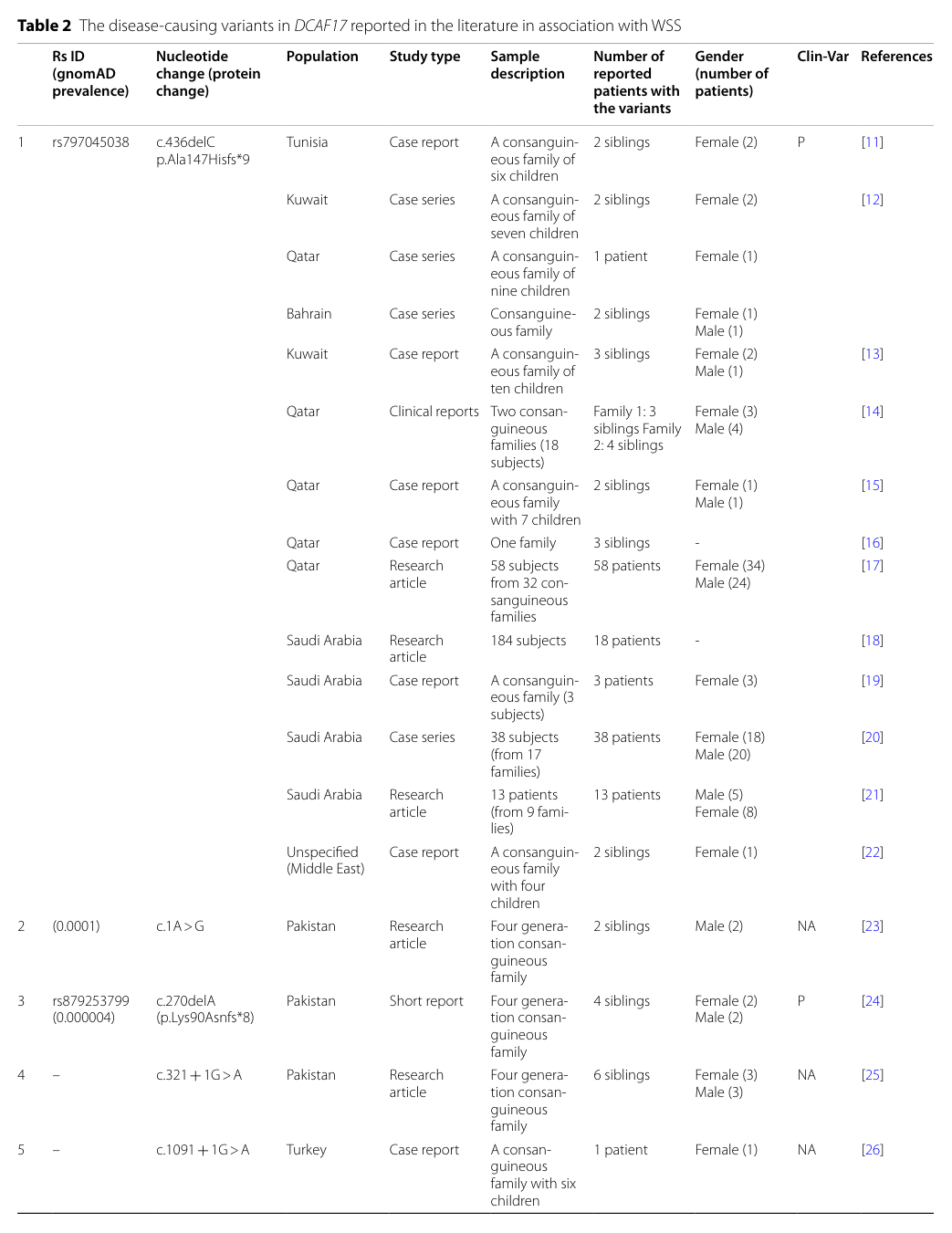
WSS is caused by biallelic pathogenic variants in DCAF17. A recurrent
frameshift deletion (c.436delC, p.Ala147Hisfs*9) is a founder variant in
Arab populations. No clear genotype-phenotype correlation has emerged, and
marked intrafamilial variability suggests additional modifiers.
evidence:
- reference: PMID:36721231
reference_title: "Genetic epidemiology of Woodhouse-Sakati Syndrome in the Greater Middle East region and beyond: a systematic review."
supports: SUPPORT
evidence_source: HUMAN_CLINICAL
snippet: >-
Thirteen different DCAF17 variants were associated with WSS development (including 8 identified in the GME region).
explanation: >-
This systematic review identifies DCAF17 as the disease gene with multiple
pathogenic variants reported worldwide.
- reference: PMID:36721231
reference_title: "Genetic epidemiology of Woodhouse-Sakati Syndrome in the Greater Middle East region and beyond: a systematic review."
supports: SUPPORT
evidence_source: HUMAN_CLINICAL
snippet: >-
The most frequent variant was a frameshift deletion variant (c.436delC, p.Ala147Hisfs*9) unique to Arabs that was reported in 11 cases from Tunisia, Kuwait, Qatar, Bahrain, and Saudi Arabia.
explanation: >-
Supports the recurrent founder c.436delC frameshift deletion in Arab
populations.
- reference: PMID:35002959
reference_title: "Case Report: A Chinese Family of Woodhouse-Sakati Syndrome With Diabetes Mellitus, With a Novel Biallelic Deletion Mutation of the DCAF17 Gene."
supports: SUPPORT
evidence_source: HUMAN_CLINICAL
snippet: >-
Whole-exome sequencing revealed a homozygous deletion NM_025000.4:c.1488_1489delAG in the DCAF17 gene, which resulted in a frameshift mutation that led to stop codon formation.
explanation: >-
Documents a distinct loss-of-function frameshift DCAF17 variant
(c.1488_1489delAG) outside the Arab founder, identified in a Chinese
family, illustrating the worldwide allelic heterogeneity of WSS.
- reference: PMID:20507343
reference_title: "C2orf37 mutational spectrum in Woodhouse-Sakati syndrome patients."
supports: SUPPORT
evidence_source: HUMAN_CLINICAL
snippet: >-
This study doubles the number of known mutations for this disorder, confirms that truncating mutations in C2orf37 are the only known cause of WSS, and suggests that mutations in this gene do not contribute significantly to cases presenting with isolated elements of WSS such as deafness and dystonia.
explanation: >-
This primary cohort supports a biallelic truncating loss-of-function
disease mechanism and the need to interpret DCAF17 variants in the full
syndromic context rather than isolated dystonia or deafness.
- reference: PMID:36721231
reference_title: "Genetic epidemiology of Woodhouse-Sakati Syndrome in the Greater Middle East region and beyond: a systematic review."
supports: SUPPORT
evidence_source: HUMAN_CLINICAL
snippet: >-
There were no clear genotype-phenotype correlations for the different variants.
explanation: >-
The systematic review found no reproducible relationship between DCAF17
variant and clinical severity or pattern.
diagnosis:
- name: DCAF17 molecular genetic testing
description: >-
The diagnosis of WSS is established in a proband with suggestive clinical,
neuroimaging, and neurophysiologic findings by identification of biallelic
pathogenic variants in DCAF17 on molecular genetic testing.
diagnosis_term:
preferred_term: molecular genetic testing
term:
id: NCIT:C19770
label: Molecular Analysis
qualifiers:
- predicate:
preferred_term: has participant
term:
id: RO:0000057
label: has participant
value:
preferred_term: DCAF17
term:
id: hgnc:25784
label: DCAF17
results: Biallelic pathogenic DCAF17 variant.
evidence:
- reference: PMID:27489925
reference_title: "Woodhouse-Sakati Syndrome."
supports: SUPPORT
evidence_source: HUMAN_CLINICAL
snippet: >-
The diagnosis of WSS is established in a proband with suggestive clinical, neuroimaging, and neurophysiologic findings by identification of biallelic pathogenic variants in DCAF17 on molecular genetic testing.
explanation: >-
GeneReviews specifies molecular genetic confirmation of biallelic DCAF17
variants as the diagnostic standard.
- name: Brain magnetic resonance imaging
description: >-
Brain MRI is a supportive component of the evaluation. The combination of
globus-pallidus iron deposition, nonenhancing frontoparietal or
periventricular white-matter lesions, and a small pituitary gland can raise
suspicion for WSS, but normal MRI does not exclude a molecular diagnosis.
diagnosis_term:
preferred_term: brain magnetic resonance imaging
term:
id: NCIT:C16809
label: Magnetic Resonance Imaging
results: >-
Basal-ganglia iron deposition, frontoparietal/periventricular white-matter
lesions, and/or a small pituitary gland; occasionally no reportable
abnormality.
evidence:
- reference: PMID:30409855
reference_title: "Brain MR Imaging Findings in Woodhouse-Sakati Syndrome."
supports: SUPPORT
evidence_source: HUMAN_CLINICAL
snippet: >-
The presence of pituitary hypoplasia and white matter lesions can further distinguish Woodhouse-Sakati syndrome from other neurodegenerative diseases with brain iron accumulation subtypes.
explanation: >-
The dedicated imaging cohort identifies the diagnostically useful MRI
pattern.
- reference: PMID:39342163
reference_title: "Woodhouse-sakati syndrome with no reportable MRI findings: a case report."
supports: SUPPORT
evidence_source: HUMAN_CLINICAL
snippet: >-
all previously reported cases having positive MRI findings, unlike our case.
explanation: >-
A genetically confirmed MRI-negative case shows that MRI is supportive,
not a required criterion.
treatments:
- name: Hormone replacement therapy
description: >-
Hypogonadism requires hormone replacement therapy to induce secondary sex
characteristics and promote bone health at the usual age of puberty.
treatment_term:
preferred_term: hormone replacement therapy
term:
id: NCIT:C15599
label: Hormone Replacement Therapy
target_mechanisms:
- target: Hypogonadism
treatment_effect: MODULATES
description: >-
Hormone replacement compensates for the hypogonadal endocrine deficiency.
evidence:
- reference: PMID:27489925
reference_title: "Woodhouse-Sakati Syndrome."
supports: SUPPORT
evidence_source: HUMAN_CLINICAL
snippet: >-
Hypogonadism requires hormone replacement therapy to induce secondary sex characteristics and promote bone health at the usual age of puberty.
explanation: >-
GeneReviews recommends hormone replacement therapy for the hypogonadism
of WSS.
evidence:
- reference: PMID:27489925
reference_title: "Woodhouse-Sakati Syndrome."
supports: SUPPORT
evidence_source: HUMAN_CLINICAL
snippet: >-
Hypogonadism requires hormone replacement therapy to induce secondary sex characteristics and promote bone health at the usual age of puberty.
explanation: >-
GeneReviews recommends hormone replacement therapy as core management of
WSS hypogonadism.
- reference: PMID:37895404
reference_title: "The Successful Management of Primary Amenorrhea in Woodhouse-Sakati Syndrome: A Case Report and a Literature Review."
supports: SUPPORT
evidence_source: HUMAN_CLINICAL
snippet: >-
Treatment includes hormonal replacement therapy for the induction of puberty.
explanation: >-
This case report describes successful hormone replacement therapy for
pubertal induction in a WSS patient with primary amenorrhea.
- name: Pharmacotherapy for dystonia
description: >-
Treatment for dystonia is routine; oral medications are tried first and
followed in some instances by botulinum toxin injection and/or deep-brain
stimulation.
treatment_term:
preferred_term: Pharmacotherapy
term:
id: NCIT:C15986
label: Pharmacotherapy
target_mechanisms:
- target: Dystonia
treatment_effect: MODULATES
description: >-
Oral antidystonia medications are first-line symptomatic treatment.
evidence:
- reference: PMID:27489925
reference_title: "Woodhouse-Sakati Syndrome."
supports: SUPPORT
evidence_source: HUMAN_CLINICAL
snippet: >-
Treatment for dystonia is routine; oral medications are tried first and followed in some instances by botulinum toxin injection and/or deep-brain stimulation.
explanation: >-
GeneReviews describes oral pharmacotherapy as first-line dystonia
management.
evidence:
- reference: PMID:27489925
reference_title: "Woodhouse-Sakati Syndrome."
supports: SUPPORT
evidence_source: HUMAN_CLINICAL
snippet: >-
Treatment for dystonia is routine; oral medications are tried first and followed in some instances by botulinum toxin injection and/or deep-brain stimulation.
explanation: >-
GeneReviews documents oral pharmacotherapy as the first-line approach for
WSS-associated dystonia.
- name: Botulinum toxin injection
description: >-
Botulinum toxin injection is used for dystonia in some individuals when oral
medications are insufficient.
treatment_term:
preferred_term: Botulinum Toxin Therapy
term:
id: NCIT:C157775
label: Botulinum Toxin Therapy
target_mechanisms:
- target: Dystonia
treatment_effect: MODULATES
description: >-
Botulinum toxin injection is a symptomatic option after oral medications
in some individuals with dystonia.
evidence:
- reference: PMID:27489925
reference_title: "Woodhouse-Sakati Syndrome."
supports: SUPPORT
evidence_source: HUMAN_CLINICAL
snippet: >-
oral medications are tried first and followed in some instances by botulinum toxin injection and/or deep-brain stimulation
explanation: >-
GeneReviews lists botulinum toxin injection as second-line dystonia
treatment.
evidence:
- reference: PMID:27489925
reference_title: "Woodhouse-Sakati Syndrome."
supports: SUPPORT
evidence_source: HUMAN_CLINICAL
snippet: >-
oral medications are tried first and followed in some instances by botulinum toxin injection and/or deep-brain stimulation
explanation: >-
GeneReviews documents botulinum toxin injection as a treatment option for
WSS dystonia.
- name: Deep brain stimulation
description: >-
Bilateral globus pallidus internus deep brain stimulation is an advanced
symptomatic option for severe, progressive generalized dystonia. In a 2026
retrospective series of five genetically
confirmed patients, all improved at 12 months and mean BFMDRS score improved
by approximately 39%; the uncontrolled small series does not establish
comparative efficacy or universal response.
therapeutic_modality: DEVICE
treatment_term:
preferred_term: deep brain stimulation
term:
id: NCIT:C21024
label: Deep Brain Stimulation
target_mechanisms:
- target: Dystonia
treatment_effect: MODULATES
description: >-
Bilateral GPi DBS is used as an advanced symptomatic intervention for
severe generalized dystonia.
evidence:
- reference: PMID:41902420
reference_title: "Long-Term Outcomes of Deep Brain Stimulation in Woodhouse-Sakati Syndrome."
supports: SUPPORT
evidence_source: HUMAN_CLINICAL
snippet: >-
Five patients with severe progressive generalized dystonia secondary to clinically and genetically confirmed WSS underwent bilateral GPi DBS from February 2011 through September 2023.
explanation: >-
This series directly identifies the genetically confirmed population,
severe generalized dystonia indication, bilateral procedure, and GPi
target without asserting an uncited physiologic mechanism.
- reference: PMID:40235137
reference_title: "Clinical and Genetic Characterization of Woodhouse-Sakati Syndrome in Iranian Patients: A Case Series."
supports: SUPPORT
evidence_source: HUMAN_CLINICAL
snippet: >-
Patients had variable responses to common therapies, and one patient achieved significant improvement following DBS.
explanation: >-
This case series reports significant improvement with DBS in a WSS
patient with refractory dystonia.
evidence:
- reference: PMID:41902420
reference_title: "Long-Term Outcomes of Deep Brain Stimulation in Woodhouse-Sakati Syndrome."
supports: SUPPORT
evidence_source: HUMAN_CLINICAL
snippet: >-
Five patients with severe progressive generalized dystonia secondary to clinically and genetically confirmed WSS underwent bilateral GPi DBS from February 2011 through September 2023. The mean age at disease onset and at the time of DBS was 11.3 and 18.6, respectively. All patients' BFMDRS total scores improved from baseline to 12 months post-DBS. The mean pre-DBS BFMDRS score was 71.1, and the mean post-DBS BFMDRS score was 43.6. The percentage improvement in the BFMDRS mean score from pre- to post-DBS was approximately 39%.
explanation: >-
The abstract documents five genetically confirmed patients treated with
bilateral GPi DBS, improvement in every patient at 12 months, and the
approximately 39% mean score improvement; the retrospective small series
limits certainty.
- reference: PMID:40235137
reference_title: "Clinical and Genetic Characterization of Woodhouse-Sakati Syndrome in Iranian Patients: A Case Series."
supports: SUPPORT
evidence_source: HUMAN_CLINICAL
snippet: >-
We highlight the importance of considering WSS in patients with both neurological and endocrine symptoms and suggest DBS as a potential treatment option.
explanation: >-
This case series proposes DBS as a treatment option for WSS-associated
movement disorder.
- reference: PMID:39342163
reference_title: "Woodhouse-sakati syndrome with no reportable MRI findings: a case report."
supports: SUPPORT
evidence_source: HUMAN_CLINICAL
snippet: >-
Treatment provided includes botulinum toxin injections and deep brain stimulation, providing better dystonia control, with progress in walking and strength exercises, and overall remarkable improvement.
explanation: >-
This case report documents that deep brain stimulation (with botulinum
toxin and neurorehabilitation) produced remarkable improvement in dystonia
control and ambulation in a WSS patient.
- name: Supportive care
description: >-
Treatment is symptomatic and should be managed by a multidisciplinary team,
including speech therapy for dysarthria; secretion management, thickened
liquids or pureed foods, and gastrostomy when needed for dysphagia; and
standard treatment of diabetes mellitus, hypothyroidism, hearing loss, and
intellectual disability. There is no established disease-modifying therapy.
treatment_term:
preferred_term: Supportive Care
term:
id: NCIT:C15747
label: Supportive Care
evidence:
- reference: PMID:27489925
reference_title: "Woodhouse-Sakati Syndrome."
supports: SUPPORT
evidence_source: HUMAN_CLINICAL
snippet: >-
Treatment of manifestations: Treatment is symptomatic and should be managed by a multidisciplinary team.
explanation: >-
GeneReviews describes WSS management as symptomatic multidisciplinary
supportive care.
- reference: PMID:27489925
reference_title: "Woodhouse-Sakati Syndrome."
supports: SUPPORT
evidence_source: HUMAN_CLINICAL
snippet: >-
Dysarthria often benefits from consultation with a speech therapist. Those with dysphagia often require measures to reduce oral secretions, use of thickened liquids and pureed foods to avoid aspiration, and eventually a gastrostomy to help maintain caloric intake.
explanation: >-
Directly supports speech, swallowing, aspiration-prevention, and
nutritional measures included in supportive care.
- reference: PMID:27489925
reference_title: "Woodhouse-Sakati Syndrome."
supports: SUPPORT
evidence_source: HUMAN_CLINICAL
snippet: >-
Standard treatment for diabetes mellitus, hypothyroidism, hearing loss, and intellectual disability.
explanation: >-
Supports consequence-specific standard management across the remaining
endocrine, auditory, and developmental manifestations.
- name: Multisystem surveillance
action_category: MONITORING
description: >-
Monitor for hypogonadism beginning at age 12-14 years; diabetes and
hypothyroidism beginning at age 20 years; serum IGF-1 every three to five
years after diagnosis; dystonia, development, and audiology annually; and
speech and swallowing as clinically indicated. People with dystonia should
also avoid situations that materially increase fall risk.
treatment_term:
preferred_term: clinical assessment
term:
id: NCIT:C124351
label: Clinical Evaluation
evidence:
- reference: PMID:27489925
reference_title: "Woodhouse-Sakati Syndrome."
supports: SUPPORT
evidence_source: HUMAN_CLINICAL
snippet: >-
Surveillance: Monitoring for endocrine abnormalities is recommended at the following ages: hypogonadism beginning at age 12-14 years; diabetes mellitus and hypothyroidism beginning at age 20 years; serum IGF-1 every three to five years following diagnosis; annual neurologic assessment for dystonia; speech and language assessment for dysarthria and dysphagia as needed; annual developmental assessment throughout childhood; annual audiology evaluation.
explanation: >-
GeneReviews supplies the age- and interval-specific surveillance plan.
- reference: PMID:27489925
reference_title: "Woodhouse-Sakati Syndrome."
supports: SUPPORT
evidence_source: HUMAN_CLINICAL
snippet: >-
Persons with dystonia should avoid situations in which the risk of falling is increased.
explanation: >-
Supports explicit counseling about fall-risk situations.
- name: Genetic counseling and familial variant testing
action_category: COUNSELING_INFORMATIONAL
description: >-
Counsel families about autosomal recessive inheritance: when both parents
are carriers, each sibling has a 25% chance of being affected, a 50% chance
of being an asymptomatic carrier, and a 25% chance of being unaffected and
not a carrier. Once familial DCAF17 variants are known, carrier testing,
testing of at-risk siblings, prenatal testing, and preimplantation genetic
testing are possible.
treatment_term:
preferred_term: genetic counseling
term:
id: NCIT:C15240
label: Genetic Counseling
evidence:
- reference: PMID:27489925
reference_title: "Woodhouse-Sakati Syndrome."
supports: SUPPORT
evidence_source: HUMAN_CLINICAL
snippet: >-
At conception, each sib of an affected individual has a 25% chance of being affected, a 50% chance of being an asymptomatic carrier, and a 25% chance of being unaffected and not a carrier.
explanation: >-
GeneReviews provides the Mendelian recurrence risks used in counseling.
- reference: PMID:27489925
reference_title: "Woodhouse-Sakati Syndrome."
supports: SUPPORT
evidence_source: HUMAN_CLINICAL
snippet: >-
Once the pathogenic DCAF17 variants have been identified in an affected family member, carrier testing for at-risk relatives, prenatal testing for a pregnancy at increased risk, and preimplantation genetic testing are possible.
explanation: >-
Supports familial testing and reproductive options after molecular
confirmation.
differential_diagnoses:
- name: Neurodegeneration with brain iron accumulation
description: >-
WSS is classified within the NBIA spectrum and shares progressive
extrapyramidal movement disorder and brain iron accumulation with other
NBIA disorders, but is distinguished by its prominent endocrine and
ectodermal features (hypogonadism, alopecia, diabetes).
distinguishing_features:
- WSS combines a movement disorder with hypogonadism and progressive alopecia.
- WSS is caused by biallelic DCAF17 variants rather than other NBIA genes.
disease_term:
preferred_term: neurodegeneration with brain iron accumulation
term:
id: MONDO:0018307
label: neurodegeneration with brain iron accumulation
evidence:
- reference: PMID:38320940
reference_title: "Woodhouse-Sakati syndrome: A review."
supports: SUPPORT
evidence_source: HUMAN_CLINICAL
snippet: >-
Woodhouse-Sakati Syndrome (WSS) is one of the rarest NBIAs.
explanation: >-
This review places WSS within the NBIA spectrum, supporting NBIA disorders
as the relevant differential category.
- name: Perrault syndrome
description: >-
Perrault syndrome overlaps WSS through sensorineural hearing loss and female
gonadal dysfunction. Its defining combination is sensorineural hearing loss
in both sexes with gonadal dysgenesis in females; molecular testing can
distinguish genetically heterogeneous Perrault syndrome from DCAF17-related
WSS.
distinguishing_features:
- Perrault syndrome is defined by sensorineural hearing loss in males and females and gonadal dysgenesis in females.
- A molecular diagnosis in a Perrault-associated gene distinguishes it from biallelic DCAF17-related WSS.
disease_term:
preferred_term: Perrault syndrome
term:
id: MONDO:0017312
label: Perrault syndrome
evidence:
- reference: PMID:32423379
reference_title: "LARS2-Perrault syndrome: a new case report and literature review."
supports: SUPPORT
evidence_source: HUMAN_CLINICAL
snippet: >-
Perrault syndrome is a rare recessive and genetically heterogeneous disorder characterized by sensorineural hearing loss in males and females and gonadal dysgenesis in females.
explanation: >-
The abstract directly defines the overlapping auditory and female gonadal
phenotype and its genetic heterogeneity.
- name: Gordon Holmes syndrome
description: >-
Gordon Holmes syndrome overlaps WSS through hypogonadism and neurologic
disease, but its defining neurologic pattern is early-onset ataxia with
brisk reflexes rather than the characteristic WSS combination of dystonia,
hearing loss, endocrine disease, and alopecia.
distinguishing_features:
- Gordon Holmes syndrome is defined by early-onset ataxia, hypogonadism, and brisk reflexes.
- Its ataxia-predominant pattern with brisk reflexes differs from the dystonia-predominant WSS pattern.
disease_term:
preferred_term: Gordon Holmes syndrome
term:
id: MONDO:0008935
label: cerebellar ataxia-hypogonadism syndrome
evidence:
- reference: PMID:24355708
reference_title: "PNPLA6 mutations cause Boucher-Neuhauser and Gordon Holmes syndromes as part of a broad neurodegenerative spectrum."
supports: SUPPORT
evidence_source: HUMAN_CLINICAL
snippet: >-
Boucher-Neuhäuser and Gordon Holmes syndromes are clinical syndromes defined by early-onset ataxia and hypogonadism plus chorioretinal dystrophy (Boucher-Neuhäuser syndrome) or brisk reflexes (Gordon Holmes syndrome).
explanation: >-
The abstract directly defines the early ataxia, hypogonadism, and
brisk-reflex pattern used to distinguish Gordon Holmes syndrome.
- name: Deafness-dystonia-optic neuronopathy syndrome
description: >-
TIMM8A-related deafness-dystonia-optic neuronopathy syndrome overlaps WSS
through deafness and dystonia. Its X-linked inheritance and TIMM8A cause
distinguish it from autosomal recessive DCAF17-related WSS.
distinguishing_features:
- DDON syndrome is an X-linked TIMM8A disorder characterized by early-onset deafness and dystonia.
- TIMM8A testing and X-linked inheritance distinguish DDON from DCAF17-related WSS.
disease_term:
preferred_term: deafness-dystonia-optic neuronopathy syndrome
term:
id: MONDO:0010578
label: deafness dystonia syndrome
evidence:
- reference: PMID:23418071
reference_title: "The syndrome of deafness-dystonia: clinical and genetic heterogeneity."
supports: SUPPORT
evidence_source: HUMAN_CLINICAL
snippet: >-
The syndrome of deafness-dystonia is rare and refers to the association of hearing impairment and dystonia when these are dominant features of a disease. Known genetic causes include Mohr-Tranebjaerg syndrome, Woodhouse-Sakati syndrome, and mitochondrial disorders, but the cause frequently remains unidentified.
explanation: >-
This study directly places both Mohr-Tranebjaerg and Woodhouse-Sakati
syndromes in the overlapping deafness-dystonia differential.
- reference: PMID:23418071
reference_title: "The syndrome of deafness-dystonia: clinical and genetic heterogeneity."
supports: SUPPORT
evidence_source: HUMAN_CLINICAL
snippet: >-
translocase of inner mitochondrial membrane 8 homolog A (TIMM8A) mutation (Mohr-Tranebjaerg syndrome), and chromosome 2 open reading frame 37 (C2orf37) mutation (Woodhouse-Sakati syndrome).
explanation: >-
The abstract identifies TIMM8A and C2orf37 mutations as distinct causes of
the two overlapping syndromes.
- reference: PMID:31903733
reference_title: "Functional analysis of a novel mutation in the TIMM8A gene that causes deafness-dystonia-optic neuronopathy syndrome."
supports: SUPPORT
evidence_source: HUMAN_CLINICAL
snippet: >-
The rare, X-linked neurodegenerative disorder, Mohr-Tranebjaerg syndrome
explanation: >-
The abstract directly identifies Mohr-Tranebjaerg syndrome as X-linked.
- reference: PMID:31903733
reference_title: "Functional analysis of a novel mutation in the TIMM8A gene that causes deafness-dystonia-optic neuronopathy syndrome."
supports: SUPPORT
evidence_source: HUMAN_CLINICAL
snippet: >-
DDON syndrome is characterized by dystonia, early-onset deafness, and various other neurological manifestations.
explanation: >-
The abstract directly establishes the early-onset deafness-dystonia
phenotype.
clinical_trials:
- name: NCT05522374
status: RECRUITING
description: >-
TIRCON International NBIA Patient Registry and Natural History Study, a
prospective observational registry collecting longitudinal clinical and
natural-history data on neurodegeneration with brain iron accumulation
(NBIA) disorders, the spectrum within which Woodhouse-Sakati syndrome is
classified.
target_phenotypes:
- preferred_term: Progressive extrapyramidal movement disorder
term:
id: HP:0007153
label: Progressive extrapyramidal movement disorder
evidence:
- reference: clinicaltrials:NCT05522374
reference_title: "TIRCON International NBIA (Neurodegeneration Associated With Brain Iron Accumulation) Patient Registry and Natural History Study"
supports: SUPPORT
snippet: >-
continue the provision of a global registry and natural history study for NBIA disorders
explanation: >-
This registry provides a global natural-history study for NBIA disorders,
the disease spectrum that includes Woodhouse-Sakati syndrome.
animal_models:
- species: Golden hamster (Mesocricetus auratus)
genotype: CRISPR-Cas9-generated Dcaf17 deficiency in males
category: Loss-of-function model
genes:
- preferred_term: DCAF17
term:
id: hgnc:25784
label: DCAF17
description: >-
Dcaf17-deficient male golden hamsters develop abnormal spermatogenesis and
infertility. Single-cell RNA sequencing localizes major transcriptional
effects to early spermatogenic cells and identifies altered spermatogenesis
and protein-degradation programs. The model directly supports male
reproductive biology but has not been shown to reproduce the human
neurologic, endocrine, auditory, ectodermal, or MRI phenotype.
associated_phenotypes:
- Abnormal spermatogenesis
- Male infertility
evidence:
- reference: PMID:39239833
reference_title: "Single-cell RNA sequencing reveals the important role of Dcaf17 in spermatogenesis of golden hamsters."
supports: SUPPORT
evidence_source: MODEL_ORGANISM
snippet: >-
we created Dcaf17-deficient male golden hamsters using CRISPR-Cas9 technology; the results of which demonstrate that deletion of Dcaf17 led to abnormal spermatogenesis and infertility.
explanation: >-
Directly establishes the engineered model and its reproductive phenotype.
- reference: PMID:39239833
reference_title: "Single-cell RNA sequencing reveals the important role of Dcaf17 in spermatogenesis of golden hamsters."
supports: SUPPORT
evidence_source: MODEL_ORGANISM
snippet: >-
These data emphasize the significant regulatory role played by Dcaf17 in early spermatogenic cells, with many biological processes being affected, including spermatogenesis and protein degradation.
explanation: >-
Defines the affected cell stage and transcriptomic programs in the model.
datasets: []
discussions:
- discussion_id: wss_systemic_mechanism_gap
prompt: >-
Which nucleolar or CRL4-dependent molecular consequences of DCAF17 loss
cause the human neurologic, endocrine, auditory, ectodermal, and imaging
manifestations of Woodhouse-Sakati syndrome?
kind: KNOWLEDGE_GAP
status: OPEN
attaches_to:
- pathophysiology#Biallelic DCAF17 loss and nucleolar involvement
- pathophysiology#Unresolved multisystem tissue dysfunction
rationale: >-
Biallelic DCAF17 loss and nucleolar localization are established, but the
intervening human molecular pathway is not. Assigning every manifestation
to impaired CRL4 proteostasis would exceed the current organ-limited animal
evidence and could misdirect biomarker or therapeutic development.
proposed_experiments:
- experiment_id: exp_wss_isogenic_multilineage_human_models
name: Isogenic DCAF17 human multilineage functional comparison
description: >-
Compare DCAF17-null and isogenic-corrected human iPSC-derived neurons,
pancreatic beta cells, pituitary endocrine cells, and hair-follicle cells
using nucleolar morphology, ribosome-biogenesis, ubiquitin-proteomics,
protein-turnover, and lineage-specific functional readouts. Concordant
rescue by DCAF17 correction would identify which abnormalities bridge the
genotype to multiple human tissues.
evidence:
- reference: PMID:19026396
reference_title: "Mutations in C2orf37, encoding a nucleolar protein, cause hypogonadism, alopecia, diabetes mellitus, mental retardation, and extrapyramidal syndrome."
supports: SUPPORT
evidence_source: IN_VITRO
snippet: >-
The gene encodes a nucleolar protein of unknown function, and the cellular phenotype observed in patient lymphoblasts implicates a role for the nucleolus in the pathogenesis of this disease.
explanation: >-
The founding study defines both the nucleolar clue and the unresolved
molecular function that motivate this gap.
- discussion_id: wss_hamster_human_model_mismatch
prompt: >-
Does the Dcaf17-deficient male golden-hamster reproductive phenotype model
the multisystem human syndrome, or only a tissue-specific role in
spermatogenesis?
kind: HUMAN_MODEL_MISMATCH
status: OPEN
attaches_to:
- pathophysiology#Putative CRL4-dependent proteostasis disruption
- phenotypes#Male infertility
rationale: >-
The model directly demonstrates infertility and altered
protein-degradation programs in early spermatogenic cells, but the published
abstract reports no neurologic, endocrine, auditory, ectodermal, or brain
imaging characterization. It therefore cannot yet validate a systemic
CRL4/proteostasis mechanism for human WSS.
proposed_experiments:
- experiment_id: exp_wss_hamster_multisystem_phenotyping
name: Longitudinal multisystem phenotyping of Dcaf17-deficient hamsters
description: >-
Assess male and female mutants longitudinally for movement disorder,
hearing, glucose and insulin secretion, thyroid and gonadal axes, hair
loss, cognition, brain MRI iron and white-matter changes, and matched
tissue proteostasis readouts to determine which human manifestations the
model actually recapitulates.
evidence:
- reference: PMID:39239833
reference_title: "Single-cell RNA sequencing reveals the important role of Dcaf17 in spermatogenesis of golden hamsters."
supports: SUPPORT
evidence_source: MODEL_ORGANISM
snippet: >-
we created Dcaf17-deficient male golden hamsters using CRISPR-Cas9 technology; the results of which demonstrate that deletion of Dcaf17 led to abnormal spermatogenesis and infertility.
explanation: >-
The publication establishes reproductive recapitulation but does not
establish multisystem human-disease recapitulation.
References & Deep Research
References
21Deep Research
1Deep research results are used as seeds for research; they do not undergo the same validation as the main records and may contain errors. How we use deep research.
1. Disease Information
1.1 Definition and current understanding
Woodhouse–Sakati syndrome is a rare multisystem neuroendocrine disorder with core endocrine involvement (hypogonadism, diabetes, thyroid abnormalities) and progressive neurologic manifestations, caused by biallelic pathogenic variants in DCAF17 and inherited in an autosomal recessive pattern. (bakhsh2023thesuccessfulmanagement pages 1-2, louro2019woodhouse–sakatisyndromefirst pages 1-2, wakim2024woodhousesakatisyndromegenotype–phenotype pages 1-2)
Abstract-supported definition (direct quotes): - A 2023 systematic review states: “Woodhouse-Sakati syndrome (WSS) is a rare, autosomal recessive genetic disorder with variable clinical manifestations mainly affecting the endocrine and nervous systems.” (Kohil et al., Orphanet J Rare Dis, published Jan 2023; DOI: https://doi.org/10.1186/s13023-023-02614-8) (kohil2023geneticepidemiologyof pages 1-2) - A 2024 case report states WSS is “a rare autosomal recessive condition caused by biallelic pathogenic variants in the DCAF17 gene” with “fewer than 200 cases reported” and symptoms that “first emerge in middle-late adolescence.” (Irvine & Ahmad, BMC Neurology, published Sep 2024; DOI: https://doi.org/10.1186/s12883-024-03865-z) (irvine2024woodhousesakatisyndromewith pages 1-3)
1.2 Synonyms / alternative names
- Woodhouse–Sakati syndrome (WSS) (bakhsh2023thesuccessfulmanagement pages 1-2, louro2019woodhouse–sakatisyndromefirst pages 1-2)
- Sometimes described as a DCAF17-linked NBIA (neurodegeneration with brain iron accumulation) phenotype due to basal ganglia iron deposition on MRI in many patients. (louro2019woodhouse–sakatisyndromefirst pages 1-2)
1.3 Evidence source types
Evidence in this report is primarily from: - Aggregated disease-level resources: systematic reviews and narrative reviews (2023–2024 prioritized). (kohil2023geneticepidemiologyof pages 1-2, wakim2024woodhousesakatisyndromegenotype–phenotype pages 2-4) - Human clinical evidence: patient cohorts and case reports (including quantified cohort neurologic data). (bohlega2019patternsofneurological pages 2-3, louro2019woodhouse–sakatisyndromefirst pages 1-2, irvine2024woodhousesakatisyndromewith pages 3-5)
2. Etiology
2.1 Disease causal factors
Primary cause: Germline loss-of-function variants in DCAF17 (biallelic) with autosomal recessive inheritance. (wakim2024woodhousesakatisyndromegenotype–phenotype pages 1-2, kohil2023geneticepidemiologyof pages 1-2, amalnath2024woodhouse–sakatisyndromein pages 1-3)
DCAF17 is described as encoding nucleolar proteins (two main transcripts) and is implicated (in reviews) in nucleolar functions and possibly ubiquitin-ligase associated biology; truncating variants likely impair function through truncated protein and/or nonsense-mediated decay. (wakim2024woodhousesakatisyndromegenotype–phenotype pages 4-5, kohil2023geneticepidemiologyof pages 6-7)
2.2 Risk factors
Because WSS is Mendelian, “risk factors” are primarily genetic and population-structure related.
Genetic risk factors - Biallelic pathogenic variants in DCAF17 are necessary and sufficient for the disorder in reported families. (wakim2024woodhousesakatisyndromegenotype–phenotype pages 1-2, kohil2023geneticepidemiologyof pages 1-2)
Population risk factors / epidemiologic correlates - Consanguinity is common among reported families in high-prevalence regions: the 2023 systematic review found that in the Greater Middle East (GME) region, “consanguineous marriages were common (67%).” (Kohil et al., 2023) (kohil2023geneticepidemiologyof pages 1-2)
2.3 Protective factors / gene–environment interactions
No protective genetic variants or environmental protective factors have been established in the retrieved literature for WSS. The intrafamilial phenotypic variability noted in cohorts suggests possible modifier factors, but specific genes or environmental interactions are not clearly defined. (bohlega2019patternsofneurological pages 1-2)
3. Phenotypes
3.1 Key phenotypic domains
WSS typically involves: - Endocrine/reproductive: hypogonadism with delayed/absent puberty and primary amenorrhea; diabetes mellitus; hypothyroidism; low IGF-1. (bakhsh2023thesuccessfulmanagement pages 1-2, louro2019woodhouse–sakatisyndromefirst pages 1-2, zhou2021casereporta pages 1-2) - Dermatologic: alopecia (often temporal/frontotemporal), sparse eyebrows; progeroid skin changes. (wakim2024woodhousesakatisyndromegenotype–phenotype pages 2-4, wakim2024woodhousesakatisyndromegenotype–phenotype pages 5-7) - Neurologic: progressive extrapyramidal movement disorder (dystonia prominent), dysarthria/dysphagia; intellectual disability; seizures in a subset; hearing loss. (bohlega2019patternsofneurological pages 2-3, wakim2024woodhousesakatisyndromegenotype–phenotype pages 5-7) - Imaging: many cases show basal ganglia iron deposition and leukodystrophy/white matter changes; exceptions occur. (louro2019woodhouse–sakatisyndromefirst pages 1-2, irvine2024woodhousesakatisyndromewith pages 1-3)
3.2 Quantitative phenotype frequencies (human cohort data)
A detailed neurologic cohort (n=38, genetically confirmed; founder DCAF17 c.436delC) reported:
- Neurologic involvement: 31/38 (81.5%)
- Dystonia: 25/38 (65.7%)
- Intellectual disability: 36.8% (also described as 45% in another excerpt of same study)
- Sensorineural hearing loss: 31.5%
- Seizures: 10.5%
- Rigidity: 5.2%
- Tremor/ataxia/choreoathetosis: 2.6%
Additionally, patients clustered into a severe phenotype (47.4%) with earlier onset and progressive disability: mean age of first neurologic symptoms 12.6 ± 4.5 years; loss of ambulation over 7.4 ± 3.6 years. (Bohlega et al., Parkinsonism Relat Disord, published Dec 2019; DOI: https://doi.org/10.1016/j.parkreldis.2019.10.007) (bohlega2019patternsofneurological pages 2-3, bohlega2019patternsofneurological pages 1-2)
3.3 Typical age of onset and progression
- Endocrine/alopecia manifestations often become apparent around puberty/adolescence, with neurologic symptoms frequently emerging later and progressing variably. (irvine2024woodhousesakatisyndromewith pages 1-3, wakim2024woodhousesakatisyndromegenotype–phenotype pages 5-7)
3.4 Suggested HPO terms (non-exhaustive)
(These are ontology suggestions based on described clinical features; HPO IDs should be verified against the HPO database.) - Hypogonadism; primary amenorrhea; delayed puberty (bakhsh2023thesuccessfulmanagement pages 1-2, louro2019woodhouse–sakatisyndromefirst pages 1-2) - Alopecia; sparse eyebrows (wakim2024woodhousesakatisyndromegenotype–phenotype pages 2-4, wakim2024woodhousesakatisyndromegenotype–phenotype pages 5-7) - Diabetes mellitus (often adolescent/young adult onset) (louro2019woodhouse–sakatisyndromefirst pages 1-2) - Hypothyroidism (louro2019woodhouse–sakatisyndromefirst pages 1-2) - Dystonia; dysarthria; dysphagia (bohlega2019patternsofneurological pages 2-3, louro2019woodhouse–sakatisyndromefirst pages 1-2) - Intellectual disability (bohlega2019patternsofneurological pages 2-3) - Sensorineural hearing impairment (bohlega2019patternsofneurological pages 2-3, louro2019woodhouse–sakatisyndromefirst pages 1-2) - Abnormal brain iron accumulation; leukodystrophy/white matter abnormalities (louro2019woodhouse–sakatisyndromefirst pages 1-2)
3.5 Quality-of-life impacts
Direct standardized QoL instruments specific to WSS were not identified in the retrieved papers; however, severe dystonia and progressive disability including wheelchair dependence are reported, implying major functional burden. (irvine2024woodhousesakatisyndromewith pages 3-5, bohlega2019patternsofneurological pages 2-3)
4. Genetic / Molecular Information
4.1 Causal gene
- DCAF17 (DDB1 and CUL4-associated factor 17; formerly C2orf37). (kohil2023geneticepidemiologyof pages 1-2, louro2019woodhouse–sakatisyndromefirst pages 1-2)
4.2 Pathogenic variant spectrum
A 2023 systematic review identified 185 patients in 97 families from 12 countries and reported 13 distinct DCAF17 variants linked to WSS. (Kohil et al., 2023) (kohil2023geneticepidemiologyof pages 1-2)
Key recurrent/founder and representative variants include: - c.436delC (p.Ala147Hisfs*9) (frameshift; recurrent/founder in Arab populations) (kohil2023geneticepidemiologyof pages 4-6, kohil2023geneticepidemiologyof pages 1-2, kohil2023geneticepidemiologyof pages 6-7) - Splice-site variants such as c.321+1G>A and c.1091+1G>A (kohil2023geneticepidemiologyof pages 4-6) - c.1488_1489delAG (frameshift; reported in China; gnomAD prevalence noted as 0.000011 in one excerpt) (kohil2023geneticepidemiologyof pages 6-7) - c.1091+2T>C (Portuguese case; splice-site) (louro2019woodhouse–sakatisyndromefirst pages 1-2) - Novel truncating c.153G>A (p.Trp51*) in an Indian patient; absent from population databases cited (gnomAD/IndiGenomes) (Amalnath et al., Am J Med Genet A, published Sep 2024; DOI: https://doi.org/10.1002/ajmg.a.63405) (amalnath2024woodhouse–sakatisyndromein pages 1-3)
Visual evidence: A table of reported DCAF17 variants and countries is available from the 2023 systematic review (Table 2). (kohil2023geneticepidemiologyof media b5c57154, kohil2023geneticepidemiologyof media 150533d1)
4.3 Founder effects and geographic distribution
- The 2023 systematic review describes c.436delC (p.Ala147Hisfs*9) as “unique to Arabs,” reported across Tunisia, Kuwait, Qatar, Bahrain, and Saudi Arabia. (kohil2023geneticepidemiologyof pages 1-2)
- The same review reports high representation of families from the Greater Middle East and an association with consanguinity. (kohil2023geneticepidemiologyof pages 1-2)
- A 2024 case report reiterates that “most of the patients have been reported from Greater Middle Eastern countries.” (Amalnath et al., 2024) (amalnath2024woodhouse–sakatisyndromein pages 1-3)
4.4 Modifier genes / epigenetics / chromosomal abnormalities
No validated modifier genes, disease-specific epigenetic signatures, or recurrent chromosomal abnormalities were identified in the retrieved evidence.
5. Environmental Information
WSS is primarily genetic; no environmental triggers, toxins, lifestyle exposures, or infectious agents have been established as causal or modifying factors in the retrieved sources.
6. Mechanism / Pathophysiology
6.1 Current mechanistic understanding
Mechanistic understanding remains incomplete. However, reviews and systematic summaries converge on a nucleolar DCAF17 biology with downstream multisystem effects.
- The 2023 systematic review notes that DCAF17 encodes nucleolar proteins and that mutant DCAF17 has been suggested to cause “defective ribosome biogenesis,” “reduced splicing efficiency,” and loss-of-function effects. (kohil2023geneticepidemiologyof pages 1-2)
- A 2019 Portuguese case report describes DCAF17 as a nucleolar protein that “may act as a substrate receptor for the CUL4-DDB1 E3 ubiquitin ligase complex,” providing a plausible link to proteostasis/regulatory pathways. (louro2019woodhouse–sakatisyndromefirst pages 1-2)
6.2 Causal chain (evidence-based, with uncertainty)
1) Biallelic DCAF17 LOF → 2) nucleolar dysfunction (proposed ribosome/splicing deficits; uncertain) → 3) selective vulnerability in endocrine tissues and nervous system → 4) clinical syndrome with hypogonadism/diabetes/thyroid dysfunction and progressive dystonia/intellectual disability/hearing loss. (kohil2023geneticepidemiologyof pages 1-2, louro2019woodhouse–sakatisyndromefirst pages 1-2, bohlega2019patternsofneurological pages 2-3)
6.3 Tissue-level pathology proxies (imaging)
MRI findings in many patients include basal ganglia iron deposition and leukodystrophy/white matter changes, supporting classification alongside NBIA phenotypes for some individuals; however, normal MRI is possible. (louro2019woodhouse–sakatisyndromefirst pages 1-2, irvine2024woodhousesakatisyndromewith pages 1-3)
6.4 Suggested GO / CL terms (high-level suggestions)
(These are ontology suggestions inferred from described biology and are not directly asserted as experimentally demonstrated in WSS-specific studies in the retrieved evidence.) - GO biological process candidates: ribosome biogenesis; RNA splicing; protein ubiquitination; DNA repair; cell cycle regulation; apoptosis (wakim2024woodhousesakatisyndromegenotype–phenotype pages 4-5, kohil2023geneticepidemiologyof pages 1-2) - CL cell types likely involved clinically: pancreatic beta cell; gonadal cells (ovarian/testicular); neurons of basal ganglia; oligodendrocytes/myelin-related systems (clinical proxy via leukodystrophy) (zhou2021casereporta pages 1-2, louro2019woodhouse–sakatisyndromefirst pages 1-2)
6.5 Molecular profiling / multi-omics / single-cell / spatial
No WSS-specific transcriptomic, proteomic, metabolomic, or single-cell/spatial multi-omics datasets were identified in the retrieved evidence.
7. Anatomical Structures Affected
7.1 Organ- and system-level
- Endocrine system: gonads/HPG axis, pancreas (beta-cell dysfunction suggested), thyroid. (zhou2021casereporta pages 1-2, louro2019woodhouse–sakatisyndromefirst pages 1-2)
- Nervous system: basal ganglia/extrapyramidal circuitry; white matter involvement in many cases. (louro2019woodhouse–sakatisyndromefirst pages 1-2, bohlega2019patternsofneurological pages 2-3)
- Integumentary system: scalp hair follicles (alopecia). (wakim2024woodhousesakatisyndromegenotype–phenotype pages 5-7)
- Auditory system: sensorineural hearing loss. (bohlega2019patternsofneurological pages 2-3, louro2019woodhouse–sakatisyndromefirst pages 1-2)
7.2 Suggested UBERON terms (conceptual)
- Ovary/uterus (absent ovaries on ultrasound; uterine/adnexal hypoplasia in some cases) (wakim2024woodhousesakatisyndromegenotype–phenotype pages 2-4, baigh2026woodhousesakatisyndromedue pages 2-4)
- Basal ganglia; globus pallidus; substantia nigra; white matter (louro2019woodhouse–sakatisyndromefirst pages 1-2)
- Pancreas (pancreatic atrophy in one family; functional impairment evidence) (zhou2021casereporta pages 1-2)
8. Temporal Development
8.1 Onset
Symptoms commonly emerge in middle-late adolescence with endocrine features such as delayed puberty/amenorrhea and metabolic abnormalities, and later neurologic deterioration in many patients. (irvine2024woodhousesakatisyndromewith pages 1-3, wakim2024woodhousesakatisyndromegenotype–phenotype pages 5-7)
8.2 Progression
Progression is variable. In the 38-patient cohort, a severe phenotype included loss of ambulation over ~7 years after neurologic onset, whereas a milder/absent neurologic phenotype occurred in roughly half. (bohlega2019patternsofneurological pages 2-3)
9. Inheritance and Population
9.1 Inheritance
- Autosomal recessive with biallelic DCAF17 pathogenic variants. (wakim2024woodhousesakatisyndromegenotype–phenotype pages 1-2, kohil2023geneticepidemiologyof pages 1-2)
9.2 Epidemiology (counts and geography)
Robust prevalence/incidence estimates were not identified.
Best available summary from literature aggregation: - Across 25 studies, 185 patients in 97 families from 12 countries were identified (systematic review to June 2022). (Kohil et al., 2023) (kohil2023geneticepidemiologyof pages 1-2) - Strong geographic clustering in the Greater Middle East, with consanguinity common. (kohil2023geneticepidemiologyof pages 1-2, amalnath2024woodhouse–sakatisyndromein pages 1-3)
10. Diagnostics
10.1 Clinical clues
Alopecia + hypogonadism (often primary amenorrhea) + diabetes mellitus + progressive dystonia/extrapyramidal signs are recurrent diagnostic clues. (bakhsh2023thesuccessfulmanagement pages 1-2, wakim2024woodhousesakatisyndromegenotype–phenotype pages 5-7)
10.2 Laboratory testing
- Endocrine: gonadotropins/sex steroids consistent with hypergonadotropic hypogonadism; glucose/HbA1c; thyroid tests; IGF-1 may be low. (louro2019woodhouse–sakatisyndromefirst pages 1-2, zhou2021casereporta pages 1-2)
- Diabetes physiology: OGTT-derived measures, insulin and C-peptide testing can show impaired secretion and low HOMA-b in some cases. (zhou2021casereporta pages 1-2)
10.3 Imaging
- Brain MRI: typical findings include progressive periventricular leukodystrophy/white-matter changes and iron deposition in globus pallidus/substantia nigra/red nucleus. (louro2019woodhouse–sakatisyndromefirst pages 1-2)
- Important recent development: a 2024 report described a genetically confirmed WSS patient with no reportable abnormalities on T2/ADC/SWI MRI sequences. (irvine2024woodhousesakatisyndromewith pages 1-3)
10.4 Genetic testing (definitive)
Definitive diagnosis relies on identifying biallelic pathogenic variants in DCAF17, commonly via targeted sequencing, multigene panels, or exome sequencing. (irvine2024woodhousesakatisyndromewith pages 1-3, wakim2024woodhousesakatisyndromegenotype–phenotype pages 5-7)
Example diagnostic implementations: - Whole-exome sequencing identified DCAF17 c.1488_1489delAG in a Chinese family with WSS and diabetes phenotype. (Frontiers Endocrinology, Dec 2021; DOI: https://doi.org/10.3389/fendo.2021.770871) (zhou2021casereporta pages 1-2)
10.5 Differential diagnosis
Differential diagnosis includes other leukodystrophies and other NBIA disorders (PKAN, PLA2G6-associated disease), where genetic testing is decisive. (louro2019woodhouse–sakatisyndromefirst pages 1-2, wakim2024woodhousesakatisyndromegenotype–phenotype pages 5-7)
11. Outcome / Prognosis
Systematic survival statistics are not available in the retrieved evidence.
- A 2023 management-focused case report/literature review notes: “it is generally believed that individuals with this syndrome have a normal lifespan,” while progressive comorbidities can affect long-term quality of life. (Bakhsh et al., Life, Oct 2023; DOI: https://doi.org/10.3390/life13102022) (bakhsh2023thesuccessfulmanagement pages 1-2)
- Severe neurologic phenotypes can lead to substantial disability and loss of ambulation. (bohlega2019patternsofneurological pages 2-3)
12. Treatment
12.1 Current applications / real-world implementations
There is no disease-specific curative therapy; management is symptomatic and multidisciplinary. (irvine2024woodhousesakatisyndromewith pages 1-3, bakhsh2023thesuccessfulmanagement pages 6-8)
Endocrine / reproductive - Hormone replacement therapy (HRT) is used to induce puberty and menstruation in affected females. (bakhsh2023thesuccessfulmanagement pages 1-2) - A 2023 case report describes incremental estrogen/progesterone therapy over four years with pubertal development and reversal of primary amenorrhea. (bakhsh2023thesuccessfulmanagement pages 6-8)
Diabetes management Standard diabetes care is applied (lifestyle, oral agents, insulin as needed). (bakhsh2023thesuccessfulmanagement pages 6-8)
Neurologic management (dystonia/extrapyramidal) - Botulinum toxin for focal dystonia and deep brain stimulation (DBS) for refractory dystonia have been applied. - A 2024 BMC Neurology case reported DBS with immediate and subsequent improvement after activation and “remarkable improvement,” including regained assisted ambulation (~20 m with support versus previously unable). (Irvine & Ahmad, Sep 2024) (irvine2024woodhousesakatisyndromewith pages 3-5) - A 2025 Iranian case series notes one patient achieved “significant improvement” after GPi DBS, suggesting DBS as a treatment option. (Khosravi et al., J Mov Disord, Jul 2025; DOI: https://doi.org/10.14802/jmd.25043) (khosravi2025clinicalandgenetic pages 1-3)
Supportive rehabilitation Intensive physiotherapy/occupational therapy/speech-language therapy is reported with functional gains, especially when paired with dystonia control (e.g., DBS). (irvine2024woodhousesakatisyndromewith pages 3-5)
12.2 Suggested MAXO terms (conceptual)
- Hormone replacement therapy; pubertal induction therapy (bakhsh2023thesuccessfulmanagement pages 1-2)
- Diabetes pharmacotherapy; insulin therapy (bakhsh2023thesuccessfulmanagement pages 6-8)
- Botulinum toxin injection therapy (irvine2024woodhousesakatisyndromewith pages 3-5)
- Deep brain stimulation (pallidal DBS) (irvine2024woodhousesakatisyndromewith pages 3-5, khosravi2025clinicalandgenetic pages 1-3)
- Rehabilitation therapy (PT/OT/SLT) (irvine2024woodhousesakatisyndromewith pages 3-5)
13. Prevention
No primary prevention exists beyond genetic counseling and carrier/family testing in at-risk families.
- Family screening/cascade testing is recommended in management literature. (bakhsh2023thesuccessfulmanagement pages 1-2)
14. Other Species / Natural Disease
No naturally occurring veterinary analogs were identified in the retrieved evidence.
15. Model Organisms
No directly retrieved WSS-specific animal model papers were available in the accessible corpus in this run; therefore, model organism phenotypic recapitulation cannot be summarized here.
Recent developments (2023–2024 emphasized)
1) 2023 systematic review (genetic epidemiology): consolidated global case counts (185 patients/97 families/12 countries), variant spectrum (13 variants), and consanguinity burden in GME (67%). (Kohil et al., Jan 2023) (kohil2023geneticepidemiologyof pages 1-2) 2) 2024 phenotype/genotype review: emphasized expanding phenotypic spectrum and structured diagnostic workup recommendations (endocrine panel, ECG, hearing, MRI, genetic confirmation). (Wakim et al., Jul 2024) (wakim2024woodhousesakatisyndromegenotype–phenotype pages 7-8) 3) 2024 MRI-negative case report: reported genetically confirmed WSS with no reportable MRI abnormalities, challenging the assumption that MRI is always positive. (Irvine & Ahmad, Sep 2024) (irvine2024woodhousesakatisyndromewith pages 1-3) 4) 2024 therapeutic report: DBS combined with intensive rehabilitation produced marked functional improvements in severe dystonia. (irvine2024woodhousesakatisyndromewith pages 3-5) 5) 2024 novel pathogenic variants in underrepresented populations: novel truncating DCAF17 variant reported from India with fatal pulmonary hemorrhage complications despite intervention, highlighting phenotypic expansion and medical complexity. (Amalnath et al., Sep 2024) (amalnath2024woodhouse–sakatisyndromein pages 1-3)
Clinical trials / registries
No WSS-specific interventional trials were identified in the retrieved ClinicalTrials.gov search results; however, WSS is included in a major NBIA registry.
- TIRCON International NBIA Registry / Natural History Study
- NCT: NCT05522374
- Type: Observational, prospective patient registry (started 2012; actively recruiting)
- Target enrollment: ~2000; duration: 30 years
- Includes: explicitly lists “Woodhouse Sakati Syndrome” among NBIA conditions
- Data collected: clinical outcomes (e.g., BAD scale, UPDRS, PedsQL) and disease progression encoded as HPO terms, plus biospecimens (DNA/RNA/plasma/urine). (ClinicalTrials.gov record; accessed via trial chunks) (NCT05522374 chunk 1, NCT05522374 chunk 2)
Summary table
| Domain | Key findings/statistics | Best supporting citation IDs |
|---|---|---|
| Identifiers | Woodhouse–Sakati syndrome (WSS); autosomal recessive multisystem neuroendocrine disorder caused by biallelic DCAF17 variants; MONDO:0009419; OMIM:241080 (disease); DCAF17 OMIM:612515 | (OpenTargets Search: Woodhouse-Sakati syndrome, wakim2024woodhousesakatisyndromegenotype–phenotype pages 1-2, kohil2023geneticepidemiologyof pages 1-2) |
| Core phenotype | Hallmark features: hypogonadism and alopecia; additional common findings include diabetes mellitus, hypothyroidism, sensorineural hearing loss, intellectual disability, dysarthria/dysphagia, and progressive extrapyramidal signs; adolescence/puberty is a typical presentation window | (bakhsh2023thesuccessfulmanagement pages 1-2, louro2019woodhouse–sakatisyndromefirst pages 1-2, wakim2024woodhousesakatisyndromegenotype–phenotype pages 5-7) |
| Neurologic phenotype frequencies | In a genetically confirmed n=38 cohort: neurologic involvement 31/38 (81.5%); dystonia 25/38 (65.7%); intellectual disability 36.8%–45%; sensorineural hearing loss 31.5%–30%; seizures 10.5%; rigidity 5.2%; tremor/ataxia/choreoathetosis 2.6%. Severe phenotype in 18/38 (47.4%) with mean neurologic onset 12.6 ± 4.5 y and loss of ambulation over 7.4 ± 3.6 y; milder/absent neurologic phenotype in 20/38 (52.6%) with later onset 18.1 ± 4.3 y | (bohlega2019patternsofneurological pages 2-3, bohlega2019patternsofneurological pages 1-2) |
| Endocrine phenotype | Diabetes and hypothyroidism are frequent; review estimates about ~50% diabetes and ~30% hypothyroidism. Females often present with delayed/absent puberty and primary amenorrhea; hypergonadotropic hypogonadism, low estradiol, absent/underdeveloped ovaries, and low IGF-1 are reported. In one c.436delC table subset: hypogonadism 100%, diabetes 28%, hypothyroidism 20% | (wakim2024woodhousesakatisyndromegenotype–phenotype pages 2-4, louro2019woodhouse–sakatisyndromefirst pages 1-2, wakim2024woodhousesakatisyndromegenotype–phenotype pages 5-7, zhou2021casereporta pages 1-2) |
| Imaging findings | Typical MRI: progressive periventricular/frontoparietal white-matter abnormalities or leukodystrophy and iron deposition in globus pallidus ± substantia nigra/red nucleus; small pituitary also reported. However, a 2024 case showed no reportable T2/ADC/SWI MRI abnormalities, expanding the spectrum | (louro2019woodhouse–sakatisyndromefirst pages 1-2, irvine2024woodhousesakatisyndromewith pages 1-3) |
| Genetics/variants | Systematic review found 185 patients from 97 families in 12 countries and 13 pathogenic DCAF17 variants. Most frequent founder/recurrent Arab variant: c.436delC (p.Ala147Hisfs*9), reported across Tunisia, Kuwait, Qatar, Bahrain, and Saudi Arabia; other variants include c.321+1G>A, c.1091+2T>C, c.1488_1489delAG, c.153G>A (p.Trp51*), c.270dup, c.1111delA, c.1238delA. No clear genotype–phenotype correlation established | (kohil2023geneticepidemiologyof pages 4-6, kohil2023geneticepidemiologyof pages 1-2, wakim2024woodhousesakatisyndromegenotype–phenotype pages 4-5, amalnath2024woodhouse–sakatisyndromein pages 1-3, kohil2023geneticepidemiologyof pages 6-7, kohil2023geneticepidemiologyof media b5c57154) |
| Management/treatment | No disease-specific curative therapy; management is multidisciplinary and symptom-directed. Reported approaches: hormone replacement therapy for puberty induction/amenorrhea (case report showed pubertal development and reversal of amenorrhea over 4 years), diabetes treatment with lifestyle/oral agents/insulin, botulinum toxin for focal dystonia, deep brain stimulation (GPi DBS) for refractory dystonia, plus physiotherapy/OT/SLT. A 2024 case reported remarkable improvement in dystonia control and ambulation after DBS + intensive rehab | (irvine2024woodhousesakatisyndromewith pages 3-5, irvine2024woodhousesakatisyndromewith pages 1-3, bakhsh2023thesuccessfulmanagement pages 1-2, bakhsh2023thesuccessfulmanagement pages 6-8, khosravi2025clinicalandgenetic pages 1-3) |
| Epidemiology/consanguinity | Extremely rare; literature-based review concentrated cases in the Greater Middle East. Among reviewed studies, 67% of GME families had consanguinity. Most genetically confirmed cases/families were from GME populations, consistent with founder effects and autosomal recessive inheritance | (kohil2023geneticepidemiologyof pages 1-2, amalnath2024woodhouse–sakatisyndromein pages 1-3, kohil2023geneticepidemiologyof media b5c57154) |
Table: This table condenses the most actionable identifiers, phenotype statistics, genetics, imaging, treatment, and epidemiology for Woodhouse–Sakati syndrome. It is designed as a quick-reference summary for building or validating a disease knowledge base entry.
Key evidence visualization
A visual table summarizing disease-causing DCAF17 variants and their geographic distribution is available from the 2023 Orphanet Journal of Rare Diseases systematic review (Table 2). (kohil2023geneticepidemiologyof media b5c57154, kohil2023geneticepidemiologyof media 150533d1)
Limitations / gaps
- No robust prevalence/incidence rates were found in the retrieved evidence.
- Limited mechanistic data and limited disease-specific multi-omics resources were identified in accessible texts.
- Animal models were not directly retrievable in this run; further targeted searches (e.g., “Dcaf17 knockout mouse infertility”, “Dcaf17 nucleolar function”) would be required.
References
-
(OpenTargets Search: Woodhouse-Sakati syndrome): Open Targets Query (Woodhouse-Sakati syndrome, 25 results). Buniello, A. et al. (2025). Open Targets Platform: facilitating therapeutic hypotheses building in drug discovery. Nucleic Acids Research.
-
(louro2019woodhouse–sakatisyndromefirst pages 1-2): Pedro Louro, João Durães, Diana Oliveira, Sandra Paiva, Lina Ramos, and Maria Carmo Macário. Woodhouse–sakati syndrome: first report of a portuguese case. American Journal of Medical Genetics Part A, 179:2237-2240, Jul 2019. URL: https://doi.org/10.1002/ajmg.a.61303, doi:10.1002/ajmg.a.61303. This article has 15 citations.
-
(zhou2021casereporta pages 1-2): Min Zhou, Ningjie Shi, Juan Zheng, Yang Chen, Siqi Wang, Kang-li Xiao, Zhen-hai Cui, Kangli Qiu, F. Zhu, and Hui-qing Li. Case report: a chinese family of woodhouse-sakati syndrome with diabetes mellitus, with a novel biallelic deletion mutation of the dcaf17 gene. Frontiers in Endocrinology, Dec 2021. URL: https://doi.org/10.3389/fendo.2021.770871, doi:10.3389/fendo.2021.770871. This article has 7 citations.
-
(wakim2024woodhousesakatisyndromegenotype–phenotype pages 1-2): Victor Wakim, Mohammad El Dassouki, Ahlam Azar, Abeer Hani, Cybel Mehawej, Eliane Chouery, Marie-Jeanne Baroudi, and Gerard Wakim. Woodhouse-sakati syndrome: genotype–phenotype review and case of intra-familial heterogeneity. Journal of Rare Diseases, Jul 2024. URL: https://doi.org/10.1007/s44162-024-00045-y, doi:10.1007/s44162-024-00045-y. This article has 0 citations.
-
(bakhsh2023thesuccessfulmanagement pages 1-2): Hanadi Bakhsh, Norah Alqntash, and Ebtesam Almajed. The successful management of primary amenorrhea in woodhouse–sakati syndrome: a case report and a literature review. Life, 13:2022, Oct 2023. URL: https://doi.org/10.3390/life13102022, doi:10.3390/life13102022. This article has 2 citations.
-
(kohil2023geneticepidemiologyof pages 1-2): Amira Kohil, Atiyeh M. Abdallah, Khalid Hussain, and Mashael Al-Shafai. Genetic epidemiology of woodhouse-sakati syndrome in the greater middle east region and beyond: a systematic review. Orphanet Journal of Rare Diseases, Jan 2023. URL: https://doi.org/10.1186/s13023-023-02614-8, doi:10.1186/s13023-023-02614-8. This article has 12 citations and is from a peer-reviewed journal.
-
(irvine2024woodhousesakatisyndromewith pages 1-3): Rebecca Eilish Irvine and Arshia Ahmad. Woodhouse-sakati syndrome with no reportable mri findings: a case report. BMC Neurology, Sep 2024. URL: https://doi.org/10.1186/s12883-024-03865-z, doi:10.1186/s12883-024-03865-z. This article has 3 citations and is from a peer-reviewed journal.
-
(wakim2024woodhousesakatisyndromegenotype–phenotype pages 2-4): Victor Wakim, Mohammad El Dassouki, Ahlam Azar, Abeer Hani, Cybel Mehawej, Eliane Chouery, Marie-Jeanne Baroudi, and Gerard Wakim. Woodhouse-sakati syndrome: genotype–phenotype review and case of intra-familial heterogeneity. Journal of Rare Diseases, Jul 2024. URL: https://doi.org/10.1007/s44162-024-00045-y, doi:10.1007/s44162-024-00045-y. This article has 0 citations.
-
(bohlega2019patternsofneurological pages 2-3): Saeed Bohlega, Ali H. Abusrair, Fahad S. Al-Ajlan, Norah Alharbi, Abdulaziz Al-Semari, Balsam Bohlega, Dalya Abualsaud, and Fowzan Alkuraya. Patterns of neurological manifestations in woodhouse-sakati syndrome. Dec 2019. URL: https://doi.org/10.1016/j.parkreldis.2019.10.007, doi:10.1016/j.parkreldis.2019.10.007. This article has 26 citations and is from a peer-reviewed journal.
-
(irvine2024woodhousesakatisyndromewith pages 3-5): Rebecca Eilish Irvine and Arshia Ahmad. Woodhouse-sakati syndrome with no reportable mri findings: a case report. BMC Neurology, Sep 2024. URL: https://doi.org/10.1186/s12883-024-03865-z, doi:10.1186/s12883-024-03865-z. This article has 3 citations and is from a peer-reviewed journal.
-
(amalnath2024woodhouse–sakatisyndromein pages 1-3): S. Deepak Amalnath, Jothivanan, Junko Oshima, Jillian G. Buchan, and Sarah Paolucci. Woodhouse–sakati syndrome in an indian patient with a novel pathogenic variant. American Journal of Medical Genetics Part A, 194:100-102, Sep 2024. URL: https://doi.org/10.1002/ajmg.a.63405, doi:10.1002/ajmg.a.63405. This article has 4 citations.
-
(wakim2024woodhousesakatisyndromegenotype–phenotype pages 4-5): Victor Wakim, Mohammad El Dassouki, Ahlam Azar, Abeer Hani, Cybel Mehawej, Eliane Chouery, Marie-Jeanne Baroudi, and Gerard Wakim. Woodhouse-sakati syndrome: genotype–phenotype review and case of intra-familial heterogeneity. Journal of Rare Diseases, Jul 2024. URL: https://doi.org/10.1007/s44162-024-00045-y, doi:10.1007/s44162-024-00045-y. This article has 0 citations.
-
(kohil2023geneticepidemiologyof pages 6-7): Amira Kohil, Atiyeh M. Abdallah, Khalid Hussain, and Mashael Al-Shafai. Genetic epidemiology of woodhouse-sakati syndrome in the greater middle east region and beyond: a systematic review. Orphanet Journal of Rare Diseases, Jan 2023. URL: https://doi.org/10.1186/s13023-023-02614-8, doi:10.1186/s13023-023-02614-8. This article has 12 citations and is from a peer-reviewed journal.
-
(bohlega2019patternsofneurological pages 1-2): Saeed Bohlega, Ali H. Abusrair, Fahad S. Al-Ajlan, Norah Alharbi, Abdulaziz Al-Semari, Balsam Bohlega, Dalya Abualsaud, and Fowzan Alkuraya. Patterns of neurological manifestations in woodhouse-sakati syndrome. Dec 2019. URL: https://doi.org/10.1016/j.parkreldis.2019.10.007, doi:10.1016/j.parkreldis.2019.10.007. This article has 26 citations and is from a peer-reviewed journal.
-
(wakim2024woodhousesakatisyndromegenotype–phenotype pages 5-7): Victor Wakim, Mohammad El Dassouki, Ahlam Azar, Abeer Hani, Cybel Mehawej, Eliane Chouery, Marie-Jeanne Baroudi, and Gerard Wakim. Woodhouse-sakati syndrome: genotype–phenotype review and case of intra-familial heterogeneity. Journal of Rare Diseases, Jul 2024. URL: https://doi.org/10.1007/s44162-024-00045-y, doi:10.1007/s44162-024-00045-y. This article has 0 citations.
-
(kohil2023geneticepidemiologyof pages 4-6): Amira Kohil, Atiyeh M. Abdallah, Khalid Hussain, and Mashael Al-Shafai. Genetic epidemiology of woodhouse-sakati syndrome in the greater middle east region and beyond: a systematic review. Orphanet Journal of Rare Diseases, Jan 2023. URL: https://doi.org/10.1186/s13023-023-02614-8, doi:10.1186/s13023-023-02614-8. This article has 12 citations and is from a peer-reviewed journal.
-
(kohil2023geneticepidemiologyof media b5c57154): Amira Kohil, Atiyeh M. Abdallah, Khalid Hussain, and Mashael Al-Shafai. Genetic epidemiology of woodhouse-sakati syndrome in the greater middle east region and beyond: a systematic review. Orphanet Journal of Rare Diseases, Jan 2023. URL: https://doi.org/10.1186/s13023-023-02614-8, doi:10.1186/s13023-023-02614-8. This article has 12 citations and is from a peer-reviewed journal.
-
(kohil2023geneticepidemiologyof media 150533d1): Amira Kohil, Atiyeh M. Abdallah, Khalid Hussain, and Mashael Al-Shafai. Genetic epidemiology of woodhouse-sakati syndrome in the greater middle east region and beyond: a systematic review. Orphanet Journal of Rare Diseases, Jan 2023. URL: https://doi.org/10.1186/s13023-023-02614-8, doi:10.1186/s13023-023-02614-8. This article has 12 citations and is from a peer-reviewed journal.
-
(baigh2026woodhousesakatisyndromedue pages 2-4): ZH Baigh, JA Sheikh, BMO Dawar, Z Baigh, and BO Dawar. Woodhouse-sakati syndrome due to the rare dcaf17 c. 321+ 1g> a mutation: the second case report worldwide. Unknown journal, 2026.
-
(bakhsh2023thesuccessfulmanagement pages 6-8): Hanadi Bakhsh, Norah Alqntash, and Ebtesam Almajed. The successful management of primary amenorrhea in woodhouse–sakati syndrome: a case report and a literature review. Life, 13:2022, Oct 2023. URL: https://doi.org/10.3390/life13102022, doi:10.3390/life13102022. This article has 2 citations.
-
(khosravi2025clinicalandgenetic pages 1-3): Sepehr Khosravi, Toktam Moosavian, Shadab Salehpour, Seyed Amir Hassan Habibi, Afagh Alavi, and Mohammad Rohani. Clinical and genetic characterization of woodhouse-sakati syndrome in iranian patients: a case series. Journal of Movement Disorders, 18:257-261, Jul 2025. URL: https://doi.org/10.14802/jmd.25043, doi:10.14802/jmd.25043. This article has 0 citations and is from a peer-reviewed journal.
-
(wakim2024woodhousesakatisyndromegenotype–phenotype pages 7-8): Victor Wakim, Mohammad El Dassouki, Ahlam Azar, Abeer Hani, Cybel Mehawej, Eliane Chouery, Marie-Jeanne Baroudi, and Gerard Wakim. Woodhouse-sakati syndrome: genotype–phenotype review and case of intra-familial heterogeneity. Journal of Rare Diseases, Jul 2024. URL: https://doi.org/10.1007/s44162-024-00045-y, doi:10.1007/s44162-024-00045-y. This article has 0 citations.
-
(NCT05522374 chunk 1): Prof. Thomas Klopstock. TIRCON International NBIA Registry. LMU Klinikum. 2012. ClinicalTrials.gov Identifier: NCT05522374
-
(NCT05522374 chunk 2): Prof. Thomas Klopstock. TIRCON International NBIA Registry. LMU Klinikum. 2012. ClinicalTrials.gov Identifier: NCT05522374