WAGR Syndrome
WAGR syndrome (WAGR spectrum disorder) is a rare contiguous-gene deletion disorder caused by a heterozygous interstitial deletion of chromosome band 11p13 that removes several adjacent genes, most importantly WT1 and PAX6. The acronym denotes its cardinal features: Wilms tumor, Aniridia, Genitourinary anomalies, and a Range of neurodevelopmental delay/intellectual disability. WT1 haploinsufficiency predisposes to Wilms tumor (nephroblastoma), genitourinary malformations, and later-onset nephropathy, while PAX6 haploinsufficiency causes aniridia and a pan-ocular developmental phenotype. The variable size of the deletion explains the phenotypic spectrum: when the deletion extends distally to include BDNF (11p14.1), affected individuals additionally develop childhood-onset obesity and hyperphagia, designated the WAGRO subtype. The disorder is almost always due to a de novo 11p13 deletion and is inherited in an autosomal dominant manner. The recognized phenotype has broadened to include neurobehavioral and psychiatric features, hypotonia, scoliosis, respiratory and gastrointestinal issues, and recurrent infections.
Ask OpenScientist
Ask a research question about WAGR Syndrome. OpenScientist will conduct autonomous deep research using the Disorder Mechanisms Knowledge Base and PubMed literature (typically 10-30 minutes).
Do not include personal health information in your question. Questions and results are cached in your browser's local storage.
Inheritance
1Show evidence (2 references)
Subtypes
2Show evidence (1 reference)
Show evidence (2 references)
Discussions and Knowledge Gaps
1Show evidence (2 references)
Pathophysiology
5Show evidence (3 references)
Show evidence (1 reference)
Show evidence (3 references)
Show evidence (1 reference)
Show evidence (5 references)
Pathograph
Phenotypes
37Cardiovascular 2
Show evidence (1 reference)
Show evidence (1 reference)
Digestive 2
Show evidence (1 reference)
Show evidence (1 reference)
Ear 1
Show evidence (1 reference)
Eye 9
Show evidence (1 reference)
Show evidence (1 reference)
Show evidence (1 reference)
Show evidence (1 reference)
Show evidence (1 reference)
Show evidence (1 reference)
Show evidence (1 reference)
Show evidence (1 reference)
Show evidence (1 reference)
Genitourinary 9
Show evidence (2 references)
Show evidence (1 reference)
Context-specific annotations (1)
Show evidence (1 reference)
Show evidence (1 reference)
Show evidence (2 references)
Show evidence (1 reference)
Show evidence (1 reference)
Show evidence (1 reference)
Show evidence (3 references)
Show evidence (1 reference)
Immune 1
Show evidence (1 reference)
Musculoskeletal 2
Show evidence (1 reference)
Show evidence (1 reference)
Nervous System 9
Show evidence (2 references)
Show evidence (1 reference)
Show evidence (1 reference)
Show evidence (1 reference)
Show evidence (1 reference)
Show evidence (1 reference)
Show evidence (1 reference)
Show evidence (1 reference)
Show evidence (1 reference)
Growth 1
Show evidence (2 references)
Other 1
Show evidence (1 reference)
Context-specific annotations (1)
Show evidence (1 reference)
Genetic Associations
1Show evidence (2 references)
Medical Actions
10Show evidence (3 references)
Show evidence (3 references)
Show evidence (1 reference)
Show evidence (2 references)
Show evidence (2 references)
Show evidence (1 reference)
Show evidence (1 reference)
Show evidence (2 references)
Show evidence (1 reference)
Show evidence (1 reference)
Diagnosis
2Show evidence (2 references)
Show evidence (1 reference)
Progression
3Show evidence (1 reference)
Show evidence (2 references)
Show evidence (1 reference)
Prevalence
1Show evidence (1 reference)
Differential Diagnoses
2Conditions with similar clinical presentations that must be differentiated from WAGR Syndrome:
Animal Models
1Show evidence (2 references)
Source YAML
click to showname: WAGR Syndrome
creation_date: "2026-06-03T00:00:00Z"
category: Genetic
synonyms:
- WAGR spectrum disorder
- WAGR complex
- 11p13 deletion syndrome
- Wilms tumor-aniridia-genitourinary anomalies-intellectual disability syndrome
- WAGRO syndrome
description: >
WAGR syndrome (WAGR spectrum disorder) is a rare contiguous-gene deletion
disorder caused by a heterozygous interstitial deletion of chromosome band
11p13 that removes several adjacent genes, most importantly WT1 and PAX6. The
acronym denotes its cardinal features: Wilms tumor, Aniridia, Genitourinary
anomalies, and a Range of neurodevelopmental delay/intellectual disability.
WT1 haploinsufficiency predisposes to Wilms tumor (nephroblastoma), genitourinary
malformations, and later-onset nephropathy, while PAX6 haploinsufficiency causes
aniridia and a pan-ocular developmental phenotype. The variable size of the
deletion explains the phenotypic spectrum: when the deletion extends distally to
include BDNF (11p14.1), affected individuals additionally develop childhood-onset
obesity and hyperphagia, designated the WAGRO subtype. The disorder is almost
always due to a de novo 11p13 deletion and is inherited in an autosomal dominant
manner. The recognized phenotype has broadened to include neurobehavioral and
psychiatric features, hypotonia, scoliosis, respiratory and gastrointestinal
issues, and recurrent infections.
disease_term:
preferred_term: WAGR syndrome
term:
id: MONDO:0008681
label: WAGR syndrome
parents:
- Chromosomal microdeletion syndrome
- Hereditary neoplastic syndrome
references:
- reference: PMID:41818601
title: "WAGR Spectrum Disorder."
tags:
- GeneReviews
- reference: PMID:20301534
title: "PAX6 Aniridia Syndrome."
tags:
- GeneReviews
inheritance:
- name: Autosomal dominant contiguous-gene deletion, typically de novo
inheritance_term:
preferred_term: Autosomal dominant inheritance
term:
id: HP:0000006
label: Autosomal dominant inheritance
expressivity: VARIABLE
description: >
WAGR spectrum disorder is autosomal dominant but is usually caused by a de
novo 11p13 deletion. Rarely, an unaffected parent carries a predisposing
chromosome rearrangement or mosaicism, so parental genomic and chromosome
testing is important for recurrence-risk counseling.
evidence:
- reference: PMID:41818601
reference_title: "WAGR Spectrum Disorder."
supports: SUPPORT
evidence_source: HUMAN_CLINICAL
snippet: "WAGR spectrum disorder is an autosomal dominant disorder typically caused by a de novo 11p13 deletion"
explanation: >
GeneReviews establishes the inheritance mode and the usual de novo origin.
- reference: PMID:41818601
reference_title: "WAGR Spectrum Disorder."
supports: SUPPORT
evidence_source: HUMAN_CLINICAL
snippet: "Rarely, an unaffected parent of a proband with WAGR spectrum disorder has a predisposing chromosome rearrangement"
explanation: >
This documents the uncommon parental structural-rearrangement mechanism
that makes parental testing relevant despite the usually de novo origin.
prevalence:
- population: Worldwide literature estimate
measure_type: POINT_PREVALENCE
prevalence_class: BAND_1_9_PER_1000000
rate_low: 0.1
rate_high: 0.2
percentage: 1 in 500,000 to 1 in 1,000,000 persons
notes: >
This is a background estimate cited in a WAGR cohort paper rather than a
population-based ascertainment study. The range is equivalent to 0.1-0.2
affected persons per 100,000.
evidence:
- reference: PMID:18753648
reference_title: "Brain-derived neurotrophic factor and obesity in the WAGR syndrome."
supports: SUPPORT
evidence_source: OTHER
snippet: "This rare disorder (estimated prevalence, 1 case per 500,000 to 1,000,000 persons)"
explanation: >
The published background estimate directly supplies the prevalence range;
its non-population-based provenance is retained in the notes.
progression:
- phase: Early-childhood Wilms tumor risk window
age_range: Birth to the seventh birthday
notes: >
Wilms tumor and nephroblastomatosis usually arise in early childhood. In a
30-year WAGR cohort, the median presentation age was 22 months and most
tumors were asymptomatic findings on surveillance.
evidence:
- reference: PMID:33146894
reference_title: "Clinical characteristics and outcomes of children with WAGR syndrome and Wilms tumor and/or nephroblastomatosis: The 30-year SIOP-RTSG experience."
supports: SUPPORT
evidence_source: HUMAN_CLINICAL
snippet: "The median age at WT/nephroblastomatosis presentation was 22 months (range, 6-44 months). The majority of the tumors were asymptomatic and were detected by surveillance (27 of 39 [69.2%])"
explanation: >
This defines the early-childhood tumor window and demonstrates the value
of presymptomatic surveillance.
- phase: Later kidney disease risk
age_range: Childhood through adulthood
notes: >
Chronic kidney disease can emerge years after Wilms tumor treatment or in
individuals without a tumor history. Kidney-health surveillance therefore
continues after tumor-focused screening ends and into adulthood.
evidence:
- reference: PMID:33146894
reference_title: "Clinical characteristics and outcomes of children with WAGR syndrome and Wilms tumor and/or nephroblastomatosis: The 30-year SIOP-RTSG experience."
supports: SUPPORT
evidence_source: HUMAN_CLINICAL
snippet: "In 5 of these 20 patients (25%), a decreased eGFR, proteinuria (2+), or both were reported, with the age of onset varying from 3 to 16 years"
explanation: >
Longitudinal cohort data demonstrate kidney impairment emerging across
childhood and adolescence.
- reference: PMID:39320341
reference_title: "Update on Surveillance for Wilms Tumor and Hepatoblastoma in Beckwith-Wiedemann Syndrome and Other Predisposition Syndromes."
supports: SUPPORT
evidence_source: OTHER
snippet: "Additional screening to evaluate kidney health should extend into adolescence and beyond"
explanation: >
The 2024 AACR surveillance update explicitly extends kidney-health
monitoring beyond the childhood tumor-surveillance window.
- phase: Outcomes after WAGR-associated Wilms tumor
age_range: Five years after Wilms tumor diagnosis
notes: >
In the tumor-enriched SIOP-RTSG WAGR cohort, five-year event-free survival
was 84.3% and overall survival was 91.2%. These are outcome estimates among
affected children with Wilms tumor, not survival estimates for all people
with WAGR syndrome.
evidence:
- reference: PMID:33146894
reference_title: "Clinical characteristics and outcomes of children with WAGR syndrome and Wilms tumor and/or nephroblastomatosis: The 30-year SIOP-RTSG experience."
supports: SUPPORT
evidence_source: HUMAN_CLINICAL
snippet: "Among patients with WT, the 5-year event-free survival rate was 84.3% (95% confidence interval, 72.4%-98.1%), and the overall survival rate was 91.2% (95% confidence interval, 82.1%-100%)."
explanation: >
The cohort directly reports five-year event-free and overall survival for
WAGR-associated Wilms tumor.
has_subtypes:
- name: WAGR
display_name: WAGR syndrome (BDNF intact)
description: >
Classic WAGR syndrome with an 11p13 deletion encompassing WT1 and PAX6 but
sparing BDNF. Affected individuals show Wilms tumor predisposition, aniridia,
genitourinary anomalies, and a range of developmental delay without the severe
childhood-onset obesity characteristic of the WAGRO subtype.
evidence:
- reference: PMID:18753648
reference_title: "Brain-derived neurotrophic factor and obesity in the WAGR syndrome."
supports: SUPPORT
evidence_source: HUMAN_CLINICAL
snippet: "significantly higher BMI z scores throughout childhood than did patients with intact BDNF"
explanation: >
Genotype-stratified BMI data distinguish BDNF-intact classic WAGR from the
BDNF-deleted obesity-prone WAGRO subgroup without implying that obesity can
never occur when BDNF is intact.
- name: WAGRO
display_name: WAGRO syndrome (BDNF-deleted)
description: >
Extended-deletion subtype in which the 11p deletion reaches distally to include
BDNF at 11p14.1. BDNF haploinsufficiency adds hyperphagia and childhood-onset
Obesity to the WAGR phenotype, giving the WAGRO acronym.
evidence:
- reference: PMID:23266638
reference_title: "The modifier effect of the BDNF gene in the phenotype of the WAGRO syndrome."
supports: SUPPORT
evidence_source: HUMAN_CLINICAL
snippet: "are susceptible to Wilms tumor, aniridia, mental retardation, genitourinary anomalies and obesity (WAGRO syndrome)"
explanation: >
This report documents the WAGRO label for the obesity-associated extension
of the WAGR phenotype.
- reference: PMID:18753648
reference_title: "Brain-derived neurotrophic factor and obesity in the WAGR syndrome."
supports: SUPPORT
evidence_source: HUMAN_CLINICAL
snippet: "Among persons with the WAGR syndrome, BDNF haploinsufficiency is associated with lower levels of serum BDNF and with childhood-onset obesity"
explanation: >
Direct genotype-phenotype analysis supports BDNF deletion as the molecular
basis of childhood-onset obesity in the WAGRO subtype.
pathophysiology:
- name: 11p13 contiguous-gene deletion
description: >
WAGR syndrome results from a heterozygous, variably sized interstitial deletion
at chromosome 11p13 that simultaneously removes multiple contiguous genes,
obligately including WT1 and PAX6. Because the deletion is the unifying lesion,
the specific genes lost (and therefore the clinical features) depend on deletion
extent; larger deletions reaching BDNF produce the WAGRO obesity subphenotype.
evidence:
- reference: PMID:41818601
reference_title: "WAGR Spectrum Disorder."
supports: SUPPORT
evidence_source: HUMAN_CLINICAL
snippet: "a deletion of chromosome 11p13 that includes the genes WT1 and PAX6 identified by molecular genetic testing"
explanation: >
The GeneReviews diagnostic criterion confirms that a contiguous 11p13 deletion
removing both WT1 and PAX6 defines the disorder.
- reference: PMID:18753648
reference_title: "Brain-derived neurotrophic factor and obesity in the WAGR syndrome."
supports: SUPPORT
evidence_source: HUMAN_CLINICAL
snippet: "Heterozygous, variably sized, contiguous gene deletions causing haploinsufficiency of the WT1 and PAX6 genes on chromosome 11p13"
explanation: >
Confirms the contiguous-gene deletion mechanism and the variability in
deletion size that underlies the phenotypic spectrum.
- reference: PMID:34970513
reference_title: "Results From the WAGR Syndrome Patient Registry: Characterization of WAGR Spectrum and Recommendations for Care Management."
supports: SUPPORT
evidence_source: HUMAN_CLINICAL
snippet: "a broader phenotypic spectrum beyond the classic syndrome exists"
explanation: >
Registry data support reframing the contiguous-deletion disorder as a broad
WAGR spectrum whose manifestations depend on the genes deleted.
downstream:
- target: WT1 haploinsufficiency and Wilms tumor predisposition
description: >
The 11p13 deletion obligately removes one WT1 allele, producing WT1
haploinsufficiency.
causal_link_type: DIRECT
evidence:
- reference: PMID:41818601
reference_title: "WAGR Spectrum Disorder."
supports: SUPPORT
evidence_source: HUMAN_CLINICAL
snippet: "a deletion of chromosome 11p13 that includes the genes WT1 and PAX6 identified by molecular genetic testing"
explanation: >
The diagnostic deletion directly contains and removes one WT1 copy.
- target: PAX6 haploinsufficiency and ocular maldevelopment
description: >
The 11p13 deletion obligately removes one PAX6 allele, producing PAX6
haploinsufficiency.
causal_link_type: DIRECT
evidence:
- reference: PMID:41818601
reference_title: "WAGR Spectrum Disorder."
supports: SUPPORT
evidence_source: HUMAN_CLINICAL
snippet: "a deletion of chromosome 11p13 that includes the genes WT1 and PAX6 identified by molecular genetic testing"
explanation: >
The diagnostic deletion directly contains and removes one PAX6 copy.
- target: BDNF haploinsufficiency and hypothalamic energy dysregulation
description: >
When the deletion extends distally to BDNF, one BDNF allele is lost, producing
BDNF haploinsufficiency (WAGRO subtype).
causal_link_type: DIRECT
evidence:
- reference: PMID:18753648
reference_title: "Brain-derived neurotrophic factor and obesity in the WAGR syndrome."
supports: SUPPORT
evidence_source: HUMAN_CLINICAL
snippet: "Deletions of chromosome 11p in the patients studied ranged from 1.0 to 26.5 Mb; 58% of the patients had heterozygous BDNF deletions"
explanation: >
Deletion mapping directly demonstrates that larger WAGR deletions remove
one BDNF copy in the WAGRO subset.
- target: Recurrent urinary tract infections
description: >
Recurrent UTI is associated with the WAGR deletion and often co-occurs with
CAKUT, but the intervening causal route is not resolved in this record.
causal_link_type: UNKNOWN
evidence:
- reference: PMID:34970513
reference_title: "Results From the WAGR Syndrome Patient Registry: Characterization of WAGR Spectrum and Recommendations for Care Management."
supports: SUPPORT
evidence_source: HUMAN_CLINICAL
snippet: "Recurrent infections of the urinary tract (UTIs) were common in the cohort"
explanation: >
Registry association supports the genotype-to-phenotype edge; PARTIAL and
UNKNOWN preserve uncertainty about the deleted gene and intermediates.
- target: Chronic kidney disease
description: >
CKD is a major downstream health burden of WAGR, with contributions from
constitutional renal susceptibility, tumor treatment, and cardiometabolic
factors that are not fully separable.
causal_link_type: INDIRECT_UNKNOWN_INTERMEDIATES
evidence:
- reference: PMID:34970513
reference_title: "Results From the WAGR Syndrome Patient Registry: Characterization of WAGR Spectrum and Recommendations for Care Management."
supports: SUPPORT
evidence_source: HUMAN_CLINICAL
snippet: "a lifelong risk of renal failure likely exists in at least some patients"
explanation: >
Human registry synthesis supports long-term kidney disease downstream of
WAGR while explicitly describing multifactorial causation.
- target: Bilateral renal tumor or precursor involvement
description: >
WAGR predisposes to bilateral renal involvement that can comprise Wilms
tumor, nephroblastomatosis, or one process in each kidney.
causal_link_type: INDIRECT_UNKNOWN_INTERMEDIATES
evidence:
- reference: PMID:33146894
reference_title: "Clinical characteristics and outcomes of children with WAGR syndrome and Wilms tumor and/or nephroblastomatosis: The 30-year SIOP-RTSG experience."
supports: SUPPORT
evidence_source: HUMAN_CLINICAL
snippet: "The overall stage was available for 40 patients, including 15 (37.5%) with bilateral disease and none with metastatic disease."
explanation: >
The cohort directly documents the mixed bilateral renal-disease spectrum;
UNKNOWN intermediates avoid treating all bilateral presentations as the
same lesion.
- target: Hypertension
description: >
Hypertension is associated with the renal and cardiometabolic WAGR
phenotype, but its specific gene-level and directional intermediates remain
unresolved.
causal_link_type: UNKNOWN
evidence:
- reference: PMID:34970513
reference_title: "Results From the WAGR Syndrome Patient Registry: Characterization of WAGR Spectrum and Recommendations for Care Management."
supports: SUPPORT
evidence_source: HUMAN_CLINICAL
snippet: "hypertension was present in more than a third of the cohort"
explanation: >
The human association is strong; PARTIAL and UNKNOWN avoid asserting a
single deleted-gene mechanism or one-way CKD relationship.
- target: Intellectual disability
description: >
Intellectual disability is a cardinal but variably expressed downstream
neurodevelopmental outcome of the contiguous deletion; gene-specific
attribution remains incomplete.
causal_link_type: INDIRECT_UNKNOWN_INTERMEDIATES
evidence:
- reference: PMID:16199712
reference_title: "WAGR syndrome: a clinical review of 54 cases."
supports: SUPPORT
evidence_source: HUMAN_CLINICAL
snippet: "clinically associated with Wilms' tumor, aniridia, genitourinary anomalies, and mental retardation"
explanation: >
The clinical review establishes intellectual disability as a cardinal
deletion-associated outcome without resolving its gene-level mechanism.
- target: Global developmental delay
description: >
Global developmental delay is a common downstream outcome, with variable
deletion extent and multiple candidate genes likely contributing.
causal_link_type: INDIRECT_UNKNOWN_INTERMEDIATES
evidence:
- reference: PMID:34970513
reference_title: "Results From the WAGR Syndrome Patient Registry: Characterization of WAGR Spectrum and Recommendations for Care Management."
supports: SUPPORT
evidence_source: HUMAN_CLINICAL
snippet: "Approximately 77% of all participants reported cognitive impairment and/or global developmental delay"
explanation: >
Registry data support the distal developmental outcome while the UNKNOWN
intermediates prevent over-attribution to one deleted gene.
- target: Delayed speech and language development
description: >
Speech and language delay is part of the downstream neurodevelopmental
spectrum, but the responsible dosage-sensitive gene or genes are unresolved.
causal_link_type: INDIRECT_UNKNOWN_INTERMEDIATES
evidence:
- reference: PMID:34970513
reference_title: "Results From the WAGR Syndrome Patient Registry: Characterization of WAGR Spectrum and Recommendations for Care Management."
supports: SUPPORT
evidence_source: HUMAN_CLINICAL
snippet: "The most common issues involved speech (expressive) and/or language (receptive) delays"
explanation: >
WAGR-specific registry evidence supports the outcome while preserving the
unresolved intermediate mechanism.
- target: Seizure
description: >
Seizures occur downstream in a minority of patients; several genes in and
near the WAGR interval have been proposed, but no single mechanism is
established.
causal_link_type: INDIRECT_UNKNOWN_INTERMEDIATES
evidence:
- reference: PMID:34970513
reference_title: "Results From the WAGR Syndrome Patient Registry: Characterization of WAGR Spectrum and Recommendations for Care Management."
supports: SUPPORT
evidence_source: HUMAN_CLINICAL
snippet: "In the WAGR Discovery Cohort, 12 patients reported seizures for a frequency of 18.2% affected"
explanation: >
Registry data establish the distal neurologic outcome but not a specific
dosage-to-seizure pathway.
- target: Attention deficit hyperactivity disorder
description: >
ADHD is a downstream neurobehavioral association of WAGR, with the deleted
gene or combination of genes still unresolved.
causal_link_type: INDIRECT_UNKNOWN_INTERMEDIATES
evidence:
- reference: PMID:34970513
reference_title: "Results From the WAGR Syndrome Patient Registry: Characterization of WAGR Spectrum and Recommendations for Care Management."
supports: SUPPORT
evidence_source: HUMAN_CLINICAL
snippet: "it is estimated that ~25% of patients with WAGR may be affected by attention issues"
explanation: >
Syndrome-specific cohort synthesis supports the distal association while
UNKNOWN intermediates avoid extrapolating a PAX6-only mechanism.
- target: Anxiety
description: >
Anxiety is part of the downstream psychiatric spectrum, but its gene-level
mechanism and contribution from lived medical burden are unresolved.
causal_link_type: UNKNOWN
evidence:
- reference: PMID:34970513
reference_title: "Results From the WAGR Syndrome Patient Registry: Characterization of WAGR Spectrum and Recommendations for Care Management."
supports: SUPPORT
evidence_source: HUMAN_CLINICAL
snippet: "Between 25 and 29% of patients are estimated to be affected by ADD/ADHD, anxiety, autism, and/or OCD"
explanation: >
The combined syndrome-specific estimate supports inclusion but not a
disorder-specific frequency or a single causal route for anxiety.
- target: Autism spectrum disorder
description: >
Autism and autistic traits occur within the broader 11p13 deletion
neurodevelopmental phenotype. The responsible interval includes PAX6,
WT1, and PRRG4, but the available human data do not support assigning the
outcome specifically to BDNF haploinsufficiency.
causal_link_type: INDIRECT_UNKNOWN_INTERMEDIATES
evidence:
- reference: PMID:24357251
reference_title: "Narrowing of the responsible region for severe developmental delay and autistic behaviors in WAGR syndrome down to 1.6 Mb including PAX6, WT1, and PRRG4."
supports: SUPPORT
evidence_source: HUMAN_CLINICAL
snippet: "the region responsible for severe developmental delay and autistic features on WAGR syndrome can be narrowed down"
explanation: >
Human deletion mapping supports a WAGR-interval association while the
broad causal edge preserves uncertainty about the responsible gene and
intermediates.
- target: Recurrent infections
description: >
Recurrent infections are part of the expanded WAGR phenotype, although the
responsible deleted gene and immune or anatomic intermediates are unknown.
causal_link_type: UNKNOWN
evidence:
- reference: PMID:41818601
reference_title: "WAGR Spectrum Disorder."
supports: SUPPORT
evidence_source: HUMAN_CLINICAL
snippet: "hypotonia and scoliosis, and recurrent infections"
explanation: >
GeneReviews supports the expanded phenotype; UNKNOWN records the absence
of a resolved mechanistic route.
- target: Constipation
description: >
Constipation is associated with the expanded gastrointestinal phenotype,
but a specific deleted-gene mechanism has not been established.
causal_link_type: UNKNOWN
evidence:
- reference: PMID:34970513
reference_title: "Results From the WAGR Syndrome Patient Registry: Characterization of WAGR Spectrum and Recommendations for Care Management."
supports: SUPPORT
evidence_source: HUMAN_CLINICAL
snippet: "approximately half reporting chronic constipation and/or feeding problems"
explanation: >
The combined registry estimate supports the distal phenotype but not an
isolated frequency or mechanism for constipation.
- target: Feeding difficulties
description: >
Feeding difficulty is associated with the expanded gastrointestinal and
respiratory phenotype; its exact causal intermediates are unresolved.
causal_link_type: UNKNOWN
evidence:
- reference: PMID:34970513
reference_title: "Results From the WAGR Syndrome Patient Registry: Characterization of WAGR Spectrum and Recommendations for Care Management."
supports: SUPPORT
evidence_source: HUMAN_CLINICAL
snippet: "approximately half reporting chronic constipation and/or feeding problems"
explanation: >
The combined registry estimate supports inclusion while PARTIAL and
UNKNOWN avoid assigning the estimate or mechanism to feeding alone.
- target: Obstructive sleep apnea
description: >
Obstructive sleep apnea is part of the expanded respiratory phenotype, but
the relative roles of airway structure, obesity, and other deletion effects
are unresolved.
causal_link_type: INDIRECT_UNKNOWN_INTERMEDIATES
evidence:
- reference: PMID:34970513
reference_title: "Results From the WAGR Syndrome Patient Registry: Characterization of WAGR Spectrum and Recommendations for Care Management."
supports: SUPPORT
evidence_source: HUMAN_CLINICAL
snippet: "additional common issues included apnea, asthma, and obstructive sleep apnea (OSA)"
explanation: >
Registry evidence supports the respiratory outcome; the edge does not
choose among competing anatomic and cardiometabolic intermediates.
- target: Hearing impairment
description: >
Hearing impairment is associated with WAGR but the responsible deletion
content and contribution of recurrent ear disease are unresolved.
causal_link_type: UNKNOWN
evidence:
- reference: PMID:34970513
reference_title: "Results From the WAGR Syndrome Patient Registry: Characterization of WAGR Spectrum and Recommendations for Care Management."
supports: SUPPORT
evidence_source: HUMAN_CLINICAL
snippet: "Hearing loss was reported by close to 15% of participants"
explanation: >
The registry association supports inclusion while PARTIAL and UNKNOWN
preserve causal uncertainty.
- target: Congenital heart defect
description: >
Diverse congenital heart defects occur downstream of the developmental
deletion syndrome, but no characteristic lesion or dosage-sensitive gene is
established.
causal_link_type: UNKNOWN
evidence:
- reference: PMID:34970513
reference_title: "Results From the WAGR Syndrome Patient Registry: Characterization of WAGR Spectrum and Recommendations for Care Management."
supports: SUPPORT
evidence_source: HUMAN_CLINICAL
snippet: "Congenital heart defects were present in approximately 20% of participants"
explanation: >
Registry association supports the distal congenital phenotype, not a
specific developmental mechanism.
- target: Hypotonia
description: >
Hypotonia is an expanded neurodevelopmental manifestation whose deleted-gene
mechanism is unresolved.
causal_link_type: UNKNOWN
evidence:
- reference: PMID:41818601
reference_title: "WAGR Spectrum Disorder."
supports: SUPPORT
evidence_source: HUMAN_CLINICAL
snippet: "hypotonia and scoliosis, and recurrent infections"
explanation: >
GeneReviews supports hypotonia as a WAGR manifestation while the edge
explicitly leaves its causal intermediates unresolved.
- target: Scoliosis
description: >
Scoliosis occurs within the expanded musculoskeletal phenotype, but the
responsible developmental, tone-related, or deletion-size pathway is
unresolved.
causal_link_type: UNKNOWN
evidence:
- reference: PMID:41818601
reference_title: "WAGR Spectrum Disorder."
supports: SUPPORT
evidence_source: HUMAN_CLINICAL
snippet: "hypotonia and scoliosis, and recurrent infections"
explanation: >
GeneReviews supports scoliosis as a WAGR manifestation without defining a
single causal route.
- name: WT1 haploinsufficiency and Wilms tumor predisposition
description: >
Loss of one WT1 allele removes a copy of the WT1 zinc-finger transcription
factor that is essential for normal nephrogenesis and gonadal development.
Constitutional haploinsufficiency predisposes to Wilms tumor and contributes
to genitourinary malformations and later glomerular/kidney dysfunction. The
constitutional deletion creates susceptibility; complete somatic WT1
inactivation in a renal precursor is represented separately because the
second-hit mechanism varies among tumors.
gene:
preferred_term: WT1
term:
id: hgnc:12796
label: WT1
cell_types:
- preferred_term: nephrogenic blastemal cell
term:
id: CL:0000354
label: blastemal cell
- preferred_term: podocyte
term:
id: CL:0000653
label: podocyte
biological_processes:
- preferred_term: kidney development
term:
id: GO:0001822
label: kidney development
modifier: DECREASED
- preferred_term: gonad development
term:
id: GO:0008406
label: gonad development
modifier: ABNORMAL
evidence:
- reference: PMID:18753648
reference_title: "Brain-derived neurotrophic factor and obesity in the WAGR syndrome."
supports: SUPPORT
evidence_source: HUMAN_CLINICAL
snippet: "haploinsufficiency of the WT1 and PAX6 genes on chromosome 11p13"
explanation: >
WT1 haploinsufficiency in the contiguous deletion is the basis of the Wilms
tumor and genitourinary components of WAGR syndrome.
downstream:
- target: Somatic biallelic WT1 inactivation in renal precursor cells
description: >
Constitutional loss of one WT1 copy creates a substrate in which an
independently acquired somatic event can eliminate the remaining WT1
function in a renal precursor clone.
causal_link_type: DIRECT
evidence:
- reference: PMID:40340749
reference_title: "Distinct pathways for genetic and epigenetic predisposition in familial and bilateral Wilms tumor."
supports: SUPPORT
evidence_source: HUMAN_CLINICAL
snippet: "Complete loss of WT1 function in tumors was due to somatic copy-neutral LOH of 11p in 43/53 samples, while 10 were compound heterozygous"
explanation: >
Tumor sequencing establishes biallelic/complete somatic WT1 loss as a
second step after constitutional WT1 alteration.
- target: Genital anomalies
description: >
WT1 haploinsufficiency disrupts genital development, causing
genital anomalies including cryptorchidism.
causal_link_type: INDIRECT_UNKNOWN_INTERMEDIATES
evidence:
- reference: PMID:23517654
reference_title: "Association of brain-derived neurotrophic factor (BDNF) haploinsufficiency with lower adaptive behaviour and reduced cognitive functioning in WAGR/11p13 deletion syndrome."
supports: SUPPORT
evidence_source: HUMAN_CLINICAL
snippet: "The genitourinary and ocular manifestations of the syndrome are attributed to hemizygosity for WT1 and PAX6, respectively"
explanation: >
Human syndrome evidence attributes the genitourinary arm to WT1 dosage;
the developmental intermediates remain incompletely specified.
- target: Congenital anomalies of the kidney and urinary tract
description: >
WT1 haploinsufficiency disrupts kidney and urinary tract development,
causing congenital anomalies of the kidney and urinary tract.
causal_link_type: INDIRECT_UNKNOWN_INTERMEDIATES
evidence:
- reference: PMID:23517654
reference_title: "Association of brain-derived neurotrophic factor (BDNF) haploinsufficiency with lower adaptive behaviour and reduced cognitive functioning in WAGR/11p13 deletion syndrome."
supports: SUPPORT
evidence_source: HUMAN_CLINICAL
snippet: "The genitourinary and ocular manifestations of the syndrome are attributed to hemizygosity for WT1 and PAX6, respectively"
explanation: >
Human syndrome evidence attributes the genitourinary arm to WT1 dosage;
the specific CAKUT developmental intermediates remain unresolved.
- target: Renal failure
description: >
WT1-associated nephropathy and the renal consequences of Wilms tumor can
progress to kidney failure.
causal_link_type: INDIRECT_UNKNOWN_INTERMEDIATES
evidence:
- reference: PMID:34970513
reference_title: "Results From the WAGR Syndrome Patient Registry: Characterization of WAGR Spectrum and Recommendations for Care Management."
supports: SUPPORT
evidence_source: HUMAN_CLINICAL
snippet: "The role of WT1 abnormalities in kidney and renal failure development has previously been described"
explanation: >
Registry synthesis supports WT1-related renal susceptibility while PARTIAL
preserves the important additional effects of tumor treatment and
cardiometabolic risk.
- name: Somatic biallelic WT1 inactivation in renal precursor cells
description: >
In a WT1-driven tumor route, a renal precursor clone loses the remaining WT1
function through somatic copy-neutral 11p loss of heterozygosity or through
an independent somatic WT1 alteration. In the heterogeneous hereditary and
bilateral cohort, 43 of 53 tumors used copy-neutral LOH and 10 were compound
heterozygous; importantly, compound-heterozygous alterations occurred
preferentially with large WAGR or other structural WT1 variants. The 43/53
aggregate therefore must not be interpreted as evidence that LOH predominates
specifically in WAGR. In the subset using 11p LOH, concomitant imprinted IGF2
activation and subsequent WNT-pathway activation provide a route to tumor
growth.
gene:
preferred_term: WT1
term:
id: hgnc:12796
label: WT1
cell_types:
- preferred_term: nephrogenic blastemal cell
term:
id: CL:0000354
label: blastemal cell
evidence:
- reference: PMID:40340749
reference_title: "Distinct pathways for genetic and epigenetic predisposition in familial and bilateral Wilms tumor."
supports: SUPPORT
evidence_source: HUMAN_CLINICAL
snippet: "Complete loss of WT1 function in tumors was due to somatic copy-neutral LOH of 11p in 43/53 samples, while 10 were compound heterozygous with 6 truncating mutations, 2 missense substitution or in-frame insertion variants, and 2 deletions of C-terminal exons (exons 6–10 or 7–10). These compound heterozygous alterations occurred preferentially in tumors with large (WAGR) or small structural WT1 variants that may prevent a reduction to homozygosity."
explanation: >
This complete result distinguishes the two somatic routes and explicitly
cautions against assigning the mixed-cohort LOH proportion to WAGR, whose
structural variants preferentially followed the compound-heterozygous route.
- reference: PMID:40340749
reference_title: "Distinct pathways for genetic and epigenetic predisposition in familial and bilateral Wilms tumor."
supports: SUPPORT
evidence_source: HUMAN_CLINICAL
snippet: "The second WT1 hit occurred independently on both sides in all 11 informative bilateral cases"
explanation: >
Independent second hits in paired bilateral tumors support separate somatic
inactivation events after constitutional predisposition.
- reference: PMID:40340749
reference_title: "Distinct pathways for genetic and epigenetic predisposition in familial and bilateral Wilms tumor."
supports: SUPPORT
evidence_source: HUMAN_CLINICAL
snippet: "Especially WT1-driven tumors follow a stereotypical pathway of germline WT1 mutations becoming homozygous in renal precursor lesions through 11p LOH, which concomitantly activates imprinted IGF2 expression, with subsequent WNT pathway activation leading to tumor growth"
explanation: >
This supports the IGF2/WNT sequence specifically for the WT1-driven 11p-LOH
route, not for every WAGR-associated tumor.
downstream:
- target: Nephrogenic rests or nephroblastomatosis
description: >
Somatically altered nephrogenic precursor lesions can persist as nephrogenic
rests and nephroblastomatosis before or alongside Wilms tumor.
causal_link_type: INDIRECT_UNKNOWN_INTERMEDIATES
evidence:
- reference: PMID:33146894
reference_title: "Clinical characteristics and outcomes of children with WAGR syndrome and Wilms tumor and/or nephroblastomatosis: The 30-year SIOP-RTSG experience."
supports: SUPPORT
evidence_source: HUMAN_CLINICAL
snippet: "Upon histological assessment, nephroblastomatosis or nephrogenic rests were present in 30 of 38 patients (78.9%), including patients with intralobar (n = 20), perilobar (n = 1), or both intralobar and perilobar rests (n = 2)."
explanation: >
The tumor-enriched WAGR cohort documents the combined renal-precursor
category; PARTIAL preserves that the cohort observation does not by
itself resolve every molecular intermediate.
- target: Nephroblastomatosis
description: >
Diffuse or multifocal nephrogenic rests can present as
nephroblastomatosis without progression to Wilms tumor.
causal_link_type: INDIRECT_UNKNOWN_INTERMEDIATES
evidence:
- reference: PMID:33146894
reference_title: "Clinical characteristics and outcomes of children with WAGR syndrome and Wilms tumor and/or nephroblastomatosis: The 30-year SIOP-RTSG experience."
supports: SUPPORT
evidence_source: HUMAN_CLINICAL
snippet: "Histology was available for 42 patients; 6 nephroblastomatosis without further WT and 36 WT, including 19 stromal WT (52.8%), 12 mixed WT (33.3%), 1 regressive WT (2.8%) and 2 other/indeterminable WT (5.6%)."
explanation: >
The selected WAGR cohort separately identifies nephroblastomatosis without
subsequent Wilms tumor in 6 of 42 patients; PARTIAL avoids inferring a
fully resolved molecular route from the clinical series.
- target: Nephroblastoma
description: >
Biallelic WT1 inactivation in a susceptible renal precursor can progress to
Wilms tumor, with IGF2 and WNT activation defining one supported route.
causal_link_type: INDIRECT_KNOWN_INTERMEDIATES
intermediate_mechanisms:
- Imprinted IGF2 activation in tumors following 11p loss of heterozygosity
- Subsequent WNT-pathway activation and tumor growth
evidence:
- reference: PMID:40340749
reference_title: "Distinct pathways for genetic and epigenetic predisposition in familial and bilateral Wilms tumor."
supports: SUPPORT
evidence_source: HUMAN_CLINICAL
snippet: "Especially WT1-driven tumors follow a stereotypical pathway of germline WT1 mutations becoming homozygous in renal precursor lesions through 11p LOH, which concomitantly activates imprinted IGF2 expression, with subsequent WNT pathway activation leading to tumor growth"
explanation: >
The human tumor study provides the complete precursor-to-tumor sequence
for the 11p-LOH subset.
- target: Bilateral nephroblastoma
description: >
Bilateral tumors can arise through independent somatic WT1 second hits in
the two kidneys rather than through one shared tumor clone.
causal_link_type: DIRECT
evidence:
- reference: PMID:40340749
reference_title: "Distinct pathways for genetic and epigenetic predisposition in familial and bilateral Wilms tumor."
supports: SUPPORT
evidence_source: HUMAN_CLINICAL
snippet: "The second WT1 hit occurred independently on both sides in all 11 informative bilateral cases"
explanation: >
Molecular comparison of paired tumors directly supports independent
bilateral second-hit events.
- name: PAX6 haploinsufficiency and ocular maldevelopment
description: >
Loss of one PAX6 allele reduces dosage of the PAX6 master transcription factor
that controls eye morphogenesis. Haploinsufficiency causes classic aniridia
together with a pan-ocular phenotype affecting the cornea, lens, anterior
segment, fovea, and optic nerve, as well as central nervous system features.
gene:
preferred_term: PAX6
term:
id: hgnc:8620
label: PAX6
biological_processes:
- preferred_term: camera-type eye development
term:
id: GO:0043010
label: camera-type eye development
modifier: ABNORMAL
- preferred_term: iris morphogenesis
term:
id: GO:0061072
label: iris morphogenesis
modifier: DECREASED
evidence:
- reference: PMID:20301534
reference_title: "PAX6 Aniridia Syndrome."
supports: SUPPORT
evidence_source: HUMAN_CLINICAL
snippet: "Classic aniridia affects the iris (partial or full iris hypoplasia), cornea (corneal keratopathy), anterior segment"
explanation: >
GeneReviews documents that PAX6 dosage loss produces the pan-ocular aniridia
phenotype seen in WAGR syndrome.
downstream:
- target: Aniridia
description: >
PAX6 haploinsufficiency causes classic aniridia.
evidence:
- reference: PMID:20301534
reference_title: "PAX6 Aniridia Syndrome."
supports: SUPPORT
evidence_source: HUMAN_CLINICAL
snippet: "Classic aniridia affects the iris (partial or full iris hypoplasia)"
explanation: >
Classic aniridia is the direct ocular consequence of PAX6 dosage loss.
- target: Cataract
description: >
PAX6 haploinsufficiency contributes to the pan-ocular phenotype including
cataract.
causal_link_type: INDIRECT_KNOWN_INTERMEDIATES
intermediate_mechanisms:
- Abnormal lens development from reduced PAX6 dosage
evidence:
- reference: PMID:20301534
reference_title: "PAX6 Aniridia Syndrome."
supports: SUPPORT
evidence_source: HUMAN_CLINICAL
snippet: "lens (cataract and lens subluxation)"
explanation: >
PAX6 GeneReviews directly includes cataract in the aniridia pan-ocular
phenotype.
- target: Glaucoma
description: >
PAX6-related anterior-segment dysgenesis raises intraocular pressure, causing
glaucoma.
causal_link_type: INDIRECT_KNOWN_INTERMEDIATES
intermediate_mechanisms:
- PAX6-related anterior-segment dysgenesis with raised intraocular pressure
evidence:
- reference: PMID:20301534
reference_title: "PAX6 Aniridia Syndrome."
supports: SUPPORT
evidence_source: HUMAN_CLINICAL
snippet: "anterior segment (resulting in raised intraocular pressure and glaucoma)"
explanation: >
GeneReviews supplies the developmental intermediate linking PAX6-related
aniridia to glaucoma.
- target: Nystagmus
description: >
Foveal hypoplasia and aniridia from PAX6 loss produce nystagmus.
causal_link_type: INDIRECT_UNKNOWN_INTERMEDIATES
evidence:
- reference: PMID:20301534
reference_title: "PAX6 Aniridia Syndrome."
supports: SUPPORT
evidence_source: HUMAN_CLINICAL
snippet: "Individuals with classic aniridia characteristically show nystagmus and impaired visual acuity"
explanation: >
GeneReviews supports the PAX6-aniridia-to-nystagmus clinical route while
the precise ocular intermediates may vary.
- target: Foveal hypoplasia
description: >
PAX6 haploinsufficiency impairs foveal development, causing foveal hypoplasia.
causal_link_type: DIRECT
evidence:
- reference: PMID:20301534
reference_title: "PAX6 Aniridia Syndrome."
supports: SUPPORT
evidence_source: HUMAN_CLINICAL
snippet: "lens (cataract and lens subluxation), fovea (foveal hypoplasia), and optic nerve"
explanation: >
PAX6 GeneReviews directly includes impaired foveal development in the
pan-ocular phenotype.
- target: Visual impairment
description: >
The combined iris, corneal, lens, foveal, and optic-nerve abnormalities of
PAX6 aniridia impair visual acuity.
causal_link_type: INDIRECT_KNOWN_INTERMEDIATES
intermediate_mechanisms:
- Pan-ocular developmental abnormalities caused by reduced PAX6 dosage
evidence:
- reference: PMID:20301534
reference_title: "PAX6 Aniridia Syndrome."
supports: SUPPORT
evidence_source: HUMAN_CLINICAL
snippet: "Individuals with classic aniridia characteristically show nystagmus and impaired visual acuity (usually 20/100 to 20/200)."
explanation: >
GeneReviews directly documents clinically important visual impairment in
classic PAX6 aniridia.
- target: Corneal keratopathy
description: >
Reduced PAX6 dosage disrupts corneal development and maintenance, producing
aniridia-related corneal keratopathy.
causal_link_type: INDIRECT_UNKNOWN_INTERMEDIATES
evidence:
- reference: PMID:20301534
reference_title: "PAX6 Aniridia Syndrome."
supports: SUPPORT
evidence_source: HUMAN_CLINICAL
snippet: "Classic aniridia affects the iris (partial or full iris hypoplasia), cornea (corneal keratopathy), anterior segment"
explanation: >
The PAX6 GeneReviews phenotype definition explicitly includes corneal
keratopathy.
- target: Lens subluxation
description: >
PAX6-related abnormal lens development can produce lens subluxation.
causal_link_type: INDIRECT_KNOWN_INTERMEDIATES
intermediate_mechanisms:
- Abnormal lens development from reduced PAX6 dosage
evidence:
- reference: PMID:20301534
reference_title: "PAX6 Aniridia Syndrome."
supports: SUPPORT
evidence_source: HUMAN_CLINICAL
snippet: "lens (cataract and lens subluxation)"
explanation: >
Lens subluxation is directly included in the PAX6 aniridia pan-ocular
spectrum.
- target: Optic nerve hypoplasia
description: >
PAX6 haploinsufficiency can impair optic-nerve development and cause optic
nerve hypoplasia.
causal_link_type: DIRECT
evidence:
- reference: PMID:20301534
reference_title: "PAX6 Aniridia Syndrome."
supports: SUPPORT
evidence_source: HUMAN_CLINICAL
snippet: "optic nerve (optic nerve coloboma and hypoplasia)"
explanation: >
GeneReviews directly includes optic nerve hypoplasia in the classic PAX6
aniridia phenotype.
- name: BDNF haploinsufficiency and hypothalamic energy dysregulation
description: >
When the 11p deletion extends distally to BDNF (11p14.1), brain-derived
neurotrophic factor dosage is reduced. BDNF acts in hypothalamic circuits
regulating energy homeostasis, and its haploinsufficiency produces hyperphagia
and childhood-onset obesity, defining the WAGRO subtype. Serum BDNF is roughly
halved in deletion carriers. BDNF deletion is also associated with lower
cognitive and adaptive-behavior scores within WAGR syndrome. Apparent
differences in autism-interview social scores disappeared after adjustment
for cognitive function, and clinician-assigned ASD did not differ
significantly by BDNF deletion status; ASD is therefore not assigned as a
BDNF-specific downstream outcome.
gene:
preferred_term: BDNF
term:
id: hgnc:1033
label: BDNF
biological_processes:
- preferred_term: regulation of feeding behavior
term:
id: GO:0060259
label: regulation of feeding behavior
modifier: ABNORMAL
- preferred_term: regulation of synaptic plasticity
term:
id: GO:0048167
label: regulation of synaptic plasticity
modifier: ABNORMAL
evidence:
- reference: PMID:18753648
reference_title: "Brain-derived neurotrophic factor and obesity in the WAGR syndrome."
supports: SUPPORT
evidence_source: HUMAN_CLINICAL
snippet: "BDNF haploinsufficiency is associated with lower levels of serum BDNF and with childhood-onset obesity"
explanation: >
Han et al. directly link BDNF haploinsufficiency to reduced serum BDNF and
obesity in WAGR patients, establishing the WAGRO mechanism.
- reference: PMID:18753648
reference_title: "Brain-derived neurotrophic factor and obesity in the WAGR syndrome."
supports: SUPPORT
evidence_source: HUMAN_CLINICAL
snippet: "The critical region for childhood-onset obesity in the WAGR syndrome was located within 80 kb of exon 1 of BDNF"
explanation: >
Maps the obesity-critical region to BDNF, supporting the dosage mechanism for
the WAGRO phenotype.
- reference: PMID:23517654
reference_title: "Association of brain-derived neurotrophic factor (BDNF) haploinsufficiency with lower adaptive behaviour and reduced cognitive functioning in WAGR/11p13 deletion syndrome."
supports: SUPPORT
evidence_source: HUMAN_CLINICAL
snippet: "among subjects with WAGR syndrome, BDNF+/- subjects had a mean Vineland Adaptive Behaviour Compose score that was 14-points lower and a mean intelligence quotient (IQ) that was 20-points lower than BDNF+/+ subjects"
explanation: >
Demonstrates that BDNF haploinsufficiency within WAGR syndrome lowers adaptive
behavior and cognition, extending the BDNF dosage mechanism to neurocognitive
outcomes.
- reference: PMID:23517654
reference_title: "Association of brain-derived neurotrophic factor (BDNF) haploinsufficiency with lower adaptive behaviour and reduced cognitive functioning in WAGR/11p13 deletion syndrome."
supports: SUPPORT
evidence_source: HUMAN_CLINICAL
snippet: "had been previously diagnosed with an ASD by their local providers, with no statistically significant difference between BDNF+/− versus BDNF+/+ subgroups (p=.65)."
explanation: >
Clinical ASD diagnoses did not differ significantly by BDNF deletion
status, opposing a BDNF-specific ASD edge while leaving broader WAGR ASD
susceptibility intact.
- reference: PMID:23517654
reference_title: "Association of brain-derived neurotrophic factor (BDNF) haploinsufficiency with lower adaptive behaviour and reduced cognitive functioning in WAGR/11p13 deletion syndrome."
supports: SUPPORT
evidence_source: HUMAN_CLINICAL
snippet: "after adjustment for cognitive functioning, there were no significant differences between BDNF+/− and BDNF+/+ for ADI-R scores (all p’s >.43)"
explanation: >
The apparent social/autism-interview association was lost after adjustment
for cognition, indicating that cognitive impairment mediated the measured
social-score difference.
downstream:
- target: Hyperphagia
description: >
BDNF haploinsufficiency dysregulates hypothalamic energy balance, producing
hyperphagia.
causal_link_type: INDIRECT_KNOWN_INTERMEDIATES
intermediate_mechanisms:
- Reduced hypothalamic BDNF signaling and impaired regulation of energy intake
evidence:
- reference: PMID:18753648
reference_title: "Brain-derived neurotrophic factor and obesity in the WAGR syndrome."
supports: SUPPORT
evidence_source: HUMAN_CLINICAL
snippet: "significantly more symptoms of hyperphagia in patients with heterozygous BDNF deletions than in patients without BDNF deletions"
explanation: >
Genotype-stratified human data directly associate BDNF deletion with more
hyperphagia symptoms.
- target: Childhood-onset obesity
description: >
BDNF-driven hyperphagia and impaired energy homeostasis produce childhood-onset
obesity in the WAGRO subtype.
evidence:
- reference: PMID:18753648
reference_title: "Brain-derived neurotrophic factor and obesity in the WAGR syndrome."
supports: SUPPORT
evidence_source: HUMAN_CLINICAL
snippet: "BDNF haploinsufficiency is associated with lower levels of serum BDNF and with childhood-onset obesity"
explanation: >
Directly links BDNF haploinsufficiency to childhood-onset obesity.
phenotypes:
- name: Aniridia
description: >
Partial or complete absence/hypoplasia of the iris from PAX6 haploinsufficiency;
a near-constant and often presenting feature of WAGR syndrome.
phenotype_term:
preferred_term: Aniridia
term:
id: HP:0000526
label: Aniridia
evidence:
- reference: PMID:16199712
reference_title: "WAGR syndrome: a clinical review of 54 cases."
supports: SUPPORT
evidence_source: HUMAN_CLINICAL
snippet: "clinically associated with Wilms' tumor, aniridia, genitourinary anomalies, and mental retardation"
explanation: >
The 54-case clinical review lists aniridia as a cardinal feature of WAGR
syndrome.
- name: Nephroblastoma
description: >
Wilms tumor (nephroblastoma) predisposition driven by WT1 haploinsufficiency;
a defining and surveillance-relevant component of the syndrome.
phenotype_term:
preferred_term: Nephroblastoma
term:
id: HP:0002667
label: Nephroblastoma
frequency: FREQUENT
evidence:
- reference: PMID:16199712
reference_title: "WAGR syndrome: a clinical review of 54 cases."
supports: SUPPORT
evidence_source: HUMAN_CLINICAL
snippet: "clinically associated with Wilms' tumor, aniridia, genitourinary anomalies, and mental retardation"
explanation: >
Wilms tumor is the "W" of WAGR and a cardinal feature documented in the
clinical review.
- reference: PMID:33146894
reference_title: "Clinical characteristics and outcomes of children with WAGR syndrome and Wilms tumor and/or nephroblastomatosis: The 30-year SIOP-RTSG experience."
supports: SUPPORT
evidence_source: HUMAN_CLINICAL
snippet: "WAGR syndrome (Wilms tumor, aniridia, genitourinary anomalies, and range of developmental delays) is a rare contiguous gene deletion syndrome with a 45% to 60% risk of developing Wilms tumor (WT)"
explanation: >
Quantifies the high (45-60%) lifetime Wilms tumor risk in WAGR syndrome,
supporting FREQUENT frequency and the need for renal surveillance.
- name: Nephrogenic rests or nephroblastomatosis
description: >
Persistent nephrogenic rests, including diffuse or multifocal
nephroblastomatosis, are clinically important renal precursor lesions that
can coexist with or precede Wilms tumor. The reported 78.9% is explicitly a
combined category of nephroblastomatosis or nephrogenic rests in a cohort
selected for WAGR with Wilms tumor and/or nephroblastomatosis; it is neither
a nephroblastomatosis-only estimate nor a WAGR-wide population frequency.
phenotype_term:
preferred_term: Nephrogenic rests or nephroblastomatosis
term:
id: HP:0100880
label: Nephrogenic rest
evidence:
- reference: PMID:33146894
reference_title: "Clinical characteristics and outcomes of children with WAGR syndrome and Wilms tumor and/or nephroblastomatosis: The 30-year SIOP-RTSG experience."
supports: SUPPORT
evidence_source: HUMAN_CLINICAL
snippet: "Upon histological assessment, nephroblastomatosis or nephrogenic rests were present in 30 of 38 patients (78.9%), including patients with intralobar (n = 20), perilobar (n = 1), or both intralobar and perilobar rests (n = 2)."
explanation: >
The complete result directly defines the combined renal-precursor category
and its denominator.
phenotype_contexts:
- frequency: FREQUENT
population: SIOP-RTSG cohort of children with WAGR and Wilms tumor and/or nephroblastomatosis
notes: >
The 78.9% estimate is conditional on a tumor/nephroblastomatosis-enriched
cohort and must not be generalized to all individuals with WAGR syndrome.
evidence:
- reference: PMID:33146894
reference_title: "Clinical characteristics and outcomes of children with WAGR syndrome and Wilms tumor and/or nephroblastomatosis: The 30-year SIOP-RTSG experience."
supports: SUPPORT
evidence_source: HUMAN_CLINICAL
snippet: "Upon histological assessment, nephroblastomatosis or nephrogenic rests were present in 30 of 38 patients (78.9%), including patients with intralobar (n = 20), perilobar (n = 1), or both intralobar and perilobar rests (n = 2)."
explanation: >
The observed combined-category proportion maps to FREQUENT within this
explicitly selected cohort because 78.9% is below the 80% threshold
for VERY_FREQUENT.
- name: Nephroblastomatosis
description: >
Multiple or diffuse nephrogenic rests visible on imaging, where possible
confirmed histologically. Nephroblastomatosis without further Wilms tumor was
diagnosed in 6 of 42 patients with available histology in the selected
WAGR tumor/nephroblastomatosis cohort (14.3%); this must not be conflated
with the broader 30-of-38 combined precursor-lesion result.
phenotype_term:
preferred_term: Nephroblastomatosis
term:
id: HP:0008643
label: Nephroblastomatosis
evidence:
- reference: PMID:33146894
reference_title: "Clinical characteristics and outcomes of children with WAGR syndrome and Wilms tumor and/or nephroblastomatosis: The 30-year SIOP-RTSG experience."
supports: SUPPORT
evidence_source: HUMAN_CLINICAL
snippet: "Histology was available for 42 patients; 6 nephroblastomatosis without further WT and 36 WT, including 19 stromal WT (52.8%), 12 mixed WT (33.3%), 1 regressive WT (2.8%) and 2 other/indeterminable WT (5.6%)."
explanation: >
The abstract separately identifies 6 nephroblastomatosis-only cases among
42 patients with available histology.
- name: Bilateral renal tumor or precursor involvement
description: >
Bilateral renal involvement is a prominent presentation in WAGR and can
include bilateral nephroblastomatosis, unilateral Wilms tumor with
contralateral nephroblastomatosis, bilateral Wilms tumor, or incompletely
classified combinations. No single HPO term faithfully captures this mixed
tumor/precursor category, so the preferred term carries an explicit bilateral
laterality qualifier without a narrower ontology binding.
phenotype_term:
preferred_term: Bilateral renal tumor or precursor involvement
laterality: BILATERAL
evidence:
- reference: PMID:33146894
reference_title: "Clinical characteristics and outcomes of children with WAGR syndrome and Wilms tumor and/or nephroblastomatosis: The 30-year SIOP-RTSG experience."
supports: SUPPORT
evidence_source: HUMAN_CLINICAL
snippet: "The overall stage was available for 40 patients, including 15 (37.5%) with bilateral disease and none with metastatic disease."
explanation: >
The cohort directly documents bilateral renal disease at diagnosis; the
phenotype descriptor formally records bilateral laterality.
phenotype_contexts:
- frequency: FREQUENT
population: SIOP-RTSG cohort of children with WAGR and Wilms tumor and/or nephroblastomatosis
notes: >
Bilateral disease included bilateral nephroblastomatosis, unilateral Wilms
tumor with contralateral nephroblastomatosis, bilateral Wilms tumor, and
incompletely classified bilateral combinations. The 37.5% estimate is
conditional on this selected cohort.
evidence:
- reference: PMID:33146894
reference_title: "Clinical characteristics and outcomes of children with WAGR syndrome and Wilms tumor and/or nephroblastomatosis: The 30-year SIOP-RTSG experience."
supports: SUPPORT
evidence_source: HUMAN_CLINICAL
snippet: "The overall stage was available for 40 patients, including 15 (37.5%) with bilateral disease and none with metastatic disease."
explanation: >
The 37.5% selected-cohort proportion maps to FREQUENT in this context
without being presented as a syndrome-wide estimate.
- name: Bilateral nephroblastoma
description: >
Bilateral Wilms tumor is a structured subset of bilateral renal involvement.
It is kept separate from the broader 37.5% mixed bilateral-disease estimate,
which also included nephroblastomatosis and incompletely classified
combinations.
phenotype_term:
preferred_term: Bilateral nephroblastoma
term:
id: HP:0002667
label: Nephroblastoma
laterality: BILATERAL
evidence:
- reference: PMID:33146894
reference_title: "Clinical characteristics and outcomes of children with WAGR syndrome and Wilms tumor and/or nephroblastomatosis: The 30-year SIOP-RTSG experience."
supports: SUPPORT
evidence_source: HUMAN_CLINICAL
snippet: >-
This included bilateral nephroblastomatosis (n = 5; 3 progressed to WT on
1 or both sides), unilateral WT with contralateral nephroblastomatosis (n
= 5), and bilateral WT (n = 2); in 3 patients with bilateral disease, it
was not known whether they had bilateral WT or (a combination of WT and)
nephroblastomatosis.
explanation: >
The WAGR cohort explicitly identifies bilateral Wilms tumor as one subset
of bilateral disease without assigning the broader 37.5% estimate to it.
- reference: PMID:40340749
reference_title: "Distinct pathways for genetic and epigenetic predisposition in familial and bilateral Wilms tumor."
supports: SUPPORT
evidence_source: HUMAN_CLINICAL
snippet: "The second WT1 hit occurred independently on both sides in all 11 informative bilateral cases"
explanation: >
Paired-tumor sequencing supports bilateral Wilms tumors arising through
independent WT1 second hits.
- name: Genital anomalies
description: >
Genital malformations including cryptorchidism, hypospadias, and ambiguous
genitalia, related to WT1 dosage loss; the "G" of WAGR.
phenotype_term:
preferred_term: Abnormality of the genital system
term:
id: HP:0000078
label: Abnormality of the genital system
evidence:
- reference: PMID:16199712
reference_title: "WAGR syndrome: a clinical review of 54 cases."
supports: SUPPORT
evidence_source: HUMAN_CLINICAL
snippet: "clinically associated with Wilms' tumor, aniridia, genitourinary anomalies, and mental retardation"
explanation: >
Genitourinary anomalies (the "G" of WAGR) are a cardinal feature; the broad
HPO mapping accurately covers the heterogeneous genital findings in the
description.
- name: Congenital anomalies of the kidney and urinary tract
description: >
Structural anomalies of the kidney and urinary tract (CAKUT) are part of the
genitourinary spectrum of WAGR syndrome related to WT1 dosage loss.
phenotype_term:
preferred_term: Congenital anomalies of the kidney and urinary tract
term:
id: HP:0000079
label: Abnormality of the urinary system
evidence:
- reference: PMID:41818601
reference_title: "WAGR Spectrum Disorder."
supports: SUPPORT
evidence_source: HUMAN_CLINICAL
snippet: "genital anomalies and congenital anomalies of the kidney and urinary tract"
explanation: >
GeneReviews documents congenital anomalies of the kidney and urinary tract
among the urologic manifestations of WAGR spectrum disorder.
- name: Recurrent urinary tract infections
description: >
Recurrent urinary tract infections occur in WAGR spectrum disorder and are
enriched among individuals with congenital kidney or urinary-tract anomalies.
phenotype_term:
preferred_term: Recurrent urinary tract infections
term:
id: HP:0000010
label: Recurrent urinary tract infections
evidence:
- reference: PMID:34970513
reference_title: "Results From the WAGR Syndrome Patient Registry: Characterization of WAGR Spectrum and Recommendations for Care Management."
supports: SUPPORT
evidence_source: HUMAN_CLINICAL
snippet: "Recurrent infections of the urinary tract (UTIs) were common in the cohort"
explanation: >
Registry data document recurrent UTI and its clinical association with
congenital kidney and urinary-tract abnormalities.
- name: Chronic kidney disease
description: >
Chronic kidney disease can include proteinuria, reduced kidney function,
focal segmental glomerulosclerosis, and kidney failure. Risk reflects the
constitutional renal phenotype as well as tumor, nephrectomy, and
cardiometabolic contributors, and extends beyond childhood.
phenotype_term:
preferred_term: Chronic kidney disease
term:
id: HP:0012622
label: Chronic kidney disease
frequency: FREQUENT
evidence:
- reference: PMID:34970513
reference_title: "Results From the WAGR Syndrome Patient Registry: Characterization of WAGR Spectrum and Recommendations for Care Management."
supports: SUPPORT
evidence_source: HUMAN_CLINICAL
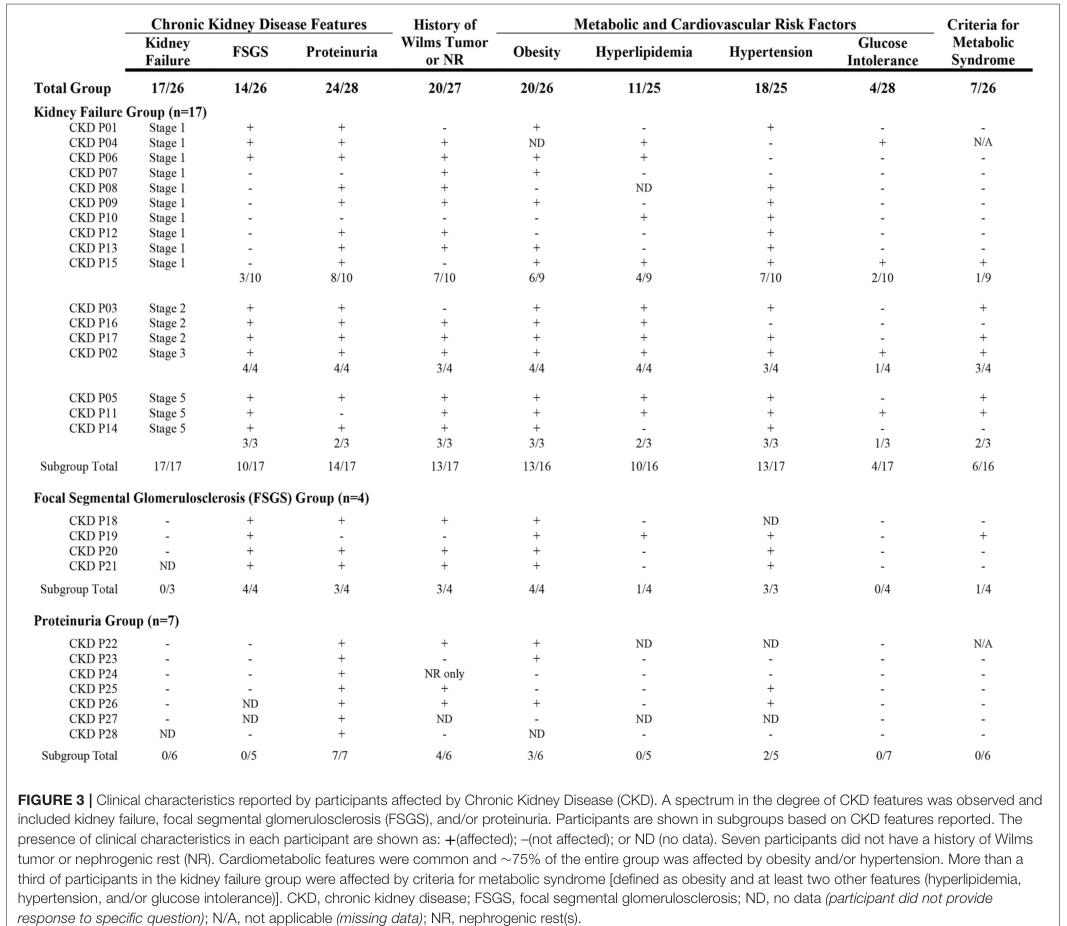
snippet: "Participants were frequently affected by features of chronic kidney disease (CKD), with rates of proteinuria, kidney failure, and/or focal segmental glomerulosclerosis (FSGS) reported between 20 and 33%"
explanation: >
Registry data establish a broad CKD phenotype rather than kidney failure
alone and identify its proteinuric and glomerular components.
- reference: PMID:39320341
reference_title: "Update on Surveillance for Wilms Tumor and Hepatoblastoma in Beckwith-Wiedemann Syndrome and Other Predisposition Syndromes."
supports: SUPPORT
evidence_source: OTHER
snippet: "these patients are at risk for chronic kidney disease as observed in up to 51% of patients with WAGR syndrome"
explanation: >
The AACR update confirms substantial CKD risk and the need for extended
kidney-health surveillance.
- reference: PMID:34970513
reference_title: "Results From the WAGR Syndrome Patient Registry: Characterization of WAGR Spectrum and Recommendations for Care Management."
supports: SUPPORT
evidence_source: HUMAN_CLINICAL
snippet: "At least one feature of CKD was reported by 28 individual participants, with 42.9% of females (n = 18/42) and 32.3% of males (n = 10/31) affected."
explanation: >
The sex-stratified counts total 28 of 73 participants (38.4%), directly
supporting a FREQUENT syndrome-level frequency band.
- name: Hypertension
description: >
Hypertension is a common cardiometabolic and renal comorbidity and may cluster
with obesity and more severe chronic kidney disease.
phenotype_term:
preferred_term: Hypertension
term:
id: HP:0000822
label: Hypertension
frequency: FREQUENT
evidence:
- reference: PMID:34970513
reference_title: "Results From the WAGR Syndrome Patient Registry: Characterization of WAGR Spectrum and Recommendations for Care Management."
supports: SUPPORT
evidence_source: HUMAN_CLINICAL
snippet: "hypertension was present in more than a third of the cohort"
explanation: >
A prevalence above one third supports a FREQUENT frequency band.
- name: Intellectual disability
description: >
A range of neurodevelopmental delay and intellectual disability of variable
severity; one of the cardinal WAGR features.
phenotype_term:
preferred_term: Intellectual disability
term:
id: HP:0001249
label: Intellectual disability
evidence:
- reference: PMID:24357251
reference_title: "Narrowing of the responsible region for severe developmental delay and autistic behaviors in WAGR syndrome down to 1.6 Mb including PAX6, WT1, and PRRG4."
supports: SUPPORT
evidence_source: HUMAN_CLINICAL
snippet: "Developmental delay and autistic features are major complications of this syndrome"
explanation: >
Developmental delay/intellectual disability is documented as a major
complication of WAGR syndrome.
- reference: PMID:34970513
reference_title: "Results From the WAGR Syndrome Patient Registry: Characterization of WAGR Spectrum and Recommendations for Care Management."
supports: SUPPORT
evidence_source: HUMAN_CLINICAL
snippet: "Approximately 77% of all participants reported cognitive impairment and/or global developmental delay"
explanation: >
Registry data establish cognitive impairment and global delay as frequent,
variably expressed parts of the WAGR neurodevelopmental spectrum.
- name: Global developmental delay
description: >
Delay across multiple developmental domains is frequent and contributes to
the variable "R" component of WAGR spectrum disorder.
phenotype_term:
preferred_term: Global developmental delay
term:
id: HP:0001263
label: Global developmental delay
evidence:
- reference: PMID:34970513
reference_title: "Results From the WAGR Syndrome Patient Registry: Characterization of WAGR Spectrum and Recommendations for Care Management."
supports: SUPPORT
evidence_source: HUMAN_CLINICAL
snippet: "Approximately 77% of all participants reported cognitive impairment and/or global developmental delay"
explanation: >
About 77% reported cognitive impairment, global developmental delay, or
both, documenting the developmental phenotype without assigning the
combined estimate to global delay alone.
- name: Delayed speech and language development
description: >
Expressive speech and receptive-language delays are prominent within a broad
spectrum of communication disorders reported in WAGR syndrome.
phenotype_term:
preferred_term: Delayed speech and language development
term:
id: HP:0000750
label: Delayed speech and language development
evidence:
- reference: PMID:34970513
reference_title: "Results From the WAGR Syndrome Patient Registry: Characterization of WAGR Spectrum and Recommendations for Care Management."
supports: SUPPORT
evidence_source: HUMAN_CLINICAL
snippet: "between 65 and 75% of the cohort affected by at least one communication issue"
explanation: >
Communication problems affected most registry participants, with speech
and receptive-language delay reported as the most common forms.
- name: Seizure
description: >
Seizures or epilepsy occur in a minority of affected individuals and are part
of the emerging neurologic spectrum.
phenotype_term:
preferred_term: Seizure
term:
id: HP:0001250
label: Seizure
frequency: OCCASIONAL
evidence:
- reference: PMID:34970513
reference_title: "Results From the WAGR Syndrome Patient Registry: Characterization of WAGR Spectrum and Recommendations for Care Management."
supports: SUPPORT
evidence_source: HUMAN_CLINICAL
snippet: "In the WAGR Discovery Cohort, 12 patients reported seizures for a frequency of 18.2% affected"
explanation: >
The 18.2% registry estimate supports an OCCASIONAL frequency band.
- name: Childhood-onset obesity
description: >
Hyperphagia and early-onset obesity occurring in the WAGRO subtype when the
deletion includes BDNF.
subtype: WAGRO
phenotype_term:
preferred_term: Obesity
term:
id: HP:0001513
label: Obesity
evidence:
- reference: PMID:18753648
reference_title: "Brain-derived neurotrophic factor and obesity in the WAGR syndrome."
supports: SUPPORT
evidence_source: HUMAN_CLINICAL
snippet: "All patients with deletions that involved any portion of the BDNF gene became obese by 10 years of age."
explanation: >
All BDNF-deletion (WAGRO) patients were obese by age 10, supporting
childhood-onset obesity as a subtype feature.
- reference: PMID:18753648
reference_title: "Brain-derived neurotrophic factor and obesity in the WAGR syndrome."
supports: SUPPORT
evidence_source: HUMAN_CLINICAL
snippet: "were obese (BMI > or = 95th percentile for age and sex) as compared with 20% of persons without BDNF deletions"
explanation: >
The complete outcome phrase confirms that the endpoint was obesity and
provides the contrast with BDNF-intact WAGR participants.
- name: Hyperphagia
description: >
Excessive food intake associated with BDNF haploinsufficiency in the WAGRO
subtype, contributing to childhood-onset obesity.
subtype: WAGRO
phenotype_term:
preferred_term: Hyperphagia
term:
id: HP:0002591
label: Polyphagia
evidence:
- reference: PMID:18753648
reference_title: "Brain-derived neurotrophic factor and obesity in the WAGR syndrome."
supports: SUPPORT
evidence_source: HUMAN_CLINICAL
snippet: "Hyperphagia and obesity were observed in a subgroup of patients with the WAGR syndrome"
explanation: >
Hyperphagia is reported in the obesity-prone subgroup of WAGR patients (the
WAGRO subtype with BDNF deletion).
- name: Autism spectrum disorder
description: >
Autistic behaviors and neurobehavioral features are reported in WAGR syndrome,
with the responsible region narrowed to a 1.6 Mb interval containing PAX6, WT1,
and PRRG4.
phenotype_term:
preferred_term: Autism
term:
id: HP:0000717
label: Autism
evidence:
- reference: PMID:24357251
reference_title: "Narrowing of the responsible region for severe developmental delay and autistic behaviors in WAGR syndrome down to 1.6 Mb including PAX6, WT1, and PRRG4."
supports: SUPPORT
evidence_source: HUMAN_CLINICAL
snippet: "the region responsible for severe developmental delay and autistic features on WAGR syndrome can be narrowed down"
explanation: >
Autistic features are documented as a major complication and were genetically
mapped within the WAGR critical region.
- name: Attention deficit hyperactivity disorder
description: >
ADHD is a recurrent neurobehavioral feature of WAGR spectrum disorder,
estimated to affect roughly a quarter of patients across WAGR cohorts.
phenotype_term:
preferred_term: Attention deficit hyperactivity disorder
term:
id: HP:0007018
label: Attention deficit hyperactivity disorder
frequency: OCCASIONAL
evidence:
- reference: PMID:34970513
reference_title: "Results From the WAGR Syndrome Patient Registry: Characterization of WAGR Spectrum and Recommendations for Care Management."
supports: SUPPORT
evidence_source: HUMAN_CLINICAL
snippet: "it is estimated that ~25% of patients with WAGR may be affected by attention issues"
explanation: >
The syndrome-specific cohort review supports ADHD/attention problems and an
OCCASIONAL frequency band without extrapolating from isolated PAX6 disease.
- name: Anxiety
description: >
Anxiety is part of the variable psychiatric and behavioral spectrum reported
in WAGR cohorts.
phenotype_term:
preferred_term: Anxiety
term:
id: HP:0000739
label: Anxiety
evidence:
- reference: PMID:34970513
reference_title: "Results From the WAGR Syndrome Patient Registry: Characterization of WAGR Spectrum and Recommendations for Care Management."
supports: SUPPORT
evidence_source: HUMAN_CLINICAL
snippet: "Between 25 and 29% of patients are estimated to be affected by ADD/ADHD, anxiety, autism, and/or OCD"
explanation: >
WAGR-specific cohort synthesis includes anxiety among recurrent psychiatric
diagnoses; the combined estimate is not assigned to anxiety alone.
- name: Cataract
description: >
Lens opacity occurring as part of the PAX6-related pan-ocular phenotype.
phenotype_term:
preferred_term: Cataract
term:
id: HP:0000518
label: Cataract
evidence:
- reference: PMID:20301534
reference_title: "PAX6 Aniridia Syndrome."
supports: SUPPORT
evidence_source: HUMAN_CLINICAL
snippet: "lens (cataract and lens subluxation)"
explanation: >
Cataract is part of the PAX6 aniridia syndrome ocular spectrum that applies to
WAGR aniridia.
- name: Glaucoma
description: >
Raised intraocular pressure and glaucoma from anterior-segment dysgenesis in the
PAX6-related ocular phenotype.
phenotype_term:
preferred_term: Glaucoma
term:
id: HP:0000501
label: Glaucoma
evidence:
- reference: PMID:20301534
reference_title: "PAX6 Aniridia Syndrome."
supports: SUPPORT
evidence_source: HUMAN_CLINICAL
snippet: "anterior segment (resulting in raised intraocular pressure and glaucoma)"
explanation: >
Glaucoma is documented in the PAX6 aniridia ocular phenotype relevant to WAGR.
- name: Nystagmus
description: >
Involuntary eye movements characteristically accompanying aniridia/foveal
hypoplasia in PAX6-related disease.
phenotype_term:
preferred_term: Nystagmus
term:
id: HP:0000639
label: Nystagmus
evidence:
- reference: PMID:20301534
reference_title: "PAX6 Aniridia Syndrome."
supports: SUPPORT
evidence_source: HUMAN_CLINICAL
snippet: "Individuals with classic aniridia characteristically show nystagmus and impaired visual acuity"
explanation: >
Nystagmus is a characteristic feature of classic aniridia, which is part of
WAGR syndrome.
- name: Foveal hypoplasia
description: >
Underdevelopment of the fovea contributing to impaired visual acuity in
PAX6-related aniridia.
phenotype_term:
preferred_term: Foveal hypoplasia
term:
id: HP:0007750
label: Hypoplasia of the fovea
evidence:
- reference: PMID:20301534
reference_title: "PAX6 Aniridia Syndrome."
supports: SUPPORT
evidence_source: HUMAN_CLINICAL
snippet: "fovea (foveal hypoplasia)"
explanation: >
Foveal hypoplasia is documented in the PAX6 aniridia ocular spectrum applicable
to WAGR.
- name: Visual impairment
description: >
Reduced visual acuity caused by the combined PAX6-related pan-ocular
phenotype. Classic aniridia commonly limits acuity to approximately 20/100
to 20/200, although severity varies.
phenotype_term:
preferred_term: Visual impairment
term:
id: HP:0000505
label: Visual impairment
evidence:
- reference: PMID:20301534
reference_title: "PAX6 Aniridia Syndrome."
supports: SUPPORT
evidence_source: HUMAN_CLINICAL
snippet: "Individuals with classic aniridia characteristically show nystagmus and impaired visual acuity (usually 20/100 to 20/200)."
explanation: >
GeneReviews directly documents the functional visual consequence of the
PAX6-related ocular phenotype.
- name: Corneal keratopathy
description: >
Aniridia-related corneal keratopathy is part of the PAX6 pan-ocular phenotype
and may be worsened by ocular surgery. Because HPO lacks a specific term for
aniridia-related keratopathy, it is mapped to the broader abnormal corneal
morphology term.
phenotype_term:
preferred_term: Corneal keratopathy
term:
id: HP:0000481
label: Abnormal cornea morphology
evidence:
- reference: PMID:20301534
reference_title: "PAX6 Aniridia Syndrome."
supports: SUPPORT
evidence_source: HUMAN_CLINICAL
snippet: "Classic aniridia affects the iris (partial or full iris hypoplasia), cornea (corneal keratopathy), anterior segment"
explanation: >
The PAX6 GeneReviews phenotype definition explicitly identifies corneal
keratopathy.
- name: Lens subluxation
description: >
Partial displacement of the lens as part of the PAX6-related pan-ocular
developmental phenotype.
phenotype_term:
preferred_term: Lens subluxation
term:
id: HP:0001132
label: Lens subluxation
evidence:
- reference: PMID:20301534
reference_title: "PAX6 Aniridia Syndrome."
supports: SUPPORT
evidence_source: HUMAN_CLINICAL
snippet: "lens (cataract and lens subluxation)"
explanation: >
Lens subluxation is directly listed among classic PAX6 aniridia findings.
- name: Optic nerve hypoplasia
description: >
Underdevelopment of the optic nerve as part of the PAX6 pan-ocular phenotype,
contributing to visual impairment in some affected individuals.
phenotype_term:
preferred_term: Optic nerve hypoplasia
term:
id: HP:0000609
label: Optic nerve hypoplasia
evidence:
- reference: PMID:20301534
reference_title: "PAX6 Aniridia Syndrome."
supports: SUPPORT
evidence_source: HUMAN_CLINICAL
snippet: "optic nerve (optic nerve coloboma and hypoplasia)"
explanation: >
Optic nerve hypoplasia is directly included in the classic PAX6 aniridia
spectrum.
- name: Recurrent infections
description: >
Recurrent infections are among the expanded phenotypic features of WAGR spectrum
disorder.
phenotype_term:
preferred_term: Recurrent infections
term:
id: HP:0002719
label: Recurrent infections
evidence:
- reference: PMID:41818601
reference_title: "WAGR Spectrum Disorder."
supports: SUPPORT
evidence_source: HUMAN_CLINICAL
snippet: "hypotonia and scoliosis, and recurrent infections"
explanation: >
GeneReviews lists recurrent infections among the expanded WAGR spectrum
findings.
- name: Constipation
description: >
Chronic constipation is one of the most frequently reported specific
gastrointestinal manifestations in WAGR spectrum disorder.
phenotype_term:
preferred_term: Constipation
term:
id: HP:0002019
label: Constipation
evidence:
- reference: PMID:34970513
reference_title: "Results From the WAGR Syndrome Patient Registry: Characterization of WAGR Spectrum and Recommendations for Care Management."
supports: SUPPORT
evidence_source: HUMAN_CLINICAL
snippet: "approximately half reporting chronic constipation and/or feeding problems"
explanation: >
Registry data identify constipation and feeding problems as prominent
components of the broader gastrointestinal phenotype; the combined
estimate is not assigned to constipation alone.
- name: Feeding difficulties
description: >
Feeding problems occur within the common gastrointestinal and respiratory
phenotype of WAGR spectrum disorder.
phenotype_term:
preferred_term: Feeding difficulties
term:
id: HP:0011968
label: Feeding difficulties
evidence:
- reference: PMID:34970513
reference_title: "Results From the WAGR Syndrome Patient Registry: Characterization of WAGR Spectrum and Recommendations for Care Management."
supports: SUPPORT
evidence_source: HUMAN_CLINICAL
snippet: "approximately half reporting chronic constipation and/or feeding problems"
explanation: >
Registry data directly include feeding problems among common GI findings;
the combined estimate is not assigned to feeding difficulty alone.
- name: Obstructive sleep apnea
description: >
Obstructive sleep apnea occurs within a broader pattern of respiratory and
sleep problems, potentially alongside airway malacia and recurrent
respiratory infections.
phenotype_term:
preferred_term: Obstructive sleep apnea
term:
id: HP:0002870
label: Obstructive sleep apnea
evidence:
- reference: PMID:34970513
reference_title: "Results From the WAGR Syndrome Patient Registry: Characterization of WAGR Spectrum and Recommendations for Care Management."
supports: SUPPORT
evidence_source: HUMAN_CLINICAL
snippet: "additional common issues included apnea, asthma, and obstructive sleep apnea (OSA)"
explanation: >
The WAGR registry identifies obstructive sleep apnea among common
respiratory manifestations.
- name: Hearing impairment
description: >
Hearing loss affects a minority of patients and is especially consequential
because most affected individuals also have severe visual impairment.
phenotype_term:
preferred_term: Hearing impairment
term:
id: HP:0000365
label: Hearing impairment
frequency: OCCASIONAL
evidence:
- reference: PMID:34970513
reference_title: "Results From the WAGR Syndrome Patient Registry: Characterization of WAGR Spectrum and Recommendations for Care Management."
supports: SUPPORT
evidence_source: HUMAN_CLINICAL
snippet: "Hearing loss was reported by close to 15% of participants"
explanation: >
The approximately 15% registry estimate supports an OCCASIONAL frequency
band.
- name: Congenital heart defect
description: >
Diverse congenital cardiac structural defects occur, but no single defect
has emerged as characteristic of WAGR spectrum disorder.
phenotype_term:
preferred_term: Abnormal heart morphology
term:
id: HP:0001627
label: Abnormal heart morphology
frequency: OCCASIONAL
evidence:
- reference: PMID:34970513
reference_title: "Results From the WAGR Syndrome Patient Registry: Characterization of WAGR Spectrum and Recommendations for Care Management."
supports: SUPPORT
evidence_source: HUMAN_CLINICAL
snippet: "Congenital heart defects were present in approximately 20% of participants"
explanation: >
The approximately 20% registry estimate supports an OCCASIONAL frequency
band for nonspecific congenital cardiac morphology abnormalities.
- name: Hypotonia
description: >
Reduced muscle tone reported among the expanded WAGR spectrum features.
phenotype_term:
preferred_term: Hypotonia
term:
id: HP:0001252
label: Hypotonia
evidence:
- reference: PMID:41818601
reference_title: "WAGR Spectrum Disorder."
supports: SUPPORT
evidence_source: HUMAN_CLINICAL
snippet: "hypotonia and scoliosis, and recurrent infections"
explanation: >
GeneReviews lists hypotonia among the expanded WAGR spectrum findings.
- name: Scoliosis
description: >
Abnormal lateral curvature of the spine reported among the expanded WAGR
spectrum features.
phenotype_term:
preferred_term: Scoliosis
term:
id: HP:0002650
label: Scoliosis
evidence:
- reference: PMID:41818601
reference_title: "WAGR Spectrum Disorder."
supports: SUPPORT
evidence_source: HUMAN_CLINICAL
snippet: "hypotonia and scoliosis, and recurrent infections"
explanation: >
GeneReviews lists scoliosis among the expanded WAGR spectrum findings.
- name: Renal failure
description: >
Kidney failure can develop in WAGR spectrum disorder, related to WT1-associated
nephropathy and the renal consequences of Wilms tumor and its treatment.
phenotype_term:
preferred_term: Renal insufficiency
term:
id: HP:0000083
label: Renal insufficiency
evidence:
- reference: PMID:34970513
reference_title: "Results From the WAGR Syndrome Patient Registry: Characterization of WAGR Spectrum and Recommendations for Care Management."
supports: SUPPORT
evidence_source: HUMAN_CLINICAL
snippet: "patients affected by WAGR syndrome can develop obesity and kidney failure"
explanation: >
The WAGR patient registry documents kidney failure as a recognized
manifestation of the WAGR spectrum.
genetic:
- name: 11p13 contiguous-gene deletion
inheritance:
- name: Autosomal dominant
evidence:
- reference: PMID:41818601
reference_title: "WAGR Spectrum Disorder."
supports: SUPPORT
evidence_source: HUMAN_CLINICAL
snippet: "WAGR spectrum disorder is an autosomal dominant disorder typically caused by a de novo 11p13 deletion"
explanation: >
GeneReviews documents the autosomal dominant inheritance with a typically de
novo 11p13 deletion.
features: >
Heterozygous interstitial deletion of chromosome band 11p13 encompassing the
contiguous WT1 and PAX6 genes, typically de novo. Deletion size is variable;
extension distally to BDNF (11p14.1) produces the WAGRO obesity subtype.
evidence:
- reference: PMID:41818601
reference_title: "WAGR Spectrum Disorder."
supports: SUPPORT
evidence_source: HUMAN_CLINICAL
snippet: "WAGR spectrum disorder is an autosomal dominant disorder typically caused by a de novo 11p13 deletion"
explanation: >
GeneReviews establishes the autosomal dominant, usually de novo, 11p13 deletion
etiology.
- reference: PMID:18753648
reference_title: "Brain-derived neurotrophic factor and obesity in the WAGR syndrome."
supports: SUPPORT
evidence_source: HUMAN_CLINICAL
snippet: "Deletions of chromosome 11p in the patients studied ranged from 1.0 to 26.5 Mb; 58% of the patients had heterozygous BDNF deletions"
explanation: >
Documents the wide range of deletion sizes and the proportion extending to BDNF.
treatments:
- name: Wilms tumor surveillance
action_category: SCREENING
description: >
Begin renal ultrasound at birth or diagnosis and repeat every three months
through the seventh birthday. This schedule targets the early-childhood risk
window in which at least 95% of predisposition-associated Wilms tumors occur.
treatment_term:
preferred_term: surveillance for malignancies
term:
id: NCIT:C15406
label: Cancer Screening
evidence:
- reference: PMID:39320341
reference_title: "Update on Surveillance for Wilms Tumor and Hepatoblastoma in Beckwith-Wiedemann Syndrome and Other Predisposition Syndromes."
supports: SUPPORT
evidence_source: OTHER
snippet: "For WT screening, we propose initiating screening at birth (or upon diagnosis of the specific syndrome) with renal ultrasound every 3 months up to the child's 7th birthday"
explanation: >
The 2024 AACR update gives the exact start point, modality, interval, and
stopping age for Wilms tumor surveillance.
- reference: PMID:39320341
reference_title: "Update on Surveillance for Wilms Tumor and Hepatoblastoma in Beckwith-Wiedemann Syndrome and Other Predisposition Syndromes."
supports: SUPPORT
evidence_source: OTHER
snippet: "we recommend a standard surveillance strategy using ultrasounds every three months in early childhood until the 7th birthday, to cover the reported age range in which 95% of WT develop"
explanation: >
This supports both the three-month interval and the reported 95% coverage
of the age-defined tumor-risk window.
- reference: PMID:33146894
reference_title: "Clinical characteristics and outcomes of children with WAGR syndrome and Wilms tumor and/or nephroblastomatosis: The 30-year SIOP-RTSG experience."
supports: SUPPORT
evidence_source: HUMAN_CLINICAL
snippet: "intensive monitoring of toxicity and surveillance of the remaining kidney(s) are advised"
explanation: >
The SIOP-RTSG cohort advises ongoing surveillance of remaining kidney tissue
in WAGR patients given the high rate of bilateral disease.
- name: Extended kidney-health surveillance
action_category: SCREENING
description: >
Continue kidney-health monitoring into adolescence and adulthood after
tumor-focused screening ends. Follow-up should assess blood pressure,
urinalysis/proteinuria, kidney function, and imaging as individualized by
nephrology. Registry authors propose at least annual renal ultrasound across
the lifetime, but the precise adult interval remains a care-model proposal
rather than a trial-tested schedule.
treatment_term:
preferred_term: supportive care
term:
id: NCIT:C15747
label: Supportive Care
evidence:
- reference: PMID:39320341
reference_title: "Update on Surveillance for Wilms Tumor and Hepatoblastoma in Beckwith-Wiedemann Syndrome and Other Predisposition Syndromes."
supports: SUPPORT
evidence_source: OTHER
snippet: "Additional screening to evaluate kidney health should extend into adolescence and beyond"
explanation: >
AACR guidance distinguishes extended kidney-health monitoring from the
finite childhood tumor-surveillance schedule.
- reference: PMID:34970513
reference_title: "Results From the WAGR Syndrome Patient Registry: Characterization of WAGR Spectrum and Recommendations for Care Management."
supports: SUPPORT
evidence_source: HUMAN_CLINICAL
snippet: "All patients should at least receive annual RUS to monitor for CKD risk"
explanation: >
The WAGR registry care model proposes a minimum annual renal ultrasound
after the high-risk childhood period; the record preserves its proposal
status rather than presenting it as experimentally validated.
- reference: PMID:34970513
reference_title: "Results From the WAGR Syndrome Patient Registry: Characterization of WAGR Spectrum and Recommendations for Care Management."
supports: SUPPORT
evidence_source: HUMAN_CLINICAL
snippet: "Routine monitoring of kidney function and cardiometabolic health is warranted, and specific monitoring schedules can be determined by the care team"
explanation: >
This supports individualized functional and cardiometabolic follow-up in
addition to the registry's proposed imaging schedule.
- name: Cardiometabolic monitoring
action_category: SCREENING
description: >
Measure growth and weight trajectory, blood pressure, and other routine
biometric markers at primary-care visits, with urine or serum testing and
referral to nephrology, cardiology, endocrinology, or weight management when
abnormalities emerge.
treatment_term:
preferred_term: supportive care
term:
id: NCIT:C15747
label: Supportive Care
evidence:
- reference: PMID:34970513
reference_title: "Results From the WAGR Syndrome Patient Registry: Characterization of WAGR Spectrum and Recommendations for Care Management."
supports: SUPPORT
evidence_source: HUMAN_CLINICAL
snippet: "all patients with WAGR should receive routine biometric screening at all visits from their pediatrician and/or primary care provider"
explanation: >
The syndrome-specific care model recommends routine cardiometabolic
surveillance because obesity, hypertension, and CKD frequently cluster.
- name: Wilms tumor surgical resection
description: >
Surgical resection of Wilms tumor may use nephron-sparing surgery or total
nephrectomy. Kidney preservation is especially relevant because bilateral
disease and later chronic kidney disease are common.
treatment_term:
preferred_term: nephrectomy
term:
id: NCIT:C15284
label: Nephrectomy
target_phenotypes:
- preferred_term: Nephroblastoma
term:
id: HP:0002667
label: Nephroblastoma
evidence:
- reference: PMID:41818601
reference_title: "WAGR Spectrum Disorder."
supports: SUPPORT
evidence_source: HUMAN_CLINICAL
snippet: "oncology (Wilms tumor risk assessment and management)"
explanation: >
GeneReviews specifies pediatric oncology management of Wilms tumor risk, which
includes surgical resection when tumors arise.
- reference: PMID:33146894
reference_title: "Clinical characteristics and outcomes of children with WAGR syndrome and Wilms tumor and/or nephroblastomatosis: The 30-year SIOP-RTSG experience."
supports: SUPPORT
evidence_source: HUMAN_CLINICAL
snippet: "Among the other 13 patients with bilateral disease, 11 (85%) underwent nephron-sparing surgery (NSS)"
explanation: >
The WAGR tumor cohort directly documents frequent nephron-sparing surgery
in bilateral disease.
- name: Wilms tumor chemotherapy
description: >
Chemotherapy is a core component of multimodality Wilms tumor management,
coordinated with surgical care by pediatric oncology.
treatment_term:
preferred_term: chemotherapy
term:
id: NCIT:C15632
label: Chemotherapy
target_phenotypes:
- preferred_term: Nephroblastoma
term:
id: HP:0002667
label: Nephroblastoma
evidence:
- reference: PMID:41818601
reference_title: "WAGR Spectrum Disorder."
supports: SUPPORT
evidence_source: HUMAN_CLINICAL
snippet: "oncology (Wilms tumor risk assessment and management)"
explanation: >
GeneReviews specifies pediatric oncology management of Wilms tumor, which
encompasses chemotherapy as a core element of the multimodality regimen.
- reference: PMID:33146894
reference_title: "Clinical characteristics and outcomes of children with WAGR syndrome and Wilms tumor and/or nephroblastomatosis: The 30-year SIOP-RTSG experience."
supports: SUPPORT
evidence_source: HUMAN_CLINICAL
snippet: "39 of these patients (92.9%) received preoperative chemotherapy, including actinomycin D and vincristine"
explanation: >
The 30-year cohort directly documents chemotherapy use in WAGR-associated
Wilms tumor.
- name: Aniridia and ophthalmologic management
description: >
Multidisciplinary ophthalmologic care for complications of aniridia, including
correction of refractive errors, tinted/photochromic lenses, glaucoma medication,
and cautious surgical management given keratopathy and foveal hypoplasia.
treatment_term:
preferred_term: supportive care
term:
id: NCIT:C15747
label: Supportive Care
target_phenotypes:
- preferred_term: Visual impairment
term:
id: HP:0000505
label: Visual impairment
- preferred_term: Corneal keratopathy
term:
id: HP:0000481
label: Abnormal cornea morphology
- preferred_term: Cataract
term:
id: HP:0000518
label: Cataract
- preferred_term: Glaucoma
term:
id: HP:0000501
label: Glaucoma
evidence:
- reference: PMID:20301534
reference_title: "PAX6 Aniridia Syndrome."
supports: SUPPORT
evidence_source: HUMAN_CLINICAL
snippet: "Supportive treatment: Multidisciplinary care by specialists in ophthalmology who are familiar with management of PAX6 aniridia syndrome (i.e., correction of refractive errors; use of tinted or photochromic lenses; occlusion therapy in childhood for anisometropic amblyopia or strabismic amblyopia; caution regarding surgical procedures to decrease the likelihood or exacerbation of aniridic-related keratopathy (ARK) and/or severe aniridic fibrosis syndrome (AFS); cautious use of lensectomy to attempt to improve visual acuity in those with cataracts because of associated foveal hypoplasia; use of topical anti-glaucoma medication to manage glaucoma when possible; methods to treat corneal opacification)."
explanation: >
This complete management statement directly supports refractive correction,
tinted lenses, amblyopia therapy, cautious surgery/lensectomy, glaucoma
medication, and corneal treatment without extending beyond the source.
- name: WAGRO weight monitoring and preventive lifestyle guidance
description: >
For individuals whose deletion includes BDNF, monitor weight more vigilantly
and provide early family guidance about dietary intake and physical activity.
This is preventive supportive care based on the obesity-prone WAGRO phenotype,
not evidence for a disease-modifying pharmacologic treatment.
treatment_term:
preferred_term: supportive care
term:
id: NCIT:C15747
label: Supportive Care
target_phenotypes:
- preferred_term: Childhood-onset obesity
term:
id: HP:0001513
label: Obesity
- preferred_term: Hyperphagia
term:
id: HP:0002591
label: Polyphagia
evidence:
- reference: PMID:23517654
reference_title: "Association of brain-derived neurotrophic factor (BDNF) haploinsufficiency with lower adaptive behaviour and reduced cognitive functioning in WAGR/11p13 deletion syndrome."
supports: SUPPORT
evidence_source: HUMAN_CLINICAL
snippet: "currently advise that BDNF+/− patients receive more vigilant weight monitoring and that their families receive early preventive guidance regarding dietary intake and physical activity."
explanation: >
The WAGR cohort investigators make a deletion-status-specific management
recommendation covering both monitoring and early prevention guidance.
- name: Genitourinary evaluation and urology management
description: >
Include pediatric urology and nephrology in multidisciplinary care for genital
anomalies and congenital kidney/urinary-tract anomalies. Initial evaluation
should include full abdominal and pelvic ultrasonography, with further imaging
and management individualized to the detected findings and clinical history.
treatment_term:
preferred_term: supportive care
term:
id: NCIT:C15747
label: Supportive Care
target_phenotypes:
- preferred_term: Abnormality of the genital system
term:
id: HP:0000078
label: Abnormality of the genital system
- preferred_term: Congenital anomalies of the kidney and urinary tract
term:
id: HP:0000079
label: Abnormality of the urinary system
evidence:
- reference: PMID:41818601
reference_title: "WAGR Spectrum Disorder."
supports: SUPPORT
evidence_source: HUMAN_CLINICAL
snippet: "urology (genital anomalies and congenital anomalies of the kidney and urinary tract), and nephrology (kidney function)"
explanation: >
GeneReviews directly assigns the genital, urinary-tract, and kidney aspects
of WAGR care to pediatric urology and nephrology.
- reference: PMID:34970513
reference_title: "Results From the WAGR Syndrome Patient Registry: Characterization of WAGR Spectrum and Recommendations for Care Management."
supports: SUPPORT
evidence_source: HUMAN_CLINICAL
snippet: "All patients should receive a full abdominal ultrasound and a pelvic ultrasound in order to detect any anomalies"
explanation: >
The WAGR registry care model specifies abdominal and pelvic ultrasound in
the initial work-up for internal genitourinary anomalies.
- name: Developmental and behavioral support
description: >
Early childhood developmental intervention and management of intellectual
disability and neurobehavioral/psychiatric issues by developmental specialists.
treatment_term:
preferred_term: supportive care
term:
id: NCIT:C15747
label: Supportive Care
evidence:
- reference: PMID:41818601
reference_title: "WAGR Spectrum Disorder."
supports: SUPPORT
evidence_source: HUMAN_CLINICAL
snippet: "early childhood development (developmental delay / intellectual disability, neurobehavioral issues)"
explanation: >
GeneReviews recommends developmental and neurobehavioral support as part of
multidisciplinary WAGR care.
- name: Genetic counseling
description: >
Genetic counseling for recurrence-risk assessment, including parental genetic
and chromosome evaluation for predisposing rearrangements or mosaicism.
treatment_term:
preferred_term: Genetic Counseling
term:
id: NCIT:C15240
label: Genetic Counseling
evidence:
- reference: PMID:41818601
reference_title: "WAGR Spectrum Disorder."
supports: SUPPORT
evidence_source: HUMAN_CLINICAL
snippet: "Recommended evaluations of the parents to confirm their genetic status and to allow reliable recurrence risk counseling"
explanation: >
GeneReviews recommends parental genetic evaluation and counseling for
recurrence-risk assessment in WAGR spectrum disorder families.
diagnosis:
- name: Molecular copy-number testing for an 11p13 deletion
description: >
Confirm WAGR spectrum disorder by demonstrating a chromosome 11p13 deletion
that includes both WT1 and PAX6. A chromosomal microarray or another validated
molecular copy-number method can define the deletion and determine whether it
extends to BDNF or other neighboring genes.
diagnosis_term:
preferred_term: genetic testing
term:
id: NCIT:C15709
label: Genetic Testing
evidence:
- reference: PMID:41818601
reference_title: "WAGR Spectrum Disorder."
supports: SUPPORT
evidence_source: HUMAN_CLINICAL
snippet: "The diagnosis of WAGR spectrum disorder is established in a proband with suggestive findings and a deletion of chromosome 11p13 that includes the genes WT1 and PAX6 identified by molecular genetic testing"
explanation: >
GeneReviews defines the molecular diagnostic criterion: deletion of both
WT1 and PAX6, rather than aniridia or a WT1 alteration alone.
- reference: PMID:34970513
reference_title: "Results From the WAGR Syndrome Patient Registry: Characterization of WAGR Spectrum and Recommendations for Care Management."
supports: SUPPORT
evidence_source: HUMAN_CLINICAL
snippet: "A geneticist can determine the most appropriate molecular analyses to be performed, as a variety of molecular tests have been suggested for these patients and often a combination of multiple methods is needed for an accurate diagnosis"
explanation: >
The syndrome-specific care model supports individualized copy-number and
chromosome testing when a single assay does not fully define the lesion.
- name: Evaluation of aniridia for WAGR tumor risk
description: >
Congenital or early-onset aniridia should trigger prompt genetics assessment
for a deletion involving both PAX6 and WT1. Until WAGR is excluded, manage the
patient as potentially at risk for Wilms tumor rather than assuming isolated
PAX6-related aniridia.
diagnosis_term:
preferred_term: genetic testing
term:
id: NCIT:C15709
label: Genetic Testing
evidence:
- reference: PMID:34970513
reference_title: "Results From the WAGR Syndrome Patient Registry: Characterization of WAGR Spectrum and Recommendations for Care Management."
supports: SUPPORT
evidence_source: HUMAN_CLINICAL
snippet: "Patients suspected for WAGR spectrum should be considered at risk for WT development and receive renal ultrasounds every 3 months while the diagnostic work-up occurs"
explanation: >
This supports provisional tumor-risk management during molecular work-up
when aniridia raises concern for WAGR spectrum disorder.
differential_diagnoses:
- name: Isolated PAX6-related aniridia
description: >
PAX6-related aniridia can reproduce the ocular phenotype but lacks the
contiguous WT1 deletion and therefore does not confer the WAGR-associated
Wilms tumor risk.
distinguishing_features:
- A pathogenic PAX6 variant or isolated PAX6 deletion without WT1 involvement supports isolated PAX6-related aniridia.
- A deletion encompassing both PAX6 and WT1 supports WAGR spectrum disorder and changes tumor surveillance.
evidence:
- reference: PMID:33146894
reference_title: "Clinical characteristics and outcomes of children with WAGR syndrome and Wilms tumor and/or nephroblastomatosis: The 30-year SIOP-RTSG experience."
supports: SUPPORT
evidence_source: HUMAN_CLINICAL
snippet: "The genetic diagnosis of WAGR syndrome requires the involvement of both WT1 and the aniridia gene PAX6 in the deletion, whereas patients with isolated PAX6 deletions are not at risk of developing WT"
explanation: >
This directly distinguishes isolated PAX6 deletion from the two-gene WAGR
deletion by both genotype and tumor risk.
- name: WT1-related tumor predisposition or nephropathy
description: >
Germline WT1 variants or smaller deletions can cause Wilms tumor
predisposition, nephropathy, or differences of sex development without the
PAX6-related pan-ocular aniridia phenotype that defines WAGR.
distinguishing_features:
- A pathogenic WT1 variant or WT1-limited deletion without PAX6 involvement supports a WT1-related disorder.
- Pan-ocular aniridia plus a deletion of both WT1 and PAX6 supports WAGR spectrum disorder.
evidence:
- reference: PMID:39320341
reference_title: "Update on Surveillance for Wilms Tumor and Hepatoblastoma in Beckwith-Wiedemann Syndrome and Other Predisposition Syndromes."
supports: SUPPORT
evidence_source: OTHER
snippet: "The WT1-related tumor predisposition syndromes, however, are distinct from WAGR syndrome which involves a large germline deletion spanning a larger section of the chromosomal region and includes both WT1 and PAX6"
explanation: >
The AACR update explicitly distinguishes limited WT1-related conditions
from the multigene WT1-PAX6 deletion defining WAGR.
animal_models:
- species: Mouse (Mus musculus)
genotype: Heterozygous Bdnf knockout
category: Heterozygous knockout
genes:
- preferred_term: BDNF
term:
id: hgnc:1033
label: BDNF
associated_phenotypes:
- Hyperphagia
- Obesity
- Decreased nociception
- Impaired learning and social behavior
description: >
Heterozygous Bdnf knockout mice reproduce the hyperphagia and obesity seen in
BDNF-deleted WAGRO and show learning and social-behavior changes. The model
isolates Bdnf dosage and therefore cannot reproduce the WT1/PAX6 tumor,
genitourinary, or ocular arms of the human contiguous-gene deletion.
evidence:
- reference: PMID:23517654
reference_title: "Association of brain-derived neurotrophic factor (BDNF) haploinsufficiency with lower adaptive behaviour and reduced cognitive functioning in WAGR/11p13 deletion syndrome."
supports: SUPPORT
evidence_source: MODEL_ORGANISM
snippet: "Heterozygous Bdnf knockout mice exhibit hyperphagia, obesity, decreased nociception, and impaired learning and social behaviours"
explanation: >
This summarizes the model phenotype overlapping the metabolic and
neurobehavioral BDNF-deletion arm of WAGRO.
- reference: PMID:18753648
reference_title: "Brain-derived neurotrophic factor and obesity in the WAGR syndrome."
supports: SUPPORT
evidence_source: MODEL_ORGANISM
snippet: "Mice that are heterozygous for inactivated BDNF have a 50% reduction in hypothalamic expression of BDNF, and they have hyperphagia and obesity, which are reversed by intracerebroventricular infusions of BDNF"
explanation: >
The dosage, phenotype, and BDNF-rescue result support a direct BDNF
energy-homeostasis mechanism in the mouse.
discussions:
- discussion_id: gap_wagr_bdnf_mouse_contiguous_deletion_translation
prompt: >
Which metabolic and neurobehavioral effects of the human BDNF-deleted WAGRO
phenotype are attributable specifically to BDNF dosage, and which require
other genes in the variably sized 11p deletion or human developmental context?
kind: HUMAN_MODEL_MISMATCH
status: OPEN
attaches_to:
- pathophysiology#BDNF haploinsufficiency and hypothalamic energy dysregulation
rationale: >
Heterozygous Bdnf knockout mice provide strong directional support for the
hyperphagia-obesity mechanism and show learning and social-behavior changes.
Human WAGRO, however, is a variably sized contiguous-gene deletion that always
also removes WT1 and PAX6 and may remove additional neurodevelopmental genes.
The mouse therefore supports BDNF-specific dosage biology but cannot by itself
assign every human cognitive, adaptive, or autism-related feature to BDNF, and
it does not model the renal-tumor, genitourinary, or ocular syndrome arms.
evidence:
- reference: PMID:23517654
reference_title: "Association of brain-derived neurotrophic factor (BDNF) haploinsufficiency with lower adaptive behaviour and reduced cognitive functioning in WAGR/11p13 deletion syndrome."
supports: SUPPORT
evidence_source: MODEL_ORGANISM
snippet: "Heterozygous Bdnf knockout mice exhibit hyperphagia, obesity, decreased nociception, and impaired learning and social behaviours"
explanation: >
The model recapitulates several BDNF-associated traits but is a single-gene
perturbation rather than the human contiguous deletion.
- reference: PMID:23517654
reference_title: "Association of brain-derived neurotrophic factor (BDNF) haploinsufficiency with lower adaptive behaviour and reduced cognitive functioning in WAGR/11p13 deletion syndrome."
supports: SUPPORT
evidence_source: HUMAN_CLINICAL
snippet: "the aetiology of cognitive impairment, which is quite variable among individuals with WAGR syndrome, has not been well elucidated"
explanation: >-
Human evidence explicitly preserves uncertainty about assigning variable
cognition to one deleted gene.
References & Deep Research
References
2Deep Research
1Deep research results are used as seeds for research; they do not undergo the same validation as the main records and may contain errors. How we use deep research.
1. Disease Information
1.1 What is the disease?
WAGR syndrome (also framed as WAGR spectrum disorder) is a developmental and cancer predisposition syndrome due to a germline 11p13 deletion encompassing WT1 and PAX6, classically manifesting Wilms tumor, aniridia, genitourinary anomalies, and intellectual disability/developmental delay. (hol2021clinicalcharacteristicsand pages 1-2, chbel2024conventionalandmolecular pages 1-2, duffy2021resultsfromthe pages 1-2)
Source type note: Much of the modern quantitative phenotype characterization comes from a patient registry (self-reported) (disease-level aggregation) rather than EHR-curated cohorts. (duffy2021resultsfromthe pages 1-2, duffy2021resultsfromthe pages 29-30)
1.2 Key identifiers
- OMIM: 194072 (WAGR syndrome) (chbel2024conventionalandmolecular pages 1-2)
- MONDO / Orphanet / MeSH / ICD-10/ICD-11: not directly retrievable from the accessible full-text evidence in this tool run; should be populated from authoritative terminologies (Orphanet/MONDO/UMLS) in a subsequent ontology-focused lookup.
1.3 Synonyms / alternative names
- WAGR syndrome (Wilms tumor–Aniridia–Genitourinary anomalies–(Range of) developmental delay) (duffy2021resultsfromthe pages 1-2)
- WAGR spectrum disorder (expanded phenotypic framing) (duffy2021resultsfromthe pages 1-2, duffy2021resultsfromthe pages 29-30)
- WAGRO (WAGR + obesity; often when deletion extends to BDNF) (chbel2024conventionalandmolecular pages 1-2, duffy2021resultsfromthe pages 1-2)
2. Etiology
2.1 Disease causal factors
Primary cause: germline heterozygous interstitial deletion at 11p13 involving (at minimum) WT1 and PAX6. (hol2021clinicalcharacteristicsand pages 1-2, souza2022characterizationofassociated pages 1-2, chbel2024conventionalandmolecular pages 1-2)
Inheritance: Typically de novo (sporadic) but can rarely be inherited through parental chromosomal rearrangements; parental genomic/chromosome evaluation is recommended in modern reviews. (george2026wagrspectrumdisorder pages 1-3)
2.2 Risk factors
- Genetic: deletion size and inclusion of additional genes may influence phenotype. For example, BDNF haploinsufficiency is linked to obesity and neurobehavioral severity within WAGR/WAGRO. (duffy2021resultsfromthe pages 1-2, han2013associationofbrainderived pages 1-2)
- Environmental: No disease-specific external risk factors were identified in the retrieved WAGR-focused sources; however, for obesity/metabolic outcomes, general diet/activity factors likely modulate severity (not WAGR-specific evidence in retrieved texts).
2.3 Protective factors
No validated genetic or environmental protective factors were identified in the WAGR-focused retrieved evidence.
2.4 Gene–environment interactions
No explicit WAGR-specific GxE evidence was identified in retrieved sources.
3. Phenotypes
3.1 Core phenotypic spectrum (with frequencies where available)
Registry data (91 participants) support reframing as “WAGR spectrum” with high burden across ocular, neurodevelopmental, renal/urologic, and cardiometabolic domains. (duffy2021resultsfromthe pages 1-2, duffy2021resultsfromthe pages 9-11)
Ocular / visual system * Eye issues: 85/85 (100%) (duffy2021resultsfromthe pages 8-9) * Nystagmus: 77/82 (93.9%) (duffy2021resultsfromthe pages 8-9) * Cataracts: 68/79 (86.1%) (duffy2021resultsfromthe pages 8-9) Suggested HPO terms: Aniridia (HP:0000526), Nystagmus (HP:0000639), Cataract (HP:0000518), Foveal hypoplasia (HP:0007750) (the last is commonly associated with aniridia but not quantified in the retrieved registry excerpts).
Wilms tumor / nephroblastomatosis predisposition * Registry: Wilms tumor and/or nephrogenic rests: 42/77 (54.5%); Wilms tumor specifically: 36/77 (46.8%) (duffy2021resultsfromthe pages 2-4) * Cohort-based risk estimate: 45%–60% lifetime Wilms tumor risk (hol2021clinicalcharacteristicsand pages 1-2) Suggested HPO terms: Wilms tumor (HP:0002667), Nephroblastomatosis / nephrogenic rests (often encoded as nephroblastomatosis; HPO usage may vary).
Neurodevelopmental / psychiatric (patient registry) * Cognitive and/or learning problems: 69/78 (88.5%) (duffy2021resultsfromthe pages 6-7) * Cognitive impairment: 45/78 (57.7%) (duffy2021resultsfromthe pages 6-7) * Global developmental delay: 44/78 (56.4%) (duffy2021resultsfromthe pages 6-7) * Autism spectrum disorder: 19/76 (25.0%) (duffy2021resultsfromthe pages 6-7) * ADD/ADHD: 18/76 (23.7%) (duffy2021resultsfromthe pages 6-7) * Anxiety disorder: 30/68 (44.1%) (duffy2021resultsfromthe pages 6-7) Suggested HPO terms: Global developmental delay (HP:0001263), Intellectual disability (HP:0001249), Autism (HP:0000717), Attention deficit hyperactivity disorder (HP:0007018), Anxiety (HP:0000739).
Neurologic / tone / seizures * Abnormal muscle control/tone: 53/77 (68.8%) (duffy2021resultsfromthe pages 8-9) * Seizures: 12/66 (18.1%) (duffy2021resultsfromthe pages 8-9) Suggested HPO terms: Hypotonia (HP:0001252), Seizures (HP:0001250).
Kidney / CAKUT / UTI / CKD * CAKUT may be underappreciated historically; “more than half” had ≥1 kidney condition (registry narrative). (duffy2021resultsfromthe pages 9-11) * CAKUT frequency in registry-derived summary: 38.5% (george2026wagrspectrumdisorder pages 3-5) * Among 15 with recurrent UTI, 9 (60.0%) had a CAKUT-consistent issue (duffy2021resultsfromthe pages 6-7) Suggested HPO terms: Congenital anomaly of kidney and urinary tract (HP:0000078), Recurrent urinary tract infections (HP:0000010), Chronic kidney disease (HP:0012622).
Cardiometabolic / obesity * Registry: “∼75% of the entire group was affected by obesity and/or hypertension” (duffy2021resultsfromthe pages 9-11) * In participants with reported BDNF deletion, ~two-thirds reported obesity (17/26) (duffy2021resultsfromthe pages 6-7) Suggested HPO terms: Obesity (HP:0001513), Hypertension (HP:0000822), Hyperlipidemia (HP:0003124), Abnormal glucose tolerance (HP:0001952).
Quality of life impact The retrieved evidence set did not include standardized QoL instruments (e.g., PROMIS, SF-36), but the high prevalence of ocular disease plus neurodevelopmental and metabolic/renal issues implies substantial lifelong functional impact and need for multidisciplinary care. (duffy2021resultsfromthe pages 9-11, george2026wagrspectrumdisorder pages 1-3)
4. Genetic / Molecular Information
4.1 Causal genes and genomic lesion
- WT1 and PAX6 deletion at 11p13 is defining for WAGR; isolated PAX6 deletions are not associated with Wilms tumor, highlighting WT1 as the Wilms tumor predisposition driver. (hol2021clinicalcharacteristicsand pages 1-2)
- Deletions frequently extend beyond WT1/PAX6 and may include BDNF (distal, ~4 Mb from PAX6), influencing obesity/neurobehavioral phenotypes. (han2013associationofbrainderived pages 1-2)
HGNC gene symbols: WT1, PAX6, BDNF.
4.2 Pathogenic variant class
Predominant pathogenic mechanism is copy-number loss (heterozygous deletion; contiguous gene deletion) rather than single-nucleotide variants. (hol2021clinicalcharacteristicsand pages 1-2, chbel2024conventionalandmolecular pages 2-5)
Variant type/class: structural variant / CNV (microdeletion); typically germline. (chbel2024conventionalandmolecular pages 1-2)
Allele frequency: not applicable in the conventional SNV sense; deletions are generally de novo and rare.
4.3 Modifier genes
BDNF is the best-supported modifier/extension gene for the “WAGRO” phenotype (obesity, adaptive/cognitive effects). (duffy2021resultsfromthe pages 6-7, han2013associationofbrainderived pages 1-2) A candidate-gene association study of common BDNF variants (tag SNPs) did not find strong evidence of a common-variant modifier effect on BMI in their WAGRO context, suggesting deletion/haploinsufficiency is more important than common polymorphism in driving the phenotype. (rodriguezlopez2013themodifiereffect pages 3-4)
4.4 Epigenetic information
A WAGR case study evaluated methylation at imprinting control regions and found normal methylation patterns, concluding that epigenetic contributions remain to be characterized. (takada2017sustainedendocrineprofiles pages 1-3)
4.5 Mechanistic notes (current understanding)
- PAX6 haploinsufficiency disrupts ocular development → congenital aniridia and associated panocular anomalies. (rodriguezlopez2013themodifiereffect pages 3-4, chbel2024conventionalandmolecular pages 1-2)
- WT1 loss disrupts kidney development/tumor suppression → high Wilms tumor risk; WAGR WT risk 45–60%. (hol2021clinicalcharacteristicsand pages 1-2, kalish2024updateonsurveillance pages 5-6)
- BDNF haploinsufficiency affects hypothalamic energy-balance circuits downstream of leptin/MC4R and impacts synaptic plasticity/learning; mechanistic support comes from mouse models and human genotype–phenotype analyses. (rodriguezlopez2013themodifiereffect pages 2-3, han2013associationofbrainderived pages 1-2)
Suggested GO biological process terms (examples): * Eye development: GO:0001654 (eye development) * Kidney development: GO:0001822 (kidney development) * Regulation of feeding behavior: GO:0060259 (regulation of feeding behavior) * Synaptic plasticity: GO:0048167 (regulation of synaptic plasticity)
Suggested CL cell types (examples): * Hypothalamic neuron: CL:0000679 (neuron) (more specific hypothalamic subtypes not extractable from retrieved WAGR sources) * Podocyte relevance is discussed in WT1-related disorders broadly but not specifically extracted here.
5. Environmental Information
No WAGR-specific environmental toxin, lifestyle, or infectious triggers were identified in the retrieved disease-focused sources. Management of obesity and cardiovascular risk is nonetheless likely to involve standard lifestyle/environmental interventions as part of general care pathways (not specific to WAGR evidence in this set).
6. Mechanism / Pathophysiology
6.1 Causal chain (integrated)
1) Germline 11p13 deletion removes WT1 + PAX6 (± BDNF and other genes) → 2) Developmental dysregulation of eye structures (PAX6), genitourinary/kidney development and tumor suppression (WT1), and neurotrophic signaling impacting cognition and energy balance (BDNF) → 3) Clinical manifestations: aniridia/panocular disease, Wilms tumor predisposition, GU anomalies/CAKUT/CKD, neurodevelopmental and psychiatric disorders, obesity/metabolic syndrome features. (hol2021clinicalcharacteristicsand pages 1-2, duffy2021resultsfromthe pages 9-11, han2013associationofbrainderived pages 1-2)
6.2 BDNF haploinsufficiency as a mechanistic driver of “WAGRO” features
A key mechanistic anchor is the observation that heterozygous Bdnf knockout mice show hyperphagia/obesity and learning/social-behavior deficits, paralleling human WAGR/WAGRO features. (han2013associationofbrainderived pages 1-2)
In a WAGR cohort stratified by BDNF deletion status, BDNF+/− subjects had ~14-point lower Vineland Adaptive Behaviour scores and ~20-point lower mean IQ compared with BDNF+/+ subjects, supporting BDNF dosage as a driver of adaptive/cognitive outcomes. (han2013associationofbrainderived pages 1-2)
7. Anatomical Structures Affected
Primary organ systems * Eye (aniridia/panocular anomalies): UBERON suggestion UBERON:0000970 (eye) (duffy2021resultsfromthe pages 8-9) * Kidney (Wilms tumor risk; CAKUT; CKD): UBERON:0002113 (kidney) (hol2021clinicalcharacteristicsand pages 1-2, duffy2021resultsfromthe pages 9-11) * Genitourinary tract: UBERON:0000990 (reproductive system) and UBERON:0000057 (ureter) for CAKUT-related structures (phenotype category supported; detailed UBERON mapping not enumerated in retrieved excerpts) (chbel2024conventionalandmolecular pages 1-2) * Brain (neurodevelopmental and behavioral phenotypes): UBERON:0000955 (brain) (duffy2021resultsfromthe pages 6-7)
Subcellular/cellular components Not systematically described in retrieved WAGR-focused clinical sources.
8. Temporal Development
- Onset: congenital ocular manifestations (aniridia and associated anomalies) are present early; Wilms tumor typically occurs in early childhood, with registry/case series emphasizing early surveillance. (duffy2021resultsfromthe pages 2-4, kalish2024updateonsurveillance pages 12-14)
- Wilms tumor timing: SIOP-RTSG cohort median age at WT/nephroblastomatosis diagnosis 22 months (range 6–44 months). (hol2021clinicalcharacteristicsand pages 1-2)
- Long-term course: CKD and cardiometabolic complications are important later morbidities; registry and guideline sources emphasize surveillance beyond childhood for kidney health. (kalish2024updateonsurveillance pages 5-6, duffy2021resultsfromthe pages 9-11)
9. Inheritance and Population
- Inheritance pattern: typically autosomal dominant at the level of the deletion, but most cases are de novo. (george2026wagrspectrumdisorder pages 1-3)
- Prevalence/incidence: robust population estimates were not available in the authoritative cohort/guideline sources retrieved here. Some low-authority case reports claim prevalence ranges (e.g., 1/500,000–1/1,000,000), but these were not used as a primary statistic due to limited evidentiary strength.
10. Diagnostics
10.1 Genetic testing (recommended approaches from retrieved sources)
- Chromosomal microarray / array CGH (CMA): high-resolution delineation of 11p deletions and breakpoints; can detect submicroscopic deletions not seen on karyotype. (chbel2024conventionalandmolecular pages 2-5)
- Conventional karyotype: can reveal complex rearrangements but may miss small deletions; still useful especially when rearrangements/translocations are suspected. (chbel2024conventionalandmolecular pages 2-5, takada2017sustainedendocrineprofiles pages 1-3)
- FISH: used for targeted confirmation in some workflows; may be unnecessary if CMA clearly defines deletion; can also interrogate regulatory regions when PAX6 coding is intact. (chbel2024conventionalandmolecular pages 2-5, chbel2024conventionalandmolecular pages 1-2)
- MLPA + karyotype as first-tier for newborns with aniridia in one proposed care pathway, while proceeding with tumor surveillance. (duffy2021resultsfromthe pages 14-15)
- Sequencing with CNV calling / genome sequencing / exome with CNV: highlighted in contemporary WAGR spectrum review as high-resolution methods for copy-number detection and family studies. (george2026wagrspectrumdisorder pages 1-3)
10.2 Clinical surveillance tests
- Wilms tumor screening: renal ultrasound-based protocols (see Treatment/Prevention sections). (kalish2024updateonsurveillance pages 12-14)
11. Outcome / Prognosis
11.1 Wilms tumor outcomes
In a 30-year SIOP-RTSG WAGR WT/nephroblastomatosis cohort (n=43): * 5-year event-free survival: 84.3% * 5-year overall survival: 91.2% with frequent nephrogenic rests (78.9%) and substantial bilateral disease (37.5%). (hol2021clinicalcharacteristicsand pages 1-2)
11.2 Long-term morbidity
Registry evidence indicates substantial long-term burden from renal disease and cardiometabolic complications; “∼75%” had obesity and/or hypertension, and kidney conditions were common. (duffy2021resultsfromthe pages 9-11)
12. Treatment
12.1 Wilms tumor
Standard Wilms tumor therapy (surgery and chemotherapy) is applied when WT develops; a WAGR endocrine case describes tumor resection and chemotherapy with favorable response. (takada2017sustainedendocrineprofiles pages 1-3)
12.2 Ophthalmologic care
WAGR management includes regular monitoring and treatment of aniridia-associated ocular complications (e.g., glaucoma, cataract, corneal changes), though detailed procedure-level recommendations were not fully enumerated in the retrieved WAGR-specific sources beyond “regular monitoring of visual function.” (chbel2024conventionalandmolecular pages 2-5, george2026wagrspectrumdisorder pages 1-3)
12.3 Neurodevelopmental / behavioral
Given high registry frequencies of learning problems, ASD/ADHD, anxiety, and tone abnormalities, early developmental services and behavioral/psychiatric care are a core component of multidisciplinary management. (duffy2021resultsfromthe pages 6-7, george2026wagrspectrumdisorder pages 1-3)
12.4 Obesity and cardiometabolic risk
Registry data demonstrate frequent obesity/hypertension, especially among those with BDNF deletion, supporting early monitoring of weight trajectory, blood pressure, lipids, and glucose, integrated with standard pediatric obesity interventions. (duffy2021resultsfromthe pages 9-11, duffy2021resultsfromthe pages 6-7, george2026wagrspectrumdisorder pages 13-16)
12.5 Multidisciplinary care model (expert synthesis)
Registry authors explicitly conclude that “A comprehensive care management approach is needed … and we propose a care model” for WAGR spectrum disorder, emphasizing coordinated longitudinal care. (duffy2021resultsfromthe pages 1-2, duffy2021resultsfromthe pages 29-30)
MAXO term suggestions (examples): * Renal ultrasound surveillance: MAXO:0000837 (ultrasonography) (ontology mapping suggestion) * Genetic counseling: MAXO:0000079 (genetic counseling) * Multidisciplinary care coordination: MAXO:0000138 (care coordination)
13. Prevention
Primary prevention: not generally applicable (germline deletion typically de novo), but reproductive counseling and prenatal/preimplantation options may be offered once a familial rearrangement/deletion is identified. (george2026wagrspectrumdisorder pages 13-16)
Secondary prevention (early detection): Wilms tumor surveillance * AACR 2024 guidance: ultrasound surveillance every 3 months until the 7th birthday for WT predisposition syndromes (renal ultrasound when only WT risk; complete abdominal US if hepatoblastoma risk also applies). (kalish2024updateonsurveillance pages 12-14) * WAGR registry care recommendation: renal ultrasound every 3 months below age 8 years, then individualized; at least annual renal ultrasound recommended for long-term kidney health monitoring. (duffy2021resultsfromthe pages 18-19)
Tertiary prevention: monitoring/management of CKD progression and cardiometabolic risk factors to reduce long-term morbidity. (duffy2021resultsfromthe pages 9-11, george2026wagrspectrumdisorder pages 13-16)
14. Other Species / Natural Disease
No naturally occurring veterinary analogue of WAGR syndrome was identified in the retrieved sources.
15. Model Organisms
BDNF-related WAGR/WAGRO features are supported by animal models referenced in WAGR-focused human studies: heterozygous Bdnf knockout mice show hyperphagia/obesity and learning/social-behavior deficits, aligning with obesity and neurodevelopmental phenotypes in BDNF-deleted WAGR individuals. (han2013associationofbrainderived pages 1-2)
Recent developments and real-world implementation highlights (2023–2024 emphasis)
1) Updated cancer surveillance guidance (2024): AACR Pediatric Cancer Working Group updated recommendations; WAGR is categorized as high-risk for WT (45–60%) and therefore fits standardized q3-month ultrasound surveillance through early childhood. (kalish2024updateonsurveillance pages 5-6, kalish2024updateonsurveillance pages 12-14)
2) Cytogenetic diagnostic implementation (2024 case report): Practical workflows using karyotype + array CGH (with FISH as needed) to define deletion size/breakpoints and guide surveillance and counseling, emphasizing the importance of differentiating isolated aniridia from WAGR. (chbel2024conventionalandmolecular pages 2-5, chbel2024conventionalandmolecular pages 1-2)
3) Registry-driven care models: WAGR patient registry data are being used to formalize multidisciplinary care pathways and quantify the expanded phenotype (renal, metabolic, neuropsychiatric), which supports real-world implementation of coordinated long-term surveillance beyond Wilms tumor screening. (duffy2021resultsfromthe pages 1-2, duffy2021resultsfromthe pages 9-11)
Evidence tables and figures
The following table consolidates key identifiers, genes, quantitative risks/frequencies, and surveillance recommendations.
| Item | Value/Recommendation | Evidence type (guideline/cohort/registry/case report) | Source (citation id) |
|---|---|---|---|
| Disease name | WAGR syndrome; increasingly reframed as WAGR spectrum disorder because manifestations extend beyond the classic acronym | Registry synthesis / review | (duffy2021resultsfromthe pages 1-2, duffy2021resultsfromthe pages 29-30) |
| OMIM identifier | OMIM #194072 | Case series / review | (chbel2024conventionalandmolecular pages 1-2) |
| Common expansion of acronym | Wilms tumor, Aniridia, Genitourinary anomalies, and Range of developmental delays; older literature may use “mental retardation/intellectual disability” | Registry / review | (duffy2021resultsfromthe pages 1-2, chbel2024conventionalandmolecular pages 1-2) |
| Synonym / subtype term | WAGRO used when childhood-onset obesity is present, typically with deletion extending to BDNF | Case report / registry | (chbel2024conventionalandmolecular pages 1-2, duffy2021resultsfromthe pages 1-2) |
| Core genomic lesion | Contiguous 11p13 deletion involving WT1 and PAX6 is the defining lesion for WAGR syndrome | Cohort / review / case report | (hol2021clinicalcharacteristicsand pages 1-2, chbel2024conventionalandmolecular pages 1-2, souza2022characterizationofassociated pages 1-2) |
| Core genes | WT1 (tumor suppressor, kidney/gonadal development) and PAX6 (ocular/neurodevelopment) | Cohort / review / case report | (hol2021clinicalcharacteristicsand pages 1-2, chbel2024conventionalandmolecular pages 1-2, souza2022characterizationofassociated pages 1-2) |
| Modifier / extension gene | BDNF deletion occurs in about ~50% of registry respondents with molecular data and is associated with obesity; WAGRO concept reflects this extension | Registry | (duffy2021resultsfromthe pages 1-2, duffy2021resultsfromthe pages 2-4) |
| Other candidate genes in expanded phenotype | Additional genes in larger deletions may contribute to behavioral/cognitive or nonclassic phenotypes (e.g., PRRG4 and others discussed in region-based studies) | Review / genotype-phenotype study | (george2026wagrspectrumdisorder pages 18-20, souza2022characterizationofassociated pages 15-15) |
| Lifetime Wilms tumor risk in WAGR | 45%–60% | Guideline / cohort | (kalish2024updateonsurveillance pages 5-6, hol2021clinicalcharacteristicsand pages 1-2) |
| Registry frequency of Wilms tumor / nephrogenic rests | 42/77 (54.5%) reported Wilms tumor and/or nephrogenic rests | Registry | (duffy2021resultsfromthe pages 2-4) |
| Registry frequency of Wilms tumor specifically | 36/77 (46.8%) developed Wilms tumor | Registry | (duffy2021resultsfromthe pages 2-4) |
| Age at WT/nephroblastomatosis diagnosis | Median 22 months (range 6–44 months) in SIOP-RTSG series | Cohort | (hol2021clinicalcharacteristicsand pages 1-2) |
| Bilateral WT frequency | 37.5% bilateral disease in SIOP-RTSG cohort | Cohort | (hol2021clinicalcharacteristicsand pages 1-2) |
| Metastatic / anaplastic WT in cohort | No metastases or anaplasia reported in the SIOP-RTSG cohort; nephrogenic rests were common (78.9%) | Cohort | (hol2021clinicalcharacteristicsand pages 1-2) |
| WT outcomes | 5-year event-free survival 84.3%; overall survival 91.2% | Cohort | (hol2021clinicalcharacteristicsand pages 1-2) |
| BDNF deletion frequency | Registry molecular-response subset: 27/54 (~50%) selected BDNF deletion | Registry | (duffy2021resultsfromthe pages 2-4) |
| Obesity among those with reported BDNF deletion | 17/26 (~65%) reported obesity; 7/22 (~32%) reported obesity with short stature | Registry | (duffy2021resultsfromthe pages 6-7) |
| Cardiometabolic burden | ~75% of the WAGR Discovery Cohort had obesity and/or hypertension | Registry | (duffy2021resultsfromthe pages 9-11) |
| Kidney involvement | More than half of participants had at least one kidney condition; CAKUT may be underappreciated in WAGR | Registry | (duffy2021resultsfromthe pages 9-11) |
| CAKUT frequency | 38.5% reported in registry-derived summary | Registry synthesis | (george2026wagrspectrumdisorder pages 3-5) |
| Recurrent UTI association | Among 15 with recurrent UTIs, 9 (60.0%) had a CAKUT-consistent issue | Registry | (duffy2021resultsfromthe pages 6-7) |
| Cognitive/learning problems | 69/78 (88.5%) | Registry | (duffy2021resultsfromthe pages 6-7) |
| Cognitive impairment | 45/78 (57.7%) | Registry | (duffy2021resultsfromthe pages 6-7) |
| Global developmental delay | 44/78 (56.4%) | Registry | (duffy2021resultsfromthe pages 6-7) |
| Autism spectrum disorder | 19/76 (25.0%) | Registry | (duffy2021resultsfromthe pages 6-7) |
| ADD/ADHD | 18/76 (23.7%) | Registry | (duffy2021resultsfromthe pages 6-7) |
| Anxiety disorder | 30/68 (44.1%) | Registry | (duffy2021resultsfromthe pages 6-7) |
| Neurologic / muscle tone abnormalities | Abnormal muscle control/tone 53/77 (68.8%); seizures 12/66 (18.1%); neurological problems 28/74 (37.8%) | Registry | (duffy2021resultsfromthe pages 8-9) |
| Ocular involvement | Eye issues were universal in registry participants with available data (85/85, 100%); aniridia was nearly universal | Registry | (duffy2021resultsfromthe pages 8-9, duffy2021resultsfromthe pages 2-4) |
| AACR 2024 WT surveillance principle | WAGR WT risk is high and surveillance follows standard WT predisposition recommendations | Guideline | (kalish2024updateonsurveillance pages 5-6, kalish2024updateonsurveillance pages 12-14) |
| AACR 2024 WT surveillance modality and interval | Renal ultrasound every 3 months until the 7th birthday for WT-predisposition syndromes without hepatoblastoma risk | Guideline | (kalish2024updateonsurveillance pages 12-14) |
| Rationale for AACR age cutoff | Surveillance window chosen to cover the age range in which ~95% of WT develop | Guideline | (kalish2024updateonsurveillance pages 12-14) |
| Registry care recommendation for WT surveillance | Renal ultrasound every 3 months below age 8 years for all patients considered at risk; more frequent if abnormalities suspected | Registry care recommendation | (duffy2021resultsfromthe pages 18-19) |
| Registry long-term renal follow-up | After age 8, renal ultrasound frequency should be individualized; at least annual renal ultrasound recommended to monitor CKD risk | Registry care recommendation | (duffy2021resultsfromthe pages 18-19) |
| Additional renal concern | Because WAGR carries significant CKD risk, kidney-health monitoring should continue into adolescence and beyond | Guideline / registry care recommendation | (kalish2024updateonsurveillance pages 5-6, duffy2021resultsfromthe pages 18-19) |
Table: This table consolidates identifiers, genomic basis, quantitative clinical risks, phenotype frequencies, and current Wilms tumor surveillance recommendations for WAGR syndrome/WAGR spectrum disorder. It is useful as a compact evidence map for populating disease knowledge-base fields with cited values.
A registry figure supporting cardiometabolic features in CKD-affected participants was retrieved and is available for visual reference. (duffy2021resultsfromthe media 332392c7)
Key limitations of this evidence set
- Ontology identifiers (MONDO/Orphanet/MeSH/ICD): not extracted from the retrieved full-text corpus in this run; these should be added from authoritative terminologies.
- Epidemiology: robust population-based prevalence/incidence estimates were not available from high-authority epidemiologic studies in the retrieved evidence; registry and clinical cohorts are not designed to estimate population prevalence.
- 2023–2024 mechanistic breakthroughs: the most direct mechanistic genotype–phenotype evidence for BDNF in WAGR remains anchored in 2011–2017 era primary studies, while 2024 contributions in the retrieved set are strongest in surveillance and diagnostics.
URLs and publication dates (from retrieved primary sources)
- Kalish JM et al. Clinical Cancer Research. Sep 2024. “Update on surveillance for Wilms tumor and hepatoblastoma…” https://doi.org/10.1158/1078-0432.ccr-24-2100 (kalish2024updateonsurveillance pages 5-6, kalish2024updateonsurveillance pages 12-14)
- Chbel F et al. Egyptian Journal of Medical Human Genetics. Mar 2024. “Conventional and molecular cytogenetic characterization…” https://doi.org/10.1186/s43042-024-00514-5 (chbel2024conventionalandmolecular pages 2-5)
- Duffy KA et al. Frontiers in Pediatrics. Dec 2021. “Results From the WAGR Syndrome Patient Registry…” https://doi.org/10.3389/fped.2021.733018 (duffy2021resultsfromthe pages 1-2, duffy2021resultsfromthe pages 2-4)
- Hol JA et al. Cancer. Nov 2021. “30-year SIOP-RTSG experience…” https://doi.org/10.1002/cncr.33304 (hol2021clinicalcharacteristicsand pages 1-2)
- Han JC et al. Cortex. Nov 2013. “BDNF haploinsufficiency… adaptive behaviour…” https://doi.org/10.1016/j.cortex.2013.02.009 (han2013associationofbrainderived pages 1-2)
- Rodríguez-López R et al. Gene. Mar 2013. “Modifier effect of the BDNF gene…” https://doi.org/10.1016/j.gene.2012.11.073 (rodriguezlopez2013themodifiereffect pages 1-2)
- Takada Y et al. BMC Medical Genetics. Oct 2017. “Sustained endocrine profiles…” https://doi.org/10.1186/s12881-017-0477-5 (takada2017sustainedendocrineprofiles pages 1-3)
References
-
(hol2021clinicalcharacteristicsand pages 1-2): Janna A. Hol, Marjolijn C. J. Jongmans, Hélène Sudour‐Bonnange, Gema L. Ramírez‐Villar, Tanzina Chowdhury, Catherine Rechnitzer, Niklas Pal, Gudrun Schleiermacher, Axel Karow, Roland P. Kuiper, Beatriz de Camargo, Simona Avcin, Danka Redzic, Antonio Wachtel, Heidi Segers, Gordan M. Vujanic, Harm van Tinteren, Christophe Bergeron, Kathy Pritchard‐Jones, Norbert Graf, and Marry M. van den Heuvel‐Eibrink. Clinical characteristics and outcomes of children with wagr syndrome and wilms tumor and/or nephroblastomatosis: the 30‐year siop‐rtsg experience. Cancer, 127:628-638, Nov 2021. URL: https://doi.org/10.1002/cncr.33304, doi:10.1002/cncr.33304. This article has 51 citations and is from a domain leading peer-reviewed journal.
-
(duffy2021resultsfromthe pages 1-2): Kelly A. Duffy, Kelly L. Trout, Jennifer M. Gunckle, Shari McCullen Krantz, John Morris, and Jennifer M. Kalish. Results from the wagr syndrome patient registry: characterization of wagr spectrum and recommendations for care management. Frontiers in Pediatrics, Dec 2021. URL: https://doi.org/10.3389/fped.2021.733018, doi:10.3389/fped.2021.733018. This article has 42 citations.
-
(chbel2024conventionalandmolecular pages 1-2): Faiza Chbel, Hasna Hamdaoui, Houssein Mossafa, Karim Ouldim, and Houda Benrahma. Conventional and molecular cytogenetic characterization of a moroccan patient with wagr syndrome. Egyptian Journal of Medical Human Genetics, Mar 2024. URL: https://doi.org/10.1186/s43042-024-00514-5, doi:10.1186/s43042-024-00514-5. This article has 2 citations and is from a peer-reviewed journal.
-
(kalish2024updateonsurveillance pages 12-14): Jennifer M. Kalish, Kerri D. Becktell, Gaëlle Bougeard, Garrett M. Brodeur, Lisa R. Diller, Andrea S. Doria, Jordan R. Hansford, Steven D. Klein, Wendy K. Kohlmann, Christian P. Kratz, Suzanne P. MacFarland, Kristian W. Pajtler, Surya P. Rednam, Jaclyn Schienda, Lisa J. States, Anita Villani, Rosanna Weksberg, Kristin Zelley, Gail E. Tomlinson, and Jack J. Brzezinski. Update on surveillance for wilms tumor and hepatoblastoma in beckwith-wiedemann syndrome and other predisposition syndromes. Clinical cancer research : an official journal of the American Association for Cancer Research, 30:5260-5269, Sep 2024. URL: https://doi.org/10.1158/1078-0432.ccr-24-2100, doi:10.1158/1078-0432.ccr-24-2100. This article has 46 citations.
-
(duffy2021resultsfromthe pages 9-11): Kelly A. Duffy, Kelly L. Trout, Jennifer M. Gunckle, Shari McCullen Krantz, John Morris, and Jennifer M. Kalish. Results from the wagr syndrome patient registry: characterization of wagr spectrum and recommendations for care management. Frontiers in Pediatrics, Dec 2021. URL: https://doi.org/10.3389/fped.2021.733018, doi:10.3389/fped.2021.733018. This article has 42 citations.
-
(duffy2021resultsfromthe pages 8-9): Kelly A. Duffy, Kelly L. Trout, Jennifer M. Gunckle, Shari McCullen Krantz, John Morris, and Jennifer M. Kalish. Results from the wagr syndrome patient registry: characterization of wagr spectrum and recommendations for care management. Frontiers in Pediatrics, Dec 2021. URL: https://doi.org/10.3389/fped.2021.733018, doi:10.3389/fped.2021.733018. This article has 42 citations.
-
(kalish2024updateonsurveillance pages 5-6): Jennifer M. Kalish, Kerri D. Becktell, Gaëlle Bougeard, Garrett M. Brodeur, Lisa R. Diller, Andrea S. Doria, Jordan R. Hansford, Steven D. Klein, Wendy K. Kohlmann, Christian P. Kratz, Suzanne P. MacFarland, Kristian W. Pajtler, Surya P. Rednam, Jaclyn Schienda, Lisa J. States, Anita Villani, Rosanna Weksberg, Kristin Zelley, Gail E. Tomlinson, and Jack J. Brzezinski. Update on surveillance for wilms tumor and hepatoblastoma in beckwith-wiedemann syndrome and other predisposition syndromes. Clinical cancer research : an official journal of the American Association for Cancer Research, 30:5260-5269, Sep 2024. URL: https://doi.org/10.1158/1078-0432.ccr-24-2100, doi:10.1158/1078-0432.ccr-24-2100. This article has 46 citations.
-
(duffy2021resultsfromthe pages 29-30): Kelly A. Duffy, Kelly L. Trout, Jennifer M. Gunckle, Shari McCullen Krantz, John Morris, and Jennifer M. Kalish. Results from the wagr syndrome patient registry: characterization of wagr spectrum and recommendations for care management. Frontiers in Pediatrics, Dec 2021. URL: https://doi.org/10.3389/fped.2021.733018, doi:10.3389/fped.2021.733018. This article has 42 citations.
-
(souza2022characterizationofassociated pages 1-2): Vanessa Sodré de Souza, Gabriela Corassa Rodrigues da Cunha, Beatriz R. Versiani, Claudiner Pereira de Oliveira, Maria Teresa Alves Silva Rosa, Silviene F. de Oliveira, Patricia N. Moretti, Juliana F. Mazzeu, and Aline Pic-Taylor. Characterization of associated nonclassical phenotypes in patients with deletion in the wagr region identified by chromosomal microarray: new insights and literature review. Molecular Syndromology, 13:1-15, Feb 2022. URL: https://doi.org/10.1159/000518872, doi:10.1159/000518872. This article has 2 citations and is from a peer-reviewed journal.
-
(george2026wagrspectrumdisorder pages 1-3): AM George, Z Katz, and ER Hathaway. Wagr spectrum disorder. Unknown journal, 2026.
-
(han2013associationofbrainderived pages 1-2): Joan C. Han, Audrey Thurm, Christine Golden Williams, Lisa A. Joseph, Wadih M. Zein, Brian P. Brooks, John A. Butman, Sheila M. Brady, Shannon R. Fuhr, Melanie D. Hicks, Amanda E. Huey, Alyson E. Hanish, Kristen M. Danley, Margarita J. Raygada, Owen M. Rennert, Keri Martinowich, Stephen J. Sharp, Jack W. Tsao, and Susan E. Swedo. Association of brain-derived neurotrophic factor (bdnf) haploinsufficiency with lower adaptive behaviour and reduced cognitive functioning in wagr/11p13 deletion syndrome. Cortex, 49(10):2700-2710, Nov 2013. URL: https://doi.org/10.1016/j.cortex.2013.02.009, doi:10.1016/j.cortex.2013.02.009. This article has 86 citations and is from a domain leading peer-reviewed journal.
-
(duffy2021resultsfromthe pages 2-4): Kelly A. Duffy, Kelly L. Trout, Jennifer M. Gunckle, Shari McCullen Krantz, John Morris, and Jennifer M. Kalish. Results from the wagr syndrome patient registry: characterization of wagr spectrum and recommendations for care management. Frontiers in Pediatrics, Dec 2021. URL: https://doi.org/10.3389/fped.2021.733018, doi:10.3389/fped.2021.733018. This article has 42 citations.
-
(duffy2021resultsfromthe pages 6-7): Kelly A. Duffy, Kelly L. Trout, Jennifer M. Gunckle, Shari McCullen Krantz, John Morris, and Jennifer M. Kalish. Results from the wagr syndrome patient registry: characterization of wagr spectrum and recommendations for care management. Frontiers in Pediatrics, Dec 2021. URL: https://doi.org/10.3389/fped.2021.733018, doi:10.3389/fped.2021.733018. This article has 42 citations.
-
(george2026wagrspectrumdisorder pages 3-5): AM George, Z Katz, and ER Hathaway. Wagr spectrum disorder. Unknown journal, 2026.
-
(chbel2024conventionalandmolecular pages 2-5): Faiza Chbel, Hasna Hamdaoui, Houssein Mossafa, Karim Ouldim, and Houda Benrahma. Conventional and molecular cytogenetic characterization of a moroccan patient with wagr syndrome. Egyptian Journal of Medical Human Genetics, Mar 2024. URL: https://doi.org/10.1186/s43042-024-00514-5, doi:10.1186/s43042-024-00514-5. This article has 2 citations and is from a peer-reviewed journal.
-
(rodriguezlopez2013themodifiereffect pages 3-4): Raquel Rodríguez-López, José M. Carbonell Pérez, Aránzazu Margallo Balsera, Guillermo Gervasini Rodríguez, Trinidad Herrera Moreno, Mayte García de Cáceres, Marta González-Carpio Serrano, Felipe Casanueva Freijo, Juan Ramón González Ruiz, Francisco Barros Angueira, Pilar Méndez Pérez, Manuela Núñez Estévez, and Enrique Galán Gómez. The modifier effect of the bdnf gene in the phenotype of the wagro syndrome. Gene, 516 2:285-90, Mar 2013. URL: https://doi.org/10.1016/j.gene.2012.11.073, doi:10.1016/j.gene.2012.11.073. This article has 35 citations and is from a peer-reviewed journal.
-
(takada2017sustainedendocrineprofiles pages 1-3): Yui Takada, Yasunari Sakai, Yuki Matsushita, Kazuhiro Ohkubo, Yuhki Koga, Satoshi Akamine, Michiko Torio, Yoshito Ishizaki, Masafumi Sanefuji, Hiroyuki Torisu, Chad A. Shaw, Masayo Kagami, Toshiro Hara, and Shouichi Ohga. Sustained endocrine profiles of a girl with wagr syndrome. BMC Medical Genetics, Oct 2017. URL: https://doi.org/10.1186/s12881-017-0477-5, doi:10.1186/s12881-017-0477-5. This article has 8 citations and is from a peer-reviewed journal.
-
(rodriguezlopez2013themodifiereffect pages 2-3): Raquel Rodríguez-López, José M. Carbonell Pérez, Aránzazu Margallo Balsera, Guillermo Gervasini Rodríguez, Trinidad Herrera Moreno, Mayte García de Cáceres, Marta González-Carpio Serrano, Felipe Casanueva Freijo, Juan Ramón González Ruiz, Francisco Barros Angueira, Pilar Méndez Pérez, Manuela Núñez Estévez, and Enrique Galán Gómez. The modifier effect of the bdnf gene in the phenotype of the wagro syndrome. Gene, 516 2:285-90, Mar 2013. URL: https://doi.org/10.1016/j.gene.2012.11.073, doi:10.1016/j.gene.2012.11.073. This article has 35 citations and is from a peer-reviewed journal.
-
(duffy2021resultsfromthe pages 14-15): Kelly A. Duffy, Kelly L. Trout, Jennifer M. Gunckle, Shari McCullen Krantz, John Morris, and Jennifer M. Kalish. Results from the wagr syndrome patient registry: characterization of wagr spectrum and recommendations for care management. Frontiers in Pediatrics, Dec 2021. URL: https://doi.org/10.3389/fped.2021.733018, doi:10.3389/fped.2021.733018. This article has 42 citations.
-
(george2026wagrspectrumdisorder pages 13-16): AM George, Z Katz, and ER Hathaway. Wagr spectrum disorder. Unknown journal, 2026.
-
(duffy2021resultsfromthe pages 18-19): Kelly A. Duffy, Kelly L. Trout, Jennifer M. Gunckle, Shari McCullen Krantz, John Morris, and Jennifer M. Kalish. Results from the wagr syndrome patient registry: characterization of wagr spectrum and recommendations for care management. Frontiers in Pediatrics, Dec 2021. URL: https://doi.org/10.3389/fped.2021.733018, doi:10.3389/fped.2021.733018. This article has 42 citations.
-
(george2026wagrspectrumdisorder pages 18-20): AM George, Z Katz, and ER Hathaway. Wagr spectrum disorder. Unknown journal, 2026.
-
(souza2022characterizationofassociated pages 15-15): Vanessa Sodré de Souza, Gabriela Corassa Rodrigues da Cunha, Beatriz R. Versiani, Claudiner Pereira de Oliveira, Maria Teresa Alves Silva Rosa, Silviene F. de Oliveira, Patricia N. Moretti, Juliana F. Mazzeu, and Aline Pic-Taylor. Characterization of associated nonclassical phenotypes in patients with deletion in the wagr region identified by chromosomal microarray: new insights and literature review. Molecular Syndromology, 13:1-15, Feb 2022. URL: https://doi.org/10.1159/000518872, doi:10.1159/000518872. This article has 2 citations and is from a peer-reviewed journal.
-
(duffy2021resultsfromthe media 332392c7): Kelly A. Duffy, Kelly L. Trout, Jennifer M. Gunckle, Shari McCullen Krantz, John Morris, and Jennifer M. Kalish. Results from the wagr syndrome patient registry: characterization of wagr spectrum and recommendations for care management. Frontiers in Pediatrics, Dec 2021. URL: https://doi.org/10.3389/fped.2021.733018, doi:10.3389/fped.2021.733018. This article has 42 citations.
-
(rodriguezlopez2013themodifiereffect pages 1-2): Raquel Rodríguez-López, José M. Carbonell Pérez, Aránzazu Margallo Balsera, Guillermo Gervasini Rodríguez, Trinidad Herrera Moreno, Mayte García de Cáceres, Marta González-Carpio Serrano, Felipe Casanueva Freijo, Juan Ramón González Ruiz, Francisco Barros Angueira, Pilar Méndez Pérez, Manuela Núñez Estévez, and Enrique Galán Gómez. The modifier effect of the bdnf gene in the phenotype of the wagro syndrome. Gene, 516 2:285-90, Mar 2013. URL: https://doi.org/10.1016/j.gene.2012.11.073, doi:10.1016/j.gene.2012.11.073. This article has 35 citations and is from a peer-reviewed journal.