TUBB2A/TUBB2B-related Cortical Malformation
TUBB2A/TUBB2B-related cortical malformation is modeled as a narrow beta-tubulin cortical malformation entry, not as a generic tubulinopathy lump. The shared pathograph is heterozygous pathogenic variation in beta-tubulin isotypes that participate in alpha/beta tubulin heterodimers, leading to disturbed microtubule apparatus function during corticogenesis, impaired microtubule-dependent neuronal migration and organization, and a malformation-of-cortical-development phenotype. TUBB2B is the better established arm and is characterized mainly by focal perisylvian or generalized polymicrogyria-like cortical dysplasia, often with basal-ganglia/internal capsule abnormalities, ventriculomegaly, corpus callosum anomalies, and cerebellar or brainstem involvement. TUBB2A evidence is thinner but fits the same beta-tubulin cortical malformation skeleton, with reported global developmental delay, seizures, cortical dysplasia, dysmorphic corpus callosum, hypotonia, and intellectual disability. The entry is separated from TUBA1A because TUBA1A has a more lissencephaly/microlissencephaly-centered alpha-tubulin pattern, and from TUBB3 because TUBB3 has a distinct kinesin/axon-guidance and cranial dysinnervation branch.
Ask OpenScientist
Ask a research question about TUBB2A/TUBB2B-related Cortical Malformation. OpenScientist will conduct autonomous deep research using the Disorder Mechanisms Knowledge Base and PubMed literature (typically 10-30 minutes).
Do not include personal health information in your question. Questions and results are cached in your browser's local storage.
Mappings
Inheritance
1Show evidence (1 reference)
Subtypes
2Discussions and Knowledge Gaps
4Show evidence (5 references)
Show evidence (3 references)
Show evidence (2 references)
Show evidence (2 references)
Pathophysiology
3Show evidence (2 references)
Show evidence (2 references)
Show evidence (3 references)
Pathograph
Phenotypes
19Eye 3
Show evidence (2 references)
Context-specific annotations (1)
Show evidence (1 reference)
Show evidence (1 reference)
Show evidence (1 reference)
Head and Neck 1
Show evidence (1 reference)
Context-specific annotations (1)
Show evidence (1 reference)
Musculoskeletal 1
Show evidence (1 reference)
Nervous System 14
Show evidence (2 references)
Show evidence (1 reference)
Show evidence (1 reference)
Show evidence (1 reference)
Show evidence (1 reference)
Context-specific annotations (1)
Show evidence (1 reference)
Show evidence (1 reference)
Show evidence (1 reference)
Show evidence (1 reference)
Show evidence (1 reference)
Show evidence (2 references)
Context-specific annotations (1)
Show evidence (1 reference)
Show evidence (1 reference)
Show evidence (1 reference)
Context-specific annotations (1)
Show evidence (1 reference)
Show evidence (3 references)
Show evidence (1 reference)
Genetic Associations
2Show evidence (1 reference)
Variants (1)
Show evidence (1 reference)
Show evidence (2 references)
Medical Actions
3Show evidence (1 reference)
Show evidence (1 reference)
Show evidence (2 references)
Diagnosis
2Show evidence (1 reference)
Show evidence (1 reference)
Prevalence
1Show evidence (1 reference)
Epidemiology
2Show evidence (1 reference)
Show evidence (1 reference)
Source YAML
click to showname: TUBB2A/TUBB2B-related Cortical Malformation
creation_date: "2026-06-12T03:31:46Z"
category: Mendelian
disease_term:
preferred_term: tubulinopathy-associated dysgyria
term:
id: MONDO:0018763
label: tubulinopathy-associated dysgyria
description: >-
TUBB2A/TUBB2B-related cortical malformation is modeled as a narrow
beta-tubulin cortical malformation entry, not as a generic tubulinopathy lump.
The shared pathograph is heterozygous pathogenic variation in beta-tubulin
isotypes that participate in alpha/beta tubulin heterodimers, leading to
disturbed microtubule apparatus function during corticogenesis, impaired
microtubule-dependent neuronal migration and organization, and a
malformation-of-cortical-development phenotype. TUBB2B is the better
established arm and is characterized mainly by focal perisylvian or generalized
polymicrogyria-like cortical dysplasia, often with basal-ganglia/internal
capsule abnormalities, ventriculomegaly, corpus callosum anomalies, and
cerebellar or brainstem involvement. TUBB2A evidence is thinner but fits the
same beta-tubulin cortical malformation skeleton, with reported global
developmental delay, seizures, cortical dysplasia, dysmorphic corpus callosum,
hypotonia, and intellectual disability. The entry is separated from TUBA1A
because TUBA1A has a more lissencephaly/microlissencephaly-centered
alpha-tubulin pattern, and from TUBB3 because TUBB3 has a distinct
kinesin/axon-guidance and cranial dysinnervation branch.
mappings:
mondo_mappings:
- term:
id: MONDO:0014337
label: complex cortical dysplasia with other brain malformations 5
mapping_predicate: skos:narrowMatch
mapping_source: MONDO
mapping_justification: >-
CDCBM5 is MONDO's TUBB2A-specific concept and is curated here as the
TUBB2A subtype branch of this entry. narrowMatch because this entry's
disease_term (MONDO:0018763, tubulinopathy-associated dysgyria) spans both
beta-tubulin genes, so CDCBM5 is one of two concepts subsumed rather than
an equivalent term.
- term:
id: MONDO:0012399
label: complex cortical dysplasia with other brain malformations 7
mapping_predicate: skos:narrowMatch
mapping_source: MONDO
mapping_justification: >-
CDCBM7 is MONDO's TUBB2B-specific concept (synonym "polymicrogyria due to
TUBB2B mutation") and is curated here as the TUBB2B subtype branch.
narrowMatch for the same reason as CDCBM5.
- term:
id: MONDO:0100144
label: Uner Tan Syndrome
mapping_predicate: skos:relatedMatch
mapping_source: MONDO
mapping_justification: >-
MONDO defines Uner Tan Syndrome as a tubulinopathy with material basis in
TUBB2B characterized by the Arg390Gln variant, quadrupedal locomotion and
cerebellar hypoplasia WITHOUT basal ganglia malformations. It is a
TUBB2B allele-specific concept and an is-a descendant of MONDO:0100153,
but it is deliberately recorded as relatedMatch, not narrowMatch: the
absence of basal ganglia malformation is the opposite of the dysmorphic
basal ganglia this entry curates as a core feature, and no Arg390Gln case
is curated here. relatedMatch therefore does NOT retire the concept from
the curation queue - it records that the boundary was examined. See the
gap_tubb2b_uner_tan_boundary discussion.
parents:
- congenital nervous system disorder
- disorder of development or morphogenesis
- hereditary neurological disease
- neuronal migration disorder
has_subtypes:
- name: TUBB2A
display_name: TUBB2A-related beta-tubulin cortical malformation
subtype_term:
preferred_term: complex cortical dysplasia with other brain malformations 5
term:
id: MONDO:0014337
label: complex cortical dysplasia with other brain malformations 5
classification: gene_defined
description: >-
TUBB2A-related disease is represented as a subtype branch because the
published case evidence is thinner than for TUBB2B, but the reported
cortical dysplasia, dysmorphic corpus callosum, hypotonia, intellectual
disability, and seizure phenotype fits the same beta-tubulin/microtubule
apparatus skeleton.
genes:
- preferred_term: TUBB2A
term:
id: hgnc:12412
label: TUBB2A
- name: TUBB2B
display_name: TUBB2B-associated polymicrogyria-like cortical dysplasia
subtype_term:
preferred_term: complex cortical dysplasia with other brain malformations 7
term:
id: MONDO:0012399
label: complex cortical dysplasia with other brain malformations 7
classification: gene_defined
description: >-
TUBB2B-related disease is the better-established branch, with a
polymicrogyria-like cortical dysplasia pattern, dysmorphic basal ganglia and
internal capsule, ventriculomegaly, and frequent developmental, motor,
seizure, microcephaly, and ocular findings.
genes:
- preferred_term: TUBB2B
term:
id: hgnc:30829
label: TUBB2B
references:
- reference: PMID:23361065
title: Overlapping cortical malformations and mutations in TUBB2B and TUBA1A.
- reference: PMID:33776625
title: "Expanding the Phenotype of TUBB2A-Related Tubulinopathy: Three Cases of a Novel, Heterozygous TUBB2A Pathogenic Variant p.Gly98Arg."
- reference: PMID:33082561
title: Cross-sectional quantitative analysis of the natural history of TUBA1A and TUBB2B tubulinopathies.
- reference: PMID:30016746
title: Tubulin genes and malformations of cortical development.
- reference: PMID:31269740
title: "Epilepsy in Tubulinopathy: Personal Series and Literature Review."
- reference: PMID:28111201
title: Human iPSC-Derived Cerebral Organoids Model Cellular Features of Lissencephaly and Reveal Prolonged Mitosis of Outer Radial Glia.
- reference: PMID:19465910
title: Mutations in the beta-tubulin gene TUBB2B result in asymmetrical polymicrogyria.
- reference: PMID:41080462
title: A mutational hotspot in TUBB2A associated with impaired heterodimer formation and severe brain developmental disorders.
- reference: PMID:41872443
title: "TUBB2A related epilepsy: novel variants and genotype-phenotype correlation."
- reference: PMID:42050746
title: A Novel TUBB2A Variant Causing Ataxia With Preserved Ambulation Into Adulthood.
- reference: PMID:28013290
title: Uner Tan syndrome caused by a homozygous TUBB2B mutation affecting microtubule stability.
- reference: PMID:42593952
title: "Developmental Profiles Associated with TUBA1A, TUBB2A, TUBB2B, and TUBB3 Tubulinopathy Conditions."
- reference: PMID:27010057
title: Tubulinopathies Overview.
tags:
- GeneReviews
- reference: url:https://www.ncbi.nlm.nih.gov/books/NBK350554/pdf/Bookshelf_NBK350554.pdf
title: "https://www.ncbi.nlm.nih.gov/books/NBK350554/pdf/Bookshelf_NBK350554.pdf"
tags:
- GeneReviews
inheritance:
- name: Autosomal dominant inheritance
inheritance_term:
preferred_term: Autosomal dominant inheritance
term:
id: HP:0000006
label: Autosomal dominant inheritance
evidence:
- reference: PMID:33082561
reference_title: Cross-sectional quantitative analysis of the natural history of TUBA1A and TUBB2B tubulinopathies.
supports: SUPPORT
evidence_source: HUMAN_CLINICAL
snippet: >-
an expanding number of mostly heterozygous de novo missense variants in
tubulin genes have been associated with a heterogeneous group of disorders
characterized by malformations of cortical development
explanation: >-
The natural-history meta-cohort frames tubulinopathy-causing variants,
including beta-tubulin variants, as mostly heterozygous de novo missense
alleles causing malformations of cortical development.
epidemiology:
- name: Ultra-rare prevalence estimate
description: >-
Orphanet estimates tubulinopathy-associated dysgyria at fewer than one
affected person per million; this is an umbrella estimate rather than a
separately measured TUBB2A-versus-TUBB2B population prevalence.
evidence:
- reference: PMID:33082561
reference_title: Cross-sectional quantitative analysis of the natural history of TUBA1A and TUBB2B tubulinopathies.
supports: SUPPORT
evidence_source: OTHER
snippet: >-
Orphanet estimates a prevalence of <1:1,000,000
(tubulinopathy-associated dysgyria; Orpha: 467166).
explanation: The natural-history paper reports the Orphanet umbrella prevalence estimate.
- name: TUBB2B infancy onset and diagnostic delay
description: >-
In the literature-derived TUBB2B meta-cohort, symptoms began at a mean age
of six months but molecular diagnosis was delayed by a mean 12.3 years.
These are cohort summaries subject to publication and ascertainment bias,
not prospective population estimates.
evidence:
- reference: PMID:33082561
reference_title: Cross-sectional quantitative analysis of the natural history of TUBA1A and TUBB2B tubulinopathies.
supports: SUPPORT
evidence_source: HUMAN_CLINICAL
snippet: >-
TUBA1A and TUBB2B tubulinopathies usually become symptomatic in infancy
at an average age of 4 and 6 months, respectively, but a considerable
diagnostic delay of 4.2 and 12.3 years is observed until a genetic
diagnosis is established.
explanation: Quantifies TUBB2B onset and diagnostic delay in the published-case meta-cohort.
prevalence:
- population: Worldwide
measure_type: POINT_PREVALENCE
prevalence_class: BELOW_1_IN_1000000
rate_per_100000: 0.1
notes: >-
Orphanet estimate for tubulinopathy-associated dysgyria (ORPHA:467166),
used as an umbrella upper bound rather than a separately measured
TUBB2A-versus-TUBB2B population prevalence.
evidence:
- reference: PMID:33082561
reference_title: Cross-sectional quantitative analysis of the natural history of TUBA1A and TUBB2B tubulinopathies.
supports: SUPPORT
evidence_source: OTHER
snippet: >-
Orphanet estimates a prevalence of <1:1,000,000
(tubulinopathy-associated dysgyria; Orpha: 467166).
explanation: The reported Orphanet estimate supports an upper bound of 0.1 per 100,000.
pathophysiology:
- name: Altered Beta-Tubulin (TUBB2A/TUBB2B) Function
role: TRIGGER
biological_scale: MOLECULAR
conforms_to: microtubule_dependent_neuronal_migration_failure#Microtubule Apparatus Perturbation
description: >-
Pathogenic TUBB2A or TUBB2B variants alter beta-tubulin isotypes that pair
with alpha-tubulin in heterodimers and co-assemble into microtubules. The
shared molecular lesion is therefore not an MRI-defined malformation label,
but beta-tubulin/microtubule apparatus dysfunction during cortical
development. TUBB2B has stronger published evidence; TUBB2A is retained in
the same entry because the available cases fit the same beta-tubulin
heterodimer and cortical dysplasia skeleton rather than a distinct
pathograph.
genetic_context:
functional_impact_category: UNKNOWN
variant_origin: DE_NOVO
zygosity: HETEROZYGOUS
allele_type: missense
description: >-
Disease alleles are heterozygous, predominantly de novo missense
substitutions. What is directly evidenced for both genes is impaired
alpha/beta-tubulin heterodimer formation - shown for two TUBB2B
disease-associated mutations in the founding study, and modeled for the
recurrent TUBB2A Arg391 E-site hotspot. That finding alone does not
discriminate the mechanism class: reduced formation of functional
heterodimers is compatible both with a dominant-negative subunit that
poisons the polymer (the mechanism resolved for TUBA1A Arg402 and inferred
for TUBB3) and with a mutant subunit that simply fails to contribute,
lowering the functional heterodimer pool. UNKNOWN records that the
question was examined and is unresolved for these two isotypes, rather
than that it was never annotated. See the
gap_tubb2ab_functional_impact_class discussion.
cell_types:
- preferred_term: cortical progenitor and migrating neuron
term:
id: CL:0000540
label: neuron
- preferred_term: radial glial cell
term:
id: CL:0000681
label: radial glial cell
biological_processes:
- preferred_term: tubulin heterodimer assembly
term:
id: GO:0007021
label: tubulin complex assembly
modifier: DYSREGULATED
- preferred_term: microtubule cytoskeleton organization
term:
id: GO:0000226
label: microtubule cytoskeleton organization
modifier: DYSREGULATED
- preferred_term: microtubule-based process
term:
id: GO:0007017
label: microtubule-based process
modifier: DYSREGULATED
genes:
- preferred_term: TUBB2A
term:
id: hgnc:12412
label: TUBB2A
- preferred_term: TUBB2B
term:
id: hgnc:30829
label: TUBB2B
evidence:
- reference: PMID:30016746
reference_title: Tubulin genes and malformations of cortical development.
supports: SUPPORT
evidence_source: OTHER
snippet: >-
These globular proteins form heterodimers and subsequently co-assemble
into microtubules.
explanation: >-
Establishes the alpha/beta tubulin heterodimer and microtubule assembly
biology that makes TUBB2A and TUBB2B mechanistically coherent.
- reference: PMID:30016746
reference_title: Tubulin genes and malformations of cortical development.
supports: SUPPORT
evidence_source: OTHER
snippet: >-
Mutations in seven genes encoding alpha-tubulin (TUBA1A), beta-tubulin
(TUBB2A, TUBB2B, TUBB3, TUBB4A, TUBB) and gamma-tubulin (TUBG1) isoforms
have been associated with a wide and overlapping range of brain
malformations
explanation: >-
Places TUBB2A and TUBB2B in the same beta-tubulin malformation family
while preserving the entry as a specific beta-tubulin cortical
malformation mechanism.
downstream:
- target: Impaired Microtubule-Dependent Neuronal Migration and Organization
description: >-
In vivo TUBB2B depletion directly impairs neuronal migration. The same
route is plausible but not directly demonstrated for TUBB2A, so the
shared-entry edge preserves that isotype-specific uncertainty.
causal_link_type: DIRECT
evidence:
- reference: PMID:19465910
reference_title: Mutations in the beta-tubulin gene TUBB2B result in asymmetrical polymicrogyria.
supports: SUPPORT
evidence_source: MODEL_ORGANISM
snippet: >-
In utero RNAi-based inactivation demonstrates that TUBB2B is required
for neuronal migration.
explanation: >-
In vivo perturbation directly links reduced TUBB2B function to impaired
neuronal migration; it only partially supports the shared TUBB2A/TUBB2B
edge because TUBB2A is not tested.
- name: Impaired Microtubule-Dependent Neuronal Migration and Organization
role: CENTRAL_EFFECTOR
biological_scale: CELLULAR
conforms_to: microtubule_dependent_neuronal_migration_failure#Microtubule-Based Neuronal Motility Failure
description: >-
Microtubules provide the cytoskeletal machinery for neuronal migration,
cortical laminar organization, and projection outgrowth. In TUBB2B and
probably TUBB2A disease, altered beta-tubulin function disrupts these
microtubule-dependent processes and produces a cortical organization defect
that is closer to polymicrogyria-like cortical dysplasia than to classic
postmigrational polymicrogyria.
cell_types:
- preferred_term: migrating cortical neuron
term:
id: CL:0000540
label: neuron
biological_processes:
- preferred_term: neuron migration
term:
id: GO:0001764
label: neuron migration
modifier: DECREASED
- preferred_term: cerebral cortex development
term:
id: GO:0021987
label: cerebral cortex development
modifier: DYSREGULATED
- preferred_term: microtubule-based movement
term:
id: GO:0007018
label: microtubule-based movement
modifier: DYSREGULATED
evidence:
- reference: PMID:30016746
reference_title: Tubulin genes and malformations of cortical development.
supports: SUPPORT
evidence_source: OTHER
snippet: >-
Microtubules are dynamic, cytoskeletal polymers which play key roles in
cellular processes crucial for cortical development, including neuronal
proliferation, migration and cortical laminar organisation.
explanation: >-
Defines the cortical-development processes that are disrupted when
beta-tubulin microtubule function is altered.
- reference: PMID:31269740
reference_title: "Epilepsy in Tubulinopathy: Personal Series and Literature Review."
supports: SUPPORT
evidence_source: OTHER
snippet: >-
Mutations in tubulin genes are responsible for a large spectrum of brain
malformations secondary to abnormal neuronal migration, organization,
differentiation and axon guidance and maintenance.
explanation: >-
Supports neuronal migration, organization, differentiation, and axon
guidance as the shared developmental processes downstream of tubulin gene
disruption.
downstream:
- target: Tubulinopathy-Associated Dysgyria and Extracortical Malformation Pattern
description: >-
Failed microtubule-dependent cortical development produces
polymicrogyria-like cortical dysplasia, less commonly lissencephalic
patterns, and extracortical abnormalities of basal ganglia, internal
capsule, corpus callosum, ventricles, cerebellum, and brainstem.
causal_link_type: INDIRECT_KNOWN_INTERMEDIATES
intermediate_mechanisms:
- disrupted cortical laminar organization
- neuronal overmigration and ectopia
evidence:
- reference: PMID:19465910
reference_title: Mutations in the beta-tubulin gene TUBB2B result in asymmetrical polymicrogyria.
supports: SUPPORT
evidence_source: MODEL_ORGANISM
snippet: >-
disruption of microtubule-based processes underlies a large spectrum
of neuronal migration disorders that includes not only lissencephaly
and pachygyria, but also polymicrogyria malformations.
explanation: >-
The experimental study links microtubule-dependent migration failure to
the cortical-malformation spectrum while leaving lamination and pial
boundary intermediates compressed in this edge.
- name: Tubulinopathy-Associated Dysgyria and Extracortical Malformation Pattern
role: ENDPOINT
biological_scale: TISSUE
conforms_to: microtubule_dependent_neuronal_migration_failure#Cortical Dyslamination and Neuronal Ectopia
description: >-
The cortical endpoint is a recognizable tubulinopathy-associated dysgyria
spectrum, especially in TUBB2B: focal perisylvian or generalized abnormal
gyral organization previously described as polymicrogyria-like cortical
dysplasia, sometimes extending toward
lissencephalic or pachygyric phenotypes. The associated extracortical pattern
includes dysmorphic basal ganglia/internal capsule abnormalities,
ventriculomegaly, corpus callosum abnormalities, and cerebellar or brainstem
involvement. This node is the main justification for lumping TUBB2A and
TUBB2B together while keeping them separate from the broader tubulinopathy
label.
cell_types:
- preferred_term: cortical neuron
term:
id: CL:0000540
label: neuron
biological_processes:
- preferred_term: cerebral cortex development
term:
id: GO:0021987
label: cerebral cortex development
modifier: DYSREGULATED
- preferred_term: neuron migration
term:
id: GO:0001764
label: neuron migration
modifier: DECREASED
evidence:
- reference: PMID:23361065
reference_title: Overlapping cortical malformations and mutations in TUBB2B and TUBA1A.
supports: SUPPORT
evidence_source: HUMAN_CLINICAL
snippet: >-
Dysmorphic basal ganglia with an abnormal internal capsule were the most
consistent feature.
explanation: >-
Identifies dysmorphic basal ganglia and internal capsule abnormality as
consistent imaging hallmarks in the TUBB2B/TUBA1A cortical malformation
cohort.
- reference: PMID:23361065
reference_title: Overlapping cortical malformations and mutations in TUBB2B and TUBA1A.
supports: SUPPORT
evidence_source: HUMAN_CLINICAL
snippet: >-
recognizable tubulinopathy-associated spectrum that ranges from
lissencephalic to polymicrogyric cortical dysplasias
explanation: >-
Supports the cortical endpoint as a recognizable tubulinopathy-associated
spectrum spanning lissencephalic and polymicrogyria-like cortical
dysplasias.
- reference: PMID:33082561
reference_title: Cross-sectional quantitative analysis of the natural history of TUBA1A and TUBB2B tubulinopathies.
supports: SUPPORT
evidence_source: HUMAN_CLINICAL
snippet: >-
TUBB2B-associated tubulinopathies are mainly characterized by focal
(perisylvian) or generalized polymicrogyria-like cortical dysplasia.
explanation: >-
Defines the core TUBB2B cortical malformation pattern that anchors this
beta-tubulin entry.
downstream:
- target: Tubulinopathy-Associated Dysgyria
description: The tissue-level cortical dysgyria node directly represents this imaging phenotype.
causal_link_type: DIRECT
evidence:
- reference: PMID:23361065
reference_title: Overlapping cortical malformations and mutations in TUBB2B and TUBA1A.
supports: SUPPORT
evidence_source: HUMAN_CLINICAL
snippet: >-
the cortical malformations associated with these genes represent a
recognizable tubulinopathy-associated spectrum that ranges from
lissencephalic to polymicrogyric cortical dysplasias
explanation: Directly supports the dysgyria-spectrum endpoint.
- target: Lissencephaly / Pachygyria Spectrum
description: Rare severe TUBB2B alleles extend the dysgyria spectrum toward lissencephaly or pachygyria.
causal_link_type: DIRECT
evidence:
- reference: PMID:23361065
reference_title: Overlapping cortical malformations and mutations in TUBB2B and TUBA1A.
supports: SUPPORT
evidence_source: HUMAN_CLINICAL
snippet: >-
One of the patients with a TUBB2B mutation had a lissencephalic phenotype,
similar to that previously associated with a TUBA1A mutation.
explanation: Documents the severe lissencephalic endpoint in TUBB2B disease.
- target: Dysmorphic Basal Ganglia
description: Basal-ganglia and internal-capsule dysmorphism accompany the cortical dysgyria pattern.
causal_link_type: INDIRECT_UNKNOWN_INTERMEDIATES
evidence:
- reference: PMID:23361065
reference_title: Overlapping cortical malformations and mutations in TUBB2B and TUBA1A.
supports: SUPPORT
evidence_source: HUMAN_CLINICAL
snippet: Dysmorphic basal ganglia with an abnormal internal capsule were the most consistent feature.
explanation: Establishes the associated endpoint but not the developmental intermediates.
- target: Internal Capsule Abnormality
description: Internal-capsule dysmorphism accompanies the basal-ganglia malformation pattern.
causal_link_type: INDIRECT_UNKNOWN_INTERMEDIATES
evidence:
- reference: PMID:23361065
reference_title: Overlapping cortical malformations and mutations in TUBB2B and TUBA1A.
supports: SUPPORT
evidence_source: HUMAN_CLINICAL
snippet: Dysmorphic basal ganglia with an abnormal internal capsule were the most consistent feature.
explanation: Establishes the associated internal-capsule endpoint without resolving its developmental route.
- target: Ventriculomegaly
description: Ventricular dysgenesis, especially ventriculomegaly, is part of the TUBB2B extracortical pattern.
causal_link_type: INDIRECT_UNKNOWN_INTERMEDIATES
evidence:
- reference: PMID:33082561
reference_title: Cross-sectional quantitative analysis of the natural history of TUBA1A and TUBB2B tubulinopathies.
supports: SUPPORT
evidence_source: HUMAN_CLINICAL
snippet: >-
TUBB2B tubulinopathy showed significant differences concerning the
occurrence of basal ganglia (63.6% vs. 84.6%; P = 0.02) and
ventricular dysgenesis, especially ventriculomegaly (44.3% vs. 88.0%;
P < 0.001).
explanation: Establishes the TUBB2B endpoint but not the intervening developmental route.
- target: Cerebellar Vermis Abnormality
description: Cerebellar-vermis dysplasia accompanies TUBB2B cortical dysgyria.
causal_link_type: INDIRECT_UNKNOWN_INTERMEDIATES
evidence:
- reference: url:https://www.ncbi.nlm.nih.gov/books/NBK350554/pdf/Bookshelf_NBK350554.pdf
reference_title: "https://www.ncbi.nlm.nih.gov/books/NBK350554/pdf/Bookshelf_NBK350554.pdf"
supports: SUPPORT
evidence_source: OTHER
snippet: The cerebellar vermis is dysplastic
explanation: The TUBB2B figure documents the endpoint but not its developmental intermediates.
- target: Brainstem Hypoplasia
description: Brainstem hypoplasia is an extracortical TUBB2B malformation associated with epilepsy in the meta-cohort.
causal_link_type: INDIRECT_UNKNOWN_INTERMEDIATES
evidence:
- reference: PMID:33082561
reference_title: Cross-sectional quantitative analysis of the natural history of TUBA1A and TUBB2B tubulinopathies.
supports: SUPPORT
evidence_source: HUMAN_CLINICAL
snippet: >-
In the TUBB2B cohort, epilepsy was associated with complete agenesis of
the CC and brainstem hypoplasia
explanation: Establishes the TUBB2B brainstem endpoint but not the developmental route.
- target: Olfactory Bulb Abnormality
description: Olfactory-bulb agenesis occurs particularly in the severe TUBB2B subgroup.
causal_link_type: INDIRECT_UNKNOWN_INTERMEDIATES
evidence:
- reference: PMID:33082561
reference_title: Cross-sectional quantitative analysis of the natural history of TUBA1A and TUBB2B tubulinopathies.
supports: SUPPORT
evidence_source: HUMAN_CLINICAL
snippet: >-
In the TUBB2B cohort, agenesis of the olfactory bulb was significantly
more prevalent in severely affected individuals
explanation: Establishes the severe-subgroup endpoint but not its developmental route.
- target: Corpus Callosum Abnormality
description: Callosal dysmorphism or agenesis accompanies the cortical and extracortical malformation pattern.
causal_link_type: INDIRECT_UNKNOWN_INTERMEDIATES
evidence:
- reference: PMID:33776625
reference_title: "Expanding the Phenotype of TUBB2A-Related Tubulinopathy: Three Cases of a Novel, Heterozygous TUBB2A Pathogenic Variant p.Gly98Arg."
supports: SUPPORT
evidence_source: HUMAN_CLINICAL
snippet: >-
common manifestations including, but not limited to, global developmental
delay, seizures, cortical dysplasia, and dysmorphic corpus callosum.
explanation: Establishes a TUBB2A-associated callosal endpoint without resolving intermediates.
- target: Global Developmental Delay
description: The congenital malformation pattern produces developmental impairment through distributed network dysfunction.
causal_link_type: INDIRECT_UNKNOWN_INTERMEDIATES
evidence:
- reference: PMID:33776625
reference_title: "Expanding the Phenotype of TUBB2A-Related Tubulinopathy: Three Cases of a Novel, Heterozygous TUBB2A Pathogenic Variant p.Gly98Arg."
supports: SUPPORT
evidence_source: HUMAN_CLINICAL
snippet: They presented similarly with intellectual disability, hypotonia, and global developmental delay
explanation: Establishes the associated developmental endpoint without defining its complete neural-network route.
- target: Intellectual Disability
description: Intellectual disability accompanies TUBB2A cortical dysplasia through unresolved network-level intermediates.
causal_link_type: INDIRECT_UNKNOWN_INTERMEDIATES
evidence:
- reference: PMID:33776625
reference_title: "Expanding the Phenotype of TUBB2A-Related Tubulinopathy: Three Cases of a Novel, Heterozygous TUBB2A Pathogenic Variant p.Gly98Arg."
supports: SUPPORT
evidence_source: HUMAN_CLINICAL
snippet: They presented similarly with intellectual disability, hypotonia, and global developmental delay
explanation: Establishes the TUBB2A endpoint but not the full circuit-level route.
- target: Hypotonia
description: Hypotonia is a recurrent TUBB2A manifestation associated with the cortical-malformation phenotype.
causal_link_type: INDIRECT_UNKNOWN_INTERMEDIATES
evidence:
- reference: PMID:33776625
reference_title: "Expanding the Phenotype of TUBB2A-Related Tubulinopathy: Three Cases of a Novel, Heterozygous TUBB2A Pathogenic Variant p.Gly98Arg."
supports: SUPPORT
evidence_source: HUMAN_CLINICAL
snippet: They presented similarly with intellectual disability, hypotonia, and global developmental delay
explanation: Establishes the TUBB2A endpoint but not its precise developmental route.
- target: Microcephaly
description: Microcephaly accompanies the developmental cortical-malformation process in TUBB2B disease.
causal_link_type: INDIRECT_UNKNOWN_INTERMEDIATES
evidence:
- reference: PMID:33082561
reference_title: Cross-sectional quantitative analysis of the natural history of TUBA1A and TUBB2B tubulinopathies.
supports: SUPPORT
evidence_source: HUMAN_CLINICAL
snippet: Microcephaly had a similar prevalence in both cohorts (74.3% vs. 67.4%).
explanation: Quantifies the endpoint but does not resolve how each allele alters brain growth.
- target: Gross Motor Impairment
description: Distributed cortical and motor-system malformation produces gross-motor impairment through unresolved intermediates.
causal_link_type: INDIRECT_UNKNOWN_INTERMEDIATES
evidence:
- reference: PMID:33082561
reference_title: Cross-sectional quantitative analysis of the natural history of TUBA1A and TUBB2B tubulinopathies.
supports: SUPPORT
evidence_source: HUMAN_CLINICAL
snippet: >-
Gross motor function was more commonly affected in the TUBA1A (97.3%) than
in the TUBB2B cohort (73.1%; P = 0.001)
explanation: Establishes frequent TUBB2B motor impairment but not a direct tissue-to-function route.
- target: Ocular Abnormality
description: Ocular abnormalities, predominantly strabismus and nystagmus, accompany the TUBB2B pattern.
causal_link_type: INDIRECT_UNKNOWN_INTERMEDIATES
evidence:
- reference: PMID:33082561
reference_title: Cross-sectional quantitative analysis of the natural history of TUBA1A and TUBB2B tubulinopathies.
supports: SUPPORT
evidence_source: HUMAN_CLINICAL
snippet: Strabismus and nystagmus were the most common ocular motility disorders.
explanation: Establishes the associated ocular endpoint but not its developmental route.
- target: Strabismus
description: Strabismus is a common ocular-motility manifestation associated with the TUBB2B malformation pattern.
causal_link_type: INDIRECT_UNKNOWN_INTERMEDIATES
evidence:
- reference: PMID:33082561
reference_title: Cross-sectional quantitative analysis of the natural history of TUBA1A and TUBB2B tubulinopathies.
supports: SUPPORT
evidence_source: HUMAN_CLINICAL
snippet: Strabismus and nystagmus were the most common ocular motility disorders.
explanation: Establishes the clinical endpoint but not the intervening developmental route.
- target: Nystagmus
description: Nystagmus is a common ocular-motility manifestation associated with the TUBB2B malformation pattern.
causal_link_type: INDIRECT_UNKNOWN_INTERMEDIATES
evidence:
- reference: PMID:33082561
reference_title: Cross-sectional quantitative analysis of the natural history of TUBA1A and TUBB2B tubulinopathies.
supports: SUPPORT
evidence_source: HUMAN_CLINICAL
snippet: Strabismus and nystagmus were the most common ocular motility disorders.
explanation: Establishes the clinical endpoint but not the intervening developmental route.
- target: Epilepsy / Seizures
description: Cortical dysgyria can create an epileptogenic substrate through unresolved circuit-level intermediates.
causal_link_type: INDIRECT_UNKNOWN_INTERMEDIATES
evidence:
- reference: PMID:33082561
reference_title: Cross-sectional quantitative analysis of the natural history of TUBA1A and TUBB2B tubulinopathies.
supports: SUPPORT
evidence_source: HUMAN_CLINICAL
snippet: >-
In the TUBB2B cohort, epilepsy was associated with complete agenesis of
the CC and brainstem hypoplasia
explanation: Supports a malformation-associated epilepsy route while leaving the circuit intermediates unresolved.
phenotypes:
- name: Tubulinopathy-Associated Dysgyria
subtype: TUBB2B
description: >-
Focal perisylvian or generalized dysgyria is the core TUBB2B imaging
phenotype. Older reports called the coarse, irregular gyral pattern
polymicrogyria-like cortical dysplasia, but it is not classical
polymicrogyria and is curated to the broader HPO dysgyria term.
phenotype_term:
preferred_term: Tubulinopathy-associated dysgyria
term:
id: HP:0032398
label: Dysgyria
evidence:
- reference: PMID:33082561
reference_title: Cross-sectional quantitative analysis of the natural history of TUBA1A and TUBB2B tubulinopathies.
supports: SUPPORT
evidence_source: HUMAN_CLINICAL
snippet: >-
PMG and PMG-like CD, with their microscopic correlate of neuronal
overmigration, and abnormalities of the basal ganglia and ventricles are
predominant neuroradiological and histopathological features.
explanation: >-
Establishes polymicrogyria and polymicrogyria-like cortical dysplasia as
predominant TUBB2B features.
- reference: url:https://www.ncbi.nlm.nih.gov/books/NBK350554/pdf/Bookshelf_NBK350554.pdf
reference_title: "https://www.ncbi.nlm.nih.gov/books/NBK350554/pdf/Bookshelf_NBK350554.pdf"
supports: SUPPORT
evidence_source: OTHER
snippet: >-
Note: Dysgyria was previously referred to as "simplified gyral pattern" or
"polymicrogyria-like cortical dysplasia"; these terms are potentially confusing.
explanation: >-
GeneReviews supports dysgyria as the preferred term and explains why the
older polymicrogyria-like label should not be coded as classical polymicrogyria.
- name: Lissencephaly / Pachygyria Spectrum
subtype: TUBB2B
description: >-
Although less common than in TUBA1A disease, TUBB2B can present with a
lissencephalic or pachygyric malformation, supporting a spectrum from
smooth-brain phenotypes to polymicrogyria-like cortical dysplasia.
phenotype_term:
preferred_term: Lissencephaly
term:
id: HP:0001339
label: Lissencephaly
evidence:
- reference: PMID:23361065
reference_title: Overlapping cortical malformations and mutations in TUBB2B and TUBA1A.
supports: SUPPORT
evidence_source: HUMAN_CLINICAL
snippet: >-
One of the patients with a TUBB2B mutation had a lissencephalic phenotype,
similar to that previously associated with a TUBA1A mutation.
explanation: >-
Documents a TUBB2B-associated lissencephalic phenotype within the broader
cortical dysplasia spectrum.
- name: Dysmorphic Basal Ganglia
subtype: TUBB2B
description: >-
Dysmorphic basal ganglia, often with internal capsule abnormality, are a
recurrent extracortical hallmark of beta-tubulin cortical malformation.
phenotype_term:
preferred_term: Abnormal basal ganglia morphology
term:
id: HP:0002134
label: Abnormal basal ganglia morphology
evidence:
- reference: PMID:23361065
reference_title: Overlapping cortical malformations and mutations in TUBB2B and TUBA1A.
supports: SUPPORT
evidence_source: HUMAN_CLINICAL
snippet: >-
Dysmorphic basal ganglia with an abnormal internal capsule were the most
consistent feature.
explanation: >-
Directly identifies basal-ganglia/internal-capsule dysmorphism as the most
consistent imaging feature in the cohort.
- name: Internal Capsule Abnormality
subtype: TUBB2B
description: >-
Dysmorphism, hypoplasia, branching, or absence of the anterior internal
capsule accompanies the characteristic basal-ganglia malformation pattern.
phenotype_term:
preferred_term: Internal capsule abnormality
term:
id: HP:0012502
label: Abnormality of the internal capsule
evidence:
- reference: PMID:23361065
reference_title: Overlapping cortical malformations and mutations in TUBB2B and TUBA1A.
supports: SUPPORT
evidence_source: HUMAN_CLINICAL
snippet: Dysmorphic basal ganglia with an abnormal internal capsule were the most consistent feature.
explanation: Directly supports internal-capsule abnormality in the TUBB2B imaging cohort.
- name: Ventriculomegaly
subtype: TUBB2B
frequency: VERY_FREQUENT
description: >-
Ventriculomegaly is a frequent extracortical imaging feature in the TUBB2B
branch and part of the basal-ganglia/ventricular dysgenesis pattern that
distinguishes TUBB2B from the TUBA1A-predominant lissencephaly branch.
phenotype_term:
preferred_term: Ventriculomegaly
term:
id: HP:0002119
label: Ventriculomegaly
evidence:
- reference: PMID:33082561
reference_title: Cross-sectional quantitative analysis of the natural history of TUBA1A and TUBB2B tubulinopathies.
supports: SUPPORT
evidence_source: HUMAN_CLINICAL
snippet: >-
In return, TUBB2B tubulinopathy showed significant differences concerning
the occurrence of basal ganglia (63.6% vs. 84.6%; P = 0.02) and
ventricular dysgenesis, especially ventriculomegaly (44.3% vs. 88.0%;
P < 0.001).
explanation: >-
Quantifies ventriculomegaly as a very frequent TUBB2B extracortical
imaging feature; the second value in each comparison is TUBB2B.
phenotype_contexts:
- subtype: TUBB2B
frequency: 88.0%
evidence:
- reference: PMID:33082561
reference_title: Cross-sectional quantitative analysis of the natural history of TUBA1A and TUBB2B tubulinopathies.
supports: SUPPORT
evidence_source: HUMAN_CLINICAL
snippet: >-
In return, TUBB2B tubulinopathy showed significant differences concerning
the occurrence of basal ganglia (63.6% vs. 84.6%; P = 0.02) and
ventricular dysgenesis, especially ventriculomegaly (44.3% vs. 88.0%;
P < 0.001).
explanation: >-
Records the exact TUBB2B cohort frequency for ventriculomegaly.
- name: Cerebellar Vermis Abnormality
subtype: TUBB2B
description: >-
Cerebellar-vermis dysplasia is part of the TUBB2B cortical-dysgyria imaging
pattern; no frequency is assigned because the cited figure is illustrative.
phenotype_term:
preferred_term: Cerebellar vermis abnormality
term:
id: HP:0002334
label: Abnormal cerebellar vermis morphology
evidence:
- reference: url:https://www.ncbi.nlm.nih.gov/books/NBK350554/pdf/Bookshelf_NBK350554.pdf
reference_title: "https://www.ncbi.nlm.nih.gov/books/NBK350554/pdf/Bookshelf_NBK350554.pdf"
supports: SUPPORT
evidence_source: OTHER
snippet: >-
Cortical dysgyria resembling polymicrogyria is associated with complete
agenesis of the corpus callosum (A). The basal ganglia are hypertrophic
and fused; the lateral ventricles are dysmorphic (B). The cerebellar
vermis is dysplastic
explanation: The GeneReviews TUBB2B figure directly documents cerebellar-vermis dysplasia.
- name: Brainstem Hypoplasia
subtype: TUBB2B
description: >-
Brainstem hypoplasia is an extracortical malformation in the TUBB2B cohort
and was associated with epilepsy; no population frequency is inferred.
phenotype_term:
preferred_term: Brainstem hypoplasia
term:
id: HP:0002365
label: Hypoplasia of the brainstem
evidence:
- reference: PMID:33082561
reference_title: Cross-sectional quantitative analysis of the natural history of TUBA1A and TUBB2B tubulinopathies.
supports: SUPPORT
evidence_source: HUMAN_CLINICAL
snippet: >-
In the TUBB2B cohort, epilepsy was associated with complete agenesis of
the CC and brainstem hypoplasia
explanation: Directly documents brainstem hypoplasia in the TUBB2B cohort.
- name: Olfactory Bulb Abnormality
subtype: TUBB2B
description: >-
Olfactory-bulb agenesis is enriched among severely affected individuals
with TUBB2B tubulinopathy; no overall frequency is inferred.
phenotype_term:
preferred_term: Olfactory bulb abnormality
term:
id: HP:0040327
label: Abnormal morphology of the olfactory bulb
evidence:
- reference: PMID:33082561
reference_title: Cross-sectional quantitative analysis of the natural history of TUBA1A and TUBB2B tubulinopathies.
supports: SUPPORT
evidence_source: HUMAN_CLINICAL
snippet: >-
In the TUBB2B cohort, agenesis of the olfactory bulb was significantly
more prevalent in severely affected individuals
explanation: Directly supports the severe-subgroup olfactory-bulb phenotype.
- name: Corpus Callosum Abnormality
description: >-
Corpus callosum hypoplasia, dysmorphism, or agenesis is part of the shared
tubulinopathy-associated extracortical pattern and is specifically reported
in TUBB2A cases.
phenotype_term:
preferred_term: Abnormal corpus callosum morphology
term:
id: HP:0001273
label: Abnormal corpus callosum morphology
evidence:
- reference: PMID:33776625
reference_title: "Expanding the Phenotype of TUBB2A-Related Tubulinopathy: Three Cases of a Novel, Heterozygous TUBB2A Pathogenic Variant p.Gly98Arg."
supports: SUPPORT
evidence_source: HUMAN_CLINICAL
snippet: >-
common manifestations including, but not limited to, global developmental
delay, seizures, cortical dysplasia, and dysmorphic corpus callosum.
explanation: >-
Supports dysmorphic corpus callosum as a recurrent TUBB2A manifestation.
- name: Global Developmental Delay
frequency: FREQUENT
description: >-
Developmental delay is a frequent clinical manifestation, including
TUBB2A-reported global developmental delay and TUBB2B developmental delay in
the natural-history meta-cohort.
phenotype_term:
preferred_term: Global developmental delay
term:
id: HP:0001263
label: Global developmental delay
evidence:
- reference: PMID:33776625
reference_title: "Expanding the Phenotype of TUBB2A-Related Tubulinopathy: Three Cases of a Novel, Heterozygous TUBB2A Pathogenic Variant p.Gly98Arg."
supports: SUPPORT
evidence_source: HUMAN_CLINICAL
snippet: >-
They presented similarly with intellectual disability, hypotonia, and
global developmental delay
explanation: >-
Documents global developmental delay in the TUBB2A p.Gly98Arg case series.
- reference: PMID:33082561
reference_title: Cross-sectional quantitative analysis of the natural history of TUBA1A and TUBB2B tubulinopathies.
supports: SUPPORT
evidence_source: HUMAN_CLINICAL
snippet: >-
global development (95.7% vs. 76.7%; P = 0.005), speech (98.9% vs. 88.6%;
P = 0.020), and motor development (97.8% vs. 83.8%; P = 0.007)
explanation: >-
Quantifies developmental delay domains in the TUBA1A versus TUBB2B
natural-history cohort; the second value in each comparison is TUBB2B.
phenotype_contexts:
- subtype: TUBB2B
frequency: 76.7%
evidence:
- reference: PMID:33082561
reference_title: Cross-sectional quantitative analysis of the natural history of TUBA1A and TUBB2B tubulinopathies.
supports: SUPPORT
evidence_source: HUMAN_CLINICAL
snippet: >-
global development (95.7% vs. 76.7%; P = 0.005), speech (98.9% vs. 88.6%;
P = 0.020), and motor development (97.8% vs. 83.8%; P = 0.007)
explanation: >-
Records the exact TUBB2B cohort frequency for global developmental delay.
- name: Intellectual Disability
subtype: TUBB2A
description: >-
Intellectual disability was shared by the three reported individuals with
the recurrent TUBB2A p.Gly98Arg pathogenic variant; severity across the full
TUBB2A allelic series is not quantified here.
phenotype_term:
preferred_term: Intellectual disability
term:
id: HP:0001249
label: Intellectual disability
evidence:
- reference: PMID:33776625
reference_title: "Expanding the Phenotype of TUBB2A-Related Tubulinopathy: Three Cases of a Novel, Heterozygous TUBB2A Pathogenic Variant p.Gly98Arg."
supports: SUPPORT
evidence_source: HUMAN_CLINICAL
snippet: They presented similarly with intellectual disability, hypotonia, and global developmental delay
explanation: Documents intellectual disability in the TUBB2A p.Gly98Arg case series.
- name: Hypotonia
subtype: TUBB2A
description: >-
Hypotonia was shared by the three reported individuals with the recurrent
TUBB2A p.Gly98Arg pathogenic variant; no broader TUBB2A frequency is inferred.
phenotype_term:
preferred_term: Hypotonia
term:
id: HP:0001252
label: Hypotonia
evidence:
- reference: PMID:33776625
reference_title: "Expanding the Phenotype of TUBB2A-Related Tubulinopathy: Three Cases of a Novel, Heterozygous TUBB2A Pathogenic Variant p.Gly98Arg."
supports: SUPPORT
evidence_source: HUMAN_CLINICAL
snippet: They presented similarly with intellectual disability, hypotonia, and global developmental delay
explanation: Documents hypotonia in the TUBB2A p.Gly98Arg case series.
- name: Microcephaly
subtype: TUBB2B
frequency: FREQUENT
description: >-
Microcephaly is common in the TUBB2B natural-history cohort, although
primary and progressive microcephaly are more characteristic of TUBA1A
disease.
phenotype_term:
preferred_term: Microcephaly
term:
id: HP:0000252
label: Microcephaly
evidence:
- reference: PMID:33082561
reference_title: Cross-sectional quantitative analysis of the natural history of TUBA1A and TUBB2B tubulinopathies.
supports: SUPPORT
evidence_source: HUMAN_CLINICAL
snippet: >-
Microcephaly had a similar prevalence in both cohorts (74.3% vs. 67.4%).
explanation: >-
Quantifies microcephaly as a frequent TUBB2B clinical feature; the second
value is TUBB2B.
phenotype_contexts:
- subtype: TUBB2B
frequency: 67.4%
evidence:
- reference: PMID:33082561
reference_title: Cross-sectional quantitative analysis of the natural history of TUBA1A and TUBB2B tubulinopathies.
supports: SUPPORT
evidence_source: HUMAN_CLINICAL
snippet: >-
Microcephaly had a similar prevalence in both cohorts (74.3% vs. 67.4%).
explanation: >-
Records the exact TUBB2B cohort frequency for microcephaly.
- name: Gross Motor Impairment
subtype: TUBB2B
frequency: FREQUENT
description: >-
Gross motor impairment is common in the TUBB2B branch, but less prevalent
than in TUBA1A disease; the natural-history study stratified this clinical
variable using the Gross Motor Function Classification System.
phenotype_term:
preferred_term: Gross motor impairment
term:
id: HP:0007015
label: Poor gross motor coordination
evidence:
- reference: PMID:33082561
reference_title: Cross-sectional quantitative analysis of the natural history of TUBA1A and TUBB2B tubulinopathies.
supports: SUPPORT
evidence_source: HUMAN_CLINICAL
snippet: >-
Gross motor function was more commonly affected in the TUBA1A (97.3%) than
in the TUBB2B cohort (73.1%; P = 0.001) whereas normal motor function was
significantly more prevalent in the TUBB2B cohort (19.2% vs. 2.9%;
P = 0.012).
explanation: >-
Quantifies gross motor impairment as frequent in the TUBB2B cohort; the
second affected-function value is TUBB2B.
phenotype_contexts:
- subtype: TUBB2B
frequency: 73.1%
evidence:
- reference: PMID:33082561
reference_title: Cross-sectional quantitative analysis of the natural history of TUBA1A and TUBB2B tubulinopathies.
supports: SUPPORT
evidence_source: HUMAN_CLINICAL
snippet: >-
Gross motor function was more commonly affected in the TUBA1A (97.3%) than
in the TUBB2B cohort (73.1%; P = 0.001) whereas normal motor function was
significantly more prevalent in the TUBB2B cohort (19.2% vs. 2.9%;
P = 0.012).
explanation: >-
Records the exact TUBB2B cohort frequency for gross motor impairment.
- name: Ocular Abnormality
subtype: TUBB2B
frequency: FREQUENT
description: >-
Ocular abnormalities affect 65.2% of the TUBB2B natural-history cohort.
Strabismus and nystagmus are the most common ocular motility manifestations,
while congenital fibrosis of the extraocular muscles is rare. The broader
parent term is used because the cohort percentage covers all ocular
abnormalities rather than eye-movement findings alone.
phenotype_term:
preferred_term: Ocular abnormality
term:
id: HP:0000478
label: Abnormality of the eye
evidence:
- reference: PMID:33082561
reference_title: Cross-sectional quantitative analysis of the natural history of TUBA1A and TUBB2B tubulinopathies.
supports: SUPPORT
evidence_source: HUMAN_CLINICAL
snippet: >-
Further clinical features were facial diplegia (21.7%), which was
exclusively observed in the TUBA1A cohort, and ocular abnormalities, which
were described in 58.6% (TUBA1A) and 65.2% (TUBB2B) of the individuals,
respectively.
explanation: >-
Quantifies ocular abnormalities as frequent in the TUBB2B cohort.
- reference: PMID:33082561
reference_title: Cross-sectional quantitative analysis of the natural history of TUBA1A and TUBB2B tubulinopathies.
supports: SUPPORT
evidence_source: HUMAN_CLINICAL
snippet: >-
Strabismus and nystagmus were the most common ocular motility disorders.
explanation: >-
Specifies that the ocular feature set mainly involves ocular motility
abnormalities.
phenotype_contexts:
- subtype: TUBB2B
frequency: 65.2%
evidence:
- reference: PMID:33082561
reference_title: Cross-sectional quantitative analysis of the natural history of TUBA1A and TUBB2B tubulinopathies.
supports: SUPPORT
evidence_source: HUMAN_CLINICAL
snippet: >-
Further clinical features were facial diplegia (21.7%), which was
exclusively observed in the TUBA1A cohort, and ocular abnormalities, which
were described in 58.6% (TUBA1A) and 65.2% (TUBB2B) of the individuals,
respectively.
explanation: >-
Records the exact TUBB2B cohort frequency for ocular abnormalities.
- name: Strabismus
subtype: TUBB2B
description: Strabismus is one of the most common ocular-motility findings in the TUBB2B cohort.
phenotype_term:
preferred_term: Strabismus
term:
id: HP:0000486
label: Strabismus
evidence:
- reference: PMID:33082561
reference_title: Cross-sectional quantitative analysis of the natural history of TUBA1A and TUBB2B tubulinopathies.
supports: SUPPORT
evidence_source: HUMAN_CLINICAL
snippet: Strabismus and nystagmus were the most common ocular motility disorders.
explanation: Directly identifies strabismus among the predominant ocular-motility manifestations.
- name: Nystagmus
subtype: TUBB2B
description: Nystagmus is one of the most common ocular-motility findings in the TUBB2B cohort.
phenotype_term:
preferred_term: Nystagmus
term:
id: HP:0000639
label: Nystagmus
evidence:
- reference: PMID:33082561
reference_title: Cross-sectional quantitative analysis of the natural history of TUBA1A and TUBB2B tubulinopathies.
supports: SUPPORT
evidence_source: HUMAN_CLINICAL
snippet: Strabismus and nystagmus were the most common ocular motility disorders.
explanation: Directly identifies nystagmus among the predominant ocular-motility manifestations.
- name: Epilepsy / Seizures
subtype: TUBB2B
description: >-
Seizures are common across the beta-tubulin cortical malformation spectrum.
In the TUBB2B meta-cohort, epilepsy was reported in slightly more than half
of individuals, with infantile onset common and variable severity.
phenotype_term:
preferred_term: Seizure
term:
id: HP:0001250
label: Seizure
evidence:
- reference: PMID:33082561
reference_title: Cross-sectional quantitative analysis of the natural history of TUBA1A and TUBB2B tubulinopathies.
supports: SUPPORT
evidence_source: HUMAN_CLINICAL
snippet: >-
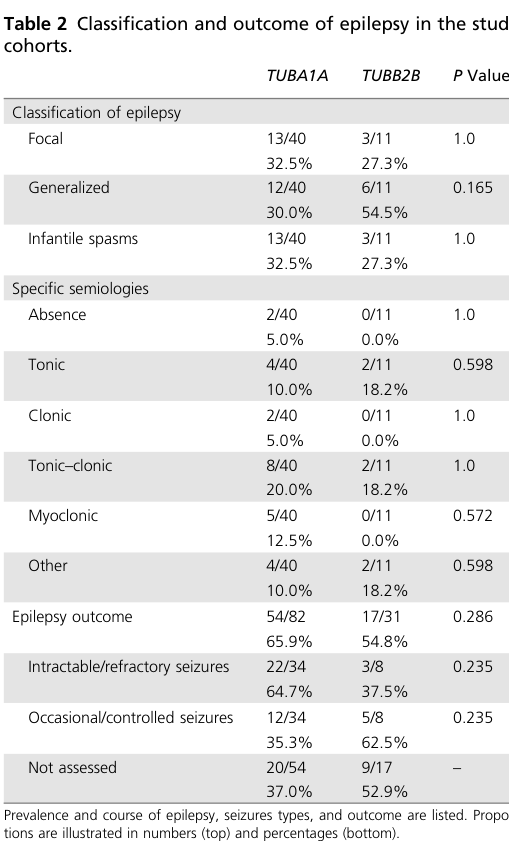
Epilepsy was common in both cohorts: 65.9% (TUBA1A) and 54.8% (TUBB2B) of
individuals developed seizures during the observation period.
explanation: >-
Quantifies epilepsy prevalence in the TUBB2B natural-history cohort.
- reference: PMID:33776625
reference_title: "Expanding the Phenotype of TUBB2A-Related Tubulinopathy: Three Cases of a Novel, Heterozygous TUBB2A Pathogenic Variant p.Gly98Arg."
supports: SUPPORT
evidence_source: HUMAN_CLINICAL
snippet: >-
common manifestations including, but not limited to, global developmental
delay, seizures, cortical dysplasia, and dysmorphic corpus callosum.
explanation: >-
Documents seizures among common TUBB2A manifestations.
- reference: PMID:42472988
reference_title: "Genotypic and phenotypic heterogeneity in tubulinopathies: insights from a Turkish multicenter cohort."
supports: SUPPORT
evidence_source: HUMAN_CLINICAL
snippet: >-
Notably, one patient with TUBB2A-related tubulinopathy experienced a
probable sudden unexpected death in epilepsy (SUDEP).
explanation: >-
The first report of probable SUDEP in this disorder, and the reason the
epilepsy here should be counselled and monitored as a mortality risk rather
than only as a seizure burden. Note the authors' own hedge - "probable" -
and that this is a single patient in a 15-patient cohort, so it establishes
that the risk exists, not its magnitude.
- name: Movement Disorder
description: >-
Dystonia and mirror movements (bimanual synkinesia) were reported in a third
of a 2026 multicentre tubulinopathy cohort spanning seven genes including
TUBB2A and TUBB2B. Mirror movements are mechanistically interesting here
because they point at the module's axon-guidance branch - failure of
corticospinal midline decussation - rather than at the migration branch that
accounts for the cortical malformation. The cohort figure is across all seven
genes, so it is not a TUBB2A/TUBB2B-specific frequency and no frequency band
is asserted.
phenotype_term:
preferred_term: Dystonia
term:
id: HP:0001332
label: Dystonia
evidence:
- reference: PMID:42472988
reference_title: "Genotypic and phenotypic heterogeneity in tubulinopathies: insights from a Turkish multicenter cohort."
supports: SUPPORT
evidence_source: HUMAN_CLINICAL
snippet: >-
Movement disorders were observed in 33.3% of the cohort, including dystonia
and mirror movements.
explanation: >-
Establishes movement disorders as part of the tubulinopathy phenotype in a
cohort that includes TUBB2A and TUBB2B patients; the percentage is
cross-gene, which is why no per-gene frequency is claimed.
genetic:
- name: TUBB2A
association: Causative
relationship_type: CAUSATIVE
subtype: TUBB2A
gene_term:
preferred_term: TUBB2A
term:
id: hgnc:12412
label: TUBB2A
evidence:
- reference: PMID:33776625
reference_title: "Expanding the Phenotype of TUBB2A-Related Tubulinopathy: Three Cases of a Novel, Heterozygous TUBB2A Pathogenic Variant p.Gly98Arg."
supports: SUPPORT
evidence_source: HUMAN_CLINICAL
snippet: >-
We report 3 patients identified by exome and genome sequencing to have a
novel, pathogenic, missense variant in TUBB2A (p.Gly98Arg).
explanation: >-
Direct human case-series evidence for pathogenic TUBB2A missense variation
causing the TUBB2A arm of this beta-tubulin cortical malformation entry.
variants:
- name: TUBB2A p.Gly98Arg
description: >-
Recurrent heterozygous pathogenic missense variant reported in three
individuals with intellectual disability, hypotonia, global developmental
delay, and variable cortical malformation and seizure history.
clinical_significance: PATHOGENIC
evidence:
- reference: PMID:33776625
reference_title: "Expanding the Phenotype of TUBB2A-Related Tubulinopathy: Three Cases of a Novel, Heterozygous TUBB2A Pathogenic Variant p.Gly98Arg."
supports: SUPPORT
evidence_source: HUMAN_CLINICAL
snippet: >-
We report 3 patients identified by exome and genome sequencing to have a
novel, pathogenic, missense variant in TUBB2A (p.Gly98Arg).
explanation: Directly documents the recurrent pathogenic TUBB2A p.Gly98Arg variant.
- name: TUBB2B
association: Causative
relationship_type: CAUSATIVE
subtype: TUBB2B
gene_term:
preferred_term: TUBB2B
term:
id: hgnc:30829
label: TUBB2B
evidence:
- reference: PMID:23361065
reference_title: Overlapping cortical malformations and mutations in TUBB2B and TUBA1A.
supports: SUPPORT
evidence_source: HUMAN_CLINICAL
snippet: >-
We identified four β-tubulin and two α-tubulin mutations in
patients with a spectrum of cortical and extra-cortical anomalies.
explanation: >-
Founding cohort evidence identifying TUBB2B beta-tubulin mutations in
patients with cortical and extracortical malformations.
- reference: PMID:33082561
reference_title: Cross-sectional quantitative analysis of the natural history of TUBA1A and TUBB2B tubulinopathies.
supports: SUPPORT
evidence_source: HUMAN_CLINICAL
snippet: >-
TUBB2B tubulinopathies from clinical reports and database entries of
DECIPHER and ClinVar
explanation: >-
Shows that the natural-history study aggregated TUBB2B tubulinopathy cases
from clinical reports and pathogenic/likely pathogenic database entries.
diagnosis:
- name: Brain MRI pattern recognition
description: >-
Brain MRI characterizes the cortical dysgyria and the accompanying callosal,
basal-ganglia, ventricular, cerebellar, and brainstem malformations. The
coarse, irregular cortical surfaces and grey-white junction support
tubulinopathy-associated dysgyria but are not gene-specific, so imaging
guides rather than replaces molecular confirmation.
diagnosis_term:
preferred_term: brain magnetic resonance imaging
term:
id: NCIT:C16809
label: Magnetic Resonance Imaging
results: >-
Cortical dysgyria with a coarse irregular gyral pattern and characteristic
extracortical malformations supports a beta-tubulin cortical malformation.
evidence:
- reference: url:https://www.ncbi.nlm.nih.gov/books/NBK350554/pdf/Bookshelf_NBK350554.pdf
reference_title: "https://www.ncbi.nlm.nih.gov/books/NBK350554/pdf/Bookshelf_NBK350554.pdf"
supports: SUPPORT
evidence_source: OTHER
snippet: >-
MRI reveals a "coarse" appearance with a thick cortex and irregular
surfaces on both the pial and grey-white junction sides
explanation: GeneReviews defines the characteristic MRI appearance of tubulinopathy dysgyria.
- name: TUBB2A/TUBB2B molecular genetic testing
description: >-
A malformation-of-cortical-development multigene panel can test TUBB2A,
TUBB2B, and important phenocopies; exome or genome sequencing is appropriate
when imaging does not identify a single likely gene. Parental testing helps
establish de novo status and informs recurrence-risk counseling.
diagnosis_term:
preferred_term: genetic testing
term:
id: NCIT:C15709
label: Genetic Testing
results: >-
Identification of a heterozygous pathogenic TUBB2A or TUBB2B variant in a
compatible cortical-malformation phenotype establishes the molecular cause.
evidence:
- reference: url:https://www.ncbi.nlm.nih.gov/books/NBK350554/pdf/Bookshelf_NBK350554.pdf
reference_title: "https://www.ncbi.nlm.nih.gov/books/NBK350554/pdf/Bookshelf_NBK350554.pdf"
supports: SUPPORT
evidence_source: OTHER
snippet: >-
Molecular genetic testing approaches can include a combination of
gene-targeted testing (multigene panel) and comprehensive genomic testing
(exome sequencing, genome sequencing).
explanation: GeneReviews supports panel, exome, and genome testing as the molecular diagnostic approaches.
treatments:
- name: Anti-Seizure Medication
description: >-
Symptomatic anti-seizure pharmacotherapy is used when epilepsy is present.
No disease-modifying therapy for the underlying beta-tubulin cortical
malformation mechanism is established.
treatment_term:
preferred_term: pharmacotherapy
term:
id: NCIT:C15986
label: Pharmacotherapy
evidence:
- reference: url:https://www.ncbi.nlm.nih.gov/books/NBK350554/pdf/Bookshelf_NBK350554.pdf
reference_title: "https://www.ncbi.nlm.nih.gov/books/NBK350554/pdf/Bookshelf_NBK350554.pdf"
supports: SUPPORT
evidence_source: OTHER
snippet: Seizures are treated with anti-seizure medications based on the specific seizure type.
explanation: GeneReviews directly supports seizure-type-directed anti-seizure pharmacotherapy.
- name: Supportive and Rehabilitative Care
description: >-
Supportive developmental, physical, occupational, speech, vision, and
feeding care is the practical management backbone for developmental delay,
hypotonia, motor impairment, visual/ocular findings, and epilepsy-related
morbidity.
treatment_term:
preferred_term: supportive care
term:
id: NCIT:C15747
label: Supportive Care
evidence:
- reference: url:https://www.ncbi.nlm.nih.gov/books/NBK350554/pdf/Bookshelf_NBK350554.pdf
reference_title: "https://www.ncbi.nlm.nih.gov/books/NBK350554/pdf/Bookshelf_NBK350554.pdf"
supports: SUPPORT
evidence_source: OTHER
snippet: >-
Supportive management, including an individualized therapy plan that
includes physical therapy to manage the complications of spasticity,
occupational therapy, speech therapy, and vision therapy for oculomotor
deficits and/or strabismus should begin at the time of diagnosis
explanation: GeneReviews directly supports early multidisciplinary supportive and rehabilitative management.
- name: Genetic Counseling
description: >-
Genetic counseling should cover de novo dominant inheritance as the common
pattern, the possibility of parental mosaicism in apparently sporadic
disease, prenatal imaging findings, and recurrence-risk uncertainty.
treatment_term:
preferred_term: Genetic Counseling
term:
id: NCIT:C15240
label: Genetic Counseling
evidence:
- reference: url:https://www.ncbi.nlm.nih.gov/books/NBK350554/pdf/Bookshelf_NBK350554.pdf
reference_title: "https://www.ncbi.nlm.nih.gov/books/NBK350554/pdf/Bookshelf_NBK350554.pdf"
supports: SUPPORT
evidence_source: OTHER
snippet: >-
The proband inherited a pathogenic variant from a parent with germline
(or somatic and germline) mosaicism.
explanation: GeneReviews supports counseling about parental mosaicism in apparently sporadic disease.
- reference: url:https://www.ncbi.nlm.nih.gov/books/NBK350554/pdf/Bookshelf_NBK350554.pdf
reference_title: "https://www.ncbi.nlm.nih.gov/books/NBK350554/pdf/Bookshelf_NBK350554.pdf"
supports: SUPPORT
evidence_source: OTHER
snippet: >-
molecular genetic testing is recommended for the parents of the proband
to confirm their genetic status and to allow reliable recurrence risk counseling.
explanation: GeneReviews supports parental testing to refine recurrence risk.
discussions:
- discussion_id: gap_tubb2ab_lumping_boundary
prompt: >-
Should TUBB2A and TUBB2B remain a shared beta-tubulin cortical malformation
entry, or should additional TUBB2A cases split out a distinct disease
skeleton?
kind: KNOWLEDGE_GAP
status: OPEN
attaches_to:
- pathophysiology#Altered Beta-Tubulin (TUBB2A/TUBB2B) Function
- pathophysiology#Tubulinopathy-Associated Dysgyria and Extracortical Malformation Pattern
rationale: >-
The original argument for the lump was asymmetry of evidence: TUBB2B had a
cohort-level natural-history and imaging profile while TUBB2A had only nine
reported individuals, so a TUBB2A entry would have been a stub. Reviewed
2026-08-20, that premise no longer holds. TUBB2A now has (i) a 28-patient
epilepsy cohort with an explicit genotype-phenotype correlation - variants at
or near the alpha-beta tubulin dimer interface give a higher proportion of
severe phenotypes such as pachygyria - backed by functional testing of eight
variants; (ii) a recurrent mutational hotspot at Arg391 in the longitudinal
E-site heterodimer interface, found in multiple unrelated families; and (iii)
a phenotype extending to an adult with slowly progressive ataxia and
preserved ambulation at 40 years, far outside the range this entry curates.
The lump is NOT thereby refuted - the two genes still share beta-tubulin
heterodimer biology and a common cortical-dysplasia skeleton, and the
strongest TUBB2A mechanism finding (disrupted heterodimer formation at the
dimer interface) is the same lesion class curated for TUBB2B. What has
changed is that the split decision must now be argued on mechanism rather
than settled by default on TUBB2A's thin evidence base. The concrete question
for a future curator: does the TUBB2A dimer-interface hotspot define a
severity axis that TUBB2B does not share, and is the adult ataxia phenotype a
TUBB2A-specific mild end or simply an under-ascertained part of both?
evidence:
- reference: PMID:33776625
reference_title: "Expanding the Phenotype of TUBB2A-Related Tubulinopathy: Three Cases of a Novel, Heterozygous TUBB2A Pathogenic Variant p.Gly98Arg."
supports: SUPPORT
evidence_source: HUMAN_CLINICAL
snippet: >-
Currently, there are 9 reported individuals with pathogenic variants
within the TUBB2A gene
explanation: >-
The 2021 evidence base that originally justified the lump: only nine
reported TUBB2A individuals.
- reference: PMID:41872443
reference_title: "TUBB2A related epilepsy: novel variants and genotype-phenotype correlation."
supports: SUPPORT
evidence_source: HUMAN_CLINICAL
snippet: >-
The clinical data of 5 epilepsy patients in our cohort and 23 epilepsy
patients from published studies carrying TUBB2A variants were evaluated.
explanation: >-
Supersedes the nine-patient count: TUBB2A now has a 28-patient clinical
series, so thinness of evidence can no longer carry the lump on its own.
- reference: PMID:41872443
reference_title: "TUBB2A related epilepsy: novel variants and genotype-phenotype correlation."
supports: SUPPORT
evidence_source: IN_VITRO
snippet: >-
Patients with TUBB2A variants that perturb tubulin dimer linkage were
observed to have a higher proportion of severe phenotypes, such as
pachygyria.
explanation: >-
A TUBB2A-specific genotype-phenotype axis - dimer-interface variants track
with severity - which is the kind of finding that would justify a split if
it proves not to hold for TUBB2B.
- reference: PMID:41080462
reference_title: A mutational hotspot in TUBB2A associated with impaired heterodimer formation and severe brain developmental disorders.
supports: SUPPORT
evidence_source: HUMAN_CLINICAL
snippet: >-
Comparative analysis with previously reported TUBB2A de novo variants
confirmed that this novel recurrent mutation affects a highly conserved
Arg391 residue within the longitudinal E-site heterodimer interface.
explanation: >-
Establishes a recurrent TUBB2A hotspot at a defined structural interface,
strengthening the TUBB2A arm independently of the shared skeleton.
- reference: PMID:42050746
reference_title: A Novel TUBB2A Variant Causing Ataxia With Preserved Ambulation Into Adulthood.
supports: SUPPORT
evidence_source: HUMAN_CLINICAL
snippet: >-
We report a newly diagnosed case of TUBB2A tubulinopathy with novel
clinical findings of ataxia with preserved ambulation into adulthood, in
addition to the already characteristic findings of global developmental
delay in childhood, cortical malformations, and epilepsy.
explanation: >-
Extends the TUBB2A phenotype to a mild adult presentation well outside the
severity range this entry currently curates.
- discussion_id: gap_tubb2b_uner_tan_boundary
prompt: >-
Should the recessive TUBB2B p.Arg390Gln entity (Uner Tan syndrome,
MONDO:0100144) be curated inside this entry, as its own Disease entry, or
left as an out-of-scope allele-specific concept?
kind: KNOWLEDGE_GAP
status: OPEN
attaches_to:
- pathophysiology#Altered Beta-Tubulin (TUBB2A/TUBB2B) Function
- phenotypes#Dysmorphic Basal Ganglia
rationale: >-
MONDO:0100144 is an is-a descendant of MONDO:0100153 tubulinopathy and is
caused by a variant in a gene this entry curates, so on a naive gene-family
reading it belongs here. Three features argue it does not. First,
inheritance: it is biallelic in a consanguineous family, an unusual recessive
mode for missense tubulinopathies, whereas every other allele in this entry
is heterozygous and de novo. Second, phenotype: the defining finding is
quadrupedal locomotion with severe cerebellar hypoplasia and an explicit
ABSENCE of the basal ganglia malformations this entry curates as a core
TUBB2B feature - the discriminating feature is a negative. Third, mechanism:
functional analysis showed R390Q does not impair folding, heterodimer
assembly, or incorporation into microtubule polymers, only increasing
sensitivity to depolymerizing drugs - which is a much milder lesion than the
impaired heterodimer formation this entry's trigger node curates for other
TUBB2B alleles. It is therefore recorded as a relatedMatch mapping rather
than folded in, and the mapping deliberately does not retire the MONDO
concept from the curation queue. Note the parallel worth watching: the
recurrent severe TUBB2A hotspot is Arg391, the structurally equivalent
residue in the neighbouring isotype, yet it is dominant and severe. Why the
same position gives a dominant severe phenotype in TUBB2A and a recessive
cerebellar one in TUBB2B is unexplained and is the sharpest available test of
this entry's isotype-specificity premise.
evidence:
- reference: PMID:28013290
reference_title: Uner Tan syndrome caused by a homozygous TUBB2B mutation affecting microtubule stability.
supports: SUPPORT
evidence_source: HUMAN_CLINICAL
snippet: >-
Analysis of a consanguineous UTS family identified a biallelic TUBB2B
mutation, resulting in a p.R390Q amino acid substitution.
explanation: >-
Establishes the biallelic, recessive inheritance that separates this
entity from the heterozygous de novo alleles curated in this entry.
- reference: PMID:28013290
reference_title: Uner Tan syndrome caused by a homozygous TUBB2B mutation affecting microtubule stability.
supports: REFUTE
evidence_source: HUMAN_CLINICAL
snippet: >-
None, however, displayed the basal ganglia malformations typically
associated with TUBB2B mutations.
explanation: >-
Directly refutes inclusion under this entry's curated phenotype set: the
dysmorphic basal ganglia curated here as a core TUBB2B feature are absent.
- reference: PMID:28013290
reference_title: Uner Tan syndrome caused by a homozygous TUBB2B mutation affecting microtubule stability.
supports: SUPPORT
evidence_source: IN_VITRO
snippet: >-
Functional analysis of the R390Q substitution revealed that it did not
affect the ability of β-tubulin to fold or become assembled into the
α/β-heterodimer, nor did it influence the incorporation of
mutant-containing heterodimers into microtubule polymers.
explanation: >-
Shows the molecular lesion differs from the impaired heterodimer formation
curated on this entry's trigger node, supporting a separate entity.
- discussion_id: gap_tubb2ab_functional_impact_class
prompt: >-
Do TUBB2A and TUBB2B disease alleles act as dominant-negative subunits that
poison the microtubule polymer, or by lowering the pool of functional
alpha/beta heterodimers?
kind: KNOWLEDGE_GAP
status: OPEN
attaches_to:
- pathophysiology#Altered Beta-Tubulin (TUBB2A/TUBB2B) Function
rationale: >-
This node records functional_impact_category UNKNOWN, and that value is a
finding rather than an omission. What is directly evidenced for both genes is
impaired alpha/beta-tubulin heterodimer formation - shown for two TUBB2B
disease-associated mutations in the founding study, modeled for the recurrent
TUBB2A Arg391 E-site variant, and supported functionally for eight TUBB2A
variants that all altered spindle morphology and microtubule dynamics. That
observation does not discriminate between the two mechanism classes. A mutant
subunit that folds and incorporates but degrades a motor-binding surface is
dominant-negative - the mechanism resolved for TUBA1A Arg402, where dynein
impairment scales with mutant expression, and inferred for TUBB3, where
folded mutant heterodimers still polymerize and a subset disrupts kinesin
binding. A mutant subunit that simply fails to form heterodimers instead
lowers the functional tubulin pool, which is closer to reduced dose. The
distinction is not academic: it decides whether isotype-compensation
strategies such as CRISPRa upregulation of an unaffected beta-tubulin should
be expected to work for these two genes, since adding wild-type subunits
dilutes a poisoning allele but does not remove it. Resolving it needs a
dose-response incorporation assay of the TUBB2A and TUBB2B alleles in a
common background, of the kind already done for TUBA1A Arg402.
evidence:
- reference: PMID:19465910
reference_title: Mutations in the beta-tubulin gene TUBB2B result in asymmetrical polymicrogyria.
supports: SUPPORT
evidence_source: IN_VITRO
snippet: >-
We also show that two disease-associated mutations lead to impaired
formation of tubulin heterodimers.
explanation: >-
The TUBB2B half of what is evidenced - impaired heterodimer formation -
which is compatible with either mechanism class.
- reference: PMID:41080462
reference_title: A mutational hotspot in TUBB2A associated with impaired heterodimer formation and severe brain developmental disorders.
supports: SUPPORT
evidence_source: COMPUTATIONAL
snippet: >-
Computational modeling demonstrated that the variant disrupts α/β-tubulin
heterodimer formation, impairing binding stability at this critical
interaction site.
explanation: >-
The TUBB2A half, and in silico rather than measured, which is a second
reason the mechanism class is not yet settled.
- discussion_id: gap_tubb2ab_human_organoid_translatability
prompt: >-
Do human iPSC-derived cortical organoids reveal TUBB2A/TUBB2B-specific
progenitor, outer-radial-glia, or migration defects that are not captured by
clinical imaging, biochemical inference, or rodent/tubulinopathy models?
kind: HUMAN_MODEL_MISMATCH
status: OPEN
attaches_to:
- pathophysiology#Altered Beta-Tubulin (TUBB2A/TUBB2B) Function
- pathophysiology#Impaired Microtubule-Dependent Neuronal Migration and Organization
rationale: >-
The Falcon report found human clinical and cohort evidence but no direct
TUBB2A/TUBB2B organoid or iPSC disease model. Because human cortical
expansion and outer radial glia are incompletely represented in
lissencephalic rodents, a human organoid/iPSC experiment is needed to
decide whether the beta-tubulin skeleton is purely postmitotic
migration/organization failure or also includes human progenitor
vulnerability.
evidence:
- reference: PMID:28111201
reference_title: Human iPSC-Derived Cerebral Organoids Model Cellular Features of Lissencephaly and Reveal Prolonged Mitosis of Outer Radial Glia.
supports: SUPPORT
evidence_source: OTHER
snippet: >-
However, the mouse brain is naturally lissencephalic, suggesting that
certain aspects of cortical development may not be adequately assessed in
mice.
explanation: >-
Supports treating mouse-to-human translatability as an explicit knowledge
gap for cortical malformation mechanisms.
- reference: PMID:28111201
reference_title: Human iPSC-Derived Cerebral Organoids Model Cellular Features of Lissencephaly and Reveal Prolonged Mitosis of Outer Radial Glia.
supports: SUPPORT
evidence_source: IN_VITRO
snippet: >-
We saw a cell migration defect that was rescued when we corrected the MDS
causative chromosomal deletion
explanation: >-
Provides precedent that human iPSC-derived cerebral organoids can detect
and rescue a lissencephaly-relevant migration defect, motivating a
TUBB2A/TUBB2B-specific new-approach-model test.
proposed_experiments:
- experiment_id: exp_tubb2ab_isogenic_cortical_organoid_migration
name: TUBB2A/TUBB2B isogenic cortical-organoid migration experiment
description: >-
Engineer representative pathogenic TUBB2A and TUBB2B missense variants
into human iPSCs, correct patient-derived variants where available, and
compare cortical organoid radial-glial organization, outer-radial-glia
mitosis, neuronal migration, microtubule dynamics, and cortical layer
organization across mutant, corrected, and knock-in lines.
experiment_type:
preferred_term: patient-derived cortical organoid perturbation experiment
model_systems:
- name: TUBB2A/TUBB2B human iPSC-derived cortical organoid
description: >-
Three-dimensional human cortical organoid carrying a pathogenic TUBB2A
or TUBB2B variant, with matched isogenic corrected and knock-in controls.
experimental_model_type: ORGANOID
namo_type: namo:Organoid
organism:
preferred_term: human
term:
id: NCBITaxon:9606
label: Homo sapiens
tissue_term:
preferred_term: cerebral cortex
term:
id: UBERON:0000956
label: cerebral cortex
cell_types:
- preferred_term: radial glial cell
term:
id: CL:0000681
label: radial glial cell
- preferred_term: migrating cortical neuron
term:
id: CL:0000540
label: neuron
conditions:
- TUBB2A/TUBB2B-related cortical malformation
- polymicrogyria-like cortical dysplasia
- microtubule-dependent neuronal migration failure
cell_source: Patient-derived or CRISPR-engineered human induced pluripotent stem cells
culture_system: Three-dimensional cortical organoid with live-imaging migration assays
perturbations:
- name: Isogenic TUBB2A/TUBB2B variant correction or knock-in
target: pathophysiology#Altered Beta-Tubulin (TUBB2A/TUBB2B) Function
description: >-
Correct a patient variant or knock in a recurrent pathogenic variant to
separate variant effect from donor genetic background.
readouts:
- name: Microtubule dynamics and tubulin heterodimer incorporation
target: pathophysiology#Altered Beta-Tubulin (TUBB2A/TUBB2B) Function
description: >-
Quantify microtubule polymerization, stability, and mutant beta-tubulin
incorporation in cortical progenitors and neurons.
biological_processes:
- preferred_term: microtubule cytoskeleton organization
term:
id: GO:0000226
label: microtubule cytoskeleton organization
modifier: DYSREGULATED
assays:
- preferred_term: live-cell imaging assay
direction: NEGATIVE
- name: Live-imaging neuronal migration and cortical organization
target: pathophysiology#Impaired Microtubule-Dependent Neuronal Migration and Organization
description: >-
Track DCX-positive neuronal movement, radial-glial scaffold integrity,
outer-radial-glia mitotic timing, and cortical layer organization.
biological_processes:
- preferred_term: neuron migration
term:
id: GO:0001764
label: neuron migration
modifier: DECREASED
assays:
- preferred_term: live-cell imaging assay
- preferred_term: single-cell transcriptomic profiling
direction: NEGATIVE
controls:
- name: Isogenic corrected organoids
description: Matched organoids in which the candidate pathogenic variant is corrected.
- name: Isogenic knock-in organoids
description: Wild-type-background organoids carrying the introduced pathogenic variant.
- name: Non-disease donor organoids
description: Unedited control organoids differentiated and imaged in parallel.
decision_criterion: >-
A conserved beta-tubulin migration mechanism is supported if mutant
organoids show reduced neuronal migration, altered microtubule dynamics,
or abnormal radial-glial organization that is rescued by correction and
reproduced by knock-in. A human-specific branch is supported if organoids
reveal reproducible outer-radial-glia or progenitor-output defects not
predicted from existing model systems.
would_support:
- pathophysiology#Altered Beta-Tubulin (TUBB2A/TUBB2B) Function
- pathophysiology#Impaired Microtubule-Dependent Neuronal Migration and Organization
notes: >-
Entry created from cortical-malformation epic 4098 (issue 4084), seeded from
Romero, Bahi-Buisson & Francis 2018 and refined with Falcon deep research.
The entry boundary follows the dismech mechanism-skeleton rule: TUBB2A and
TUBB2B are curated together only because the available evidence supports a
coherent beta-tubulin heterodimer/microtubule apparatus skeleton with cortical
migration/organization failure and overlapping cortical-plus-extracortical
malformation endpoints. This is narrower than "tubulinopathy" and should not
be used to absorb TUBA1A, TUBB3, TUBB5/TUBB, or TUBG1 without checking whether
their disease skeletons match. TUBB2A remains the thinner branch, and the
`gap_tubb2ab_lumping_boundary` discussion is intentionally open. The Falcon
report did not identify TUBB2A/TUBB2B-specific organoid or iPSC evidence; the
proposed organoid experiment is included as an organoid/iPSC translatability
knowledge gap, not as existing disease evidence.
References & Deep Research
References
14Deep Research
1Deep research results are used as seeds for research; they do not undergo the same validation as the main records and may contain errors. How we use deep research.
Evaluations and curation notes (1)
Record notes
Entry created from cortical-malformation epic 4098 (issue 4084), seeded from Romero, Bahi-Buisson & Francis 2018 and refined with Falcon deep research. The entry boundary follows the dismech mechanism-skeleton rule: TUBB2A and TUBB2B are curated together only because the available evidence supports a coherent beta-tubulin heterodimer/microtubule apparatus skeleton with cortical migration/organization failure and overlapping cortical-plus-extracortical malformation endpoints. This is narrower than "tubulinopathy" and should not be used to absorb TUBA1A, TUBB3, TUBB5/TUBB, or TUBG1 without checking whether their disease skeletons match. TUBB2A remains the thinner branch, and the `gap_tubb2ab_lumping_boundary` discussion is intentionally open. The Falcon report did not identify TUBB2A/TUBB2B-specific organoid or iPSC evidence; the proposed organoid experiment is included as an organoid/iPSC translatability knowledge gap, not as existing disease evidence.
1. Disease Information
1.1 What is the disease?
TUBB2A/TUBB2B-related cortical malformation is part of the broader group of tubulinopathies, i.e., neurodevelopmental disorders caused by pathogenic variants in tubulin genes that disrupt microtubule-dependent processes during brain development and lead to malformations of cortical development (MCD) and characteristic extracortical brain anomalies. (romaniello2019epilepsyintubulinopathy pages 1-3, cushion2013overlappingcorticalmalformations pages 2-3)
A key neuroradiologic concept emphasized across tubulinopathy literature is that the cortical malformation may be described as polymicrogyria-like cortical dysplasia or “atypical polymicrogyria,” often accompanied by dysmorphic basal ganglia and internal capsule abnormalities, plus corpus callosum/cerebellar/brainstem involvement. (cushion2013overlappingcorticalmalformations pages 2-3, cushion2013overlappingcorticalmalformations pages 1-2)
1.2 Key identifiers
- OMIM / Orphanet / ICD-10/ICD-11 / MeSH / MONDO: Not available from the retrieved evidence set.
- Peer-reviewed primary natural history reference: Schröter et al., Genetics in Medicine (publication date March 2021; URL https://doi.org/10.1038/s41436-020-01001-z). (schroter2021crosssectionalquantitativeanalysis pages 2-3)
1.3 Synonyms and alternative names (as used in the literature)
- Tubulinopathy (umbrella term). (romaniello2019epilepsyintubulinopathy pages 1-3)
- Polymicrogyria-like cortical dysplasia / atypical polymicrogyria in TUBB2B-related disease descriptions. (cushion2013overlappingcorticalmalformations pages 2-3)
- Complex cortical dysplasia is used in case reports involving TUBB2B. (citli2022maternalgermlinemosaicism pages 1-5)
1.4 Evidence source types
- Aggregated disease-level resources / meta-cohort modeling: Natural history modeling integrating published clinical reports + DECIPHER + ClinVar entries (Schröter 2021). (schroter2021crosssectionalquantitativeanalysis pages 2-3)
- Human cohort studies of MCD diagnostic testing: exome sequencing yield studies and deep-sequencing panel studies in polymicrogyria cohorts. (kooshavar2024diagnosticutilityof pages 4-5, stutterd2021geneticheterogeneityof pages 2-3)
- Human case series/case reports: detailed genotype–phenotype reports for TUBB2A and TUBB2B. (schmidt2021expandingthephenotype pages 1-3, citli2022maternalgermlinemosaicism pages 1-5, cushion2013overlappingcorticalmalformations pages 5-6)
2. Etiology
2.1 Disease causal factors
Primary causal factor: heterozygous pathogenic variants in TUBB2B or TUBB2A, encoding neuronal β-tubulin isotypes that participate in microtubule heterodimers essential for neurodevelopment. (cushion2013overlappingcorticalmalformations pages 2-3, schmidt2021expandingthephenotype pages 1-3)
2.2 Risk factors
- Genetic: presence of a pathogenic/likely pathogenic variant in TUBB2B or TUBB2A. (schroter2021crosssectionalquantitativeanalysis pages 2-3, schmidt2021expandingthephenotype pages 1-3)
- Non-genetic/environmental risk factors: not established in the retrieved evidence; tubulinopathies are primarily genetic disorders. (romaniello2019epilepsyintubulinopathy pages 1-3)
2.3 Protective factors
Not identified in the retrieved evidence.
2.4 Gene–environment interactions
Not identified in the retrieved evidence.
3. Phenotypes
3.1 Core phenotype domains
Neurodevelopmental and neurologic phenotype commonly includes: - Global developmental delay / intellectual disability. (cushion2013overlappingcorticalmalformations pages 5-6, schroter2021crosssectionalquantitativeanalysis pages 2-3) - Motor impairment and abnormal tone (hypotonia and/or other tone abnormalities). (schroter2021crosssectionalquantitativeanalysis pages 3-4, schroter2021crosssectionalquantitativeanalysis pages 2-3) - Epilepsy and EEG abnormalities. (romaniello2019epilepsyintubulinopathy pages 1-3, schroter2021crosssectionalquantitativeanalysis pages 3-4)
Neuroimaging phenotype commonly includes: - Polymicrogyria-like cortical dysplasia (especially perisylvian) and sometimes pachygyria/lissencephaly spectrum. (schroter2021crosssectionalquantitativeanalysis pages 1-2, cushion2013overlappingcorticalmalformations pages 5-6) - Dysmorphic basal ganglia and internal capsule anomalies. (cushion2013overlappingcorticalmalformations pages 1-2, romaniello2019epilepsyintubulinopathy pages 1-3) - Corpus callosum abnormalities and posterior fossa/brainstem abnormalities. (romaniello2019epilepsyintubulinopathy pages 1-3, cushion2013overlappingcorticalmalformations pages 5-6)
3.2 Quantitative phenotype statistics (TUBB2B emphasized)
From the natural-history meta-cohort (DECIPHER/ClinVar/clinical reports; cutoff 1 July 2019; analyzed NTUBB2B=48): - Early/postnatal presenting signs: developmental delay 47.4%, seizures 36.8%, muscular hypotonia 21.1%. (schroter2021crosssectionalquantitativeanalysis pages 2-3) - Global developmental delay: 76.7% (TUBB2B) vs 95.7% (TUBA1A) in a subset analysis. (schroter2021crosssectionalquantitativeanalysis pages 3-4) - Motor function affected: 73.1%; normal motor function: 19.2%. (schroter2021crosssectionalquantitativeanalysis pages 3-4) - Epilepsy prevalence: 54.8%; seizure onset mean 33.1 months (N=14); infantile onset seizures in 78.6%; infantile spasms 27.3%; refractory epilepsy 37.5% (in available cases). (schroter2021crosssectionalquantitativeanalysis pages 3-4) - Neuroimaging frequencies: cortical malformations reported in 97.8%; lissencephaly/pachygyria/agyria 6.8% (less common than TUBA1A); basal ganglia involvement 84.6%; ventriculomegaly 88.0%; corpus callosum abnormalities 77.5%. (schroter2021crosssectionalquantitativeanalysis pages 4-5)
Additional clinical features reported in smaller series include optic atrophy (2/4) and scoliosis (4/4) in a small TUBB2B cohort (limitations: small sample size). (cushion2013overlappingcorticalmalformations pages 5-6)
3.3 Suggested HPO terms (examples)
Neurodevelopment/neurology - Global developmental delay (HP:0001263) - Intellectual disability (HP:0001249) - Seizures (HP:0001250) - Hypotonia (HP:0001252)
Brain malformations / imaging - Polymicrogyria (HP:0002126) - Pachygyria (HP:0001302) - Lissencephaly (HP:0001339) - Corpus callosum agenesis/hypoplasia (HP:0001274 / HP:0002079) - Ventriculomegaly (HP:0002119) - Cerebellar hypoplasia (HP:0001321)
(These term suggestions are consistent with the phenotypes described across tubulinopathy cohorts and imaging summaries in the retrieved evidence.) (romaniello2019epilepsyintubulinopathy pages 1-3, schroter2021crosssectionalquantitativeanalysis pages 4-5)
3.4 Quality-of-life impact
Quantitative QoL instruments (EQ-5D/SF-36/PROMIS) were not reported in the retrieved evidence. Severe neurodevelopmental impairment and long-term dependence on care are described in tubulinopathy reviews. (berbeka2026theroleof pages 8-11)
4. Genetic / Molecular Information
4.1 Causal genes
- TUBB2B: associated with polymicrogyria-like cortical dysplasia and extracortical malformations; variants largely heterozygous. (schroter2021crosssectionalquantitativeanalysis pages 2-3, cushion2013overlappingcorticalmalformations pages 5-6)
- TUBB2A: associated with pachygyria/simplified gyral pattern/cortical dysplasia; variants heterozygous. (schmidt2021expandingthephenotype pages 1-3)
4.2 Pathogenic variant classes and consequences
- Predominantly heterozygous missense variants are described for TUBB2A/TUBB2B tubulinopathy in the gathered case series literature. (schmidt2021expandingthephenotype pages 1-3, cushion2013overlappingcorticalmalformations pages 5-6)
- Mechanistic interpretation across tubulinopathies implicates disrupted tubulin heterodimer/microtubule function leading to cortical malformations. (cushion2013overlappingcorticalmalformations pages 1-2, romaniello2019epilepsyintubulinopathy pages 1-3)
TUBB2B example of recurrence mechanism: maternal germline mosaicism for c.728C>T (p.Pro243Leu) inferred in two affected siblings, with paternal sperm testing reported as normal. (citli2022maternalgermlinemosaicism pages 1-5)
4.3 Allele frequency
Gene- and variant-level population frequency statistics (gnomAD etc.) were not available from the key peer-reviewed cohort evidence we extracted; thus they are not reported here.
4.4 Modifier genes / epigenetic information / chromosomal abnormalities
Not identified in the retrieved evidence specific to TUBB2A/TUBB2B.
5. Environmental Information
No validated environmental/lifestyle/infectious contributors were identified in the retrieved evidence for TUBB2A/TUBB2B-related malformations.
6. Mechanism / Pathophysiology
6.1 Current mechanistic understanding
Tubulinopathies are described as brain malformation disorders secondary to disruption of microtubule-dependent neurodevelopmental processes (neuronal migration, neuronal organization, differentiation, axon guidance). (romaniello2019epilepsyintubulinopathy pages 1-3)
Cushion et al. emphasize that tubulin proteins form heterodimers that incorporate into microtubules, implicating shared pathogenic mechanisms across tubulin genes and a convergence on microtubule dysfunction and altered interactions with microtubule-associated proteins. (cushion2013overlappingcorticalmalformations pages 1-2)
6.2 Causal chain (high-level)
Pathogenic TUBB2A/TUBB2B variant → altered β-tubulin function within microtubules → disrupted neurodevelopmental microtubule dynamics and associated processes (neuronal migration/organization and axon guidance) → malformations of cortical development (e.g., polymicrogyria-like cortical dysplasia/pachygyria) + extracortical anomalies (basal ganglia/internal capsule/corpus callosum/cerebellum) → clinical outcomes (developmental delay, epilepsy, motor impairment). (romaniello2019epilepsyintubulinopathy pages 1-3, cushion2013overlappingcorticalmalformations pages 1-2, schroter2021crosssectionalquantitativeanalysis pages 4-5)
6.3 Suggested ontology annotations
GO Biological Process (examples) - Microtubule-based process (GO:0007017) - Neuron migration (GO:0001764) - Axon guidance (GO:0007411)
Cell Ontology (CL) (examples) - Cortical excitatory neuron (e.g., glutamatergic neuron; CL terms depend on preferred granularity) - Radial glial cell (developmental neural progenitor)
UBERON (examples) - Cerebral cortex (UBERON:0000956) - Basal ganglion (UBERON:0002420) - Corpus callosum (UBERON:0002336) - Cerebellum (UBERON:0002037)
(These suggestions reflect the neurodevelopmental and anatomic structures repeatedly implicated by neuroimaging/histopathology patterns in the evidence.) (romaniello2019epilepsyintubulinopathy pages 1-3, schroter2021crosssectionalquantitativeanalysis pages 4-5)
7. Anatomical Structures Affected
7.1 Organ/system level
- Primary system: central nervous system. (romaniello2019epilepsyintubulinopathy pages 1-3)
7.2 Tissue/cell level (inferred from disease context)
- Neurodevelopmental tissue: cortical plate and developing white matter connectivity structures; neuronal migration/organization abnormalities are central. (romaniello2019epilepsyintubulinopathy pages 1-3)
7.3 Key neuroanatomical substrates seen on MRI
- Cerebral cortex: polymicrogyria-like cortical dysplasia; less commonly lissencephaly/pachygyria/agyria in TUBB2B. (schroter2021crosssectionalquantitativeanalysis pages 4-5)
- Basal ganglia/internal capsule: frequent involvement; dysmorphic basal ganglia highlighted as highly consistent in tubulinopathy MRI patterns. (cushion2013overlappingcorticalmalformations pages 1-2, schroter2021crosssectionalquantitativeanalysis pages 4-5)
- Corpus callosum: abnormalities common. (schroter2021crosssectionalquantitativeanalysis pages 4-5)
- Posterior fossa/brainstem: cerebellar and pons/brainstem abnormalities described. (romaniello2019epilepsyintubulinopathy pages 1-3, cushion2013overlappingcorticalmalformations pages 5-6)
8. Temporal Development
8.1 Onset
For TUBB2B in the natural-history meta-cohort: - Mean age at disease onset: 5.9 ± 8.2 months (N=17). (schroter2021crosssectionalquantitativeanalysis pages 2-3)
8.2 Progression
Tubulinopathies are generally framed as neurodevelopmental disorders where structural malformations are non-progressive, but clinical manifestations (epilepsy, developmental trajectory, complications such as respiratory infections) determine course. (berbeka2026theroleof pages 8-11, schroter2021crosssectionalquantitativeanalysis pages 2-3)
9. Inheritance and Population
9.1 Inheritance patterns
- TUBB2B and TUBB2A: largely reported as heterozygous pathogenic variants; de novo occurrence is common, with familial and mosaic mechanisms also recognized in tubulin-gene disorders. (cushion2013overlappingcorticalmalformations pages 2-3, schmidt2021expandingthephenotype pages 1-3)
9.2 Mosaicism and recurrence mechanisms
- Maternal germline mosaicism in TUBB2B has been reported as a recurrence mechanism (two siblings with the same variant; paternal sperm testing normal). (citli2022maternalgermlinemosaicism pages 1-5)
- In polymicrogyria diagnostic cohorts, low-level mosaicism is common among dominant variants (5/22 dominant variants mosaic; allele fractions <0.33, lowest 0.09). (stutterd2021geneticheterogeneityof pages 2-3)
9.3 Epidemiology
Population prevalence/incidence was not available in the retrieved primary evidence for this gene-specific condition.
10. Diagnostics
10.1 Imaging and electrophysiology
- Brain MRI is central to diagnosis, revealing cortical and extracortical malformation patterns characteristic of tubulinopathy (e.g., polymicrogyria-like cortex; basal ganglia/internal capsule anomalies; commissural/posterior fossa anomalies). (romaniello2019epilepsyintubulinopathy pages 1-3, cushion2013overlappingcorticalmalformations pages 1-2)
- EEG abnormalities may be frequent in tubulinopathies; in one series, significant EEG background abnormalities were detected in 100% of patients assessed. (romaniello2019epilepsyintubulinopathy pages 1-3)
10.2 Genetic testing approaches (real-world implementation)
Exome sequencing (ES) - In a 2024 multicenter clinical cohort of children with diverse MRI-defined brain malformations (n=102), clinical singleton exome sequencing produced a diagnostic yield of 36% (37/102), rising to 43% after research follow-up/reanalysis. (Kooshavar et al., publication date Feb 2024; URL https://doi.org/10.1093/braincomms/fcae056) (kooshavar2024diagnosticutilityof pages 4-5)
Deep sequencing gene panels - In a 123-patient polymicrogyria cohort excluding congenital CMV and pathogenic CNVs, deep sequencing panels identified pathogenic/likely pathogenic variants in 25/123 (20.3%), and demonstrated that deep panels can be more sensitive for detecting low-level mosaic variants than WES/WGS, though limited to included genes. (Stutterd et al., publication date Dec 2021; URL https://doi.org/10.1093/braincomms/fcaa221) (stutterd2021geneticheterogeneityof pages 2-3)
Targeted panels for MCD - A targeted re-sequencing study emphasized strong genotype–phenotype correlation in neuroradiologically recognizable tubulinopathy, noting that “all but one” with neuroradiological tubulinopathy had pathogenic variants in TUBA1A, TUBB2B, or TUBB3 in that cohort (with additional observation that a third of those with ventricular enlargement/dysmorphism had pathogenic tubulin variants). (Accogli et al., publication date Aug 2020; URL https://doi.org/10.1016/j.seizure.2020.05.023) (accogli2020targetedresequencingin pages 18-23)
10.3 Differential diagnosis
The retrieved evidence supports that a broad differential exists for polymicrogyria/MCD, including congenital CMV and CNVs (explicitly excluded in some diagnostic yield cohorts) and multiple monogenic causes beyond tubulins. (stutterd2021geneticheterogeneityof pages 2-3, kooshavar2024diagnosticutilityof pages 4-5)
11. Outcome / Prognosis
From the quantitative natural history analysis (TUBB2B): - Survival: 93.3% alive at age 8.0 years; 2/48 (4.3%) deaths during follow-up (reported cause example: recurrent respiratory infections leading to death at age 8 in one TUBB2B case). (schroter2021crosssectionalquantitativeanalysis pages 2-3) - Diagnostic delay: mean diagnostic delay 12.3 ± 9.9 years; mean age at genetic diagnosis 12.8 ± 9.5 years (N=17 with onset/diagnosis data). (schroter2021crosssectionalquantitativeanalysis pages 2-3) - Epilepsy may be less often refractory in TUBB2B than TUBA1A in that meta-cohort comparison. (schroter2021crosssectionalquantitativeanalysis pages 3-4)
12. Treatment
12.1 Current standard of care
No disease-modifying therapy was identified in the retrieved evidence. Management is generally supportive and symptomatic, driven by seizure control, developmental and rehabilitative therapies, and multidisciplinary care for associated impairments. Reviews emphasize severe neurodevelopmental prognosis in many patients and the need for long-term supportive care. (berbeka2026theroleof pages 8-11)
12.2 Epilepsy management and outcomes
In a dedicated epilepsy-focused tubulinopathy review, epilepsy was reported to have a wide severity range and in their synthesis “has a favorable evolution over time,” suggesting epilepsy may not always require an aggressively escalating therapeutic approach in all cases (clinical decision individualized). (romaniello2019epilepsyintubulinopathy pages 1-3)
12.3 Suggested MAXO terms (examples)
- Antiseizure therapy / anticonvulsant therapy (MAXO term selection depends on MAXO release)
- Developmental therapy / early intervention
- Physical therapy, occupational therapy, speech therapy
- Genetic counseling
(These are consistent with supportive management framing in the retrieved reviews and cohorts.) (berbeka2026theroleof pages 8-11, romaniello2019epilepsyintubulinopathy pages 1-3)
13. Prevention
Primary prevention of de novo disease is not established. Preventive strategies are primarily reproductive and counseling-oriented, including: - Genetic counseling for families, especially addressing variable expressivity and the possibility of parental germline mosaicism. (citli2022maternalgermlinemosaicism pages 9-11) - Consideration of parental testing strategies when recurrence is suspected; semen testing can help evaluate paternal germline status, and recurrence risk is related to the fraction of germ cells carrying the mutation. (citli2022maternalgermlinemosaicism pages 9-11)
14. Other Species / Natural Disease
Not identified in the retrieved evidence set for TUBB2A/TUBB2B specifically.
15. Model Organisms
A directly retrieved model-organism paper for TUBB2B specifically was not present in the evidence excerpts above. However, the evidence base does include an example of a mammalian genetic model demonstrating that mutation in Tubb2b (mouse ortholog) causes lethality and abnormal cortical development, supporting pathogenicity of tubulin disruption in neurodevelopment (citation retrieved but not deeply evidenced in the gathered excerpts). (beheshti2025expandingtheclinical pages 7-9)
Recent developments and latest research (prioritizing 2023–2024)
- Exome sequencing + reanalysis is a current high-impact real-world diagnostic strategy in pediatric brain malformations (including tubulinopathy subtypes). Kooshavar et al. (Feb 2024) quantified a 36%→43% yield improvement with research reanalysis and updated gene–disease knowledge, underscoring how rapidly evolving discovery impacts clinical return-of-results. (kooshavar2024diagnosticutilityof pages 4-5)
- Large-scale exome efforts in polymicrogyria have expanded germline genetic architecture and support TUBB2B as an established PMG gene within broader discovery frameworks (JAMA Neurology 2023 paper retrieved; detailed extraction not available in the evidence snippets). (liu2026tubb2arelatedepilepsy pages 10-10)
- Microtubule biology reviews and mechanistic synthesis (2023) emphasize that neuronal migration and axon guidance depend on microtubule dynamics and microtubule-based transport, framing tubulin gene variants as mechanistic drivers of neurodevelopmental malformations. (puri2023 review retrieved; mechanistic statements consistent with tubulinopathy definitions used here). (romaniello2019epilepsyintubulinopathy pages 1-3)
Visual evidence from the natural-history study
Key phenotype frequencies, survival curves, diagnostic delay visualization, and neuroradiology frequency plots were extracted from Schröter et al. 2021 (Table/Figures). (schroter2021crosssectionalquantitativeanalysis media 69f549d2, schroter2021crosssectionalquantitativeanalysis media 342dbb80, schroter2021crosssectionalquantitativeanalysis media 141dad08, schroter2021crosssectionalquantitativeanalysis media b031693d, schroter2021crosssectionalquantitativeanalysis media 79884aeb)
Consolidated gene-focused summary table
| Gene | Typical cortical malformation pattern | Key extracortical MRI features | Common clinical features | Epilepsy frequency/notes | Inheritance/recurrence | Key quantitative stats (onset, diagnostic delay, mortality) | Key references |
|---|---|---|---|---|---|---|---|
| TUBB2A | Cortical dysplasia, simplified gyral pattern, pachygyria; in the 2021 case series all 3 reported individuals had pachygyria (schmidt2021expandingthephenotype pages 1-3) | Dysmorphic corpus callosum; basal ganglia and thalamic abnormalities; brainstem and cerebellar involvement; hypoplastic right caudate nucleus and periaqueductal gray signal abnormality reported in 2 cases (schmidt2021expandingthephenotype pages 1-3) | Intellectual disability, hypotonia, developmental delay, seizures; prior reports included infantile spasms (schmidt2021expandingthephenotype pages 1-3) | Seizures are recurrently reported, but no robust pooled TUBB2A-specific frequency was available in the gathered evidence (schmidt2021expandingthephenotype pages 1-3, romaniello2019epilepsyintubulinopathy pages 1-3) | Heterozygous pathogenic variants; reports are consistent with predominantly de novo occurrence in published cases identified by exome/genome sequencing (schmidt2021expandingthephenotype pages 1-3) | No TUBB2A-specific onset, diagnostic-delay, or mortality estimates were available in the gathered evidence (schmidt2021expandingthephenotype pages 1-3) | Schmidt et al. 2021, Molecular Syndromology, doi:10.1159/000512160, https://doi.org/10.1159/000512160 (schmidt2021expandingthephenotype pages 1-3) |
| TUBB2B | Predominantly focal perisylvian or generalized polymicrogyria-like cortical dysplasia; diffuse polymicrogyria-like cortical dysplasia also reported; lissencephalic/pachygyric phenotypes can occur but are less common than in TUBA1A (6.8% in the natural-history meta-cohort) (schroter2021crosssectionalquantitativeanalysis pages 1-2, cushion2013overlappingcorticalmalformations pages 5-6, schroter2021crosssectionalquantitativeanalysis pages 4-5) | Basal ganglia involvement/dysmorphism with abnormal or absent anterior limb of the internal capsule; ventriculomegaly; corpus callosum abnormalities/hypoplasia/agenesis; cerebellar hemispheric/vermis abnormalities; small brainstem/pons (cushion2013overlappingcorticalmalformations pages 2-3, romaniello2019epilepsyintubulinopathy pages 1-3, cushion2013overlappingcorticalmalformations pages 5-6, schroter2021crosssectionalquantitativeanalysis pages 4-5) | Developmental delay/global developmental delay, cognitive and motor impairment, hypotonia or abnormal tone, postnatal microcephaly, ocular abnormalities, severe psychomotor delay/intellectual disability; scoliosis and optic atrophy reported in small series (schroter2021crosssectionalquantitativeanalysis pages 2-3, schroter2021crosssectionalquantitativeanalysis pages 3-4, cushion2013overlappingcorticalmalformations pages 5-6) | Epilepsy in 54.8% of the 2021 meta-cohort; mean seizure onset 33.1 months (N=14); 78.6% of seizures had infantile onset; infantile spasms 27.3%; refractory epilepsy 37.5% in available cases. Earlier review reported TUBB2B associated with epilepsy in 74% of pooled cases and noted often favorable evolution over time (schroter2021crosssectionalquantitativeanalysis pages 3-4, romaniello2019epilepsyintubulinopathy pages 1-3) | Usually heterozygous de novo missense variants; recurrence can occur from maternal germline mosaicism (same c.728C>T, p.P243L variant in 2 siblings) and low-level mosaic dominant variants are recognized more broadly in polymicrogyria cohorts (cushion2013overlappingcorticalmalformations pages 2-3, schroter2021crosssectionalquantitativeanalysis pages 2-3, beheshti2025expandingtheclinical pages 7-9) | Mean age at disease onset 5.9 ± 8.2 months (N=17); mean age at genetic diagnosis 12.8 ± 9.5 years; mean diagnostic delay 12.3 ± 9.9 years; termination of pregnancy in 7/47 (14.9%) reported prenatal cases, mean 28 gestational weeks; 93.3% alive at age 8.0 years and 2/48 (4.3%) deaths during follow-up in the natural-history study (schroter2021crosssectionalquantitativeanalysis pages 2-3, schroter2021crosssectionalquantitativeanalysis pages 1-2) | Schröter et al. 2021, Genetics in Medicine, doi:10.1038/s41436-020-01001-z, https://doi.org/10.1038/s41436-020-01001-z; Romaniello et al. 2019, Cells, doi:10.3390/cells8070669, https://doi.org/10.3390/cells8070669; Cushion et al. 2013, Brain, doi:10.1093/brain/aws338, https://doi.org/10.1093/brain/aws338; Çitli & Serdaroğlu 2022, Fetal and Pediatric Pathology, doi:10.1080/15513815.2020.1753270, https://doi.org/10.1080/15513815.2020.1753270 (schroter2021crosssectionalquantitativeanalysis pages 2-3, romaniello2019epilepsyintubulinopathy pages 1-3, cushion2013overlappingcorticalmalformations pages 5-6, beheshti2025expandingtheclinical pages 7-9) |
| Context for real-world diagnosis/testing | Tubulinopathies are a recognizable MRI-genetics pattern within malformations of cortical development; TUBB2B is a recurring cause in polymicrogyria/deep-sequencing cohorts, while TUBB2A has generally been identified through broad exome/genome testing rather than single-gene testing in the gathered evidence (schmidt2021expandingthephenotype pages 1-3, cushion2013overlappingcorticalmalformations pages 2-3) | MRI pattern recognition plus genetic testing is standard in published cohorts; deep gene panels improve sensitivity for mosaic variants, whereas exome sequencing has high utility across brain malformations (cushion2013overlappingcorticalmalformations pages 2-3, romaniello2019epilepsyintubulinopathy pages 1-3, schroter2021crosssectionalquantitativeanalysis pages 1-2) | Clinical suspicion is driven by developmental delay, epilepsy, and characteristic extracortical anomalies (especially dysmorphic basal ganglia/internal capsule abnormalities) (cushion2013overlappingcorticalmalformations pages 2-3, romaniello2019epilepsyintubulinopathy pages 1-3) | In a 123-patient polymicrogyria deep-sequencing cohort, pathogenic/likely pathogenic variants were found in 25/123 (20.3%) overall and included TUBB2B; in a 102-child brain-malformation exome study, tubulinopathy represented 10% of phenotypic subtypes and overall clinical singleton exome diagnostic yield was 36%, rising to 43% after research follow-up/reanalysis (schroter2021crosssectionalquantitativeanalysis pages 1-2, liu2026tubb2arelatedepilepsy pages 10-10) | Mosaicism matters for recurrence counseling and detection strategy; parental testing is important when a de novo-appearing variant is found (beheshti2025expandingtheclinical pages 7-9, schroter2021crosssectionalquantitativeanalysis pages 1-2) | Testing-yield statistics above are not gene-specific for TUBB2A/TUBB2B but reflect current implementation in cortical malformation diagnostics (schroter2021crosssectionalquantitativeanalysis pages 1-2, liu2026tubb2arelatedepilepsy pages 10-10) | Stutterd et al. 2021, Brain Communications, doi:10.1093/braincomms/fcaa221, https://doi.org/10.1093/braincomms/fcaa221; Kooshavar et al. 2024, Brain Communications, doi:10.1093/braincomms/fcae056, https://doi.org/10.1093/braincomms/fcae056 (schroter2021crosssectionalquantitativeanalysis pages 1-2, liu2026tubb2arelatedepilepsy pages 10-10) |
Table: This table contrasts the cortical malformation, MRI, clinical, inheritance, and quantitative natural-history features supported by the gathered evidence for TUBB2A- and TUBB2B-related tubulinopathies. It also adds a final row summarizing how these genes are currently identified in real-world malformation-of-cortical-development diagnostics.
Expert interpretation / analysis (grounded in cited sources)
- Radiologic pattern recognition is clinically actionable: multiple sources converge that tubulinopathies have a recognizable constellation (cortical dysgyria/PMG-like patterns plus extracortical basal ganglia/internal capsule/corpus callosum/cerebellar findings), enabling targeted testing strategies. (cushion2013overlappingcorticalmalformations pages 1-2, romaniello2019epilepsyintubulinopathy pages 1-3, accogli2020targetedresequencingin pages 18-23)
- Recurrence risk is non-zero even for “de novo” disorders due to parental gonadal mosaicism; therefore, genetic counseling should incorporate germline mosaicism discussion, and, when appropriate, consider specialized parental testing approaches. (citli2022maternalgermlinemosaicism pages 1-5, citli2022maternalgermlinemosaicism pages 9-11)
- Diagnostic delay can be substantial, particularly for TUBB2B, despite infant-onset manifestations; shortening delay likely requires systematic adoption of MRI-guided gene lists, periodic ES reanalysis, and/or deep panel approaches when mosaicism is suspected. (schroter2021crosssectionalquantitativeanalysis pages 2-3, kooshavar2024diagnosticutilityof pages 4-5, stutterd2021geneticheterogeneityof pages 2-3)
Primary abstract quotations (verbatim, evidence-supported)
- Schröter et al. (2021) abstract: “TUBA1A and TUBB2B tubulinopathies are rare neurodevelopmental disorders characterized by cortical and extracortical malformations and heterogenic phenotypes.” (schroter2021crosssectionalquantitativeanalysis pages 1-2)
- Schröter et al. (2021) abstract: “Mean age at disease onset was 4 (TUBA1A) and 6 months (TUBB2B), respectively. Mortality was equally estimated with 7% at 3.2 (TUBA1A) and 8.0 years (TUBB2B). Diagnostic delay was significantly higher in TUBB2B (12.3 years) compared with TUBA1A tubulinopathy (4.2 years).” (schroter2021crosssectionalquantitativeanalysis pages 1-2)
- Kooshavar et al. (2024) abstract: “The overall diagnostic yield for the clinical singleton exome sequencing was 36%, which increased to 43% after research follow-up.” (kooshavar2024diagnosticutilityof pages 4-5)
Reference URLs and publication dates (from retrieved evidence)
- Schröter J. et al. Genetics in Medicine (Mar 2021). https://doi.org/10.1038/s41436-020-01001-z (schroter2021crosssectionalquantitativeanalysis pages 2-3)
- Kooshavar D. et al. Brain Communications (Feb 2024). https://doi.org/10.1093/braincomms/fcae056 (kooshavar2024diagnosticutilityof pages 4-5)
- Romaniello R. et al. Cells (Jul 2019). https://doi.org/10.3390/cells8070669 (romaniello2019epilepsyintubulinopathy pages 1-3)
- Cushion T.D. et al. Brain (Jan 2013). https://doi.org/10.1093/brain/aws338 (cushion2013overlappingcorticalmalformations pages 1-2)
- Schmidt L. et al. Molecular Syndromology (Dec 2021). https://doi.org/10.1159/000512160 (schmidt2021expandingthephenotype pages 1-3)
- Çitli Ş. & Serdaroğlu E. Fetal and Pediatric Pathology (Apr 2022). https://doi.org/10.1080/15513815.2020.1753270 (citli2022maternalgermlinemosaicism pages 1-5)
- Stutterd C.A. et al. Brain Communications (Dec 2021). https://doi.org/10.1093/braincomms/fcaa221 (stutterd2021geneticheterogeneityof pages 2-3)
- Accogli A. et al. Seizure (Aug 2020). https://doi.org/10.1016/j.seizure.2020.05.023 (accogli2020targetedresequencingin pages 18-23)
References
-
(romaniello2019epilepsyintubulinopathy pages 1-3): Romina Romaniello, Claudio Zucca, Filippo Arrigoni, Paolo Bonanni, Elena Panzeri, Maria T. Bassi, and Renato Borgatti. Epilepsy in tubulinopathy: personal series and literature review. Cells, 8:669, Jul 2019. URL: https://doi.org/10.3390/cells8070669, doi:10.3390/cells8070669. This article has 48 citations.
-
(cushion2013overlappingcorticalmalformations pages 2-3): Thomas D. Cushion, William B. Dobyns, Jonathan G. L. Mullins, Neil Stoodley, Seo-Kyung Chung, Andrew E. Fry, Ute Hehr, Roxana Gunny, Arthur S. Aylsworth, Prab Prabhakar, Gökhan Uyanik, Julia Rankin, Mark I. Rees, and Daniela T. Pilz. Overlapping cortical malformations and mutations in tubb2b and tuba1a. Brain : a journal of neurology, 136 Pt 2:536-48, Jan 2013. URL: https://doi.org/10.1093/brain/aws338, doi:10.1093/brain/aws338. This article has 187 citations.
-
(cushion2013overlappingcorticalmalformations pages 1-2): Thomas D. Cushion, William B. Dobyns, Jonathan G. L. Mullins, Neil Stoodley, Seo-Kyung Chung, Andrew E. Fry, Ute Hehr, Roxana Gunny, Arthur S. Aylsworth, Prab Prabhakar, Gökhan Uyanik, Julia Rankin, Mark I. Rees, and Daniela T. Pilz. Overlapping cortical malformations and mutations in tubb2b and tuba1a. Brain : a journal of neurology, 136 Pt 2:536-48, Jan 2013. URL: https://doi.org/10.1093/brain/aws338, doi:10.1093/brain/aws338. This article has 187 citations.
-
(schroter2021crosssectionalquantitativeanalysis pages 2-3): Julian Schröter, Jan H. Döring, Sven F. Garbade, Georg F. Hoffmann, Stefan Kölker, Markus Ries, and Steffen Syrbe. Cross-sectional quantitative analysis of the natural history of tuba1a and tubb2b tubulinopathies. Genetics in Medicine, 23:516-523, Mar 2021. URL: https://doi.org/10.1038/s41436-020-01001-z, doi:10.1038/s41436-020-01001-z. This article has 28 citations and is from a highest quality peer-reviewed journal.
-
(citli2022maternalgermlinemosaicism pages 1-5): Şenol Çitli and Esra Serdaroglu. Maternal germline mosaicism of a de novo tubb2b mutation leads to complex cortical dysplasia in two siblings. Fetal and Pediatric Pathology, 41:155-165, Apr 2022. URL: https://doi.org/10.1080/15513815.2020.1753270, doi:10.1080/15513815.2020.1753270. This article has 6 citations and is from a peer-reviewed journal.
-
(kooshavar2024diagnosticutilityof pages 4-5): Daniz Kooshavar, David J Amor, Kirsten Boggs, Naomi Baker, Christopher Barnett, Michelle G de Silva, Samantha Edwards, Michael C Fahey, Justine E Marum, Penny Snell, Kiymet Bozaoglu, Kate Pope, Shekeeb S Mohammad, Kate Riney, Rani Sachdev, Ingrid E Scheffer, Sarah Schenscher, John Silberstein, Nicholas Smith, Melanie Tom, Tyson L Ware, Paul J Lockhart, and Richard J Leventer. Diagnostic utility of exome sequencing followed by research reanalysis in human brain malformations. Brain Communications, Feb 2024. URL: https://doi.org/10.1093/braincomms/fcae056, doi:10.1093/braincomms/fcae056. This article has 6 citations and is from a peer-reviewed journal.
-
(stutterd2021geneticheterogeneityof pages 2-3): Chloe A Stutterd, Stefanie Brock, Katrien Stouffs, Miriam Fanjul-Fernandez, Paul J Lockhart, George McGillivray, Simone Mandelstam, Kate Pope, Martin B Delatycki, Anna Jansen, and Richard J Leventer. Genetic heterogeneity of polymicrogyria: study of 123 patients using deep sequencing. Brain Communications, Dec 2021. URL: https://doi.org/10.1093/braincomms/fcaa221, doi:10.1093/braincomms/fcaa221. This article has 46 citations and is from a peer-reviewed journal.
-
(schmidt2021expandingthephenotype pages 1-3): Lindsey Schmidt, K. Wain, Catherine Hajek, Juvianee I. Estrada-Veras, M. J. Guillen Sacoto, I. Wentzensen, A. Malhotra, Amanda R. Clause, D. Perry, A. Moreno-De-Luca, and Megan Bell. Expanding the phenotype of tubb2a-related tubulinopathy: three cases of a novel, heterozygous tubb2a pathogenic variant p.gly98arg. Molecular Syndromology, 12:33-40, Dec 2021. URL: https://doi.org/10.1159/000512160, doi:10.1159/000512160. This article has 20 citations and is from a peer-reviewed journal.
-
(cushion2013overlappingcorticalmalformations pages 5-6): Thomas D. Cushion, William B. Dobyns, Jonathan G. L. Mullins, Neil Stoodley, Seo-Kyung Chung, Andrew E. Fry, Ute Hehr, Roxana Gunny, Arthur S. Aylsworth, Prab Prabhakar, Gökhan Uyanik, Julia Rankin, Mark I. Rees, and Daniela T. Pilz. Overlapping cortical malformations and mutations in tubb2b and tuba1a. Brain : a journal of neurology, 136 Pt 2:536-48, Jan 2013. URL: https://doi.org/10.1093/brain/aws338, doi:10.1093/brain/aws338. This article has 187 citations.
-
(schroter2021crosssectionalquantitativeanalysis pages 3-4): Julian Schröter, Jan H. Döring, Sven F. Garbade, Georg F. Hoffmann, Stefan Kölker, Markus Ries, and Steffen Syrbe. Cross-sectional quantitative analysis of the natural history of tuba1a and tubb2b tubulinopathies. Genetics in Medicine, 23:516-523, Mar 2021. URL: https://doi.org/10.1038/s41436-020-01001-z, doi:10.1038/s41436-020-01001-z. This article has 28 citations and is from a highest quality peer-reviewed journal.
-
(schroter2021crosssectionalquantitativeanalysis pages 1-2): Julian Schröter, Jan H. Döring, Sven F. Garbade, Georg F. Hoffmann, Stefan Kölker, Markus Ries, and Steffen Syrbe. Cross-sectional quantitative analysis of the natural history of tuba1a and tubb2b tubulinopathies. Genetics in Medicine, 23:516-523, Mar 2021. URL: https://doi.org/10.1038/s41436-020-01001-z, doi:10.1038/s41436-020-01001-z. This article has 28 citations and is from a highest quality peer-reviewed journal.
-
(schroter2021crosssectionalquantitativeanalysis pages 4-5): Julian Schröter, Jan H. Döring, Sven F. Garbade, Georg F. Hoffmann, Stefan Kölker, Markus Ries, and Steffen Syrbe. Cross-sectional quantitative analysis of the natural history of tuba1a and tubb2b tubulinopathies. Genetics in Medicine, 23:516-523, Mar 2021. URL: https://doi.org/10.1038/s41436-020-01001-z, doi:10.1038/s41436-020-01001-z. This article has 28 citations and is from a highest quality peer-reviewed journal.
-
(berbeka2026theroleof pages 8-11): Krzysztof Berbeka, Katarzyna Stefańska, Aleksy Świetlicki, Dagmara Filipecka-Tyczka, Magda Rybak-Krzyszkowska, and Miriam Illa. The role of prenatal neurosonography in identification of tubulinopathy—narrative review. Life, 16(3):501, Mar 2026. URL: https://doi.org/10.3390/life16030501, doi:10.3390/life16030501. This article has 0 citations.
-
(accogli2020targetedresequencingin pages 18-23): Andrea Accogli, Mariasavina Severino, Antonella Riva, Francesca Madia, Ganna Balagura, Michele Iacomino, Barbara Carlini, Simona Baldassari, Thea Giacomini, Carolina Croci, Livia Pisciotta, Tullio Messana, Antonella Boni, Angelo Russo, Leonilda Bilo, Rosa Tonziello, Antonietta Coppola, Alessandro Filla, Oriano Mecarelli, Rosario Casalone, Francesco Pisani, Raffaele Falsaperla, Silvia Marino, Pasquale Parisi, Alessandro Ferretti, Maurizio Elia, Anna Luchetti, Donatella Milani, Francesca Vanadia, Laura Silvestri, Erika Rebessi, Eliana Parente, Giampaolo Vatti, Maria Margherita Mancardi, Lino Nobili, Valeria Capra, Vincenzo Salpietro, Pasquale Striano, and Federico Zara. Targeted re-sequencing in malformations of cortical development: genotype-phenotype correlations. Seizure, 80:145-152, Aug 2020. URL: https://doi.org/10.1016/j.seizure.2020.05.023, doi:10.1016/j.seizure.2020.05.023. This article has 23 citations.
-
(citli2022maternalgermlinemosaicism pages 9-11): Şenol Çitli and Esra Serdaroglu. Maternal germline mosaicism of a de novo tubb2b mutation leads to complex cortical dysplasia in two siblings. Fetal and Pediatric Pathology, 41:155-165, Apr 2022. URL: https://doi.org/10.1080/15513815.2020.1753270, doi:10.1080/15513815.2020.1753270. This article has 6 citations and is from a peer-reviewed journal.
-
(beheshti2025expandingtheclinical pages 7-9): Shaghayegh T. Beheshti, Angad Jolly, Ahmed K. Saad, Haowei Du, Lauren E. Westerfield, Chloe Munderloh, Divya Kalra, Yifan Wu, Yi Chen, Marie-Claude Gingras, Shalini N. Jhangiani, Sarenur Yilmaz, Maha S. Zaki, Daniel G. Calame, Davut Pehlivan, Richard A. Gibbs, Richard A. Lewis, James R. Lupski, and Jennifer E. Posey. Expanding the clinical and molecular spectrum of tubb2b through distinct variants identified across multiple families. medRxiv, Dec 2025. URL: https://doi.org/10.64898/2025.12.28.25342917, doi:10.64898/2025.12.28.25342917. This article has 1 citations.
-
(liu2026tubb2arelatedepilepsy pages 10-10): Wenwei Liu, Miaomiao Chen, Xiaowei Tang, Ying Zhu, Yufen Li, Ling Liang, Zhongyang Wu, Yuwu Jiang, Yuxin Yin, Fan Mei, and Yuehua Zhang. Tubb2a related epilepsy: novel variants and genotype-phenotype correlation. Scientific Reports, Mar 2026. URL: https://doi.org/10.1038/s41598-026-44992-6, doi:10.1038/s41598-026-44992-6. This article has 0 citations and is from a peer-reviewed journal.
-
(schroter2021crosssectionalquantitativeanalysis media 69f549d2): Julian Schröter, Jan H. Döring, Sven F. Garbade, Georg F. Hoffmann, Stefan Kölker, Markus Ries, and Steffen Syrbe. Cross-sectional quantitative analysis of the natural history of tuba1a and tubb2b tubulinopathies. Genetics in Medicine, 23:516-523, Mar 2021. URL: https://doi.org/10.1038/s41436-020-01001-z, doi:10.1038/s41436-020-01001-z. This article has 28 citations and is from a highest quality peer-reviewed journal.
-
(schroter2021crosssectionalquantitativeanalysis media 342dbb80): Julian Schröter, Jan H. Döring, Sven F. Garbade, Georg F. Hoffmann, Stefan Kölker, Markus Ries, and Steffen Syrbe. Cross-sectional quantitative analysis of the natural history of tuba1a and tubb2b tubulinopathies. Genetics in Medicine, 23:516-523, Mar 2021. URL: https://doi.org/10.1038/s41436-020-01001-z, doi:10.1038/s41436-020-01001-z. This article has 28 citations and is from a highest quality peer-reviewed journal.
-
(schroter2021crosssectionalquantitativeanalysis media 141dad08): Julian Schröter, Jan H. Döring, Sven F. Garbade, Georg F. Hoffmann, Stefan Kölker, Markus Ries, and Steffen Syrbe. Cross-sectional quantitative analysis of the natural history of tuba1a and tubb2b tubulinopathies. Genetics in Medicine, 23:516-523, Mar 2021. URL: https://doi.org/10.1038/s41436-020-01001-z, doi:10.1038/s41436-020-01001-z. This article has 28 citations and is from a highest quality peer-reviewed journal.
-
(schroter2021crosssectionalquantitativeanalysis media b031693d): Julian Schröter, Jan H. Döring, Sven F. Garbade, Georg F. Hoffmann, Stefan Kölker, Markus Ries, and Steffen Syrbe. Cross-sectional quantitative analysis of the natural history of tuba1a and tubb2b tubulinopathies. Genetics in Medicine, 23:516-523, Mar 2021. URL: https://doi.org/10.1038/s41436-020-01001-z, doi:10.1038/s41436-020-01001-z. This article has 28 citations and is from a highest quality peer-reviewed journal.
-
(schroter2021crosssectionalquantitativeanalysis media 79884aeb): Julian Schröter, Jan H. Döring, Sven F. Garbade, Georg F. Hoffmann, Stefan Kölker, Markus Ries, and Steffen Syrbe. Cross-sectional quantitative analysis of the natural history of tuba1a and tubb2b tubulinopathies. Genetics in Medicine, 23:516-523, Mar 2021. URL: https://doi.org/10.1038/s41436-020-01001-z, doi:10.1038/s41436-020-01001-z. This article has 28 citations and is from a highest quality peer-reviewed journal.