Spondyloepimetaphyseal Dysplasia Missouri Type
Spondyloepimetaphyseal dysplasia, Missouri type is an autosomal dominant skeletal dysplasia of the growth plate caused by heterozygous missense variants in MMP13, which encodes collagenase-3. Affected children have mild to moderate short stature, bowed femora, coxa vara, and wide, irregular metaphyses of the long tubular bones, with variable vertebral involvement. The metaphyseal changes are characteristically transient: they are most conspicuous in early childhood and regress with age, which is what the older name "metaphyseal anadysplasia" records. **The lesion is a folding defect in the prodomain, not a catalytic-site defect.** The disease-causing substitutions cluster in exon 2, in the MMP13 propeptide - F56S in the founding Missouri kindred, M71T and S73P in later families. Structural modelling of F56S predicted a hydrophobic cavity, and expression in human embryonic kidney cells confirmed the prediction: the mutant protein autoactivates and autodegrades inside the cell, so only enzymatically inactive small fragments ever reach the extracellular space. The net effect of a missense allele is therefore a deficiency of secreted active enzyme, reached by a route - premature intracellular activation - that a null allele does not take. **What the enzyme does is remove the cartilage template.** MMP13 is expressed by terminal hypertrophic chondrocytes and by osteoblasts, and type II collagen and aggrecan - the two major components of the cartilage extracellular matrix - are its in vivo substrates. When that degradation fails, chondrocytes still differentiate normally but their exit from the growth plate is delayed, so the hypertrophic zone persists and the metaphysis is remodelled abnormally. This makes the entry a case where the disease node is an *absent* process rather than a toxic one. **The transience has a mechanistic correlate in mouse.** In Mmp13-null mice the growth-plate phenotype worsens until about five weeks and then resolves completely by twelve weeks, while the increased trabecular bone persists for months. The time course parallels the human radiographic course closely enough to be worth recording, and the persistence of the trabecular change is a reminder that "resolves" describes the metaphyseal appearance rather than the whole skeletal consequence. **The nosological point.** MONDO:0011198 carries both "spondyloepimetaphyseal dysplasia, Missouri type" and "metaphyseal anadysplasia 1" as names for one concept. The 2026 literature endorses that lumping explicitly, and the ISDS 2023 dyadic naming scheme separates MMP13-related metaphyseal dysplasia into exactly two entities distinguished by inheritance rather than by these two historical names. The recessive counterpart - metaphyseal dysplasia, Spahr type - is a different disease with a different variant location and is not curated here.
Ask OpenScientist
Ask a research question about Spondyloepimetaphyseal Dysplasia Missouri Type. OpenScientist will conduct autonomous deep research using the Disorder Mechanisms Knowledge Base and PubMed literature (typically 10-30 minutes).
Do not include personal health information in your question. Questions and results are cached in your browser's local storage.
Classifications
Inheritance
1Show evidence (2 references)
Discussions and Knowledge Gaps
1- Secreted active collagenase-3 falls below the level produced when a null allele is co-expressed with wild-type MMP13, and co-expression also lowers secreted active MMP9.
- Secreted active collagenase-3 matches the co-expressed-null baseline and MMP9 activity is unchanged.
Pathophysiology
6Show evidence (1 reference)
Show evidence (1 reference)
Show evidence (1 reference)
Show evidence (3 references)
Show evidence (2 references)
Show evidence (1 reference)
Pathograph
Phenotypes
8Limbs 4
Show evidence (1 reference)
Show evidence (1 reference)
Show evidence (1 reference)
Show evidence (1 reference)
Musculoskeletal 3
Show evidence (2 references)
Show evidence (1 reference)
Show evidence (2 references)
Growth 1
Show evidence (1 reference)
Genetic Associations
1Show evidence (2 references)
Variants
3Show evidence (1 reference)
Show evidence (1 reference)
Show evidence (1 reference)
Medical Actions
3Show evidence (1 reference)
Show evidence (1 reference)
Diagnosis
2Show evidence (1 reference)
Show evidence (2 references)
Prevalence
1Show evidence (1 reference)
Differential Diagnoses
4Conditions with similar clinical presentations that must be differentiated from Spondyloepimetaphyseal Dysplasia Missouri Type:
Show evidence (1 reference)
Show evidence (1 reference)
Show evidence (1 reference)
Show evidence (1 reference)
Animal Models
1Show evidence (1 reference)
Show evidence (1 reference)
Show evidence (1 reference)
Source YAML
click to showname: Spondyloepimetaphyseal Dysplasia Missouri Type
category: Mendelian
creation_date: "2026-09-22T13:00:00Z"
synonyms:
- SEMD Missouri type
- SEMD, Missouri type
- SEMDMO
- metaphyseal anadysplasia 1
- MANDP1
- MMP13-related autosomal dominant metaphyseal dysplasia
description: >-
Spondyloepimetaphyseal dysplasia, Missouri type is an autosomal dominant skeletal
dysplasia of the growth plate caused by heterozygous missense variants in MMP13,
which encodes collagenase-3. Affected children have mild to moderate short stature,
bowed femora, coxa vara, and wide, irregular metaphyses of the long tubular bones,
with variable vertebral involvement. The metaphyseal changes are characteristically
transient: they are most conspicuous in early childhood and regress with age, which
is what the older name "metaphyseal anadysplasia" records.
**The lesion is a folding defect in the prodomain, not a catalytic-site defect.**
The disease-causing substitutions cluster in exon 2, in the MMP13 propeptide - F56S
in the founding Missouri kindred, M71T and S73P in later families. Structural
modelling of F56S predicted a hydrophobic cavity, and expression in human embryonic
kidney cells confirmed the prediction: the mutant protein autoactivates and
autodegrades inside the cell, so only enzymatically inactive small fragments ever
reach the extracellular space. The net effect of a missense allele is therefore a
deficiency of secreted active enzyme, reached by a route - premature intracellular
activation - that a null allele does not take.
**What the enzyme does is remove the cartilage template.** MMP13 is expressed by
terminal hypertrophic chondrocytes and by osteoblasts, and type II collagen and
aggrecan - the two major components of the cartilage extracellular matrix - are its
in vivo substrates. When that degradation fails, chondrocytes still differentiate
normally but their exit from the growth plate is delayed, so the hypertrophic zone
persists and the metaphysis is remodelled abnormally. This makes the entry a case
where the disease node is an *absent* process rather than a toxic one.
**The transience has a mechanistic correlate in mouse.** In Mmp13-null mice the
growth-plate phenotype worsens until about five weeks and then resolves completely
by twelve weeks, while the increased trabecular bone persists for months. The
time course parallels the human radiographic course closely enough to be worth
recording, and the persistence of the trabecular change is a reminder that
"resolves" describes the metaphyseal appearance rather than the whole skeletal
consequence.
**The nosological point.** MONDO:0011198 carries both "spondyloepimetaphyseal
dysplasia, Missouri type" and "metaphyseal anadysplasia 1" as names for one concept.
The 2026 literature endorses that lumping explicitly, and the ISDS 2023 dyadic
naming scheme separates MMP13-related metaphyseal dysplasia into exactly two
entities distinguished by inheritance rather than by these two historical names.
The recessive counterpart - metaphyseal dysplasia, Spahr type - is a different
disease with a different variant location and is not curated here.
disease_term:
preferred_term: spondyloepimetaphyseal dysplasia, Missouri type
term:
id: MONDO:0011198
label: spondyloepimetaphyseal dysplasia, Missouri type
classifications:
isds_skeletal_category:
- classification_value: metaphyseal_dysplasias
notes: >-
ISDS Nosology of Genetic Skeletal Disorders, 2023 revision (Unger, Ferreira,
Mortier et al., PMID:36779427), group 11 "Metaphyseal dysplasias", which lists
MMP13-related metaphyseal dysplasia. The Nosology's 2023 dyadic scheme splits
MMP13-related metaphyseal dysplasia by inheritance; this entry is the autosomal
dominant member, historically named both SEMD Missouri type and metaphyseal
anadysplasia 1. Note the entry name says "spondyloepimetaphyseal", which is the
MONDO label, while the Nosology files the disorder under metaphyseal dysplasias
- the vertebral involvement is variable and mild, and the group assignment
follows the Nosology rather than the name.
references:
- reference: PMID:16167086
title: "MMP13 mutation causes spondyloepimetaphyseal dysplasia, Missouri type (SEMD(MO)."
- reference: PMID:15539485
title: "Altered endochondral bone development in matrix metalloproteinase 13-deficient mice."
- reference: PMID:42069302
title: "MMP13-related Metaphyseal anadysplasia type 1 presenting with rickets-like manifestations in a family."
- reference: PMID:30439533
title: "A de novo variant in MMP13 identified in a patient with dominant metaphyseal anadysplasia."
- reference: PMID:24648384
title: "MMP13 mutations are the cause of recessive metaphyseal dysplasia, Spahr type."
- reference: PMID:24781753
title: "Exome sequencing reveals a nonsense mutation in MMP13 as a new cause of autosomal recessive metaphyseal anadysplasia."
- reference: PMID:40514045
title: "MMP13-related metaphyseal dysplasia: a differential diagnosis of rickets."
- reference: PMID:42142773
title: "The Interstitial Collagenases MMP13 and MMP14 Are Dispensable for the Early Onset of Skin Morphogenesis but Modulate Endochondral Ossification."
inheritance:
- name: Autosomal dominant
description: >-
Heterozygous MMP13 missense variants segregate with the phenotype. The founding
Missouri kindred was a multigenerational dominant pedigree; a later Swedish/Syrian
family showed father-to-children transmission of p.Ser73Pro, and a de novo
p.Met71Thr has been reported in a sporadic case.
inheritance_term:
preferred_term: Autosomal dominant inheritance
term:
id: HP:0000006
label: Autosomal dominant inheritance
evidence:
- reference: PMID:42069302
reference_title: "MMP13-related Metaphyseal anadysplasia type 1 presenting with rickets-like manifestations in a family."
supports: SUPPORT
evidence_source: HUMAN_CLINICAL
snippet: "The family pedigree demonstrates multiple affected individuals with short stature and bowed femurs, consistent with autosomal dominant inheritance."
explanation: >-
Records dominant segregation across three generations of a family carrying a
heterozygous MMP13 missense allele.
- reference: PMID:30439533
reference_title: "A de novo variant in MMP13 identified in a patient with dominant metaphyseal anadysplasia."
supports: SUPPORT
evidence_source: HUMAN_CLINICAL
snippet: "Here we reported the identification of a previously unreported pathogenic heterozygous de novo variant NM_002427.3:c.212T > C/p.Met71Thr in MMP13 in a Chinese male pediatric patient with metaphyseal anadysplasia 1"
explanation: >-
A de novo heterozygous allele in a sporadic patient, which is the genetic
argument that one mutant copy suffices.
genetic:
- name: MMP13
notes: >-
MMP13 encodes collagenase-3, a secreted matrix metalloproteinase expressed in
terminal hypertrophic chondrocytes of the growth plate and in osteoblasts. The
dominant disease alleles are missense substitutions in the propeptide encoded by
exon 2; the recessive MMP13 disease (Spahr type) instead carries variants in the
catalytic domain, which is the observation behind the ISDS dyadic split.
relationship_type: CAUSATIVE
gene_term:
preferred_term: MMP13
term:
id: hgnc:7159
label: MMP13
evidence:
- reference: PMID:16167086
reference_title: "MMP13 mutation causes spondyloepimetaphyseal dysplasia, Missouri type (SEMD(MO)."
supports: SUPPORT
evidence_source: HUMAN_CLINICAL
snippet: "We show that a missense mutation of MMP13 causes the Missouri type of human spondyloepimetaphyseal dysplasia (SEMD(MO)), an autosomal dominant disorder characterized by defective growth and modeling of vertebrae and long bones."
explanation: >-
The gene-disease assertion, from the linkage and sequencing study that
established it.
- reference: PMID:40514045
reference_title: "MMP13-related metaphyseal dysplasia: a differential diagnosis of rickets."
supports: SUPPORT
evidence_source: HUMAN_CLINICAL
quote_role: BACKGROUND
snippet: "we reinforce the dyadic naming system for the two groups of"
explanation: >-
A case report of the recessive form, quoted for its statement that MMP13-related
metaphyseal dysplasia comprises two groups separated by inheritance pattern and
by variant location. The sentence is the paper's framing of the 2023 Nosology
rather than its own finding, so it is graded BACKGROUND.
variants:
- name: MMP13 p.Phe56Ser
description: >-
The founding Missouri allele. A phenylalanine conserved through evolution is
replaced by serine in the MMP13 proregion. Structural modelling predicted that
the substitution opens a hydrophobic cavity, destabilizing the propeptide fold.
variant_type: single nucleotide variant
clinical_significance: PATHOGENIC
evidence:
- reference: PMID:16167086
reference_title: "MMP13 mutation causes spondyloepimetaphyseal dysplasia, Missouri type (SEMD(MO)."
supports: SUPPORT
evidence_source: HUMAN_CLINICAL
snippet: "DNA sequence analysis revealed a missense mutation, F56S, that substituted an evolutionarily conserved phenylalanine residue for a serine in the proregion domain of MMP13."
explanation: >-
Identifies the allele and locates it in the propeptide rather than the catalytic
domain.
- name: MMP13 p.Ser73Pro
description: >-
A heterozygous exon 2 missense allele reported in a Swedish family of Syrian
origin, inherited from an affected father and located in the same propeptide
domain as the earlier alleles.
variant_type: single nucleotide variant
clinical_significance: PATHOGENIC
evidence:
- reference: PMID:42069302
reference_title: "MMP13-related Metaphyseal anadysplasia type 1 presenting with rickets-like manifestations in a family."
supports: SUPPORT
evidence_source: HUMAN_CLINICAL
snippet: "Genetic analysis revealed a novel heterozygous missense variant c.217T > C, p.(Ser73Pro) in MMP13, inherited from the affected father, and located within the same MMP13 domain as previously reported patients."
explanation: >-
Extends the allelic series and supports the exon 2 propeptide clustering.
- name: MMP13 p.Met71Thr
description: >-
A de novo heterozygous exon 2 missense allele in a sporadic Chinese paediatric
patient, the third of the canonical propeptide alleles. Its carrier had mild
rickets-like metaphyseal changes and patchy vertebral bone defects that largely
resolved during childhood.
variant_type: single nucleotide variant
clinical_significance: PATHOGENIC
evidence:
- reference: PMID:30439533
reference_title: "A de novo variant in MMP13 identified in a patient with dominant metaphyseal anadysplasia."
supports: SUPPORT
evidence_source: HUMAN_CLINICAL
snippet: "Here we reported the identification of a previously unreported pathogenic heterozygous de novo variant NM_002427.3:c.212T > C/p.Met71Thr in MMP13 in a Chinese male pediatric patient with metaphyseal anadysplasia 1"
explanation: >-
Identifies the allele, its de novo origin and its exon 2 location, completing the
propeptide series with p.Phe56Ser and p.Ser73Pro.
pathophysiology:
- name: MMP13 Propeptide Misfolding
description: >-
A heterozygous missense substitution in the MMP13 proregion destabilizes the fold
of the propeptide. For the founding F56S allele this was predicted from structural
modelling as a hydrophobic cavity, then confirmed functionally. The disease alleles
described since cluster in the same exon 2 region, which is the argument for a
shared lesion rather than three unrelated ones.
biological_scale: MOLECULAR
mechanism_confidence: ESTABLISHED
genes:
- preferred_term: MMP13
term:
id: hgnc:7159
label: MMP13
biological_processes:
- preferred_term: protein folding
modifier: DECREASED
term:
id: GO:0006457
label: protein folding
downstream:
- target: Premature Intracellular Autoactivation and Autodegradation of MMP13
causal_link_type: DIRECT
description: >-
The destabilized propeptide no longer holds the zymogen latent, so the enzyme
activates before it leaves the cell.
evidence:
- reference: PMID:16167086
reference_title: "MMP13 mutation causes spondyloepimetaphyseal dysplasia, Missouri type (SEMD(MO)."
supports: SUPPORT
evidence_source: COMPUTATIONAL
snippet: "We predicted, by modeling MMP13 structure, that this F56S mutation would result in a hydrophobic cavity with misfolding, autoactivation, and degradation of mutant protein intracellularly."
explanation: >-
The structural prediction linking the propeptide substitution to premature
activation. Graded COMPUTATIONAL because the quoted sentence reports the
modelling result; the experimental confirmation is carried separately on the
downstream node.
evidence:
- reference: PMID:16167086
reference_title: "MMP13 mutation causes spondyloepimetaphyseal dysplasia, Missouri type (SEMD(MO)."
supports: SUPPORT
evidence_source: HUMAN_CLINICAL
snippet: "DNA sequence analysis revealed a missense mutation, F56S, that substituted an evolutionarily conserved phenylalanine residue for a serine in the proregion domain of MMP13."
explanation: >-
Places the founding lesion in the propeptide, which is what makes a folding
defect the natural reading.
- name: Premature Intracellular Autoactivation and Autodegradation of MMP13
description: >-
Mutant MMP13 activates inside the cell instead of after secretion, and the
activated enzyme then digests itself. Expression of wild-type and F56S MMP13 in
human embryonic kidney cells showed that only enzymatically inactive small
fragments are secreted. This is the step that converts a missense allele into an
enzyme deficiency.
biological_scale: MOLECULAR
mechanism_confidence: ESTABLISHED
cellular_components:
- preferred_term: endoplasmic reticulum and secretory pathway
term:
id: GO:0005783
label: endoplasmic reticulum
molecular_functions:
- preferred_term: metalloendopeptidase activity
modifier: DECREASED
term:
id: GO:0004222
label: metalloendopeptidase activity
downstream:
- target: Deficiency of Secreted Active Collagenase-3
causal_link_type: DIRECT
evidence:
- reference: PMID:16167086
reference_title: "MMP13 mutation causes spondyloepimetaphyseal dysplasia, Missouri type (SEMD(MO)."
supports: SUPPORT
evidence_source: IN_VITRO
snippet: "Expression of wild-type and mutant MMP13s in human embryonic kidney cells confirmed abnormal intracellular autoactivation and autodegradation of F56S MMP13 such that only enzymatically inactive, small fragments were secreted."
explanation: >-
The cell-based experiment that demonstrates the mechanism rather than predicting
it, and that establishes the secreted product is inactive.
- name: Deficiency of Secreted Active Collagenase-3
description: >-
The extracellular pool of active MMP13 is reduced. The founding study states the
conclusion in exactly these terms - the F56S substitution results in deficiency of
MMP13. Note this is a deficiency reached through a gain of an aberrant behaviour
inside the cell; the schema records the variant consequence as loss of function
because that is the consequence for the enzyme's job.
biological_scale: MOLECULAR
mechanism_confidence: ESTABLISHED
molecular_functions:
- preferred_term: collagenase-3 metalloendopeptidase activity in the extracellular space
modifier: DECREASED
term:
id: GO:0004222
label: metalloendopeptidase activity
downstream:
- target: Failure of Growth-Plate Cartilage Matrix Degradation
causal_link_type: DIRECT
evidence:
- reference: PMID:16167086
reference_title: "MMP13 mutation causes spondyloepimetaphyseal dysplasia, Missouri type (SEMD(MO)."
supports: SUPPORT
evidence_source: IN_VITRO
snippet: "Thus, the F56S mutation results in deficiency of MMP13, which leads to the human skeletal developmental anomaly of SEMD(MO)."
explanation: >-
The authors' own statement of the causal chain from allele to enzyme deficiency
to skeletal phenotype.
- name: Failure of Growth-Plate Cartilage Matrix Degradation
description: >-
Type II collagen and aggrecan, the two major components of the cartilage
extracellular matrix, are in vivo substrates of MMP13, and their degradation is a
coordinated process in which MMP13 works synergistically with MMP9. With active
MMP13 reduced, the hypertrophic-zone matrix is not cleared on schedule. Extracellular
matrix remodelling is the rate-limiting step of endochondral bone formation, so a
defect here is a defect in the pace of the whole process rather than in any one
cell type's differentiation.
biological_scale: TISSUE
mechanism_confidence: ESTABLISHED
cell_types:
- preferred_term: terminal hypertrophic chondrocyte
term:
id: CL:0000743
label: hypertrophic chondrocyte
locations:
- preferred_term: growth plate
term:
id: UBERON:0002516
label: epiphyseal plate
biological_processes:
- preferred_term: collagen catabolic process
modifier: DECREASED
term:
id: GO:0030574
label: collagen catabolic process
- preferred_term: extracellular matrix disassembly
modifier: DECREASED
term:
id: GO:0022617
label: extracellular matrix disassembly
downstream:
- target: Delayed Exit of Chondrocytes From the Growth Plate
causal_link_type: DIRECT
evidence:
- reference: PMID:15539485
reference_title: "Altered endochondral bone development in matrix metalloproteinase 13-deficient mice."
supports: SUPPORT
evidence_source: MODEL_ORGANISM
snippet: "Our studies identified the two major components of the cartilage ECM, collagen type II and aggrecan, as in vivo substrates for MMP13."
explanation: >-
Establishes what the missing enzyme was supposed to be degrading, in vivo rather
than in a substrate assay.
- reference: PMID:15539485
reference_title: "Altered endochondral bone development in matrix metalloproteinase 13-deficient mice."
supports: SUPPORT
evidence_source: MODEL_ORGANISM
snippet: "We found that degradation of cartilage collagen and aggrecan is a coordinated process in which MMP13 works synergistically with MMP9."
explanation: >-
Records that MMP13 does not act alone, which is why partial deficiency gives a
mild and self-limiting phenotype rather than the severe one seen when both
enzymes are absent.
- reference: PMID:42142773
reference_title: "The Interstitial Collagenases MMP13 and MMP14 Are Dispensable for the Early Onset of Skin Morphogenesis but Modulate Endochondral Ossification."
supports: SUPPORT
evidence_source: MODEL_ORGANISM
directness: INDIRECT
snippet: "These findings indicate that MMP13 partly compensates for MMP14 during bone development, while both enzymes are unnecessary for postnatal dermal collagen remodeling."
explanation: >-
Read the DIRECTION of this sentence carefully. It says MMP13 compensates for
MMP14, established by the double knockout being far worse than either single one.
That is evidence that the collagenases of the growth plate are partly
interchangeable, which is why a partial MMP13 deficiency is survivable and mild -
but it is NOT evidence that MMP14 compensates for missing MMP13, which is the
claim a reader wants here and which this paper does not make. Graded INDIRECT for
that reason: the redundancy is demonstrated, its usefulness in the MMP13-deficient
direction is an inference from it.
- name: Delayed Exit of Chondrocytes From the Growth Plate
description: >-
Chondrocytes differentiate normally - the lesion is not a differentiation block -
but they leave the growth plate late. The hypertrophic zone is therefore retained
and the ordered replacement of cartilage by bone at the metaphysis is desynchronized.
In the Mmp13-null mouse this abnormality intensifies to about five weeks of age and
then resolves completely by twelve weeks, a time course that parallels the transient
metaphyseal changes seen radiographically in patients.
biological_scale: TISSUE
mechanism_confidence: ESTABLISHED
cell_types:
- preferred_term: growth plate cartilage chondrocyte
term:
id: CL:1000217
label: growth plate cartilage chondrocyte
biological_processes:
- preferred_term: endochondral ossification
modifier: DECREASED
term:
id: GO:0001958
label: endochondral ossification
downstream:
- target: Abnormal Metaphyseal Modelling of the Long Tubular Bones
causal_link_type: DIRECT
- target: Pear-shaped vertebrae
causal_link_type: INDIRECT_UNKNOWN_INTERMEDIATES
description: >-
The vertebral body grows from endplate growth plates, so the same delayed exit of
chondrocytes reaches the spine. Drawn with unknown intermediates: no source here
shows the vertebral growth plate in this disorder, and the spine is affected far
more mildly than the long-bone metaphyses, which the sources say without
explaining.
- target: Small epiphyses
causal_link_type: INDIRECT_UNKNOWN_INTERMEDIATES
description: >-
Epiphyseal size derives from growth at the secondary ossification centre, which is
cartilage cleared by the same collagenase step. Unknown intermediates for the same
reason as the vertebral edge, and epiphyseal involvement is likewise mild against
moderate-to-severe metaphyseal change.
evidence:
- reference: PMID:15539485
reference_title: "Altered endochondral bone development in matrix metalloproteinase 13-deficient mice."
supports: SUPPORT
evidence_source: MODEL_ORGANISM
snippet: "Chondrocytes differentiated normally but their exit from the growth plate was delayed."
explanation: >-
The specific cellular abnormality in the Mmp13-null growth plate, and the basis
for describing the lesion as a timing defect rather than a differentiation defect.
- reference: PMID:15539485
reference_title: "Altered endochondral bone development in matrix metalloproteinase 13-deficient mice."
supports: SUPPORT
evidence_source: MODEL_ORGANISM
snippet: "The severity of the Mmp13- null growth plate phenotype increased until about 5 weeks and completely resolved by 12 weeks of age."
explanation: >-
The time course that makes the mouse informative about why the human metaphyseal
changes regress.
- name: Abnormal Metaphyseal Modelling of the Long Tubular Bones
description: >-
The clinical-radiographic node. Metaphyses of the long tubular bones are wide and
irregular, with fraying, splaying and cupping; the femora bow, coxa vara develops,
and vertebral modelling may be abnormal. Biochemistry is normal, which is what
separates this from rickets at the bedside.
biological_scale: ORGANISM
mechanism_confidence: ESTABLISHED
locations:
- preferred_term: metaphysis
term:
id: UBERON:0001438
label: metaphysis
downstream:
- target: Metaphyseal irregularity
causal_link_type: DIRECT
- target: Short stature
causal_link_type: DIRECT
- target: Coxa vara
causal_link_type: DIRECT
- target: Bowing of the long bones
causal_link_type: DIRECT
- target: Genu varum
causal_link_type: DIRECT
evidence:
- reference: PMID:16167086
reference_title: "MMP13 mutation causes spondyloepimetaphyseal dysplasia, Missouri type (SEMD(MO)."
supports: SUPPORT
evidence_source: HUMAN_CLINICAL
snippet: "an autosomal dominant disorder characterized by defective growth and modeling of vertebrae and long bones"
explanation: >-
The clinical definition of the disorder as a modelling defect of vertebrae and
long bones.
phenotypes:
- category: Skeletal
name: Metaphyseal irregularity
description: >-
Wide, irregular metaphyses of the long tubular bones with fraying, splaying and
cupping. The finding is most marked in early childhood and regresses with age,
which is the observation the name "anadysplasia" preserves.
phenotype_term:
preferred_term: Metaphyseal irregularity
term:
id: HP:0003025
label: Metaphyseal irregularity
temporality: TRANSIENT
onset:
onset_category: CHILDHOOD
evidence:
- reference: PMID:42069302
reference_title: "MMP13-related Metaphyseal anadysplasia type 1 presenting with rickets-like manifestations in a family."
supports: SUPPORT
evidence_source: HUMAN_CLINICAL
quote_role: BACKGROUND
snippet: "characterized by short stature, mild limb deformities, and transient metaphyseal irregularities that typically resolve with age"
explanation: >-
The disorder's clinical definition, quoted from the background paragraph of a
case report rather than from its own observations, so graded BACKGROUND.
- category: Skeletal
name: Short stature
description: >-
Mild to moderate short stature. In the dominant form it is generally mild and
improves relative to peers with age; the recessive MMP13 disease can carry more
severe short stature that persists into adulthood.
phenotype_term:
preferred_term: Short stature
term:
id: HP:0004322
label: Short stature
evidence:
- reference: PMID:42069302
reference_title: "MMP13-related Metaphyseal anadysplasia type 1 presenting with rickets-like manifestations in a family."
supports: SUPPORT
evidence_source: HUMAN_CLINICAL
snippet: "Their father, of Syrian origin, exhibited short stature and mild femoral bowing."
explanation: >-
A directly observed affected adult in the reported family, rather than the
condition's textbook description.
- category: Skeletal
name: Coxa vara
description: >-
Reduced femoral neck-shaft angle, reported in MMP13-related metaphyseal dysplasia
alongside the metaphyseal changes.
phenotype_term:
preferred_term: Coxa vara
term:
id: HP:0002812
label: Coxa vara
evidence:
- reference: PMID:40514045
reference_title: "MMP13-related metaphyseal dysplasia: a differential diagnosis of rickets."
supports: SUPPORT
evidence_source: HUMAN_CLINICAL
snippet: "mildly enlarged epiphyses, wide and irregular metaphyses of the long tubular bones, mildly thickened long tubular bones, and coxa vara"
explanation: >-
The radiographic description from a molecularly confirmed MMP13 case. Note this
patient carries the recessive form, so the finding is recorded here as shared
MMP13-related skeletal pathology rather than as dominant-specific.
- category: Skeletal
name: Bowing of the long bones
description: >-
Femoral bowing is a recurring feature and was present in the affected adult of the
reported Swedish family.
phenotype_term:
preferred_term: Bowing of the long bones
term:
id: HP:0006487
label: Bowing of the long bones
evidence:
- reference: PMID:42069302
reference_title: "MMP13-related Metaphyseal anadysplasia type 1 presenting with rickets-like manifestations in a family."
supports: SUPPORT
evidence_source: HUMAN_CLINICAL
snippet: "The family pedigree demonstrates multiple affected individuals with short stature and bowed femurs"
explanation: >-
Bowed femora across multiple affected family members.
- category: Skeletal
name: Pear-shaped vertebrae
description: >-
The childhood vertebral form: greatest vertical height anteriorly with bulbous
anterior contours, most pronounced in the lumbar spine. This is the "spondylo" of
spondyloepimetaphyseal dysplasia and the entry had no phenotype for it until review
pointed that out. HPO has no pear-shaped vertebra term, so the node stays bound at
HP:0003468 and carries the shape in `preferred_term` - the case the Ontology Term
Contract covers, rather than manufacturing a specificity HPO does not offer. The
adult form is a separate node below, because the finding changes rather than
persists. The vertebral involvement is variable and mild overall, which is why the
ISDS Nosology files the disorder under metaphyseal dysplasias despite the name.
phenotype_term:
preferred_term: Pear-shaped vertebrae with increased anterior height
term:
id: HP:0003468
label: Abnormal vertebral morphology
onset:
onset_category: CHILDHOOD
evidence:
- reference: PMID:16167086
reference_title: "MMP13 mutation causes spondyloepimetaphyseal dysplasia, Missouri type (SEMD(MO)."
supports: SUPPORT
evidence_source: HUMAN_CLINICAL
snippet: "an autosomal dominant disorder characterized by defective growth and modeling of vertebrae and long bones"
explanation: >-
The founding study's definition of the disorder, which names the vertebrae
alongside the long bones.
- reference: PMID:16167086
reference_title: "MMP13 mutation causes spondyloepimetaphyseal dysplasia, Missouri type (SEMD(MO)."
supports: SUPPORT
evidence_source: HUMAN_CLINICAL
snippet: "Pear-shaped vertebrae, with greatest vertical height anteriorly as well as bulbous anterior superior-inferior contours that are more pronounced in the lumbar region in patient IV.7."
explanation: >-
The shape itself, described radiographically in a member of the SEMD Missouri
kindred. This is what the unbound part of `preferred_term` is quoting.
- category: Skeletal
name: Platyspondyly
description: >-
The adult vertebral form. The childhood pear-shaped vertebrae do not persist: they
evolve into mild platyspondyly with irregular endplate margins, so this is a
separate node with a separate onset rather than the same finding renamed.
phenotype_term:
preferred_term: Mild platyspondyly with irregular superior and inferior margins
term:
id: HP:0000926
label: Platyspondyly
severity: MILD
onset:
onset_category: ADULT
evidence:
- reference: PMID:16167086
reference_title: "MMP13 mutation causes spondyloepimetaphyseal dysplasia, Missouri type (SEMD(MO)."
supports: SUPPORT
evidence_source: HUMAN_CLINICAL
snippet: "These pear-shaped vertebrae in early childhood evolve to mild platyspondyly with irregular superior and inferior margins in adults."
explanation: >-
States both the adult finding and that it is an evolution of the childhood one,
which is why the two are curated as separate nodes.
- category: Skeletal
name: Small epiphyses
description: >-
Small, flat epiphyses - the "epi" of the name, and mild relative to the metaphyseal
changes that dominate the radiographic picture. Bound from this disorder's own
founding study rather than from the recessive Spahr-type case, which reports MILDLY
ENLARGED epiphyses instead. Those are contrary findings for the same structure, so
the recessive observation is recorded in the Spahr differential and not carried here
as a phenotype of this entity.
phenotype_term:
preferred_term: Small and flat epiphyses
term:
id: HP:0010585
label: Small epiphyses
onset:
onset_category: CHILDHOOD
evidence:
- reference: PMID:16167086
reference_title: "MMP13 mutation causes spondyloepimetaphyseal dysplasia, Missouri type (SEMD(MO)."
supports: SUPPORT
evidence_source: HUMAN_CLINICAL
snippet: "The epiphyses are small and flat, and those of patient IV.7 have slightly irregular margins."
explanation: >-
The radiographic description of the epiphyses in the SEMD Missouri kindred itself.
This replaces an Enlarged epiphyses node taken from the recessive Spahr-type case
report, which asserted the opposite of what this entry's own founding study says.
- reference: PMID:16167086
reference_title: "MMP13 mutation causes spondyloepimetaphyseal dysplasia, Missouri type (SEMD(MO)."
supports: SUPPORT
evidence_source: HUMAN_CLINICAL
snippet: "moderate to severe metaphyseal changes, mild epiphyseal involvement, and pear-shaped vertebrae in childhood"
explanation: >-
Places the epiphyseal involvement as MILD against moderate-to-severe metaphyseal
change, which is the proportion the radiographic picture turns on.
- category: Skeletal
name: Genu varum
description: >-
Bowing of the lower extremities at the knee, one of the features that prompts
evaluation for rickets.
phenotype_term:
preferred_term: Genu varum
term:
id: HP:0002970
label: Genu varum
evidence:
- reference: PMID:40514045
reference_title: "MMP13-related metaphyseal dysplasia: a differential diagnosis of rickets."
supports: SUPPORT
evidence_source: HUMAN_CLINICAL
quote_role: BACKGROUND
snippet: "It is characterized by mild short stature, genu varum, and metaphyseal irregularities including fraying, splaying, and cupping of the long bones."
explanation: >-
The clinical characterization of MMP13-related metaphyseal dysplasia, quoted from
the paper's objectives paragraph rather than its own case, so graded BACKGROUND.
prevalence:
- population: Worldwide
measure_type: CASES_IN_LITERATURE
prevalence_class: ULTRA_RARE
notes: >-
No prevalence or incidence estimate exists. Only a few families have been reported,
and the entry records the qualitative tier with CASES_IN_LITERATURE rather than
inventing a rate. Per CLAUDE.md a qualitative tier is permitted alongside
CASES_IN_LITERATURE precisely because that measure presupposes no numeric estimate.
evidence:
- reference: PMID:42069302
reference_title: "MMP13-related Metaphyseal anadysplasia type 1 presenting with rickets-like manifestations in a family."
supports: SUPPORT
evidence_source: HUMAN_CLINICAL
quote_role: BACKGROUND
snippet: "Pathogenic variants in MMP13 are exceedingly rare, with only a few families reported."
explanation: >-
The rarity statement, from the background paragraph of a 2026 case report - so it
reflects the state of the literature at that date rather than a survey.
diagnosis:
- name: Normal mineral biochemistry distinguishes this from rickets
description: >-
Calcium, phosphate, alkaline phosphatase and vitamin D are normal. This is the
single most useful bedside discriminator, because the radiographic picture -
short stature, genu varum, frayed and cupped metaphyses - is the picture of
rickets, and rickets is far commoner.
evidence:
- reference: PMID:40514045
reference_title: "MMP13-related metaphyseal dysplasia: a differential diagnosis of rickets."
supports: SUPPORT
evidence_source: HUMAN_CLINICAL
snippet: "Biochemical tests including calcium, phosphate, alkaline phosphatase, and vitamin D levels were all within normal ranges."
explanation: >-
The measured biochemistry in a molecularly confirmed patient who had been
referred as rickets.
- name: Targeted MMP13 sequencing
description: >-
The confirmatory test. Every patient cited in this entry is molecularly confirmed,
and the molecular result is what separates the dominant from the recessive MMP13
entity - which is a different recurrence risk and a different prognosis for
persistence of short stature, not a naming preference. Variant location within
MMP13 carries the same information: propeptide for the dominant form, catalytic
domain for the recessive.
diagnosis_term:
preferred_term: targeted MMP13 sequencing
term:
id: NCIT:C15709
label: Genetic Testing
evidence:
- reference: PMID:24648384
reference_title: "MMP13 mutations are the cause of recessive metaphyseal dysplasia, Spahr type."
supports: SUPPORT
evidence_source: HUMAN_CLINICAL
snippet: "Molecular confirmation of MDST allows distinction of it from dominant conditions (e.g., metaphyseal dysplasia, Schmid type; OMIM # 156500) and from more severe multi-system conditions (such as cartilage-hair hypoplasia; OMIM # 250250) and to give precise recurrence risks and prognosis."
explanation: >-
States what molecular confirmation buys and what it buys it against, which is the
clinical reason to sequence rather than to stop at the radiograph. Quoted whole:
the earlier fragment "to give precise recurrence risks and prognosis" cleared the
length gate without naming what gives them.
- reference: PMID:40514045
reference_title: "MMP13-related metaphyseal dysplasia: a differential diagnosis of rickets."
supports: SUPPORT
evidence_source: HUMAN_CLINICAL
snippet: "Clinical exome sequencing identified a homozygous variant in the MMP13 gene, confirming the diagnosis of metaphyseal dysplasia Spahr type."
explanation: >-
An exome result reaching the diagnosis in a child referred as rickets. An earlier
version of this item stopped the snippet before the gene symbol and said the cache
rendered it as a link; that was false - the sentence is contiguous in the cached
record - and the claim is removed rather than left to tell the next reviewer not
to check it.
differential_diagnoses:
- name: Metaphyseal anadysplasia type 2 (MMP9)
description: >-
The other metaphyseal anadysplasia, caused by MMP9 rather than MMP13. It is in
scope for this entry rather than merely adjacent, because MMP9 is the enzyme this
entry's pathograph already names as MMP13's synergistic partner in degrading
cartilage collagen and aggrecan: the two diseases are loss of the two halves of one
collaborative step.
evidence:
- reference: PMID:24781753
reference_title: "Exome sequencing reveals a nonsense mutation in MMP13 as a new cause of autosomal recessive metaphyseal anadysplasia."
supports: SUPPORT
evidence_source: HUMAN_CLINICAL
quote_role: BACKGROUND
snippet: "MANDP is caused by mutations in the matrix metalloproteinase (MMP) 9 and 13 genes."
explanation: >-
Names both genes as causes of metaphyseal anadysplasia. Graded BACKGROUND because
the sentence is the paper's framing of the established nosology rather than its own
finding.
- name: Nutritional and metabolic rickets
description: >-
Shares short stature, genu varum and frayed, splayed, cupped metaphyses.
Separated by mineral biochemistry, which is normal in MMP13-related disease.
evidence:
- reference: PMID:40514045
reference_title: "MMP13-related metaphyseal dysplasia: a differential diagnosis of rickets."
supports: SUPPORT
evidence_source: HUMAN_CLINICAL
snippet: "The disorder is in the differential diagnosis of rickets, a relatively common disorder in childhood that shares similar clinical and radiological features with metaphyseal dysplasia."
explanation: >-
States the differential explicitly and why it arises.
- name: Metaphyseal dysplasia, Spahr type (recessive MMP13 disease)
description: >-
The other MMP13 entity. Biallelic variants, located in the catalytic domain rather
than the propeptide, and short stature that can persist into adulthood. It is a
separate MONDO concept and is not curated here.
evidence:
- reference: PMID:24648384
reference_title: "MMP13 mutations are the cause of recessive metaphyseal dysplasia, Spahr type."
supports: SUPPORT
evidence_source: HUMAN_CLINICAL
snippet: "The predicted non-conservative amino acid substitution, p.Trp207Gly, disrupts a crucial hydrogen bond in the calcium-binding region of the catalytic domain of the matrix metalloproteinase, MMP13."
explanation: >-
Locates the recessive allele in the catalytic domain, which is the structural
contrast with the propeptide clustering of the dominant alleles.
- name: Metaphyseal dysplasia, Schmid type
description: >-
A dominant COL10A1 metaphyseal dysplasia named as the condition MMP13-related
disease must be distinguished from once the molecular diagnosis is available.
evidence:
- reference: PMID:24648384
reference_title: "MMP13 mutations are the cause of recessive metaphyseal dysplasia, Spahr type."
supports: SUPPORT
evidence_source: HUMAN_CLINICAL
quote_role: BACKGROUND
snippet: "Molecular confirmation of MDST allows distinction of it from dominant conditions (e.g., metaphyseal dysplasia, Schmid type; OMIM # 156500)"
explanation: >-
Names the differential. The sentence is the paper's framing of what its molecular
result is useful for rather than a reported comparison, so graded BACKGROUND.
animal_models:
- name: Mmp13-null mouse
species: Mouse
genotype: Mmp13 homozygous null (homologous recombination)
publication: PMID:15539485
description: >-
Germline inactivation of Mmp13. The model is informative for this entry in two
ways at once: it identifies the in vivo substrates of the enzyme, and its growth
plate phenotype has a rise-and-resolve time course that parallels the transience
of the human radiographic findings.
modeled_mechanisms:
- target: Delayed Exit of Chondrocytes From the Growth Plate
relationship: RECAPITULATES
fidelity: MODERATE
model_scale: TISSUE
description: >-
The null mouse reproduces the growth-plate abnormality and its self-limiting
course.
limitations: >-
The allele is a null, while human dominant disease is caused by a heterozygous
missense allele acting through premature intracellular autoactivation. The mouse
therefore models the consequence of absent enzyme but not the route by which the
human allele produces it, and it says nothing about whether the human missense
product has any residual or aberrant activity.
readouts:
- name: Timing of chondrocyte exit from the growth plate
target: Delayed Exit of Chondrocytes From the Growth Plate
direction: ALTERED
interpretation: >-
Delayed exit with normal differentiation, which is the cellular signature of
this node.
evidence:
- reference: PMID:15539485
reference_title: "Altered endochondral bone development in matrix metalloproteinase 13-deficient mice."
supports: SUPPORT
evidence_source: MODEL_ORGANISM
snippet: "Chondrocytes differentiated normally but their exit from the growth plate was delayed."
explanation: >-
The measured abnormality in the null growth plate.
- target: Failure of Growth-Plate Cartilage Matrix Degradation
relationship: RECAPITULATES
fidelity: HIGH
model_scale: TISSUE
description: >-
Identifies type II collagen and aggrecan as the in vivo substrates whose
degradation fails, and the MMP9 synergy that buffers partial loss.
readouts:
- name: Trabecular bone mass
target: Failure of Growth-Plate Cartilage Matrix Degradation
direction: INCREASED
interpretation: >-
Increased trabecular bone that persists for months after the growth-plate
abnormality has resolved. Conditional inactivation showed it arises
independently of the cartilage matrix defect, so it is recorded as a separate
consequence of Mmp13 loss rather than as a downstream effect of this node.
evidence:
- reference: PMID:15539485
reference_title: "Altered endochondral bone development in matrix metalloproteinase 13-deficient mice."
supports: SUPPORT
evidence_source: MODEL_ORGANISM
snippet: "Mmp13-null mice had increased trabecular bone, which persisted for months."
explanation: >-
The persistent skeletal change, and the reason "resolves with age" should not
be read as "leaves no trace".
evidence:
- reference: PMID:15539485
reference_title: "Altered endochondral bone development in matrix metalloproteinase 13-deficient mice."
supports: SUPPORT
evidence_source: MODEL_ORGANISM
snippet: "Inactivation of Mmp13 in mice through homologous recombination led to abnormal skeletal growth plate development."
explanation: >-
Establishes that the mouse reproduces a growth-plate phenotype at all, which is
the precondition for treating it as informative about this disease.
treatments:
- name: Orthopaedic management of limb deformity
description: >-
Correction of bowing, coxa vara and angular deformity where it is symptomatic or
progressive. No disease-modifying therapy exists, and no trial evidence specific to
MMP13-related metaphyseal dysplasia has been published; management is the general
orthopaedic management of a metaphyseal dysplasia. This treatment is recorded
because it is what patients receive, not because a study supports it in this
disease, and it carries no evidence block for that reason.
treatment_term:
preferred_term: orthopaedic correction of limb deformity
term:
id: NCIT:C16186
label: Orthopedic Surgical Procedure
therapeutic_modality: SURGERY
- name: Radiographic surveillance
description: >-
Regular radiographic monitoring with long-term clinical follow-up, proposed on the
grounds that the metaphyseal changes evolve and largely regress, so a single
radiograph taken at the wrong age misrepresents the disorder.
treatment_term:
preferred_term: long-term clinical and radiographic follow-up
term:
id: NCIT:C15747
label: Supportive Care
evidence:
- reference: PMID:42069302
reference_title: "MMP13-related Metaphyseal anadysplasia type 1 presenting with rickets-like manifestations in a family."
supports: SUPPORT
evidence_source: HUMAN_CLINICAL
snippet: "a clinical long-term follow-up is proposed with regular radiographic monitoring"
explanation: >-
The authors' management recommendation. Note it is a proposal in a case report,
not a validated surveillance protocol.
- name: Genetic counselling
description: >-
Autosomal dominant transmission with a 50 percent recurrence risk for an affected
parent, and the possibility of a de novo allele in a sporadic case. Distinguishing
the dominant from the recessive MMP13 entity changes the recurrence risk given to
a family, which is the practical reason the dyadic split matters.
treatment_term:
preferred_term: genetic counselling
term:
id: NCIT:C15240
label: Genetic Counseling
evidence:
- reference: PMID:24648384
reference_title: "MMP13 mutations are the cause of recessive metaphyseal dysplasia, Spahr type."
supports: SUPPORT
evidence_source: HUMAN_CLINICAL
snippet: "to give precise recurrence risks and prognosis"
explanation: >-
States that molecular confirmation of which MMP13 entity is present is what
allows accurate recurrence-risk counselling.
discussions:
- discussion_id: mmp13_dominant_negative_or_haploinsufficient
kind: KNOWLEDGE_GAP
prompt: >-
Does the dominant MMP13 missense product act purely by reducing the secreted active
enzyme pool, or does it also suppress wild-type MMP13 and MMP9 as a dominant
negative?
attaches_to:
- pathophysiology#Deficiency of Secreted Active Collagenase-3
rationale: >-
The two readings predict different things. Simple haploinsufficiency predicts about
half-normal activity and a phenotype at the mild end; a dominant negative that also
suppresses MMP9 removes the synergistic partner that the mouse work shows buffers
partial MMP13 loss, and predicts a considerably more severe growth plate defect.
The dominant-negative reading is in the literature and is attributed to the Lausch
classification, but the papers in this entry state it as background rather than
measure it, and the founding study's own cell-based experiment was not designed to
test an effect on co-expressed wild-type protein - it compared wild-type and mutant
constructs, and reported that the mutant's own secreted fragments are inactive.
Nothing quoted here shows a mutant allele reducing activity below what losing one
copy would give.
This matters beyond mechanism. A heterozygous nonsense or whole-gene deletion allele
should be benign under the dominant-negative model and mildly affected under the
haploinsufficiency model, so the answer determines how an incidental truncating
MMP13 variant is reported.
proposed_experiments:
- experiment_id: mmp13_coexpression_dominant_negative_assay
name: Co-expression assay for suppression of wild-type MMP13 and MMP9
description: >-
Co-express a disease propeptide allele with wild-type MMP13 and, separately, with
MMP9, and measure secreted active enzyme against the single-construct baseline and
against a co-expressed null allele. Suppression below the null-allele baseline is
the dominant-negative signature; equality with it is haploinsufficiency.
perturbations:
- name: Co-expression of a disease propeptide allele with wild-type MMP13
target: pathophysiology#Premature Intracellular Autoactivation and Autodegradation of MMP13
readouts:
- name: Secreted active collagenase-3 activity
target: pathophysiology#Deficiency of Secreted Active Collagenase-3
direction: DECREASED
interpretation: >-
Activity below the co-expressed-null baseline would support a dominant-negative
action; activity equal to it would support simple haploinsufficiency.
would_support:
- pathophysiology#Deficiency of Secreted Active Collagenase-3
supporting_outcome:
- >-
Secreted active collagenase-3 falls below the level produced when a null allele is
co-expressed with wild-type MMP13, and co-expression also lowers secreted active
MMP9.
refuting_outcome:
- >-
Secreted active collagenase-3 matches the co-expressed-null baseline and MMP9
activity is unchanged.
notes: >-
Ontology gaps recorded rather than worked around.
No GO term names "growth plate cartilage matrix degradation" as such. The node
"Failure of Growth-Plate Cartilage Matrix Degradation" therefore carries two broader
process terms - collagen catabolic process (GO:0030574) and extracellular matrix
disassembly (GO:0022617) - with the tissue restriction expressed through the
anatomical structure (UBERON:0002516 epiphyseal plate) and cell type (CL:0000743
hypertrophic chondrocyte) rather than through the process binding. Searched
cache/go/terms.csv for "growth plate cartilage" (no rows) and for "cartilage" and
"collagen catabolic"; the closest process terms are the two bound here.
MMP13's specific enzymatic identity has no dedicated GO molecular function term in
the term cache beyond metalloendopeptidase activity (GO:0004222), which is what both
molecular nodes bind. The collagenase-3 identity is carried in preferred_term.
MMP13 inhibitors are contraindicated in principle, and this is recorded as reasoning
rather than as a treatment. SEMD Missouri type is a DEFICIENCY of secreted active
collagenase-3. Selective MMP13 inhibitors and MMP13-lowering siRNA conjugates are in
preclinical development for osteoarthritis, where the enzyme is in excess. Giving one
to a patient whose disease is too little of the enzyme would be expected to worsen it.
No publication cited here says this - it follows from the mechanism - so it appears in
notes rather than as a treatment record with manufactured evidence.
Splitting the vertebral node and rebinding the epiphyseal one left three skeletal
phenotypes causally isolated, so the vertebral and epiphyseal nodes are now wired from
Delayed Exit of Chondrocytes From the Growth Plate rather than from the metaphyseal
node: the vertebral body grows from endplate growth plates and epiphyseal size comes
from the secondary ossification centre, both cartilage cleared by the same collagenase
step. Both edges are INDIRECT_UNKNOWN_INTERMEDIATES, because no source here shows
either growth plate in this disorder and neither explains why the spine and epiphyses
are affected so much more mildly than the long-bone metaphyses. Entry connectivity is
7/8. Platyspondyly stays unconnected on purpose: its upstream is the childhood
pear-shaped vertebra node, and that is a temporal evolution of one finding rather than
one node causing another.
The epiphyseal binding took two rounds and the second one overturned the first. Review
offered HP:0010585 under the label "Abnormal epiphysis morphology"; the CURIE is real
and that label is not its - HP:0010585 is Small epiphyses, and HP:0005930 is the
general term the review meant. Because the only epiphyseal finding then in hand came
from a recessive Spahr-type case reporting "mildly enlarged epiphyses", the entry
bound HP:0010580 Enlarged epiphyses instead and recorded the label check here.
That was the wrong finding, which the label check could not have caught. This
disorder's own founding study, PMID:16167086, cited five times in this entry, says
"The epiphyses are small and flat" and characterises the disorder as having "mild
epiphyseal involvement" against moderate-to-severe metaphyseal change. So the entry
asserted enlarged epiphyses while quoting a paper saying they are small. Reading a
finding across from the recessive form is defensible where the dominant source is
silent - Coxa vara is recorded that way on purpose - and not where it states the
contrary. The node is now Small epiphyses, bound to HP:0010585 after all, evidenced
from the founding study. The reviewer-CURIE rule in design decision 7 held, and the
reason to re-read the source was independent of it.
Deep-research reconciliation. The committed OpenScientist report independently reached
this entry's recorded knowledge gap, listing "dominant-negative model not fully proven
in vivo" among its own limitations, which is corroboration rather than a new fact.
Two of its claims were NOT adopted:
- Its mechanistic diagram attributes the transient course to "MMP14 (and other)
compensation". The source it cites for compensation, PMID:42142773, states the
opposite direction: MMP13 partly compensates for MMP14. The redundancy is real and
is now cited on the matrix-degradation node with the direction stated correctly and
the inference marked INDIRECT.
- Its NCIT treatment-term suggestions are wrong. It offers NCIT:C15682 as "Physical
Therapy" (NCIT calls it Dose-Rate), NCIT:C15277 as "Supportive Care" (Mastectomy)
and NCIT:C15311 as "Genetic Counseling" (Quality Control). Its own Term Validation
section catches all three. The treatments in this entry use codes taken from
cache/ncit/terms.csv instead - NCIT:C16186 Orthopedic Surgical Procedure,
NCIT:C15747 Supportive Care and NCIT:C15240 Genetic Counseling - which is why none
of the three reached the file.
No GeneReviews chapter exists for this disorder. Verified offline against
cache/bookshelf/genereviews.csv, which indexes every PubMed-indexed chapter of the
collection: grep for "missouri", "anadysplasia", "MMP13" and "metaphyseal dysplasia"
returns no matching chapter. `just check-genereviews` on this file reports no
GeneReviews gap.
review_notes: >-
Lump/split. MONDO:0011198 carries both "spondyloepimetaphyseal dysplasia, Missouri
type" and "metaphyseal anadysplasia 1" among its labels and synonyms, and this entry
accepts that lumping rather than arguing it. The reason is that the 2026 case report
states it directly - metaphyseal anadysplasia 1 "includes Spondyloepimetaphyseal
dysplasia Missouri type" - and the ISDS 2023 Nosology's dyadic scheme divides
MMP13-related metaphyseal dysplasia by inheritance pattern into two entities, not by
these two historical names into three.
The recessive MMP13 disease is deliberately NOT curated here, even though it shares
the gene and much of the radiographic picture. It is a separate MONDO concept, its
alleles sit in a different protein domain, and its short stature can persist into
adulthood where the dominant form's improves. It is recorded as a differential
diagnosis instead. If it is curated later it should be its own entry, not a subtype
row here.
One phenotype (Coxa vara) is evidenced from a recessive-form case report, and its
evidence explanation says so. The alternative was to leave a real and reported
feature of MMP13-related skeletal disease unrecorded, or to cite it to a paper that
does not state it. Flagging the provenance in the explanation seemed the honest
option, but a reviewer may prefer it removed.
No treatment in this entry has trial evidence, because none exists. The orthopaedic
management row deliberately carries no evidence block rather than a citation that
would imply one.
References & Deep Research
References
8Deep Research
1Deep research results are used as seeds for research; they do not undergo the same validation as the main records and may contain errors. How we use deep research.
Evaluations and curation notes (2)
Record notes
Ontology gaps recorded rather than worked around. No GO term names "growth plate cartilage matrix degradation" as such. The node "Failure of Growth-Plate Cartilage Matrix Degradation" therefore carries two broader process terms - collagen catabolic process (GO:0030574) and extracellular matrix disassembly (GO:0022617) - with the tissue restriction expressed through the anatomical structure (UBERON:0002516 epiphyseal plate) and cell type (CL:0000743 hypertrophic chondrocyte) rather than through the process binding. Searched cache/go/terms.csv for "growth plate cartilage" (no rows) and for "cartilage" and "collagen catabolic"; the closest process terms are the two bound here. MMP13's specific enzymatic identity has no dedicated GO molecular function term in the term cache beyond metalloendopeptidase activity (GO:0004222), which is what both molecular nodes bind. The collagenase-3 identity is carried in preferred_term. MMP13 inhibitors are contraindicated in principle, and this is recorded as reasoning rather than as a treatment. SEMD Missouri type is a DEFICIENCY of secreted active collagenase-3. Selective MMP13 inhibitors and MMP13-lowering siRNA conjugates are in preclinical development for osteoarthritis, where the enzyme is in excess. Giving one to a patient whose disease is too little of the enzyme would be expected to worsen it. No publication cited here says this - it follows from the mechanism - so it appears in notes rather than as a treatment record with manufactured evidence. Splitting the vertebral node and rebinding the epiphyseal one left three skeletal phenotypes causally isolated, so the vertebral and epiphyseal nodes are now wired from Delayed Exit of Chondrocytes From the Growth Plate rather than from the metaphyseal node: the vertebral body grows from endplate growth plates and epiphyseal size comes from the secondary ossification centre, both cartilage cleared by the same collagenase step. Both edges are INDIRECT_UNKNOWN_INTERMEDIATES, because no source here shows either growth plate in this disorder and neither explains why the spine and epiphyses are affected so much more mildly than the long-bone metaphyses. Entry connectivity is 7/8. Platyspondyly stays unconnected on purpose: its upstream is the childhood pear-shaped vertebra node, and that is a temporal evolution of one finding rather than one node causing another. The epiphyseal binding took two rounds and the second one overturned the first. Review offered HP:0010585 under the label "Abnormal epiphysis morphology"; the CURIE is real and that label is not its - HP:0010585 is Small epiphyses, and HP:0005930 is the general term the review meant. Because the only epiphyseal finding then in hand came from a recessive Spahr-type case reporting "mildly enlarged epiphyses", the entry bound HP:0010580 Enlarged epiphyses instead and recorded the label check here. That was the wrong finding, which the label check could not have caught. This disorder's own founding study, PMID:16167086, cited five times in this entry, says "The epiphyses are small and flat" and characterises the disorder as having "mild epiphyseal involvement" against moderate-to-severe metaphyseal change. So the entry asserted enlarged epiphyses while quoting a paper saying they are small. Reading a finding across from the recessive form is defensible where the dominant source is silent - Coxa vara is recorded that way on purpose - and not where it states the contrary. The node is now Small epiphyses, bound to HP:0010585 after all, evidenced from the founding study. The reviewer-CURIE rule in design decision 7 held, and the reason to re-read the source was independent of it. Deep-research reconciliation. The committed OpenScientist report independently reached this entry's recorded knowledge gap, listing "dominant-negative model not fully proven in vivo" among its own limitations, which is corroboration rather than a new fact. Two of its claims were NOT adopted: - Its mechanistic diagram attributes the transient course to "MMP14 (and other) compensation". The source it cites for compensation, PMID:42142773, states the opposite direction: MMP13 partly compensates for MMP14. The redundancy is real and is now cited on the matrix-degradation node with the direction stated correctly and the inference marked INDIRECT. - Its NCIT treatment-term suggestions are wrong. It offers NCIT:C15682 as "Physical Therapy" (NCIT calls it Dose-Rate), NCIT:C15277 as "Supportive Care" (Mastectomy) and NCIT:C15311 as "Genetic Counseling" (Quality Control). Its own Term Validation section catches all three. The treatments in this entry use codes taken from cache/ncit/terms.csv instead - NCIT:C16186 Orthopedic Surgical Procedure, NCIT:C15747 Supportive Care and NCIT:C15240 Genetic Counseling - which is why none of the three reached the file. No GeneReviews chapter exists for this disorder. Verified offline against cache/bookshelf/genereviews.csv, which indexes every PubMed-indexed chapter of the collection: grep for "missouri", "anadysplasia", "MMP13" and "metaphyseal dysplasia" returns no matching chapter. `just check-genereviews` on this file reports no GeneReviews gap.
Create: Spondyloepimetaphyseal Dysplasia Missouri Type (MONDO:0011198) · 2026-09-22T13:31:56Z · View source
De novo curation of SEMD Missouri type / metaphyseal anadysplasia 1 (MONDO:0011198), claimed in #12505. entry_type decision: DISEASE. MONDO:0011198 carries both historical names for one concept, and PMID:42069302 states directly that metaphyseal anadysplasia 1 includes SEMD Missouri type. The ISDS 2023 dyadic scheme splits MMP13-related metaphyseal dysplasia by inheritance into two entities, not by these two names into three. The recessive MMP13 disease (Spahr type) is a separate MONDO concept and is recorded as a differential diagnosis rather than as a subtype here. Pathograph: six nodes from propeptide misfolding through premature intracellular autoactivation and autodegradation, to a deficiency of secreted active collagenase-3, failure of growth-plate matrix degradation, delayed chondrocyte exit, and abnormal metaphyseal modelling. The mouse Mmp13-null time course (worsens to five weeks, resolves by twelve) is recorded as the correlate of the transient human radiographic picture, and the persistent trabecular bone increase is recorded as a separate readout so that 'resolves with age' is not read as leaving no trace. Evidence: 29 snippets, all verified against cached references. Seven references fetched with just fetch-reference. Two evidence items carry quote_role BACKGROUND where the quoted sentence is the citing paper's framing of the nosology rather than its own finding. Recorded knowledge gap: whether the dominant MMP13 missense product acts as a simple haploinsufficiency or as a dominant negative that also suppresses MMP9. The dominant-negative reading is in the literature but is stated as background in the papers cited here and was not measured by the founding study's cell assay; the two readings predict different phenotypes for an incidental truncating MMP13 variant. Validation: just validate, just validate-terms, just count-verified-snippets (29/29), check-duplicate-keys, check-entity-refs, check-causal-targets, check-qualifier-terms, check-genereviews (NO_CHAPTER, verified offline against the committed Bookshelf index). Deep research reconciliation. The committed OpenScientist report corroborated the recorded knowledge gap - it lists "dominant-negative model not fully proven in vivo" among its own limitations - and contributed the MMP13/MMP14 redundancy reference. Two of its claims were checked and NOT adopted, and both are recorded in the entry's notes so a reader of the committed report sees the correction. First, its mechanistic diagram attributes the transient course to MMP14 compensating for missing MMP13. Its own cited source, PMID:42142773, states the opposite direction - MMP13 partly compensates for MMP14. The redundancy is real and is now cited with the direction stated correctly and the inference marked INDIRECT. Second, its NCIT treatment-term suggestions resolve to unrelated concepts: NCIT:C15682 offered as Physical Therapy is Dose-Rate, NCIT:C15277 as Supportive Care is Mastectomy, NCIT:C15311 as Genetic Counseling is Quality Control. The report's own Term Validation section catches all three. The entry uses the codes from cache/ncit/terms.csv instead. Also added to notes: MMP13 inhibitors and MMP13-lowering siRNA, in preclinical development for osteoarthritis, are contraindicated in principle here because this disease is a deficiency of the same enzyme. Recorded as reasoning, not as a treatment record, because no cited publication states it. Review round 1 (PR #12513). Three IMPORTANT items taken, five suggestions taken. Two phenotypes added for the two body parts in the disease's name that had none: abnormal vertebral morphology (HP:0003468) and enlarged epiphyses (HP:0010580). Both supporting quotes were already verified in this entry, attached to other records - the vertebral one to inheritance and a pathophysiology node, the epiphyseal one to Coxa vara, where it was the first clause of a sentence being used only for its last clause. Molecular testing added to diagnosis. Variant location within MMP13 carries the dominant/recessive information, so sequencing is not merely confirmatory. p.Met71Thr curated as the third propeptide variant; metaphyseal anadysplasia type 2 (MMP9) added as a differential, argued from this entry's own MMP9 synergy node rather than from adjacency; prevalence recorded as CASES_IN_LITERATURE with an ULTRA_RARE tier and no invented rate; CHILDHOOD onset on the two transient radiographic phenotypes; and the stale notes sentence about which NCIT codes the treatments use corrected to name C16186 rather than C15302. One reviewer-supplied CURIE was replaced. HP:0010585 was offered as "Abnormal epiphysis morphology"; it is Small epiphyses, the opposite of the source's "mildly enlarged epiphyses". Recorded in notes.
Spondyloepimetaphyseal Dysplasia, Missouri Type (SEMD-MO): A Comprehensive Disease Characteristics Report
Disease: Spondyloepimetaphyseal Dysplasia, Missouri Type MONDO ID: MONDO:0011198 · OMIM: 602111 · Causal gene: MMP13 (collagenase-3) Report type: Aggregated disease-level synthesis (OMIM, Orphanet, primary literature, model-organism data)
Summary
Spondyloepimetaphyseal dysplasia, Missouri type (SEMD-MO) is an ultra-rare autosomal dominant skeletal dysplasia caused by heterozygous missense variants in MMP13, the gene encoding the interstitial collagenase collagenase-3 (matrix metalloproteinase 13). It is now understood to sit within the Metaphyseal Anadysplasia type 1 (MANDP1) spectrum — a family of MMP13-related conditions unified by early-onset metaphyseal irregularity, mild disproportionate short stature, mild limb deformity (bowing, coxa vara), and — characteristically — transient radiographic changes that improve or resolve with age. Biochemically, affected individuals have normal calcium, phosphate, alkaline phosphatase, and vitamin D, which makes the condition an important radiographic mimic of rickets that must be distinguished by genetic testing rather than metabolic work-up.
The mechanistic core of the disease is well established at the protein level. The founding mutation, p.Phe56Ser (F56S), substitutes an evolutionarily conserved phenylalanine in the propeptide (latency) domain of MMP13. This destabilizes the zymogen, causing intracellular misfolding, premature autoactivation and autodegradation, so that only enzymatically inactive fragments are secreted. The net result is a functional MMP13 deficiency (with a dominant-negative component that also suppresses MMP9). Because MMP13 is the principal collagenase that degrades type II collagen and aggrecan in the hypertrophic zone of the growth plate — acting synergistically with MMP9 — its loss delays the exit of hypertrophic chondrocytes and slows endochondral ossification. This produces the metaphyseal dysplasia. The transient nature of the human disease is faithfully mirrored by Mmp13-null mice, whose growth-plate abnormality worsens until ~5 weeks and completely resolves by 12 weeks, reflecting redundancy from other collagenases (notably MMP14) as the animal matures.
A clear genotype–structure–inheritance correlation emerges from the reported allelic spectrum: dominant SEMD-MO/MANDP1 variants cluster in a tight window of the propeptide near the cysteine switch (F56S, M71T, S73P — residues 56–73, immediately N-terminal to the PRCGVPD/Cys97 latency motif), whereas recessive variants (nonsense R109, and the catalytic-domain W207G that causes the related Metaphyseal Dysplasia, Spahr type) fall in or downstream of the catalytic domain. Prognosis is benign with normal life expectancy and no organ-system involvement beyond the skeleton. There is no disease-specific therapy; management is supportive/orthopedic with genetic counseling. Notably, because MMP13 inhibitors are actively being developed for osteoarthritis (where MMP13 is over-active), such inhibitors would be directionally contraindicated in a disease of MMP13 deficiency*.
Section-by-Section Report
1. Disease Information
Overview. SEMD-MO is a rare heritable skeletal dysplasia affecting the growth and modeling of vertebrae and long bones. It is characterized by mild disproportionate short stature, mild limb deformities (including bowed legs, coxa vara, and genu varum/valgum), and metaphyseal irregularity that is most conspicuous in childhood and tends to improve with skeletal maturation. It is best classified today within the Metaphyseal Anadysplasia type 1 (MANDP1) group of MMP13-related dysplasias.
"Metaphyseal anadysplasia 1, which includes Spondyloepimetaphyseal dysplasia Missouri type, is a rare autosomal dominant skeletal dysplasia characterized by short stature, mild limb deformities, and transient metaphyseal irregularities that typically resolve with age." — Thunström et al. 2026 PMID: 42069302
Key identifiers.
| Resource | Identifier |
|---|---|
| MONDO | MONDO:0011198 |
| OMIM | 602111 (Spondyloepimetaphyseal dysplasia, Missouri type / MANDP1) |
| Gene | MMP13 (HGNC:7159; NCBI Gene 4322; UniProt P45452) |
| Related OMIM | 250400 (Metaphyseal dysplasia, Spahr type — recessive MMP13) |
Synonyms / alternative names. SEMD Missouri type; SEMD(MO); Missouri-type spondyloepimetaphyseal dysplasia; within the broader label Metaphyseal anadysplasia type 1 (MANDP1).
Source of information. This report is derived from aggregated disease-level resources (OMIM, Orphanet) and primary literature describing individual families and patients, together with model-organism (mouse) and in vitro functional studies. It is not derived from EHR/individual-patient registries.
2. Etiology
Primary cause — genetic. SEMD-MO is a monogenic disorder caused by heterozygous pathogenic variants in MMP13. Kennedy et al. (2005) mapped the disease by genome-wide linkage to chromosome 11q14.3–23.2 and identified the causal heterozygous missense change.
"We show that a missense mutation of MMP13 causes the Missouri type of human spondyloepimetaphyseal dysplasia (SEMD(MO)), an autosomal dominant disorder characterized by defective growth and modeling of vertebrae and long bones." — Kennedy et al. 2005 PMID: 16167086
Genetic risk factors. The disease is fully explained by the MMP13 variant; there are no known susceptibility loci or common modifier variants in humans. In mice, HDAC4 genetically modifies Mmp13 dosage (see Sections 4 and 6). No GWAS or polygenic contributions are relevant to this Mendelian condition.
Environmental risk factors. None identified. There is no evidence for toxin, occupational, dietary, radiation, or infectious contribution. Because the radiographic picture mimics rickets, environmental vitamin D deficiency is an important differential rather than a cause; biochemical markers are normal in SEMD-MO (see Section 10).
Protective factors. No genetic or environmental protective factors are described. The condition's natural tendency toward spontaneous radiographic improvement with age is intrinsic (developmental redundancy of collagenases) rather than a modifiable protective exposure.
Gene–environment interactions. None documented. This is a highly penetrant monogenic disorder without a demonstrated GxE component.
3. Phenotypes
SEMD-MO phenotypes are skeletal physical manifestations and radiographic signs; there are no behavioral or biochemical laboratory abnormalities.
| Phenotype | Type | Onset | Severity / course | Suggested HPO term |
|---|---|---|---|---|
| Disproportionate short stature | Physical manifestation | Childhood | Mild; improves relatively with age | HP:0004322 (Short stature) |
| Metaphyseal irregularity / widening | Radiographic sign | Early childhood | Mild–moderate; transient, resolves/improves with age | HP:0000944 (Abnormal metaphyseal morphology) |
| Bowing of long bones (genu varum/valgum) | Physical/radiographic | Childhood | Mild; may need orthopedic correction | HP:0002979 (Bowing of the long bones) |
| Coxa vara | Radiographic sign | Childhood | Mild–moderate | HP:0002812 (Coxa vara) |
| Vertebral (spondylo-) changes / platyspondyly | Radiographic sign | Childhood | Mild | HP:0000926 (Platyspondyly) |
| Epiphyseal involvement | Radiographic sign | Childhood | Mild (mixed epiphyseal–metaphyseal in some MMP13 cases) | HP:0002656 (Epiphyseal dysplasia) |
| Rickets-like metaphyseal changes with normal biochemistry | Radiographic mimic | Childhood | Distinguishing feature | HP:0002748 (Rickets) — radiographic only |
Frequency and progression. The hallmark is transient/self-limited radiographic disease. In the Mmp13-null mouse, growth-plate severity "increased until about 5 weeks and completely resolved by 12 weeks of age" (PMID: 15539485), matching the human observation of improvement with maturation. A recessive nonsense report (R109) noted short stature that can persist beyond childhood*, indicating expressivity varies across the allelic spectrum.
Quality-of-life impact. Generally mild. Short stature and limb deformity may require orthopedic monitoring/intervention, but there is no organ failure, no cognitive involvement, and normal life expectancy — so QoL impact is limited to musculoskeletal function and cosmesis. No disease-specific EQ-5D/SF-36 data exist for this ultra-rare condition.
4. Genetic / Molecular Information
Causal gene. MMP13 (matrix metalloproteinase 13 / collagenase-3), HGNC:7159, NCBI Gene 4322, UniProt P45452 (471 aa), located on chromosome 11q22.2 (linkage interval 11q14.3–23.2).
Pathogenic variants — allelic spectrum. MMP13 variants produce a spectrum spanning dominant and recessive metaphyseal dysplasias:
| Variant (protein) | Domain | Inheritance | Phenotype | Reference |
|---|---|---|---|---|
| p.Phe56Ser (F56S) | Propeptide | Dominant | SEMD Missouri type / MANDP1 | Kennedy 2005 PMID: 16167086 |
| p.Met71Thr (M71T), c.212T>C | Propeptide | Dominant (de novo) | MANDP1 | Song 2019 PMID: 30439533 |
| p.Ser73Pro (S73P), c.217T>C | Propeptide | Dominant | MANDP1, rickets-like | Thunström 2026 PMID: 42069302 |
| p.Arg109* (R109*), c.325C>T | End propeptide / catalytic border | Recessive | Metaphyseal anadysplasia (persistent short stature) | Li 2015 PMID: 24781753 |
| p.Trp207Gly (W207G), c.619T>G | Catalytic (Ca²⁺ region) | Recessive | Metaphyseal dysplasia, Spahr type (OMIM 250400) | Bonafé 2014 PMID: 24648384 |
"we reported the identification of a previously unreported pathogenic heterozygous de novo variant NM_002427.3:c.212T > C/p.Met71Thr in MMP13" — Song et al. 2019 PMID: 30439533
Variant classification and type. The dominant variants are missense (pathogenic/likely pathogenic by ACMG/AMP criteria, given segregation, de novo occurrence, and functional data). The recessive spectrum includes a nonsense (R109*) and a missense (W207G) allele. All are germline; there is no somatic/oncogenic context. Population allele frequencies are effectively absent/ultra-rare in gnomAD, consistent with pathogenicity.
Functional consequences. The dominant propeptide variants act through a dominant-negative loss-of-function mechanism: the misfolded mutant zymogen autoactivates/autodegrades intracellularly and can suppress activity of both MMP13 and its partner MMP9 (see Section 6). The catalytic-domain recessive variant (W207G) directly disrupts a hydrogen bond in the calcium-binding region, abolishing enzyme function; the nonsense R109* abolishes MMP13 activity.
"The predicted non-conservative amino acid substitution, p.Trp207Gly, disrupts a crucial hydrogen bond in the calcium-binding region of the catalytic domain of the matrix metalloproteinase, MMP13." — Bonafé et al. 2014 PMID: 24648384
Modifier genes. HDAC4 is a genetic/epigenetic modifier of Mmp13 dosage in mouse: HDAC4 transcriptionally represses Mmp13, and Hdac4/Mmp13 double knockouts recover growth-plate zone thickness relative to Hdac4-null mice (PMID: 27320207; PMID: 33000215). MMP9 is a functional partner whose activity is co-suppressed by dominant MMP13 mutants. MMP14 partly compensates for MMP13 during bone development (PMID: 42142773).
Epigenetic information. No disease-specific human methylation/histone data. Mechanistically, HDAC4 (a histone deacetylase) represses Mmp13 transcription, tying chromatin-level regulation to MMP13 dosage and growth-plate architecture (mouse evidence).
Chromosomal abnormalities. None; SEMD-MO is a single-gene point-mutation disorder, not a copy-number/structural disorder.
5. Environmental Information
- Environmental factors: None causally implicated (no toxins, radiation, pollution, or occupational exposures).
- Lifestyle factors: None. Diet/nutrition do not cause the disease, though nutritional rickets is the key clinical mimic to exclude.
- Infectious agents: Not applicable. SEMD-MO is a non-infectious Mendelian dysplasia.
6. Mechanism / Pathophysiology
Ordered causal chain (initiating lesion → clinical manifestation):
- A heterozygous missense variant in the MMP13 propeptide (e.g., F56S, M71T, S73P) substitutes a conserved residue near the cysteine switch → leads to destabilization of the pro-MMP13 zymogen fold.
- Destabilization results in intracellular misfolding of pro-MMP13 → leads to premature intracellular autoactivation and autodegradation (demonstrated in HEK293 expression: only inactive small fragments are secreted).
- Autodegradation results in a net functional MMP13 deficiency, with a dominant-negative effect that also suppresses MMP9 activity (inferred from the more severe dominant phenotype vs. recessive missense alleles).
- MMP13 deficiency impairs collagenolysis of the growth-plate extracellular matrix — chiefly type II collagen and aggrecan — normally degraded by MMP13 acting synergistically with MMP9 in terminal hypertrophic chondrocytes.
- Impaired ECM remodeling delays the exit of hypertrophic chondrocytes from the growth plate and slows vascular invasion / endochondral ossification (demonstrated in Mmp13-null mice: normal differentiation but delayed exit, increased trabecular bone).
- Delayed ossification and disordered metaphyseal modeling result in the clinical/radiographic phenotype: metaphyseal irregularity, mild short stature, limb bowing, coxa vara.
- As the child/animal matures, redundant collagenases (e.g., MMP14) partially compensate → leads to the characteristic transient/self-resolving course (inferred from mouse double-knockout data).
Branch (recessive arm): Catalytic-domain variants (W207G) or nonsense alleles (R109*) directly abolish enzymatic activity rather than acting via propeptide misfolding → result in the related Metaphyseal dysplasia, Spahr type and recessive metaphyseal anadysplasia, with short stature that may persist beyond childhood.
Protein dysfunction. The founding mechanism is a zymogen-folding defect in the latency (propeptide) domain.
"Expression of wild-type and mutant MMP13s in human embryonic kidney cells confirmed abnormal intracellular autoactivation and autodegradation of F56S MMP13 such that only enzymatically inactive, small fragments were secreted. Thus, the F56S mutation results in deficiency of MMP13, which leads to the human skeletal developmental anomaly of SEMD(MO)." — Kennedy 2005 PMID: 16167086
Cellular processes and substrates. MMP13 is expressed in terminal hypertrophic chondrocytes, periosteal cells, and osteoblasts; its substrates in the growth plate are type II collagen and aggrecan.
"Chondrocytes differentiated normally but their exit from the growth plate was delayed. The severity of the Mmp13-null growth plate phenotype increased until about 5 weeks and completely resolved by 12 weeks of age." — Stickens et al. 2004 PMID: 15539485
"We found that degradation of cartilage collagen and aggrecan is a coordinated process in which MMP13 works synergistically with MMP9." — Stickens et al. 2004 PMID: 15539485
Upstream regulatory context. MMP13 is a downstream effector of the RUNX2-driven hypertrophic chondrocyte program, co-regulated with COL10A1. Multiple signaling modules converge on MMP13 in chondrocyte hypertrophy: Wnt/β-catenin, TGF-β/BMP, Indian hedgehog–PTHrP, HIF-1α/HIF-2α, Notch, and NF-κB; epigenetically, HDAC4 represses it.
"articular chondrocytes shift from a stable extracellular matrix (ECM)-maintaining state toward a hypertrophy-like program with increased collagen type X alpha 1 chain (COL10A1), runt-related transcription factor 2 (RUNX2), and matrix metalloproteinase 13 (MMP-13), promoting ECM degradation, calcification, and pro-angiogenic remodeling" — Ha et al. 2026 PMID: 41967814
"The nobly increased expression of matrix metallopeptidase 13 (MMP13) and type X collagen (Col10a1) as Runx2 downstream genes contributed to the hypertrophic differentiation of chondrocytes" — Lin et al. 2022 PMID: 36232582
HDAC4 dosage control (mouse). HDAC4 sits upstream and tunes MMP13:
"Hdac4(-/-)/Mmp13(-/-) double knockout mice are significantly heavier and larger than Hdac4(-/-) mice, they survive longer, and they recover the thickness of their growth plate zones." — Nakatani et al. 2016 PMID: 27320207
Suggested ontology terms. GO:0030574 (collagen catabolic process); GO:0001958 (endochondral ossification); GO:0002062 (chondrocyte differentiation); GO:0003417 (growth plate cartilage development); GO:0004222 (metalloendopeptidase activity). Cell types: CL:0000743 (hypertrophic chondrocyte); CL:0000138 (chondrocyte); CL:0000062 (osteoblast).
{{figure:mmp13_variant_map.png|caption=Reported MMP13 disease variants mapped onto UniProt P45452 domain architecture. Autosomal dominant SEMD-MO/MANDP1 variants (F56S, M71T, S73P) cluster in a narrow window of the propeptide/latency domain immediately N-terminal to the cysteine switch (PRCGVPD, Cys97), whereas recessive variants (R109*, W207G) fall in or downstream of the catalytic domain.}}
7. Anatomical Structures Affected
- Organ level (primary): The skeletal system — specifically the growth plates (physes) and metaphyses of long bones and the vertebrae (UBERON:0002515 metaphysis; UBERON:0006255 growth plate; UBERON:0001474 bone element; UBERON:0001130 vertebral column). Sites include femur/tibia (limb bowing, coxa vara) and spine (spondylo- changes).
- Secondary involvement: None — no cardiovascular, neurological, renal, hepatic, or other organ involvement. This is a skeleton-restricted disorder.
- Tissue/cell level: Cartilage (connective tissue) of the growth plate; the targeted cells are hypertrophic chondrocytes (CL:0000743), with contributions from osteoblasts (CL:0000062) and periosteal cells. The affected extracellular matrix comprises type II collagen and aggrecan.
- Subcellular level: The extracellular matrix (GO:0031012) is the functional site of MMP13 action; the pathogenic misfolding/autodegradation occurs within the secretory pathway / endoplasmic reticulum–Golgi (GO:0005788 ER lumen; GO:0005615 extracellular space for the mature enzyme).
- Localization / lateralization: Bilateral and generally symmetric involvement of the appendicular and axial skeleton, as expected for a systemic germline enzyme deficiency.
8. Temporal Development
- Onset: Pediatric / early childhood, congenital predisposition with radiographic manifestation as the growth plates are active. Onset is insidious/chronic (a developmental modeling defect, not an acute event).
- Progression: Radiographic severity typically worsens in early childhood then improves with skeletal maturation — a distinctive transient, self-resolving course. The mouse model shows the phenotype peaking ~5 weeks and resolving by 12 weeks (PMID: 15539485). Some recessive alleles (R109*) are associated with short stature persisting beyond childhood, indicating variable duration across the spectrum.
- Disease course pattern: Non-progressive to improving; not relapsing-remitting, not episodic. Chronic/lifelong short stature and residual deformity may remain, but the metaphyseal changes tend to remit.
- Critical periods: The window of active endochondral growth (infancy through puberty) is when the phenotype is expressed and when orthopedic intervention would be most relevant.
9. Inheritance and Population
- Inheritance pattern: Autosomal dominant for SEMD-MO/MANDP1 (heterozygous propeptide missense variants). The broader MMP13 spectrum also includes autosomal recessive forms (Spahr type; recessive metaphyseal anadysplasia).
- Penetrance / expressivity: High penetrance for the dominant variants; variable expressivity in severity and persistence of short stature. De novo occurrence is documented (M71T).
- Genetic anticipation / mosaicism / founder effects: No evidence of anticipation (not a repeat-expansion disorder). No documented founder effect; the reported dominant variants arose independently in different families, with a suggested mutational hotspot in exon 2 (propeptide).
"located within the same MMP13 domain as previously reported patients. This report expands the genotypic spectrum of Metaphyseal anadysplasia 1 and suggests a putative mutational hotspot in exon 2." — Thunström 2026 PMID: 42069302
- Consanguinity: Relevant to the recessive forms (e.g., affected sib-pairs, homozygous R109*), not to the dominant SEMD-MO.
- Carrier frequency: Not applicable to the dominant disorder; recessive MMP13 alleles are ultra-rare in gnomAD.
- Epidemiology: Ultra-rare — only a handful of families/patients reported worldwide; precise prevalence/incidence figures are not established (well under Orphanet's <1/1,000,000 category). No sex predilection expected (autosomal). No geographic clustering established.
10. Diagnostics
Clinical/laboratory tests. Routine bone biochemistry is normal, which is diagnostically important because the radiographs mimic rickets.
"Biochemical tests including calcium, phosphate, alkaline phosphatase, and vitamin D levels were all within normal ranges." — Kolkiran 2025 PMID: 40514045
Imaging (primary diagnostic modality). Skeletal survey / plain radiographs show metaphyseal irregularity and widening, epiphyseal involvement in some cases, coxa vara, long-bone bowing, and mild spondylar (vertebral) changes. The transient improvement with age on serial imaging is characteristic.
Genetic testing (definitive). - Single-gene / targeted MMP13 sequencing confirms diagnosis when the phenotype is suggestive. - Whole-exome sequencing (WES) has been the discovery tool for several variants (e.g., recessive R109*), and is useful when the phenotype is nonspecific or overlaps other skeletal dysplasias. - Skeletal dysplasia gene panels including MMP13 (and MMP9) are appropriate. - WGS, CMA, karyotyping, FISH, mtDNA and repeat-expansion testing are not indicated (this is a point-mutation single-gene disorder).
Clinical criteria / differential diagnosis. No formal consensus criteria exist; diagnosis rests on the radiographic pattern + normal biochemistry + MMP13 genotype. Key differentials: - Nutritional / hypophosphatemic rickets (distinguished by abnormal Ca/PO₄/ALP/vitamin D or PHEX etc.). - Metaphyseal dysplasia, Spahr type (recessive MMP13, catalytic-domain). - Metaphyseal anadysplasia type 2 (MMP9). - Other spondylometaphyseal/spondyloepimetaphyseal dysplasias (e.g., COL2A1, COL10A1, TRPV4 related).
Screening. No population/newborn screening exists or is warranted given rarity and benign course; cascade genetic testing of at-risk relatives is appropriate once a familial variant is known.
11. Outcome / Prognosis
- Survival / mortality: Normal life expectancy; the disease is not life-limiting and does not involve vital organs.
- Morbidity / function: Limited to musculoskeletal impact — mild short stature and limb deformity, potentially requiring orthopedic follow-up. No cognitive, cardiac, respiratory, or renal morbidity.
- Disease course: Benign, with radiographic improvement/resolution over time in the dominant form; residual short stature is generally mild. Complications are mechanical (deformity, gait), not systemic.
- Recovery potential: High for the radiographic metaphyseal changes (self-limited); deformities may need correction.
- Prognostic factors: Genotype (dominant propeptide vs. recessive catalytic/nonsense) predicts persistence — recessive alleles may be associated with more persistent short stature. No molecular prognostic biomarkers are established.
12. Treatment
There is no disease-specific or disease-modifying pharmacotherapy for SEMD-MO. Management is supportive and orthopedic.
- Pharmacotherapy: None targeted. Importantly, MMP13 inhibitors — actively developed for osteoarthritis, where MMP13 is over-active — would be directionally contraindicated in a disease of MMP13 deficiency. Selective non-zinc-binding MMP13 inhibitors (targeting the S1' pocket; Cuffaro 2023, PMID 37446276) and MMP13-selective siRNA conjugates exist as OA candidates and illustrate this contraindication.
"Using siRNA sequences targeting MMP13, a key driver of arthritis-re[lated cartilage degradation]" — Colazo et al. 2023 PMID: 37333210
- Advanced therapeutics (gene/cell/RNA): None clinically available; conceptually, gene-correction or read-through/allele-specific strategies could be explored, but none are in trials for this ultra-rare disorder.
- Surgical / interventional: Orthopedic correction of limb deformity (e.g., osteotomy for severe bowing or coxa vara) as clinically indicated; guided growth procedures where appropriate.
- Supportive / rehabilitative: Physical therapy, gait and activity support, monitoring of growth and joints.
- Experimental / trials: No disease-specific ClinicalTrials.gov entries identified.
Suggested NCIT terms: NCIT:C15329 (Surgery/Surgical Procedure), NCIT:C15682 (Physical Therapy), NCIT:C15277 (Supportive Care), NCIT:C15311 (Genetic Counseling).
13. Prevention
- Primary prevention: Not applicable to a germline monogenic disease; no environmental risk to modify.
- Secondary prevention: Early radiographic recognition and avoidance of unnecessary rickets treatment (the key clinical pitfall) via biochemistry + genetic confirmation.
- Tertiary prevention: Orthopedic surveillance to prevent/manage deformity-related complications.
- Genetic counseling: Central to management — autosomal dominant recurrence risk of 50% for offspring of an affected parent (with counseling on variable expressivity and de novo occurrence); for recessive MMP13 families, standard AR counseling and carrier testing. Prenatal / preimplantation genetic testing is technically feasible once the familial variant is known, though rarely pursued given the benign prognosis.
- Immunization / public health / prophylaxis: Not applicable.
14. Other Species / Natural Disease
- Taxonomy / orthologs: MMP13 is conserved across mammals; the principal experimental ortholog is mouse Mmp13 (Mus musculus, NCBI Taxon 10090). Structural work has been performed on recombinant mouse collagenase-3 (PMID: 10525409).
- Natural disease in other species: No well-characterized naturally occurring MMP13 metaphyseal dysplasia has been catalogued in companion animals or wildlife in the sources reviewed (OMIA entry not established here).
- Comparative biology: The transient growth-plate phenotype and collagen II/aggrecan substrate biology are conserved between mouse and human, making mouse an evolutionarily faithful model of the mechanism. MMP14 compensation for MMP13 in bone is also conserved (PMID: 42142773).
- Transmission: Not applicable (non-infectious, heritable).
15. Model Organisms
- Model type: Mammalian (mouse) is the primary system; in vitro HEK293 expression was used to demonstrate the protein-folding defect.
- Specific models:
- Mmp13-null (knockout) mouse — recapitulates the human disease closely: normal chondrocyte differentiation but delayed hypertrophic chondrocyte exit, increased trabecular bone, and a transient growth-plate phenotype that resolves by 12 weeks (PMID: 15539485). This is the best phenotypic match to SEMD-MO's self-resolving course.
- Hdac4-null and Hdac4/Mmp13 double-knockout mice — establish MMP13 as genetically downstream of HDAC4 and show MMP13 dosage tunes growth-plate zone thickness (PMID: 27320207; PMID: 33000215).
- Mmp13/Mmp14 double-knockout mice — reveal MMP14 partially compensates for MMP13 in endochondral ossification, informing the transient nature of the human phenotype (PMID: 42142773).
- In vitro / cellular: HEK293 expression of WT vs. F56S MMP13 demonstrated intracellular autoactivation/autodegradation (PMID: 16167086).
- Phenotype recapitulation: High for the growth-plate/metaphyseal and transient-course features; the knockout models the deficiency endpoint shared by the human dominant-negative mechanism.
- Limitations: The mouse knockout models total loss of function and does not fully capture the dominant-negative intracellular misfolding of the human propeptide missense alleles or the human vertebral (spondylo-) phenotype; species differences in growth-plate timing exist.
- Resources: MGI (mouse Mmp13), and standard model-organism repositories.
Mechanistic Model / Interpretation
   MMP13 propeptide missense (F56S / M71T / S73P; near cysteine switch, Cys97)
       │  (destabilizes zymogen fold)
       ▼
Intracellular misfolding of pro-MMP13
       │
       ▼
   Premature autoactivation + autodegradation  ──►  only inactive fragments secreted
       │
       ▼
   Functional MMP13 deficiency  (dominant-negative; also suppresses MMP9)
       │
       ▼
   Impaired collagenolysis of growth-plate ECM (type II collagen + aggrecan;
       │   MMP13–MMP9 synergy)
       ▼
   Delayed hypertrophic chondrocyte exit + slowed endochondral ossification
       │
       ▼
   Metaphyseal irregularity, mild short stature, bowing, coxa vara
       │
       ▼
   MMP14 (and other) compensation with maturation  ──►  transient / self-resolving

   ── Recessive branch ──
   Catalytic-domain W207G (Ca²⁺ region) / nonsense R109*  ──►  direct loss of
   catalytic activity  ──►  Spahr type / recessive metaphyseal anadysplasia
Upstream vs downstream. Upstream: the RUNX2/COL10A1 hypertrophy program and its inputs (Wnt/β-catenin, TGF-β/BMP, IHH–PTHrP, HIF, Notch, NF-κB), with HDAC4 as an epigenetic brake on MMP13. MMP13 is the downstream executor — the collagenase that physically remodels the matrix. SEMD-MO is therefore a disease of a failing effector within an otherwise intact maturation program: the signal to remodel is delivered, but the enzyme that carries it out is deficient.
Evidence Base
| PMID | Study | Evidence type | Role in this report |
|---|---|---|---|
| 16167086 | Kennedy 2005 — MMP13 mutation causes SEMD(MO) | Human clinical + in vitro | Establishes causal gene, AD inheritance, F56S propeptide mechanism |
| 15539485 | Stickens 2004 — Altered endochondral bone in Mmp13-null mice | Model organism | Cellular mechanism (delayed chondrocyte exit), substrates (Col II/aggrecan), MMP9 synergy, transient course |
| 42069302 | Thunström 2026 — MMP13 MANDP1 with rickets-like manifestations | Human clinical | Modern nosology, S73P variant, exon-2 hotspot |
| 30439533 | Song 2019 — de novo MMP13 variant | Human clinical | Dominant de novo M71T; allelic spectrum |
| 24648384 | Bonafé 2014 — MMP13 recessive Spahr type | Human clinical | Recessive catalytic-domain W207G branch |
| 24781753 | Li 2015 — MMP13 nonsense recessive MANDP | Human clinical | Recessive R109*; persistent short stature |
| 40514045 | Kolkiran 2025 — MMP13 dysplasia vs rickets | Human clinical | Normal biochemistry; rickets differential |
| 41967814 | Ha 2026 — Chondrocyte hypertrophy in OA | Review | Upstream RUNX2/COL10A1/MMP13 program |
| 36232582 | Lin 2022 — miR-30b-5p/Runx2 | Model/in vitro | MMP13 as RUNX2 downstream gene |
| 27320207 | Nakatani 2016 — HDAC4/MMP13 skeleton | Model organism | MMP13 dosage tunes growth-plate thickness; HDAC4 modifier |
| 33000215 | Du 2020 — HDAC4 deletion | Model organism | HDAC4 represses MMP13/RUNX2; ossification timing |
| 42142773 | MMP13/MMP14 double KO | Model organism | MMP14 compensation; transient-course rationale |
| 37333210 | Colazo 2023 — MMP13 siRNA conjugate | Preclinical | Druggability; contraindication rationale |
| 37446276 | Cuffaro 2023 — Selective MMP13 inhibitors | In vitro | OA-directed inhibitors; contraindication rationale |
| 10525409 | Structure of mouse MMP-13 | Structural | Domain/catalytic architecture underpinning variant mapping |
Limitations and Knowledge Gaps
- Ultra-rarity. Only a handful of families/patients are reported; there are no formal prevalence/incidence figures, natural-history cohorts, or QoL instruments specific to SEMD-MO.
- Dominant-negative model not fully proven in vivo. The human dominant mechanism (propeptide misfolding + MMP9 co-suppression) is inferred from in vitro expression and phenotype comparison; the primary mouse model is a knockout, which captures deficiency but not the dominant-negative intracellular pathology.
- Genotype–phenotype correlation is provisional. The propeptide-dominant vs. catalytic-recessive clustering is based on only five reported variants; more cases are needed to confirm the exon-2 hotspot and the correlation with disease severity/persistence.
- HDAC4 modifier evidence is murine. The HDAC4→MMP13 dosage relationship has not been validated as a human modifier of SEMD-MO severity.
- No human omics. There are no disease-specific transcriptomic, proteomic, metabolomic, or epigenomic datasets from SEMD-MO patients.
- No therapeutics. No disease-modifying treatment has been tested; the deficiency mechanism makes MMP13-inhibitor repurposing counterproductive.
Proposed Follow-up Experiments / Actions
- Knock-in mouse of a dominant propeptide allele (e.g., F56S or S73P) to test the dominant-negative/MMP9-suppression hypothesis in vivo and to model the transient course and vertebral phenotype more faithfully than the knockout.
- Patient iPSC-derived chondrocyte/organoid models to characterize the secretory-pathway handling of mutant pro-MMP13, quantify MMP9 co-suppression, and screen for read-through or folding-corrector strategies.
- International registry / GeneMatcher outreach to aggregate cases, refine prevalence, penetrance/expressivity, and confirm the exon-2 propeptide mutational hotspot.
- Structural/biophysical study of mutant pro-MMP13 (near the Cys97 cysteine switch) to define how residues 56–73 destabilize latency and drive autoactivation.
- Test whether modulating HDAC4 or MMP9/MMP14 activity can compensate for MMP13 deficiency in model systems — a mechanistically rational, non-inhibitory therapeutic direction opposite to OA strategies.
- Systematic ACMG re-classification of all reported MMP13 variants with segregation and functional data to support clinical reporting.
Evidence source legend: Human clinical (patient/family reports, linkage/genetics), Model organism (mouse), In vitro (cell expression), Computational/structural (domain mapping, crystal structure). This report synthesizes 7 confirmed findings across 5 investigation iterations and 23 reviewed papers.
Artifacts
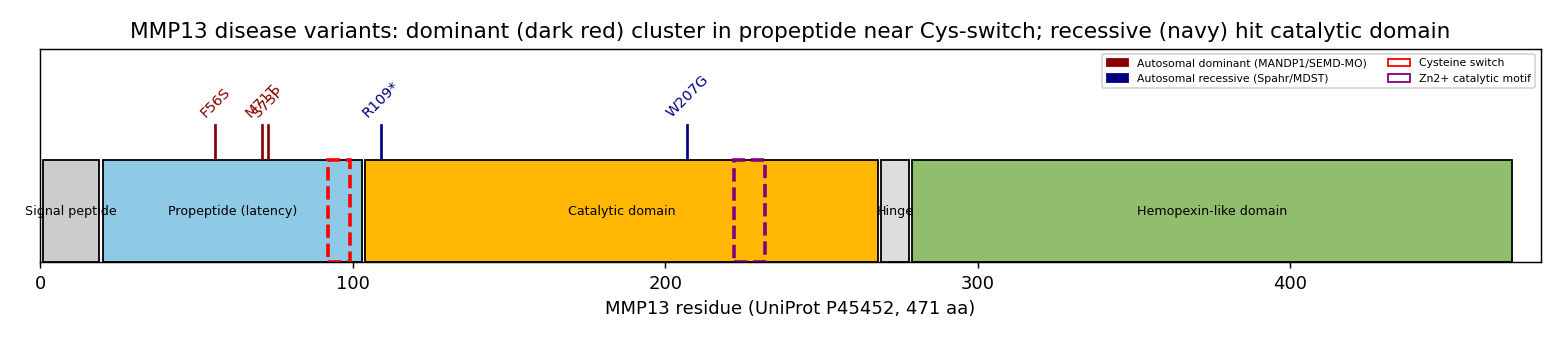
Reference Validation
Checked with linkml-reference-validator 0.2.1.
| Outcome | Count |
|---|---|
| References checked | 15 |
| Resolved | 15 |
| Unresolved (possible confabulation) | 0 |
| Unverifiable | 0 |
| Quoted claims checked | 1 |
| Quoted claims found in source | 1 |
| Quoted claims not found in source | 0 |
| References weighed for topical relevance | 15 |
| On topic | 10 |
| Off topic | 1 |
References that may not be about this subject
These identifiers resolve, so they are not fabrications, but the records they resolve to share almost none of this report's vocabulary. That is a clue and not a verdict - a paper can be relevant in ways its title and abstract do not spell out - so read them before deciding:
PMID:37446276(2 mentions) - Identification of N-Acyl Hydrazones as New Non-Zinc-Binding MMP-13 Inhibitors by Structure-Based Virtual Screening Studies and Chemical Optimization.- shared terms: human
Weighed against this report's own most characteristic terms: mmp13, disease, type, semd-mo, metaphyseal, recessive, dominant, dysplasia, variant, human, mouse, transient, bone, phenotype, propeptide, stature, gene, hdac4, radiographic, genetic.
All extracted references resolved successfully. Resolving is not the same as being relevant, though - see the references listed above as possibly off topic.
Term Validation
Checked with linkml-term-validator 0.4.5, through the ols: adapter.
| Outcome | Count |
|---|---|
| Terms checked | 28 |
| Resolved | 26 |
| Unresolved (possible confabulation) | 0 |
| Obsolete | 1 |
| Unverifiable | 1 |
| Terms whose name was checked | 21 |
| Terms named correctly | 13 |
| Terms named as a different term | 4 |
| Terms whose name is worth a second look | 4 |
Terms the report names something else
These identifiers resolve, so nothing about them looks wrong, and the ontology calls them something unrelated to what the report calls them. That usually means the identifier is not the one the sentence needs:
MONDO:0011198(2 mentions) - the report calls it "MONDO"; MONDO calls it spondyloepimetaphyseal dysplasia, Missouri typeNCIT:C15682(1 mention) - the report calls it "Physical Therapy"; NCIT calls it Dose-RateNCIT:C15277(1 mention) - the report calls it "Supportive Care"; NCIT calls it MastectomyNCIT:C15311(1 mention) - the report calls it "Genetic Counseling"; NCIT calls it Quality Control
Obsolete terms
These terms are real but deprecated. Citing one is not a fabrication; it does mean the report is naming something the ontology has retired:
GO:0005615(obsolete extracellular space) (1 mention) - replaced byGO:0005576
Terms whose name is worth a second look
The report's name for these is recognisably related to the term's own name without being one of them. A loose paraphrase reads the same way as a citation of the wrong sibling term - and so does a related synonym, which the ontology records precisely because it names something adjacent rather than the same thing - so these are listed rather than judged:
HP:0000944(1 mention) - the report calls it "Abnormal metaphyseal morphology"; HP calls it Abnormal metaphysis morphologyHP:0002979(1 mention) - the report calls it "Bowing of the long bones"; HP calls it Bowing of the legsGO:0031012(1 mention) - the report calls it "extracellular matrix", "Subcellular level: The extracellular matrix"; GO calls it extracellular matrixNCIT:C15329(1 mention) - the report calls it "Surgery/Surgical Procedure"; NCIT calls it Surgical Procedure
Terms named inconsistently
The report gives these identifiers more than one name of its own:
CL:0000743- called "hypertrophic chondrocyte", "hypertrophic chondrocytes"CL:0000062- called "osteoblast", "osteoblasts"GO:0031012- called "extracellular matrix", "Subcellular level: The extracellular matrix"