Kallmann Syndrome
Kallmann syndrome is the anosmic form of congenital isolated gonadotropin-releasing hormone (GnRH) deficiency, characterized by hypogonadotropic hypogonadism (absent or incomplete puberty, low sex steroids, infertility) combined with an impaired sense of smell (anosmia or hyposmia). It arises from defective embryonic co-migration of GnRH neurons and olfactory axons from the olfactory placode to the forebrain, with associated failure of olfactory bulb morphogenesis. Kallmann syndrome is genetically heterogeneous and can be inherited in X-linked recessive, autosomal dominant, autosomal recessive, or oligogenic patterns. Causal genes include ANOS1/KAL1 (X-linked), FGFR1/KAL2, FGF8, PROKR2, PROK2, and CHD7, among others. Anosmia distinguishes Kallmann syndrome from normosmic isolated GnRH deficiency, with which it shares a reproductive phenotype.
Ask OpenScientist
Ask a research question about Kallmann Syndrome. OpenScientist will conduct autonomous deep research using the Disorder Mechanisms Knowledge Base and PubMed literature (typically 10-30 minutes).
Do not include personal health information in your question. Questions and results are cached in your browser's local storage.
Mappings
Inheritance
3Show evidence (1 reference)
Show evidence (1 reference)
Show evidence (1 reference)
Subtypes
14Show evidence (1 reference)
Show evidence (1 reference)
Show evidence (1 reference)
Show evidence (1 reference)
Show evidence (1 reference)
Show evidence (4 references)
Show evidence (3 references)
Show evidence (3 references)
Show evidence (3 references)
Show evidence (4 references)
Show evidence (7 references)
Show evidence (3 references)
Show evidence (2 references)
Show evidence (3 references)
Discussions and Knowledge Gaps
1Show evidence (1 reference)
Pathophysiology
3Show evidence (9 references)
Show evidence (1 reference)
Show evidence (1 reference)
Pathograph
Phenotypes
11Endocrine 2
Show evidence (1 reference)
Show evidence (1 reference)
Genitourinary 5
Show evidence (1 reference)
Show evidence (1 reference)
Show evidence (1 reference)
Show evidence (1 reference)
Show evidence (1 reference)
Head and Neck 3
Show evidence (1 reference)
Show evidence (1 reference)
Show evidence (1 reference)
Nervous System 1
Show evidence (1 reference)
Genetic Associations
15Show evidence (2 references)
Show evidence (1 reference)
Show evidence (2 references)
Show evidence (3 references)
Show evidence (1 reference)
Show evidence (1 reference)
Show evidence (6 references)
Show evidence (5 references)
Show evidence (1 reference)
Show evidence (2 references)
Show evidence (1 reference)
Show evidence (1 reference)
Show evidence (1 reference)
Show evidence (1 reference)
Show evidence (1 reference)
Medical Actions
2Show evidence (1 reference)
Show evidence (1 reference)
Diagnosis
1Show evidence (1 reference)
Source YAML
click to showname: Kallmann Syndrome
creation_date: '2026-06-17T12:00:00Z'
category: Mendelian
description: >-
Kallmann syndrome is the anosmic form of congenital isolated gonadotropin-releasing
hormone (GnRH) deficiency, characterized by hypogonadotropic hypogonadism (absent or
incomplete puberty, low sex steroids, infertility) combined with an impaired sense of
smell (anosmia or hyposmia). It arises from defective embryonic co-migration of GnRH
neurons and olfactory axons from the olfactory placode to the forebrain, with associated
failure of olfactory bulb morphogenesis. Kallmann syndrome is genetically heterogeneous
and can be inherited in X-linked recessive, autosomal dominant, autosomal recessive, or
oligogenic patterns. Causal genes include ANOS1/KAL1 (X-linked), FGFR1/KAL2, FGF8,
PROKR2, PROK2, and CHD7, among others. Anosmia distinguishes Kallmann syndrome from
normosmic isolated GnRH deficiency, with which it shares a reproductive phenotype.
disease_term:
preferred_term: Kallmann syndrome
term:
id: MONDO:0018800
label: Kallmann syndrome
parents:
- Hypogonadotropic hypogonadism
- Disorders of puberty
notes: >-
MONDO makes eighteen numbered `hypogonadotropic hypogonadism N with or without
anosmia` classes direct children of Kallmann syndrome (MONDO:0018800), and
defines seventeen of the eighteen only as "any hypogonadotropic hypogonadism in
which the cause of the disease is a mutation in <gene>" - a definition that does
not require anosmia, while this entry is scoped to the anosmic form. The
exception is HH1 (MONDO:0010635, ANOS1), whose definition does name Kallmann
syndrome. Three of the eighteen carry a ClinGen gene-disease validity assertion
against their own MONDO term - HH1 (ANOS1, Definitive, X-linked), HH3 (PROKR2,
Definitive) and HH4 (PROK2, Definitive) - and those three are the whole of
ClinGen's coverage of this disease area. Sixteen of the eighteen are curated as subtype rows here or
as their own entries, each carrying the same scope caveat. Two are declined,
and the reason is mechanistic rather than a scope quibble.
MONDO:0013910 (HH8, KISS1R) and MONDO:0013913 (HH11, TACR3) are declined as
subtypes of this entry, on mechanism rather than on scope. This entry models
exactly one mechanism: failure of GnRH neurons and olfactory axons to
co-migrate from the olfactory placode, with failure of olfactory bulb
morphogenesis. The kisspeptin receptor and the neurokinin B receptor act on the
central control of GnRH secretion instead. PMID:14573733, the founding KISS1R
report, describes a consanguineous family homozygous for GPR54 p.Leu148Ser and
an unrelated compound heterozygote, with attenuated endogenous GnRH secretion
and reduced inositol phosphate accumulation from the mutant receptor in vitro.
PMID:19079066, the founding TACR3 report, describes four pedigrees homozygous
for loss-of-function variants in TAC3 or TACR3 with severe congenital
gonadotropin deficiency and pubertal failure, and names neurokinin B a critical
central regulator of human gonadal function. Neither report claims a defect in
olfactory development or in neuronal migration. A subtype row here would
therefore attach a gene to a mechanism its own literature does not claim.
A review of the genetics of both syndromes puts the same point at the level of
the whole gene set: PMID:25071724 states that "mutations in KISS1/KISSR,
TAC3/TACR3, GNRH1/GNRHR, LEP/LEPR, HESX1, FSHB, and LHB are only present in
patients with normosmic IHH", while listing the genes associated with Kallmann
syndrome separately as those "related to defects in neuronal migration". That
review is tagged in `references:` so the claim can be checked; it is not an
evidence item because there is no block on this entry for a gene the entry
declines.
This is a disagreement with MONDO's classification, not with its gene edges:
KISS1R and TACR3 are correct causal genes for hypogonadotropic hypogonadism, and
what is questionable is filing them below Kallmann syndrome. The structure
behind that is worth stating precisely, because it is checkable and because it
is not a single stray edge. MONDO:0018555 `hypogonadotropic hypogonadism` is the
parent of both Kallmann syndrome and MONDO:0015770 `congenital hypogonadotropic
hypogonadism`, and MONDO:0018555 carries `Normosmic idiopathic hypogonadotropic
hypogonadism` among its own synonyms. The numbered `HHn` classes are then spread
across all three levels: HH1 to HH6, HH8, HH9, HH11 and HH14 to HH22 are
descendants of Kallmann syndrome; HH10, HH12, HH13 and HH23 to HH27 are direct
children of MONDO:0018555; and HH7 is a child of MONDO:0015770.
That spread does not track anosmia. HH7 (GNRHR, MONDO:0007794) is the case that
shows MONDO has both the vocabulary and a precedent for the placement this entry
is asking for: its own MONDO definition ends "No patients with anosmia have been
reported", and it is filed under congenital hypogonadotropic hypogonadism rather
than under Kallmann syndrome. HH8 (KISS1R) and HH11 (TACR3) have the same
normosmic character and are filed under Kallmann syndrome instead. The
receptor-ligand pairs make the inconsistency sharper still: HH13 (KISS1,
MONDO:0013915) and HH10 (TAC3, MONDO:0013912) sit at the broader MONDO:0018555
level while the classes for their receptors sit two levels down under Kallmann
syndrome, so the two halves of each pair are classified differently. Read
against MONDO through the OLS4 API on 2026-09-25; the descendant set of
MONDO:0018800 and the direct-child set of MONDO:0018555 are what the ranges
above are taken from.
One observation cuts the other way and is recorded so the decline is not
overstated. A TACR3 allele does reach an anosmic patient in the literature, but
as the second locus of an oligogenic combination rather than alone - the
NELF/TACR3 pair recorded on the `NSMF` subtype row, and an ANOS1/TACR3 pair in
one of only two digenic combinations found in a 158-patient exome cohort. Both
are consistent with TACR3 contributing to a Kallmann phenotype in combination,
and neither makes TACR3 a Kallmann gene in its own right.
The right home for KISS1R and TACR3 is a normosmic or general congenital
hypogonadotropic hypogonadism Disease entry, which this knowledge base does not
yet have. What it does have is the grouping
`kb/groupings/Congenital_and_Syndromic_Hypogonadotropic_Hypogonadism.yaml`,
whose own mapping justification already identifies MONDO:0015770 as the closer
match for the developmental arm; that grouping is the natural place to hang such
an entry from once someone curates it.
MONDO:0014103 (HH18, IL17RD) is also not a subtype row here; it has its own
entry, `Hypogonadotropic_Hypogonadism_18_With_Or_Without_Anosmia`, which types
IL17RD as a susceptibility locus in an oligogenic architecture. That entry's
own notes record that a future rearrangement folding it in here as a subtype
row would be reasonable, and that the two representations should not both
exist. It remains a separate entry.
Nine of the genes recorded here - KISS1R, NSMF, TACR3, WDR11, HS6ST1, SEMA3A,
DUSP6, FGF17, FEZF1 - have no ClinGen
gene-disease validity assertion in the current Gene-Disease Validity table
(file created 2026-09-25, downloaded from the unversioned URL pinned in
data/clingen/MANIFEST.yaml). ClinGen's coverage of congenital hypogonadotropic
hypogonadism extends to ANOS1, PROK2 and PROKR2 and stops there, so absence of
an assertion carries no weight either way for the rest.
mappings:
mondo_mappings:
- term:
id: MONDO:0009482
label: hypogonadotropic hypogonadism 3 with or without anosmia
mapping_predicate: skos:narrowMatch
mapping_source: MONDO
mapping_justification: >-
MONDO splits the prokineticin form of Kallmann syndrome by gene - HH3
(OMIM:244200, PROKR2) and HH4 (OMIM:610628, PROK2) - while this entry
curates them as the single `PROKR2_PROK2` subtype, because receptor and
ligand loss converge on the same insufficient prokineticin signal.
`subtype_term` is single-valued, so the two MONDO leaves are declared here
at the disease level instead. Declared narrowMatch rather than exactMatch
because each MONDO class is narrower than the dismech subtype.
- term:
id: MONDO:0012528
label: hypogonadotropic hypogonadism 4 with or without anosmia
mapping_predicate: skos:narrowMatch
mapping_source: MONDO
mapping_justification: >-
The PROK2 (ligand) half of the same split; see the MONDO:0009482
justification above.
has_subtypes:
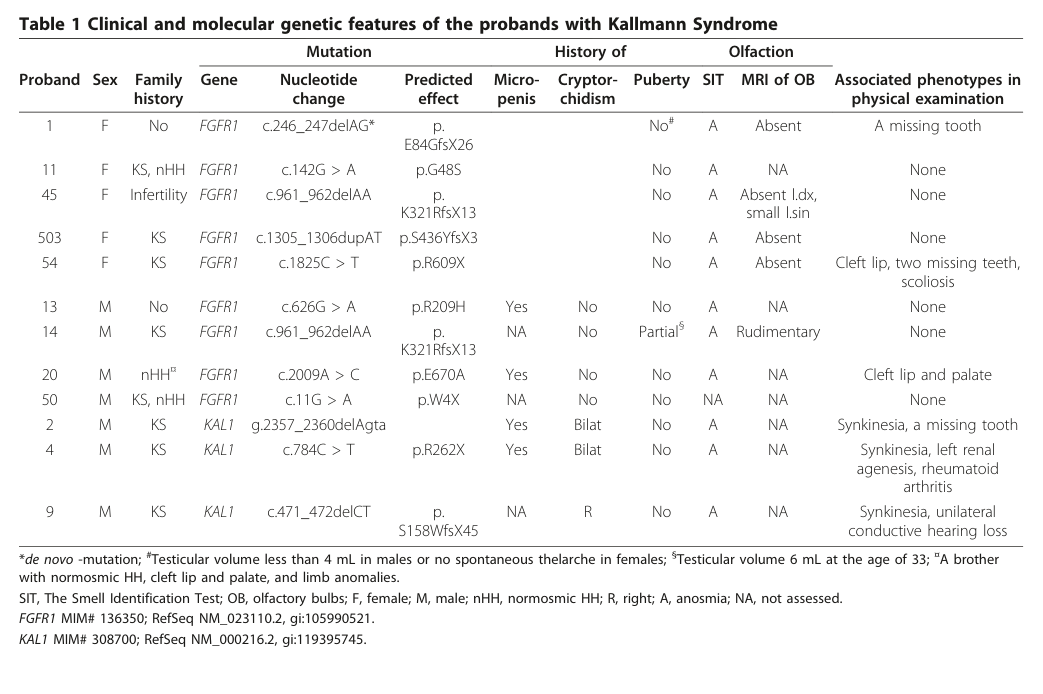
- name: ANOS1
display_name: Kallmann syndrome 1 (X-linked, ANOS1/KAL1)
subtype_term:
preferred_term: hypogonadotropic hypogonadism 1 with or without anosmia
term:
id: MONDO:0010635
label: hypogonadotropic hypogonadism 1 with or without anosmia
genes:
- preferred_term: ANOS1
term:
id: hgnc:6211
label: ANOS1
description: >-
X-linked recessive Kallmann syndrome caused by loss-of-function variants in ANOS1
(formerly KAL1), encoding the extracellular matrix adhesion protein anosmin-1. KAL1
mutations tend to cause a more severe reproductive phenotype and are distinctively
associated with unilateral renal agenesis and bimanual synkinesia (mirror movements).
evidence:
- reference: PMID:15605412
reference_title: "Kallmann syndrome: 14 novel mutations in KAL1 and FGFR1 (KAL2)."
supports: SUPPORT
evidence_source: HUMAN_CLINICAL
snippet: "In this study, unilateral renal agenesis and bimanual synkinesia were exclusively found\nassociated with KAL1mutations, cleft palate and dental agenesia with\nFGFR1mutations."
explanation: A KAL1/FGFR1 cohort distinguishes the KAL1 subtype by renal agenesis and bimanual synkinesia.
- name: FGFR1
display_name: Kallmann syndrome 2 (FGFR1, KAL2)
subtype_term:
preferred_term: hypogonadotropic hypogonadism 2 with or without anosmia
term:
id: MONDO:0007844
label: hypogonadotropic hypogonadism 2 with or without anosmia
genes:
- preferred_term: FGFR1
term:
id: hgnc:3688
label: FGFR1
description: >-
Autosomal dominant Kallmann syndrome caused by loss-of-function variants in FGFR1
(KAL2), with incomplete penetrance and variable expressivity. May include cleft
lip/palate and dental agenesis.
evidence:
- reference: PMID:12627230
reference_title: "Loss-of-function mutations in FGFR1 cause autosomal dominant Kallmann syndrome."
supports: SUPPORT
evidence_source: HUMAN_CLINICAL
snippet: "We establish here that loss-of-function mutations in FGFR1 underlie KAL2 whereas a\ngain-of-function mutation in FGFR1 has been shown to cause a form of\ncraniosynostosis."
explanation: The discovery paper establishes FGFR1 loss-of-function as the cause of KAL2.
- name: PROKR2_PROK2
display_name: Kallmann syndrome 3/4 (PROKR2 / PROK2)
review_notes: >-
Intentionally has no `subtype_term`. This one dismech subtype spans two MONDO
classes - MONDO:0009482 (HH3, PROKR2) and MONDO:0012528 (HH4, PROK2) - and
`subtype_term` is single-valued, so binding either alone would silently drop
the other. Both are declared as disease-level `skos:narrowMatch` mappings
instead. The advisory `test_subtypes_have_disease_term` warning on this
subtype is therefore expected, not an omission.
genes:
- preferred_term: PROKR2
term:
id: hgnc:15836
label: PROKR2
- preferred_term: PROK2
term:
id: hgnc:18455
label: PROK2
description: >-
Kallmann syndrome caused by variants in the prokineticin receptor PROKR2 (KAL3) or its
ligand prokineticin-2, PROK2 (KAL4). PROKR2 variants occur in heterozygous, homozygous,
or compound heterozygous states and frequently contribute to oligogenic inheritance.
evidence:
- reference: PMID:17054399
reference_title: "Kallmann syndrome: mutations in the genes encoding prokineticin-2 and prokineticin receptor-2."
supports: SUPPORT
evidence_source: HUMAN_CLINICAL
snippet: "we took a \ncandidate gene strategy and identified ten and four different point mutations in \nthe genes encoding the G protein-coupled prokineticin receptor-2 (PROKR2) and \none of its ligands, prokineticin-2 (PROK2), respectively."
explanation: Establishes PROKR2 and PROK2 as Kallmann syndrome genes.
- name: FGF8
display_name: Kallmann syndrome 6 (FGF8)
subtype_term:
preferred_term: hypogonadotropic hypogonadism 6 with or without anosmia
term:
id: MONDO:0012988
label: hypogonadotropic hypogonadism 6 with or without anosmia
genes:
- preferred_term: FGF8
term:
id: hgnc:3686
label: FGF8
description: >-
Kallmann syndrome / GnRH deficiency caused by variants in FGF8, the principal ligand for
FGFR1 in GnRH neuron ontogeny; reduced FGF8 signaling impairs GnRH neuron development.
evidence:
- reference: PMID:18596921
reference_title: "Decreased FGF8 signaling causes deficiency of gonadotropin-releasing hormone in humans and mice."
supports: SUPPORT
evidence_source: HUMAN_CLINICAL
snippet: "While loss-of-function mutations in FGF receptor 1 (FGFR1) cause human GnRH deficiency, to date no specific ligand for FGFR1 has been identified in GnRH neuron ontogeny."
explanation: Establishes the FGF8-FGFR1 ligand-receptor axis underlying this subtype.
- name: CHD7
display_name: Kallmann syndrome 5 (CHD7)
subtype_term:
preferred_term: hypogonadotropic hypogonadism 5 with or without anosmia
term:
id: MONDO:0012880
label: hypogonadotropic hypogonadism 5 with or without anosmia
genes:
- preferred_term: CHD7
term:
id: hgnc:20626
label: CHD7
description: >-
Kallmann syndrome caused by heterozygous CHD7 variants, overlapping mechanistically with
CHARGE syndrome. Isolated Kallmann syndrome / IHH can represent a milder allelic variant
of CHARGE syndrome.
evidence:
- reference: PMID:18834967
reference_title: "Mutations in CHD7, encoding a chromatin-remodeling protein, cause idiopathic hypogonadotropic hypogonadism and Kallmann syndrome."
supports: SUPPORT
evidence_source: HUMAN_CLINICAL
snippet: "We hypothesized that CHD7 would be \ninvolved in the pathogenesis of IHH and KS (IHH/KS) without the CHARGE phenotype \nand that IHH/KS represents a milder allelic variant of CHARGE syndrome."
explanation: Establishes CHD7 as a Kallmann syndrome gene and its allelic relationship to CHARGE.
- name: SPRY4
display_name: Hypogonadotropic hypogonadism 17 (SPRY4)
subtype_term:
preferred_term: hypogonadotropic hypogonadism 17 with or without anosmia
term:
id: MONDO:0014102
label: hypogonadotropic hypogonadism 17 with or without anosmia
description: >-
GnRH deficiency associated with heterozygous variants in SPRY4, which encodes
Sprouty4, an intracellular antagonist of FGF/RAS-ERK signalling and therefore a
negative modulator of the same FGF8-FGFR1 axis that the ANOS1, FGFR1 and FGF8
subtypes act on. Unlike those three, SPRY4 is not established as a
self-sufficient cause: it was identified in an FGF-pathway candidate screen,
its variants are usually reported alongside a second or third locus, and no
ClinGen gene-disease validity assertion exists. GenCC submitters classify the
SPRY4-HH17 relationship as Limited to Moderate and Genomics England PanelApp
lists SPRY4 as amber (not green-listed for routine diagnostic reporting) on
both its hypogonadotropic hypogonadism panels. Curated here as a contributory
subtype rather than as an independent disease entry for that reason.
Two scope caveats. First, the MONDO label is "with or without anosmia" and a
minority of reported carriers are normosmic, so the concept is slightly wider
than the anosmic form this entry is scoped to; MONDO nonetheless classifies
all eighteen numbered "HHn with or without anosmia" terms as children of
Kallmann syndrome, and this binding follows that classification rather than
inventing a different one. Second, apparently isolated SPRY4 findings do
occur - one reported case carried a single heterozygous SPRY4 variant with no
second hit across a 28-gene panel - so the oligogenic framing describes the
typical reported architecture, not an established requirement.
genes:
- preferred_term: SPRY4
term:
id: hgnc:15533
label: SPRY4
inheritance:
- name: Oligogenic inheritance (SPRY4)
inheritance_term:
preferred_term: Oligogenic inheritance
term:
id: HP:0010983
label: Oligogenic inheritance
description: >-
SPRY4 variants are typically reported as one contributing locus among two or
three rather than as a self-sufficient cause. Oligogenic rather than digenic
is the right term because the published combinations include trigenic ones
(PROKR2/SPRY4/NSMF) as well as two-locus ones, and because the founding
cohort frames the FGF-pathway genes as contributors to an architecture
rather than as a defined two-locus requirement.
evidence:
- reference: PMID:23643382
reference_title: "Mutations in FGF17, IL17RD, DUSP6, SPRY4, and FLRT3 are identified in individuals with congenital hypogonadotropic hypogonadism."
supports: SUPPORT
evidence_source: HUMAN_CLINICAL
snippet: "Mutations in genes encoding components of the FGF pathway are associated with complex modes of CHH inheritance and act primarily as contributors to an oligogenic genetic architecture underlying CHH."
explanation: The cohort that first reported SPRY4 in CHH concludes that FGF-pathway genes act primarily as contributors to an oligogenic architecture.
- reference: PMID:35316923
reference_title: New findings in oligogenic inheritance of congenital hypogonadotropic hypogonadism.
supports: SUPPORT
evidence_source: HUMAN_CLINICAL
snippet: "Here we report the identification of new oligogenic variants in SPRY4/SEMA3A, SRA1/SEMA7A, CHD7/SEMA7A, CCDC141/POLR3B/POLR3B, and PROKR2/SPRY4/NSMF."
explanation: Names the specific two-locus (SPRY4/SEMA3A) and three-locus (PROKR2/SPRY4/NSMF) combinations that make oligogenic, not digenic, the correct term here.
- reference: PMID:31781046
reference_title: A Rare SPRY4 Gene Mutation Is Associated With Anosmia and Adult-Onset Isolated Hypogonadotropic Hypogonadism.
supports: REFUTE
evidence_source: HUMAN_CLINICAL
snippet: "No other variants in the 27 remaining loci were identified by NGS."
explanation: >-
Counter-evidence to obligate oligogenicity, kept on the block it argues against
rather than only in prose. In this case the SPRY4 variant was the sole finding, so
a second locus is not required for the phenotype to appear. It weakens rather than
overturns the oligogenic reading, because the panel covered 28 loci and a second
hit outside them would not have been seen.
evidence:
- reference: PMID:23643382
reference_title: "Mutations in FGF17, IL17RD, DUSP6, SPRY4, and FLRT3 are identified in individuals with congenital hypogonadotropic hypogonadism."
supports: SUPPORT
evidence_source: HUMAN_CLINICAL
snippet: "Except for FGF18 and SPRY2, all other genes were found to be mutated in CHH individuals: FGF17 (n = 3 individuals), IL17RD (n = 8), DUSP6 (n = 5), SPRY4 (n = 14), and FLRT3 (n = 3)."
explanation: The report that established SPRY4 as a CHH gene, finding variants in 14 individuals in a screen of FGF-pathway modulators.
- reference: PMID:32389901
reference_title: "Prevalence and associated phenotypes of DUSP6, IL17RD and SPRY4 variants in a large Chinese cohort with isolated hypogonadotropic hypogonadism."
supports: SUPPORT
evidence_source: HUMAN_CLINICAL
snippet: "Mutations in DUSP6 alone seem sufficient to cause IHH in an autosomal dominant manner, whereas IL17RD or SPRY4 mutations may cause IHH phenotypes in synergy with variants in other IHH-associated genes."
explanation: An independent cohort separates SPRY4 from DUSP6 on exactly the point at issue, concluding SPRY4 acts in synergy with other loci rather than alone.
- reference: PMID:40034250
reference_title: "PROKR2 mutations and SPRY4 variants with uncertain significance in a Kallmann syndrome family: Incomplete penetrance."
supports: SUPPORT
evidence_source: HUMAN_CLINICAL
snippet: "The genotyping results indicated PROKR2 mutations and SPRY4 variants of uncertain significance, which might be incompletely penetrant in this family."
explanation: A family in which the SPRY4 variant was carried by two unaffected relatives, supporting the contributory-and-incompletely-penetrant reading rather than a causal one.
- reference: PMID:31781046
reference_title: A Rare SPRY4 Gene Mutation Is Associated With Anosmia and Adult-Onset Isolated Hypogonadotropic Hypogonadism.
supports: SUPPORT
evidence_source: HUMAN_CLINICAL
snippet: "No other variants in the 27 remaining loci were identified by NGS."
explanation: The counterweight, recorded so the oligogenic framing is not overstated - in this case the SPRY4 variant was the only finding across the panel tested.
- name: FLRT3
display_name: Hypogonadotropic hypogonadism 21 (FLRT3)
subtype_term:
preferred_term: hypogonadotropic hypogonadism 21 with or without anosmia
term:
id: MONDO:0014107
label: hypogonadotropic hypogonadism 21 with or without anosmia
description: >-
GnRH deficiency associated with heterozygous variants in FLRT3, which encodes
fibronectin leucine-rich transmembrane protein 3 - a cell-surface molecule that
both interacts with FGFR1 and acts as an axon-guidance and neuronal-migration
receptor through Robo1 and the Unc5 family. Both of those roles point at the same
node this entry already models: defective co-migration of GnRH neurons and
olfactory axons under an FGF8-FGFR1 signal.
FLRT3 is the weakest of the FGF-pathway loci curated here, and the subtype is
scoped accordingly. It entered the CHH literature in the same 2013 candidate
screen that produced SPRY4, IL17RD, DUSP6 and FGF17, and it was the smallest yield
of the five - variants in 3 of 386 unrelated individuals, against 14 for SPRY4.
That paper's own conclusion is that the FGF-pathway genes act primarily as
contributors to an oligogenic architecture rather than as self-sufficient causes.
Nothing since has strengthened it: later cohorts report FLRT3 only among rare
variants of uncertain significance, usually alongside a second locus, and there is
no ClinGen gene-disease validity assertion for FLRT3 (checked against the ClinGen
gene-validity download of 2026-09-08).
Curated as a contributory subtype rather than as a standalone disease entry for
that reason, and the comparison that decides it is internal: SPRY4 is the stronger
gene from the same paper and is a subtype here, so curating FLRT3 standalone would
be inconsistent. The knowledge base does carry standalone entries for other HH
loci - FGFR1_Hypogonadotropic_Hypogonadism, and HH18/IL17RD on an open pull
request - but IL17RD was promoted on the strength of a distinguishing phenotype
(hearing loss in 6 of 8 in the founding cohort), a larger series and a dedicated
review literature. FLRT3 has none of the three.
Scope caveat, as for SPRY4. The MONDO label is "with or without anosmia" and the
concept is therefore slightly wider than the anosmic form this entry is scoped to;
MONDO classifies the numbered "HHn with or without anosmia" terms as children of
Kallmann syndrome, and this binding follows that classification rather than
inventing a different one.
genes:
- preferred_term: FLRT3
term:
id: hgnc:3762
label: FLRT3
inheritance:
- name: Oligogenic inheritance (FLRT3)
inheritance_term:
preferred_term: Oligogenic inheritance
term:
id: HP:0010983
label: Oligogenic inheritance
description: >-
FLRT3 variants are reported heterozygous and, where a panel or exome was run,
typically alongside variants at other CHH loci. Oligogenic rather than digenic
is the right term because the founding cohort frames the FGF-pathway genes as
contributors to an architecture rather than as a defined two-locus requirement,
and because the later series that report FLRT3 do so in cohorts where multi-gene
findings are explicitly counted.
evidence:
- reference: PMID:23643382
reference_title: "Mutations in FGF17, IL17RD, DUSP6, SPRY4, and FLRT3 are identified in individuals with congenital hypogonadotropic hypogonadism."
supports: SUPPORT
evidence_source: HUMAN_CLINICAL
snippet: "Mutations in genes encoding components of the FGF pathway are associated with complex modes of CHH inheritance and act primarily as contributors to an oligogenic genetic architecture underlying CHH."
explanation: >-
The cohort that first reported FLRT3 in CHH concludes that the FGF-pathway genes,
FLRT3 among them, act primarily as contributors to an oligogenic architecture.
- reference: PMID:31200363
reference_title: "New genetic findings in a large cohort of congenital hypogonadotropic hypogonadism."
supports: SUPPORT
evidence_source: HUMAN_CLINICAL
snippet: "Notably, 6.9% of the patients had rare variants in more than one gene."
explanation: >-
The rate of multi-locus findings in the 130-patient Brazilian cohort that also
reported a rare FLRT3 variant, which is what an oligogenic architecture looks like
at cohort level.
evidence:
- reference: PMID:23643382
reference_title: "Mutations in FGF17, IL17RD, DUSP6, SPRY4, and FLRT3 are identified in individuals with congenital hypogonadotropic hypogonadism."
supports: SUPPORT
evidence_source: HUMAN_CLINICAL
snippet: "Except for FGF18 and SPRY2, all other genes were found to be mutated in CHH individuals: FGF17 (n = 3 individuals), IL17RD (n = 8), DUSP6 (n = 5), SPRY4 (n = 14), and FLRT3 (n = 3)."
explanation: >-
The report that established FLRT3 as a CHH gene, with the yield that makes it the
smallest of the five - three individuals in a screen of 386.
- reference: PMID:31200363
reference_title: "New genetic findings in a large cohort of congenital hypogonadotropic hypogonadism."
supports: SUPPORT
evidence_source: HUMAN_CLINICAL
snippet: "Rare variants were also identified in SPRY4, IL17RD, FGF17, IGSF1 and FLRT3 genes."
explanation: >-
Independent replication of a kind - FLRT3 recurs in a large unrelated cohort, but
under the heading of rare variants rather than of pathogenic or probably pathogenic
ones, which is the level of support this subtype rests on.
- reference: PMID:36700485
reference_title: "Clinical Characteristics and Genetic Analyses of Patients with Idiopathic Hypogonadotropic Hypogonadism."
supports: SUPPORT
evidence_source: HUMAN_CLINICAL
snippet: "four (25%) each had a heterozygous (VUS) variant in HESX1, FGF8, FLRT3 and DMXL2"
explanation: >-
A further cohort finding, and the classification it carries - a heterozygous variant
of uncertain significance rather than a pathogenic one.
- name: WDR11
display_name: Hypogonadotropic hypogonadism 14 (WDR11)
subtype_term:
preferred_term: hypogonadotropic hypogonadism 14 with or without anosmia
term:
id: MONDO:0013926
label: hypogonadotropic hypogonadism 14 with or without anosmia
genes:
- preferred_term: WDR11
term:
id: hgnc:13831
label: WDR11
description: >-
GnRH deficiency associated with heterozygous missense variants in WDR11, a WD
repeat protein found by mapping the breakpoint of a balanced t(10;12)
translocation in a Kallmann syndrome patient. Six patients carried five
different missense alterations, three of them in WD domains that build the
beta propeller and mediate protein-protein interaction. The functional route
to this entry's migration node is the WDR11-EMX1 interaction: EMX1 is a
homeodomain transcription factor involved in the development of olfactory
neurons, and the patient alterations reduce or abolish WDR11 binding to it.
Scope caveat, as for the other numbered subtypes on this entry. The MONDO label
is "with or without anosmia" and the class definition is simply "any
hypogonadotropic hypogonadism in which the cause of the disease is a mutation
in <gene>", so the concept is wider than the anosmic form this entry is scoped
to; MONDO nonetheless classifies the numbered "HHn with or without anosmia"
terms as children of Kallmann syndrome, and this binding follows that
classification rather than inventing a different one.
evidence:
- reference: PMID:20887964
reference_title: "WDR11, a WD protein that interacts with transcription factor EMX1, is mutated in idiopathic hypogonadotropic hypogonadism and Kallmann syndrome."
supports: SUPPORT
evidence_source: HUMAN_CLINICAL
snippet: "We found six patients with a total of five different heterozygous WDR11 missense mutations, including three alterations (A435T, R448Q, and H690Q) in WD domains important for β propeller formation and protein-protein interaction."
explanation: >-
The gene-disease claim and its size: six patients, five heterozygous
missense alleles, three of them in the functionally important WD domains.
- reference: PMID:20887964
reference_title: "WDR11, a WD protein that interacts with transcription factor EMX1, is mutated in idiopathic hypogonadotropic hypogonadism and Kallmann syndrome."
supports: SUPPORT
evidence_source: IN_VITRO
snippet: "In addition, we discovered that WDR11 interacts with EMX1, a homeodomain transcription factor involved in the development of olfactory neurons, and that missense alterations reduce or abolish this interaction."
explanation: >-
The functional consequence, and the reason WDR11 is bound at the GnRH
neuron and olfactory axon migration node rather than only listed: the
partner it loses is an olfactory-neuron developmental transcription factor.
- reference: PMID:25071724
reference_title: "Reproduction, smell, and neurodevelopmental disorders: genetic defects in different hypogonadotropic hypogonadal syndromes."
supports: SUPPORT
evidence_source: OTHER
snippet: "Interestingly, defects in PROKR2, FGFR1, FGF8, CHD7, DUSP6, and WDR11 genes are also associated with normosmic IHH, whereas mutations in KISS1/KISSR, TAC3/TACR3, GNRH1/GNRHR, LEP/LEPR, HESX1, FSHB, and LHB are only present in patients with normosmic IHH."
explanation: >-
The scope caveat above made concrete for this gene: WDR11 variants are
reported in normosmic isolated hypogonadotropic hypogonadism as well as in
the anosmic form, so the MONDO leaf bound here is wider than this entry.
The founding WDR11 report's own title names both syndromes for the same
reason.
- name: HS6ST1
display_name: Hypogonadotropic hypogonadism 15 (HS6ST1)
subtype_term:
preferred_term: hypogonadotropic hypogonadism 15 with or without anosmia
term:
id: MONDO:0013946
label: hypogonadotropic hypogonadism 15 with or without anosmia
genes:
- preferred_term: HS6ST1
term:
id: hgnc:5201
label: HS6ST1
description: >-
GnRH deficiency associated with variants in HS6ST1, which 6-O-sulfates
heparan sulfate. This is the same FGFR1 axis the ANOS1, FGFR1 and FGF8
subtypes act on, reached from the sugar side: heparan sulfate modification is
what allows anosmin-1 to act as a modulatory coligand with FGF in activating
the receptor, and the IHH-associated HS6ST1 alleles reduce enzyme activity.
Direction of effect is therefore sourced rather than assumed - less
6-O-sulfation gives less FGFR1 activation, which is the direction this
entry's migration node asserts - and HS6ST1 is bound at that node.
A nomenclature note that matters for reconciliation: MONDO records HS6ST1
against this term with a `contributes_to` predicate rather than a `causes`
one, in contrast to most of the numbered leaves. This record is nonetheless
typed CAUSATIVE, on the strength of an independent exome cohort that counts
HS6ST1 among the genes in which it found pathogenic or likely pathogenic
variants sufficient to cause disease.
Scope caveat, as for the other numbered subtypes on this entry. The MONDO label
is "with or without anosmia" and the class definition is simply "any
hypogonadotropic hypogonadism in which the cause of the disease is a mutation
in <gene>", so the concept is wider than the anosmic form this entry is scoped
to; MONDO nonetheless classifies the numbered "HHn with or without anosmia"
terms as children of Kallmann syndrome, and this binding follows that
classification rather than inventing a different one.
evidence:
- reference: PMID:21700882
reference_title: "Heparan sulfate 6-O-sulfotransferase 1, a gene involved in extracellular sugar modifications, is mutated in patients with idiopathic hypogonadotrophic hypogonadism."
supports: SUPPORT
evidence_source: HUMAN_CLINICAL
snippet: "We report here mutations in HS 6-O-sulfotransferase 1 (HS6ST1) in families with idiopathic hypogonadotropic hypogonadism (IHH)."
explanation: The founding gene-disease report for this subtype.
- reference: PMID:21700882
reference_title: "Heparan sulfate 6-O-sulfotransferase 1, a gene involved in extracellular sugar modifications, is mutated in patients with idiopathic hypogonadotrophic hypogonadism."
supports: SUPPORT
evidence_source: MODEL_ORGANISM
snippet: "These findings are consistent with a model in which KAL1 can act as a modulatory coligand with FGF to activate the FGF receptor in an HS-dependent manner."
explanation: >-
Places HS6ST1 on the ANOS1/FGF8/FGFR1 axis this entry already models, and
gives the direction of effect - heparan sulfate is required for receptor
activation, so reduced sulfotransferase activity reduces FGFR1 signalling.
- reference: PMID:38593951
reference_title: "Prevalence of pathogenic variants and digenic disease in patients diagnosed with normosmic hypogonadotropic hypogonadism/Kallmann Syndrome."
supports: SUPPORT
evidence_source: HUMAN_CLINICAL
snippet: "Thirty-one confirmed P/LP variants in 10 genes (ANOS1, CHD7, DUSP6, FGFR1, HS6ST1, KISS1, PROKR2, SEMA3A, SEMA3E, TACR3), sufficient to cause disease, were identified in 30/158 (19%) patients."
explanation: >-
An independent 158-patient exome cohort counting HS6ST1 among the genes
whose pathogenic or likely pathogenic variants it judged sufficient to cause
disease, which is the basis for typing this record CAUSATIVE despite MONDO's
`contributes_to` predicate.
- name: SEMA3A
display_name: Hypogonadotropic hypogonadism 16 (SEMA3A)
subtype_term:
preferred_term: hypogonadotropic hypogonadism 16 with or without anosmia
term:
id: MONDO:0013961
label: hypogonadotropic hypogonadism 16 with or without anosmia
genes:
- preferred_term: SEMA3A
term:
id: hgnc:10723
label: SEMA3A
description: >-
Kallmann syndrome caused by loss of one SEMA3A allele. The founding report
screened 48 Kallmann propositi with no mutation in a known gene by array
comparative genomic hybridisation and found one heterozygous 213 kb deletion
removing 11 of the 17 SEMA3A exons, which cosegregated with the Kallmann
phenotype in the family in an autosomal dominant fashion and with no other
neurological or non-neurological disorder. Semaphorin 3A is described in that
report as a protein that interacts with neuropilins, and mice lacking it have
a Kallmann-like phenotype, which is what puts the mechanism on this entry's
olfactory-axon and GnRH-neuron migration node.
Two qualifications. MONDO records SEMA3A against this term with a
`contributes_to` rather than a `causes` predicate, and SEMA3A variants are
also reported in oligogenic combinations - SPRY4/SEMA3A in one series, and
SEMA3A/SEMA3E as one of only two digenic pairs found in a 158-patient exome
cohort. This record is typed CAUSATIVE because the founding evidence is a
whole-gene-region deletion segregating dominantly, and because the same exome
cohort counts SEMA3A among the genes whose variants it judged sufficient to
cause disease; the oligogenic reports describe an additional architecture
rather than a replacement for it.
Scope caveat, as for the other numbered subtypes on this entry. The MONDO label
is "with or without anosmia" and the class definition is simply "any
hypogonadotropic hypogonadism in which the cause of the disease is a mutation
in <gene>", so the concept is wider than the anosmic form this entry is scoped
to; MONDO nonetheless classifies the numbered "HHn with or without anosmia"
terms as children of Kallmann syndrome, and this binding follows that
classification rather than inventing a different one.
evidence:
- reference: PMID:22416012
reference_title: "SEMA3A deletion in a family with Kallmann syndrome validates the role of semaphorin 3A in human puberty and olfactory system development."
supports: SUPPORT
evidence_source: HUMAN_CLINICAL
snippet: "One propositus was found to have a heterozygous deletion of 213 kb at locus 7q21.11, confirmed by real-time qPCR, deleting 11 of the 17 SEMA3A exons."
explanation: >-
The founding allele: a heterozygous multi-exon deletion, which is what makes
this a loss-of-function claim rather than a missense association.
- reference: PMID:22416012
reference_title: "SEMA3A deletion in a family with Kallmann syndrome validates the role of semaphorin 3A in human puberty and olfactory system development."
supports: SUPPORT
evidence_source: HUMAN_CLINICAL
snippet: "This deletion cosegregated in the propositus' family with the KS phenotype, that was transmitted in autosomal dominant fashion and was not associated with other neurological or non-neurological clinical disorders."
explanation: >-
Family cosegregation and the dominant transmission this subtype asserts,
with the phenotype restricted to Kallmann syndrome.
- reference: PMID:22416012
reference_title: "SEMA3A deletion in a family with Kallmann syndrome validates the role of semaphorin 3A in human puberty and olfactory system development."
supports: SUPPORT
evidence_source: MODEL_ORGANISM
snippet: "Mice lacking semaphorin 3A expression have been showed to have a Kallmann-like phenotype."
explanation: >-
The animal support for the gene-disease claim, and the reason SEMA3A is
bound at the migration node rather than only listed.
- reference: PMID:38593951
reference_title: "Prevalence of pathogenic variants and digenic disease in patients diagnosed with normosmic hypogonadotropic hypogonadism/Kallmann Syndrome."
supports: SUPPORT
evidence_source: HUMAN_CLINICAL
snippet: "Only 2/158 (1.2%) patients had digenic variant combinations: a male with hemizygous ANOS1 and heterozygous TACR3 variants and a male with heterozygous SEMA3A and SEMA3E variants."
explanation: >-
The counterweight, kept on the row it qualifies: SEMA3A appears in one of
the two digenic combinations this cohort found, so an oligogenic
architecture is on record for the gene alongside the dominant deletion
family.
- name: DUSP6
display_name: Hypogonadotropic hypogonadism 19 (DUSP6)
subtype_term:
preferred_term: hypogonadotropic hypogonadism 19 with or without anosmia
term:
id: MONDO:0014105
label: hypogonadotropic hypogonadism 19 with or without anosmia
genes:
- preferred_term: DUSP6
term:
id: hgnc:3072
label: DUSP6
description: >-
GnRH deficiency associated with heterozygous variants in DUSP6, an ERK
phosphatase and a negative modulator of FGF8-FGFR1 signalling. It entered the
literature in the same 2013 FGF-pathway candidate screen that produced SPRY4,
FLRT3, FGF17 and IL17RD, with variants in 5 of 386 unrelated individuals.
DUSP6 is the only one of that five for which a cohort has argued that
variants act alone: a 196-patient Chinese series found four heterozygous
DUSP6 alleles in six patients and concluded that DUSP6 mutations alone seem
sufficient to cause IHH in an autosomal dominant manner, explicitly
separating DUSP6 from IL17RD and SPRY4, which it judged to act in synergy
with other loci. A 158-patient exome cohort likewise counts DUSP6 among the
genes whose pathogenic or likely pathogenic variants it judged sufficient to
cause disease.
The subtype is nonetheless typed SUSCEPTIBILITY, with that sufficiency claim
recorded as evidence rather than adopted. Three things weigh against it. The
founding screen's own conclusion is that the FGF-pathway genes act primarily
as oligogenic contributors. Two of the five DUSP6 carriers in that screen
carried a second FGF-pathway allele, in SPRY4 - a detail that is not in the
screen's own abstract but is recounted in the discussion of PMID:37108593,
which is why it is stated here rather than quoted as a snippet. And the one
patient whose
DUSP6 allele has been characterised structurally carried it as a variant of
uncertain significance in a case series whose own conclusion is that
functional studies are needed to confirm its role. "Seem sufficient" from one
cohort is not enough to outweigh that, and typing DUSP6 CAUSATIVE while
SPRY4, FLRT3 and IL17RD - the same screen, the same pathway, the same
architecture - are all SUSCEPTIBILITY would be inconsistent.
DUSP6 is not bound at the migration pathophysiology node, and the reason is
the same paradox SPRY4's row describes. DUSP6 is an ERK2 phosphatase and so a
negative modulator of the FGF8-FGFR1 axis, and the one published
direction-of-effect analysis of a congenital hypogonadotropic hypogonadism
allele - molecular dynamics on DUSP6 p.Leu145Arg - concludes it disrupts the
interaction needed for ERK2 binding, which is a loss of phosphatase function
and so points towards more ERK signalling, not less. That is the opposite of
the decreased FGFR1 signalling this entry's migration node asserts. SPRY4's
row resolves its own version of the paradox with published characterisation
of two Kallmann-reported Sprouty4 substitutions as hyperactive inhibitors; no
equivalent gain-of-inhibition result exists for DUSP6, so the direction is
left unasserted rather than assumed by analogy.
Scope caveat, as for the other numbered subtypes on this entry. The MONDO label
is "with or without anosmia" and the class definition is simply "any
hypogonadotropic hypogonadism in which the cause of the disease is a mutation
in <gene>", so the concept is wider than the anosmic form this entry is scoped
to; MONDO nonetheless classifies the numbered "HHn with or without anosmia"
terms as children of Kallmann syndrome, and this binding follows that
classification rather than inventing a different one.
evidence:
- reference: PMID:23643382
reference_title: "Mutations in FGF17, IL17RD, DUSP6, SPRY4, and FLRT3 are identified in individuals with congenital hypogonadotropic hypogonadism."
supports: SUPPORT
evidence_source: HUMAN_CLINICAL
snippet: "Except for FGF18 and SPRY2, all other genes were found to be mutated in CHH individuals: FGF17 (n = 3 individuals), IL17RD (n = 8), DUSP6 (n = 5), SPRY4 (n = 14), and FLRT3 (n = 3)."
explanation: The report that established DUSP6 as a CHH gene, with its yield of five individuals in a screen of 386.
- reference: PMID:32389901
reference_title: "Prevalence and associated phenotypes of DUSP6, IL17RD and SPRY4 variants in a large Chinese cohort with isolated hypogonadotropic hypogonadism."
supports: SUPPORT
evidence_source: HUMAN_CLINICAL
snippet: "Mutations in DUSP6 alone seem sufficient to cause IHH in an autosomal dominant manner, whereas IL17RD or SPRY4 mutations may cause IHH phenotypes in synergy with variants in other IHH-associated genes."
explanation: >-
The independent cohort that separates DUSP6 from the other FGF-pathway
modulators on sufficiency. Its "seem sufficient" reading is recorded here
because it is the strongest claim in the literature for DUSP6 acting alone,
but it is outweighed by the oligogenic-architecture conclusion of the
founding screen, so this row is typed SUSCEPTIBILITY rather than CAUSATIVE.
- reference: PMID:32389901
reference_title: "Prevalence and associated phenotypes of DUSP6, IL17RD and SPRY4 variants in a large Chinese cohort with isolated hypogonadotropic hypogonadism."
supports: SUPPORT
evidence_source: HUMAN_CLINICAL
snippet: "Four heterozygous DUSP6 variants (p.S157I, p.R83Q, p.P188L and p.N355I) were found in six patients."
explanation: The size of that cohort's DUSP6 finding - four alleles in six patients.
- reference: PMID:23643382
reference_title: "Mutations in FGF17, IL17RD, DUSP6, SPRY4, and FLRT3 are identified in individuals with congenital hypogonadotropic hypogonadism."
supports: SUPPORT
evidence_source: HUMAN_CLINICAL
snippet: "Mutations in genes encoding components of the FGF pathway are associated with complex modes of CHH inheritance and act primarily as contributors to an oligogenic genetic architecture underlying CHH."
explanation: >-
The cohort that first reported DUSP6 concludes that the FGF-pathway genes
act primarily as oligogenic contributors, which is what the SUSCEPTIBILITY
typing records and what the sufficiency claim above is weighed against.
- reference: PMID:37108593
reference_title: "Genetic Analysis of Patients with Congenital Hypogonadotropic Hypogonadism: A Case Series."
supports: SUPPORT
evidence_source: COMPUTATIONAL
snippet: "Except for DUSP6, where the L145R variant was shown to disrupt the interaction between β6 and β3, needed for extracellular signal-regulated kinase 2 (ERK2) binding and recognition, no significant changes were identified between the wild-types and mutants of the other proteins."
explanation: >-
The one published direction-of-effect analysis of a congenital
hypogonadotropic hypogonadism DUSP6 allele. It is molecular dynamics rather
than a functional assay, and what it predicts is loss of ERK2 binding by the
phosphatase - which points towards increased rather than decreased ERK
signalling, and is why DUSP6 is not bound at the migration node.
- reference: PMID:37108593
reference_title: "Genetic Analysis of Patients with Congenital Hypogonadotropic Hypogonadism: A Case Series."
supports: SUPPORT
evidence_source: COMPUTATIONAL
snippet: "The molecular modeling results suggest that the VUS of the DUSP6 (c.434T>G, p.Leu145Arg) gene may play a role in the pathogenesis of cHH."
explanation: >-
The strength of that claim in the authors' own words - a variant of
uncertain significance that modelling suggests may play a role - which is
part of why this subtype is typed SUSCEPTIBILITY rather than CAUSATIVE.
- reference: PMID:25071724
reference_title: "Reproduction, smell, and neurodevelopmental disorders: genetic defects in different hypogonadotropic hypogonadal syndromes."
supports: SUPPORT
evidence_source: OTHER
snippet: "Interestingly, defects in PROKR2, FGFR1, FGF8, CHD7, DUSP6, and WDR11 genes are also associated with normosmic IHH, whereas mutations in KISS1/KISSR, TAC3/TACR3, GNRH1/GNRHR, LEP/LEPR, HESX1, FSHB, and LHB are only present in patients with normosmic IHH."
explanation: >-
The scope caveat above made concrete for this gene: DUSP6 variants are
reported in normosmic isolated hypogonadotropic hypogonadism as well as in
the anosmic form this entry is scoped to, so the MONDO leaf bound here is
genuinely wider than this entry. The same sentence separates the genes that
occur only in normosmic patients, which is the basis for this entry's ruling
on KISS1R and TACR3 recorded in the entry `notes:`.
- name: FGF17
display_name: Hypogonadotropic hypogonadism 20 (FGF17)
subtype_term:
preferred_term: hypogonadotropic hypogonadism 20 with or without anosmia
term:
id: MONDO:0014106
label: hypogonadotropic hypogonadism 20 with or without anosmia
genes:
- preferred_term: FGF17
term:
id: hgnc:3673
label: FGF17
description: >-
GnRH deficiency associated with heterozygous variants in FGF17. It came from
the 2013 candidate screen of the "FGF8 synexpression" group - the screen's own
term for the set it sequenced, which is what places FGF17 on the FGFR1 axis
this entry models - and it was tied with FLRT3 for the smallest yield of the
five genes reported there, variants in 3 of 386 unrelated individuals against
14 for SPRY4. An independent protein-interaction algorithm run on the whole
proteome ranked FGF17 among its top two candidates, and most of the FGF17
alleles altered protein function in vitro.
Typed SUSCEPTIBILITY rather than CAUSATIVE, on the same footing as SPRY4 and
FLRT3 and for the same reasons: the founding cohort's own conclusion is that
the FGF-pathway genes act primarily as contributors to an oligogenic
architecture, the yield is three individuals, a later large cohort reports
FGF17 only under the heading of rare variants, and there is no ClinGen
gene-disease validity assertion for FGF17 in the current Gene-Disease
Validity table (file created 2026-09-25). DUSP6, from the same screen, is
typed the same way here despite one cohort arguing that its variants are
sufficient alone; no cohort makes that argument for FGF17.
Scope caveat, as for the other numbered subtypes on this entry. The MONDO label
is "with or without anosmia" and the class definition is simply "any
hypogonadotropic hypogonadism in which the cause of the disease is a mutation
in <gene>", so the concept is wider than the anosmic form this entry is scoped
to; MONDO nonetheless classifies the numbered "HHn with or without anosmia"
terms as children of Kallmann syndrome, and this binding follows that
classification rather than inventing a different one.
evidence:
- reference: PMID:23643382
reference_title: "Mutations in FGF17, IL17RD, DUSP6, SPRY4, and FLRT3 are identified in individuals with congenital hypogonadotropic hypogonadism."
supports: SUPPORT
evidence_source: HUMAN_CLINICAL
snippet: "Except for FGF18 and SPRY2, all other genes were found to be mutated in CHH individuals: FGF17 (n = 3 individuals), IL17RD (n = 8), DUSP6 (n = 5), SPRY4 (n = 14), and FLRT3 (n = 3)."
explanation: The report that established FGF17 as a CHH gene, with its yield of three individuals in a screen of 386.
- reference: PMID:23643382
reference_title: "Mutations in FGF17, IL17RD, DUSP6, SPRY4, and FLRT3 are identified in individuals with congenital hypogonadotropic hypogonadism."
supports: SUPPORT
evidence_source: IN_VITRO
snippet: "Most of the FGF17 and IL17RD mutations altered protein function in vitro."
explanation: >-
The functional support that distinguishes FGF17 from the weakest loci in the
same screen, and the reason it is curated as a subtype rather than left out.
- reference: PMID:31200363
reference_title: "New genetic findings in a large cohort of congenital hypogonadotropic hypogonadism."
supports: SUPPORT
evidence_source: HUMAN_CLINICAL
snippet: "Rare variants were also identified in SPRY4, IL17RD, FGF17, IGSF1 and FLRT3 genes."
explanation: >-
Independent recurrence of FGF17 in a large unrelated cohort, but under the
heading of rare variants rather than of pathogenic ones, which is the level
of support the SUSCEPTIBILITY typing records.
- name: FEZF1
display_name: Hypogonadotropic hypogonadism 22 (FEZF1)
subtype_term:
preferred_term: hypogonadotropic hypogonadism 22 with or without anosmia
term:
id: MONDO:0014461
label: hypogonadotropic hypogonadism 22 with or without anosmia
genes:
- preferred_term: FEZF1
term:
id: hgnc:22788
label: FEZF1
description: >-
Autosomal recessive Kallmann syndrome caused by homozygous loss-of-function
variants in FEZF1, found in two independent consanguineous families each with
two affected siblings. This is the most mechanistically direct subtype on the
entry: the FEZF1 product enables the axons of olfactory receptor neurons to
penetrate the basal lamina of the central nervous system, and because a subset
of those axons is the migratory pathway the GnRH neurons follow, FEZF1
deficiency stops the GnRH neurons entering the brain. That is this entry's
migration node stated as a gene function, which is why FEZF1 is bound there.
Recessive rather than dominant, and therefore a different counselling
situation from most of the entry; the subtype's inheritance block records it
explicitly.
Scope caveat, as for the other numbered subtypes on this entry. The MONDO label
is "with or without anosmia" and the class definition is simply "any
hypogonadotropic hypogonadism in which the cause of the disease is a mutation
in <gene>", so the concept is wider than the anosmic form this entry is scoped
to; MONDO nonetheless classifies the numbered "HHn with or without anosmia"
terms as children of Kallmann syndrome, and this binding follows that
classification rather than inventing a different one.
inheritance:
- name: Autosomal recessive inheritance (FEZF1)
inheritance_term:
preferred_term: Autosomal recessive inheritance
term:
id: HP:0000007
label: Autosomal recessive inheritance
description: >-
Both founding families were consanguineous and the affected siblings were
homozygous for the loss-of-function allele, so the recurrence risk in a
sibship is the recessive one rather than the dominant 50% that applies to
the FGFR1, FGF8 and SEMA3A subtypes.
evidence:
- reference: PMID:25192046
reference_title: Mutations in FEZF1 cause Kallmann syndrome.
supports: SUPPORT
evidence_source: HUMAN_CLINICAL
snippet: "We identified homozygous loss-of-function mutations in FEZF1 in two independent consanguineous families each with two affected siblings."
explanation: Homozygous alleles in two consanguineous families is the basis for the recessive inheritance recorded here.
evidence:
- reference: PMID:25192046
reference_title: Mutations in FEZF1 cause Kallmann syndrome.
supports: SUPPORT
evidence_source: HUMAN_CLINICAL
snippet: "We identified homozygous loss-of-function mutations in FEZF1 in two independent consanguineous families each with two affected siblings."
explanation: "The gene-disease claim: homozygous loss of function, two independent consanguineous families, four affected individuals."
- reference: PMID:25192046
reference_title: Mutations in FEZF1 cause Kallmann syndrome.
supports: SUPPORT
evidence_source: MODEL_ORGANISM
snippet: "The FEZF1 product is known to enable axons of olfactory receptor neurons (ORNs) to penetrate the CNS basal lamina in mice."
explanation: >-
The mouse function that supplies the mechanism, and the reason FEZF1 is
bound at the migration node: the olfactory axon tract it enables is the
route the GnRH neurons take.
- name: NSMF
display_name: Hypogonadotropic hypogonadism 9 (NSMF / NELF)
subtype_term:
preferred_term: hypogonadotropic hypogonadism 9 with or without anosmia
term:
id: MONDO:0013911
label: hypogonadotropic hypogonadism 9 with or without anosmia
genes:
- preferred_term: NSMF
term:
id: hgnc:29843
label: NSMF
description: >-
GnRH deficiency associated with variants in NSMF, the gene originally
described as NELF (nasal embryonic LHRH factor) and isolated from migratory
GnRH neurons, which is what makes it a candidate for this entry's migration
node. NSMF is already named in this entry outside its own row: the oligogenic
inheritance block on the SPRY4 subtype quotes a trigenic PROKR2/SPRY4/NSMF
combination.
Typed SUSCEPTIBILITY. In the largest dedicated screen, three novel NELF
variants were found in 3 of 168 IHH/KS patients, and of those three only one
- a compound heterozygote with no variant in eleven other IHH/KS genes -
was a solitary finding; the two Kallmann patients each carried a
heterozygous NELF variant together with a variant at a second locus, KAL1 in
one and TACR3 in the other. The screen's own conclusion is that NELF is
associated with IHH and KS "either singly or in combination with a mutation
in another gene", which is what the SUSCEPTIBILITY value records. There is no
ClinGen gene-disease validity assertion for NSMF in the current Gene-Disease
Validity table (file created 2026-09-25).
NSMF is not bound at the migration pathophysiology node, following the rule
that node's own `notes:` set: susceptibility loci are not bound there. The
in vitro evidence in the founding screen is reduced protein expression and
splicing defects, which supports the variants being deleterious but does not
demonstrate the migration step.
Scope caveat, as for the other numbered subtypes on this entry. The MONDO label
is "with or without anosmia" and the class definition is simply "any
hypogonadotropic hypogonadism in which the cause of the disease is a mutation
in <gene>", so the concept is wider than the anosmic form this entry is scoped
to; MONDO nonetheless classifies the numbered "HHn with or without anosmia"
terms as children of Kallmann syndrome, and this binding follows that
classification rather than inventing a different one.
evidence:
- reference: PMID:21300340
reference_title: "Nasal embryonic LHRH factor (NELF) mutations in patients with normosmic hypogonadotropic hypogonadism and Kallmann syndrome."
supports: SUPPORT
evidence_source: HUMAN_CLINICAL
snippet: "Three novel NELF mutations absent in 372 ethnically matched control subjects were identified in 3/168 (1.8%) IHH/KS patients."
explanation: "The size of the gene-disease claim: three alleles in 168 patients, none seen in 372 matched controls."
- reference: PMID:21300340
reference_title: "Nasal embryonic LHRH factor (NELF) mutations in patients with normosmic hypogonadotropic hypogonadism and Kallmann syndrome."
supports: SUPPORT
evidence_source: HUMAN_CLINICAL
snippet: "Two unrelated KS patients had heterozygous NELF mutations and mutation in a second gene: NELF/KAL1 (c.757G>A; p.Ala253Thr of NELF and c.488_490delGTT; p.Cys163del of KAL1) and NELF/TACR3 (c.1160-13C>T of NELF and c.824G>A; p.Trp275X of TACR3)."
explanation: >-
The contributory pattern in the two anosmic patients specifically, which is
the population this entry is scoped to and the basis for the SUSCEPTIBILITY
typing.
- reference: PMID:21300340
reference_title: "Nasal embryonic LHRH factor (NELF) mutations in patients with normosmic hypogonadotropic hypogonadism and Kallmann syndrome."
supports: SUPPORT
evidence_source: IN_VITRO
snippet: "In vitro evidence of these NELF mutations included reduced protein expression and splicing defects."
explanation: >-
Functional support that the variants are deleterious, without demonstrating
the migration step - which is why NSMF is curated as a subtype but not bound
at the migration node.
inheritance:
- name: X-linked recessive
inheritance_term:
preferred_term: X-linked inheritance
term:
id: HP:0001417
label: X-linked inheritance
description: >-
ANOS1 (KAL1) mutations cause X-linked recessive Kallmann syndrome, the first molecularly
defined form. The gender difference in anosmin-1 dosage has been proposed to explain the
higher prevalence of disease in males.
evidence:
- reference: PMID:12627230
reference_title: "Loss-of-function mutations in FGFR1 cause autosomal dominant Kallmann syndrome."
supports: SUPPORT
evidence_source: HUMAN_CLINICAL
snippet: "we suggest that the KAL1 gene product, the\nextracellular matrix protein anosmin-1, is involved in FGF signaling and propose\nthat the gender difference in anosmin-1 dosage (because KAL1 partially escapes X\ninactivation) explains the higher prevalence of the disease in males."
explanation: Supports X-linked inheritance and the male predominance of the KAL1 form.
- name: Autosomal dominant
inheritance_term:
preferred_term: Autosomal dominant inheritance
term:
id: HP:0000006
label: Autosomal dominant inheritance
description: >-
FGFR1, FGF8, and CHD7 variants typically cause autosomal dominant Kallmann syndrome with
incomplete penetrance and variable expressivity.
evidence:
- reference: PMID:12627230
reference_title: "Loss-of-function mutations in FGFR1 cause autosomal dominant Kallmann syndrome."
supports: SUPPORT
evidence_source: HUMAN_CLINICAL
snippet: "We took advantage of overlapping interstitial deletions at chromosome 8p11-p12\nin two individuals with contiguous gene syndromes and defined an interval of\nroughly 540 kb associated with a dominant form of Kallmann syndrome, KAL2."
explanation: Defines FGFR1/KAL2 as a dominant form of Kallmann syndrome.
- name: Oligogenic inheritance
inheritance_term:
preferred_term: Oligogenic inheritance
term:
id: HP:0010983
label: Oligogenic inheritance
description: >-
A subset of cases reflects oligogenic/digenic inheritance, with variants in two or more
GnRH-deficiency genes combining to produce or modify the phenotype.
evidence:
- reference: PMID:17054399
reference_title: "Kallmann syndrome: mutations in the genes encoding prokineticin-2 and prokineticin receptor-2."
supports: SUPPORT
evidence_source: HUMAN_CLINICAL
snippet: "one of the patients heterozygous for a PROKR2 mutation was also carrying a missense \nmutation in KAL1, thus indicating a possible digenic inheritance of the disease \nin this individual."
explanation: Documents digenic PROKR2/KAL1 inheritance, the basis for oligogenic transmission.
pathophysiology:
- name: Defective GnRH neuron and olfactory axon migration
description: >-
During embryogenesis GnRH neurons originate in the olfactory placode and migrate along
olfactory/vomeronasal axons to the hypothalamus. Kallmann syndrome genes disrupt the
molecular guidance, adhesion, and growth-factor signaling required for this co-migration
and for olfactory bulb formation. Anosmin-1 (ANOS1) is an extracellular matrix protein
that binds heparan sulfate proteoglycans and modulates FGFR1 signaling; FGF8 is the
cognate FGFR1 ligand; and prokineticin-2/PROKR2 signaling is also required, so loss of
any of these arrests GnRH neuron migration and impairs olfactory bulb morphogenesis.
cell_types:
- preferred_term: Hypothalamic GnRH neuron
term:
id: CL:0011111
label: hypothalamic gonadotropin-releasing hormone neuron
genes:
- preferred_term: ANOS1
term:
id: hgnc:6211
label: ANOS1
- preferred_term: FGFR1
term:
id: hgnc:3688
label: FGFR1
- preferred_term: FGF8
term:
id: hgnc:3686
label: FGF8
- preferred_term: PROKR2
term:
id: hgnc:15836
label: PROKR2
- preferred_term: PROK2
term:
id: hgnc:18455
label: PROK2
- preferred_term: CHD7
term:
id: hgnc:20626
label: CHD7
- preferred_term: WDR11
term:
id: hgnc:13831
label: WDR11
- preferred_term: HS6ST1
term:
id: hgnc:5201
label: HS6ST1
- preferred_term: SEMA3A
term:
id: hgnc:10723
label: SEMA3A
- preferred_term: FEZF1
term:
id: hgnc:22788
label: FEZF1
biological_processes:
- preferred_term: Neuron migration
term:
id: GO:0001764
label: neuron migration
modifier: DECREASED
- preferred_term: Fibroblast growth factor receptor signaling pathway
term:
id: GO:0008543
label: fibroblast growth factor receptor signaling pathway
modifier: DECREASED
notes: >-
The `genes:` list binds the ten causative genes on this entry. They are not
interchangeable at this node: ANOS1, FGFR1 and FGF8 act on one axis (anosmin-1
modulating FGFR1 signalling, FGF8 as its cognate ligand), PROK2/PROKR2 on a
second, independent ligand-receptor axis, and CHD7 through chromatin
remodelling.
Four genes were added to this list when the numbered `HHn with or without
anosmia` leaves were reconciled onto this entry, and each has a sourced route
to this node rather than a positional one. HS6ST1 joins the first axis from
the sugar side - 6-O-sulfation of heparan sulfate is what lets anosmin-1 act
as a modulatory coligand with FGF in activating FGFR1, and the disease alleles
reduce that enzyme's activity, so the direction matches the decreased FGFR1
signalling bound here. WDR11 binds EMX1, a homeodomain transcription factor
involved in olfactory neuron development, and the patient alterations reduce
or abolish that interaction. SEMA3A is a neuropilin-binding axon-guidance cue
whose loss in mouse gives a Kallmann-like phenotype. FEZF1 is the most direct
of all: it enables olfactory receptor neuron axons to cross the CNS basal
lamina, and a subset of those axons is the route the GnRH neurons take.
The four susceptibility genes on this entry - SPRY4, FLRT3, DUSP6 and NSMF -
are deliberately not bound here. None is typed causative; FLRT3's direction of
effect is explicitly not asserted; and SPRY4 and DUSP6 are both negative
modulators of FGF signalling, so a loss-of-function reading of either points
towards increased rather than decreased FGFR1 output, the opposite of what
this node asserts. SPRY4's record argues its way out of that with published
gain-of-inhibition characterisation; DUSP6's cannot.
evidence:
- reference: PMID:21497178
reference_title: "X-linked GnRH deficiency: role of KAL-1 mutations in GnRH deficiency."
supports: SUPPORT
evidence_source: OTHER
snippet: "Initial studies suggested a \ncentral role of anosmin-1, in GnRH neuron ontogeny - specifically in GnRH \nneuronal migration from the cribriform plate area into the brain - as well as in \nolfactory bulb development."
explanation: Supports anosmin-1's role in GnRH neuron migration and olfactory bulb development.
- reference: PMID:12627230
reference_title: "Loss-of-function mutations in FGFR1 cause autosomal dominant Kallmann syndrome."
supports: SUPPORT
evidence_source: HUMAN_CLINICAL
snippet: "we suggest that the KAL1 gene product, the\nextracellular matrix protein anosmin-1, is involved in FGF signaling"
explanation: Links anosmin-1 to the FGFR1 signaling pathway that guides GnRH neuron migration.
- reference: PMID:18596921
reference_title: "Decreased FGF8 signaling causes deficiency of gonadotropin-releasing hormone in humans and mice."
supports: SUPPORT
evidence_source: HUMAN_CLINICAL
snippet: "While loss-of-function mutations in FGF receptor 1 (FGFR1) cause human GnRH deficiency, to date no specific ligand for FGFR1 has been identified in GnRH neuron ontogeny."
explanation: Places FGF8 at this node as the FGFR1 ligand acting in GnRH neuron ontogeny, which is why both genes are bound here rather than only the receptor.
- reference: PMID:17054399
reference_title: "Kallmann syndrome: mutations in the genes encoding prokineticin-2 and prokineticin receptor-2."
supports: SUPPORT
evidence_source: HUMAN_CLINICAL
snippet: "These findings reveal that insufficient \nprokineticin-signaling through PROKR2 leads to abnormal development of the \nolfactory system and reproductive axis in man."
explanation: Places the PROK2/PROKR2 pair at this node as a second, independent signalling axis whose loss disrupts the same olfactory and reproductive development.
- reference: PMID:18834967
reference_title: "Mutations in CHD7, encoding a chromatin-remodeling protein, cause idiopathic hypogonadotropic hypogonadism and Kallmann syndrome."
supports: SUPPORT
directness: INDIRECT
evidence_source: HUMAN_CLINICAL
snippet: "CHD7's role is further \ncorroborated by specific expression in IHH/KS-relevant tissues and appropriate \ndevelopmental expression."
explanation: >-
The basis for binding CHD7 at this node. INDIRECT deliberately: it establishes
that CHD7 is expressed in the tissues and at the developmental stages this node
describes, not that CHD7 loss was observed to arrest GnRH neuron migration.
- reference: PMID:20887964
reference_title: "WDR11, a WD protein that interacts with transcription factor EMX1, is mutated in idiopathic hypogonadotropic hypogonadism and Kallmann syndrome."
supports: SUPPORT
directness: INDIRECT
evidence_source: IN_VITRO
snippet: "In addition, we discovered that WDR11 interacts with EMX1, a homeodomain transcription factor involved in the development of olfactory neurons, and that missense alterations reduce or abolish this interaction."
explanation: >-
The basis for binding WDR11 at this node. INDIRECT deliberately: the
demonstrated step is loss of an interaction with an olfactory-neuron
developmental transcription factor, not an observed arrest of GnRH neuron
migration.
- reference: PMID:21700882
reference_title: "Heparan sulfate 6-O-sulfotransferase 1, a gene involved in extracellular sugar modifications, is mutated in patients with idiopathic hypogonadotrophic hypogonadism."
supports: SUPPORT
evidence_source: MODEL_ORGANISM
snippet: "These findings are consistent with a model in which KAL1 can act as a modulatory coligand with FGF to activate the FGF receptor in an HS-dependent manner."
explanation: >-
The basis for binding HS6ST1 at this node, and for the direction: heparan
sulfate modification is required for anosmin-1 to help activate FGFR1, so
reduced 6-O-sulfotransferase activity reduces signalling through the axis
already bound here.
- reference: PMID:22416012
reference_title: "SEMA3A deletion in a family with Kallmann syndrome validates the role of semaphorin 3A in human puberty and olfactory system development."
supports: SUPPORT
evidence_source: MODEL_ORGANISM
snippet: "Mice lacking semaphorin 3A expression have been showed to have a Kallmann-like phenotype."
explanation: >-
The basis for binding SEMA3A at this node: loss of the semaphorin in mouse
reproduces the human developmental phenotype this node describes.
- reference: PMID:25192046
reference_title: Mutations in FEZF1 cause Kallmann syndrome.
supports: SUPPORT
evidence_source: MODEL_ORGANISM
snippet: "Because a subset of axons in these tracks is the migratory pathway for GnRH neurons, in FEZF1 deficiency, GnRH neurons also fail to enter the brain."
explanation: >-
The basis for binding FEZF1 at this node, and the most direct statement of
this node's own claim that any gene on the entry supplies: loss of FEZF1
stops the GnRH neurons entering the brain.
downstream:
- target: GnRH deficiency and hypogonadotropic hypogonadism
description: >-
Failure of GnRH neurons to reach the hypothalamus results in deficient hypothalamic
GnRH secretion.
causal_link_type: DIRECT
- target: Impaired olfactory bulb development
description: >-
The same migratory/developmental defect that prevents olfactory axons from reaching
the forebrain also disrupts olfactory bulb formation.
causal_link_type: DIRECT
- name: GnRH deficiency and hypogonadotropic hypogonadism
description: >-
Deficient hypothalamic GnRH leads to inappropriately low pituitary secretion of
gonadotropins (LH and FSH) and consequently low sex steroid levels, producing absent or
incomplete puberty, hypogonadism, and infertility.
cell_types:
- preferred_term: Hypothalamic GnRH neuron
term:
id: CL:0011111
label: hypothalamic gonadotropin-releasing hormone neuron
biological_processes:
- preferred_term: Gonadotropin secretion
term:
id: GO:0032274
label: gonadotropin secretion
modifier: DECREASED
evidence:
- reference: PMID:20301509
reference_title: "Isolated Gonadotropin-Releasing Hormone (GnRH) Deficiency."
supports: SUPPORT
evidence_source: OTHER
snippet: "Isolated gonadotropin-releasing hormone (GnRH) \ndeficiency (IGD) is characterized by inappropriately low serum concentrations of \nthe gonadotropins LH (luteinizing hormone) and FSH (follicle-stimulating \nhormone) in the presence of low circulating concentrations of sex steroids."
explanation: Defines the core endocrine defect downstream of GnRH deficiency.
- name: Impaired olfactory bulb development
description: >-
Disrupted migration of olfactory axons and failure of olfactory bulb morphogenesis cause
absent or hypoplastic olfactory bulbs, the anatomic basis of the anosmia that defines
Kallmann syndrome.
biological_processes:
- preferred_term: Olfactory bulb development
term:
id: GO:0021772
label: olfactory bulb development
modifier: DECREASED
evidence:
- reference: PMID:17054399
reference_title: "Kallmann syndrome: mutations in the genes encoding prokineticin-2 and prokineticin receptor-2."
supports: SUPPORT
evidence_source: HUMAN_CLINICAL
snippet: "Kallmann syndrome combines anosmia, related to defective olfactory bulb \nmorphogenesis, and hypogonadism due to gonadotropin-releasing hormone \ndeficiency."
explanation: Attributes anosmia to defective olfactory bulb morphogenesis.
phenotypes:
- name: Hypogonadotropic hypogonadism
description: Low sex steroids with low or inappropriately normal LH and FSH.
frequency: OBLIGATE
phenotype_term:
preferred_term: Hypogonadotropic hypogonadism
term:
id: HP:0000044
label: Hypogonadotropic hypogonadism
evidence:
- reference: PMID:20301509
reference_title: "Isolated Gonadotropin-Releasing Hormone (GnRH) Deficiency."
supports: SUPPORT
evidence_source: OTHER
snippet: "low serum \ntestosterone or estradiol (hypogonadism) that results from complete or partial \nabsence of GnRH-mediated release of LH and FSH (hypogonadotropic hypogonadism"
explanation: Confirms hypogonadotropic hypogonadism as the cardinal endocrine feature.
- name: Anosmia
description: Absent or impaired sense of smell due to absent/hypoplastic olfactory bulbs; defines Kallmann syndrome.
frequency: OBLIGATE
phenotype_term:
preferred_term: Anosmia
term:
id: HP:0000458
label: Anosmia
evidence:
- reference: PMID:17054399
reference_title: "Kallmann syndrome: mutations in the genes encoding prokineticin-2 and prokineticin receptor-2."
supports: SUPPORT
evidence_source: HUMAN_CLINICAL
snippet: "Kallmann syndrome combines anosmia, related to defective olfactory bulb \nmorphogenesis, and hypogonadism due to gonadotropin-releasing hormone \ndeficiency."
explanation: Anosmia is a defining feature of Kallmann syndrome.
- name: Delayed puberty
description: Absent or incomplete puberty due to GnRH deficiency.
frequency: VERY_FREQUENT
phenotype_term:
preferred_term: Delayed puberty
term:
id: HP:0000823
label: Delayed puberty
evidence:
- reference: PMID:20301509
reference_title: "Isolated Gonadotropin-Releasing Hormone (GnRH) Deficiency."
supports: SUPPORT
evidence_source: OTHER
snippet: "Adolescents and adults with IGD have clinical evidence of \nhypogonadism and incomplete sexual maturation on physical examination."
explanation: Confirms absent/incomplete pubertal maturation.
- name: Infertility
description: Inability to conceive due to absent gonadotropin-driven gametogenesis.
frequency: VERY_FREQUENT
phenotype_term:
preferred_term: Infertility
term:
id: HP:0000789
label: Infertility
evidence:
- reference: PMID:20301509
reference_title: "Isolated Gonadotropin-Releasing Hormone (GnRH) Deficiency."
supports: SUPPORT
evidence_source: OTHER
snippet: "diminished libido, erectile dysfunction, and infertility."
explanation: Infertility is a core consequence of GnRH deficiency.
- name: Micropenis
description: Small penis in infant boys due to fetal gonadotropin deficiency.
frequency: FREQUENT
phenotype_term:
preferred_term: Micropenis
term:
id: HP:0000054
label: Micropenis
evidence:
- reference: PMID:20301509
reference_title: "Isolated Gonadotropin-Releasing Hormone (GnRH) Deficiency."
supports: SUPPORT
evidence_source: OTHER
snippet: "Infant boys with congenital IGD often have micropenis and \ncryptorchidism."
explanation: Micropenis is a recognized neonatal feature of congenital GnRH deficiency.
- name: Cryptorchidism
description: Undescended testes due to fetal gonadotropin deficiency.
frequency: FREQUENT
phenotype_term:
preferred_term: Cryptorchidism
term:
id: HP:0000028
label: Cryptorchidism
evidence:
- reference: PMID:20301509
reference_title: "Isolated Gonadotropin-Releasing Hormone (GnRH) Deficiency."
supports: SUPPORT
evidence_source: OTHER
snippet: "Infant boys with congenital IGD often have micropenis and \ncryptorchidism."
explanation: Cryptorchidism is a recognized neonatal feature of congenital GnRH deficiency.
- name: Primary amenorrhea
description: Absence of menstruation in affected females due to estrogen deficiency.
frequency: FREQUENT
phenotype_term:
preferred_term: Primary amenorrhea
term:
id: HP:0000786
label: Primary amenorrhea
evidence:
- reference: PMID:20301509
reference_title: "Isolated Gonadotropin-Releasing Hormone (GnRH) Deficiency."
supports: SUPPORT
evidence_source: OTHER
snippet: "Adult females have little or no breast development and primary \namenorrhea."
explanation: Primary amenorrhea is the female reproductive manifestation.
- name: Renal agenesis
description: >-
Unilateral renal agenesis, distinctively associated with the X-linked ANOS1/KAL1
subtype, reflecting anosmin-1 expression in the developing kidney.
frequency: OCCASIONAL
phenotype_term:
preferred_term: Unilateral renal agenesis
term:
id: HP:0000122
label: Unilateral renal agenesis
evidence:
- reference: PMID:15605412
reference_title: "Kallmann syndrome: 14 novel mutations in KAL1 and FGFR1 (KAL2)."
supports: SUPPORT
evidence_source: HUMAN_CLINICAL
snippet: "In this study, unilateral renal agenesis and bimanual synkinesia were exclusively found\nassociated with KAL1mutations"
explanation: Unilateral renal agenesis was exclusively associated with KAL1 mutations in this cohort.
- name: Bimanual synkinesia
description: >-
Mirror movements of the hands, a feature distinctively associated with the X-linked
ANOS1/KAL1 subtype.
frequency: OCCASIONAL
phenotype_term:
preferred_term: Bimanual synkinesia
term:
id: HP:0001335
label: Bimanual synkinesia
evidence:
- reference: PMID:15605412
reference_title: "Kallmann syndrome: 14 novel mutations in KAL1 and FGFR1 (KAL2)."
supports: SUPPORT
evidence_source: HUMAN_CLINICAL
snippet: "In this study, unilateral renal agenesis and bimanual synkinesia were exclusively found\nassociated with KAL1mutations"
explanation: Bimanual synkinesia was exclusively associated with KAL1 mutations in this cohort.
- name: Orofacial cleft
description: >-
Cleft lip and/or palate, distinctively associated with the FGFR1/KAL2 subtype.
frequency: OCCASIONAL
phenotype_term:
preferred_term: Cleft lip and palate
term:
id: HP:0000202
label: Orofacial cleft
evidence:
- reference: PMID:15605412
reference_title: "Kallmann syndrome: 14 novel mutations in KAL1 and FGFR1 (KAL2)."
supports: SUPPORT
evidence_source: HUMAN_CLINICAL
snippet: "cleft palate and dental agenesia with\nFGFR1mutations."
explanation: Cleft palate was associated with FGFR1 mutations in this cohort.
- name: Tooth agenesis
description: >-
Dental agenesis (missing teeth), distinctively associated with the FGFR1/KAL2 subtype.
frequency: OCCASIONAL
phenotype_term:
preferred_term: Tooth agenesis
term:
id: HP:0009804
label: Tooth agenesis
evidence:
- reference: PMID:15605412
reference_title: "Kallmann syndrome: 14 novel mutations in KAL1 and FGFR1 (KAL2)."
supports: SUPPORT
evidence_source: HUMAN_CLINICAL
snippet: "cleft palate and dental agenesia with\nFGFR1mutations."
explanation: Dental agenesis was associated with FGFR1 mutations in this cohort.
genetic:
- name: ANOS1 (KAL1) loss-of-function
association: Causative
relationship_type: CAUSATIVE
subtype: ANOS1
gene_term:
preferred_term: ANOS1
term:
id: hgnc:6211
label: ANOS1
notes: >-
Loss-of-function variants in ANOS1 (KAL1) cause X-linked Kallmann syndrome via loss of
anosmin-1, an extracellular matrix protein required for GnRH neuron migration and
olfactory bulb development.
evidence:
- reference: PMID:21497178
reference_title: "X-linked GnRH deficiency: role of KAL-1 mutations in GnRH deficiency."
supports: SUPPORT
evidence_source: OTHER
snippet: "The gene for X-linked Kallmann's syndrome (KAL-1, encoding anosmin-1) was cloned \nin 1991."
explanation: Establishes KAL1/ANOS1 (anosmin-1) as the X-linked Kallmann syndrome gene.
- reference: CGGV:assertion_2b7650b6-f2b6-4ac3-a967-3e631c98d7b1-2022-05-17T223152.758Z
reference_title: "ANOS1 / hypogonadotropic hypogonadism 1 with or without anosmia (Definitive)"
supports: SUPPORT
evidence_source: OTHER
snippet: "ANOS1 | HGNC:6211 | hypogonadotropic hypogonadism 1 with or without anosmia | MONDO:0010635 | XL | Definitive"
explanation: ClinGen classifies the ANOS1-HH1 gene-disease relationship as definitive with X-linked inheritance, matching this subtype's MONDO binding.
- name: FGFR1 (KAL2) loss-of-function
association: Causative
relationship_type: CAUSATIVE
subtype: FGFR1
gene_term:
preferred_term: FGFR1
term:
id: hgnc:3688
label: FGFR1
notes: >-
Loss-of-function variants in FGFR1 cause autosomal dominant Kallmann syndrome (KAL2).
evidence:
- reference: PMID:12627230
reference_title: "Loss-of-function mutations in FGFR1 cause autosomal dominant Kallmann syndrome."
supports: SUPPORT
evidence_source: HUMAN_CLINICAL
snippet: "We establish here that loss-of-function mutations in FGFR1 underlie KAL2 whereas a\ngain-of-function mutation in FGFR1 has been shown to cause a form of\ncraniosynostosis."
explanation: Direct evidence that FGFR1 loss-of-function causes Kallmann syndrome type 2.
- name: PROKR2 variants
association: Causative
relationship_type: CAUSATIVE
subtype: PROKR2_PROK2
gene_term:
preferred_term: PROKR2
term:
id: hgnc:15836
label: PROKR2
notes: >-
Variants in the prokineticin receptor PROKR2 (KAL3) cause Kallmann syndrome;
insufficient prokineticin signaling through PROKR2 impairs olfactory system and
reproductive axis development. PROKR2 and its ligand PROK2 previously shared one
`genetic:` record here, which meant the ligand was named in prose but bound to no
HGNC identifier and so was invisible to any machine reading of this entry. They are
split into two records because `gene_term` is single-valued; both still point at the
one `PROKR2_PROK2` subtype row, which now carries both genes.
evidence:
- reference: PMID:17054399
reference_title: "Kallmann syndrome: mutations in the genes encoding prokineticin-2 and prokineticin receptor-2."
supports: SUPPORT
evidence_source: HUMAN_CLINICAL
snippet: "These findings reveal that insufficient \nprokineticin-signaling through PROKR2 leads to abnormal development of the \nolfactory system and reproductive axis in man."
explanation: Establishes the PROKR2/PROK2 prokineticin pathway in Kallmann syndrome pathogenesis.
- reference: CGGV:assertion_1ed279e5-f1a6-4f02-818e-e34aaf8c9947-2022-04-26T160000.000Z
reference_title: "PROKR2 / hypogonadotropic hypogonadism 3 with or without anosmia (Definitive)"
supports: SUPPORT
evidence_source: OTHER
snippet: "PROKR2 | HGNC:15836 | hypogonadotropic hypogonadism 3 with or without anosmia | MONDO:0009482 | AD | Definitive"
explanation: ClinGen classifies the PROKR2-HH3 gene-disease relationship as definitive, which is the MONDO class this subtype row spans.
- name: PROK2 variants
association: Causative
relationship_type: CAUSATIVE
subtype: PROKR2_PROK2
gene_term:
preferred_term: PROK2
term:
id: hgnc:18455
label: PROK2
notes: >-
PROK2 (KAL4) encodes prokineticin-2, the ligand for PROKR2. It is the ligand half of
the same signalling axis as the PROKR2 record above and shares the `PROKR2_PROK2`
subtype row. ClinGen's assertion is recorded against hypogonadotropic hypogonadism 4
(MONDO:0012528) and carries a semidominant mode of inheritance. Note that this does
not come from the founding cohort's PROK2 zygosity data, which points the other way:
in that series every PROK2 mutation was heterozygous, and it was PROKR2 that was
found heterozygous, homozygous and compound heterozygous. The same cohort reported a
patient carrying both a PROKR2 and a KAL1 mutation, which is one of the observations
behind this entry's digenic/oligogenic modelling.
evidence:
- reference: PMID:17054399
reference_title: "Kallmann syndrome: mutations in the genes encoding prokineticin-2 and prokineticin receptor-2."
supports: SUPPORT
evidence_source: HUMAN_CLINICAL
snippet: "we took a \ncandidate gene strategy and identified ten and four different point mutations in \nthe genes encoding the G protein-coupled prokineticin receptor-2 (PROKR2) and \none of its ligands, prokineticin-2 (PROK2), respectively."
explanation: The founding cohort's own result identifying point mutations in PROK2 itself, not only in its receptor.
- reference: PMID:17054399
reference_title: "Kallmann syndrome: mutations in the genes encoding prokineticin-2 and prokineticin receptor-2."
supports: SUPPORT
evidence_source: HUMAN_CLINICAL
snippet: "The mutations in PROK2 \nwere detected in the heterozygous state, whereas PROKR2 mutations were found in \nthe heterozygous, homozygous, or compound heterozygous state."
explanation: >-
The zygosity split between the ligand and the receptor in the founding cohort,
recorded because it is the point on which ClinGen's semidominant grading for PROK2
cannot be read off this paper.
- reference: CGGV:assertion_2305ec95-325d-4ebe-9401-121705e49660-2022-03-22T160000.000Z
reference_title: "PROK2 / hypogonadotropic hypogonadism 4 with or without anosmia (Definitive)"
supports: SUPPORT
evidence_source: OTHER
snippet: "PROK2 | HGNC:18455 | hypogonadotropic hypogonadism 4 with or without anosmia | MONDO:0012528 | SD | Definitive"
explanation: ClinGen classifies the PROK2-HH4 gene-disease relationship as definitive with semidominant inheritance.
- name: FGF8 variants
association: Causative
relationship_type: CAUSATIVE
subtype: FGF8
gene_term:
preferred_term: FGF8
term:
id: hgnc:3686
label: FGF8
notes: >-
Decreased FGF8 signaling causes GnRH deficiency in humans and mice; FGF8 is the
principal FGFR1 ligand in GnRH neuron ontogeny.
evidence:
- reference: PMID:18596921
reference_title: "Decreased FGF8 signaling causes deficiency of gonadotropin-releasing hormone in humans and mice."
supports: SUPPORT
evidence_source: HUMAN_CLINICAL
snippet: "While loss-of-function mutations in FGF receptor 1 (FGFR1) cause human GnRH deficiency, to date no specific ligand for FGFR1 has been identified in GnRH neuron ontogeny."
explanation: Establishes FGF8 as the FGFR1 ligand whose deficiency causes GnRH deficiency.
- name: CHD7 variants
association: Causative
relationship_type: CAUSATIVE
subtype: CHD7
gene_term:
preferred_term: CHD7
term:
id: hgnc:20626
label: CHD7
notes: >-
Heterozygous CHD7 variants cause Kallmann syndrome / IHH; isolated disease can represent
a milder allelic variant of CHARGE syndrome.
ClinGen has no gene-disease validity assertion for CHD7 against Kallmann syndrome or
any hypogonadotropic hypogonadism class - checked against the ClinGen gene-validity
download retrieved 2026-09-19, in which the only CHD7 row is CHARGE syndrome
(MONDO:0008965, Definitive). The KS relationship is therefore cited to the primary
mutation-screening study rather than to ClinGen.
case_fractions:
- population: Sporadic idiopathic hypogonadotropic hypogonadism / Kallmann syndrome patients
case_fraction_percent: 6.0
notes: >-
The founding screen's own reported share, from a series of 101 IHH/KS patients
screened across all 37 protein-coding exons plus a further 96 screened across
exons 6-10.
evidence:
- reference: PMID:18834967
reference_title: "Mutations in CHD7, encoding a chromatin-remodeling protein, cause idiopathic hypogonadotropic hypogonadism and Kallmann syndrome."
supports: SUPPORT
evidence_source: HUMAN_CLINICAL
snippet: "Sporadic CHD7 mutations occur in 6% of IHH/KS \npatients."
explanation: The paper's own statement of the share of IHH/KS patients carrying a sporadic CHD7 mutation.
evidence:
- reference: PMID:18834967
reference_title: "Mutations in CHD7, encoding a chromatin-remodeling protein, cause idiopathic hypogonadotropic hypogonadism and Kallmann syndrome."
supports: SUPPORT
evidence_source: HUMAN_CLINICAL
snippet: "Seven heterozygous mutations, two splice and \nfive missense, which were absent in > or = 180 controls, were identified in \nthree sporadic KS and four sporadic normosmic IHH patients."
explanation: CHD7 mutations were identified in sporadic Kallmann syndrome patients.
- name: SPRY4 variants
association: Susceptibility
relationship_type: SUSCEPTIBILITY
subtype: SPRY4
gene_term:
preferred_term: SPRY4
term:
id: hgnc:15533
label: SPRY4
notes: >-
SPRY4 encodes Sprouty4, an intracellular antagonist of receptor tyrosine kinase
signalling that restrains FGFR1-driven MAPK/ERK activation. The naive reading -
that losing an antagonist raises FGF signalling - points the wrong way for this
disease, because Kallmann syndrome is a DECREASED-FGFR1-signalling disorder. The
published functional work points the other way. Two Kallmann-reported Sprouty4
substitutions - S241Y and K177R - have each been characterised as HYPERACTIVE
inhibitors, suppressing migration, proliferation and serum- or FGF-induced ERK
activation where wild-type Sprouty4 does not, and S241Y does so selectively for
FGF rather than EGF signalling. Gain of inhibitory function in the antagonist
therefore converges on the same decreased FGFR1 signalling node as FGFR1 and FGF8
loss of function, which is why this subtype needs no separate pathograph.
`relationship_type: SUSCEPTIBILITY` rather than `CAUSATIVE` is deliberate. There
is no ClinGen gene-disease validity assertion for SPRY4; GenCC submitters
classify it Limited to Moderate, and Genomics England PanelApp lists it amber on
both hypogonadotropic hypogonadism panels. The reported architecture is
contributory - usually a second or third locus alongside - which is what the
SUSCEPTIBILITY value describes.
evidence:
- reference: PMID:33670044
reference_title: A Sprouty4 Mutation Identified in Kallmann Syndrome Increases the Inhibitory Potency of the Protein towards FGF and Connected Processes.
supports: SUPPORT
directness: INDIRECT
evidence_source: IN_VITRO
snippet: "these data emphasize that like the other mutations associated with Kallmann syndrome the described Spry4 mutation creates a hyperactive version of a selective inhibitory molecule and can thereby contribute to a weakened FGF signaling."
explanation: States the gain-of-inhibition reading directly for the S241Y allele, and is the reason this subtype is modelled as converging on decreased FGFR1 signalling rather than as a loss of FGF restraint.
- reference: PMID:33670044
reference_title: A Sprouty4 Mutation Identified in Kallmann Syndrome Increases the Inhibitory Potency of the Protein towards FGF and Connected Processes.
supports: SUPPORT
directness: INDIRECT
evidence_source: IN_VITRO
snippet: "Spry4 gains the capability of inhibiting FGF, but not epithelial growth factor (EGF)-induced signaling as a consequence of the tyrosine substitution."
explanation: The inhibition gained by the variant is FGF-selective rather than a general dampening of receptor tyrosine kinase signalling, which is what makes it disease-relevant here.
- reference: PMID:40806483
reference_title: The Lysine at Position 177 Is Essential to Limit the Inhibitory Capacities of Sprouty4 Protein in Normal and Cancer-Derived Cells.
supports: SUPPORT
directness: INDIRECT
evidence_source: IN_VITRO
snippet: "The inhibition of these processes was accompanied by lower relative phospho-extracellular-signal-regulated kinases (pERK) levels in response to serum induction, indicating that activation of MAPK was less efficient."
explanation: Shows the Kallmann-associated Sprouty4 K177R protein reduces ERK activation, the gain-of-inhibition step that reconciles an antagonist variant with a decreased-FGFR1-signalling disease.
- reference: PMID:40806483
reference_title: The Lysine at Position 177 Is Essential to Limit the Inhibitory Capacities of Sprouty4 Protein in Normal and Cancer-Derived Cells.
supports: SUPPORT
directness: INDIRECT
evidence_source: IN_VITRO
snippet: "This mutation was found in two independent studies, and in both cases associated with the Kallmann syndrome"
explanation: Establishes that the variant tested in that functional work is one reported in Kallmann syndrome patients, not an arbitrary substitution.
- reference: PMID:40806483
reference_title: The Lysine at Position 177 Is Essential to Limit the Inhibitory Capacities of Sprouty4 Protein in Normal and Cancer-Derived Cells.
supports: SUPPORT
directness: INDIRECT
evidence_source: MODEL_ORGANISM
snippet: "Knockout mice of Spry1, Spry2 and Spry4 show characteristic phenotypes often similar to the one observed with FGF overdose"
explanation: >-
The independent argument that simple SPRY4 loss of function is the wrong reading for
this disease. Deleting the antagonist in mouse produces an FGF-EXCESS phenotype, the
opposite direction from the decreased FGFR1 signalling Kallmann syndrome requires, so
the human variants have to be doing something other than abolishing Sprouty4.
- reference: PMID:32389901
reference_title: "Prevalence and associated phenotypes of DUSP6, IL17RD and SPRY4 variants in a large Chinese cohort with isolated hypogonadotropic hypogonadism."
supports: SUPPORT
evidence_source: HUMAN_CLINICAL
snippet: "One rare SPRY4 variant (p.T68S) was found in a female patient with Kallmann syndrome who also carried a PLXNA1 mutation."
explanation: A worked instance of the contributory pattern - the SPRY4 carrier in this cohort also carried a variant at a second IHH locus.
- name: FLRT3 variants
association: Susceptibility
relationship_type: SUSCEPTIBILITY
subtype: FLRT3
gene_term:
preferred_term: FLRT3
term:
id: hgnc:3762
label: FLRT3
notes: >-
FLRT3 encodes fibronectin leucine-rich transmembrane protein 3, a cell-surface
molecule with two documented activities that both point at this disease. It
interacts with FGFR1 and is itself induced by FGF signalling, which is why it was
selected into the FGF8-synexpression candidate screen that found it in CHH. And it
is an axon-guidance and neuronal-migration receptor: it is a Robo1 coreceptor whose
absence makes thalamic axons insensitive to Netrin-1 and produces axon guidance
defects in vivo, and it acts with FLRT2 through Unc5 receptors to control the
tangential migratory streams of cortical interneurons. Defective co-migration of
GnRH neurons and olfactory axons is exactly the node this entry's pathograph
already carries, so no separate mechanism is needed for this subtype.
The direction of effect is not established, and this entry does not assert one.
FLRT3 is a positive modulator of FGF signalling on the first reading, so losing it
would lower FGFR1 pathway output and converge on the same decreased-signalling node
as ANOS1, FGFR1 and FGF8. But no functional study of a CHH-associated FLRT3 variant
has been published - the founding paper performed in vitro work on FGF17 and IL17RD
variants and not on the FLRT3 ones - so whether the reported alleles reduce, raise
or leave unchanged either the FGFR1 interaction or the guidance function is unknown.
The guidance data cited here come from mouse and from Flrt3-null systems, not from
patient alleles.
`relationship_type: SUSCEPTIBILITY` rather than `CAUSATIVE` is deliberate and is the
same call made for SPRY4 on weaker grounds. There is no ClinGen gene-disease
validity assertion for FLRT3 - checked against the ClinGen gene-validity download of
2026-09-08 - the founding cohort found variants in 3 of 386 individuals and concluded
that the FGF-pathway genes act as contributors to an oligogenic architecture, and
the later cohorts that report FLRT3 classify the variants as rare or of uncertain
significance. Typing it causative would assert a sufficiency nobody has claimed.
evidence:
- reference: PMID:16872596
reference_title: "Regulated expression of FLRT genes implies a functional role in the regulation of FGF signalling during mouse development."
supports: SUPPORT
directness: INDIRECT
evidence_source: MODEL_ORGANISM
snippet: "We confirmed this by showing that all FLRTs can interact with FGFR1 and FLRTs can be induced by the activation of FGF signalling by FGF-2."
explanation: >-
The physical link to the FGFR1 axis this disease runs on, which is what made FLRT3 a
candidate at all. INDIRECT because the interaction was shown in mouse development
rather than in a GnRH neuron or in a patient.
- reference: PMID:24560577
reference_title: "FLRT3 is a Robo1-interacting protein that determines Netrin-1 attraction in developing axons."
supports: SUPPORT
directness: INDIRECT
evidence_source: MODEL_ORGANISM
snippet: "While thalamic axons lacking FLRT3 are insensitive to Netrin-1, thalamic axons containing FLRT3 can modulate their Netrin-1 responsiveness in a context-dependent manner."
explanation: >-
The second candidate mechanism, axon guidance, which is the process this disease is
about. INDIRECT because it is a thalamic axon in a mouse rather than an olfactory or
GnRH axon in a patient.
- reference: PMID:34301831
reference_title: "FLRT2 and FLRT3 Cooperate in Maintaining the Tangential Migratory Streams of Cortical Interneurons during Development."
supports: SUPPORT
directness: INDIRECT
evidence_source: MODEL_ORGANISM
snippet: "we show that mouse embryos with a double deletion of FLRT2 and FLRT3 genes encoding cell adhesion molecules exhibit an abnormal distribution of interneurons within the streams during development"
explanation: >-
That FLRT3 loss disturbs tangential neuronal migration, which is the class of process
that fails in Kallmann syndrome. INDIRECT, and doubly so - a double knockout in mouse
cortex, not a single FLRT3 patient allele in the olfactory system.
- reference: PMID:23643382
reference_title: "Mutations in FGF17, IL17RD, DUSP6, SPRY4, and FLRT3 are identified in individuals with congenital hypogonadotropic hypogonadism."
supports: SUPPORT
evidence_source: HUMAN_CLINICAL
snippet: "Mutations in genes encoding components of the FGF pathway are associated with complex modes of CHH inheritance and act primarily as contributors to an oligogenic genetic architecture underlying CHH."
explanation: >-
The founding cohort's own conclusion about the class of gene FLRT3 belongs to, which
is what the SUSCEPTIBILITY typing records.
- reference: PMID:37108593
reference_title: "Genetic Analysis of Patients with Congenital Hypogonadotropic Hypogonadism: A Case Series."
supports: SUPPORT
evidence_source: HUMAN_CLINICAL
snippet: "Previously reported heterozygous variants were also found in the PROK2 (c.163del, p.Ile55*), CHD7 (c.c.2750C>T, p.Thr917Met and c.7891C>T, p.Arg2631*), FLRT3 (c.1106C>T, p.Ala369Val), and CCDC103 (c.461A>C, p.His154Pro) genes."
explanation: >-
A worked instance of the contributory pattern - the FLRT3 allele in this series is one
of several heterozygous findings in a five-patient cohort, reported alongside PROK2 and
CHD7 variants rather than as a solitary cause.
- name: WDR11 variants
association: Causative
relationship_type: CAUSATIVE
subtype: WDR11
gene_term:
preferred_term: WDR11
term:
id: hgnc:13831
label: WDR11
notes: >-
Heterozygous WDR11 missense variants were found in six patients after a
balanced t(10;12) translocation in a Kallmann syndrome patient pointed at the
locus. The functional route to this entry's mechanism is WDR11's interaction
with EMX1, a homeodomain transcription factor involved in olfactory neuron
development, which the patient alterations reduce or abolish. There is no
ClinGen gene-disease validity assertion for WDR11 in the current
Gene-Disease Validity table (file created 2026-09-25, downloaded from the
unversioned URL pinned in data/clingen/MANIFEST.yaml); ClinGen has classified none of
those nine genes, so that silence is about the panel's coverage of congenital
hypogonadotropic hypogonadism rather than about any one gene.
evidence:
- reference: PMID:20887964
reference_title: "WDR11, a WD protein that interacts with transcription factor EMX1, is mutated in idiopathic hypogonadotropic hypogonadism and Kallmann syndrome."
supports: SUPPORT
evidence_source: HUMAN_CLINICAL
snippet: "We found six patients with a total of five different heterozygous WDR11 missense mutations, including three alterations (A435T, R448Q, and H690Q) in WD domains important for β propeller formation and protein-protein interaction."
explanation: Establishes heterozygous WDR11 missense variants as a cause of IHH and Kallmann syndrome.
- name: HS6ST1 variants
association: Causative
relationship_type: CAUSATIVE
subtype: HS6ST1
gene_term:
preferred_term: HS6ST1
term:
id: hgnc:5201
label: HS6ST1
notes: >-
HS6ST1 6-O-sulfates heparan sulfate, the modification that lets anosmin-1 act
as a modulatory coligand with FGF in activating FGFR1. The IHH-associated
alleles reduce enzyme activity in vitro and in vivo, so the direction of
effect - less FGFR1 activation - is sourced rather than inferred, which is
why this gene is bound at the migration node where SPRY4, FLRT3 and DUSP6 are
not. MONDO records HS6ST1 against MONDO:0013946 with a `contributes_to`
predicate rather than `causes`; this record is typed CAUSATIVE on the
strength of an independent 158-patient exome cohort that counted HS6ST1 among
the genes whose pathogenic or likely pathogenic variants it judged sufficient
to cause disease.
evidence:
- reference: PMID:21700882
reference_title: "Heparan sulfate 6-O-sulfotransferase 1, a gene involved in extracellular sugar modifications, is mutated in patients with idiopathic hypogonadotrophic hypogonadism."
supports: SUPPORT
evidence_source: HUMAN_CLINICAL
snippet: "We report here mutations in HS 6-O-sulfotransferase 1 (HS6ST1) in families with idiopathic hypogonadotropic hypogonadism (IHH)."
explanation: The founding human observation that establishes HS6ST1 as an IHH gene, in families rather than in a functional assay.
- reference: PMID:21700882
reference_title: "Heparan sulfate 6-O-sulfotransferase 1, a gene involved in extracellular sugar modifications, is mutated in patients with idiopathic hypogonadotrophic hypogonadism."
supports: SUPPORT
evidence_source: MODEL_ORGANISM
snippet: "IHH-associated HS6ST1 mutations display reduced activity in vitro and in vivo, suggesting that HS6ST1 and the complex modifications of extracellular sugars are critical for normal development in humans."
explanation: >-
Establishes the loss-of-activity direction of the disease alleles, which is
what makes this gene consistent with a decreased-FGFR1-signalling disease.
Graded MODEL_ORGANISM because the "in vivo" half of this sentence is the
Caenorhabditis elegans work the same abstract describes, not a human
observation; the enzyme assays are the in vitro half, and the sentence covers
both.
- name: SEMA3A variants
association: Causative
relationship_type: CAUSATIVE
subtype: SEMA3A
gene_term:
preferred_term: SEMA3A
term:
id: hgnc:10723
label: SEMA3A
notes: >-
A heterozygous 213 kb deletion removing 11 of the 17 SEMA3A exons
cosegregated with Kallmann syndrome in an autosomal dominant family, and mice
lacking semaphorin 3A have a Kallmann-like phenotype. That mouse phenotype is
what puts the mechanism on the olfactory-axon and GnRH-neuron migration step
this entry models, and is why the gene is bound at that node.
Two things qualify the CAUSATIVE typing without overturning it. MONDO records
SEMA3A against MONDO:0013961 with a `contributes_to` predicate rather than
`causes`, and a 158-patient exome cohort found SEMA3A in one of its two
digenic combinations (with SEMA3E). The same cohort also counts SEMA3A among
the genes whose variants it judged sufficient to cause disease, and the
founding evidence is a segregating whole-gene-region deletion rather than a
missense association, which is why the typing follows the dominant reading
with the digenic report kept as evidence on the subtype row.
evidence:
- reference: PMID:22416012
reference_title: "SEMA3A deletion in a family with Kallmann syndrome validates the role of semaphorin 3A in human puberty and olfactory system development."
supports: SUPPORT
evidence_source: HUMAN_CLINICAL
snippet: "This deletion cosegregated in the propositus' family with the KS phenotype, that was transmitted in autosomal dominant fashion and was not associated with other neurological or non-neurological clinical disorders."
explanation: Establishes dominant cosegregation of a SEMA3A deletion with Kallmann syndrome.
- name: DUSP6 variants
association: Susceptibility
relationship_type: SUSCEPTIBILITY
subtype: DUSP6
gene_term:
preferred_term: DUSP6
term:
id: hgnc:3072
label: DUSP6
notes: >-
DUSP6 encodes an ERK2 phosphatase that negatively modulates FGF8-FGFR1
signalling. Of the three FGF-pathway modulator loci curated as subtypes here -
SPRY4, FLRT3 and DUSP6 - it is the only one for which a cohort has argued that
variants are sufficient alone, but it is
typed SUSCEPTIBILITY on the same footing as SPRY4, FLRT3 and IL17RD, because
the founding screen's own conclusion is that these genes act primarily as
oligogenic contributors, because two of that screen's five DUSP6 carriers
also carried an SPRY4 allele (recounted in the discussion of PMID:37108593,
not in the screen's own abstract), and because the one structurally
characterised
congenital hypogonadotropic hypogonadism DUSP6 allele is a variant of
uncertain significance whose reporting authors say functional studies are
needed. The sufficiency claim is kept as evidence on the subtype row rather
than discarded.
DUSP6 is not bound at the migration pathophysiology node. Losing a negative
modulator of FGF signalling would raise rather than lower FGFR1 output, the
opposite of the decreased signalling that node asserts, and the one published
direction-of-effect analysis of a disease allele agrees with the naive
reading: molecular dynamics on DUSP6 p.Leu145Arg predicts loss of the
interaction needed for ERK2 binding. SPRY4's record resolves its own version
of this paradox with published characterisation of two Kallmann-reported
Sprouty4 substitutions as hyperactive inhibitors; nothing equivalent exists
for DUSP6, so the direction is left unasserted.
evidence:
- reference: PMID:32389901
reference_title: "Prevalence and associated phenotypes of DUSP6, IL17RD and SPRY4 variants in a large Chinese cohort with isolated hypogonadotropic hypogonadism."
supports: SUPPORT
evidence_source: HUMAN_CLINICAL
snippet: "Mutations in DUSP6 alone seem sufficient to cause IHH in an autosomal dominant manner, whereas IL17RD or SPRY4 mutations may cause IHH phenotypes in synergy with variants in other IHH-associated genes."
explanation: >-
The cohort conclusion that separates DUSP6 from the other FGF-pathway
modulators. Recorded as the sufficiency claim that exists for DUSP6 and not
for IL17RD or SPRY4; it does not determine this record's typing, which stays
SUSCEPTIBILITY because the founding screen concludes FGF-pathway genes act
primarily as contributors to an oligogenic architecture.
- name: FGF17 variants
association: Susceptibility
relationship_type: SUSCEPTIBILITY
subtype: FGF17
gene_term:
preferred_term: FGF17
term:
id: hgnc:3673
label: FGF17
notes: >-
FGF17 is an FGF8-subfamily ligand, so it is a plausible participant in the
FGFR1 axis this entry models, and most of the reported FGF17 alleles altered
protein function in vitro. It is typed SUSCEPTIBILITY rather than CAUSATIVE
on the same grounds as SPRY4 and FLRT3: three individuals in a screen of 386,
the founding cohort's own conclusion that the FGF-pathway genes act primarily
as oligogenic contributors, later recurrence only under the heading of rare
variants, and no ClinGen gene-disease validity assertion in the current
Gene-Disease Validity table (file created 2026-09-25). DUSP6, from the same
screen, carries the same typing here, and the difference between them is only
that one cohort has argued DUSP6 variants are sufficient alone while none has
argued that for FGF17.
evidence:
- reference: PMID:23643382
reference_title: "Mutations in FGF17, IL17RD, DUSP6, SPRY4, and FLRT3 are identified in individuals with congenital hypogonadotropic hypogonadism."
supports: SUPPORT
evidence_source: IN_VITRO
snippet: "Most of the FGF17 and IL17RD mutations altered protein function in vitro."
explanation: The functional support for the FGF17 alleles, which is what raises this above a list-only association.
- name: FEZF1 variants
association: Causative
relationship_type: CAUSATIVE
subtype: FEZF1
gene_term:
preferred_term: FEZF1
term:
id: hgnc:22788
label: FEZF1
notes: >-
Homozygous loss-of-function FEZF1 variants in two independent consanguineous
families, each with two affected siblings. The mechanism is stated directly
in the founding report and is this entry's own node: the FEZF1 product lets
olfactory receptor neuron axons cross the CNS basal lamina, and because a
subset of those axons carries the migrating GnRH neurons, FEZF1 deficiency
stops them entering the brain. Inheritance is autosomal recessive, unlike
most of this entry.
evidence:
- reference: PMID:25192046
reference_title: Mutations in FEZF1 cause Kallmann syndrome.
supports: SUPPORT
evidence_source: HUMAN_CLINICAL
snippet: "We identified homozygous loss-of-function mutations in FEZF1 in two independent consanguineous families each with two affected siblings."
explanation: Establishes biallelic FEZF1 loss of function as a cause of Kallmann syndrome.
- name: NSMF (NELF) variants
association: Susceptibility
relationship_type: SUSCEPTIBILITY
subtype: NSMF
gene_term:
preferred_term: NSMF
term:
id: hgnc:29843
label: NSMF
notes: >-
NSMF is the gene originally described as NELF, nasal embryonic LHRH factor,
isolated from migratory GnRH neurons. Typed SUSCEPTIBILITY: the dedicated
screen found three alleles in 168 IHH/KS patients, and both of its two
Kallmann (anosmic) patients carried the NELF variant together with a variant
at a second locus - KAL1 in one, TACR3 in the other - while the single
solitary finding was in a normosmic IHH patient. The screen's conclusion is
that NELF is associated with IHH and KS either singly or in combination with
a mutation in another gene. There is no ClinGen gene-disease validity
assertion for NSMF in the current Gene-Disease Validity table (file created
2026-09-25).
The NELF/TACR3 pair is worth noting alongside this entry's TACR3 ruling: a
TACR3 nonsense allele does appear in an anosmic patient, as the second locus
in an oligogenic combination. That is consistent with TACR3 contributing to a
Kallmann phenotype in combination, and not with TACR3 being a Kallmann gene
in its own right.
evidence:
- reference: PMID:21300340
reference_title: "Nasal embryonic LHRH factor (NELF) mutations in patients with normosmic hypogonadotropic hypogonadism and Kallmann syndrome."
supports: SUPPORT
evidence_source: HUMAN_CLINICAL
snippet: "Our findings suggest that NELF is associated with normosmic IHH and KS, either singly or in combination with a mutation in another gene."
explanation: The screen's own conclusion, which is what the SUSCEPTIBILITY typing records.
diagnosis:
- name: Biochemical confirmation of hypogonadotropic hypogonadism
description: >-
Diagnosis requires biochemical testing showing low serum testosterone or estradiol with
low or inappropriately normal LH and FSH, in the setting of otherwise normal anterior
pituitary anatomy and function and after excluding secondary causes.
diagnosis_term:
preferred_term: circulating hormone measurement
term:
id: NCIT:C74742
label: Hormone Measurement
results: Low sex steroids with low or inappropriately normal LH and FSH support isolated GnRH deficiency.
evidence:
- reference: PMID:20301509
reference_title: "Isolated Gonadotropin-Releasing Hormone (GnRH) Deficiency."
supports: SUPPORT
evidence_source: OTHER
snippet: "using biochemical testing that reveals low serum \ntestosterone or estradiol (hypogonadism) that results from complete or partial \nabsence of GnRH-mediated release of LH and FSH"
explanation: GeneReviews defines the biochemical, exclusion-based diagnostic pattern.
treatments:
- name: Sex steroid replacement therapy
description: >-
Testosterone (or hCG injections) in males or estrogen and progestin in females to induce
and maintain secondary sexual characteristics.
treatment_term:
preferred_term: Pharmacotherapy
term:
id: NCIT:C15986
label: Pharmacotherapy
evidence:
- reference: PMID:20301509
reference_title: "Isolated Gonadotropin-Releasing Hormone (GnRH) Deficiency."
supports: SUPPORT
evidence_source: OTHER
snippet: "To induce and maintain secondary sex \ncharacteristics, gradually increasing doses of testosterone or human chorionic \ngonadotropin (hCG) injections in males or estrogen and progestin in females"
explanation: GeneReviews recommends sex steroid replacement to induce and maintain secondary sex characteristics.
- name: Fertility-inducing gonadotropin or pulsatile GnRH therapy
description: >-
Combined gonadotropin therapy or pulsatile GnRH therapy to stimulate spermatogenesis or
folliculogenesis when fertility is desired.
treatment_term:
preferred_term: Pharmacotherapy
term:
id: NCIT:C15986
label: Pharmacotherapy
evidence:
- reference: PMID:20301509
reference_title: "Isolated Gonadotropin-Releasing Hormone (GnRH) Deficiency."
supports: SUPPORT
evidence_source: OTHER
snippet: "to \nstimulate spermatogenesis or folliculogenesis, either combined gonadotropin \ntherapy"
explanation: GeneReviews describes gonadotropin/pulsatile GnRH therapy to restore fertility.
discussions:
- discussion_id: spry4_gain_of_inhibition_not_shown_in_gnrh_neurons
prompt: >-
Does the gain-of-inhibition behaviour of Kallmann-associated Sprouty4 variants
hold in GnRH neurons and olfactory placode-derived cells, or only in the
mesenchymal and cancer-derived lines it has been tested in?
kind: HUMAN_MODEL_MISMATCH
status: OPEN
attaches_to:
- has_subtypes#SPRY4
- genetic#SPRY4 variants
- pathophysiology#Defective GnRH neuron and olfactory axon migration
rationale: >-
The mechanism that makes SPRY4 coherent as a Kallmann gene - a variant antagonist
that inhibits FGFR1/ERK output more strongly than wild-type - rests on ectopic
expression in lung fibroblasts, osteosarcoma cells and lung cancer lines. The
same paper reports that the direction of effect is cell-type dependent: in the
lung cancer lines both wild-type and variant Sprouty4 inhibited proliferation,
and the variant's advantage appeared only where FGFR1 was highly expressed. The
disease-relevant cell, the migrating GnRH neuron, has not been tested, so
whether the effect size or even the sign carries over is unknown. This is a
model-fidelity question rather than an absence of evidence, which is why it is
recorded as HUMAN_MODEL_MISMATCH and not KNOWLEDGE_GAP.
evidence:
- reference: PMID:40806483
reference_title: The Lysine at Position 177 Is Essential to Limit the Inhibitory Capacities of Sprouty4 Protein in Normal and Cancer-Derived Cells.
supports: SUPPORT
directness: INDIRECT
evidence_source: IN_VITRO
snippet: "In contrast to the situation in these cells of mesenchymal origin, in lung cancer-derived cell lines both variants of Spry4 were able to interfere with proliferation of tested cells"
explanation: The authors' own cell-type contrast is the mismatch - the variant-specific effect is not reproduced across the lines tested, and no GnRH-neuron model was used.
references:
- reference: PMID:20301509
title: "Isolated Gonadotropin-Releasing Hormone (GnRH) Deficiency."
tags:
- GeneReviews
- reference: PMID:25071724
title: "Reproduction, smell, and neurodevelopmental disorders: genetic defects in different hypogonadotropic hypogonadal syndromes."
References & Deep Research
References
2Deep Research
1Deep research results are used as seeds for research; they do not undergo the same validation as the main records and may contain errors. How we use deep research.
1. Disease Information
1.1 Overview (current understanding)
KS is a rare congenital disorder characterized by hypogonadotropic hypogonadism plus impaired sense of smell, with broad phenotypic heterogeneity (reproductive and non-reproductive anomalies). (laitinen2011incidencephenotypicfeatures pages 1-2, zak2024kallmannsyndromecausessymptoms pages 1-5)
Key mechanistic definition: KS “results from disturbed intrauterine migration of gonadotropin-releasing hormone (GnRH) neurons from the olfactory placode to the hypothalamus.” (laitinen2011incidencephenotypicfeatures pages 1-2)
1.2 Key identifiers (available in retrieved sources)
- OMIM (MIM): KS is explicitly listed as MIM#147950. (laitinen2011incidencephenotypicfeatures pages 1-2)
- Related OMIM: hypogonadotropic hypogonadism is cited as MIM#146110 in the same source. (laitinen2011incidencephenotypicfeatures pages 1-2)
- ICD-10 (as used in Finnish discharge register ascertainment): hypogonadotropic hypogonadism E23.04 (and ICD-9 253.4). (laitinen2011incidencephenotypicfeatures pages 1-2)
Not found in the retrieved evidence snippets (therefore cannot be asserted here with citations): Orphanet ORPHA code, MeSH ID, MONDO ID, and ICD-11 code for KS specifically. (laitinen2011incidencephenotypicfeatures pages 1-2, meczekalski2013kallmannsyndromein pages 1-2)
1.3 Synonyms and alternative names
A women-focused KS review explicitly lists alternative names/synonyms: “de Morsier syndrome”, “dysplasia olfactogenitalis”, and “familial hypogonadism with anosmia”. (meczekalski2013kallmannsyndromein pages 1-2)
1.4 Evidence provenance
Most information in this report is derived from aggregated disease-level resources: population-based epidemiology (Finland), cohort sequencing studies, and clinical genetics reviews—not from EHR-only sources. (laitinen2011incidencephenotypicfeatures pages 1-2, kałuzna2021defectsingnrh pages 1-2, sayed2023paneltestingfor pages 1-2)
2. Etiology
2.1 Disease causal factors
Primary cause: genetic defects affecting GnRH neuron development/migration and/or hypothalamic–pituitary signaling, producing congenital GnRH deficiency and associated olfactory defects. (laitinen2011incidencephenotypicfeatures pages 1-2, kałuzna2021defectsingnrh pages 1-2)
2.2 Risk factors
- Genetic: pathogenic/likely pathogenic variants in multiple genes (see Section 4). KS is “genetically heterogeneous,” with multiple inheritance modes (X-linked, autosomal dominant/recessive, and oligogenic). (laitinen2011incidencephenotypicfeatures pages 1-2, sayed2023paneltestingfor pages 1-2)
- Non-genetic/environmental: no specific environmental risk factors were identified in the retrieved evidence; KS is generally treated as primarily genetic/developmental in the cited sources. (laitinen2011incidencephenotypicfeatures pages 1-2, sayed2023paneltestingfor pages 1-2)
2.3 Protective factors
No protective genetic or environmental factors were identified in the retrieved evidence. (laitinen2011incidencephenotypicfeatures pages 1-2, sayed2023paneltestingfor pages 1-2)
2.4 Gene–environment interactions
No specific gene–environment interaction evidence was identified in the retrieved texts. (laitinen2011incidencephenotypicfeatures pages 1-2, sayed2023paneltestingfor pages 1-2)
3. Phenotypes
KS has a wide phenotype spectrum including reproductive, olfactory, congenital anomaly, neurologic, and psychosocial manifestations. (laitinen2011incidencephenotypicfeatures pages 1-2, zak2024kallmannsyndromecausessymptoms pages 1-5)
| Phenotype (plain) | Suggested HPO term(s) | Typical timing/onset | Notes on frequency | Key evidence (include abstract quotes if present) | Key references/URL |
|---|---|---|---|---|---|
| Hypogonadotropic hypogonadism | HP:0000044 Hypogonadotropic hypogonadism | Congenital; usually recognized in infancy (mini-puberty) or adolescence | Core/defining feature; effectively universal in KS by definition | KS is defined as congenital HH with olfactory dysfunction; Laitinen: KS is “comprised of congenital hypogonadotropic hypogonadism (HH) and anosmia” (laitinen2011incidencephenotypicfeatures pages 1-2) | Laitinen 2011 https://doi.org/10.1186/1750-1172-6-41; Żak 2024 review (zak2024kallmannsyndromecausessymptoms pages 1-5) |
| Delayed or absent puberty | HP:0000823 Delayed puberty; HP:0008197 Absent puberty | Adolescence | Very common/core presentation; often the reason for diagnosis | Żak 2024 notes absent or incomplete pubertal development in adolescence; Meczekalski 2013 describes “absence of spontaneous puberty” and arrested sexual maturation in female KS (zak2024kallmannsyndromecausessymptoms pages 1-5, meczekalski2013kallmannsyndromein pages 3-4) | Meczekalski 2013 https://doi.org/10.3109/09513590.2012.752459; Żak 2024 review (zak2024kallmannsyndromecausessymptoms pages 1-5) |
| Anosmia / hyposmia | HP:0000458 Anosmia; HP:0004409 Hyposmia | Congenital, though often recognized in childhood/adolescence | Core/defining feature; required to distinguish KS from normosmic CHH | Sayed 2023 lists anosmia as a clinical “red flag”; Laitinen used UPSIT with anosmia defined as “<5th percentile for age”; Żak 2024 and Liu 2022 define KS by HH plus hyposmia/anosmia (laitinen2011incidencephenotypicfeatures pages 1-2, sayed2023paneltestingfor pages 1-2, liu2022advancesingenetic pages 1-2) | Sayed 2023 https://doi.org/10.1038/s41431-022-01261-0; Laitinen 2011 https://doi.org/10.1186/1750-1172-6-41 |
| Infertility / subfertility | HP:0000789 Infertility | Usually recognized in adulthood | Very common if untreated; treatment-responsive in many patients | Sayed 2023 states CHH/KS causes “reduced potential for fertility” and that fertility can be restored in “approximately 75% of men and women”; Żak 2024 notes infertility is common in adults with KS (sayed2023paneltestingfor pages 1-2, zak2024kallmannsyndromecausessymptoms pages 1-5) | Sayed 2023 https://doi.org/10.1038/s41431-022-01261-0; Żak 2024 review (zak2024kallmannsyndromecausessymptoms pages 1-5) |
| Cryptorchidism | HP:0000028 Cryptorchidism | Neonatal/infancy in males | Important early clue in boys; qualitative frequency high enough to be a classic red flag; one Chinese IHH cohort reported 35% overall among male patients, not KS-specific (zak2024kallmannsyndromecausessymptomsa pages 1-5) | Sayed 2023 includes cryptorchidism among KS/CHH “red flag” features; Żak 2024 lists neonatal male presentation with cryptorchidism; Liu 2022 highlights neonatal male signs including cryptorchidism (sayed2023paneltestingfor pages 1-2, zak2024kallmannsyndromecausessymptoms pages 1-5, liu2022advancesingenetic pages 1-2) | Sayed 2023 https://doi.org/10.1038/s41431-022-01261-0; Żak 2024 review (zak2024kallmannsyndromecausessymptoms pages 1-5) |
| Micropenis | HP:0000054 Micropenis | Neonatal/infancy in males | Important early clue; qualitative classic sign of congenital GnRH deficiency | Sayed 2023 lists micropenis as a clinical red flag; Liu 2022 notes neonatal male signs such as “cryptorchidism and micropenis (stretched penile length <2.5 cm)”; Żak 2024 also notes micropenis in neonatal males (sayed2023paneltestingfor pages 1-2, liu2022advancesingenetic pages 1-2, zak2024kallmannsyndromecausessymptoms pages 1-5) | Sayed 2023 https://doi.org/10.1038/s41431-022-01261-0; Liu 2022 https://doi.org/10.1007/s43032-021-00638-8 |
| Renal agenesis (often unilateral) | HP:0000122 Renal agenesis; HP:0010957 Unilateral renal agenesis | Congenital | Non-reproductive associated anomaly; frequency variable and gene-dependent | Żak 2024 lists “Unilateral renal agenesis”; Laitinen 2011 and Liu 2022 include renal agenesis among associated non-reproductive features; Sayed 2023 lists renal agenesis among red flags (zak2024kallmannsyndromecausessymptoms pages 5-8, laitinen2011incidencephenotypicfeatures pages 1-2, sayed2023paneltestingfor pages 1-2, liu2022advancesingenetic pages 1-2) | Laitinen 2011 https://doi.org/10.1186/1750-1172-6-41; Sayed 2023 https://doi.org/10.1038/s41431-022-01261-0 |
| Cleft lip and/or palate | HP:0000202 Cleft palate; HP:0000204 Cleft upper lip | Congenital | Non-reproductive associated anomaly; variable | Laitinen 2011 lists “cleft lip/palate”; Żak 2024 lists “cleft palate and lip”; Sayed 2023 includes midline defects such as cleft palate (laitinen2011incidencephenotypicfeatures pages 1-2, zak2024kallmannsyndromecausessymptoms pages 5-8, sayed2023paneltestingfor pages 1-2) | Laitinen 2011 https://doi.org/10.1186/1750-1172-6-41; Żak 2024 review (zak2024kallmannsyndromecausessymptoms pages 5-8) |
| Dental agenesis / hypodontia | HP:0009804 Tooth agenesis; HP:0000674 Hypodontia | Congenital; often recognized in childhood/adolescence | Variable but well-established associated feature | Laitinen 2011 lists “dental agenesis”; Żak 2024 lists “hypodontia”; Liu 2022 includes “dental agenesis” in the broad phenotype; FGFR1-associated dental anomalies are repeatedly cited (laitinen2011incidencephenotypicfeatures pages 1-2, zak2024kallmannsyndromecausessymptoms pages 5-8, liu2022advancesingenetic pages 1-2) | Laitinen 2011 https://doi.org/10.1186/1750-1172-6-41; Liu 2022 https://doi.org/10.1007/s43032-021-00638-8 |
| Synkinesis / mirror movements | HP:0003128 Mirror movements | Childhood onward; often longstanding | Classic associated neurologic sign; variable, gene-enriched | Laitinen 2011 lists “mirror movements”; Sayed 2023 lists “synkinesis (mirror movements)” as a red flag; Liu 2022 includes “mirror movements” in the phenotypic spectrum (laitinen2011incidencephenotypicfeatures pages 1-2, sayed2023paneltestingfor pages 1-2, liu2022advancesingenetic pages 1-2) | Laitinen 2011 https://doi.org/10.1186/1750-1172-6-41; Sayed 2023 https://doi.org/10.1038/s41431-022-01261-0 |
| Hearing impairment | HP:0000365 Hearing impairment | Congenital or early-life; may be recognized later | Variable associated feature | Laitinen 2011 lists “hearing impairment”; Żak 2024 notes “central hearing impairment”; Liu 2022 lists “hearing loss” among broader phenotypes; He 2023 lists hearing loss among non-reproductive features (laitinen2011incidencephenotypicfeatures pages 1-2, zak2024kallmannsyndromecausessymptoms pages 5-8, liu2022advancesingenetic pages 1-2, he2023clinicalmanifestationsgenetic pages 1-2) | Laitinen 2011 https://doi.org/10.1186/1750-1172-6-41; He 2023 https://doi.org/10.2147/ijgm.s430904 |
| Eye movement abnormalities / ataxia | HP:0000640 Oculomotor apraxia/abnormality of eye movement; HP:0001251 Ataxia | Childhood onward | Variable neurologic manifestations; not universal | Liu 2022 lists “eye movement abnormalities”; Żak 2024 lists “ataxia”; Laitinen 2011 includes associated anomalies and later reviews emphasize cerebellar/oculomotor involvement in some patients (liu2022advancesingenetic pages 1-2, zak2024kallmannsyndromecausessymptoms pages 5-8, laitinen2011incidencephenotypicfeatures pages 1-2) | Liu 2022 https://doi.org/10.1007/s43032-021-00638-8; Żak 2024 review (zak2024kallmannsyndromecausessymptoms pages 5-8) |
| Psychological impact / reduced quality of life | HP:0012735 Emotional lability or use broader term: HP:0000716 Depression; HP:0000739 Anxiety | Often emerges in adolescence/adulthood | Qualitatively important; related to delayed puberty, infertility, body image, chronic disease burden | Żak 2024 notes “significant psychological morbidity” and elevated BDI/BAI/ASEX scores in cited literature; the review emphasizes psychosocial burden and the need for psychological support (zak2024kallmannsyndromecausessymptomsa pages 5-8, zak2024kallmannsyndromecausessymptomsa pages 8-13) | Żak 2024 review (zak2024kallmannsyndromecausessymptomsa pages 5-8, zak2024kallmannsyndromecausessymptomsa pages 8-13) |
| Low gonadotropins and inhibin B | HP:0011968 Decreased circulating luteinizing hormone level; HP:0011969 Decreased circulating follicle stimulating hormone level; HP:0034343 Decreased circulating inhibin B level | Detectable in infancy (mini-puberty) and at diagnostic evaluation later | Characteristic laboratory abnormality; central to diagnosis | Żak 2024: “Patients of both sexes with KS exhibit very low plasma levels of gonadotropins, including FSH, LH and inhibin B”; He 2023 describes “low or inappropriately normal serum levels of luteinizing hormone (LH), follicle-stimulating hormone (FSH)” with low sex steroids (zak2024kallmannsyndromecausessymptomsa pages 5-8, he2023clinicalmanifestationsgenetic pages 1-2, zak2024kallmannsyndromecausessymptoms pages 5-8) | Żak 2024 review (zak2024kallmannsyndromecausessymptomsa pages 5-8); He 2023 https://doi.org/10.2147/ijgm.s430904 |
| Primary amenorrhea / absent breast development in affected females | HP:0000786 Primary amenorrhea; HP:0000066 Hypogonadism; HP:0000824 Delayed menarche | Adolescence | Common female presentation but female cases are under-recognized | Żak 2024 notes underdeveloped breasts and primary amenorrhea in girls; Meczekalski 2013 discusses incomplete secondary sexual characteristics in women with KS (zak2024kallmannsyndromecausessymptoms pages 1-5, meczekalski2013kallmannsyndromein pages 3-4) | Meczekalski 2013 https://doi.org/10.3109/09513590.2012.752459; Żak 2024 review (zak2024kallmannsyndromecausessymptoms pages 1-5) |
| Osteopenia / osteoporosis / fracture risk | HP:0000939 Osteoporosis; HP:0002758 Osteopenia | Usually chronic, emerging in adolescence/adulthood if untreated | Secondary complication of untreated hypogonadism; clinically important | Meczekalski 2013 states “Untreated KS patients have increased risk of osteoporosis” and “higher incidence of osteopenia or osteoporosis and have a greater fracture risk”; Żak 2024 notes risk of early osteoporotic fractures (meczekalski2013kallmannsyndromein pages 3-4, zak2024kallmannsyndromecausessymptomsa pages 1-5) | Meczekalski 2013 https://doi.org/10.3109/09513590.2012.752459; Żak 2024 review (zak2024kallmannsyndromecausessymptomsa pages 1-5) |
Table: This table summarizes the core reproductive, olfactory, neurologic, congenital, psychological, and laboratory phenotypes reported in Kallmann syndrome, with suggested HPO mappings and evidence-linked notes. It is useful for structured disease knowledge-base curation and phenotype annotation.
3.1 Phenotypic spectrum and timing
- Neonatal/infancy (males): cryptorchidism and micropenis may be early “red flags” for CHH/KS. (sayed2023paneltestingfor pages 1-2, liu2022advancesingenetic pages 1-2)
- Adolescence: absent or incomplete puberty and delayed sexual maturation are common triggers for diagnosis. (zak2024kallmannsyndromecausessymptomsa pages 1-5, meczekalski2013kallmannsyndromein pages 3-4)
- Adulthood: infertility/subfertility becomes prominent if untreated; chronic hypogonadism contributes to low bone mineral density and fracture risk. (meczekalski2013kallmannsyndromein pages 3-4, zak2024kallmannsyndromecausessymptoms pages 1-5)
3.2 Frequency data and cohort statistics (available)
- Finnish epidemiology/ascertainment: KS minimal incidence 1:48,000 overall (sex-stratified in Section 9). (laitinen2011incidencephenotypicfeatures pages 1-2)
- Genetic diagnostic yield in a KS cohort (Poland, panel sequencing): P/LP variants detected in 43.5% (20/46) and oligogenic P/LP defects in 26% (12/46). (kałuzna2021defectsingnrh pages 1-2)
For specific non-reproductive phenotype frequencies (e.g., renal agenesis rate, mirror movements rate), the retrieved evidence identifies these features but does not provide consistent percentages in the snippets available; therefore only qualitative assertions are provided. (laitinen2011incidencephenotypicfeatures pages 1-2, zak2024kallmannsyndromecausessymptoms pages 5-8)
4. Genetic / Molecular Information
4.1 Causal genes (representative, non-exhaustive)
Multiple genes are implicated, including ANOS1 (KAL1), FGFR1, FGF8, PROK2, PROKR2, CHD7, WDR11, SOX10, SEMA3A, among others; genetic heterogeneity and incomplete penetrance are emphasized across sources. (laitinen2011incidencephenotypicfeatures pages 1-2, sayed2023paneltestingfor pages 1-2, he2023clinicalmanifestationsgenetic pages 1-2, zak2024kallmannsyndromecausessymptoms pages 1-5)
| Gene (HGNC symbol) | Typical inheritance in KS | Biological role/mechanism (short) | Evidence (include abstract quote if present) | Key references (with DOI/URL) |
|---|---|---|---|---|
| ANOS1 (formerly KAL1) | X-linked recessive; can contribute to oligogenic KS | Encodes anosmin-1; involved in olfactory axon/GnRH neuron development and migration from olfactory placode to hypothalamus | Review evidence lists KAL1/ANOS1 among core KS genes and classifies it as X-linked; KS mechanistically “results from disturbed intrauterine migration of gonadotropin-releasing hormone (GnRH) neurons from the olfactory placode to the hypothalamus” (zak2024kallmannsyndromecausessymptoms pages 1-5, laitinen2011incidencephenotypicfeatures pages 1-2). Laitinen et al. found KAL1 mutations in 3 men in the Finnish cohort (laitinen2011incidencephenotypicfeatures pages 1-2). | Laitinen 2011, Orphanet J Rare Dis — https://doi.org/10.1186/1750-1172-6-41; Żak 2024 review (zak2024kallmannsyndromecausessymptoms pages 1-5, laitinen2011incidencephenotypicfeatures pages 1-2) |
| FGFR1 | Usually autosomal dominant; incomplete penetrance; also seen in oligogenic disease | FGF receptor controlling olfactory bulb development, GnRH neuron ontogeny/migration, craniofacial/dental development | Laitinen: “a monoallelic mutation in FGFR1 underlies approximately 10% of KS cases” and mutations were found in all 5 women vs. 4/25 men in their cohort (laitinen2011incidencephenotypicfeatures pages 1-2). Chu 2023: “autosomal dominant (FGFR1, FGF8, and CHD7...)” and identified novel FGFR1 variants including pathogenic frameshift/CNV lesions (laitinen2011incidencephenotypicfeatures pages 1-2). | Laitinen 2011 — https://doi.org/10.1186/1750-1172-6-41; Chu 2023 — https://doi.org/10.1186/s12958-023-01074-w |
| FGF8 | Usually autosomal dominant; sometimes incomplete penetrance/oligogenic contribution | Ligand for FGFR1 pathway; critical for embryonic olfactory/GnRH neuronal development | Core KS reviews consistently include FGF8 in dominant KS genetics and within the neurodevelopmental class of genes linked to anosmic CHH/KS (zak2024kallmannsyndromecausessymptoms pages 1-5, stamou2018kallmannsyndromephenotype pages 1-3, zak2024kallmannsyndromecausessymptoms pages 5-8). The FGFR1/FGF8 axis is repeatedly associated with craniofacial and dental phenotypes in KS (zak2024kallmannsyndromecausessymptoms pages 5-8). | Chu 2023 — https://doi.org/10.1186/s12958-023-01074-w; Stamou 2018 — https://doi.org/10.1016/j.metabol.2017.10.012 |
| PROK2 | Usually autosomal recessive; may participate in digenic/oligogenic KS | Ligand in prokineticin signaling required for olfactory bulb morphogenesis and GnRH neuron migration/guidance | Gene lists from Finnish and later reviews include PROK2 among canonical KS genes with AR inheritance patterns and possible oligogenicity (laitinen2011incidencephenotypicfeatures pages 1-2, liu2022advancesingenetic pages 1-2). Sayed 2023 emphasizes CHH/KS complexity with “di- and oligogenic, as well as classic monogenic, inheritance and incomplete penetrance” (sayed2023paneltestingfor pages 1-2). | Laitinen 2011 — https://doi.org/10.1186/1750-1172-6-41; Sayed 2023 — https://doi.org/10.1038/s41431-022-01261-0 |
| PROKR2 | Often autosomal recessive or dominant with reduced penetrance; frequent digenic/oligogenic contributor | GPCR for PROK2; regulates olfactory bulb formation and GnRH neuron migration; variants can also affect broader neuroendocrine phenotypes | Martinez-Mayer 2023 abstract: “Mice lacking Prokr2 have been shown to present abnormal olfactory bulb formation as well as defects in GnRH neuron migration. Patients carrying mutations in PROKR2 typically present hypogonadotropic hypogonadism, anosmia/hyposmia or Kallmann Syndrome” (zak2024kallmannsyndromecausessymptomsa pages 1-5). He 2023 found PROKR2 heterozygous variants in both KS and nIHH; Kałużna 2021 reported oligogenic P/LP defects in 26% of KS patients (he2023clinicalmanifestationsgenetic pages 1-2, kałuzna2021defectsingnrh pages 1-2). | Martinez-Mayer 2023 — https://doi.org/10.3389/fendo.2023.1132787; He 2023 — https://doi.org/10.2147/ijgm.s430904; Kałużna 2021 — https://doi.org/10.3390/genes12060868 |
| CHD7 | Usually autosomal dominant; variable expressivity; incomplete penetrance; oligogenic cases reported | Chromatin remodeler implicated in neural crest/olfactory/GnRH development; overlaps KS–CHARGE spectrum | Laitinen notes some KS patients show CHARGE-like features even without CHD7 mutation, supporting pathway overlap (laitinen2011incidencephenotypicfeatures pages 1-2). He 2023 detected CHD7 variants in both KS and nIHH; Sayed 2023 highlights incomplete penetrance and oligogenic inheritance in CHH panels (he2023clinicalmanifestationsgenetic pages 1-2, sayed2023paneltestingfor pages 1-2). | Laitinen 2011 — https://doi.org/10.1186/1750-1172-6-41; He 2023 — https://doi.org/10.2147/ijgm.s430904; Sayed 2023 — https://doi.org/10.1038/s41431-022-01261-0 |
| WDR11 | Usually autosomal dominant or oligogenic contributor; incomplete penetrance reported | Developmental regulator affecting GnRH neuronal development and hypothalamic-pituitary signaling | Included in canonical KS gene sets from Laitinen and later NGS studies (laitinen2011incidencephenotypicfeatures pages 1-2, he2023clinicalmanifestationsgenetic pages 1-2). Kałużna 2021 showed that genes affecting “GnRH neuron migration/development and hypothalamic-pituitary signaling” contribute to clinical variability in KS, supporting WDR11 as a pathway gene (kałuzna2021defectsingnrh pages 1-2). | Laitinen 2011 — https://doi.org/10.1186/1750-1172-6-41; He 2023 — https://doi.org/10.2147/ijgm.s430904; Kałużna 2021 — https://doi.org/10.3390/genes12060868 |
| SOX10 | Usually autosomal dominant; can be syndromic; reduced penetrance/variable expressivity | Neural crest transcription factor; links KS with hearing/pigmentary phenotypes and olfactory/GnRH developmental defects | He 2023: “a novel likely pathogenic variant in the SOX10 (c.429–1G>C) was considered to cause the KS phenotype” (he2023clinicalmanifestationsgenetic pages 1-2). Żak 2024 also lists SOX10 among implicated autosomal dominant genes and notes hearing/pigmentary manifestations in KS (zak2024kallmannsyndromecausessymptomsa pages 1-5). | He 2023 — https://doi.org/10.2147/ijgm.s430904; Żak 2024 review (zak2024kallmannsyndromecausessymptomsa pages 1-5) |
| SEMA3A | Likely autosomal dominant susceptibility/modifier gene; often oligogenic | Axon guidance cue influencing olfactory/GnRH neuron pathfinding | Żak 2024 lists SEMA3A among genes “under investigation” in KS (zak2024kallmannsyndromecausessymptoms pages 1-5). He 2023 includes SEMA3A among common IHH/KS genes in the NGS era (he2023clinicalmanifestationsgenetic pages 1-2). Kałużna 2021 places KS genes within the broader class of migration/guidance genes; Sayed 2023 highlights panel-based diagnosis amid oligogenicity/incomplete penetrance (kałuzna2021defectsingnrh pages 1-2, sayed2023paneltestingfor pages 1-2). | He 2023 — https://doi.org/10.2147/ijgm.s430904; Sayed 2023 — https://doi.org/10.1038/s41431-022-01261-0 |
| RMST (lncRNA) | Structural-disruption/LOF mechanism reported in isolated case; inheritance not yet established as classic Mendelian pattern | Long noncoding RNA regulating neural crest/GnRH ontogeny; affects downstream developmental genes | Stamou 2020 abstract: “A novel deletion in RMST implicates the loss of function of a lncRNA as a unique cause of KS and suggests it plays a critical role in the ontogeny of GnRH neurons and puberty” (zak2024kallmannsyndromecausessymptomsa pages 1-5). In patient-derived cells, RMST reduction was associated with abnormal neural crest morphology and altered expression of SOX2, PAX3, CHD7, TUBB3, MKRN3 (zak2024kallmannsyndromecausessymptomsa pages 1-5). | Stamou 2020 — https://doi.org/10.1210/clinem/dgz011 |
| Cross-gene architecture note | Monogenic, digenic, and oligogenic inheritance; incomplete penetrance common | KS is genetically heterogeneous; neurodevelopmental and hypothalamic-pituitary pathway defects converge on GnRH deficiency plus olfactory dysfunction | Kałużna 2021 abstract: “The prevalence of oligogenic P/LP defects in selected genes among KS patients was 26% (12/46)” and P/LP variants were found in 43.5% of the cohort (kałuzna2021defectsingnrh pages 1-2). Sayed 2023: CHH genetics includes “di- and oligogenic, as well as classic monogenic, inheritance and incomplete penetrance” (sayed2023paneltestingfor pages 1-2). Liu 2022: “Approximately 40% of KS patients have one or several rare sequence variants that have been identified” (liu2022advancesingenetic pages 1-2). | Kałużna 2021 — https://doi.org/10.3390/genes12060868; Sayed 2023 — https://doi.org/10.1038/s41431-022-01261-0; Liu 2022 — https://doi.org/10.1007/s43032-021-00638-8 |
Table: This table summarizes the main genes implicated in Kallmann syndrome, their typical inheritance patterns, and the developmental mechanisms linking them to GnRH deficiency and olfactory dysfunction. It is useful for rapid comparison of core KS genes while highlighting oligogenicity and incomplete penetrance.
4.2 Pathogenic variant types and classification practices
- A 2023 KS mutation study reported identification of novel ANOS1 variants including splice-altering mutations validated by functional splicing assay, and FGFR1 variants including frameshift and pathogenic CNV deletions, interpreted under ACMG/ClinGen standards. (zak2024kallmannsyndromecausessymptomsa pages 1-5)
- A 2023 sporadic IHH/KS cohort explicitly classified variants according to ACMG-AMP guidelines and reported a novel likely pathogenic SOX10 splice variant (c.429–1G>C) in a KS patient. (he2023clinicalmanifestationsgenetic pages 1-2)
4.3 Oligogenicity and diagnostic yield (recent emphasis)
- A KS cohort sequencing study found “The prevalence of oligogenic P/LP defects…was 26% (12/46)” and P/LP variants in “43.5%.” (kałuzna2021defectsingnrh pages 1-2)
- A CHH genetic testing perspective emphasizes that CHH/KS genetics includes “di- and oligogenic, as well as classic monogenic, inheritance and incomplete penetrance,” and notes a curated 14-gene panel adopted in the UK NHS Genomic Medicine Service for CHH molecular diagnosis. (sayed2023paneltestingfor pages 1-2)
4.4 Epigenetic information
Direct epigenetic mechanisms (methylation/histone marks) were not identified in the retrieved evidence; however, chromatin remodeling genes (e.g., CHD7) can contribute to KS/CHH phenotypes. (sayed2023paneltestingfor pages 1-2, he2023clinicalmanifestationsgenetic pages 1-2)
4.5 Chromosomal/structural abnormalities
A structural defect affecting a long noncoding RNA was described: a KS patient with a balanced translocation implicating RMST. The abstract concludes: “A novel deletion in RMST implicates the loss of function of a lncRNA as a unique cause of KS and suggests it plays a critical role in the ontogeny of GnRH neurons and puberty.” (zak2024kallmannsyndromecausessymptomsa pages 1-5)
5. Environmental Information
No specific toxins, lifestyle exposures, or infectious agents were identified as contributors in the retrieved KS-focused evidence; the disorder is predominantly presented as genetic/developmental. (laitinen2011incidencephenotypicfeatures pages 1-2, sayed2023paneltestingfor pages 1-2)
6. Mechanism / Pathophysiology
6.1 Causal chain (current consensus in retrieved sources)
- Upstream developmental defect: genetic disruptions in pathways controlling olfactory system development and GnRH neuron ontogeny/migration. (laitinen2011incidencephenotypicfeatures pages 1-2, kałuzna2021defectsingnrh pages 1-2)
- Key developmental event: GnRH neurons normally migrate from the olfactory placode/nasal region to the hypothalamus; KS arises when this is disturbed. (laitinen2011incidencephenotypicfeatures pages 1-2, kałuzna2021defectsingnrh pages 1-2)
- Downstream endocrine consequence: impaired GnRH pulsatility → low/inappropriately normal LH/FSH → hypogonadism, absent puberty, infertility. (he2023clinicalmanifestationsgenetic pages 1-2, zak2024kallmannsyndromecausessymptomsa pages 5-8)
- Parallel olfactory phenotype: olfactory bulb/tract hypoplasia or agenesis may accompany the GnRH neuronal defect (e.g., MRI findings). (zak2024kallmannsyndromecausessymptomsa pages 5-8, zak2024kallmannsyndromecausessymptoms pages 5-8)
6.2 Molecular/cellular processes and example pathway anchors
- GnRH neuronal migration and axon guidance: A KS genetics study describes GnRH neurons originating in the nasal region and migrating toward the brain, consistent with shared developmental origins of the olfactory and reproductive axes. (kałuzna2021defectsingnrh pages 1-2)
- PROKR2 biology: Review-level mechanistic evidence links PROKR2 loss to abnormal olfactory bulb formation and GnRH neuron migration; the abstract states: “Mice lacking Prokr2 have been shown to present abnormal olfactory bulb formation as well as defects in GnRH neuron migration. Patients carrying mutations in PROKR2 typically present hypogonadotropic hypogonadism, anosmia/hyposmia or Kallmann Syndrome.” (zak2024kallmannsyndromecausessymptomsa pages 1-5)
6.3 Suggested ontology terms
- GO biological processes (suggested):
- GnRH neuron migration/development (e.g., neuron migration; axon guidance; olfactory bulb development; regulation of GnRH secretion)
- Cell types (CL, suggested):
- Gonadotropin-releasing hormone neuron; olfactory ensheathing cell (supporting GnRH axon pathfinding); neural crest cell (as implicated in RMST/iPSC-NCC modeling) (kałuzna2021defectsingnrh pages 1-2, zak2024kallmannsyndromecausessymptomsa pages 1-5)
7. Anatomical Structures Affected
7.1 Organ and system level
- Hypothalamic–pituitary–gonadal axis (endocrine/reproductive) leading to hypogonadism and infertility. (he2023clinicalmanifestationsgenetic pages 1-2, sayed2023paneltestingfor pages 1-2)
- Olfactory system (olfactory bulbs/tracts), often with structural or functional deficits. (zak2024kallmannsyndromecausessymptomsa pages 5-8, zak2024kallmannsyndromecausessymptoms pages 5-8)
7.2 Tissue and cell level (suggested)
- Neuroendocrine neurons: GnRH neurons (hypothalamic). (laitinen2011incidencephenotypicfeatures pages 1-2)
- Olfactory pathway-associated cells: olfactory-related guidance/support (e.g., olfactory ensheathing cells, based on migration framework). (kałuzna2021defectsingnrh pages 1-2)
7.3 Subcellular level
No consistent subcellular compartment pathology (e.g., mitochondria/ER) is specified in the retrieved evidence.
8. Temporal Development
- Onset: congenital, but diagnosis commonly occurs in adolescence; neonatal male signs may enable earlier recognition. (zak2024kallmannsyndromecausessymptomsa pages 1-5, sayed2023paneltestingfor pages 1-2)
- Course: chronic lifelong without treatment; phenotypic severity ranges from severe HH with absent puberty to partial puberty, and “reversal of hypogonadotropism later in life” is possible in some cases. (laitinen2011incidencephenotypicfeatures pages 1-2)
- Reversal: a recent review states spontaneous recovery occurs in “approximately 10–20%,” though details are not in the snippet. (zak2024kallmannsyndromecausessymptoms pages 5-8)
9. Inheritance and Population
9.1 Epidemiology (recently cited benchmark)
A Finnish population-based ascertainment study reports: “The minimal incidence estimate of KS in Finland was 1:48 000, with clear difference between males (1:30 000) and females (1:125 000).” (laitinen2011incidencephenotypicfeatures pages 1-2)
A key visual summary of clinical features and genotypes appears in Table 1 of this Finnish paper (cropped). (laitinen2011incidencephenotypicfeatures media a022cd77)
9.2 Inheritance patterns
- Family patterns include X-linked recessive, autosomal dominant, autosomal recessive, and oligogenic inheritance. (laitinen2011incidencephenotypicfeatures pages 1-2)
- Clinical genetics perspective underscores incomplete penetrance and the need for careful interpretation of genetic results in panels. (sayed2023paneltestingfor pages 1-2)
10. Diagnostics
10.1 Clinical and laboratory testing
- Hormones: KS commonly shows very low gonadotropins; one review states: “Patients of both sexes with KS exhibit very low plasma levels of gonadotropins, including FSH, LH and inhibin B.” (zak2024kallmannsyndromecausessymptomsa pages 5-8)
- Mini-puberty window (infants): highlighted as a diagnostic opportunity (1–3 months) to assess congenital GnRH deficiency. (zak2024kallmannsyndromecausessymptomsa pages 5-8)
10.2 Olfactory testing and imaging
- Formal olfactory assessment: UPSIT thresholds were used in Finnish ascertainment (anosmia <5th percentile for age). (laitinen2011incidencephenotypicfeatures pages 1-2)
- MRI: reviews emphasize MRI findings such as unilateral/bilateral agenesis of olfactory bulbs/tracts in KS patients, supporting diagnosis and phenotyping. (zak2024kallmannsyndromecausessymptomsa pages 5-8, zak2024kallmannsyndromecausessymptoms pages 5-8)
10.3 Genetic testing (real-world implementation)
- Modern practice increasingly uses NGS-based panels/WES due to genetic heterogeneity. (he2023clinicalmanifestationsgenetic pages 1-2, sayed2023paneltestingfor pages 1-2)
- In the UK NHS Genomic Medicine Service, a curated 14-gene CHH diagnostic panel has been adopted (review report). (sayed2023paneltestingfor pages 1-2)
10.4 Differential diagnosis
Reviews highlight differentiation from constitutional delay of growth and puberty (CDGP), CHARGE syndrome, tumors causing acquired HH, and functional hypogonadotropic hypogonadism. (zak2024kallmannsyndromecausessymptomsa pages 5-8, zak2024kallmannsyndromecausessymptoms pages 5-8)
11. Outcome / Prognosis
- Fertility: CHH/KS is considered treatable for fertility; one authoritative review states fertility “can be restored in approximately 75% of men and women” with appropriate therapy. (sayed2023paneltestingfor pages 1-2)
- Bone health: untreated KS is associated with osteoporosis/osteopenia and increased fracture risk (secondary to chronic hypogonadism). (meczekalski2013kallmannsyndromein pages 3-4)
- Psychosocial burden: reviews note substantial psychological morbidity and emphasize psychological support as part of management. (zak2024kallmannsyndromecausessymptomsa pages 5-8, zak2024kallmannsyndromecausessymptomsa pages 8-13)
Mortality/life expectancy statistics specific to KS were not identified in the retrieved evidence snippets.
12. Treatment
12.1 Hormone replacement (puberty induction / maintenance)
- Males: testosterone replacement is used to induce/maintain virilization and secondary sexual characteristics. (zak2024kallmannsyndromecausessymptoms pages 5-8, sayed2023paneltestingfor pages 1-2)
- Females: 17β-estradiol with later addition of progesterone (or estrogen–progestin regimens) to induce/maintain feminization and protect endometrium. (zak2024kallmannsyndromecausessymptoms pages 5-8, meczekalski2013kallmannsyndromein pages 3-4)
12.2 Fertility induction
- Pulsatile GnRH or gonadotropin therapy (e.g., hCG/FSH-based regimens) are used for fertility induction in adults (both sexes). (zak2024kallmannsyndromecausessymptoms pages 5-8)
- Treatment success for fertility restoration is summarized at population level as ~75% in the CHH panel-testing review. (sayed2023paneltestingfor pages 1-2)
12.3 Surgical/interventional and supportive care
- Cryptorchidism repair is recommended early in infancy (review suggests 6–12 months). (zak2024kallmannsyndromecausessymptoms pages 5-8)
- Psychological support is repeatedly recommended given psychosocial impacts. (zak2024kallmannsyndromecausessymptomsa pages 1-5, zak2024kallmannsyndromecausessymptomsa pages 5-8)
12.4 Experimental/advanced therapeutics
No KS-specific gene therapy or RNA therapy clinical trials were identified in retrieved evidence.
12.5 Suggested MAXO terms (examples)
- Hormone replacement therapy (sex steroid replacement)
- Gonadotropin therapy
- Pulsatile GnRH therapy
- Orchidopexy (cryptorchidism repair)
13. Prevention
Primary prevention is not currently established for KS (congenital genetic/developmental). However, reproductive genetic options are discussed in a genetic diagnosis review, including prenatal diagnosis and preimplantation genetic testing (PGT) to reduce transmission risk in affected families. (liu2022advancesingenetic pages 1-2)
14. Other Species / Natural Disease
No naturally occurring veterinary analogs were identified in the retrieved evidence.
15. Model Organisms
Mouse models are used to support mechanism. For example, Prokr2 loss in mice is associated with “abnormal olfactory bulb formation” and “defects in GnRH neuron migration,” paralleling the human KS phenotype spectrum. (zak2024kallmannsyndromecausessymptomsa pages 1-5)
Recent developments and latest research emphasis (2023–2024)
- Clinical deployment of curated genetic panels (UK NHS): A 2023 European Journal of Human Genetics review reports a curated 14-gene panel for CHH diagnosis within the NHS Genomic Medicine Service and highlights pitfalls/benefits in real-world endocrine diagnostics, stressing oligogenicity and incomplete penetrance. Publication date: Dec 2023; URL: https://doi.org/10.1038/s41431-022-01261-0 (sayed2023paneltestingfor pages 1-2)
- Oligogenicity quantified in KS cohort sequencing: A KS cohort NGS study reports 26% oligogenic P/LP defects and 43.5% P/LP detection (Genes, 2021; still widely relevant as quantification). (kałuzna2021defectsingnrh pages 1-2)
- 2024 literature synthesis: A 2024 KS review summarizes contemporary diagnostic workup (including mini-puberty, olfactory testing, MRI), modern genetics, and treatment approaches including reported reversal (10–20%). (zak2024kallmannsyndromecausessymptomsa pages 1-5, zak2024kallmannsyndromecausessymptoms pages 5-8)
Key visual evidence
A cropped Table 1 from the Finland epidemiology/genetics study summarizes clinical and molecular genetic features across KS probands (supporting phenotypic heterogeneity and genotype-phenotype mapping). (laitinen2011incidencephenotypicfeatures media a022cd77)
Limitations of this evidence package
- Standard ontology identifiers (MONDO, Orphanet ORPHA, MeSH ID, ICD-11 for KS) were not present in the retrieved full-text snippets and therefore are not asserted here.
- Several clinically important phenotype frequencies (e.g., renal agenesis %, mirror movements %) are identified qualitatively but were not numerically extractable from the available snippets.
References
-
(laitinen2011incidencephenotypicfeatures pages 1-2): Eeva-Maria Laitinen, Kirsi Vaaralahti, Johanna Tommiska, Elina Eklund, Mari Tervaniemi, Leena Valanne, and Taneli Raivio. Incidence, phenotypic features and molecular genetics of kallmann syndrome in finland. Orphanet Journal of Rare Diseases, 6:41-41, Jun 2011. URL: https://doi.org/10.1186/1750-1172-6-41, doi:10.1186/1750-1172-6-41. This article has 244 citations and is from a peer-reviewed journal.
-
(zak2024kallmannsyndromecausessymptoms pages 1-5): N Żak. Kallmann syndrome-causes, symptoms, treatment-review of literature. Unknown journal, 2024.
-
(meczekalski2013kallmannsyndromein pages 3-4): Blazej Meczekalski, Agnieszka Podfigurna-Stopa, Roman Smolarczyk, Krzysztof Katulski, and Andrea R. Genazzani. Kallmann syndrome in women: from genes to diagnosis and treatment. Gynecological Endocrinology, 29:296-300, Mar 2013. URL: https://doi.org/10.3109/09513590.2012.752459, doi:10.3109/09513590.2012.752459. This article has 46 citations and is from a peer-reviewed journal.
-
(zak2024kallmannsyndromecausessymptomsa pages 1-5): N Żak. Kallmann syndrome-causes, symptoms, treatment-review of literature. Unknown journal, 2024.
-
(meczekalski2013kallmannsyndromein pages 1-2): Blazej Meczekalski, Agnieszka Podfigurna-Stopa, Roman Smolarczyk, Krzysztof Katulski, and Andrea R. Genazzani. Kallmann syndrome in women: from genes to diagnosis and treatment. Gynecological Endocrinology, 29:296-300, Mar 2013. URL: https://doi.org/10.3109/09513590.2012.752459, doi:10.3109/09513590.2012.752459. This article has 46 citations and is from a peer-reviewed journal.
-
(kałuzna2021defectsingnrh pages 1-2): Małgorzata Kałużna, Bartłomiej Budny, Michał Rabijewski, Jarosław Kałużny, Agnieszka Dubiel, Małgorzata Trofimiuk-Müldner, Elżbieta Wrotkowska, Alicja Hubalewska-Dydejczyk, Marek Ruchała, and Katarzyna Ziemnicka. Defects in gnrh neuron migration/development and hypothalamic-pituitary signaling impact clinical variability of kallmann syndrome. Genes, 12:868, Jun 2021. URL: https://doi.org/10.3390/genes12060868, doi:10.3390/genes12060868. This article has 19 citations.
-
(sayed2023paneltestingfor pages 1-2): Yasmin Al Sayed and Sasha R. Howard. Panel testing for the molecular genetic diagnosis of congenital hypogonadotropic hypogonadism – a clinical perspective. European Journal of Human Genetics, 31:387-394, Dec 2023. URL: https://doi.org/10.1038/s41431-022-01261-0, doi:10.1038/s41431-022-01261-0. This article has 35 citations and is from a domain leading peer-reviewed journal.
-
(liu2022advancesingenetic pages 1-2): Yujun Liu and Xu Zhi. Advances in genetic diagnosis of kallmann syndrome and genetic interruption. Reproductive Sciences, 29:1697-1709, Jul 2022. URL: https://doi.org/10.1007/s43032-021-00638-8, doi:10.1007/s43032-021-00638-8. This article has 42 citations and is from a peer-reviewed journal.
-
(zak2024kallmannsyndromecausessymptoms pages 5-8): N Żak. Kallmann syndrome-causes, symptoms, treatment-review of literature. Unknown journal, 2024.
-
(he2023clinicalmanifestationsgenetic pages 1-2): Dongye He, Hailing Sun, Mei Zhang, Yanying Li, Fupeng Liu, Yanhong Zhang, Mingming He, and Bo Ban. Clinical manifestations, genetic variants and therapeutic evaluation in sporadic chinese patients with idiopathic hypogonadotropic hypogonadism. International Journal of General Medicine, 16:4429-4439, Sep 2023. URL: https://doi.org/10.2147/ijgm.s430904, doi:10.2147/ijgm.s430904. This article has 1 citations.
-
(zak2024kallmannsyndromecausessymptomsa pages 5-8): N Żak. Kallmann syndrome-causes, symptoms, treatment-review of literature. Unknown journal, 2024.
-
(zak2024kallmannsyndromecausessymptomsa pages 8-13): N Żak. Kallmann syndrome-causes, symptoms, treatment-review of literature. Unknown journal, 2024.
-
(stamou2018kallmannsyndromephenotype pages 1-3): Maria I. Stamou and Neoklis A. Georgopoulos. Kallmann syndrome: phenotype and genotype of hypogonadotropic hypogonadism. Sep 2018. URL: https://doi.org/10.1016/j.metabol.2017.10.012, doi:10.1016/j.metabol.2017.10.012. This article has 222 citations.
-
(laitinen2011incidencephenotypicfeatures media a022cd77): Eeva-Maria Laitinen, Kirsi Vaaralahti, Johanna Tommiska, Elina Eklund, Mari Tervaniemi, Leena Valanne, and Taneli Raivio. Incidence, phenotypic features and molecular genetics of kallmann syndrome in finland. Orphanet Journal of Rare Diseases, 6:41-41, Jun 2011. URL: https://doi.org/10.1186/1750-1172-6-41, doi:10.1186/1750-1172-6-41. This article has 244 citations and is from a peer-reviewed journal.