Genitopatellar Syndrome
Genitopatellar syndrome (GPS; OMIM:606170; MONDO:0011640) is a rare autosomal dominant multiple congenital anomaly / neurodevelopmental disorder caused by heterozygous, usually de novo, truncating variants in KAT6B, which encodes a MYST-family histone (lysine) acetyltransferase. GPS is defined by patellar aplasia or hypoplasia, external genital anomalies, flexion contractures of the hips and knees, and severe global developmental delay / intellectual disability, frequently accompanied by microcephaly, agenesis or hypoplasia of the corpus callosum, renal cysts and hydronephrosis, congenital heart defects, and characteristic facial dysmorphism. GPS lies at the severe end of the KAT6B-related disorder spectrum and is allelic with Say-Barber-Biesecker-Young-Simpson syndrome (SBBYSS; OMIM:603736).
Ask OpenScientist
Ask a research question about Genitopatellar Syndrome. OpenScientist will conduct autonomous deep research using the Disorder Mechanisms Knowledge Base and PubMed literature (typically 10-30 minutes).
Do not include personal health information in your question. Questions and results are cached in your browser's local storage.
Classifications
Pathophysiology
3Show evidence (3 references)
Show evidence (2 references)
Show evidence (3 references)
Pathograph
Phenotypes
10Cardiovascular 1
Show evidence (1 reference)
Digestive 1
Show evidence (1 reference)
Genitourinary 2
Show evidence (1 reference)
Show evidence (2 references)
Limbs 2
Show evidence (3 references)
Show evidence (2 references)
Musculoskeletal 2
Show evidence (1 reference)
Show evidence (1 reference)
Nervous System 2
Show evidence (2 references)
Show evidence (1 reference)
Genetic Associations
1Show evidence (2 references)
External Assertions
1Show evidence (2 references)
Medical Actions
5Show evidence (1 reference)
Show evidence (1 reference)
Show evidence (1 reference)
Show evidence (1 reference)
Show evidence (1 reference)
Source YAML
click to showname: Genitopatellar Syndrome
synonyms:
- Genitopatellar syndrome, KAT6B-related
creation_date: "2026-06-04T12:00:00Z"
category: Mendelian
description: >-
Genitopatellar syndrome (GPS; OMIM:606170; MONDO:0011640) is a rare
autosomal dominant multiple congenital anomaly / neurodevelopmental disorder
caused by heterozygous, usually de novo, truncating variants in KAT6B, which
encodes a MYST-family histone (lysine) acetyltransferase. GPS is defined by
patellar aplasia or hypoplasia, external genital anomalies, flexion
contractures of the hips and knees, and severe global developmental delay /
intellectual disability, frequently accompanied by microcephaly, agenesis or
hypoplasia of the corpus callosum, renal cysts and hydronephrosis, congenital
heart defects, and characteristic facial dysmorphism. GPS lies at the severe
end of the KAT6B-related disorder spectrum and is allelic with
Say-Barber-Biesecker-Young-Simpson syndrome (SBBYSS; OMIM:603736).
disease_term:
preferred_term: Genitopatellar Syndrome
term:
id: MONDO:0011640
label: genitopatellar syndrome
external_assertions:
- name: Orphanet genitopatellar syndrome record
source: Orphanet
assertion_type: structured_disease_record
external_id: ORPHA:85201
url: http://www.orpha.net/consor/cgi-bin/OC_Exp.php?lng=en&Expert=85201
description: >
Orphanet's ORPHA:85201 structured record for genitopatellar syndrome includes
the exact MONDO and OMIM cross-references, autosomal dominant inheritance,
KAT6B disease-gene assertion, definition, epidemiology, and HPO phenotype
rows used in this entry.
evidence:
- reference: ORPHA:85201
reference_title: "Genitopatellar syndrome"
supports: SUPPORT
evidence_source: OTHER
snippet: "MONDO:0011640 | Exact"
explanation: Orphanet maps ORPHA:85201 exactly to the MONDO identifier used by this entry.
- reference: ORPHA:85201
reference_title: "Genitopatellar syndrome"
supports: SUPPORT
evidence_source: OTHER
snippet: "OMIM:606170 | Exact"
explanation: Orphanet lists OMIM:606170 as an exact external cross-reference.
references:
- reference: PMID:23236640
title: "KAT6B Disorders."
tags:
- GeneReviews
classifications:
isds_skeletal_category:
- classification_value: patellar_dysostoses
notes: >-
ISDS Nosology and Classification of Genetic Skeletal Disorders, 2019
revision (Mortier et al., PMID:31633310), Table 1 group 36 "Patellar
dysostoses"; listed as "Genitopatellar syndrome".
pathophysiology:
- name: KAT6B C-terminal truncating variants
description: >
GPS is caused by heterozygous truncating variants (predominantly frameshift
and nonsense alleles) clustered in the terminal exon (exon 18) of KAT6B,
most arising de novo. The variants are predicted to generate a truncated
protein product lacking evolutionarily conserved C-terminal domains
(including the transcriptional activation domain). Mutant transcripts escape
nonsense-mediated decay and the truncated protein is expressed, supporting a
dominant-negative or altered-function mechanism rather than simple
haploinsufficiency.
gene:
preferred_term: KAT6B
term:
id: hgnc:17582
label: KAT6B
molecular_functions:
- preferred_term: histone acetyltransferase activity
term:
id: GO:0004402
label: histone acetyltransferase activity
cellular_components:
- preferred_term: nucleus
term:
id: GO:0005634
label: nucleus
evidence:
- reference: PMID:22265017
reference_title: "De novo mutations of the gene encoding the histone acetyltransferase KAT6B cause Genitopatellar syndrome."
supports: SUPPORT
evidence_source: HUMAN_CLINICAL
snippet: "All identified mutations are located within the terminal exon of the gene and are predicted to generate a truncated protein product lacking evolutionarily conserved domains."
explanation: GPS-causing KAT6B variants cluster in the terminal exon and truncate the protein, removing conserved C-terminal domains.
- reference: PMID:22265014
reference_title: "Mutations in KAT6B, encoding a histone acetyltransferase, cause Genitopatellar syndrome."
supports: SUPPORT
evidence_source: HUMAN_CLINICAL
snippet: "By exome sequencing, we found de novo heterozygous truncating mutations in KAT6B (lysine acetyltransferase 6B, formerly known as MYST4 and MORF) in three subjects"
explanation: Establishes de novo heterozygous truncating KAT6B variants as the cause of GPS.
- reference: PMID:22265014
reference_title: "Mutations in KAT6B, encoding a histone acetyltransferase, cause Genitopatellar syndrome."
supports: SUPPORT
evidence_source: IN_VITRO
snippet: "The mutant transcripts do not undergo nonsense-mediated decay in cells from subjects with GPS."
explanation: Mutant transcripts escape NMD, so a truncated protein is produced, consistent with a dominant-negative / altered-function mechanism rather than simple haploinsufficiency.
downstream:
- target: Dysregulation of histone acetylation and transcriptional coactivation
- name: Dysregulation of histone acetylation and transcriptional coactivation
description: >
KAT6B is a MYST-family histone acetyltransferase that acetylates histone H3
(including H3K23 and H3K9) within multiprotein chromatin-modifying complexes
and acts as a transcriptional coactivator. GPS alleles reduce histone H3 and
H4 acetylation in patient-derived cells and impair the transcriptional
activation function of the protein, dysregulating expression of downstream
developmental target genes (e.g., RUNX2, NR5A1). This is the proximate
molecular lesion linking the KAT6B variant to abnormal developmental gene
programs.
biological_processes:
- preferred_term: internal peptidyl-lysine acetylation (histone acetylation)
term:
id: GO:0018393
label: internal peptidyl-lysine acetylation
modifier: DECREASED
- preferred_term: positive regulation of transcription by RNA polymerase II
term:
id: GO:0045944
label: positive regulation of transcription by RNA polymerase II
modifier: DECREASED
- preferred_term: chromatin organization
term:
id: GO:0006325
label: chromatin organization
cellular_components:
- preferred_term: chromatin
term:
id: GO:0000785
label: chromatin
evidence:
- reference: PMID:22265017
reference_title: "De novo mutations of the gene encoding the histone acetyltransferase KAT6B cause Genitopatellar syndrome."
supports: SUPPORT
evidence_source: IN_VITRO
snippet: "We demonstrate a reduced level of both histone H3 and H4 acetylation in patient-derived cells suggesting that dysregulation of histone acetylation is a direct functional consequence of GPS alleles."
explanation: Directly links GPS alleles to reduced histone acetylation, the proximate molecular mechanism.
- reference: PMID:37288707
reference_title: "Clinical features and underlying mechanisms of KAT6B disease in a Chinese boy."
supports: SUPPORT
evidence_source: IN_VITRO
snippet: "RUNX2 and NR5A1, downstream products of the gene, affect the corresponding clinical symptoms."
explanation: Identifies downstream developmental target genes whose dysregulation links KAT6B dysfunction to skeletal (RUNX2) and genital/gonadal (NR5A1) phenotypes.
downstream:
- target: Disrupted skeletal, genital, and CNS developmental programs
- name: Disrupted skeletal, genital, and CNS developmental programs
description: >
Loss of normal KAT6B-dependent histone acetylation and transcriptional
coactivation results in epigenetic dysregulation of the limb/skeletal,
urogenital, and brain developmental programs. Human pathological analyses
and mouse expression studies point to systemic roles of KAT6B in controlling
organismal growth and development, and CRISPR-engineered truncating-variant
cell models show dysregulation of pathways aligned with the phenotype. This
convergent developmental dysregulation produces the multisystem GPS
phenotype (patellar aplasia, genital anomalies, corpus callosum agenesis,
intellectual disability, renal anomalies).
cell_types:
- preferred_term: neural progenitor cell
term:
id: CL:0011020
label: neural progenitor cell
- preferred_term: osteoblast
term:
id: CL:0000062
label: osteoblast
biological_processes:
- preferred_term: skeletal system development
term:
id: GO:0001501
label: skeletal system development
modifier: ABNORMAL
- preferred_term: urogenital system development
term:
id: GO:0001655
label: urogenital system development
modifier: ABNORMAL
- preferred_term: nervous system development
term:
id: GO:0007399
label: nervous system development
modifier: ABNORMAL
evidence:
- reference: PMID:22265014
reference_title: "Mutations in KAT6B, encoding a histone acetyltransferase, cause Genitopatellar syndrome."
supports: SUPPORT
evidence_source: HUMAN_CLINICAL
snippet: "Together, the data support an epigenetic dysregulation of the limb, brain, and genital developmental programs."
explanation: Establishes that KAT6B dysfunction in GPS converges on dysregulation of the limb, brain, and genital developmental programs.
- reference: PMID:22265014
reference_title: "Mutations in KAT6B, encoding a histone acetyltransferase, cause Genitopatellar syndrome."
supports: SUPPORT
evidence_source: MODEL_ORGANISM
snippet: "Myst4 (the mouse orthologous gene) is expressed in mouse tissues corresponding to those affected by GPS."
explanation: Mouse expression of the KAT6B ortholog Myst4 in tissues corresponding to GPS-affected organs supports a systemic developmental role for KAT6B underlying the multisystem phenotype.
- reference: PMID:34519438
reference_title: "Novel variants in KAT6B spectrum of disorders expand our knowledge of clinical manifestations and molecular mechanisms."
supports: SUPPORT
evidence_source: IN_VITRO
snippet: "We used CRISPR to introduce truncating variants into the KAT6B gene in model cell lines and performed chromatin accessibility and transcriptome sequencing to identify key dysregulated pathways."
explanation: CRISPR-engineered truncating-variant cell models reveal dysregulated chromatin-accessibility and transcriptome pathways downstream of KAT6B loss, supporting disrupted developmental gene programs.
downstream:
- target: Patellar aplasia/hypoplasia
description: Disrupted skeletal developmental programs produce patellar aplasia or hypoplasia.
causal_link_type: INDIRECT_KNOWN_INTERMEDIATES
intermediate_mechanisms:
- Dysregulated limb and skeletal developmental gene expression.
evidence:
- reference: PMID:22265017
reference_title: "De novo mutations of the gene encoding the histone acetyltransferase KAT6B cause Genitopatellar syndrome."
supports: SUPPORT
evidence_source: HUMAN_CLINICAL
snippet: "Genitopatellar syndrome (GPS) is a rare disorder in which patellar aplasia or hypoplasia is associated with external genital anomalies and severe intellectual disability."
explanation: GPS definition links the KAT6B developmental disorder to patellar aplasia or hypoplasia.
- target: External genital anomalies
description: Disrupted urogenital developmental programs produce external genital anomalies.
causal_link_type: INDIRECT_KNOWN_INTERMEDIATES
intermediate_mechanisms:
- Dysregulated genital and gonadal developmental gene expression.
evidence:
- reference: PMID:22265017
reference_title: "De novo mutations of the gene encoding the histone acetyltransferase KAT6B cause Genitopatellar syndrome."
supports: SUPPORT
evidence_source: HUMAN_CLINICAL
snippet: "patellar aplasia or hypoplasia is associated with external genital anomalies and severe intellectual disability"
explanation: GPS definition links the developmental disorder to external genital anomalies.
- target: Flexion contractures of hips and knees
description: Disrupted skeletal developmental programs produce flexion contractures of the lower limbs.
causal_link_type: INDIRECT_KNOWN_INTERMEDIATES
intermediate_mechanisms:
- Dysregulated limb and skeletal developmental gene expression.
evidence:
- reference: PMID:23236640
reference_title: "KAT6B Disorders."
supports: SUPPORT
evidence_source: HUMAN_CLINICAL
snippet: "skeletal abnormalities including patellar hypoplasia/agenesis, flexion contractures of the knees and/or hips"
explanation: GeneReviews links KAT6B disorders to lower-limb flexion contractures.
- target: Global developmental delay / intellectual disability
description: Disrupted CNS developmental programs produce developmental delay and intellectual disability.
causal_link_type: INDIRECT_KNOWN_INTERMEDIATES
intermediate_mechanisms:
- Dysregulated brain developmental gene expression.
evidence:
- reference: PMID:22265017
reference_title: "De novo mutations of the gene encoding the histone acetyltransferase KAT6B cause Genitopatellar syndrome."
supports: SUPPORT
evidence_source: HUMAN_CLINICAL
snippet: "patellar aplasia or hypoplasia is associated with external genital anomalies and severe intellectual disability"
explanation: GPS definition includes severe intellectual disability.
- target: Agenesis/hypoplasia of the corpus callosum
description: Disrupted CNS developmental programs produce corpus callosum malformation.
causal_link_type: INDIRECT_KNOWN_INTERMEDIATES
intermediate_mechanisms:
- Dysregulated brain developmental gene expression.
evidence:
- reference: ORPHA:85201
reference_title: "Genitopatellar syndrome"
supports: SUPPORT
evidence_source: OTHER
snippet: "HP:0001274 | Agenesis of corpus callosum | Frequent (79-30%)"
explanation: Orphanet records corpus callosum agenesis as a frequent GPS phenotype, supporting this broader corpus callosum malformation entry.
- target: Renal cysts and hydronephrosis
description: Disrupted urogenital developmental programs produce renal and urinary tract malformations.
causal_link_type: INDIRECT_KNOWN_INTERMEDIATES
intermediate_mechanisms:
- Dysregulated urogenital developmental gene expression.
evidence:
- reference: PMID:23236640
reference_title: "KAT6B Disorders."
supports: SUPPORT
evidence_source: HUMAN_CLINICAL
snippet: "Evaluation and monitoring of cardiac malformation and/or renal function (if hydronephrosis or renal cysts are present) as needed."
explanation: GeneReviews supports hydronephrosis and renal cysts as KAT6B disorder manifestations.
- target: Congenital heart defects
description: Multisystem developmental dysregulation can include congenital heart malformations.
causal_link_type: INDIRECT_UNKNOWN_INTERMEDIATES
evidence:
- reference: PMID:23236640
reference_title: "KAT6B Disorders."
supports: SUPPORT
evidence_source: HUMAN_CLINICAL
snippet: "Congenital heart defects, small bowel malrotation, feeding difficulties, slow growth, cleft palate, hearing loss, and dental anomalies have been observed in individuals with either phenotype."
explanation: GeneReviews supports congenital heart defects across the KAT6B disorder spectrum.
- target: Hypotonia
description: CNS and multisystem developmental dysregulation is associated with hypotonia.
causal_link_type: INDIRECT_UNKNOWN_INTERMEDIATES
evidence:
- reference: PMID:23236640
reference_title: "KAT6B Disorders."
supports: SUPPORT
evidence_source: HUMAN_CLINICAL
snippet: "Both phenotypes are characterized by some degree of global developmental delay / intellectual disability; hypotonia; genital abnormalities"
explanation: GeneReviews supports hypotonia across KAT6B disorders including GPS.
- target: Feeding difficulties
description: Developmental and multisystem congenital involvement can produce feeding difficulties.
causal_link_type: INDIRECT_UNKNOWN_INTERMEDIATES
evidence:
- reference: PMID:23236640
reference_title: "KAT6B Disorders."
supports: SUPPORT
evidence_source: HUMAN_CLINICAL
snippet: "Congenital heart defects, small bowel malrotation, feeding difficulties, slow growth, cleft palate, hearing loss, and dental anomalies have been observed in individuals with either phenotype."
explanation: GeneReviews supports feeding difficulties across the KAT6B disorder spectrum.
- target: Talipes equinovarus (clubfoot)
description: Disrupted skeletal developmental programs include clubfoot.
causal_link_type: INDIRECT_KNOWN_INTERMEDIATES
intermediate_mechanisms:
- Dysregulated limb and skeletal developmental gene expression.
evidence:
- reference: PMID:23236640
reference_title: "KAT6B Disorders."
supports: SUPPORT
evidence_source: HUMAN_CLINICAL
snippet: "Orthopedic intervention as needed for contractures and clubfoot; physical therapy to increase joint mobility."
explanation: GeneReviews recognizes clubfoot among orthopedic manifestations requiring intervention.
phenotypes:
- category: Skeletal
name: Patellar aplasia/hypoplasia
description: >
Absent or hypoplastic patellae are the cardinal skeletal feature of GPS,
typically more severe (aplasia/agenesis) than in the allelic SBBYSS.
phenotype_term:
preferred_term: Patellar aplasia
term:
id: HP:0006443
label: Patellar aplasia
frequency: VERY_FREQUENT
evidence:
- reference: PMID:22265017
reference_title: "De novo mutations of the gene encoding the histone acetyltransferase KAT6B cause Genitopatellar syndrome."
supports: SUPPORT
evidence_source: HUMAN_CLINICAL
snippet: "Genitopatellar syndrome (GPS) is a rare disorder in which patellar aplasia or hypoplasia is associated with external genital anomalies and severe intellectual disability."
explanation: Patellar aplasia/hypoplasia is a defining feature of GPS.
- reference: PMID:23236640
reference_title: "KAT6B Disorders."
supports: SUPPORT
evidence_source: HUMAN_CLINICAL
snippet: "skeletal abnormalities including patellar hypoplasia/agenesis, flexion contractures of the knees and/or hips"
explanation: GeneReviews lists patellar hypoplasia/agenesis as a core skeletal abnormality of KAT6B disorders including GPS.
- reference: ORPHA:85201
reference_title: "Genitopatellar syndrome"
supports: SUPPORT
evidence_source: OTHER
snippet: "HP:0006443 | Patellar aplasia | Very frequent (99-80%)"
explanation: Orphanet records patellar aplasia as a very frequent GPS phenotype.
- category: Genitourinary
name: External genital anomalies
description: >
Genital anomalies (e.g., scrotal hypoplasia, cryptorchidism, hypoplastic
labia/clitoromegaly) are a hallmark of GPS and are more frequent and severe
than in SBBYSS.
phenotype_term:
preferred_term: Abnormal external genitalia morphology
term:
id: HP:0000811
label: Abnormal external genitalia morphology
frequency: VERY_FREQUENT
evidence:
- reference: PMID:22265017
reference_title: "De novo mutations of the gene encoding the histone acetyltransferase KAT6B cause Genitopatellar syndrome."
supports: SUPPORT
evidence_source: HUMAN_CLINICAL
snippet: "patellar aplasia or hypoplasia is associated with external genital anomalies and severe intellectual disability"
explanation: External genital anomalies are a defining triad feature of GPS.
- category: Skeletal
name: Flexion contractures of hips and knees
description: >
Flexion contractures, particularly of the hips and knees, are a major
diagnostic feature and contribute substantially to impaired mobility.
phenotype_term:
preferred_term: Flexion contracture
term:
id: HP:0001371
label: Flexion contracture
frequency: VERY_FREQUENT
evidence:
- reference: PMID:23236640
reference_title: "KAT6B Disorders."
supports: SUPPORT
evidence_source: HUMAN_CLINICAL
snippet: "skeletal abnormalities including patellar hypoplasia/agenesis, flexion contractures of the knees and/or hips"
explanation: GeneReviews documents flexion contractures of the knees and/or hips as a core skeletal feature.
- category: Neurologic
name: Global developmental delay / intellectual disability
description: >
Severe global developmental delay and intellectual disability are
near-universal in classic GPS, with profound language impairment and delayed
or absent ambulation.
phenotype_term:
preferred_term: Intellectual disability
term:
id: HP:0001249
label: Intellectual disability
frequency: VERY_FREQUENT
evidence:
- reference: PMID:22265017
reference_title: "De novo mutations of the gene encoding the histone acetyltransferase KAT6B cause Genitopatellar syndrome."
supports: SUPPORT
evidence_source: HUMAN_CLINICAL
snippet: "patellar aplasia or hypoplasia is associated with external genital anomalies and severe intellectual disability"
explanation: Severe intellectual disability is a defining feature of GPS.
- reference: PMID:23236640
reference_title: "KAT6B Disorders."
supports: SUPPORT
evidence_source: HUMAN_CLINICAL
snippet: "Both phenotypes are characterized by some degree of global developmental delay / intellectual disability"
explanation: GeneReviews documents global developmental delay / intellectual disability across the KAT6B disorder spectrum.
- category: Neurologic
name: Agenesis/hypoplasia of the corpus callosum
description: >
Agenesis or hypoplasia of the corpus callosum is a core CNS malformation in
GPS and a key feature distinguishing it from milder KAT6B phenotypes.
phenotype_term:
preferred_term: Aplasia/Hypoplasia of the corpus callosum
term:
id: HP:0007370
label: Aplasia/Hypoplasia of the corpus callosum
frequency: FREQUENT
evidence:
- reference: ORPHA:85201
reference_title: "Genitopatellar syndrome"
supports: SUPPORT
evidence_source: OTHER
snippet: "HP:0001274 | Agenesis of corpus callosum | Frequent (79-30%)"
explanation: Orphanet records corpus callosum agenesis as frequent in GPS, supporting this broader corpus callosum aplasia/hypoplasia phenotype.
- category: Renal
name: Renal cysts and hydronephrosis
description: >
Renal/urinary tract involvement, including multicystic kidneys, renal cysts,
and hydronephrosis, is a frequent and classic feature of GPS.
phenotype_term:
preferred_term: Hydronephrosis
term:
id: HP:0000126
label: Hydronephrosis
frequency: VERY_FREQUENT
evidence:
- reference: PMID:23236640
reference_title: "KAT6B Disorders."
supports: SUPPORT
evidence_source: HUMAN_CLINICAL
snippet: "Evaluation and monitoring of cardiac malformation and/or renal function (if hydronephrosis or renal cysts are present) as needed."
explanation: GeneReviews recognizes hydronephrosis and renal cysts as recurrent renal manifestations requiring monitoring in KAT6B disorders.
- reference: ORPHA:85201
reference_title: "Genitopatellar syndrome"
supports: SUPPORT
evidence_source: OTHER
snippet: "HP:0000126 | Hydronephrosis | Very frequent (99-80%)"
explanation: Orphanet records hydronephrosis as a very frequent GPS phenotype.
- category: Cardiovascular
name: Congenital heart defects
description: >
Congenital heart defects, most commonly atrial and ventricular septal
defects, are common in GPS cohorts.
phenotype_term:
preferred_term: Abnormal heart morphology
term:
id: HP:0001627
label: Abnormal heart morphology
frequency: FREQUENT
evidence:
- reference: PMID:23236640
reference_title: "KAT6B Disorders."
supports: SUPPORT
evidence_source: HUMAN_CLINICAL
snippet: "Congenital heart defects, small bowel malrotation, feeding difficulties, slow growth, cleft palate, hearing loss, and dental anomalies have been observed in individuals with either phenotype."
explanation: GeneReviews documents congenital heart defects across the KAT6B disorder spectrum including GPS.
- category: Neurologic
name: Hypotonia
description: >
Hypotonia is common across the KAT6B spectrum and contributes to feeding and
motor delay.
phenotype_term:
preferred_term: Hypotonia
term:
id: HP:0001252
label: Hypotonia
frequency: FREQUENT
evidence:
- reference: PMID:23236640
reference_title: "KAT6B Disorders."
supports: SUPPORT
evidence_source: HUMAN_CLINICAL
snippet: "Both phenotypes are characterized by some degree of global developmental delay / intellectual disability; hypotonia; genital abnormalities"
explanation: GeneReviews lists hypotonia as a characteristic feature of KAT6B disorders including GPS.
- category: Gastrointestinal
name: Feeding difficulties
description: >
Feeding difficulties are a recurrent source of neonatal/infant morbidity and
drive multidisciplinary care needs.
phenotype_term:
preferred_term: Feeding difficulties
term:
id: HP:0011968
label: Feeding difficulties
frequency: FREQUENT
evidence:
- reference: PMID:23236640
reference_title: "KAT6B Disorders."
supports: SUPPORT
evidence_source: HUMAN_CLINICAL
snippet: "Congenital heart defects, small bowel malrotation, feeding difficulties, slow growth, cleft palate, hearing loss, and dental anomalies have been observed in individuals with either phenotype."
explanation: GeneReviews documents feeding difficulties as a recurrent manifestation of KAT6B disorders.
- category: Skeletal
name: Talipes equinovarus (clubfoot)
description: >
Clubfoot is frequently reported in GPS, often grouped with lower-limb
contractures.
phenotype_term:
preferred_term: Talipes equinovarus
term:
id: HP:0001762
label: Talipes equinovarus
frequency: FREQUENT
evidence:
- reference: PMID:23236640
reference_title: "KAT6B Disorders."
supports: SUPPORT
evidence_source: HUMAN_CLINICAL
snippet: "Orthopedic intervention as needed for contractures and clubfoot; physical therapy to increase joint mobility."
explanation: GeneReviews recognizes clubfoot among the orthopedic manifestations of KAT6B disorders requiring intervention.
- reference: ORPHA:85201
reference_title: "Genitopatellar syndrome"
supports: SUPPORT
evidence_source: OTHER
snippet: "HP:0001762 | Talipes equinovarus | Frequent (79-30%)"
explanation: Orphanet records talipes equinovarus as a frequent GPS phenotype.
genetic:
- name: KAT6B
gene_term:
preferred_term: KAT6B
term:
id: hgnc:17582
label: KAT6B
association: CAUSAL
inheritance:
- name: Autosomal dominant
description: >
Most individuals with a KAT6B disorder have a de novo pathogenic variant;
vertical transmission is rare.
evidence:
- reference: PMID:23236640
reference_title: "KAT6B Disorders."
supports: SUPPORT
evidence_source: HUMAN_CLINICAL
snippet: "KAT6B disorders are inherited in an autosomal dominant manner. To date, most individuals with a KAT6B disorder have had a de novo pathogenic variant."
explanation: GeneReviews establishes autosomal dominant inheritance with predominantly de novo occurrence.
features: >
GPS is caused by heterozygous truncating variants (frameshift and nonsense
predominate) in KAT6B (chromosome 10q22.2), clustered in the terminal exon
(exon 18) and predicted to produce a truncated protein lacking conserved
C-terminal domains. Mutant transcripts escape nonsense-mediated decay. A
recurrent example is the de novo variant c.4066del (p.Glu1356Argfs*23).
evidence:
- reference: PMID:22265014
reference_title: "Mutations in KAT6B, encoding a histone acetyltransferase, cause Genitopatellar syndrome."
supports: SUPPORT
evidence_source: HUMAN_CLINICAL
snippet: "By exome sequencing, we found de novo heterozygous truncating mutations in KAT6B (lysine acetyltransferase 6B, formerly known as MYST4 and MORF) in three subjects"
explanation: Identifies KAT6B as the causal gene for GPS via de novo heterozygous truncating mutations.
- reference: PMID:39445296
reference_title: "Genitopatellar Syndrome With a Novel Variant in the KAT6B Gene: Supporting Spectrum Delineation."
supports: SUPPORT
evidence_source: HUMAN_CLINICAL
snippet: "We present a case of an African American infant with classic GPS features and a novel KAT6B gene mutation (c.4066del, p.Glu1356Argfs*23)."
explanation: Documents a recurrent/representative de novo truncating KAT6B variant associated with classic GPS.
treatments:
- name: Multidisciplinary supportive and rehabilitative care
description: >
No disease-modifying therapy exists for GPS; management is supportive and
multidisciplinary. Early-intervention occupational, physical, speech, and
feeding therapy are initiated in infancy, with physical therapy to increase
joint mobility.
treatment_term:
preferred_term: supportive care
term:
id: NCIT:C15747
label: Supportive Care
evidence:
- reference: PMID:23236640
reference_title: "KAT6B Disorders."
supports: SUPPORT
evidence_source: HUMAN_CLINICAL
snippet: "Referral to an early intervention program to access occupational, physical, speech, and feeding therapy beginning in infancy."
explanation: GeneReviews recommends multidisciplinary early-intervention supportive care as standard management.
- name: Physical therapy
description: >
Physical therapy is used to increase joint mobility and manage contractures.
therapeutic_modality: BEHAVIORAL
treatment_term:
preferred_term: physical therapy
term:
id: NCIT:C15302
label: Physical Therapy
evidence:
- reference: PMID:23236640
reference_title: "KAT6B Disorders."
supports: SUPPORT
evidence_source: HUMAN_CLINICAL
snippet: "physical therapy to increase joint mobility"
explanation: GeneReviews recommends physical therapy to improve joint mobility in KAT6B disorders.
- name: Orthopedic surgical intervention
description: >
Orthopedic intervention is performed as needed for contractures and clubfoot,
and surgical correction of major congenital anomalies (e.g., cardiac, palatal,
genitourinary) is undertaken by the appropriate specialist.
therapeutic_modality: SURGERY
treatment_term:
preferred_term: surgical procedure
term:
id: NCIT:C15329
label: Surgical Procedure
evidence:
- reference: PMID:23236640
reference_title: "KAT6B Disorders."
supports: SUPPORT
evidence_source: HUMAN_CLINICAL
snippet: "Orthopedic intervention as needed for contractures and clubfoot; physical therapy to increase joint mobility."
explanation: GeneReviews recommends orthopedic surgical intervention for contractures and clubfoot.
- name: Genetic counseling
description: >
Genetic counseling addresses autosomal dominant, usually de novo, causation,
recurrence risk, and reproductive options. Prenatal and preimplantation
genetic testing are possible when the familial variant is known.
treatment_term:
preferred_term: Genetic Counseling
term:
id: NCIT:C15240
label: Genetic Counseling
evidence:
- reference: PMID:23236640
reference_title: "KAT6B Disorders."
supports: SUPPORT
evidence_source: HUMAN_CLINICAL
snippet: "Prenatal and preimplantation genetic testing are possible for families in which the pathogenic variant has been identified."
explanation: GeneReviews documents genetic counseling and prenatal/preimplantation testing options for KAT6B disorders.
- name: Histone-acetylation-modulating therapy (experimental / preclinical)
description: >
A preclinical proof-of-principle strategy targets the core epigenetic lesion
of KAT6B disorders by increasing histone acetylation. In KAT6B-haploinsufficient
(SBBYSS-modeled) mice and patient-mutation human cells, a histone deacetylase
inhibitor (valproic acid) and an acetyl donor (acetyl-carnitine / ALCAR)
elevated histone acetylation and partially reversed behavioral and cognitive
deficits. This is not yet clinically validated for GPS.
treatment_term:
preferred_term: pharmacotherapy
term:
id: NCIT:C15986
label: Pharmacotherapy
evidence:
- reference: PMID:38557491
reference_title: "Increasing histone acetylation improves sociability and restores learning and memory in KAT6B-haploinsufficient mice."
supports: SUPPORT
evidence_source: MODEL_ORGANISM
snippet: "Both compounds improved sociability in Kat6b+/- mice, and ALCAR treatment restored learning and memory."
explanation: Preclinical mouse evidence that increasing histone acetylation (valproic acid, acetyl-carnitine) partially rescues neurobehavioral phenotypes downstream of KAT6B deficiency; supports an experimental acetylation-targeted strategy across KAT6B disorders.
notes: >
GPS is allelic with Say-Barber-Biesecker-Young-Simpson syndrome (SBBYSS; OMIM
OMIM:603736); both are KAT6B-related disorders on a phenotypic spectrum with
intermediate presentations. GPS is distinguished by more severe developmental
impairment and more prominent/severe genital, renal, and patellar (aplasia
rather than mild hypoplasia) involvement plus flexion contractures, whereas
SBBYSS more prominently features mask-like facies, blepharophimosis, ptosis,
lacrimal duct anomalies, and long thumbs/great toes. Genotype tends to
correlate with phenotype by position within exon 18. A 2024 mouse and human
cell study (PMID:38557491) showed that increasing histone acetylation with
valproic acid or acetyl-carnitine partially rescued behavioral and cognitive
phenotypes in Kat6b-haploinsufficient (SBBYSS-modeled) mice, providing
preclinical proof-of-principle for acetylation-targeted therapy across KAT6B
disorders, but this is not yet validated clinically in GPS. Population
prevalence is unknown. Additional features reported in GPS cohorts that are not
captured as structured phenotypes here for lack of a directly quotable abstract
snippet include microcephaly (reported as a highly consistent neurodevelopmental
feature, e.g., 19/19 in Campeau et al. 2012 PMID:22265014 and 7/7 in Yabumoto et
al. 2021 PMID:34519438) and micrognathia/retrognathia as part of the
characteristic GPS facial dysmorphism; these should be promoted to structured
phenotype entries once an exact-substring evidence snippet is sourced.
datasets: []
References & Deep Research
References
1Deep Research
1Deep research results are used as seeds for research; they do not undergo the same validation as the main records and may contain errors. How we use deep research.
Genitopatellar Syndrome (GPS) — Disease Characteristics Research Report
Target Disease
- Disease name: Genitopatellar syndrome (GPS)
- Category: Mendelian (monogenic; KAT6B-related)
- MONDO ID: Not retrievable from tool-accessed sources in this run.
Executive overview
Genitopatellar syndrome (GPS; OMIM/MIM #606170) is a rare, congenital malformation and neurodevelopmental disorder classically defined by patellar aplasia/hypoplasia together with genital anomalies, frequent renal anomalies, and severe neurodevelopmental impairment. It is caused by heterozygous pathogenic variants in KAT6B, usually de novo and typically truncating variants in the terminal exon (exon 18). GPS and the allelic condition Say–Barber–Biesecker–Young–Simpson syndrome (SBBYSS; OMIM #603736) are often grouped as a KAT6B-related disorder spectrum with overlapping/intermediate phenotypes. (campeau2012mutationsinkat6b pages 1-2, simpson2012denovomutations pages 1-2, magdalena2023clinicalheterogeneityof pages 1-2, maglione2025phenotypiccharacterizationof pages 1-2)
1. Disease information
1.1 What is the disease?
Early primary descriptions define GPS as a disorder where “patellar aplasia or hypoplasia is associated with external genital anomalies and severe intellectual disability” (2012 AJHG) and highlight renal anomalies and corpus callosum agenesis as common associated findings. (simpson2012denovomutations pages 1-2, simpson2012denovomutations pages 2-4)
1.2 Key identifiers
- OMIM/MIM (disease): GPS 606170 (simpson2012denovomutations pages 1-2)
- OMIM/MIM (allelic disorder): SBBYSS 603736 (davarnia2024denovokat6b pages 1-2, maglione2025phenotypiccharacterizationof pages 1-2)
- Gene: KAT6B (lysine/histone acetyltransferase) (magdalena2023clinicalheterogeneityof pages 1-2, sun2023clinicalfeaturesand pages 2-4)
- Genomic locus: 10q22.2 (magdalena2023clinicalheterogeneityof pages 1-2)
- Orphanet / MeSH / ICD-10/11 / MONDO: Not explicitly present in the tool-retrieved evidence in this run; therefore not provided.
1.3 Synonyms and alternative names
- GTPTS (abbreviation used in later KAT6B literature) (niida2017asay‐barber‐biesecker‐young‐simpsonvariant pages 6-9)
- “KAT6B-related disorders” / “KAT6B spectrum disorders” (umbrella category frequently used for GPS and SBBYSS) (magdalena2023clinicalheterogeneityof pages 1-2, maglione2025phenotypiccharacterizationof pages 1-2)
1.4 Evidence source types
Most GPS knowledge is derived from aggregated disease-level resources built from case reports and case series, including landmark exome-discovery cohorts (2012) and subsequent multi-center cohorts and literature reviews. (campeau2012mutationsinkat6b pages 1-2, campeau2012mutationsinkat6b pages 2-4, yabumoto2021novelvariantsin pages 16-18)
2. Etiology
2.1 Primary causes
GPS is a monogenic disorder caused by heterozygous pathogenic variants in KAT6B, most often truncating variants in the terminal exons (especially exon 18). Primary evidence comes from exome sequencing discovery studies showing de novo truncating variants. (simpson2012denovomutations pages 1-2, campeau2012mutationsinkat6b pages 1-2)
Key discovery abstract quote (Simpson et al., 2012 AJHG): “Using an exome-sequencing approach, we identified de novo mutations of KAT6B in five individuals with GPS.” (simpson2012denovomutations pages 1-2)
2.2 Risk factors
- Genetic: The core “risk factor” is carrying a pathogenic KAT6B variant; most arise de novo (autosomal dominant) based on parental testing. (campeau2012mutationsinkat6b pages 1-2, simpson2012denovomutations pages 1-2)
- Environmental: No environmental risk factors were identified in the tool-retrieved GPS-specific literature.
2.3 Protective factors / gene–environment interactions
No protective factors or gene–environment interactions were identified in the tool-retrieved GPS-specific sources.
3. Phenotypes (clinical features)
3.1 Core phenotype spectrum and frequencies
GPS presents congenitally with multisystem malformations. The strongest frequency data in the tool-retrieved evidence come from (i) Campeau et al., 2012 aggregated GPS cohort and (ii) Yabumoto et al., 2021 GPS subset (n=7) within a KAT6B spectrum cohort.
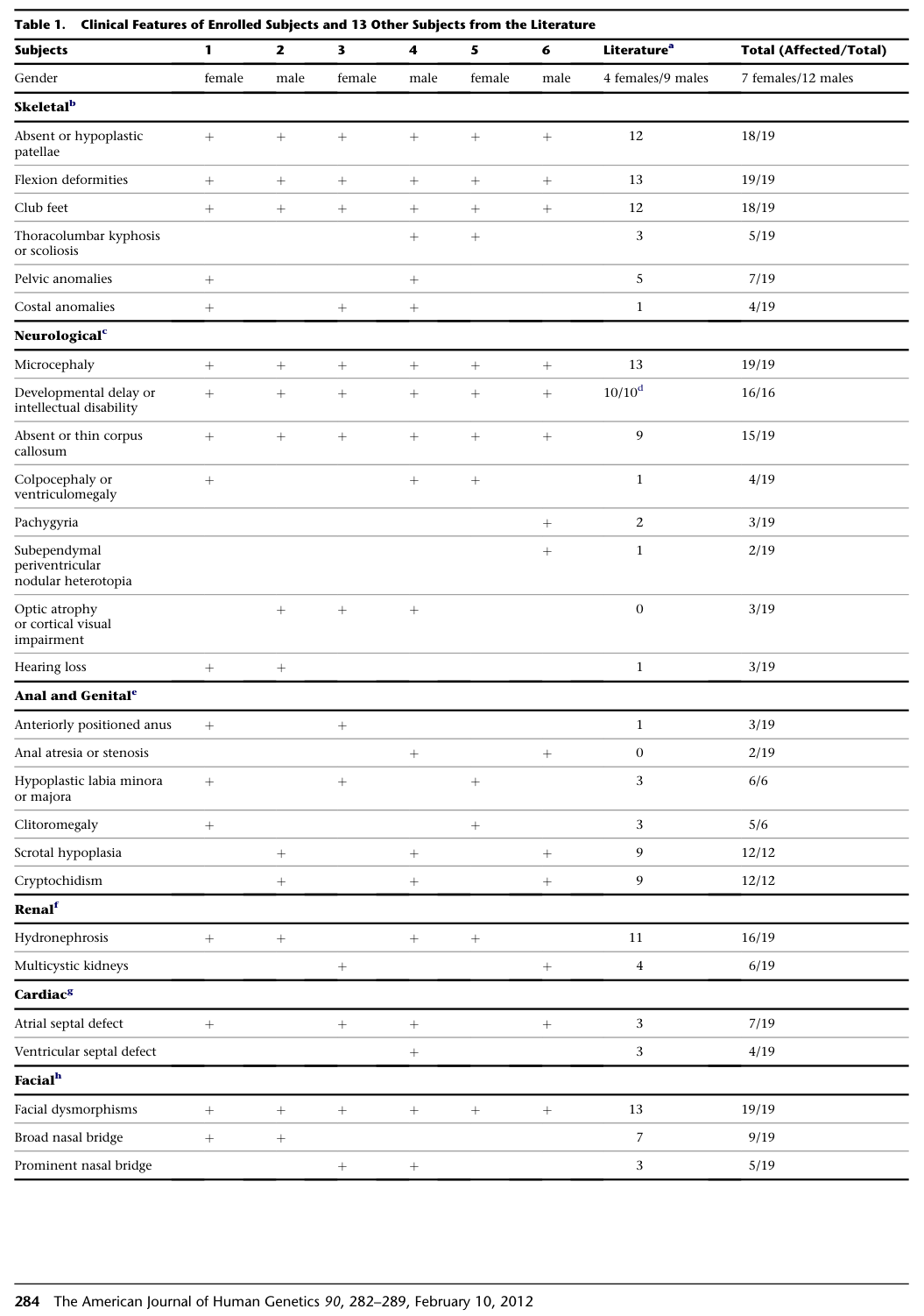
Visual evidence: Campeau et al. Table 1 summarizes GPS clinical feature frequencies and is provided in cropped form here. (campeau2012mutationsinkat6b media 6fcb6bbc, campeau2012mutationsinkat6b media d2fd0246, campeau2012mutationsinkat6b media 698f1663)
| Phenotype | HPO term(s) | Frequency (Campeau 2012) | Frequency (Yabumoto 2021 GPS) | Notes |
|---|---|---|---|---|
| Patellar aplasia/hypoplasia | HP:0006498 Absent patella; HP:0006388 Hypoplastic patella | 18/19 absent or hypoplastic patellae | 6/6 abnormal patella | Cardinal skeletal feature of GPS; often absent or severely hypoplastic rather than mildly small (campeau2012mutationsinkat6b pages 2-4, yabumoto2021novelvariantsin pages 8-9) |
| Flexion contractures / contractures | HP:0001371 Flexion contracture; HP:0002804 Hip flexion contracture; HP:0005047 Knee flexion contracture | 19/19 flexion deformities | 6/6 contractures | Major diagnostic feature; often involves hips and knees and may contribute to impaired mobility (campeau2012mutationsinkat6b pages 2-4, yabumoto2021novelvariantsin pages 8-9) |
| Clubfoot | HP:0001762 Talipes equinovarus | ~18/19 | Not separately quantified in extracted GPS subset | Often grouped with lower-limb contractures in GPS descriptions (campeau2012mutationsinkat6b pages 2-4, back2024genitopatellarsyndromewith pages 5-7) |
| Microcephaly | HP:0000252 Microcephaly | 19/19 | 7/7 | Highly consistent neurodevelopmental feature across cohorts (campeau2012mutationsinkat6b pages 2-4, yabumoto2021novelvariantsin pages 8-9) |
| Corpus callosum abnormality | HP:0001274 Agenesis of corpus callosum; HP:0002079 Hypoplasia of corpus callosum | 15/19 absent or thin corpus callosum | Not explicitly tabulated in extracted GPS subset | Core CNS malformation in GPS and a key differential feature versus some milder KAT6B phenotypes (campeau2012mutationsinkat6b pages 2-4, back2024genitopatellarsyndromewith pages 5-7) |
| Developmental delay / intellectual disability | HP:0001263 Global developmental delay; HP:0001249 Intellectual disability | 16/16 developmental delay/intellectual disability | 7/7 developmental delay/intellectual disability | Universal or near-universal; severe psychomotor impairment is characteristic of classic GPS (campeau2012mutationsinkat6b pages 2-4, yabumoto2021novelvariantsin pages 8-9) |
| Severe language impairment | HP:0001344 Severe global developmental delay; HP:0000750 Delayed speech and language development | Not separately quantified | 7/7 profound/severe language impairment | Prominent functional/QoL impact; extracted as a distinct frequency only in the GPS subset table (yabumoto2021novelvariantsin pages 8-9) |
| Delayed mobility / non-ambulatory status | HP:0001270 Motor delay; HP:0002505 Poor head control; HP:0002540 Delayed ability to walk | Not separately quantified | 7/7 delayed mobility/non-ambulatory | Reflects major functional burden from neurologic and orthopedic disease (yabumoto2021novelvariantsin pages 8-9) |
| Hypotonia | HP:0001252 Hypotonia | Reported, but not quantified in extracted Campeau frequencies | 7/7 | Common across KAT6B-related disorders; contributes to feeding and motor delay (campeau2012mutationsinkat6b pages 4-5, yabumoto2021novelvariantsin pages 8-9) |
| Hydronephrosis | HP:0000126 Hydronephrosis | 11/16 or 11/19 reported in extracted table summary | 7/7 | Renal/urinary tract involvement is a classic GPS feature; denominator uncertainty reflects extracted summary wording from Table 1 (campeau2012mutationsinkat6b pages 2-4, yabumoto2021novelvariantsin pages 8-9) |
| Multicystic kidneys / renal cysts | HP:0000107 Renal cyst; HP:0000003 Multicystic kidney dysplasia | 6/19 multicystic kidneys | Not separately quantified | Supports frequent congenital renal involvement, though not universal (campeau2012mutationsinkat6b pages 2-4, campeau2012mutationsinkat6b pages 4-5) |
| Congenital heart defect (overall) | HP:0001627 Abnormal heart morphology; HP:0001631 Atrial septal defect; HP:0001629 Ventricular septal defect | ASD 7/19; VSD 4/19 | 6/7 ASD/VSD | Cardiac screening is important because septal defects are common in both cohorts (campeau2012mutationsinkat6b pages 2-4, yabumoto2021novelvariantsin pages 8-9) |
| Genital anomalies (overall) | HP:0000078 Abnormality of the genital system | Reported as defining feature, but not frequency-extracted from Campeau table here | Not frequency-tabulated in Yabumoto GPS subset table excerpt | Larger review found genital anomalies in 94% of GPS, supporting this as a hallmark feature (maglione2025phenotypiccharacterizationof pages 8-9) |
| Prenatal imaging abnormalities | HP:0000112 Abnormality of the genitourinary system; HP:0012443 Abnormal prenatal development or birth finding | Not available | 6/6 prenatal anatomy scan findings | Suggests many GPS cases are detectable prenatally by structural anomalies, though the specific anomalies vary (yabumoto2021novelvariantsin pages 8-9, back2024genitopatellarsyndromewith pages 1-5) |
| Low-set / dysplastic ears | HP:0000369 Low-set ears; HP:0000377 Abnormal pinna morphology | Facial dysmorphism frequent (19/19 overall facial dysmorphism) | 6/6 low-set/posteriorly rotated/dysplastic ears | Facial findings are common but vary in specific expression across reports (campeau2012mutationsinkat6b pages 2-4, yabumoto2021novelvariantsin pages 8-9) |
| Bulbous nose | HP:0000414 Bulbous nose | Included within facial dysmorphism, not individually quantified | 6/6 | Helpful craniofacial clue, though not specific to GPS (campeau2012mutationsinkat6b pages 2-4, yabumoto2021novelvariantsin pages 8-9) |
| Long thumbs / great toes | HP:0011304 Broad thumb?; HP:0001177 Abnormal thumb morphology; HP:0001831 Broad hallux / abnormal great toe morphology | Not extracted as a Campeau GPS frequency | 5/6 | More classically emphasized in SBBYSS, but can also occur in GPS-spectrum patients (yabumoto2021novelvariantsin pages 8-9, maglione2025phenotypiccharacterizationof pages 1-2) |
| Ptosis | HP:0000508 Ptosis | Facial dysmorphism frequent, but not individually quantified | 4/5 | Less specific for GPS than for SBBYSS, but still observed in some GPS cases (yabumoto2021novelvariantsin pages 8-9, maglione2025phenotypiccharacterizationof pages 1-2) |
| Feeding difficulties | HP:0011968 Feeding difficulties | Reported clinically, not frequency-extracted from Campeau table here | 7/7 | Strong contributor to neonatal/infant morbidity and multidisciplinary care needs (campeau2012mutationsinkat6b pages 2-4, yabumoto2021novelvariantsin pages 8-9) |
Table: This table summarizes key Genitopatellar syndrome clinical features with suggested HPO mappings and compares frequencies reported in the original Campeau 2012 cohort versus the GPS subset in Yabumoto 2021. It is useful for structured phenotype curation and for identifying high-consistency hallmark findings.
Notable GPS-associated findings (examples; see artifact table for frequencies): - Musculoskeletal: absent/hypoplastic patellae; lower-limb flexion contractures; clubfoot; hip dysplasia/contractures. (campeau2012mutationsinkat6b pages 2-4, yabumoto2021novelvariantsin pages 8-9) - Neurodevelopment/CNS: microcephaly; agenesis/hypoplasia of corpus callosum; severe developmental delay/intellectual disability; profound language impairment; impaired mobility/non-ambulatory. (simpson2012denovomutations pages 2-4, yabumoto2021novelvariantsin pages 8-9) - Renal/urinary: hydronephrosis and/or renal cystic anomalies are frequent. (campeau2012mutationsinkat6b pages 2-4, yabumoto2021novelvariantsin pages 8-9) - Cardiac: septal defects (ASD/VSD) are common in cohorts. (campeau2012mutationsinkat6b pages 2-4, yabumoto2021novelvariantsin pages 8-9) - Genital: hallmark genital anomalies; one large review reports genital anomalies in 94% of GPS (vs 43% in SBBYSS). (maglione2025phenotypiccharacterizationof pages 8-9)
3.2 Phenotype characteristics: onset, severity, progression
- Onset: Typically congenital; many features are detected prenatally by ultrasound (structural anomalies) or at birth. (back2024genitopatellarsyndromewith pages 1-5, yabumoto2021novelvariantsin pages 8-9)
- Severity/variability: Severe developmental impairment is typical of classic GPS, though intermediate phenotypes exist across the KAT6B spectrum. (maglione2025phenotypiccharacterizationof pages 1-2, magdalena2023clinicalheterogeneityof pages 1-2)
3.3 Quality of life and functional impact
Direct QoL instrument data (EQ-5D/SF-36) were not identified in tool-retrieved GPS sources. However, functional burden is strongly implied by: - Profound/severe language impairment (100% in one GPS subset) and delayed mobility/non-ambulatory status (100% in the same subset). (yabumoto2021novelvariantsin pages 8-9) - Frequent feeding problems and multisystem complications that require multidisciplinary care. (campeau2012mutationsinkat6b pages 2-4, yabumoto2021novelvariantsin pages 16-18)
3.4 Suggested HPO term set (examples)
A curated HPO mapping is included in the phenotype-frequency artifact; key terms include Absent patella (HP:0006498), Flexion contracture (HP:0001371), Microcephaly (HP:0000252), Agenesis of corpus callosum (HP:0001274), Hydronephrosis (HP:0000126), Global developmental delay (HP:0001263), and Intellectual disability (HP:0001249). (campeau2012mutationsinkat6b pages 2-4, yabumoto2021novelvariantsin pages 8-9)
4. Genetic / molecular information
4.1 Causal gene
- KAT6B encodes a conserved MYST-family histone acetyltransferase implicated in chromatin regulation during development. (magdalena2023clinicalheterogeneityof pages 1-2, sun2023clinicalfeaturesand pages 2-4)
4.2 Pathogenic variant classes and architecture
Primary discovery studies found that GPS is most often caused by de novo heterozygous truncating variants clustered in exon 18, predicted to truncate the protein before specific C-terminal domains.
Key discovery cohort statements: - Variants cluster in terminal exon and are truncating; mutant transcripts can be present (escape NMD). (simpson2012denovomutations pages 2-4, simpson2012denovomutations pages 1-2) - Campeau et al. concluded the truncations remove the transcriptional activation domain and that the mutant is impaired in transcriptional activation. (campeau2012mutationsinkat6b pages 4-5)
Variant-type statistics from a 2023 synthesis of reported KAT6B disease variants: 33 frameshift, 19 nonsense, 2 missense, and 2 splicing defects at the protein level, with enrichment in exon 18. (sun2023clinicalfeaturesand pages 1-2)
4.3 Inheritance, penetrance, and expressivity
- Inheritance: Autosomal dominant; predominantly de novo in reported cases, supported by parental testing in discovery and later cohorts. (campeau2012mutationsinkat6b pages 1-2, simpson2012denovomutations pages 1-2)
- Penetrance/expressivity: Quantitative penetrance estimates were not available in retrieved sources; variable expressivity and intermediate phenotypes are widely described across KAT6B-related disorders. (maglione2025phenotypiccharacterizationof pages 1-2, magdalena2023clinicalheterogeneityof pages 1-2)
4.4 Genotype–phenotype correlations
A 2023 Polish cohort review notes approximate codon ranges where variants more often correlate with SBBYSS vs GPS (with intermediate ranges) and emphasizes that the molecular mechanism (escape vs induction of nonsense-mediated decay) can influence phenotype. (magdalena2023clinicalheterogeneityof pages 1-2)
5. Environmental information
GPS is fundamentally a genetic developmental disorder; no consistent non-genetic environmental contributors were identified in the tool-retrieved GPS literature.
6. Mechanism / pathophysiology
6.1 Current mechanistic understanding
GPS is a chromatin-regulatory disorder linked to altered histone acetylation and downstream developmental gene dysregulation.
- Patient-derived cells in a discovery paper show altered acetylation: “We demonstrate a reduced level of both histone H3 and H4 acetylation in patient-derived cells.” (simpson2012denovomutations pages 1-2)
- GPS-associated truncations often escape nonsense-mediated decay and produce truncated proteins lacking C-terminal domains; Campeau et al. hypothesize dominant-negative or gain-of-function effects on cellular signaling. (campeau2012mutationsinkat6b pages 4-5, simpson2012denovomutations pages 2-4)
6.2 Pathways and downstream programs (omics)
In a KAT6B spectrum cohort with engineered cell models, transcriptome analysis identified differentially expressed genes enriched for processes aligned with the phenotype (skeletal ossification, urogenital development, axonal development). (yabumoto2021novelvariantsin pages 16-18)
6.3 Model systems and recent preclinical therapeutics (2024)
A 2024 Journal of Clinical Investigation study developed mechanistic and therapeutic proof-of-principle in Kat6b+/– mice and human cells with SBBYSS mutations: - Kat6b haploinsufficiency reduces Kat6b mRNA (e.g., ~48% reduction in adult cortex) and reduces histone acetylation marks including H3K9ac. (bergamasco2024increasinghistoneacetylation pages 1-2, bergamasco2024increasinghistoneacetylation pages 2-4) - Postnatal treatment strategies increasing histone acetylation were tested: an HDAC inhibitor (valproic acid) and an acetyl donor (acetyl-carnitine). Both improved sociability; ALCAR restored learning and memory in the mouse model. (bergamasco2024increasinghistoneacetylation pages 1-2) - Quantitative effects include VPA-induced increases in histone acetylation (e.g., cortical H3K9/H3K14/H3K23 acetylation increased 1.2–1.4-fold with strong P-values) and measurable behavioral changes, with potential adverse effects (motor coordination). (bergamasco2024increasinghistoneacetylation pages 6-8)
Interpretation: these results support a mechanism where a component of the neurobehavioral phenotype may be modifiable by altering acetylation balance; however, evidence is preclinical and was performed in SBBYSS-oriented models, not GPS-specific clinical trials. (bergamasco2024increasinghistoneacetylation pages 1-2, bergamasco2024increasinghistoneacetylation pages 6-8)
6.4 Suggested ontology terms (mechanism-related)
- GO Biological Process (examples): chromatin organization; histone acetylation; regulation of transcription; skeletal system development; urogenital system development; nervous system development (supported by omics enrichment statements). (yabumoto2021novelvariantsin pages 16-18, simpson2012denovomutations pages 1-2)
- GO Cellular Component (examples): nucleus; chromatin.
- CL Cell types (examples): neural progenitor cells / cortical neurons (supported by the KAT6B neurodevelopment model context in 2024 JCI). (bergamasco2024increasinghistoneacetylation pages 1-2)
7. Anatomical structures affected
GPS affects multiple organ systems: - Skeletal system: patellae, hips, long bones, feet (contractures/clubfoot). (campeau2012mutationsinkat6b pages 2-4) - CNS: corpus callosum and brain development (microcephaly/ACC). (simpson2012denovomutations pages 2-4, campeau2012mutationsinkat6b pages 2-4) - Genitourinary system: genital anomalies; kidneys/urinary tract (hydronephrosis/renal cysts). (campeau2012mutationsinkat6b pages 2-4, maglione2025phenotypiccharacterizationof pages 8-9) - Cardiovascular: congenital heart defects (ASD/VSD). (campeau2012mutationsinkat6b pages 2-4, yabumoto2021novelvariantsin pages 8-9)
Suggested UBERON examples: patella; kidney; corpus callosum; gonad/external genitalia; heart.
8. Temporal development
- Prenatal/Neonatal: Many cases have prenatal ultrasound anomalies; neonatal intensive care may be required depending on airway/GI/genitourinary malformations. (back2024genitopatellarsyndromewith pages 1-5, back2024genitopatellarsyndromewith pages 5-7)
- Childhood: Persistent severe neurodevelopmental impairment, orthopedic limitations, and ongoing multispecialty needs; radiographs may show persistent patellar non-ossification. (niida2017asay‐barber‐biesecker‐young‐simpsonvariant pages 6-9)
9. Inheritance and population
9.1 Epidemiology
- Prevalence/incidence: Not established in tool-retrieved sources; one 2023 report explicitly states that prevalence is unknown for KAT6B disease. (sun2023clinicalfeaturesand pages 1-2)
- Case-count based indicators (not population prevalence):
- A 2023 summary noted that among 89 published KAT6B cases, 18 were GPS, 58 SBBYSS, and 13 intermediate. (sun2023clinicalfeaturesand pages 1-2)
- A 2024 GPS case report, summarizing newer literature, reported ~157 total KAT6B mutation patients and 37 GPS patients (as of that report’s synthesis). (back2024genitopatellarsyndromewith pages 5-7)
9.2 Inheritance pattern
- Autosomal dominant, usually de novo. (simpson2012denovomutations pages 1-2, campeau2012mutationsinkat6b pages 1-2)
Sex ratio, founder effects, and carrier frequency were not reported in the tool-retrieved evidence.
10. Diagnostics
10.1 Recommended diagnostic approach (current practice)
GPS diagnosis is based on a combination of characteristic clinical findings and molecular confirmation of a pathogenic KAT6B variant.
Molecular testing evidence: - Exome sequencing was a successful discovery and diagnostic approach: “Using an exome-sequencing approach…” with subsequent Sanger confirmation and parental testing to establish de novo status. (simpson2012denovomutations pages 1-2)
Clinical workup examples in retrieved reports include: - Brain MRI for corpus callosum agenesis and other malformations. (back2024genitopatellarsyndromewith pages 1-5) - Skeletal imaging (knee/lower limb radiographs; skeletal survey). (burgo2025skeletalsurveyof pages 4-7, niida2017asay‐barber‐biesecker‐young‐simpsonvariant pages 6-9) - Renal imaging for hydronephrosis/cysts. (back2024genitopatellarsyndromewith pages 5-7)
Emerging diagnostics: - A 2023 KAT6B cohort cites the broader clinical epigenomics literature on DNA methylation episignatures as diagnostic tools for Mendelian disorders, but KAT6B/GPS-specific episignature implementation is not detailed in the extracted text. (magdalena2023clinicalheterogeneityof pages 10-10)
10.2 Differential diagnosis (high-level)
- SBBYSS (KAT6B allelic): overlaps with GPS but is often described with more prominent facial/ocular features (mask-like face, blepharophimosis), lacrimal duct anomalies, and long thumbs/great toes; GPS is distinguished by more severe developmental delay and prominent genital/renal anomalies with contractures. (maglione2025phenotypiccharacterizationof pages 1-2, niida2017asay‐barber‐biesecker‐young‐simpsonvariant pages 6-9)
11. Outcome / prognosis
Formal survival curves and life expectancy estimates were not identified in tool-retrieved sources. However, natural history data indicate possible neonatal mortality with substantial survival beyond the neonatal period: - Campeau et al. report: “Ten out of thirteen children survived beyond neonatal period and were included.” (campeau2012mutationsinkat6b pages 4-5)
Major morbidity drivers include congenital malformations (renal/cardiac/airway/GI), severe developmental impairment, and orthopedic disability. (campeau2012mutationsinkat6b pages 2-4, yabumoto2021novelvariantsin pages 8-9)
12. Treatment
12.1 Current standard-of-care (real-world implementation)
No disease-modifying therapy is established for GPS; care is supportive and surgical when indicated.
Examples of real-world implementations from recent GPS case reports: - Neonatal surgical correction (e.g., anal atresia; airway surgery for laryngomalacia) and prophylactic management for hydronephrosis (antibiotic prophylaxis). (back2024genitopatellarsyndromewith pages 5-7) - Surgeries in KAT6B-related disorders such as cryptorchidism repair and cardiac defect repair were reported in individual cases. (sun2023clinicalfeaturesand pages 2-4)
A structured set of monitoring and supportive-management recommendations (including MAXO suggestions) is summarized below.
| Domain | Recommendation | MAXO term suggestion(s) | Evidence/notes |
|---|---|---|---|
| Molecular diagnosis | Perform next-generation sequencing with WES or broad NGS as first-line molecular testing when GPS/KAT6B-related disorder is suspected; confirm candidate variants by Sanger sequencing and test parents to determine de novo status | MAXO: genetic testing; next-generation sequencing; whole-exome sequencing; Sanger sequencing; familial variant testing | GPS was molecularly solved by WES in the 2012 discovery studies, with Sanger confirmation and parental testing showing de novo heterozygous truncating KAT6B variants; later series also used NGS/exome sequencing as routine diagnostics (campeau2012mutationsinkat6b pages 1-2, simpson2012denovomutations pages 1-2, magdalena2023clinicalheterogeneityof pages 1-2) |
| Variant interpretation | Pay particular attention to truncating variants in exon 18/C-terminal region and assess predicted escape from nonsense-mediated decay because this can inform GPS-vs-SBBYSS interpretation | MAXO: sequence variant interpretation; genotype-phenotype correlation assessment | GPS-associated variants often cluster in proximal exon 18 and may escape NMD, producing truncated proteins; careful interpretation is clinically relevant (magdalena2023clinicalheterogeneityof pages 1-2, maglione2025phenotypiccharacterizationof pages 8-9) |
| Prenatal detection | If structural anomalies are seen prenatally, consider prenatal genetic testing for KAT6B-related disorder and targeted fetal imaging review | MAXO: prenatal diagnostic testing; prenatal ultrasonography | Prenatal anatomy scan abnormalities were frequent in GPS subsets, and recent case reports describe prenatal detection of corpus callosum/genitourinary/skeletal anomalies before molecular confirmation (back2024genitopatellarsyndromewith pages 1-5, yabumoto2021novelvariantsin pages 8-9) |
| Neuroimaging | Obtain brain MRI to evaluate agenesis/hypoplasia of the corpus callosum and other CNS malformations | MAXO: magnetic resonance imaging; neurologic evaluation | Corpus callosum abnormalities are a core GPS feature; postnatal MRI was central to diagnosis in recent GPS cases (campeau2012mutationsinkat6b pages 2-4, back2024genitopatellarsyndromewith pages 5-7, back2024genitopatellarsyndromewith pages 1-5) |
| Skeletal/orthopedic workup | Perform skeletal survey and focused knee/limb imaging to document patellar aplasia/hypoplasia, contractures, clubfoot, hip dysplasia, and other skeletal defects | MAXO: radiographic imaging; skeletal survey; orthopedic evaluation | Patellar abnormalities and flexion deformities are hallmark findings; skeletal survey and radiographs are recommended in case-based literature (campeau2012mutationsinkat6b pages 2-4, burgo2025skeletalsurveyof pages 4-7, niida2017asay‐barber‐biesecker‐young‐simpsonvariant pages 6-9) |
| Renal/urologic workup | Perform renal ultrasound / urinary tract imaging and nephrology-urology assessment to detect hydronephrosis, renal cysts, or structural anomalies | MAXO: renal imaging; nephrology referral; urologic evaluation | Hydronephrosis and renal anomalies are common in GPS; recent neonatal GPS management included surveillance and prophylaxis for hydronephrosis (campeau2012mutationsinkat6b pages 2-4, back2024genitopatellarsyndromewith pages 5-7, yabumoto2021novelvariantsin pages 8-9) |
| Cardiac workup | Obtain baseline ECG and echocardiogram at diagnosis | MAXO: electrocardiography; echocardiography; cardiology referral | Congenital heart defects are common across KAT6B disorders; Yabumoto et al. recommend baseline ECG/echo, and GPS cohorts show frequent ASD/VSD (campeau2012mutationsinkat6b pages 2-4, yabumoto2021novelvariantsin pages 16-18) |
| Endocrine assessment | Check thyroid function (including TSH) early after diagnosis and follow clinically | MAXO: thyroid function test; endocrinology referral | Thyroid abnormalities/hypothyroidism have been reported in KAT6B-related disorders, prompting recommendation for TSH testing soon after diagnosis (yabumoto2021novelvariantsin pages 16-18, magdalena2023clinicalheterogeneityof pages 1-2) |
| Ophthalmology/hearing | Arrange ophthalmologic assessment and hearing evaluation where clinically indicated | MAXO: ophthalmologic examination; hearing assessment | Ocular and hearing anomalies occur across the spectrum; Yabumoto et al. recommend regular visual assessments and ophthalmology referral (magdalena2023clinicalheterogeneityof pages 1-2, yabumoto2021novelvariantsin pages 16-18) |
| Feeding/airway evaluation | Assess for feeding difficulty, aspiration/airway issues, and abnormal breathing; consider swallow/feeding support and sleep study if breathing is abnormal | MAXO: feeding support; sleep study; respiratory evaluation | Feeding difficulties and airway problems such as laryngomalacia/tracheomalacia are recurrent; sleep study is suggested for abnormal breathing (campeau2012mutationsinkat6b pages 2-4, back2024genitopatellarsyndromewith pages 5-7, niida2017asay‐barber‐biesecker‐young‐simpsonvariant pages 6-9, yabumoto2021novelvariantsin pages 16-18) |
| Developmental management | Initiate multidisciplinary developmental care including physical, occupational, and speech-language therapy | MAXO: physical therapy; occupational therapy; speech therapy; developmental assessment | Severe developmental delay, profound language impairment, hypotonia, and mobility limitations are common and drive supportive therapy needs (campeau2012mutationsinkat6b pages 2-4, yabumoto2021novelvariantsin pages 8-9, yabumoto2021novelvariantsin pages 16-18) |
| Orthopedic intervention | Refer early for orthopedic management of clubfoot, contractures, hip dysplasia, and patellar problems; use casting/splinting and surgery as indicated | MAXO: orthopedic management; casting; corrective surgery | Real-world neonatal GPS care included clubfoot casting; contractures and lower-limb malformations are major morbidity drivers (back2024genitopatellarsyndromewith pages 5-7, yabumoto2021novelvariantsin pages 8-9) |
| Surgical management of congenital anomalies | Correct major structural anomalies such as anal atresia, genital anomalies, airway lesions, cryptorchidism, or selected cardiac defects when indicated | MAXO: surgical repair; orchiopexy; reconstructive surgery | Recent and prior case reports document successful surgery for anal atresia, laryngomalacia, cryptorchidism, and genital reconstruction in KAT6B-related disorders (back2024genitopatellarsyndromewith pages 5-7, sun2023clinicalfeaturesand pages 2-4, maglione2025phenotypiccharacterizationof pages 8-9) |
| Bone health monitoring | Consider bone densitometry and fracture surveillance in patients with fractures or low bone health concern | MAXO: bone density assessment; fracture monitoring | Fractures were noted in expanded KAT6B cohorts; Yabumoto et al. recommend bone densitometry when clinically relevant (yabumoto2021novelvariantsin pages 16-18) |
| Biomarker/advanced diagnostics | DNA methylation episignature testing may be useful as an emerging adjunct in unresolved Mendelian neurodevelopmental disorders, but KAT6B-specific routine use remains investigational in the extracted evidence | MAXO: DNA methylation profiling | Recent KAT6B literature cites diagnostic DNA methylation episignature work and clinical epigenomics resources, but no extracted GPS-specific implementation standard was provided (magdalena2023clinicalheterogeneityof pages 10-10) |
| Genetic counseling | Provide genetic counseling regarding usually autosomal dominant, de novo causation, recurrence risk, and family planning; consider prenatal testing in future pregnancies if a familial variant is known | MAXO: genetic counseling; reproductive counseling; prenatal counseling | Most GPS cases arise from de novo heterozygous KAT6B variants; multiple reports emphasize counseling as part of management (davarnia2024denovokat6b pages 1-2, campeau2012mutationsinkat6b pages 1-2, yabumoto2021novelvariantsin pages 1-3) |
| Ongoing follow-up | Use a multidisciplinary longitudinal surveillance model involving genetics, neurology, orthopedics, cardiology, nephrology/urology, developmental pediatrics, ophthalmology, and other specialties as needed | MAXO: multidisciplinary care; longitudinal monitoring | Recent case reports and cohort studies consistently describe multispecialty follow-up as the practical standard of care because complications are multisystemic and evolve over time (back2024genitopatellarsyndromewith pages 5-7, burgo2025skeletalsurveyof pages 4-7, yabumoto2021novelvariantsin pages 16-18) |
Table: This table summarizes practical diagnostic, monitoring, and supportive-management recommendations for genitopatellar syndrome and related KAT6B disorders, with suggested MAXO-style action labels. It is useful for translating case-series and cohort evidence into structured knowledge-base actions.
12.2 Experimental / preclinical therapeutics
A 2024 JCI study provides proof-of-principle that increasing histone acetylation (valproic acid, acetyl-carnitine) can partially rescue behavioral phenotypes in a Kat6b haploinsufficiency model and in human-engineered cell lines. This is not yet evidence of clinical efficacy in GPS patients, but it is a significant research development in 2023–2024 for KAT6B disorders broadly. (bergamasco2024increasinghistoneacetylation pages 1-2, bergamasco2024increasinghistoneacetylation pages 6-8)
12.3 Clinical trials
A tool-based clinical trial search did not identify GPS-specific interventional trials in the retrieved set; one retrieved Phase 1 oncology trial (OP-3136) is not GPS-directed. Therefore, no GPS-targeted trial landscape can be claimed from the retrieved evidence. (clinical trial retrieval summary in tool state; no citeable trial-context ID was produced for GPS relevance)
13. Prevention
No primary prevention exists for de novo GPS. Prevention focuses on genetic counseling, recurrence-risk counseling, and prenatal testing options when a familial variant is known. - GPS is predominantly de novo autosomal dominant; multiple reports emphasize counseling after molecular diagnosis. (campeau2012mutationsinkat6b pages 1-2, yabumoto2021novelvariantsin pages 1-3)
14. Other species / natural disease
No naturally occurring GPS orthologous disease in other species was identified in the tool-retrieved evidence.
15. Model organisms
- Mouse (Kat6b+/–): Used to model KAT6B haploinsufficiency and neurobehavioral phenotypes; supports therapeutic proof-of-principle targeting histone acetylation. (bergamasco2024increasinghistoneacetylation pages 1-2, bergamasco2024increasinghistoneacetylation pages 6-8)
- Engineered human cell lines (CRISPR): Used to introduce truncating KAT6B variants and study histone acetylation and gene expression effects. (bergamasco2024increasinghistoneacetylation pages 1-2, yabumoto2021novelvariantsin pages 1-3)
Key recent developments (prioritizing 2023–2024)
- 2024 preclinical therapeutic proof-of-principle: postnatal interventions (valproic acid; acetyl-carnitine) increased histone acetylation and improved sociability and cognition in Kat6b+/– mice, suggesting potential modifiability of downstream chromatin state. (bergamasco2024increasinghistoneacetylation pages 1-2, bergamasco2024increasinghistoneacetylation pages 6-8)
- 2023–2024 continued case ascertainment and variant expansion: new de novo truncating variants and detailed neonatal care pathways continue to be reported, increasing cumulative case counts and refining genotype–phenotype discussions. (back2024genitopatellarsyndromewith pages 5-7, sun2023clinicalfeaturesand pages 2-4, magdalena2023clinicalheterogeneityof pages 1-2)
Identifier/genetics summary table
| Item | Value | Notes |
|---|---|---|
| Disease name | Genitopatellar syndrome (GPS) | Rare KAT6B-related developmental disorder; original discovery papers describe GPS as a disorder with patellar aplasia/hypoplasia plus genital and neurodevelopmental anomalies (campeau2012mutationsinkat6b pages 1-2, simpson2012denovomutations pages 1-2) |
| Primary identifier | OMIM/MIM #606170 | Reported consistently in primary and recent literature as the canonical identifier for GPS (davarnia2024denovokat6b pages 1-2, back2024genitopatellarsyndromewith pages 1-5, simpson2012denovomutations pages 1-2) |
| Common synonym | GTPTS | Used in later KAT6B literature as abbreviation for genitopatellar syndrome (niida2017asay‐barber‐biesecker‐young‐simpsonvariant pages 6-9) |
| Related disease group | KAT6B-related disorders / KAT6B spectrum disorders | GPS and SBBYSS are now often framed as allelic disorders on a phenotypic spectrum with overlapping/intermediate presentations (magdalena2023clinicalheterogeneityof pages 1-2, maglione2025phenotypiccharacterizationof pages 1-2) |
| Allelic disorder | Say-Barber-Biesecker-Young-Simpson syndrome (SBBYSS), OMIM #603736 | Closely related allelic KAT6B disorder with overlapping but distinguishable features; frequently discussed together with GPS (davarnia2024denovokat6b pages 1-2, magdalena2023clinicalheterogeneityof pages 1-2, maglione2025phenotypiccharacterizationof pages 1-2) |
| Causal gene | KAT6B | Encodes a highly conserved MYST-family histone acetyltransferase implicated in chromatin regulation and development (magdalena2023clinicalheterogeneityof pages 1-2, back2024genitopatellarsyndromewith pages 1-5, sun2023clinicalfeaturesand pages 2-4) |
| Gene locus | Chromosome 10q22.2 | Explicitly stated in recent KAT6B-related disorder literature (magdalena2023clinicalheterogeneityof pages 1-2) |
| Molecular function | Histone acetyltransferase / lysine acetyltransferase | Patient-derived cells show reduced histone H3/H4 acetylation; KAT6B deficiency is linked to reduced H3K9 acetylation (back2024genitopatellarsyndromewith pages 1-5, bergamasco2024increasinghistoneacetylation pages 1-2, bergamasco2024increasinghistoneacetylation pages 2-4) |
| Inheritance | Autosomal dominant, usually de novo | Most reported GPS-causing variants are heterozygous and de novo; parental testing in discovery studies supported de novo occurrence (davarnia2024denovokat6b pages 1-2, campeau2012mutationsinkat6b pages 1-2, simpson2012denovomutations pages 1-2) |
| Typical variant class | Truncating variants: frameshift and nonsense predominate | Discovery and follow-up studies found mainly truncating alleles; one review summarized 33 frameshift, 19 nonsense, 2 missense, and 2 splice variants among reported KAT6B disease variants (sun2023clinicalfeaturesand pages 1-2, campeau2012mutationsinkat6b pages 4-5, simpson2012denovomutations pages 1-2) |
| Typical variant location | Exon 18, especially proximal/mid terminal exon region | GPS variants cluster strongly in exon 18; original GPS alleles localized to a 66-bp region of exon 18, and newer reports continue to identify exon 18 enrichment (campeau2012mutationsinkat6b pages 4-5, simpson2012denovomutations pages 1-2, maglione2025phenotypiccharacterizationof pages 8-9) |
| Functional consequence | Truncated transcripts often escape nonsense-mediated decay; likely dominant-negative/gain-of-function or altered function in GPS | Discovery studies showed mutant mRNAs are expressed and do not undergo NMD; GPS-associated truncations may retain N-terminal/HAT domains while losing the transcriptional activation domain (campeau2012mutationsinkat6b pages 4-5, simpson2012denovomutations pages 2-4, campeau2012mutationsinkat6b pages 1-2) |
| Example recent GPS variant | c.4066del, p.Glu1356Argfs*23 | 2024 case report described a novel de novo heterozygous pathogenic variant in exon 18 associated with classic GPS features (back2024genitopatellarsyndromewith pages 5-7, back2024genitopatellarsyndromewith pages 1-5) |
Table: This table summarizes the main disease identifiers, synonyms, and core genetic facts for Genitopatellar syndrome from the gathered primary and recent literature. It is useful as a compact reference for knowledge-base fields covering disease naming, allelic relationships, inheritance, and variant architecture.
Limitations of this report (due to tool-accessible sources)
- Orphanet, MONDO, MeSH, and ICD identifiers were not explicitly present in the retrieved texts; they are therefore not provided here.
- Population prevalence/incidence is not established in the retrieved evidence and is explicitly described as unknown in at least one recent summary. (sun2023clinicalfeaturesand pages 1-2)
- QoL instruments and long-term survival statistics were not available in the retrieved GPS-specific evidence.
References
-
(campeau2012mutationsinkat6b pages 1-2): Philippe M. Campeau, Jaeseung C. Kim, James T. Lu, Jeremy A. Schwartzentruber, Omar A. Abdul-Rahman, Silke Schlaubitz, David M. Murdock, Ming-Ming Jiang, Edward J. Lammer, Gregory M. Enns, William J. Rhead, Jon Rowland, Stephen P. Robertson, Valérie Cormier-Daire, Matthew N. Bainbridge, Xiang-Jiao Yang, Marie-Claude Gingras, Richard A. Gibbs, David S. Rosenblatt, Jacek Majewski, and Brendan H. Lee. Mutations in kat6b, encoding a histone acetyltransferase, cause genitopatellar syndrome. American journal of human genetics, 90 2:282-9, Feb 2012. URL: https://doi.org/10.1016/j.ajhg.2011.11.023, doi:10.1016/j.ajhg.2011.11.023. This article has 163 citations and is from a highest quality peer-reviewed journal.
-
(simpson2012denovomutations pages 1-2): Michael A. Simpson, Charu Deshpande, Dimitra Dafou, Lisenka E.L.M. Vissers, Wesley J. Woollard, Susan E. Holder, Gabriele Gillessen-Kaesbach, Ronny Derks, Susan M. White, Ruthy Cohen-Snuijf, Sarina G. Kant, Lies H. Hoefsloot, Willie Reardon, Han G. Brunner, Ernie M.H.F. Bongers, and Richard C. Trembath. De novo mutations of the gene encoding the histone acetyltransferase kat6b cause genitopatellar syndrome. American journal of human genetics, 90 2:290-4, Feb 2012. URL: https://doi.org/10.1016/j.ajhg.2011.11.024, doi:10.1016/j.ajhg.2011.11.024. This article has 125 citations and is from a highest quality peer-reviewed journal.
-
(magdalena2023clinicalheterogeneityof pages 1-2): Klaniewska Magdalena, Bolanowska‐Tyszko Anna, Latos‐Bielenska Anna, Jezela‐Stanek Aleksandra, Szczaluba Krzysztof, Krajewska‐Walasek Malgorzata, Ciara Elzbieta, Pelc Magdalena, Jurkiewicz Dorota, Stawinski Piotr, Zubkiewicz‐Kucharska Agnieszka, Rydzanicz Małgorzata, Ploski Rafal, and Smigiel Robert. Clinical heterogeneity of polish patients with kat6b–related disorder. Molecular Genetics & Genomic Medicine, Sep 2023. URL: https://doi.org/10.1002/mgg3.2265, doi:10.1002/mgg3.2265. This article has 6 citations and is from a peer-reviewed journal.
-
(maglione2025phenotypiccharacterizationof pages 1-2): Vittorio Maglione, Antonio Pizzuti, Gioia Mastromoro, Eleonora Cresta, Paola Favata, Maria Cristina Digilio, Rossella Capolino, Maria Lisa Dentici, Lorenzo Sinibaldi, Antonio Novelli, Marco Tartaglia, Gianluca Terrin, and Viviana Cardilli. Phenotypic characterization of seven pediatric patients diagnosed with kat6b-related disorders: case series and review of the literature. American journal of medical genetics. Part A, pages e64100, Apr 2025. URL: https://doi.org/10.1002/ajmg.a.64100, doi:10.1002/ajmg.a.64100. This article has 1 citations and is from a peer-reviewed journal.
-
(simpson2012denovomutations pages 2-4): Michael A. Simpson, Charu Deshpande, Dimitra Dafou, Lisenka E.L.M. Vissers, Wesley J. Woollard, Susan E. Holder, Gabriele Gillessen-Kaesbach, Ronny Derks, Susan M. White, Ruthy Cohen-Snuijf, Sarina G. Kant, Lies H. Hoefsloot, Willie Reardon, Han G. Brunner, Ernie M.H.F. Bongers, and Richard C. Trembath. De novo mutations of the gene encoding the histone acetyltransferase kat6b cause genitopatellar syndrome. American journal of human genetics, 90 2:290-4, Feb 2012. URL: https://doi.org/10.1016/j.ajhg.2011.11.024, doi:10.1016/j.ajhg.2011.11.024. This article has 125 citations and is from a highest quality peer-reviewed journal.
-
(davarnia2024denovokat6b pages 1-2): Behzad Davarnia, Mohammad Panahi, Bahareh Rahimi, Hassan Anari, Reza Farajollahi, Ehsan Abbaspour Rodbaneh, and Farhad Jeddi. De novo kat6b mutation causes say–barber–biesecker–young–simpson variant of ohdo syndrome in an iranian boy: a case report. Journal of Medical Case Reports, Jan 2024. URL: https://doi.org/10.1186/s13256-023-04237-w, doi:10.1186/s13256-023-04237-w. This article has 7 citations and is from a peer-reviewed journal.
-
(sun2023clinicalfeaturesand pages 2-4): Xiaoang Sun, Xiaona Luo, Longlong Lin, Simei Wang, Chunmei Wang, Fang Yuan, Xiaoping Lan, Jingbin Yan, and Yucai Chen. Clinical features and underlying mechanisms of kat6b disease in a chinese boy. Molecular Genetics & Genomic Medicine, Jun 2023. URL: https://doi.org/10.1002/mgg3.2202, doi:10.1002/mgg3.2202. This article has 3 citations and is from a peer-reviewed journal.
-
(niida2017asay‐barber‐biesecker‐young‐simpsonvariant pages 6-9): Yo Niida, Yusuke Mitani, Mondo Kuroda, Ayano Yokoi, Hiroyasu Nakagawa, and Akiko Kato. A say‐barber‐biesecker‐young‐simpson variant of ohdo syndrome with a kat6b 10‐base pair palindromic duplication: a recurrent mutation causing a severe phenotype mixed with genitopatellar syndrome. Congenital Anomalies, 57:86-88, May 2017. URL: https://doi.org/10.1111/cga.12196, doi:10.1111/cga.12196. This article has 22 citations and is from a peer-reviewed journal.
-
(campeau2012mutationsinkat6b pages 2-4): Philippe M. Campeau, Jaeseung C. Kim, James T. Lu, Jeremy A. Schwartzentruber, Omar A. Abdul-Rahman, Silke Schlaubitz, David M. Murdock, Ming-Ming Jiang, Edward J. Lammer, Gregory M. Enns, William J. Rhead, Jon Rowland, Stephen P. Robertson, Valérie Cormier-Daire, Matthew N. Bainbridge, Xiang-Jiao Yang, Marie-Claude Gingras, Richard A. Gibbs, David S. Rosenblatt, Jacek Majewski, and Brendan H. Lee. Mutations in kat6b, encoding a histone acetyltransferase, cause genitopatellar syndrome. American journal of human genetics, 90 2:282-9, Feb 2012. URL: https://doi.org/10.1016/j.ajhg.2011.11.023, doi:10.1016/j.ajhg.2011.11.023. This article has 163 citations and is from a highest quality peer-reviewed journal.
-
(yabumoto2021novelvariantsin pages 16-18): Megan Yabumoto, Jessica Kianmahd, Meghna Singh, Maria F. Palafox, Angela Wei, Kathryn Elliott, Dana H. Goodloe, S. Joy Dean, Catherine Gooch, Brianna K. Murray, Erin Swartz, Samantha A. Schrier Vergano, Meghan C. Towne, Kimberly Nugent, Elizabeth R. Roeder, Christina Kresge, Beth A. Pletcher, Katheryn Grand, John M. Graham, Ryan Gates, Natalia Gomez‐Ospina, Subhadra Ramanathan, Robin Dawn Clark, Kimberly Glaser, Paul J. Benke, Julie S. Cohen, Ali Fatemi, Weiyi Mu, Kristin W. Baranano, Jill A. Madden, Cynthia S. Gubbels, Timothy W. Yu, Pankaj B. Agrawal, Mary‐Kathryn Chambers, Chanika Phornphutkul, John A. Pugh, Kate A. Tauber, Svetlana Azova, Jessica R. Smith, Anne O’Donnell‐Luria, Hannah Medsker, Siddharth Srivastava, Deborah Krakow, Daniela N. Schweitzer, and Valerie A. Arboleda. Novel variants in kat6b spectrum of disorders expand our knowledge of clinical manifestations and molecular mechanisms. Molecular Genetics & Genomic Medicine, Sep 2021. URL: https://doi.org/10.1002/mgg3.1809, doi:10.1002/mgg3.1809. This article has 15 citations and is from a peer-reviewed journal.
-
(campeau2012mutationsinkat6b media 6fcb6bbc): Philippe M. Campeau, Jaeseung C. Kim, James T. Lu, Jeremy A. Schwartzentruber, Omar A. Abdul-Rahman, Silke Schlaubitz, David M. Murdock, Ming-Ming Jiang, Edward J. Lammer, Gregory M. Enns, William J. Rhead, Jon Rowland, Stephen P. Robertson, Valérie Cormier-Daire, Matthew N. Bainbridge, Xiang-Jiao Yang, Marie-Claude Gingras, Richard A. Gibbs, David S. Rosenblatt, Jacek Majewski, and Brendan H. Lee. Mutations in kat6b, encoding a histone acetyltransferase, cause genitopatellar syndrome. American journal of human genetics, 90 2:282-9, Feb 2012. URL: https://doi.org/10.1016/j.ajhg.2011.11.023, doi:10.1016/j.ajhg.2011.11.023. This article has 163 citations and is from a highest quality peer-reviewed journal.
-
(campeau2012mutationsinkat6b media d2fd0246): Philippe M. Campeau, Jaeseung C. Kim, James T. Lu, Jeremy A. Schwartzentruber, Omar A. Abdul-Rahman, Silke Schlaubitz, David M. Murdock, Ming-Ming Jiang, Edward J. Lammer, Gregory M. Enns, William J. Rhead, Jon Rowland, Stephen P. Robertson, Valérie Cormier-Daire, Matthew N. Bainbridge, Xiang-Jiao Yang, Marie-Claude Gingras, Richard A. Gibbs, David S. Rosenblatt, Jacek Majewski, and Brendan H. Lee. Mutations in kat6b, encoding a histone acetyltransferase, cause genitopatellar syndrome. American journal of human genetics, 90 2:282-9, Feb 2012. URL: https://doi.org/10.1016/j.ajhg.2011.11.023, doi:10.1016/j.ajhg.2011.11.023. This article has 163 citations and is from a highest quality peer-reviewed journal.
-
(campeau2012mutationsinkat6b media 698f1663): Philippe M. Campeau, Jaeseung C. Kim, James T. Lu, Jeremy A. Schwartzentruber, Omar A. Abdul-Rahman, Silke Schlaubitz, David M. Murdock, Ming-Ming Jiang, Edward J. Lammer, Gregory M. Enns, William J. Rhead, Jon Rowland, Stephen P. Robertson, Valérie Cormier-Daire, Matthew N. Bainbridge, Xiang-Jiao Yang, Marie-Claude Gingras, Richard A. Gibbs, David S. Rosenblatt, Jacek Majewski, and Brendan H. Lee. Mutations in kat6b, encoding a histone acetyltransferase, cause genitopatellar syndrome. American journal of human genetics, 90 2:282-9, Feb 2012. URL: https://doi.org/10.1016/j.ajhg.2011.11.023, doi:10.1016/j.ajhg.2011.11.023. This article has 163 citations and is from a highest quality peer-reviewed journal.
-
(yabumoto2021novelvariantsin pages 8-9): Megan Yabumoto, Jessica Kianmahd, Meghna Singh, Maria F. Palafox, Angela Wei, Kathryn Elliott, Dana H. Goodloe, S. Joy Dean, Catherine Gooch, Brianna K. Murray, Erin Swartz, Samantha A. Schrier Vergano, Meghan C. Towne, Kimberly Nugent, Elizabeth R. Roeder, Christina Kresge, Beth A. Pletcher, Katheryn Grand, John M. Graham, Ryan Gates, Natalia Gomez‐Ospina, Subhadra Ramanathan, Robin Dawn Clark, Kimberly Glaser, Paul J. Benke, Julie S. Cohen, Ali Fatemi, Weiyi Mu, Kristin W. Baranano, Jill A. Madden, Cynthia S. Gubbels, Timothy W. Yu, Pankaj B. Agrawal, Mary‐Kathryn Chambers, Chanika Phornphutkul, John A. Pugh, Kate A. Tauber, Svetlana Azova, Jessica R. Smith, Anne O’Donnell‐Luria, Hannah Medsker, Siddharth Srivastava, Deborah Krakow, Daniela N. Schweitzer, and Valerie A. Arboleda. Novel variants in kat6b spectrum of disorders expand our knowledge of clinical manifestations and molecular mechanisms. Molecular Genetics & Genomic Medicine, Sep 2021. URL: https://doi.org/10.1002/mgg3.1809, doi:10.1002/mgg3.1809. This article has 15 citations and is from a peer-reviewed journal.
-
(back2024genitopatellarsyndromewith pages 5-7): Warren Back, Adam Mierzwa, and Naeem Mahfooz. Genitopatellar syndrome with a novel variant in the kat6b gene: supporting spectrum delineation. Cureus, Sep 2024. URL: https://doi.org/10.7759/cureus.69989, doi:10.7759/cureus.69989. This article has 1 citations.
-
(campeau2012mutationsinkat6b pages 4-5): Philippe M. Campeau, Jaeseung C. Kim, James T. Lu, Jeremy A. Schwartzentruber, Omar A. Abdul-Rahman, Silke Schlaubitz, David M. Murdock, Ming-Ming Jiang, Edward J. Lammer, Gregory M. Enns, William J. Rhead, Jon Rowland, Stephen P. Robertson, Valérie Cormier-Daire, Matthew N. Bainbridge, Xiang-Jiao Yang, Marie-Claude Gingras, Richard A. Gibbs, David S. Rosenblatt, Jacek Majewski, and Brendan H. Lee. Mutations in kat6b, encoding a histone acetyltransferase, cause genitopatellar syndrome. American journal of human genetics, 90 2:282-9, Feb 2012. URL: https://doi.org/10.1016/j.ajhg.2011.11.023, doi:10.1016/j.ajhg.2011.11.023. This article has 163 citations and is from a highest quality peer-reviewed journal.
-
(maglione2025phenotypiccharacterizationof pages 8-9): Vittorio Maglione, Antonio Pizzuti, Gioia Mastromoro, Eleonora Cresta, Paola Favata, Maria Cristina Digilio, Rossella Capolino, Maria Lisa Dentici, Lorenzo Sinibaldi, Antonio Novelli, Marco Tartaglia, Gianluca Terrin, and Viviana Cardilli. Phenotypic characterization of seven pediatric patients diagnosed with kat6b-related disorders: case series and review of the literature. American journal of medical genetics. Part A, pages e64100, Apr 2025. URL: https://doi.org/10.1002/ajmg.a.64100, doi:10.1002/ajmg.a.64100. This article has 1 citations and is from a peer-reviewed journal.
-
(back2024genitopatellarsyndromewith pages 1-5): Warren Back, Adam Mierzwa, and Naeem Mahfooz. Genitopatellar syndrome with a novel variant in the kat6b gene: supporting spectrum delineation. Cureus, Sep 2024. URL: https://doi.org/10.7759/cureus.69989, doi:10.7759/cureus.69989. This article has 1 citations.
-
(sun2023clinicalfeaturesand pages 1-2): Xiaoang Sun, Xiaona Luo, Longlong Lin, Simei Wang, Chunmei Wang, Fang Yuan, Xiaoping Lan, Jingbin Yan, and Yucai Chen. Clinical features and underlying mechanisms of kat6b disease in a chinese boy. Molecular Genetics & Genomic Medicine, Jun 2023. URL: https://doi.org/10.1002/mgg3.2202, doi:10.1002/mgg3.2202. This article has 3 citations and is from a peer-reviewed journal.
-
(bergamasco2024increasinghistoneacetylation pages 1-2): Maria I. Bergamasco, Hannah K. Vanyai, Alexandra L. Garnham, Niall D. Geoghegan, Adam P. Vogel, Samantha Eccles, Kelly L. Rogers, Gordon K. Smyth, Marnie E. Blewitt, Anthony J. Hannan, Tim Thomas, and Anne K. Voss. Increasing histone acetylation improves sociability and restores learning and memory in kat6b-haploinsufficient mice. The Journal of Clinical Investigation, Apr 2024. URL: https://doi.org/10.1172/jci167672, doi:10.1172/jci167672. This article has 19 citations.
-
(bergamasco2024increasinghistoneacetylation pages 2-4): Maria I. Bergamasco, Hannah K. Vanyai, Alexandra L. Garnham, Niall D. Geoghegan, Adam P. Vogel, Samantha Eccles, Kelly L. Rogers, Gordon K. Smyth, Marnie E. Blewitt, Anthony J. Hannan, Tim Thomas, and Anne K. Voss. Increasing histone acetylation improves sociability and restores learning and memory in kat6b-haploinsufficient mice. The Journal of Clinical Investigation, Apr 2024. URL: https://doi.org/10.1172/jci167672, doi:10.1172/jci167672. This article has 19 citations.
-
(bergamasco2024increasinghistoneacetylation pages 6-8): Maria I. Bergamasco, Hannah K. Vanyai, Alexandra L. Garnham, Niall D. Geoghegan, Adam P. Vogel, Samantha Eccles, Kelly L. Rogers, Gordon K. Smyth, Marnie E. Blewitt, Anthony J. Hannan, Tim Thomas, and Anne K. Voss. Increasing histone acetylation improves sociability and restores learning and memory in kat6b-haploinsufficient mice. The Journal of Clinical Investigation, Apr 2024. URL: https://doi.org/10.1172/jci167672, doi:10.1172/jci167672. This article has 19 citations.
-
(burgo2025skeletalsurveyof pages 4-7): Terence Burgo and Brian Andrich Pollo. Skeletal survey of a filipino teenage female with ohdo syndrome: case report. Unknown journal, Jul 2025. URL: https://doi.org/10.1590/scielopreprints.12720, doi:10.1590/scielopreprints.12720.
-
(magdalena2023clinicalheterogeneityof pages 10-10): Klaniewska Magdalena, Bolanowska‐Tyszko Anna, Latos‐Bielenska Anna, Jezela‐Stanek Aleksandra, Szczaluba Krzysztof, Krajewska‐Walasek Malgorzata, Ciara Elzbieta, Pelc Magdalena, Jurkiewicz Dorota, Stawinski Piotr, Zubkiewicz‐Kucharska Agnieszka, Rydzanicz Małgorzata, Ploski Rafal, and Smigiel Robert. Clinical heterogeneity of polish patients with kat6b–related disorder. Molecular Genetics & Genomic Medicine, Sep 2023. URL: https://doi.org/10.1002/mgg3.2265, doi:10.1002/mgg3.2265. This article has 6 citations and is from a peer-reviewed journal.
-
(yabumoto2021novelvariantsin pages 1-3): Megan Yabumoto, Jessica Kianmahd, Meghna Singh, Maria F. Palafox, Angela Wei, Kathryn Elliott, Dana H. Goodloe, S. Joy Dean, Catherine Gooch, Brianna K. Murray, Erin Swartz, Samantha A. Schrier Vergano, Meghan C. Towne, Kimberly Nugent, Elizabeth R. Roeder, Christina Kresge, Beth A. Pletcher, Katheryn Grand, John M. Graham, Ryan Gates, Natalia Gomez‐Ospina, Subhadra Ramanathan, Robin Dawn Clark, Kimberly Glaser, Paul J. Benke, Julie S. Cohen, Ali Fatemi, Weiyi Mu, Kristin W. Baranano, Jill A. Madden, Cynthia S. Gubbels, Timothy W. Yu, Pankaj B. Agrawal, Mary‐Kathryn Chambers, Chanika Phornphutkul, John A. Pugh, Kate A. Tauber, Svetlana Azova, Jessica R. Smith, Anne O’Donnell‐Luria, Hannah Medsker, Siddharth Srivastava, Deborah Krakow, Daniela N. Schweitzer, and Valerie A. Arboleda. Novel variants in kat6b spectrum of disorders expand our knowledge of clinical manifestations and molecular mechanisms. Molecular Genetics & Genomic Medicine, Sep 2021. URL: https://doi.org/10.1002/mgg3.1809, doi:10.1002/mgg3.1809. This article has 15 citations and is from a peer-reviewed journal.