Familial Partial Lipodystrophy
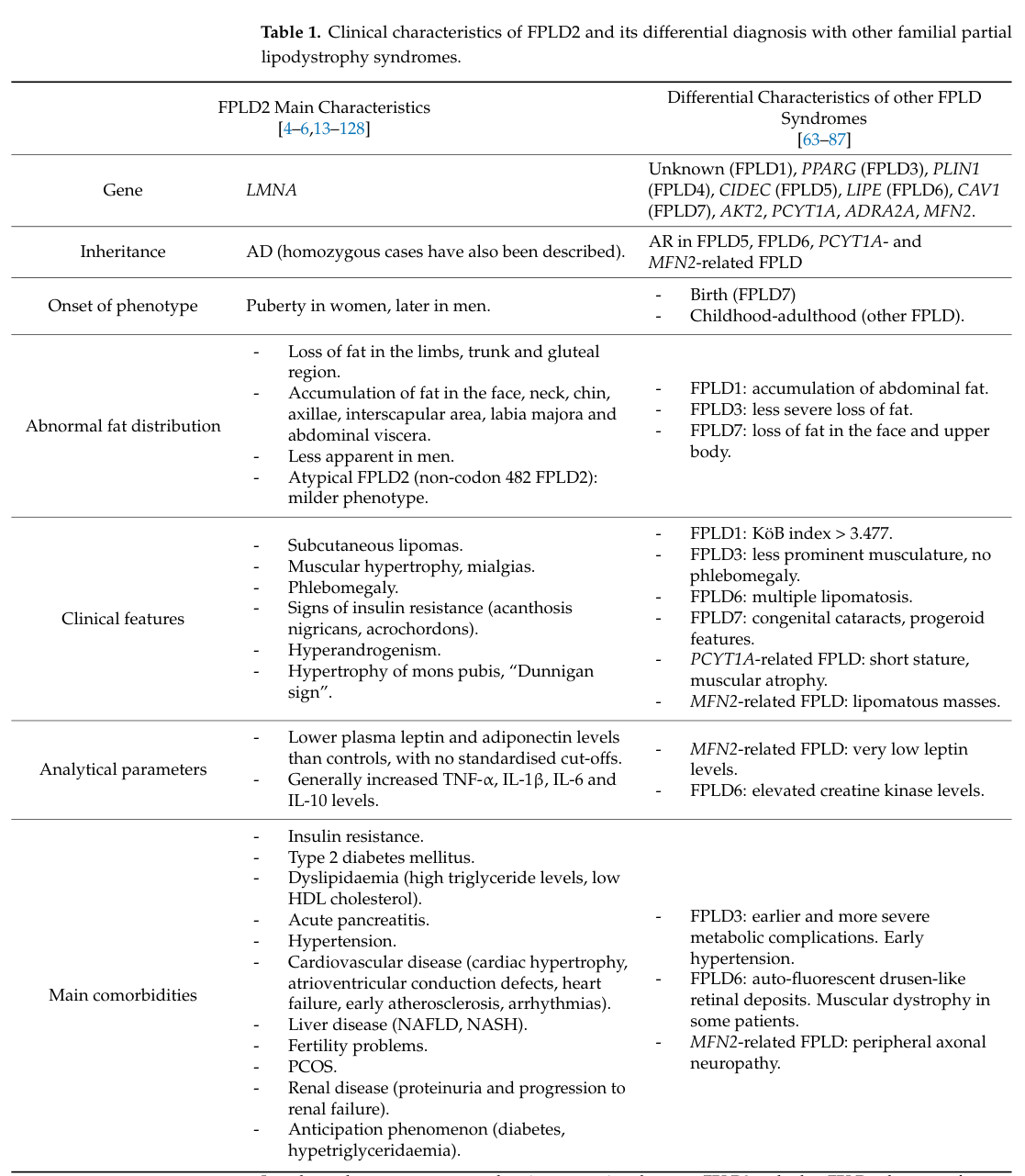
Familial partial lipodystrophy (FPLD) is a group of rare, genetically heterogeneous Mendelian disorders of adipose tissue characterized by selective loss of subcutaneous fat from the limbs and gluteal region, usually beginning around puberty or early adulthood, with relative or excess fat accumulation in the face, neck, and intra-abdominal/visceral depots. The reduced capacity for safe triglyceride storage in subcutaneous adipose tissue drives ectopic lipid deposition, severe insulin resistance, diabetes mellitus, hypertriglyceridemia, and hepatic steatosis, often accompanied by acanthosis nigricans, hypertension, early atherosclerotic cardiovascular disease, and (in women) polycystic ovary syndrome and hyperandrogenism. Multiple genes define the recognized subtypes, most prominently LMNA (FPLD2/Dunnigan) and PPARG (FPLD3), with rarer causes including PLIN1, CIDEC, LIPE, AKT2, CAV1, MFN2, and ADRA2A. FPLD1 (Köbberling) is defined clinically and lacks a consistently identified gene.
Ask OpenScientist
Ask a research question about Familial Partial Lipodystrophy. OpenScientist will conduct autonomous deep research using the Disorder Mechanisms Knowledge Base and PubMed literature (typically 10-30 minutes).
Do not include personal health information in your question. Questions and results are cached in your browser's local storage.
Subtypes
10Show evidence (1 reference)
Show evidence (1 reference)
Show evidence (1 reference)
Pathophysiology
9Show evidence (1 reference)
Show evidence (1 reference)
Show evidence (1 reference)
Show evidence (2 references)
Show evidence (2 references)
Show evidence (3 references)
Show evidence (2 references)
Show evidence (2 references)
Show evidence (1 reference)
Pathograph
Phenotypes
11Cardiovascular 2
Show evidence (1 reference)
Show evidence (1 reference)
Digestive 2
Show evidence (1 reference)
Show evidence (1 reference)
Endocrine 1
Show evidence (1 reference)
Genitourinary 1
Show evidence (1 reference)
Integument 1
Metabolism 3
Show evidence (1 reference)
Show evidence (1 reference)
Show evidence (1 reference)
Musculoskeletal 1
Show evidence (1 reference)
Genetic Associations
11Show evidence (3 references)
Show evidence (3 references)
Show evidence (3 references)
Show evidence (1 reference)
Show evidence (1 reference)
Show evidence (2 references)
Show evidence (2 references)
Show evidence (3 references)
Show evidence (2 references)
Show evidence (1 reference)
Show evidence (2 references)
Medical Actions
9Show evidence (1 reference)
Related Datasets
1Clinical Trials
2Show evidence (1 reference)
Show evidence (1 reference)
Source YAML
click to showname: Familial Partial Lipodystrophy
creation_date: "2026-06-05T12:00:00Z"
category: Mendelian
description: >-
Familial partial lipodystrophy (FPLD) is a group of rare, genetically
heterogeneous Mendelian disorders of adipose tissue characterized by selective
loss of subcutaneous fat from the limbs and gluteal region, usually beginning
around puberty or early adulthood, with relative or excess fat accumulation in
the face, neck, and intra-abdominal/visceral depots. The reduced capacity for
safe triglyceride storage in subcutaneous adipose tissue drives ectopic lipid
deposition, severe insulin resistance, diabetes mellitus, hypertriglyceridemia,
and hepatic steatosis, often accompanied by acanthosis nigricans, hypertension,
early atherosclerotic cardiovascular disease, and (in women) polycystic ovary
syndrome and hyperandrogenism. Multiple genes define the recognized subtypes,
most prominently LMNA (FPLD2/Dunnigan) and PPARG (FPLD3), with rarer causes
including PLIN1, CIDEC, LIPE, AKT2, CAV1, MFN2, and ADRA2A. FPLD1
(Köbberling) is defined clinically and lacks a consistently identified gene.
disease_term:
preferred_term: Familial Partial Lipodystrophy
term:
id: MONDO:0020088
label: familial partial lipodystrophy
parents:
- partial lipodystrophy
- inherited lipodystrophy
synonyms:
- FPLD
- familial partial lipodystrophy
- familial lipodystrophy, partial
- partial lipodystrophy, familial
has_subtypes:
- name: FPLD1
display_name: FPLD1 (Köbberling type)
description: >-
Köbberling-type familial partial lipodystrophy with subcutaneous fat loss
confined predominantly to the limbs and sparing of the trunk; defined
clinically, with no consistently identified causal gene to date. Associated
with insulin resistance and metabolic complications.
subtype_term:
preferred_term: FPLD1 (Köbberling type)
term:
id: MONDO:0012072
label: familial partial lipodystrophy, Kobberling type
review_notes: >-
No genes list is attached to this row, and that is a deliberate
disagreement with MONDO. MONDO records NOTCH3 (hgnc:7883) as the causal
gene of MONDO:0012072 via RO:0004003. That assignment traces to OMIM:
MONDO:0012072 cross-references OMIM:608600, and NCBI's mim2gene_medgen
table (retrieved 2026-09-19) maps phenotype MIM 608600 to GeneID 4854
(NOTCH3) through OMIM's GeneMap. The primary report behind that mapping,
Garg et al. Diabetes 2025 (PMID:39652711), describes its gain-of-function
NOTCH3 variants as causing "a novel subtype of FPL" and nowhere equates
the affected families with the Koebberling phenotype. MONDO's own text
definition of this class still reads "of unknown etiology". Koebberling-type
FPLD1 is a clinical description (limb-confined lipoatrophy with normal or
increased truncal fat), so this entry keeps the row clinical and curates
NOTCH3 separately in the genetic list rather than asserting that the two
are the same disorder. A synonym-inclusive OLS search of MONDO for
"lipodystrophy" (2026-09-19) returns no separate class for NOTCH3-related
familial partial lipodystrophy, so MONDO:0012072 is the only place MONDO
has to put the gene. Note also that PMID:39652711 carries a published
erratum (PMID:41147879) whose content could not be retrieved: PubMed
returns the erratum record with no abstract text, and Crossref returns no
abstract for its DOI 10.2337/db26-er01a (both checked 2026-09-19). What the
erratum corrects is therefore unknown here, and no reference cache for it
is committed.
- name: FPLD2
display_name: FPLD2 (Dunnigan type, LMNA)
description: >-
The most common genetic form, caused by autosomal dominant pathogenic
variants in LMNA (commonly missense variants at codon 482, e.g., R482W/R482Q).
Progressive loss of subcutaneous fat from limbs, buttocks, and trunk with
relative accumulation in the face, neck, and intra-abdominal depots; muscular
appearance and prominent veins are characteristic.
subtype_term:
preferred_term: FPLD2 (Dunnigan type)
term:
id: MONDO:0007906
label: familial partial lipodystrophy, Dunnigan type
genes:
- preferred_term: LMNA
term:
id: hgnc:6636
label: LMNA
- name: FPLD3
display_name: FPLD3 (PPARG)
description: >-
Caused by loss-of-function pathogenic variants in PPARG (PPARgamma), the
master regulator of adipogenesis. Often a severe insulin-resistant metabolic
phenotype with high rates of hypertriglyceridemia, diabetes, hypertension,
PCOS, and fatty liver disease; lipoatrophy may be less pronounced than FPLD2.
subtype_term:
preferred_term: FPLD3 (PPARG-related)
term:
id: MONDO:0011448
label: PPARG-related familial partial lipodystrophy
genes:
- preferred_term: PPARG
term:
id: hgnc:9236
label: PPARG
- name: FPLD4
display_name: FPLD4 (PLIN1)
description: >-
Caused by pathogenic variants in PLIN1 (perilipin-1), a key lipid-droplet
coat protein. Impaired lipid-droplet biology leads to partial lipodystrophy
with metabolic complications.
subtype_term:
preferred_term: FPLD4 (PLIN1-related)
term:
id: MONDO:0013478
label: PLIN1-related familial partial lipodystrophy
genes:
- preferred_term: PLIN1
term:
id: hgnc:9076
label: PLIN1
- name: FPLD5
display_name: FPLD5 (CIDEC)
description: >-
Autosomal recessive partial lipodystrophy caused by biallelic CIDEC variants,
affecting lipid-droplet formation and unilocular lipid storage in adipocytes.
subtype_term:
preferred_term: FPLD5 (CIDEC-related)
term:
id: MONDO:0014098
label: CIDEC-related familial partial lipodystrophy
genes:
- preferred_term: CIDEC
term:
id: hgnc:24229
label: CIDEC
- name: FPLD6
display_name: FPLD6 (LIPE)
description: >-
Autosomal recessive (biallelic) partial lipodystrophy caused by
loss-of-function variants in LIPE (hormone-sensitive lipase), with a
distinctive fat redistribution pattern and metabolic disturbances.
subtype_term:
preferred_term: FPLD6 (LIPE-related)
term:
id: MONDO:0014431
label: LIPE-related familial partial lipodystrophy
genes:
- preferred_term: LIPE
term:
id: hgnc:6621
label: LIPE
- name: AKT2
display_name: AKT2-related partial lipodystrophy
description: >-
Partial lipodystrophy with severe insulin resistance and diabetes caused by
dominant-negative variants in AKT2, a central kinase of the insulin/PI3K-AKT
signaling pathway.
subtype_term:
preferred_term: AKT2-related familial partial lipodystrophy
term:
id: MONDO:0019192
label: AKT2-related familial partial lipodystrophy
genes:
- preferred_term: AKT2
term:
id: hgnc:392
label: AKT2
- name: CAV1
display_name: CAV1-related partial lipodystrophy (FPLD7)
subtype_term:
preferred_term: FPLD7 (CAV1-related)
term:
id: MONDO:0011714
label: partial lipodystrophy, congenital cataracts, and neurodegeneration syndrome
description: >-
Partial lipodystrophy caused by heterozygous variants in CAV1
(caveolin-1), a structural protein of adipocyte caveolae important for
lipid uptake and storage. Only two variants from a single report are known.
The reported phenotype is broader than lipoatrophy alone: ClinGen's review
records atypical partial lipodystrophy with severe type 5
hyperlipoproteinemia and recurrent pancreatitis, and congenital cataracts
and neurological involvement in some affected individuals, which is the
phenotype the bound MONDO class is named for.
genes:
- preferred_term: CAV1
term:
id: hgnc:1527
label: CAV1
review_notes: >-
subtype_term added 2026-09-19, and the reason it was nearly missed is worth
recording. MONDO:0011714 is the class for OMIM:606721, the phenotype number
ClinGen names as the disease it split the dominant CAV1 lipodystrophy
curation against, and it carries "lipodystrophy, familial partial, type 7"
as an exact synonym. Its primary label names the fuller syndrome instead, so
a label search (runoak -i ols:mondo search "l~familial partial
lipodystrophy") does not return it; a synonym-inclusive OLS search for
"lipodystrophy" does. An earlier draft of this row asserted that MONDO had
no class for CAV1-related partial lipodystrophy, which was wrong.
Note that MONDO places MONDO:0011714 directly under MONDO:0003847
"hereditary disease" rather than under this entry's disease term
MONDO:0020088, unlike every other numbered FPLD class, so the parent
relationship here is a curation judgement rather than an ontology one.
evidence:
- reference: CGGV:assertion_7278df5e-7003-4ff8-bcb6-f043cf2fcb60-2025-07-16T160000.000Z
reference_title: "CAV1 / lipodystrophy (Limited)"
supports: SUPPORT
evidence_source: OTHER
snippet: >-
So far, only two variants (a frameshift and a 5’UTR variant) have been reported in association with atypical partial lipodystrophy, severe type 5 hyperlipoproteinemia, recurrent pancreatitis, and, in some affected individuals, congenital cataracts and neurological involvement
explanation: >-
ClinGen's phenotype summary for the dominant CAV1 relationship, which is
both the description of this subtype and the reason the bound MONDO class
is named for cataracts and neurodegeneration rather than for lipodystrophy
alone.
- name: ADRA2A
display_name: ADRA2A-related partial lipodystrophy (FPLD8)
subtype_term:
preferred_term: FPLD8 (ADRA2A-related)
term:
id: MONDO:0958022
label: lipodystrophy, familial partial, type 8
genes:
- preferred_term: ADRA2A
term:
id: hgnc:281
label: ADRA2A
description: >-
Atypical autosomal dominant partial lipodystrophy reported in a single
African-American pedigree with a heterozygous ADRA2A p.Leu68Phe variant.
ADRA2A encodes the presynaptic inhibitory alpha-2A adrenergic receptor;
activation normally suppresses adipocyte cAMP and lipolysis, and the mutant
receptor loses that restraint, so the proposed mechanism is excessive
depot-selective lipolysis rather than failed adipogenesis.
review_notes: >-
subtype_term added 2026-09-19. MONDO:0958022 "lipodystrophy, familial
partial, type 8" is a direct child of this entry's disease term
MONDO:0020088 (checked via the OLS MONDO parents endpoint) and
cross-references OMIM:620679, which NCBI's mim2gene_medgen table maps to
GeneID 150 (ADRA2A). The row previously carried neither a term nor a gene.
evidence:
- reference: PMID:27376152
reference_title: Whole-exome sequencing identifies ADRA2A mutation in atypical familial partial lipodystrophy.
supports: SUPPORT
evidence_source: HUMAN_CLINICAL
snippet: >-
A heterozygous g.112837956C>T mutation on chromosome 10 (c.202C>T, p.Leu68Phe) affecting a highly conserved residue in adrenoceptor alpha 2A (ADRA2A) was found in all affected subjects but not in unaffected relatives.
explanation: >-
Segregation of the ADRA2A p.Leu68Phe variant with the lipodystrophy
phenotype in the founding pedigree is the genetic basis of this subtype.
- name: FPLD9
display_name: FPLD9 (PLAAT3-related)
subtype_term:
preferred_term: FPLD9 (PLAAT3-related)
term:
id: MONDO:0958034
label: lipodystrophy, familial partial, type 9
genes:
- preferred_term: PLAAT3
term:
id: hgnc:17825
label: PLAAT3
description: >-
Autosomal recessive lipodystrophy caused by homozygous loss-of-function
variants in PLAAT3, a phospholipid-modifying enzyme expressed in neural
tissue and white adipose tissue. Fat loss ranges from partial to
generalized and is accompanied by variable neurological features
(demyelinating neuropathy, intellectual disability), so the entity is
broader than a purely adipose disorder; OMIM and MONDO nonetheless number
it within the familial partial lipodystrophy series.
review_notes: >-
Added 2026-09-19. MONDO:0958034 is a direct child of MONDO:0020088 (OLS
MONDO parents endpoint) and cross-references OMIM:620683, which NCBI's
mim2gene_medgen maps to GeneID 11145 (PLAAT3). The neurological component
means this row is a syndromic member of the series rather than an isolated
partial lipodystrophy; it is kept here because MONDO places it under this
entry's disease term, and the caveat is recorded in the description rather
than being silently dropped.
evidence:
- reference: PMID:37919452
reference_title: Loss of phospholipase PLAAT3 causes a mixed lipodystrophic and neurological syndrome due to impaired PPARγ signaling.
supports: SUPPORT
evidence_source: HUMAN_CLINICAL
snippet: >-
We identified seven patients from four unrelated consanguineous families, with homozygous loss-of-function variants in PLAAT3, who presented with a lipodystrophy syndrome with loss of fat varying from partial to generalized and associated with metabolic complications, as well as variable neurological features including demyelinating neuropathy and intellectual disability.
explanation: >-
Establishes biallelic PLAAT3 loss of function as a cause of a lipodystrophy
syndrome and records the partial-to-generalized fat loss and the
neurological features this row describes.
pathophysiology:
- name: Impaired adipocyte differentiation and adipose storage capacity
description: >-
The unifying defect across FPLD subtypes is failure of subcutaneous adipose
tissue to develop and/or store triglycerides normally, owing to disruption of
adipogenesis, lipid-droplet biology, or adipocyte maintenance. This produces
selective loss of subcutaneous fat from the limbs and gluteal region.
cell_types:
- preferred_term: Adipocyte
term:
id: CL:0000136
label: adipocyte
biological_processes:
- preferred_term: Fat cell differentiation (adipogenesis)
term:
id: GO:0045444
label: fat cell differentiation
modifier: DECREASED
- preferred_term: Regulation of lipid storage
term:
id: GO:0010883
label: regulation of lipid storage
modifier: DECREASED
locations:
- preferred_term: Subcutaneous adipose tissue
term:
id: UBERON:0002190
label: subcutaneous adipose tissue
evidence:
- reference: PMID:39398333
reference_title: "Familial partial lipodystrophy resulting from loss-of-function PPARγ pathogenic variants: phenotypic, clinical, and genetic features."
supports: SUPPORT
evidence_source: HUMAN_CLINICAL
snippet: >-
PPARγ plays an essential role in adipogenesis, stimulating the
differentiation of preadipocytes into adipocytes. Loss-of-function
pathogenic variants in PPARG reduce the activity of the PPARγ receptor and
can lead to severe metabolic consequences associated with familial partial
lipodystrophy type 3 (FPLD3).
explanation: >-
Establishes impaired adipogenesis (via PPARgamma loss of function) as a
core mechanism producing the lipodystrophy and metabolic phenotype.
downstream:
- target: Ectopic lipid deposition and systemic insulin resistance
description: >-
Reduced subcutaneous storage capacity diverts lipid to ectopic sites,
driving systemic insulin resistance.
- name: LMNA nuclear-lamina dysfunction and adipocyte loss (FPLD2)
description: >-
In FPLD2 (Dunnigan), pathogenic LMNA variants (commonly codon 482) perturb
lamin A/C structure and lamin-chromatin (lamina-associated domain)
interactions required for adipocyte differentiation and maintenance, with
suppression of lipid-metabolism and mitochondrial programs and an intrinsic
inflammatory transcriptional signature. (Adipocyte-specific Lmna-knockout
mouse data supporting a cell-autonomous role for lamin A/C in adipocyte
maintenance are summarized in the entry notes.)
genes:
- preferred_term: LMNA
term:
id: hgnc:6636
label: LMNA
cell_types:
- preferred_term: Adipocyte
term:
id: CL:0000136
label: adipocyte
biological_processes:
- preferred_term: Chromatin organization
term:
id: GO:0006325
label: chromatin organization
modifier: ABNORMAL
- preferred_term: Lipid metabolic process
term:
id: GO:0006629
label: lipid metabolic process
modifier: DECREASED
- preferred_term: Inflammatory response
term:
id: GO:0006954
label: inflammatory response
modifier: INCREASED
evidence:
- reference: PMID:39125589
reference_title: "Navigating Lipodystrophy: Insights from Laminopathies and Beyond."
supports: SUPPORT
evidence_source: HUMAN_CLINICAL
snippet: >-
Research on laminopathies has highlighted how LMNA mutations disrupt
adipose tissue function and metabolic regulation, leading to altered fat
distribution and metabolic pathway dysfunctions.
explanation: >-
Supports LMNA-driven disruption of adipose tissue function and metabolic
regulation as the FPLD2 mechanism.
downstream:
- target: Ectopic lipid deposition and systemic insulin resistance
description: >-
LMNA-driven adipose dysfunction feeds the shared ectopic-lipid and
insulin-resistance cascade.
- name: Loss of PPARgamma-driven adipogenic transcription
biological_scale: MOLECULAR
description: >-
PPARgamma is the master transcriptional regulator of preadipocyte-to-adipocyte
differentiation. Two curated routes converge on reduced PPARgamma signaling:
loss-of-function PPARG variants themselves (FPLD3), and biallelic PLAAT3 loss
(FPLD9), which remodels white adipose membrane phospholipids and strongly
lowers PPARgamma signaling without altering PPARG itself.
genes:
- preferred_term: PPARG
term:
id: hgnc:9236
label: PPARG
cell_types:
- preferred_term: Adipocyte
term:
id: CL:0000136
label: adipocyte
biological_processes:
- preferred_term: PPARgamma nuclear receptor signaling
term:
id: GO:0141193
label: nuclear receptor-mediated signaling pathway
modifier: DECREASED
evidence:
- reference: PMID:39398333
reference_title: "Familial partial lipodystrophy resulting from loss-of-function PPARγ pathogenic variants: phenotypic, clinical, and genetic features."
supports: SUPPORT
evidence_source: HUMAN_CLINICAL
snippet: >-
PPARγ plays an essential role in adipogenesis, stimulating the
differentiation of preadipocytes into adipocytes. Loss-of-function
pathogenic variants in PPARG reduce the activity of the PPARγ receptor and
can lead to severe metabolic consequences associated with familial partial
lipodystrophy type 3 (FPLD3).
explanation: >-
States both the adipogenic role of PPARgamma and the reduction of receptor
activity by loss-of-function PPARG variants that this node asserts.
downstream:
- target: Impaired adipocyte differentiation and adipose storage capacity
description: >-
Reduced PPARgamma transcriptional output blocks preadipocyte
differentiation, limiting the subcutaneous adipose compartment that can be
built and maintained.
- name: PLAAT3 loss and phospholipid remodeling of white adipose tissue
biological_scale: MOLECULAR
description: >-
PLAAT3 is a phospholipid-modifying enzyme expressed in neural tissue and
white adipose tissue. Biallelic loss of function enriches white adipose
membranes in arachidonic-acid-containing phospholipids and strongly lowers
PPARgamma signaling, so the lesion is upstream of the adipogenic
transcriptional program rather than in it. This is the FPLD9 route.
genes:
- preferred_term: PLAAT3
term:
id: hgnc:17825
label: PLAAT3
cell_types:
- preferred_term: Adipocyte
term:
id: CL:0000136
label: adipocyte
biological_processes:
- preferred_term: membrane phospholipid metabolic process
term:
id: GO:0006644
label: phospholipid metabolic process
modifier: ABNORMAL
evidence:
- reference: PMID:37919452
reference_title: Loss of phospholipase PLAAT3 causes a mixed lipodystrophic and neurological syndrome due to impaired PPARγ signaling.
supports: SUPPORT
evidence_source: HUMAN_CLINICAL
snippet: >-
Multi-omics analysis of mouse Plaat3-/- and patient-derived WAT showed enrichment of arachidonic acid-containing membrane phospholipids and a strong decrease in the signaling of peroxisome proliferator-activated receptor gamma (PPARγ), the master regulator of adipocyte differentiation.
explanation: >-
Patient-derived white adipose tissue shows both the phospholipid
remodeling and the fall in PPARgamma signaling that this node and its
downstream edge assert.
- reference: PMID:37919452
reference_title: Loss of phospholipase PLAAT3 causes a mixed lipodystrophic and neurological syndrome due to impaired PPARγ signaling.
supports: SUPPORT
evidence_source: IN_VITRO
snippet: >-
CRISPR-Cas9-mediated PLAAT3 inactivation in human adipose stem cells induced insulin resistance, altered adipocyte differentiation with decreased lipid droplet formation and reduced the expression of adipogenic and mature adipocyte markers, including PPARγ.
explanation: >-
Directed inactivation in human adipose stem cells reproduces the
differentiation defect, establishing the direction of the link rather than
only its correlation.
downstream:
- target: Loss of PPARgamma-driven adipogenic transcription
description: >-
Phospholipid remodeling of white adipose membranes lowers PPARgamma
signaling, joining the FPLD3 route at the adipogenic transcription node.
- name: Adipocyte lipid-droplet formation defect
biological_scale: CELLULAR
description: >-
CIDEC and PLIN1 act at the adipocyte lipid droplet itself. CIDEC is required
for unilocular lipid droplet formation and for optimal energy storage in
human fat; the truncating allele is mistargeted and fails to increase lipid
droplet size, and the patient's white adipocytes are multiloculated (FPLD5).
PLIN1 coats the droplet, and the FPLD4 frameshift alleles extend its
C-terminus and act dominant-negatively rather than by haploinsufficiency.
genes:
- preferred_term: CIDEC
term:
id: hgnc:24229
label: CIDEC
- preferred_term: PLIN1
term:
id: hgnc:9076
label: PLIN1
cell_types:
- preferred_term: Adipocyte
term:
id: CL:0000136
label: adipocyte
biological_processes:
- preferred_term: Lipid droplet organization
term:
id: GO:0034389
label: lipid droplet organization
modifier: ABNORMAL
evidence:
- reference: PMID:20049731
reference_title: Partial lipodystrophy and insulin resistant diabetes in a patient with a homozygous nonsense mutation in CIDEC.
supports: SUPPORT
evidence_source: HUMAN_CLINICAL
snippet: >-
In addition to describing a novel autosomal recessive form of familial partial lipodystrophy, these observations also suggest that CIDEC is required for unilocular lipid droplet formation and optimal energy storage in human fat.
explanation: >-
Establishes the unilocular-droplet requirement whose failure is the CIDEC
arm of this node.
- reference: CGGV:assertion_dcba327c-dc89-4e78-ae7b-84b23db5429e-2025-09-10T160000.000Z
reference_title: "PLIN1 / PLIN1-related familial partial lipodystrophy (Definitive)"
supports: SUPPORT
evidence_source: OTHER
snippet: >-
Mechanistic studies suggest that subcutaneous patients’ adipose tissues show reduced full-length perilipin-1 and an extended perilipin-1 form compatible with the predicted elongated C-terminal tail of the mutant proteins
explanation: >-
ClinGen's mechanistic review records the altered perilipin-1 protein on the
droplet in patient adipose tissue, which is the PLIN1 arm of this node.
downstream:
- target: Impaired adipocyte differentiation and adipose storage capacity
description: >-
Adipocytes that cannot build or coat a normal unilocular droplet store
triglyceride inefficiently, reducing safe subcutaneous storage capacity.
- target: Dysregulated adipocyte triglyceride lipolysis
description: >-
The same droplet-coat defect removes the perilipin-1 brake on lipase
access to stored triglyceride.
- name: Dysregulated adipocyte triglyceride lipolysis
biological_scale: CELLULAR
description: >-
Three curated genes disturb the release of stored triglyceride from the
adipocyte droplet, in opposite directions, which is why the node is tagged
abnormal rather than increased or decreased. PLIN1 frameshift mutants fail to
hold ABHD5, so adipose triglyceride lipase is constitutively activated and
basal lipolysis runs unchecked (FPLD4). The reported ADRA2A variant removes
the presynaptic alpha-2A adrenergic brake on adipocyte cAMP, again raising
lipolysis, and is proposed to do so only in some depots (FPLD8). LIPE encodes
hormone-sensitive lipase itself, so biallelic loss instead impairs
triglyceride mobilization (FPLD6).
genes:
- preferred_term: PLIN1
term:
id: hgnc:9076
label: PLIN1
- preferred_term: LIPE
term:
id: hgnc:6621
label: LIPE
- preferred_term: ADRA2A
term:
id: hgnc:281
label: ADRA2A
cell_types:
- preferred_term: Adipocyte
term:
id: CL:0000136
label: adipocyte
biological_processes:
- preferred_term: Adipocyte triglyceride lipolysis
term:
id: GO:0061725
label: cytosolic lipolysis
modifier: ABNORMAL
evidence:
- reference: CGGV:assertion_dcba327c-dc89-4e78-ae7b-84b23db5429e-2025-09-10T160000.000Z
reference_title: "PLIN1 / PLIN1-related familial partial lipodystrophy (Definitive)"
supports: SUPPORT
evidence_source: OTHER
snippet: >-
the p.(Val398Glyfs) and p.(Leu404Alafs) mutants fail to interact with ABHD5, leading to constitutive activation of adipocyte triglyceride lipase
explanation: >-
Gives the molecular route from the FPLD4 perilipin-1 alleles to unchecked
lipolysis asserted in this node.
- reference: PMID:27376152
reference_title: Whole-exome sequencing identifies ADRA2A mutation in atypical familial partial lipodystrophy.
supports: SUPPORT
evidence_source: HUMAN_CLINICAL
snippet: >-
ADRA2A is the main presynaptic inhibitory feedback G protein-coupled receptor regulating norepinephrine release. Activation of ADRA2A inhibits cAMP production and reduces lipolysis in adipocytes.
explanation: >-
States the normal restraining role of ADRA2A on adipocyte lipolysis that
the reported loss-of-function variant removes.
- reference: PMID:27376152
reference_title: Whole-exome sequencing identifies ADRA2A mutation in atypical familial partial lipodystrophy.
supports: SUPPORT
evidence_source: IN_VITRO
snippet: >-
the mutant ADRA2A produced more cAMP and glycerol, which were resistant to the effects of the α2-adrenergic receptor agonist clonidine and the α2-adrenergic receptor antagonist yohimbine, suggesting loss of function.
explanation: >-
Cell assays show the mutant receptor raises cAMP and glycerol release,
the functional signature of increased lipolysis in this node.
downstream:
- target: Ectopic lipid deposition and systemic insulin resistance
description: >-
Triglyceride that cannot be retained in, or mobilized from, subcutaneous
adipocytes reaches ectopic depots.
- name: Impaired adipose insulin and PI3K-AKT signaling
biological_scale: MOLECULAR
description: >-
AKT2 is a kinase of the insulin/PI3K-AKT pathway, and ClinGen's review of
the reported evidence records that AKT2 signaling is important for adipocyte
differentiation. The reported FPLD allele has little or no kinase activity,
so insulin signaling fails in the adipocyte itself rather than only
downstream of an adipose deficit.
genes:
- preferred_term: AKT2
term:
id: hgnc:392
label: AKT2
cell_types:
- preferred_term: Adipocyte
term:
id: CL:0000136
label: adipocyte
biological_processes:
- preferred_term: Insulin receptor signaling pathway
term:
id: GO:0008286
label: insulin receptor signaling pathway
modifier: DECREASED
evidence:
- reference: CGGV:assertion_77eff07e-5764-4161-86b7-ac8289cc5461-2026-01-21T170000.000Z
reference_title: "AKT2 / AKT2-related familial partial lipodystrophy (Limited)"
supports: SUPPORT
evidence_source: OTHER
snippet: >-
The mechanism of pathogenicity is reported to be loss of function, evidenced by in vitro functional assays showed that the AKT2 Arg274His allele has little or no kinase activity.
explanation: >-
ClinGen's mechanistic review records the kinase-dead behaviour of the
reported allele, the molecular basis of this node.
- reference: CGGV:assertion_77eff07e-5764-4161-86b7-ac8289cc5461-2026-01-21T170000.000Z
reference_title: "AKT2 / AKT2-related familial partial lipodystrophy (Limited)"
supports: SUPPORT
evidence_source: OTHER
snippet: "AKT2 signaling is also important for adipocyte differentiation"
explanation: >-
Links the signaling defect to the adipocyte differentiation failure this
node feeds.
downstream:
- target: Impaired adipocyte differentiation and adipose storage capacity
description: >-
Loss of AKT2 kinase output impairs the insulin-driven differentiation and
storage program of the adipocyte.
- target: Ectopic lipid deposition and systemic insulin resistance
description: >-
A kinase-dead AKT2 also blocks insulin action directly, so the insulin
resistance is not solely a consequence of reduced fat mass.
- name: NOTCH3 gain of function and adipose senescence
biological_scale: CELLULAR
description: >-
Missense variants clustered in the heterodimerization domain of the NOTCH3
negative regulatory region were reported in three unrelated FPL families.
Patient skin fibroblasts show raised NOTCH3 RNA and protein and activation of
widespread senescence pathways, which the authors propose as the route from
unrestrained NOTCH3 signaling to loss of adipose tissue. This node records a
single-publication mechanism; see the notes on the NOTCH3 genetic record.
genes:
- preferred_term: NOTCH3
term:
id: hgnc:7883
label: NOTCH3
biological_processes:
- preferred_term: Notch signaling pathway
term:
id: GO:0007219
label: Notch signaling pathway
modifier: GAIN_OF_FUNCTION
- preferred_term: Cellular senescence
term:
id: GO:0090398
label: cellular senescence
modifier: INCREASED
mechanism_confidence: PROVISIONAL
evidence:
- reference: PMID:39652711
reference_title: Gain of Function NOTCH3 Variants Cause Familial Partial Lipodystrophy Due to Activation of Senescence Pathways.
supports: SUPPORT
evidence_source: HUMAN_CLINICAL
snippet: >-
All variants were clustered in the heterodimerization domain of the negative regulatory region of NOTCH3.
explanation: >-
Localizes the reported variants to the domain that normally restrains
receptor activation, which is the basis for calling the effect a gain of
function rather than a quantitative increase.
- reference: PMID:39652711
reference_title: Gain of Function NOTCH3 Variants Cause Familial Partial Lipodystrophy Due to Activation of Senescence Pathways.
supports: SUPPORT
evidence_source: HUMAN_CLINICAL
snippet: >-
RNA sequencing and proteomics analysis of skin fibroblasts revealed significantly higher RNA and protein expression of NOTCH3 and activation of widespread senescence pathways in the patients with FPL versus control study participants.
explanation: >-
Patient-derived fibroblasts carry both halves of this node, raised NOTCH3
expression and activated senescence programs.
downstream:
- target: Impaired adipocyte differentiation and adipose storage capacity
description: >-
Senescence activation is the proposed route by which unrestrained NOTCH3
signaling depletes the subcutaneous adipose compartment.
- name: Ectopic lipid deposition and systemic insulin resistance
description: >-
The limited subcutaneous storage capacity forces triglycerides into ectopic
sites (liver, muscle, viscera), driving severe insulin resistance,
hypertriglyceridemia, type 2 diabetes, hepatic steatosis, and downstream
cardiometabolic disease.
cell_types:
- preferred_term: Adipocyte
term:
id: CL:0000136
label: adipocyte
biological_processes:
- preferred_term: Lipid metabolic process
term:
id: GO:0006629
label: lipid metabolic process
modifier: ABNORMAL
locations:
- preferred_term: Liver
term:
id: UBERON:0002107
label: liver
evidence:
- reference: PMID:39125589
reference_title: "Navigating Lipodystrophy: Insights from Laminopathies and Beyond."
supports: SUPPORT
evidence_source: HUMAN_CLINICAL
snippet: >-
their associated metabolic complications, such as insulin resistance,
hypertriglyceridemia, hepatic steatosis, and metabolic syndrome, all of
which elevate the risk of cardiovascular disease, stroke, and diabetes.
explanation: >-
Supports the downstream cascade of insulin resistance, hypertriglyceridemia,
hepatic steatosis, and cardiovascular risk arising from adipose dysfunction.
phenotypes:
- name: Partial loss of subcutaneous fat
category: Physical
description: >-
Selective loss of subcutaneous adipose tissue from the limbs and gluteal
region with relative accumulation in face, neck, and abdomen; muscular
appearance and prominent veins are common, especially in FPLD2.
phenotype_term:
preferred_term: Loss of subcutaneous adipose tissue in limbs
term:
id: HP:0003635
label: Loss of subcutaneous adipose tissue in limbs
evidence:
- reference: PMID:38887266
reference_title: "Comprehensive analysis of morbidity and mortality patterns in familial partial lipodystrophy patients: insights from a population study."
supports: SUPPORT
evidence_source: HUMAN_CLINICAL
snippet: >-
familial partial lipodystrophy (FPLD), a rare genetic disorder
characterized by partial subcutaneous fat loss.
explanation: >-
Defines the hallmark partial subcutaneous fat loss of FPLD in a
genetically confirmed cohort.
- name: Insulin resistance
category: Laboratory
phenotype_term:
preferred_term: Insulin resistance
term:
id: HP:0000855
label: Insulin resistance
evidence:
- reference: PMID:39125589
reference_title: "Navigating Lipodystrophy: Insights from Laminopathies and Beyond."
supports: SUPPORT
evidence_source: HUMAN_CLINICAL
snippet: >-
their associated metabolic complications, such as insulin resistance,
hypertriglyceridemia, hepatic steatosis, and metabolic syndrome
explanation: >-
Lists insulin resistance among the core metabolic complications of FPLD.
- name: Diabetes mellitus
category: Laboratory
frequency: FREQUENT
phenotype_term:
preferred_term: Diabetes mellitus
term:
id: HP:0000819
label: Diabetes mellitus
evidence:
- reference: PMID:38887266
reference_title: "Comprehensive analysis of morbidity and mortality patterns in familial partial lipodystrophy patients: insights from a population study."
supports: SUPPORT
evidence_source: HUMAN_CLINICAL
snippet: "Diabetes mellitus (DM) was highly prevalent (57.5%),"
explanation: >-
Diabetes was present in 57.5% of a genetically confirmed FPLD cohort,
supporting a FREQUENT frequency band.
- name: Hypertriglyceridemia
category: Laboratory
phenotype_term:
preferred_term: Hypertriglyceridemia
term:
id: HP:0002155
label: Hypertriglyceridemia
evidence:
- reference: PMID:38887266
reference_title: "Comprehensive analysis of morbidity and mortality patterns in familial partial lipodystrophy patients: insights from a population study."
supports: SUPPORT
evidence_source: HUMAN_CLINICAL
snippet: >-
severe hypertriglyceridemia (≥ 500 mg/dL) was found in 34.9% and
pancreatitis in 8.5%.
explanation: >-
Documents severe hypertriglyceridemia and consequent pancreatitis in the
FPLD cohort.
- name: Decreased HDL cholesterol
category: Laboratory
description: >-
Low HDL cholesterol is part of the characteristic dyslipidemia of FPLD and a
core component of the metabolic syndrome that accompanies the lipodystrophic
phenotype; it is used as a diagnostic criterion alongside hypertriglyceridemia.
phenotype_term:
preferred_term: Decreased HDL cholesterol concentration
term:
id: HP:0003233
label: Decreased HDL cholesterol concentration
evidence:
- reference: PMID:26775134
reference_title: "A case of familial partial lipodystrophy caused by a novel lamin A/C (LMNA) mutation in exon 1 (D47N)."
supports: SUPPORT
evidence_source: HUMAN_CLINICAL
snippet: >-
Metabolic abnormalities were observed as a form of insulin resistant
diabetes, hypertriglyceridemia, low HDL cholesterol and hepatic steatosis.
explanation: >-
Documents low HDL cholesterol as part of the metabolic abnormalities in an
LMNA-confirmed FPLD2 family.
- name: Pancreatitis
category: Physical
description: >-
Acute pancreatitis can result from severe hypertriglyceridemia.
phenotype_term:
preferred_term: Pancreatitis
term:
id: HP:0001733
label: Pancreatitis
evidence:
- reference: PMID:38887266
reference_title: "Comprehensive analysis of morbidity and mortality patterns in familial partial lipodystrophy patients: insights from a population study."
supports: SUPPORT
evidence_source: HUMAN_CLINICAL
snippet: >-
severe hypertriglyceridemia (≥ 500 mg/dL) was found in 34.9% and
pancreatitis in 8.5%.
explanation: >-
Pancreatitis occurred in 8.5% of the cohort, linked to severe
hypertriglyceridemia.
- name: Hepatic steatosis
category: Physical
frequency: FREQUENT
phenotype_term:
preferred_term: Hepatic steatosis
term:
id: HP:0001397
label: Hepatic steatosis
evidence:
- reference: PMID:38887266
reference_title: "Comprehensive analysis of morbidity and mortality patterns in familial partial lipodystrophy patients: insights from a population study."
supports: SUPPORT
evidence_source: HUMAN_CLINICAL
snippet: "Metabolic-associated fatty liver disease (MAFLD) was observed in 56.6%,"
explanation: >-
MAFLD (hepatic steatosis) was present in 56.6% of FPLD patients,
supporting a FREQUENT frequency band.
- name: Hypertension
category: Physical
phenotype_term:
preferred_term: Hypertension
term:
id: HP:0000822
label: Hypertension
evidence:
- reference: PMID:39398333
reference_title: "Familial partial lipodystrophy resulting from loss-of-function PPARγ pathogenic variants: phenotypic, clinical, and genetic features."
supports: SUPPORT
evidence_source: HUMAN_CLINICAL
snippet: >-
hypertriglyceridemia (91.9% of cases), diabetes (77%), hypertension
(59.5%), polycystic ovary syndrome (58.2% of women)
explanation: >-
Hypertension was present in 59.5% of FPLD3 (PPARG) patients in this review.
- name: Acanthosis nigricans
category: Physical
description: >-
Skin manifestation of severe insulin resistance, recognized among the
FPLD-associated conditions in clinical consensus criteria.
phenotype_term:
preferred_term: Acanthosis nigricans
term:
id: HP:0000956
label: Acanthosis nigricans
- name: Polycystic ovaries
category: Physical
subtype: FPLD3
description: >-
Polycystic ovary syndrome and hyperandrogenism are frequent in women,
particularly in PPARG-related FPLD3.
phenotype_term:
preferred_term: Polycystic ovaries
term:
id: HP:0000147
label: Polycystic ovaries
evidence:
- reference: PMID:39398333
reference_title: "Familial partial lipodystrophy resulting from loss-of-function PPARγ pathogenic variants: phenotypic, clinical, and genetic features."
supports: SUPPORT
evidence_source: HUMAN_CLINICAL
snippet: "polycystic ovary syndrome (58.2% of women)"
explanation: >-
PCOS occurred in 58.2% of women with FPLD3 (PPARG variants).
- name: Atherosclerosis
category: Physical
description: >-
Premature/early atherosclerotic cardiovascular disease is a major
complication and the leading cause of death in FPLD cohorts.
phenotype_term:
preferred_term: Atherosclerosis
term:
id: HP:0002621
label: Atherosclerosis
evidence:
- reference: PMID:38887266
reference_title: "Comprehensive analysis of morbidity and mortality patterns in familial partial lipodystrophy patients: insights from a population study."
supports: SUPPORT
evidence_source: HUMAN_CLINICAL
snippet: >-
cardiovascular disease in 10.4%. The overall mortality rate was 3.8%, due
to cardiovascular events.
explanation: >-
Cardiovascular disease affected 10.4% of patients and accounted for all
deaths, underscoring atherosclerotic CVD as the principal cause of
mortality.
genetic:
- name: LMNA pathogenic variants (FPLD2/Dunnigan)
relationship_type: CAUSATIVE
variant_origin: GERMLINE
subtype: FPLD2
notes: >-
Autosomal dominant pathogenic variants in LMNA cause FPLD2 (Dunnigan), the
most common genetic form, frequently missense variants at codon 482. LMNA was
the most common genetic cause in a Brazilian cohort (85.8%).
gene_term:
preferred_term: LMNA
term:
id: hgnc:6636
label: LMNA
inheritance:
- name: Autosomal dominant
evidence:
- reference: PMID:38887266
reference_title: "Comprehensive analysis of morbidity and mortality patterns in familial partial lipodystrophy patients: insights from a population study."
supports: SUPPORT
evidence_source: HUMAN_CLINICAL
snippet: "LMNA \npathogenic variants were identified in 85.8% of patients, PPARG in 10.4%, PLIN1 \nin 2.8%, and MFN2 in 0.9%."
explanation: >-
Quantifies the relative contribution of LMNA, PPARG, PLIN1, and MFN2 in a
genetically confirmed FPLD cohort.
- reference: CGGV:assertion_9a2725cf-2492-4f4d-8646-7a757cdac3dc-2024-10-09T160000.000Z
reference_title: "LMNA / lipodystrophy (Definitive)"
supports: SUPPORT
evidence_source: OTHER
snippet: "LMNA | HGNC:6636 | lipodystrophy | MONDO:0006573 | SD | Definitive"
explanation: >-
ClinGen rates the LMNA-lipodystrophy gene-disease relationship Definitive, which is the classification level the CAUSATIVE relationship_type on this record asserts.
- reference: CGGV:assertion_9a2725cf-2492-4f4d-8646-7a757cdac3dc-2024-10-09T160000.000Z
reference_title: "LMNA / lipodystrophy (Definitive)"
supports: SUPPORT
evidence_source: OTHER
snippet: >-
In summary, LMNA is definitively associated with semidominant lipodystrophy, with most cases presenting as autosomal dominant familial partial lipodystrophy in adolescents and young adults.
explanation: >-
ClinGen records the inheritance as semidominant with most cases presenting as autosomal dominant familial partial lipodystrophy, which is the FPLD2 phenotype curated here.
- name: PPARG loss-of-function variants (FPLD3)
relationship_type: CAUSATIVE
variant_origin: GERMLINE
subtype: FPLD3
notes: >-
Loss-of-function pathogenic variants in PPARG (PPARgamma) cause FPLD3 by
reducing activity of the master regulator of adipogenesis.
gene_term:
preferred_term: PPARG
term:
id: hgnc:9236
label: PPARG
inheritance:
- name: Autosomal dominant
evidence:
- reference: PMID:39398333
reference_title: "Familial partial lipodystrophy resulting from loss-of-function PPARγ pathogenic variants: phenotypic, clinical, and genetic features."
supports: SUPPORT
evidence_source: HUMAN_CLINICAL
snippet: >-
Loss-of-function pathogenic variants in PPARG reduce the activity of the
PPARγ receptor and can lead to severe metabolic consequences associated
with familial partial lipodystrophy type 3 (FPLD3).
explanation: >-
Establishes PPARG loss of function as the cause of FPLD3.
- reference: CGGV:assertion_b4c76c1c-7e8a-418f-ba62-b7eeb3c3d472-2024-08-14T160000.000Z
reference_title: "PPARG / lipodystrophy (Definitive)"
supports: SUPPORT
evidence_source: OTHER
snippet: "PPARG | HGNC:9236 | lipodystrophy | MONDO:0006573 | SD | Definitive"
explanation: >-
ClinGen rates the PPARG-lipodystrophy gene-disease relationship Definitive, supporting the CAUSATIVE relationship_type on this record.
- reference: CGGV:assertion_b4c76c1c-7e8a-418f-ba62-b7eeb3c3d472-2024-08-14T160000.000Z
reference_title: "PPARG / lipodystrophy (Definitive)"
supports: SUPPORT
evidence_source: OTHER
snippet: >-
In summary, PPARG is definitively associated with semidominant lipodystrophy, with most cases presenting as autosomal dominant familial partial lipodystrophy in adolescents and young adults.
explanation: >-
ClinGen records semidominant inheritance with most cases presenting as autosomal dominant familial partial lipodystrophy, the FPLD3 phenotype curated here.
- name: PLIN1 pathogenic variants (FPLD4)
relationship_type: CAUSATIVE
variant_origin: GERMLINE
subtype: FPLD4
notes: >-
Pathogenic variants in PLIN1 (perilipin-1) cause FPLD4; PLIN1 accounted for
2.8% of a genetically confirmed Brazilian FPLD cohort. The mechanism is
dominant-negative rather than haploinsufficient: ClinGen's review of the
reported alleles records that only frameshift variants extending the
perilipin-1 C-terminus have been implicated in humans, and that
heterozygous null variants predicted to undergo nonsense-mediated decay
are not associated with FPLD4.
gene_term:
preferred_term: PLIN1
term:
id: hgnc:9076
label: PLIN1
evidence:
- reference: PMID:38887266
reference_title: "Comprehensive analysis of morbidity and mortality patterns in familial partial lipodystrophy patients: insights from a population study."
supports: SUPPORT
evidence_source: HUMAN_CLINICAL
snippet: "PLIN1 \nin 2.8%, and MFN2 in 0.9%."
explanation: >-
PLIN1 (FPLD4) and MFN2 were identified as rarer genetic causes in the
cohort.
- reference: CGGV:assertion_dcba327c-dc89-4e78-ae7b-84b23db5429e-2025-09-10T160000.000Z
reference_title: "PLIN1 / PLIN1-related familial partial lipodystrophy (Definitive)"
supports: SUPPORT
evidence_source: OTHER
snippet: "PLIN1 | HGNC:9076 | PLIN1-related familial partial lipodystrophy | MONDO:0013478 | AD | Definitive"
explanation: >-
ClinGen rates the PLIN1-FPLD4 gene-disease relationship Definitive with autosomal dominant inheritance, supporting the CAUSATIVE relationship_type here.
- reference: CGGV:assertion_dcba327c-dc89-4e78-ae7b-84b23db5429e-2025-09-10T160000.000Z
reference_title: "PLIN1 / PLIN1-related familial partial lipodystrophy (Definitive)"
supports: SUPPORT
evidence_source: OTHER
snippet: >-
Instead, the disorder results specifically from dominant-negative effects of C-terminal elongating frameshift variants predicted to escape NMD.
explanation: >-
ClinGen's allele review states the dominant-negative mechanism recorded in
this record's notes and distinguishes it from haploinsufficiency.
- name: CIDEC biallelic variants (FPLD5)
relationship_type: CAUSATIVE
variant_origin: GERMLINE
subtype: FPLD5
notes: >-
Biallelic CIDEC variants cause autosomal recessive FPLD5, impairing
lipid-droplet formation and lipid storage. The founding report is a single
homozygous proband with supporting cell and mouse work. No ClinGen
gene-disease validity curation exists for CIDEC: the ClinGen validity table
committed in this repository (cache/clingen/gene_validity.csv) contains no
CIDEC row, so the CAUSATIVE relationship_type rests on the primary report
and on OMIM/MONDO recognition of the locus rather than on a ClinGen
classification.
gene_term:
preferred_term: CIDEC
term:
id: hgnc:24229
label: CIDEC
inheritance:
- name: Autosomal recessive
evidence:
- reference: PMID:20049731
reference_title: Partial lipodystrophy and insulin resistant diabetes in a patient with a homozygous nonsense mutation in CIDEC.
supports: SUPPORT
evidence_source: HUMAN_CLINICAL
snippet: >-
we describe a female patient with partial lipodystrophy (affecting limb, femorogluteal and subcutaneous abdominal fat), white adipocytes with multiloculated lipid droplets and insulin-resistant diabetes, who was found to be homozygous for a premature truncation mutation in the lipid droplet protein cell death-inducing Dffa-like effector C (CIDEC) (E186X).
explanation: >-
The founding report of biallelic CIDEC loss of function in human partial
lipodystrophy, including the multilocular-lipid-droplet adipocyte phenotype
that distinguishes this subtype.
- name: LIPE biallelic variants (FPLD6)
relationship_type: CAUSATIVE
variant_origin: GERMLINE
subtype: FPLD6
notes: >-
Biallelic loss-of-function variants in LIPE (hormone-sensitive lipase) cause
autosomal recessive FPLD6.
gene_term:
preferred_term: LIPE
term:
id: hgnc:6621
label: LIPE
inheritance:
- name: Autosomal recessive
evidence:
- reference: CGGV:assertion_05644df2-842b-45ef-a118-01994bdf07eb-2025-12-30T170000.000Z
reference_title: "LIPE / LIPE-related familial partial lipodystrophy (Definitive)"
supports: SUPPORT
evidence_source: OTHER
snippet: "LIPE | HGNC:6621 | LIPE-related familial partial lipodystrophy | MONDO:0014431 | AR | Definitive"
explanation: >-
ClinGen rates the LIPE-FPLD6 gene-disease relationship Definitive with autosomal recessive inheritance, supporting the CAUSATIVE relationship_type and the recessive inheritance recorded here.
- name: AKT2 dominant-negative variants
relationship_type: UNKNOWN
variant_origin: GERMLINE
subtype: AKT2
notes: >-
Dominant-negative variants in AKT2, a kinase in the insulin/PI3K-AKT pathway,
cause partial lipodystrophy with severe insulin resistance. ClinGen rates
this gene-disease relationship Limited: the mechanism is well evidenced but
the human genetic evidence still rests on one kindred. relationship_type is
UNKNOWN rather than CAUSATIVE because GeneDiseaseRelationshipEnum defines
CAUSATIVE as ClinGen Definitive or Strong and has no Limited value; it is
not DISPUTED, because nothing contradicts the association.
gene_term:
preferred_term: AKT2
term:
id: hgnc:392
label: AKT2
evidence:
- reference: CGGV:assertion_77eff07e-5764-4161-86b7-ac8289cc5461-2026-01-21T170000.000Z
reference_title: "AKT2 / AKT2-related familial partial lipodystrophy (Limited)"
supports: SUPPORT
evidence_source: OTHER
snippet: "AKT2 | HGNC:392 | AKT2-related familial partial lipodystrophy | MONDO:0019192 | AD | Limited"
explanation: >-
ClinGen classifies the AKT2-FPLD relationship as Limited, which is the
evidence level this record reports.
- reference: CGGV:assertion_77eff07e-5764-4161-86b7-ac8289cc5461-2026-01-21T170000.000Z
reference_title: "AKT2 / AKT2-related familial partial lipodystrophy (Limited)"
supports: SUPPORT
evidence_source: OTHER
snippet: >-
In summary, while the mechanistic link between AKT2 dysfunction and lipodystrophic insulin resistance is highly plausible and well evidenced, current genetic evidence supporting the human gene-disease relationship is limited.
explanation: >-
Distinguishes the strong mechanistic case for AKT2 from the limited human
genetic evidence, which is why relationship_type is left UNKNOWN here.
- name: CAV1 variants (FPLD7)
relationship_type: UNKNOWN
variant_origin: GERMLINE
subtype: CAV1
notes: >-
Variants in CAV1 (caveolin-1) are associated with partial lipodystrophy
(FPLD7, OMIM 606721), affecting adipocyte caveolae and lipid storage.
ClinGen rates this Limited: only two variants from a single 2008
publication have been reported, with no segregation or experimental data.
ClinGen split CAV1 into three curations - the autosomal dominant partial
and/or progeroid lipodystrophy curated here, autosomal recessive congenital
generalized lipodystrophy type 3 (OMIM 612526, rated Definitive; curated in
dismech as the CGL3 subtype of
kb/disorders/Berardinelli_Seip_Congenital_Lipodystrophy.yaml), and
autosomal dominant pulmonary
arterial hypertension - so a CAV1 result must be read against the right one
of the three. relationship_type is UNKNOWN for the same enum reason given
on the AKT2 record.
gene_term:
preferred_term: CAV1
term:
id: hgnc:1527
label: CAV1
evidence:
- reference: CGGV:assertion_7278df5e-7003-4ff8-bcb6-f043cf2fcb60-2025-07-16T160000.000Z
reference_title: "CAV1 / lipodystrophy (Limited)"
supports: SUPPORT
evidence_source: OTHER
snippet: "CAV1 | HGNC:1527 | lipodystrophy | MONDO:0006573 | AD | Limited"
explanation: >-
ClinGen classifies the autosomal dominant CAV1-lipodystrophy relationship as
Limited, the evidence level this record reports.
- reference: CGGV:assertion_7278df5e-7003-4ff8-bcb6-f043cf2fcb60-2025-07-16T160000.000Z
reference_title: "CAV1 / lipodystrophy (Limited)"
supports: SUPPORT
evidence_source: OTHER
snippet: >-
Evidence supporting this gene-disease relationship includes limited case-level data, with no segregation data or experimental data available.
explanation: >-
States what the CAV1 partial-lipodystrophy claim rests on, supporting the
caution recorded in this record's notes.
- name: MFN2 variants
variant_origin: GERMLINE
notes: >-
Rare cases of partial lipodystrophy are associated with MFN2; identified in
0.9% of a genetically confirmed FPLD cohort. No subtype is assigned and
relationship_type is left unset, because the entity ClinGen curates for
MFN2 is not familial partial lipodystrophy: it is autosomal recessive
multiple symmetric lipomatosis with partial lipodystrophy
(MONDO:1060153, OMIM 151800), rated Definitive, in which every reported
patient carries at least one p.Arg707Trp allele and upper-body adipose
overgrowth accompanies the limb lipodystrophy. The inheritance also differs
from the dominant FPLD forms curated above. MFN2 is retained on this entry
because MFN2 carriers turn up in genetically screened FPLD cohorts and a
curator reading an MFN2 result needs to find this disposition; it is a
candidate for a separate dismech entry rather than an FPLD subtype.
gene_term:
preferred_term: MFN2
term:
id: hgnc:16877
label: MFN2
evidence:
- reference: PMID:38887266
reference_title: "Comprehensive analysis of morbidity and mortality patterns in familial partial lipodystrophy patients: insights from a population study."
supports: SUPPORT
evidence_source: HUMAN_CLINICAL
snippet: "PLIN1 \nin 2.8%, and MFN2 in 0.9%."
explanation: >-
MFN2 was a rare cause identified in the genetically confirmed cohort.
- reference: CGGV:assertion_9322bddb-bcdb-466b-acae-058f4a368e01-2025-09-10T160000.000Z
reference_title: "MFN2 / multiple symmetric lipomatosis with partial lipodystrophy (Definitive)"
supports: SUPPORT
evidence_source: OTHER
snippet: "MFN2 | HGNC:16877 | multiple symmetric lipomatosis with partial lipodystrophy | MONDO:1060153 | AR | Definitive"
explanation: >-
ClinGen curates MFN2 against a separate autosomal recessive disease term,
not against a familial partial lipodystrophy term, which is the basis for
not making MFN2 a subtype of this entry.
- reference: CGGV:assertion_9322bddb-bcdb-466b-acae-058f4a368e01-2025-09-10T160000.000Z
reference_title: "MFN2 / multiple symmetric lipomatosis with partial lipodystrophy (Definitive)"
supports: SUPPORT
evidence_source: OTHER
snippet: >-
One specific MFN2 variant, p.Arg707Trp, has been reported in all multiple symmetric lipomatosis with partial lipodystrophy cases to date.
explanation: >-
The single recurrent allele behind every reported case is part of what
distinguishes this entity from the allelically heterogeneous FPLD subtypes.
- name: NOTCH3 gain-of-function variants
relationship_type: UNKNOWN
variant_origin: GERMLINE
notes: >-
Heterozygous missense variants clustered in the heterodimerization domain of
the NOTCH3 negative regulatory region were reported in three unrelated
families with familial partial lipodystrophy, with patient fibroblasts
showing raised NOTCH3 expression and activation of senescence pathways. No
subtype is assigned. OMIM has folded this gene-disease relationship into
phenotype MIM 608600 (familial partial lipodystrophy type 1, the Koebberling
type), and MONDO therefore records NOTCH3 as the causal gene of
MONDO:0012072; the source report instead describes its families as a novel
subtype of FPL and does not call them Koebberling, so this entry curates the
gene without asserting that equivalence (see the review_notes on the FPLD1
subtype). relationship_type is UNKNOWN: the evidence is a single 2025
publication, the ClinGen validity table committed in this repository has no
NOTCH3 row for any lipodystrophy (its only NOTCH3 row is a Disputed
pulmonary arterial hypertension curation), and that publication carries an
erratum (PMID:41147879) whose content could not be retrieved - see the
FPLD1 review_notes.
gene_term:
preferred_term: NOTCH3
term:
id: hgnc:7883
label: NOTCH3
inheritance:
- name: Autosomal dominant
evidence:
- reference: PMID:39652711
reference_title: Gain of Function NOTCH3 Variants Cause Familial Partial Lipodystrophy Due to Activation of Senescence Pathways.
supports: SUPPORT
evidence_source: HUMAN_CLINICAL
snippet: >-
Further analysis of WES data of 222 patients with unexplained FPL identified two unrelated patients with FPL with novel heterozygous (p.Cys1600Tyr and p.Gln1552Pro) NOTCH3 variants.
explanation: >-
Two further unrelated probands beyond the index pedigree are the human
genetic evidence for this gene-disease relationship, and also show how
narrow it still is.
- reference: PMID:39652711
reference_title: Gain of Function NOTCH3 Variants Cause Familial Partial Lipodystrophy Due to Activation of Senescence Pathways.
supports: SUPPORT
evidence_source: HUMAN_CLINICAL
snippet: >-
We conclude that gain-of-function missense variants in the negative regulatory region of NOTCH3 cause a novel subtype of FPL by activation of senescence pathways.
explanation: >-
The authors' own conclusion, which describes the entity as a novel subtype
of familial partial lipodystrophy rather than as the Koebberling type that
OMIM and MONDO attach the gene to.
- name: PLAAT3 biallelic loss-of-function variants (FPLD9)
relationship_type: CAUSATIVE
variant_origin: GERMLINE
subtype: FPLD9
notes: >-
Homozygous loss-of-function PLAAT3 variants were identified in seven
patients from four unrelated consanguineous families with a lipodystrophy
syndrome, with variable neurological involvement. The ClinGen validity table
committed in this repository contains no PLAAT3 row, so the CAUSATIVE
relationship_type rests on the primary report - multiple unrelated
consanguineous families, a concordant mouse knockout, and CRISPR
inactivation in human adipose stem cells - together with OMIM and MONDO
recognition of the locus as FPLD9.
gene_term:
preferred_term: PLAAT3
term:
id: hgnc:17825
label: PLAAT3
inheritance:
- name: Autosomal recessive
evidence:
- reference: PMID:37919452
reference_title: Loss of phospholipase PLAAT3 causes a mixed lipodystrophic and neurological syndrome due to impaired PPARγ signaling.
supports: SUPPORT
evidence_source: HUMAN_CLINICAL
snippet: >-
These findings establish PLAAT3 deficiency as a hereditary lipodystrophy syndrome with neurological manifestations, caused by a PPARγ-dependent defect in WAT differentiation and function.
explanation: >-
The report's own conclusion establishing the gene-disease relationship and
naming the PPARgamma-dependent mechanism wired on the pathophysiology
graph.
- name: ADRA2A variants (FPLD8)
relationship_type: UNKNOWN
variant_origin: GERMLINE
subtype: ADRA2A
notes: >-
A heterozygous ADRA2A p.Leu68Phe variant segregated with atypical familial
partial lipodystrophy in a single African-American pedigree; functional work
in the same report showed the mutant receptor produced more cAMP and
glycerol and was resistant to alpha-2 agonist and antagonist, consistent
with loss of the receptor's normal restraint on adipocyte lipolysis. OMIM
numbers this FPLD8 (620679) and MONDO carries it as MONDO:0958022.
relationship_type is UNKNOWN: the evidence is one pedigree, the ClinGen
validity table committed in this repository contains no ADRA2A row, and the
European Consortium for Lipodystrophies consensus warns that next-generation
sequencing has produced a proliferation of proposed new genetic causes of
lipodystrophy with variable supporting evidence.
gene_term:
preferred_term: ADRA2A
term:
id: hgnc:281
label: ADRA2A
evidence:
- reference: PMID:27376152
reference_title: Whole-exome sequencing identifies ADRA2A mutation in atypical familial partial lipodystrophy.
supports: SUPPORT
evidence_source: HUMAN_CLINICAL
snippet: >-
We conclude that heterozygous p.Leu68Phe ADRA2A mutation causes a rare atypical FPLD, most likely by inducing excessive lipolysis in some adipose tissue depots.
explanation: >-
The founding report's own conclusion, giving both the allele and the
proposed excessive-lipolysis mechanism curated on the pathophysiology node.
- reference: PMID:42681552
reference_title: European Consortium for Lipodystrophies consensus definition and classification framework for monogenic lipodystrophy.
supports: SUPPORT
evidence_source: OTHER
quote_role: REVIEW_SYNTHESIS
snippet: >-
Conversely, increasing use of next-generation sequencing has led to proliferation of proposed new genetic causes of lipodystrophy with variable supporting evidence.
explanation: >-
The ECLip consensus states the field-level reason this single-pedigree
association is recorded with an UNKNOWN relationship_type rather than as
causative.
treatments:
- name: Dietary intervention
description: >-
Balanced calorie-controlled diet (typically ~50-60% carbohydrate, 20-30%
fat, ~20% protein) with reduced simple sugars and alcohol abstinence to
reduce metabolic stress on limited adipose storage capacity and lower
triglyceride/pancreatitis risk.
therapeutic_modality: BEHAVIORAL
treatment_term:
preferred_term: dietary intervention
term:
id: NCIT:C15447
label: Dietary Intervention
- name: Aerobic exercise
description: >-
Regular aerobic exercise (after cardiac evaluation) to improve insulin
sensitivity and cardiometabolic risk.
treatment_term:
preferred_term: aerobic exercise therapy
term:
id: NCIT:C15302
label: Physical Therapy
- name: Metformin
description: >-
First-line pharmacotherapy for hyperglycemia and insulin resistance in FPLD.
therapeutic_modality: SMALL_MOLECULE
treatment_term:
preferred_term: Pharmacotherapy
term:
id: NCIT:C15986
label: Pharmacotherapy
therapeutic_agent:
- preferred_term: metformin
term:
id: CHEBI:6801
label: metformin
- name: Statin therapy
description: >-
First-line lipid-lowering therapy (e.g., atorvastatin) for dyslipidemia.
therapeutic_modality: SMALL_MOLECULE
treatment_term:
preferred_term: Pharmacotherapy
term:
id: NCIT:C15986
label: Pharmacotherapy
therapeutic_agent:
- preferred_term: atorvastatin
term:
id: CHEBI:39548
label: atorvastatin
- name: Fibrate therapy
description: >-
Fibrates (e.g., fenofibrate), often with omega-3 fatty acids, for severe
hypertriglyceridemia (TG > 500 mg/dL) to reduce pancreatitis risk.
therapeutic_modality: SMALL_MOLECULE
treatment_term:
preferred_term: Pharmacotherapy
term:
id: NCIT:C15986
label: Pharmacotherapy
therapeutic_agent:
- preferred_term: fenofibrate
term:
id: CHEBI:5001
label: fenofibrate
- name: Metreleptin
description: >-
Recombinant leptin analog (leptin replacement therapy); a major advance for
generalized lipodystrophy, with more variable benefit in partial forms,
associated with reductions in triglycerides and HbA1c in hypoleptinemic
patients.
therapeutic_modality: PROTEIN_REPLACEMENT
treatment_term:
preferred_term: Pharmacotherapy
term:
id: NCIT:C15986
label: Pharmacotherapy
therapeutic_agent:
- preferred_term: metreleptin
term:
id: NCIT:C170171
label: Metreleptin
- name: GLP-1 receptor agonist therapy
description: >-
Glucagon-like peptide 1 receptor agonists (GLP-1RA) improve weight, BMI,
HbA1c, fasting glucose, and triglycerides in FPLD; acute pancreatitis has
been reported with longer therapy, warranting caution in patients with prior
pancreatitis.
therapeutic_modality: PEPTIDE
treatment_term:
preferred_term: Pharmacotherapy
term:
id: NCIT:C15986
label: Pharmacotherapy
therapeutic_agent:
- preferred_term: liraglutide
term:
id: NCIT:C82239
label: Liraglutide
evidence:
- reference: PMID:38300898
reference_title: "Efficacy and Safety of Glucagon-Like Peptide 1 Agonists in a Retrospective Study of Patients With Familial Partial Lipodystrophy."
supports: SUPPORT
evidence_source: HUMAN_CLINICAL
snippet: >-
Our study demonstrates the relative safety and effectiveness of GLP-1RA in
patients with FPLD.
explanation: >-
Retrospective study supporting GLP-1RA efficacy and relative safety in FPLD,
with a noted pancreatitis signal on longer therapy.
- name: Volanesorsen
description: >-
ApoC-III antisense oligonucleotide investigated for severe
hypertriglyceridemia in FPLD (BROADEN trial); produces large triglyceride
reductions.
therapeutic_modality: ANTISENSE_OLIGONUCLEOTIDE
oligonucleotide_details:
oligonucleotide_mechanism: RNASE_H_KNOCKDOWN
target_gene:
preferred_term: APOC3
term:
id: hgnc:610
label: APOC3
target_transcript: APOC3 mRNA
treatment_term:
preferred_term: Pharmacotherapy
term:
id: NCIT:C15986
label: Pharmacotherapy
therapeutic_agent:
- preferred_term: volanesorsen
term:
id: NCIT:C152904
label: Volanesorsen
- name: Genetic counseling
description: >-
Genetic counseling and cascade genetic testing of relatives are recommended
for affected families.
treatment_term:
preferred_term: Genetic Counseling
term:
id: NCIT:C15240
label: Genetic Counseling
clinical_trials:
- name: NCT02527343
phase: PHASE_III
status: TERMINATED
description: >-
The BROADEN Study: a randomized, double-blind, placebo-controlled trial of
volanesorsen (ApoC-III antisense oligonucleotide) in participants with
familial partial lipodystrophy, with triglyceride lowering as the primary
endpoint.
target_phenotypes:
- preferred_term: Hypertriglyceridemia
term:
id: HP:0002155
label: Hypertriglyceridemia
evidence:
- reference: clinicaltrials:NCT02527343
reference_title: "A Randomized, Double-Blind, Placebo-Controlled, With an Open Label Extension, Phase 2/3 Study of ISIS 304801 Administered Subcutaneously to Patients With Familial Partial Lipodystrophy"
supports: SUPPORT
snippet: >-
The purpose of this study is to evaluate the efficacy and safety of
volanesorsen given for 52 weeks in a randomized treatment (RT) period in
participants with familial partial lipodystrophy (FPL).
explanation: >-
The BROADEN trial tested volanesorsen specifically in FPLD, targeting the
severe hypertriglyceridemia that drives pancreatitis risk.
- name: NCT02262806
phase: NOT_APPLICABLE
status: COMPLETED
description: >-
Compassionate use of metreleptin in previously treated people with partial
lipodystrophy (NIDDK).
target_phenotypes:
- preferred_term: Insulin resistance
term:
id: HP:0000855
label: Insulin resistance
evidence:
- reference: clinicaltrials:NCT02262806
reference_title: "Compassionate Use of Metreleptin in Previously-Treated Patients With Partial Lipodystrophy"
supports: SUPPORT
snippet: >-
Partial lipodystrophy can cause high blood fat levels and resistance to
insulin.
explanation: >-
This NIDDK trial provides metreleptin to partial lipodystrophy patients
who benefited previously, addressing insulin resistance and dyslipidemia.
notes: >-
FPLD is typically autosomal dominant for the common forms (LMNA, PPARG), while
CIDEC (FPLD5) and LIPE (FPLD6) are autosomal recessive. FPLD1 (Köbberling) is
defined clinically with no consistently identified gene. Partial lipodystrophy
prevalence is estimated at roughly 1.7-2.8 per million, and diagnostic delay is
substantial (median ~10.5 years for FPLD2 in a French reference-center cohort).
An adipocyte-specific Lmna-knockout mouse recapitulates adipocyte loss,
supporting a cell-autonomous role for lamin A/C. This entry is distinct from
acquired partial lipodystrophy (Barraquer-Simons syndrome, MONDO:0012104),
which is immune/complement-mediated rather than Mendelian. Note: no dedicated
GeneReviews chapter exists for familial partial lipodystrophy (PubMed has no
GeneReviews[Book] record for this condition as of 2026-06); the Fernandez-Pombo
et al. 2023 systematic review is used as the authoritative baseline reference
instead.
GeneReviews, rechecked 2026-09-19. The absence claim above is now checkable
offline: the committed Bookshelf index (cache/bookshelf/genereviews.csv,
snapshot 2026-09-10, 958 chapters) contains no chapter for familial partial
lipodystrophy, and `just check-genereviews` on this file reports NO_CHAPTER.
The nearest chapters in that index are LMNA-Related Dilated Cardiomyopathy,
INSR-Related Severe Insulin Resistance Syndrome, and a retired
Berardinelli-Seip Congenital Lipodystrophy chapter, none of which covers this
disease.
Gene scope and dispositions, 2026-09-19. Every gene-defined has_subtypes row
now carries a genes list, and every genetic record now carries a subtype
foreign key except the two that deliberately have none: NOTCH3 (see the
FPLD1 review_notes) and MFN2 (see below). Two MONDO leaf classes that were missing were added as subtype rows:
MONDO:0958022 (FPLD8), bound to the pre-existing ADRA2A row, and
MONDO:0958034 (FPLD9, PLAAT3), added new. Both are direct children of this
entry's disease term MONDO:0020088. FPLD9 is syndromic - fat loss with
variable demyelinating neuropathy and intellectual disability - and is kept
here because MONDO places it under this term, with the caveat recorded on the
row rather than dropped.
MFN2 is kept in the genetic list but is not a subtype of this disease.
ClinGen curates MFN2 against autosomal recessive multiple symmetric
lipomatosis with partial lipodystrophy (MONDO:1060153, OMIM 151800), a
distinct entity with a different inheritance pattern in which every reported
patient carries at least one p.Arg707Trp allele. It is a candidate for a
separate dismech entry.
CAV1 has no pathophysiology node. ClinGen's Limited curation for the
autosomal dominant CAV1 partial-lipodystrophy relationship records that no
experimental data are available for it, so there is no mechanism to cite, and
a node was not invented. The gene remains curated with its subtype row, its
gene binding and its ClinGen evidence. The row is bound to MONDO:0011714,
whose exact synonym is "lipodystrophy, familial partial, type 7"; MONDO
places that class under hereditary disease rather than under MONDO:0020088,
unlike the other numbered FPLD classes.
Unverified legacy prose. The prevalence figure (roughly 1.7-2.8 per million)
and the diagnostic-delay figure (median about 10.5 years for FPLD2 in a
French reference-center cohort) in the first paragraph predate this pass and
carry no citation anywhere in the entry. They were not re-derived here and
should be sourced or removed.
references:
- reference: PMID:36899861
title: "Clinical Spectrum of LMNA-Associated Type 2 Familial Partial Lipodystrophy: A Systematic Review."
findings: []
datasets:
- accession: massive:MSV000096235
title: NOTCH3 missense variants cause familial partial lipodystrophy
description: Molecular defects in some ultra-rare subtypes of familial lipodystrophies remain unidentified. We identified novel NOTCH3 heterozygous variants in familial partial lipodystrophy (FPL) pedigrees. All variants were clustered in the heterodimerization domain of the negative regulatory region of NOTCH3. Proteomics of skin fibroblasts revealed significantly higher RNA expression of NOTCH3 and activation of widespread senescence pathways in the FPL patients versus controls.
notes: Located via OmicsDI, which aggregates across omics repositories; this record comes from massive. Only repositories with no other discovery route in this project and with a working accession resolver are curated from OmicsDI -- GEO, ArrayExpress, PRIDE, MetaboLights and EGA hits are excluded as duplicates of dedicated passes. Matched because the disease is named in the dataset's own title ("Familial Partial Lipodystrophy"). Retrieved 2026-08-02.
References & Deep Research
References
1Deep Research
1Deep research results are used as seeds for research; they do not undergo the same validation as the main records and may contain errors. How we use deep research.
Question: You are an expert researcher providing comprehensive, well-cited information.
Provide detailed information focusing on: 1. Key concepts and definitions with current understanding 2. Recent developments and latest research (prioritize 2023-2024 sources) 3. Current applications and real-world implementations 4. Expert opinions and analysis from authoritative sources 5. Relevant statistics and data from recent studies
Format as a comprehensive research report with proper citations. Include URLs and publication dates where available. Always prioritize recent, authoritative sources and provide specific citations for all major claims.
Disease Characteristics Research Template
Target Disease
- Disease Name: Familial Partial Lipodystrophy
- MONDO ID: (if available)
- Category: Mendelian
Research Objectives
Please provide a comprehensive research report on Familial Partial Lipodystrophy covering all of the disease characteristics listed below. This report will be used to populate a disease knowledge base entry. Be thorough and cite primary literature (PMID preferred) for all claims.
For each section, suggested databases/resources are listed. These are the first places you should search for information on each topic.
1. Disease Information
Search first: OMIM, Orphanet, ICD-10/ICD-11, MeSH, PubMed
- What is the disease? Provide a concise overview.
- What are the key identifiers? (OMIM, Orphanet, ICD-10/ICD-11, MeSH, Mondo)
- What are the common synonyms and alternative names?
- Is the information derived from individual patients (e.g., EHR) or aggregated disease-level resources?
2. Etiology
- Disease Causal Factors: What are the primary causes? (genetic, environmental, infectious, mechanistic)
- Risk Factors:
Search first: PubMed, Cochrane Library, UpToDate, clinical guidelines, ClinVar, ClinGen, GWAS Catalog, PheGenI, CTD, CDC, WHO, epidemiological databases
- Genetic risk factors (causal variants, susceptibility loci, modifier genes)
- Environmental risk factors (toxins, lifestyle, occupational exposures, age, sex, family history)
- Protective Factors:
Search first: PubMed, Cochrane Library, clinical trial databases, GWAS Catalog, gnomAD, WHO, CDC, nutrition databases
- Genetic protective factors (protective variants, modifier alleles)
- Environmental protective factors (diet, lifestyle, exposures that reduce risk)
- Gene-Environment Interactions: How do genetic and environmental factors interact to influence disease?
Search first: CTD, PubMed, PheGenI, GxE databases
3. Phenotypes
Search first: HPO (Human Phenotype Ontology), OMIM, Orphanet, PubMed, clinicaltrials.gov, MedDRA, SNOMED CT, DECIPHER, LOINC
For each phenotype, provide: - Phenotype type: symptoms, clinical signs, physical manifestations, behavioral changes, or laboratory abnormalities
For symptoms/signs: HPO, OMIM, Orphanet, PubMed For behavioral changes: HPO, DSM, RDoC (Research Domain Criteria), PubMed For laboratory abnormalities: LOINC, SNOMED CT, LabTests Online, PubMed - Phenotype characteristics: Search first: OMIM, Orphanet, HPO, PubMed - Age of symptom onset (neonatal, childhood, adult-onset, late-onset) - Symptom severity (mild, moderate, severe, variable) - Symptom progression (stable, progressive, episodic, fluctuating) - Frequency among affected individuals (percentage or qualitative) - Quality of life impact: Effects on daily functioning and well-being (per-phenotype when possible) Search first: EQ-5D database, SF-36, WHO QOL databases, PubMed - Suggest HPO (Human Phenotype Ontology) terms for each phenotype
4. Genetic/Molecular Information
- Causal Genes: Gene mutations or chromosomal abnormalities responsible for disease (gene symbols, OMIM IDs)
Search first: OMIM, ClinVar, HGMD, Ensembl, NCBI Gene
- Pathogenic Variants:
- Affected genes (gene symbols, HGNC IDs) > Search first: OMIM, NCBI Gene, Ensembl, HGNC, UniProt, GeneCards
- Variant classification (pathogenic, likely pathogenic, VUS per ACMG/AMP guidelines) > Search first: ClinVar, ClinGen, ACMG/AMP guidelines, VarSome
- Variant type/class (missense, frameshift, nonsense, splice-site, structural)
- Allele frequency in population databases > Search first: gnomAD, 1000 Genomes, ExAC, TOPMed, dbSNP
- Somatic vs germline origin > Search first: COSMIC (somatic), ClinVar, ICGC, TCGA
- Functional consequences (loss of function, gain of function, dominant negative)
- Modifier Genes: Genes that modify disease severity or expression
- Epigenetic Information: DNA methylation, histone modifications, chromatin changes affecting disease
Search first: ENCODE, Roadmap Epigenomics, MethBase, DiseaseMeth
- Chromosomal Abnormalities: Large-scale genetic changes (aneuploidy, translocations, inversions)
Search first: DECIPHER, ClinVar, ECARUCA, UCSC Genome Browser
5. Environmental Information
- Environmental Factors: Non-genetic contributing factors (toxins, radiation, pollution, occupational exposure)
Search first: CTD (Comparative Toxicogenomics Database), TOXNET, PubMed, EPA databases
- Lifestyle Factors: Behavioral factors (smoking, diet, exercise, alcohol consumption)
Search first: CDC databases, WHO, PubMed, NHANES
- Infectious Agents: If applicable, pathogens causing or triggering disease (bacteria, viruses, fungi, parasites)
Search first: NCBI Taxonomy, ViPR, BV-BRC, MicrobeDB, GIDEON
6. Mechanism / Pathophysiology
- Molecular Pathways: Specific signaling cascades or biochemical pathways involved (Wnt, MAPK, mTOR, PI3K-AKT, etc.)
Search first: KEGG, Reactome, WikiPathways, PathBank, BioCyc
- Cellular Processes: Cell-level mechanisms (apoptosis, autophagy, cell cycle dysregulation, inflammation, etc.)
Search first: Gene Ontology (GO), Reactome, KEGG, PubMed
- Protein Dysfunction: How protein structure or function is altered (misfolding, aggregation, loss of function, gain of function)
Search first: UniProt, PDB (Protein Data Bank), InterPro, Pfam, AlphaFold
- Metabolic Changes: Alterations in metabolic processes (energy metabolism, lipid metabolism, amino acid metabolism)
Search first: KEGG, BioCyc, HMDB (Human Metabolome Database), BRENDA
- Immune System Involvement: Role of immune response (autoimmunity, immunodeficiency, chronic inflammation)
Search first: ImmPort, Immunome Database, IEDB, Gene Ontology
- Tissue Damage Mechanisms: How tissues/ are injured (oxidative stress, ischemia, fibrosis, necrosis)
Search first: PubMed, Gene Ontology, Reactome
- Biochemical Abnormalities: Specific molecular defects (enzyme deficiencies, receptor dysfunction, ion channel defects)
Search first: BRENDA, UniProt, KEGG, OMIM, PubMed
- Epigenetic Changes: DNA methylation, histone modifications affecting gene expression in disease
Search first: ENCODE, Roadmap Epigenomics, MethBase, DiseaseMeth
- Molecular Profiling (if available):
- Transcriptomics/gene expression changes > Search first: GEO (Gene Expression Omnibus), ArrayExpress, GTEx, Human Cell Atlas, SRA
- Proteomics findings > Search first: PRIDE, ProteomeXchange, Human Protein Atlas, STRING, BioGRID
- Metabolomics signatures > Search first: MetaboLights, Metabolomics Workbench, HMDB, METLIN
- Lipidomics alterations > Search first: LIPID MAPS, SwissLipids, LipidHome, Metabolomics Workbench
- Genomic structural features > Search first: UCSC Genome Browser, Ensembl, NCBI, dbVar, DGV
- Advanced Technologies (if applicable):
- Single-cell analysis findings (cell-type specific mechanisms, cellular heterogeneity) > Search first: Human Cell Atlas, Single Cell Portal, GEO, CELLxGENE
- Spatial transcriptomics findings > Search first: GEO, Spatial Research, Vizgen, 10x Genomics data
- Multi-omics integration results > Search first: TCGA, ICGC, cBioPortal, LinkedOmics, PubMed
- Functional genomics screens (CRISPR, RNAi) > Search first: DepMap, GenomeRNAi, PubMed, BioGRID ORCS
For each mechanism, describe: - The causal chain from initial trigger to clinical manifestation - Which mechanisms are upstream vs downstream - What cell types and biological processes are involved - Suggest GO terms for biological processes and CL terms for cell types
7. Anatomical Structures Affected
- Organ Level:
- Primary organs directly affected
- Secondary organ involvement (complications, secondary effects)
- Body systems involved (cardiovascular, nervous, digestive, respiratory, endocrine, etc.)
Search first: Uberon, FMA (Foundational Model of Anatomy), OMIM, HPO, ICD-11, MeSH, SNOMED CT
- Tissue and Cell Level:
- Specific tissue types affected (epithelial, connective, muscle, nervous)
- Specific cell populations targeted (with Cell Ontology terms)
Search first: Uberon, Human Protein Atlas, Cell Ontology, Human Cell Atlas, CellMarker, PanglaoDB
- Subcellular Level:
- Cellular compartments involved (mitochondria, nucleus, ER, lysosomes) (with GO Cellular Component terms)
Search first: Gene Ontology (Cellular Component), UniProt, Human Protein Atlas
- Localization:
- Specific anatomical sites (with UBERON terms) > Search first: FMA, Uberon, NeuroNames (for brain), SNOMED CT
- Lateralization (unilateral, bilateral, asymmetric) > Search first: HPO, clinical literature, imaging databases
8. Temporal Development
- Onset:
- Typical age of onset (congenital, pediatric, adult, geriatric)
- Onset pattern (acute, subacute, chronic, insidious)
Search first: OMIM, Orphanet, HPO, PubMed
- Progression:
- Disease stages (early, intermediate, advanced, end-stage) > Search first: Cancer Staging Manual (AJCC), WHO classifications, PubMed
- Progression rate (rapid, slow, variable)
- Disease course pattern (episodic, relapsing-remitting, progressive, stable)
- Disease duration (self-limited, chronic lifelong)
Search first: Disease registries, longitudinal cohort databases, natural history studies, PubMed, Orphanet, OMIM
- Patterns:
- Remission patterns (spontaneous, treatment-induced) > Search first: Clinical trial databases, disease registries, PubMed
- Critical periods (time windows of vulnerability or opportunity for intervention) > Search first: PubMed, developmental biology databases, clinical guidelines
9. Inheritance and Population
- Epidemiology:
- Prevalence (cases per 100,000 at given time)
- Incidence (new cases per 100,000 per year)
Search first: Orphanet, CDC, WHO, GBD (Global Burden of Disease), national registries, SEER, disease registries
- For Genetic Etiology:
- Inheritance pattern (AD, AR, X-linked, mitochondrial, multifactorial, polygenic) > Search first: OMIM, Orphanet, ClinVar, GTR (Genetic Testing Registry)
- Penetrance (complete, incomplete, age-dependent) > Search first: ClinVar, OMIM, PubMed, ClinGen
- Expressivity (variable, consistent) > Search first: OMIM, ClinVar, PubMed
- Genetic anticipation (increasing severity in successive generations) > Search first: OMIM, PubMed (especially for repeat expansion disorders)
- Germline mosaicism > Search first: ClinVar, OMIM, genetic counseling literature, PubMed
- Founder effects (population-specific mutations) > Search first: gnomAD, population genetics databases, PubMed
- Consanguinity role > Search first: OMIM, population studies, genetic counseling resources
- Carrier frequency > Search first: gnomAD, carrier screening databases, GeneReviews, GTR
- Population Demographics:
- Affected populations (ethnic or demographic groups with higher prevalence) > Search first: gnomAD, 1000 Genomes, PAGE Study, PubMed, population registries
- Geographic distribution (endemic areas, regional variation) > Search first: WHO, CDC, GBD, Orphanet, geographic epidemiology databases
- Geographic distribution of specific variants
- Sex ratio (male:female) > Search first: Disease registries, OMIM, PubMed, epidemiological databases
- Age distribution of affected individuals > Search first: CDC, disease registries, SEER, Orphanet
10. Diagnostics
- Clinical Tests:
- Laboratory tests (blood, urine, tissue chemistry, specific enzyme assays) > Search first: LOINC, LabTests Online, PubMed
- Biomarkers (proteins, metabolites, genetic markers, circulating biomarkers) > Search first: FDA Biomarker List, BEST (Biomarkers, EndpointS, and other Tools), PubMed
- Imaging studies (X-ray, CT, MRI, PET, ultrasound) > Search first: RadLex, DICOM, Radiopaedia, imaging databases
- Functional tests (pulmonary function, cardiac stress tests) > Search first: LOINC, clinical guidelines, PubMed
- Electrophysiology (EEG, EMG, ECG, nerve conduction studies) > Search first: LOINC, clinical neurophysiology databases, PubMed
- Biopsy findings (histopathology, immunohistochemistry) > Search first: SNOMED CT, College of American Pathologists resources, PubMed
- Pathology findings (microscopic examination) > Search first: SNOMED CT, Digital Pathology databases, PubMed
- Genetic Testing:
Search first: GTR (Genetic Testing Registry), GeneReviews, ClinGen
- Overview of recommended genetic testing approach
- Whole genome sequencing (WGS) utility > Search first: GTR, ClinVar, GEL (Genomics England), gnomAD
- Whole exome sequencing (WES) utility > Search first: GTR, ClinVar, OMIM, GeneMatcher
- Gene panels (which panels, which genes) > Search first: GTR, ClinVar, laboratory-specific databases
- Single gene testing > Search first: GTR, ClinVar, OMIM, GeneReviews
- Chromosomal microarray (CMA) > Search first: DECIPHER, ClinVar, dbVar, ECARUCA
- Karyotyping > Search first: Chromosome Abnormality Database, ClinVar, cytogenetics resources
- FISH > Search first: ClinVar, cytogenetics databases, PubMed
- Mitochondrial DNA testing > Search first: MITOMAP, MSeqDR, ClinVar, GTR
- Repeat expansion testing > Search first: GTR, ClinVar, repeat expansion databases, PubMed
- Omics-Based Diagnostics (if applicable):
- RNA sequencing / transcriptomics > Search first: GEO, ArrayExpress, GTEx, RNA-seq databases
- Proteomics > Search first: PRIDE, ProteomeXchange, FDA Biomarker database
- Metabolomics > Search first: MetaboLights, Metabolomics Workbench, HMDB
- Epigenomics > Search first: GEO, ENCODE, Roadmap Epigenomics, MethBase
- Liquid biopsy > Search first: COSMIC, ClinVar, liquid biopsy databases, PubMed
- Clinical Criteria:
- Standardized diagnostic criteria (DSM, ICD, society guidelines) > Search first: DSM-5, ICD-11, clinical society guidelines, UpToDate
- Differential diagnosis (other conditions to rule out, with distinguishing features) > Search first: DynaMed, UpToDate, clinical decision support systems
- Screening:
- Screening methods for asymptomatic individuals (newborn screening, carrier screening, cascade screening) > Search first: ACMG recommendations, CDC newborn screening, GTR
11. Outcome/Prognosis
- Survival and Mortality:
- Survival rate (5-year, 10-year, overall) > Search first: SEER, cancer registries, disease-specific registries, PubMed
- Life expectancy (with and without treatment if applicable) > Search first: Orphanet, disease registries, actuarial databases, PubMed
- Mortality rate > Search first: CDC, WHO, GBD, national mortality databases
- Disease-specific mortality (deaths directly attributable to disease) > Search first: Disease registries, CDC Wonder, GBD, PubMed
- Morbidity and Function:
- Morbidity (disease-related disability and health impacts) > Search first: GBD, WHO, disability databases, PubMed
- Disability outcomes (long-term functional impairments) > Search first: ICF (International Classification of Functioning), disability registries
- Quality of life measures (EQ-5D, SF-36, PROMIS, disease-specific tools) > Search first: EQ-5D database, SF-36, PROMIS, PubMed
- Disease Course:
- Complications (secondary problems: infections, organ failure, etc.) > Search first: ICD codes, disease registries, clinical databases, PubMed
- Recovery potential (likelihood and extent of recovery, with vs without treatment) > Search first: Natural history studies, rehabilitation databases, PubMed
- Prediction:
- Prognostic factors (age, disease severity, biomarkers, treatment response) > Search first: Prognostic models databases, clinical calculators, PubMed
- Prognostic biomarkers (molecular markers predicting disease course) > Search first: FDA Biomarker database, PubMed, cancer prognostic databases
12. Treatment
- Pharmacotherapy:
- Pharmacological treatments (drug names, drug classes, mechanisms of action) > Search first: DrugBank, RxNorm, ATC classification, DailyMed, FDA databases
- Pharmacogenomics (how genetic variants affect drug metabolism, efficacy, toxicity) > Search first: PharmGKB, CPIC (Clinical Pharmacogenetics), FDA Table of PGx Biomarkers
- Advanced Therapeutics:
- Gene therapy (viral vectors, CRISPR, gene replacement, gene editing) > Search first: ClinicalTrials.gov, FDA gene therapy database, ASGCT resources
- Cell therapy (stem cell transplant, CAR-T, cellular therapeutics) > Search first: ClinicalTrials.gov, FDA cell therapy database, FACT standards
- RNA-based therapies (ASOs, siRNA, mRNA therapies) > Search first: ClinicalTrials.gov, FDA approvals, PubMed
- Targeted therapies (treatments directed at specific molecular targets) > Search first: My Cancer Genome, OncoKB, ClinicalTrials.gov, FDA approvals
- Immunotherapies (checkpoint inhibitors, monoclonal antibodies) > Search first: Cancer Immunotherapy Database, FDA approvals, ClinicalTrials.gov
- Surgical and Interventional:
- Surgical interventions (types of surgery, timing, outcomes) > Search first: CPT codes, surgical registries, clinical guidelines, PubMed
- Supportive and Rehabilitative:
- Supportive care (symptom management, pain control, nutrition) > Search first: Clinical guidelines, Cochrane Library, PubMed
- Rehabilitation (physical therapy, occupational therapy, speech therapy) > Search first: Rehabilitation medicine databases, clinical guidelines, PubMed
- Experimental:
- Experimental treatments in clinical trials (with NCT identifiers if available) > Search first: ClinicalTrials.gov, EU Clinical Trials Register, WHO ICTRP
- Treatment Outcomes:
- Treatment response rates > Search first: Clinical trial databases, FDA reviews, systematic reviews, PubMed
- Side effects and adverse events > Search first: FDA Adverse Event Reporting System (FAERS), MedWatch, PubMed
- Treatment Strategy:
- Treatment algorithms (clinical pathways, decision trees) > Search first: Clinical practice guidelines, NCCN Guidelines, UpToDate
- Combination therapies > Search first: ClinicalTrials.gov, treatment guidelines, PubMed
- Personalized medicine approaches (genotype-guided treatment) > Search first: My Cancer Genome, CIViC, PharmGKB, precision medicine databases
For each treatment, suggest MAXO (Medical Action Ontology) terms where applicable.
13. Prevention
- Prevention Levels:
- Primary prevention (preventing disease occurrence: vaccination, risk factor modification) > Search first: CDC, WHO, USPSTF recommendations, Cochrane Library
- Secondary prevention (early detection and treatment: screening programs, early intervention) > Search first: USPSTF, CDC screening guidelines, WHO
- Tertiary prevention (preventing complications in those with disease) > Search first: Clinical guidelines, disease management protocols, PubMed
- Immunization: Vaccine strategies (if applicable)
Search first: CDC vaccine schedules, WHO immunization, FDA vaccine database
- Screening and Early Detection:
- Screening programs (population-based: newborn screening, cancer screening) > Search first: CDC screening programs, USPSTF, cancer screening databases
- Genetic screening (carrier screening, preimplantation genetic diagnosis, prenatal testing) > Search first: ACMG recommendations, ACOG guidelines, GTR
- Risk stratification (identifying high-risk individuals for targeted prevention) > Search first: Risk prediction models, clinical calculators, PubMed
- Behavioral Interventions: Lifestyle modifications to reduce risk
Search first: CDC, WHO, behavioral intervention databases, Cochrane Library
- Counseling: Genetic counseling (risk assessment, family planning guidance)
Search first: NSGC resources, ACMG guidelines, GeneReviews
- Public Health:
- Public health interventions (sanitation, vector control, health education) > Search first: CDC, WHO, public health databases, PubMed
- Environmental interventions (reducing environmental risk factors) > Search first: EPA databases, WHO environmental health, PubMed
- Prophylaxis: Preventive medications or procedures
Search first: Clinical guidelines, FDA approvals, PubMed
14. Other Species / Natural Disease
- Taxonomy: Species affected (with NCBI Taxon identifiers)
Search first: NCBI Taxonomy
- Breed: Specific breeds affected (with VBO identifiers if applicable)
Search first: VBO (Vertebrate Breed Ontology)
- Gene: Orthologous genes in other species (with NCBI Gene IDs)
Search first: NCBI Gene
- Natural Disease:
- Naturally occurring disease in other species (companion animals, wildlife) > Search first: OMIA (Online Mendelian Inheritance in Animals), VetCompass, PubMed
- Veterinary relevance and importance in animal health > Search first: OMIA, veterinary databases, PubMed
- Comparative Biology:
- Comparative pathology (similarities and differences across species) > Search first: OMIA, comparative pathology databases, PubMed
- Evolutionary conservation of disease mechanisms > Search first: HomoloGene, OrthoMCL, Alliance of Genome Resources
- Transmission (if applicable):
- Zoonotic potential > Search first: CDC zoonotic diseases, WHO zoonoses, GIDEON
- Cross-species susceptibility > Search first: NCBI Taxonomy, veterinary databases, PubMed
15. Model Organisms
- Model Types:
- Model organism type (mammalian, invertebrate, cellular, in vitro) > Search first: Alliance of Genome Resources, model organism databases
- Specific model systems (mouse, rat, zebrafish, Drosophila, C. elegans, yeast, cell lines, organoids, iPSCs) > Search first: MGI, RGD, ZFIN, FlyBase, WormBase, SGD, ATCC, Cellosaurus
- Induced models (drug treatment, surgical intervention, environmental manipulation) > Search first: MGI, model organism databases, PubMed
- Genetic Models:
- Types available (knockout, knock-in, transgenic, conditional, humanized) > Search first: MGI, IMPC, KOMP, EuMMCR, IMSR
- Model Characteristics:
- Phenotype recapitulation (how well model reproduces human disease features) > Search first: Model organism databases, comparative studies, PubMed
- Model limitations (aspects of human disease not captured) > Search first: Model organism databases, PubMed, review articles
- Applications:
- Research applications (what aspects of disease can be studied) > Search first: Model organism databases, PubMed
- Resources:
- Model databases > Search first: MGI, RGD, ZFIN, FlyBase, WormBase, IMSR, EMMA, MMRRC
Citation Requirements
- Cite primary literature (PMID preferred) for all mechanistic and clinical claims
- Prioritize recent reviews and landmark papers
- Include direct quotes from abstracts where possible to support key statements
- Distinguish evidence source types: human clinical, model organism, in vitro, computational
Output Format
Structure your response as a comprehensive narrative organized by the sections above. For each section, provide: - Factual content with specific details (numbers, percentages, gene names, variant nomenclature) - Ontology term suggestions (HPO, GO, CL, UBERON, CHEBI, MAXO, MONDO) where applicable - Evidence citations with PMIDs - Direct quotes from abstracts to support key claims - Clear indication when information is not available or not applicable for this disease
This report will be used to populate a disease knowledge base entry with: - Pathophysiology descriptions with causal chains - Gene/protein annotations (HGNC, GO terms) - Phenotype associations (HP terms) with frequencies - Cell type involvement (CL terms) - Anatomical locations (UBERON terms) - Chemical entities (CHEBI terms) - Treatment annotations (MAXO terms) - Evidence items with PMIDs and exact abstract quotes - Epidemiology, prognosis, diagnostic, and prevention information - Animal model descriptions with phenotype recapitulation details
Comprehensive Disease Characteristics Report: Familial Partial Lipodystrophy (FPLD)
Target disease: Familial Partial Lipodystrophy (Mendelian, genetically heterogeneous)
Evidence scope note: This report is based on retrieved primary/review literature and clinical-trial registry records available in the current tool context. Some requested identifiers (e.g., MONDO/MeSH) were not explicitly present in retrieved full-text excerpts and are therefore marked as not available from the retrieved sources.
1. Disease information
1.1 Definition and overview
Familial partial lipodystrophy (FPLD) refers to inherited lipodystrophy syndromes characterized by selective loss of subcutaneous adipose tissue (SAT) in specific body regions, often with relative/ectopic fat accumulation in others, and associated metabolic complications driven by insulin resistance (diabetes, dyslipidemia/hypertriglyceridemia, fatty liver disease, cardiovascular and reproductive complications). (soares2024familialpartiallipodystrophy pages 1-2, fernandezpombo2023clinicalspectrumof pages 3-5, fossfreitas2025lipodystrophysyndromesone pages 7-8)
FPLD2 (Dunnigan disease/syndrome) is the most prevalent monogenic form and is described in a recent review as involving loss of fat from trunk/buttocks/limbs with fat accumulation in face/neck/supraclavicular regions (a “Cushingoid appearance”), with frequent insulin-resistance manifestations. (fernandezpombo2023clinicalspectrumof pages 3-5, diazlopez2024lipodystrophiclaminopathiesfrom pages 2-3)
Abstract support (direct quote): A systematic review summarized FPLD2 as a disorder where adipose dysfunction “conditions the development of metabolic complications associated with insulin resistance, such as diabetes, dyslipidaemia, fatty liver disease, cardiovascular disease, and reproductive disorders.” (Fernandez‑Pombo et al., 2023; Cells; 2023‑02; https://doi.org/10.3390/cells12050725) (fernandezpombo2023clinicalspectrumof pages 7-9)
1.2 Key identifiers and coding (from retrieved sources)
Because FPLD comprises multiple subtypes, identifiers may be subtype-specific.
FPLD2 / Dunnigan syndrome - OMIM (MIM): 151660 (explicitly stated as “MIM#151660”). (diazlopez2024lipodystrophiclaminopathiesfrom pages 2-3) - Orphanet (ORPHA): ORPHA:2348 (“FPLD2; ORPHA 2348”). (mosbah2022dunniganlipodystrophysyndrome pages 1-2) - ICD-10/ICD-9 codes used for lipodystrophy case capture: ICD‑10 E88.1, ICD‑9 272.6 (broad lipodystrophy/lipoatrophy coding used in EHR-based prevalence work; not specific to FPLD2). (gonzagajauregui2020clinicalandmolecular pages 1-2)
FPLD3 / PPARG-related familial partial lipodystrophy - OMIM (MIM): 604367 was shown in a subtype table linking FPLD3 to PPARG. (kruger2024navigatinglipodystrophyinsights pages 8-9)
MONDO, MeSH, ICD-11: Not explicitly present in retrieved excerpts; therefore not reliably reportable here from tool evidence.
1.3 Synonyms and alternative names
- “Familial partial lipodystrophy” (FPLD) (soares2024familialpartiallipodystrophy pages 1-2)
- “Familial partial lipodystrophy type 2” (FPLD2) (diazlopez2024lipodystrophiclaminopathiesfrom pages 2-3)
- “Dunnigan disease/syndrome” (synonymous with FPLD2) (diazlopez2024lipodystrophiclaminopathiesfrom pages 2-3, mosbah2022dunniganlipodystrophysyndrome pages 1-2)
1.4 Evidence sources: patient-level vs aggregated
Evidence used here includes: - Aggregated reviews (systematic review of FPLD2; review of PPARG/FPLD3). (fernandezpombo2023clinicalspectrumof pages 7-9, soares2024familialpartiallipodystrophy pages 1-2) - Multicenter cohort study (Brazil, 106 genetically confirmed cases). (guidorizzi2024comprehensiveanalysisof pages 1-2, guidorizzi2024comprehensiveanalysisof pages 3-5) - National reference-center registry analysis (France PRISIS/BNDMR, 292 patients across syndromes; includes FPLD subsets). (donadille2024diagnosticandreferral pages 1-2) - International registry cross-sectional analysis (ECLip registry). (ceccarini2025epidemiologicalandclinical pages 1-2, ceccarini2025epidemiologicalandclinical pages 9-10) - ClinicalTrials.gov registry records for interventional studies. (NCT02527343 chunk 1, NCT02262806 chunk 2)
2. Etiology
2.1 Primary causes
FPLD is primarily a genetic disorder of adipose biology (adipogenesis, lipid storage/lipid droplet biology, nuclear lamina/chromatin regulation), leading to reduced capacity for safe triglyceride storage in subcutaneous depots and promoting ectopic fat deposition and insulin resistance. (soares2024familialpartiallipodystrophy pages 1-2, kruger2024navigatinglipodystrophyinsights pages 12-14, brown2025theclinicalapproach pages 3-5)
2.2 Genetic risk factors (causal genes)
FPLD is genetically heterogeneous, with subtype-defining genes including LMNA (FPLD2) and PPARG (FPLD3), as well as rarer causes (e.g., PLIN1, CIDEC, LIPE, CAV1). (diazlopez2024lipodystrophiclaminopathiesfrom pages 6-7, fossfreitas2025lipodystrophysyndromesone pages 7-8)
In a Brazilian multicenter cohort (n=106) with genetic confirmation: - LMNA: 85.8% - PPARG: 10.4% - PLIN1: 2.8% - MFN2: 0.9% (guidorizzi2024comprehensiveanalysisof pages 1-2)
The same cohort states genetic FPLD forms “typically follow autosomal dominant inheritance” and highlights Köbberling (FPLD1) as an exception without an identified mutation. (guidorizzi2024comprehensiveanalysisof pages 1-2)
2.3 Pathogenic variant types/classes (examples from retrieved sources)
- LMNA codon 482 missense variants are repeatedly emphasized as common in classic FPLD2 (e.g., R482W/R482Q). (diazlopez2024lipodystrophiclaminopathiesfrom pages 2-3, tirthani2024mon045acase pages 1-1)
- LIPE biallelic loss-of-function can cause FPLD6; a case series reports a homozygous frameshift variant (p.Val1068GlyfsTer102). (magno2026casereportfamilial pages 5-7)
2.4 Environmental risk factors / protective factors
For familial (Mendelian) FPLD, environmental exposures do not cause the disorder, but lifestyle factors modify severity of metabolic complications. Dietary composition and caloric excess are discussed as key modifiable contributors to metabolic burden in lipodystrophy care. (fernandezpombo2023clinicalspectrumof pages 13-14, gilio2025clinicalguidancefor pages 8-10)
Evidence for true “protective” genetic variants within FPLD-specific genes was not identified in the retrieved FPLD-focused excerpts.
2.5 Gene–environment interactions
Direct gene–environment interaction studies in FPLD were not identified in the retrieved texts. Available guidance emphasizes that caloric reduction and macronutrient management may reduce metabolic stress on limited adipose storage capacity across forms of lipodystrophy. (gilio2025clinicalguidancefor pages 8-10)
3. Phenotypes (with suggested HPO terms)
3.1 Core adipose distribution phenotype
Phenotype: Selective regional lipoatrophy with relative fat accumulation in face/neck/trunk/intra-abdominal depots; muscular appearance and prominent veins are common in FPLD2. (fernandezpombo2023clinicalspectrumof pages 3-5, diazlopez2024lipodystrophiclaminopathiesfrom pages 2-3, fernandezpombo2023clinicalspectrumof pages 7-9)
Onset: FPLD2 typically emerges progressively around puberty in women; later in men. (fernandezpombo2023clinicalspectrumof pages 3-5)
Suggested HPO terms: - Abnormality of body fat distribution (HP:0009126) - Partial lipodystrophy (HP:0009124) - Lipoatrophy (HP:0009121) - Increased subcutaneous fat in face/neck (map to regional fat accumulation; consider HP terms for increased neck adipose)
3.2 Metabolic complications (frequency data)
Diabetes / insulin resistance
FPLD2 systematic review reports diabetes prevalence 28–51%, higher in women (54% women vs 17% men). (fernandezpombo2023clinicalspectrumof pages 10-11)
In the Brazilian cohort (n=106): diabetes was 57.5% overall; by gene group diabetes was ~55% in LMNA and 73% in PPARG. (guidorizzi2024comprehensiveanalysisof pages 3-5)
Suggested HPO terms: - Insulin resistance (HP:0000855) - Diabetes mellitus (HP:0000819)
Dyslipidemia / hypertriglyceridemia / pancreatitis
FPLD2 review reports dyslipidemia prevalence 59–89%, with marked hypertriglyceridemia and low HDL; severe hypertriglyceridemia may cause acute pancreatitis, with pancreatitis events “up to 29% in affected women” in one series. (fernandezpombo2023clinicalspectrumof pages 10-11)
In the Brazilian cohort: severe hypertriglyceridemia (≥500 mg/dL) occurred in 34.9%, and pancreatitis in 8.5%. (guidorizzi2024comprehensiveanalysisof pages 1-2)
Suggested HPO terms: - Hypertriglyceridemia (HP:0002155) - Low HDL cholesterol (HP:0003563) - Acute pancreatitis (HP:0001733)
Fatty liver disease
In the Brazilian cohort: metabolic-associated fatty liver disease (MAFLD) was 56.6%. (guidorizzi2024comprehensiveanalysisof pages 1-2)
Suggested HPO terms: - Hepatic steatosis (HP:0001397)
Cardiovascular disease and arrhythmia
FPLD2 review notes early atherosclerosis (reported before age 45), and arrhythmias more frequent with an odds ratio OR 3.77. (fernandezpombo2023clinicalspectrumof pages 10-11)
In the Brazilian cohort: cardiovascular disease (CVD) was 10.4%, and mortality was attributed to cardiovascular events. (guidorizzi2024comprehensiveanalysisof pages 1-2)
Suggested HPO terms: - Atherosclerosis (HP:0002633) - Arrhythmia (HP:0011675) - Hypertension (HP:0000822)
3.3 Reproductive/endocrine features
FPLD3 review reports PCOS in 58.2% of women among PPARG variant carriers. (soares2024familialpartiallipodystrophy pages 1-2)
Suggested HPO terms: - Polycystic ovary syndrome (HP:0000130) - Hyperandrogenism (HP:0000847) - Hirsutism (HP:0001007)
3.4 Pregnancy outcomes (FPLD2)
A retrospective study of pregnancies in women with FPLD2 (n=8 women; 17 pregnancies) reported: gestational diabetes 25%, preeclampsia 12.5%, miscarriages 11.8%, macrosomia 29.4%, plus prematurity and neonatal complications including two neonatal deaths (case-level). (tirthani2024mon045acase pages 1-1)
3.5 Quality of life impact
The prospective QuaLip study (lipodystrophy broadly) found psychiatric disorders diagnosed in 27.69% of adults (18/65 assessed), and clinically significant depressive symptoms (BDI >17) in 37.3% at baseline and 44.6% at final visit; >1/4 reported significant hunger, and physical appearance, fatigue, and pain were major contributors to burden. (demir2024impactoflipodystrophy pages 1-2, demir2024impactoflipodystrophy pages 5-8)
A registry analysis also reports psychosocial impact prevalence around 27% in partial and generalized lipodystrophy groups (27.3% vs 26.3%). (ceccarini2025epidemiologicalandclinical pages 13-13)
Suggested HPO terms: - Depressed mood (HP:0000716) - Anxiety (HP:0000739) - Hyperphagia (HP:0002591) - Fatigue (HP:0012378) - Pain (HP:0012531)
4. Genetic / molecular information
4.1 Causal genes (non-exhaustive from retrieved sources)
- LMNA → FPLD2 (Dunnigan). (diazlopez2024lipodystrophiclaminopathiesfrom pages 2-3, mosbah2022dunniganlipodystrophysyndrome pages 1-2)
- PPARG → FPLD3. (soares2024familialpartiallipodystrophy pages 1-2, kruger2024navigatinglipodystrophyinsights pages 8-9)
- PLIN1 → FPLD4. (diazlopez2024lipodystrophiclaminopathiesfrom pages 6-7)
- CIDEC → FPLD5. (diazlopez2024lipodystrophiclaminopathiesfrom pages 6-7)
- LIPE → FPLD6. (diazlopez2024lipodystrophiclaminopathiesfrom pages 6-7, magno2026casereportfamilial pages 5-7)
- CAV1 → FPLD7. (diazlopez2024lipodystrophiclaminopathiesfrom pages 6-7)
- MFN2 can be associated with partial lipodystrophy (rare). (guidorizzi2024comprehensiveanalysisof pages 1-2, brown2025theclinicalapproach pages 3-5)
4.2 Mechanistic genotype–phenotype anchors
- FPLD2: classic forms frequently involve LMNA exon 8 codon 482 variants (e.g., R482W/R482Q). (diazlopez2024lipodystrophiclaminopathiesfrom pages 2-3)
- In the Brazilian cohort, 58.2% of LMNA variants involved codon 482, and all deaths occurred among those with codon-482 variants (suggesting higher-risk subgroup, though causality cannot be established from a cross-sectional design). (guidorizzi2024comprehensiveanalysisof pages 3-5)
4.3 Modifier/protective genes and epigenetics
LMNA-driven disease is explicitly linked to chromatin/epigenetic regulation through disruption of lamina-associated chromatin domains and altered chromatin accessibility programs relevant to lipid metabolism and inflammatory signaling (see Mechanisms). (kruger2024navigatinglipodystrophyinsights pages 1-2, maung2026alteredlipidmetabolism pages 1-6)
Specific modifier genes affecting clinical expressivity were not explicitly identified in the retrieved excerpts.
5. Environmental information
No infectious etiology is implicated for familial partial lipodystrophy. Lifestyle factors are relevant primarily for management of metabolic consequences (diet, exercise, alcohol avoidance for pancreatitis risk) rather than disease causation. (fernandezpombo2023clinicalspectrumof pages 13-14)
6. Mechanism / pathophysiology (with causal chain, GO/CL suggestions)
6.1 Unifying pathophysiologic concept
Across FPLD subtypes, the core downstream problem is adipose tissue dysfunction and reduced capacity to store triglycerides in subcutaneous depots, promoting ectopic lipid deposition, insulin resistance, and multi-organ metabolic disease. This is emphasized in reviews of FPLD and lipodystrophic laminopathies. (fernandezpombo2023clinicalspectrumof pages 7-9, kruger2024navigatinglipodystrophyinsights pages 4-5)
6.2 LMNA-associated FPLD2 (Dunnigan): nuclear lamina → adipocyte loss → metabolic disease
Upstream trigger: LMNA pathogenic variants (commonly codon 482) affecting lamin A/C biology. (diazlopez2024lipodystrophiclaminopathiesfrom pages 2-3, kruger2024navigatinglipodystrophyinsights pages 1-2)
Proposed chain: 1) LMNA mutations can cause toxic accumulation of permanently farnesylated prelamin A and disrupt nuclear lamina structure. (kruger2024navigatinglipodystrophyinsights pages 12-14) 2) Lamin A/C normally binds large lamina-associated domains (LADs); variants (e.g., R482W) perturb lamin–chromatin interactions essential for differentiation (including adipogenesis), leading to altered gene regulation. (kruger2024navigatinglipodystrophyinsights pages 1-2) 3) Multi-omics data in FPLD2 adipose tissue and models identify suppression of lipid metabolism and mitochondrial pathways with increased inflammation, and show adipocytes that “shrank and disappeared” in adipocyte-specific Lmna knockout mice, supporting a cell-autonomous requirement for lamin A/C in adipocyte maintenance. (maung2026alteredlipidmetabolism pages 6-11, maung2026alteredlipidmetabolism pages 1-6) 4) Downstream systemic effects include insulin resistance, hypertriglyceridemia, fatty liver disease, and cardiovascular risk. (fernandezpombo2023clinicalspectrumof pages 10-11, guidorizzi2024comprehensiveanalysisof pages 1-2)
Key molecular programs: - Chromatin organization / enhancer accessibility (maung2026alteredlipidmetabolism pages 1-6) - Lipogenesis impairment (reduced ChREBP and lipogenic enzymes) and mitochondrial OXPHOS dysfunction (maung2026alteredlipidmetabolism pages 15-19) - Intrinsic inflammatory transcription (Il6, Il1b, Nlrp3, Tnfa) without early macrophage expansion in some models (maung2026alteredlipidmetabolism pages 15-19)
Suggested GO Biological Process terms (examples): - Chromatin organization (GO:0006325) - Regulation of transcription, DNA-templated (GO:0006355) - Adipocyte differentiation (GO:0045444) - Lipid metabolic process (GO:0006629) - Mitochondrial respiratory chain complex I biogenesis / oxidative phosphorylation (GO:0006119) - Inflammatory response (GO:0006954) - Extracellular matrix organization / fibrosis programs (based on ECM/fibrosis signals) (maung2026alteredlipidmetabolism pages 6-11)
Suggested Cell Ontology (CL) terms: - Adipocyte (CL:0000136) - Adipose stromal cell / adipose stem and progenitor cell (ASPC; as described in single-nucleus RNA-seq) (maung2026alteredlipidmetabolism pages 6-11) - Fibroblast (CL:0000057) (maung2026alteredlipidmetabolism pages 6-11) - Macrophage (CL:0000235) (kruger2024navigatinglipodystrophyinsights pages 4-5)
6.3 PPARG-associated FPLD3: impaired adipogenesis and lipid storage
PPARG encodes PPARγ, described as a master regulator of adipogenesis; loss-of-function pathogenic PPARG variants reduce PPARγ activity, leading to defective adipocyte differentiation and a severe metabolic phenotype. (soares2024familialpartiallipodystrophy pages 1-2)
Abstract support (direct quote): “Loss-of-function pathogenic variants in PPARG reduce the activity of the PPARγ receptor and can lead to severe metabolic consequences associated with familial partial lipodystrophy type 3 (FPLD3).” (Soares et al., 2024; Frontiers in Endocrinology; 2024‑09; https://doi.org/10.3389/fendo.2024.1394102) (soares2024familialpartiallipodystrophy pages 1-2)
Suggested GO terms: - Fat cell differentiation / adipogenesis (GO:0045444) - Regulation of lipid storage (GO:0010883) - Regulation of insulin secretion / insulin sensitivity pathways (downstream phenotype)
7. Anatomical structures affected (UBERON suggestions)
Primary tissues/organs: - Subcutaneous adipose tissue depots (limbs, gluteofemoral) and visceral/neck depots (relative accumulation). (fernandezpombo2023clinicalspectrumof pages 3-5, fossfreitas2025lipodystrophysyndromesone pages 7-8) - Liver (steatosis/MAFLD). (guidorizzi2024comprehensiveanalysisof pages 1-2) - Cardiovascular system (early atherosclerosis, arrhythmias). (fernandezpombo2023clinicalspectrumof pages 10-11) - Pancreas (pancreatitis from severe hypertriglyceridemia). (fernandezpombo2023clinicalspectrumof pages 10-11) - Reproductive organs/endocrine axis (PCOS/hyperandrogenism). (soares2024familialpartiallipodystrophy pages 1-2)
Suggested UBERON terms (examples): - Subcutaneous adipose tissue (UBERON:0002190) - Visceral adipose tissue (UBERON:0010414) - Liver (UBERON:0002107) - Pancreas (UBERON:0001264) - Heart (UBERON:0000948) - Ovary (UBERON:0000992)
8. Temporal development
- FPLD2: onset typically around puberty in women; later in men. (fernandezpombo2023clinicalspectrumof pages 3-5)
- In a national French reference-center analysis (FPLD2 subgroup), first signs occurred at median age 19.3 years (IQR 14.4–27.8) with a median diagnostic delay 10.5 years (IQR 1.8–27.0). (donadille2024diagnosticandreferral pages 1-2)
9. Inheritance and population
9.1 Inheritance
- FPLD genetic forms are typically autosomal dominant (LMNA, PPARG, PLIN1, etc.), while some subtypes are autosomal recessive (CIDEC/FPLD5; LIPE/FPLD6). (guidorizzi2024comprehensiveanalysisof pages 1-2, brown2025theclinicalapproach pages 3-5)
9.2 Epidemiology and underdiagnosis
Prevalence estimates (non-HIV lipodystrophy; partial lipodystrophy): - A systematic review reports partial lipodystrophy prevalence around 1.7–2.8 per million and gives a genomic estimate of pathogenic variant carrier prevalence for autosomal dominant FPLD of ~1 in 7588. (fernandezpombo2023clinicalspectrumof pages 3-5) - Spain cohort estimated prevalence of all (non-HIV) lipodystrophies in Spain (excluding Köbberling) at 2.78 per million. (fernandezpombo2023naturalhistoryand pages 1-2)
Registry/care-pathway evidence of diagnostic delay (recent): - France PRISIS reference-center: median diagnostic delay across syndromes 6.4 years; for FPLD2 specifically 10.5 years. (donadille2024diagnosticandreferral pages 1-2)
ECLip registry (2025): - FPLD was the most common subtype 57.4%; FPLD2 comprised 37.9% of the whole registry. (ceccarini2025epidemiologicalandclinical pages 1-2) - Metabolic complications were common: dyslipidemia 59.0%, diabetes 48.4% (all lipodystrophy). (ceccarini2025epidemiologicalandclinical pages 1-2)
10. Diagnostics
10.1 Clinical suspicion criteria (Brazilian expert consensus, 2025)
A Brazilian expert consensus proposes clinical suspicion requiring: - Mandatory criterion: “lipoatrophy in the lower limbs” - plus ≥1 associated condition: “hypertriglyceridemia and/or low HDL, diabetes mellitus, impaired fasting glucose or glucose intolerance, metabolic-associated steatosis liver disease, early coronary atherosclerotic disease, acanthosis nigricans, and polycystic ovary syndrome.” (valerio2025brazilianexpertconsensus pages 1-2)
For diagnosis confirmation, the consensus suggests combinations of the mandatory criterion plus major/minor criteria or a positive genetic test together with the mandatory criterion. (valerio2025brazilianexpertconsensus pages 1-2)
10.2 Anthropometry and imaging aids
Suggested supportive thresholds include: - Anterior thigh skinfold: <22 mm (women) and <10 mm (men) (proposed as diagnostic/supportive). (valerio2025brazilianexpertconsensus pages 2-4, gilio2025clinicalguidancefor pages 3-4) - DXA: lower-limb fat ≤1st percentile (women) and diagnostic performance reports including sensitivity 1.0 and specificity 0.995 in one study; fat mass ratio (FMR = trunk/lower-limb fat) cut-off ~1.2 suggested. (fernandezpombo2023clinicalspectrumof pages 7-9)
10.3 Laboratory evaluation and exclusion of secondary causes
Brazilian consensus recommends metabolic characterization and exclusion testing including lipid profile, fasting glucose/HbA1c (±OGTT), CBC/platelets, liver tests with fibrosis risk stratification (FIB-4), and evaluation for secondary causes such as HIV and complement testing (C3, C4, CH50), plus endocrine tests when indicated (Cushing’s testing; IGF-1 for acromegaly). (valerio2025brazilianexpertconsensus pages 4-5, valerio2025brazilianexpertconsensus pages 2-4)
10.4 Genetic testing strategy
A 2025 clinical guidance review emphasizes that diagnosis uses history/phenotype plus metabolic complications and imaging, and that genetic testing via multi-gene panels (LMNA, PPARG, PLIN1, CIDEC, MFN2, etc.) and WES/WGS can be efficient in undiagnosed/complex cases; cascade testing is recommended for relatives. (gilio2025clinicalguidancefor pages 3-4, valerio2025brazilianexpertconsensus pages 4-5)
Clinical resource note (France): A national protocol (PNDS) exists for Dunnigan/FPLD2 and states that “molecular analysis of the LMNA gene confirms diagnosis and allows for family investigations” (abstract). (mosbah2022dunniganlipodystrophysyndrome pages 1-2)
11. Outcome / prognosis
11.1 Complications and mortality (recent cohort)
In the Brazilian cohort (n=106 genetically confirmed FPLD): - CVD: 10.4% - Pancreatitis: 8.5% - MAFLD: 56.6% - Overall mortality: 3.8%, attributed to cardiovascular events - LMNA codon-482 variants: 58.2% of LMNA variants; all deaths were in codon‑482 carriers (guidorizzi2024comprehensiveanalysisof pages 1-2, guidorizzi2024comprehensiveanalysisof pages 3-5)
11.2 Registry-level survival differences
In the ECLip registry, 34 deaths were documented; generalized forms had earlier death than partial forms (median age at death 27.0 vs 72.0 years). (ceccarini2025epidemiologicalandclinical pages 1-2)
12. Treatment
12.1 Standard metabolic management (real-world practice)
A systematic review of FPLD2 summarizes typical management including diet and exercise, metformin as first-line therapy for hyperglycemia, statins first-line for dyslipidemia, and fibrates/omega‑3 for TG >500 mg/dL. (fernandezpombo2023clinicalspectrumof pages 13-14)
Dietary macronutrient guidance (from review summarizing multisociety guidance): 50–60% carbohydrate, 20–30% fat, ~20% protein; reduced simple sugars/fat and alcohol abstinence may help, and exercise is encouraged after cardiac evaluation. (fernandezpombo2023clinicalspectrumof pages 13-14)
Suggested MAXO terms (examples): - Dietary modification therapy (MAXO:0000082) - Exercise therapy (MAXO:0000064) - Metformin therapy (MAXO term for metformin administration) - Statin therapy (MAXO term) - Fibrate therapy (MAXO term)
12.2 Leptin replacement: metreleptin
Metreleptin is described as a major breakthrough for generalized lipodystrophy, with more variable efficacy in partial forms; early trials enrolled hypoleptinemic subjects (females <4 ng/dL, males <3 ng/mL). (gilio2025clinicalguidancefor pages 7-8)
A systematic review reports metreleptin associated with lower triglycerides and HbA1c in aggregated lipodystrophy and partial lipodystrophy (n=71 in partial). (semple2023systematicreviewof pages 1-5)
A review of FPLD2 reports, in small numbers of Dunnigan patients, triglyceride reductions (e.g., 65% at 4 months in six patients) and improvements in insulin sensitivity, but inconsistent HbA1c effects across studies; predictive biomarkers for response are not established. (fernandezpombo2023clinicalspectrumof pages 13-14)
Clinical trial / program implementation (registry): Compassionate use of metreleptin in partial lipodystrophy is registered as NCT02262806. (NCT02262806 chunk 2)
Suggested MAXO terms: leptin replacement therapy; metreleptin administration.
12.3 GLP-1 receptor agonists (notable 2024 development)
A 2024 Diabetes Care retrospective study in 14 FPLD patients reported at 6 months after GLP‑1RA initiation: - Weight: 95 ± 23 → 91 ± 22 kg (P=0.002) - BMI: 33 ± 6 → 31 ± 6 kg/m² (P=0.001) - HbA1c: 8.2 ± 1.4% → 7.7 ± 1.4% (P≈0.02) - Fasting glucose: 186 ± 64 → 166 ± 53 mg/dL (P≈0.04) - Triglycerides: 334.1 ± 170 → 256 ± 81 mg/dL (16.7% reduction) - Safety: no pancreatitis during the initial 6‑month observation, but two patients developed acute pancreatitis within the following 12 months on longer therapy; both had prior pancreatitis history. (fossfreitas2024efficacyandsafety pages 1-3, fossfreitas2024efficacyandsafety pages 3-4)
Suggested MAXO terms: GLP‑1 receptor agonist therapy.
12.4 Targeting severe hypertriglyceridemia: ApoC-III and ANGPTL3 pathways
Volanesorsen (ApoC-III antisense): Reviews report large triglyceride reductions in FPLD, including ~88% TG reduction at 3 months and hepatic fat reduction in a 40-subject FPLD study context. (fernandezpombo2023clinicalspectrumof pages 13-14, gilio2025clinicalguidancefor pages 8-10)
BROADEN trial registry record: NCT02527343 (Phase 2/3; randomized, double-blind, placebo-controlled with open-label extension) tested weekly 300 mg SC volanesorsen for 52 weeks; primary endpoint was percent TG change at month 3; study terminated early after sufficient data were collected; enrollment 40; results posted 2021‑10‑18. (NCT02527343 chunk 1)
Vupanorsen (ANGPTL3 inhibition): A review reports a 59.9% fasting triglyceride reduction in four FPLD patients. (fernandezpombo2023clinicalspectrumof pages 13-14)
Suggested MAXO terms: antisense oligonucleotide therapy; triglyceride-lowering therapy.
12.5 Investigational leptin receptor agonism
A clinical guidance review summarizes a leptin-receptor agonist antibody program (REGN4461) with good tolerability and “promising results” in leptin-deficient patients, with a partial lipodystrophy trial listed as NCT05088460 (terminated) and additional programs noted. (gilio2025clinicalguidancefor pages 7-8)
13. Prevention
13.1 Primary prevention
Primary prevention of germline FPLD is not generally feasible without reproductive planning, but family-based risk reduction strategies apply.
13.2 Secondary/tertiary prevention (complication prevention)
- Cascade screening/testing: Brazilian consensus recommends genetic testing for individuals meeting suspicion criteria and relatives of clinically/genetically affected patients (cascade screening). (valerio2025brazilianexpertconsensus pages 4-5)
- Early cardiometabolic surveillance: Given high rates of diabetes, severe hypertriglyceridemia, fatty liver and cardiovascular disease in cohorts, systematic screening for these complications is essential. (guidorizzi2024comprehensiveanalysisof pages 1-2, valerio2025brazilianexpertconsensus pages 4-5)
- Reproductive counseling: FPLD2 pregnancy series highlighted fetal complications and emphasized effective contraception to plan pregnancies when metabolic comorbidities are optimized. (tirthani2024mon045acase pages 1-1)
Suggested MAXO terms: genetic counseling; cascade genetic testing; cardiovascular risk monitoring; liver disease screening.
14. Other species / natural disease
No naturally occurring veterinary FPLD analogs were identified in the retrieved sources. (Not available from current evidence.)
15. Model organisms
A multi-omics mechanistic study reports that adipocyte loss/inflammation/lipid metabolic suppression signatures in human FPLD2 adipose were mirrored in tamoxifen-inducible adipocyte-specific Lmna-knockout mice, where lamin A/C–deficient adipocytes “shrank and disappeared,” supporting a causal role for LMNA in adipocyte maintenance and providing an experimental disease model. (maung2026alteredlipidmetabolism pages 6-11)
Model limitations: The extent to which mouse depots and endocrine phenotypes replicate the sex-specific and puberty-linked onset in human FPLD2 is not established in the retrieved excerpt.
Visual evidence from a key 2023 systematic review
A 2023 systematic review includes a table and figures summarizing FPLD2 clinical spectrum and diagnostic imaging features (DXA-based patterns). (fernandezpombo2023clinicalspectrumof media da405135, fernandezpombo2023clinicalspectrumof media 983292a0, fernandezpombo2023clinicalspectrumof media 6e575424)
Summary table (subtypes, genes, complications)
| FPLD subtype | Main gene(s) | Usual inheritance | Typical onset | Hallmark fat distribution | Key metabolic/systemic complications | Quantitative data from available evidence | Main citation IDs |
|---|---|---|---|---|---|---|---|
| FPLD2 (Dunnigan disease) | LMNA | Usually autosomal dominant | During or around puberty; sometimes before puberty; later in men in some series | Progressive loss of subcutaneous fat from limbs, buttocks, and trunk with relative accumulation in face, neck/supraclavicular region, mons pubis, and intra-abdominal depots; muscular appearance; prominent veins; “Dunnigan sign” may be present | Insulin resistance, diabetes, hypertriglyceridemia/dyslipidemia, pancreatitis, MASLD/MAFLD, hypertension, early atherosclerotic CVD/arrhythmias, hyperandrogenism/PCOS in women | In Brazilian FPLD cohort, LMNA accounted for 85.8% of genetically confirmed cases; overall cohort: diabetes 57.5%, severe hypertriglyceridemia 34.9%, pancreatitis 8.5%, MAFLD 56.6%, CVD 10.4%, mortality 3.8%; in FPLD2 review, diabetes 28–51% overall, 54% in women vs 17% in men; dyslipidemia 59–89%; lipomas about 20%; lower-limb fat ≤1st percentile on DXA in women had sensitivity 1.0 and specificity 0.995 in one diagnostic study (guidorizzi2024comprehensiveanalysisof pages 3-5, fernandezpombo2023clinicalspectrumof pages 10-11, fernandezpombo2023clinicalspectrumof pages 3-5, fernandezpombo2023clinicalspectrumof pages 7-9) | (diazlopez2024lipodystrophiclaminopathiesfrom pages 2-3, guidorizzi2024comprehensiveanalysisof pages 3-5, fernandezpombo2023clinicalspectrumof pages 10-11, fernandezpombo2023clinicalspectrumof pages 3-5, fernandezpombo2023clinicalspectrumof pages 7-9) |
| FPLD3 | PPARG | Usually autosomal dominant (loss-of-function) | Early adulthood; mean lipoatrophy onset about 21 y, diagnosis about 33 y | Selective fat loss, often less pronounced than FPLD2; typically buttocks/lower limbs with relative accumulation in abdomen/neck | Severe insulin resistance phenotype with hypertriglyceridemia, diabetes, hypertension, PCOS, fatty liver/MASLD | Review of 91 patients / 41 PPARG variants: hypertriglyceridemia 91.9%, diabetes 77%, hypertension 59.5%, PCOS 58.2% of women, MASLD 87.5%; in Brazilian FPLD cohort, PPARG accounted for 10.4% of cases and diabetes was reported in about 73% of PPARG cases (soares2024familialpartiallipodystrophy pages 1-2, guidorizzi2024comprehensiveanalysisof pages 3-5) | (soares2024familialpartiallipodystrophy pages 1-2, guidorizzi2024comprehensiveanalysisof pages 3-5) |
| FPLD4 | PLIN1 | Monogenic; inheritance not detailed in provided evidence | Childhood in review-level summary | Partial lipodystrophy; detailed depot pattern not provided in retrieved evidence | Metabolic complications can occur, but subtype-specific profile is not detailed in provided evidence | In Brazilian cohort, PLIN1 accounted for 2.8% (3/106) of genetically confirmed FPLD; diabetes reported in 67% of these few cases, but sample size is very small (guidorizzi2024comprehensiveanalysisof pages 3-5, guidorizzi2024comprehensiveanalysisof pages 1-2) | (diazlopez2024lipodystrophiclaminopathiesfrom pages 6-7, fossfreitas2025lipodystrophysyndromesone pages 7-8, guidorizzi2024comprehensiveanalysisof pages 3-5, guidorizzi2024comprehensiveanalysisof pages 1-2) |
| FPLD5 | CIDEC | Autosomal recessive | Childhood in review-level summary | Partial lipodystrophy; specific fat-loss pattern not detailed in provided evidence | Metabolic complications expected in lipodystrophy, but subtype-specific frequencies not available here | No quantitative subtype-specific clinical series retrieved in the provided evidence; gene–subtype association established (diazlopez2024lipodystrophiclaminopathiesfrom pages 6-7, fossfreitas2025lipodystrophysyndromesone pages 7-8, brown2025theclinicalapproach pages 3-5) | (diazlopez2024lipodystrophiclaminopathiesfrom pages 6-7, fossfreitas2025lipodystrophysyndromesone pages 7-8, brown2025theclinicalapproach pages 3-5) |
| FPLD6 | LIPE | Autosomal recessive / biallelic | Early adulthood in review-level summary | Partial lipodystrophy with distinctive redistribution pattern in reported cases; full canonical depot pattern not well quantified in provided evidence | Metabolic disturbances reported; some cases with distinctive non-LMNA phenotype | Evidence in provided set is limited mainly to case-level data; one reported patient had homozygous LIPE frameshift p.Val1068GlyfsTer102; broader frequency estimates unavailable (magno2026casereportfamilial pages 1-2, magno2026casereportfamilial pages 5-7) | (magno2026casereportfamilial pages 1-2, fossfreitas2025lipodystrophysyndromesone pages 7-8, brown2025theclinicalapproach pages 3-5, magno2026casereportfamilial pages 5-7) |
| FPLD7 | CAV1 | Monogenic; inheritance not detailed in provided evidence | Not available from provided evidence | Partial lipodystrophy; detailed depot pattern not provided in retrieved evidence | Limited subtype-specific data in provided evidence | Gene–subtype mapping available, but no quantitative cohort or phenotype-frequency data retrieved (diazlopez2024lipodystrophiclaminopathiesfrom pages 6-7, fossfreitas2025lipodystrophysyndromesone pages 7-8) | (diazlopez2024lipodystrophiclaminopathiesfrom pages 6-7, fossfreitas2025lipodystrophysyndromesone pages 7-8) |
| MFN2-associated partial lipodystrophy | MFN2 | Not detailed in provided evidence | Not available from provided evidence | Partial lipodystrophy reported in rare cases; specific depot pattern not detailed here | Diabetes/metabolic disease may occur | Brazilian cohort identified 1/106 (0.9%) with MFN2; that single case had diabetes mellitus; broader phenotype/frequency data not available (guidorizzi2024comprehensiveanalysisof pages 3-5, guidorizzi2024comprehensiveanalysisof pages 1-2) | (guidorizzi2024comprehensiveanalysisof pages 3-5, guidorizzi2024comprehensiveanalysisof pages 1-2, brown2025theclinicalapproach pages 3-5) |
Table: This table summarizes the major familial partial lipodystrophy subtypes, their genes, onset patterns, fat-distribution phenotypes, and key complications. It highlights where quantitative evidence is available and where current evidence remains limited for rarer subtypes.
High-priority 2023–2024 developments highlighted
1) Large contemporary cohort data on genetically confirmed FPLD (Brazil, 2024; n=106) quantifying complication burden and gene distribution. (guidorizzi2024comprehensiveanalysisof pages 1-2, guidorizzi2024comprehensiveanalysisof pages 3-5) 2) GLP‑1 receptor agonists in FPLD: quantitative 6‑month improvements and pancreatitis safety signal in longer follow-up. (fossfreitas2024efficacyandsafety pages 1-3, fossfreitas2024efficacyandsafety pages 3-4) 3) Care-pathway evidence of diagnostic delay (France national reference center, 2024) reinforcing need for earlier recognition and cascade testing. (donadille2024diagnosticandreferral pages 1-2) 4) Quality-of-life/psychiatric burden quantified prospectively (QuaLip, 2024). (demir2024impactoflipodystrophy pages 1-2, demir2024impactoflipodystrophy pages 5-8)
URLs and publication dates (selected key sources)
- Fernandez‑Pombo et al. Cells (Systematic review of FPLD2). 2023‑02. https://doi.org/10.3390/cells12050725 (fernandezpombo2023clinicalspectrumof pages 7-9)
- Soares et al. Frontiers in Endocrinology (PPARG/FPLD3 review). 2024‑09. https://doi.org/10.3389/fendo.2024.1394102 (soares2024familialpartiallipodystrophy pages 1-2)
- Guidorizzi et al. Frontiers in Endocrinology (Brazilian cohort). 2024‑06. https://doi.org/10.3389/fendo.2024.1359211 (guidorizzi2024comprehensiveanalysisof pages 1-2)
- Foss‑Freitas et al. Diabetes Care (GLP‑1RA in FPLD). 2024‑02. https://doi.org/10.2337/dc23-1614 (fossfreitas2024efficacyandsafety pages 1-3)
- Donadille et al. Orphanet Journal of Rare Diseases (France PRISIS referral pathways). 2024‑04. https://doi.org/10.1186/s13023-024-03173-2 (donadille2024diagnosticandreferral pages 1-2)
- Demir et al. Orphanet Journal of Rare Diseases (QuaLip). 2024‑01. https://doi.org/10.1186/s13023-023-03004-w (demir2024impactoflipodystrophy pages 1-2)
- Mosbah et al. Orphanet Journal of Rare Diseases (FPLD2 PNDS). 2022‑04. https://doi.org/10.1186/s13023-022-02308-7 (mosbah2022dunniganlipodystrophysyndrome pages 1-2)
- ClinicalTrials.gov: Volanesorsen BROADEN NCT02527343 (record created 2015; results posted 2021‑10‑18). https://clinicaltrials.gov/study/NCT02527343 (NCT02527343 chunk 1)
- ClinicalTrials.gov: Metreleptin compassionate use NCT02262806 (record created 2014). https://clinicaltrials.gov/study/NCT02262806 (NCT02262806 chunk 2)
Key gaps (from retrieved evidence)
- MONDO and MeSH identifiers for FPLD were not explicitly present in retrieved excerpts; confirm via MONDO/MeSH/Orphanet/OMIM database queries in a follow-on curation pass.
- Variant-level penetrance, founder effects, and carrier frequencies by ancestry were limited in retrieved excerpts; additional population-genetic studies (e.g., biobank-based genotype-first analyses) would strengthen these sections.
- Rarer FPLD subtypes (PLIN1/CAV1/CIDEC/LIPE): limited quantitative natural history data were available in the retrieved corpus.
References
-
(soares2024familialpartiallipodystrophy pages 1-2): Reivla Marques Vasconcelos Soares, Monique Alvares da Silva, Julliane Tamara Araújo de Melo Campos, and Josivan Gomes Lima. Familial partial lipodystrophy resulting from loss-of-function pparγ pathogenic variants: phenotypic, clinical, and genetic features. Frontiers in Endocrinology, Sep 2024. URL: https://doi.org/10.3389/fendo.2024.1394102, doi:10.3389/fendo.2024.1394102. This article has 14 citations.
-
(fernandezpombo2023clinicalspectrumof pages 3-5): Antia Fernandez-Pombo, Everardo Josue Diaz-Lopez, Ana I. Castro, Sofia Sanchez-Iglesias, Silvia Cobelo-Gomez, Teresa Prado-Moraña, and David Araujo-Vilar. Clinical spectrum of lmna-associated type 2 familial partial lipodystrophy: a systematic review. Cells, 12:725, Feb 2023. URL: https://doi.org/10.3390/cells12050725, doi:10.3390/cells12050725. This article has 44 citations.
-
(fossfreitas2025lipodystrophysyndromesone pages 7-8): Maria Foss-Freitas, Donatella Gilio, and Elif A. Oral. Lipodystrophy syndromes: one name but many diseases highlighting the importance of adipose tissue in metabolism. Current Diabetes Reports, Aug 2025. URL: https://doi.org/10.1007/s11892-025-01602-5, doi:10.1007/s11892-025-01602-5. This article has 6 citations and is from a peer-reviewed journal.
-
(diazlopez2024lipodystrophiclaminopathiesfrom pages 2-3): Everardo Josué Díaz-López, Sofía Sánchez-Iglesias, Ana I. Castro, Silvia Cobelo-Gómez, Teresa Prado-Moraña, David Araújo-Vilar, and Antia Fernandez-Pombo. Lipodystrophic laminopathies: from dunnigan disease to progeroid syndromes. International Journal of Molecular Sciences, 25:9324, Aug 2024. URL: https://doi.org/10.3390/ijms25179324, doi:10.3390/ijms25179324. This article has 3 citations.
-
(fernandezpombo2023clinicalspectrumof pages 7-9): Antia Fernandez-Pombo, Everardo Josue Diaz-Lopez, Ana I. Castro, Sofia Sanchez-Iglesias, Silvia Cobelo-Gomez, Teresa Prado-Moraña, and David Araujo-Vilar. Clinical spectrum of lmna-associated type 2 familial partial lipodystrophy: a systematic review. Cells, 12:725, Feb 2023. URL: https://doi.org/10.3390/cells12050725, doi:10.3390/cells12050725. This article has 44 citations.
-
(mosbah2022dunniganlipodystrophysyndrome pages 1-2): H. Mosbah, B. Donadille, C. Vatier, S. Janmaat, M. Atlan, C. Badens, P. Barat, S. Béliard, J. Beltrand, R. Ben Yaou, E. Bismuth, F. Boccara, B. Cariou, M. Chaouat, G. Charriot, S. Christin-Maitre, M. De Kerdanet, B. Delemer, E. Disse, N. Dubois, B. Eymard, B. Fève, O. Lascols, P. Mathurin, E. Nobécourt, A. Poujol-Robert, G. Prevost, P. Richard, J. Sellam, I. Tauveron, D. Treboz, B. Vergès, V. Vermot-Desroches, K. Wahbi, I. Jéru, M. C. Vantyghem, and C. Vigouroux. Dunnigan lipodystrophy syndrome: french national diagnosis and care protocol (pnds; protocole national de diagnostic et de soins). Orphanet Journal of Rare Diseases, Apr 2022. URL: https://doi.org/10.1186/s13023-022-02308-7, doi:10.1186/s13023-022-02308-7. This article has 35 citations and is from a peer-reviewed journal.
-
(gonzagajauregui2020clinicalandmolecular pages 1-2): Claudia Gonzaga-Jauregui, Wenzhen Ge, Jeffrey Staples, Cristopher Van Hout, Ashish Yadav, Ryan Colonie, Joseph B. Leader, H. Lester Kirchner, Michael F. Murray, Jeffrey G. Reid, David J. Carey, John D. Overton, Alan R. Shuldiner, Omri Gottesman, Steve Gao, Jesper Gromada, Aris Baras, and Judith Altarejos. Clinical and molecular prevalence of lipodystrophy in an unascertained large clinical care cohort. Diabetes, 69:249-258, Dec 2020. URL: https://doi.org/10.2337/db19-0447, doi:10.2337/db19-0447. This article has 109 citations and is from a highest quality peer-reviewed journal.
-
(kruger2024navigatinglipodystrophyinsights pages 8-9): Peter Krüger, Ramona Hartinger, and Karima Djabali. Navigating lipodystrophy: insights from laminopathies and beyond. International Journal of Molecular Sciences, 25:8020, Jul 2024. URL: https://doi.org/10.3390/ijms25158020, doi:10.3390/ijms25158020. This article has 14 citations.
-
(guidorizzi2024comprehensiveanalysisof pages 1-2): Natália Rossin Guidorizzi, Cynthia M. Valerio, Luiz F. Viola, Victor Rezende Veras, Virgínia Oliveira Fernandes, Grayce Ellen da Cruz Paiva Lima, Amanda Caboclo Flor, Jessica Silveira Araújo, Raquel Beatriz Gonçalves Muniz, Rodrigo Oliveira Moreira, Francisco José Albuquerque De Paula, Lenita Zajdenverg, Joana R. Dantas, Amélio F. Godoy-Matos, Renan Magalhães Montenegro Júnior, and Maria Cristina Foss-Freitas. Comprehensive analysis of morbidity and mortality patterns in familial partial lipodystrophy patients: insights from a population study. Frontiers in Endocrinology, Jun 2024. URL: https://doi.org/10.3389/fendo.2024.1359211, doi:10.3389/fendo.2024.1359211. This article has 17 citations.
-
(guidorizzi2024comprehensiveanalysisof pages 3-5): Natália Rossin Guidorizzi, Cynthia M. Valerio, Luiz F. Viola, Victor Rezende Veras, Virgínia Oliveira Fernandes, Grayce Ellen da Cruz Paiva Lima, Amanda Caboclo Flor, Jessica Silveira Araújo, Raquel Beatriz Gonçalves Muniz, Rodrigo Oliveira Moreira, Francisco José Albuquerque De Paula, Lenita Zajdenverg, Joana R. Dantas, Amélio F. Godoy-Matos, Renan Magalhães Montenegro Júnior, and Maria Cristina Foss-Freitas. Comprehensive analysis of morbidity and mortality patterns in familial partial lipodystrophy patients: insights from a population study. Frontiers in Endocrinology, Jun 2024. URL: https://doi.org/10.3389/fendo.2024.1359211, doi:10.3389/fendo.2024.1359211. This article has 17 citations.
-
(donadille2024diagnosticandreferral pages 1-2): Bruno Donadille, Sonja Janmaat, Héléna Mosbah, Inès Belalem, Sophie Lamothe, Mariana Nedelcu, Anne-Sophie Jannot, Sophie Christin-Maitre, Bruno Fève, Camille Vatier, and Corinne Vigouroux. Diagnostic and referral pathways in patients with rare lipodystrophy and insulin-resistance syndromes: key milestones assessed from a national reference center. Orphanet Journal of Rare Diseases, 19:1-10, Apr 2024. URL: https://doi.org/10.1186/s13023-024-03173-2, doi:10.1186/s13023-024-03173-2. This article has 9 citations and is from a peer-reviewed journal.
-
(ceccarini2025epidemiologicalandclinical pages 1-2): Giovanni Ceccarini, Camille Vatier, Baris Akinci, Ines Belalem, Marjoleine Broekema, Eva Csajbok, Maria Rosaria D'Apice, Alessandra Gambineri, Kathrin Heldt, Martin Heni, Lotte Kleinendorst, Kerstin Krause, Giovanna Lattanzi, Konstanze Miehle, Lavinia Palladino, Flavia Prodam, Ferruccio Santini, Ermelinda Santos Silva, David B Savage, Paolo Sbraccia, Thomas Scherer, Ekaterina Sorkina, Iztok Štotl, Marie-Christine Vantyghem, Corinne Vigouroux, Elena Vorona, David Araújo-Vilar, Martin Wabitsch, Gabriele Nagel, Julia von Schnurbein, Carolina Cerchetti, Laura Rotolo, Roza Sabia, Gisa Ufer, Marianna Beghini, Hippolyte Dupuis, Elaine Withers, Anna Stears, Héléna Mosbah, Sophie Lamothe, Bruno Donadille, Sonja Janmaat, Martina Romanisio, Silvia Magno, Donatella Gilio, and Giuseppe Novelli. Epidemiological and clinical data from the european lipodystrophy registry. European Journal of Endocrinology, 193:585-603, Oct 2025. URL: https://doi.org/10.1093/ejendo/lvaf214, doi:10.1093/ejendo/lvaf214. This article has 2 citations and is from a highest quality peer-reviewed journal.
-
(ceccarini2025epidemiologicalandclinical pages 9-10): Giovanni Ceccarini, Camille Vatier, Baris Akinci, Ines Belalem, Marjoleine Broekema, Eva Csajbok, Maria Rosaria D'Apice, Alessandra Gambineri, Kathrin Heldt, Martin Heni, Lotte Kleinendorst, Kerstin Krause, Giovanna Lattanzi, Konstanze Miehle, Lavinia Palladino, Flavia Prodam, Ferruccio Santini, Ermelinda Santos Silva, David B Savage, Paolo Sbraccia, Thomas Scherer, Ekaterina Sorkina, Iztok Štotl, Marie-Christine Vantyghem, Corinne Vigouroux, Elena Vorona, David Araújo-Vilar, Martin Wabitsch, Gabriele Nagel, Julia von Schnurbein, Carolina Cerchetti, Laura Rotolo, Roza Sabia, Gisa Ufer, Marianna Beghini, Hippolyte Dupuis, Elaine Withers, Anna Stears, Héléna Mosbah, Sophie Lamothe, Bruno Donadille, Sonja Janmaat, Martina Romanisio, Silvia Magno, Donatella Gilio, and Giuseppe Novelli. Epidemiological and clinical data from the european lipodystrophy registry. European Journal of Endocrinology, 193:585-603, Oct 2025. URL: https://doi.org/10.1093/ejendo/lvaf214, doi:10.1093/ejendo/lvaf214. This article has 2 citations and is from a highest quality peer-reviewed journal.
-
(NCT02527343 chunk 1): The BROADEN Study: A Study of Volanesorsen (Formerly IONIS-APOCIIIRx) in Participants With Familial Partial Lipodystrophy. Akcea Therapeutics. 2015. ClinicalTrials.gov Identifier: NCT02527343
-
(NCT02262806 chunk 2): Compassionate Use of Metreleptin in Previously Treated People With Partial Lipodystrophy. National Institute of Diabetes and Digestive and Kidney Diseases (NIDDK). 2014. ClinicalTrials.gov Identifier: NCT02262806
-
(kruger2024navigatinglipodystrophyinsights pages 12-14): Peter Krüger, Ramona Hartinger, and Karima Djabali. Navigating lipodystrophy: insights from laminopathies and beyond. International Journal of Molecular Sciences, 25:8020, Jul 2024. URL: https://doi.org/10.3390/ijms25158020, doi:10.3390/ijms25158020. This article has 14 citations.
-
(brown2025theclinicalapproach pages 3-5): Rebecca J. Brown, B. Akıncı, Saif Al Yaarubi, Elise Bismuth, Marco Cappa, Asma Deeb, Clemens Kamrath, Carla Musso, N. Patni, Flavia Prodam, Rachel Williams, and Martin Wabitsch. The clinical approach to child and adolescent patients with lipodystrophy: a series of international case discussions. Frontiers in Endocrinology, Aug 2025. URL: https://doi.org/10.3389/fendo.2025.1597053, doi:10.3389/fendo.2025.1597053. This article has 2 citations.
-
(diazlopez2024lipodystrophiclaminopathiesfrom pages 6-7): Everardo Josué Díaz-López, Sofía Sánchez-Iglesias, Ana I. Castro, Silvia Cobelo-Gómez, Teresa Prado-Moraña, David Araújo-Vilar, and Antia Fernandez-Pombo. Lipodystrophic laminopathies: from dunnigan disease to progeroid syndromes. International Journal of Molecular Sciences, 25:9324, Aug 2024. URL: https://doi.org/10.3390/ijms25179324, doi:10.3390/ijms25179324. This article has 3 citations.
-
(tirthani2024mon045acase pages 1-1): Ekta Tirthani and Richard D Siegel. Mon-045 a case of familial partial lipodystrophy type 2 with isolated hepatic steatosis. Journal of the Endocrine Society, Oct 2024. URL: https://doi.org/10.1210/jendso/bvae163.2293, doi:10.1210/jendso/bvae163.2293. This article has 0 citations and is from a peer-reviewed journal.
-
(magno2026casereportfamilial pages 5-7): Silvia Magno, Caterina Pelosini, Melania Paoli, Donatella Gilio, Lavinia Palladino, Francesca Menconi, Andrea Barison, Giancarlo Todiere, Simona Ortori, Barbara Coco, Giordano Paolucci, Guido Salvetti, Maria Rita Sessa, Giovanni Ceccarini, and Ferruccio Santini. Case report: familial partial lipodystrophy, description of novel and ultrarare variants with distinct phenotypic spectrum. Frontiers in Endocrinology, Mar 2026. URL: https://doi.org/10.3389/fendo.2026.1725771, doi:10.3389/fendo.2026.1725771. This article has 0 citations.
-
(fernandezpombo2023clinicalspectrumof pages 13-14): Antia Fernandez-Pombo, Everardo Josue Diaz-Lopez, Ana I. Castro, Sofia Sanchez-Iglesias, Silvia Cobelo-Gomez, Teresa Prado-Moraña, and David Araujo-Vilar. Clinical spectrum of lmna-associated type 2 familial partial lipodystrophy: a systematic review. Cells, 12:725, Feb 2023. URL: https://doi.org/10.3390/cells12050725, doi:10.3390/cells12050725. This article has 44 citations.
-
(gilio2025clinicalguidancefor pages 8-10): Donatella Gilio, Maria Foss-Freitas, and Elif A. Oral. Clinical guidance for lipodystrophy syndromes: from diagnosis and work-up to treatment. Current Diabetes Reports, Sep 2025. URL: https://doi.org/10.1007/s11892-025-01603-4, doi:10.1007/s11892-025-01603-4. This article has 8 citations and is from a peer-reviewed journal.
-
(fernandezpombo2023clinicalspectrumof pages 10-11): Antia Fernandez-Pombo, Everardo Josue Diaz-Lopez, Ana I. Castro, Sofia Sanchez-Iglesias, Silvia Cobelo-Gomez, Teresa Prado-Moraña, and David Araujo-Vilar. Clinical spectrum of lmna-associated type 2 familial partial lipodystrophy: a systematic review. Cells, 12:725, Feb 2023. URL: https://doi.org/10.3390/cells12050725, doi:10.3390/cells12050725. This article has 44 citations.
-
(demir2024impactoflipodystrophy pages 1-2): Tevfik Demir, Ilgin Yildirim Simsir, Ozlem Kuman Tuncel, Burcu Ozbaran, Ilker Yildirim, Sebnem Pirildar, Samim Ozen, and Baris Akinci. Impact of lipodystrophy on health-related quality of life: the qualip study. Orphanet Journal of Rare Diseases, Jan 2024. URL: https://doi.org/10.1186/s13023-023-03004-w, doi:10.1186/s13023-023-03004-w. This article has 11 citations and is from a peer-reviewed journal.
-
(demir2024impactoflipodystrophy pages 5-8): Tevfik Demir, Ilgin Yildirim Simsir, Ozlem Kuman Tuncel, Burcu Ozbaran, Ilker Yildirim, Sebnem Pirildar, Samim Ozen, and Baris Akinci. Impact of lipodystrophy on health-related quality of life: the qualip study. Orphanet Journal of Rare Diseases, Jan 2024. URL: https://doi.org/10.1186/s13023-023-03004-w, doi:10.1186/s13023-023-03004-w. This article has 11 citations and is from a peer-reviewed journal.
-
(ceccarini2025epidemiologicalandclinical pages 13-13): Giovanni Ceccarini, Camille Vatier, Baris Akinci, Ines Belalem, Marjoleine Broekema, Eva Csajbok, Maria Rosaria D'Apice, Alessandra Gambineri, Kathrin Heldt, Martin Heni, Lotte Kleinendorst, Kerstin Krause, Giovanna Lattanzi, Konstanze Miehle, Lavinia Palladino, Flavia Prodam, Ferruccio Santini, Ermelinda Santos Silva, David B Savage, Paolo Sbraccia, Thomas Scherer, Ekaterina Sorkina, Iztok Štotl, Marie-Christine Vantyghem, Corinne Vigouroux, Elena Vorona, David Araújo-Vilar, Martin Wabitsch, Gabriele Nagel, Julia von Schnurbein, Carolina Cerchetti, Laura Rotolo, Roza Sabia, Gisa Ufer, Marianna Beghini, Hippolyte Dupuis, Elaine Withers, Anna Stears, Héléna Mosbah, Sophie Lamothe, Bruno Donadille, Sonja Janmaat, Martina Romanisio, Silvia Magno, Donatella Gilio, and Giuseppe Novelli. Epidemiological and clinical data from the european lipodystrophy registry. European Journal of Endocrinology, 193:585-603, Oct 2025. URL: https://doi.org/10.1093/ejendo/lvaf214, doi:10.1093/ejendo/lvaf214. This article has 2 citations and is from a highest quality peer-reviewed journal.
-
(kruger2024navigatinglipodystrophyinsights pages 1-2): Peter Krüger, Ramona Hartinger, and Karima Djabali. Navigating lipodystrophy: insights from laminopathies and beyond. International Journal of Molecular Sciences, 25:8020, Jul 2024. URL: https://doi.org/10.3390/ijms25158020, doi:10.3390/ijms25158020. This article has 14 citations.
-
(maung2026alteredlipidmetabolism pages 1-6): Jessica N. Maung, Rebecca L. Schill, Akira Nishii, Maria Foss de Freitas, Bonje N. Obua, Marcus Nygård, Maria D. Mendez-Casillas, Isabel D.K. Hermsmeyer, Donatella Gilio, Ozge Besci, Yang Chen, Brian Desrosiers, Rose E. Adler, Anabela D. Gomes, Merve Celik Guler, Hiroyuki Mori, Romina M. Uranga, Ziru Li, Hadla Hariri, Liping Zhang, Anderson de Paula Souza, Keegan S. Hoose, Kenneth T. Lewis, Taryn A. Hetrick, Paul Cederna, Carey N. Lumeng, Susanne Mandrup, Elif A. Oral, and Ormond A. MacDougald. Altered lipid metabolism and inflammatory programs associate with adipocyte loss in familial partial lipodystrophy 2. Journal of Clinical Investigation, Nov 2026. URL: https://doi.org/10.1172/jci198387, doi:10.1172/jci198387. This article has 2 citations and is from a highest quality peer-reviewed journal.
-
(kruger2024navigatinglipodystrophyinsights pages 4-5): Peter Krüger, Ramona Hartinger, and Karima Djabali. Navigating lipodystrophy: insights from laminopathies and beyond. International Journal of Molecular Sciences, 25:8020, Jul 2024. URL: https://doi.org/10.3390/ijms25158020, doi:10.3390/ijms25158020. This article has 14 citations.
-
(maung2026alteredlipidmetabolism pages 6-11): Jessica N. Maung, Rebecca L. Schill, Akira Nishii, Maria Foss de Freitas, Bonje N. Obua, Marcus Nygård, Maria D. Mendez-Casillas, Isabel D.K. Hermsmeyer, Donatella Gilio, Ozge Besci, Yang Chen, Brian Desrosiers, Rose E. Adler, Anabela D. Gomes, Merve Celik Guler, Hiroyuki Mori, Romina M. Uranga, Ziru Li, Hadla Hariri, Liping Zhang, Anderson de Paula Souza, Keegan S. Hoose, Kenneth T. Lewis, Taryn A. Hetrick, Paul Cederna, Carey N. Lumeng, Susanne Mandrup, Elif A. Oral, and Ormond A. MacDougald. Altered lipid metabolism and inflammatory programs associate with adipocyte loss in familial partial lipodystrophy 2. Journal of Clinical Investigation, Nov 2026. URL: https://doi.org/10.1172/jci198387, doi:10.1172/jci198387. This article has 2 citations and is from a highest quality peer-reviewed journal.
-
(maung2026alteredlipidmetabolism pages 15-19): Jessica N. Maung, Rebecca L. Schill, Akira Nishii, Maria Foss de Freitas, Bonje N. Obua, Marcus Nygård, Maria D. Mendez-Casillas, Isabel D.K. Hermsmeyer, Donatella Gilio, Ozge Besci, Yang Chen, Brian Desrosiers, Rose E. Adler, Anabela D. Gomes, Merve Celik Guler, Hiroyuki Mori, Romina M. Uranga, Ziru Li, Hadla Hariri, Liping Zhang, Anderson de Paula Souza, Keegan S. Hoose, Kenneth T. Lewis, Taryn A. Hetrick, Paul Cederna, Carey N. Lumeng, Susanne Mandrup, Elif A. Oral, and Ormond A. MacDougald. Altered lipid metabolism and inflammatory programs associate with adipocyte loss in familial partial lipodystrophy 2. Journal of Clinical Investigation, Nov 2026. URL: https://doi.org/10.1172/jci198387, doi:10.1172/jci198387. This article has 2 citations and is from a highest quality peer-reviewed journal.
-
(fernandezpombo2023naturalhistoryand pages 1-2): Antía Fernández-Pombo, Sofía Sánchez-Iglesias, Ana I. Castro-Pais, Maria José Ginzo-Villamayor, Silvia Cobelo-Gómez, Teresa Prado-Moraña, Everardo Josué Díaz-López, Felipe F. Casanueva, Lourdes Loidi, and David Araújo-Vilar. Natural history and comorbidities of generalised and partial lipodystrophy syndromes in spain. Frontiers in Endocrinology, Nov 2023. URL: https://doi.org/10.3389/fendo.2023.1250203, doi:10.3389/fendo.2023.1250203. This article has 24 citations.
-
(valerio2025brazilianexpertconsensus pages 1-2): Cynthia Melissa Valerio, Luiz F. Viola, Natália Rossin Guidorizzi, Josivan Gomes Lima, Amélio F. Godoy-Matos, Alexandre Hohl, Fabio R. Trujilho, Joana R. Dantas, Julliane Tamara Araújo de Melo Campos, Lenita Zajdenverg, Raquel Beatriz Gonçalves Muniz, Rodrigo Oliveira Moreira, Virgínia Oliveira Fernandes, Maria Cristina Foss-Freitas, and Renan Montenegro. Brazilian expert consensus on the diagnosis, classification, screening for complications and treatment of familial partial lipodystrophy. Diabetology & Metabolic Syndrome, Jun 2025. URL: https://doi.org/10.1186/s13098-025-01733-5, doi:10.1186/s13098-025-01733-5. This article has 4 citations and is from a peer-reviewed journal.
-
(valerio2025brazilianexpertconsensus pages 2-4): Cynthia Melissa Valerio, Luiz F. Viola, Natália Rossin Guidorizzi, Josivan Gomes Lima, Amélio F. Godoy-Matos, Alexandre Hohl, Fabio R. Trujilho, Joana R. Dantas, Julliane Tamara Araújo de Melo Campos, Lenita Zajdenverg, Raquel Beatriz Gonçalves Muniz, Rodrigo Oliveira Moreira, Virgínia Oliveira Fernandes, Maria Cristina Foss-Freitas, and Renan Montenegro. Brazilian expert consensus on the diagnosis, classification, screening for complications and treatment of familial partial lipodystrophy. Diabetology & Metabolic Syndrome, Jun 2025. URL: https://doi.org/10.1186/s13098-025-01733-5, doi:10.1186/s13098-025-01733-5. This article has 4 citations and is from a peer-reviewed journal.
-
(gilio2025clinicalguidancefor pages 3-4): Donatella Gilio, Maria Foss-Freitas, and Elif A. Oral. Clinical guidance for lipodystrophy syndromes: from diagnosis and work-up to treatment. Current Diabetes Reports, Sep 2025. URL: https://doi.org/10.1007/s11892-025-01603-4, doi:10.1007/s11892-025-01603-4. This article has 8 citations and is from a peer-reviewed journal.
-
(valerio2025brazilianexpertconsensus pages 4-5): Cynthia Melissa Valerio, Luiz F. Viola, Natália Rossin Guidorizzi, Josivan Gomes Lima, Amélio F. Godoy-Matos, Alexandre Hohl, Fabio R. Trujilho, Joana R. Dantas, Julliane Tamara Araújo de Melo Campos, Lenita Zajdenverg, Raquel Beatriz Gonçalves Muniz, Rodrigo Oliveira Moreira, Virgínia Oliveira Fernandes, Maria Cristina Foss-Freitas, and Renan Montenegro. Brazilian expert consensus on the diagnosis, classification, screening for complications and treatment of familial partial lipodystrophy. Diabetology & Metabolic Syndrome, Jun 2025. URL: https://doi.org/10.1186/s13098-025-01733-5, doi:10.1186/s13098-025-01733-5. This article has 4 citations and is from a peer-reviewed journal.
-
(gilio2025clinicalguidancefor pages 7-8): Donatella Gilio, Maria Foss-Freitas, and Elif A. Oral. Clinical guidance for lipodystrophy syndromes: from diagnosis and work-up to treatment. Current Diabetes Reports, Sep 2025. URL: https://doi.org/10.1007/s11892-025-01603-4, doi:10.1007/s11892-025-01603-4. This article has 8 citations and is from a peer-reviewed journal.
-
(semple2023systematicreviewof pages 1-5): Robert K. Semple, Kashyap A. Pate, Sungyoung Auh, and Rebecca J. Brown. Systematic review of genotype-stratified treatment for monogenic insulin resistance. medRxiv, Apr 2023. URL: https://doi.org/10.1101/2023.04.17.23288671, doi:10.1101/2023.04.17.23288671. This article has 1 citations.
-
(fossfreitas2024efficacyandsafety pages 1-3): Maria C. Foss-Freitas, Salman Imam, Adam Neidert, Anabela Dill Gomes, David T. Broome, and Elif A. Oral. Efficacy and safety of glucagon-like peptide 1 agonists in a retrospective study of patients with familial partial lipodystrophy. Diabetes Care, 47:653-659, Feb 2024. URL: https://doi.org/10.2337/dc23-1614, doi:10.2337/dc23-1614. This article has 34 citations and is from a highest quality peer-reviewed journal.
-
(fossfreitas2024efficacyandsafety pages 3-4): Maria C. Foss-Freitas, Salman Imam, Adam Neidert, Anabela Dill Gomes, David T. Broome, and Elif A. Oral. Efficacy and safety of glucagon-like peptide 1 agonists in a retrospective study of patients with familial partial lipodystrophy. Diabetes Care, 47:653-659, Feb 2024. URL: https://doi.org/10.2337/dc23-1614, doi:10.2337/dc23-1614. This article has 34 citations and is from a highest quality peer-reviewed journal.
-
(fernandezpombo2023clinicalspectrumof media da405135): Antia Fernandez-Pombo, Everardo Josue Diaz-Lopez, Ana I. Castro, Sofia Sanchez-Iglesias, Silvia Cobelo-Gomez, Teresa Prado-Moraña, and David Araujo-Vilar. Clinical spectrum of lmna-associated type 2 familial partial lipodystrophy: a systematic review. Cells, 12:725, Feb 2023. URL: https://doi.org/10.3390/cells12050725, doi:10.3390/cells12050725. This article has 44 citations.
-
(fernandezpombo2023clinicalspectrumof media 983292a0): Antia Fernandez-Pombo, Everardo Josue Diaz-Lopez, Ana I. Castro, Sofia Sanchez-Iglesias, Silvia Cobelo-Gomez, Teresa Prado-Moraña, and David Araujo-Vilar. Clinical spectrum of lmna-associated type 2 familial partial lipodystrophy: a systematic review. Cells, 12:725, Feb 2023. URL: https://doi.org/10.3390/cells12050725, doi:10.3390/cells12050725. This article has 44 citations.
-
(fernandezpombo2023clinicalspectrumof media 6e575424): Antia Fernandez-Pombo, Everardo Josue Diaz-Lopez, Ana I. Castro, Sofia Sanchez-Iglesias, Silvia Cobelo-Gomez, Teresa Prado-Moraña, and David Araujo-Vilar. Clinical spectrum of lmna-associated type 2 familial partial lipodystrophy: a systematic review. Cells, 12:725, Feb 2023. URL: https://doi.org/10.3390/cells12050725, doi:10.3390/cells12050725. This article has 44 citations.
-
(magno2026casereportfamilial pages 1-2): Silvia Magno, Caterina Pelosini, Melania Paoli, Donatella Gilio, Lavinia Palladino, Francesca Menconi, Andrea Barison, Giancarlo Todiere, Simona Ortori, Barbara Coco, Giordano Paolucci, Guido Salvetti, Maria Rita Sessa, Giovanni Ceccarini, and Ferruccio Santini. Case report: familial partial lipodystrophy, description of novel and ultrarare variants with distinct phenotypic spectrum. Frontiers in Endocrinology, Mar 2026. URL: https://doi.org/10.3389/fendo.2026.1725771, doi:10.3389/fendo.2026.1725771. This article has 0 citations.