Familial Hemiplegic Migraine
Familial hemiplegic migraine (FHM) is a rare autosomal dominant subtype of migraine with aura in which the aura obligatorily includes fully reversible motor weakness (hemiparesis) alongside visual, sensory, or language symptoms, in a proband with at least one affected first- or second-degree relative. Three genes encoding ion-transport proteins define the classical molecular subtypes - CACNA1A (Cav2.1, FHM1), ATP1A2 (astrocytic Na+/K+-ATPase alpha2, FHM2) and SCN1A (Nav1.1, FHM3) - and PRRT2 is now recognized as a fourth hemiplegic-migraine gene. Experimental models of the three classical ion-transport subtypes show facilitated cortical spreading depolarization, the leading physiological explanation for aura. The intervening route from PRRT2 loss to FHM attacks remains less resolved. FHM has served as a Mendelian model for migraine aura biology more generally.
Ask OpenScientist
Ask a research question about Familial Hemiplegic Migraine. OpenScientist will conduct autonomous deep research using the Disorder Mechanisms Knowledge Base and PubMed literature (typically 10-30 minutes).
Do not include personal health information in your question. Questions and results are cached in your browser's local storage.
Classifications
Mappings
Inheritance
1Show evidence (6 references)
Subtypes
3Show evidence (2 references)
Show evidence (1 reference)
Show evidence (2 references)
Mechanistic Hypotheses
9Discussions and Knowledge Gaps
5Show evidence (1 reference)
Show evidence (3 references)
Show evidence (3 references)
Show evidence (1 reference)
Pathophysiology
15Show evidence (1 reference)
Show evidence (3 references)
Show evidence (2 references)
Show evidence (1 reference)
Show evidence (2 references)
Show evidence (5 references)
Show evidence (2 references)
Show evidence (1 reference)
Show evidence (1 reference)
Show evidence (2 references)
Show evidence (1 reference)
Show evidence (1 reference)
Show evidence (2 references)
Show evidence (2 references)
Pathograph
Phenotypes
39Digestive 2
Show evidence (2 references)
Show evidence (1 reference)
Ear 2
Show evidence (1 reference)
Show evidence (1 reference)
Eye 5
Show evidence (1 reference)
Show evidence (1 reference)
Show evidence (1 reference)
Show evidence (1 reference)
Show evidence (2 references)
Immune 2
Show evidence (1 reference)
Show evidence (1 reference)
Metabolism 2
Show evidence (2 references)
Show evidence (1 reference)
Nervous System 26
Show evidence (1 reference)
Show evidence (1 reference)
Show evidence (2 references)
Show evidence (1 reference)
Show evidence (1 reference)
Show evidence (1 reference)
Show evidence (2 references)
Show evidence (3 references)
Show evidence (1 reference)
Show evidence (2 references)
Show evidence (1 reference)
Show evidence (1 reference)
Show evidence (1 reference)
Show evidence (1 reference)
Show evidence (1 reference)
Show evidence (1 reference)
Show evidence (1 reference)
Show evidence (1 reference)
Show evidence (1 reference)
Show evidence (1 reference)
Show evidence (1 reference)
Show evidence (2 references)
Show evidence (2 references)
Show evidence (2 references)
Show evidence (1 reference)
Show evidence (2 references)
Genetic Associations
6Show evidence (1 reference)
Show evidence (1 reference)
Show evidence (1 reference)
Show evidence (2 references)
Show evidence (4 references)
Show evidence (1 reference)
Medical Actions
8Show evidence (1 reference)
Show evidence (1 reference)
Show evidence (4 references)
Show evidence (2 references)
Show evidence (1 reference)
Show evidence (2 references)
Show evidence (1 reference)
Show evidence (1 reference)
Environmental Factors
3Show evidence (1 reference)
Show evidence (1 reference)
Show evidence (1 reference)
Diagnosis
3Show evidence (4 references)
Show evidence (5 references)
Show evidence (3 references)
Progression
2Show evidence (1 reference)
Show evidence (4 references)
Prevalence
3Show evidence (1 reference)
Show evidence (1 reference)
Show evidence (1 reference)
Differential Diagnoses
4Conditions with similar clinical presentations that must be differentiated from Familial Hemiplegic Migraine:
- Motor weakness is obligatory in FHM and absent in ordinary migraine with aura.
- FHM requires at least one affected first- or second-degree relative.
- FHM deficits can last hours to days and outlast the headache, whereas typical aura symptoms resolve within an hour.
- Familial non-hemiplegic migraine with aura is the nearer differential than sporadic migraine with aura, because it shares the familial aggregation without the motor weakness. It too differs from population migraine with aura - earlier onset, later cessation, more severe aura - so a family history plus a severe aura is not by itself evidence of FHM.
Show evidence (3 references)
- AHC is an ATP1A3 disorder; ATP1A2 is the FHM2 gene, and sporadic AHC has not been attributed to ATP1A2.
- AHC begins in infancy, typically before 18 months, with attacks that alternate sides, remit with sleep, and carry dystonia and nystagmus.
- Headache is the dominant feature of an FHM attack and is not required in AHC; AHC additionally carries persistent developmental impairment between attacks, which FHM does not.
- AHC arises mostly from de novo variants and is usually sporadic, whereas autosomal dominant transmission with an affected relative is definitional for FHM.
Show evidence (2 references)
- No affected first- or second-degree relative with hemiplegic attacks.
- May carry a de novo variant in an FHM gene, or one inherited from an asymptomatic parent, so molecular testing does not distinguish the two.
Show evidence (1 reference)
- FHM deficits develop gradually and are fully reversible, with a stereotyped attack pattern and a positive family history.
- Neuroimaging, CSF analysis and EEG are used to exclude structural and vascular causes.
Show evidence (1 reference)
Clinical Trials
2Show evidence (1 reference)
Show evidence (1 reference)
Animal Models
3Show evidence (1 reference)
Show evidence (1 reference)
Show evidence (1 reference)
Show evidence (1 reference)
Show evidence (1 reference)
Show evidence (1 reference)
Show evidence (1 reference)
Show evidence (1 reference)
Show evidence (2 references)
Show evidence (1 reference)
Show evidence (2 references)
Show evidence (1 reference)
Show evidence (1 reference)
Show evidence (1 reference)
Show evidence (1 reference)
Show evidence (1 reference)
Show evidence (2 references)
Source YAML
click to showname: Familial Hemiplegic Migraine
creation_date: "2026-08-27T00:00:00Z"
category: Mendelian
description: >-
Familial hemiplegic migraine (FHM) is a rare autosomal dominant subtype of migraine with aura in
which the aura obligatorily includes fully reversible motor weakness (hemiparesis) alongside visual,
sensory, or language symptoms, in a proband with at least one affected first- or second-degree
relative. Three genes encoding ion-transport proteins define the classical molecular subtypes -
CACNA1A (Cav2.1, FHM1), ATP1A2 (astrocytic Na+/K+-ATPase alpha2, FHM2) and SCN1A (Nav1.1, FHM3)
- and PRRT2 is now recognized as a fourth hemiplegic-migraine gene. Experimental models of the
three classical ion-transport subtypes show facilitated cortical spreading depolarization, the
leading physiological explanation for aura. The intervening route from PRRT2 loss to FHM attacks
remains less resolved. FHM has served as a Mendelian model for migraine aura biology more generally.
synonyms:
- FHM
- hereditary hemiplegic migraine
disease_term:
preferred_term: familial hemiplegic migraine
term:
id: MONDO:0000700
label: familial hemiplegic migraine
parents:
- Migraine with aura
- Channelopathy
notes: >-
Scope and boundaries with adjacent entries. This entry is the disease-centred view of hemiplegic
migraine across all four genes; the gene-centred view of CACNA1A (which also spans episodic ataxia
type 2, SCA6 and DEE42) lives in CACNA1A-Related Disorder, which already carries "Familial Hemiplegic
Migraine Type 1" as a molecular subtype. Migraine with aura carries the general (non-hemiplegic)
aura biology and explicitly excludes hemiplegic migraine from its scope; FHM-associated aura components,
headache and additional manifestations are curated here with their clinical and molecular scope.
Alternating Hemiplegia of Childhood is an ATP1A3 disorder that overlaps FHM through episodic hemiplegia
and the Na+/K+-ATPase family but is a separate entity, curated as a differential diagnosis in both
directions.
Sporadic hemiplegic migraine (SHM) shares the ICHD phenotype and the same genes but by definition
lacks an affected first- or second-degree relative; it is not curated here as a subtype because
the family-history criterion, not the mechanism, is what separates it. It is roughly as common
as FHM in population-based case-finding.
PRRT2 is deliberately NOT curated as a numbered subtype, and specifically not as "FHM4". The FHM4
designation does exist - OMIM %607516, mirrored by MONDO:0800335 "migraine, familial hemiplegic,
4" - but it is a gene-less concept: MedGen's record for it (UID 334830, the concept MONDO:0800335
mirrors) lists no associated gene, and MONDO gives it no definition, no OMIM gene cross-reference
and no causal-gene relationship. PRRT2 is therefore not FHM4 under another name, and numbering
it as a fourth subtype here would assert an equivalence the source ontologies do not make. Two
further reasons keep PRRT2 in the genetic section: its mechanism (synaptic protein, loss of function)
is not an ion-transport defect of the kind that unifies FHM1-3, and the authors who established
PRRT2 as a hemiplegic-migraine gene state that the specific intervening route to hemiplegic attacks
is not understood. GeneReviews describes disrupted synaptic neurotransmission and sodium/calcium-channel
regulation after PRRT2 loss, but those synaptic effects do not by themselves establish the route
to every FHM manifestation.
External identifiers. The schema's DiseaseMappings container carries ICD-10-CM, ICD-11-F, MONDO
and NCIT slots only, so two identifiers are recorded here instead: the OMIM phenotypic series OMIMPS:141500,
which MONDO:0000700 already cross-references, and the per-subtype OMIM phenotype numbers, which
are noted on each has_subtypes mapping. MONDO:0000700 carries no Orphanet cross-reference, so no
ORPHA identifier is asserted for this entry.
prevalence:
- population: Denmark (nationwide case-finding, hemiplegic migraine overall)
measure_type: POINT_PREVALENCE
prevalence_class: BAND_1_5_PER_10000
rate_per_100000: 10.0
notes: >-
The 0.01% figure is for hemiplegic migraine as a whole. The same study found
familial and sporadic forms to be about equally frequent, so the familial
form alone is roughly half this rate; a separate FHM-only prevalence has not
been established, so the combined figure is recorded with this caveat rather
than a derived number.
evidence:
- reference: PMID:12110112
reference_title: An epidemiological survey of hemiplegic migraine.
supports: SUPPORT
evidence_source: HUMAN_CLINICAL
snippet: >-
Based on the identified number of affected patients the prevalence of HM
at the end of 1999 was estimated to be 0.01% in Denmark, where the
familial and sporadic form were equally frequent.
explanation: >-
Nationwide capture-recapture case-finding gives the population prevalence
of hemiplegic migraine and establishes that familial and sporadic forms
contribute about equally.
- population: Reported literature estimate for FHM specifically
measure_type: POINT_PREVALENCE
prevalence_class: BAND_1_9_PER_100000
rate_per_100000: 3.0
notes: >-
0.003%, i.e. about 3 per 100,000. This is the familial form alone, as
against the 0.01% figure for hemiplegic migraine as a whole recorded above,
and is consistent with the Danish finding that familial and sporadic forms
are about equally frequent. It is a review's summary of several primary
sources rather than a single measurement, so it is recorded alongside the
Danish figure rather than replacing it.
evidence:
- reference: PMID:38674378
reference_title: >-
Unravelling the Genetic Landscape of Hemiplegic Migraine: Exploring Innovative Strategies and
Emerging Approaches.
supports: SUPPORT
evidence_source: HUMAN_CLINICAL
snippet: >-
FHM is a rare disorder with an estimated low prevalence rate of 0.003%
explanation: >-
The FHM-specific prevalence estimate, distinct from the
hemiplegic-migraine-overall figure recorded above.
- population: Denmark (nationwide case-finding, sex ratio)
measure_type: POINT_PREVALENCE
notes: Female predominance of 3:1 in the same nationwide survey.
evidence:
- reference: PMID:12110112
reference_title: An epidemiological survey of hemiplegic migraine.
supports: SUPPORT
evidence_source: HUMAN_CLINICAL
snippet: "The HM sex ratio (M:F) was 1:3."
explanation: Establishes the female predominance of hemiplegic migraine.
progression:
- phase: Childhood onset and first years
age_range: First attack under 18 years
notes: >-
In a genetically confirmed paediatric FHM cohort, attacks were infrequent
from the outset - only four of nine patients had a further attack during the
first year - and attack duration differed markedly by genotype, being far
longer in the CACNA1A group than in the ATP1A2 group.
evidence:
- reference: PMID:37326332
reference_title: >-
Familial hemiplegic migraine in pediatric patients: A genetic, clinical,
and follow-up study.
supports: SUPPORT
evidence_source: HUMAN_CLINICAL
snippet: >-
The aim of this study was to describe a cohort of pediatric patients with genetically
confirmed familial hemiplegic migraine (FHM). ... We selected patients who met International
Classification of Headache Disorders, third edition criteria for FHM, who had a molecular
diagnosis, and whose first attack occurred under the age of 18 years. ... We enrolled nine
patients (seven males and two females) first referred to our three centers. Three of the nine
(33%) patients had calcium voltage-gated channel subunit alpha1 A (CACNA1A) mutations, five
(55%) had ATPase Na+/K+ transporting subunit alpha 2 (ATP1A2) mutations, and one had both
genetic mutations. ... The mean (SD) duration of HM attacks in the sample was 11.3 (17.1) h;
3.8 (6.1) h in the ATP1A2 group, and 24.3 (23.5) h in the CACNA1A group. The mean (SD, range)
duration of follow-up was 7.4 (2.2, 3-10) years. During the first year from the disorder's
onset, only four patients had additional attacks. Over the course of follow-up, the attack
frequency overall was 0.4 attacks/year without a difference between the two groups (CACNA1A
and ATP1A2).
explanation: >-
Identifies genetically confirmed pediatric familial hemiplegic migraine with first attacks
before eighteen, genotype-specific attack durations and first-year recurrence in four of nine
patients.
- phase: Long-term follow-up
age_range: Mean 7.4 years of follow-up from onset
duration: Mean 7.4 years (range 3-10)
notes: >-
Over follow-up the course was benign in this cohort: attacks remained
infrequent, improved with time, and no new neurological disorder or
deterioration in neurological or cognitive function appeared. This is the
natural-history counterpart of the severe-attack phenotypes recorded in
phenotypes, and the two are not in conflict - severe attacks are real but
are not the usual course.
evidence:
- reference: PMID:37326332
reference_title: >-
Familial hemiplegic migraine in pediatric patients: A genetic, clinical,
and follow-up study.
supports: SUPPORT
evidence_source: HUMAN_CLINICAL
snippet: >-
Over the course of follow-up, the attack frequency overall was 0.4
attacks/year without a difference between the two groups (CACNA1A and
ATP1A2).
explanation: Quantifies long-term attack frequency.
- reference: PMID:37326332
reference_title: >-
Familial hemiplegic migraine in pediatric patients: A genetic, clinical,
and follow-up study.
supports: SUPPORT
evidence_source: HUMAN_CLINICAL
snippet: >-
The study data show that most of our patients with early-onset FHM
experienced infrequent and non-severe attacks, which improved over time.
explanation: >-
The authors' summary of the course. Nine patients, single-arm, so this is
a cohort description rather than a prognosis, and no frequency band is
asserted anywhere from it.
- reference: PMID:37326332
reference_title: >-
Familial hemiplegic migraine in pediatric patients: A genetic, clinical,
and follow-up study.
supports: SUPPORT
evidence_source: HUMAN_CLINICAL
snippet: >-
the clinical course revealed neither the appearance of novel neurological
disorders or a deterioration of basic neurological or cognitive
functioning
explanation: >-
A negative finding worth recording: no progressive neurological or
cognitive decline over a mean 7.4 years, which bounds the intellectual
disability and cerebellar phenotypes curated elsewhere in this entry.
- reference: PMID:20301562
reference_title: Familial Hemiplegic Migraine.
supports: SUPPORT
evidence_source: HUMAN_CLINICAL
snippet: >-
FHM is often earlier in onset than typical migraine, frequently beginning
in the first or second decade; the frequency of attacks tends to decrease
with age.
explanation: >-
The GeneReviews statement of onset and of the decline in attack frequency
with age, which the paediatric cohort above is consistent with.
inheritance:
- name: Autosomal dominant
inheritance_term:
preferred_term: Autosomal dominant inheritance
term:
id: HP:0000006
label: Autosomal dominant inheritance
description: >-
FHM caused by a heterozygous pathogenic variant in ATP1A2, CACNA1A, PRRT2 or
SCN1A is inherited in an autosomal dominant manner, with a 50% recurrence
risk for each child of an affected individual. Because the FHM diagnosis
itself requires an affected relative, most probands have an affected parent;
apparently simplex cases may reflect a de novo variant or an asymptomatic
transmitting parent.
Penetrance is high but incomplete, and expressivity is markedly variable -
within a single pedigree the same variant can produce infrequent pure
hemiplegic attacks in one carrier and attacks with coma or prolonged
hemiplegia in another. Both facts matter for counseling: an unaffected
carrier parent is expected rather than anomalous, and a mild index case
does not predict a mild course in relatives.
penetrance: INCOMPLETE
penetrance_percentage: "89 (CACNA1A mutation carriers; see the CACNA1A genetic record)"
expressivity: VARIABLE
evidence:
- reference: PMID:20301562
reference_title: Familial Hemiplegic Migraine.
supports: SUPPORT
evidence_source: HUMAN_CLINICAL
snippet: >-
FHM and simplex hemiplegic migraine caused by a heterozygous ATP1A2,
CACNA1A, PRRT2, or SCN1A pathogenic variant are inherited in an autosomal
dominant manner.
explanation: GeneReviews states the mode of inheritance for all four FHM genes.
- reference: PMID:20301562
reference_title: Familial Hemiplegic Migraine.
supports: SUPPORT
evidence_source: HUMAN_CLINICAL
snippet: >-
Individuals with simplex hemiplegic migraine (i.e., individuals with an
FHM-causing pathogenic variant and an apparently negative family history)
may have a de novo pathogenic variant or a pathogenic variant inherited
from an asymptomatic parent.
explanation: >-
Explains why an apparently sporadic presentation does not exclude a
dominant FHM-gene variant.
- reference: PMID:11439943
reference_title: >-
The clinical spectrum of familial hemiplegic migraine associated with
mutations in a neuronal calcium channel.
supports: SUPPORT
evidence_source: HUMAN_CLINICAL
snippet: >-
Eighty-nine percent of the subjects with mutations had attacks of
hemiplegic migraine.
explanation: >-
In 117 genotyped CACNA1A mutation carriers, 11% had no hemiplegic migraine
attacks - a direct measurement of incomplete penetrance, and the source of
the 89% figure recorded above. The denominator is CACNA1A carriers, so the
number should not be read as a penetrance estimate for ATP1A2, SCN1A or
PRRT2.
- reference: PMID:11439943
reference_title: >-
The clinical spectrum of familial hemiplegic migraine associated with
mutations in a neuronal calcium channel.
supports: SUPPORT
evidence_source: HUMAN_CLINICAL
snippet: >-
Hemiplegic migraine in subjects with mutations in CACNA1A has a broad
clinical spectrum. This clinical variability is partially associated with
the various types of mutations.
explanation: >-
Establishes variable expressivity and attributes it only partially to
allele identity, which is why the variability is recorded as expressivity
rather than as a genotype-phenotype rule.
- reference: PMID:11439943
reference_title: >-
The clinical spectrum of familial hemiplegic migraine associated with
mutations in a neuronal calcium channel.
supports: SUPPORT
evidence_source: HUMAN_CLINICAL
snippet: >-
One third had severe attacks with coma, prolonged hemiplegia, or both,
with full recovery.
explanation: >-
Quantifies the severe end of the expressivity range within the same
carrier series.
- reference: PMID:41552155
reference_title: "Hemiplegic Migraine: An Imitator of Cerebrovascular Disease."
supports: SUPPORT
evidence_source: HUMAN_CLINICAL
snippet: >-
These genes are transmitted in an autosomal dominant pattern with variable
penetrance.
explanation: >-
A second source stating that penetrance is variable across the FHM genes
generally, not only in CACNA1A families.
has_subtypes:
- name: FHM1
display_name: Familial Hemiplegic Migraine Type 1 (CACNA1A)
subtype_term:
preferred_term: migraine, familial hemiplegic, 1
term:
id: MONDO:0020756
label: migraine, familial hemiplegic, 1
mappings:
mondo_mappings:
- term:
id: MONDO:0020756
label: migraine, familial hemiplegic, 1
mapping_predicate: skos:exactMatch
mapping_source: MONDO
mapping_justification: semapv:ManualMappingCuration
notes: >-
MONDO carries a dedicated term for this numbered molecular subtype, so
the mapping is exact rather than a narrowMatch under the MONDO:0000700
parent. The corresponding OMIM phenotype entry is #141500; the schema's
DiseaseMappings container has no OMIM slot, so that identifier is
recorded here rather than as a separate mapping.
classification: molecular
description: >-
Caused by heterozygous missense variants in CACNA1A encoding the alpha1A
pore-forming subunit of the neuronal Cav2.1 (P/Q-type) voltage-gated calcium
channel. The pathogenic variants act by gain of function, increasing
presynaptic Ca2+ influx and glutamate release. Roughly 40-50% of CACNA1A-FHM
families additionally show cerebellar signs, from nystagmus to a late-onset
mild progressive ataxia, and the severe S218L allele is associated with
coma and cerebral edema after minor head trauma.
genes:
- preferred_term: CACNA1A
term:
id: hgnc:1388
label: CACNA1A
evidence:
- reference: PMID:8898206
reference_title: >-
Familial hemiplegic migraine and episodic ataxia type-2 are caused by
mutations in the Ca2+ channel gene CACNL1A4.
supports: SUPPORT
evidence_source: HUMAN_CLINICAL
snippet: >-
In FHM, we found four different missense mutations in conserved functional
domains.
explanation: >-
The original linkage and mutation study identifying missense variants in
the brain P/Q-type calcium channel alpha1 subunit gene as the cause of FHM1.
- reference: PMID:20301562
reference_title: Familial Hemiplegic Migraine.
supports: SUPPORT
evidence_source: HUMAN_CLINICAL
snippet: >-
Approximately 40%-50% of families with CACNA1A-FHM have cerebellar signs
ranging from nystagmus to progressive, usually late-onset mild ataxia.
explanation: >-
Establishes the cerebellar phenotype that distinguishes FHM1 from the
other molecular subtypes.
- name: FHM2
display_name: Familial Hemiplegic Migraine Type 2 (ATP1A2)
subtype_term:
preferred_term: migraine, familial hemiplegic, 2
term:
id: MONDO:0011232
label: migraine, familial hemiplegic, 2
mappings:
mondo_mappings:
- term:
id: MONDO:0011232
label: migraine, familial hemiplegic, 2
mapping_predicate: skos:exactMatch
mapping_source: MONDO
mapping_justification: semapv:ManualMappingCuration
notes: >-
MONDO carries a dedicated term for this numbered molecular subtype, so
the mapping is exact rather than a narrowMatch under the MONDO:0000700
parent. The corresponding OMIM phenotype entry is #602481; the schema's
DiseaseMappings container has no OMIM slot, so that identifier is
recorded here rather than as a separate mapping.
classification: molecular
description: >-
Caused by heterozygous variants in ATP1A2 encoding the alpha2 subunit of the
Na+/K+-ATPase, an isoform expressed almost exclusively in astrocytes in the
adult brain. The variants act by loss of function of a single allele, and in
the knock-in mouse the mutant protein is retained in the endoplasmic
reticulum and degraded. Epilepsy is a particularly common comorbidity in
ATP1A2-FHM.
genes:
- preferred_term: ATP1A2
term:
id: hgnc:800
label: ATP1A2
evidence:
- reference: PMID:12539047
reference_title: >-
Haploinsufficiency of ATP1A2 encoding the Na+/K+ pump alpha2 subunit
associated with familial hemiplegic migraine type 2.
supports: SUPPORT
evidence_source: HUMAN_CLINICAL
snippet: >-
Here we show that mutations in the gene ATP1A2 that encodes the alpha2
subunit of the Na+/K+ pump are associated with familial hemiplegic
migraine type 2 (FHM2) linked to chromosome 1q23
explanation: The gene-discovery study defining the FHM2 molecular subtype.
- name: FHM3
display_name: Familial Hemiplegic Migraine Type 3 (SCN1A)
subtype_term:
preferred_term: migraine, familial hemiplegic, 3
term:
id: MONDO:0012320
label: migraine, familial hemiplegic, 3
mappings:
mondo_mappings:
- term:
id: MONDO:0012320
label: migraine, familial hemiplegic, 3
mapping_predicate: skos:exactMatch
mapping_source: MONDO
mapping_justification: semapv:ManualMappingCuration
notes: >-
MONDO carries a dedicated term for this numbered molecular subtype, so
the mapping is exact rather than a narrowMatch under the MONDO:0000700
parent. The corresponding OMIM phenotype entry is #609634; the schema's
DiseaseMappings container has no OMIM slot, so that identifier is
recorded here rather than as a separate mapping.
classification: molecular
description: >-
Caused by heterozygous missense variants in SCN1A encoding the neuronal
Nav1.1 voltage-gated sodium channel, the same gene whose loss-of-function
variants cause Dravet syndrome and other epilepsies. FHM3 variants act in
the opposite direction, as gain of function, and Nav1.1 is the principal
sodium channel of GABAergic interneurons - so FHM3 reaches cortical
spreading depression by a route distinct from the glutamatergic
FHM1/FHM2 mechanism.
genes:
- preferred_term: SCN1A
term:
id: hgnc:10585
label: SCN1A
evidence:
- reference: PMID:16054936
reference_title: >-
Mutation in the neuronal voltage-gated sodium channel SCN1A in familial
hemiplegic migraine.
supports: SUPPORT
evidence_source: HUMAN_CLINICAL
snippet: >-
Sequencing of candidate genes in this region revealed a heterozygous
missense mutation (Gln1489Lys) in the neuronal voltage-gated sodium
channel gene SCN1A, mutations of which have been associated with epilepsy.
explanation: The gene-discovery study defining the FHM3 molecular subtype.
- reference: PMID:16054936
reference_title: >-
Mutation in the neuronal voltage-gated sodium channel SCN1A in familial
hemiplegic migraine.
supports: SUPPORT
evidence_source: HUMAN_CLINICAL
snippet: >-
Dysfunction of the neuronal sodium channel SCN1A can cause familial
hemiplegic migraine. Our findings have implications for the understanding
of migraine aura. Moreover, our study reinforces the molecular links
between migraine and epilepsy, two common paroxysmal disorders.
explanation: >-
Establishes both causation and the mechanistic link between FHM3 and the
epilepsies caused by the same gene.
pathophysiology:
- name: Cav2.1 Calcium Channel Gain of Function
genes:
- preferred_term: CACNA1A
term:
id: hgnc:1388
label: CACNA1A
biological_scale: MOLECULAR
description: >-
FHM1 missense variants in CACNA1A produce a gain of function of the neuronal
Cav2.1 (P/Q-type) voltage-gated calcium channel. In the R192Q knock-in mouse
the effect is measured directly as increased Cav2.1 current density in
cerebellar neurons and enhanced neurotransmission at the neuromuscular
junction.
molecular_functions:
- preferred_term: voltage-gated calcium channel activity
term:
id: GO:0005245
label: voltage-gated calcium channel activity
modifier: INCREASED
genetic_context:
gene:
preferred_term: CACNA1A
term:
id: hgnc:1388
label: CACNA1A
allele_type: MISSENSE
zygosity: HETEROZYGOUS
functional_impact_category: GAIN_OF_FUNCTION
description: >-
Heterozygous missense variants in conserved functional domains of the
alpha1A subunit; the archetypal pure-FHM allele is R192Q and the severe
allele is S218L.
cell_types:
- preferred_term: neuron
term:
id: CL:0000540
label: neuron
locations:
- preferred_term: brain
term:
id: UBERON:0000955
label: brain
evidence:
- reference: PMID:15003170
reference_title: >-
A Cacna1a knockin migraine mouse model with increased susceptibility to cortical spreading
depression.
supports: SUPPORT
evidence_source: MODEL_ORGANISM
snippet: >-
We generated a knockin mouse model carrying the human pure FHM-1 R192Q
mutation and found multiple gain-of-function effects. These include
increased Ca(v)2.1 current density in cerebellar neurons, enhanced
neurotransmission at the neuromuscular junction
explanation: >-
Direct electrophysiological demonstration that the FHM1 variant is a
gain-of-function change in Cav2.1 channel activity.
downstream:
- target: Increased Cortical Glutamatergic Excitability
description: >-
Increased presynaptic calcium influx enhances release at cortical excitatory synapses in FHM1
models.
causal_link_type: DIRECT
evidence:
- reference: PMID:19285472
reference_title: >-
Enhanced excitatory transmission at cortical synapses as the basis for facilitated spreading
depression in Ca(v)2.1 knockin migraine mice.
supports: SUPPORT
evidence_source: IN_VITRO
snippet: >-
We show gain of function of excitatory neurotransmission due to increased
action-potential-evoked Ca(2+) influx and increased probability of
glutamate release at pyramidal cell synapses but unaltered inhibitory
neurotransmission at fast-spiking interneuron synapses.
explanation: >-
Establishes the synapse-specific enhancement of glutamate release as the
cellular consequence of the FHM1 channel gain of function.
- target: Purkinje Cell Firing Dysregulation
description: >-
S218L Cav2.1 gating increases Purkinje excitability and disrupts firing patterns.
causal_link_type: DIRECT
evidence:
- reference: PMID:23115190
reference_title: Cerebellar ataxia by enhanced Ca(V)2.1 currents is alleviated by
Ca2+-dependent K+-channel activators in Cacna1a(S218L) mutant mice.
supports: SUPPORT
evidence_source: IN_VITRO
snippet: >-
Here, we demonstrate that the S218L mutation causes a negative shift of voltage dependence
of Ca(V)2.1 channels of mouse Purkinje cells and results in lowered thresholds for somatic
action potentials and dendritic Ca(2+) spikes and in disrupted firing patterns.
explanation: >-
Purkinje-cell electrophysiology directly supports the S218L channel-to-firing relation. It
does not generalize this effect to CACNA1A loss-of-function ataxias.
hypothesis_groups:
- fhm1_cerebellar
- target: Cerebellar Neuronal Degeneration
description: >-
Selected FHM1 current abnormalities are proposed to produce Purkinje dysfunction and neuronal
loss.
causal_link_type: INDIRECT_KNOWN_INTERMEDIATES
evidence:
- reference: PMID:25143767
reference_title: Familial hemiplegic migraine and spreading depression.
supports: SUPPORT
evidence_source: OTHER
snippet: >-
FHM1 with ataxia is attributable to specific mutations that differ from mutations that cause
pure FHM1 and have peculiar consequences on cerebellar Cav2.1 currents that lead to profound
Purkinje cell dysfunction and to neuronal loss with atrophy.
explanation: >-
The mechanistic review attributes cerebellar neuronal loss and atrophy to selected FHM1 current
abnormalities. This synthesis supports a qualified degeneration route, not a human histological
demonstration across all CACNA1A families.
directness: INDIRECT
hypothesis_groups:
- fhm1_cerebellar
intermediate_mechanisms:
- Purkinje cell dysfunction
- target: Attack-Associated Psychosis
description: >-
A chromosome-19-linked FHM/ataxia family prompted the authors' calcium-channel hypothesis for
acute psychosis. Applying the Cav2.1 gain-of-function framework to that family remains provisional.
causal_link_type: INDIRECT_UNKNOWN_INTERMEDIATES
evidence:
- reference: PMID:10202246
reference_title: Familial hemiplegic migraine with cerebellar ataxia and paroxysmal
psychosis.
supports: SUPPORT
evidence_source: OTHER
snippet: >-
we hypothesize that a dysfunction of the mutated calcium channel may be involved not only
in the development of hemiplegic migraine but also in the acute psychotic episodes observed
in these patients.
explanation: >-
The family authors explicitly propose a calcium-channel explanation from chromosome-19 linkage
and phenotype. This is a provisional attribution, without a confirmed molecular variant or
intervening psychiatric pathway.
directness: INDIRECT
hypothesis_groups:
- familial_psychosis
- target: Cerebellar Ataxia
description: >-
R583Q gain-of-function physiology is the family authors' explanation of cerebellar ataxia;
intervening circuitry is not reconstructed for those patients.
causal_link_type: INDIRECT_UNKNOWN_INTERMEDIATES
evidence:
- reference: DOI:10.3389/fncel.2017.00263
reference_title: Cerebellar Atrophy and Changes in Cytokines Associated with the CACNA1A
R583Q Mutation in a Russian Familial Hemiplegic Migraine Type 1 Family
supports: SUPPORT
evidence_source: OTHER
snippet: |-
it is long recognized that the gain-of-function effect of
R583Q-mutated channels can explain cerebellar atrophy and
cerebellar ataxia in patients.
explanation: >-
The family investigators explicitly attribute R583Q-associated cerebellar atrophy and ataxia
to abnormal channel function. This broad clinical attribution does not establish the S218L
firing intermediary in R583Q carriers.
directness: INDIRECT
hypothesis_groups:
- fhm1_cerebellar
- target: Dysdiadochokinesis
description: >-
The R583Q family study interprets the observed cerebellar syndrome, including this examination
sign, in terms of abnormal Cav2.1 function. This clinical attribution is broader than the S218L-specific
firing experiment.
causal_link_type: INDIRECT_UNKNOWN_INTERMEDIATES
evidence:
- reference: DOI:10.3389/fncel.2017.00263
reference_title: Cerebellar Atrophy and Changes in Cytokines Associated with the CACNA1A
R583Q Mutation in a Russian Familial Hemiplegic Migraine Type 1 Family
supports: SUPPORT
evidence_source: OTHER
snippet: |-
it is long recognized that the gain-of-function effect of
R583Q-mutated channels can explain cerebellar atrophy and
cerebellar ataxia in patients.
explanation: >-
The family investigators explicitly attribute R583Q-associated cerebellar atrophy and ataxia
to abnormal channel function. This broad clinical attribution does not establish the S218L
firing intermediary in R583Q carriers.
directness: INDIRECT
- reference: DOI:10.3389/fncel.2017.00263
reference_title: Cerebellar Atrophy and Changes in Cytokines Associated with the CACNA1A
R583Q Mutation in a Russian Familial Hemiplegic Migraine Type 1 Family
supports: SUPPORT
evidence_source: HUMAN_CLINICAL
snippet: |-
Neurological examination reveals minor
signs of adiadochokinesia (right > left) and heel-knee probe
which is slightly asymmetrical with hypermetria on the right
side.
explanation: >-
Patient D had these interictal examination findings. They are cerebellar signs in a genetically
confirmed FHM1 family, not inferred from the broad ataxia label.
hypothesis_groups:
- fhm1_cerebellar
- target: Lower Limb Dysmetria
description: >-
The R583Q family study interprets the observed cerebellar syndrome, including this examination
sign, in terms of abnormal Cav2.1 function. This clinical attribution is broader than the S218L-specific
firing experiment.
causal_link_type: INDIRECT_UNKNOWN_INTERMEDIATES
evidence:
- reference: DOI:10.3389/fncel.2017.00263
reference_title: Cerebellar Atrophy and Changes in Cytokines Associated with the CACNA1A
R583Q Mutation in a Russian Familial Hemiplegic Migraine Type 1 Family
supports: SUPPORT
evidence_source: OTHER
snippet: |-
it is long recognized that the gain-of-function effect of
R583Q-mutated channels can explain cerebellar atrophy and
cerebellar ataxia in patients.
explanation: >-
The family investigators explicitly attribute R583Q-associated cerebellar atrophy and ataxia
to abnormal channel function. This broad clinical attribution does not establish the S218L
firing intermediary in R583Q carriers.
directness: INDIRECT
- reference: DOI:10.3389/fncel.2017.00263
reference_title: Cerebellar Atrophy and Changes in Cytokines Associated with the CACNA1A
R583Q Mutation in a Russian Familial Hemiplegic Migraine Type 1 Family
supports: SUPPORT
evidence_source: HUMAN_CLINICAL
snippet: |-
Neurological examination reveals minor
signs of adiadochokinesia (right > left) and heel-knee probe
which is slightly asymmetrical with hypermetria on the right
side.
explanation: >-
Patient D had these interictal examination findings. They are cerebellar signs in a genetically
confirmed FHM1 family, not inferred from the broad ataxia label.
hypothesis_groups:
- fhm1_cerebellar
- target: Positive Romberg Sign
description: >-
The authors interpret the R583Q family's interictal examination abnormalities as cerebellar
changes due to channel dysfunction. This includes Romberg instability; the particular balance-control
intermediary is not resolved.
causal_link_type: INDIRECT_UNKNOWN_INTERMEDIATES
evidence:
- reference: DOI:10.3389/fncel.2017.00263
reference_title: Cerebellar Atrophy and Changes in Cytokines Associated with the CACNA1A
R583Q Mutation in a Russian Familial Hemiplegic Migraine Type 1 Family
supports: SUPPORT
evidence_source: OTHER
snippet: |-
it is long recognized that the gain-of-function effect of
R583Q-mutated channels can explain cerebellar atrophy and
cerebellar ataxia in patients.
explanation: >-
The family investigators explicitly attribute R583Q-associated cerebellar atrophy and ataxia
to abnormal channel function. This broad clinical attribution does not establish the S218L
firing intermediary in R583Q carriers.
directness: INDIRECT
- reference: DOI:10.3389/fncel.2017.00263
reference_title: Cerebellar Atrophy and Changes in Cytokines Associated with the CACNA1A
R583Q Mutation in a Russian Familial Hemiplegic Migraine Type 1 Family
supports: SUPPORT
evidence_source: HUMAN_CLINICAL
snippet: |-
Also, instability in the Romberg test is detected.
explanation: >-
Direct clinical examination of patient F. The source does not demonstrate sensory neuropathy,
and tactile sensation was unaffected.
hypothesis_groups:
- fhm1_cerebellar
- target: Attack-Associated Anxiety
description: >-
The authors' calcium-channel hypothesis concerns acute psychotic episodes explicitly including
anxiety in this chromosome-19-linked FHM family. Applying the Cav2.1 gain-of-function framework
remains provisional; neither a specific variant nor a separate component-specific circuit was
established.
causal_link_type: INDIRECT_UNKNOWN_INTERMEDIATES
evidence:
- reference: PMID:10202246
reference_title: Familial hemiplegic migraine with cerebellar ataxia and paroxysmal
psychosis.
supports: SUPPORT
evidence_source: OTHER
snippet: >-
we hypothesize that a dysfunction of the mutated calcium channel may be involved not only
in the development of hemiplegic migraine but also in the acute psychotic episodes observed
in these patients.
explanation: >-
The family authors explicitly propose a calcium-channel explanation from chromosome-19 linkage
and phenotype. This is a provisional attribution, without a confirmed molecular variant or
intervening psychiatric pathway.
directness: INDIRECT
- reference: PMID:10202246
reference_title: Familial hemiplegic migraine with cerebellar ataxia and paroxysmal
psychosis.
supports: SUPPORT
evidence_source: HUMAN_CLINICAL
snippet: >-
Here we report on a family with familial hemiplegic migraine and cerebellar ataxia with recurrent
episodes of acute paranoid psychosis with anxiety and visual hallucinations associated with
migraine attacks.
explanation: >-
The human family report explicitly places anxiety within the acute psychotic episodes covered
by the authors' channel hypothesis. This establishes the component and its episode scope,
not an independently demonstrated cellular pathway.
hypothesis_groups:
- familial_psychosis
- target: Visual Hallucinations
description: >-
The authors' calcium-channel hypothesis concerns acute psychotic episodes explicitly including
visual hallucinations in this chromosome-19-linked FHM family. Applying the Cav2.1 gain-of-function
framework remains provisional; neither a specific variant nor a separate component-specific
circuit was established.
causal_link_type: INDIRECT_UNKNOWN_INTERMEDIATES
evidence:
- reference: PMID:10202246
reference_title: Familial hemiplegic migraine with cerebellar ataxia and paroxysmal
psychosis.
supports: SUPPORT
evidence_source: OTHER
snippet: >-
we hypothesize that a dysfunction of the mutated calcium channel may be involved not only
in the development of hemiplegic migraine but also in the acute psychotic episodes observed
in these patients.
explanation: >-
The family authors explicitly propose a calcium-channel explanation from chromosome-19 linkage
and phenotype. This is a provisional attribution, without a confirmed molecular variant or
intervening psychiatric pathway.
directness: INDIRECT
- reference: PMID:10202246
reference_title: Familial hemiplegic migraine with cerebellar ataxia and paroxysmal
psychosis.
supports: SUPPORT
evidence_source: HUMAN_CLINICAL
snippet: >-
Here we report on a family with familial hemiplegic migraine and cerebellar ataxia with recurrent
episodes of acute paranoid psychosis with anxiety and visual hallucinations associated with
migraine attacks.
explanation: >-
The human family report explicitly places visual hallucinations within the acute psychotic
episodes covered by the authors' channel hypothesis. This establishes the component and its
episode scope, not an independently demonstrated cellular pathway.
hypothesis_groups:
- familial_psychosis
- name: Astrocytic Na+/K+-ATPase Alpha2 Loss of Function
genes:
- preferred_term: ATP1A2
term:
id: hgnc:800
label: ATP1A2
biological_scale: MOLECULAR
description: >-
FHM2 variants in ATP1A2 cause loss of function of a single allele of the
alpha2 subunit of the Na+/K+ pump. The alpha2 isoform is expressed almost
exclusively in astrocytes in the adult brain, where the pump maintains the
Na+ gradient that drives astrocytic glutamate and potassium reuptake. In the
W887R knock-in mouse the mutant protein is retained in the endoplasmic
reticulum and degraded, so the defect is a reduction in functional pump
rather than a dominant-negative pump.
molecular_functions:
- preferred_term: P-type sodium:potassium-exchanging transporter activity
term:
id: GO:0005391
label: P-type sodium:potassium-exchanging transporter activity
modifier: DECREASED
genetic_context:
gene:
preferred_term: ATP1A2
term:
id: hgnc:800
label: ATP1A2
zygosity: HETEROZYGOUS
functional_impact_category: LOSS_OF_FUNCTION
description: >-
Heterozygous ATP1A2 variants acting through haploinsufficiency of the
astrocytic alpha2 Na+/K+ pump.
cell_types:
- preferred_term: astrocyte
term:
id: CL:0000127
label: astrocyte
locations:
- preferred_term: brain
term:
id: UBERON:0000955
label: brain
evidence:
- reference: PMID:12539047
reference_title: >-
Haploinsufficiency of ATP1A2 encoding the Na+/K+ pump alpha2 subunit associated with familial
hemiplegic migraine type 2.
supports: SUPPORT
evidence_source: IN_VITRO
snippet: >-
Functional data indicate that the putative pathogenetic mechanism is
triggered by a loss of function of a single allele of ATP1A2.
explanation: >-
Establishes haploinsufficiency, not gain of function, as the FHM2
molecular mechanism.
- reference: PMID:21731499
reference_title: >-
Increased susceptibility to cortical spreading depression in the mouse model of familial hemiplegic
migraine type 2.
supports: SUPPORT
evidence_source: MODEL_ORGANISM
snippet: >-
mutations of the α2-subunit of the Na,K-ATPase, an isoform almost
exclusively expressed in astrocytes in the adult brain
explanation: >-
Localizes the affected pump to astrocytes, which is what makes the FHM2
mechanism a glial clearance defect rather than a neuronal channel defect.
- reference: PMID:21731499
reference_title: >-
Increased susceptibility to cortical spreading depression in the mouse model of familial hemiplegic
migraine type 2.
supports: SUPPORT
evidence_source: MODEL_ORGANISM
snippet: >-
The mutant α2 Na,K-ATPase protein was barely detectable in the brain of
homozygous mutants and strongly reduced in the brain of heterozygous
mutants, likely as a consequence of endoplasmic reticulum retention and
subsequent proteasomal degradation
explanation: >-
Identifies the cell-biological route from variant to reduced pump
function in the knock-in model.
downstream:
- target: Impaired Astrocytic Glutamate and Potassium Clearance
description: >-
The W887R/+ model has reduced alpha2 pump abundance together with directly measured astrocytic
glutamate and potassium clearance deficits.
causal_link_type: DIRECT
evidence:
- reference: PMID:27354390
reference_title: Defective glutamate and K+ clearance by cortical astrocytes in familial
hemiplegic migraine type 2.
supports: SUPPORT
evidence_source: IN_VITRO
snippet: >-
Here, we show reduced rates of glutamate and K(+) clearance by cortical astrocytes during
neuronal activity and reduced density of GLT-1a glutamate transporters in cortical perisynaptic
astrocytic processes in heterozygous FHM2-knockin mice
explanation: >-
Patch-clamp recordings in acute W887R/+ cortical slices directly measured slower astrocytic
clearance, with reduced perisynaptic GLT-1a in tissue microscopy. This updates the unmeasured
2011 hypothesis; the ex vivo functional claim is graded IN_VITRO.
- name: Nav1.1 Sodium Channel Gain of Function
genes:
- preferred_term: SCN1A
term:
id: hgnc:10585
label: SCN1A
biological_scale: MOLECULAR
description: >-
FHM3 missense variants in SCN1A produce a gain of function of the neuronal
Nav1.1 sodium channel. The archetypal Q1489K variant alters the hinged-lid
domain critical for fast inactivation and accelerates recovery from fast
inactivation two- to four-fold; other FHM3 alleles increase persistent
sodium current. This is the opposite direction of effect to the SCN1A
loss-of-function variants that cause Dravet syndrome and related epilepsies.
molecular_functions:
- preferred_term: voltage-gated sodium channel activity
term:
id: GO:0005248
label: voltage-gated sodium channel activity
modifier: INCREASED
genetic_context:
gene:
preferred_term: SCN1A
term:
id: hgnc:10585
label: SCN1A
allele_type: MISSENSE
zygosity: HETEROZYGOUS
functional_impact_category: GAIN_OF_FUNCTION
description: >-
Heterozygous missense variants such as Q1489K in the fast-inactivation
hinged-lid domain of Nav1.1.
cell_types:
- preferred_term: GABAergic neuron
term:
id: CL:0000617
label: GABAergic neuron
locations:
- preferred_term: neocortex
term:
id: UBERON:0001950
label: neocortex
evidence:
- reference: PMID:16054936
reference_title: >-
Mutation in the neuronal voltage-gated sodium channel SCN1A in familial hemiplegic migraine.
supports: SUPPORT
evidence_source: IN_VITRO
snippet: >-
Whole-cell recordings in transiently transfected tsA201 cells expressing
the highly homologous SCN5A sodium channel showed that the mutation
induces a two-fold to four-fold accelerated recovery from fast
inactivation without altering any of the other channel parameters
investigated.
explanation: >-
The original functional characterization of the FHM3 Q1489K variant as an
inactivation-kinetics gain of function. Note the recordings were made in
a homologous surrogate channel (SCN5A), not Nav1.1 itself.
- reference: PMID:34491914
reference_title: >-
Initiation of migraine-related cortical spreading depolarization by hyperactivity of GABAergic
neurons and NaV1.1 channels.
supports: SUPPORT
evidence_source: IN_VITRO
snippet: >-
We and others have provided evidence that, in contrast to epileptogenic
mutations, FHM3 mutations cause gain of function of the channel, often
increasing persistent current and inducing hyperexcitability of
transfected GABAergic neurons in primary culture
explanation: >-
Confirms the gain-of-function direction across FHM3 alleles and places the
effect in GABAergic neurons, contrasting it with epileptogenic SCN1A loss
of function.
- reference: PMID:34546973
reference_title: Hyperexcitable interneurons trigger cortical spreading depression in an
Scn1a migraine model.
supports: SUPPORT
evidence_source: IN_VITRO
snippet: >-
We found L1649Q to cause a gain-of-function effect with an impaired Na+-channel inactivation
and increased ramp Na+ currents leading to hyperactivity of fast-spiking inhibitory interneurons.
explanation: >-
Recordings from neurons of the L1649Q knock-in establish the FHM-specific channel-to-interneuron
relation. This does not import the loss-of-function mechanism of Dravet syndrome.
downstream:
- target: Cortical Interneuron Hyperactivity
description: >-
FHM3 L1649Q impaired inactivation increases fast-spiking interneuron activity in the genetic
mouse model.
causal_link_type: DIRECT
evidence:
- reference: PMID:34546973
reference_title: Hyperexcitable interneurons trigger cortical spreading depression in an
Scn1a migraine model.
supports: SUPPORT
evidence_source: IN_VITRO
snippet: >-
We found L1649Q to cause a gain-of-function effect with an impaired Na+-channel inactivation
and increased ramp Na+ currents leading to hyperactivity of fast-spiking inhibitory interneurons.
explanation: >-
Recordings from neurons of the L1649Q knock-in establish the FHM-specific channel-to-interneuron
relation. This does not import the loss-of-function mechanism of Dravet syndrome.
- name: Increased Cortical Glutamatergic Excitability
biological_scale: CELLULAR
description: >-
The convergence point of the FHM1 and FHM2 arms. Increased presynaptic Ca2+
influx (FHM1) and reduced astrocytic reuptake (FHM2) both raise glutamate
concentration at cortical excitatory synapses, disrupting the
excitation-inhibition balance in favour of neuronal hyperactivity. In FHM1
mice the effect is synapse-specific: excitatory neurotransmission at
pyramidal cell synapses is enhanced while inhibitory neurotransmission at
fast-spiking interneuron synapses is unaltered.
biological_processes:
- preferred_term: glutamatergic synaptic transmission
term:
id: GO:0035249
label: synaptic transmission, glutamatergic
modifier: INCREASED
molecular_functions: []
cell_types:
- preferred_term: pyramidal neuron
term:
id: CL:0000598
label: pyramidal neuron
locations:
- preferred_term: neocortex
term:
id: UBERON:0001950
label: neocortex
evidence:
- reference: PMID:19285472
reference_title: >-
Enhanced excitatory transmission at cortical synapses as the basis for facilitated spreading
depression in Ca(v)2.1 knockin migraine mice.
supports: SUPPORT
evidence_source: IN_VITRO
snippet: >-
We show gain of function of excitatory neurotransmission due to increased
action-potential-evoked Ca(2+) influx and increased probability of
glutamate release at pyramidal cell synapses but unaltered inhibitory
neurotransmission at fast-spiking interneuron synapses.
explanation: >-
Establishes the synapse-specific enhancement of glutamate release as the
cellular consequence of the FHM1 channel gain of function.
- reference: PMID:19285472
reference_title: >-
Enhanced excitatory transmission at cortical synapses as the basis for facilitated spreading
depression in Ca(v)2.1 knockin migraine mice.
supports: SUPPORT
evidence_source: IN_VITRO
snippet: >-
The synapse-specific effect of FHM1 mutations points to disruption of
excitation-inhibition balance and neuronal hyperactivity as the basis for
episodic vulnerability to CSD ignition in migraine.
explanation: >-
States the excitation-inhibition imbalance framing that links this node to
the spreading-depression threshold node.
downstream:
- target: Facilitated Cortical Spreading Depolarization
description: >-
Enhanced excitatory release facilitates CSD initiation in FHM1 cortical preparations.
causal_link_type: DIRECT
evidence:
- reference: PMID:19285472
reference_title: Enhanced excitatory transmission at cortical synapses as the basis for
facilitated spreading depression in Ca(v)2.1 knockin migraine mice.
supports: SUPPORT
evidence_source: IN_VITRO
snippet: >-
Using an in vitro model of CSD, we show a causative link between enhanced glutamate release
and CSD facilitation.
explanation: >-
Experimental cortical preparations from FHM1 knock-in mice support enhanced glutamate release
as a cause of facilitated CSD.
- name: Impaired Astrocytic Glutamate and Potassium Clearance
biological_scale: CELLULAR
description: >-
W887R/+ FHM2 cortical slices have directly measured reductions in astrocytic glutamate and potassium
clearance. Reduced perisynaptic GLT-1a accompanies alpha2 pump deficiency. Pharmacological perturbation
supports defective glutamate clearance as a major contributor to easier CSD initiation; potassium
buffering may contribute differently to propagation. These model results do not quantify clearance
during human attacks.
biological_processes:
- preferred_term: L-glutamate import across plasma membrane
term:
id: GO:0098712
label: L-glutamate import across plasma membrane
modifier: DECREASED
- preferred_term: potassium ion transmembrane transport
term:
id: GO:0071805
label: potassium ion transmembrane transport
modifier: DECREASED
cell_types:
- preferred_term: astrocyte
term:
id: CL:0000127
label: astrocyte
evidence:
- reference: PMID:27354390
reference_title: Defective glutamate and K+ clearance by cortical astrocytes in familial
hemiplegic migraine type 2.
supports: SUPPORT
evidence_source: IN_VITRO
snippet: >-
Here, we show reduced rates of glutamate and K(+) clearance by cortical astrocytes during neuronal
activity and reduced density of GLT-1a glutamate transporters in cortical perisynaptic astrocytic
processes in heterozygous FHM2-knockin mice
explanation: >-
Patch-clamp recordings in acute W887R/+ cortical slices directly measured slower astrocytic
clearance, with reduced perisynaptic GLT-1a in tissue microscopy. This updates the unmeasured
2011 hypothesis; the ex vivo functional claim is graded IN_VITRO.
downstream:
- target: Increased Cortical Glutamatergic Excitability
description: >-
Reduced glutamate removal increases excitatory transmitter availability; the authors interpret
excessive cortical glutamatergic transmission as the route to CSD susceptibility.
causal_link_type: INDIRECT_UNKNOWN_INTERMEDIATES
evidence:
- reference: PMID:27354390
reference_title: Defective glutamate and K+ clearance by cortical astrocytes in familial
hemiplegic migraine type 2.
supports: SUPPORT
evidence_source: IN_VITRO
snippet: >-
Using ceftriaxone treatment of FHM2 mutants and partial inhibition of glutamate transporters
in wild-type mice, we obtain evidence that defective glutamate clearance can account for
most of the facilitation of CSD initiation in FHM2-knockin mice
explanation: >-
CSD recordings in cortical slices after mutant-mouse treatment or transporter inhibition
support a causal clearance contribution. Ceftriaxone produced only a small rescue and did
not restore perisynaptic astrocytic transporter density; this is not evidence of clinical
drug efficacy.
- target: Facilitated Cortical Spreading Depolarization
description: >-
The experimentally supported net clearance-to-CSD relation is retained alongside the proposed
glutamatergic intermediary.
causal_link_type: INDIRECT_KNOWN_INTERMEDIATES
evidence:
- reference: PMID:27354390
reference_title: Defective glutamate and K+ clearance by cortical astrocytes in familial
hemiplegic migraine type 2.
supports: SUPPORT
evidence_source: IN_VITRO
snippet: >-
Using ceftriaxone treatment of FHM2 mutants and partial inhibition of glutamate transporters
in wild-type mice, we obtain evidence that defective glutamate clearance can account for
most of the facilitation of CSD initiation in FHM2-knockin mice
explanation: >-
CSD recordings in cortical slices after mutant-mouse treatment or transporter inhibition
support a causal clearance contribution. Ceftriaxone produced only a small rescue and did
not restore perisynaptic astrocytic transporter density; this is not evidence of clinical
drug efficacy.
intermediate_mechanisms:
- Increased cortical glutamatergic transmission
notes: >-
The 2011 clearance hypothesis was tested directly in 2016. The net edge to CSD summarizes the
same route shown through glutamatergic excitation, not independent additive effects.
- name: Cortical Interneuron Hyperactivity
biological_scale: CELLULAR
description: >-
FHM3 gain of function increases fast-spiking inhibitory interneuron activity. The L1649Q knock-in
confirms this genetic route, while acute NaV1.1 enhancement and optogenetic activation show that
spiking can ignite CSD through extracellular potassium build-up. GABAergic synaptic transmission
itself is not required for initiation.
biological_processes: []
cell_types:
- preferred_term: GABAergic neuron
term:
id: CL:0000617
label: GABAergic neuron
locations:
- preferred_term: neocortex
term:
id: UBERON:0001950
label: neocortex
evidence:
- reference: PMID:34546973
reference_title: Hyperexcitable interneurons trigger cortical spreading depression in an
Scn1a migraine model.
supports: SUPPORT
evidence_source: IN_VITRO
snippet: >-
We found L1649Q to cause a gain-of-function effect with an impaired Na+-channel inactivation
and increased ramp Na+ currents leading to hyperactivity of fast-spiking inhibitory interneurons.
explanation: >-
Recordings from neurons of the L1649Q knock-in establish the FHM-specific channel-to-interneuron
relation. This does not import the loss-of-function mechanism of Dravet syndrome.
- reference: PMID:34491914
reference_title: Initiation of migraine-related cortical spreading depolarization by
hyperactivity of GABAergic neurons and NaV1.1 channels.
supports: SUPPORT
evidence_source: IN_VITRO
snippet: >-
Here, we show that acute pharmacological activation of NaV1.1 (the main Na+ channel of interneurons)
or optogenetic-induced hyperactivity of GABAergic interneurons is sufficient to ignite CSD
in the neocortex by spiking-generated extracellular K+ build-up.
explanation: >-
Pharmacologic and optogenetic acute-slice experiments support the spiking/potassium route;
they mimic FHM3 activity rather than carrying an FHM allele.
downstream:
- target: Extracellular Potassium Accumulation
description: >-
Repetitive interneuron spiking increases extracellular potassium; the precise early-phase contribution
is supported but qualified in the L1649Q model.
causal_link_type: DIRECT
evidence:
- reference: PMID:34491914
reference_title: Initiation of migraine-related cortical spreading depolarization by
hyperactivity of GABAergic neurons and NaV1.1 channels.
supports: SUPPORT
evidence_source: IN_VITRO
snippet: >-
Here, we show that acute pharmacological activation of NaV1.1 (the main Na+ channel of interneurons)
or optogenetic-induced hyperactivity of GABAergic interneurons is sufficient to ignite CSD
in the neocortex by spiking-generated extracellular K+ build-up.
explanation: >-
Pharmacologic and optogenetic acute-slice experiments support the spiking/potassium route;
they mimic FHM3 activity rather than carrying an FHM allele.
- reference: PMID:34546973
reference_title: Hyperexcitable interneurons trigger cortical spreading depression in an
Scn1a migraine model.
supports: SUPPORT
evidence_source: IN_VITRO
snippet: >-
Brain slice recordings using K+-sensitive electrodes revealed an increase in extracellular
K+ in the early phase of CSD in heterozygous mice, likely representing the mechanistic link
between interneuron hyperactivity and CSD initiation.
explanation: >-
The L1649Q genetic model independently supports the potassium intermediary, which the authors
explicitly qualify as likely.
directness: INDIRECT
hypothesis_groups:
- fhm3_potassium
notes: >-
Curated as a parallel arm rather than folded into the glutamatergic node.
The source study states that CSD initiation here did not require
glutamatergic transmission, so asserting a single glutamate-mediated
convergence for all three subtypes would overstate the evidence.
- name: Facilitated Cortical Spreading Depolarization
biological_scale: TISSUE
description: >-
A propagating wave of neuronal and glial depolarization followed by depression of cortical activity
is facilitated in models of FHM1, FHM2 and FHM3. Reduced triggering threshold is an assay readout
of this susceptibility. FHM1/FHM2 models also show faster propagation, whereas the L1649Q FHM3
model did not show increased in vivo propagation speed. CSD is the leading explanation of aura,
with human FHM translation remaining indirect.
biological_processes:
- preferred_term: cortical spreading depolarization
term:
id: GO:0051899
label: membrane depolarization
modifier: INCREASED
cell_types:
- preferred_term: neuron
term:
id: CL:0000540
label: neuron
- preferred_term: astrocyte
term:
id: CL:0000127
label: astrocyte
locations:
- preferred_term: neocortex
term:
id: UBERON:0001950
label: neocortex
evidence:
- reference: PMID:15003170
reference_title: >-
A Cacna1a knockin migraine mouse model with increased susceptibility to cortical spreading
depression.
supports: SUPPORT
evidence_source: MODEL_ORGANISM
snippet: >-
in the intact animal, a reduced threshold and increased velocity of
cortical spreading depression (CSD; the likely mechanism for the migraine
aura). Our data show that the increased susceptibility for CSD and aura in
migraine may be due to cortical hyperexcitability.
explanation: >-
The FHM1 in vivo measurement of a lowered CSD threshold, and the framing
of cortical hyperexcitability as its cause.
- reference: PMID:21731499
reference_title: >-
Increased susceptibility to cortical spreading depression in the mouse model of familial hemiplegic
migraine type 2.
supports: SUPPORT
evidence_source: MODEL_ORGANISM
snippet: >-
In vivo analysis of cortical spreading depression (CSD), the phenomenon
underlying migraine aura, revealed a decreased induction threshold and an
increased velocity of propagation in the heterozygous FHM2 mouse.
explanation: The matching FHM2 in vivo measurement.
- reference: PMID:21731499
reference_title: >-
Increased susceptibility to cortical spreading depression in the mouse model of familial hemiplegic
migraine type 2.
supports: SUPPORT
evidence_source: MODEL_ORGANISM
snippet: >-
The demonstration that FHM2 and FHM1 mutations share the ability to
facilitate induction and propagation of CSD in mouse models further
support the role of CSD as a key migraine trigger.
explanation: >-
States the convergence of the two arms on a shared CSD-facilitation
phenotype.
- reference: PMID:34546973
reference_title: Hyperexcitable interneurons trigger cortical spreading depression in an
Scn1a migraine model.
supports: SUPPORT
evidence_source: MODEL_ORGANISM
snippet: >-
Heterozygous Scn1aL1649Q knock-in mice compared with WT mice displayed a significantly enhanced
susceptibility to CSD.
explanation: >-
The in vivo L1649Q genetic model establishes FHM3 CSD susceptibility; the corresponding propagation-speed
result was not increased.
- reference: PMID:34491914
reference_title: Initiation of migraine-related cortical spreading depolarization by hyperactivity of GABAergic neurons and NaV1.1 channels.
supports: SUPPORT
evidence_source: MODEL_ORGANISM
directness: INDIRECT
snippet: |-
For optogenetic experiments, we illuminated the somatosensory cortex of VGAT-ChR2 mice with an optical fiber, monitoring CSD by LFP recordings (Figure 9, A–C). CSD was induced in 50% of VGAT-ChR2 mice and never in control littermates.
explanation: >-
In anesthetized mice, selective optogenetic activation of GABAergic neurons induced CSD
in vivo. These mice did not carry an FHM mutation, so translation to FHM3 is indirect.
This result supports the net interneuron-to-CSD relation; the potassium intermediary was
investigated separately in slices. Direct Hm1a injection alone did not evoke recorded
CSD, although Hm1a shortened the latency of KCl-evoked CSD.
downstream:
- target: Reversible Hemiparesis During Aura
description: >-
The cortical aura model attributes this focal aura manifestation to propagating depolarization
and subsequent suppression in the relevant cortical network. Translation from experimental
CSD to spontaneous human FHM remains indirect.
causal_link_type: INDIRECT_UNKNOWN_INTERMEDIATES
evidence:
- reference: url:https://www.ncbi.nlm.nih.gov/books/NBK1388/
reference_title: Familial Hemiplegic Migraine - GeneReviews® - NCBI Bookshelf
supports: SUPPORT
evidence_source: OTHER
snippet: >-
Accumulating evidence supports the hypothesis that the electrophysiologic correlate underlying
migraine aura is cortical spreading depolarization (CSD)
explanation: >-
GeneReviews presents CSD as the hypothesized electrophysiologic basis of aura. Together with
its clinical localization of aura to cortex or brainstem, this supports a qualified route
to cortical motor, sensory, visual and language manifestations; it is not a direct recording
during human FHM attacks.
directness: INDIRECT
- reference: PMID:20301562
reference_title: Familial Hemiplegic Migraine.
supports: SUPPORT
evidence_source: HUMAN_CLINICAL
snippet: >-
in whom the aura includes fully reversible motor weakness and visual,
sensory, or language symptoms
explanation: >-
This clinical source establishes the particular aura component. Paired with the CSD hypothesis
above, it supports the qualified cortical attribution; it is not independent experimental
evidence of CSD during this symptom.
hypothesis_groups:
- cortical_aura
- target: Migraine with Aura
description: >-
The cortical aura model attributes this focal aura manifestation to propagating depolarization
and subsequent suppression in the relevant cortical network. Translation from experimental
CSD to spontaneous human FHM remains indirect.
causal_link_type: INDIRECT_UNKNOWN_INTERMEDIATES
evidence:
- reference: url:https://www.ncbi.nlm.nih.gov/books/NBK1388/
reference_title: Familial Hemiplegic Migraine - GeneReviews® - NCBI Bookshelf
supports: SUPPORT
evidence_source: OTHER
snippet: >-
Accumulating evidence supports the hypothesis that the electrophysiologic correlate underlying
migraine aura is cortical spreading depolarization (CSD)
explanation: >-
GeneReviews presents CSD as the hypothesized electrophysiologic basis of aura. Together with
its clinical localization of aura to cortex or brainstem, this supports a qualified route
to cortical motor, sensory, visual and language manifestations; it is not a direct recording
during human FHM attacks.
directness: INDIRECT
- reference: PMID:20301562
reference_title: Familial Hemiplegic Migraine.
supports: SUPPORT
evidence_source: HUMAN_CLINICAL
snippet: >-
Familial hemiplegic migraine (FHM) falls within the category of migraine
with aura.
explanation: >-
This clinical source establishes the particular aura component. Paired with the CSD hypothesis
above, it supports the qualified cortical attribution; it is not independent experimental
evidence of CSD during this symptom.
hypothesis_groups:
- cortical_aura
- target: Paresthesia During Aura
description: >-
The cortical aura model attributes this focal aura manifestation to propagating depolarization
and subsequent suppression in the relevant cortical network. Translation from experimental
CSD to spontaneous human FHM remains indirect.
causal_link_type: INDIRECT_UNKNOWN_INTERMEDIATES
evidence:
- reference: url:https://www.ncbi.nlm.nih.gov/books/NBK1388/
reference_title: Familial Hemiplegic Migraine - GeneReviews® - NCBI Bookshelf
supports: SUPPORT
evidence_source: OTHER
snippet: >-
Accumulating evidence supports the hypothesis that the electrophysiologic correlate underlying
migraine aura is cortical spreading depolarization (CSD)
explanation: >-
GeneReviews presents CSD as the hypothesized electrophysiologic basis of aura. Together with
its clinical localization of aura to cortex or brainstem, this supports a qualified route
to cortical motor, sensory, visual and language manifestations; it is not a direct recording
during human FHM attacks.
directness: INDIRECT
- reference: PMID:20301562
reference_title: Familial Hemiplegic Migraine.
supports: SUPPORT
evidence_source: HUMAN_CLINICAL
snippet: >-
sensory loss (e.g., numbness or paresthesias of the face or an extremity)
explanation: >-
This clinical source establishes the particular aura component. Paired with the CSD hypothesis
above, it supports the qualified cortical attribution; it is not independent experimental
evidence of CSD during this symptom.
hypothesis_groups:
- cortical_aura
- target: Hypoesthesia During Aura
description: >-
The cortical aura model attributes this focal aura manifestation to propagating depolarization
and subsequent suppression in the relevant cortical network. Translation from experimental
CSD to spontaneous human FHM remains indirect.
causal_link_type: INDIRECT_UNKNOWN_INTERMEDIATES
evidence:
- reference: url:https://www.ncbi.nlm.nih.gov/books/NBK1388/
reference_title: Familial Hemiplegic Migraine - GeneReviews® - NCBI Bookshelf
supports: SUPPORT
evidence_source: OTHER
snippet: >-
Accumulating evidence supports the hypothesis that the electrophysiologic correlate underlying
migraine aura is cortical spreading depolarization (CSD)
explanation: >-
GeneReviews presents CSD as the hypothesized electrophysiologic basis of aura. Together with
its clinical localization of aura to cortex or brainstem, this supports a qualified route
to cortical motor, sensory, visual and language manifestations; it is not a direct recording
during human FHM attacks.
directness: INDIRECT
- reference: PMID:20301562
reference_title: Familial Hemiplegic Migraine.
supports: SUPPORT
evidence_source: HUMAN_CLINICAL
snippet: >-
sensory loss (e.g., numbness or paresthesias of the face or an extremity)
explanation: >-
This clinical source establishes the particular aura component. Paired with the CSD hypothesis
above, it supports the qualified cortical attribution; it is not independent experimental
evidence of CSD during this symptom.
hypothesis_groups:
- cortical_aura
- target: Aphasia During Aura
description: >-
The cortical aura model attributes this focal aura manifestation to propagating depolarization
and subsequent suppression in the relevant cortical network. Translation from experimental
CSD to spontaneous human FHM remains indirect.
causal_link_type: INDIRECT_UNKNOWN_INTERMEDIATES
evidence:
- reference: url:https://www.ncbi.nlm.nih.gov/books/NBK1388/
reference_title: Familial Hemiplegic Migraine - GeneReviews® - NCBI Bookshelf
supports: SUPPORT
evidence_source: OTHER
snippet: >-
Accumulating evidence supports the hypothesis that the electrophysiologic correlate underlying
migraine aura is cortical spreading depolarization (CSD)
explanation: >-
GeneReviews presents CSD as the hypothesized electrophysiologic basis of aura. Together with
its clinical localization of aura to cortex or brainstem, this supports a qualified route
to cortical motor, sensory, visual and language manifestations; it is not a direct recording
during human FHM attacks.
directness: INDIRECT
- reference: PMID:20301562
reference_title: Familial Hemiplegic Migraine.
supports: SUPPORT
evidence_source: HUMAN_CLINICAL
snippet: >-
In migraine with aura (including FHM) the neurologic symptoms of aura are
unequivocally localizable to the cerebral cortex or brain stem and include
visual disturbance (most common), sensory loss (e.g., numbness or
paresthesias of the face or an extremity), and dysphasia (difficulty with
speech).
explanation: >-
This clinical source establishes the particular aura component. Paired with the CSD hypothesis
above, it supports the qualified cortical attribution; it is not independent experimental
evidence of CSD during this symptom.
hypothesis_groups:
- cortical_aura
- target: Scotoma During Aura
description: >-
The cortical aura model attributes this focal aura manifestation to propagating depolarization
and subsequent suppression in the relevant cortical network. Translation from experimental
CSD to spontaneous human FHM remains indirect.
causal_link_type: INDIRECT_UNKNOWN_INTERMEDIATES
evidence:
- reference: url:https://www.ncbi.nlm.nih.gov/books/NBK1388/
reference_title: Familial Hemiplegic Migraine - GeneReviews® - NCBI Bookshelf
supports: SUPPORT
evidence_source: OTHER
snippet: >-
Accumulating evidence supports the hypothesis that the electrophysiologic correlate underlying
migraine aura is cortical spreading depolarization (CSD)
explanation: >-
GeneReviews presents CSD as the hypothesized electrophysiologic basis of aura. Together with
its clinical localization of aura to cortex or brainstem, this supports a qualified route
to cortical motor, sensory, visual and language manifestations; it is not a direct recording
during human FHM attacks.
directness: INDIRECT
- reference: url:https://www.ncbi.nlm.nih.gov/books/NBK1388/
reference_title: Familial Hemiplegic Migraine - GeneReviews® - NCBI Bookshelf
supports: SUPPORT
evidence_source: HUMAN_CLINICAL
snippet: >-
Visual disturbances can include scotoma (blind spots), photopsia (flashing lights), fortification
spectra (zigzag pattern), and diplopia (double vision).
explanation: >-
This clinical source establishes the particular aura component. Paired with the CSD hypothesis
above, it supports the qualified cortical attribution; it is not independent experimental
evidence of CSD during this symptom.
hypothesis_groups:
- cortical_aura
- target: Photopsia During Aura
description: >-
The cortical aura model attributes this focal aura manifestation to propagating depolarization
and subsequent suppression in the relevant cortical network. Translation from experimental
CSD to spontaneous human FHM remains indirect.
causal_link_type: INDIRECT_UNKNOWN_INTERMEDIATES
evidence:
- reference: url:https://www.ncbi.nlm.nih.gov/books/NBK1388/
reference_title: Familial Hemiplegic Migraine - GeneReviews® - NCBI Bookshelf
supports: SUPPORT
evidence_source: OTHER
snippet: >-
Accumulating evidence supports the hypothesis that the electrophysiologic correlate underlying
migraine aura is cortical spreading depolarization (CSD)
explanation: >-
GeneReviews presents CSD as the hypothesized electrophysiologic basis of aura. Together with
its clinical localization of aura to cortex or brainstem, this supports a qualified route
to cortical motor, sensory, visual and language manifestations; it is not a direct recording
during human FHM attacks.
directness: INDIRECT
- reference: url:https://www.ncbi.nlm.nih.gov/books/NBK1388/
reference_title: Familial Hemiplegic Migraine - GeneReviews® - NCBI Bookshelf
supports: SUPPORT
evidence_source: HUMAN_CLINICAL
snippet: >-
Visual disturbances can include scotoma (blind spots), photopsia (flashing lights), fortification
spectra (zigzag pattern), and diplopia (double vision).
explanation: >-
This clinical source establishes the particular aura component. Paired with the CSD hypothesis
above, it supports the qualified cortical attribution; it is not independent experimental
evidence of CSD during this symptom.
hypothesis_groups:
- cortical_aura
- target: Meningeal Nociceptor Sensitization
description: >-
CSD may sensitize meningeal trigeminal nociceptors and thereby trigger headache; the source
treats this step as a proposed mechanism.
causal_link_type: INDIRECT_UNKNOWN_INTERMEDIATES
evidence:
- reference: PMID:34491914
reference_title: Initiation of migraine-related cortical spreading depolarization by
hyperactivity of GABAergic neurons and NaV1.1 channels.
supports: SUPPORT
evidence_source: OTHER
snippet: >-
SD-induced cortical spreading depression (CSD) of spontaneous activity causes migraine aura
and could induce migraine headache by sensitization of meningeal nociceptors
explanation: >-
This is the paper's background mechanistic hypothesis, not a headache outcome measured in
its slice or optogenetic experiments. The CSD-to-headache relation remains qualified.
directness: INDIRECT
hypothesis_groups:
- csd_headache
- target: Subcortical Spreading Depolarization
description: >-
Cortical waves spread into subcortical structures in the R192Q/S218L models, with allele-dependent
distribution.
causal_link_type: DIRECT
evidence:
- reference: PMID:21490217
reference_title: Enhanced subcortical spreading depression in familial hemiplegic
migraine type 1 mutant mice.
supports: SUPPORT
evidence_source: MODEL_ORGANISM
snippet: >-
We showed that unlike the wild type, cortical spreading depression readily propagated into
subcortical structures in both familial hemiplegic migraine type 1 mutants.
explanation: >-
Multielectrode recordings, diffusion MRI and c-fos mapping in R192Q and S218L mice demonstrate
subcortical spread. Hippocampal/thalamic spread was specific to the severe S218L model; R192Q
spread was limited to striatum.
hypothesis_groups:
- severe_fhm1_spread
- target: Attack-Associated Neuronal Injury
description: >-
Repeated depolarization can injure juvenile rat brain; applying that result to repeated severe
FHM attacks remains a provisional model-translation hypothesis.
causal_link_type: INDIRECT_UNKNOWN_INTERMEDIATES
evidence:
- reference: PMID:25143767
reference_title: Familial hemiplegic migraine and spreading depression.
supports: SUPPORT
evidence_source: MODEL_ORGANISM
snippet: >-
Repetitive cortical SD enhanced the production of dark neurons, reduced the mean volume of
normal neurons, increased the number of apoptotic neurons
explanation: >-
The review summarizes neuronal injury after repeated spreading depression in juvenile rats.
These animals are not FHM knock-ins; transfer to severe childhood FHM is hypothetical.
directness: INDIRECT
hypothesis_groups:
- severe_attack_injury
notes: >-
The three classical subtypes converge on facilitated CSD through distinct cellular routes. This
does not establish a glutamate-dependent initiation mechanism in FHM3 or a complete CSD pathway
for PRRT2-FHM.
- name: Extracellular Potassium Accumulation
biological_scale: CELLULAR
description: >-
Spiking-generated extracellular potassium build-up couples interneuron hyperactivity to CSD initiation
in FHM3 experimental systems.
mechanism_confidence: PROVISIONAL
evidence:
- reference: PMID:34491914
reference_title: Initiation of migraine-related cortical spreading depolarization by
hyperactivity of GABAergic neurons and NaV1.1 channels.
supports: SUPPORT
evidence_source: IN_VITRO
snippet: >-
Here, we show that acute pharmacological activation of NaV1.1 (the main Na+ channel of interneurons)
or optogenetic-induced hyperactivity of GABAergic interneurons is sufficient to ignite CSD
in the neocortex by spiking-generated extracellular K+ build-up.
explanation: >-
Pharmacologic and optogenetic acute-slice experiments support the spiking/potassium route;
they mimic FHM3 activity rather than carrying an FHM allele.
- reference: PMID:34546973
reference_title: Hyperexcitable interneurons trigger cortical spreading depression in an
Scn1a migraine model.
supports: SUPPORT
evidence_source: IN_VITRO
snippet: >-
Brain slice recordings using K+-sensitive electrodes revealed an increase in extracellular
K+ in the early phase of CSD in heterozygous mice, likely representing the mechanistic link
between interneuron hyperactivity and CSD initiation.
explanation: >-
The L1649Q genetic model independently supports the potassium intermediary, which the authors
explicitly qualify as likely.
directness: INDIRECT
downstream:
- target: Facilitated Cortical Spreading Depolarization
description: >-
Potassium accumulation depolarizes the cortical network and facilitates CSD initiation. The
genetic model supports the proposed ionic intermediary.
causal_link_type: DIRECT
evidence:
- reference: PMID:34491914
reference_title: Initiation of migraine-related cortical spreading depolarization by
hyperactivity of GABAergic neurons and NaV1.1 channels.
supports: SUPPORT
evidence_source: IN_VITRO
snippet: >-
Here, we show that acute pharmacological activation of NaV1.1 (the main Na+ channel of interneurons)
or optogenetic-induced hyperactivity of GABAergic interneurons is sufficient to ignite CSD
in the neocortex by spiking-generated extracellular K+ build-up.
explanation: >-
Pharmacologic and optogenetic acute-slice experiments support the spiking/potassium route;
they mimic FHM3 activity rather than carrying an FHM allele.
- reference: PMID:34546973
reference_title: Hyperexcitable interneurons trigger cortical spreading depression in an
Scn1a migraine model.
supports: SUPPORT
evidence_source: IN_VITRO
snippet: >-
Brain slice recordings using K+-sensitive electrodes revealed an increase in extracellular
K+ in the early phase of CSD in heterozygous mice, likely representing the mechanistic link
between interneuron hyperactivity and CSD initiation.
explanation: >-
The L1649Q genetic model independently supports the potassium intermediary, which the authors
explicitly qualify as likely.
directness: INDIRECT
hypothesis_groups:
- fhm3_potassium
- name: Meningeal Nociceptor Sensitization
biological_scale: CELLULAR
description: >-
Sensitization of meningeal trigeminal afferents is a proposed link between CSD and migraine headache.
mechanism_confidence: PROVISIONAL
evidence:
- reference: PMID:34491914
reference_title: Initiation of migraine-related cortical spreading depolarization by
hyperactivity of GABAergic neurons and NaV1.1 channels.
supports: SUPPORT
evidence_source: OTHER
snippet: >-
SD-induced cortical spreading depression (CSD) of spontaneous activity causes migraine aura
and could induce migraine headache by sensitization of meningeal nociceptors
explanation: >-
This is the paper's background mechanistic hypothesis, not a headache outcome measured in its
slice or optogenetic experiments. The CSD-to-headache relation remains qualified.
directness: INDIRECT
downstream:
- target: Headache
description: >-
Sensitized meningeal nociceptors drive trigeminovascular pain signaling in the proposed CSD-triggered
headache pathway.
causal_link_type: INDIRECT_UNKNOWN_INTERMEDIATES
evidence:
- reference: PMID:34491914
reference_title: Initiation of migraine-related cortical spreading depolarization by
hyperactivity of GABAergic neurons and NaV1.1 channels.
supports: SUPPORT
evidence_source: OTHER
snippet: >-
SD-induced cortical spreading depression (CSD) of spontaneous activity causes migraine aura
and could induce migraine headache by sensitization of meningeal nociceptors
explanation: >-
This is the paper's background mechanistic hypothesis, not a headache outcome measured in
its slice or optogenetic experiments. The CSD-to-headache relation remains qualified.
directness: INDIRECT
hypothesis_groups:
- csd_headache
- name: Subcortical Spreading Depolarization
biological_scale: TISSUE
description: >-
Spreading depolarization enters striatum in R192Q and more extensive subcortical structures in
S218L mice, offering an allele-scoped explanation for severe attack manifestations.
mechanism_confidence: PROVISIONAL
evidence:
- reference: PMID:21490217
reference_title: Enhanced subcortical spreading depression in familial hemiplegic migraine
type 1 mutant mice.
supports: SUPPORT
evidence_source: MODEL_ORGANISM
snippet: >-
We showed that unlike the wild type, cortical spreading depression readily propagated into
subcortical structures in both familial hemiplegic migraine type 1 mutants.
explanation: >-
Multielectrode recordings, diffusion MRI and c-fos mapping in R192Q and S218L mice demonstrate
subcortical spread. Hippocampal/thalamic spread was specific to the severe S218L model; R192Q
spread was limited to striatum.
downstream:
- target: Reversible Hemiparesis During Aura
description: >-
Subcortical spreading depolarization is the authors' proposed explanation for this severe-attack
manifestation; the anatomical extent and clinical translation remain allele-dependent.
causal_link_type: INDIRECT_UNKNOWN_INTERMEDIATES
evidence:
- reference: PMID:21490217
reference_title: Enhanced subcortical spreading depression in familial hemiplegic
migraine type 1 mutant mice.
supports: SUPPORT
evidence_source: MODEL_ORGANISM
snippet: >-
Altogether, these data show that spreading depression propagates between cortex, basal ganglia,
diencephalon, and hippocampus in genetically susceptible brains, which could explain the
prolonged hemiplegia, coma, and seizure phenotype in this variant of migraine with aura.
explanation: >-
The authors propose subcortical propagation as an explanation of prolonged motor deficits,
coma and seizures. This is a model-derived clinical hypothesis, especially for S218L, not
proof that every seizure or coma in FHM uses this route.
directness: INDIRECT
hypothesis_groups:
- severe_fhm1_spread
- target: Coma
description: >-
Subcortical spreading depolarization is the authors' proposed explanation for this severe-attack
manifestation; the anatomical extent and clinical translation remain allele-dependent.
causal_link_type: INDIRECT_UNKNOWN_INTERMEDIATES
evidence:
- reference: PMID:21490217
reference_title: Enhanced subcortical spreading depression in familial hemiplegic
migraine type 1 mutant mice.
supports: SUPPORT
evidence_source: MODEL_ORGANISM
snippet: >-
Altogether, these data show that spreading depression propagates between cortex, basal ganglia,
diencephalon, and hippocampus in genetically susceptible brains, which could explain the
prolonged hemiplegia, coma, and seizure phenotype in this variant of migraine with aura.
explanation: >-
The authors propose subcortical propagation as an explanation of prolonged motor deficits,
coma and seizures. This is a model-derived clinical hypothesis, especially for S218L, not
proof that every seizure or coma in FHM uses this route.
directness: INDIRECT
hypothesis_groups:
- severe_fhm1_spread
- target: Seizures
description: >-
Subcortical spreading depolarization is the authors' proposed explanation for this severe-attack
manifestation; the anatomical extent and clinical translation remain allele-dependent.
causal_link_type: INDIRECT_UNKNOWN_INTERMEDIATES
evidence:
- reference: PMID:21490217
reference_title: Enhanced subcortical spreading depression in familial hemiplegic
migraine type 1 mutant mice.
supports: SUPPORT
evidence_source: MODEL_ORGANISM
snippet: >-
Altogether, these data show that spreading depression propagates between cortex, basal ganglia,
diencephalon, and hippocampus in genetically susceptible brains, which could explain the
prolonged hemiplegia, coma, and seizure phenotype in this variant of migraine with aura.
explanation: >-
The authors propose subcortical propagation as an explanation of prolonged motor deficits,
coma and seizures. This is a model-derived clinical hypothesis, especially for S218L, not
proof that every seizure or coma in FHM uses this route.
directness: INDIRECT
hypothesis_groups:
- severe_fhm1_spread
- name: Purkinje Cell Firing Dysregulation
biological_scale: CELLULAR
description: >-
S218L Cav2.1 gain of function lowers Purkinje-cell spike thresholds and disrupts firing regularity,
a proposed substrate for cerebellar ataxia.
mechanism_confidence: PROVISIONAL
evidence:
- reference: PMID:23115190
reference_title: Cerebellar ataxia by enhanced Ca(V)2.1 currents is alleviated by
Ca2+-dependent K+-channel activators in Cacna1a(S218L) mutant mice.
supports: SUPPORT
evidence_source: IN_VITRO
snippet: >-
Here, we demonstrate that the S218L mutation causes a negative shift of voltage dependence
of Ca(V)2.1 channels of mouse Purkinje cells and results in lowered thresholds for somatic
action potentials and dendritic Ca(2+) spikes and in disrupted firing patterns.
explanation: >-
Purkinje-cell electrophysiology directly supports the S218L channel-to-firing relation. It
does not generalize this effect to CACNA1A loss-of-function ataxias.
- reference: PMID:23115190
reference_title: Cerebellar ataxia by enhanced Ca(V)2.1 currents is alleviated by
Ca2+-dependent K+-channel activators in Cacna1a(S218L) mutant mice.
supports: SUPPORT
evidence_source: MODEL_ORGANISM
snippet: >-
The current data suggest that abnormalities in Purkinje cell firing contributes to cerebellar
ataxia induced by the S218L mutation
explanation: >-
The authors infer a causal firing-to-ataxia route from electrophysiology and improved mouse
motor performance with channel modulation. The translational inference is explicitly limited
to the S218L model.
directness: INDIRECT
downstream:
- target: Cerebellar Ataxia
description: >-
Irregular Purkinje firing is proposed to cause ataxia in the S218L model. This supports a qualified
route to the clinical cerebellar phenotype without proving every progressive human ataxia has
the same substrate.
causal_link_type: INDIRECT_UNKNOWN_INTERMEDIATES
evidence:
- reference: PMID:23115190
reference_title: Cerebellar ataxia by enhanced Ca(V)2.1 currents is alleviated by
Ca2+-dependent K+-channel activators in Cacna1a(S218L) mutant mice.
supports: SUPPORT
evidence_source: MODEL_ORGANISM
snippet: >-
The current data suggest that abnormalities in Purkinje cell firing contributes to cerebellar
ataxia induced by the S218L mutation
explanation: >-
The authors infer a causal firing-to-ataxia route from electrophysiology and improved mouse
motor performance with channel modulation. The translational inference is explicitly limited
to the S218L model.
directness: INDIRECT
hypothesis_groups:
- fhm1_cerebellar
- name: Cerebellar Neuronal Degeneration
biological_scale: CELLULAR
description: >-
Neuronal loss is a proposed consequence of selected ataxia-associated FHM1 current abnormalities;
it provides a substrate for cerebellar tissue atrophy.
mechanism_confidence: PROVISIONAL
evidence:
- reference: PMID:25143767
reference_title: Familial hemiplegic migraine and spreading depression.
supports: SUPPORT
evidence_source: OTHER
snippet: >-
FHM1 with ataxia is attributable to specific mutations that differ from mutations that cause
pure FHM1 and have peculiar consequences on cerebellar Cav2.1 currents that lead to profound
Purkinje cell dysfunction and to neuronal loss with atrophy.
explanation: >-
The mechanistic review attributes cerebellar neuronal loss and atrophy to selected FHM1 current
abnormalities. This synthesis supports a qualified degeneration route, not a human histological
demonstration across all CACNA1A families.
directness: INDIRECT
downstream:
- target: Cerebellar Atrophy
description: >-
Loss of cerebellar neurons contributes to the atrophic tissue phenotype in the reviewed FHM1
model.
causal_link_type: DIRECT
evidence:
- reference: PMID:25143767
reference_title: Familial hemiplegic migraine and spreading depression.
supports: SUPPORT
evidence_source: OTHER
snippet: >-
FHM1 with ataxia is attributable to specific mutations that differ from mutations that cause
pure FHM1 and have peculiar consequences on cerebellar Cav2.1 currents that lead to profound
Purkinje cell dysfunction and to neuronal loss with atrophy.
explanation: >-
The mechanistic review attributes cerebellar neuronal loss and atrophy to selected FHM1 current
abnormalities. This synthesis supports a qualified degeneration route, not a human histological
demonstration across all CACNA1A families.
directness: INDIRECT
hypothesis_groups:
- fhm1_cerebellar
- name: Blood-Brain Barrier Disruption
biological_scale: TISSUE
description: >-
Cortical barrier leakage preceded delayed edema in one ATP1A2-FHM attack. The cause of barrier
disruption upstream of this observed tissue lesion remains unresolved.
mechanism_confidence: PROVISIONAL
evidence:
- reference: PMID:15985592
reference_title: Opening of the blood-brain barrier preceding cortical edema in a severe
attack of FHM type II.
supports: SUPPORT
evidence_source: HUMAN_CLINICAL
snippet: >-
Quantitative analysis of early gadolinium-enhanced MRI revealed a mild but significant left-hemispheric
blood-brain barrier (BBB) opening limited to the cortex and preceding cortical edema.
explanation: >-
The severe ATP1A2-FHM case provides direct serial-imaging evidence of cortical edema and earlier
barrier leakage.
downstream:
- target: Cerebral Edema
description: >-
The case authors interpret delayed edema after barrier opening as vasogenic fluid accumulation.
causal_link_type: INDIRECT_KNOWN_INTERMEDIATES
evidence:
- reference: PMID:15985592
reference_title: Opening of the blood-brain barrier preceding cortical edema in a severe
attack of FHM type II.
supports: SUPPORT
evidence_source: OTHER
snippet: >-
The findings suggest that the delayed cortical edema was vasogenic in the severe migraine
aura variant of this ATP1A2 mutation carrier.
explanation: >-
Serial MRI showed barrier opening before edema in one severe FHM2 attack. The authors' vasogenic
interpretation supports a case-scoped causal link; it does not identify the upstream molecular
cause of barrier leakage.
directness: INDIRECT
hypothesis_groups:
- fhm2_vasogenic_edema
intermediate_mechanisms:
- Vasogenic fluid accumulation
role: Observed tissue effector with unresolved upstream attribution
- name: Attack-Associated Neuronal Injury
biological_scale: CELLULAR
description: >-
Neuronal injury after severe or repeated attacks is a proposed substrate for stepwise cognitive
decline in a subset of children with FHM, supported indirectly by juvenile-rat spreading-depression
experiments.
mechanism_confidence: PROVISIONAL
evidence:
- reference: PMID:25143767
reference_title: Familial hemiplegic migraine and spreading depression.
supports: SUPPORT
evidence_source: MODEL_ORGANISM
snippet: >-
Repetitive cortical SD enhanced the production of dark neurons, reduced the mean volume of
normal neurons, increased the number of apoptotic neurons
explanation: >-
The review summarizes neuronal injury after repeated spreading depression in juvenile rats.
These animals are not FHM knock-ins; transfer to severe childhood FHM is hypothetical.
directness: INDIRECT
- reference: PMID:25143767
reference_title: Familial hemiplegic migraine and spreading depression.
supports: SUPPORT
evidence_source: OTHER
snippet: >-
Severe attacks are suggested to result in permanent brain damage and atrophy as well as cognitive
deterioration in the few children with normal early development and a notable stepwise developmental
regression after the onset of severe FHM attacks.
explanation: >-
The review describes a proposed attack-injury route in a specific severe childhood course,
not a demonstrated explanation for the T666M family or all developmental disability.
directness: INDIRECT
downstream:
- target: Progressive Cognitive Deterioration
description: >-
The review proposes severe-attack brain injury as the cause of cognitive decline in children
who initially developed normally. This does not establish the route in every T666M family or
in static intellectual disability.
causal_link_type: INDIRECT_UNKNOWN_INTERMEDIATES
evidence:
- reference: PMID:25143767
reference_title: Familial hemiplegic migraine and spreading depression.
supports: SUPPORT
evidence_source: OTHER
snippet: >-
Severe attacks are suggested to result in permanent brain damage and atrophy as well as cognitive
deterioration in the few children with normal early development and a notable stepwise developmental
regression after the onset of severe FHM attacks.
explanation: >-
The review describes a proposed attack-injury route in a specific severe childhood course,
not a demonstrated explanation for the T666M family or all developmental disability.
directness: INDIRECT
hypothesis_groups:
- severe_attack_injury
- name: Proposed Cytokine-Mediated Neuroinflammation
biological_scale: TISSUE
description: >-
A hypothesis of cytokine action on neural and trigeminovascular tissues motivated by exploratory
serum profiles in two R583Q-FHM carriers. Serum changes are readouts of a proposed state, and
may instead be consequences of recurrent disease.
mechanism_confidence: HYPOTHETICAL
evidence:
- reference: DOI:10.3389/fncel.2017.00263
reference_title: Cerebellar Atrophy and Changes in Cytokines Associated with the CACNA1A
R583Q Mutation in a Russian Familial Hemiplegic Migraine Type 1 Family
supports: SUPPORT
evidence_source: OTHER
snippet: |-
High levels of certain pro-apoptotic
cytokines may have contributed to the cerebellar degenerat ion
seen in the mutation carriers
explanation: >-
The authors propose a cytokine contribution to cerebellar degeneration in two R583Q carriers.
They explicitly acknowledge that altered cytokines could instead be secondary to disease or
pain.
directness: INDIRECT
- reference: DOI:10.3389/fncel.2017.00263
reference_title: Cerebellar Atrophy and Changes in Cytokines Associated with the CACNA1A
R583Q Mutation in a Russian Familial Hemiplegic Migraine Type 1 Family
supports: SUPPORT
evidence_source: OTHER
snippet: |-
Thus, combined pro-nociceptive and pro-inflammatory action
of cytokines IL-6, IL-18, CXCL1, LIF , and MIF could occur in
the trigeminovascular system, which comprises of peripheral
trigeminal neurons and vessels in meninges located outside
the brain blood barrier, that might explain specific migraine
related changes in our patients.
explanation: >-
This is the family authors' proposed neuroimmune pain mechanism, based on serum profiles and
external experimental work. Neither cytokine action in patient meninges nor clinical benefit
from cytokine blockade was tested.
directness: INDIRECT
downstream:
- target: Cerebellar Neuronal Degeneration
description: >-
Pro-apoptotic cytokines are proposed contributors to cerebellar degeneration in the R583Q family;
reverse causation remains possible.
causal_link_type: INDIRECT_UNKNOWN_INTERMEDIATES
evidence:
- reference: DOI:10.3389/fncel.2017.00263
reference_title: Cerebellar Atrophy and Changes in Cytokines Associated with the CACNA1A
R583Q Mutation in a Russian Familial Hemiplegic Migraine Type 1 Family
supports: SUPPORT
evidence_source: OTHER
snippet: |-
High levels of certain pro-apoptotic
cytokines may have contributed to the cerebellar degenerat ion
seen in the mutation carriers
explanation: >-
The authors propose a cytokine contribution to cerebellar degeneration in two R583Q carriers.
They explicitly acknowledge that altered cytokines could instead be secondary to disease
or pain.
directness: INDIRECT
hypothesis_groups:
- cytokine_hypothesis
- target: Meningeal Nociceptor Sensitization
description: >-
The combined pro-nociceptive cytokine profile is proposed to act in the trigeminovascular system.
causal_link_type: INDIRECT_UNKNOWN_INTERMEDIATES
evidence:
- reference: DOI:10.3389/fncel.2017.00263
reference_title: Cerebellar Atrophy and Changes in Cytokines Associated with the CACNA1A
R583Q Mutation in a Russian Familial Hemiplegic Migraine Type 1 Family
supports: SUPPORT
evidence_source: OTHER
snippet: |-
Thus, combined pro-nociceptive and pro-inflammatory action
of cytokines IL-6, IL-18, CXCL1, LIF , and MIF could occur in
the trigeminovascular system, which comprises of peripheral
trigeminal neurons and vessels in meninges located outside
the brain blood barrier, that might explain specific migraine
related changes in our patients.
explanation: >-
This is the family authors' proposed neuroimmune pain mechanism, based on serum profiles
and external experimental work. Neither cytokine action in patient meninges nor clinical
benefit from cytokine blockade was tested.
directness: INDIRECT
hypothesis_groups:
- cytokine_hypothesis
role: Proposed tissue effector with unresolved upstream attribution
phenotypes:
- category: Neurological
name: Reversible Hemiparesis During Aura
description: >-
Fully reversible unilateral motor weakness during the aura, obligatory for
the diagnosis and the feature that separates FHM from other migraine with
aura.
diagnostic: true
phenotype_term:
preferred_term: Hemiparesis
term:
id: HP:0001269
label: Hemiparesis
temporality: TRANSIENT
evidence:
- reference: PMID:20301562
reference_title: Familial Hemiplegic Migraine.
supports: SUPPORT
evidence_source: HUMAN_CLINICAL
snippet: >-
in whom the aura includes fully reversible motor weakness and visual,
sensory, or language symptoms
explanation: >-
The diagnostic criterion establishing reversible motor weakness as
obligatory.
- category: Neurological
name: Migraine with Aura
description: >-
FHM sits within the category of migraine with aura; the aura symptoms are
localizable to cerebral cortex or brainstem.
frequency: VERY_FREQUENT
phenotype_term:
preferred_term: Migraine with aura
term:
id: HP:0002077
label: Migraine with aura
evidence:
- reference: PMID:20301562
reference_title: Familial Hemiplegic Migraine.
supports: SUPPORT
evidence_source: HUMAN_CLINICAL
snippet: >-
Familial hemiplegic migraine (FHM) falls within the category of migraine
with aura.
explanation: >-
Places FHM inside migraine with aura, which is why the aura is obligatory
rather than occasional.
- category: Neurological
name: Headache
description: Migrainous headache accompanying or following the aura.
phenotype_term:
preferred_term: Headache
term:
id: HP:0002315
label: Headache
evidence:
- reference: PMID:32430436
reference_title: Diagnostic and therapeutic aspects of hemiplegic migraine.
supports: SUPPORT
evidence_source: HUMAN_CLINICAL
snippet: >-
Hemiplegic migraine (HM) is a clinically and genetically heterogeneous
condition with attacks of headache and motor weakness
explanation: Establishes headache as a core attack feature alongside weakness.
- reference: PMID:12023326
reference_title: A population-based study of familial hemiplegic migraine suggests revised
diagnostic criteria.
supports: SUPPORT
evidence_source: HUMAN_CLINICAL
snippet: >-
Headache was present in 99% of FHM patients during FHM attacks
explanation: >-
The population-based Danish series included 147 affected individuals in 44 families; 99% had
headache with attacks. This supports VERY_FREQUENT within that FHM cohort.
frequency: VERY_FREQUENT
notes: >-
The 99% figure is from the Danish population-based FHM cohort, not from genetically selected
severe-allele carriers.
- category: Neurological
name: Paresthesia During Aura
description: >-
Transient tingling of the face or an extremity during aura. Reduced sensation is represented
separately as hypoesthesia.
phenotype_term:
preferred_term: Paresthesia
term:
id: HP:0003401
label: Paresthesia
temporality: TRANSIENT
evidence:
- reference: PMID:20301562
reference_title: Familial Hemiplegic Migraine.
supports: SUPPORT
evidence_source: HUMAN_CLINICAL
snippet: >-
sensory loss (e.g., numbness or paresthesias of the face or an extremity)
explanation: Names the sensory aura modality in FHM.
- category: Neurological
name: Aphasia During Aura
description: Dysphasia (difficulty with speech) as an aura symptom.
phenotype_term:
preferred_term: Aphasia
term:
id: HP:0002381
label: Aphasia
temporality: TRANSIENT
evidence:
- reference: PMID:20301562
reference_title: Familial Hemiplegic Migraine.
supports: SUPPORT
evidence_source: HUMAN_CLINICAL
snippet: >-
In migraine with aura (including FHM) the neurologic symptoms of aura are
unequivocally localizable to the cerebral cortex or brain stem and include
visual disturbance (most common), sensory loss (e.g., numbness or
paresthesias of the face or an extremity), and dysphasia (difficulty with
speech).
explanation: Names the language aura modality in FHM.
- category: Neurological
name: Vertigo During Aura
description: >-
Vertigo as a brainstem aura symptom during a hemiplegic migraine attack.
phenotype_term:
preferred_term: Vertigo
term:
id: HP:0002321
label: Vertigo
temporality: TRANSIENT
evidence:
- reference: PMID:38674378
reference_title: >-
Unravelling the Genetic Landscape of Hemiplegic Migraine: Exploring Innovative Strategies and
Emerging Approaches.
supports: SUPPORT
evidence_source: HUMAN_CLINICAL
snippet: >-
bilateral visual defects, brainstem aura with vertigo, ataxia,
hyperacusia, dysarthria, disturbed consciousness, tinnitus
explanation: Names vertigo as a brainstem aura feature of hemiplegic migraine.
notes: >-
No frequency is asserted. The 69% population figure is for brainstem
symptoms as a group, and the source that names the individual symptoms does
not break them down.
- category: Neurological
name: Tinnitus During Aura
description: >-
Tinnitus as a brainstem aura symptom during a hemiplegic migraine attack.
phenotype_term:
preferred_term: Tinnitus
term:
id: HP:0000360
label: Tinnitus
temporality: TRANSIENT
evidence:
- reference: PMID:38674378
reference_title: >-
Unravelling the Genetic Landscape of Hemiplegic Migraine: Exploring Innovative Strategies and
Emerging Approaches.
supports: SUPPORT
evidence_source: HUMAN_CLINICAL
snippet: >-
hyperacusia, dysarthria, disturbed consciousness, tinnitus, and, in severe
cases, coma
explanation: Names tinnitus as a brainstem aura feature of hemiplegic migraine.
- category: Neurological
name: Dysarthria
description: >-
Slurred speech during an attack. Distinct from the aphasic (language) aura
already curated above: dysarthria is a motor speech disturbance localizing
to the brainstem, aphasia a cortical language disturbance, and the two are
listed separately in the sources.
phenotype_term:
preferred_term: Dysarthria
term:
id: HP:0001260
label: Dysarthria
temporality: TRANSIENT
evidence:
- reference: PMID:38674378
reference_title: >-
Unravelling the Genetic Landscape of Hemiplegic Migraine: Exploring Innovative Strategies and
Emerging Approaches.
supports: SUPPORT
evidence_source: HUMAN_CLINICAL
snippet: >-
brainstem aura with vertigo, ataxia, hyperacusia, dysarthria, disturbed
consciousness
explanation: >-
Names dysarthria as a brainstem aura feature of hemiplegic migraine.
- category: Neurological
name: Cerebellar Ataxia
description: >-
A permanent, usually late-onset and mild progressive cerebellar ataxia,
largely confined to the CACNA1A subtype.
subtype: FHM1
phenotype_term:
preferred_term: Progressive cerebellar ataxia
term:
id: HP:0002073
label: Progressive cerebellar ataxia
evidence:
- reference: PMID:20301562
reference_title: Familial Hemiplegic Migraine.
supports: SUPPORT
evidence_source: HUMAN_CLINICAL
snippet: >-
Approximately 40%-50% of families with CACNA1A-FHM have cerebellar signs
ranging from nystagmus to progressive, usually late-onset mild ataxia.
explanation: >-
The estimate concerns families with any cerebellar signs, combining nystagmus and ataxia. It
establishes the spectrum but cannot quantify progressive ataxia in individual patients.
- reference: PMID:10408534
reference_title: A new CACNA1A gene mutation in acetazolamide-responsive familial
hemiplegic migraine and ataxia.
supports: SUPPORT
evidence_source: HUMAN_CLINICAL
snippet: >-
She, as well as her affected sister, developed a permanent, late-onset cerebellar ataxia and
cerebellar atrophy evident on MRI.
explanation: >-
Direct observation of persistent cerebellar ataxia and MRI atrophy in two sisters with the
R583Q CACNA1A variant.
notes: >-
GeneReviews estimates cerebellar signs in 40%-50% of CACNA1A-FHM families. Neither that family-level
composite nor the 83% nystagmus-or-ataxia figure in selected carriers quantifies individual progressive
ataxia.
- category: Neurological
name: Nystagmus
description: >-
The mildest end of the cerebellar spectrum seen in CACNA1A-FHM families.
subtype: FHM1
phenotype_term:
preferred_term: Nystagmus
term:
id: HP:0000639
label: Nystagmus
evidence:
- reference: PMID:20301562
reference_title: Familial Hemiplegic Migraine.
supports: SUPPORT
evidence_source: HUMAN_CLINICAL
snippet: >-
have cerebellar signs ranging from nystagmus to progressive, usually
late-onset mild ataxia
explanation: Names nystagmus as part of the CACNA1A-FHM cerebellar spectrum.
- category: Neurological
name: Seizures
description: >-
Seizures can accompany severe FHM attacks, and epilepsy has been reported in selected pedigrees
across the FHM genes. The systematic review of epilepsy-associated FHM families found 78 of 195
individuals with accessible information had epilepsy; its epilepsy-focused ascertainment prevents
population frequency inference.
phenotype_term:
preferred_term: Seizure
term:
id: HP:0001250
label: Seizure
evidence:
- reference: url:https://www.ncbi.nlm.nih.gov/books/NBK1388/
reference_title: Familial Hemiplegic Migraine - GeneReviews® - NCBI Bookshelf
supports: SUPPORT
evidence_source: HUMAN_CLINICAL
snippet: >-
Seizures during severe attacks have been reported in some families
explanation: >-
The complete GeneReviews sentence identifies these families as ATP1A2-FHM and describes accompanying
coma and encephalopathy. The uninterrupted quoted span establishes clinical seizure occurrence
rather than treatment advice.
- reference: PMID:33839563
reference_title: Epilepsy in patients with familial hemiplegic migraine.
supports: SUPPORT
evidence_source: HUMAN_CLINICAL
snippet: >-
there were 28 families and 195 individuals, 78 of whom had epilepsy; 30
patients had focal epilepsy and 30 patients had generalized epilepsy.
explanation: >-
The review selected published families with FHM and epilepsy. The 78/195 count describes that
ascertained literature pool, not the prevalence of epilepsy among all people with FHM.
- reference: PMID:33839563
reference_title: Epilepsy in patients with familial hemiplegic migraine.
supports: SUPPORT
evidence_source: HUMAN_CLINICAL
snippet: >-
Mutations in all three and possibly four FHM genes can cause epilepsy.
Contrary to our expectations, the well-known epilepsy gene SCN1A mutations
are not the leading cause; the highest number of cases associated with
epilepsy belongs to the ATP1A2 mutation.
explanation: >-
Establishes that epilepsy is not confined to the SCN1A subtype and is most
often reported with ATP1A2.
- category: Neurological
name: Coma
description: >-
Coma during severe prolonged attacks, documented in ATP1A2-FHM and in the severe CACNA1A spectrum.
This is distinct from milder drowsiness and confusion.
phenotype_term:
preferred_term: Coma
term:
id: HP:0001259
label: Coma
temporality: TRANSIENT
evidence:
- reference: PMID:15985592
reference_title: Opening of the blood-brain barrier preceding cortical edema in a severe
attack of FHM type II.
supports: SUPPORT
evidence_source: HUMAN_CLINICAL
snippet: >-
The authors report a patient with familial hemiplegic migraine type II who developed a long-lasting
attack including fever, right-sided hemiplegia, aphasia, and coma.
explanation: >-
An ATP1A2-FHM case directly establishes coma during a severe attack, without relying on simplex
pediatric cases or transferring all S218L carriers into familial disease.
- category: Neurological
name: Cerebral Edema
description: >-
Delayed cerebral edema is described in severe attacks, with blood-brain
barrier opening documented as preceding cortical edema in FHM2.
phenotype_term:
preferred_term: Cerebral edema
term:
id: HP:0002181
label: Cerebral edema
temporality: TRANSIENT
evidence:
- reference: PMID:19438926
reference_title: >-
The FHM1 mutation S218L: a severe clinical phenotype? A case report and review of the literature.
supports: SUPPORT
evidence_source: HUMAN_CLINICAL
snippet: "delayed cerebral oedema and coma following minor head trauma"
explanation: Documents cerebral edema in the severe attack phenotype.
- reference: PMID:15985592
reference_title: Opening of the blood-brain barrier preceding cortical edema in a severe
attack of FHM type II.
supports: SUPPORT
evidence_source: HUMAN_CLINICAL
snippet: >-
Quantitative analysis of early gadolinium-enhanced MRI revealed a mild but significant left-hemispheric
blood-brain barrier (BBB) opening limited to the cortex and preceding cortical edema.
explanation: >-
The severe ATP1A2-FHM case provides direct serial-imaging evidence of cortical edema and earlier
barrier leakage.
- category: Constitutional
name: Fever During Severe Attacks
description: >-
Fever accompanying prolonged hemiplegic episodes with altered consciousness.
phenotype_term:
preferred_term: Fever
term:
id: HP:0001945
label: Fever
temporality: TRANSIENT
evidence:
- reference: PMID:10408534
reference_title: >-
A new CACNA1A gene mutation in acetazolamide-responsive familial hemiplegic migraine and ataxia.
supports: SUPPORT
evidence_source: HUMAN_CLINICAL
snippet: >-
hemiplegia was associated with acutely altered consciousness and fever
lasting several days
explanation: Reports fever as a feature of severe prolonged FHM attacks.
- category: Neurological
name: Intellectual Disability
description: >-
Intellectual disability has been reported with selected ATP1A2 variants, including D718N and
P979L. Broader hemiplegic-migraine series mix familial and simplex presentations, so they do
not establish its frequency in FHM.
phenotype_term:
preferred_term: Intellectual disability
term:
id: HP:0001249
label: Intellectual disability
evidence:
- reference: PMID:32430436
reference_title: Diagnostic and therapeutic aspects of hemiplegic migraine.
supports: SUPPORT
evidence_source: HUMAN_CLINICAL
snippet: >-
with attacks of headache and motor weakness which may be associated with
impaired consciousness, cerebellar ataxia and intellectual disability
explanation: >-
Names intellectual disability among the associated features of hemiplegic
migraine. The source does not quantify it, so no frequency is asserted.
- reference: PMID:15159495
reference_title: Variability of familial hemiplegic migraine with novel A1A2 Na+/K+-ATPase
variants.
supports: SUPPORT
evidence_source: HUMAN_CLINICAL
snippet: >-
D718N and P979L may predispose to seizures and mental retardation.
explanation: >-
The primary ATP1A2 family study attributes this developmental association to particular variants;
it is not a general consequence of all FHM alleles.
- category: Neurological
name: Scotoma During Aura
description: >-
Transient blind spots during visual aura.
phenotype_term:
preferred_term: Scotoma
term:
id: HP:0000575
label: Scotoma
temporality: TRANSIENT
evidence:
- reference: url:https://www.ncbi.nlm.nih.gov/books/NBK1388/
reference_title: Familial Hemiplegic Migraine - GeneReviews® - NCBI Bookshelf
supports: SUPPORT
evidence_source: HUMAN_CLINICAL
snippet: >-
Visual disturbances can include scotoma (blind spots), photopsia (flashing lights), fortification
spectra (zigzag pattern), and diplopia (double vision).
explanation: >-
GeneReviews describes these individual visual aura manifestations in its FHM clinical description.
The list establishes occurrence, without individual frequencies.
- category: Neurological
name: Photopsia During Aura
description: >-
Flashing lights during visual aura.
phenotype_term:
preferred_term: Photopsia
term:
id: HP:0030786
label: Photopsia
temporality: TRANSIENT
evidence:
- reference: url:https://www.ncbi.nlm.nih.gov/books/NBK1388/
reference_title: Familial Hemiplegic Migraine - GeneReviews® - NCBI Bookshelf
supports: SUPPORT
evidence_source: HUMAN_CLINICAL
snippet: >-
Visual disturbances can include scotoma (blind spots), photopsia (flashing lights), fortification
spectra (zigzag pattern), and diplopia (double vision).
explanation: >-
GeneReviews describes these individual visual aura manifestations in its FHM clinical description.
The list establishes occurrence, without individual frequencies.
- category: Neurological
name: Diplopia During Aura
description: >-
Transient double vision during aura; a visual symptom that may involve brainstem or ocular-motor
pathways.
phenotype_term:
preferred_term: Diplopia
term:
id: HP:0000651
label: Diplopia
temporality: TRANSIENT
evidence:
- reference: url:https://www.ncbi.nlm.nih.gov/books/NBK1388/
reference_title: Familial Hemiplegic Migraine - GeneReviews® - NCBI Bookshelf
supports: SUPPORT
evidence_source: HUMAN_CLINICAL
snippet: >-
Visual disturbances can include scotoma (blind spots), photopsia (flashing lights), fortification
spectra (zigzag pattern), and diplopia (double vision).
explanation: >-
GeneReviews describes these individual visual aura manifestations in its FHM clinical description.
The list establishes occurrence, without individual frequencies.
- category: Neurological
name: Hypoesthesia During Aura
description: >-
Transient numbness of the face or an extremity during sensory aura.
phenotype_term:
preferred_term: Hypoesthesia
term:
id: HP:0033748
label: Hypoesthesia
temporality: TRANSIENT
evidence:
- reference: PMID:20301562
reference_title: Familial Hemiplegic Migraine.
supports: SUPPORT
evidence_source: HUMAN_CLINICAL
snippet: >-
sensory loss (e.g., numbness or paresthesias of the face or an extremity)
explanation: >-
The sensory aura description includes reduced sensation as well as positive paresthesias; these
are represented separately.
- category: Neurological
name: Hyperacusis During Aura
description: >-
Sound hypersensitivity described among brainstem aura manifestations of hemiplegic migraine.
phenotype_term:
preferred_term: Hyperacusis
term:
id: HP:0010780
label: Hyperacusis
temporality: TRANSIENT
evidence:
- reference: PMID:38674378
reference_title: 'Unravelling the Genetic Landscape of Hemiplegic Migraine: Exploring Innovative
Strategies and Emerging Approaches.'
supports: SUPPORT
evidence_source: HUMAN_CLINICAL
snippet: >-
bilateral visual defects, brainstem aura with vertigo, ataxia, hyperacusia, dysarthria, disturbed
consciousness, tinnitus
explanation: >-
The clinical review explicitly lists hyperacusia. As for vertigo and tinnitus, its HM-wide
scope and lack of a component denominator are retained; the 69% FHM composite is not assigned
to this symptom.
- category: Neurological
name: Ataxia During Aura
description: >-
Transient incoordination during attacks, distinct from the progressive interictal cerebellar
ataxia of selected CACNA1A families.
phenotype_term:
preferred_term: Ataxia
term:
id: HP:0001251
label: Ataxia
temporality: TRANSIENT
evidence:
- reference: PMID:38674378
reference_title: 'Unravelling the Genetic Landscape of Hemiplegic Migraine: Exploring Innovative
Strategies and Emerging Approaches.'
supports: SUPPORT
evidence_source: HUMAN_CLINICAL
snippet: >-
brainstem aura with vertigo, ataxia, hyperacusia, dysarthria, disturbed consciousness
explanation: >-
This clinical review lists attack-associated ataxia; it does not identify a progressive cerebellar
course or a symptom-specific frequency.
- category: Neurological
name: Drowsiness During Attacks
description: >-
Drowsiness may occur during an FHM attack without aphasia and does not imply coma.
phenotype_term:
preferred_term: Drowsiness
term:
id: HP:0002329
label: Drowsiness
temporality: TRANSIENT
evidence:
- reference: url:https://www.ncbi.nlm.nih.gov/books/NBK1388/
reference_title: Familial Hemiplegic Migraine - GeneReviews® - NCBI Bookshelf
supports: SUPPORT
evidence_source: HUMAN_CLINICAL
snippet: >-
Some confusion and/or drowsiness may be present even without dysphasia.
explanation: >-
The FHM clinical description distinguishes these altered-awareness manifestations from dysphasia.
- category: Neurological
name: Confusion During Attacks
description: >-
Confusion can accompany attacks; selected CACNA1A T666M families also have episodes without hemiparesis.
phenotype_term:
preferred_term: Confusion
term:
id: HP:0001289
label: Confusion
temporality: TRANSIENT
evidence:
- reference: PMID:12756131
reference_title: 'Expanding the phenotypic spectrum of the CACNA1A gene T666M mutation: a description
of 5 families with familial hemiplegic migraine.'
supports: SUPPORT
evidence_source: HUMAN_CLINICAL
snippet: >-
In 1 family, some affected members with the mutation had attacks with confusion but without
hemiparesis.
explanation: >-
The primary study of five unrelated T666M families documents confusion attacks in one pedigree.
This does not make every episode a diagnostic hemiplegic attack.
- category: Neurological
name: Cerebellar Atrophy
description: >-
MRI cerebellar atrophy in selected CACNA1A-FHM families, including the R583Q sisters with progressive
ataxia.
phenotype_term:
preferred_term: Cerebellar atrophy
term:
id: HP:0001272
label: Cerebellar atrophy
evidence:
- reference: PMID:10408534
reference_title: A new CACNA1A gene mutation in acetazolamide-responsive familial
hemiplegic migraine and ataxia.
supports: SUPPORT
evidence_source: HUMAN_CLINICAL
snippet: >-
She, as well as her affected sister, developed a permanent, late-onset cerebellar ataxia and
cerebellar atrophy evident on MRI.
explanation: >-
Direct MRI observation in two affected sisters with the R583Q allele.
- category: Neurological
name: Memory Impairment
description: >-
Attention and memory loss can persist for weeks to months after attacks; this is distinct from
lifelong intellectual disability.
phenotype_term:
preferred_term: Memory impairment
term:
id: HP:0002354
label: Memory impairment
evidence:
- reference: url:https://www.ncbi.nlm.nih.gov/books/NBK1388/
reference_title: Familial Hemiplegic Migraine - GeneReviews® - NCBI Bookshelf
supports: SUPPORT
evidence_source: HUMAN_CLINICAL
snippet: >-
Persistent attention and memory loss can last weeks to months
explanation: >-
GeneReviews reports the prolonged cognitive sequelae in its FHM clinical description, citing
the T666M family study. No frequency or permanent course is inferred.
- category: Neurological
name: Learning Disability
description: >-
Learning disability is an interictal finding in some genetically identified FHM cases.
phenotype_term:
preferred_term: Specific learning disability
term:
id: HP:0001328
label: Specific learning disability
evidence:
- reference: url:https://www.ncbi.nlm.nih.gov/books/NBK1388/
reference_title: Familial Hemiplegic Migraine - GeneReviews® - NCBI Bookshelf
supports: SUPPORT
evidence_source: HUMAN_CLINICAL
snippet: >-
associated interictal symptoms and signs (nystagmus, episodic or progressive ataxia, learning
disability, epilepsy)
explanation: >-
GeneReviews describes learning disability among interictal findings in genetically identified
FHM. Surveillance advice alone is not used as evidence of occurrence.
- category: Neurological
name: Attack-Associated Psychosis
description: >-
Recurrent paranoid psychotic episodes accompanying migraine attacks in one FHM family with cerebellar
ataxia.
phenotype_term:
preferred_term: Psychosis
term:
id: HP:0000709
label: Psychosis
temporality: TRANSIENT
evidence:
- reference: PMID:10202246
reference_title: Familial hemiplegic migraine with cerebellar ataxia and paroxysmal
psychosis.
supports: SUPPORT
evidence_source: HUMAN_CLINICAL
snippet: >-
Here we report on a family with familial hemiplegic migraine and cerebellar ataxia with recurrent
episodes of acute paranoid psychosis with anxiety and visual hallucinations associated with
migraine attacks.
explanation: >-
The primary family report directly describes these attack-associated psychiatric observations.
Linkage and phenotype supported a chromosome-19 hypothesis; a specific pathogenic CACNA1A variant
was not established in this abstract.
- category: Neurological
name: Attack-Associated Anxiety
description: >-
Anxiety during the acute psychotic episodes in the reported FHM and cerebellar-ataxia family.
phenotype_term:
preferred_term: Anxiety
term:
id: HP:0000739
label: Anxiety
temporality: TRANSIENT
evidence:
- reference: PMID:10202246
reference_title: Familial hemiplegic migraine with cerebellar ataxia and paroxysmal
psychosis.
supports: SUPPORT
evidence_source: HUMAN_CLINICAL
snippet: >-
Here we report on a family with familial hemiplegic migraine and cerebellar ataxia with recurrent
episodes of acute paranoid psychosis with anxiety and visual hallucinations associated with
migraine attacks.
explanation: >-
The primary family report directly describes these attack-associated psychiatric observations.
Linkage and phenotype supported a chromosome-19 hypothesis; a specific pathogenic CACNA1A variant
was not established in this abstract.
- category: Neurological
name: Visual Hallucinations
description: >-
Formed visual hallucinations during acute psychotic episodes in one reported FHM family, distinct
from simple flashing-light aura.
phenotype_term:
preferred_term: Visual hallucination
term:
id: HP:0002367
label: Visual hallucination
evidence:
- reference: PMID:10202246
reference_title: Familial hemiplegic migraine with cerebellar ataxia and paroxysmal
psychosis.
supports: SUPPORT
evidence_source: HUMAN_CLINICAL
snippet: >-
Here we report on a family with familial hemiplegic migraine and cerebellar ataxia with recurrent
episodes of acute paranoid psychosis with anxiety and visual hallucinations associated with
migraine attacks.
explanation: >-
The primary family report directly describes these attack-associated psychiatric observations.
Linkage and phenotype supported a chromosome-19 hypothesis; a specific pathogenic CACNA1A variant
was not established in this abstract.
- category: Neurological
name: Nausea
description: >-
Nausea accompanying the headache phase, directly reported in the R583Q father and daughter.
phenotype_term:
preferred_term: Nausea
term:
id: HP:0002018
label: Nausea
temporality: TRANSIENT
evidence:
- reference: DOI:10.3389/fncel.2017.00263
reference_title: Cerebellar Atrophy and Changes in Cytokines Associated with the CACNA1A
R583Q Mutation in a Russian Familial Hemiplegic Migraine Type 1 Family
supports: SUPPORT
evidence_source: HUMAN_CLINICAL
snippet: |-
Headache
was typically localized to the left temporal region of the head and
associated with photo- and phonophobia, nausea and occasional
vomiting.
explanation: >-
Patient D, a genetically confirmed R583Q carrier with an affected father, had all four associated
symptoms. This clinical observation does not imply a population frequency; "occasional" describes
her vomiting within attacks.
- reference: DOI:10.3389/fncel.2017.00263
reference_title: Cerebellar Atrophy and Changes in Cytokines Associated with the CACNA1A R583Q Mutation in a Russian Familial Hemiplegic Migraine Type 1 Family
supports: SUPPORT
evidence_source: HUMAN_CLINICAL
snippet: |-
Headaches usually present on one side, often last
several hours, and are accompanied by nausea and intolerance
to light and sound.
explanation: >-
Patient F, the genetically confirmed R583Q father, reported nausea accompanying
his headaches. This supports the father component of the description alongside
the daughter’s separately quoted history, without implying a population frequency.
- category: Neurological
name: Vomiting
description: >-
Vomiting accompanying some headaches in the R583Q daughter.
phenotype_term:
preferred_term: Vomiting
term:
id: HP:0002013
label: Vomiting
temporality: TRANSIENT
evidence:
- reference: DOI:10.3389/fncel.2017.00263
reference_title: Cerebellar Atrophy and Changes in Cytokines Associated with the CACNA1A
R583Q Mutation in a Russian Familial Hemiplegic Migraine Type 1 Family
supports: SUPPORT
evidence_source: HUMAN_CLINICAL
snippet: |-
Headache
was typically localized to the left temporal region of the head and
associated with photo- and phonophobia, nausea and occasional
vomiting.
explanation: >-
Patient D, a genetically confirmed R583Q carrier with an affected father, had all four associated
symptoms. This clinical observation does not imply a population frequency; "occasional" describes
her vomiting within attacks.
- category: Neurological
name: Photophobia
description: >-
Light intolerance during the headache phase in R583Q-FHM.
phenotype_term:
preferred_term: Photophobia
term:
id: HP:0000613
label: Photophobia
temporality: TRANSIENT
evidence:
- reference: DOI:10.3389/fncel.2017.00263
reference_title: Cerebellar Atrophy and Changes in Cytokines Associated with the CACNA1A
R583Q Mutation in a Russian Familial Hemiplegic Migraine Type 1 Family
supports: SUPPORT
evidence_source: HUMAN_CLINICAL
snippet: |-
Headache
was typically localized to the left temporal region of the head and
associated with photo- and phonophobia, nausea and occasional
vomiting.
explanation: >-
Patient D, a genetically confirmed R583Q carrier with an affected father, had all four associated
symptoms. This clinical observation does not imply a population frequency; "occasional" describes
her vomiting within attacks.
- reference: DOI:10.3389/fncel.2017.00263
reference_title: Cerebellar Atrophy and Changes in Cytokines Associated with the CACNA1A R583Q Mutation in a Russian Familial Hemiplegic Migraine Type 1 Family
supports: SUPPORT
evidence_source: HUMAN_CLINICAL
snippet: |-
Headaches usually present on one side, often last
several hours, and are accompanied by nausea and intolerance
to light and sound.
explanation: >-
Patient F, the genetically confirmed R583Q father, reported light intolerance
accompanying his headaches. This independently supports headache-associated
photophobia in this family, without implying a population frequency.
- category: Neurological
name: Phonophobia
description: >-
Sound intolerance during the headache phase, distinct from the hyperacusis enumerated among brainstem
aura symptoms.
phenotype_term:
preferred_term: Phonophobia
term:
id: HP:0002183
label: Phonophobia
temporality: TRANSIENT
evidence:
- reference: DOI:10.3389/fncel.2017.00263
reference_title: Cerebellar Atrophy and Changes in Cytokines Associated with the CACNA1A
R583Q Mutation in a Russian Familial Hemiplegic Migraine Type 1 Family
supports: SUPPORT
evidence_source: HUMAN_CLINICAL
snippet: |-
Headache
was typically localized to the left temporal region of the head and
associated with photo- and phonophobia, nausea and occasional
vomiting.
explanation: >-
Patient D, a genetically confirmed R583Q carrier with an affected father, had all four associated
symptoms. This clinical observation does not imply a population frequency; "occasional" describes
her vomiting within attacks.
- reference: DOI:10.3389/fncel.2017.00263
reference_title: Cerebellar Atrophy and Changes in Cytokines Associated with the CACNA1A R583Q Mutation in a Russian Familial Hemiplegic Migraine Type 1 Family
supports: SUPPORT
evidence_source: HUMAN_CLINICAL
snippet: |-
Headaches usually present on one side, often last
several hours, and are accompanied by nausea and intolerance
to light and sound.
explanation: >-
Patient F, the genetically confirmed R583Q father, reported sound intolerance
accompanying his headaches. This supports headache-associated phonophobia,
without assigning it to brainstem aura or implying a population frequency.
- category: Neurological
name: Dysdiadochokinesis
description: >-
Impaired rapid alternating movements in the R583Q father and daughter, right-predominant.
phenotype_term:
preferred_term: Dysdiadochokinesis
term:
id: HP:0002075
label: Dysdiadochokinesis
evidence:
- reference: DOI:10.3389/fncel.2017.00263
reference_title: Cerebellar Atrophy and Changes in Cytokines Associated with the CACNA1A
R583Q Mutation in a Russian Familial Hemiplegic Migraine Type 1 Family
supports: SUPPORT
evidence_source: HUMAN_CLINICAL
snippet: |-
Neurological examination reveals minor
signs of adiadochokinesia (right > left) and heel-knee probe
which is slightly asymmetrical with hypermetria on the right
side.
explanation: >-
Patient D had these interictal examination findings. They are cerebellar signs in a genetically
confirmed FHM1 family, not inferred from the broad ataxia label.
- reference: DOI:10.3389/fncel.2017.00263
reference_title: Cerebellar Atrophy and Changes in Cytokines Associated with the CACNA1A R583Q Mutation in a Russian Familial Hemiplegic Migraine Type 1 Family
supports: SUPPORT
evidence_source: HUMAN_CLINICAL
snippet: |-
Tendon reflexes are normal and symmetrical, however, slight
adiadochokinesia with prevalence on the right side as well as
hypermetria on the right side of the heel-knee test is detecte d.
explanation: >-
Patient F, the genetically confirmed R583Q father, had right-predominant
adiadochokinesia on interictal examination. This complements his daughter’s separately
quoted examination and does not establish a disease-wide frequency.
- category: Neurological
name: Lower Limb Dysmetria
description: >-
Right-sided hypermetria on heel-knee testing in the R583Q father and daughter.
phenotype_term:
preferred_term: Lower limb dysmetria
term:
id: HP:0020035
label: Lower limb dysmetria
evidence:
- reference: DOI:10.3389/fncel.2017.00263
reference_title: Cerebellar Atrophy and Changes in Cytokines Associated with the CACNA1A
R583Q Mutation in a Russian Familial Hemiplegic Migraine Type 1 Family
supports: SUPPORT
evidence_source: HUMAN_CLINICAL
snippet: |-
Neurological examination reveals minor
signs of adiadochokinesia (right > left) and heel-knee probe
which is slightly asymmetrical with hypermetria on the right
side.
explanation: >-
Patient D had these interictal examination findings. They are cerebellar signs in a genetically
confirmed FHM1 family, not inferred from the broad ataxia label.
- reference: DOI:10.3389/fncel.2017.00263
reference_title: Cerebellar Atrophy and Changes in Cytokines Associated with the CACNA1A R583Q Mutation in a Russian Familial Hemiplegic Migraine Type 1 Family
supports: SUPPORT
evidence_source: HUMAN_CLINICAL
snippet: |-
Tendon reflexes are normal and symmetrical, however, slight
adiadochokinesia with prevalence on the right side as well as
hypermetria on the right side of the heel-knee test is detecte d.
explanation: >-
Patient F, the genetically confirmed R583Q father, had right-sided hypermetria on
heel-knee testing. This independently supports the father component of the description,
alongside his daughter’s examination; it is not inferred from ataxia or MRI atrophy.
- category: Neurological
name: Positive Romberg Sign
description: >-
Instability on Romberg testing in the R583Q father.
phenotype_term:
preferred_term: Positive Romberg sign
term:
id: HP:0002403
label: Positive Romberg sign
evidence:
- reference: DOI:10.3389/fncel.2017.00263
reference_title: Cerebellar Atrophy and Changes in Cytokines Associated with the CACNA1A
R583Q Mutation in a Russian Familial Hemiplegic Migraine Type 1 Family
supports: SUPPORT
evidence_source: HUMAN_CLINICAL
snippet: |-
Also, instability in the Romberg test is detected.
explanation: >-
Direct clinical examination of patient F. The source does not demonstrate sensory neuropathy,
and tactile sensation was unaffected.
- category: Neurological
name: Progressive Cognitive Deterioration
description: >-
Progressive cognitive dysfunction in one of five reported CACNA1A T666M families. Severe attacks
have also been proposed to cause stepwise cognitive decline in some children.
phenotype_term:
preferred_term: Mental deterioration
term:
id: HP:0001268
label: Mental deterioration
evidence:
- reference: PMID:12756131
reference_title: 'Expanding the phenotypic spectrum of the CACNA1A gene T666M mutation: a description
of 5 families with familial hemiplegic migraine.'
supports: SUPPORT
evidence_source: HUMAN_CLINICAL
snippet: >-
In 1 family, patients had progressive cognitive dysfunction.
explanation: >-
The T666M family study reports progressive cognitive dysfunction, distinct from static intellectual
disability or transient confusion.
- reference: PMID:25143767
reference_title: Familial hemiplegic migraine and spreading depression.
supports: SUPPORT
evidence_source: OTHER
snippet: >-
Severe attacks are suggested to result in permanent brain damage and atrophy as well as cognitive
deterioration in the few children with normal early development and a notable stepwise developmental
regression after the onset of severe FHM attacks.
explanation: >-
The review describes a proposed attack-injury route in a specific severe childhood course,
not a demonstrated explanation for the T666M family or all developmental disability.
directness: INDIRECT
- category: Laboratory
name: Increased Serum Interleukin 6
description: >-
Exploratory serum cytokine elevation in the two R583Q-FHM carriers; also seen in mutation-negative
migraine relatives. Not a disease-specific diagnostic marker.
phenotype_term:
preferred_term: Increased circulating interleukin 6 concentration
term:
id: HP:0030783
label: Increased circulating interleukin 6 concentration
evidence:
- reference: DOI:10.3389/fncel.2017.00263
reference_title: Cerebellar Atrophy and Changes in Cytokines Associated with the CACNA1A
R583Q Mutation in a Russian Familial Hemiplegic Migraine Type 1 Family
supports: SUPPORT
evidence_source: HUMAN_CLINICAL
snippet: |-
We found an increased serum levels or IL-6 in both FHM1
patients (D and F), as well as in the two migraine with aura
patients without the genetic mutation (B and S).
explanation: >-
IL-6 was increased in the two R583Q-FHM carriers and the two migraine-with-aura relatives without
the mutation; the study is too small for statistical inference.
reports_on:
- target: Proposed Cytokine-Mediated Neuroinflammation
relationship: READOUT_OF
interpretation: >-
A circulating readout motivating the proposed inflammatory state, not proof that the cytokine
change causes symptoms or reflects brain inflammation.
- category: Laboratory
name: Increased Serum Interleukin 18
description: >-
Exploratory serum cytokine elevation in the two R583Q-FHM carriers; also seen in mutation-negative
migraine relatives. Not a disease-specific diagnostic marker.
phenotype_term:
preferred_term: Increased circulating interleukin 18 concentration
term:
id: HP:0034447
label: Increased circulating interleukin 18 concentration
evidence:
- reference: DOI:10.3389/fncel.2017.00263
reference_title: Cerebellar Atrophy and Changes in Cytokines Associated with the CACNA1A
R583Q Mutation in a Russian Familial Hemiplegic Migraine Type 1 Family
supports: SUPPORT
evidence_source: HUMAN_CLINICAL
snippet: |-
pro-inflammatory cytokine IL-18 is also up-regulated in serum
of all migraine patients, albeit stronger in patients with the gene
mutation.
explanation: >-
Serum IL-18 was higher in the two FHM1 carriers and their mutation-negative migraine relatives.
This is an exploratory blood assay, not proof of local CNS inflammation.
reports_on:
- target: Proposed Cytokine-Mediated Neuroinflammation
relationship: READOUT_OF
interpretation: >-
A circulating readout motivating the proposed inflammatory state, not proof that the cytokine
change causes symptoms or reflects brain inflammation.
genetic:
- name: CACNA1A
gene_term:
preferred_term: CACNA1A
term:
id: hgnc:1388
label: CACNA1A
subtype: FHM1
relationship_type: CAUSATIVE
variant_origin: GERMLINE
notes: >-
Encodes the alpha1A pore-forming subunit of the neuronal Cav2.1 (P/Q-type) voltage-gated calcium
channel. FHM1 variants are missense and act by gain of function. Truncating variants in the same
gene cause episodic ataxia type 2 instead, making FHM1 and EA2 allelic channelopathies.
The CACNA1A study provides a carrier-based penetrance estimate. In a series of 117 genotyped
carriers from pedigrees ascertained on hemiplegic migraine with or without cerebellar signs,
with two sporadic subjects also included, 89% had hemiplegic migraine attacks and one third had
severe attacks with coma, prolonged hemiplegia or both. Expressivity varies with the allele but
only partially: 83% of carriers of the six cerebellar-associated mutations had nystagmus, ataxia
or both, while three other mutations were associated with pure hemiplegic migraine.
inheritance:
- name: Autosomal dominant, incomplete penetrance (CACNA1A)
inheritance_term:
preferred_term: Autosomal dominant inheritance
term:
id: HP:0000006
label: Autosomal dominant inheritance
penetrance: INCOMPLETE
penetrance_percentage: "89"
expressivity: VARIABLE
description: >-
Gene-specific penetrance and expressivity for CACNA1A, measured in
genotyped carriers rather than inferred from affected probands. Recorded
here rather than only on the disease-level inheritance block because the
denominator is CACNA1A carriers.
evidence:
- reference: PMID:11439943
reference_title: >-
The clinical spectrum of familial hemiplegic migraine associated with mutations in a neuronal
calcium channel.
supports: SUPPORT
evidence_source: HUMAN_CLINICAL
snippet: >-
Genotyping of probands and relatives identified a total of 117 subjects
with mutations whose clinical manifestations were assessed in detail.
explanation: >-
Establishes the carrier-based denominator, which is what makes the
following figure a penetrance estimate rather than a case-series
proportion.
- reference: PMID:11439943
reference_title: >-
The clinical spectrum of familial hemiplegic migraine associated with mutations in a neuronal
calcium channel.
supports: SUPPORT
evidence_source: HUMAN_CLINICAL
snippet: >-
Eighty-nine percent of the subjects with mutations had attacks of
hemiplegic migraine.
explanation: The penetrance measurement itself.
- reference: PMID:11439943
reference_title: >-
The clinical spectrum of familial hemiplegic migraine associated with mutations in a neuronal
calcium channel.
supports: SUPPORT
evidence_source: HUMAN_CLINICAL
snippet: >-
Six mutations were associated with hemiplegic migraine and cerebellar
signs, and 83 percent of the subjects with these six mutations had
nystagmus, ataxia, or both.
explanation: >-
Quantifies the allele-dependent component of expressivity - the
cerebellar arm that separates FHM1 from the other subtypes.
frequency: >-
26% of genetically solved probands (105 of 697 consecutively screened hemiplegic-migraine probands)
case_fractions:
- population: Genetically solved subset of the French consecutive hemiplegic-migraine cohort
(105 of 697 screened probands)
case_fraction_percent: 26.0
cohort_size: 105
notes: >-
The percentage denominator is 105 probands with an identified pathogenic variant, selected
from 697 consecutive HM probands. Familial and simplex HM are not separately quantified by
this percentage.
evidence:
- reference: PMID:34649875
reference_title: >-
Hemiplegic Migraine Associated With PRRT2 Variations: A Clinical and Genetic Study.
supports: SUPPORT
evidence_source: HUMAN_CLINICAL
snippet: >-
In this second group, pathogenic variants were found in 105 individuals,
mostly in ATP1A2 (42%), followed by CACNA1A (26%), PRRT2 (17%), and
SCN1A (15%).
explanation: >-
Gives the relative gene contributions among solved hemiplegic migraine
cases in a large consecutively screened cohort.
evidence:
- reference: PMID:8898206
reference_title: >-
Familial hemiplegic migraine and episodic ataxia type-2 are caused by mutations in the Ca2+
channel gene CACNL1A4.
supports: SUPPORT
evidence_source: HUMAN_CLINICAL
snippet: >-
Thus, FHM and EA-2 can be considered as allelic channelopathies.
explanation: >-
Establishes CACNA1A as causal for FHM and defines the allelic relationship
with episodic ataxia type 2, which is the boundary with the
CACNA1A-Related Disorder entry.
- name: ATP1A2
gene_term:
preferred_term: ATP1A2
term:
id: hgnc:800
label: ATP1A2
subtype: FHM2
relationship_type: CAUSATIVE
variant_origin: GERMLINE
notes: >-
Encodes the alpha2 subunit of the Na+/K+-ATPase, expressed almost
exclusively in astrocytes in the adult brain. FHM2 variants act through
haploinsufficiency. In a large consecutively screened cohort ATP1A2 was the
most frequently implicated hemiplegic-migraine gene.
frequency: >-
42% of genetically solved probands (105 of 697 consecutively screened hemiplegic-migraine probands)
case_fractions:
- population: Genetically solved subset of the French consecutive hemiplegic-migraine cohort
(105 of 697 screened probands)
case_fraction_percent: 42.0
cohort_size: 105
notes: >-
The percentage denominator is 105 probands with an identified pathogenic variant, selected
from 697 consecutive HM probands. Familial and simplex HM are not separately quantified by
this percentage.
evidence:
- reference: PMID:34649875
reference_title: >-
Hemiplegic Migraine Associated With PRRT2 Variations: A Clinical and Genetic Study.
supports: SUPPORT
evidence_source: HUMAN_CLINICAL
snippet: >-
pathogenic variants were found in 105 individuals, mostly in ATP1A2
(42%), followed by CACNA1A (26%), PRRT2 (17%), and SCN1A (15%).
explanation: ATP1A2 is the most frequently implicated gene among solved cases.
evidence:
- reference: PMID:12539047
reference_title: >-
Haploinsufficiency of ATP1A2 encoding the Na+/K+ pump alpha2 subunit associated with familial
hemiplegic migraine type 2.
supports: SUPPORT
evidence_source: HUMAN_CLINICAL
snippet: >-
This is the first report associating mutations of Na+K+ pump subunits to
genetic diseases.
explanation: >-
The gene-discovery report establishing ATP1A2 as causal for FHM2.
- name: SCN1A
gene_term:
preferred_term: SCN1A
term:
id: hgnc:10585
label: SCN1A
subtype: FHM3
relationship_type: CAUSATIVE
variant_origin: GERMLINE
notes: >-
Encodes the neuronal Nav1.1 voltage-gated sodium channel. FHM3 variants are
missense gain-of-function changes, the opposite direction to the SCN1A
loss-of-function variants that cause Dravet syndrome and related epilepsies.
SCN1A is the least frequently implicated of the four hemiplegic-migraine
genes in cohort screening.
frequency: >-
15% of genetically solved probands (105 of 697 consecutively screened hemiplegic-migraine probands)
case_fractions:
- population: Genetically solved subset of the French consecutive hemiplegic-migraine cohort
(105 of 697 screened probands)
case_fraction_percent: 15.0
cohort_size: 105
notes: >-
The percentage denominator is 105 probands with an identified pathogenic variant, selected
from 697 consecutive HM probands. Familial and simplex HM are not separately quantified by
this percentage.
evidence:
- reference: PMID:34649875
reference_title: >-
Hemiplegic Migraine Associated With PRRT2 Variations: A Clinical and Genetic Study.
supports: SUPPORT
evidence_source: HUMAN_CLINICAL
snippet: >-
mostly in ATP1A2 (42%), followed by CACNA1A (26%), PRRT2 (17%), and
SCN1A (15%).
explanation: SCN1A is the least frequent of the four genes among solved cases.
evidence:
- reference: PMID:16054936
reference_title: >-
Mutation in the neuronal voltage-gated sodium channel SCN1A in familial hemiplegic migraine.
supports: SUPPORT
evidence_source: HUMAN_CLINICAL
snippet: >-
This same mutation was present in three families with familial hemiplegic
migraine.
explanation: >-
Recurrence of the Q1489K variant across three independent families
supports SCN1A causation.
- name: PRRT2
gene_term:
preferred_term: PRRT2
term:
id: hgnc:30500
label: PRRT2
relationship_type: CAUSATIVE
variant_origin: GERMLINE
notes: >-
A fourth autosomal dominant hemiplegic-migraine gene, recognized more
recently than CACNA1A/ATP1A2/SCN1A and included in the GeneReviews molecular
diagnostic criteria. PRRT2 encodes a synaptic protein rather than an ion
transporter, and the same loss-of-function variants also cause paroxysmal
kinesigenic dyskinesia, benign familial infantile epilepsy and other
phenotypes. It is deliberately not curated as a numbered FHM subtype: the
FHM4 designation (OMIM %607516 / MONDO:0800335) names a gene-less mapped
locus rather than PRRT2, and the PRRT2 mechanism is not the ion-transport
defect that unifies FHM1-3. See the entry notes for the full rationale.
No PRRT2 pathophysiology node is curated. The variants are loss of function
and the gene product is a synaptic protein, but the authors state explicitly
that how PRRT2 loss produces hemiplegic migraine is not understood, so
connecting it to the cortical spreading depression chain would be an
inference the literature does not yet support.
frequency: >-
17% of genetically solved probands (105 of 697 consecutively screened hemiplegic-migraine probands)
case_fractions:
- population: Genetically solved subset of the French consecutive hemiplegic-migraine cohort
(105 of 697 screened probands)
case_fraction_percent: 17.0
cohort_size: 105
notes: >-
The percentage denominator is 105 probands with an identified pathogenic variant, selected
from 697 consecutive HM probands. Familial and simplex HM are not separately quantified by
this percentage.
evidence:
- reference: PMID:34649875
reference_title: >-
Hemiplegic Migraine Associated With PRRT2 Variations: A Clinical and Genetic Study.
supports: SUPPORT
evidence_source: HUMAN_CLINICAL
snippet: >-
pathogenic variants were found in 105 individuals, mostly in ATP1A2
(42%), followed by CACNA1A (26%), PRRT2 (17%), and SCN1A (15%).
explanation: >-
PRRT2 accounts for a substantial minority of solved hemiplegic-migraine
cases, comparable to SCN1A.
evidence:
- reference: PMID:34649875
reference_title: >-
Hemiplegic Migraine Associated With PRRT2 Variations: A Clinical and Genetic Study.
supports: SUPPORT
evidence_source: OTHER
snippet: >-
PRRT2 should be regarded as the fourth autosomal dominant gene for
hemiplegic migraine and screened in any affected patient, together with
the 3 other main genes.
explanation: >-
The quoted conclusion states the authors' gene-classification and screening recommendation.
The underlying observed cohort counts remain HUMAN_CLINICAL in the case-fraction evidence;
this grading does not alter PRRT2 causative status.
- reference: PMID:34649875
reference_title: >-
Hemiplegic Migraine Associated With PRRT2 Variations: A Clinical and Genetic Study.
supports: SUPPORT
evidence_source: OTHER
snippet: >-
Further studies are needed to understand how the same loss-of-function
PRRT2 variations can lead to a wide range of neurologic phenotypes,
including paroxysmal movement disorder, epilepsy, learning disabilities,
sleep disorder, and hemiplegic migraine.
explanation: >-
Records both the loss-of-function direction and the open question about
how one gene produces this phenotypic range.
- name: CACNA1H
gene_term:
preferred_term: CACNA1H
term:
id: hgnc:1395
label: CACNA1H
relationship_type: SUSCEPTIBILITY
variant_origin: GERMLINE
notes: >-
Not a hemiplegic-migraine gene in the Mendelian sense. Whole-exome
sequencing of mutation-negative hemiplegic-migraine patients found a
significant excess of missense variants in CACNA1H relative to gnomAD
controls, replicated in an independent Dutch cohort. The authors' reading -
which this entry follows - is that hemiplegic migraine without a single
causal mutation behaves as a complex trait, not that a fourth
high-penetrance gene is waiting to be found. No pathophysiology node is
curated for it.
evidence:
- reference: DOI:10.1007/s12035-023-03255-5
reference_title: >-
Whole Exome Sequencing of Hemiplegic Migraine Patients Shows an Increased Burden of Missense
Variants in CACNA1H and CACNA1I Genes
supports: SUPPORT
evidence_source: HUMAN_CLINICAL
snippet: >-
Our data suggest that HM, in the absence of a single causal mutation, is a
complex trait, in which an increased burden of missense variants in
CACNA1H and CACNA1I may contribute to the risk of disease.
explanation: >-
The authors' own conclusion, which is what SUSCEPTIBILITY records here -
a contribution to risk, not causation.
- reference: DOI:10.1007/s12035-023-03255-5
reference_title: >-
Whole Exome Sequencing of Hemiplegic Migraine Patients Shows an Increased Burden of Missense
Variants in CACNA1H and CACNA1I Genes
supports: SUPPORT
evidence_source: HUMAN_CLINICAL
snippet: >-
Both the number of variants and number of subjects were replicated for
CACNA1H
explanation: >-
CACNA1H is the one gene whose burden signal replicated in the independent
cohort on both tests, which is why it is recorded ahead of CACNA1I.
- reference: DOI:10.3390/genes15040443
reference_title: >-
Unravelling the Genetic Landscape of Hemiplegic Migraine: Exploring Innovative Strategies and
Emerging Approaches
supports: SUPPORT
evidence_source: HUMAN_CLINICAL
snippet: >-
However, approximately 75% of HM patients are negative for these
mutations, indicating there are other genes involved in disease causation.
explanation: >-
Establishes the size of the unexplained fraction that the burden analysis
above is addressing.
- reference: DOI:10.1097/wco.0000000000000687
reference_title: Advance in genetics of migraine
supports: SUPPORT
evidence_source: OTHER
snippet: >-
Mild hemiplegic migraine is likely caused by complex polygenic interaction
of multiple gene variants and environmental factors, like in common
migraine subtypes.
explanation: >-
States the polygenic reading of mutation-negative hemiplegic migraine
directly, and is the reason these two genes are curated as SUSCEPTIBILITY
rather than as candidate Mendelian loci.
- name: CACNA1I
gene_term:
preferred_term: CACNA1I
term:
id: hgnc:1396
label: CACNA1I
relationship_type: SUSCEPTIBILITY
variant_origin: GERMLINE
notes: >-
The second gene in the same burden analysis. Its replication was weaker than
CACNA1H's - it did not survive multiple-testing correction in the
replication cohort - so it is recorded with that caveat rather than as an
established susceptibility locus. CACNA1E also showed a discovery-cohort
burden signal but is not curated, because the replication result is reported
only for CACNA1H and CACNA1I.
evidence:
- reference: DOI:10.1007/s12035-023-03255-5
reference_title: >-
Whole Exome Sequencing of Hemiplegic Migraine Patients Shows an Increased Burden of Missense
Variants in CACNA1H and CACNA1I Genes
supports: SUPPORT
evidence_source: HUMAN_CLINICAL
snippet: >-
albeit that CACNA1I did not remain significant after multiple testing
correction
explanation: >-
The authors explicitly qualify the replication: CACNA1I did not remain significant after multiple-testing
correction. It remains a candidate association, not an established causal FHM gene.
environmental:
- name: Minor head trauma
description: >-
Mild head injury is the best characterized attack trigger in FHM and the one
with the clearest mechanistic reading. It does not cause the disorder; it
precipitates an attack in a cortex whose spreading-depression threshold is
already genetically lowered, and in the severe CACNA1A S218L allele the
attack it precipitates can be a prolonged one with delayed cerebral edema
and coma. The S218L knock-in mouse reproduces this: its cortex responds to
a single weak stimulus with multiple spreading-depression events, which is
the proposed reason a trivial injury has a non-trivial consequence.
exposure_term:
preferred_term: minor head trauma
influences_mechanisms:
- target: Facilitated Cortical Spreading Depolarization
environmental_effect: TRIGGERS
causal_link_type: INDIRECT_UNKNOWN_INTERMEDIATES
description: >-
The source supports attack triggering in susceptible FHM/HM patients or models. Placement at
facilitated CSD is a physiological hypothesis; the precise exposure-to-depolarization route
is not established by this observation.
evidence:
- reference: PMID:20186955
reference_title: >-
High cortical spreading depression susceptibility and migraine-associated symptoms in Ca(v)2.1
S218L mice.
supports: SUPPORT
evidence_source: MODEL_ORGANISM
snippet: >-
The particularly low CSD threshold and the strong tendency to respond
with multiple CSD events make the S218L cortex highly vulnerable to weak
stimuli
explanation: >-
States the mechanism by which a weak stimulus such as minor trauma
triggers spreading depression in this genotype. Mouse data, hence
MODEL_ORGANISM.
- target: Cerebral Edema
environmental_effect: TRIGGERS
causal_link_type: DIRECT
description: >-
In patients carrying the S218L allele, minor head trauma is the reported
precipitant of the severe attack phenotype with delayed cerebral edema and
coma.
evidence:
- reference: PMID:19438926
reference_title: >-
The FHM1 mutation S218L: a severe clinical phenotype? A case report and review of the literature.
supports: SUPPORT
evidence_source: HUMAN_CLINICAL
snippet: >-
This CACNA1A mutation has been associated with HM, delayed cerebral
oedema and coma following minor head trauma.
explanation: >-
The human observation linking minor head trauma to the severe attack
phenotype in S218L carriers.
- reference: PMID:20186955
reference_title: >-
High cortical spreading depression susceptibility and migraine-associated symptoms in Ca(v)2.1
S218L mice.
supports: SUPPORT
evidence_source: HUMAN_CLINICAL
snippet: >-
the S218L CACNA1A mutation causes a dramatic hemiplegic migraine syndrome
that is associated with ataxia, seizures, and severe, sometimes fatal,
brain edema often triggered by only a mild head trauma
explanation: >-
Restates the human trauma-edema association that this knock-in model was
built to explain.
evidence:
- reference: PMID:38674378
reference_title: >-
Unravelling the Genetic Landscape of Hemiplegic Migraine: Exploring Innovative Strategies and
Emerging Approaches.
supports: SUPPORT
evidence_source: HUMAN_CLINICAL
snippet: >-
Common factors, such as viral infection, physical and emotional stress,
and head trauma, have been found to trigger HM
explanation: >-
Establishes head trauma as a recognized trigger of hemiplegic migraine
generally, not only in the S218L genotype.
notes: >-
exposure_term is left with a free-text preferred_term and no ontology
binding. ECTO was searched for a head-trauma, head-injury, physical-trauma
or mechanical-force exposure class and has none; the OLS ECTO index returns
only chemical and anatomical hits for those strings. No term beats a wrong
term, so nothing is bound here.
Practical consequence recorded in the source literature: avoidance of
contact sports and repetitive head injury is reasonable for patients whose
severe attacks are trauma-triggered. That is a management inference from
this trigger rather than a tested intervention, so it is not curated as a
treatment.
- name: Physical and emotional stress
description: >-
Physical or emotional stress is a reported precipitant of attacks, in common
with migraine generally. It is recorded as an attack trigger acting on the
same threshold node, not as a cause of the disorder.
exposure_term:
preferred_term: physical or emotional stress
influences_mechanisms:
- target: Facilitated Cortical Spreading Depolarization
environmental_effect: TRIGGERS
causal_link_type: INDIRECT_UNKNOWN_INTERMEDIATES
description: >-
The source supports attack triggering in susceptible FHM/HM patients or models. Placement at
facilitated CSD is a physiological hypothesis; the precise exposure-to-depolarization route
is not established by this observation.
evidence:
- reference: PMID:38674378
reference_title: >-
Unravelling the Genetic Landscape of Hemiplegic Migraine: Exploring Innovative Strategies
and Emerging Approaches.
supports: SUPPORT
evidence_source: HUMAN_CLINICAL
snippet: >-
Common factors, such as viral infection, physical and emotional stress,
and head trauma, have been found to trigger HM
explanation: Names physical and emotional stress as attack triggers.
evidence:
- reference: PMID:41552155
reference_title: "Hemiplegic Migraine: An Imitator of Cerebrovascular Disease."
supports: SUPPORT
evidence_source: HUMAN_CLINICAL
snippet: >-
the attacks are frequently triggered by factors such as stress, sleep
disturbances, bright lights, or intense emotional stimuli
explanation: >-
A second source listing stress, and adding sleep disruption and sensory
stimuli, among attack triggers.
notes: >-
ECTO has no exposure class for psychosocial or emotional stress, so
exposure_term is left unbound, as it is for the head-trauma entry above.
Sleep disruption and bright light are named in the second snippet but are
not curated as their own entries, because neither source characterizes them
beyond the list.
- name: Viral infection and febrile illness
description: >-
Intercurrent viral illness and fever are reported precipitants of attacks.
Fever also occurs during severe attacks as a manifestation rather than a
trigger, and the two are not the same claim - this entry is the trigger.
exposure_term:
preferred_term: viral infection
influences_mechanisms:
- target: Facilitated Cortical Spreading Depolarization
environmental_effect: TRIGGERS
causal_link_type: INDIRECT_UNKNOWN_INTERMEDIATES
description: >-
The source supports attack triggering in susceptible FHM/HM patients or models. Placement at
facilitated CSD is a physiological hypothesis; the precise exposure-to-depolarization route
is not established by this observation.
evidence:
- reference: PMID:38674378
reference_title: >-
Unravelling the Genetic Landscape of Hemiplegic Migraine: Exploring Innovative Strategies
and Emerging Approaches.
supports: SUPPORT
evidence_source: HUMAN_CLINICAL
snippet: >-
Common factors, such as viral infection, physical and emotional stress,
and head trauma, have been found to trigger HM
explanation: Names viral infection as an attack trigger.
evidence:
- reference: PMID:38674378
reference_title: >-
Unravelling the Genetic Landscape of Hemiplegic Migraine: Exploring Innovative Strategies and
Emerging Approaches.
supports: SUPPORT
evidence_source: HUMAN_CLINICAL
snippet: >-
Common factors, such as viral infection, physical and emotional stress,
and head trauma, have been found to trigger HM
explanation: >-
Establishes viral infection as a recognized precipitant in hemiplegic
migraine. Recorded at the entry level as well as on the mechanism link
because the two are different claims - that the exposure is relevant to
this disease at all, and that it acts on the threshold node.
notes: >-
No infectious agent is curated for this entry. Viral illness precipitates
attacks in an already-susceptible brain; it is not an etiologic agent, and
no specific organism is implicated.
treatments:
- name: Acetazolamide
description: >-
A carbonic anhydrase inhibitor, tried preferentially in CACNA1A-FHM. In one
family with a CACNA1A R583Q variant the proband and her affected sister
reported freedom from new FHM attacks on acetazolamide, although the
cerebellar ataxia continued to progress. The evidence base is case-level, in
keeping with the rarity of the disorder.
therapeutic_modality: SMALL_MOLECULE
treatment_term:
preferred_term: Pharmacotherapy
term:
id: NCIT:C15986
label: Pharmacotherapy
therapeutic_agent:
- preferred_term: acetazolamide
term:
id: CHEBI:27690
label: acetazolamide
target_mechanisms:
- target: Reversible Hemiparesis During Aura
description: >-
Reported to abolish new hemiplegic attacks in an acetazolamide-responsive
CACNA1A family, without effect on the progressive cerebellar deficit.
evidence:
- reference: PMID:10408534
reference_title: >-
A new CACNA1A gene mutation in acetazolamide-responsive familial hemiplegic migraine and
ataxia.
supports: SUPPORT
evidence_source: HUMAN_CLINICAL
snippet: >-
The proband and her affected sister were treated with acetazolamide,
reporting freedom from new FHM attacks but no benefit in the progression
of ataxia.
explanation: >-
Supports an attack-preventive effect, but from two related individuals in one family with
no control condition; the uncontrolled case scope limits causal inference.
evidence:
- reference: PMID:20301562
reference_title: Familial Hemiplegic Migraine.
supports: SUPPORT
evidence_source: OTHER
snippet: >-
A trial of acetazolamide for individuals with CACNA1A-FHM or a trial of
prophylactic migraine medications (e.g., tricyclic antidepressants,
beta-blockers, calcium channel blockers, anti-seizure medications) for all
FHM types may be warranted for frequent attacks.
explanation: >-
GeneReviews management guidance recommending an acetazolamide trial
specifically for the CACNA1A subtype.
- name: Acute Attack Analgesia with NSAIDs and Non-Narcotic Analgesics
description: >-
NSAIDs and non-narcotic analgesics are described for acute headache control. The source is usual-practice
advice, not a comparative FHM trial; vasoconstrictor avoidance is recorded separately.
therapeutic_modality: SMALL_MOLECULE
treatment_term:
preferred_term: Pharmacotherapy
term:
id: NCIT:C15986
label: Pharmacotherapy
therapeutic_agent:
- preferred_term: nonsteroidal anti-inflammatory drug
term:
id: NCIT:C257
label: Nonsteroidal Antiinflammatory Drug
target_phenotypes:
- preferred_term: Headache
term:
id: HP:0002315
label: Headache
evidence:
- reference: PMID:41552155
reference_title: "Hemiplegic Migraine: An Imitator of Cerebrovascular Disease."
supports: SUPPORT
evidence_source: OTHER
snippet: >-
Acute management focuses on pain control using nonsteroidal
anti-inflammatory drugs (NSAIDs) and non-narcotic analgesics.
explanation: >-
States the acute-phase management approach. This is a narrative review
section of a single case report, so it records usual practice rather than
trial evidence, and no efficacy claim is attached.
notes: >-
No frequency, dose or comparative-efficacy claim is made. Hemiplegic
migraine patients are routinely excluded from migraine randomized trials,
so there is no acute-treatment trial evidence specific to this disorder.
- name: Migraine Prophylaxis
description: >-
A trial of standard prophylactic migraine medication - tricyclic
antidepressants, beta-blockers, calcium channel blockers or anti-seizure
medications - may be warranted for frequent attacks in any FHM subtype. Note
that because hemiplegic migraine is rare, most published treatment data are
case studies rather than trials.
therapeutic_modality: SMALL_MOLECULE
treatment_term:
preferred_term: Pharmacotherapy
term:
id: NCIT:C15986
label: Pharmacotherapy
therapeutic_agent:
- preferred_term: flunarizine
term:
id: CHEBI:135652
label: flunarizine
- preferred_term: verapamil
term:
id: CHEBI:9948
label: verapamil
- preferred_term: lamotrigine
term:
id: CHEBI:6367
label: lamotrigine
- preferred_term: topiramate
term:
id: CHEBI:63631
label: topiramate
- preferred_term: valproic acid
term:
id: CHEBI:39867
label: valproic acid
- preferred_term: amitriptyline
term:
id: CHEBI:2666
label: amitriptyline
evidence:
- reference: PMID:41552155
reference_title: "Hemiplegic Migraine: An Imitator of Cerebrovascular Disease."
supports: SUPPORT
evidence_source: OTHER
snippet: >-
Commonly used agents include flunarizine, verapamil, lamotrigine,
acetazolamide, topiramate, valproic acid, and amitriptyline
explanation: >-
Names the individual agents used for prophylaxis, which is what the
therapeutic_agent list above records. Acetazolamide appears in the same
list and has its own treatment entry.
- reference: PMID:41552155
reference_title: "Hemiplegic Migraine: An Imitator of Cerebrovascular Disease."
supports: SUPPORT
evidence_source: OTHER
snippet: >-
While evidence from randomized trials is unavailable, case series suggest
potential benefit.
explanation: >-
States the strength of the evidence for these agents explicitly. No efficacy claim is made
here, which limits inference.
- reference: PMID:20301562
reference_title: Familial Hemiplegic Migraine.
supports: SUPPORT
evidence_source: OTHER
snippet: >-
a trial of prophylactic migraine medications (e.g., tricyclic
antidepressants, beta-blockers, calcium channel blockers, anti-seizure
medications) for all FHM types may be warranted for frequent attacks
explanation: >-
GeneReviews management guidance for prophylaxis across all FHM molecular
subtypes.
- reference: PMID:37247170
reference_title: Hemiplegic Migraine.
supports: SUPPORT
evidence_source: OTHER
snippet: >-
Given the low prevalence of the disease, most studies regarding treatment
are limited to case studies. There is still an important need for further
and larger studies regarding management of these cases.
explanation: >-
Records the weakness of the treatment evidence base, which is why no
efficacy claim is made here.
- name: Anti-Seizure Medication for Comorbid Epilepsy
description: >-
Anti-seizure treatment where seizures occur, which is particularly relevant
in ATP1A2-FHM. Drug-resistant epilepsy is rare across all FHM genotypes.
therapeutic_modality: SMALL_MOLECULE
treatment_term:
preferred_term: Pharmacotherapy
term:
id: NCIT:C15986
label: Pharmacotherapy
therapeutic_agent:
- preferred_term: anticonvulsant agent
term:
id: NCIT:C264
label: Anticonvulsant Agent
target_phenotypes:
- preferred_term: Seizure
term:
id: HP:0001250
label: Seizure
evidence:
- reference: PMID:20301562
reference_title: Familial Hemiplegic Migraine.
supports: SUPPORT
evidence_source: OTHER
snippet: >-
Anti-seizure treatment may be necessary for seizures, which are prevalent
in ATP1A2-FHM.
explanation: GeneReviews management guidance for the epilepsy comorbidity.
- reference: PMID:33839563
reference_title: Epilepsy in patients with familial hemiplegic migraine.
supports: SUPPORT
evidence_source: HUMAN_CLINICAL
snippet: >-
In 60 patients for whom the epilepsy prognosis was evaluated, only 3.5% of
patients were drug-resistant, and the remainder had a self-limited course
or responded to anti-epileptic drug treatment.
explanation: >-
Supports a generally favourable epilepsy prognosis, relevant to counseling.
- name: Corticosteroids for Attack-Associated Cerebral Edema
description: >-
Corticosteroids in children with cerebral edema, to reduce life-threatening
manifestations of a severe attack.
therapeutic_modality: SMALL_MOLECULE
treatment_term:
preferred_term: Pharmacotherapy
term:
id: NCIT:C15986
label: Pharmacotherapy
therapeutic_agent:
- preferred_term: corticosteroid
term:
id: CHEBI:50858
label: corticosteroid
target_phenotypes:
- preferred_term: Cerebral edema
term:
id: HP:0002181
label: Cerebral edema
evidence:
- reference: PMID:20301562
reference_title: Familial Hemiplegic Migraine.
supports: SUPPORT
evidence_source: OTHER
snippet: >-
Corticosteroids in children with cerebral edema to reduce life-threatening
manifestations.
explanation: >-
GeneReviews management guidance for the severe cerebral-edema attack
phenotype.
- name: Avoidance of Vasoconstricting Agents and Cerebral Angiography
description: >-
A management constraint rather than an intervention. GeneReviews lists
vasoconstricting agents (which includes the triptans and ergots used in
ordinary migraine) as agents to avoid because of stroke risk, and cerebral
angiography as a circumstance to avoid because it may precipitate a severe
attack. This is the main way FHM management diverges from typical migraine
with aura.
therapeutic_modality: BEHAVIORAL
treatment_term:
preferred_term: Supportive Care
term:
id: NCIT:C15747
label: Supportive Care
evidence:
- reference: PMID:20301562
reference_title: Familial Hemiplegic Migraine.
supports: SUPPORT
evidence_source: OTHER
snippet: >-
Agents/circumstances to avoid: Vasoconstricting agents because of the risk
of stroke; cerebral angiography as it may precipitate a severe attack.
explanation: >-
The GeneReviews Agents/Circumstances to Avoid section, recorded verbatim
because it is a safety constraint.
- reference: PMID:41552155
reference_title: "Hemiplegic Migraine: An Imitator of Cerebrovascular Disease."
supports: SUPPORT
evidence_source: OTHER
snippet: >-
Triptans and ergot derivatives are contraindicated because of their
vasoconstrictive effects and potential risk of inducing ischemia.
explanation: >-
Names the specific drug classes that "vasoconstricting agents" refers to
in the GeneReviews wording above, and states the reason.
- name: Genetic Counseling
description: >-
Autosomal dominant inheritance with a 50% recurrence risk per child. Once
the family variant is known, prenatal and preimplantation genetic testing
are possible.
therapeutic_modality: BEHAVIORAL
treatment_term:
preferred_term: Genetic Counseling
term:
id: NCIT:C15240
label: Genetic Counseling
evidence:
- reference: PMID:20301562
reference_title: Familial Hemiplegic Migraine.
supports: SUPPORT
evidence_source: OTHER
snippet: >-
Each child of an individual with FHM has a 50% chance of inheriting the
pathogenic variant. Once an FHM-causing pathogenic variant has been
identified in an affected family member, prenatal testing for a pregnancy
at increased risk and preimplantation genetic testing are possible.
explanation: GeneReviews genetic counseling guidance.
- name: Neurologic Surveillance
description: >-
Annual or more frequent neurologic evaluation for change in attack frequency
or seizures, and for emergence of a movement disorder, developmental delay
or learning disability.
therapeutic_modality: BEHAVIORAL
treatment_term:
preferred_term: Supportive Care
term:
id: NCIT:C15747
label: Supportive Care
evidence:
- reference: PMID:20301562
reference_title: Familial Hemiplegic Migraine.
supports: SUPPORT
evidence_source: OTHER
snippet: >-
Surveillance: Neurologic evaluation to assess change in attack frequency
and/or seizures, development of movement disorder, developmental delay,
and/or learning disability annually or more frequently for worsening
symptoms.
explanation: GeneReviews surveillance guidance.
diagnosis:
- name: ICHD-Based Clinical Diagnosis
description: >-
FHM is diagnosed clinically, on a three-part criterion set: the proband
fulfils the criteria for migraine with aura, the aura includes fully
reversible motor weakness together with visual, sensory or language
symptoms, and at least one first- or second-degree relative has attacks
meeting the same hemiplegic-migraine criteria. The third clause is what
separates FHM from sporadic hemiplegic migraine; it is a statement about
family history, not about mechanism.
diagnosis_term:
preferred_term: clinical diagnostic evaluation against the ICHD criteria
term:
id: NCIT:C18020
label: Diagnostic Procedure
presence: >-
Required. A molecular result is confirmatory but is not needed to make the
diagnosis.
evidence:
- reference: PMID:20301562
reference_title: Familial Hemiplegic Migraine.
supports: SUPPORT
evidence_source: HUMAN_CLINICAL
snippet: >-
The clinical diagnosis of FHM can be established in a proband: (1) who
fulfills criteria for migraine with aura; (2) in whom the aura includes
fully reversible motor weakness and visual, sensory, or language symptoms;
and (3) who has at least one first- or second-degree relative with similar
attacks that fulfill the diagnostic criteria for hemiplegic migraine.
explanation: >-
The GeneReviews Diagnosis/Testing statement of the three-part clinical
criteria, which is what this diagnosis entry records.
- reference: PMID:41552155
reference_title: "Hemiplegic Migraine: An Imitator of Cerebrovascular Disease."
supports: SUPPORT
evidence_source: HUMAN_CLINICAL
snippet: >-
include recurrent episodes of migraine with fully reversible motor
weakness and other aura symptoms (visual, sensory, or language-related)
explanation: >-
Restates the criteria in ICHD-3 terms and adds the aura timing, confirming
that the GeneReviews formulation tracks the current classification.
- reference: DOI:10.1186/s10194-021-01228-4
reference_title: >-
Reference programme: diagnosis and treatment of headache disorders and facial pain. Danish
Headache Society, 3rd edition, 2020
supports: SUPPORT
evidence_source: OTHER
snippet: >-
The guideline first describes how to examine and diagnose the headache
patient and how headache treatment is organized in Denmark.
explanation: >-
A current national reference programme covering the examination and
diagnosis of the headache patient, which is the general clinical framework
within which the FHM-specific criteria above are applied. It is a
consensus guideline rather than a study, hence evidence_source OTHER.
- reference: DOI:10.1186/s10194-021-01228-4
reference_title: >-
Reference programme: diagnosis and treatment of headache disorders and facial pain. Danish
Headache Society, 3rd edition, 2020
supports: SUPPORT
evidence_source: OTHER
snippet: >-
The recommendations for the primary headaches and facial pain are largely
in accordance with the European guidelines produced by the European
Academy of Neurology.
explanation: >-
Records that this reference programme is concordant with the European
Academy of Neurology guidance, so it is not a purely local convention.
notes: >-
The Danish reference programme is cached abstract-only, so the two quotes
above are the strongest claims it can support here. It is cited for the
general diagnostic framework, not for any FHM-specific criterion; the
FHM-specific criteria come from GeneReviews and ICHD-3.
- name: Molecular Genetic Testing of ATP1A2, CACNA1A, PRRT2 and SCN1A
description: >-
Identification of a heterozygous pathogenic variant in one of the four
hemiplegic-migraine genes establishes the molecular diagnosis and assigns
the subtype. It is confirmatory rather than required: a large majority of
clinically diagnosed patients are mutation-negative on these four genes,
so a negative panel does not exclude FHM.
diagnosis_term:
preferred_term: molecular genetic testing of the hemiplegic-migraine genes
term:
id: NCIT:C15709
label: Genetic Testing
presence: >-
Confirmatory. Positive in a minority of clinically diagnosed patients.
evidence:
- reference: PMID:20301562
reference_title: Familial Hemiplegic Migraine.
supports: SUPPORT
evidence_source: HUMAN_CLINICAL
snippet: >-
The molecular diagnosis can be established in a proband by identification
of a heterozygous pathogenic variant in ATP1A2, CACNA1A, PRRT2, or SCN1A.
explanation: >-
The GeneReviews molecular-diagnosis sentence, naming the four genes that
constitute the diagnostic panel.
- reference: PMID:34649875
reference_title: >-
Hemiplegic Migraine Associated With PRRT2 Variations: A Clinical and Genetic Study.
supports: SUPPORT
evidence_source: OTHER
snippet: >-
PRRT2 should be regarded as the fourth autosomal dominant gene for
hemiplegic migraine and screened in any affected patient, together with
the 3 other main genes.
explanation: >-
Supports testing all four genes rather than the classical three, which is
why PRRT2 appears in the panel above.
- reference: PMID:41552155
reference_title: "Hemiplegic Migraine: An Imitator of Cerebrovascular Disease."
supports: SUPPORT
evidence_source: HUMAN_CLINICAL
snippet: >-
However, routine genetic testing is not required for diagnosis and is
reserved for atypical or severe cases.
explanation: >-
Establishes that the test is confirmatory rather than diagnostic, which is
what the presence field records.
- reference: PMID:41552155
reference_title: "Hemiplegic Migraine: An Imitator of Cerebrovascular Disease."
supports: SUPPORT
evidence_source: HUMAN_CLINICAL
snippet: >-
A Danish population-based study found that only 14% of familial hemiplegic
migraine patients had mutations in these genes, suggesting additional
unidentified genetic factors
explanation: >-
Quantifies the low diagnostic yield, which is why a negative panel does
not exclude the clinical diagnosis. This is a review restating a
population-based result rather than the primary report.
- reference: DOI:10.3390/genes15040443
reference_title: >-
Unravelling the Genetic Landscape of Hemiplegic Migraine: Exploring Innovative Strategies and
Emerging Approaches
supports: SUPPORT
evidence_source: HUMAN_CLINICAL
snippet: >-
However, approximately 75% of HM patients are negative for these
mutations, indicating there are other genes involved in disease causation.
explanation: >-
An independent estimate of the proportion of clinically diagnosed patients
left unexplained by the four-gene panel. Cited here in its DOI form
because that is how the review was cached; the same review's full text is
cited elsewhere in this entry as PMID:38674378.
- name: Neuroimaging to Exclude Stroke and Other Secondary Causes
description: >-
Because the motor deficit mimics an acute cerebrovascular event, patients
are commonly imaged urgently. Structural imaging is typically normal in
hemiplegic migraine, and its role is exclusion of infarction, haemorrhage
and other secondary causes rather than positive confirmation of FHM.
diagnosis_term:
preferred_term: neuroimaging
term:
id: NCIT:C173635
label: Neuroimaging
presence: >-
Typically normal. Used to exclude alternative diagnoses, not to confirm FHM.
evidence:
- reference: PMID:41552155
reference_title: "Hemiplegic Migraine: An Imitator of Cerebrovascular Disease."
supports: SUPPORT
evidence_source: HUMAN_CLINICAL
snippet: >-
Given its overlapping presentation with cerebrovascular events, hemiplegic
migraine can easily be mistaken for ischemic stroke or TIA.
explanation: >-
Establishes the differential that drives urgent imaging in a suspected
attack.
- reference: PMID:41552155
reference_title: "Hemiplegic Migraine: An Imitator of Cerebrovascular Disease."
supports: SUPPORT
evidence_source: HUMAN_CLINICAL
snippet: >-
Although structural imaging is often normal in hemiplegic migraine, early
presentation before symptom resolution can prompt unnecessary therapy.
explanation: >-
Records that a normal scan is the expected finding, so imaging is an
exclusion test here. This is a single case report with a literature
discussion, so no frequency is asserted.
- reference: DOI:10.3389/fped.2023.1214837
reference_title: >-
Two pediatric patients with hemiplegic migraine presenting as acute encephalopathy: case reports
and a literature review
supports: SUPPORT
evidence_source: HUMAN_CLINICAL
snippet: >-
Physicians should consider HM in the differential diagnosis of patients
presenting with somnolence, coma, or convulsion without structural,
epileptic, infectious, or inflammatory explanation.
explanation: >-
States the paediatric version of the exclusion logic: once structural,
epileptic, infectious and inflammatory causes are excluded, hemiplegic
migraine belongs in the differential rather than being a diagnosis of
last resort.
differential_diagnoses:
- name: Migraine with aura
disease_term:
preferred_term: migraine with aura
term:
id: MONDO:0005475
label: migraine with aura
description: >-
FHM sits inside the migraine-with-aura category and shares its cortical
spreading depression biology; what separates them is the obligatory
reversible motor weakness in FHM and the family history requirement.
distinguishing_features:
- Motor weakness is obligatory in FHM and absent in ordinary migraine with aura.
- FHM requires at least one affected first- or second-degree relative.
- >-
FHM deficits can last hours to days and outlast the headache, whereas typical
aura symptoms resolve within an hour.
- >-
Familial non-hemiplegic migraine with aura is the nearer differential than
sporadic migraine with aura, because it shares the familial aggregation
without the motor weakness. It too differs from population migraine with
aura - earlier onset, later cessation, more severe aura - so a family
history plus a severe aura is not by itself evidence of FHM.
evidence:
- reference: PMID:20301562
reference_title: Familial Hemiplegic Migraine.
supports: SUPPORT
evidence_source: HUMAN_CLINICAL
snippet: >-
The clinical diagnosis of FHM can be established in a proband: (1) who
fulfills criteria for migraine with aura; (2) in whom the aura includes
fully reversible motor weakness and visual, sensory, or language symptoms;
and (3) who has at least one first- or second-degree relative with similar
attacks that fulfill the diagnostic criteria for hemiplegic migraine.
explanation: >-
States the three criteria that separate FHM from ordinary migraine with
aura.
- reference: PMID:15196299
reference_title: Clinical characteristics of 362 patients with familial migraine with aura.
supports: SUPPORT
evidence_source: HUMAN_CLINICAL
snippet: >-
Several clinical characteristics of familial NHMA differed from migraine
with aura in the general population: firstly, the age at onset was lower,
secondly, the age at cessation was higher, thirdly, aura symptoms were
more severe and finally, the co-occurrence of migraine without aura was
higher in familial NHMA.
explanation: >-
Characterizes familial non-hemiplegic migraine with aura, the sibling
entity ascertained by the same Danish group and methodology as the FHM
series used elsewhere in this entry. It shows that early onset and severe
aura in a family are features of familial migraine with aura in general,
not discriminators for FHM - the motor weakness is.
- reference: PMID:15196299
reference_title: Clinical characteristics of 362 patients with familial migraine with aura.
supports: SUPPORT
evidence_source: HUMAN_CLINICAL
snippet: >-
Visual aura occurred in almost every NHMA attack.
explanation: >-
The comparator for the FHM aura profile: visual aura dominates familial
non-hemiplegic attacks, whereas FHM attacks usually carry all four typical
aura modalities together.
- name: Alternating hemiplegia of childhood
disease_term:
preferred_term: alternating hemiplegia of childhood
term:
id: MONDO:0016241
label: alternating hemiplegia of childhood
description: >-
AHC shares episodic hemiplegia with FHM and, like FHM2, involves a
Na+/K+-ATPase alpha subunit - but the two are different genes, not one
shared locus. AHC is caused by ATP1A3 and FHM2 by ATP1A2, paralogous alpha
isoforms of the same pump with different cellular distributions (ATP1A3 is
neuronal, ATP1A2 astrocytic in the adult brain). The overlap is therefore
family-level paralogy rather than allelism, and the inheritance patterns
differ correspondingly: AHC is usually sporadic and de novo, whereas the
FHM diagnosis requires an affected first- or second-degree relative.
distinguishing_features:
- >-
AHC is an ATP1A3 disorder; ATP1A2 is the FHM2 gene, and sporadic AHC has not
been attributed to ATP1A2.
- >-
AHC begins in infancy, typically before 18 months, with attacks that
alternate sides, remit with sleep, and carry dystonia and nystagmus.
- >-
Headache is the dominant feature of an FHM attack and is not required in
AHC; AHC additionally carries persistent developmental impairment between
attacks, which FHM does not.
- >-
AHC arises mostly from de novo variants and is usually sporadic, whereas
autosomal dominant transmission with an affected relative is definitional
for FHM.
evidence:
- reference: PMID:22842232
reference_title: De novo mutations in ATP1A3 cause alternating hemiplegia of childhood.
supports: SUPPORT
evidence_source: HUMAN_CLINICAL
snippet: >-
This work identifies de novo ATP1A3 mutations as the primary cause of AHC
and offers insight into disease pathophysiology by expanding the spectrum
of phenotypes associated with mutations in ATP1A3.
explanation: >-
Establishes ATP1A3 as the AHC gene, which is what separates AHC from the
ATP1A2-associated FHM2 subtype curated here.
- reference: PMID:22842232
reference_title: De novo mutations in ATP1A3 cause alternating hemiplegia of childhood.
supports: SUPPORT
evidence_source: HUMAN_CLINICAL
snippet: >-
To date, no cases of sporadic AHC have been attributed to ATP1A2
mutations.
explanation: >-
States the gene boundary directly: the FHM2 gene ATP1A2 does not account
for sporadic AHC, so the shared Na+/K+-ATPase involvement is paralogy
between two disorders rather than a shared cause.
- name: Sporadic hemiplegic migraine
description: >-
Clinically and genetically indistinguishable from FHM apart from the absence
of an affected first- or second-degree relative; it is about as common as the
familial form, and an apparently negative family history does not exclude an
FHM-gene variant.
distinguishing_features:
- No affected first- or second-degree relative with hemiplegic attacks.
- >-
May carry a de novo variant in an FHM gene, or one inherited from an
asymptomatic parent, so molecular testing does not distinguish the two.
evidence:
- reference: PMID:12110112
reference_title: An epidemiological survey of hemiplegic migraine.
supports: SUPPORT
evidence_source: HUMAN_CLINICAL
snippet: >-
147 were familial HM from 44 different families, 105 were sporadic HM and
39 were unclassifiable HM.
explanation: >-
Shows sporadic hemiplegic migraine to be comparably frequent in
population-based case-finding.
- name: Stroke and transient ischemic attack
description: >-
Any condition causing transitory focal neurological signs enters the
differential; the breadth of that differential is why neuroimaging and
workup are recommended before settling on hemiplegic migraine, and it is the
reason vasoconstricting agents are avoided.
distinguishing_features:
- >-
FHM deficits develop gradually and are fully reversible, with a stereotyped
attack pattern and a positive family history.
- Neuroimaging, CSF analysis and EEG are used to exclude structural and vascular causes.
evidence:
- reference: PMID:32430436
reference_title: Diagnostic and therapeutic aspects of hemiplegic migraine.
supports: SUPPORT
evidence_source: HUMAN_CLINICAL
snippet: >-
The differential diagnosis of HM is broad, including other types of
migraine and any condition that can cause transitory neurological signs
and symptoms. Neuroimaging, cerebrospinal fluid analysis and
electroencephalography are useful, but the diagnosis is clinical with a
genetic confirmation.
explanation: >-
States the breadth of the differential and the role of investigations in
excluding mimics.
animal_models:
- name: Cacna1a R192Q knock-in mouse (FHM1, pure hemiplegic migraine allele)
species: Mouse
genotype: Cacna1a R192Q knock-in (human pure FHM1 allele)
genes:
- preferred_term: CACNA1A
term:
id: hgnc:1388
label: CACNA1A
publication: PMID:15003170
description: >-
The founding FHM1 model, carrying the human R192Q allele that causes pure
hemiplegic migraine without cerebellar signs. It supplies the in vivo
measurement on which this entry's central mechanistic claim rests - a
reduced cortical spreading depression threshold and increased propagation
velocity in the intact animal - and, through the companion synaptic study,
the reason for it: a synapse-specific gain of function at excitatory
pyramidal-cell synapses with inhibitory transmission left intact.
evidence:
- reference: PMID:15003170
reference_title: >-
A Cacna1a knockin migraine mouse model with increased susceptibility to cortical spreading
depression.
supports: SUPPORT
evidence_source: MODEL_ORGANISM
snippet: >-
The R192Q FHM-1 mouse is a promising animal model to study migraine
mechanisms and treatments.
explanation: >-
The authors' own framing of this knock-in as a model for the human
mechanism, which is what the links below rely on.
modeled_mechanisms:
- target: Facilitated Cortical Spreading Depolarization
relationship: RECAPITULATES
fidelity: MODERATE
description: >-
The in vivo CSD threshold and velocity measurement that grounds the
unifying node of this entry.
limitations: >-
The threshold is measured as susceptibility to an experimentally applied
stimulus in anaesthetised mouse cortex, which is not the same quantity
as whatever initiates a spontaneous human attack. The mouse cortex is
also lissencephalic and lacks the motor-cortex geometry a wave would
have to traverse to produce human hemiparesis. This link is the
structural counterpart of the HUMAN_MODEL_MISMATCH discussion.
evidence:
- reference: PMID:15003170
reference_title: >-
A Cacna1a knockin migraine mouse model with increased susceptibility to cortical spreading
depression.
supports: SUPPORT
evidence_source: MODEL_ORGANISM
snippet: >-
Our data show that the increased susceptibility for CSD and aura in
migraine may be due to cortical hyperexcitability.
explanation: >-
The authors' interpretation of what this model demonstrates about the
threshold node, as distinct from the individual measurements recorded
as readouts below.
readouts:
- name: Cortical spreading depression induction threshold
target: Facilitated Cortical Spreading Depolarization
description: >-
Stimulus intensity required to ignite CSD in the intact animal.
direction: DECREASED
biological_processes:
- preferred_term: cortical spreading depolarization
term:
id: GO:0051899
label: membrane depolarization
modifier: INCREASED
interpretation: >-
A lower induction threshold is the direct measurement behind the
threshold node.
evidence:
- reference: PMID:15003170
reference_title: >-
A Cacna1a knockin migraine mouse model with increased susceptibility to cortical spreading
depression.
supports: SUPPORT
evidence_source: MODEL_ORGANISM
snippet: >-
in the intact animal, a reduced threshold and increased velocity of
cortical spreading depression
explanation: >-
Reports the threshold measurement in vivo.
- name: Cortical spreading depression propagation velocity
target: Facilitated Cortical Spreading Depolarization
description: >-
Speed at which the depolarization wave travels across cortex.
direction: INCREASED
interpretation: >-
Faster propagation accompanies the lowered threshold, so the cortex
both enters and spreads CSD more readily.
evidence:
- reference: PMID:15003170
reference_title: >-
A Cacna1a knockin migraine mouse model with increased susceptibility to cortical spreading
depression.
supports: SUPPORT
evidence_source: MODEL_ORGANISM
snippet: >-
a reduced threshold and increased velocity of cortical spreading
depression (CSD; the likely mechanism for the migraine aura)
explanation: >-
Reports the propagation-velocity measurement in vivo.
- target: Increased Cortical Glutamatergic Excitability
relationship: RECAPITULATES
fidelity: MODERATE
description: >-
Cortical microcultures and slices from this model show increased
action-potential-evoked Ca2+ influx and increased glutamate release probability
at pyramidal-cell synapses, with fast-spiking interneuron synapses
unaltered - the synapse specificity that makes this an
excitation-inhibition imbalance rather than a global change.
limitations: >-
Measured in microcultures and acute slices rather than in the intact
animal, and the causative link to CSD is established in an in vitro CSD
model.
readouts:
- name: Glutamate release probability at cortical pyramidal cell synapses
target: Increased Cortical Glutamatergic Excitability
direction: INCREASED
biological_processes:
- preferred_term: glutamate secretion
term:
id: GO:0014047
label: glutamate secretion
modifier: INCREASED
interpretation: >-
The presynaptic measurement that connects Cav2.1 gain of function to
cortical hyperexcitability.
evidence:
- reference: PMID:19285472
reference_title: >-
Enhanced excitatory transmission at cortical synapses as the basis for facilitated spreading
depression in Ca(v)2.1 knockin migraine mice.
supports: SUPPORT
evidence_source: IN_VITRO
snippet: >-
increased action-potential-evoked Ca(2+) influx and increased
probability of glutamate release at pyramidal cell synapses but
unaltered inhibitory neurotransmission at fast-spiking interneuron
synapses
explanation: >-
Reports the synapse-specific presynaptic measurement. Neuronal
microcultures and brain slices, hence IN_VITRO rather than
MODEL_ORGANISM.
evidence:
- reference: PMID:19285472
reference_title: >-
Enhanced excitatory transmission at cortical synapses as the basis for facilitated spreading
depression in Ca(v)2.1 knockin migraine mice.
supports: SUPPORT
evidence_source: IN_VITRO
snippet: >-
Using an in vitro model of CSD, we show a causative link between
enhanced glutamate release and CSD facilitation.
explanation: >-
Establishes that the synaptic change in this model is causative for
CSD facilitation, which is why the model is treated as informative for
this node.
- name: Cacna1a S218L knock-in mouse (FHM1, severe allele)
species: Mouse
genotype: Cacna1a S218L knock-in (human severe FHM1 allele)
genes:
- preferred_term: CACNA1A
term:
id: hgnc:1388
label: CACNA1A
publication: PMID:20186955
description: >-
The severe-allele counterpart of the R192Q model. It is the model that explains why a trivial
head injury has a non-trivial consequence in S218L carriers: the mutant cortex not only has a
lower CSD threshold than R192Q but responds to a single stimulus with repeated CSD events, making
it vulnerable to weak stimuli. The two FHM1 models together give an allele-severity gradient
that matches the human one. The model was built to explain the trauma-triggered cerebral edema
of the human S218L syndrome, and the authors present the low threshold and repeated CSD events
as its mechanistic basis. PARTIALLY, not fully: the cited work offers the CSD phenotype as a
proposed mechanistic basis for the severe human syndrome rather than reporting trauma-triggered
cerebral edema as a measured outcome in the mouse. The link records the proposed explanation,
not a reproduced clinical event.
evidence:
- reference: PMID:20186955
reference_title: >-
High cortical spreading depression susceptibility and migraine-associated symptoms in Ca(v)2.1
S218L mice.
supports: SUPPORT
evidence_source: MODEL_ORGANISM
snippet: >-
Cacna1a(S218L) mice faithfully mimic the associated clinical features of
the human S218L syndrome.
explanation: >-
The authors' assessment of phenotypic correspondence, which is the basis
for the HIGH fidelity assigned to the threshold link below.
- reference: PMID:20186955
reference_title: >-
High cortical spreading depression susceptibility and migraine-associated symptoms in Ca(v)2.1
S218L mice.
supports: SUPPORT
evidence_source: MODEL_ORGANISM
snippet: >-
may provide a mechanistic basis for the dramatic phenotype seen in
S218L mice and patients. Thus, the S218L mouse model may prove a
valuable tool to further elucidate mechanisms underlying migraine,
seizures, ataxia, and trauma-triggered cerebral edema.
explanation: >-
The authors propose a mechanistic basis for the severe syndrome; this is not a demonstration
of trauma-triggered edema in the mouse.
modeled_mechanisms:
- target: Facilitated Cortical Spreading Depolarization
relationship: RECAPITULATES
fidelity: HIGH
description: >-
An exaggerated version of the R192Q threshold phenotype, with multiple
CSD events following a single trigger.
limitations: >-
The same anaesthetised-cortex and species caveats as the R192Q model
apply. HIGH here refers to correspondence with the human S218L syndrome
specifically, which is the narrowest and best-matched of the FHM
genotype-phenotype pairings; it should not be read as a claim about FHM
in general.
evidence:
- reference: PMID:20186955
reference_title: >-
High cortical spreading depression susceptibility and migraine-associated symptoms in Ca(v)2.1
S218L mice.
supports: SUPPORT
evidence_source: MODEL_ORGANISM
snippet: >-
We introduced the S218L mutation into the mouse Cacna1a gene and studied
the mechanisms for the S218L syndrome by analyzing the phenotypic,
molecular, and electrophysiological consequences.
explanation: >-
Establishes that this is a knock-in of the human allele characterized
phenotypically, molecularly and electrophysiologically, which is what
makes it informative for the threshold node.
readouts:
- name: Cortical spreading depression induction threshold
target: Facilitated Cortical Spreading Depolarization
description: >-
Stimulus required to induce CSD; the measured threshold is decreased.
direction: DECREASED
interpretation: >-
The vastly reduced threshold plus repeated events after one stimulus
is what distinguishes the severe allele from R192Q, where one stimulus
typically yields one event.
evidence:
- reference: PMID:20186955
reference_title: >-
High cortical spreading depression susceptibility and migraine-associated symptoms in Ca(v)2.1
S218L mice.
supports: SUPPORT
evidence_source: MODEL_ORGANISM
snippet: >-
an exquisite sensitivity to cortical spreading depression (CSD),
with a vastly reduced triggering threshold, an increased propagation
velocity, and frequently multiple CSD events after a single stimulus
explanation: >-
Reports the threshold, velocity and event-count measurements.
- name: Cortical spreading depression propagation velocity
target: Facilitated Cortical Spreading Depolarization
description: >-
Speed of the propagating CSD wave; this increases rather than decreases.
direction: INCREASED
interpretation: >-
The propagation-speed readout is distinct from the induction threshold.
evidence:
- reference: PMID:20186955
reference_title: >-
High cortical spreading depression susceptibility and migraine-associated symptoms in Ca(v)2.1
S218L mice.
supports: SUPPORT
evidence_source: MODEL_ORGANISM
snippet: >-
an exquisite sensitivity to cortical spreading depression (CSD),
with a vastly reduced triggering threshold, an increased propagation
velocity, and frequently multiple CSD events after a single stimulus
explanation: >-
Reports the threshold, velocity and event-count measurements.
- name: Repeated CSD events after a single stimulus
target: Facilitated Cortical Spreading Depolarization
description: >-
Multiple events after one trigger in S218L mice.
direction: INCREASED
interpretation: >-
Repeated events distinguish the severe S218L response from the typical single R192Q event.
evidence:
- reference: PMID:20186955
reference_title: >-
High cortical spreading depression susceptibility and migraine-associated symptoms in Ca(v)2.1
S218L mice.
supports: SUPPORT
evidence_source: MODEL_ORGANISM
snippet: >-
an exquisite sensitivity to cortical spreading depression (CSD),
with a vastly reduced triggering threshold, an increased propagation
velocity, and frequently multiple CSD events after a single stimulus
explanation: >-
Reports the threshold, velocity and event-count measurements.
- reference: PMID:20186955
reference_title: >-
High cortical spreading depression susceptibility and migraine-associated symptoms in Ca(v)2.1
S218L mice.
supports: SUPPORT
evidence_source: MODEL_ORGANISM
snippet: >-
In contrast, mice bearing the R192Q CACNA1A mutation, which in
humans causes a milder form of hemiplegic migraine, typically
exhibit only a single CSD event after one triggering stimulus.
explanation: >-
The direct comparison with the milder allele, which is what makes
the event count an allele-severity readout rather than an isolated
number.
- name: Atp1a2 W887R knock-in mouse (FHM2)
species: Mouse
genotype: Atp1a2 W887R knock-in, heterozygous (homozygotes die after birth)
genes:
- preferred_term: ATP1A2
term:
id: hgnc:800
label: ATP1A2
publication: PMID:21731499
description: >-
The first FHM2 model. It is the source of two separate claims in this entry: that the FHM2 variant
acts by loss of the alpha2 pump through ER retention and proteasomal degradation, and that the
resulting cortex has a lowered CSD threshold - the finding that lets FHM1 and FHM2 be drawn as
converging on one node. It is also the entry's clearest negative result: heterozygous mutants
have the cortical phenotype without any apparent clinical phenotype. The heterozygous FHM2 mouse
- the genotype that matches the human heterozygous patient - shows no apparent clinical phenotype
despite carrying the cortical CSD phenotype. The model reproduces the mechanism and not the disease.
This is the negative result behind the entry's HUMAN_MODEL_MISMATCH discussion, and it is a substantive
one: it means the step from a lowered CSD threshold to an episodic hemiparetic attack is not
demonstrated in the one model where both could have been observed together. Mouse hemiparesis
is also harder to ascertain than human hemiparesis, so absence of an apparent phenotype is weaker
than a demonstration of absence - but it is what the cited work reports.
evidence:
- reference: PMID:21731499
reference_title: >-
Increased susceptibility to cortical spreading depression in the mouse model of familial hemiplegic
migraine type 2.
supports: SUPPORT
evidence_source: MODEL_ORGANISM
snippet: >-
We generated the first FHM2 knock-in mouse model carrying the human
W887R mutation in the Atp1a2 orthologous gene.
explanation: >-
Establishes the model and its genotype.
- reference: PMID:21731499
reference_title: >-
Increased susceptibility to cortical spreading depression in the mouse model of familial hemiplegic
migraine type 2.
supports: REFUTE
evidence_source: MODEL_ORGANISM
snippet: >-
Homozygous Atp1a2(R887/R887) mutants died just after birth, while
heterozygous Atp1a2(+/R887) mice showed no apparent clinical
phenotype.
explanation: >-
Reports directly that the heterozygous model does not display a
clinical phenotype, which is what a FAILS_TO_RECAPITULATE link
asserts.
modeled_mechanisms:
- target: Facilitated Cortical Spreading Depolarization
relationship: RECAPITULATES
fidelity: MODERATE
description: >-
The FHM2 in vivo threshold and velocity measurement, matching the FHM1
result and supporting the convergence drawn at this node.
limitations: >-
The 2011 study measured provoked CSD in anesthetized cortex and proposed a clearance deficit;
the 2016 follow-up directly tested astrocytic clearance in slices. Neither establishes the
complete spontaneous human attack phenotype.
evidence:
- reference: PMID:21731499
reference_title: >-
Increased susceptibility to cortical spreading depression in the mouse model of familial
hemiplegic migraine type 2.
supports: SUPPORT
evidence_source: MODEL_ORGANISM
snippet: >-
The demonstration that FHM2 and FHM1 mutations share the ability to
facilitate induction and propagation of CSD in mouse models further
support the role of CSD as a key migraine trigger.
explanation: >-
The authors' statement of what this model contributes to the shared
threshold node, which is the convergence claim that node makes.
readouts:
- name: Cortical spreading depression induction threshold
target: Facilitated Cortical Spreading Depolarization
direction: DECREASED
interpretation: >-
The FHM2 counterpart of the FHM1 threshold readout, measured in vivo
in the heterozygous mutant.
evidence:
- reference: PMID:21731499
reference_title: >-
Increased susceptibility to cortical spreading depression in the mouse model of familial
hemiplegic migraine type 2.
supports: SUPPORT
evidence_source: MODEL_ORGANISM
snippet: >-
In vivo analysis of cortical spreading depression (CSD), the
phenomenon underlying migraine aura, revealed a decreased induction
threshold and an increased velocity of propagation in the
heterozygous FHM2 mouse.
explanation: >-
Reports the in vivo threshold and velocity measurements.
description: >-
Stimulus required to induce CSD; the measured threshold is decreased.
- name: Cortical spreading depression propagation velocity
target: Facilitated Cortical Spreading Depolarization
direction: INCREASED
interpretation: >-
The propagation-speed readout is distinct from the induction threshold.
evidence:
- reference: PMID:21731499
reference_title: >-
Increased susceptibility to cortical spreading depression in the mouse model of familial
hemiplegic migraine type 2.
supports: SUPPORT
evidence_source: MODEL_ORGANISM
snippet: >-
In vivo analysis of cortical spreading depression (CSD), the
phenomenon underlying migraine aura, revealed a decreased induction
threshold and an increased velocity of propagation in the
heterozygous FHM2 mouse.
explanation: >-
Reports the in vivo threshold and velocity measurements.
description: >-
Speed of the propagating CSD wave; this increases rather than decreases.
- target: Astrocytic Na+/K+-ATPase Alpha2 Loss of Function
relationship: RECAPITULATES
fidelity: MODERATE
description: >-
The molecular lesion itself: mutant alpha2 protein is strongly reduced
in the brain of heterozygous mutants, consistent with ER retention and
proteasomal degradation.
limitations: >-
Protein loss is measured in mouse brain; the ER-retention and
degradation mechanism is demonstrated in transfected cells rather than
in vivo.
evidence:
- reference: PMID:21731499
reference_title: >-
Increased susceptibility to cortical spreading depression in the mouse model of familial
hemiplegic migraine type 2.
supports: SUPPORT
evidence_source: IN_VITRO
snippet: >-
likely as a consequence of endoplasmic reticulum retention and
subsequent proteasomal degradation, as we demonstrate in transfected
cells
explanation: >-
The mechanism by which the variant produces loss of function. Graded
IN_VITRO because the authors state that this part was shown in
transfected cells rather than in the mouse.
readouts:
- name: Brain alpha2 Na,K-ATPase protein abundance
target: Astrocytic Na+/K+-ATPase Alpha2 Loss of Function
direction: DECREASED
interpretation: >-
Reduced protein rather than altered pump kinetics is the readout that
makes this a loss-of-function node.
evidence:
- reference: PMID:21731499
reference_title: >-
Increased susceptibility to cortical spreading depression in the mouse model of familial
hemiplegic migraine type 2.
supports: SUPPORT
evidence_source: MODEL_ORGANISM
snippet: >-
The mutant alpha2 Na,K-ATPase protein was barely detectable in the
brain of homozygous mutants and strongly reduced in the brain of
heterozygous mutants
explanation: >-
Reports the protein-abundance measurement.
clinical_trials:
- name: NCT00541736
phase: NOT_APPLICABLE
status: COMPLETED
description: >-
Glyceryl trinitrate (GTN) provocation in genotyped FHM patients and healthy
volunteers, 30 participants, completed 2008. A mechanistic study, not a
treatment trial: GTN reliably provokes migraine in ordinary migraine
sufferers, so the question was whether an FHM gene defect changes that
response. It is recorded here because it is one of only two registered
interventional studies in this disorder, and because a negative or divergent
provocation response bears on the entry's mechanism.
target_phenotypes:
- preferred_term: Headache
term:
id: HP:0002315
label: Headache
- preferred_term: Migraine with aura
term:
id: HP:0002077
label: Migraine with aura
evidence:
- reference: clinicaltrials:NCT00541736
reference_title: >-
Glyceryl-Trinitrate-Induced Headache in Patients With Familial Hemiplegic
Migraine
supports: SUPPORT
evidence_source: HUMAN_CLINICAL
snippet: >-
The aim of the present study is to explore the importance of migraine
genes on the headache/migraine responses after GTN in FHM-patients and
healthy volunteers.
explanation: >-
The registered aim, which establishes this as a gene-directed provocation
study rather than a therapeutic trial.
notes: >-
Phase is NOT_APPLICABLE because the registry records the study as
interventional with phase NA - a human provocation paradigm does not carry
an FDA phase. No results are curated: the registry entry has no posted
results and no linked publication was verified for this identifier, so
nothing is asserted about the outcome.
- name: NCT00358839
phase: NOT_APPLICABLE
status: COMPLETED
description: >-
Calcitonin gene-related peptide (CGRP) infusion in genetically confirmed
FHM1 and FHM2 patients and controls, enrollment 20, completed 2006. Like the
GTN study it is a mechanistic provocation paradigm, and it is the more
directly relevant of the two here because it tests the CGRP pathway that
underlies the modern migraine-specific drug classes in patients whose
causal ion-transport lesion is known.
target_phenotypes:
- preferred_term: Headache
term:
id: HP:0002315
label: Headache
evidence:
- reference: clinicaltrials:NCT00358839
reference_title: >-
Calcitonin Gene Related Peptide-Induced Headache in Patients With Familial
Hemiplegic Migraine Type 1 and 2.
supports: SUPPORT
evidence_source: HUMAN_CLINICAL
snippet: >-
The aim of the present study is to explore functional consequences of
migraine gene mutations on their responses to Calcitonin Gene Related
Peptide (CGRP)infusion.
explanation: >-
The registered aim, establishing the genotype-stratified CGRP provocation
design.
notes: >-
Recorded for the same reasons and with the same limits as NCT00541736. The
snippet reproduces the registry text verbatim, including its missing space
before "infusion".
references:
- reference: PMID:20301562
title: Familial Hemiplegic Migraine.
tags:
- GeneReviews
- reference: DOI:10.1016/S1474-4422(24)00026-7
title: "Genetics of migraine: complexity, implications, and potential clinical applications"
findings:
- statement: >-
Listed as background reading only. It is deliberately not used as evidence
anywhere in this entry, because the cached record for this DOI has an
empty body (content_type unavailable), so no snippet could be verified
against it.
- reference: PMID:10202246
title: Familial hemiplegic migraine with cerebellar ataxia and paroxysmal psychosis.
- reference: PMID:12756131
title: 'Expanding the phenotypic spectrum of the CACNA1A gene T666M mutation: a description of
5 families with familial hemiplegic migraine.'
- reference: PMID:15159495
title: Variability of familial hemiplegic migraine with novel A1A2 Na+/K+-ATPase variants.
- reference: PMID:15985592
title: Opening of the blood-brain barrier preceding cortical edema in a severe attack of FHM
type II.
- reference: PMID:21490217
title: Enhanced subcortical spreading depression in familial hemiplegic migraine type 1
mutant mice.
- reference: PMID:23115190
title: Cerebellar ataxia by enhanced Ca(V)2.1 currents is alleviated by Ca2+-dependent
K+-channel activators in Cacna1a(S218L) mutant mice.
- reference: PMID:25143767
title: Familial hemiplegic migraine and spreading depression.
- reference: PMID:27354390
title: Defective glutamate and K+ clearance by cortical astrocytes in familial hemiplegic
migraine type 2.
- reference: PMID:34546973
title: Hyperexcitable interneurons trigger cortical spreading depression in an Scn1a migraine
model.
- reference: url:https://www.ncbi.nlm.nih.gov/books/NBK1388/
title: Familial Hemiplegic Migraine - GeneReviews® - NCBI Bookshelf
- reference: DOI:10.3389/fncel.2017.00263
title: Cerebellar Atrophy and Changes in Cytokines Associated with the CACNA1A R583Q Mutation
in a Russian Familial Hemiplegic Migraine Type 1 Family
discussions:
- discussion_id: gap_fhm_shared_csd_convergence
kind: KNOWLEDGE_GAP
status: OPEN
prompt: >-
Do the three FHM genes lower the cortical spreading depression threshold
through one shared final mechanism, or through separate routes that happen
to converge on the same clinical outcome?
attaches_to:
- pathophysiology#Facilitated Cortical Spreading Depolarization
- pathophysiology#Increased Cortical Glutamatergic Excitability
- pathophysiology#Cortical Interneuron Hyperactivity
rationale: >-
FHM1 and FHM2 have experimentally supported glutamatergic routes to CSD; the W887R/+ clearance
deficit is directly measured in the 2016 study. FHM3 differs: acute activation experiments and
the L1649Q knock-in support interneuron spiking and potassium accumulation without requiring
glutamatergic synaptic transmission for initiation. A universal quantitative threshold-setting
mechanism across the three subtypes remains unresolved, and these data do not establish the PRRT2
route.
proposed_experiments:
- experiment_id: exp_fhm_cross_subtype_csd_threshold
name: Cross-subtype comparison of CSD threshold determinants
description: >-
Measure CSD threshold together with extracellular K+ and glutamate
transients in FHM1 (CACNA1A), FHM2 (ATP1A2) and FHM3 (SCN1A) knock-in
cortex under one protocol, then test whether blocking glutamatergic
transmission or buffering extracellular K+ abolishes the threshold shift
in each. A K+ manipulation that rescues all three, where glutamatergic
blockade rescues only FHM1 and FHM2, would establish extracellular K+ as
the shared final common path rather than glutamate.
evidence:
- reference: PMID:27354390
reference_title: Defective glutamate and K+ clearance by cortical astrocytes in familial
hemiplegic migraine type 2.
supports: SUPPORT
evidence_source: IN_VITRO
snippet: >-
Using ceftriaxone treatment of FHM2 mutants and partial inhibition of glutamate transporters
in wild-type mice, we obtain evidence that defective glutamate clearance can account for most
of the facilitation of CSD initiation in FHM2-knockin mice
explanation: >-
CSD recordings in cortical slices after mutant-mouse treatment or transporter inhibition support
a causal clearance contribution. Ceftriaxone produced only a small rescue and did not restore
perisynaptic astrocytic transporter density; this is not evidence of clinical drug efficacy.
- reference: PMID:34491914
reference_title: Initiation of migraine-related cortical spreading depolarization by
hyperactivity of GABAergic neurons and NaV1.1 channels.
supports: SUPPORT
evidence_source: IN_VITRO
snippet: >-
Here, we show that acute pharmacological activation of NaV1.1 (the main Na+ channel of interneurons)
or optogenetic-induced hyperactivity of GABAergic interneurons is sufficient to ignite CSD
in the neocortex by spiking-generated extracellular K+ build-up.
explanation: >-
Pharmacologic and optogenetic acute-slice experiments support the spiking/potassium route;
they mimic FHM3 activity rather than carrying an FHM allele.
- reference: PMID:34546973
reference_title: Hyperexcitable interneurons trigger cortical spreading depression in an
Scn1a migraine model.
supports: SUPPORT
evidence_source: IN_VITRO
snippet: >-
Brain slice recordings using K+-sensitive electrodes revealed an increase in extracellular
K+ in the early phase of CSD in heterozygous mice, likely representing the mechanistic link
between interneuron hyperactivity and CSD initiation.
explanation: >-
The L1649Q genetic model independently supports the potassium intermediary, which the authors
explicitly qualify as likely.
directness: INDIRECT
- discussion_id: mismatch_fhm_csd_human_attack
kind: HUMAN_MODEL_MISMATCH
status: OPEN
prompt: >-
Does the reduced cortical spreading depression threshold measured in FHM
knock-in mice actually explain the hemiparetic aura of a human FHM attack?
attaches_to:
- pathophysiology#Facilitated Cortical Spreading Depolarization
- phenotypes#Reversible Hemiparesis During Aura
rationale: >-
FHM1, FHM2 and FHM3 models show facilitated CSD, while the CSD-to-human-aura relation remains
the leading clinical hypothesis rather than a directly recorded spontaneous FHM event. Qualified
causal edges preserve that explanatory relation. Experimentally evoked thresholds measure susceptibility,
and W887R heterozygotes showed no apparent clinical phenotype despite facilitated CSD. That negative
result remains in animal-model evidence and limitations; it is not a clinical-restatement mechanism
node.
proposed_experiments:
- experiment_id: exp_fhm_human_csd_correlate
name: Non-invasive detection of a CSD correlate during a human FHM attack
description: >-
Capture spontaneous or provoked attacks in genotyped FHM patients using
serial perfusion and diffusion MRI or MEG timed to aura onset, and test
whether a propagating wavefront traverses the motor cortex with the
timing and direction predicted by CSD, and whether its speed and
threshold differ between FHM1, FHM2 and FHM3 carriers as the mouse models
predict.
evidence:
- reference: url:https://www.ncbi.nlm.nih.gov/books/NBK1388/
reference_title: Familial Hemiplegic Migraine - GeneReviews® - NCBI Bookshelf
supports: SUPPORT
evidence_source: OTHER
snippet: >-
Accumulating evidence supports the hypothesis that the electrophysiologic correlate underlying
migraine aura is cortical spreading depolarization (CSD)
explanation: >-
GeneReviews presents CSD as the hypothesized electrophysiologic basis of aura. Together with
its clinical localization of aura to cortex or brainstem, this supports a qualified route to
cortical motor, sensory, visual and language manifestations; it is not a direct recording during
human FHM attacks.
directness: INDIRECT
- discussion_id: fhm_brainstem_component_scope
kind: INTERPRETATION
status: OPEN
prompt: Which individual aura components explain the reported brainstem composite?
rationale: >-
The 69% figure is for any basilar-type symptom in 147 Danish FHM patients. It cannot quantify
vertigo, tinnitus, dysarthria, diplopia, hyperacusis or transient ataxia separately. The primary
abstract establishes ordering and the composite, while the full phenotype table was unavailable
through attempted publisher and author-copy routes. The later clinical review explicitly lists
individual HM manifestations, whose familial-versus-simplex component denominators remain unresolved.
No composite phenotype is used to duplicate its constituents.
evidence:
- reference: PMID:12023326
reference_title: >-
A population-based study of familial hemiplegic migraine suggests revised diagnostic criteria.
supports: SUPPORT
evidence_source: HUMAN_CLINICAL
snippet: >-
In addition, 69% had basilar migraine (BM) symptoms during FHM attacks.
explanation: >-
The Danish population-based study reports a 69% composite for any basilar-type symptoms in
147 FHM patients. It does not give the individual component frequencies in the accessible abstract.
- reference: PMID:12023326
reference_title: >-
A population-based study of familial hemiplegic migraine suggests revised diagnostic criteria.
supports: SUPPORT
evidence_source: HUMAN_CLINICAL
snippet: >-
The order of the aura symptoms was usually visual, followed by sensory,
aphasic, motor and, lastly, basilar-type migraine symptoms.
explanation: >-
The Danish FHM cohort reports the usual ordering of aura modalities, with basilar-type symptoms
last. This supports the discussion of the composite's timing, not a frequency for any particular
component.
- reference: PMID:38674378
reference_title: >-
Unravelling the Genetic Landscape of Hemiplegic Migraine: Exploring Innovative Strategies and
Emerging Approaches.
supports: SUPPORT
evidence_source: HUMAN_CLINICAL
snippet: >-
Other accompanying features during the attacks may include seizure, fever,
bilateral visual defects, brainstem aura with vertigo, ataxia,
hyperacusia, dysarthria, disturbed consciousness, tinnitus, and, in severe
cases, coma
explanation: >-
The later clinical review lists individual manifestations across hemiplegic migraine. It does
not establish that this enumeration matches the components or denominators of the separate
Danish FHM composite, and does not provide familial-only component frequencies.
attaches_to: []
- discussion_id: fhm_residual_clinical_routes
kind: KNOWLEDGE_GAP
status: OPEN
prompt: Which routes account for brainstem, cognitive and febrile findings beyond the modeled
cortical and severe-allele pathways?
attaches_to:
- phenotypes#Vertigo During Aura
- phenotypes#Tinnitus During Aura
- phenotypes#Dysarthria
- phenotypes#Diplopia During Aura
- phenotypes#Hyperacusis During Aura
- phenotypes#Ataxia During Aura
- phenotypes#Drowsiness During Attacks
- phenotypes#Confusion During Attacks
- phenotypes#Nystagmus
- phenotypes#Fever During Severe Attacks
- phenotypes#Intellectual Disability
- phenotypes#Memory Impairment
- phenotypes#Learning Disability
- phenotypes#Nausea
- phenotypes#Vomiting
- phenotypes#Photophobia
- phenotypes#Phonophobia
rationale: >-
The reviewed sources establish occurrence or syndrome/allele attribution, but do not resolve
the particular upstream causal route for these findings. Brainstem localization alone does not
establish cortical depolarization as the cause of each brainstem manifestation. Nystagmus is
a cerebellar sign, but the S218L Purkinje firing experiment tests ataxia rather than ocular-motor
dysfunction. Drowsiness and confusion are not automatically coma, and the severe-allele subcortical-spread
hypothesis should not be transferred to all altered-awareness symptoms. Developmental disability
in selected ATP1A2 variants and prolonged memory/learning problems are not all consequences of
attack injury. Fever lacks a demonstrated thermoregulatory mechanism. The family authors' channel
hypothesis covers the observed psychotic episodes, including anxiety and visual hallucinations.
All three have the same provisional, family-scoped channel attribution; their unspecified intermediate
circuits do not negate that broader hypothesis. These are attribution or translation gaps, not
missing clinical observations. The reviewed FHM family data establish nausea, vomiting and sensory
intolerance, but do not identify their autonomic or sensory-integration routes; a nociceptive
pain mechanism alone does not establish these additional effects. The family authors' cerebellar
attribution is represented by qualified channel-level links to coordination signs and Romberg
instability, without asserting a specific balance-control intermediary.
evidence:
- reference: PMID:15159495
reference_title: Variability of familial hemiplegic migraine with novel A1A2 Na+/K+-ATPase
variants.
supports: SUPPORT
evidence_source: HUMAN_CLINICAL
snippet: >-
D718N and P979L may predispose to seizures and mental retardation.
explanation: >-
The primary ATP1A2 family study attributes this developmental association to particular variants;
it is not a general consequence of all FHM alleles.
- reference: PMID:10202246
reference_title: Familial hemiplegic migraine with cerebellar ataxia and paroxysmal
psychosis.
supports: SUPPORT
evidence_source: HUMAN_CLINICAL
snippet: >-
Here we report on a family with familial hemiplegic migraine and cerebellar ataxia with recurrent
episodes of acute paranoid psychosis with anxiety and visual hallucinations associated with
migraine attacks.
explanation: >-
The primary family report directly describes these attack-associated psychiatric observations.
Linkage and phenotype supported a chromosome-19 hypothesis; a specific pathogenic CACNA1A variant
was not established in this abstract.
- reference: url:https://www.ncbi.nlm.nih.gov/books/NBK1388/
reference_title: Familial Hemiplegic Migraine - GeneReviews® - NCBI Bookshelf
supports: SUPPORT
evidence_source: OTHER
snippet: >-
Accumulating evidence supports the hypothesis that the electrophysiologic correlate underlying
migraine aura is cortical spreading depolarization (CSD)
explanation: >-
GeneReviews presents CSD as the hypothesized electrophysiologic basis of aura. Together with
its clinical localization of aura to cortex or brainstem, this supports a qualified route to
cortical motor, sensory, visual and language manifestations; it is not a direct recording during
human FHM attacks.
directness: INDIRECT
- discussion_id: fhm_missing_candidate_scope
kind: INTERPRETATION
status: OPEN
prompt: Which additional findings can be assigned specifically to familial hemiplegic
migraine?
rationale: >-
Whole-source review added specific visual/sensory aura, brainstem components, prolonged cognitive
and psychiatric findings. The R583Q father/daughter primary report directly supports nausea,
vomiting, photophobia, phonophobia and specific cerebellar examination findings, independently
of general migraine descriptions or management advice. Its two mutation-negative relatives are
not counted as molecular FHM1. Pediatric encephalopathy pools mix familial and simplex cases;
PRRT2 hypersomnia cohorts do not resolve a familial-only clinical denominator. Surveillance for
developmental delay is advice rather than clinical occurrence. Serum cytokines are exploratory
readouts and their causal role is a separate hypothesis.
evidence:
- reference: PMID:12023326
reference_title: A population-based study of familial hemiplegic migraine suggests revised
diagnostic criteria.
supports: SUPPORT
evidence_source: HUMAN_CLINICAL
snippet: >-
FHM patients most often had all four 'typical' aura symptoms (visual, sensory, aphasic and
motor symptoms) and all had at least two of these aura symptoms during FHM attacks.
explanation: >-
The primary familial cohort establishes typical aura modalities, but its accessible abstract
does not quantify the additional associated symptoms.
attaches_to: []
classifications:
harrisons_chapter:
- classification_value: NEUROLOGIC
channelopathy_category:
classification_value: neurological channelopathy
notes: >-
ChannelopathyOrganSystemEnum classifies by affected organ system rather
than by ion, and all three classical FHM subtypes act on cortical neurons
and astrocytes, so the single neurological value covers the whole entry.
The underlying transport lesions are heterogeneous - a calcium channel
(CACNA1A/Cav2.1, FHM1), a sodium channel (SCN1A/Nav1.1, FHM3), and an ion
pump rather than a channel (ATP1A2/Na+,K+-ATPase alpha2, FHM2) - so
"channelopathy" is applied here in its broad ion-transport sense. PRRT2,
the fourth hemiplegic-migraine gene, is a synaptic protein and is not a
channelopathy locus at all; see the genetic section.
mappings:
icd10cm_mappings:
- term:
id: ICD10CM:G43.4
label: Hemiplegic migraine
mapping_predicate: skos:broadMatch
mapping_source: ICD10CM
mapping_justification: semapv:ManualMappingCuration
notes: >-
Deliberately a broadMatch. ICD-10-CM G43.4 codes hemiplegic migraine as a
whole and does not distinguish the familial form from the sporadic form,
which this entry treats as a separate entity (see differential diagnoses).
Its children encode intractability and status migrainosus rather than
family history, so no narrower code corresponds to FHM.
icd11f_mappings:
- term:
id: icd11f:1827007904
label: Familial hemiplegic migraine
mapping_predicate: skos:exactMatch
mapping_source: MONDO
mapping_justification: semapv:ManualMappingCuration
notes: >-
MONDO:0000700 cross-references icd11.foundation:1827007904, whose
foundation-entity label matches this entry exactly. Unlike the ICD-10-CM
code, the ICD-11 Foundation does separate the familial form from the
sporadic one, so this mapping is exact.
mechanistic_hypotheses:
- hypothesis_group_id: cortical_aura
hypothesis_label: Cortical spreading depolarization and focal aura
status: CANONICAL
description: >-
The leading aura explanation, with indirect translation from model physiology to spontaneous
human FHM.
- hypothesis_group_id: fhm3_potassium
hypothesis_label: FHM3 spiking and potassium-mediated CSD initiation
status: EMERGING
description: >-
Genetic L1649Q and acute activation experiments support a route distinct from glutamatergic initiation.
- hypothesis_group_id: csd_headache
hypothesis_label: CSD-triggered meningeal sensitization
status: EMERGING
description: >-
A proposed link to headache, not an obligatory causal ordering of aura and pain.
- hypothesis_group_id: severe_fhm1_spread
hypothesis_label: Subcortical spread in severe FHM1
status: EMERGING
description: >-
Allele-scoped mouse explanation for prolonged hemiplegia, coma and seizures, especially S218L.
- hypothesis_group_id: fhm1_cerebellar
hypothesis_label: FHM1 cerebellar current abnormalities
status: EMERGING
description: >-
Selected FHM1 alleles alter Purkinje firing or contribute to neuronal loss; this does not encompass
all CACNA1A disorders.
- hypothesis_group_id: familial_psychosis
hypothesis_label: Calcium-channel attribution of familial psychosis
status: EMERGING
description: >-
An explicit chromosome-19 family hypothesis without a confirmed causal variant or defined psychiatric
intermediary.
- hypothesis_group_id: fhm2_vasogenic_edema
hypothesis_label: Case-scoped vasogenic edema
status: EMERGING
description: >-
One severe ATP1A2-FHM attack showed barrier opening preceding edema, interpreted as vasogenic.
- hypothesis_group_id: severe_attack_injury
hypothesis_label: Severe-attack neuronal injury and acquired cognitive decline
status: EMERGING
description: >-
The childhood regression hypothesis draws on clinical course and juvenile-rat spreading-depression
injury, not a proven universal developmental mechanism.
- hypothesis_group_id: cytokine_hypothesis
hypothesis_label: Exploratory neuroimmune contribution in R583Q-FHM
status: EMERGING
description: >-
Two-carrier serum observations motivate possible nociceptive and neurodegenerative cytokine actions.
Reverse causation and effects shared with ordinary migraine remain unresolved.
References & Deep Research
References
13Deep Research
1Deep research results are used as seeds for research; they do not undergo the same validation as the main records and may contain errors. How we use deep research.
Familial Hemiplegic Migraine: Disease-Characteristics Research Report
Scope. This report prioritizes literature published in 2023–2024, supplemented by established diagnostic guidance and landmark mechanistic evidence. Evidence types are identified explicitly. Familial hemiplegic migraine (FHM) is rare, and many management recommendations rest on observational studies, small series, or extrapolation from ordinary migraine rather than randomized FHM trials.
Executive summary
FHM is a usually autosomal-dominant subtype of migraine with aura in which attacks include fully reversible motor weakness and at least one first- or second-degree relative has hemiplegic migraine. Estimated prevalence is approximately 0.003% (3 per 100,000). Onset is usually pediatric or adolescent (mean reported onset 12–17 years), attacks average approximately 3–4 per year but vary from weekly to only a few lifetime events, and frequency commonly decreases with age. Besides hemiparesis, attacks may include visual, sensory, language, and brainstem aura; severe episodes can cause seizures, fever, encephalopathy, coma, and reversible cerebral edema. (alfayyadh2024unravellingthegenetic pages 1-2, alfayyadh2024unravellingthegenetic pages 2-4, grangeon2023geneticsofmigraine pages 1-2)
Three genes have definitive causal status: CACNA1A (FHM1), ATP1A2 (FHM2), and SCN1A (FHM3). Their dysfunction converges on disturbed neuronal–glial ion and glutamate homeostasis, lowering the threshold for cortical spreading depolarization/depression (CSD), the accepted physiological substrate of aura. Nevertheless, approximately 75% of clinically diagnosed HM is negative for pathogenic variants in these genes, and some unsolved disease may be oligogenic or polygenic. (alfayyadh2024unravellingthegenetic pages 1-2, maksemous2023wholeexomesequencing pages 1-3, sutherland2024geneticsofmigraine pages 1-2)
There is no validated blood, CSF, imaging, electrophysiological, or omics biomarker and no FHM-specific approved therapy. Diagnosis is clinical and genetic testing can confirm a molecular subtype. First or atypical attacks require urgent exclusion of stroke, seizure/Todd paresis, infection or inflammation, and metabolic disease. Treatment is individualized; evidence for verapamil, flunarizine, acetazolamide, lamotrigine, valproate, or topiramate is low quality. Gene, RNA, cell, and surgical therapies are not established.
A compact knowledge-base scaffold follows.
| Domain | Key finding | Suggested ontology terms | Evidence level/limitations |
|---|---|---|---|
| Definition / epidemiology | Familial hemiplegic migraine (FHM) is a rare, severe subtype of migraine with aura defined by reversible motor weakness and at least one first- or second-degree relative with hemiplegic migraine; usually autosomal dominant. Reported prevalence is ~0.003% for FHM, within overall HM prevalence around 0.01% in European populations. Onset is typically in youth, often first or second decade; mean onset 12–17 years; females are affected more often; attack severity/frequency often decrease with age. (alfayyadh2024unravellingthegenetic pages 1-2, grangeon2023geneticsofmigraine pages 1-2) | Hemiplegic migraine; Migraine with aura [MeSH D020325]; hemiparesis; autosomal dominant inheritance | Recent review-level evidence synthesizing older epidemiology; prevalence estimates derive from limited rare-disease cohorts and may vary by ascertainment. (alfayyadh2024unravellingthegenetic pages 1-2, grangeon2023geneticsofmigraine pages 1-2) |
| Core phenotypes | Core attack phenotype is unilateral motor weakness/hemiparesis during aura, often with visual, sensory, speech/language, and brainstem symptoms. Brainstem aura symptoms occur in ~70% of cases; average attack frequency ~3–4/year but ranges widely; aura may last days to weeks in some patients. Severe attacks can include confusion, fever, seizures, coma, encephalopathy, and reversible cerebral edema; mild head trauma can trigger severe episodes. (alfayyadh2024unravellingthegenetic pages 2-4, grangeon2023geneticsofmigraine pages 1-2, xiang2023twopediatricpatients pages 1-3) | HP:0001269 Hemiplegia; hemiparesis; visual aura; paresthesia; aphasia; ataxia; dysarthria; vertigo; seizure; coma; fever; cerebral edema | Mixed evidence: narrative reviews plus pediatric case-based literature summary; exact phenotype frequencies beyond brainstem symptoms are incompletely standardized. (alfayyadh2024unravellingthegenetic pages 2-4, grangeon2023geneticsofmigraine pages 1-2, xiang2023twopediatricpatients pages 1-3) |
| CACNA1A / FHM1 | CACNA1A is the best-established FHM gene and accounts for ~50–75% of genetically solved FHM. Variants are mostly missense, with some deletions/other classes. Functional effect is usually gain of function of Cav2.1 (P/Q-type) calcium channels, increasing calcium influx, glutamate release, neuronal hyperexcitability, and susceptibility to cortical spreading depression (CSD). Chronic progressive ataxia and nystagmus are especially associated with FHM1; some variants are linked to developmental/epileptic encephalopathy, cerebellar atrophy, coma, or seizures. Example recurrent variants summarized in a 2024 table include R192Q, S218L, T501M, R583Q, T666M/T665M, V714A, D715E, and Y1384C. (alfayyadh2024unravellingthegenetic pages 4-5, alfayyadh2024unravellingthegenetic pages 2-4) | CACNA1A; Cav2.1 / P/Q-type voltage-gated calcium channel; glutamatergic synapse; cortical spreading depression; cerebellar ataxia | Strong gene-disease validity from longstanding familial, functional, and animal-model data; many variant-specific assertions are compiled from prior studies rather than re-tested in 2024. (alfayyadh2024unravellingthegenetic pages 4-5, alfayyadh2024unravellingthegenetic pages 2-4) |
| ATP1A2 / FHM2 | ATP1A2 is an established causal FHM gene encoding the Na+/K+-ATPase alpha-2 subunit, with astrocytic potassium and glutamate homeostasis central to mechanism. FHM2 converges mechanistically on elevated extracellular glutamate and increased CSD susceptibility; ATP1A2-related severe pediatric attacks can present with encephalopathy, seizures, and stroke-like episodes. (sutherland2024geneticsofmigraine pages 1-2, xiang2023twopediatricpatients pages 1-3, alfayyadh2024unravellingthegenetic pages 24-26) | ATP1A2; sodium-potassium ATPase; astrocyte; potassium ion homeostasis; glutamate clearance | Strong gene-level evidence, but the provided contexts contain fewer variant-by-variant details than for CACNA1A. Much of the mechanistic detail is review-synthesized. (sutherland2024geneticsofmigraine pages 1-2, xiang2023twopediatricpatients pages 1-3, alfayyadh2024unravellingthegenetic pages 24-26) |
| SCN1A / FHM3 | SCN1A is the third established FHM gene, encoding a neuronal voltage-gated sodium channel. FHM3 overlaps clinically with epilepsy; SCN1A variants can produce hemiplegic migraine with seizures and, in some cases, prolonged or severe neurological sequelae. A recent case report highlighted late-onset type 3 HM with permanent neurologic sequelae after attacks. (alfayyadh2024unravellingthegenetic pages 2-4, boer2019advanceingenetics pages 5-8, grangeon2023geneticsofmigraine pages 1-2) | SCN1A; voltage-gated sodium channel; epilepsy; neuronal excitability | Established causal gene, but rarer than CACNA1A/ATP1A2 and less comprehensively represented in the retrieved 2023–2024 primary data. (alfayyadh2024unravellingthegenetic pages 2-4, boer2019advanceingenetics pages 5-8, grangeon2023geneticsofmigraine pages 1-2) |
| Emerging genes / modifiers | A substantial proportion of HM/FHM remains genetically unexplained: recent reviews state ~75% of HM cases are negative for CACNA1A, ATP1A2, and SCN1A. Danish and Finnish studies found only 14% and 9% of FHM families, respectively, with variants in the 3 known genes. PRRT2 is described as more likely a modifier than a primary causal FHM gene. WES burden testing in 184 Australian HM cases found significant excess missense variation in CACNA1E, CACNA1H, and CACNA1I, with replication for CACNA1H and partial replication for CACNA1I in 32 Dutch cases, supporting a more complex architecture in some unsolved HM. (alfayyadh2024unravellingthegenetic pages 1-2, alfayyadh2024unravellingthegenetic pages 2-4, maksemous2023wholeexomesequencing pages 1-3) | PRRT2; CACNA1E; CACNA1H; CACNA1I; modifier gene; complex trait | Emerging/disputed evidence. Burden studies indicate association, not monogenic causality; unsolved cases likely reflect locus heterogeneity and polygenic/background effects. (alfayyadh2024unravellingthegenetic pages 2-4, maksemous2023wholeexomesequencing pages 1-3) |
| Mechanism / CSD | Current model: pathogenic ion-transport defects in neurons and astrocytes disturb excitatory-inhibitory balance and glutamatergic signaling, increase extracellular glutamate and/or impair ion homeostasis, thereby lowering the threshold for CSD initiation and propagation; CSD then drives aura and can activate downstream migraine pain pathways. The neurovascular unit is emphasized, involving neurons, glial cells, and vessels. Female sex hormones may further enhance CSD susceptibility. (sutherland2024geneticsofmigraine pages 1-2, grangeon2023geneticsofmigraine pages 1-2, alfayyadh2024unravellingthegenetic pages 4-5) | cortical spreading depression; glutamatergic neurotransmission; excitatory-inhibitory balance; neuron; astrocyte; neurovascular unit; GO:0007268 synaptic transmission | Mechanism is strongly supported by convergent human genetics and animal models, but the direct step from CSD to individual clinical features remains partly inferential. (sutherland2024geneticsofmigraine pages 1-2, grangeon2023geneticsofmigraine pages 1-2, alfayyadh2024unravellingthegenetic pages 4-5) |
| Diagnosis | Diagnosis is clinical using ICHD-3 criteria for migraine with aura; if aura includes motor weakness it is classified as hemiplegic migraine. FHM is distinguished from sporadic HM by family history. Because presentation overlaps with stroke and other acute neurologic disorders, diagnosis often requires exclusion of structural, vascular, infectious, epileptic, and inflammatory causes; genetic testing is particularly useful in atypical or pediatric severe cases. (schytz2021referenceprogrammediagnosis pages 3-7, alfayyadh2024unravellingthegenetic pages 1-2, xiang2023twopediatricpatients pages 1-3) | ICHD-3; Migraine with aura [MeSH D020325]; hemiplegic migraine; family history | Guideline and review support are strong for clinical diagnosis, but no single biomarker or pathognomonic ancillary test exists. (schytz2021referenceprogrammediagnosis pages 3-7, alfayyadh2024unravellingthegenetic pages 1-2) |
| Treatment | No FHM-specific approved therapy was identified in the retrieved evidence. Management is largely extrapolated from migraine care and case-based experience. Human provocation studies show FHM has been used experimentally in GTN and CGRP infusion paradigms (NCT00541736, n=30; NCT00358839, n=20) to probe mechanism. Pediatric longitudinal EMR data in CACNA1A-related HM (15 individuals, 163 patient-years) found no clear efficacy for levetiracetam or acetazolamide, while verapamil and valproate were associated with modest prevention but not reduced severity. (NCT00541736 chunk 1, NCT00358839 chunk 1, xiang2023twopediatricpatients pages 1-3) | verapamil; valproate; acetazolamide; levetiracetam; migraine prophylaxis; supportive care | Evidence is weak to moderate and mostly non-randomized/case-based; HM patients are commonly excluded from migraine RCTs. Provocation trials are mechanistic, not therapeutic. (NCT00541736 chunk 1, NCT00358839 chunk 1, xiang2023twopediatricpatients pages 1-3) |
| Prognosis | Many patients improve over time with decreasing attack frequency/severity, but prognosis is highly variable. Severe attacks can be prolonged and life-threatening; permanent neurologic sequelae, cognitive impairment, cerebellar atrophy, or developmental issues occur in some genetic subgroups, especially severe CACNA1A- or SCN1A-related disease. Early recognition in children may improve prognosis by avoiding misdiagnosis and delayed care. (alfayyadh2024unravellingthegenetic pages 1-2, alfayyadh2024unravellingthegenetic pages 2-4, xiang2023twopediatricpatients pages 1-3) | cognitive impairment; cerebellar atrophy; developmental delay; permanent neurologic deficit | Mostly derived from reviews, longitudinal pediatric series, and case reports; mortality/life expectancy statistics are not well defined in retrieved evidence. (alfayyadh2024unravellingthegenetic pages 1-2, xiang2023twopediatricpatients pages 1-3) |
| Models | Knock-in mouse models carrying human FHM mutations, especially CACNA1A R192Q and S218L, show increased CSD susceptibility and enhanced excitatory/glutamatergic transmission; ATP1A2-related models show extracellular glutamate abnormalities ("glutamate plumes") and increased CSD propensity. These models are useful for studying synaptic signaling, neuroinflammation, metabolite changes, and sex-hormone modulation, but cannot fully recapitulate subjective human aura/headache experience. (sutherland2024geneticsofmigraine pages 1-2, alfayyadh2024unravellingthegenetic pages 23-24, alfayyadh2024unravellingthegenetic pages 24-26) | mouse model; knock-in model; Cacna1a; Atp1a2; cortical spreading depression; glutamate | Strong translational value for mechanism; limited face validity for subjective pain and heterogeneous human attack phenomenology. (sutherland2024geneticsofmigraine pages 1-2, alfayyadh2024unravellingthegenetic pages 23-24, alfayyadh2024unravellingthegenetic pages 24-26) |
Table: This table compacts the main disease, genetic, mechanistic, diagnostic, treatment, prognosis, and model-organism findings for familial hemiplegic migraine. It is useful as a structured scaffold for populating a disease knowledge base while preserving evidence strength and key limitations.
1. Disease information
Definition and classification
Hemiplegic migraine (HM) is a rare, severe form of migraine with aura characterized by reversible motor weakness, usually unilateral. FHM is diagnosed when at least one first- or second-degree relative has HM; without such a family history, the classification is sporadic hemiplegic migraine (SHM). FHM constitutes approximately two-thirds and SHM one-third of HM in a recent review. (alfayyadh2024unravellingthegenetic pages 1-2, grangeon2023geneticsofmigraine pages 1-2)
The current diagnostic construct is disease-level and aggregated from ICHD, curated genetic resources, cohorts, and literature—not principally an EHR-derived phenotype. Individual case reports and recent electronic-record cohorts supply natural-history details but should not be treated as population estimates.
Identifiers and synonyms
- MONDO: familial hemiplegic migraine is represented in MONDO as a hereditary hemiplegic-migraine concept; database releases should be checked before ingestion because parent/child mappings can change.
- OMIM phenotypes: FHM1 #141500; FHM2 #602481; FHM3 #609634.
- Orphanet: familial hemiplegic migraine, ORPHA:569.
- MeSH: Migraine with Aura, D020325; the clinical-trial registry also maps FHM1 to MeSH supplementary concept C536890. (NCT00541736 chunk 1, NCT00358839 chunk 1)
- ICD-10-CM: G43.4- (hemiplegic migraine; extensions specify intractability/status migrainosus). ICD systems generally do not reliably encode molecular FHM subtype.
- ICD-11: classified under migraine with aura/hemiplegic migraine; verify the current browser code at implementation time.
- Synonyms: familial hemiplegic migraine; familial hemiplegic migraine with aura; FHM; familial hemiplegic migraine type 1/FHM1, type 2/FHM2, and type 3/FHM3; historically, familial hemiplegic migraine with progressive cerebellar ataxia for some CACNA1A families.
2. Etiology, risk, protection, and gene–environment interaction
Primary causal factors
FHM is primarily a germline genetic channelopathy/ion-transport disorder. Heterozygous pathogenic variants in CACNA1A, ATP1A2, or SCN1A alter presynaptic calcium entry, astrocytic Na+/K+ transport, or neuronal sodium-channel excitability. These defects converge on excessive extracellular glutamate or defective ionic homeostasis and heightened CSD susceptibility. (alfayyadh2024unravellingthegenetic pages 4-5, sutherland2024geneticsofmigraine pages 1-2)
Genetic risk and modifiers
The three established genes account for only a minority of all clinically diagnosed families in population-based series: a Danish study found variants in 14%, and a Finnish study in 9% of 45 families. Conversely, among genetically solved FHM, CACNA1A has been reported to account for 50–75%. These denominators are different and should not be conflated. (alfayyadh2024unravellingthegenetic pages 4-5, alfayyadh2024unravellingthegenetic pages 2-4)
PRRT2 loss-of-function variation has been reported in HM, especially in overlapping paroxysmal phenotypes, but current evidence favors a modifier or susceptibility role rather than definitive primary FHM causation. A 2023 WES study found excess missense variation in CACNA1E, CACNA1H, and CACNA1I among 184 Australian HM cases; CACNA1H replicated in 32 Dutch cases, while CACNA1I did not survive correction in the replication analysis. These are association/burden findings, not established Mendelian genes. (maksemous2023wholeexomesequencing pages 1-3)
Environmental and lifestyle triggers
Reported attack triggers include minor head trauma, physical or emotional stress, viral illness/fever, disrupted sleep, and other homeostatic stresses. Hormonal state is relevant: experimental FHM1 evidence indicates female sex hormones can increase CSD susceptibility. These exposures precipitate attacks in a genetically susceptible brain; they do not cause the inherited disorder. (alfayyadh2024unravellingthegenetic pages 4-5, alfayyadh2024unravellingthegenetic pages 1-2, alfayyadh2024unravellingthegenetic pages 2-4)
No toxin, pollution, occupational exposure, diet, smoking pattern, alcohol exposure, or infectious organism is established as an FHM cause. Viral infection may trigger an attack but is not etiologic. No replicated genetic protective allele is established. Environmental protection is therefore pragmatic—regular sleep and meals, hydration, stress management, and avoidance of individually documented triggers, particularly head trauma—not evidence of disease prevention.
3. Phenotypes
| Phenotype | Characteristics and frequency | Suggested HPO annotation |
|---|---|---|
| Motor aura/hemiparesis | Defining feature; usually unilateral, reversible, may switch sides, rarely bilateral; episodic and variable in severity | Hemiplegia HP:0002301; hemiparesis; migraine with aura |
| Headache | Often unilateral and severe but may be bilateral, ipsilateral, or contralateral to weakness; headache is not required after every aura | Migraine; headache HP:0002315; nausea/vomiting; photophobia; phonophobia |
| Visual aura | Scintillating scotoma, hemianopia, or other positive/negative visual symptoms; commonly accompanies motor aura | Visual aura; hemianopia HP:0012377 |
| Sensory aura | Numbness, tingling, and paresthesia; generally spreads gradually | Paresthesia HP:0003401; hypoesthesia |
| Language aura | Dysphasia/aphasia or dysarthria | Aphasia HP:0002381; dysarthria HP:0001260 |
| Brainstem manifestations | Vertigo, tinnitus, hyperacusis, ataxia, dysarthria, or impaired consciousness; collectively reported in approximately 70% | Vertigo HP:0002321; tinnitus HP:0000360; ataxia HP:0001251 |
| Severe encephalopathic attack | Confusion, somnolence, fever, seizure/status epilepticus, coma, and reversible edema; uncommon but clinically critical; may last days–weeks | Encephalopathy HP:0001298; seizure HP:0001250; coma HP:0001259; cerebral edema HP:0002181 |
| Chronic cerebellar syndrome | Progressive or interictal ataxia and gaze-evoked nystagmus, particularly CACNA1A-related disease; reported in up to 60% of FHM1 in the cited review but rare in FHM2 | Cerebellar ataxia HP:0001251; nystagmus HP:0000639; cerebellar atrophy HP:0001272 |
| Neurodevelopmental/cognitive phenotype | Learning disability, intellectual disability, or cognitive impairment in severe CACNA1A/ATP1A2 disease; may precede or follow HM | Intellectual disability HP:0001249; developmental delay HP:0001263 |
The frequency, duration, and sequence of symptoms vary substantially even among relatives carrying the same variant. Typical individual aura symptoms often evolve over minutes; motor weakness commonly resolves within hours, but severe attacks can persist for weeks. (alfayyadh2024unravellingthegenetic pages 2-4, grangeon2023geneticsofmigraine pages 1-2, schytz2021referenceprogrammediagnosis pages 3-7)
A 2023 pediatric analysis assembled 160 mutation-positive patients—73 CACNA1A and 87 ATP1A2—and emphasized that severe childhood attacks may present principally as acute encephalopathy. Its abstract states: “Physicians should consider HM in the differential diagnosis of patients presenting with somnolence, coma, or convulsion without structural, epileptic, infectious, or inflammatory explanation.” This is case-based literature evidence, not a frequency estimate for all FHM. (xiang2023twopediatricpatients pages 1-3)
Quality of life
Motor deficits, pain, vomiting, sensory/language impairment, fear of recurrence, emergency assessment for stroke, school/work absence, and prolonged post-attack recovery can markedly impair function. Severe chronic cerebellar or developmental phenotypes add interictal disability. However, no robust FHM-specific EQ-5D, SF-36, PROMIS, or MIDAS population dataset was identified; general migraine burden statistics should not be assigned directly to FHM.
4. Genetic and molecular information
Definitive causal genes
| Subtype | Gene/protein | Locus/function | Typical functional consequence |
|---|---|---|---|
| FHM1 | CACNA1A; CaV2.1 α1A subunit | 19p13; presynaptic P/Q-type voltage-gated Ca²⁺ channel | Usually gain of function: activation at lower voltage, increased Ca²⁺ influx and glutamate release, cortical hyperexcitability |
| FHM2 | ATP1A2; Na⁺/K⁺-ATPase α2 | 1q23; enriched in astrocytes in adult brain | Usually loss of pump function, impaired extracellular K⁺ and glutamate clearance |
| FHM3 | SCN1A; NaV1.1 | 2q24; neuronal voltage-gated Na⁺ channel, especially inhibitory interneurons | Variant-dependent altered excitability; many HM variants produce gain-of-function or impaired inactivation, disturbing excitation–inhibition balance |
All are ordinarily heterozygous germline variants. Somatic mutation is not a recognized usual mechanism. Large recurrent chromosomal rearrangements, aneuploidy, repeat expansions, and mitochondrial inheritance are not established causes.
Variant classes and examples
Most classic FHM1 alleles are missense variants in channel pore/voltage-sensor or regulatory regions, although splice, deletion, frameshift, and other loss-of-function alleles occur across the broader CACNA1A disorder spectrum. Recurrent examples include p.Arg192Gln (R192Q; rs121908211), p.Ser218Leu (S218L; rs121908225), p.Thr501Met, p.Arg583Gln, p.Thr666Met, p.Val714Ala, and p.Asp715Glu. R192Q and S218L increase calcium influx and CSD susceptibility; S218L is associated with a particularly severe epilepsy/ataxia/encephalopathy spectrum. Variant-specific effects are not uniform: for example, p.Tyr1384Cys is reported as CaV2.1 loss of function. (alfayyadh2024unravellingthegenetic pages 4-5, alfayyadh2024unravellingthegenetic media 3fe8f9b6, alfayyadh2024unravellingthegenetic media bf5d2d35)
Population frequency must be evaluated per exact HGVS allele and transcript in gnomAD. A credible highly penetrant FHM allele is generally absent or extremely rare in reference populations. Pathogenicity must be assigned under ACMG/AMP criteria using segregation, de novo status, population rarity, functional evidence, phenotype specificity, and validated database assertions; a rare missense variant or in-silico score alone is insufficient.
Penetrance and expressivity
Inheritance is usually autosomal dominant with high but not universally complete penetrance. Expressivity is markedly variable—including within a pedigree—from infrequent pure HM to epilepsy, ataxia, intellectual disability, edema, or coma. Mutation-positive patients in a comparison of 208 carriers versus 73 mutation-negative HM patients had earlier onset and more extensive motor, brainstem, confusion, edema, and head-trauma-triggered phenotypes; intellectual disability and progressive ataxia occurred only among mutation-positive individuals in that dataset. (boer2019advanceingenetics pages 5-8)
No consistent anticipation mechanism is established. De novo variants are well documented, especially in severe sporadic presentations. Parental germline mosaicism is biologically possible and relevant to counseling after an apparently de novo result, but its frequency is unknown. Founder variants exist in individual populations/families, but there is no universal founder allele. Consanguinity is not a principal risk factor for this dominant disorder.
Epigenetics and structural variation
No validated FHM-specific DNA-methylation, histone, or chromatin signature is used clinically. Copy-number and structural variants are plausible and occasionally reported, particularly in CACNA1A/PRRT2 regions, but sequence-level variants predominate. A negative exome or panel does not exclude deep-intronic, regulatory, repeat-complex, mosaic, or structural variation.
5. Environmental information
FHM is not caused by toxins, radiation, pollution, occupational exposure, or infection. The relevant environmental layer is attack provocation. Minor head trauma is particularly important because severe edema, encephalopathy, seizure, or coma may follow otherwise mild injury in susceptible children. Physical/emotional stress and febrile or viral illness are also reported triggers. (alfayyadh2024unravellingthegenetic pages 1-2, grangeon2023geneticsofmigraine pages 1-2, xiang2023twopediatricpatients pages 1-3)
Regular sleep, meals, hydration, graded exercise as tolerated, and trigger diaries are reasonable implementations of general migraine care. Evidence for avoiding particular foods is weak; a guideline notes no clear evidence for commonly implicated foods such as red wine, chocolate, or cheese. (schytz2021referenceprogrammediagnosis pages 3-7)
6. Mechanism and pathophysiology
Causal chain
- Upstream germline lesion: altered CACNA1A, ATP1A2, or SCN1A protein function.
- Cellular ion-homeostasis defect: excessive presynaptic Ca²⁺-dependent glutamate release (FHM1), impaired astrocytic K⁺/glutamate clearance (FHM2), or altered interneuron/network excitability (FHM3).
- Network consequence: increased extracellular glutamate/K⁺ and impaired cortical excitation–inhibition balance.
- Threshold event: easier initiation and propagation of CSD—a slowly advancing wave of neuronal/glial depolarization followed by suppression of activity.
- Clinical aura: propagation through visual, somatosensory, language, and motor cortex produces corresponding positive and negative neurological symptoms, including hemiparesis.
- Downstream pain: CSD and associated neurovascular signaling can activate meningeal/trigeminovascular afferents and release vasoactive neuropeptides, producing migraine headache and associated symptoms. Severe depolarization and homeostatic failure can produce seizures, edema, or prolonged encephalopathy. (alfayyadh2024unravellingthegenetic pages 4-5, sutherland2024geneticsofmigraine pages 1-2, grangeon2023geneticsofmigraine pages 1-2)
A 2024 Lancet Neurology review summarizes the convergence directly: FHM1 and FHM2 mutations increase extracellular glutamate, dysregulate cortical excitatory–inhibitory balance, and increase CSD initiation and propagation. (sutherland2024geneticsofmigraine pages 1-2)
Cells, tissues, pathways, and ontology suggestions
- Cells: excitatory cortical neuron (CL:0000679), GABAergic neuron (CL:0000617), astrocyte (CL:0000127), trigeminal sensory neuron, vascular endothelial cell (CL:0000115), vascular smooth-muscle cell.
- Anatomy: cerebral cortex (UBERON:0000956), motor cortex, visual cortex, somatosensory cortex, brainstem (UBERON:0002298), cerebellum (UBERON:0002037), meninges (UBERON:0002360), trigeminal ganglion.
- GO biological processes: synaptic transmission (GO:0007268), glutamatergic synaptic transmission (GO:0035249), calcium-ion transmembrane transport (GO:0070588), potassium-ion homeostasis, regulation of membrane potential (GO:0042391), neurotransmitter secretion (GO:0007269), spreading depolarization/CSD (use the current GO term if available).
- GO cellular components: voltage-gated calcium-channel complex (GO:0005891), sodium-channel complex (GO:0034706), sodium:potassium-exchanging ATPase complex (GO:0005890), presynaptic membrane (GO:0042734), astrocyte projection.
Metabolism, immunity, and tissue injury
Metabolic abnormalities observed in FHM models are chiefly downstream of abnormal ion flux and the energetic demand of repolarization. Neuroinflammatory and vascular responses can accompany CSD, but FHM is neither a primary autoimmune disease nor an immunodeficiency. Cerebral edema, rare infarction, neuronal stress, and cerebellar degeneration are complications rather than universal progressive tissue injury.
Molecular profiling and advanced technologies
No reproducible FHM-specific clinical transcriptomic, proteomic, metabolomic, lipidomic, single-cell, spatial-transcriptomic, or multi-omic diagnostic signature is established. Current high-value technologies are family-based WES/WGS, structural-variant analysis, electrophysiology, knock-in models, and patient-derived neuronal systems. The 2023 burden study supports pathway-level analysis of rare variants rather than assuming every unsolved patient has a fourth high-penetrance gene. (maksemous2023wholeexomesequencing pages 1-3)
7. Anatomical structures affected
The primary system is the central nervous system, especially cerebral cortical networks. Symptoms lateralize according to the cortical hemisphere involved; weakness is usually unilateral, may alternate between attacks, and rarely becomes bilateral. Visual, sensory, language, and motor cortices account for aura topography. Brainstem networks account for vertigo, dysarthria, tinnitus, ataxia, and impaired consciousness; cerebellar tissue is chronically affected in some CACNA1A genotypes. Meningeal vessels and trigeminal afferents mediate downstream headache. (alfayyadh2024unravellingthegenetic pages 2-4, grangeon2023geneticsofmigraine pages 1-2)
At the subcellular level, relevant compartments are presynaptic membranes/active zones, voltage-gated ion-channel complexes, astrocytic plasma membranes, and synaptic extracellular space. FHM is not primarily a muscle disorder despite the clinical weakness.
8. Temporal development
- Onset: usually childhood/adolescence; mean 12–17 years, although infancy and adult-onset cases occur. (alfayyadh2024unravellingthegenetic pages 1-2, grangeon2023geneticsofmigraine pages 1-2)
- Attack onset: aura generally develops acutely and often spreads over minutes; stroke-like abrupt onset can occur.
- Duration: typical aura components often last 5–60 minutes, but motor or encephalopathic deficits may last days to weeks. (alfayyadh2024unravellingthegenetic pages 2-4, schytz2021referenceprogrammediagnosis pages 3-7)
- Course: lifelong episodic/relapsing disorder rather than staged neurodegeneration. Mean attack frequency is approximately 3–4/year but ranges from more than weekly to a few lifetime attacks. Frequency and severity often decline with age. (alfayyadh2024unravellingthegenetic pages 1-2, grangeon2023geneticsofmigraine pages 1-2)
- Interictal state: many patients recover fully; some genotypes produce persistent ataxia, nystagmus, epilepsy, cognitive disability, or cerebellar atrophy.
- Critical periods: childhood severe attacks, attacks after minor head trauma, and prolonged altered consciousness are high-risk windows requiring urgent assessment and supportive treatment.
9. Inheritance and population
FHM is usually autosomal dominant, with each child of a heterozygous affected person having a 50% chance of inheriting the variant. Clinical penetrance is high but incomplete and age-dependent in some families; molecular inheritance does not guarantee identical severity. The 2023 genetics review describes monogenic FHM as having “almost complete penetrance,” while other families demonstrate incomplete penetrance—an important counseling distinction. (alfayyadh2024unravellingthegenetic pages 22-23, grangeon2023geneticsofmigraine pages 1-2)
Estimated prevalence is 0.003%, equivalent to roughly 3 per 100,000; overall HM is approximately 0.01%. Reliable incidence, carrier frequency, mortality rate, ethnic stratification, and geographic variation are unavailable. Females are affected more often, but a robust FHM-specific sex ratio is not established. (alfayyadh2024unravellingthegenetic pages 1-2)
No ethnicity is intrinsically exempt or consistently at uniquely high risk. Apparent geographic clusters usually reflect founder alleles, family ascertainment, access to specialty diagnosis, or sequencing practices.
10. Diagnostics
Clinical criteria
ICHD-3 requires attacks meeting hemiplegic-migraine criteria: migraine with aura including fully reversible motor weakness plus fully reversible visual, sensory, and/or speech/language symptoms. FHM additionally requires at least one first- or second-degree relative meeting HM criteria. The gradual spread and sequential appearance of aura favor migraine, but abrupt deficits occur and do not safely exclude stroke. (alfayyadh2024unravellingthegenetic pages 1-2, schytz2021referenceprogrammediagnosis pages 3-7)
Acute assessment and ancillary tests
There is no confirmatory routine laboratory biomarker. In a first, abrupt, prolonged, febrile, encephalopathic, or otherwise atypical attack, evaluation commonly includes:
- CT/CTA or MRI with diffusion and vascular imaging to exclude hemorrhage, infarction, dissection, venous thrombosis, or other lesions;
- glucose, electrolytes, calcium, renal/hepatic indices, toxicology and metabolic testing as clinically indicated;
- CSF studies when infection/inflammation is plausible;
- EEG for seizure or unexplained altered consciousness.
MRI may be normal or show transient cortical swelling, diffusion/perfusion changes, meningeal enhancement, or edema. EEG can show nonspecific slowing. These findings are neither necessary nor specific. In one pediatric CACNA1A case, prior MRI/MRA/MRV and routine metabolic testing were normal, while a later attack produced right frontotemporal cortical DWI hyperintensities. (xiang2023twopediatricpatients pages 1-3)
Genetic testing strategy
- Begin with a multigene episodic-neurology/HM panel including CACNA1A, ATP1A2, and SCN1A, with deletion/duplication analysis.
- Add phenotype-overlap genes where appropriate—PRRT2, SLC2A1, ATP1A3, NOTCH3 and other epilepsy, ataxia, small-vessel, or metabolic genes—noting that these may cause mimics rather than classic FHM.
- Use trio WES or WGS when panel-negative, syndromic, very early onset, or severe; WGS is preferable for noncoding and structural variants.
- Confirm reportable variants and perform segregation/cascade testing.
CMA is reasonable for syndromic developmental disease but has low expected yield in isolated FHM. Karyotyping, FISH, mitochondrial sequencing, and repeat-expansion testing are not routine unless the phenotype suggests another disorder. RNA-seq may clarify a suspected splice variant but is not a standard diagnostic assay.
Differential diagnosis
Urgent differentials are ischemic/hemorrhagic stroke, TIA, cerebral venous thrombosis, arterial dissection, focal seizure with Todd paresis, encephalitis/meningitis, inflammatory demyelination, metabolic derangement, and toxic exposure. Genetic mimics include CADASIL (NOTCH3), MELAS/mitochondrial disease, GLUT1 deficiency (SLC2A1), ATP1A3 disorders, alternating hemiplegia of childhood, epilepsy syndromes, and other CACNA1A phenotypes. Severe pediatric HM is frequently mistaken for epilepsy, viral encephalitis, or postictal confusion. (xiang2023twopediatricpatients pages 1-3)
Screening
There is no population or newborn screening. Once a pathogenic familial variant is known, cascade testing of at-risk relatives is appropriate after genetic counseling. Prenatal diagnosis and preimplantation genetic testing are technically possible for a known pathogenic variant, subject to local law and informed reproductive counseling.
11. Outcome and prognosis
Most attacks resolve completely, and attack frequency commonly declines with age. Life expectancy is generally presumed near normal in uncomplicated FHM, but population-level survival estimates are unavailable. Severe attacks can be life-threatening through coma, status epilepticus, edema, or rare infarction; permanent ataxia, cognitive impairment, epilepsy, and cerebellar atrophy occur in severe molecular subtypes. (alfayyadh2024unravellingthegenetic pages 4-5, alfayyadh2024unravellingthegenetic pages 1-2, xiang2023twopediatricpatients pages 1-3)
Important adverse prognostic indicators include very early onset, recurrent encephalopathy, prolonged weakness, seizures, cerebral edema, developmental impairment, progressive ataxia, and severe CACNA1A alleles such as S218L. Mutation-positive cases tend to have earlier and more extensive neurological manifestations than mutation-negative HM. (boer2019advanceingenetics pages 5-8, alfayyadh2024unravellingthegenetic media 3fe8f9b6)
No validated prognostic blood or imaging biomarker exists. Recovery potential is usually high after ordinary attacks, but prolonged attacks require rehabilitation assessment for residual motor, cognitive, speech, or school-function deficits.
12. Treatment
General strategy
Because HM patients are usually excluded from migraine randomized trials, management should be specialist-led and individualized. A practical algorithm is:
- New or atypical deficit: treat as possible stroke/encephalitis/seizure until excluded.
- Supportive acute care: quiet/dark environment, hydration, antiemetic, acetaminophen or NSAID when safe; control fever, seizures, vomiting, and intracranial complications.
- Prevention: consider frequent, prolonged, disabling, or encephalopathic attacks; select an agent based on aura, headache, epilepsy, ataxia, blood pressure, weight, pregnancy potential, and genotype.
- Monitor: headache/aura diary, attack duration, weakness, consciousness, adverse effects, school/work function, and interictal neurological signs.
Pharmacotherapy
| Intervention | Role/evidence | Suggested NCIt concept |
|---|---|---|
| NSAID or acetaminophen | Acute headache; extrapolated from migraine | Analgesic therapy; nonsteroidal anti-inflammatory agent |
| Antiemetic | Nausea/vomiting and hydration support | Antiemetic therapy |
| Verapamil | Often used preventively; occasional acute reports; low-quality HM evidence | Verapamil NCIt:C928 |
| Flunarizine | Common pediatric/HM preventive where available; observational evidence | Flunarizine |
| Acetazolamide | Consider particularly with CACNA1A/ataxia overlap; case-based evidence | Acetazolamide NCIt:C225 |
| Lamotrigine | May reduce aura; useful where epilepsy coexists; limited HM data | Lamotrigine NCIt:C38703 |
| Valproate | Preventive option with seizure comorbidity; teratogenic and metabolically adverse | Valproic acid NCIt:C29536 |
| Topiramate | General migraine preventive; HM-specific evidence sparse and occasional worsening reported | Topiramate NCIt:C47752 |
| CGRP-pathway agents | Emerging case-series use, but no robust FHM RCT evidence through 2024 | CGRP inhibitor therapy |
Triptans and ergots were historically avoided because of theoretical vasoconstrictive risk and trial exclusions. Retrospective experience has challenged an absolute contraindication, but evidence remains limited; their use should be decided by a headache specialist after vascular disease is excluded. Intravenous vasodilators or experimental provocation agents are not treatments.
Trials and real-world implementation
Completed Danish mechanistic studies include:
- NCT00541736, GTN/nitroglycerin infusion, 30 participants, nonrandomized open-label basic-science study, completed May 2008; outcomes were migraine symptoms and aura over 14 hours. The registry notes that GTN induces migraine in approximately 80% of ordinary migraine sufferers and tested whether FHM pathways differ. (NCT00541736 chunk 1)
- NCT00358839, CGRP infusion in genetically confirmed FHM1/FHM2 and controls, enrollment 20, single-masked nonrandomized study, completed October 2006; outcomes included headache, cerebral blood-flow velocity, and superficial temporal-artery diameter. (NCT00358839 chunk 1)
- Pediatric topiramate studies NCT00131443 and NCT00158002 included basilar/hemiplegic migraine, but small mixed populations and limited accessible results prevent a reliable FHM response estimate.
These are largely mechanistic or mixed-phenotype studies, not evidence for a standard FHM drug. No approved gene therapy, CRISPR treatment, ASO/siRNA therapy, cell therapy, immunotherapy, or surgery exists. Physical, occupational, speech, cognitive, and school rehabilitation are appropriate after prolonged deficits.
13. Prevention
Primary prevention of the genotype is not possible. Genetic counseling can clarify the 50% transmission risk in a heterozygous parent and discuss reproductive options.
Secondary prevention consists of recognizing at-risk relatives, cascade testing for a known familial variant, early diagnosis, individualized trigger management, and preventive medication for clinically significant attacks. Avoidance of contact sports or situations with repetitive head injury is reasonable in patients whose severe attacks are trauma-triggered.
Tertiary prevention includes an emergency action plan, prompt evaluation of stroke-like deficits, seizure management, prevention of dehydration and hyperthermia, and rehabilitation after prolonged attacks. Vaccination follows ordinary schedules; no FHM-specific vaccine exists. Population screening, environmental remediation, or infectious-disease control is not applicable.
14. Other species and natural disease
No well-established naturally occurring veterinary disease precisely equivalent to human FHM was identified. Therefore breed-specific VBO terms, veterinary incidence, zoonotic transmission, and cross-species contagion are not applicable. The responsible ion-transport proteins are deeply conserved across vertebrates, enabling engineered models. Relevant taxa include Homo sapiens (NCBI Taxon 9606) and Mus musculus (10090).
15. Model organisms and experimental systems
The principal models are knock-in mice carrying human FHM alleles, especially Cacna1a R192Q and S218L, and Atp1a2 mutant models. They reproduce lowered CSD threshold, faster propagation, enhanced cortical excitatory transmission, abnormal extracellular glutamate, photophobia-like behavior, and interactions with sex hormones or stress. S218L models generally have the more severe seizure/ataxia phenotype. (alfayyadh2024unravellingthegenetic pages 24-26, alfayyadh2024unravellingthegenetic pages 23-24, sutherland2024geneticsofmigraine pages 1-2)
Applications include electrophysiology, in-vivo CSD imaging, synaptic physiology, neurovascular coupling, trigeminovascular activation, metabolite analysis, and preclinical drug testing. Cell systems include heterologous channel-expression assays, cultured neurons/astrocytes, and increasingly patient-derived iPSC neurons or brain organoid-like systems.
Limitations: mice cannot report aura or headache; experimentally induced CSD is not identical to a spontaneous human attack; homozygous or high-expression models may exaggerate severity; and one allele cannot represent the broad human allelic spectrum. Models have strong mechanistic validity but incomplete face and predictive validity.
Evidence gaps and expert interpretation
- Genetic architecture: “Approximately 75% of HM patients are negative” for the three canonical genes in the 2024 review; unsolved disease should not automatically be labeled a novel monogenic syndrome. Burden, structural-variant, and polygenic analyses are priorities. (alfayyadh2024unravellingthegenetic pages 1-2)
- Treatment: adequately powered prospective multicenter registries and genotype-stratified trials are the largest unmet need. Current prescribing is largely empirical.
- Biomarkers: no molecular or imaging marker reliably distinguishes HM from stroke during an acute presentation.
- Natural history: incidence, penetrance by variant, FHM-specific quality-of-life scores, permanent-deficit rates, pregnancy outcomes, and mortality remain poorly quantified.
- Precision medicine: molecular diagnosis is already useful for counseling and anticipating epilepsy/ataxia/encephalopathy, but genotype-guided drug selection remains investigational.
Key recent sources and access information
- Alfayyadh MM et al. “Unravelling the Genetic Landscape of Hemiplegic Migraine.” Genes. Published 31 March 2024. DOI/URL: https://doi.org/10.3390/genes15040443. The abstract states: “approximately 75% of HM patients are negative for these mutations.” (alfayyadh2024unravellingthegenetic pages 1-2)
- Sutherland HG et al. “Genetics of migraine: complexity, implications, and potential clinical applications.” Lancet Neurology. April 2024;23:429–446. DOI/URL: https://doi.org/10.1016/S1474-4422(24)00026-7. (sutherland2024geneticsofmigraine pages 1-2)
- Grangeon L et al. “Genetics of migraine: where are we now?” Journal of Headache and Pain. Published February 2023. DOI/URL: https://doi.org/10.1186/s10194-023-01547-8. (grangeon2023geneticsofmigraine pages 1-2)
- Maksemous N et al. “Whole Exome Sequencing of Hemiplegic Migraine Patients Shows an Increased Burden of Missense Variants in CACNA1H and CACNA1I Genes.” Molecular Neurobiology. Published online 14 February 2023;60:3034–3043. DOI/URL: https://doi.org/10.1007/s12035-023-03255-5. The authors conclude that unsolved HM may be “a complex trait” involving increased missense-variant burden. (maksemous2023wholeexomesequencing pages 1-3)
- Xiang Y et al. “Two pediatric patients with hemiplegic migraine presenting as acute encephalopathy.” Frontiers in Pediatrics. Published 28 July 2023. DOI/URL: https://doi.org/10.3389/fped.2023.1214837. (xiang2023twopediatricpatients pages 1-3)
- Schytz HW et al. Danish Headache Society reference programme. Journal of Headache and Pain. Published 2021. DOI/URL: https://doi.org/10.1186/s10194-021-01228-4. (schytz2021referenceprogrammediagnosis pages 3-7)
Curation caution: database identifiers, HGVS nomenclature, ClinVar classification, and ontology accessions should be validated against current releases at ingestion. Variant assertions in review tables are useful for candidate extraction but should be linked to their original case/functional study and independently reconciled with current ClinVar/ClinGen evidence before being labeled pathogenic.
References
-
(alfayyadh2024unravellingthegenetic pages 1-2): Mohammed M. Alfayyadh, Neven Maksemous, Heidi G. Sutherland, Rod A. Lea, and Lyn R. Griffiths. Unravelling the genetic landscape of hemiplegic migraine: exploring innovative strategies and emerging approaches. Genes, 15:443, Mar 2024. URL: https://doi.org/10.3390/genes15040443, doi:10.3390/genes15040443. This article has 11 citations.
-
(alfayyadh2024unravellingthegenetic pages 2-4): Mohammed M. Alfayyadh, Neven Maksemous, Heidi G. Sutherland, Rod A. Lea, and Lyn R. Griffiths. Unravelling the genetic landscape of hemiplegic migraine: exploring innovative strategies and emerging approaches. Genes, 15:443, Mar 2024. URL: https://doi.org/10.3390/genes15040443, doi:10.3390/genes15040443. This article has 11 citations.
-
(grangeon2023geneticsofmigraine pages 1-2): Lou Grangeon, Kristin Sophie Lange, Marta Waliszewska-Prosół, Dilara Onan, Karol Marschollek, Wietse Wiels, Petr Mikulenka, Fatemeh Farham, Cédric Gollion, and Anne Ducros. Genetics of migraine: where are we now? The Journal of Headache and Pain, Feb 2023. URL: https://doi.org/10.1186/s10194-023-01547-8, doi:10.1186/s10194-023-01547-8. This article has 202 citations.
-
(maksemous2023wholeexomesequencing pages 1-3): Neven Maksemous, Aster V. E. Harder, Omar Ibrahim, Lisanne S. Vijfhuizen, Heidi Sutherland, Nadine Pelzer, Irene de Boer, Gisela M. Terwindt, Rodney A. Lea, Arn M. J. M. van den Maagdenberg, and Lyn R. Griffiths. Whole exome sequencing of hemiplegic migraine patients shows an increased burden of missense variants in cacna1h and cacna1i genes. Molecular Neurobiology, 60:3034-3043, Feb 2023. URL: https://doi.org/10.1007/s12035-023-03255-5, doi:10.1007/s12035-023-03255-5. This article has 17 citations and is from a peer-reviewed journal.
-
(sutherland2024geneticsofmigraine pages 1-2): Heidi G Sutherland, Bronwyn Jenkins, and Lyn R Griffiths. Genetics of migraine: complexity, implications, and potential clinical applications. The Lancet Neurology, 23:429-446, Apr 2024. URL: https://doi.org/10.1016/s1474-4422(24)00026-7, doi:10.1016/s1474-4422(24)00026-7. This article has 43 citations and is from a highest quality peer-reviewed journal.
-
(xiang2023twopediatricpatients pages 1-3): Yu Xiang, Fei Li, Zhenfeng Song, Zhi Yi, Chengqing Yang, Jiao Xue, and Ying Zhang. Two pediatric patients with hemiplegic migraine presenting as acute encephalopathy: case reports and a literature review. Frontiers in Pediatrics, Jul 2023. URL: https://doi.org/10.3389/fped.2023.1214837, doi:10.3389/fped.2023.1214837. This article has 7 citations.
-
(alfayyadh2024unravellingthegenetic pages 4-5): Mohammed M. Alfayyadh, Neven Maksemous, Heidi G. Sutherland, Rod A. Lea, and Lyn R. Griffiths. Unravelling the genetic landscape of hemiplegic migraine: exploring innovative strategies and emerging approaches. Genes, 15:443, Mar 2024. URL: https://doi.org/10.3390/genes15040443, doi:10.3390/genes15040443. This article has 11 citations.
-
(alfayyadh2024unravellingthegenetic pages 24-26): Mohammed M. Alfayyadh, Neven Maksemous, Heidi G. Sutherland, Rod A. Lea, and Lyn R. Griffiths. Unravelling the genetic landscape of hemiplegic migraine: exploring innovative strategies and emerging approaches. Genes, 15:443, Mar 2024. URL: https://doi.org/10.3390/genes15040443, doi:10.3390/genes15040443. This article has 11 citations.
-
(boer2019advanceingenetics pages 5-8): Irene de Boer, Arn M.J.M. van den Maagdenberg, and Gisela M. Terwindt. Advance in genetics of migraine. Jun 2019. URL: https://doi.org/10.1097/wco.0000000000000687, doi:10.1097/wco.0000000000000687. This article has 121 citations and is from a peer-reviewed journal.
-
(schytz2021referenceprogrammediagnosis pages 3-7): Henrik W. Schytz, Faisal M. Amin, Rigmor H. Jensen, Louise Carlsen, Stine Maarbjerg, Nunu Lund, Karen Aegidius, Lise L. Thomsen, Flemming W. Bach, Dagmar Beier, Hanne Johansen, Jakob M. Hansen, Helge Kasch, Signe B. Munksgaard, Lars Poulsen, Per Schmidt Sørensen, Peter T. Schmidt-Hansen, Vlasta V. Cvetkovic, Messoud Ashina, and Lars Bendtsen. Reference programme: diagnosis and treatment of headache disorders and facial pain. danish headache society, 3rd edition, 2020. The Journal of Headache and Pain, Apr 2021. URL: https://doi.org/10.1186/s10194-021-01228-4, doi:10.1186/s10194-021-01228-4. This article has 74 citations.
-
(NCT00541736 chunk 1): Glyceryl-Trinitrate-Induced Headache in Patients With Familial Hemiplegic Migraine. Danish Headache Center. 2007. ClinicalTrials.gov Identifier: NCT00541736
-
(NCT00358839 chunk 1): Calcitonin Gene Related Peptide-Induced Headache in Patients With Familial Hemiplegic Migraine Type 1 and 2.. Danish Headache Center. 2006. ClinicalTrials.gov Identifier: NCT00358839
-
(alfayyadh2024unravellingthegenetic pages 23-24): Mohammed M. Alfayyadh, Neven Maksemous, Heidi G. Sutherland, Rod A. Lea, and Lyn R. Griffiths. Unravelling the genetic landscape of hemiplegic migraine: exploring innovative strategies and emerging approaches. Genes, 15:443, Mar 2024. URL: https://doi.org/10.3390/genes15040443, doi:10.3390/genes15040443. This article has 11 citations.
-
(alfayyadh2024unravellingthegenetic media 3fe8f9b6): Mohammed M. Alfayyadh, Neven Maksemous, Heidi G. Sutherland, Rod A. Lea, and Lyn R. Griffiths. Unravelling the genetic landscape of hemiplegic migraine: exploring innovative strategies and emerging approaches. Genes, 15:443, Mar 2024. URL: https://doi.org/10.3390/genes15040443, doi:10.3390/genes15040443. This article has 11 citations.
-
(alfayyadh2024unravellingthegenetic media bf5d2d35): Mohammed M. Alfayyadh, Neven Maksemous, Heidi G. Sutherland, Rod A. Lea, and Lyn R. Griffiths. Unravelling the genetic landscape of hemiplegic migraine: exploring innovative strategies and emerging approaches. Genes, 15:443, Mar 2024. URL: https://doi.org/10.3390/genes15040443, doi:10.3390/genes15040443. This article has 11 citations.
-
(alfayyadh2024unravellingthegenetic pages 22-23): Mohammed M. Alfayyadh, Neven Maksemous, Heidi G. Sutherland, Rod A. Lea, and Lyn R. Griffiths. Unravelling the genetic landscape of hemiplegic migraine: exploring innovative strategies and emerging approaches. Genes, 15:443, Mar 2024. URL: https://doi.org/10.3390/genes15040443, doi:10.3390/genes15040443. This article has 11 citations.
Artifacts
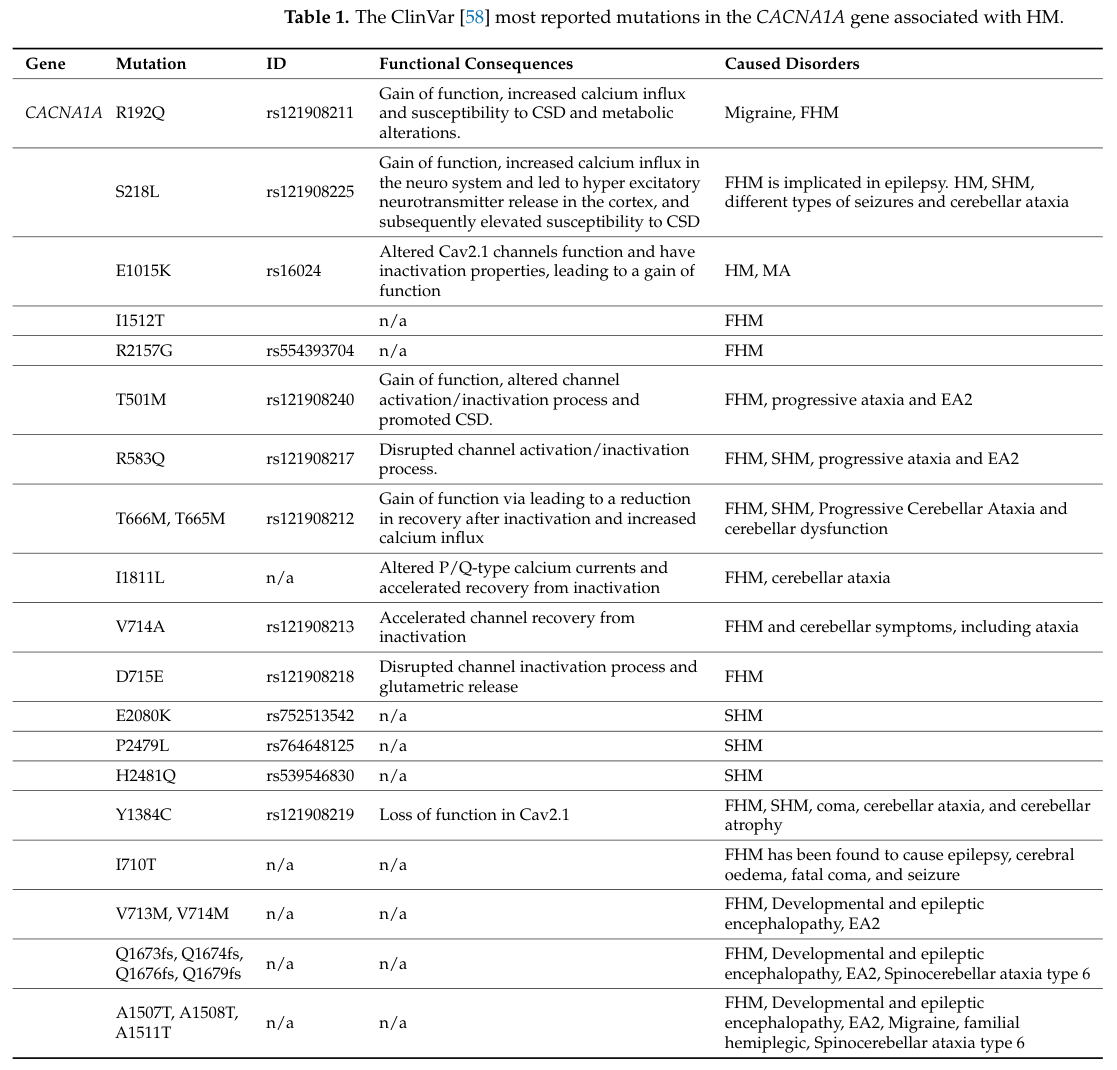
Reference Validation
Checked with linkml-reference-validator 0.2.1.
| Outcome | Count |
|---|---|
| References checked | 10 |
| Resolved | 8 |
| Unresolved (possible confabulation) | 0 |
| Unverifiable | 2 |
| References weighed for topical relevance | 8 |
| On topic | 5 |
| Off topic | 0 |
8 of 10 references resolved; the rest could not be looked up either way.