Familial Congenital Mirror Movements
Familial congenital mirror movements (CMM, MONDO:0016558) is a rare, typically autosomal dominant neurodevelopmental motor disorder in which intentional movements of one side of the body are involuntarily mirrored by homologous movements of the opposite side, most prominently affecting the distal upper limbs (hands and fingers). Onset is in infancy or early childhood and the condition persists lifelong, in contrast to the physiological mirror movements of young children that resolve with maturation. The disorder is genetically heterogeneous but converges on failure of midline axon crossing: pathogenic variants in the netrin-1/DCC axon-guidance pathway (DCC, NTN1) and downstream/associated effectors (RAD51, DNAL4, ARHGEF7) impair decussation of the corticospinal tract and development of commissural connections, producing abnormal bilateral corticospinal projections and deficient interhemispheric (transcallosal) inhibition. Intelligence and life expectancy are typically normal in isolated CMM, although some genetic subtypes (notably biallelic DCC) overlap with corpus callosum agenesis and broader neurodevelopmental phenotypes.
Ask OpenScientist
Ask a research question about Familial Congenital Mirror Movements. OpenScientist will conduct autonomous deep research using the Disorder Mechanisms Knowledge Base and PubMed literature (typically 10-30 minutes).
Do not include personal health information in your question. Questions and results are cached in your browser's local storage.
Inheritance
2Show evidence (1 reference)
Show evidence (1 reference)
Subtypes
4Show evidence (1 reference)
Show evidence (1 reference)
Show evidence (1 reference)
Show evidence (1 reference)
Pathophysiology
6Show evidence (2 references)
Show evidence (1 reference)
Show evidence (2 references)
Show evidence (1 reference)
Show evidence (2 references)
Show evidence (2 references)
Pathograph
Phenotypes
3Show evidence (1 reference)
Show evidence (1 reference)
Show evidence (1 reference)
Genetic Associations
5Show evidence (1 reference)
Show evidence (1 reference)
Show evidence (1 reference)
Show evidence (1 reference)
Show evidence (1 reference)
Medical Actions
3Show evidence (1 reference)
Show evidence (1 reference)
Diagnosis
3Show evidence (1 reference)
Show evidence (1 reference)
Show evidence (1 reference)
Prevalence
1Show evidence (1 reference)
Source YAML
click to showname: Familial Congenital Mirror Movements
creation_date: "2026-06-05T12:00:00Z"
category: Mendelian
description: >-
Familial congenital mirror movements (CMM, MONDO:0016558) is a rare,
typically autosomal dominant neurodevelopmental motor disorder in which
intentional movements of one side of the body are involuntarily mirrored by
homologous movements of the opposite side, most prominently affecting the
distal upper limbs (hands and fingers). Onset is in infancy or early
childhood and the condition persists lifelong, in contrast to the
physiological mirror movements of young children that resolve with
maturation. The disorder is genetically heterogeneous but converges on
failure of midline axon crossing: pathogenic variants in the netrin-1/DCC
axon-guidance pathway (DCC, NTN1) and downstream/associated effectors
(RAD51, DNAL4, ARHGEF7) impair decussation of the corticospinal tract and
development of commissural connections, producing abnormal bilateral
corticospinal projections and deficient interhemispheric (transcallosal)
inhibition. Intelligence and life expectancy are typically normal in
isolated CMM, although some genetic subtypes (notably biallelic DCC) overlap
with corpus callosum agenesis and broader neurodevelopmental phenotypes.
disease_term:
preferred_term: Familial congenital mirror movements
term:
id: MONDO:0016558
label: familial congenital mirror movements
inheritance:
- name: Autosomal dominant
inheritance_term:
preferred_term: Autosomal dominant inheritance
term:
id: HP:0000006
label: Autosomal dominant inheritance
evidence:
- reference: PMID:22305526
reference_title: "RAD51 haploinsufficiency causes congenital mirror movements in humans."
supports: SUPPORT
evidence_source: HUMAN_CLINICAL
snippet: >-
CMM reflect dysfunctions and structural abnormalities of the motor
network and are mainly inherited in an autosomal-dominant fashion.
explanation: >-
Establishes that congenital mirror movements are mainly inherited in an
autosomal dominant fashion, consistent with most DCC, RAD51, NTN1, and
ARHGEF7 families.
- name: Autosomal recessive
inheritance_term:
preferred_term: Autosomal recessive inheritance
term:
id: HP:0000007
label: Autosomal recessive inheritance
evidence:
- reference: PMID:25098561
reference_title: "Identification of a homozygous splice site mutation in the dynein axonemal light chain 4 gene on 22q13.1 in a large consanguineous family from Pakistan with congenital mirror movement disorder."
supports: SUPPORT
evidence_source: HUMAN_CLINICAL
snippet: >-
Congenital mirror movement disorder is a rare, typically
autosomal-dominant disorder, although it has been suspected that some
sporadic cases may be due to recessive inheritance.
explanation: >-
Documents that, while CMM is typically autosomal dominant, recessive
inheritance occurs, as established for the DNAL4 (CMM3) subtype in a
large consanguineous Pakistani family.
has_subtypes:
- name: CMM1
display_name: CMM1 (DCC, MRMV1)
description: >-
The most common genetic form of CMM, caused by heterozygous (monoallelic)
variants in DCC, the gene encoding the netrin-1 receptor. DCC accounts for
the majority of solved CMM cases. Variants impair netrin-1-DCC attractive
signaling required for commissural and corticospinal midline crossing.
Biallelic loss-of-function DCC variants cause the more severe allelic
developmental split-brain syndrome with corpus callosum agenesis.
evidence:
- reference: PMID:38314870
reference_title: "Defining the Genetic Landscape of Congenital Mirror Movements in 80 Affected Individuals."
supports: SUPPORT
evidence_source: HUMAN_CLINICAL
snippet: >-
The most common causal gene was DCC, responsible for 28% of CMM probands
and 80% of solved cases.
explanation: >-
A cohort of 80 affected individuals establishes DCC as the most common
CMM gene, responsible for the majority of solved cases.
- name: CMM2
display_name: CMM2 (RAD51, MRMV2)
description: >-
CMM caused by heterozygous RAD51 variants producing haploinsufficiency
through nonsense-mediated decay of the mutant transcript. RAD51, classically
a DNA double-strand-break repair factor, has an unexpected neurodevelopmental
role and is specifically present in a subpopulation of corticospinal axons
at the pyramidal decussation.
evidence:
- reference: PMID:22305526
reference_title: "RAD51 haploinsufficiency causes congenital mirror movements in humans."
supports: SUPPORT
evidence_source: HUMAN_CLINICAL
snippet: >-
we identified heterozygous mutations introducing premature termination
codons in RAD51 in two families with CMM.
explanation: >-
Identifies heterozygous RAD51 premature-termination variants as the cause
of CMM in two families, defining the RAD51 (CMM2) subtype.
- name: CMM3
display_name: CMM3 (DNAL4)
description: >-
A rare recessive form of CMM identified in a large consanguineous Pakistani
family with autosomal recessive inheritance, caused by a homozygous splice
site mutation in DNAL4 (dynein axonemal light chain 4) on chromosome
22q13.1 that leads to skipping of exon 3. Affected individuals lack features
of primary ciliary dyskinesia, situs inversus, or defective sperm.
evidence:
- reference: PMID:25098561
reference_title: "Identification of a homozygous splice site mutation in the dynein axonemal light chain 4 gene on 22q13.1 in a large consanguineous family from Pakistan with congenital mirror movement disorder."
supports: SUPPORT
evidence_source: HUMAN_CLINICAL
snippet: >-
Whole exome sequencing was employed, and identified a splice site mutation
in the dynein axonemal light chain 4 gene, DNAL4.
explanation: >-
Identifies a homozygous DNAL4 splice site mutation as the cause of
autosomal recessive CMM (CMM3) in a large consanguineous family.
- name: CMM4
display_name: CMM4 (NTN1)
description: >-
CMM caused by heterozygous variants in NTN1, the gene encoding the secreted
axon-guidance ligand netrin-1. Reported mutations cluster in exon 7; mutant
netrin-1 proteins are retained intracellularly rather than secreted,
implying loss of extracellular guidance function and abnormal corticospinal
tract decussation.
evidence:
- reference: PMID:28945198
reference_title: "Mutations in the netrin-1 gene cause congenital mirror movements."
supports: SUPPORT
evidence_source: HUMAN_CLINICAL
snippet: >-
we have identified 3 mutations in exon 7 of NTN1 in 2 unrelated families
and 1 sporadic case with isolated congenital mirror movements (CMM)
explanation: >-
Identifies NTN1 exon 7 mutations as a cause of isolated CMM, defining the
NTN1 (CMM4) subtype.
phenotypes:
- name: Mirror movements
description: >-
The defining phenotype: involuntary movements of one side of the body that
occur simultaneously with and mirror intentional movements of the opposite
side, most prominently affecting the hands and fingers. Onset is in infancy
or early childhood and the movements persist lifelong.
phenotype_term:
preferred_term: Mirror movements
term:
id: HP:0001335
label: Bimanual synkinesia
evidence:
- reference: PMID:22305526
reference_title: "RAD51 haploinsufficiency causes congenital mirror movements in humans."
supports: SUPPORT
evidence_source: HUMAN_CLINICAL
snippet: >-
Congenital mirror movements (CMM) are characterized by involuntary
movements of one side of the body that mirror intentional movements on
the opposite side.
explanation: >-
Defines the core CMM phenotype of involuntary mirrored movements of one
side mirroring intentional movements of the opposite side.
- name: Agenesis of corpus callosum
subtype: CMM1
description: >-
Agenesis or dysgenesis of the corpus callosum may co-occur with mirror
movements, particularly in DCC-related disease, reflecting the role of DCC
in corpus callosum and corticospinal tract development. Biallelic DCC
variants cause more complete callosal agenesis.
phenotype_term:
preferred_term: Agenesis of corpus callosum
term:
id: HP:0001274
label: Agenesis of corpus callosum
evidence:
- reference: PMID:38398422
reference_title: "Paroxysmal Dystonic Posturing Mimicking Nocturnal Leg Cramps as a Presenting Sign in an Infant with DCC Mutation, Callosal Agenesis and Mirror Movements."
supports: SUPPORT
evidence_source: HUMAN_CLINICAL
snippet: >-
Pathogenic variants in the deleted in colorectal cancer gene (DCC),
encoding the Netrin-1 receptor, may lead to mirror movements (MMs)
associated with agenesis/dysgenesis of the corpus callosum (ACC)
explanation: >-
Establishes that DCC pathogenic variants may cause mirror movements
associated with agenesis/dysgenesis of the corpus callosum.
- name: Global developmental delay
subtype: CMM1
description: >-
Some individuals with DCC-related CMM and corpus callosum agenesis develop
a broader neurodevelopmental phenotype including global developmental delay
and behavioural problems, beyond the motor phenotype of isolated CMM.
phenotype_term:
preferred_term: Global developmental delay
term:
id: HP:0001263
label: Global developmental delay
evidence:
- reference: PMID:38398422
reference_title: "Paroxysmal Dystonic Posturing Mimicking Nocturnal Leg Cramps as a Presenting Sign in an Infant with DCC Mutation, Callosal Agenesis and Mirror Movements."
supports: SUPPORT
evidence_source: HUMAN_CLINICAL
snippet: >-
He developed typical upper limb MMs during childhood and a progressively
evolving neuro-phenotype with global development delay and behavioural
problems.
explanation: >-
Reports global developmental delay and behavioural problems in a child
with a monoallelic DCC variant, callosal agenesis, and mirror movements.
pathophysiology:
- name: Netrin-1/DCC axon-guidance failure of midline crossing
description: >-
Pathogenic variants in netrin-1/DCC pathway genes impair attractive
axon-guidance signaling required for commissural and corticospinal axons to
cross the midline during development. Netrin-1 (NTN1), a secreted guidance
cue, binds its receptor DCC to attract commissural axons to the midline.
NTN1 mutations cause intracellular retention of netrin-1 (loss of secreted
function), and DCC variants disrupt netrin-1 binding or downstream
signaling, so the attractive guidance program fails.
cell_types:
- preferred_term: Commissural / pyramidal projection neuron
term:
id: CL:0000598
label: pyramidal neuron
- preferred_term: Upper motor neuron (corticospinal projection)
term:
id: CL:0008048
label: upper motor neuron
- preferred_term: Radial glial cell (netrin-1 transport)
term:
id: CL:0000681
label: radial glial cell
biological_processes:
- preferred_term: Netrin-activated signaling pathway
term:
id: GO:0038007
label: netrin-activated signaling pathway
modifier: DECREASED
- preferred_term: Commissural neuron axon guidance
term:
id: GO:0071679
label: commissural neuron axon guidance
modifier: ABNORMAL
- preferred_term: Axon guidance
term:
id: GO:0007411
label: axon guidance
modifier: ABNORMAL
evidence:
- reference: PMID:28945198
reference_title: "Mutations in the netrin-1 gene cause congenital mirror movements."
supports: SUPPORT
evidence_source: IN_VITRO
snippet: >-
When expressed in HEK293 or stable HeLa cells, the 3 mutated netrin-1
proteins were almost exclusively detected in the intracellular
compartment, contrary to WT netrin-1, which is detected in both
intracellular and extracellular compartments.
explanation: >-
Shows that CMM-causing NTN1 mutations cause intracellular retention of
netrin-1, indicating loss of secreted guidance-cue function.
- reference: PMID:38398422
reference_title: "Paroxysmal Dystonic Posturing Mimicking Nocturnal Leg Cramps as a Presenting Sign in an Infant with DCC Mutation, Callosal Agenesis and Mirror Movements."
supports: SUPPORT
evidence_source: HUMAN_CLINICAL
snippet: >-
The clinical phenotype is related to the biological function of DCC in
the corpus callosum and corticospinal tract development as Netrin-1 is
implicated in the guidance of developing axons toward the midline.
explanation: >-
Links the DCC/netrin-1 pathway to corpus callosum and corticospinal tract
development through midline axon guidance.
downstream:
- target: Abnormal corticospinal tract decussation and ipsilateral projection
causal_link_type: DIRECT
description: >-
Failure of netrin-1/DCC midline guidance directly produces failed
pyramidal decussation, with corticospinal axons descending ipsilaterally.
- target: Callosal commissural development failure
causal_link_type: DIRECT
description: >-
Loss of DCC/netrin-1 guidance also disrupts corpus callosum commissural
development in DCC-related disease.
- name: Callosal commissural development failure
description: >-
DCC/netrin-1 signaling is required for midline guidance of commissural
axons, including corpus callosum development. In DCC-related CMM, this
developmental role explains the callosal agenesis/dysgenesis and broader
neurodevelopmental phenotype seen in the CMM1 subtype.
subtypes:
- CMM1
locations:
- preferred_term: corpus callosum
term:
id: UBERON:0002336
label: corpus callosum
biological_processes:
- preferred_term: commissural neuron axon guidance
term:
id: GO:0071679
label: commissural neuron axon guidance
modifier: ABNORMAL
evidence:
- reference: PMID:38398422
reference_title: "Paroxysmal Dystonic Posturing Mimicking Nocturnal Leg Cramps as a Presenting Sign in an Infant with DCC Mutation, Callosal Agenesis and Mirror Movements."
supports: SUPPORT
evidence_source: HUMAN_CLINICAL
snippet: >-
The clinical phenotype is related to the biological function of DCC in
the corpus callosum and corticospinal tract development as Netrin-1 is
implicated in the guidance of developing axons toward the midline.
explanation: >-
Links DCC/netrin-1 midline axon guidance to corpus callosum development
in the DCC-related CMM phenotype.
downstream:
- target: Agenesis of corpus callosum
causal_link_type: DIRECT
description: >-
Disrupted DCC/netrin-1 commissural guidance can produce agenesis or
dysgenesis of the corpus callosum in CMM1.
- target: Global developmental delay
causal_link_type: INDIRECT_KNOWN_INTERMEDIATES
description: >-
Callosal maldevelopment in DCC-related disease can be accompanied by a
broader neurodevelopmental phenotype, including global developmental
delay.
- name: Defective actin-cytoskeletal effector signaling downstream of DCC
description: >-
Netrin-1-DCC guidance requires downstream cytoskeletal effectors. DCC
signals through a conserved WIRS motif to the WAVE regulatory complex (WRC)
to drive actin dynamics, and through RhoGEF effectors (ARHGEF7/GIT1) that
activate Rac1/Cdc42, inhibit Arf1, and increase cell-surface DCC. CMM-associated
variants that disrupt these effector interactions impair
netrin-1-DCC axon guidance even when ligand binding is intact.
cell_types:
- preferred_term: Commissural / pyramidal projection neuron
term:
id: CL:0000598
label: pyramidal neuron
biological_processes:
- preferred_term: Actin cytoskeleton organization
term:
id: GO:0030036
label: actin cytoskeleton organization
modifier: ABNORMAL
- preferred_term: Regulation of small GTPase mediated signal transduction
term:
id: GO:0051056
label: regulation of small GTPase mediated signal transduction
modifier: DYSREGULATED
evidence:
- reference: PMID:39353037
reference_title: "A human DCC variant causing mirror movement disorder reveals that the WAVE regulatory complex mediates axon guidance by netrin-1-DCC."
supports: SUPPORT
evidence_source: IN_VITRO
snippet: >-
The CMM-associated R1343H variant of DCC, which altered the WIRS motif,
prevented the DCC-WRC interaction and impaired axon guidance in cultured
commissural neurons and in Drosophila.
explanation: >-
Demonstrates that a CMM-associated DCC cytoplasmic-tail variant disrupts
DCC-WAVE regulatory complex interaction and impairs axon guidance.
- reference: PMID:37172092
reference_title: "Genetics of mirror movements identifies a multifunctional complex required for Netrin-1 guidance and lateralization of motor control."
supports: SUPPORT
evidence_source: MODEL_ORGANISM
snippet: >-
Arhgef7/Git1 activates Rac1 and Cdc42 and inhibits Arf1 downstream of
Netrin-1. Furthermore, Arhgef7/Git1, via Arf1, mediates the
Netrin-1-induced increase in cell surface Dcc.
explanation: >-
Defines the ARHGEF7/GIT1 effector complex acting downstream of netrin-1-DCC
to control Rho-family GTPases and cell-surface DCC.
downstream:
- target: Abnormal corticospinal tract decussation and ipsilateral projection
causal_link_type: DIRECT
description: >-
Impaired DCC effector signaling disrupts the actin-dependent guidance
response, producing the same midline-crossing failure as ligand/receptor
defects.
- name: RAD51 haploinsufficiency in corticospinal development
description: >-
RAD51, classically a homologous-recombination DNA-repair factor, has an
unexpected neurodevelopmental role. RAD51 is specifically present in
developing cortex and in a subpopulation of corticospinal axons at the
pyramidal decussation; heterozygous premature-termination variants cause
haploinsufficiency through nonsense-mediated decay, impairing development of
bimanual motor control.
cell_types:
- preferred_term: Upper motor neuron (corticospinal projection)
term:
id: CL:0008048
label: upper motor neuron
biological_processes:
- preferred_term: Corticospinal tract morphogenesis
term:
id: GO:0021957
label: corticospinal tract morphogenesis
modifier: ABNORMAL
evidence:
- reference: PMID:22305526
reference_title: "RAD51 haploinsufficiency causes congenital mirror movements in humans."
supports: SUPPORT
evidence_source: MODEL_ORGANISM
snippet: >-
RAD51 was specifically present in the developing mouse cortex and, more
particularly, in a subpopulation of corticospinal axons at the pyramidal
decussation.
explanation: >-
Establishes a neurodevelopmental localization of RAD51 in corticospinal
axons at the pyramidal decussation, supporting its role in CMM.
downstream:
- target: Abnormal corticospinal tract decussation and ipsilateral projection
causal_link_type: DIRECT
description: >-
RAD51 haploinsufficiency impairs corticospinal development, contributing
to abnormal decussation and bimanual motor control.
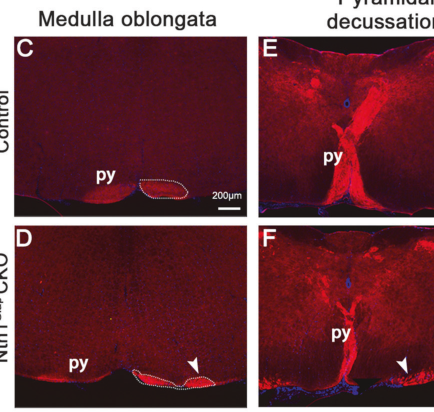
- name: Abnormal corticospinal tract decussation and ipsilateral projection
description: >-
Convergent consequence of the upstream defects: corticospinal tract axons
fail to decussate at the ventral medulla and instead descend ipsilaterally,
establishing abnormal bilateral corticospinal projections. This is the
structural substrate observed as malformations of pyramidal decussation in
most CMM cases and recapitulated in animal models.
locations:
- preferred_term: Corticospinal tract
term:
id: UBERON:0002707
label: corticospinal tract
- preferred_term: Pyramidal decussation
term:
id: UBERON:0002755
label: pyramidal decussation
- preferred_term: Medulla oblongata
term:
id: UBERON:0001896
label: medulla oblongata
biological_processes:
- preferred_term: Corticospinal tract morphogenesis
term:
id: GO:0021957
label: corticospinal tract morphogenesis
modifier: ABNORMAL
evidence:
- reference: PMID:38760361
reference_title: "Ventricular Netrin-1 deficiency leads to defective pyramidal decussation and mirror movement in mice."
supports: SUPPORT
evidence_source: MODEL_ORGANISM
snippet: >-
A large proportion of CST axons spread laterally in the ventral medulla
oblongata, failed to decussate and descended in the ipsilateral spinal
white matter of Ntn1Gfap CKO mice.
explanation: >-
A mouse netrin-1 conditional knockout recapitulates failed pyramidal
decussation with ipsilateral corticospinal descent, the structural
substrate of CMM.
- reference: PMID:28945198
reference_title: "Mutations in the netrin-1 gene cause congenital mirror movements."
supports: SUPPORT
evidence_source: HUMAN_CLINICAL
snippet: >-
the pathophysiology likely involves its loss of function and subsequent
disruption of axon guidance, resulting in abnormal decussation of the CST.
explanation: >-
Links netrin-1 loss of function to abnormal corticospinal tract
decussation in human CMM.
downstream:
- target: Bilateral motor output and deficient interhemispheric inhibition
causal_link_type: DIRECT
description: >-
Abnormal bilateral corticospinal projections, together with reduced
transcallosal inhibition, allow unilateral motor commands to drive
bilateral homologous muscle activation.
- name: Bilateral motor output and deficient interhemispheric inhibition
description: >-
The abnormal bilateral corticospinal projections, combined with deficient
interhemispheric (transcallosal) inhibition, mean that a unilateral
voluntary motor command produces inappropriate bilateral activation of
homologous muscles, which is observed clinically as mirror movements.
Model systems show that even a small number of misprojecting ipsilateral
descending axons is sufficient to drive incorrect, mirrored motor output.
locations:
- preferred_term: Corpus callosum (transcallosal inhibition substrate)
term:
id: UBERON:0002336
label: corpus callosum
evidence:
- reference: PMID:24553931
reference_title: "Mirror movement-like defects in startle behavior of zebrafish dcc mutants are caused by aberrant midline guidance of identified descending hindbrain neurons."
supports: SUPPORT
evidence_source: MODEL_ORGANISM
snippet: >-
aberrant ipsilateral connectivity of a very small number of descending
axons is sufficient to induce incorrect movement patterns.
explanation: >-
Demonstrates in zebrafish dcc mutants that a small number of aberrant
ipsilateral descending axons is sufficient to produce mirror
movement-like behaviour.
- reference: PMID:24553931
reference_title: "Mirror movement-like defects in startle behavior of zebrafish dcc mutants are caused by aberrant midline guidance of identified descending hindbrain neurons."
supports: SUPPORT
evidence_source: MODEL_ORGANISM
snippet: >-
Humans with heterozygous mutations in the axon guidance receptor DCC
display such mirror movements, where unilateral stimulation results in
inappropriate bilateral motor output.
explanation: >-
Frames mirror movements as inappropriate bilateral motor output following
unilateral stimulation in DCC-mutant humans.
downstream:
- target: Mirror movements
causal_link_type: DIRECT
description: >-
Inappropriate bilateral motor output during unilateral commands manifests
clinically as involuntary mirror movements.
genetic:
- name: DCC
association: Causative
inheritance:
- name: Autosomal dominant
inheritance_term:
preferred_term: Autosomal dominant inheritance
term:
id: HP:0000006
label: Autosomal dominant inheritance
gene_term:
preferred_term: DCC
term:
id: hgnc:2701
label: DCC
notes: >-
DCC (MRMV1/CMM1) on 18q21.2 encodes the netrin-1 receptor. Heterozygous
(monoallelic) variants are the most common cause of CMM and account for
most solved cases; penetrance is incomplete (~68%, higher in males).
Variants in the extracellular domain can disrupt netrin-1 binding or cause
truncation/haploinsufficiency, while the cytoplasmic-tail R1343H variant
disrupts the DCC-WAVE regulatory complex interaction. Biallelic loss of
function causes the allelic developmental split-brain syndrome.
evidence:
- reference: PMID:38314870
reference_title: "Defining the Genetic Landscape of Congenital Mirror Movements in 80 Affected Individuals."
supports: SUPPORT
evidence_source: HUMAN_CLINICAL
snippet: >-
Penetrance of CMM in DCC pathogenic variant carriers was 68% and higher
in males than females (74% vs. 54%).
explanation: >-
Reports incomplete, sex-biased penetrance for DCC pathogenic variant
carriers in a cohort of 80 affected individuals.
- name: NTN1
association: Causative
inheritance:
- name: Autosomal dominant
inheritance_term:
preferred_term: Autosomal dominant inheritance
term:
id: HP:0000006
label: Autosomal dominant inheritance
gene_term:
preferred_term: NTN1
term:
id: hgnc:8029
label: NTN1
notes: >-
NTN1 (CMM4) encodes the secreted axon-guidance ligand netrin-1.
Heterozygous exon 7 mutations cause isolated CMM; mutant netrin-1 is
retained intracellularly rather than secreted, indicating loss of
extracellular guidance function with abnormal corticospinal tract anatomy.
evidence:
- reference: PMID:28945198
reference_title: "Mutations in the netrin-1 gene cause congenital mirror movements."
supports: SUPPORT
evidence_source: HUMAN_CLINICAL
snippet: >-
we have identified 3 mutations in exon 7 of NTN1 in 2 unrelated families
and 1 sporadic case with isolated congenital mirror movements (CMM)
explanation: >-
Establishes NTN1 exon 7 mutations as a cause of isolated CMM.
- name: RAD51
association: Causative
inheritance:
- name: Autosomal dominant
inheritance_term:
preferred_term: Autosomal dominant inheritance
term:
id: HP:0000006
label: Autosomal dominant inheritance
gene_term:
preferred_term: RAD51
term:
id: hgnc:9817
label: RAD51
notes: >-
RAD51 (MRMV2/CMM2) on 15q15.1 causes CMM through haploinsufficiency:
heterozygous premature-termination variants are degraded by
nonsense-mediated decay. RAD51, known for homologous-recombination DNA
repair, has an unexpected developmental role in corticospinal axons at the
pyramidal decussation.
evidence:
- reference: PMID:22305526
reference_title: "RAD51 haploinsufficiency causes congenital mirror movements in humans."
supports: SUPPORT
evidence_source: HUMAN_CLINICAL
snippet: >-
RAD51 mRNA was significantly downregulated in individuals with CMM
resulting from the degradation of the mutated mRNA by nonsense-mediated
decay.
explanation: >-
Establishes RAD51 haploinsufficiency via nonsense-mediated decay as the
mechanism in CMM2.
- name: DNAL4
association: Causative
inheritance:
- name: Autosomal recessive
inheritance_term:
preferred_term: Autosomal recessive inheritance
term:
id: HP:0000007
label: Autosomal recessive inheritance
gene_term:
preferred_term: DNAL4
term:
id: hgnc:2955
label: DNAL4
notes: >-
DNAL4 (CMM3, dynein axonemal light chain 4) on chromosome 22q13.1. A
homozygous splice site mutation causing skipping of exon 3 was identified
in a large consanguineous Pakistani family with autosomal recessive CMM
across five generations, without features of primary ciliary dyskinesia.
evidence:
- reference: PMID:25098561
reference_title: "Identification of a homozygous splice site mutation in the dynein axonemal light chain 4 gene on 22q13.1 in a large consanguineous family from Pakistan with congenital mirror movement disorder."
supports: SUPPORT
evidence_source: HUMAN_CLINICAL
snippet: >-
This splice site change leads to skipping of exon 3, and omission of 28
amino acids from DNAL4 protein.
explanation: >-
Characterizes the homozygous DNAL4 splice site variant (exon 3 skipping)
underlying autosomal recessive CMM3.
- name: ARHGEF7
association: Causative
inheritance:
- name: Autosomal dominant
inheritance_term:
preferred_term: Autosomal dominant inheritance
term:
id: HP:0000006
label: Autosomal dominant inheritance
gene_term:
preferred_term: ARHGEF7
term:
id: hgnc:15607
label: ARHGEF7
notes: >-
ARHGEF7, a RhoGEF, was identified as a candidate CMM gene in an autosomal
dominant family. ARHGEF7 and its partner GIT1 bind directly to DCC and act
as a multifunctional effector complex required for netrin-1-mediated axon
guidance; heterozygous Arhgef7 mice show a mirror-movement-like phenotype.
evidence:
- reference: PMID:37172092
reference_title: "Genetics of mirror movements identifies a multifunctional complex required for Netrin-1 guidance and lateralization of motor control."
supports: SUPPORT
evidence_source: HUMAN_CLINICAL
snippet: >-
We performed genetic characterization of a family with autosomal dominant
MM and identified ARHGEF7, a RhoGEF, as a candidate MM gene.
explanation: >-
Identifies ARHGEF7 as a candidate autosomal dominant CMM gene encoding a
RhoGEF effector of netrin-1-DCC signaling.
diagnosis:
- name: Clinical recognition and severity grading
description: >-
Diagnosis rests on recognizing involuntary mirrored movements during
unilateral voluntary actions (especially of the hands/fingers), with onset
in infancy/early childhood, persistence beyond the age at which
physiological mirror movements resolve, and a supportive family history.
Severity is graded with the Woods and Teuber classification or the Cohen
Mirror Movement Scale.
diagnosis_term:
preferred_term: physical examination
term:
id: NCIT:C20989
label: Physical Examination
evidence:
- reference: PMID:38398422
reference_title: "Paroxysmal Dystonic Posturing Mimicking Nocturnal Leg Cramps as a Presenting Sign in an Infant with DCC Mutation, Callosal Agenesis and Mirror Movements."
supports: SUPPORT
evidence_source: HUMAN_CLINICAL
snippet: "MMs were measured via the Woods and Teuber classification."
explanation: >-
Documents use of the Woods and Teuber classification to grade mirror
movement severity in a DCC-related case.
- name: Molecular genetic testing
description: >-
Targeted sequencing/gene panels including DCC, RAD51, NTN1, ARHGEF7, and
DNAL4, or exome/genome sequencing with segregation analysis in families. A
genetic etiology is identified in about one third of CMM individuals overall
and the majority of familial cases; CMM remains genetically heterogeneous.
diagnosis_term:
preferred_term: genetic testing
term:
id: NCIT:C15709
label: Genetic Testing
evidence:
- reference: PMID:38314870
reference_title: "Defining the Genetic Landscape of Congenital Mirror Movements in 80 Affected Individuals."
supports: SUPPORT
evidence_source: HUMAN_CLINICAL
snippet: >-
Causal pathogenic/likely pathogenic variants were found in 35% of probands
overall, and 70% with familial CMM.
explanation: >-
Reports the molecular diagnostic yield of genetic testing across CMM
genes (35% overall, 70% in familial cases).
- name: Brain MRI and diffusion tensor imaging
description: >-
Brain MRI detects corpus callosum agenesis/dysgenesis and other
malformations in syndromic cases; diffusion tensor imaging (DTI)
tractography assesses corticospinal tract crossing and quantifies laterality.
diagnosis_term:
preferred_term: magnetic resonance imaging
term:
id: NCIT:C16809
label: Magnetic Resonance Imaging
evidence:
- reference: PMID:38398422
reference_title: "Paroxysmal Dystonic Posturing Mimicking Nocturnal Leg Cramps as a Presenting Sign in an Infant with DCC Mutation, Callosal Agenesis and Mirror Movements."
supports: SUPPORT
evidence_source: HUMAN_CLINICAL
snippet: "A brain magnetic resonance imaging (MRI) showed complete ACC."
explanation: >-
Brain MRI demonstrated complete corpus callosum agenesis in a DCC-related
CMM case, supporting its diagnostic role.
prevalence:
- population: General population (review-level estimate)
notes: >-
Familial congenital mirror movements is a rare neurodevelopmental disorder.
The cohort and primary genetics literature characterize it as rare; precise
population-based prevalence estimates are limited and vary with
ascertainment.
evidence:
- reference: PMID:38314870
reference_title: "Defining the Genetic Landscape of Congenital Mirror Movements in 80 Affected Individuals."
supports: SUPPORT
evidence_source: HUMAN_CLINICAL
snippet: >-
Congenital mirror movements (CMM) is a rare neurodevelopmental disorder
characterized by involuntary movements from one side of the body that
mirror voluntary movements on the opposite side.
explanation: >-
Characterizes CMM as a rare neurodevelopmental disorder.
treatments:
- name: Supportive and rehabilitative care
description: >-
No disease-modifying therapy is established. Management is supportive and
function-oriented, including occupational and physical therapy to improve
bimanual coordination and compensate for fine-motor limitations, plus
patient education and psychosocial support. Historical surgical approaches
such as corpus callosotomy have been largely abandoned.
treatment_term:
preferred_term: supportive care
term:
id: NCIT:C15747
label: Supportive Care
evidence:
- reference: PMID:38314870
reference_title: "Defining the Genetic Landscape of Congenital Mirror Movements in 80 Affected Individuals."
supports: NO_EVIDENCE
evidence_source: HUMAN_CLINICAL
snippet: >-
Congenital mirror movements (CMM) is a rare neurodevelopmental disorder
characterized by involuntary movements from one side of the body that
mirror voluntary movements on the opposite side.
explanation: >-
This reference establishes CMM as a chronic neurodevelopmental motor
disorder but reports no specific treatment or management evidence; no
disease-modifying therapy is described in the literature, so supportive
care is offered without direct interventional support.
- name: Occupational therapy
description: >-
Occupational therapy to improve bimanual coordination and compensate for
impairment of fine motor tasks (e.g., writing, manipulating objects).
therapeutic_modality: BEHAVIORAL
treatment_term:
preferred_term: occupational therapy
term:
id: NCIT:C121351
label: Occupational Therapy
notes: >-
No CMM-specific controlled trial of occupational therapy exists;
occupational therapy is recommended on a supportive, function-oriented basis (general
rehabilitative practice for fine-motor coordination disorders) rather than
on the basis of disease-specific interventional evidence.
- name: Genetic counseling
description: >-
Genetic counseling for affected families and at-risk relatives, with
cascade testing once a familial pathogenic variant is identified.
Counseling addresses the predominantly autosomal dominant inheritance
(with incomplete penetrance) and the rare autosomal recessive DNAL4 form.
treatment_term:
preferred_term: Genetic Counseling
term:
id: NCIT:C15240
label: Genetic Counseling
evidence:
- reference: PMID:38314870
reference_title: "Defining the Genetic Landscape of Congenital Mirror Movements in 80 Affected Individuals."
supports: SUPPORT
evidence_source: HUMAN_CLINICAL
snippet: >-
A genetic etiology can be identified in one third of CMM individuals, with
DCC being the most common gene involved.
explanation: >-
Because a genetic etiology is identifiable in a substantial fraction of
CMM cases, genetic counseling and cascade testing of relatives are
relevant once a familial pathogenic variant is found.
datasets: []
References & Deep Research
Deep Research
1Deep research results are used as seeds for research; they do not undergo the same validation as the main records and may contain errors. How we use deep research.
Familial Congenital Mirror Movements (CMM): Disease Characteristics Research Report
Target disease
- Disease name: Familial Congenital Mirror Movements (CMM)
- Category: Mendelian neurodevelopmental motor disorder
1. Disease information
Overview (current understanding)
Congenital mirror movements (CMM) are involuntary movements of one side of the body that occur simultaneously with intentional movements of the opposite side, classically involving the hands/fingers. The condition is typically apparent in infancy or early childhood and persists lifelong in the congenital/familial form, in contrast to physiologic mirroring in young children which declines with maturation. (meneret2017mutationsinthe pages 1-2, legboUnknownyearmirrormovementsa pages 4-5)
Key identifiers
- OMIM: Congenital mirror movements #157600 (explicitly cited in primary literature) (meneret2017mutationsinthe pages 1-2)
- OMIM: Developmental split-brain syndrome (DSBS) #617542 (related allelic disorder due to biallelic DCC variants, often with corpus callosum agenesis and more severe neurodevelopmental features) (accogli2024arecurrentmcf2 pages 13-16, prato2024paroxysmaldystonicposturing pages 1-2)
Not found in retrieved sources: Orphanet ORPHA code, MONDO ID, MeSH descriptor, and ICD-10/ICD-11 code were not present in the available retrieved texts; therefore they cannot be stated with evidence here. (meneret2017mutationsinthe pages 1-2, accogli2024arecurrentmcf2 pages 13-16)
Synonyms / alternative names
- Congenital mirror movements
- Mirror movement disorder
- Familial mirror movements (These naming variants are used across the clinical and genetics literature discussing “mirror movements disorder” and “congenital mirror movements.”) (meneret2017mutationsinthe pages 1-2, chaudhari2024ahumandcc pages 1-3)
Evidence provenance
Evidence in this report derives from: - Aggregated disease-level resources/reviews (narrative review emphasizing recognition, diagnostics, and management) (legboUnknownyearmirrormovementsaa pages 4-5) - Primary human genetics and mechanistic studies (NTN1, DCC pathway effectors; cohort/family studies) (meneret2017mutationsinthe pages 1-2, schlienger2023geneticsofmirror pages 1-2, chaudhari2024ahumandcc pages 1-3) - Model-organism functional validation studies (mouse, zebrafish, Drosophila) (hu2024ventricularnetrin1deficiency pages 5-6, jain2014mirrormovementlikedefects pages 6-8, chaudhari2024ahumandcc pages 1-3)
2. Etiology
Primary causal factors (genetic)
Familial CMM is genetically heterogeneous but converges strongly on axon guidance and midline-crossing biology involving the netrin-1/DCC pathway, with additional downstream effectors identified recently.
Key genetic causes supported by primary literature in this corpus: - DCC variants are frequently associated with CMM (chaudhari2024ahumandcc pages 1-3, prato2024paroxysmaldystonicposturing pages 1-2) - NTN1 (netrin-1) mutations cause CMM and are associated with abnormal corticospinal tract (CST) anatomy/decussation (meneret2017mutationsinthe pages 1-2) - RAD51 haploinsufficiency causes CMM (referenced in mechanistic genetics context) (accogli2024arecurrentmcf2 pages 13-16)
Recent developments (2023–2024): - ARHGEF7 identified in an autosomal dominant MM pedigree; mechanistic linkage to DCC signaling via a multifunctional ARHGEF7/GIT1 complex (Science Advances, 2023-05; URL in paper metadata) (schlienger2023geneticsofmirror pages 1-2) - A CMM-associated DCC cytoplasmic-tail variant reveals requirement of the WAVE regulatory complex (WRC) via a conserved WIRS motif for netrin-1–DCC axon guidance (Science Signaling, 2024-10; URL in paper metadata) (chaudhari2024ahumandcc pages 1-3) - MCF2 recurrent hemizygous X-linked variant c.31C>T p.(R11W) reported in two unrelated males with CMM/CCA; biochemical evidence shows disrupted MCF2–DCC interaction and decreased GEF activity (preprint, 2024-12; URL in paper metadata) (accogli2024arecurrentmcf2 pages 1-5)
Risk factors
- Genetic: family history consistent with Mendelian inheritance (often autosomal dominant in familial CMM) (legboUnknownyearmirrormovementsac pages 2-4)
- Non-genetic/environmental: No validated environmental risk factors were identified in the retrieved evidence. CMM is typically framed as a neurodevelopmental wiring disorder. (legboUnknownyearmirrormovementsa pages 4-5)
Protective factors / gene–environment interactions
No protective variants or gene–environment interactions were identified in the retrieved evidence. (legboUnknownyearmirrormovementsa pages 4-5)
3. Phenotypes
Core phenotype
The defining phenotype is involuntary, synchronous “mirrored” activation during voluntary movement, most prominently affecting distal upper limbs (hands/fingers), with variable severity. (prato2024paroxysmaldystonicposturing pages 1-2, legboUnknownyearmirrormovementsaa pages 4-5)
Age of onset, severity, progression
- Onset: infancy/early childhood for congenital/familial cases (legboUnknownyearmirrormovementsa pages 4-5, prato2024paroxysmaldystonicposturing pages 1-2)
- Course: typically lifelong and non-progressive (legboUnknownyearmirrormovementsa pages 4-5)
- Severity: variable within and across families; intrafamilial variability described with DCC variants (prato2024paroxysmaldystonicposturing pages 2-4)
Syndromic/associated findings
- Corpus callosum agenesis/dysgenesis (ACC): may co-occur with mirror movements, especially in DCC-related disease spectra (prato2024paroxysmaldystonicposturing pages 1-2)
- Other syndromic associations are discussed in review-level literature (e.g., Klippel–Feil, Kallmann, Joubert, Moebius) (legboUnknownyearmirrormovementsaa pages 4-5)
Quantitative phenotype statistics from recent/primary sources
- Narrative epidemiology estimates (see Epidemiology) indicate extreme rarity and ascertainment variability. (legboUnknownyearmirrormovementsaa pages 2-4)
- In a 2024 family report that also summarizes prior pediatric cases with DCC variants, among 26 reported children: 25/26 (96%) had mirror movements; 9/26 (35%) had partial/complete ACC; 8/26 (31%) had both mirror movements and ACC. (prato2024paroxysmaldystonicposturing pages 4-6)
Quality-of-life and functional impact
Persistent mirror movements can impair bimanual coordination and fine motor tasks (e.g., writing, manipulating objects) and can carry psychosocial burden (teasing/embarrassment). (legboUnknownyearmirrormovementsaa pages 4-5)
Suggested HPO terms (non-exhaustive; based on phenotypes explicitly described)
- Mirror movements (core concept; HPO term exists but identifier not provided in retrieved sources)
- Abnormality of voluntary movement / involuntary movements
- Abnormality of fine motor coordination
- Agenesis of corpus callosum (ACC) (prato2024paroxysmaldystonicposturing pages 1-2)
- Global developmental delay / developmental delay (prato2024paroxysmaldystonicposturing pages 4-6)
- Hyperreflexia; clonus; hypertonia (prato2024paroxysmaldystonicposturing pages 4-6)
- Dystonia / paroxysmal dystonic posturing (prato2024paroxysmaldystonicposturing pages 4-6)
4. Genetic / molecular information
| Gene (HGNC symbol) | Evidence type | Inheritance pattern as reported | Key variant(s)/mechanism | Phenotypic associations | Key citation |
|---|---|---|---|---|---|
| DCC | Human families/cases; cohort of 80 CMM individuals; in vitro commissural-neuron assays; Drosophila functional model (chaudhari2024ahumandcc pages 1-3, prato2024paroxysmaldystonicposturing pages 1-2) | Usually heterozygous/monoallelic for isolated CMM; biallelic loss-of-function causes developmental split-brain syndrome (DSBS) (accogli2024arecurrentmcf2 pages 13-16, prato2024paroxysmaldystonicposturing pages 1-2) | R1343H in cytoplasmic WIRS motif disrupts DCC–WAVE regulatory complex interaction, impairing netrin-1–DCC axon guidance; many other CMM-associated DCC variants localize to extracellular domain and can disrupt netrin-1 binding or cause truncation/haploinsufficiency (chaudhari2024ahumandcc pages 1-3) | Isolated CMM; agenesis/dysgenesis of corpus callosum; corticospinal/spinal commissural axon crossing defects; DSBS with more severe neurodevelopmental phenotype when biallelic (chaudhari2024ahumandcc pages 1-3, accogli2024arecurrentmcf2 pages 13-16, prato2024paroxysmaldystonicposturing pages 1-2) | Chaudhari et al., Sci Signal 2024, DOI: 10.1126/scisignal.adk2345, https://doi.org/10.1126/scisignal.adk2345 (chaudhari2024ahumandcc pages 1-3); Prato et al., J Clin Med 2024, DOI: 10.3390/jcm13041109, https://doi.org/10.3390/jcm13041109 (prato2024paroxysmaldystonicposturing pages 1-2) |
| NTN1 | Human families and sporadic case; functional cell studies; human tract-anatomy studies; mouse model support (meneret2017mutationsinthe pages 1-2, hu2024ventricularnetrin1deficiency pages 5-6) | Familial/sporadic heterozygous CMM reported; exact mode not always explicitly stated in excerpt (meneret2017mutationsinthe pages 1-2) | 3 exon 7 mutations; mutant netrin-1 proteins are retained intracellularly rather than secreted, implying loss of extracellular guidance cue function and abnormal CST decussation (meneret2017mutationsinthe pages 1-2) | Isolated CMM; abnormal corticospinal tract anatomy/decussation; mirror-like symmetric movement in mouse Ntn1 deficiency model (meneret2017mutationsinthe pages 1-2, hu2024ventricularnetrin1deficiency pages 5-6) | Méneret et al., J Clin Invest 2017, DOI: 10.1172/JCI95442, https://doi.org/10.1172/jci95442 (meneret2017mutationsinthe pages 1-2); Hu et al., Cell Death Dis 2024, DOI: 10.1038/s41419-024-06719-1, https://doi.org/10.1038/s41419-024-06719-1 (hu2024ventricularnetrin1deficiency pages 5-6) |
| RAD51 | Human family/case genetics; review synthesis (prato2024paroxysmaldystonicposturing pages 1-2, accogli2024arecurrentmcf2 pages 13-16) | Haploinsufficiency reported in humans; familial disease often described as autosomal dominant in review-level summaries (accogli2024arecurrentmcf2 pages 13-16, legboUnknownyearmirrormovementsac pages 2-4) | RAD51 haploinsufficiency causes CMM; newer 2023 review highlights an unexpected noncanonical developmental role for RAD51 in brain development rather than classical cancer predisposition pathways (accogli2024arecurrentmcf2 pages 13-16) | Isolated/familial CMM; overlaps mechanistically with axon-guidance pathway disorders, though detailed callosal/CST phenotypes are less elaborated in provided excerpts (accogli2024arecurrentmcf2 pages 13-16, legboUnknownyearmirrormovementsac pages 2-4) | Depienne et al., Am J Hum Genet 2012, DOI: 10.1016/j.ajhg.2011.12.002, https://doi.org/10.1016/j.ajhg.2011.12.002 (accogli2024arecurrentmcf2 pages 13-16); Thomas et al., Cells 2023, DOI: 10.3390/cells12081169, https://doi.org/10.3390/cells12081169 (from prior retrieval context) |
| ARHGEF7 | Human autosomal-dominant family; biochemical/cellular studies; heterozygous mouse model (schlienger2023geneticsofmirror pages 1-2) | Autosomal dominant MM pedigree reported (schlienger2023geneticsofmirror pages 1-2) | Candidate MM gene encoding a RhoGEF; ARHGEF7 and partner GIT1 bind directly to DCC, activate Rac1/Cdc42, inhibit Arf1, and mediate netrin-1–induced increase in cell-surface DCC (schlienger2023geneticsofmirror pages 1-2) | Familial CMM/MM; commissural axon trajectory defects; MM-like increased symmetric paw placement in heterozygous mice (schlienger2023geneticsofmirror pages 1-2) | Schlienger et al., Sci Adv 2023, DOI: 10.1126/sciadv.add5501, https://doi.org/10.1126/sciadv.add5501 (schlienger2023geneticsofmirror pages 1-2) |
| MCF2 | Two unrelated human male cases (adult and fetus); exome/genome sequencing; biochemical and cellular functional studies (accogli2024arecurrentmcf2 pages 1-5) | X-linked/hemizygous in affected males (accogli2024arecurrentmcf2 pages 1-5) | Recurrent c.31C>T p.(R11W); MCF2 physically interacts with DCC, relocalizes DCC, and the R11W variant disrupts DCC binding, reduces DCC relocalization, and lowers GEF activity (accogli2024arecurrentmcf2 pages 1-5) | Adult male with CMM; fetal case with corpus callosum agenesis and abnormal corticospinal decussation; broader axon-guidance/commissural defect spectrum including arhinencephaly in excerpted discussion (accogli2024arecurrentmcf2 pages 1-5, accogli2024arecurrentmcf2 pages 13-16) | Accogli et al., preprint 2024, DOI: 10.21203/rs.3.rs-5227743/v1, https://doi.org/10.21203/rs.3.rs-5227743/v1 (accogli2024arecurrentmcf2 pages 1-5) |
| DCC pathway support from models | Mouse conditional knockout and zebrafish mutant models (hu2024ventricularnetrin1deficiency pages 5-6, jain2014mirrormovementlikedefects pages 1-2, jain2014mirrormovementlikedefects pages 6-8, jain2014mirrormovementlikedefects pages 8-8) | Not applicable | Ntn1 ventricular-zone deletion in mouse causes CST defasciculation and failed pyramidal decussation with increased symmetric forelimb movements; zebrafish dcc mutants show ipsilateral misprojection of identified reticulospinal neurons sufficient to drive mirror movement-like behavior (hu2024ventricularnetrin1deficiency pages 5-6, jain2014mirrormovementlikedefects pages 1-2, jain2014mirrormovementlikedefects pages 6-8, jain2014mirrormovementlikedefects pages 8-8) | Confirms mechanistic link between defective midline crossing and mirror/symmetric motor output across vertebrate systems (hu2024ventricularnetrin1deficiency pages 5-6, jain2014mirrormovementlikedefects pages 1-2, jain2014mirrormovementlikedefects pages 6-8, jain2014mirrormovementlikedefects pages 8-8) | Hu et al., Cell Death Dis 2024, DOI: 10.1038/s41419-024-06719-1, https://doi.org/10.1038/s41419-024-06719-1 (hu2024ventricularnetrin1deficiency pages 5-6); Jain et al., J Neurosci 2014, DOI: 10.1523/JNEUROSCI.2420-13.2014, https://doi.org/10.1523/jneurosci.2420-13.2014 (jain2014mirrormovementlikedefects pages 1-2, jain2014mirrormovementlikedefects pages 6-8, jain2014mirrormovementlikedefects pages 8-8) |
Table: This table summarizes the main genes implicated in familial congenital mirror movements and the mechanistic evidence linking them to defective axon guidance and corticospinal midline crossing. It highlights inheritance, representative variants, associated phenotypes, and key citations from the provided context.
Key molecular concepts (definitions)
- Axon guidance: developmentally regulated process directing axons to targets; disruption can cause commissural/corticospinal miswiring that manifests as abnormal bilateral motor output. (accogli2024arecurrentmcf2 pages 1-5)
- Netrin-1/DCC signaling: Netrin-1 (ligand) binds DCC (receptor) to attract commissural axons to the midline; defects impair midline crossing and contribute to lateralization failures. (chaudhari2024ahumandcc pages 1-3, hu2024ventricularnetrin1deficiency pages 5-6)
- GEFs and Rho-family GTPases: ARHGEF7 and MCF2 encode GEFs affecting Rac1/Cdc42 activity and cytoskeletal dynamics downstream of DCC signaling. (schlienger2023geneticsofmirror pages 1-2, accogli2024arecurrentmcf2 pages 1-5)
Pathogenic variant types and functional consequences (examples from 2023–2024)
- DCC R1343H: missense in cytoplasmic WIRS motif; disrupts DCC–WRC binding → impaired netrin-1–DCC axon guidance (chaudhari2024ahumandcc pages 1-3)
- MCF2 p.R11W: missense; disrupts DCC interaction and reduces GEF activity (accogli2024arecurrentmcf2 pages 1-5)
Diagnostic yield / heterogeneity
Even with known genes, substantial genetic heterogeneity remains; early gene sets explain only a minority of families (reported as ~35% in a primary genetics paper context). (meneret2017mutationsinthe pages 1-2, accogli2024arecurrentmcf2 pages 1-5)
5. Environmental information
No consistent non-genetic environmental contributors were identified in the retrieved evidence; CMM is primarily presented as a genetically driven developmental connectivity disorder. (legboUnknownyearmirrormovementsa pages 4-5)
6. Mechanism / pathophysiology
High-level causal chain (current synthesis)
- Pathogenic variants in netrin-1/DCC pathway genes (DCC, NTN1) or downstream effectors (ARHGEF7, MCF2) impair attractive signaling and cytoskeletal remodeling required for commissural and corticospinal axons to cross the midline. (chaudhari2024ahumandcc pages 1-3, schlienger2023geneticsofmirror pages 1-2, accogli2024arecurrentmcf2 pages 1-5)
- This yields abnormal corticospinal tract decussation (pyramidal decussation) and/or ectopic ipsilateral projections and impaired bilateral inhibitory control. (hu2024ventricularnetrin1deficiency pages 5-6, legboUnknownyearmirrormovementsa pages 4-5)
- The result is bilateral activation of homologous muscles during unilateral voluntary movement, producing mirror movements. (legboUnknownyearmirrormovementsac pages 2-4)
Recent mechanistic advances (2023–2024)
- ARHGEF7/GIT1 effector complex: binds DCC; activates Rac1/Cdc42 and inhibits Arf1; via Arf1 mediates netrin-1–induced increase in cell-surface DCC, connecting receptor signaling to membrane trafficking and actin control. (schlienger2023geneticsofmirror pages 1-2)
- DCC–WAVE regulatory complex linkage: a conserved DCC WIRS motif mediates DCC–WRC interaction; the CMM-associated DCC variant disrupts this, implicating WRC-dependent actin dynamics in netrin-1–DCC guidance. (chaudhari2024ahumandcc pages 1-3)
- MCF2–DCC interaction: MCF2 physically interacts with DCC and influences DCC subcellular localization; R11W disrupts binding and reduces GEF activity, supporting a pathogenic mechanism through weakened DCC signaling. (accogli2024arecurrentmcf2 pages 1-5)
Model-organism evidence and quantitative data
Mouse (Ntn1Gfap conditional knockout; 2024): - CST splits into bundles with a lateral portion failing to decussate and descending ipsilaterally. - Behavioral phenotype includes increased symmetric forelimb movements in an exploratory reaching assay (p < 0.001) and increased homologous LF-RF coupling on gait analysis (p < 0.05). (hu2024ventricularnetrin1deficiency pages 5-6, hu2024ventricularnetrin1deficiency pages 6-7)
Zebrafish dcc mutants (2014): - Mirror-like startle/turning errors arise from a small subset of misprojecting identified reticulospinal neurons; midline-crossing failure produces ipsilateral projections. - Quantitative anatomy/behavior examples: misprojecting axons counted (e.g., 54/138 and 28/66 in two alleles; p = 0.0001 vs wild type); touch-evoked counterbend errors frequent (e.g., 9/12 and 7/7 animals with same-side counterbends). (jain2014mirrormovementlikedefects pages 6-8)
Suggested ontology terms (mechanisms)
- GO Biological Process (examples): axon guidance; commissural neuron axon guidance; actin cytoskeleton organization; regulation of small GTPase mediated signal transduction (schlienger2023geneticsofmirror pages 1-2, chaudhari2024ahumandcc pages 1-3)
- UBERON (examples): corticospinal tract; medulla oblongata; spinal cord; corpus callosum (hu2024ventricularnetrin1deficiency pages 5-6, prato2024paroxysmaldystonicposturing pages 1-2)
- CL (examples): corticospinal neuron; radial glial cell; commissural neuron/commissural interneuron (hu2024ventricularnetrin1deficiency pages 5-6, schlienger2023geneticsofmirror pages 1-2)
7. Anatomical structures affected
Primary structures
- Corticospinal tract (CST) and pyramidal decussation at the ventral medulla (legboUnknownyearmirrormovementsac pages 2-4, hu2024ventricularnetrin1deficiency pages 5-6)
Additional/associated structures
- Corpus callosum (agenesis/dysgenesis in some genetic subtypes, especially DCC-related) (prato2024paroxysmaldystonicposturing pages 1-2, prato2024paroxysmaldystonicposturing pages 4-6)
Lateralization
Mirror movements by definition reflect abnormal bilateral activation during unilateral intended movement; mechanisms include abnormal bilateral corticospinal projections and reduced interhemispheric inhibition. (legboUnknownyearmirrormovementsac pages 2-4, legboUnknownyearmirrormovementsa pages 4-5)
8. Temporal development
- Typical onset: congenital/infancy or early childhood (legboUnknownyearmirrormovementsa pages 4-5)
- Course: generally stable/non-progressive, lifelong persistence in congenital forms; physiological mirroring in young children typically resolves with maturation. (legboUnknownyearmirrormovementsa pages 4-5)
9. Inheritance and population
Inheritance
- Familial cases are often described as autosomal dominant in review-level synthesis, consistent with many DCC/ARHGEF7 families. (legboUnknownyearmirrormovementsac pages 2-4, schlienger2023geneticsofmirror pages 1-2)
- X-linked hemizygous inheritance is implicated for the recurrent MCF2 variant reported in males. (accogli2024arecurrentmcf2 pages 1-5)
Epidemiology (statistics)
Reported prevalence estimates vary, likely due to ascertainment and under-recognition: - < 1 per 1,000,000 individuals (review-level estimate) (legboUnknownyearmirrormovementsaa pages 2-4) - Older estimates cited: ~1 in 8,000 men and ~1 in 40,000 women (legboUnknownyearmirrormovementsaa pages 2-4)
Prognosis
Congenital/familial CMM is typically non-progressive and does not shorten life expectancy; many individuals have preserved neurological function and cognition in isolated forms, though syndromic/genetic subtypes may include callosal anomalies and neurodevelopmental issues. (legboUnknownyearmirrormovementsac pages 2-4, prato2024paroxysmaldystonicposturing pages 4-6)
10. Diagnostics
Clinical criteria / recognition
- Identify involuntary mirrored movements during unilateral voluntary actions, especially of hands/fingers; document age of onset and family history; evaluate functional impairment. (legboUnknownyearmirrormovementsa pages 4-5)
Severity scales
- Woods & Teuber classification (used in a 2024 DCC family case report) (prato2024paroxysmaldystonicposturing pages 2-4)
- Cohen Mirror Movement Scale (discussed in review) (legboUnknownyearmirrormovementsa pages 4-5)
Neurophysiology
- TMS/EMG can show bilateral motor-evoked potentials and reduced transcallosal inhibition; review notes symmetric latency of bilateral MEPs as typical. (legboUnknownyearmirrormovementsac pages 2-4, legboUnknownyearmirrormovementsaa pages 4-5)
Imaging
- Brain MRI to detect corpus callosum agenesis/dysgenesis and other malformations in syndromic cases. (prato2024paroxysmaldystonicposturing pages 1-2)
- DTI tractography to assess CST crossing and quantify laterality; one genetics paper describes quantitative tractography and laterality coefficients and extensive sampling (“1 million draws”). (meneret2017mutationsinthe pages 11-12)
Genetic testing approach
- Targeted sequencing/panels including DCC, NTN1, RAD51, and newer genes ARHGEF7 and candidate MCF2; or WES/WGS with segregation analysis in families. (schlienger2023geneticsofmirror pages 1-2, accogli2024arecurrentmcf2 pages 1-5, prato2024paroxysmaldystonicposturing pages 4-6)
- Variant interpretation using ACMG/AMP principles is referenced in clinical genetics reporting. (prato2024paroxysmaldystonicposturing pages 4-6)
Differential diagnosis
- Physiological mirror movements in young children (resolve with maturation) vs congenital persistent CMM. (legboUnknownyearmirrormovementsa pages 4-5)
- Acquired mirror movements in neurological disease (e.g., post-stroke; movement disorders) are discussed as a separate category in review-level synthesis. (legboUnknownyearmirrormovementsa pages 4-5)
11. Outcome / prognosis
- Survival: typically normal life expectancy in isolated familial CMM (legboUnknownyearmirrormovementsac pages 2-4)
- Morbidity: functional impairment in fine bimanual tasks; psychosocial distress possible (legboUnknownyearmirrormovementsaa pages 4-5)
- Complications: primarily functional; syndromic subtypes may have neurodevelopmental impairments (e.g., developmental delay, cognitive impairment in a DCC family with ACC). (prato2024paroxysmaldystonicposturing pages 4-6)
12. Treatment
Current clinical management (real-world implementations)
There is no disease-modifying therapy established in the retrieved evidence; management is supportive and function-oriented: - Rehabilitation / occupational therapy / physical therapy to improve function and compensate for bimanual limitations (legboUnknownyearmirrormovementsa pages 4-5, legboUnknownyearmirrormovementsa pages 5-6) - Patient education and psychosocial support (legboUnknownyearmirrormovementsa pages 4-5) - Surgical approaches (e.g., corpus callosotomy) have been largely abandoned historically. (legboUnknownyearmirrormovementsa pages 4-5)
MAXO term suggestions (examples)
- Occupational therapy; Physical therapy; Rehabilitation therapy
- Genetic counseling; Cascade genetic testing
- Magnetic resonance imaging; Diffusion tensor imaging
- Transcranial magnetic stimulation; Electromyography (Intervention names are supported as management/diagnostic categories in the review/case literature.) (legboUnknownyearmirrormovementsa pages 4-5, legboUnknownyearmirrormovementsac pages 2-4)
13. Prevention
No primary prevention is established; prevention centers on genetic risk management: - Genetic counseling for affected families and at-risk relatives - Cascade testing once a familial pathogenic variant is identified (legboUnknownyearmirrormovementsa pages 4-5, prato2024paroxysmaldystonicposturing pages 4-6)
14. Other species / natural disease
No naturally occurring non-human disease epidemiology was identified in the retrieved evidence. Mechanistic conservation is supported by vertebrate models (mouse, zebrafish) showing analogous midline-crossing defects producing mirror/symmetric motor output. (hu2024ventricularnetrin1deficiency pages 5-6, jain2014mirrormovementlikedefects pages 6-8)
15. Model organisms
Zebrafish
Zebrafish dcc mutants show mirror movement–like startle/turning phenotypes due to ipsilateral misprojection of specific descending hindbrain neurons; quantitative axon misprojection rates and behavioral misdirection were reported, and targeted ablation rescues directional control. (jain2014mirrormovementlikedefects pages 6-8, jain2014mirrormovementlikedefects pages 8-8)
Mouse
Conditional deletion of ventricular-zone netrin-1 (Ntn1Gfap CKO) causes defective pyramidal decussation and increased symmetric forelimb movements with preserved general locomotion, consistent with a selective lateralization defect. (hu2024ventricularnetrin1deficiency pages 5-6)
Drosophila
A conserved mechanism for attractive midline signaling is supported by the requirement of the Drosophila DCC ortholog (Fra) WIRS motif for in vivo midline attraction, paralleling the 2024 DCC–WRC findings. (chaudhari2024ahumandcc pages 1-3)
Key recent sources prioritized (2023–2024)
- Schlienger et al., Science Advances, 2023-05. “Genetics of mirror movements identifies a multifunctional complex required for Netrin-1 guidance and lateralization of motor control.” https://doi.org/10.1126/sciadv.add5501 (schlienger2023geneticsofmirror pages 1-2)
- Prato et al., Journal of Clinical Medicine, 2024-02. “Paroxysmal dystonic posturing… with DCC mutation, callosal agenesis and mirror movements.” https://doi.org/10.3390/jcm13041109 (prato2024paroxysmaldystonicposturing pages 1-2, prato2024paroxysmaldystonicposturing pages 4-6)
- Hu et al., Cell Death & Disease, 2024-05. “Ventricular Netrin-1 deficiency leads to defective pyramidal decussation and mirror movement in mice.” https://doi.org/10.1038/s41419-024-06719-1 (hu2024ventricularnetrin1deficiency pages 5-6)
- Chaudhari et al., Science Signaling, 2024-10. “A human DCC variant… reveals that the WAVE regulatory complex mediates axon guidance by netrin-1–DCC.” https://doi.org/10.1126/scisignal.adk2345 (chaudhari2024ahumandcc pages 1-3)
- Accogli et al., preprint, 2024-12. “A recurrent MCF2 variant… disrupts DCC binding…” https://doi.org/10.21203/rs.3.rs-5227743/v1 (accogli2024arecurrentmcf2 pages 1-5)
Evidence-supported figure note
Cropped figure panels from Hu et al. (2024) directly visualize CST decussation failure and quantify increased symmetric movements/homologous limb coupling in the Ntn1 conditional knockout model, supporting the mechanistic link between midline crossing defects and mirror-like motor output. (hu2024ventricularnetrin1deficiency media 43ad5fdf, hu2024ventricularnetrin1deficiency media 169a53b2)
Limitations of this report
- Orphanet, MONDO, MeSH, and ICD codes were not present in the retrieved texts, so they cannot be cited here.
- Some mechanistic and genetic claims (e.g., RAD51 primary data) are referenced but not fully extracted from their original primary papers within the current retrieved evidence set.
- Quantitative epidemiology is limited to narrative estimates; robust population-based incidence/prevalence data for genetically confirmed familial CMM remains sparse in the retrieved corpus.
References
-
(meneret2017mutationsinthe pages 1-2): Aurélie Méneret, Elizabeth A. Franz, Oriane Trouillard, Thomas C. Oliver, Yvrick Zagar, Stephen P. Robertson, Quentin Welniarz, R.J. MacKinlay Gardner, Cécile Gallea, Myriam Srour, Christel Depienne, Christine L. Jasoni, Caroline Dubacq, Florence Riant, Jean-Charles Lamy, Marie-Pierre Morel, Raphael Guérois, Jessica Andreani, Coralie Fouquet, Mohamed Doulazmi, Marie Vidailhet, Guy A. Rouleau, Alexis Brice, Alain Chédotal, Isabelle Dusart, Emmanuel Roze, and David Markie. Mutations in the netrin-1 gene cause congenital mirror movements. Journal of Clinical Investigation, 127:3923–3936, Sep 2017. URL: https://doi.org/10.1172/jci95442, doi:10.1172/jci95442. This article has 79 citations and is from a highest quality peer-reviewed journal.
-
(legboUnknownyearmirrormovementsa pages 4-5): J Legbo. Mirror movements: a narrative review of an under-recognized pediatric disorder in sub-saharan africa. Unknown journal, Unknown year.
-
(accogli2024arecurrentmcf2 pages 13-16): Andrea Accogli, Victoria Veas Roy, Patricia Yam, Nassima Addour-Boudrahem, Jean-Francois Michaud, Sabrina Schlienger, Judith St-Onge, Oriane Trouillard, Caroline Dubacq, Emmanuel Roze, Catherine Fallet-Bianco, Joke Verheij, Mirthe Schoots, Evan McNabb, Veronique Fortier, Alex Wong, Jesse Klostranec, Dorothy Barthelemy, Frederic Charron, and Myriam Sr. A recurrent mcf2 variant which disrupts dcc binding leads to congenital mirror movements and corpus callosum agenesis. Dec 2024. URL: https://doi.org/10.21203/rs.3.rs-5227743/v1, doi:10.21203/rs.3.rs-5227743/v1.
-
(prato2024paroxysmaldystonicposturing pages 1-2): Adriana Prato, Lara Cirnigliaro, Federica Maugeri, Antonina Luca, Loretta Giuliano, Giuseppina Vitiello, Edoardo Errichiello, Enza Maria Valente, Ennio Del Giudice, Giovanni Mostile, Renata Rizzo, and Rita Barone. Paroxysmal dystonic posturing mimicking nocturnal leg cramps as a presenting sign in an infant with dcc mutation, callosal agenesis and mirror movements. Journal of Clinical Medicine, 13:1109, Feb 2024. URL: https://doi.org/10.3390/jcm13041109, doi:10.3390/jcm13041109. This article has 2 citations.
-
(chaudhari2024ahumandcc pages 1-3): Karina Chaudhari, Kaiyue Zhang, Patricia T. Yam, Yixin Zang, Daniel A. Kramer, Sarah Gagnon, Sabrina Schlienger, Sara Calabretta, Jean-Francois Michaud, Meagan Collins, Junmei Wang, Myriam Srour, Baoyu Chen, Frédéric Charron, and Greg J. Bashaw. A human dcc variant causing mirror movement disorder reveals that the wave regulatory complex mediates axon guidance by netrin-1–dcc. Science Signaling, Oct 2024. URL: https://doi.org/10.1126/scisignal.adk2345, doi:10.1126/scisignal.adk2345. This article has 4 citations and is from a domain leading peer-reviewed journal.
-
(legboUnknownyearmirrormovementsaa pages 4-5): J Legbo. Mirror movements: a narrative review of an under-recognized pediatric disorder in sub-saharan africa. Unknown journal, Unknown year.
-
(schlienger2023geneticsofmirror pages 1-2): Sabrina Schlienger, Patricia T. Yam, Nursen Balekoglu, Hugo Ducuing, Jean-Francois Michaud, Shirin Makihara, Daniel K. Kramer, Baoyu Chen, Alfonso Fasano, Alfredo Berardelli, Fadi F. Hamdan, Guy A. Rouleau, Myriam Srour, and Frederic Charron. Genetics of mirror movements identifies a multifunctional complex required for netrin-1 guidance and lateralization of motor control. Science Advances, May 2023. URL: https://doi.org/10.1126/sciadv.add5501, doi:10.1126/sciadv.add5501. This article has 21 citations and is from a highest quality peer-reviewed journal.
-
(hu2024ventricularnetrin1deficiency pages 5-6): Ling Hu, Xi-Yue Liu, Li Zhao, Zhi-Bin Hu, Ze-Xuan Li, Wei-Tang Liu, Ning-Ning Song, Yun-Qing Hu, Luo-Peng Jiang, Lei Zhang, Yun-Chao Tao, Qiong Zhang, Jia-Yin Chen, Bing Lang, Yu-Bing Wang, Lei Yue, and Yu-Qiang Ding. Ventricular netrin-1 deficiency leads to defective pyramidal decussation and mirror movement in mice. Cell Death & Disease, May 2024. URL: https://doi.org/10.1038/s41419-024-06719-1, doi:10.1038/s41419-024-06719-1. This article has 5 citations and is from a peer-reviewed journal.
-
(jain2014mirrormovementlikedefects pages 6-8): Roshan A. Jain, Hannah Bell, Amy Lim, Chi-Bin Chien, and Michael Granato. Mirror movement-like defects in startle behavior of zebrafish dcc mutants are caused by aberrant midline guidance of identified descending hindbrain neurons. The Journal of Neuroscience, 34:2898-2909, Feb 2014. URL: https://doi.org/10.1523/jneurosci.2420-13.2014, doi:10.1523/jneurosci.2420-13.2014. This article has 32 citations.
-
(accogli2024arecurrentmcf2 pages 1-5): Andrea Accogli, Victoria Veas Roy, Patricia Yam, Nassima Addour-Boudrahem, Jean-Francois Michaud, Sabrina Schlienger, Judith St-Onge, Oriane Trouillard, Caroline Dubacq, Emmanuel Roze, Catherine Fallet-Bianco, Joke Verheij, Mirthe Schoots, Evan McNabb, Veronique Fortier, Alex Wong, Jesse Klostranec, Dorothy Barthelemy, Frederic Charron, and Myriam Sr. A recurrent mcf2 variant which disrupts dcc binding leads to congenital mirror movements and corpus callosum agenesis. Dec 2024. URL: https://doi.org/10.21203/rs.3.rs-5227743/v1, doi:10.21203/rs.3.rs-5227743/v1.
-
(legboUnknownyearmirrormovementsac pages 2-4): J Legbo. Mirror movements: a narrative review of an under-recognized pediatric disorder in sub-saharan africa. Unknown journal, Unknown year.
-
(prato2024paroxysmaldystonicposturing pages 2-4): Adriana Prato, Lara Cirnigliaro, Federica Maugeri, Antonina Luca, Loretta Giuliano, Giuseppina Vitiello, Edoardo Errichiello, Enza Maria Valente, Ennio Del Giudice, Giovanni Mostile, Renata Rizzo, and Rita Barone. Paroxysmal dystonic posturing mimicking nocturnal leg cramps as a presenting sign in an infant with dcc mutation, callosal agenesis and mirror movements. Journal of Clinical Medicine, 13:1109, Feb 2024. URL: https://doi.org/10.3390/jcm13041109, doi:10.3390/jcm13041109. This article has 2 citations.
-
(legboUnknownyearmirrormovementsaa pages 2-4): J Legbo. Mirror movements: a narrative review of an under-recognized pediatric disorder in sub-saharan africa. Unknown journal, Unknown year.
-
(prato2024paroxysmaldystonicposturing pages 4-6): Adriana Prato, Lara Cirnigliaro, Federica Maugeri, Antonina Luca, Loretta Giuliano, Giuseppina Vitiello, Edoardo Errichiello, Enza Maria Valente, Ennio Del Giudice, Giovanni Mostile, Renata Rizzo, and Rita Barone. Paroxysmal dystonic posturing mimicking nocturnal leg cramps as a presenting sign in an infant with dcc mutation, callosal agenesis and mirror movements. Journal of Clinical Medicine, 13:1109, Feb 2024. URL: https://doi.org/10.3390/jcm13041109, doi:10.3390/jcm13041109. This article has 2 citations.
-
(jain2014mirrormovementlikedefects pages 1-2): Roshan A. Jain, Hannah Bell, Amy Lim, Chi-Bin Chien, and Michael Granato. Mirror movement-like defects in startle behavior of zebrafish dcc mutants are caused by aberrant midline guidance of identified descending hindbrain neurons. The Journal of Neuroscience, 34:2898-2909, Feb 2014. URL: https://doi.org/10.1523/jneurosci.2420-13.2014, doi:10.1523/jneurosci.2420-13.2014. This article has 32 citations.
-
(jain2014mirrormovementlikedefects pages 8-8): Roshan A. Jain, Hannah Bell, Amy Lim, Chi-Bin Chien, and Michael Granato. Mirror movement-like defects in startle behavior of zebrafish dcc mutants are caused by aberrant midline guidance of identified descending hindbrain neurons. The Journal of Neuroscience, 34:2898-2909, Feb 2014. URL: https://doi.org/10.1523/jneurosci.2420-13.2014, doi:10.1523/jneurosci.2420-13.2014. This article has 32 citations.
-
(hu2024ventricularnetrin1deficiency pages 6-7): Ling Hu, Xi-Yue Liu, Li Zhao, Zhi-Bin Hu, Ze-Xuan Li, Wei-Tang Liu, Ning-Ning Song, Yun-Qing Hu, Luo-Peng Jiang, Lei Zhang, Yun-Chao Tao, Qiong Zhang, Jia-Yin Chen, Bing Lang, Yu-Bing Wang, Lei Yue, and Yu-Qiang Ding. Ventricular netrin-1 deficiency leads to defective pyramidal decussation and mirror movement in mice. Cell Death & Disease, May 2024. URL: https://doi.org/10.1038/s41419-024-06719-1, doi:10.1038/s41419-024-06719-1. This article has 5 citations and is from a peer-reviewed journal.
-
(meneret2017mutationsinthe pages 11-12): Aurélie Méneret, Elizabeth A. Franz, Oriane Trouillard, Thomas C. Oliver, Yvrick Zagar, Stephen P. Robertson, Quentin Welniarz, R.J. MacKinlay Gardner, Cécile Gallea, Myriam Srour, Christel Depienne, Christine L. Jasoni, Caroline Dubacq, Florence Riant, Jean-Charles Lamy, Marie-Pierre Morel, Raphael Guérois, Jessica Andreani, Coralie Fouquet, Mohamed Doulazmi, Marie Vidailhet, Guy A. Rouleau, Alexis Brice, Alain Chédotal, Isabelle Dusart, Emmanuel Roze, and David Markie. Mutations in the netrin-1 gene cause congenital mirror movements. Journal of Clinical Investigation, 127:3923–3936, Sep 2017. URL: https://doi.org/10.1172/jci95442, doi:10.1172/jci95442. This article has 79 citations and is from a highest quality peer-reviewed journal.
-
(legboUnknownyearmirrormovementsa pages 5-6): J Legbo. Mirror movements: a narrative review of an under-recognized pediatric disorder in sub-saharan africa. Unknown journal, Unknown year.
-
(hu2024ventricularnetrin1deficiency media 43ad5fdf): Ling Hu, Xi-Yue Liu, Li Zhao, Zhi-Bin Hu, Ze-Xuan Li, Wei-Tang Liu, Ning-Ning Song, Yun-Qing Hu, Luo-Peng Jiang, Lei Zhang, Yun-Chao Tao, Qiong Zhang, Jia-Yin Chen, Bing Lang, Yu-Bing Wang, Lei Yue, and Yu-Qiang Ding. Ventricular netrin-1 deficiency leads to defective pyramidal decussation and mirror movement in mice. Cell Death & Disease, May 2024. URL: https://doi.org/10.1038/s41419-024-06719-1, doi:10.1038/s41419-024-06719-1. This article has 5 citations and is from a peer-reviewed journal.
-
(hu2024ventricularnetrin1deficiency media 169a53b2): Ling Hu, Xi-Yue Liu, Li Zhao, Zhi-Bin Hu, Ze-Xuan Li, Wei-Tang Liu, Ning-Ning Song, Yun-Qing Hu, Luo-Peng Jiang, Lei Zhang, Yun-Chao Tao, Qiong Zhang, Jia-Yin Chen, Bing Lang, Yu-Bing Wang, Lei Yue, and Yu-Qiang Ding. Ventricular netrin-1 deficiency leads to defective pyramidal decussation and mirror movement in mice. Cell Death & Disease, May 2024. URL: https://doi.org/10.1038/s41419-024-06719-1, doi:10.1038/s41419-024-06719-1. This article has 5 citations and is from a peer-reviewed journal.