Distal Hereditary Motor Neuronopathy, Autosomal Dominant
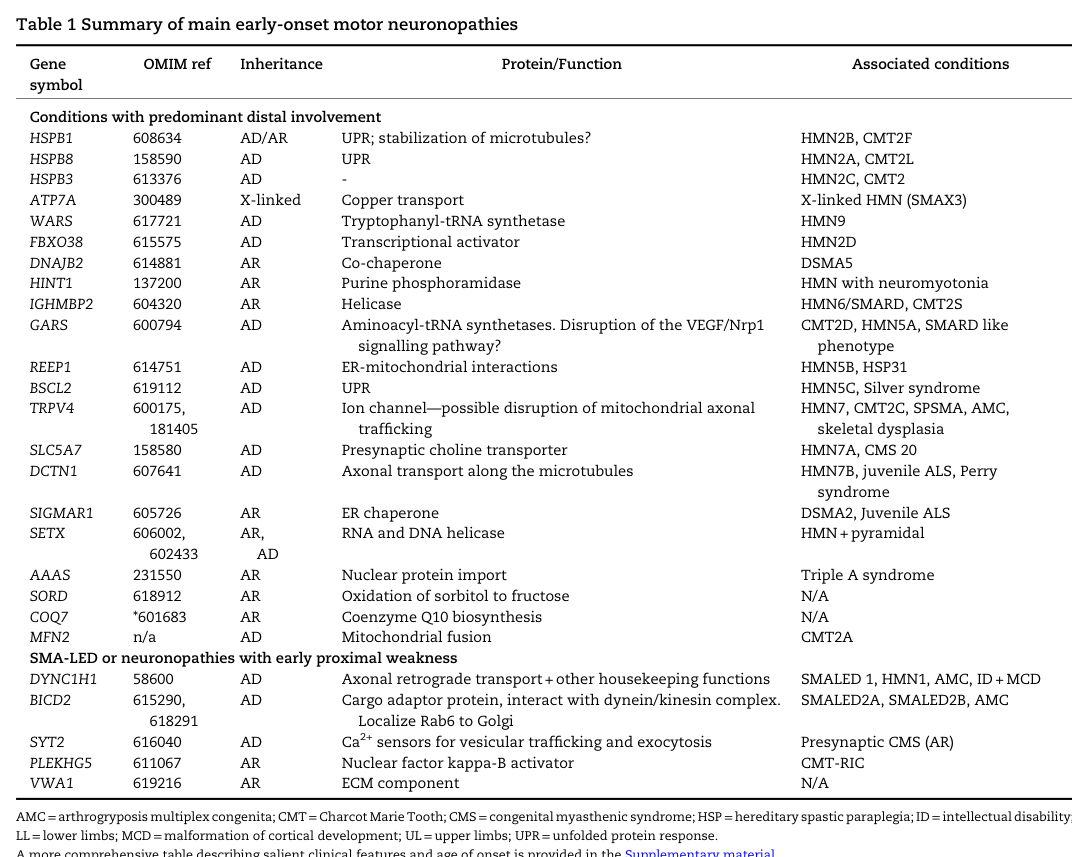
Autosomal dominant distal hereditary motor neuronopathy (dHMN; also called autosomal dominant distal spinal muscular atrophy, dSMA) is a clinically and genetically heterogeneous group of inherited lower motor neuron disorders characterized by slowly progressive, length-dependent distal muscle weakness and atrophy with minimal or absent sensory involvement. Neurophysiology shows chronic neurogenic denervation on EMG with a motor axonal pattern on nerve conduction studies and preserved sensory responses, distinguishing dHMN from axonal Charcot-Marie-Tooth disease (CMT2). The autosomal dominant forms are caused by heterozygous mutations in genes affecting motor-neuron and distal-axon biology, prominently the small heat-shock protein chaperones HSPB1 (dHMN2B / CMT2F), HSPB3 (dHMN2C) and HSPB8 (dHMN2A, split out - see below), the endoplasmic-reticulum protein seipin BSCL2 (dHMN5 / Silver syndrome), the aminoacyl-tRNA synthetase GARS1 (dHMN5 / CMT2D spectrum), the axonal-transport motor adaptor DCTN1 (dynactin), the presynaptic choline transporter SLC5A7 (dHMN7A), and the cation channel TRPV4 (scapuloperoneal/congenital distal SMA spectrum). Recurrent pathogenic mechanisms include disrupted protein quality control with aggregation, impaired axonal transport, defective tRNA charging/translation, and disturbed neuromuscular-junction transmission. The autosomal recessive forms (e.g., IGHMBP2/SMARD1, SIGMAR1, PLEKHG5) are a distinct sibling entry. HSPB8 causes dHMN type 2A (MONDO:0008025) and now has its own entry, `Distal_Hereditary_Motor_Neuronopathy_Type_2A`, rather than being carried here as a subtype - it is curated as a specific toxic-gain-of-function proteostasis lesion at the K141 hot spot, running through the HSPB8-BAG3 chaperone-assisted selective autophagy complex, which is finer than the general proteostasis framing of this entry. Its subtype row, HSPB8 genetic block and OMIM:158590 assertion moved with it. Four further dominant loci are curated here as subtype rows: FBXO38 (dHMN type 2D), which acts through KLF7-dependent transcription of axon-outgrowth genes; EMILIN1 (HMND10), an extracellular matrix glycoprotein and the one locus on this entry whose lesion is outside the motor neuron; SPTAN1 (HMND11), acting by haploinsufficiency of the axonal alpha-II spectrin cytoskeleton; and BAG3 (HMND15), the HSPB8 co-chaperone of chaperone-assisted selective autophagy. A second aminoacyl-tRNA synthetase gene, WARS1, causes dHMN type 9 (MONDO:0060585) and has its own entry, `Distal_Hereditary_Motor_Neuronopathy_Type_9`, rather than being folded in here - its curated mechanism is two-armed (dominant-negative loss of tryptophanyl-tRNA charging plus potentiation of a non-canonical angiostatic TrpRS activity) and is not represented by the proteostasis and axonal-transport framing of this entry.
Ask OpenScientist
Ask a research question about Distal Hereditary Motor Neuronopathy, Autosomal Dominant. OpenScientist will conduct autonomous deep research using the Disorder Mechanisms Knowledge Base and PubMed literature (typically 10-30 minutes).
Do not include personal health information in your question. Questions and results are cached in your browser's local storage.
Classifications
Mappings
Subtypes
11Show evidence (1 reference)
Show evidence (1 reference)
Show evidence (1 reference)
Show evidence (1 reference)
Show evidence (1 reference)
Show evidence (4 references)
Show evidence (1 reference)
Show evidence (2 references)
Show evidence (3 references)
Show evidence (3 references)
Show evidence (1 reference)
Pathophysiology
4Show evidence (7 references)
Show evidence (3 references)
Show evidence (1 reference)
Show evidence (1 reference)
Pathograph
Phenotypes
8Limbs 2
Show evidence (1 reference)
Show evidence (1 reference)
Musculoskeletal 3
Show evidence (1 reference)
Show evidence (1 reference)
Show evidence (1 reference)
Nervous System 3
Show evidence (1 reference)
Show evidence (1 reference)
Show evidence (1 reference)
Genetic Associations
11Show evidence (1 reference)
Show evidence (1 reference)
Show evidence (1 reference)
Show evidence (1 reference)
Show evidence (1 reference)
Show evidence (2 references)
Show evidence (1 reference)
Show evidence (1 reference)
Show evidence (1 reference)
Show evidence (1 reference)
Show evidence (1 reference)
External Assertions
5Medical Actions
3Prevalence
2Show evidence (2 references)
Show evidence (1 reference)
Source YAML
click to showname: Distal Hereditary Motor Neuronopathy, Autosomal Dominant
creation_date: "2026-06-17T00:00:00Z"
category: Genetic
description: >
Autosomal dominant distal hereditary motor neuronopathy (dHMN; also called
autosomal dominant distal spinal muscular atrophy, dSMA) is a clinically and
genetically heterogeneous group of inherited lower motor neuron disorders
characterized by slowly progressive, length-dependent distal muscle weakness
and atrophy with minimal or absent sensory involvement. Neurophysiology shows
chronic neurogenic denervation on EMG with a motor axonal pattern on nerve
conduction studies and preserved sensory responses, distinguishing dHMN from
axonal Charcot-Marie-Tooth disease (CMT2). The autosomal dominant forms are
caused by heterozygous mutations in genes affecting motor-neuron and
distal-axon biology, prominently the small heat-shock protein chaperones HSPB1
(dHMN2B / CMT2F), HSPB3 (dHMN2C) and HSPB8 (dHMN2A, split out - see below), the
endoplasmic-reticulum protein seipin
BSCL2 (dHMN5 / Silver syndrome), the aminoacyl-tRNA synthetase GARS1
(dHMN5 / CMT2D spectrum), the axonal-transport motor adaptor DCTN1
(dynactin), the presynaptic choline transporter SLC5A7 (dHMN7A), and the cation
channel TRPV4 (scapuloperoneal/congenital distal SMA spectrum). Recurrent
pathogenic mechanisms include disrupted protein quality control with
aggregation, impaired axonal transport, defective tRNA charging/translation,
and disturbed neuromuscular-junction transmission. The autosomal recessive
forms (e.g., IGHMBP2/SMARD1, SIGMAR1, PLEKHG5) are a distinct sibling entry.
HSPB8 causes dHMN type 2A (MONDO:0008025) and now has its own entry,
`Distal_Hereditary_Motor_Neuronopathy_Type_2A`, rather than being carried
here as a subtype - it is curated as a specific toxic-gain-of-function
proteostasis lesion at the K141 hot spot, running through the HSPB8-BAG3
chaperone-assisted selective autophagy complex, which is finer than the
general proteostasis framing of this entry. Its subtype row, HSPB8 genetic
block and OMIM:158590 assertion moved with it.
Four further dominant loci are curated here as subtype rows: FBXO38 (dHMN
type 2D), which acts through KLF7-dependent transcription of axon-outgrowth
genes; EMILIN1 (HMND10), an extracellular matrix glycoprotein and the one
locus on this entry whose lesion is outside the motor neuron; SPTAN1
(HMND11), acting by haploinsufficiency of the axonal alpha-II spectrin
cytoskeleton; and BAG3 (HMND15), the HSPB8 co-chaperone of
chaperone-assisted selective autophagy.
A second aminoacyl-tRNA synthetase gene, WARS1, causes dHMN type 9
(MONDO:0060585) and has its own entry,
`Distal_Hereditary_Motor_Neuronopathy_Type_9`, rather than being folded in
here - its curated mechanism is two-armed (dominant-negative loss of
tryptophanyl-tRNA charging plus potentiation of a non-canonical angiostatic
TrpRS activity) and is not represented by the proteostasis and
axonal-transport framing of this entry.
disease_term:
preferred_term: autosomal dominant distal hereditary motor neuropathy
term:
id: MONDO:0015362
label: neuronopathy, distal hereditary motor, autosomal dominant
parents:
- distal hereditary motor neuropathy
mappings:
mondo_mappings:
- term:
id: MONDO:0010043
label: hereditary spastic paraplegia 17
mapping_predicate: skos:narrowMatch
mapping_source: MONDO
mapping_justification: >-
OMIM gives BSCL2 two phenotype entries that both sit under this entry's
disease term in MONDO: OMIM:270685 Silver syndrome / SPG17, which MONDO
labels `hereditary spastic paraplegia 17`, and OMIM:619112, which MONDO
labels `neuronopathy, distal hereditary motor, type 5C`. The single
`dHMN5` subtype row here covers both, because the entity curated is one
BSCL2 allelic spectrum (N88S/S90L) whose upper-motor-neuron involvement is
variable rather than two diseases. `subtype_term` is single-valued, so the
row binds the pure-dHMN term (MONDO:0030860) - the one inside this entry's
scope - and the Silver-syndrome/SPG17 term is declared here at disease
level instead. narrowMatch rather than exactMatch because SPG17 is
narrower than the dismech subtype and is also a hereditary spastic
paraplegia, which this entry is not.
- term:
id: MONDO:0976226
label: neuronopathy, distal hereditary motor, autosomal dominant 15
mapping_predicate: skos:narrowMatch
mapping_source: MONDO
mapping_justification: >-
The BAG3 leaf, HMND15 / OMIM:621094. Bound as the `subtype_term` of the
`dHMN-BAG3` row, and declared here as well because BAG3's neuropathy
phenotypes are curated in depth in a different entry
(`Charcot-Marie-Tooth_Disease_Axonal_Type_2JJ`, MONDO:0976227 /
OMIM:621095) and a reader arriving at either entry should be able to see
that the two OMIM numbers are adjacent phenotypes of one gene rather than
duplicates.
classifications:
harrisons_chapter:
- classification_value: NEUROLOGIC
notes: >
Three numbering systems are live for these diseases and they do not agree, so
read a subtype designation together with its gene. OMIM currently numbers the
dominant forms HMND1 to HMND15 in one series, in the genetic-heterogeneity
table carried by its HMND1 entry (OMIM:182960; read from the corresponding
MedGen record, Concept ID C1866784); MONDO keeps the older Harding
style for the earlier entities (`type 2B`, `type 5A`, `type 7A`) and uses the
OMIM style for the recent ones (`autosomal dominant 10`, `11`, `15`); and this
entry's `has_subtypes[].name` values are short slugs that follow whichever
designation the literature uses for that gene. The collisions are real, and
each pairing below was checked against the MONDO term's own OMIM
cross-reference rather than inferred from the labels: MONDO's `type 5A`
(OMIM:600794) is OMIM's HMND5 (GARS1), `type 5B` (OMIM:614751) is HMND12
(REEP1), `type 5C` (OMIM:619112) is HMND13 (BSCL2), and `type 2D`
(OMIM:615575) is HMND6 (FBXO38). The `subtype_term`
bindings are the machine-readable answer and the gene is the human-readable
one; the slug is neither.
Every MONDO descendant of this entry's disease term MONDO:0015362 is accounted
for, either here or elsewhere in the knowledge base:
- Curated as subtype rows here: MONDO:0012080 (HSPB1), MONDO:0030860 (BSCL2),
MONDO:0015353 (GARS1), MONDO:0011879 (DCTN1), MONDO:0008024 (SLC5A7),
MONDO:0013243 (HSPB3), MONDO:0010839 (TRPV4), MONDO:0014259 (FBXO38),
MONDO:0859300 (EMILIN1), MONDO:0957875 (SPTAN1), MONDO:0976226 (BAG3).
- Curated as their own disease entries: MONDO:0008025 dHMN2A (HSPB8, as
`Distal_Hereditary_Motor_Neuronopathy_Type_2A`), MONDO:0013884 dHMN5B (REEP1,
as `Distal_Hereditary_Motor_Neuronopathy_Type_5B`), MONDO:0060585 dHMN9
(WARS1, as `Distal_Hereditary_Motor_Neuronopathy_Type_9`).
- Declared at disease level as a `skos:narrowMatch` mapping: MONDO:0010043
Silver syndrome / SPG17, the second BSCL2 term.
- Curated elsewhere because it is not primarily a neuronopathy:
MONDO:0976133 `myopathy, myofibrillar, 13, with rimmed vacuoles` (HSPB8,
OMIM:621078), which MONDO files under this entry's term and under
myofibrillar myopathy simultaneously. It is a subtype row on
`Myofibrillar_Myopathy`, which is the right home for the myopathic pole of
the HSPB8 spectrum; no row is duplicated here.
- Not curated, because MONDO records no causal gene for them and there is
nothing gene-defined to curate: MONDO:0008451 `neuronopathy, distal
hereditary motor, autosomal dominant 1` (OMIM:182960), which is the legacy
Harding type 1 designation and the entry whose record carries the
nomenclature table for the whole series, and the three intermediate grouping
terms MONDO:0015352 (`distal hereditary motor neuropathy type 2`),
MONDO:0100350 (`type 5`) and MONDO:0015355 (`type 7`), which exist to
collect their lettered children.
references:
- reference: PMID:36445400
title: "Early onset hereditary neuronopathies: an update on non-5q motor neuron diseases."
- reference: PMID:21902652
title: "Molecular genetics and mechanisms of disease in distal hereditary motor neuropathies: insights directing future genetic studies."
external_assertions:
- name: OMIM dHMN2B / CMT2F (HSPB1)
source: OMIM
assertion_type: disease_record
external_id: OMIM:606595
description: OMIM phenotype entry for distal hereditary motor neuronopathy type 2B / CMT2F (HSPB1-related).
- name: OMIM dHMN5 / Silver syndrome (BSCL2)
source: OMIM
assertion_type: disease_record
external_id: OMIM:270685
description: OMIM phenotype entry for Silver syndrome / distal hereditary motor neuropathy type V (BSCL2-related).
- name: OMIM dHMN5 / CMT2D (GARS1)
source: OMIM
assertion_type: disease_record
external_id: OMIM:601472
description: OMIM phenotype entry for distal spinal muscular atrophy type V / CMT2D (GARS1-related).
- name: OMIM dHMN7B (DCTN1)
source: OMIM
assertion_type: disease_record
external_id: OMIM:607641
description: OMIM phenotype entry for distal hereditary motor neuronopathy type 7B (DCTN1-related).
- name: OMIM dHMN2C (HSPB3)
source: OMIM
assertion_type: disease_record
external_id: OMIM:613376
description: >-
OMIM phenotype entry for distal hereditary motor neuronopathy type 2C
(HSPB3-related). The number is taken from the MONDO:0013243 cross-reference
set rather than from recall.
has_subtypes:
- name: dHMN2B
display_name: dHMN2B / CMT2F (HSPB1-related)
subtype_term:
preferred_term: neuronopathy, distal hereditary motor, type 2B
term:
id: MONDO:0012080
label: neuronopathy, distal hereditary motor, type 2B
genes:
- preferred_term: HSPB1
term:
id: hgnc:5246
label: HSPB1
description: >
Autosomal dominant distal hereditary motor neuropathy / axonal CMT2F caused
by heterozygous missense mutations in HSPB1 (HSP27), a small heat-shock
protein chaperone. Mutant HSPB1 reduces neuronal viability and disrupts
neurofilament assembly.
evidence:
- reference: PMID:15122254
reference_title: "Mutant small heat-shock protein 27 causes axonal Charcot-Marie-Tooth disease and distal hereditary motor neuropathy."
supports: SUPPORT
evidence_source: HUMAN_CLINICAL
snippet: "We observed the additional HSPB1 mutations in four families with distal HMN and in one individual with CMT neuropathy."
explanation: Establishes HSPB1 mutations as a cause of dominant distal HMN (and CMT2F).
- name: dHMN5
display_name: dHMN5 / Silver syndrome (BSCL2-related)
subtype_term:
preferred_term: neuronopathy, distal hereditary motor, type 5C
term:
id: MONDO:0030860
label: neuronopathy, distal hereditary motor, type 5C
genes:
- preferred_term: BSCL2
term:
id: hgnc:15832
label: BSCL2
description: >
Autosomal dominant distal hereditary motor neuropathy type V and Silver
syndrome caused by heterozygous BSCL2 missense mutations (N88S, S90L). BSCL2
encodes the endoplasmic-reticulum protein seipin; the substitutions impair
seipin glycosylation and cause aggregate formation and neurodegeneration,
with upper-limb predominant amyotrophy and variable lower-limb spasticity.
evidence:
- reference: PMID:14981520
reference_title: "Heterozygous missense mutations in BSCL2 are associated with distal hereditary motor neuropathy and Silver syndrome."
supports: SUPPORT
evidence_source: HUMAN_CLINICAL
snippet: "we sequenced the gene Berardinelli-Seip congenital lipodystrophy (BSCL2) and identified two heterozygous missense mutations resulting in the amino acid substitutions N88S and S90L."
explanation: Establishes heterozygous BSCL2 mutations as the cause of dominant dHMN-V / Silver syndrome.
- name: dHMN5-GARS
display_name: dHMN5 / CMT2D (GARS1-related)
subtype_term:
preferred_term: neuronopathy, distal hereditary motor, type 5A
term:
id: MONDO:0015353
label: neuronopathy, distal hereditary motor, type 5A
genes:
- preferred_term: GARS1
term:
id: hgnc:4162
label: GARS1
description: >
Autosomal dominant distal spinal muscular atrophy type V / CMT2D caused by
heterozygous GARS1 (glycyl-tRNA synthetase) missense mutations, with
upper-limb predominant distal weakness and atrophy. This was the first
aminoacyl-tRNA synthetase implicated in a human inherited neuropathy.
evidence:
- reference: PMID:12690580
reference_title: "Glycyl tRNA synthetase mutations in Charcot-Marie-Tooth disease type 2D and distal spinal muscular atrophy type V."
supports: SUPPORT
evidence_source: HUMAN_CLINICAL
snippet: "we report the identification of four disease-associated missense mutations in the glycyl tRNA synthetase gene in families with CMT2D and dSMA-V."
explanation: Establishes heterozygous GARS1 mutations as a cause of dominant dSMA-V / CMT2D.
- name: dHMN7B
display_name: dHMN7B (DCTN1-related)
subtype_term:
preferred_term: neuronopathy, distal hereditary motor, type 7B
term:
id: MONDO:0011879
label: neuronopathy, distal hereditary motor, type 7B
genes:
- preferred_term: DCTN1
term:
id: hgnc:2711
label: DCTN1
description: >
Autosomal dominant lower motor neuron disease / distal hereditary motor
neuropathy caused by a heterozygous DCTN1 (dynactin p150glued) mutation in
the microtubule-binding CAP-Gly domain, impairing dynactin-mediated axonal
transport; the original family had vocal-cord and facial weakness with distal
limb atrophy.
evidence:
- reference: PMID:12627231
reference_title: "Mutant dynactin in motor neuron disease."
supports: SUPPORT
evidence_source: HUMAN_CLINICAL
snippet: "Mutation analysis of a gene in this interval that encodes the largest subunit of the axonal transport protein dynactin showed a single base-pair change resulting in an amino-acid substitution that is predicted to distort the folding of dynactin's microtubule-binding domain."
explanation: Establishes a heterozygous DCTN1 (dynactin) mutation as a cause of dominant lower motor neuron disease.
- name: dHMN7A
display_name: dHMN7A (SLC5A7-related)
subtype_term:
preferred_term: neuronopathy, distal hereditary motor, type 7A
term:
id: MONDO:0008024
label: neuronopathy, distal hereditary motor, type 7A
genes:
- preferred_term: SLC5A7
term:
id: hgnc:14025
label: SLC5A7
description: >
Autosomal dominant distal hereditary motor neuropathy type VII caused by a
dominantly segregating SLC5A7 mutation encoding the presynaptic choline
transporter (CHT). The truncating mutation reduces choline uptake at the
neuromuscular junction, linking dHMN to impaired NMJ transmission.
evidence:
- reference: PMID:23141292
reference_title: "Defective presynaptic choline transport underlies hereditary motor neuropathy."
supports: SUPPORT
evidence_source: HUMAN_CLINICAL
snippet: "Using linkage analysis and whole-exome sequencing of DNA samples from subjects with distal hereditary motor neuropathy type VII, we identified a mutation in SLC5A7, which encodes the presynaptic choline transporter (CHT)"
explanation: Establishes a dominant SLC5A7 mutation as the cause of dHMN type VII.
- name: dHMN2C
display_name: dHMN2C (HSPB3-related)
description: >
Distal hereditary motor neuronopathy type 2C, caused by a heterozygous
variant in HSPB3 (HSPL27), a third small heat-shock protein of the same
family as the HSPB1 and HSPB8 genes that dominate this entry. The founding
report identified c.21G>T (p.Arg7Ser) in the N-terminal domain in two
affected siblings with an asymmetric, length-dependent, predominantly motor
axonal neuropathy, found by screening all ten sHSP genes in a neuropathy
cohort rather than by linkage. A second heterozygous allele, c.352T>C
(p.Tyr118His) in the alpha-crystallin domain, was later reported in a Korean
family that was ascribed to axonal CMT2 rather than to dHMN, so the two
published alleles sit on either side of the dHMN/CMT2 boundary that this
entry otherwise draws electrophysiologically.
The evidence base is deliberately recorded as thin. A 2016 review of the
chaperone dHMNs states that only one family was then known to carry a
clinical HSPB3 mutation, and ClinGen's Gene-Disease Validity table (release
pinned in data/clingen/MANIFEST.yaml) contains no HSPB3 assertion at all,
while it classifies HSPB8 as Definitive for MONDO:0015362 - this entry's own
disease term.
HSPB3 is therefore curated here as a subtype row rather than as a separate
disease entry: it has two reported alleles in two families and no
disease-specific pathophysiology that is distinguishable from the
chaperone/proteostasis chain this entry already models.
Naming trap. dHMN2C (HSPB3) is not HMSN2C, the hereditary motor and sensory
neuropathy caused by TRPV4 that appears in the `dHMN-TRPV4` row of this same
entry. The two abbreviations differ by one letter and name different genes
and different diseases.
subtype_term:
preferred_term: neuronopathy, distal hereditary motor, type 2C
term:
id: MONDO:0013243
label: neuronopathy, distal hereditary motor, type 2C
genes:
- preferred_term: HSPB3
term:
id: hgnc:5248
label: HSPB3
evidence:
- reference: PMID:20142617
reference_title: "Mutant small heat shock protein B3 causes motor neuropathy: utility of a candidate gene approach."
supports: SUPPORT
evidence_source: HUMAN_CLINICAL
snippet: "A missense mutation in the gene encoding small heat shock protein B3 (HSPB3, also called HSP27, protein 3) was discovered in 2 siblings with an asymmetric axonal motor neuropathy."
explanation: >-
Founding report assigning HSPB3 to a dominant-pattern axonal motor
neuropathy, which is the gene-disease claim this subtype row makes.
- reference: PMID:20142617
reference_title: "Mutant small heat shock protein B3 causes motor neuropathy: utility of a candidate gene approach."
supports: SUPPORT
evidence_source: HUMAN_CLINICAL
snippet: "The mutation, HSPB3(R7S), is located in the N-terminal domain and involves the loss of a conserved arginine."
explanation: >-
Locates the founding allele in the N-terminal domain, which is what
distinguishes it from the alpha-crystallin-domain allele reported later.
- reference: PMID:28018906
reference_title: "Chaperonopathies: Spotlight on Hereditary Motor Neuropathies."
supports: SUPPORT
evidence_source: OTHER
snippet: "At present, only one family is thought to carry clinical mutations in the HSPB3/HSPL27 gene: a missense mutation c.21G>T (p.R7S) described in two affected sisters who suffer from dHMN (dHMN2C)"
explanation: >-
Review naming the entity dHMN2C and recording how narrow the evidence base
was, which is the reason this is a subtype row rather than its own entry.
- reference: PMID:29341343
reference_title: "Small heat shock protein B3 (HSPB3) mutation in an axonal Charcot-Marie-Tooth disease family."
supports: SUPPORT
evidence_source: HUMAN_CLINICAL
snippet: "We identified a heterozygous mutation (c.352T>C, p.Tyr118His) in the HSPB3 from a Charcot-Marie-Tooth disease type 2 (CMT2) family by the method of targeted next generation sequencing."
explanation: >-
Second reported HSPB3 family; the allele is heterozygous, and the family was
classified as axonal CMT2 rather than dHMN.
- name: dHMN-TRPV4
display_name: Scapuloperoneal / congenital distal SMA (TRPV4-related)
subtype_term:
preferred_term: neuronopathy, distal hereditary motor, autosomal dominant 8
term:
id: MONDO:0010839
label: neuronopathy, distal hereditary motor, autosomal dominant 8
genes:
- preferred_term: TRPV4
term:
id: hgnc:18083
label: TRPV4
description: >
Autosomal dominant congenital distal SMA, scapuloperoneal SMA, and
HMSN2C caused by heterozygous TRPV4 missense mutations affecting the
intracellular N-terminal ankyrin domain, with reduced surface localization
of the mutant calcium-permeable cation channel.
evidence:
- reference: PMID:20037588
reference_title: "Alterations in the ankyrin domain of TRPV4 cause congenital distal SMA, scapuloperoneal SMA and HMSN2C."
supports: SUPPORT
evidence_source: HUMAN_CLINICAL
snippet: "we report that mutations in the TRPV4 gene cause congenital distal SMA, scapuloperoneal SMA, HMSN 2C. We identified three missense substitutions (R269H, R315W and R316C) affecting the intracellular N-terminal ankyrin domain of the TRPV4 ion channel in five families."
explanation: Establishes heterozygous TRPV4 ankyrin-domain mutations as a cause of dominant distal/scapuloperoneal SMA.
- name: dHMN-FBXO38
display_name: dHMN type 2D / HMND6 (FBXO38-related)
subtype_term:
preferred_term: neuronopathy, distal hereditary motor, type 2D
term:
id: MONDO:0014259
label: neuronopathy, distal hereditary motor, type 2D
genes:
- preferred_term: FBXO38
term:
id: hgnc:28844
label: FBXO38
description: >
Autosomal dominant distal SMA presenting with calf weakness, caused by the
heterozygous FBXO38 missense substitution p.Cys206Arg in two unrelated
families. FBXO38 is a coactivator of the transcription factor KLF7, and the
substitution leaves FBXO38 correctly localised while impairing KLF7-driven
transcription of genes needed for axon outgrowth and repair - a
transcriptional rather than a chaperone or transport lesion, which is why
this row records its own mechanism instead of deferring to the proteostasis
chain that covers the small heat-shock protein subtypes.
Calf-predominant weakness at onset is the distinguishing clinical feature
against the foot-drop-first presentation the rest of this entry describes.
PMID:31420593 later reported a homozygous FBXO38 variant, p.Arg526Gln, in the
child of consanguineous parents with a congenital mild neuronopathy, and
proposed a loss-of-function mechanism, so dominant and recessive alleles are
both on record for this gene. That report is named rather than cited as
evidence because the entity this row curates is the dominant one; the dominant
allele is what defines it.
evidence:
- reference: PMID:24207122
reference_title: "A dominant mutation in FBXO38 causes distal spinal muscular atrophy with calf predominance."
supports: SUPPORT
evidence_source: HUMAN_CLINICAL
snippet: "In two unrelated families affected by a distinct form of autosomal-dominant distal SMA initially manifesting with calf weakness, we identified by genetic linkage analysis and exome sequencing a heterozygous missense mutation, c.616T>C (p.Cys206Arg), in F-box protein 38 (FBXO38)."
explanation: >-
Establishes the gene, the single dominant allele, the two-family basis, and
the calf-predominant onset that distinguishes this subtype.
- reference: PMID:24207122
reference_title: "A dominant mutation in FBXO38 causes distal spinal muscular atrophy with calf predominance."
supports: SUPPORT
evidence_source: IN_VITRO
snippet: "This transcriptional dysregulation was associated with an impairment of neurite outgrowth in primary motor neurons."
explanation: >-
The functional consequence in the cell type this entry is about, and the
reason the mechanism is recorded as transcriptional dysregulation of axon
outgrowth rather than as a proteostasis defect.
- name: dHMN-EMILIN1
display_name: dHMN, autosomal dominant 10 / HMND10 (EMILIN1-related)
subtype_term:
preferred_term: neuronopathy, distal hereditary motor, autosomal dominant 10
term:
id: MONDO:0859300
label: neuronopathy, distal hereditary motor, autosomal dominant 10
genes:
- preferred_term: EMILIN1
term:
id: hgnc:19880
label: EMILIN1
description: >
Autosomal dominant distal motor neuropathy attributed to the heterozygous
EMILIN1 substitution p.R250C in the coiled-coil region, reported in four
affected members of one family. EMILIN-1 is an extracellular matrix
glycoprotein, so this is the only subtype on this entry whose lesion sits
outside the motor neuron: the reported defect is reduced extracellular
deposition of EMILIN-1 in a disorganised fibre network, with EMILIN-1
demonstrated in nerve structures on muscle biopsy.
Two reasons this row is scoped narrowly. First, the evidence base is one
family for the motor-predominant phenotype, plus an earlier single family in
which an EMILIN1 missense variant was associated with an autosomal dominant
connective tissue disorder and a motor-sensory neuropathy - so a neuropathy
has been reported twice, in two different clinical contexts, in two
families. Second,
the one ClinGen Gene-Disease Validity assertion for EMILIN1 in the current
table (file created 2026-09-25) is `Definitive` for arterial
tortuosity-bone fragility syndrome (MONDO:0971179) with autosomal recessive
inheritance - a different disease and a different inheritance mode from the
one MONDO's HMND10 edge asserts, so that Definitive classification supports
nothing about this subtype. ClinGen has not classified EMILIN1 against any
neuropathy.
evidence:
- reference: PMID:31978608
reference_title: Distal motor neuropathy associated with novel EMILIN1 mutation.
supports: SUPPORT
evidence_source: HUMAN_CLINICAL
snippet: "located in the coiled coil forming region of the protein, in four affected members of an autosomal dominant family presenting a distal motor neuropathy phenotype"
explanation: >-
The gene-disease claim this subtype rests on: four affected members of one
autosomal dominant family with a distal motor neuropathy phenotype, and a
variant in the coiled-coil region. The quoted span starts mid-sentence
because the source writes the allele as `c.748C>T [p.R250C]`, and the
reference validator strips bracketed glosses from a snippet before matching
while the cached source keeps them, so no quotation spanning that bracket
can verify. The allele and the gene are recorded in the description and in
the `EMILIN1` `genetic:` record instead.
- reference: PMID:31978608
reference_title: Distal motor neuropathy associated with novel EMILIN1 mutation.
supports: SUPPORT
quote_role: BACKGROUND
evidence_source: HUMAN_CLINICAL
snippet: "Recently, a missense mutation in the EMILIN1 gene has been associated with autosomal dominant connective tissue disorder and motor-sensory neuropathy in a single family."
explanation: >-
The earlier of the two reported families, which had a connective-tissue
disorder with sensorimotor neuropathy rather than the motor-predominant
phenotype of this subtype. Marked BACKGROUND because the citing paper is
restating that prior report rather than presenting it as its own result.
- reference: PMID:31978608
reference_title: Distal motor neuropathy associated with novel EMILIN1 mutation.
supports: SUPPORT
evidence_source: MODEL_ORGANISM
snippet: "Downregulation of emilin1a in zebrafish displayed developmental delay, locomotion defects, and abnormal axonal arborization from spinal cord motor neurons."
explanation: >-
The animal support, and specifically that the axonal defect is in spinal
cord motor neurons, which is what makes an extracellular matrix gene
relevant to a lower motor neuron disease.
- name: dHMN-SPTAN1
display_name: dHMN, autosomal dominant 11 / HMND11 (SPTAN1-related)
subtype_term:
preferred_term: neuronopathy, distal hereditary motor, autosomal dominant 11
term:
id: MONDO:0957875
label: neuronopathy, distal hereditary motor, autosomal dominant 11
genes:
- preferred_term: SPTAN1
term:
id: hgnc:11273
label: SPTAN1
description: >
Juvenile-onset autosomal dominant hereditary motor neuropathy caused by
heterozygous nonsense variants in SPTAN1, the alpha-II spectrin gene, in
three separate families. The mutant transcript is degraded by
nonsense-mediated decay and patient cells carry reduced protein, so the
mechanism is haploinsufficiency of a cytoskeletal scaffolding protein.
Penetrance was variable in two of the three families and severity differed
widely between affected individuals.
The allelic mechanism is what separates this entity from the other SPTAN1
disease. ClinGen classifies SPTAN1 `Definitive` for genetic developmental
and epileptic encephalopathy (MONDO:0100062, autosomal dominant; current
table, file created 2026-09-25) and has no assertion against any neuropathy;
that encephalopathy is curated in this knowledge base as
`SPTAN1-Related_Developmental_and_Epileptic_Encephalopathy`. The founding
motor-neuropathy report draws the distinction itself: the epilepsy
phenotypes were attributed to dominant-negative alleles, whereas the
neuropathy families carry nonsense alleles that are removed by
nonsense-mediated decay. A Definitive gene-disease assertion is therefore
not transferable between the two, and this row does not borrow it.
evidence:
- reference: PMID:31332438
reference_title: "Nonsense mutations in alpha-II spectrin in three families with juvenile onset hereditary motor neuropathy."
supports: SUPPORT
evidence_source: HUMAN_CLINICAL
snippet: "We identified patients with heterozygous nonsense mutations in the αII-spectrin gene, SPTAN1, in three separate dominant hereditary motor neuropathy families via next-generation sequencing."
explanation: >-
Establishes the gene, the allele class and the three-family dominant basis
for this subtype.
- reference: PMID:31332438
reference_title: "Nonsense mutations in alpha-II spectrin in three families with juvenile onset hereditary motor neuropathy."
supports: SUPPORT
evidence_source: IN_VITRO
snippet: "The mutant mRNA containing nonsense mutations is broken down by nonsense-mediated decay and leads to reduced protein levels in patient cells."
explanation: >-
Supports haploinsufficiency as the mechanism, which is the point on which
this entity differs from the dominant-negative SPTAN1 encephalopathy.
- reference: PMID:31332438
reference_title: "Nonsense mutations in alpha-II spectrin in three families with juvenile onset hereditary motor neuropathy."
supports: SUPPORT
evidence_source: OTHER
snippet: "Previously, dominant-negative αII-spectrin gene mutations were described as causal in a spectrum of epilepsy phenotypes."
explanation: >-
The founding report's own statement of the contrast with the SPTAN1
encephalopathy, which is why ClinGen's Definitive assertion for that
disease is not evidence for this one.
- name: dHMN-BAG3
display_name: dHMN, autosomal dominant 15 / HMND15 (BAG3-related)
subtype_term:
preferred_term: neuronopathy, distal hereditary motor, autosomal dominant 15
term:
id: MONDO:0976226
label: neuronopathy, distal hereditary motor, autosomal dominant 15
genes:
- preferred_term: BAG3
term:
id: hgnc:939
label: BAG3
description: >
Adult-onset autosomal dominant distal hereditary motor neuronopathy caused
by a heterozygous truncating BAG3 variant, reported in one family of eight
affected individuals with incomplete penetrance in women. BAG3's role as the
co-chaperone of chaperone-assisted selective autophagy and as the binding
partner of HSPB8 is curated with its sources in
`Charcot-Marie-Tooth_Disease_Axonal_Type_2JJ` and in
`Distal_Hereditary_Motor_Neuronopathy_Type_2A` rather than restated here;
taking it from there, the lesion sits on the same proteostasis machinery as
the small heat-shock protein subtypes of this entry.
This row is deliberately thin, and points elsewhere rather than duplicating.
The phenotype, its contrast with the sensory-predominant BAG3 neuropathy, and
the variant-class-to-phenotype correlation across BAG3's disease spectrum are
curated in `Charcot-Marie-Tooth_Disease_Axonal_Type_2JJ` (MONDO:0976227 /
OMIM:621095), which is the deeper treatment. The row exists here because
MONDO makes HMND15 (MONDO:0976226 / OMIM:621094) a direct child of this
entry's own disease term and nothing in the knowledge base bound it, so the
gene-defined subtype had no home. ClinGen classifies BAG3 `Definitive` for
myofibrillar myopathy and for dilated cardiomyopathy 1HH (current table, file
created 2026-09-25) and has no assertion against any neuropathy, so neither
classification supports this row.
evidence:
- reference: PMID:37907725
reference_title: "Distal hereditary motor neuronopathy as a new phenotype associated with variants in BAG3."
supports: SUPPORT
evidence_source: HUMAN_CLINICAL
snippet: >-
We report an autosomal dominant adult-onset distal hereditary motor
neuronopathy with incomplete penetrance in women as a new phenotype related
to a truncating variant in the BAG3 gene.
explanation: >-
Establishes the entity, its inheritance and the sex-dependent penetrance
that this subtype row asserts.
pathophysiology:
- name: Motor Neuron and Distal Axon Gene Defect
description: >
Heterozygous (dominant) mutations in motor-neuron and distal-axon genes —
small heat-shock protein chaperones (HSPB1, HSPB8), the ER protein seipin
(BSCL2), glycyl-tRNA synthetase (GARS1), the dynactin axonal-transport
adaptor (DCTN1), the choline transporter (SLC5A7), and the TRPV4 cation
channel — impair the homeostatic functions that lower motor neurons require
to build and maintain their long peripheral axons. Recurrent molecular
consequences are protein misfolding/aggregation, impaired axonal transport,
and defective tRNA charging.
cell_types:
- preferred_term: motor neuron
term:
id: CL:0000100
label: motor neuron
genes:
- preferred_term: HSPB1
term:
id: hgnc:5246
label: HSPB1
- preferred_term: HSPB3
term:
id: hgnc:5248
label: HSPB3
- preferred_term: BSCL2
term:
id: hgnc:15832
label: BSCL2
- preferred_term: GARS1
term:
id: hgnc:4162
label: GARS1
- preferred_term: DCTN1
term:
id: hgnc:2711
label: DCTN1
- preferred_term: SLC5A7
term:
id: hgnc:14025
label: SLC5A7
- preferred_term: TRPV4
term:
id: hgnc:18083
label: TRPV4
- preferred_term: FBXO38
term:
id: hgnc:28844
label: FBXO38
- preferred_term: EMILIN1
term:
id: hgnc:19880
label: EMILIN1
- preferred_term: SPTAN1
term:
id: hgnc:11273
label: SPTAN1
- preferred_term: BAG3
term:
id: hgnc:939
label: BAG3
biological_processes:
- preferred_term: Protein folding (chaperone function)
term:
id: GO:0006457
label: protein folding
modifier: DECREASED
notes: >
This is the genetic-lesion node of the entry, and its `genes:` list binds
every gene the entry curates as a dominant cause. The claim it makes of each
of them is the one each founding report makes: a heterozygous variant impairs
something lower motor neurons need in order to build and maintain their long
peripheral axons. It does not claim they act by the same molecular route, and
they do not - the small heat-shock proteins and seipin act through protein
quality control, dynactin and glycyl-tRNA synthetase through axonal transport
and local translation, SLC5A7 at the presynaptic terminal of the
neuromuscular junction, TRPV4 through a calcium-permeable channel, FBXO38
through KLF7-dependent transcription of axon-outgrowth genes, SPTAN1 through
the axonal spectrin cytoskeleton, and BAG3 through chaperone-assisted
selective autophagy. Each route is stated in that gene's `genetic:` record
and subtype row.
The bound `protein folding` process term describes the chaperone subset only
(HSPB1, HSPB3, BSCL2, BAG3) and is not asserted of the other seven genes; no
single ontology term covers what this node's eleven genes have in common.
EMILIN1 is the one binding that needs an explicit caveat. It encodes an
extracellular matrix glycoprotein, so its lesion is outside the motor neuron
rather than inside it, and the node's bound cell type should not be read as
locating the EMILIN1 defect in that cell. It is bound here because the
reported consequence is a motor-axonal one - abnormal axonal arborization from
spinal cord motor neurons in the zebrafish knockdown - which is what this
node describes.
evidence:
- reference: PMID:21902652
reference_title: "Molecular genetics and mechanisms of disease in distal hereditary motor neuropathies: insights directing future genetic studies."
supports: SUPPORT
evidence_source: OTHER
snippet: "The mutated genes identified to-date in dHMN include HSPB1, HSPB8, HSPB3, DCTN1, GARS, PLEKHG5, BSCL2, SETX, IGHMBP2, ATP7A and"
explanation: >-
Lists the dominant dHMN genes whose products converge on motor-neuron axon
biology. Covers the HSPB1, HSPB3, DCTN1, GARS1 and BSCL2 bindings at this
node; the remaining six genes are covered by the items below.
- reference: PMID:23141292
reference_title: "Defective presynaptic choline transport underlies hereditary motor neuropathy."
supports: SUPPORT
evidence_source: HUMAN_CLINICAL
snippet: "Using linkage analysis and whole-exome sequencing of DNA samples from subjects with distal hereditary motor neuropathy type VII, we identified a mutation in SLC5A7, which encodes the presynaptic choline transporter (CHT)"
explanation: The basis for binding SLC5A7 at this node.
- reference: PMID:20037588
reference_title: "Alterations in the ankyrin domain of TRPV4 cause congenital distal SMA, scapuloperoneal SMA and HMSN2C."
supports: SUPPORT
evidence_source: HUMAN_CLINICAL
snippet: "We identified three missense substitutions (R269H, R315W and R316C) affecting the intracellular N-terminal ankyrin domain of the TRPV4 ion channel in five families."
explanation: The basis for binding TRPV4 at this node.
- reference: PMID:24207122
reference_title: "A dominant mutation in FBXO38 causes distal spinal muscular atrophy with calf predominance."
supports: SUPPORT
evidence_source: HUMAN_CLINICAL
snippet: "In two unrelated families affected by a distinct form of autosomal-dominant distal SMA initially manifesting with calf weakness, we identified by genetic linkage analysis and exome sequencing a heterozygous missense mutation, c.616T>C (p.Cys206Arg), in F-box protein 38 (FBXO38)."
explanation: The basis for binding FBXO38 at this node.
- reference: PMID:31978608
reference_title: Distal motor neuropathy associated with novel EMILIN1 mutation.
supports: SUPPORT
evidence_source: MODEL_ORGANISM
snippet: "Downregulation of emilin1a in zebrafish displayed developmental delay, locomotion defects, and abnormal axonal arborization from spinal cord motor neurons."
explanation: >-
The basis for binding EMILIN1 at this node, and specifically for binding an
extracellular matrix gene at a motor-neuron node: the reported consequence
is abnormal axonal arborization from spinal cord motor neurons.
- reference: PMID:31332438
reference_title: "Nonsense mutations in alpha-II spectrin in three families with juvenile onset hereditary motor neuropathy."
supports: SUPPORT
evidence_source: HUMAN_CLINICAL
snippet: "We identified patients with heterozygous nonsense mutations in the αII-spectrin gene, SPTAN1, in three separate dominant hereditary motor neuropathy families via next-generation sequencing."
explanation: The basis for binding SPTAN1 at this node.
- reference: PMID:37907725
reference_title: "Distal hereditary motor neuronopathy as a new phenotype associated with variants in BAG3."
supports: SUPPORT
evidence_source: HUMAN_CLINICAL
snippet: >-
We report an autosomal dominant adult-onset distal hereditary motor
neuronopathy with incomplete penetrance in women as a new phenotype related
to a truncating variant in the BAG3 gene.
explanation: The basis for binding BAG3 at this node.
downstream:
- target: Disrupted Proteostasis and Axonal Transport
description: >
Mutant chaperone, ER, synthetase, and dynactin proteins disturb protein
quality control and axonal transport within the motor neuron.
causal_link_type: DIRECT
- name: Disrupted Proteostasis and Axonal Transport
description: >
Mutant small heat-shock proteins (HSPB1, HSPB8) and seipin (BSCL2) form
intracellular aggregates and impair protein quality control, while mutant
dynactin (DCTN1) and tRNA-synthetase (GARS1) defects compromise axonal
transport and local translation — collectively undermining maintenance of
the long motor axon.
cell_types:
- preferred_term: motor neuron
term:
id: CL:0000100
label: motor neuron
genes:
- preferred_term: HSPB1
term:
id: hgnc:5246
label: HSPB1
- preferred_term: BSCL2
term:
id: hgnc:15832
label: BSCL2
- preferred_term: DCTN1
term:
id: hgnc:2711
label: DCTN1
biological_processes:
- preferred_term: Axonal transport
term:
id: GO:0098930
label: axonal transport
modifier: DECREASED
notes: >
Only the three genes for which this node's own cited evidence demonstrates
the mechanistic step are bound here: mutant seipin aggregating (BSCL2),
mutant dynactin losing microtubule binding (DCTN1), and mutant HSP27
disrupting assembly of a client cytoskeletal protein (HSPB1). HSPB3, GARS1
and BAG3 are named in this node's description on the strength of their
protein family and known molecular function, but the evidence this entry
cites for them establishes the gene-disease relationship rather than this
step, so they are bound at the genetic-lesion node only. Closing that gap
needs functional citations for each, not a broader reading of the ones
already here.
evidence:
- reference: PMID:14981520
reference_title: "Heterozygous missense mutations in BSCL2 are associated with distal hereditary motor neuropathy and Silver syndrome."
supports: SUPPORT
evidence_source: IN_VITRO
snippet: "The amino acid substitutions N88S and S90L affect glycosylation of seipin and result in aggregate formation leading to neurodegeneration."
explanation: Mutant seipin aggregation exemplifies the proteostasis defect driving motor-neuron degeneration.
- reference: PMID:12627231
reference_title: "Mutant dynactin in motor neuron disease."
supports: SUPPORT
evidence_source: IN_VITRO
snippet: "Binding assays show decreased binding of the mutant protein to microtubules. Our results show that dysfunction of dynactin-mediated transport can lead to human motor neuron disease."
explanation: Mutant dynactin reduces microtubule binding, impairing axonal transport.
- reference: PMID:15122254
reference_title: "Mutant small heat-shock protein 27 causes axonal Charcot-Marie-Tooth disease and distal hereditary motor neuropathy."
supports: SUPPORT
evidence_source: IN_VITRO
snippet: "Cotransfection of neurofilament light chain (NEFL) and mutant HSPB1 resulted in altered neurofilament assembly in cells devoid of cytoplasmic intermediate filaments."
explanation: >-
The basis for binding HSPB1 at this node: the mutant chaperone fails at a
client protein whose assembly the axonal cytoskeleton depends on, which is
the protein-quality-control step this node describes.
downstream:
- target: Length-Dependent Distal Motor Axonopathy
description: >
Impaired proteostasis and axonal transport preferentially compromise the
longest peripheral motor axons, producing a length-dependent distal motor
axonopathy.
causal_link_type: DIRECT
- name: Length-Dependent Distal Motor Axonopathy
description: >
Progressive degeneration of the distal portions of the longest motor axons
with chronic motor denervation, manifest as neurogenic changes on EMG and a
motor axonal pattern on nerve conduction studies with preserved sensory
responses.
conforms_to: "peripheral_axonal_degeneration#Distal Axonal Degeneration and Demyelination"
cell_types:
- preferred_term: motor neuron
term:
id: CL:0000100
label: motor neuron
biological_processes:
- preferred_term: Anterograde axonal transport
term:
id: GO:0008089
label: anterograde axonal transport
modifier: DECREASED
evidence:
- reference: PMID:15122253
reference_title: "Hot-spot residue in small heat-shock protein 22 causes distal motor neuropathy."
supports: SUPPORT
evidence_source: HUMAN_CLINICAL
snippet: "Distal hereditary motor neuropathies are pure motor disorders of the peripheral nervous system resulting in severe atrophy and wasting of distal limb muscles."
explanation: Documents the motor-predominant, distal, length-dependent axonopathy with sensory sparing.
downstream:
- target: Distal Muscle Weakness and Wasting
description: >
Chronic motor denervation of distal muscles produces progressive distal
weakness and atrophy, beginning in the lower (or, for some subtypes, upper)
limbs.
causal_link_type: DIRECT
- name: Distal Muscle Weakness and Wasting
description: >
Clinically evident distal limb weakness and muscle atrophy, typically
beginning in the feet and lower legs with foot drop and pes cavus, without
prominent sensory loss; some subtypes (BSCL2/Silver syndrome, GARS1/CMT2D)
have upper-limb predominant hand amyotrophy, and TRPV4-related forms have a
scapuloperoneal distribution.
evidence:
- reference: PMID:15122253
reference_title: "Hot-spot residue in small heat-shock protein 22 causes distal motor neuropathy."
supports: SUPPORT
evidence_source: HUMAN_CLINICAL
snippet: "pure motor disorders of the peripheral nervous system resulting in severe atrophy and wasting of distal limb muscles"
explanation: Describes the distal weakness/wasting endpoint of dominant dHMN.
phenotypes:
- name: Lower motor neuron axonal degeneration
category: Phenotypic
description: >-
Progressive, length-dependent degeneration of the lower motor neuron axons is the
shared lesion of the distal hereditary motor neuropathies, and is what distinguishes
them from the sensorimotor neuropathies.
phenotype_term:
preferred_term: Abnormal lower motor neuron morphology
term:
id: HP:0002366
label: Abnormal lower motor neuron morphology
evidence:
- reference: PMID:36380488
reference_title: "Novel gene-intergenic fusion involving ubiquitin E3 ligase UBE3C causes distal hereditary motor neuropathy."
supports: SUPPORT
evidence_source: HUMAN_CLINICAL
snippet: "Distal hereditary motor neuropathies (dHMNs) are a group of inherited diseases
involving the progressive, length-dependent axonal degeneration of the lower
motor neurons."
explanation: >-
Defines dHMN by progressive length-dependent axonal degeneration of the lower
motor neurons.
- category: Phenotypic
name: Distal muscle weakness
description: Progressive weakness of distal limb muscles, typically beginning in the lower limbs.
phenotype_term:
preferred_term: Distal muscle weakness
term:
id: HP:0002460
label: Distal muscle weakness
clinical_course: PROGRESSIVE
evidence:
- reference: PMID:36445400
reference_title: "Early onset hereditary neuronopathies: an update on non-5q motor neuron diseases."
supports: SUPPORT
evidence_source: HUMAN_CLINICAL
snippet: "Hereditary motor neuropathies (HMN) were first defined as a group of neuromuscular disorders characterized by lower motor neuron dysfunction, slowly progressive length-dependent distal muscle weakness and atrophy, without sensory involvement."
explanation: Defines distal muscle weakness as the core feature of HMN/dHMN.
- category: Phenotypic
name: Distal amyotrophy
description: Wasting of distal limb muscles.
phenotype_term:
preferred_term: Distal amyotrophy
term:
id: HP:0003693
label: Distal amyotrophy
evidence:
- reference: PMID:15122253
reference_title: "Hot-spot residue in small heat-shock protein 22 causes distal motor neuropathy."
supports: SUPPORT
evidence_source: HUMAN_CLINICAL
snippet: "pure motor disorders of the peripheral nervous system resulting in severe atrophy and wasting of distal limb muscles"
explanation: Severe distal muscle atrophy is a hallmark of dominant dHMN.
- category: Phenotypic
name: Motor axonal neuropathy
description: Pure motor axonal involvement on nerve conduction studies with preserved sensory responses.
phenotype_term:
preferred_term: Motor axonal neuropathy
term:
id: HP:0007002
label: Motor axonal neuropathy
evidence:
- reference: PMID:21902652
reference_title: "Molecular genetics and mechanisms of disease in distal hereditary motor neuropathies: insights directing future genetic studies."
supports: SUPPORT
evidence_source: OTHER
snippet: "The distal hereditary motor neuropathies (dHMNs) are a clinically and genetically heterogeneous group of disorders that primarily affect motor neurons, without significant sensory involvement."
explanation: Documents the pure-motor, axonal character of dHMN.
- category: Phenotypic
name: Pes cavus
description: High-arched foot deformity secondary to chronic distal denervation.
phenotype_term:
preferred_term: Pes cavus
term:
id: HP:0001761
label: Pes cavus
evidence:
- reference: PMID:14981520
reference_title: "Heterozygous missense mutations in BSCL2 are associated with distal hereditary motor neuropathy and Silver syndrome."
supports: SUPPORT
evidence_source: HUMAN_CLINICAL
snippet: "characterized by an almost exclusive degeneration of motor nerve fibers, predominantly in the distal part of the limbs"
explanation: Distal motor-predominant degeneration underlies the foot deformities of dHMN.
- category: Phenotypic
name: Spasticity
description: >
Lower-limb spasticity in BSCL2/Silver syndrome (a hereditary spastic
paraparesis-overlap phenotype) reflecting additional upper motor neuron
involvement in some dominant subtypes.
subtype: dHMN5
phenotype_term:
preferred_term: Spasticity
term:
id: HP:0001257
label: Spasticity
evidence:
- reference: PMID:14981520
reference_title: "Heterozygous missense mutations in BSCL2 are associated with distal hereditary motor neuropathy and Silver syndrome."
supports: SUPPORT
evidence_source: HUMAN_CLINICAL
snippet: "Silver syndrome (OMIM #270685) is a rare form of hereditary spastic paraparesis mapped to chromosome 11q12-q14 (SPG17) in which spasticity of the legs is accompanied by amyotrophy of the hands"
explanation: Leg spasticity with hand amyotrophy defines the BSCL2/Silver-syndrome dHMN-V subtype.
- category: Phenotypic
name: Foot drop
description: >
Bilateral foot drop (ankle dorsiflexor weakness) is a cardinal early lower-limb
manifestation of the length-dependent distal motor weakness of dHMN.
phenotype_term:
preferred_term: Foot drop
term:
id: HP:0009027
label: Foot dorsiflexor weakness
evidence:
- reference: PMID:36445400
reference_title: "Early onset hereditary neuronopathies: an update on non-5q motor neuron diseases."
supports: SUPPORT
evidence_source: HUMAN_CLINICAL
snippet: "length-dependent distal muscle weakness and atrophy"
explanation: Foot drop (ankle dorsiflexor weakness) is the cardinal lower-limb manifestation of the length-dependent distal motor weakness that defines dHMN.
- category: Phenotypic
name: Gait disturbance
description: >
A steppage / foot-drop gait results from distal lower-limb weakness and is a
common presenting feature of dHMN.
phenotype_term:
preferred_term: Gait disturbance
term:
id: HP:0001288
label: Gait disturbance
evidence:
- reference: PMID:36445400
reference_title: "Early onset hereditary neuronopathies: an update on non-5q motor neuron diseases."
supports: SUPPORT
evidence_source: HUMAN_CLINICAL
snippet: "length-dependent distal muscle weakness and atrophy"
explanation: The distal lower-limb weakness of dHMN produces a steppage / foot-drop gait disturbance.
genetic:
- name: HSPB1
gene_term:
preferred_term: HSPB1
term:
id: hgnc:5246
label: HSPB1
inheritance:
- name: Autosomal Dominant
subtype: dHMN2B
notes: >
Heterozygous HSPB1 (HSP27) missense mutations cause dominant distal HMN and
axonal CMT2F.
evidence:
- reference: PMID:15122254
reference_title: "Mutant small heat-shock protein 27 causes axonal Charcot-Marie-Tooth disease and distal hereditary motor neuropathy."
supports: SUPPORT
evidence_source: HUMAN_CLINICAL
snippet: "Here we report a missense mutation in the gene encoding 27-kDa small heat-shock protein B1 (HSPB1, also called HSP27) that segregates in the family with CMT2F."
explanation: HSPB1 mutations cause dominant distal HMN / CMT2F.
- name: BSCL2
gene_term:
preferred_term: BSCL2
term:
id: hgnc:15832
label: BSCL2
inheritance:
- name: Autosomal Dominant
subtype: dHMN5
notes: >
Heterozygous BSCL2 (seipin) N88S/S90L missense mutations cause dominant
dHMN-V and Silver syndrome via impaired glycosylation and aggregation.
evidence:
- reference: PMID:14981520
reference_title: "Heterozygous missense mutations in BSCL2 are associated with distal hereditary motor neuropathy and Silver syndrome."
supports: SUPPORT
evidence_source: HUMAN_CLINICAL
snippet: "identified two heterozygous missense mutations resulting in the amino acid substitutions N88S and S90L."
explanation: Heterozygous BSCL2 mutations cause dominant dHMN-V / Silver syndrome.
- name: GARS1
gene_term:
preferred_term: GARS1
term:
id: hgnc:4162
label: GARS1
inheritance:
- name: Autosomal Dominant
subtype: dHMN5-GARS
notes: >
Heterozygous GARS1 (glycyl-tRNA synthetase) missense mutations cause dominant
dSMA-V / CMT2D; first aminoacyl-tRNA synthetase implicated in inherited
neuropathy.
evidence:
- reference: PMID:12690580
reference_title: "Glycyl tRNA synthetase mutations in Charcot-Marie-Tooth disease type 2D and distal spinal muscular atrophy type V."
supports: SUPPORT
evidence_source: HUMAN_CLINICAL
snippet: "we report the identification of four disease-associated missense mutations in the glycyl tRNA synthetase gene in families with CMT2D and dSMA-V."
explanation: Heterozygous GARS1 mutations cause dominant dSMA-V / CMT2D.
- name: DCTN1
gene_term:
preferred_term: DCTN1
term:
id: hgnc:2711
label: DCTN1
inheritance:
- name: Autosomal Dominant
subtype: dHMN7B
notes: >
Heterozygous DCTN1 (dynactin p150glued) CAP-Gly-domain mutation causes
dominant lower motor neuron disease with impaired axonal transport.
evidence:
- reference: PMID:12627231
reference_title: "Mutant dynactin in motor neuron disease."
supports: SUPPORT
evidence_source: HUMAN_CLINICAL
snippet: "Our results show that dysfunction of dynactin-mediated transport can lead to human motor neuron disease."
explanation: A heterozygous DCTN1 mutation causes dominant lower motor neuron disease.
- name: SLC5A7
gene_term:
preferred_term: SLC5A7
term:
id: hgnc:14025
label: SLC5A7
inheritance:
- name: Autosomal Dominant
subtype: dHMN7A
notes: >
Dominantly segregating SLC5A7 (presynaptic choline transporter) mutation
causes dHMN type VII via reduced choline uptake at the neuromuscular junction.
evidence:
- reference: PMID:23141292
reference_title: "Defective presynaptic choline transport underlies hereditary motor neuropathy."
supports: SUPPORT
evidence_source: HUMAN_CLINICAL
snippet: "This dominantly segregating SLC5A7 mutation truncates the encoded product just beyond the final transmembrane domain, eliminating cytosolic-C-terminus sequences known to regulate surface transporter trafficking."
explanation: A dominant SLC5A7 mutation causes dHMN type VII.
- name: HSPB3
gene_term:
preferred_term: HSPB3
term:
id: hgnc:5248
label: HSPB3
inheritance:
- name: Autosomal Dominant
subtype: dHMN2C
notes: >
Heterozygous HSPB3 (HSPL27) missense variants are reported in two families:
p.Arg7Ser in the N-terminal domain (dHMN2C) and p.Tyr118His in the
alpha-crystallin domain (reported as axonal CMT2). HSPB3 differs from HSPB1
and HSPB8 in being tissue-restricted rather than ubiquitous, and it forms
hetero-oligomers with HSPB2 and HSPB8, which is the proposed route by which
a variant in it reaches the same chaperone machinery. ClinGen's Gene-Disease
Validity table (release pinned in data/clingen/MANIFEST.yaml) contains no
HSPB3 assertion, so the gene-disease relationship has not been classified by
that panel either way.
evidence:
- reference: PMID:28018906
reference_title: "Chaperonopathies: Spotlight on Hereditary Motor Neuropathies."
supports: SUPPORT
evidence_source: OTHER
snippet: "HSPB3 interacts with HSPB2 and these two proteins in turn both interact with HSPB8, potentially contributing to maintain myofibril integrity"
explanation: >-
Places HSPB3 inside the same small heat-shock protein complex as HSPB8,
which is why a variant in it plausibly acts through the proteostasis chain
this entry models. The functional link is stated as a potential
contribution, not a demonstrated disease mechanism.
- reference: PMID:37804589
reference_title: "PINK1 and Parkin rescue motor defects and mitochondria dysfunction induced by a patient-derived HSPB3 mutant in Drosophila models."
supports: SUPPORT
evidence_source: MODEL_ORGANISM
snippet: "this human HSPB3 mutant gene induced a loss of motor activity accompanied by reduced mitochondrial membrane potential in fly neuronal tissues"
explanation: >-
First animal model of an HSPB3 variant, showing the patient-derived Y118H
allele produces a motor phenotype in fly neurons. It is a fly model of the
CMT2-associated allele, not of the dHMN2C R7S allele, so it supports the
gene being pathogenic rather than the specific dHMN2C mechanism.
- name: TRPV4
gene_term:
preferred_term: TRPV4
term:
id: hgnc:18083
label: TRPV4
inheritance:
- name: Autosomal Dominant
subtype: dHMN-TRPV4
notes: >
Heterozygous TRPV4 ankyrin-domain missense mutations cause dominant
congenital distal SMA, scapuloperoneal SMA, and HMSN2C.
evidence:
- reference: PMID:20037588
reference_title: "Alterations in the ankyrin domain of TRPV4 cause congenital distal SMA, scapuloperoneal SMA and HMSN2C."
supports: SUPPORT
evidence_source: HUMAN_CLINICAL
snippet: "We identified three missense substitutions (R269H, R315W and R316C) affecting the intracellular N-terminal ankyrin domain of the TRPV4 ion channel in five families."
explanation: Heterozygous TRPV4 ankyrin-domain mutations cause dominant distal/scapuloperoneal SMA.
- name: FBXO38
gene_term:
preferred_term: FBXO38
term:
id: hgnc:28844
label: FBXO38
association: Causative
relationship_type: CAUSATIVE
inheritance:
- name: Autosomal Dominant
subtype: dHMN-FBXO38
notes: >
The heterozygous FBXO38 p.Cys206Arg substitution impairs KLF7-mediated
transcription of axon-outgrowth and repair genes, with reduced neurite
outgrowth in primary motor neurons. ClinGen's Charcot-Marie-Tooth Disease
Gene Curation Expert Panel classifies FBXO38 as `Moderate` for distal
hereditary motor neuropathy (MONDO:0018894) with autosomal dominant
inheritance, in the current Gene-Disease Validity table (file created
2026-09-25, downloaded from the unversioned URL pinned in
data/clingen/MANIFEST.yaml). `Moderate` is the second tier, and it is worth
reading against the rest of the entry: on the same table HSPB1, GARS1, BSCL2,
HSPB8 and TRPV4 all carry `Definitive` classifications against a neuropathy or
neuromuscular term, SLC5A7 carries `Moderate` for dHMN7A exactly as FBXO38
does, DCTN1 carries `Moderate` but for amyotrophic lateral sclerosis rather
than for a neuropathy, and HSPB3, EMILIN1, SPTAN1 and BAG3 carry no neuropathy
assertion at all. This record is typed CAUSATIVE, but the subtype row records
the narrow two-family evidence base explicitly rather than leaning on the
classification.
evidence:
- reference: PMID:24207122
reference_title: "A dominant mutation in FBXO38 causes distal spinal muscular atrophy with calf predominance."
supports: SUPPORT
evidence_source: HUMAN_CLINICAL
snippet: "In two unrelated families affected by a distinct form of autosomal-dominant distal SMA initially manifesting with calf weakness, we identified by genetic linkage analysis and exome sequencing a heterozygous missense mutation, c.616T>C (p.Cys206Arg), in F-box protein 38 (FBXO38)."
explanation: Establishes the dominant FBXO38 allele as a cause of distal SMA in two unrelated families.
- name: EMILIN1
gene_term:
preferred_term: EMILIN1
term:
id: hgnc:19880
label: EMILIN1
association: Causative
relationship_type: CAUSATIVE
inheritance:
- name: Autosomal Dominant
subtype: dHMN-EMILIN1
notes: >
Heterozygous EMILIN1 p.R250C segregated with a distal motor neuropathy in
four affected members of one dominant family, with reduced extracellular
deposition of EMILIN-1 in patient skin and fibroblasts and a motor-axonal
phenotype on zebrafish knockdown that wild-type but not mutant cRNA
complemented. The mechanism is extracellular-matrix rather than
intracellular, so this gene is not bound at the proteostasis and
axonal-transport node.
The claim is typed CAUSATIVE on the strength of the family segregation plus
the complementation experiment, but on one family for this phenotype. The
only ClinGen assertion for EMILIN1 in the current Gene-Disease Validity
table (file created 2026-09-25) is `Definitive` for arterial tortuosity-bone
fragility syndrome (MONDO:0971179, autosomal recessive) - a different
disease and a different inheritance mode - and there is no ClinGen
assertion against any neuropathy, so nothing in ClinGen either supports or
contradicts this record.
evidence:
- reference: PMID:31978608
reference_title: Distal motor neuropathy associated with novel EMILIN1 mutation.
supports: SUPPORT
evidence_source: HUMAN_CLINICAL
snippet: "located in the coiled coil forming region of the protein, in four affected members of an autosomal dominant family presenting a distal motor neuropathy phenotype"
explanation: >-
Establishes four affected members of a dominant family with distal motor
neuropathy and a coiled-coil-region variant. The quoted span starts
mid-sentence for the bracket reason recorded on the `dHMN-EMILIN1` subtype
row; the allele is c.748C>T p.R250C.
- name: SPTAN1
gene_term:
preferred_term: SPTAN1
term:
id: hgnc:11273
label: SPTAN1
association: Causative
relationship_type: CAUSATIVE
inheritance:
- name: Autosomal Dominant
subtype: dHMN-SPTAN1
notes: >
Heterozygous SPTAN1 nonsense variants in three dominant hereditary motor
neuropathy families act by nonsense-mediated decay and reduced alpha-II
spectrin protein, i.e. haploinsufficiency. Penetrance was variable in two of
the three families.
ClinGen classifies SPTAN1 `Definitive` for genetic developmental and
epileptic encephalopathy (MONDO:0100062) and carries no assertion against
any neuropathy (current Gene-Disease Validity table, file created
2026-09-25). That assertion is not evidence for this record: the
encephalopathy is attributed to dominant-negative alleles and the neuropathy
to nonsense alleles removed by nonsense-mediated decay, a distinction the
founding motor-neuropathy report makes itself. This knowledge base curates
the encephalopathy separately as
`SPTAN1-Related_Developmental_and_Epileptic_Encephalopathy`.
evidence:
- reference: PMID:31332438
reference_title: "Nonsense mutations in alpha-II spectrin in three families with juvenile onset hereditary motor neuropathy."
supports: SUPPORT
evidence_source: HUMAN_CLINICAL
snippet: "We identified patients with heterozygous nonsense mutations in the αII-spectrin gene, SPTAN1, in three separate dominant hereditary motor neuropathy families via next-generation sequencing."
explanation: Establishes heterozygous SPTAN1 nonsense alleles as a cause of dominant hereditary motor neuropathy.
- name: BAG3
gene_term:
preferred_term: BAG3
term:
id: hgnc:939
label: BAG3
association: Causative
relationship_type: CAUSATIVE
inheritance:
- name: Autosomal Dominant
subtype: dHMN-BAG3
notes: >
A heterozygous truncating BAG3 variant segregated with adult-onset distal
hereditary motor neuronopathy in one family of eight affected individuals,
with incomplete penetrance in women. BAG3 is the co-chaperone of
chaperone-assisted selective autophagy and the HSPB8 partner, which places
the lesion on the proteostasis machinery this entry already models.
The depth of curation for BAG3's neuropathy phenotypes is in
`Charcot-Marie-Tooth_Disease_Axonal_Type_2JJ`, including the
variant-class-to-phenotype correlation across the gene's disease spectrum;
this record exists so the HMND15 subtype and its gene are bound under the
parent MONDO makes them children of. ClinGen's `Definitive` BAG3 assertions
are for myofibrillar myopathy and dilated cardiomyopathy 1HH, not for any
neuropathy (current Gene-Disease Validity table, file created 2026-09-25).
evidence:
- reference: PMID:37907725
reference_title: "Distal hereditary motor neuronopathy as a new phenotype associated with variants in BAG3."
supports: SUPPORT
evidence_source: HUMAN_CLINICAL
snippet: >-
We report an autosomal dominant adult-onset distal hereditary motor
neuronopathy with incomplete penetrance in women as a new phenotype related
to a truncating variant in the BAG3 gene.
explanation: Establishes the dominant truncating BAG3 allele as a cause of adult-onset distal hereditary motor neuronopathy.
prevalence:
- population: general (pooled HMN estimate)
notes: >
Cumulative estimated prevalence of hereditary motor neuropathies is 2.14 per
100,000; a dHMN cohort study reported a minimum prevalence of 2.3 per 100,000.
Most dominant dHMN families carry mutations in HSPB1, GARS1, BICD2, or DNAJB2.
evidence:
- reference: PMID:36445400
reference_title: "Early onset hereditary neuronopathies: an update on non-5q motor neuron diseases."
supports: SUPPORT
evidence_source: HUMAN_CLINICAL
snippet: "Their cumulative estimated prevalence is 2.14/100 000 and, to date, around 30 causative genes have been identified with autosomal dominant, recessive,and X-linked inheritance."
explanation: Provides the pooled HMN prevalence estimate and notes dominant inheritance among causes.
- reference: PMID:33369814
reference_title: "Distal hereditary motor neuropathies: Mutation spectrum and genotype-phenotype correlation."
supports: SUPPORT
evidence_source: HUMAN_CLINICAL
snippet: "The calculated minimum prevalence of dHMN was 2.3 per 100,000 individuals."
explanation: Provides a population-specific minimum dHMN prevalence.
- population: dHMN cohort (gene frequencies)
notes: >
In a genetically screened dHMN cohort, the most frequent causes were
dominant-acting HSPB1 and GARS1 mutations.
evidence:
- reference: PMID:33369814
reference_title: "Distal hereditary motor neuropathies: Mutation spectrum and genotype-phenotype correlation."
supports: SUPPORT
evidence_source: HUMAN_CLINICAL
snippet: "The most frequent cause of distal hereditary motor neuropathies were mutations in HSPB1 (10.4%), GARS1 (9.8%), BICD2 (8.0%), and DNAJB2 (6.7%) genes."
explanation: HSPB1 and GARS1 are the most frequent (dominant) dHMN genes.
treatments:
- name: Genetic counseling
description: >
Counseling for autosomal dominant recurrence risk (50% to offspring) and
predictive/cascade testing once a pathogenic variant is identified; the
primary preventive strategy given the genetic etiology and frequent
incomplete penetrance.
treatment_term:
preferred_term: Genetic Counseling
term:
id: NCIT:C15240
label: Genetic Counseling
- name: Physical Therapy and Orthotic Support
description: >
Supportive rehabilitation including physical therapy and ankle-foot orthoses
to manage distal weakness, foot drop, and gait disturbance.
therapeutic_modality: BEHAVIORAL
treatment_term:
preferred_term: physical therapy
term:
id: NCIT:C15302
label: Physical Therapy
target_phenotypes:
- preferred_term: Distal muscle weakness
term:
id: HP:0002460
label: Distal muscle weakness
- name: Supportive and Multidisciplinary Care
description: >
No disease-modifying therapy is available; management is supportive and
multidisciplinary, including orthopedic correction of foot deformity,
occupational therapy for hand involvement, and monitoring for respiratory or
vocal-cord involvement in DCTN1-related disease.
treatment_term:
preferred_term: supportive care
term:
id: NCIT:C15747
label: Supportive Care
datasets: []
References & Deep Research
References
2Deep Research
1Deep research results are used as seeds for research; they do not undergo the same validation as the main records and may contain errors. How we use deep research.
Evaluations and curation notes (1)
Curate dHMN2C (HSPB3) as a has_subtypes row binding MONDO:0013243 · 2026-09-08T18:04:11Z · View source
Resolved claim issue #11469 (neuronopathy, distal hereditary motor, type 2C; MONDO:0013243) as entry_type SUBTYPE rather than a standalone kb/disorders/ file. Decision. dHMN2C is the HSPB3 member of the small heat-shock protein arm of dominant dHMN, and the sibling members are already has_subtypes rows on this entry: dHMN2B (HSPB1) sits here, and dHMN2A (HSPB8) was split out only because it had a specific, finer proteostasis mechanism to curate. HSPB3 has nothing comparable. Two reported alleles in two families, and no HSPB3 assertion at all in ClinGen's Gene-Disease Validity table (release pinned in data/clingen/MANIFEST.yaml, snapshot_date 2026-08-13), against a Definitive HSPB8 classification for MONDO:0015362, which is this entry's own disease term. Note the CSV itself is gitignored and not committed; the manifest is the reproducible pin, which is why the prose attributes the absence to ClinGen the resource rather than to a local file path. A separate entry would have been mostly the parent entry restated. Also added an OMIM external_assertions row for dHMN2C (OMIM:613376), sourced from the MONDO:0013243 cross-reference set rather than recalled, matching the four sibling subtypes that already carry one. Gene. HSPB3 (hgnc:5248), taken from the stub genes block and confirmed against PMID:20142617 (the founding report) and PMID:28018906 (a review that names the entity dHMN2C and ties it to the same c.21G>T p.R7S allele). Naming trap handled. The issue warned that this entry also discusses HMSN2C, which is a different disease caused by TRPV4 and already curated here as the dHMN-TRPV4 row. The new dHMN2C description says so explicitly so the two abbreviations are not conflated by a later reader. Allele boundary recorded rather than smoothed. The two published HSPB3 alleles fall on opposite sides of the dHMN/CMT2 line this entry otherwise draws electrophysiologically: p.Arg7Ser (N-terminal) was reported as dHMN, p.Tyr118His (alpha-crystallin domain) as axonal CMT2. The description states that rather than presenting HSPB3 as a clean dHMN gene. Evidence. Four items on the subtype row (PMID:20142617 twice for the gene assignment and the allele location; PMID:28018906 for the entity name and the narrowness of the evidence base; PMID:29341343 for the second family) and two on a new genetic HSPB3 block (PMID:28018906 for the HSPB3-HSPB2-HSPB8 hetero-oligomer, quoted with its own hedging intact; PMID:37804589 for the first animal model, graded MODEL_ORGANISM and explicitly limited to the CMT2-associated allele rather than the dHMN2C one). All snippets are exact substrings of the cached references. Also added HSPB3 to the entry description's list of dominant dHMN genes, where it was previously present only inside a quoted snippet. Validation. just validate (34/34 snippets verified; PMID references only, so nothing skipped by prefix), validate-terms, validate-disorders, check-entity-refs, check-duplicate-keys, check-causal-targets, check-enum-values, check-qualifier-terms, check-stubs, and the whole-KB check-title-snippets / check-snippet-length / check-snippet-grading. No pathophysiology nodes, phenotypes or causal edges were added, so no new downstream, sequelae or target_mechanisms targets exist and there is no orphan exposure. No deep-research report was run. Two primary papers, one review and one fly model is the entire literature for this entity, and all four were read directly.
Distal Hereditary Motor Neuronopathy, Autosomal Dominant (AD-dHMN) — Comprehensive Disease Characteristics Report
Target disease
Disease name: Distal hereditary motor neuronopathy / distal hereditary motor neuropathy, autosomal dominant (often abbreviated AD-dHMN) (xie2020geneticandclinical pages 1-2, frasquet2021distalhereditarymotor pages 1-2, bansagi2017clinicalandgenetic pages 58-62).
Category: Rare inherited lower motor neuron / motor-predominant peripheral neuropathy (“hereditary motor neuropathy”, HMN) (zambon2023earlyonsethereditary pages 1-2, frasquet2021distalhereditarymotor pages 1-2).
Synonyms and related terms: distal hereditary motor neuropathy (dHMN), hereditary motor neuropathy (HMN), distal spinal muscular atrophy (dSMA), “motor CMT2”/axonal Charcot–Marie–Tooth overlap spectrum (frasquet2021distalhereditarymotor pages 1-2, bansagi2017clinicalandgenetic pages 58-62, zambon2023earlyonsethereditary pages 1-1).
Ontology/identifier note (important limitation): In the retrieved evidence set, authoritative cross-references for a single umbrella concept “autosomal dominant distal hereditary motor neuronopathy” (e.g., MONDO, Orphanet, OMIM, ICD-10/ICD-11, MeSH) were not directly available. The literature instead commonly uses (i) dHMN subtype designations (e.g., dHMN-I/II/V/VII) and/or (ii) gene-labelled entities (e.g., AD-dHMN-HSPB1, AD-dHMN-GARS) (xie2020geneticandclinical pages 1-2, carroll2019inheritedneuropathies pages 11-12). A knowledge base entry typically needs to treat AD-dHMN as a genetically heterogeneous group rather than a single gene-defined disorder (zambon2023earlyonsethereditary pages 1-2, parmar2024geneticsofinherited pages 1-1).
1. Disease information (current understanding)
What is the disease?
Distal hereditary motor neuropathy (dHMN) is a clinically and genetically heterogeneous group of inherited neuromuscular disorders characterized by slowly progressive distal limb weakness and atrophy with minimal or no sensory involvement, reflecting predominant degeneration/dysfunction of motor neurons/axons (xie2020geneticandclinical pages 1-2, frasquet2021distalhereditarymotor pages 1-2, bansagi2017clinicalandgenetic pages 58-62). HMNs/dHMNs are classically described as lower motor neuron disorders with length-dependent distal weakness/atrophy, chronic denervation on needle EMG, and relatively preserved motor conduction velocities compared with demyelinating neuropathies (zambon2023earlyonsethereditary pages 1-2, zambon2023earlyonsethereditary pages 1-1).
Key concepts/definitions
- “Pure motor” neuropathy / neuronopathy: preserved sensory nerve action potentials (SNAPs) with abnormalities predominantly in motor studies and neurogenic EMG changes; mild sensory abnormalities can occur and may shift classification toward motor CMT2 (bansagi2017clinicalandgenetic pages 58-62, bansagi2017clinicalandgenetica pages 62-73).
- Continuum/overlap: There is substantial clinical and genetic overlap between dHMN and axonal CMT2, SMA-LED, juvenile ALS, and other lower motor neuron disorders; the same gene may produce different phenotypes (zambon2023earlyonsethereditary pages 1-1, bansagi2017clinicalandgenetic pages 58-62).
Common subtype nomenclature
A commonly used clinical classification partitions autosomal dominant dHMN into subtypes such as dHMN-I (childhood onset), dHMN-II (adult onset), dHMN-V (upper-limb predominance), and dHMN-VII (vocal cord palsy) (xie2020geneticandclinical pages 1-2). A gene-based nomenclature is also used (e.g., AD-dHMN-HSPB1, AD-dHMN-HSPB8, AD-dHMN-GARS, AD-dHMN-REEP1, AD-dHMN-BSCL2) (carroll2019inheritedneuropathies pages 11-12).
2. Etiology
Primary causes
Genetic etiology dominates: dHMN/HMN has autosomal dominant, autosomal recessive, and X-linked forms, with ~30 causative genes summarized in a 2023 review focused on early-onset motor neuronopathies/HMN (zambon2023earlyonsethereditary pages 1-2). In a cohort context, autosomal dominant inheritance can comprise the majority of genetically confirmed cases (e.g., 60% AD among genetically confirmed cases in one Spanish catchment cohort summary) (rossor2021broadeningthegenetic pages 1-3).
Risk factors
- Family history is a strong predictor of achieving a genetic diagnosis: one cohort summary reported 67.4% diagnostic yield in familial index cases vs 12.3% in sporadic cases (rossor2021broadeningthegenetic pages 1-3).
- Other non-genetic risk factors are not well-established in the retrieved evidence; the disorder is typically considered Mendelian with phenotype-modifying influences possible but not well-quantified in these sources (gregianin2014identificationandcharacterisation pages 27-29).
Protective factors / gene–environment interactions
No robust protective factors or gene–environment interaction data specific to AD-dHMN were identified in the retrieved evidence set.
3. Phenotypes
Core phenotype (human clinical)
Across cohort and review sources, typical features include:
* Distal muscle weakness and atrophy (often length-dependent, lower-limb predominant, but can be upper-limb predominant in dHMN-V) (xie2020geneticandclinical pages 1-2, frasquet2021distalhereditarymotor pages 1-2).
Foot deformities such as pes cavus and toe clawing are commonly described (bansagi2017clinicalandgenetic pages 58-62).
Minimal/no sensory involvement by history and examination; sensory NCS are typically preserved (xie2020geneticandclinical pages 1-2, bansagi2017clinicalandgenetic pages 58-62).
Onset and progression
- Onset can be childhood to adulthood depending on subtype (xie2020geneticandclinical pages 1-2, frasquet2021distalhereditarymotor pages 1-2).
- In a Spanish cohort, the most frequent age at onset was 2–10 years (28.8%) (frasquet2021distalhereditarymotor pages 1-2).
- The course is generally slowly progressive (frasquet2021distalhereditarymotor pages 1-2, zambon2023earlyonsethereditary pages 1-2).
Electrophysiology and pathology
- HMN/dHMN are associated with chronic denervation on needle EMG and relatively preserved motor nerve conduction velocities; classification frameworks emphasize preserved sensory nerve studies (zambon2023earlyonsethereditary pages 1-2, bansagi2017clinicalandgenetic pages 58-62).
- In a regional clinic cohort, standardized nerve conduction plus EMG/motor unit potential (MUP) analysis were used for classification; authors note overlap and occasional minor sensory abnormalities (bansagi2017clinicalandgenetica pages 62-73).
Functional impact / real-world functional measurement
A dedicated observational study in adults with dHMN used objective outcomes that reflect real-world impairment: * MRI 3-point Dixon fat fraction (primary), * 3D gait analysis (kinematics/kinetics), and * isokinetic dynamometry for strength, along with clinical gait speed/endurance and other measures (NCT04193228 chunk 1, NCT04193228 chunk 2).
Suggested HPO terms (not exhaustive; ontology suggestions)
- Distal muscle weakness (HP:0002460), Muscle atrophy (HP:0003202), Foot deformity (HP:0001760), Pes cavus (HP:0001761), Claw toes (HP:0001778), Gait abnormality (HP:0001288), Lower limb muscle weakness (HP:0007340), Hand muscle weakness (HP:0002463), Motor neuropathy (HP:0003431).
Phenotype frequency/QoL limitation
The retrieved evidence contains limited per-phenotype frequency and no disease-specific QoL instrument results for AD-dHMN; most quantitative data are cohort-level (age of onset distribution, diagnostic yield, etc.) (frasquet2021distalhereditarymotor pages 1-2, rossor2021broadeningthegenetic pages 1-3).
4. Genetic / molecular information
Causal genes (with emphasis on AD-dHMN)
Autosomal dominant dHMN is genetically heterogeneous. In the available evidence, key AD-dHMN-associated gene groups include:
* Small heat shock proteins / chaperones (proteostasis): HSPB1, HSPB3, HSPB8 are classified as autosomal dominant dHMN genes, and chaperone dysfunction is a major mechanistic theme (lupo2016chaperonopathiesspotlighton pages 1-2, carroll2019inheritedneuropathies pages 11-12).
Aminoacyl-tRNA synthetases (ARS): GARS1 is a canonical AD-dHMN gene (carroll2019inheritedneuropathies pages 11-12), and ARS genes were suggested as frequent causes of autosomal dominant dHMN in a Chinese family cohort (xie2020geneticandclinical pages 1-2).
ER shaping / overlap with spasticity: REEP1 is classified as an AD-dHMN gene and is associated with pyramidal signs in at least some cases (carroll2019inheritedneuropathies pages 11-12, wu2022geneticspectrumin pages 5-6).
Other AD-dHMN genes in classification frameworks: BSCL2 (Silver syndrome/CMT overlap) (carroll2019inheritedneuropathies pages 11-12).
Axonal transport pathway genes appear in HMN gene tables (e.g., DCTN1) (zambon2023earlyonsethereditary pages 1-2).
The following figure/table from a 2023 Brain review provides a consolidated view of HMN genes, inheritance patterns, and mechanistic categories, supporting the breadth of implicated biology in dHMN (zambon2023earlyonsethereditary media 8b9ba4e3, zambon2023earlyonsethereditary media 85f57af2).
Example recent (2024) dominant variant and functional consequence
A 2024 report described a novel heterozygous NARS1 variant (c.1555G>C; p.Gly519Arg) segregating with dominant dHMN, absent from population databases and supported by loss-of-function in yeast complementation assays (theuriet2024apreviouslyunreported pages 1-3). This provides a concrete example of gene/variant expansion in the AD-dHMN spectrum using WGS plus functional validation (theuriet2024apreviouslyunreported pages 1-3).
Mechanistic categories (molecular pathways; current synthesis)
A 2023 review and accompanying gene table classify HMN/dHMN genes into recurrent mechanistic themes, including unfolded protein response/proteostasis, aminoacyl-tRNA synthetase dysfunction, impaired axonal transport, and mitochondrial dysfunction/ER–mitochondria interactions (zambon2023earlyonsethereditary pages 1-2, zambon2023earlyonsethereditary media 8b9ba4e3).
Suggested GO/CL/UBERON terms (ontology suggestions)
- GO biological processes: axon transport (GO:0007411), protein folding (GO:0006457), response to unfolded protein (GO:0006986), translation (GO:0006412), mitochondrial organization (GO:0007005).
- Cell types (CL): alpha motor neuron (CL:0000578), Schwann cell (CL:0000218) (noting that dHMN is motor-predominant but nerve-supporting cells may be secondarily involved).
- Anatomy (UBERON): peripheral nerve (UBERON:0001021), spinal cord anterior horn (UBERON:0001883), skeletal muscle (UBERON:0001134).
5. Environmental information
No specific environmental, lifestyle, toxin, or infectious triggers were identified as established contributors to AD-dHMN in the retrieved evidence, consistent with a primarily genetic etiology (zambon2023earlyonsethereditary pages 1-2, frasquet2021distalhereditarymotor pages 1-2).
6. Mechanism / pathophysiology (causal chain)
Causal chain (generalized)
Pathogenic variants in genes governing proteostasis (chaperones), aminoacyl-tRNA synthetase function, axonal transport, and organelle homeostasis lead to motor neuron/peripheral motor axon dysfunction, producing length-dependent denervation and chronic reinnervation changes on EMG, culminating in distal muscle weakness/atrophy and foot/hand deformities over time (zambon2023earlyonsethereditary pages 1-2, zambon2023earlyonsethereditary pages 1-1, lupo2016chaperonopathiesspotlighton pages 1-2, theuriet2024apreviouslyunreported pages 1-3).
Upstream vs downstream
- Upstream: gene/variant-driven molecular dysfunction in chaperoning/protein quality control or translation/enzymatic ARS activity, axonal transport machinery, and mitochondrial/ER homeostasis (lupo2016chaperonopathiesspotlighton pages 1-2, theuriet2024apreviouslyunreported pages 1-3, zambon2023earlyonsethereditary pages 1-2).
- Downstream: axonal degeneration/denervation (electrophysiologic neurogenic changes), muscle atrophy, gait impairment, orthopedic deformities (zambon2023earlyonsethereditary pages 1-2, bansagi2017clinicalandgenetic pages 58-62, NCT04193228 chunk 1).
7. Anatomical structures affected
Primary: peripheral motor nerves/axons and motor neuron cell bodies (lower motor neuron system) (zambon2023earlyonsethereditary pages 1-2, zambon2023earlyonsethereditary pages 1-1).
Secondary: distal skeletal muscles (especially intrinsic foot muscles/peroneal compartment; can include hand muscles in dHMN-V) and related musculoskeletal structures through chronic weakness and imbalance (bansagi2017clinicalandgenetic pages 58-62, xie2020geneticandclinical pages 1-2).
8. Temporal development
- Onset: childhood through adulthood depending on subtype; common childhood onset reported in cohorts (e.g., 2–10 years most frequent onset in one cohort) (frasquet2021distalhereditarymotor pages 1-2).
- Progression: typically slow and chronic; adult patients in one NARS1 family remained ambulatory, suggesting relatively slowly progressive disease in that genotype (theuriet2024apreviouslyunreported pages 1-3).
9. Inheritance and population
Inheritance
By definition here, autosomal dominant dHMN includes families with heterozygous segregating variants; however, dHMN overall includes AD/AR/X-linked cases (zambon2023earlyonsethereditary pages 1-2, xie2020geneticandclinical pages 1-2). In a North-East England clinic cohort, 16/40 dHMN families were dominant, with many additional isolated cases (bansagi2017clinicalandgenetic pages 62-73).
Epidemiology (recently summarized quantitative metrics)
Prevalence estimates across studies/reviews converge in the range of ~2 per 100,000 (though methodology and case ascertainment differ):
* Pooled HMN prevalence estimate: 2.14/100,000 (zambon2023earlyonsethereditary pages 1-2).
Minimum prevalence in a Spanish dHMN cohort: 2.3/100,000 (frasquet2021distalhereditarymotor pages 1-2).
North-East England dHMN prevalence: 2.14/100,000 (95% CI 1.62–2.66) (bansagi2017clinicalandgenetic pages 62-73).
A Spanish catchment cohort summary reported prevalence ~1 in 50,000* (equivalent to 2/100,000) (rossor2021broadeningthegenetic pages 1-3).
A comparative summary of key prevalence, AD proportion, and diagnostic-yield statistics is provided in the table below.
| Study (year) | Population/setting | Sample size | Key metrics | Notes |
|---|---|---|---|---|
| Zambon et al. (2023) | Review of hereditary motor neuropathies (HMN), including dHMN; pooled literature estimate | Not stated in snippet | Pooled prevalence: 2.14/100,000; diagnostic yield for pure HMN phenotype: ~32.5% | Broad HMN estimate, not restricted to autosomal dominant dHMN; ~30 causative genes noted (zambon2023earlyonsethereditary pages 1-2) |
| Frasquet et al. (2021) | Two Spanish tertiary centers; clinic-based dHMN cohort | 163 patients, 108 families | Minimum prevalence: 2.3/100,000; genetic diagnosis: 34.2% of families (37/108), 47.8% of patients (78/163); most probands sporadic: 62.3%; gene frequencies among patients: HSPB1 10.4%, GARS1 9.8%, BICD2 8.0%, DNAJB2 6.7%, SORD 3.1% | Historical genetic characterization in prior series cited as 15%–32.5%; VUS in 34.2% (37/108), with 54.0% (20/37) reclassified likely benign after segregation (frasquet2021distalhereditarymotor pages 1-2, frasquet2021distalhereditarymotor pages 7-8) |
| Rossor (2021) | Editorial summarizing Spanish dHMN cohort, including Valencia defined catchment | Not stated in snippet | Population prevalence: 1 in 50,000; diagnostic yield: 67.4% in familial index cases vs 12.3% in sporadic cases; among genetically confirmed Valencia cases, 60% autosomal dominant and 40% recessive | Barcelona genetically confirmed cases described as ~50/50 AD/AR; SORD accounted for 3% of cases despite common carrier frequency (rossor2021broadeningthegenetic pages 1-3) |
| Bansagi (2017) | North-East England referral/catchment population; inherited neuropathy clinic cohort | 64 dHMN patients from 40 families; 105 HMN patients from 73 families; 461 inherited neuropathy referrals | dHMN prevalence: 2.14/100,000 (95% CI 1.62–2.66); dHMN among included HMN cohort: 60.9% (64/105); dHMN among inherited neuropathy referrals: 13.8% (64/461); dominant dHMN families: 16/40; dHMN cumulative detection rate: 42.5%, confirmed pathogenic rate: 32.5%; testing yields: targeted testing 4.7% (5/105), IPN panel 26% (12/46), WES 45% (18/40) | Mean age at onset in dHMN ~16 years in snippet; inheritance data emphasize autosomal dominant families plus many isolated cases (bansagi2017clinicalandgenetic pages 62-73, bansagi2017clinicalandgenetica pages 62-73, bansagi2017clinicalandgenetica pages 76-82, bansagi2017clinicalandgenetic pages 76-82) |
| Xie et al. (2020) | Mainland China dHMN family cohort | 24 families | Inheritance distribution: 6 AD (25.0%), 5 AR (20.8%), 13 sporadic (51.2%); definite genetic diagnosis: 29.2% (7/24) | Diagnosed genes included GARS, WARS, SORD, SIGMAR1, HSPB1; authors note ARS genes may be frequent causes of AD-dHMN (xie2020geneticandclinical pages 1-2) |
Table: This table compiles explicit epidemiology and diagnostic-yield statistics for distal hereditary motor neuropathy across key cohort and review sources, highlighting autosomal dominant proportions where reported. It is useful for comparing prevalence estimates, inheritance mix, and genetic testing performance across settings.
10. Diagnostics
Core diagnostic approach (real-world)
- Clinical pattern recognition: distal motor-predominant weakness/atrophy, often with foot deformities and preserved sensation (bansagi2017clinicalandgenetic pages 58-62, frasquet2021distalhereditarymotor pages 1-2).
- Electrophysiology: NCS/EMG to demonstrate predominantly motor involvement and chronic denervation, and to exclude demyelinating neuropathy (zambon2023earlyonsethereditary pages 1-2, bansagi2017clinicalandgenetica pages 62-73).
- Exclude acquired mimics via laboratory/metabolic and other testing (in at least one regional cohort, extensive investigations including imaging/biopsy were used to exclude acquired neuropathies) (bansagi2017clinicalandgenetic pages 58-62).
- Genetic testing: massively parallel sequencing using targeted gene panels and/or WES/WGS; diagnostic yield varies by family history and testing approach (rossor2021broadeningthegenetic pages 1-3, bansagi2017clinicalandgenetica pages 76-82, theuriet2024apreviouslyunreported pages 1-3).
Genetic testing strategy (current and emerging)
- Panel/WES/WGS: A regional cohort reported modality-associated yields (targeted testing 4.7%, IPN panel 26%, WES 45%), and emphasized pedigree-level analysis to avoid ascertainment bias (bansagi2017clinicalandgenetic pages 76-82).
- Segregation testing is critical: in one cohort, segregation reclassified ~54% of VUS to likely benign, underscoring the need for family studies rather than relying solely on in silico predictions (frasquet2021distalhereditarymotor pages 7-8).
- Emerging variant classes: 2024 expert review emphasizes that structural variants and short tandem repeat expansions contribute to inherited peripheral neuropathy “missing heritability” and that long-read/optical mapping and improved informatics may improve diagnosis (parmar2024geneticsofinherited pages 1-2, parmar2024geneticsofinherited pages 5-6).
Differential diagnosis (high-level)
Given overlap, key clinical differentials include axonal CMT2 (motor-predominant forms), SMA-LED, juvenile ALS and other lower motor neuron disorders (zambon2023earlyonsethereditary pages 1-1, zambon2023earlyonsethereditary pages 1-2).
11. Outcome / prognosis
The disease is generally slowly progressive; subtype/genotype influences severity and whether additional signs appear (e.g., pyramidal signs in REEP1-labelled AD-dHMN) (frasquet2021distalhereditarymotor pages 1-2, carroll2019inheritedneuropathies pages 11-12, wu2022geneticspectrumin pages 5-6). Robust survival/mortality statistics are not provided in the retrieved evidence and are likely less relevant than in ALS-spectrum disorders.
12. Treatment
Current standard of care (current evidence in retrieved set)
For inherited neuropathies broadly, management remains largely symptomatic/supportive, with limited disease-modifying options for most genetic neuropathies (hustinx2023noveltherapeuticapproaches pages 1-2). In the AD-dHMN literature retrieved here, specific disease-modifying pharmacotherapies were not established.
Rehabilitation and assistive devices (real-world implementation)
A completed observational study in dHMN evaluated:
* bilateral carbon-fibre ankle–foot orthoses (AFOs), and
a 16-week home-based resistance program* with remote supervision and app monitoring,
alongside quantitative MRI and gait outcomes (NCT04193228 chunk 1). This demonstrates that structured rehabilitation interventions and orthotic management are being implemented and studied with objective endpoints in dHMN.
Therapeutic research landscape and outcome measurement (2023–2024 perspective)
A 2023 systematic review of emerging therapies in inherited neuropathies identified 28 studies with neuropathy outcomes and concluded that neuropathy symptoms/biomarkers were assessed in only a minority of trials; it recommended objective and consistent methods such as wearables, motor unit indexes, MRI/sonography, blood biomarkers, and standardized NCS endpoints to improve comparability (hustinx2023noveltherapeuticapproaches pages 1-2).
Suggested MAXO terms (ontology suggestions)
- Ankle-foot orthosis use (MAXO:0000808; if not available, “orthotic device therapy”), Physical therapy (MAXO:0000011), Resistance training/exercise therapy (MAXO:0000127), Genetic counseling (MAXO:0000071).
13. Prevention
No primary prevention exists for Mendelian AD-dHMN beyond family planning and risk assessment. Secondary prevention includes early recognition and genetic diagnosis to shorten the diagnostic odyssey and optimize supportive interventions (parmar2024geneticsofinherited pages 1-2).
14. Other species / natural disease
No naturally occurring non-human disease analogs were identified in the retrieved evidence set.
15. Model organisms and experimental systems (research direction)
A 2024 review on inherited peripheral neuropathy genetics highlights the need for functional evidence and recommends animal models (e.g., C. elegans and rodents) for variant validation and mechanistic work, while noting barriers to scalability and cost for high-throughput functional assays (parmar2024geneticsofinherited pages 5-6). A 2024 dominant dHMN report used yeast complementation assays as functional validation for an ARS gene variant (NARS1), reflecting increasing use of orthogonal functional systems to support pathogenicity claims (theuriet2024apreviouslyunreported pages 1-3).
Key statistics (selected)
- Prevalence estimates for HMN/dHMN around ~2 per 100,000 across multiple cohorts/reviews (bansagi2017clinicalandgenetic pages 62-73, frasquet2021distalhereditarymotor pages 1-2, zambon2023earlyonsethereditary pages 1-2).
- Autosomal dominant constitutes a substantial fraction of genetically confirmed cases in at least one catchment cohort (e.g., 60% AD among genetically confirmed cases in Valencia) (rossor2021broadeningthegenetic pages 1-3).
- Diagnostic yield is strongly influenced by family history (67.4% familial vs 12.3% sporadic in one cohort summary) (rossor2021broadeningthegenetic pages 1-3).
- Genetic diagnostic yield for a “pure HMN phenotype” reported as ~32.5% in a 2023 review (zambon2023earlyonsethereditary pages 1-2).
Evidence-backed gene summary (AD-dHMN focus)
| Gene (symbol) | Evidence for AD-dHMN association (study + year) | Example pathogenic/likely pathogenic variant(s) mentioned in evidence | Mechanistic category | Key clinical notes (phenotype highlights) | Notes/limitations |
|---|---|---|---|---|---|
| NARS1 | Theuriet et al., 2024 reported a previously unreported heterozygous NARS1 variant segregating with dominant dHMN in a French family (theuriet2024apreviouslyunreported pages 1-3) | c.1555G>C, p.(Gly519Arg) (heterozygous); functional yeast complementation supported loss of function (theuriet2024apreviouslyunreported pages 1-3) | Aminoacyl-tRNA synthetase | Distal weakness, osteoarticular deformities, pure motor neuropathy on NCS/EMG, brisk reflexes/possible UMN involvement; patients remained ambulatory, suggesting slowly progressive disease (theuriet2024apreviouslyunreported pages 1-3) | Strong recent AD-dHMN-specific evidence, but based on one family in the available snippet; variant absent from population databases in report (theuriet2024apreviouslyunreported pages 1-3) |
| GARS1 | Xie et al., 2020 identified novel heterozygous GARS variants with typical dHMN-V phenotype and concluded ARS genes may be frequent causes of AD-dHMN; Carroll 2019 lists AD-dHMN-GARS / HMN5A (xie2020geneticandclinical pages 1-2, carroll2019inheritedneuropathies pages 11-12) | c.373G>C p.E125Q; c.1015G>A p.G339R; also GARS listed as AD-dHMN gene in classification table (xie2020geneticandclinical pages 1-2, carroll2019inheritedneuropathies pages 11-12) | Aminoacyl-tRNA synthetase | Typical dHMN-V with upper-limb predominance/hand wasting in classification framework; overlaps with axonal CMT phenotypes (xie2020geneticandclinical pages 1-2, carroll2019inheritedneuropathies pages 11-12) | AD association is well supported in available evidence, but phenotype overlaps with CMT2D and exact variant-specific expressivity varies (xie2020geneticandclinical pages 1-2, carroll2019inheritedneuropathies pages 11-12) |
| HSPB1 | Carroll 2019 lists HMN2B as AD-dHMN-HSPB1; Lupo 2016 reviews HSPB1 as one of the main dHMN chaperone genes with ~30 reported mutations (carroll2019inheritedneuropathies pages 11-12, lupo2016chaperonopathiesspotlighton pages 1-2) | No specific HSPB1 nucleotide/protein variant named in the available snippets used here (lupo2016chaperonopathiesspotlighton pages 1-2, carroll2019inheritedneuropathies pages 11-12) | Chaperone / proteostasis (small heat-shock protein) | Canonical AD-dHMN form in modern classification; hereditary motor neuropathy with distal weakness/atrophy and little sensory involvement (carroll2019inheritedneuropathies pages 11-12, lupo2016chaperonopathiesspotlighton pages 1-2) | Gene-disease association is established, but this evidence subset does not provide a named variant or variant-level phenotype details (lupo2016chaperonopathiesspotlighton pages 1-2, carroll2019inheritedneuropathies pages 11-12) |
| HSPB8 | Carroll 2019 lists HMN2A as AD-dHMN-HSPB8; Lupo 2016 reviews HSPB8 as a dHMN chaperone gene and notes many cases affect residue K141 (carroll2019inheritedneuropathies pages 11-12, lupo2016chaperonopathiesspotlighton pages 1-2) | Mutations affecting K141 residue (specific substitutions not detailed in the snippet) (lupo2016chaperonopathiesspotlighton pages 1-2) | Chaperone / proteostasis (small heat-shock protein) | Classified AD-dHMN form; motor-predominant distal neuropathy with overlap across neuromuscular phenotypes (carroll2019inheritedneuropathies pages 11-12, lupo2016chaperonopathiesspotlighton pages 1-2) | Variant examples are only residue-level in the available evidence; more granular pathogenicity data are not given in retrieved snippets (lupo2016chaperonopathiesspotlighton pages 1-2, carroll2019inheritedneuropathies pages 11-12) |
| HSPB3 | Carroll 2019 lists HMN2C as AD-dHMN-HSPB3; Lupo 2016 notes HSPB3 is a rare dHMN chaperone gene with only one mutation described at that time (carroll2019inheritedneuropathies pages 11-12, lupo2016chaperonopathiesspotlighton pages 1-2) | No specific variant named in the available snippets (lupo2016chaperonopathiesspotlighton pages 1-2, carroll2019inheritedneuropathies pages 11-12) | Chaperone / proteostasis (small heat-shock protein) | Rare AD-dHMN subtype in classification framework (carroll2019inheritedneuropathies pages 11-12) | Association is supported by classification/review evidence, but variant-level and phenotype-detail evidence are sparse in available snippets (lupo2016chaperonopathiesspotlighton pages 1-2, carroll2019inheritedneuropathies pages 11-12) |
| BSCL2 | Carroll 2019 lists HMN5C as AD-dHMN-BSCL2 and links it to Silver syndrome/CMT overlap; Zambon 2023 gene table includes BSCL2 among dominant HMN/dHMN-associated genes (carroll2019inheritedneuropathies pages 11-12, zambon2023earlyonsethereditary pages 1-2) | No specific BSCL2 variant named in the cited snippets used for this table (carroll2019inheritedneuropathies pages 11-12, zambon2023earlyonsethereditary pages 1-2) | ER / lipid droplet biology; often grouped with ER-related motor neuropathy mechanisms | AD-dHMN form with overlap syndromes including Silver syndrome and CMT2D-like features (carroll2019inheritedneuropathies pages 11-12) | AD association is clear in classification tables, but no variant-specific details are available in the retrieved evidence subset here (carroll2019inheritedneuropathies pages 11-12, zambon2023earlyonsethereditary pages 1-2) |
| REEP1 | Carroll 2019 lists HMN5B as AD-dHMN-REEP1 and notes pyramidal signs; Wu 2022 reported truncating/splice REEP variants associated with distal motor neuropathy plus pyramidal signs (carroll2019inheritedneuropathies pages 11-12, wu2022geneticspectrumin pages 5-6) | c.337C>T p.R113*; c.417+1G>A (wu2022geneticspectrumin pages 5-6) | ER shaping / membrane modeling | Distal motor neuropathy with pyramidal signs; overlap with hereditary spastic paraplegia spectrum (carroll2019inheritedneuropathies pages 11-12, wu2022geneticspectrumin pages 5-6) | Evidence supports AD-dHMN classification, but available cohort snippet emphasizes broader motor neuropathy/plus phenotypes rather than pure dHMN only (carroll2019inheritedneuropathies pages 11-12, wu2022geneticspectrumin pages 5-6) |
| DCTN1 | Zambon 2023 gene table includes DCTN1 among genes associated with dominant hereditary motor neuronopathy/dHMN spectrum (zambon2023earlyonsethereditary pages 1-2) | No specific DCTN1 variant named in the available snippet used here (zambon2023earlyonsethereditary pages 1-2) | Axonal transport / dynein-dynactin pathway | Included in dominant motor neuronopathy gene table; relevant to distal hereditary motor neuropathy overlap spectrum (zambon2023earlyonsethereditary pages 1-2) | Available evidence confirms table inclusion but lacks variant-level and phenotype-detail data in retrieved snippets (zambon2023earlyonsethereditary pages 1-2) |
| BICD2 | Frasquet 2021 found BICD2 to be a relatively common gene in a dHMN cohort (8.0% of patients), but AD inheritance is not explicitly stated in the cited snippet; included here as requested with caution (frasquet2021distalhereditarymotor pages 1-2) | No specific BICD2 variant named in the cited evidence used here (frasquet2021distalhereditarymotor pages 1-2) | Axonal transport / dynein adaptor | Associated with dHMN spectrum, including non-length-dependent/SMALED overlap in broader literature context of cohort (frasquet2021distalhereditarymotor pages 1-2) | Inheritance is mixed/unspecified in available snippets; AD assignment should be treated cautiously unless confirmed from a dedicated source (frasquet2021distalhereditarymotor pages 1-2) |
| DNAJB2 | Lupo 2016 reviews DNAJB2 as a dHMN chaperone gene, but emphasizes founder c.352+1G>A cases and does not establish AD inheritance in the available snippet; Frasquet 2021 found DNAJB2 variants in 6.7% of patients (lupo2016chaperonopathiesspotlighton pages 1-2, frasquet2021distalhereditarymotor pages 1-2) | Founder c.352+1G>A mentioned in review (lupo2016chaperonopathiesspotlighton pages 1-2) | Chaperone / proteostasis (HSP40 co-chaperone) | dHMN-associated motor neuropathy gene in cohort/review evidence (lupo2016chaperonopathiesspotlighton pages 1-2, frasquet2021distalhereditarymotor pages 1-2) | Important dHMN gene, but AD inheritance is not certain in the available evidence and may vary; included only with this limitation noted (lupo2016chaperonopathiesspotlighton pages 1-2, frasquet2021distalhereditarymotor pages 1-2) |
Table: This table summarizes genes with available evidence for autosomal dominant distal hereditary motor neuropathy, highlighting example variants, mechanism classes, and phenotype notes. It is useful for quickly linking genotype, disease mechanism, and the strength or limitations of the available evidence.
Evidence and reporting limitations (important for knowledge base curation)
- Identifiers/ontologies: direct MONDO/OMIM/Orphanet/ICD/MeSH identifiers were not retrieved in the current tool context; the knowledge base should model AD-dHMN as a group with gene-labelled subentities (carroll2019inheritedneuropathies pages 11-12, zambon2023earlyonsethereditary pages 1-2).
- Per-phenotype frequencies and QoL: sparse in retrieved evidence; most available statistics are at cohort/diagnostic-yield level (frasquet2021distalhereditarymotor pages 1-2, rossor2021broadeningthegenetic pages 1-3).
- Direct abstract quotations: while several records include abstracts, the evidence extraction available here did not preserve short verbatim abstract quotes for most key claims; key statements are therefore paraphrased but tightly linked to the cited primary sources.
Key references (publication date; URL)
- Zambon AA et al. Brain. 2023 (online/print Nov 2023). https://doi.org/10.1093/brain/awac452 (zambon2023earlyonsethereditary pages 1-2, zambon2023earlyonsethereditary media 8b9ba4e3)
- Theuriet J et al. J Peripher Nerv Syst. May 2024. https://doi.org/10.1111/jns.12635 (theuriet2024apreviouslyunreported pages 1-3)
- Parmar JM et al. J Neurol Neurosurg Psychiatry. May 2024. https://doi.org/10.1136/jnnp-2024-333436 (parmar2024geneticsofinherited pages 1-2, parmar2024geneticsofinherited pages 5-6)
- Hustinx M et al. Pharmaceutics. May 2023. https://doi.org/10.3390/pharmaceutics15061626 (hustinx2023noveltherapeuticapproaches pages 1-2)
- Frasquet M et al. Eur J Neurol. Jan 2021. https://doi.org/10.1111/ene.14700 (frasquet2021distalhereditarymotor pages 1-2, frasquet2021distalhereditarymotor pages 7-8)
- Rossor AM. Eur J Neurol. Feb 2021. https://doi.org/10.1111/ene.14734 (rossor2021broadeningthegenetic pages 1-3)
- ClinicalTrials.gov: NCT04193228 (UCLH). Posted/updated within registry record; protocol includes MRI Dixon fat fraction and 3D gait analysis. https://clinicaltrials.gov/study/NCT04193228 (NCT04193228 chunk 1, NCT04193228 chunk 2)
References
-
(xie2020geneticandclinical pages 1-2): Yongzhi Xie, Zhiqiang Lin, Pukar Singh Pakhrin, Xiaobo Li, Binghao Wang, Lei Liu, Shunxiang Huang, Huadong Zhao, Wanqian Cao, Zhengmao Hu, Jifeng Guo, Lu Shen, Beisha Tang, and Ruxu Zhang. Genetic and clinical features in 24 chinese distal hereditary motor neuropathy families. Frontiers in Neurology, Dec 2020. URL: https://doi.org/10.3389/fneur.2020.603003, doi:10.3389/fneur.2020.603003. This article has 13 citations and is from a peer-reviewed journal.
-
(frasquet2021distalhereditarymotor pages 1-2): Marina Frasquet, Ricard Rojas‐García, Herminia Argente‐Escrig, Juan Francisco Vázquez‐Costa, Nuria Muelas, Juan Jesús Vílchez, Rafael Sivera, Elvira Millet, Marisa Barreiro, Jordi Díaz‐Manera, Janina Turon‐Sans, Elena Cortés‐Vicente, Luis Querol, Laura Ramírez‐Jiménez, Dolores Martínez‐Rubio, Ana Sánchez‐Monteagudo, Carmen Espinós, Teresa Sevilla, and Vincenzo Lupo. Distal hereditary motor neuropathies: mutation spectrum and genotype–phenotype correlation. Jan 2021. URL: https://doi.org/10.1111/ene.14700, doi:10.1111/ene.14700. This article has 75 citations and is from a domain leading peer-reviewed journal.
-
(bansagi2017clinicalandgenetic pages 58-62): BK Bansagi. Clinical and genetic characterisation of hereditary motor neuropathies. Unknown journal, 2017.
-
(zambon2023earlyonsethereditary pages 1-2): Alberto A Zambon, Veronica Pini, Luca Bosco, Yuri M Falzone, Pinki Munot, Francesco Muntoni, and Stefano C Previtali. Early onset hereditary neuronopathies: an update on non-5q motor neuron diseases. Brain, 146:806-822, Nov 2023. URL: https://doi.org/10.1093/brain/awac452, doi:10.1093/brain/awac452. This article has 36 citations and is from a highest quality peer-reviewed journal.
-
(zambon2023earlyonsethereditary pages 1-1): Alberto A Zambon, Veronica Pini, Luca Bosco, Yuri M Falzone, Pinki Munot, Francesco Muntoni, and Stefano C Previtali. Early onset hereditary neuronopathies: an update on non-5q motor neuron diseases. Brain, 146:806-822, Nov 2023. URL: https://doi.org/10.1093/brain/awac452, doi:10.1093/brain/awac452. This article has 36 citations and is from a highest quality peer-reviewed journal.
-
(carroll2019inheritedneuropathies pages 11-12): Antonia S. Carroll, Joshua Burns, Garth Nicholson, Matthew C. Kiernan, and Steve Vucic. Inherited neuropathies. Seminars in Neurology, 39:620-639, Oct 2019. URL: https://doi.org/10.1055/s-0039-1693006, doi:10.1055/s-0039-1693006. This article has 21 citations and is from a peer-reviewed journal.
-
(parmar2024geneticsofinherited pages 1-1): Jevin M. Parmar, Nigel G. Laing, Marina L. Kennerson, and Gianina Ravenscroft. Genetics of inherited peripheral neuropathies and the next frontier: looking backwards to progress forwards. Journal of Neurology, Neurosurgery & Psychiatry, 95:992-1001, May 2024. URL: https://doi.org/10.1136/jnnp-2024-333436, doi:10.1136/jnnp-2024-333436. This article has 21 citations.
-
(bansagi2017clinicalandgenetica pages 62-73): BK Bansagi. Clinical and genetic characterisation of hereditary motor neuropathies. Unknown journal, 2017.
-
(rossor2021broadeningthegenetic pages 1-3): Alexander M. Rossor. Broadening the genetic spectrum of distal hereditary motor neuropathy. European Journal of Neurology, 28:1104-1105, Feb 2021. URL: https://doi.org/10.1111/ene.14734, doi:10.1111/ene.14734. This article has 1 citations and is from a domain leading peer-reviewed journal.
-
(gregianin2014identificationandcharacterisation pages 27-29): E Gregianin. Identification and characterisation of novel genes in motor neuron disorders. Unknown journal, 2014.
-
(NCT04193228 chunk 1): Gita Ramdharry. Muscle Structure, Function and Gait in dHMN. University College London Hospitals. 2021. ClinicalTrials.gov Identifier: NCT04193228
-
(NCT04193228 chunk 2): Gita Ramdharry. Muscle Structure, Function and Gait in dHMN. University College London Hospitals. 2021. ClinicalTrials.gov Identifier: NCT04193228
-
(lupo2016chaperonopathiesspotlighton pages 1-2): Vincenzo Lupo, Carmen Aguado, Erwin Knecht, and Carmen Espinós. Chaperonopathies: spotlight on hereditary motor neuropathies. Frontiers in Molecular Biosciences, Dec 2016. URL: https://doi.org/10.3389/fmolb.2016.00081, doi:10.3389/fmolb.2016.00081. This article has 39 citations.
-
(wu2022geneticspectrumin pages 5-6): Chengsi Wu, Haijie Xiang, Ran Chen, Yilei Zheng, Min Zhu, Shuyun Chen, Yanyan Yu, Yun Peng, Yaqing Yu, Jianwen Deng, Meihong Zhou, and Daojun Hong. Genetic spectrum in a cohort of patients with distal hereditary motor neuropathy. Annals of Clinical and Translational Neurology, 9:633-643, Mar 2022. URL: https://doi.org/10.1002/acn3.51543, doi:10.1002/acn3.51543. This article has 21 citations and is from a peer-reviewed journal.
-
(zambon2023earlyonsethereditary media 8b9ba4e3): Alberto A Zambon, Veronica Pini, Luca Bosco, Yuri M Falzone, Pinki Munot, Francesco Muntoni, and Stefano C Previtali. Early onset hereditary neuronopathies: an update on non-5q motor neuron diseases. Brain, 146:806-822, Nov 2023. URL: https://doi.org/10.1093/brain/awac452, doi:10.1093/brain/awac452. This article has 36 citations and is from a highest quality peer-reviewed journal.
-
(zambon2023earlyonsethereditary media 85f57af2): Alberto A Zambon, Veronica Pini, Luca Bosco, Yuri M Falzone, Pinki Munot, Francesco Muntoni, and Stefano C Previtali. Early onset hereditary neuronopathies: an update on non-5q motor neuron diseases. Brain, 146:806-822, Nov 2023. URL: https://doi.org/10.1093/brain/awac452, doi:10.1093/brain/awac452. This article has 36 citations and is from a highest quality peer-reviewed journal.
-
(theuriet2024apreviouslyunreported pages 1-3): Julian Theuriet, Sheila Marte, Arnaud Isapof, Alix de Becdelièvre, Marina Konyukh, Stephanie M. Laureano‐Figueroa, Philippe Latour, Isabelle Quadrio, Thierry Maisonobe, Anthony Antonellis, and Tanya Stojkovic. A previously unreported nars1 variant causes dominant distal hereditary motor neuropathy in a french family. Journal of the peripheral nervous system : JPNS, 29:275-278, May 2024. URL: https://doi.org/10.1111/jns.12635, doi:10.1111/jns.12635. This article has 3 citations.
-
(bansagi2017clinicalandgenetic pages 62-73): BK Bansagi. Clinical and genetic characterisation of hereditary motor neuropathies. Unknown journal, 2017.
-
(frasquet2021distalhereditarymotor pages 7-8): Marina Frasquet, Ricard Rojas‐García, Herminia Argente‐Escrig, Juan Francisco Vázquez‐Costa, Nuria Muelas, Juan Jesús Vílchez, Rafael Sivera, Elvira Millet, Marisa Barreiro, Jordi Díaz‐Manera, Janina Turon‐Sans, Elena Cortés‐Vicente, Luis Querol, Laura Ramírez‐Jiménez, Dolores Martínez‐Rubio, Ana Sánchez‐Monteagudo, Carmen Espinós, Teresa Sevilla, and Vincenzo Lupo. Distal hereditary motor neuropathies: mutation spectrum and genotype–phenotype correlation. Jan 2021. URL: https://doi.org/10.1111/ene.14700, doi:10.1111/ene.14700. This article has 75 citations and is from a domain leading peer-reviewed journal.
-
(bansagi2017clinicalandgenetica pages 76-82): BK Bansagi. Clinical and genetic characterisation of hereditary motor neuropathies. Unknown journal, 2017.
-
(bansagi2017clinicalandgenetic pages 76-82): BK Bansagi. Clinical and genetic characterisation of hereditary motor neuropathies. Unknown journal, 2017.
-
(parmar2024geneticsofinherited pages 1-2): Jevin M. Parmar, Nigel G. Laing, Marina L. Kennerson, and Gianina Ravenscroft. Genetics of inherited peripheral neuropathies and the next frontier: looking backwards to progress forwards. Journal of Neurology, Neurosurgery & Psychiatry, 95:992-1001, May 2024. URL: https://doi.org/10.1136/jnnp-2024-333436, doi:10.1136/jnnp-2024-333436. This article has 21 citations.
-
(parmar2024geneticsofinherited pages 5-6): Jevin M. Parmar, Nigel G. Laing, Marina L. Kennerson, and Gianina Ravenscroft. Genetics of inherited peripheral neuropathies and the next frontier: looking backwards to progress forwards. Journal of Neurology, Neurosurgery & Psychiatry, 95:992-1001, May 2024. URL: https://doi.org/10.1136/jnnp-2024-333436, doi:10.1136/jnnp-2024-333436. This article has 21 citations.
-
(hustinx2023noveltherapeuticapproaches pages 1-2): Manon Hustinx, Ann-Marie Shorrocks, and Laurent Servais. Novel therapeutic approaches in inherited neuropathies: a systematic review. Pharmaceutics, 15:1626, May 2023. URL: https://doi.org/10.3390/pharmaceutics15061626, doi:10.3390/pharmaceutics15061626. This article has 6 citations.