Autoimmune Autonomic Ganglionopathy
Autoimmune autonomic ganglionopathy is an acquired immune-mediated autonomic neuropathy characterized by widespread sympathetic, parasympathetic, and enteric failure. In antibody-positive disease, autoantibodies against alpha3-containing ganglionic nicotinic acetylcholine receptors impair cholinergic transmission within autonomic ganglia. Presentations may be acute, subacute, or chronic and include orthostatic hypotension, gastrointestinal dysmotility, urinary and sexual dysfunction, anhidrosis, pupillary dysfunction, xerostomia, and reduced lacrimation. The MONDO term is exactly mapped to Orphanet acute pandysautonomia, but that acute postinfectious Guillain-Barre-associated description is narrower than the contemporary AAG clinical spectrum; it must not be assumed to describe every patient.
Ask OpenScientist
Ask a research question about Autoimmune Autonomic Ganglionopathy. OpenScientist will conduct autonomous deep research using the Disorder Mechanisms Knowledge Base and PubMed literature (typically 10-30 minutes).
Do not include personal health information in your question. Questions and results are cached in your browser's local storage.
Mappings
Definitions
2Show evidence (1 reference)
Show evidence (1 reference)
Subtypes
2Show evidence (1 reference)
Show evidence (1 reference)
Discussions and Knowledge Gaps
4Show evidence (2 references)
Show evidence (3 references)
Show evidence (2 references)
Show evidence (2 references)
Pathophysiology
4Show evidence (2 references)
Show evidence (3 references)
Show evidence (2 references)
Show evidence (1 reference)
Pathograph
Phenotypes
11Cardiovascular 1
Show evidence (2 references)
Digestive 2
Show evidence (2 references)
Show evidence (2 references)
Eye 2
Show evidence (2 references)
Show evidence (2 references)
Genitourinary 2
Show evidence (2 references)
Show evidence (1 reference)
Head and Neck 1
Show evidence (2 references)
Integument 2
Show evidence (2 references)
Show evidence (1 reference)
Nervous System 1
Show evidence (1 reference)
Medical Actions
6Show evidence (4 references)
Show evidence (2 references)
Show evidence (3 references)
Show evidence (2 references)
Show evidence (1 reference)
Show evidence (1 reference)
Biochemical Markers
1Show evidence (3 references)
Diagnosis
4Show evidence (1 reference)
Show evidence (2 references)
Show evidence (2 references)
Show evidence (1 reference)
Progression
3Show evidence (2 references)
Show evidence (1 reference)
Show evidence (1 reference)
Clinical Burden
Show evidence (1 reference)
Differential Diagnoses
4Conditions with similar clinical presentations that must be differentiated from Autoimmune Autonomic Ganglionopathy:
Show evidence (1 reference)
Show evidence (1 reference)
Show evidence (1 reference)
Show evidence (1 reference)
Clinical Trials
1Show evidence (1 reference)
Animal Models
1Show evidence (1 reference)
Source YAML
click to showname: Autoimmune Autonomic Ganglionopathy
creation_date: "2026-05-16T20:19:02Z"
category: Autoimmune
synonyms:
- AAG
- Acute pandysautonomia
- Acute panautonomic Guillain-Barre syndrome
- Acute panautonomic neuropathy
- Autoimmune autonomic neuropathy
description: >-
Autoimmune autonomic ganglionopathy is an acquired immune-mediated autonomic
neuropathy characterized by widespread sympathetic, parasympathetic, and
enteric failure. In antibody-positive disease, autoantibodies against
alpha3-containing ganglionic nicotinic acetylcholine receptors impair
cholinergic transmission within autonomic ganglia. Presentations may be acute,
subacute, or chronic and include orthostatic hypotension, gastrointestinal
dysmotility, urinary and sexual dysfunction, anhidrosis, pupillary
dysfunction, xerostomia, and reduced lacrimation. The MONDO term is exactly
mapped to Orphanet acute pandysautonomia, but that acute postinfectious
Guillain-Barre-associated description is narrower than the contemporary AAG
clinical spectrum; it must not be assumed to describe every patient.
disease_term:
preferred_term: autoimmune autonomic ganglionopathy
term:
id: MONDO:0016499
label: autoimmune autonomic ganglionopathy
parents:
- Autonomic Nervous System Disorder
- Autoimmune Disease
- Neurological Disease
mappings:
mondo_mappings:
- term:
id: MONDO:0016499
label: autoimmune autonomic ganglionopathy
mapping_predicate: skos:exactMatch
mapping_source: MONDO
mapping_justification: MONDO exact match for Orphanet ORPHA:231457.
definitions:
- name: Contemporary clinical AAG definition
definition_type: OTHER
description: >-
An acquired autoimmune cause of generalized autonomic failure in which
ganglionic acetylcholine receptor autoantibodies establish a biologically
defined subset, while clinical course and exclusion of competing autonomic
neuropathies remain essential to diagnosis.
evidence:
- reference: PMID:38396973
reference_title: "Autoimmune Autonomic Neuropathy: From Pathogenesis to Diagnosis."
supports: SUPPORT
evidence_source: HUMAN_CLINICAL
snippet: >-
Autoimmune autonomic ganglionopathy (AAG) is a disease of autonomic failure
caused by ganglionic acetylcholine receptor (gAChR) autoantibodies.
explanation: >-
This contemporary diagnostic review defines the antibody-associated core
while emphasizing clinical course and differential diagnosis elsewhere in
the same abstract.
- name: Ontology-linked acute pandysautonomia definition
definition_type: OTHER
description: >-
Orphanet defines acute pandysautonomia as a rare Guillain-Barré syndrome
variant characterized by acute
post-ganglionic sympathetic and parasympathetic failure presenting several
weeks after acute infection with gastrointestinal symptoms (abdominal pain,
vomiting, constipation, diarrhea, gastroparesis, ileus), orthostatic
hypotension, erectile dysfunction, urinary frequency, urgency or retention,
vasomotor instability with acrocyanosis and reduced salivation, lacrimation
and sweating. This is retained to document the MONDO/Orphanet mapping, not
as a claim that all contemporary AAG has an acute postinfectious course.
evidence:
- reference: ORPHA:231457
reference_title: "Acute pandysautonomia"
supports: SUPPORT
evidence_source: OTHER
snippet: "A rare variant of Guillain-Barré syndrome characterized by acute post-ganglionic sympathetic and parasympathetic failure"
explanation: Orphanet provides the disease definition linked to MONDO:0016499.
has_subtypes:
- name: Ganglionic AChR antibody-positive AAG
display_name: gAChR-antibody-positive AAG
description: >-
Biologically anchored AAG in which an appropriately interpreted assay
detects antibodies against extracellular alpha3-containing ganglionic
nicotinic acetylcholine receptors. Low-level radioimmunoprecipitation results
have lower disease specificity and require clinical correlation.
evidence:
- reference: PMID:35351814
reference_title: "Novel Cell-Based Assay for Alpha-3 Nicotinic Receptor Antibodies Detects Antibodies Exclusively in Autoimmune Autonomic Ganglionopathy."
supports: SUPPORT
evidence_source: HUMAN_CLINICAL
snippet: >-
This study showed that in contrast to the established RIPA for α3-nAChR
antibodies, which at low levels is of moderate disease specificity, our CBA
seems AAG specific
explanation: >-
The assay-comparison study supports an antibody-positive category while
warning that low RIPA values are not independently diagnostic.
- name: Seronegative putative AAG
display_name: Antibody-negative putative AAG
description: >-
A provisional clinical category for otherwise unexplained generalized
autonomic failure with features suggesting autoimmunity but no detectable
ganglionic AChR antibody. It lacks the biomarker anchor of seropositive AAG
and requires particularly careful exclusion of mimics.
evidence:
- reference: PMID:19506222
reference_title: "Efficacy of immunotherapy in seropositive and seronegative putative autoimmune autonomic ganglionopathy."
supports: SUPPORT
evidence_source: HUMAN_CLINICAL
snippet: >-
We studied six patients, four with seropositive and two with seronegative
putative AAG
explanation: >-
This very small treatment series documents use of the term but does not
validate a unique antibody-negative mechanism; support is therefore
intentionally partial.
progression:
- phase: Acute or subacute pandysautonomia
age_range: All ages
notes: >-
One presentation is rapid generalized autonomic failure, sometimes several
weeks after an infection. The postinfectious statement comes from the
narrower acute-pandysautonomia ontology record and is not universal in AAG.
evidence:
- reference: ORPHA:231457
reference_title: "Acute pandysautonomia"
supports: SUPPORT
evidence_source: OTHER
snippet: "Age of onset: All ages"
explanation: Orphanet records all ages as the onset category for acute pandysautonomia.
- reference: ORPHA:231457
reference_title: "Acute pandysautonomia"
supports: SUPPORT
evidence_source: OTHER
snippet: "presenting several weeks after acute infection"
explanation: Orphanet describes a postinfectious interval for the acute pandysautonomia presentation.
- phase: Chronic or insidious autonomic failure
notes: >-
AAG may also begin or evolve chronically. History should establish onset,
tempo, autonomic domains, and extra-autonomic features rather than requiring
an acute Guillain-Barre-like course.
evidence:
- reference: PMID:38396973
reference_title: "Autoimmune Autonomic Neuropathy: From Pathogenesis to Diagnosis."
supports: SUPPORT
evidence_source: HUMAN_CLINICAL
snippet: >-
The first step in diagnosing AAG is careful history taking, which should
reveal whether the mode of onset is acute or chronic
explanation: The diagnostic review explicitly recognizes both acute and chronic onset.
- phase: Treatment response with residual impairment or relapse
notes: >-
Objective autonomic function can improve with individualized, prolonged
immunotherapy, but residual cardiovascular, pupillary, urinary, and
symptom-level impairment is common and relapse can occur despite
steroid-sparing treatment.
evidence:
- reference: PMID:42138102
reference_title: "Long-Term Efficacy of Immunotherapy in Autoimmune Autonomic Ganglionopathy-A 10-Year Follow Up Study."
supports: SUPPORT
evidence_source: HUMAN_CLINICAL
snippet: >-
Prolonged stepwise immunosuppression in seropositive AAG is associated with
sustained objective autonomic improvement, although residual impairment
and relapse remain common.
explanation: The 10-year follow-up cohort directly supports incomplete recovery and relapse.
clinical_burden:
burden_level: VARIABLE
rationale: >-
AAG ranges from disabling generalized autonomic failure requiring
anti-hypotensive medication, urinary catheterization, nutritional or bowel
support, and prolonged immunotherapy to partial recovery with persistent
deficits. Severity, treatment response, and relapse are heterogeneous, but
cardiovascular and gastrointestinal complications can be dangerous.
evidence:
- reference: PMID:42138102
reference_title: "Long-Term Efficacy of Immunotherapy in Autoimmune Autonomic Ganglionopathy-A 10-Year Follow Up Study."
supports: SUPPORT
evidence_source: HUMAN_CLINICAL
snippet: >-
Autoimmune autonomic ganglionopathy (AAG) is a rare but potentially
treatable cause of severe autonomic failure.
explanation: The long-term cohort characterizes the potential severity and treatability of AAG.
pathophysiology:
- name: Ganglionic Acetylcholine Receptor Autoantibodies
biological_scale: MOLECULAR
mechanism_confidence: ESTABLISHED
description: >-
Circulating autoantibodies against ganglionic nicotinic acetylcholine
receptors, especially alpha3-containing receptors in autonomic ganglia,
identify a seropositive subset and correlate with autonomic failure
severity.
biological_processes:
- preferred_term: humoral immune response mediated by circulating immunoglobulin
term:
id: GO:0002455
label: humoral immune response mediated by circulating immunoglobulin
modifier: INCREASED
cell_types:
- preferred_term: autonomic neuron
term:
id: CL:0000107
label: autonomic neuron
locations:
- preferred_term: autonomic ganglion
term:
id: UBERON:0001805
label: autonomic ganglion
evidence:
- reference: PMID:10995864
reference_title: "Autoantibodies to ganglionic acetylcholine receptors in autoimmune autonomic neuropathies."
supports: SUPPORT
evidence_source: HUMAN_CLINICAL
snippet: "Seropositivity for antibodies that bind to or block ganglionic acetylcholine receptors identifies patients with various forms of autoimmune autonomic neuropathy and distinguishes these disorders from other types of dysautonomia."
explanation: This foundational patient-serology study identifies ganglionic acetylcholine receptor antibodies as markers of autoimmune autonomic neuropathy.
- reference: PMID:31924415
reference_title: "A comprehensive analysis of the clinical characteristics and laboratory features in 179 patients with autoimmune autonomic ganglionopathy."
supports: SUPPORT
evidence_source: HUMAN_CLINICAL
snippet: "A total of 179 patients tested positive for antibodies, including 116 gAChRα3-positive, 13 gAChRβ4-positive, and 50 double antibody-positive patients."
explanation: >-
This large seropositive cohort documents alpha3- and beta4-assay-defined
groups; it is used as serologic cohort evidence rather than proof of stable
clinical subtypes.
downstream:
- target: Antibody-Mediated Ganglionic Acetylcholine Receptor Dysfunction
causal_link_type: DIRECT
description: Patient IgG and anti-alpha3 antibodies can reduce functional ganglionic AChR current and surface receptor availability.
evidence:
- reference: PMID:17536048
reference_title: "Autoimmune autonomic ganglionopathy: IgG effects on ganglionic acetylcholine receptor current."
supports: SUPPORT
evidence_source: IN_VITRO
snippet: "IgG from seven patients with AAG all produced a progressive decline in whole-cell ganglionic AChR current, whereas IgG from control subjects had no effect."
explanation: Patient IgG directly reduced ganglionic AChR current, supporting a causal link from autoantibodies to receptor dysfunction.
- target: Extra-Autonomic Neural Involvement
causal_link_type: INDIRECT_UNKNOWN_INTERMEDIATES
description: >-
Sensory and central manifestations co-occur in seropositive cohorts, but
whether the same antibodies, another immune target, or a comorbid process
causes them is unresolved.
evidence:
- reference: PMID:31924415
reference_title: "A comprehensive analysis of the clinical characteristics and laboratory features in 179 patients with autoimmune autonomic ganglionopathy."
supports: SUPPORT
evidence_source: HUMAN_CLINICAL
snippet: >-
Extra-autonomic manifestations including sensory disturbance, central
nervous system involvement, endocrine disorders, autoimmune diseases,
and tumours were present in 118 patients (83%).
explanation: >-
The cohort supports co-occurrence but not a specific causal route, so
this edge is explicitly indirect and only partially supported.
- name: Antibody-Mediated Ganglionic Acetylcholine Receptor Dysfunction
biological_scale: MOLECULAR
mechanism_confidence: ESTABLISHED
description: >-
Patient IgG can block or modulate ganglionic acetylcholine receptors,
including internalization of surface receptors, reducing postsynaptic
nicotinic receptor function at autonomic ganglia.
molecular_functions:
- preferred_term: acetylcholine receptor activity
term:
id: GO:0015464
label: acetylcholine receptor activity
modifier: DECREASED
biological_processes:
- preferred_term: acetylcholine receptor signaling pathway
term:
id: GO:0095500
label: acetylcholine receptor signaling pathway
modifier: DECREASED
- preferred_term: cholinergic synaptic transmission
term:
id: GO:0007271
label: synaptic transmission, cholinergic
modifier: DECREASED
cell_types:
- preferred_term: autonomic neuron
term:
id: CL:0000107
label: autonomic neuron
locations:
- preferred_term: autonomic ganglion
term:
id: UBERON:0001805
label: autonomic ganglion
genes:
- preferred_term: CHRNA3
term:
id: hgnc:1957
label: CHRNA3
- preferred_term: CHRNB4
term:
id: hgnc:1964
label: CHRNB4
evidence:
- reference: PMID:17536048
reference_title: "Autoimmune autonomic ganglionopathy: IgG effects on ganglionic acetylcholine receptor current."
supports: SUPPORT
evidence_source: IN_VITRO
snippet: "IgG from seven patients with AAG all produced a progressive decline in whole-cell ganglionic AChR current, whereas IgG from control subjects had no effect."
explanation: Patient IgG directly reduced ganglionic AChR current in a human cell assay.
- reference: PMID:23313381
reference_title: "Autoantibody-induced internalization of nicotinic acetylcholine receptor α3 subunit exogenously expressed in human embryonic kidney cells."
supports: SUPPORT
evidence_source: IN_VITRO
snippet: "These data support the hypothesis that anti-α3 subunit autoantibody induces internalization of cell-surface nAChRs and thereby impairs synaptic transmission."
explanation: Cell-based evidence supports receptor internalization as a mechanism for impaired transmission.
- reference: PMID:18951069
reference_title: "Autonomic ganglia, acetylcholine receptor antibodies, and autoimmune ganglionopathy."
supports: SUPPORT
evidence_source: OTHER
snippet: "AAG is an antibody-mediated neurological disorder. Antibodies from patients with AAG inhibit ganglionic AChR currents and impair transmission in autonomic ganglia."
explanation: This mechanistic review links patient antibodies to impaired ganglionic AChR currents and autonomic ganglion transmission.
downstream:
- target: Postganglionic Sympathetic and Parasympathetic Failure
causal_link_type: DIRECT
description: Reduced ganglionic cholinergic signaling disrupts sympathetic, parasympathetic, and enteric autonomic outflow.
evidence:
- reference: PMID:18951069
reference_title: "Autonomic ganglia, acetylcholine receptor antibodies, and autoimmune ganglionopathy."
supports: SUPPORT
evidence_source: OTHER
snippet: "Impaired cholinergic ganglionic synaptic transmission is one important cause of autonomic failure."
explanation: This review directly supports the link from impaired ganglionic cholinergic signaling to autonomic failure.
- name: Postganglionic Sympathetic and Parasympathetic Failure
biological_scale: ORGANISM
mechanism_confidence: ESTABLISHED
description: >-
Failure of postganglionic sympathetic and parasympathetic autonomic output
links autonomic ganglion dysfunction to cardiovascular, sudomotor,
secretomotor, urinary, gastrointestinal, and pupillary manifestations.
biological_processes:
- preferred_term: cholinergic synaptic transmission
term:
id: GO:0007271
label: synaptic transmission, cholinergic
modifier: DECREASED
cell_types:
- preferred_term: autonomic neuron
term:
id: CL:0000107
label: autonomic neuron
locations:
- preferred_term: autonomic ganglion
term:
id: UBERON:0001805
label: autonomic ganglion
evidence:
- reference: ORPHA:231457
reference_title: "Acute pandysautonomia"
supports: SUPPORT
evidence_source: OTHER
snippet: "acute post-ganglionic sympathetic and parasympathetic failure"
explanation: The Orphanet definition directly supports postganglionic sympathetic and parasympathetic failure as the defining mechanism.
- reference: PMID:18951069
reference_title: "Autonomic ganglia, acetylcholine receptor antibodies, and autoimmune ganglionopathy."
supports: SUPPORT
evidence_source: OTHER
snippet: "Patients with high levels of ganglionic AChR antibodies typically present with rapid onset of severe autonomic failure, with orthostatic hypotension, gastrointestinal dysmotility, anhidrosis, bladder dysfunction and sicca symptoms."
explanation: This review connects high ganglionic AChR antibody levels with the core autonomic failure phenotype.
downstream:
- target: Orthostatic Hypotension
causal_link_type: DIRECT
description: Loss of sympathetic vasoconstrictor responses causes neurogenic orthostatic hypotension.
evidence:
- reference: PMID:18951069
reference_title: "Autonomic ganglia, acetylcholine receptor antibodies, and autoimmune ganglionopathy."
supports: SUPPORT
evidence_source: OTHER
snippet: "rapid onset of severe autonomic failure, with orthostatic hypotension, gastrointestinal dysmotility, anhidrosis, bladder dysfunction and sicca symptoms."
explanation: The mechanistic review lists orthostatic hypotension as a direct manifestation of severe autonomic failure.
- target: Gastrointestinal Dysmotility
causal_link_type: DIRECT
description: Enteric and parasympathetic failure disrupt gastrointestinal propulsion and coordination.
evidence:
- reference: PMID:18951069
reference_title: "Autonomic ganglia, acetylcholine receptor antibodies, and autoimmune ganglionopathy."
supports: SUPPORT
evidence_source: OTHER
snippet: "rapid onset of severe autonomic failure, with orthostatic hypotension, gastrointestinal dysmotility, anhidrosis, bladder dysfunction and sicca symptoms."
explanation: The review directly places gastrointestinal dysmotility in the autonomic-failure phenotype.
- target: Gastroparesis
causal_link_type: DIRECT
description: Gastrointestinal autonomic failure can markedly delay gastric emptying.
evidence:
- reference: ORPHA:231457
reference_title: "Acute pandysautonomia"
supports: SUPPORT
evidence_source: OTHER
snippet: "gastroparesis"
explanation: The acute pandysautonomia record includes gastroparesis among postganglionic autonomic manifestations.
- target: Urinary Retention
causal_link_type: DIRECT
description: Parasympathetic and coordinated bladder autonomic failure can impair emptying.
evidence:
- reference: PMID:18268189
reference_title: "Combined immunomodulatory therapy in autoimmune autonomic ganglionopathy."
supports: SUPPORT
evidence_source: HUMAN_CLINICAL
snippet: "Patients present with symptoms of autonomic failure, including syncope, orthostatic hypotension, bowel and bladder hypomotility, pupillary dysfunction, and dry mouth and eyes."
explanation: The clinical series identifies bladder hypomotility as an autonomic-failure manifestation.
- target: Reduced Sweating
causal_link_type: DIRECT
description: Postganglionic sympathetic cholinergic failure reduces sweat-gland activation.
evidence:
- reference: PMID:18951069
reference_title: "Autonomic ganglia, acetylcholine receptor antibodies, and autoimmune ganglionopathy."
supports: SUPPORT
evidence_source: OTHER
snippet: "orthostatic hypotension, gastrointestinal dysmotility, anhidrosis, bladder dysfunction and sicca symptoms."
explanation: The review directly includes anhidrosis in generalized autonomic failure.
- target: Reduced Salivation
causal_link_type: DIRECT
description: Parasympathetic secretomotor failure reduces saliva production.
evidence:
- reference: ORPHA:231457
reference_title: "Acute pandysautonomia"
supports: SUPPORT
evidence_source: OTHER
snippet: "reduced salivation, lacrimation and sweating"
explanation: The structured record directly links reduced salivation to postganglionic autonomic failure.
- target: Reduced Lacrimation
causal_link_type: DIRECT
description: Parasympathetic secretomotor failure reduces tear production.
evidence:
- reference: ORPHA:231457
reference_title: "Acute pandysautonomia"
supports: SUPPORT
evidence_source: OTHER
snippet: "reduced salivation, lacrimation and sweating"
explanation: The structured record directly links reduced lacrimation to postganglionic autonomic failure.
- target: Acrocyanosis
causal_link_type: DIRECT
description: Abnormal sympathetic vasomotor control can produce dependent acrocyanosis.
evidence:
- reference: ORPHA:231457
reference_title: "Acute pandysautonomia"
supports: SUPPORT
evidence_source: OTHER
snippet: "vasomotor instability with acrocyanosis"
explanation: Orphanet directly associates vasomotor instability with acrocyanosis.
- target: Abnormal Pupillary Light Reflex
causal_link_type: DIRECT
description: Parasympathetic pupillary efferent failure impairs light-induced constriction.
evidence:
- reference: PMID:18951069
reference_title: "Autonomic ganglia, acetylcholine receptor antibodies, and autoimmune ganglionopathy."
supports: SUPPORT
evidence_source: OTHER
snippet: "Impaired pupillary light reflex is often seen."
explanation: The review directly identifies the impaired pupillary light reflex.
- target: Erectile Dysfunction
causal_link_type: DIRECT
description: Autonomic failure can impair erection in affected males.
evidence:
- reference: ORPHA:231457
reference_title: "Acute pandysautonomia"
supports: SUPPORT
evidence_source: OTHER
snippet: "erectile dysfunction"
explanation: Orphanet lists erectile dysfunction among postganglionic autonomic manifestations.
- name: Extra-Autonomic Neural Involvement
biological_scale: ORGANISM
mechanism_confidence: PROVISIONAL
description: >-
Sensory disturbance and other extra-autonomic manifestations occur in
seropositive cohorts, but their relationship to ganglionic AChR antibodies
and their mechanism are not established.
evidence:
- reference: PMID:31924415
reference_title: "A comprehensive analysis of the clinical characteristics and laboratory features in 179 patients with autoimmune autonomic ganglionopathy."
supports: SUPPORT
evidence_source: HUMAN_CLINICAL
snippet: >-
Extra-autonomic manifestations including sensory disturbance, central
nervous system involvement, endocrine disorders, autoimmune diseases, and
tumours were present in 118 patients (83%).
explanation: The cohort establishes frequent extra-autonomic co-occurrence, not its mechanism.
downstream:
- target: Sensory Disturbance
causal_link_type: UNKNOWN
description: The causal route from AAG-associated autoimmunity to sensory symptoms remains unresolved.
evidence:
- reference: PMID:31924415
reference_title: "A comprehensive analysis of the clinical characteristics and laboratory features in 179 patients with autoimmune autonomic ganglionopathy."
supports: SUPPORT
evidence_source: HUMAN_CLINICAL
snippet: >-
Extra-autonomic manifestations including sensory disturbance, central
nervous system involvement, endocrine disorders, autoimmune diseases,
and tumours were present in 118 patients (83%).
explanation: The cohort supports association with sensory disturbance but cannot resolve causality.
phenotypes:
- name: Orthostatic Hypotension
category: Clinical
description: Orthostatic blood-pressure failure caused by autonomic dysfunction.
phenotype_term:
preferred_term: Orthostatic hypotension due to autonomic dysfunction
term:
id: HP:0004926
label: Orthostatic hypotension due to autonomic dysfunction
evidence:
- reference: ORPHA:231457
reference_title: "Acute pandysautonomia"
supports: SUPPORT
evidence_source: OTHER
snippet: "orthostatic hypotension"
explanation: Orphanet lists orthostatic hypotension among acute pandysautonomia manifestations.
- reference: PMID:18951069
reference_title: "Autonomic ganglia, acetylcholine receptor antibodies, and autoimmune ganglionopathy."
supports: SUPPORT
evidence_source: OTHER
snippet: "rapid onset of severe autonomic failure, with orthostatic hypotension, gastrointestinal dysmotility, anhidrosis, bladder dysfunction and sicca symptoms."
explanation: This review places orthostatic hypotension among the core manifestations associated with high ganglionic AChR antibody levels.
- name: Gastrointestinal Dysmotility
category: Clinical
description: >-
Autonomic gastrointestinal involvement may include constipation, diarrhea,
gastroparesis, abdominal pain, vomiting, and ileus.
phenotype_term:
preferred_term: Gastrointestinal dysmotility
term:
id: HP:0002579
label: Gastrointestinal dysmotility
evidence:
- reference: ORPHA:231457
reference_title: "Acute pandysautonomia"
supports: SUPPORT
evidence_source: OTHER
snippet: "gastrointestinal symptoms (abdominal pain, vomiting, constipation, diarrhea, gastroparesis, ileus)"
explanation: Orphanet describes a broad gastrointestinal dysautonomia phenotype including constipation.
- reference: PMID:34249013
reference_title: "A Flow Cytometric Assay to Detect Functional Ganglionic Acetylcholine Receptor Antibodies by Immunomodulation in Autoimmune Autonomic Ganglionopathy."
supports: SUPPORT
evidence_source: OTHER
snippet: "most commonly leading to orthostatic hypotension, gastrointestinal dysmotility, degrees of anhidrosis"
explanation: This AAG assay paper summarizes gastrointestinal dysmotility as a common clinical manifestation.
- name: Gastroparesis
category: Clinical
description: Delayed gastric emptying from autonomic gastrointestinal dysfunction.
phenotype_term:
preferred_term: Gastroparesis
term:
id: HP:0002578
label: Gastroparesis
evidence:
- reference: ORPHA:231457
reference_title: "Acute pandysautonomia"
supports: SUPPORT
evidence_source: OTHER
snippet: "gastroparesis"
explanation: Orphanet lists gastroparesis among gastrointestinal symptoms.
- reference: PMID:12773498
reference_title: "Experimental autoimmune autonomic neuropathy."
supports: SUPPORT
evidence_source: MODEL_ORGANISM
snippet: "severe panautonomic failure with fixed mydriasis, gastroparesis, dry eyes, impaired heart rate variability, hypotension, and low plasma catecholamines."
explanation: The experimental autoimmune autonomic neuropathy model recapitulates gastroparesis as part of panautonomic failure.
- name: Urinary Retention
category: Clinical
description: Autonomic bladder dysfunction can cause urinary retention.
phenotype_term:
preferred_term: Urinary retention
term:
id: HP:0000016
label: Urinary retention
evidence:
- reference: ORPHA:231457
reference_title: "Acute pandysautonomia"
supports: SUPPORT
evidence_source: OTHER
snippet: "urinary frequency, urgency or retention"
explanation: Orphanet lists urinary retention as part of the autonomic urinary phenotype.
- reference: PMID:18268189
reference_title: "Combined immunomodulatory therapy in autoimmune autonomic ganglionopathy."
supports: SUPPORT
evidence_source: HUMAN_CLINICAL
snippet: "Patients present with symptoms of autonomic failure, including syncope, orthostatic hypotension, bowel and bladder hypomotility, pupillary dysfunction, and dry mouth and eyes."
explanation: This prospective case-series abstract includes bladder hypomotility among AAG autonomic-failure symptoms.
- name: Reduced Sweating
category: Clinical
description: Sudomotor failure may manifest as reduced or absent sweating.
phenotype_term:
preferred_term: Anhidrosis
term:
id: HP:0000970
label: Anhidrosis
evidence:
- reference: ORPHA:231457
reference_title: "Acute pandysautonomia"
supports: SUPPORT
evidence_source: OTHER
snippet: "reduced salivation, lacrimation and sweating"
explanation: Orphanet lists reduced sweating among secretomotor/sudomotor manifestations.
- reference: PMID:18951069
reference_title: "Autonomic ganglia, acetylcholine receptor antibodies, and autoimmune ganglionopathy."
supports: SUPPORT
evidence_source: OTHER
snippet: "orthostatic hypotension, gastrointestinal dysmotility, anhidrosis, bladder dysfunction and sicca symptoms."
explanation: This review identifies anhidrosis as part of the antibody-associated autonomic failure syndrome.
- name: Reduced Salivation
category: Clinical
description: Secretomotor dysfunction may cause reduced salivation and dry mouth.
phenotype_term:
preferred_term: Xerostomia
term:
id: HP:0000217
label: Xerostomia
evidence:
- reference: ORPHA:231457
reference_title: "Acute pandysautonomia"
supports: SUPPORT
evidence_source: OTHER
snippet: "reduced salivation, lacrimation and sweating"
explanation: Orphanet lists reduced salivation among secretomotor manifestations.
- reference: PMID:18268189
reference_title: "Combined immunomodulatory therapy in autoimmune autonomic ganglionopathy."
supports: SUPPORT
evidence_source: HUMAN_CLINICAL
snippet: "Patients present with symptoms of autonomic failure, including syncope, orthostatic hypotension, bowel and bladder hypomotility, pupillary dysfunction, and dry mouth and eyes."
explanation: This case-series abstract includes dry mouth among AAG autonomic-failure symptoms.
- name: Reduced Lacrimation
category: Clinical
description: Secretomotor dysfunction may reduce tear production and cause dry eyes.
phenotype_term:
preferred_term: Decreased lacrimation
term:
id: HP:0000633
label: Decreased lacrimation
evidence:
- reference: ORPHA:231457
reference_title: "Acute pandysautonomia"
supports: SUPPORT
evidence_source: OTHER
snippet: "reduced salivation, lacrimation and sweating"
explanation: Orphanet lists reduced lacrimation among secretomotor manifestations.
- reference: PMID:18268189
reference_title: "Combined immunomodulatory therapy in autoimmune autonomic ganglionopathy."
supports: SUPPORT
evidence_source: HUMAN_CLINICAL
snippet: "Patients present with symptoms of autonomic failure, including syncope, orthostatic hypotension, bowel and bladder hypomotility, pupillary dysfunction, and dry mouth and eyes."
explanation: This case-series abstract includes dry eyes among AAG autonomic-failure symptoms.
- name: Erectile Dysfunction
category: Clinical
description: Autonomic sexual dysfunction may cause erectile dysfunction in affected males.
phenotype_term:
preferred_term: Autonomic erectile dysfunction
term:
id: HP:0008652
label: Autonomic erectile dysfunction
evidence:
- reference: ORPHA:231457
reference_title: "Acute pandysautonomia"
supports: SUPPORT
evidence_source: OTHER
snippet: "erectile dysfunction"
explanation: Orphanet lists erectile dysfunction among acute pandysautonomia manifestations.
- name: Acrocyanosis
category: Clinical
description: Vasomotor instability can manifest as acrocyanosis.
phenotype_term:
preferred_term: Acrocyanosis
term:
id: HP:0001063
label: Acrocyanosis
evidence:
- reference: ORPHA:231457
reference_title: "Acute pandysautonomia"
supports: SUPPORT
evidence_source: OTHER
snippet: "vasomotor instability with acrocyanosis"
explanation: Orphanet lists acrocyanosis with vasomotor instability.
- name: Abnormal Pupillary Light Reflex
category: Clinical
description: Pupillary parasympathetic involvement can impair the pupillary light reflex.
phenotype_term:
preferred_term: Abnormal pupillary light reflex
term:
id: HP:0007695
label: Abnormal pupillary light reflex
evidence:
- reference: PMID:18951069
reference_title: "Autonomic ganglia, acetylcholine receptor antibodies, and autoimmune ganglionopathy."
supports: SUPPORT
evidence_source: OTHER
snippet: "Impaired pupillary light reflex is often seen."
explanation: This review identifies impaired pupillary light reflex as a common AAG manifestation.
- reference: PMID:18268189
reference_title: "Combined immunomodulatory therapy in autoimmune autonomic ganglionopathy."
supports: SUPPORT
evidence_source: HUMAN_CLINICAL
snippet: "Patients present with symptoms of autonomic failure, including syncope, orthostatic hypotension, bowel and bladder hypomotility, pupillary dysfunction, and dry mouth and eyes."
explanation: This case-series abstract includes pupillary dysfunction among AAG autonomic-failure symptoms.
- name: Sensory Disturbance
category: Neurological
description: Extra-autonomic sensory involvement can occur in seropositive AAG.
phenotype_term:
preferred_term: Sensory neuropathy
term:
id: HP:0000763
label: Sensory neuropathy
evidence:
- reference: PMID:31924415
reference_title: "A comprehensive analysis of the clinical characteristics and laboratory features in 179 patients with autoimmune autonomic ganglionopathy."
supports: SUPPORT
evidence_source: HUMAN_CLINICAL
snippet: "Extra-autonomic manifestations including sensory disturbance, central nervous system involvement, endocrine disorders, autoimmune diseases, and tumours were present in 118 patients (83%)."
explanation: This large seropositive AAG cohort identifies sensory disturbance among extra-autonomic manifestations present in most patients.
biochemical:
- name: Serum Ganglionic Acetylcholine Receptor Antibodies
presence: Positive in subset
notes: >-
A convincing antibody result increases diagnostic confidence, but assay
format and concentration matter. Low-level radioimmunoprecipitation results
can occur in other neurologic diseases; a negative result does not by itself
exclude a carefully phenotyped, putative autoimmune autonomic ganglionopathy.
evidence:
- reference: PMID:10995864
reference_title: "Autoantibodies to ganglionic acetylcholine receptors in autoimmune autonomic neuropathies."
supports: SUPPORT
evidence_source: HUMAN_CLINICAL
snippet: "Ganglionic-receptor-binding antibodies were found in 19 of 46 patients with idiopathic or paraneoplastic autonomic neuropathy (41 percent)"
explanation: This original serology cohort supports ganglionic receptor antibody detection in autoimmune autonomic neuropathy.
- reference: PMID:31924415
reference_title: "A comprehensive analysis of the clinical characteristics and laboratory features in 179 patients with autoimmune autonomic ganglionopathy."
supports: SUPPORT
evidence_source: HUMAN_CLINICAL
snippet: "A total of 179 patients tested positive for antibodies, including 116 gAChRα3-positive, 13 gAChRβ4-positive, and 50 double antibody-positive patients."
explanation: This large Japanese cohort documents alpha3, beta4, and double-positive gAChR antibody groups.
- reference: PMID:35351814
reference_title: "Novel Cell-Based Assay for Alpha-3 Nicotinic Receptor Antibodies Detects Antibodies Exclusively in Autoimmune Autonomic Ganglionopathy."
supports: SUPPORT
evidence_source: HUMAN_CLINICAL
snippet: >-
low α3-nAChR antibody levels are frequently detected in other
neurologic diseases with questionable significance.
explanation: The assay-comparison study directly supports concentration- and assay-aware interpretation.
diagnosis:
- name: Clinical pattern and time-course assessment
description: >-
Establish whether autonomic failure is generalized, which sympathetic,
parasympathetic, and enteric domains are involved, whether onset is acute or
chronic, and whether sensory, central, systemic-autoimmune, infectious,
medication, toxic, or neoplastic clues suggest another diagnosis.
diagnosis_term:
preferred_term: clinical assessment
term:
id: NCIT:C124351
label: Clinical Evaluation
evidence:
- reference: PMID:38396973
reference_title: "Autoimmune Autonomic Neuropathy: From Pathogenesis to Diagnosis."
supports: SUPPORT
evidence_source: HUMAN_CLINICAL
snippet: >-
The first step in diagnosing AAG is careful history taking, which should
reveal whether the mode of onset is acute or chronic, followed by an
examination of the time course of disease progression
explanation: The diagnostic review makes clinical course the first step rather than relying on antibody status alone.
- name: Quantitative autonomic function testing
description: >-
Objective testing should document distribution and severity. Depending on
the phenotype this can include beat-to-beat blood pressure and heart-rate
responses during head-up tilt, cardiovagal and adrenergic testing,
quantitative sudomotor or thermoregulatory sweat testing, pupillometry, and
targeted urinary, lacrimal, salivary, or gastrointestinal measures.
diagnosis_term:
preferred_term: autonomic nervous system function evaluation
term:
id: NCIT:C81313
label: Neurologic Examination
evidence:
- reference: PMID:33438240
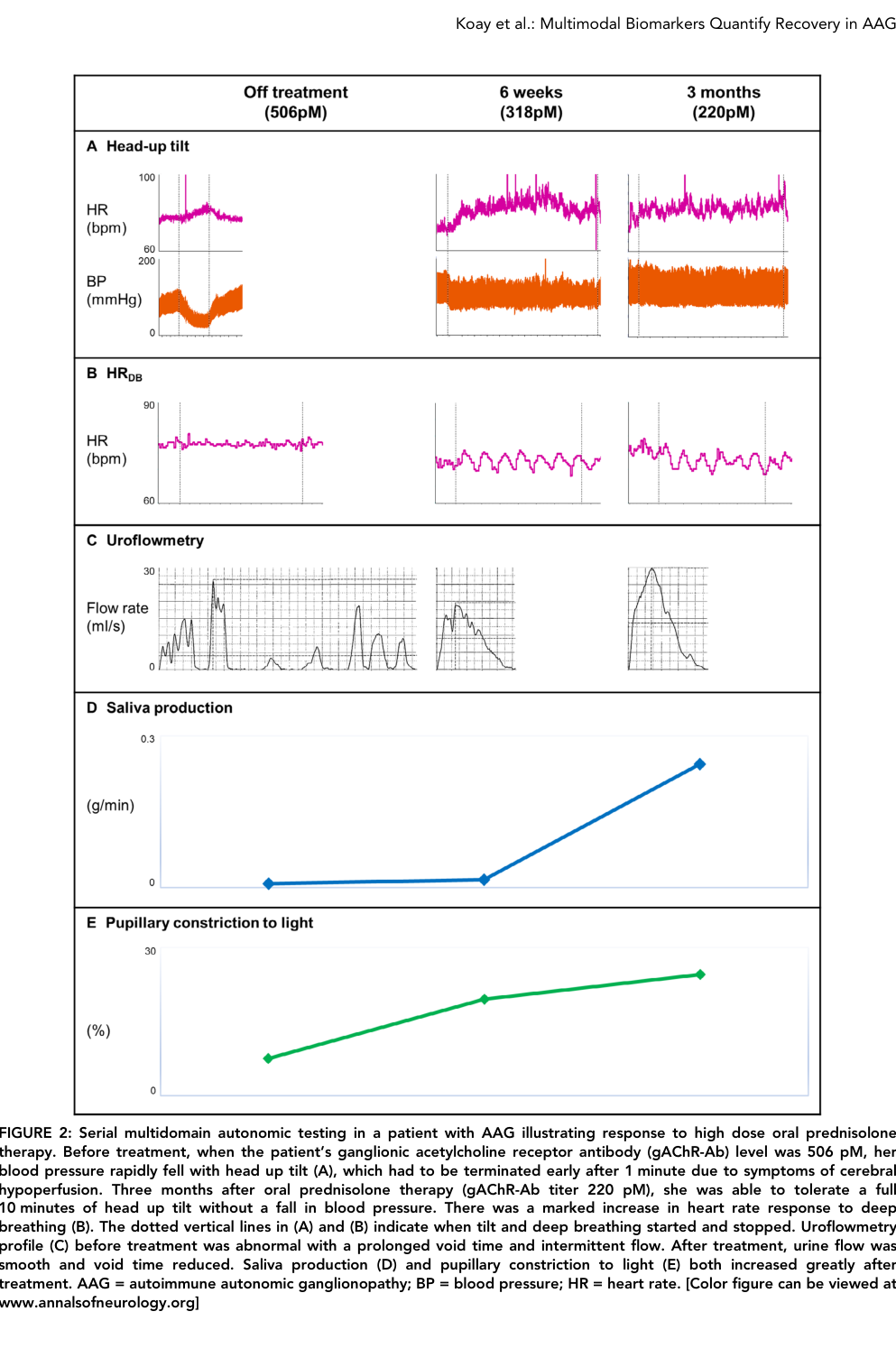
reference_title: "Multimodal Biomarkers Quantify Recovery in Autoimmune Autonomic Ganglionopathy."
supports: SUPPORT
evidence_source: HUMAN_CLINICAL
snippet: >-
all patients were longitudinally assessed with cardiovascular, pupillary,
urinary, sudomotor, lacrimal and salivary testing
explanation: The multimodal cohort demonstrates objective assessment across the major autonomic domains.
- reference: PMID:33438240
reference_title: "Multimodal Biomarkers Quantify Recovery in Autoimmune Autonomic Ganglionopathy."
supports: SUPPORT
evidence_source: HUMAN_CLINICAL
snippet: >-
Quantitative autonomic biomarkers should be used to define initial
deficits, guide therapeutic decisions, and document treatment response.
explanation: The study explicitly recommends quantitative autonomic biomarkers for baseline and follow-up.
- name: Ganglionic AChR antibody testing with assay-aware interpretation
description: >-
Test serum for antibodies against extracellular alpha3-containing
ganglionic nicotinic AChRs when AAG is suspected. Interpret the assay method,
concentration, and phenotype together: low RIPA results have limited
specificity, whereas extracellular-domain cell-based or functional
immunomodulation assays may better identify pathogenic antibody.
diagnosis_term:
preferred_term: antibody titer measurement
term:
id: NCIT:C25294
label: Laboratory Procedure
evidence:
- reference: PMID:35351814
reference_title: "Novel Cell-Based Assay for Alpha-3 Nicotinic Receptor Antibodies Detects Antibodies Exclusively in Autoimmune Autonomic Ganglionopathy."
supports: SUPPORT
evidence_source: HUMAN_CLINICAL
snippet: >-
This study provides Class II evidence that an α3-nAChR cell-based assay
is a more specific assay for AAG than the standard RIPA.
explanation: This directly supports assay-aware antibody interpretation.
- reference: PMID:34249013
reference_title: "A Flow Cytometric Assay to Detect Functional Ganglionic Acetylcholine Receptor Antibodies by Immunomodulation in Autoimmune Autonomic Ganglionopathy."
supports: SUPPORT
evidence_source: IN_VITRO
snippet: >-
AAG with pathogenic gnACHR antibodies, the autoantibodies exert their
effects by immunomodulation
explanation: Functional immunomodulation provides a biologically relevant assay readout.
- name: Context-directed malignancy and systemic-autoimmunity evaluation
description: >-
Evaluate for an underlying malignancy, paraneoplastic neurologic syndrome,
or systemic autoimmune disease when age, tempo, weight loss, examination,
antibody profile, or other red flags warrant it. This is targeted evaluation,
not a claim that every AAG patient requires identical whole-body screening.
diagnosis_term:
preferred_term: cancer screening
term:
id: NCIT:C15406
label: Cancer Screening
evidence:
- reference: PMID:31093868
reference_title: "Autoimmune autonomic neuropathies and ganglionopathies: epidemiology, pathophysiology, and therapeutic advances."
supports: SUPPORT
evidence_source: OTHER
snippet: >-
supportive care for unpleasant or dangerous autonomic dysfunction, a
search for underlying malignancy when indicated, and the use of
immunotherapy when appropriate.
explanation: The clinical review explicitly recommends malignancy evaluation when indicated.
differential_diagnoses:
- name: Acute autonomic sensory neuropathy
description: >-
AASN combines acute autonomic dysfunction with prominent sensory involvement
and dorsal-root/autonomic ganglion pathology. Current reviews do not treat it
as the same disease spectrum as gAChR-antibody AAG, and gAChR antibodies are
generally absent in AASN.
evidence:
- reference: PMID:38741497
reference_title: "[Autoimmune Autonomic Ganglionopathy and Acute Autonomic Sensory Neuropathy]."
supports: SUPPORT
evidence_source: OTHER
snippet: >-
gAChR antibodies are not detected in the sera of patients with AASN.
Currently, AAG and AASN are not considered to be on the same spectrum
explanation: This review directly states the antibody and disease-concept distinction.
- name: Postural orthostatic tachycardia syndrome
description: >-
POTS can produce orthostatic intolerance and overlapping multisystem
symptoms, but it should not be relabeled AAG without objective generalized
autonomic failure and appropriate autoimmune evidence.
disease_term:
preferred_term: postural orthostatic tachycardia syndrome
term:
id: MONDO:0011479
label: postural orthostatic tachycardia syndrome
evidence:
- reference: PMID:38396973
reference_title: "Autoimmune Autonomic Neuropathy: From Pathogenesis to Diagnosis."
supports: SUPPORT
evidence_source: HUMAN_CLINICAL
snippet: >-
Other non-neuropathic conditions, such as postural orthostatic tachycardia
syndrome, chronic fatigue syndrome, and long COVID, also present with
symptoms similar to those of AAG.
explanation: The diagnostic review explicitly identifies POTS as a symptomatic mimic requiring differentiation.
- name: Multiple system atrophy
description: >-
Multiple system atrophy is a central alpha-synucleinopathy with autonomic
failure plus levodopa-unresponsive parkinsonism or cerebellar ataxia, unlike
the antibody-mediated ganglionic transmission defect of AAG.
disease_term:
preferred_term: multiple system atrophy
term:
id: MONDO:0007803
label: multiple system atrophy
evidence:
- reference: PMID:37562886
reference_title: "Autonomic failure: Clinicopathologic, physiologic, and genetic aspects."
supports: SUPPORT
evidence_source: OTHER
snippet: >-
multiple system atrophy, characterized clinically by
levodopa-unresponsive parkinsonism or cerebellar ataxia
explanation: The autonomic-failure review distinguishes the central neurodegenerative MSA phenotype.
- name: Pure autonomic failure
description: >-
Pure autonomic failure is a chronic alpha-synucleinopathy with peripheral
sympathetic norepinephrine deficits. Chronic tempo can resemble AAG, but its
neurodegenerative mechanism, antibody profile, and treatment response differ.
evidence:
- reference: PMID:37562886
reference_title: "Autonomic failure: Clinicopathologic, physiologic, and genetic aspects."
supports: SUPPORT
evidence_source: OTHER
snippet: >-
pure autonomic failure characterized clinically by deficits in
norepinephrine synthesis and release from peripheral sympathetic nerve
terminals
explanation: The review provides the defining physiologic distinction from antibody-mediated AAG.
animal_models:
- species: Mouse
category: Induced autoimmune autonomic ganglionopathy
description: >-
C57BL/6 mice immunized with extracellular alpha3 nicotinic acetylcholine
receptor peptides developed alpha3 antibodies, reduced heart rate, labile
systolic blood pressure, slowed intestinal transit, and reduced sympathetic
cervical-ganglion neuronal density. The model supports pathogenicity but may
include tissue injury not yet established as a dominant human mechanism.
associated_phenotypes:
- Reduced heart rate
- Labile systolic blood pressure
- Slowed intestinal transit
evidence:
- reference: PMID:36507326
reference_title: "A novel murine model of autoimmune dysautonomia by α3 nicotinic acetylcholine receptor immunization."
supports: SUPPORT
evidence_source: MODEL_ORGANISM
snippet: >-
Mice with EAAG generated nAChRα3 antibodies and exhibited autonomic
dysfunction, including reduced heart rate, excessive fluctuations in
systolic blood pressure, and intestinal transit slowing.
explanation: Active alpha3-receptor immunization reproduces antibody formation and multisystem autonomic dysfunction.
treatments:
- name: Immunotherapy
action_category: THERAPEUTIC
description: >-
Individualized, usually stepwise immune-directed therapy is used most
confidently for antibody-positive AAG and selectively for rigorously
phenotyped seronegative putative disease. Cohorts show objective improvement,
but no internationally accepted regimen, sequence, or duration exists and
residual impairment or relapse is common.
treatment_term:
preferred_term: immunotherapy
term:
id: NCIT:C15262
label: Immunotherapy
target_mechanisms:
- target: Antibody-Mediated Ganglionic Acetylcholine Receptor Dysfunction
treatment_effect: MODULATES
description: Immunotherapy is intended to reduce the antibody-mediated autonomic transmission defect.
evidence:
- reference: PMID:31093868
reference_title: "Autoimmune autonomic neuropathies and ganglionopathies: epidemiology, pathophysiology, and therapeutic advances."
supports: SUPPORT
evidence_source: OTHER
snippet: "antibodies against the ganglionic nicotinic acetylcholine receptor impair autonomic transmission, causing autonomic failure, which responds to immunotherapy."
explanation: This review links AAG's antibody-mediated transmission defect with clinical response to immunotherapy.
evidence:
- reference: PMID:31093868
reference_title: "Autoimmune autonomic neuropathies and ganglionopathies: epidemiology, pathophysiology, and therapeutic advances."
supports: SUPPORT
evidence_source: OTHER
snippet: "autoimmune autonomic ganglionopathy (AAG), in which antibodies against the ganglionic nicotinic acetylcholine receptor impair autonomic transmission, causing autonomic failure, which responds to immunotherapy."
explanation: This review summarizes immunotherapy-responsive AAG as the classic autoimmune autonomic ganglionopathy.
- reference: PMID:33438240
reference_title: "Multimodal Biomarkers Quantify Recovery in Autoimmune Autonomic Ganglionopathy."
supports: SUPPORT
evidence_source: HUMAN_CLINICAL
snippet: "After immunotherapy, there were significant improvements in orthostatic intolerance ratio"
explanation: This seropositive AAG cohort provides objective autonomic biomarker evidence of improvement after immunotherapy.
- reference: PMID:42138102
reference_title: "Long-Term Efficacy of Immunotherapy in Autoimmune Autonomic Ganglionopathy-A 10-Year Follow Up Study."
supports: SUPPORT
evidence_source: HUMAN_CLINICAL
snippet: >-
Prolonged stepwise immunosuppression in seropositive AAG is associated with
sustained objective autonomic improvement, although residual impairment
and relapse remain common.
explanation: The 10-year cohort supports individualized prolonged treatment while defining its limitations.
- reference: PMID:38959810
reference_title: "Immunological and therapeutic insights in autoimmune autonomic ganglionopathy: What is the position of apheresis in immunotherapy?"
supports: SUPPORT
evidence_source: OTHER
snippet: >-
there is currently no internationally accepted standard of care for the
immunotherapy of AAG
explanation: The recent review directly supports the absence of a standardized regimen.
- name: Intravenous Immunoglobulin
action_category: THERAPEUTIC
description: >-
IVIG is used as an immunomodulatory therapy in AAG, often as initial therapy
and sometimes as part of a longer combined immunotherapy plan. Evidence is
limited to small cohorts, case series, and an extremely under-enrolled trial;
response should be documented objectively rather than assumed.
treatment_term:
preferred_term: Intravenous Immunoglobulin Therapy
term:
id: NCIT:C121331
label: Intravenous Immunoglobulin Therapy
target_mechanisms:
- target: Antibody-Mediated Ganglionic Acetylcholine Receptor Dysfunction
treatment_effect: MODULATES
description: >-
IVIG is intended to lessen antibody-mediated autonomic transmission
failure, although its precise disease-specific immunologic action and
responder profile in AAG remain unresolved.
evidence:
- reference: PMID:31093868
reference_title: "Autoimmune autonomic neuropathies and ganglionopathies: epidemiology, pathophysiology, and therapeutic advances."
supports: SUPPORT
evidence_source: OTHER
snippet: >-
antibodies against the ganglionic nicotinic acetylcholine receptor impair
autonomic transmission, causing autonomic failure, which responds to
immunotherapy.
explanation: The review supports immune modulation of the antibody-mediated defect but not an IVIG-specific molecular mechanism.
evidence:
- reference: PMID:19056323
reference_title: "Immunotherapy for autoimmune autonomic ganglionopathy."
supports: SUPPORT
evidence_source: HUMAN_CLINICAL
snippet: "Treatment with intravenous immunoglobulin (IVIG) or plasma exchange (PE) has been reported to be effective in single case reports and recent case series."
explanation: This treatment review summarizes human case-report and case-series experience with IVIG.
- reference: PMID:35966941
reference_title: "Effectiveness of treatment for 31 patients with seropositive autoimmune autonomic ganglionopathy in Japan."
supports: SUPPORT
evidence_source: HUMAN_CLINICAL
snippet: >-
Thirty-one patients received immunotherapy. Among them, 19 patients
received intravenous methylprednisolone; 27, intravenous immunoglobulin
explanation: This observational cohort documents frequent IVIG use within multimodal immunotherapy.
- name: Plasma Exchange
action_category: THERAPEUTIC
description: >-
Plasma exchange can acutely reduce circulating ganglionic AChR antibodies
and improve autonomic signs, although sustained benefit may require combined
immunosuppression.
treatment_term:
preferred_term: Plasmapheresis
term:
id: NCIT:C15304
label: Plasmapheresis
target_mechanisms:
- target: Ganglionic Acetylcholine Receptor Autoantibodies
treatment_effect: INHIBITS
description: Plasma exchange lowers circulating pathogenic antibody burden.
evidence:
- reference: PMID:18268189
reference_title: "Combined immunomodulatory therapy in autoimmune autonomic ganglionopathy."
supports: SUPPORT
evidence_source: HUMAN_CLINICAL
snippet: "Mean antibody level was 7.92 nmol/L on combined immunosuppressive therapy alone and dropped to 0.5 nmol/L after plasmapheresis."
explanation: The case series directly shows lower antibody levels after plasmapheresis.
evidence:
- reference: PMID:18268189
reference_title: "Combined immunomodulatory therapy in autoimmune autonomic ganglionopathy."
supports: SUPPORT
evidence_source: HUMAN_CLINICAL
snippet: "In patients with autoimmune autonomic ganglionopathy, combining immunosuppressive medications prednisone and mycophenolate mofetil with plasmapheresis provides substantial and sustained clinical improvement that was not seen using either treatment alone."
explanation: Prospective case-series evidence supports combined immunosuppression plus plasmapheresis for sustained improvement.
- reference: PMID:19399547
reference_title: "Autoimmune autonomic ganglionopathy: treatment by plasma exchanges and rituximab."
supports: SUPPORT
evidence_source: HUMAN_CLINICAL
snippet: "In conclusion, total PLEX temporarily improved clinical and laboratory abnormalities in this patient with AAG."
explanation: A detailed case report supports temporary clinical and laboratory improvement after plasma exchange.
- reference: PMID:38959810
reference_title: "Immunological and therapeutic insights in autoimmune autonomic ganglionopathy: What is the position of apheresis in immunotherapy?"
supports: SUPPORT
evidence_source: OTHER
snippet: >-
Although the rationale for the use of plasma exchange (PLEX) in AAG is
strong, whereby pathogenic gAChR antibodies are removed, its overall
impact on patient outcomes is not well-established.
explanation: The review supports the biological rationale while explicitly limiting confidence in outcomes.
- name: Corticosteroid and steroid-sparing immunosuppression
action_category: THERAPEUTIC
description: >-
Oral corticosteroid followed by a steroid-sparing agent may be used in a
prolonged stepwise program, particularly when IVIG or plasma exchange is
incomplete or transient. Drug selection and toxicity monitoring require
specialist individualization.
treatment_term:
preferred_term: Pharmacotherapy
term:
id: NCIT:C15986
label: Pharmacotherapy
therapeutic_agent:
- preferred_term: prednisone
term:
id: CHEBI:8382
label: prednisone
- preferred_term: mycophenolate mofetil
term:
id: CHEBI:8764
label: mycophenolate mofetil
target_mechanisms:
- target: Ganglionic Acetylcholine Receptor Autoantibodies
treatment_effect: INHIBITS
description: Prolonged immunosuppression aims to reduce production of pathogenic autoantibody.
evidence:
- reference: PMID:42138102
reference_title: "Long-Term Efficacy of Immunotherapy in Autoimmune Autonomic Ganglionopathy-A 10-Year Follow Up Study."
supports: SUPPORT
evidence_source: HUMAN_CLINICAL
snippet: >-
11 were treated with oral prednisolone followed by steroid-sparing
agents. Treatment was associated with significant improvements in
cardiovascular autonomic markers, antibody titres, and pupillary light
responses
explanation: The cohort supports the treatment sequence and antibody reduction, but not a drug-specific causal estimate.
evidence:
- reference: PMID:18268189
reference_title: "Combined immunomodulatory therapy in autoimmune autonomic ganglionopathy."
supports: SUPPORT
evidence_source: HUMAN_CLINICAL
snippet: "In patients with autoimmune autonomic ganglionopathy, combining immunosuppressive medications prednisone and mycophenolate mofetil with plasmapheresis provides substantial and sustained clinical improvement that was not seen using either treatment alone."
explanation: The prospective case series supports prednisone and mycophenolate as components of combined therapy.
- reference: PMID:42138102
reference_title: "Long-Term Efficacy of Immunotherapy in Autoimmune Autonomic Ganglionopathy-A 10-Year Follow Up Study."
supports: SUPPORT
evidence_source: HUMAN_CLINICAL
snippet: >-
Two patients were refractory to plasma exchange and intravenous
immunoglobulins but responded to prednisolone.
explanation: The long-term cohort documents response to prednisolone after incomplete first-line response.
- name: Rituximab
action_category: THERAPEUTIC
description: >-
Rituximab has been reported for refractory or relapsing AAG after or
alongside other immunotherapies. The evidence base is case-level and does
not establish comparative efficacy.
treatment_term:
preferred_term: Pharmacotherapy
term:
id: NCIT:C15986
label: Pharmacotherapy
therapeutic_agent:
- preferred_term: rituximab
term:
id: NCIT:C1702
label: Rituximab
target_mechanisms:
- target: Ganglionic Acetylcholine Receptor Autoantibodies
treatment_effect: INHIBITS
description: CD20+ B-cell depletion may reduce pathogenic antibody production.
evidence:
- reference: PMID:19399547
reference_title: "Autoimmune autonomic ganglionopathy: treatment by plasma exchanges and rituximab."
supports: SUPPORT
evidence_source: HUMAN_CLINICAL
snippet: "Rituximab resulted in minor decreases in antibody level and persistent symptomatic improvement over at least several months."
explanation: This AAG case report links rituximab to lower antibody levels and sustained symptomatic improvement.
evidence:
- reference: PMID:19399547
reference_title: "Autoimmune autonomic ganglionopathy: treatment by plasma exchanges and rituximab."
supports: SUPPORT
evidence_source: HUMAN_CLINICAL
snippet: "Rituximab resulted in minor decreases in antibody level and persistent symptomatic improvement over at least several months."
explanation: This case report supports rituximab as a later-line immunotherapy option.
- name: Supportive autonomic complication management
action_category: THERAPEUTIC
description: >-
Treat orthostatic hypotension, bowel dysmotility, bladder retention,
anhidrosis/heat intolerance, and sicca complications in parallel with any
immune-directed therapy. Measures are individualized and may include
anti-hypotensive medication, catheterization, bowel or nutritional support,
and eye or oral protection; supportive needs may persist after immune
improvement.
treatment_term:
preferred_term: supportive care
term:
id: NCIT:C15747
label: Supportive Care
target_phenotypes:
- preferred_term: Orthostatic hypotension due to autonomic dysfunction
term:
id: HP:0004926
label: Orthostatic hypotension due to autonomic dysfunction
- preferred_term: Gastrointestinal dysmotility
term:
id: HP:0002579
label: Gastrointestinal dysmotility
- preferred_term: Urinary retention
term:
id: HP:0000016
label: Urinary retention
- preferred_term: Anhidrosis
term:
id: HP:0000970
label: Anhidrosis
evidence:
- reference: PMID:42138102
reference_title: "Long-Term Efficacy of Immunotherapy in Autoimmune Autonomic Ganglionopathy-A 10-Year Follow Up Study."
supports: SUPPORT
evidence_source: HUMAN_CLINICAL
snippet: >-
highlight the need for ongoing supportive management of autonomic
complications.
explanation: The 10-year study explicitly calls for ongoing supportive management despite immunotherapy.
clinical_trials:
- name: NCT01522235
phase: PHASE_II
status: COMPLETED
description: >-
Completed randomized, blinded placebo-controlled IVIG study registered as
phase 2/3. Only six participants enrolled, five contributed to the primary
outcome, and four completed the study, so the posted aggregate results are
hypothesis-generating rather than a definitive efficacy estimate.
target_phenotypes:
- preferred_term: Orthostatic hypotension due to autonomic dysfunction
term:
id: HP:0004926
label: Orthostatic hypotension due to autonomic dysfunction
notes: >-
ClinicalTrials.gov was audited on 2026-07-20. This was the only study
returned for the AAG condition; it is completed and not an available
recruiting option.
evidence:
- reference: clinicaltrials:NCT01522235
reference_title: "A Double-blind, Randomized, Placebo-controlled Trial to Evaluate the Efficacy of Intravenous Immunoglobulin Therapy in Autoimmune Autonomic Ganglionopathy."
supports: SUPPORT
evidence_source: HUMAN_CLINICAL
snippet: >-
helps to improve the symptoms of orthostatic hypotension (sudden fall in
blood pressure when a person stands up) and quality of life
explanation: The registry states the IVIG study's AAG symptom and quality-of-life objectives.
datasets: []
references:
- reference: PMID:42138102
title: Long-Term Efficacy of Immunotherapy in Autoimmune Autonomic Ganglionopathy-A 10-Year Follow Up Study.
findings: []
- reference: PMID:38396973
title: "Autoimmune Autonomic Neuropathy: From Pathogenesis to Diagnosis."
findings: []
- reference: PMID:35351814
title: Novel Cell-Based Assay for Alpha-3 Nicotinic Receptor Antibodies Detects Antibodies Exclusively in Autoimmune Autonomic Ganglionopathy.
findings: []
- reference: PMID:38959810
title: "Immunological and therapeutic insights in autoimmune autonomic ganglionopathy: What is the position of apheresis in immunotherapy?"
findings: []
- reference: PMID:35966941
title: Effectiveness of treatment for 31 patients with seropositive autoimmune autonomic ganglionopathy in Japan.
findings: []
- reference: PMID:37562886
title: "Autonomic failure: Clinicopathologic, physiologic, and genetic aspects."
findings: []
- reference: PMID:36507326
title: A novel murine model of autoimmune dysautonomia by α3 nicotinic acetylcholine receptor immunization.
findings: []
discussions:
- discussion_id: disc_aag_nosology_boundary
prompt: >-
How should contemporary AAG be reconciled with the narrower
acute-pandysautonomia/Guillain-Barre concept encoded by the current
MONDO-Orphanet exact mapping?
kind: KNOWLEDGE_GAP
status: OPEN
rationale: >-
Contemporary reviews recognize acute and chronic AAG and emphasize
antibody-defined autonomic ganglionopathy, while ORPHA:231457 describes a
postinfectious acute Guillain-Barre variant. Cohorts and ontology resources
should distinguish overlap from equivalence so chronic AAG is not excluded
and every AAG case is not mislabeled as Guillain-Barre syndrome.
evidence:
- reference: PMID:38396973
reference_title: "Autoimmune Autonomic Neuropathy: From Pathogenesis to Diagnosis."
supports: SUPPORT
evidence_source: HUMAN_CLINICAL
snippet: >-
The first step in diagnosing AAG is careful history taking, which should
reveal whether the mode of onset is acute or chronic
explanation: The contemporary diagnostic review explicitly includes chronic onset.
- reference: ORPHA:231457
reference_title: "Acute pandysautonomia"
supports: SUPPORT
evidence_source: OTHER
snippet: >-
A rare variant of Guillain-Barré syndrome characterized by acute
post-ganglionic sympathetic and parasympathetic failure
explanation: The ontology-linked Orphanet record is explicitly acute and Guillain-Barre-associated.
- discussion_id: disc_aag_assay_seronegative_boundary
prompt: >-
Which assay, concentration threshold, and clinical criteria should define
antibody-positive AAG, and what evidence is required to classify a
seronegative case as putative autoimmune ganglionopathy?
kind: KNOWLEDGE_GAP
status: OPEN
rationale: >-
Low RIPA results and isolated recombinant-subunit reactivity can be
nonspecific. Extracellular-domain cell-based and functional assays improve
specificity, but interlaboratory standardization and validated criteria for
antibody-negative disease are lacking.
evidence:
- reference: PMID:35351814
reference_title: "Novel Cell-Based Assay for Alpha-3 Nicotinic Receptor Antibodies Detects Antibodies Exclusively in Autoimmune Autonomic Ganglionopathy."
supports: SUPPORT
evidence_source: HUMAN_CLINICAL
snippet: >-
low α3-nAChR antibody levels are frequently detected in other neurologic
diseases with questionable significance.
explanation: The assay study identifies a key specificity problem at low antibody levels.
- reference: PMID:34995917
reference_title: Subunit-specific autoantibodies in autoimmune autonomic ganglionopathy.
supports: SUPPORT
evidence_source: HUMAN_CLINICAL
snippet: >-
Subunit-specific antibody-derived false-positive results can lead to
misdiagnosis, as autonomic failure is not specific to AAG.
explanation: The comparison directly warns against treating subunit assay groups as settled disease subtypes.
- reference: PMID:19506222
reference_title: Efficacy of immunotherapy in seropositive and seronegative putative autoimmune autonomic ganglionopathy.
supports: SUPPORT
evidence_source: HUMAN_CLINICAL
snippet: >-
four with seropositive and two with seronegative putative AAG
explanation: The six-person study documents the putative category but is too small to validate diagnostic criteria.
- discussion_id: disc_aag_immunotherapy_strategy
prompt: >-
What induction, escalation, maintenance, tapering, and relapse-prevention
strategy provides the best benefit-risk balance in AAG?
kind: KNOWLEDGE_GAP
status: OPEN
rationale: >-
Cohorts support objective improvement with stepwise or combined
immunotherapy, but treatment selection is confounded by severity and
concurrent therapies. Residual dysfunction and relapse remain common, and
comparative randomized evidence is absent.
evidence:
- reference: PMID:38959810
reference_title: "Immunological and therapeutic insights in autoimmune autonomic ganglionopathy: What is the position of apheresis in immunotherapy?"
supports: SUPPORT
evidence_source: OTHER
snippet: >-
there is currently no internationally accepted standard of care for the
immunotherapy of AAG
explanation: The recent treatment review directly states the standard-of-care gap.
- reference: PMID:42138102
reference_title: "Long-Term Efficacy of Immunotherapy in Autoimmune Autonomic Ganglionopathy-A 10-Year Follow Up Study."
supports: SUPPORT
evidence_source: HUMAN_CLINICAL
snippet: >-
residual impairment and relapse remain common.
explanation: Longitudinal follow-up identifies clinically important residual and relapse risks.
- discussion_id: disc_aag_trials_and_datasets
prompt: >-
Can a multicenter natural-history platform, biobank, and adequately powered
trial establish validated endpoints and enable reusable AAG molecular data?
kind: KNOWLEDGE_GAP
status: OPEN
rationale: >-
The ClinicalTrials.gov audit on 2026-07-20 found one completed IVIG study
with six enrollees and no active AAG trial. Searches of GEO for the exact
disease and ganglionic-receptor terms found no AAG patient omics dataset
suitable for curation. Harmonized phenotyping, assay metadata, biospecimens,
and longitudinal autonomic outcomes are needed.
evidence:
- reference: PMID:35966941
reference_title: "Effectiveness of treatment for 31 patients with seropositive autoimmune autonomic ganglionopathy in Japan."
supports: SUPPORT
evidence_source: HUMAN_CLINICAL
snippet: >-
multicenter randomized, placebo-controlled prospective studies are
warranted to establish future treatment strategies.
explanation: The 31-person cohort explicitly calls for adequately controlled multicenter studies.
- reference: clinicaltrials:NCT01522235
reference_title: "A Double-blind, Randomized, Placebo-controlled Trial to Evaluate the Efficacy of Intravenous Immunoglobulin Therapy in Autoimmune Autonomic Ganglionopathy."
supports: SUPPORT
evidence_source: HUMAN_CLINICAL
snippet: >-
The purpose of the study is to see if administering intravenous immune
globulin (IVIG)
explanation: This is the sole AAG trial located in the current ClinicalTrials.gov audit.
References & Deep Research
References
7Deep Research
2Deep research results are used as seeds for research; they do not undergo the same validation as the main records and may contain errors. How we use deep research.
Disorder
- Name: Autoimmune Autonomic Ganglionopathy
- Category: Autoimmune
- Existing deep-research providers: falcon
- Existing evidence reference count in YAML: 58
Key Pathophysiology Nodes
- Ganglionic Acetylcholine Receptor Autoantibodies
- Antibody-Mediated Ganglionic Acetylcholine Receptor Dysfunction
- Postganglionic Sympathetic and Parasympathetic Failure
Citation Inventory (for evidence mapping)
- DOI:10.1002/ana.26018
- DOI:10.1007/s10286-019-00611-1
- DOI:10.1016/b978-008045046-9.00625-2
- DOI:10.1080/14737175.2018.1540304
- DOI:10.1212/wnl.0b013e3181a92b52
- DOI:10.1212/wnl.50.6.1806
- DOI:10.3389/fneur.2024.1495205
- DOI:10.3390/ijms25042296
- DOI:10.4103/aian.aian_394_24
Autoimmune Autonomic Ganglionopathy (AAG) — Comprehensive Disease Characteristics Report
Executive summary
Autoimmune autonomic ganglionopathy (AAG) is a rare, immune-mediated disorder of peripheral autonomic failure affecting sympathetic, parasympathetic, and enteric systems, classically presenting with subacute-onset diffuse dysautonomia (e.g., orthostatic hypotension, anhidrosis, severe gastrointestinal and bladder dysfunction). Roughly half of clinically suspected cases have serum autoantibodies against the ganglionic nicotinic acetylcholine receptor (gAChR; typically α3-containing receptors), and antibody titers correlate with autonomic severity; immunotherapy (plasma exchange, IVIg, corticosteroids and steroid-sparing immunosuppression) can lead to objective improvement in many patients, though controlled trial data remain very limited. (iodice2009efficacyofimmunotherapy pages 1-3, golden2019autoimmuneautonomicneuropathies pages 1-2, nakane2024autoimmuneautonomicneuropathy pages 2-3, koay2021multimodalbiomarkersquantify pages 1-8)
1. Disease information
1.1 Definition and current understanding
- AAG is an immune-mediated disorder with prominent/selective involvement of the peripheral autonomic nervous system, producing generalized autonomic failure and often orthostatic hypotension, anhidrosis, and parasympathetic dysfunction. (iodice2009efficacyofimmunotherapy pages 1-3)
- AAG is commonly described as “a disease of autonomic failure caused by ganglionic acetylcholine receptor (gAChR) autoantibodies” (direct abstract statement). (nakane2024autoimmuneautonomicneuropathy pages 11-12)
1.2 Synonyms / alternative names
Commonly used terms in the literature include: - Autoimmune autonomic ganglionopathy (AAG) (nakane2024autoimmuneautonomicneuropathy pages 11-12, iodice2009efficacyofimmunotherapy pages 1-3) - Autoimmune autonomic neuropathy (umbrella term often including AAG) (nakane2024autoimmuneautonomicneuropathy pages 11-12) - Subacute panautonomic failure / subacute autonomic neuropathy (historical discovery context for ganglionic nAChR antibodies) (vernino1998neuronalnicotinicach pages 4-6, vernino1998neuronalnicotinicach pages 3-4)
1.3 Key identifiers (OMIM/Orphanet/ICD/MeSH/MONDO)
- In the evidence retrieved for this run, explicit OMIM/Orphanet/ICD-10/ICD-11/MeSH/MONDO identifiers were not present in accessible full text excerpts; this entry should be completed by querying those dedicated ontology resources directly. (iodice2009efficacyofimmunotherapy pages 1-3, golden2019autoimmuneautonomicneuropathies pages 1-2)
1.4 Evidence sources
The characterization below is derived from: - Aggregated disease-level clinical cohorts and reviews (e.g., Japanese cohort n=80; seropositive cohort n=13) (nakane2018autoimmuneautonomicganglionopathy pages 6-8, koay2021multimodalbiomarkersquantify pages 1-8) - Primary discovery and pathophysiology studies (Neurology 1998 discovery of neuronal/ganglionic nAChR antibodies) (vernino1998neuronalnicotinicach pages 1-2, vernino1998neuronalnicotinicach pages 3-4) - Interventional/observational clinical evidence and trial registry information (Neurology 2009 immunotherapy case series; ClinicalTrials.gov NCT01522235) (iodice2009efficacyofimmunotherapy pages 1-3, NCT01522235 chunk 1)
2. Etiology
2.1 Primary causal factors (mechanistic)
Autoantibody-mediated ganglionic synaptic failure - The principal autoantigen is the ganglionic nicotinic acetylcholine receptor (gAChR), typically α3-containing receptors (often α3β4). Patient antibodies bind α3 and can reduce receptor currents in vitro, supporting pathogenicity. (golden2019autoimmuneautonomicneuropathies pages 1-2, nakane2024autoimmuneautonomicneuropathy pages 2-3) - A 2024 mechanistic synthesis proposes a three-step pathogenic model: (1) antibody binding, (2) antibody-driven internalization/degradation reducing receptor number, and (3) functional blockade. (nakane2024autoimmuneautonomicneuropathy pages 2-3) - In a 2024 clinical utility review, AAG antibodies are described as acting “by preventing post‑synaptic depolarization, thereby blocking autonomic neurotransmission.” (loser2024autoantibodiesinneuromuscular pages 13-15)
Seronegative disease and heterogeneity - About ~50% of suspected AAG may be seronegative, and some evidence suggests possible antibody- vs cell-mediated subtypes, including steroid-responsive but IVIg/PLEX/rituximab-poorly responsive subsets. (mohapatra2024decodingautoimmuneautonomic pages 4-5, golden2019autoimmuneautonomicneuropathies pages 3-5)
2.2 Risk factors
- Robust genetic susceptibility loci or causal germline variants were not identified in the retrieved evidence; AAG is primarily treated as an acquired autoimmune condition. (golden2019autoimmuneautonomicneuropathies pages 1-2)
- Autoimmune comorbidity is common. In a seropositive cohort (n=13), 8/13 (62%) had other autoimmune diseases (e.g., hypothyroidism, inflammatory bowel disease, Addison’s, pernicious anemia). (koay2021multimodalbiomarkersquantify pages 8-13)
- Antecedent infection or events are reported in subsets (see Temporal Development). (nakane2018autoimmuneautonomicganglionopathy pages 6-8, koay2021multimodalbiomarkersquantify pages 8-13)
2.3 Protective factors / gene–environment interactions
- No protective genetic variants or specific gene–environment interaction evidence was present in the retrieved set; this remains a knowledge gap. (golden2019autoimmuneautonomicneuropathies pages 1-2)
3. Phenotypes
3.1 Core clinical phenotype (multi-domain autonomic failure)
AAG reflects diffuse autonomic failure across sympathetic, parasympathetic, and enteric domains. (iodice2009efficacyofimmunotherapy pages 1-3, golden2019autoimmuneautonomicneuropathies pages 1-2)
Common features and frequencies (cohort evidence) - Japanese seropositive cohort (n=80): - Orthostatic hypotension: 64/80 (80%) - Lower GI symptoms: 59/80 (74%) - Pupillary dysfunction: 21/80 (26%) - Sensory disturbance (dysesthesia/numbness): 37/80 (46%) - Extra-autonomic involvement overall: 67/80 (84%) - Gradual onset predominant: 62/80 (78%) - Antecedent events: 13/80 (16%) (nakane2018autoimmuneautonomicganglionopathy pages 6-8)
- Seropositive multimodal cohort (n=13):
- Impaired pupillary light constriction: 12/13 (92%); cholinergic supersensitivity in tested patients
- Postganglionic sudomotor dysfunction: 7/8 (88%)
- Urinary retention: 9/11 (82%); catheterisation needed 5/13 (38%)
- Xerophthalmia (reduced lacrimation): 9/11 (82%); xerostomia: 6/8 (75%)
- 31% had antecedent infections; 15% antecedent surgery (koay2021multimodalbiomarkersquantify pages 13-17, koay2021multimodalbiomarkersquantify pages 8-13, koay2021multimodalbiomarkersquantify pages 1-8)
3.2 Suggested HPO terms (non-exhaustive; map to patient-level data when available)
- Orthostatic hypotension (HP:0001278)
- Autonomic dysfunction (HP:0004398)
- Anhidrosis / hypohidrosis (HP:0000970 / HP:0000966)
- Urinary retention / neurogenic bladder (HP:0000016 / HP:0000010)
- Gastrointestinal dysmotility / constipation (HP:0002574 / HP:0002019)
- Xerostomia / keratoconjunctivitis sicca (HP:0000217 / HP:0001097)
- Abnormal pupillary light reflex / mydriasis (HP:0000615 / HP:0000611)
- Sensory neuropathy / paresthesia (HP:0000763 / HP:0003401)
(nakane2018autoimmuneautonomicganglionopathy pages 6-8, koay2021multimodalbiomarkersquantify pages 1-8)
3.3 Quality of life impact
Quantitative symptom and QoL instruments are used in AAG cohorts, including COMPASS-31 and SF-36. In one seropositive cohort (n=13), immunotherapy improved COMPASS-31 scores (total 52 → 17, P=.03) and SF-36 physical function (example data in figures), consistent with clinically meaningful functional improvement. (koay2021multimodalbiomarkersquantify pages 1-8, koay2021multimodalbiomarkersquantify pages 17-21)
4. Genetic / molecular information
4.1 Causal genes
- AAG is not primarily described as a Mendelian genetic disorder in retrieved evidence. However, the target receptor comprises subunits including α3 and typically β4; these correspond to receptor subunit genes (e.g., CHRNA3, CHRNB4), but the disease mechanism is autoimmune rather than inherited mutation-based in the cited cohorts/reviews. (golden2019autoimmuneautonomicneuropathies pages 1-2, nakane2024autoimmuneautonomicneuropathy pages 2-3)
4.2 Pathogenic “variants”
- Not applicable as germline pathogenic variants were not implicated as causal in the retrieved clinical literature. (golden2019autoimmuneautonomicneuropathies pages 1-2)
4.3 Epigenetics / modifiers
- Not addressed in retrieved evidence.
5. Environmental information
5.1 Infectious or other triggers
- Antecedent infections/events are reported in subsets of cohorts (e.g., 31% antecedent infections in a seropositive cohort; 16% antecedent events in a Japanese cohort). (koay2021multimodalbiomarkersquantify pages 8-13, nakane2018autoimmuneautonomicganglionopathy pages 6-8)
6. Mechanism / pathophysiology
6.1 Causal chain (antibody-mediated archetype)
1) Immune tolerance break (often idiopathic; sometimes paraneoplastic context in early discovery cohorts) with production of antibodies to ganglionic nAChR (α3-containing receptor). (vernino1998neuronalnicotinicach pages 4-6, golden2019autoimmuneautonomicneuropathies pages 1-2) 2) Antibody binding to extracellular receptor epitopes, with receptor internalization/degradation and functional blockade, reducing ganglionic synaptic transmission. (nakane2024autoimmuneautonomicneuropathy pages 2-3, nakane2018autoimmuneautonomicganglionopathy pages 3-5) 3) Downstream failure of autonomic output across multiple organs (cardiovascular, sudomotor, secretomotor, GI, bladder, pupillary systems), producing “pandysautonomia.” (iodice2009efficacyofimmunotherapy pages 1-3, koay2021multimodalbiomarkersquantify pages 1-8)
6.2 Upstream vs downstream processes
- Upstream: autoantibody generation; in some patients, possibly alternative immune effector mechanisms (cell-mediated) in seronegative disease. (mohapatra2024decodingautoimmuneautonomic pages 4-5, golden2019autoimmuneautonomicneuropathies pages 3-5)
- Downstream: postganglionic sympathetic and parasympathetic failure; reduced catecholamine release; end-organ dysfunction (e.g., impaired sweating, impaired lacrimation). (nakane2024autoimmuneautonomicneuropathy pages 11-12, koay2021multimodalbiomarkersquantify pages 1-8)
6.3 Cell types and GO / CL suggestions
Cell types (CL) – suggested: - Autonomic neuron (sympathetic neuron; parasympathetic neuron) - Postganglionic sympathetic neuron - Postganglionic parasympathetic neuron
Biological processes (GO) – suggested: - Chemical synaptic transmission, cholinergic - Autonomic nervous system development / regulation of autonomic nervous system - Regulation of blood pressure - Regulation of gastrointestinal motility - Regulation of sweating
(These align with receptor localization and physiological deficits described in cohorts and mechanistic studies.) (golden2019autoimmuneautonomicneuropathies pages 1-2, koay2021multimodalbiomarkersquantify pages 1-8)
6.4 Molecular profiling / multi-omics
- No transcriptomic/proteomic/metabolomic signatures were reported in the retrieved evidence.
7. Anatomical structures affected
7.1 Organ and system level
Primary system: peripheral autonomic nervous system (autonomic ganglia and postganglionic fibers). (golden2019autoimmuneautonomicneuropathies pages 1-2, nakane2024autoimmuneautonomicneuropathy pages 11-12) Secondary/target organs include: - Cardiovascular system (orthostatic hypotension) (nakane2018autoimmuneautonomicganglionopathy pages 6-8) - Sweat glands (anhidrosis/hypohidrosis) (koay2021multimodalbiomarkersquantify pages 1-8) - Exocrine glands (lacrimal/salivary; sicca) (koay2021multimodalbiomarkersquantify pages 1-8, golden2019autoimmuneautonomicneuropathies pages 1-2) - GI tract (dysmotility) (nakane2018autoimmuneautonomicganglionopathy pages 6-8) - Urinary tract (neurogenic bladder/retention) (koay2021multimodalbiomarkersquantify pages 13-17) - Eye (pupil dysfunction) (koay2021multimodalbiomarkersquantify pages 13-17)
UBERON suggestions: - Autonomic ganglion; sympathetic ganglion; parasympathetic ganglion - Heart; gastrointestinal tract; urinary bladder; sweat gland; lacrimal gland; salivary gland; iris/pupil
7.2 Subcellular / receptor localization
- Key molecular site: postsynaptic ganglionic nicotinic ACh receptor at autonomic ganglionic synapses. (vernino1998neuronalnicotinicach pages 4-6, loser2024autoantibodiesinneuromuscular pages 13-15)
8. Temporal development
8.1 Onset
- Onset can be acute/subacute or gradual; one cohort defined subacute as peak within 3 months and found gradual onset predominated in seropositive patients. (nakane2018autoimmuneautonomicganglionopathy pages 6-8)
8.2 Course and progression
- Spontaneous improvement occurs in ~one-third of patients but is often incomplete. (iodice2009efficacyofimmunotherapy pages 1-3, golden2019autoimmuneautonomicneuropathies pages 1-2)
- Chronic phenotypes may resemble pure autonomic failure and can represent about half of seropositive patients in review-level synthesis. (golden2019autoimmuneautonomicneuropathies pages 1-2)
9. Inheritance and population
9.1 Epidemiology
- AAG is consistently described as rare; specific population prevalence/incidence rates were not identified in the retrieved evidence. (golden2019autoimmuneautonomicneuropathies pages 1-2)
9.2 Demographics
- Review synthesis: mean ages ~45–61 with ~2:1 female predominance. (golden2019autoimmuneautonomicneuropathies pages 1-2)
- Seropositive multimodal cohort: median age at onset 54 (IQR 31–63), 54% female. (koay2021multimodalbiomarkersquantify pages 8-13)
10. Diagnostics
10.1 Core diagnostic concept
Diagnosis is a combination of: 1) compatible clinical syndrome (diffuse autonomic failure) and 2) objective autonomic testing and 3) supportive biomarkers, especially gAChR antibodies, recognizing limited sensitivity and potential nonspecific low titers. (iodice2009efficacyofimmunotherapy pages 1-3, nakane2024autoimmuneautonomicneuropathy pages 11-12)
10.2 Antibody testing: assays and interpretation
- 2024 synthesis: gAChR antibody testing is “essential” but detection frequency “is not high,” and CBA or RIPA are recommended as the most accurate assays. (nakane2024autoimmuneautonomicneuropathy pages 11-12)
- Threshold interpretation (RIA/RIPA): >1.0 nmol/L high specificity; 0.2–1.0 nmol/L moderate specificity; <0.2 nmol/L nonspecific; low-level positivity can occur in 2–4% of healthy individuals. (loser2024autoantibodiesinneuromuscular pages 12-13, mohapatra2024decodingautoimmuneautonomic pages 4-5)
- Assay landscape includes RIPA/RIA, luciferase immunoprecipitation (LIPS), cell-based assays, immunomodulation assays, and flow cytometry; a 2024 review notes “there are no studies directly comparing the performance metrices of these antibody assays.” (mohapatra2024decodingautoimmuneautonomic pages 4-5)
10.3 Autonomic testing and ancillary diagnostics
Commonly used tests in cohorts/reviews include: - Head-up tilt / orthostatic vitals; Valsalva; heart-rate response to deep breathing - QSART / thermoregulatory sweat testing; plasma catecholamines (resting often reduced) - Schirmer (lacrimation) and Saxon (salivation) tests - Pupillometry / pharmacologic testing (pilocarpine supersensitivity) - Uroflowmetry and post-void residuals - CSF (protein elevation / albuminocytologic dissociation in a substantial minority) - Cardiac 123I-MIBG myocardial scintigraphy (often reduced uptake; may improve after immunotherapy) - Skin biopsy for small-fiber/autonomic denervation and recovery biomarkers (iodice2009efficacyofimmunotherapy pages 3-4, nakane2024autoimmuneautonomicneuropathy pages 11-12, koay2021multimodalbiomarkersquantify pages 1-8, nakane2018autoimmuneautonomicganglionopathy pages 9-10)
10.4 Differential diagnosis
- Differentiation from acute autonomic sensory neuropathy (AASN), pure autonomic failure (PAF), POTS, chronic fatigue syndrome, and long COVID is emphasized, using nerve conduction studies/biopsy, MRI in selected cases, catecholamine patterns, and multimodal autonomic testing. (nakane2024autoimmuneautonomicneuropathy pages 11-12)
11. Outcome / prognosis
- Spontaneous (often incomplete) improvement in ~one-third is described in clinical synthesis. (iodice2009efficacyofimmunotherapy pages 1-3, golden2019autoimmuneautonomicneuropathies pages 1-2)
- Long-term recovery can be quantified by biomarker improvement; in a seropositive cohort (n=13) immunotherapy significantly improved orthostatic intolerance ratio, HRDB, pupillary constriction, saliva production and COMPASS-31. (koay2021multimodalbiomarkersquantify pages 1-8, koay2021multimodalbiomarkersquantify media 639533be)
- Mortality rates and life expectancy are not defined in the retrieved evidence; this remains a data gap.
12. Treatment
12.1 Immunotherapy (disease-modifying)
First-line approaches - Reviews commonly describe IVIg and plasma exchange (PLEX) as first-line antibody-directed therapies; corticosteroids are often used in combination. (golden2019autoimmuneautonomicneuropathies pages 5-6, mohapatra2024decodingautoimmuneautonomic pages 4-5, golden2019autoimmuneautonomicneuropathies pages 3-5) - In a Neurology case series (n=6; 4 seropositive, 2 seronegative), all 6 patients improved clinically after immunotherapy; sudomotor measures improved in 4. (iodice2009efficacyofimmunotherapy pages 1-3)
Evidence of objective biomarker response - In a seropositive multimodal cohort (n=13; 11 treated), immunotherapy improved key outcomes, e.g. orthostatic intolerance ratio 33.3 → 5.2 (P=.007), COMPASS-31 52 → 17 (P=.03), and pupillary constriction and salivary measures (cohort-level pre/post comparisons), supported by Figure 2 and Table 5. (koay2021multimodalbiomarkersquantify pages 1-8, koay2021multimodalbiomarkersquantify media 639533be)
Maintenance / refractory therapy - Steroid-sparing agents (e.g., mycophenolate, azathioprine) and B-cell depletion (rituximab) have case-based/series-level support and are used for relapsing or refractory disease. (golden2019autoimmuneautonomicneuropathies pages 5-6, nakane2018autoimmuneautonomicganglionopathy pages 9-10) - A 2024 review notes heterogeneity: a subset can show strong steroid responses with poorer response to IVIg/PLEX/rituximab, consistent with possible cell-mediated forms. (mohapatra2024decodingautoimmuneautonomic pages 4-5)
12.2 Symptomatic/supportive care (real-world implementations)
- Pressor/orthostatic therapies (e.g., midodrine, droxidopa) are used to manage neurogenic orthostatic hypotension in AAG-focused reviews. (nakane2018autoimmuneautonomicganglionopathy pages 9-10)
- Organ-specific supportive care is routinely required (bowel regimen and prokinetic strategies for dysmotility; catheterization/urodynamic-guided care for retention; ocular/oral sicca management). (golden2019autoimmuneautonomicneuropathies pages 1-2, koay2021multimodalbiomarkersquantify pages 13-17)
12.3 Clinical trials
- NCT01522235 (ClinicalTrials.gov): randomized, double-blind, placebo-controlled Phase 2/3 IVIg vs 5% albumin in seropositive AAG; enrollment 6; started Feb 2012; primary completion May 2014; completion Sep 2015; results first posted Jul 2, 2017. Primary endpoint: change in systolic BP during 60° tilt (ΔSBP) at 6 weeks; secondary endpoints included COMPASS, CASS, EQ-5D, orthostatic symptom questionnaire. Outcome numbers were not present in the retrieved excerpts. (NCT01522235 chunk 1, NCT01522235 chunk 2)
- URL: https://clinicaltrials.gov/study/NCT01522235 (trial registry; dates from record in evidence). (NCT01522235 chunk 1)
12.4 Suggested MAXO terms (non-exhaustive)
- Plasma exchange therapy
- Intravenous immunoglobulin therapy
- Systemic glucocorticoid therapy
- B-cell depletion therapy (rituximab)
- Mycophenolate mofetil therapy
- Vasopressor therapy (for neurogenic orthostatic hypotension)
13. Prevention
- No established primary prevention strategies were identified in the retrieved evidence; prevention is largely secondary/tertiary (early recognition and treatment to prevent complications of severe autonomic failure). (nakane2024autoimmuneautonomicneuropathy pages 11-12)
14. Other species / natural disease
- Naturally occurring veterinary analogs were not identified in the retrieved evidence. (golden2019autoimmuneautonomicneuropathies pages 1-2)
15. Model organisms
Multiple experimental systems support the antibody-mediated model: - α3 nAChR subunit knockout mice: profound autonomic failure (bladder distention, GI dysmotility, absent pupillary reflexes; urinary retention and increased mortality in review synthesis). (golden2019autoimmuneautonomicneuropathies pages 1-2, nakane2018autoimmuneautonomicganglionopathy pages 3-5) - Passive transfer models: transfer of patient IgG to mice reduces evoked EPSP amplitudes in autonomic ganglia; EPSPs can recover despite persistent antibodies (suggesting homeostatic plasticity). (nakane2024autoimmuneautonomicneuropathy pages 2-3) - Active immunization models: immunization against ganglionic AChR (including α3 subunit strategies) induces experimental autoimmune dysautonomia/autonomic neuropathy in rabbits and mice. (vernino2009autoimmuneautonomicneuropathy pages 2-4, nakane2024autoimmuneautonomicneuropathy pages 12-14)
Recent developments (prioritizing 2023–2024)
Diagnostics and assay technology
- 2024 review-level consensus: CBA and/or RIPA are preferred for gAChR antibody detection; low sensitivity and limited access motivate new assays and expansion to other autonomic receptor targets. (nakane2024autoimmuneautonomicneuropathy pages 11-12)
- 2024 assay landscape and evidence gap: multiple assay modalities exist, but head-to-head performance comparisons are lacking (“no studies directly comparing…”). (mohapatra2024decodingautoimmuneautonomic pages 4-5)
Phenotyping and biomarkers for treatment response
- Multidomain quantitative biomarker panels (tilt-derived orthostatic intolerance ratio, pupillometry, sweat testing, secretomotor measures, COMPASS-31) are used to quantify response, with significant pre/post immunotherapy changes in seropositive cohorts, and are highlighted as practical tools for monitoring. (koay2021multimodalbiomarkersquantify pages 1-8, koay2021multimodalbiomarkersquantify media 639533be)
Expert opinions / authoritative analysis (from reviews)
- AAG is described as “rare” and clinically heterogeneous, with antibody titers and phenotypic distribution supporting a spectrum ranging from severe pan-dysautonomia to limited phenotypes, and with recognition of potentially distinct seronegative mechanisms. (golden2019autoimmuneautonomicneuropathies pages 1-2, mohapatra2024decodingautoimmuneautonomic pages 4-5)
- Clinical interpretation of autoantibody tests should be contextualized because low titers can be nonspecific, and assay characteristics vary across platforms and laboratories. (loser2024autoantibodiesinneuromuscular pages 12-13, loser2024autoantibodiesinneuromuscular pages 13-15)
Key quantitative statistics (selected)
- Seropositivity: ~50% of suspected AAG cases seropositive for gAChR antibodies. (iodice2009efficacyofimmunotherapy pages 1-3, golden2019autoimmuneautonomicneuropathies pages 1-2)
- Low-titer nonspecificity: <0.2 nmol/L can be nonspecific and seen in ~2–4% of healthy individuals. (mohapatra2024decodingautoimmuneautonomic pages 4-5)
- Japanese cohort symptom frequencies: orthostatic hypotension 80%; lower GI 74%; sensory disturbance 46%; extra-autonomic features 84%. (nakane2018autoimmuneautonomicganglionopathy pages 6-8)
- Seropositive cohort (n=13) domain frequencies: urinary retention 82% (9/11); impaired pupillary constriction 92% (12/13); reduced lacrimation 82% (9/11); postganglionic sudomotor dysfunction 88% (7/8). (koay2021multimodalbiomarkersquantify pages 13-17, koay2021multimodalbiomarkersquantify pages 1-8)
- Immunotherapy response (seropositive cohort): orthostatic intolerance ratio 33.3→5.2 (P=.007); COMPASS-31 52→17 (P=.03). (koay2021multimodalbiomarkersquantify pages 1-8, koay2021multimodalbiomarkersquantify media 639533be)
Evidence table (compact)
| Item | Evidence/Numbers | Source (with DOI/URL when available) | Pub year |
|---|---|---|---|
| Definition | Rare immune-mediated disorder causing diffuse autonomic failure involving sympathetic, parasympathetic, and enteric systems; often considered an antibody-mediated autonomic ganglionopathy/ganglionopathy phenotype (iodice2009efficacyofimmunotherapy pages 1-3, golden2019autoimmuneautonomicneuropathies pages 1-2, nakane2024autoimmuneautonomicneuropathy pages 2-3) | Iodice et al., Neurology doi:10.1212/WNL.0b013e3181a92b52 https://doi.org/10.1212/WNL.0b013e3181a92b52; Golden & Vernino, Clin Auton Res doi:10.1007/s10286-019-00611-1 https://doi.org/10.1007/s10286-019-00611-1; Nakane et al., Int J Mol Sci doi:10.3390/ijms25042296 https://doi.org/10.3390/ijms25042296 | 2009; 2019; 2024 |
| Core autoantigen / autoantibody | Ganglionic nicotinic acetylcholine receptor (gAChR), especially α3-containing receptor; antibodies bind mainly α3 subunit, usually in α3β4 receptor complex (golden2019autoimmuneautonomicneuropathies pages 1-2, nakane2024autoimmuneautonomicneuropathy pages 2-3, vernino1998neuronalnicotinicach pages 1-2) | Golden & Vernino, https://doi.org/10.1007/s10286-019-00611-1; Nakane et al., https://doi.org/10.3390/ijms25042296; Vernino et al., Neurology doi:10.1212/WNL.50.6.1806 https://doi.org/10.1212/WNL.50.6.1806 | 2019; 2024; 1998 |
| Pathogenic mechanism | Proposed 3-step model: antibody binding → receptor internalization/degradation → functional blockade; patient IgG reduces ganglionic AChR currents; passive transfer in mice reduces EPSPs (nakane2024autoimmuneautonomicneuropathy pages 2-3, golden2019autoimmuneautonomicneuropathies pages 1-2) | Nakane et al., https://doi.org/10.3390/ijms25042296; Golden & Vernino, https://doi.org/10.1007/s10286-019-00611-1 | 2024; 2019 |
| Seropositivity rate | About 50% of clinically suspected AAG patients are seropositive for gAChR antibodies; seronegative disease remains recognized (mohapatra2024decodingautoimmuneautonomic pages 4-5, iodice2009efficacyofimmunotherapy pages 1-3, golden2019autoimmuneautonomicneuropathies pages 1-2, nakane2018autoimmuneautonomicganglionopathy pages 1-3) | Mohapatra et al., Ann Indian Acad Neurol doi:10.4103/aian.aian_394_24 https://doi.org/10.4103/aian.aian_394_24; Iodice et al., https://doi.org/10.1212/WNL.0b013e3181a92b52; Golden & Vernino, https://doi.org/10.1007/s10286-019-00611-1; Nakane et al., https://doi.org/10.1080/14737175.2018.1540304 | 2024; 2009; 2019; 2018 |
| Antibody threshold: classic RIPA positivity | Upper lab limit reported as 0.05 nmol/L in one major clinical series; antibody-positive AAG defined at or above this threshold (iodice2009efficacyofimmunotherapy pages 3-4, golden2019autoimmuneautonomicneuropathies pages 3-5) | Iodice et al., https://doi.org/10.1212/WNL.0b013e3181a92b52; Golden & Vernino, https://doi.org/10.1007/s10286-019-00611-1 | 2009; 2019 |
| Antibody titer interpretation | >0.20 nmol/L fairly specific for AAG; high titers correlate with more severe dysautonomia/cholinergic failure; ≥1.0 nmol/L associated with severe pan-dysautonomia; <0.2 nmol/L often nonspecific and seen in ~2%–4% of healthy people (golden2019autoimmuneautonomicneuropathies pages 3-5, mohapatra2024decodingautoimmuneautonomic pages 4-5) | Golden & Vernino, https://doi.org/10.1007/s10286-019-00611-1; Mohapatra et al., https://doi.org/10.4103/aian.aian_394_24 | 2019; 2024 |
| LIPS assay thresholds | Anti-gAChRα3 A.I. cutoff 1.0: sensitivity 50.0%, specificity 100%; anti-gAChRβ4 A.I. cutoff 1.0: sensitivity 10.0%, specificity 100% (nakane2018autoimmuneautonomicganglionopathy pages 5-6) | Nakane et al., Expert Rev Neurother doi:10.1080/14737175.2018.1540304 https://doi.org/10.1080/14737175.2018.1540304 | 2018 |
| Typical demographics | Middle age predominance; mean ages reported ~45–61 years with ~2:1 female predominance; in Koay cohort median onset 54 years, 54% female; in Japanese cohort mean age 60±18 years (43M/37F) (golden2019autoimmuneautonomicneuropathies pages 1-2, koay2021multimodalbiomarkersquantify pages 8-13, nakane2018autoimmuneautonomicganglionopathy pages 5-6) | Golden & Vernino, https://doi.org/10.1007/s10286-019-00611-1; Koay et al., Ann Neurol doi:10.1002/ana.26018 https://doi.org/10.1002/ana.26018; Nakane et al., https://doi.org/10.1080/14737175.2018.1540304 | 2019; 2021; 2018 |
| Onset / course | Often acute or subacute; spontaneous but usually incomplete recovery in ~one-third; in seropositive Japanese cohort gradual onset predominated 62/80 (78%), antecedent events 13/80 (16%) (iodice2009efficacyofimmunotherapy pages 1-3, golden2019autoimmuneautonomicneuropathies pages 1-2, nakane2018autoimmuneautonomicganglionopathy pages 6-8, nakane2018autoimmuneautonomicganglionopathy pages 1-3) | Iodice et al., https://doi.org/10.1212/WNL.0b013e3181a92b52; Golden & Vernino, https://doi.org/10.1007/s10286-019-00611-1; Nakane et al., https://doi.org/10.1080/14737175.2018.1540304 | 2009; 2019; 2018 |
| Common feature: orthostatic hypotension / intolerance | Most common presenting/autonomic feature; 64/80 (80%) in seropositive Japanese cohort; initial symptom in 50/80 (62.5%); all 13/13 in Koay cohort had cardiovascular autonomic failure with orthostatic hypotension (nakane2018autoimmuneautonomicganglionopathy pages 6-8, koay2021multimodalbiomarkersquantify pages 8-13) | Nakane et al., https://doi.org/10.1080/14737175.2018.1540304; Koay et al., https://doi.org/10.1002/ana.26018 | 2018; 2021 |
| Common feature: lower GI dysmotility | Lower GI symptoms in 59/80 (74%) seropositive cases; GI dysfunction is a core cholinergic manifestation (nakane2018autoimmuneautonomicganglionopathy pages 6-8, golden2019autoimmuneautonomicneuropathies pages 1-2, nakane2018autoimmuneautonomicganglionopathy pages 9-10) | Nakane et al., https://doi.org/10.1080/14737175.2018.1540304; Golden & Vernino, https://doi.org/10.1007/s10286-019-00611-1 | 2018; 2019 |
| Common feature: urinary dysfunction | Urinary retention 9/11 (82%); catheterisation required in 5/13 (38%); abnormal uroflowmetry in 6/8 (75%) in Koay cohort (koay2021multimodalbiomarkersquantify pages 13-17, koay2021multimodalbiomarkersquantify pages 1-8) | Koay et al., https://doi.org/10.1002/ana.26018 | 2021 |
| Common feature: pupillary dysfunction | Pupillary dysfunction 21/80 (26%) in Japanese cohort; in Koay cohort impaired pupillary constriction 12/13 (92%), cholinergic supersensitivity in 5/5 tested, ptosis 4/13 (31%) (nakane2018autoimmuneautonomicganglionopathy pages 6-8, koay2021multimodalbiomarkersquantify pages 13-17, koay2021multimodalbiomarkersquantify pages 8-13) | Nakane et al., https://doi.org/10.1080/14737175.2018.1540304; Koay et al., https://doi.org/10.1002/ana.26018 | 2018; 2021 |
| Common feature: secretomotor dysfunction | Reduced lacrimation 9/11 (82%), reduced salivary production 6/8 (75%), impaired sweat production 7/8 (88%) in Koay cohort; sicca/anhidrosis also emphasized in reviews (koay2021multimodalbiomarkersquantify pages 13-17, koay2021multimodalbiomarkersquantify pages 1-8, golden2019autoimmuneautonomicneuropathies pages 1-2) | Koay et al., https://doi.org/10.1002/ana.26018; Golden & Vernino, https://doi.org/10.1007/s10286-019-00611-1 | 2021; 2019 |
| Extra-autonomic manifestations | Extra-autonomic involvement common: 67/80 (84%) in seropositive Japanese cohort; sensory disturbance/numbness 37/80 (46%); concurrent autoimmune disease in 25/80 (31%); tumors in 11/80 (14%); in Koay cohort other autoimmune diseases in 8/13 (62%) (nakane2018autoimmuneautonomicganglionopathy pages 6-8, nakane2018autoimmuneautonomicganglionopathy pages 8-9, koay2021multimodalbiomarkersquantify pages 8-13) | Nakane et al., https://doi.org/10.1080/14737175.2018.1540304; Koay et al., https://doi.org/10.1002/ana.26018 | 2018; 2021 |
| Catecholamine / imaging biomarkers | Resting plasma catecholamines often low; in Koay cohort plasma noradrenaline mostly 100–200 pg/ml with absent tilt rise; reduced cardiac 123I-MIBG uptake in ~80% of Japanese AAG cohort, and uptake may improve after immunotherapy (nakane2024autoimmuneautonomicneuropathy pages 11-12, koay2021multimodalbiomarkersquantify pages 8-13, nakane2018autoimmuneautonomicganglionopathy pages 9-10) | Nakane et al., https://doi.org/10.3390/ijms25042296; Koay et al., https://doi.org/10.1002/ana.26018; Nakane et al., https://doi.org/10.1080/14737175.2018.1540304 | 2024; 2021; 2018 |
| CSF findings | Elevated CSF protein in 48% and albuminocytologic dissociation in 37% in review summary; another review cites albuminocytologic dissociation in ~40% (nakane2024autoimmuneautonomicneuropathy pages 11-12, mohapatra2024decodingautoimmuneautonomic pages 4-5) | Nakane et al., https://doi.org/10.3390/ijms25042296; Mohapatra et al., https://doi.org/10.4103/aian.aian_394_24 | 2024; 2024 |
| Core diagnostic tests | History and time-course; autonomic reflex screen; head-up tilt; Valsalva; HR response to deep breathing; QSART/TST/sweat testing; plasma catecholamines; Schirmer/Saxon tests; pupillometry; uroflowmetry; GI motility studies; skin biopsy; 123I-MIBG scintigraphy; gAChR antibody testing by RIPA/CBA/LIPS (iodice2009efficacyofimmunotherapy pages 3-4, nakane2024autoimmuneautonomicneuropathy pages 11-12, nakane2018autoimmuneautonomicganglionopathy pages 9-10, koay2021multimodalbiomarkersquantify pages 8-13) | Iodice et al., https://doi.org/10.1212/WNL.0b013e3181a92b52; Nakane et al., https://doi.org/10.3390/ijms25042296; Nakane et al., https://doi.org/10.1080/14737175.2018.1540304; Koay et al., https://doi.org/10.1002/ana.26018 | 2009; 2024; 2018; 2021 |
| Preferred antibody assays | RIPA or live cell-based assay considered most accurate in recent review; LIPS also used with high specificity in Japanese studies (nakane2024autoimmuneautonomicneuropathy pages 11-12, nakane2018autoimmuneautonomicganglionopathy pages 5-6) | Nakane et al., https://doi.org/10.3390/ijms25042296; Nakane et al., https://doi.org/10.1080/14737175.2018.1540304 | 2024; 2018 |
| First-line immunotherapy | IVIG and plasma exchange generally regarded as first-line; corticosteroids commonly added/used in pulse regimens (golden2019autoimmuneautonomicneuropathies pages 5-6, nakane2018autoimmuneautonomicganglionopathy pages 9-10, nakane2018autoimmuneautonomicganglionopathy pages 1-3) | Golden & Vernino, https://doi.org/10.1007/s10286-019-00611-1; Nakane et al., https://doi.org/10.1080/14737175.2018.1540304 | 2019; 2018 |
| Maintenance / refractory treatment | Prednisolone, azathioprine, mycophenolate mofetil, rituximab used for sustained control or refractory disease; evidence mainly case reports/series (golden2019autoimmuneautonomicneuropathies pages 5-6, nakane2018autoimmuneautonomicganglionopathy pages 9-10, golden2019autoimmuneautonomicneuropathies pages 3-5) | Golden & Vernino, https://doi.org/10.1007/s10286-019-00611-1; Nakane et al., https://doi.org/10.1080/14737175.2018.1540304 | 2019; 2018 |
| Quantitative response biomarkers after immunotherapy | In Koay cohort, orthostatic intolerance ratio improved 33.3 [17.8–61.3] → 5.2 [1.4–8.2] (P=.007); HR response to deep breathing 1.5 → 4.5 (P=.02); pupillary constriction 12.0% → 19.0% (P=.02); saliva 0.01 → 0.08 g/min (P=.03); COMPASS-31 52 → 17 (P=.03) (koay2021multimodalbiomarkersquantify pages 1-8, koay2021multimodalbiomarkersquantify media 639533be) | Koay et al., https://doi.org/10.1002/ana.26018 | 2021 |
| Clinical trial landscape | Very limited prospective evidence; one identified interventional IVIG study: NCT01522235, completed, phase 2/3, enrollment 6 (clinicaltrials.gov result in tool output) (iodice2009efficacyofimmunotherapy pages 1-3) | Beth Israel Deaconess Medical Center trial listing: NCT01522235 | — |
Table: This table compiles high-yield clinical and mechanistic facts about autoimmune autonomic ganglionopathy, including antibody biology, phenotype frequencies, diagnostics, and treatment patterns. It is designed as a compact evidence summary for rapid knowledge-base ingestion.
Visual evidence from Koay et al. 2021
- Figure and tables demonstrating biomarker improvements and immunotherapy regimens are available from the Koay et al. cohort (Figure 2; Tables 4–5). (koay2021multimodalbiomarkersquantify media 639533be, koay2021multimodalbiomarkersquantify media 2579079a, koay2021multimodalbiomarkersquantify media 172ee738)
Notes on evidence limitations
AAG is rare, and much of the treatment evidence base remains small case series or uncontrolled cohorts; even the registered randomized trial (NCT01522235) enrolled only six participants, and outcome numbers were not available in the excerpts retrieved in this run. Population prevalence/incidence and mortality statistics were not found in the retrieved primary sources and should be filled via rare-disease registries/Orphanet or epidemiologic databases if needed for the knowledge base. (NCT01522235 chunk 1, golden2019autoimmuneautonomicneuropathies pages 1-2)
References
-
(iodice2009efficacyofimmunotherapy pages 1-3): Valeria Iodice, K. Kimpinski, S. Vernino, Paola Sandroni, R. Fealey, and Philip Low. Efficacy of immunotherapy in seropositive and seronegative putative autoimmune autonomic ganglionopathy. Neurology, 72:2002-2008, Jun 2009. URL: https://doi.org/10.1212/wnl.0b013e3181a92b52, doi:10.1212/wnl.0b013e3181a92b52. This article has 107 citations and is from a highest quality peer-reviewed journal.
-
(golden2019autoimmuneautonomicneuropathies pages 1-2): Elisabeth P. Golden and Steven Vernino. Autoimmune autonomic neuropathies and ganglionopathies: epidemiology, pathophysiology, and therapeutic advances. Clinical Autonomic Research, 29:277-288, May 2019. URL: https://doi.org/10.1007/s10286-019-00611-1, doi:10.1007/s10286-019-00611-1. This article has 77 citations and is from a peer-reviewed journal.
-
(nakane2024autoimmuneautonomicneuropathy pages 2-3): Shunya Nakane, Haruki Koike, Tomohiro Hayashi, and Yuji Nakatsuji. Autoimmune autonomic neuropathy: from pathogenesis to diagnosis. International Journal of Molecular Sciences, 25:2296, Feb 2024. URL: https://doi.org/10.3390/ijms25042296, doi:10.3390/ijms25042296. This article has 17 citations.
-
(koay2021multimodalbiomarkersquantify pages 1-8): Shiwen Koay, Ekawat Vichayanrat, Fion Bremner, Jalesh N. Panicker, Bethan Lang, Michael P. Lunn, Laura Watson, Gordon T. Ingle, Ellen Merete Hagen, Patricia McNamara, Leslie Jacobson, Vincenzo Provitera, Maria Nolano, Angela Vincent, Christopher J. Mathias, and Valeria Iodice. Multimodal biomarkers quantify recovery in autoimmune autonomic ganglionopathy. Annals of Neurology, 89:753-768, Feb 2021. URL: https://doi.org/10.1002/ana.26018, doi:10.1002/ana.26018. This article has 30 citations and is from a highest quality peer-reviewed journal.
-
(nakane2024autoimmuneautonomicneuropathy pages 11-12): Shunya Nakane, Haruki Koike, Tomohiro Hayashi, and Yuji Nakatsuji. Autoimmune autonomic neuropathy: from pathogenesis to diagnosis. International Journal of Molecular Sciences, 25:2296, Feb 2024. URL: https://doi.org/10.3390/ijms25042296, doi:10.3390/ijms25042296. This article has 17 citations.
-
(vernino1998neuronalnicotinicach pages 4-6): Steven Vernino, Jill Adamski, Thomas J. Kryzer, Robert D. Fealey, and Vanda A. Lennon. Neuronal nicotinic ach receptor antibody in subacute autonomic neuropathy and cancer‐related syndromes. Neurology, 50:1806-1813, Jun 1998. URL: https://doi.org/10.1212/wnl.50.6.1806, doi:10.1212/wnl.50.6.1806. This article has 277 citations and is from a highest quality peer-reviewed journal.
-
(vernino1998neuronalnicotinicach pages 3-4): Steven Vernino, Jill Adamski, Thomas J. Kryzer, Robert D. Fealey, and Vanda A. Lennon. Neuronal nicotinic ach receptor antibody in subacute autonomic neuropathy and cancer‐related syndromes. Neurology, 50:1806-1813, Jun 1998. URL: https://doi.org/10.1212/wnl.50.6.1806, doi:10.1212/wnl.50.6.1806. This article has 277 citations and is from a highest quality peer-reviewed journal.
-
(nakane2018autoimmuneautonomicganglionopathy pages 6-8): Shunya Nakane, Akihiro Mukaino, Osamu Higuchi, Mari Watari, Yasuhiro Maeda, Makoto Yamakawa, Keiichi Nakahara, Koutaro Takamatsu, Hidenori Matsuo, and Yukio Ando. Autoimmune autonomic ganglionopathy: an update on diagnosis and treatment. Expert Review of Neurotherapeutics, 18:953-965, Nov 2018. URL: https://doi.org/10.1080/14737175.2018.1540304, doi:10.1080/14737175.2018.1540304. This article has 42 citations and is from a peer-reviewed journal.
-
(vernino1998neuronalnicotinicach pages 1-2): Steven Vernino, Jill Adamski, Thomas J. Kryzer, Robert D. Fealey, and Vanda A. Lennon. Neuronal nicotinic ach receptor antibody in subacute autonomic neuropathy and cancer‐related syndromes. Neurology, 50:1806-1813, Jun 1998. URL: https://doi.org/10.1212/wnl.50.6.1806, doi:10.1212/wnl.50.6.1806. This article has 277 citations and is from a highest quality peer-reviewed journal.
-
(NCT01522235 chunk 1): Roy Freeman, MD. Evaluating the Effectiveness of Intravenous Immunoglobulin Therapy in Autoimmune Autonomic Ganglionopathy. Beth Israel Deaconess Medical Center. 2012. ClinicalTrials.gov Identifier: NCT01522235
-
(loser2024autoantibodiesinneuromuscular pages 13-15): Valentin Loser, Alex Vicino, and Marie Théaudin. Autoantibodies in neuromuscular disorders: a review of their utility in clinical practice. Frontiers in Neurology, Nov 2024. URL: https://doi.org/10.3389/fneur.2024.1495205, doi:10.3389/fneur.2024.1495205. This article has 10 citations and is from a peer-reviewed journal.
-
(mohapatra2024decodingautoimmuneautonomic pages 4-5): Prachi Mohapatra, Ayush Agarwal, Divya M Radhakrishnan, Achal Kumar Srivastava, and Divyani Garg. Decoding autoimmune autonomic disorders: a less-recognized overlap. Annals of Indian Academy of Neurology, 27:482-492, Oct 2024. URL: https://doi.org/10.4103/aian.aian_394_24, doi:10.4103/aian.aian_394_24. This article has 1 citations and is from a peer-reviewed journal.
-
(golden2019autoimmuneautonomicneuropathies pages 3-5): Elisabeth P. Golden and Steven Vernino. Autoimmune autonomic neuropathies and ganglionopathies: epidemiology, pathophysiology, and therapeutic advances. Clinical Autonomic Research, 29:277-288, May 2019. URL: https://doi.org/10.1007/s10286-019-00611-1, doi:10.1007/s10286-019-00611-1. This article has 77 citations and is from a peer-reviewed journal.
-
(koay2021multimodalbiomarkersquantify pages 8-13): Shiwen Koay, Ekawat Vichayanrat, Fion Bremner, Jalesh N. Panicker, Bethan Lang, Michael P. Lunn, Laura Watson, Gordon T. Ingle, Ellen Merete Hagen, Patricia McNamara, Leslie Jacobson, Vincenzo Provitera, Maria Nolano, Angela Vincent, Christopher J. Mathias, and Valeria Iodice. Multimodal biomarkers quantify recovery in autoimmune autonomic ganglionopathy. Annals of Neurology, 89:753-768, Feb 2021. URL: https://doi.org/10.1002/ana.26018, doi:10.1002/ana.26018. This article has 30 citations and is from a highest quality peer-reviewed journal.
-
(koay2021multimodalbiomarkersquantify pages 13-17): Shiwen Koay, Ekawat Vichayanrat, Fion Bremner, Jalesh N. Panicker, Bethan Lang, Michael P. Lunn, Laura Watson, Gordon T. Ingle, Ellen Merete Hagen, Patricia McNamara, Leslie Jacobson, Vincenzo Provitera, Maria Nolano, Angela Vincent, Christopher J. Mathias, and Valeria Iodice. Multimodal biomarkers quantify recovery in autoimmune autonomic ganglionopathy. Annals of Neurology, 89:753-768, Feb 2021. URL: https://doi.org/10.1002/ana.26018, doi:10.1002/ana.26018. This article has 30 citations and is from a highest quality peer-reviewed journal.
-
(koay2021multimodalbiomarkersquantify pages 17-21): Shiwen Koay, Ekawat Vichayanrat, Fion Bremner, Jalesh N. Panicker, Bethan Lang, Michael P. Lunn, Laura Watson, Gordon T. Ingle, Ellen Merete Hagen, Patricia McNamara, Leslie Jacobson, Vincenzo Provitera, Maria Nolano, Angela Vincent, Christopher J. Mathias, and Valeria Iodice. Multimodal biomarkers quantify recovery in autoimmune autonomic ganglionopathy. Annals of Neurology, 89:753-768, Feb 2021. URL: https://doi.org/10.1002/ana.26018, doi:10.1002/ana.26018. This article has 30 citations and is from a highest quality peer-reviewed journal.
-
(nakane2018autoimmuneautonomicganglionopathy pages 3-5): Shunya Nakane, Akihiro Mukaino, Osamu Higuchi, Mari Watari, Yasuhiro Maeda, Makoto Yamakawa, Keiichi Nakahara, Koutaro Takamatsu, Hidenori Matsuo, and Yukio Ando. Autoimmune autonomic ganglionopathy: an update on diagnosis and treatment. Expert Review of Neurotherapeutics, 18:953-965, Nov 2018. URL: https://doi.org/10.1080/14737175.2018.1540304, doi:10.1080/14737175.2018.1540304. This article has 42 citations and is from a peer-reviewed journal.
-
(loser2024autoantibodiesinneuromuscular pages 12-13): Valentin Loser, Alex Vicino, and Marie Théaudin. Autoantibodies in neuromuscular disorders: a review of their utility in clinical practice. Frontiers in Neurology, Nov 2024. URL: https://doi.org/10.3389/fneur.2024.1495205, doi:10.3389/fneur.2024.1495205. This article has 10 citations and is from a peer-reviewed journal.
-
(iodice2009efficacyofimmunotherapy pages 3-4): Valeria Iodice, K. Kimpinski, S. Vernino, Paola Sandroni, R. Fealey, and Philip Low. Efficacy of immunotherapy in seropositive and seronegative putative autoimmune autonomic ganglionopathy. Neurology, 72:2002-2008, Jun 2009. URL: https://doi.org/10.1212/wnl.0b013e3181a92b52, doi:10.1212/wnl.0b013e3181a92b52. This article has 107 citations and is from a highest quality peer-reviewed journal.
-
(nakane2018autoimmuneautonomicganglionopathy pages 9-10): Shunya Nakane, Akihiro Mukaino, Osamu Higuchi, Mari Watari, Yasuhiro Maeda, Makoto Yamakawa, Keiichi Nakahara, Koutaro Takamatsu, Hidenori Matsuo, and Yukio Ando. Autoimmune autonomic ganglionopathy: an update on diagnosis and treatment. Expert Review of Neurotherapeutics, 18:953-965, Nov 2018. URL: https://doi.org/10.1080/14737175.2018.1540304, doi:10.1080/14737175.2018.1540304. This article has 42 citations and is from a peer-reviewed journal.
-
(koay2021multimodalbiomarkersquantify media 639533be): Shiwen Koay, Ekawat Vichayanrat, Fion Bremner, Jalesh N. Panicker, Bethan Lang, Michael P. Lunn, Laura Watson, Gordon T. Ingle, Ellen Merete Hagen, Patricia McNamara, Leslie Jacobson, Vincenzo Provitera, Maria Nolano, Angela Vincent, Christopher J. Mathias, and Valeria Iodice. Multimodal biomarkers quantify recovery in autoimmune autonomic ganglionopathy. Annals of Neurology, 89:753-768, Feb 2021. URL: https://doi.org/10.1002/ana.26018, doi:10.1002/ana.26018. This article has 30 citations and is from a highest quality peer-reviewed journal.
-
(golden2019autoimmuneautonomicneuropathies pages 5-6): Elisabeth P. Golden and Steven Vernino. Autoimmune autonomic neuropathies and ganglionopathies: epidemiology, pathophysiology, and therapeutic advances. Clinical Autonomic Research, 29:277-288, May 2019. URL: https://doi.org/10.1007/s10286-019-00611-1, doi:10.1007/s10286-019-00611-1. This article has 77 citations and is from a peer-reviewed journal.
-
(NCT01522235 chunk 2): Roy Freeman, MD. Evaluating the Effectiveness of Intravenous Immunoglobulin Therapy in Autoimmune Autonomic Ganglionopathy. Beth Israel Deaconess Medical Center. 2012. ClinicalTrials.gov Identifier: NCT01522235
-
(vernino2009autoimmuneautonomicneuropathy pages 2-4): S Vernino, PA Low, and VA Lennon. Autoimmune autonomic neuropathy. Encyclopedia of Neuroscience, pages 785-789, Jan 2009. URL: https://doi.org/10.1016/b978-008045046-9.00625-2, doi:10.1016/b978-008045046-9.00625-2. This article has 1 citations.
-
(nakane2024autoimmuneautonomicneuropathy pages 12-14): Shunya Nakane, Haruki Koike, Tomohiro Hayashi, and Yuji Nakatsuji. Autoimmune autonomic neuropathy: from pathogenesis to diagnosis. International Journal of Molecular Sciences, 25:2296, Feb 2024. URL: https://doi.org/10.3390/ijms25042296, doi:10.3390/ijms25042296. This article has 17 citations.
-
(nakane2018autoimmuneautonomicganglionopathy pages 1-3): Shunya Nakane, Akihiro Mukaino, Osamu Higuchi, Mari Watari, Yasuhiro Maeda, Makoto Yamakawa, Keiichi Nakahara, Koutaro Takamatsu, Hidenori Matsuo, and Yukio Ando. Autoimmune autonomic ganglionopathy: an update on diagnosis and treatment. Expert Review of Neurotherapeutics, 18:953-965, Nov 2018. URL: https://doi.org/10.1080/14737175.2018.1540304, doi:10.1080/14737175.2018.1540304. This article has 42 citations and is from a peer-reviewed journal.
-
(nakane2018autoimmuneautonomicganglionopathy pages 5-6): Shunya Nakane, Akihiro Mukaino, Osamu Higuchi, Mari Watari, Yasuhiro Maeda, Makoto Yamakawa, Keiichi Nakahara, Koutaro Takamatsu, Hidenori Matsuo, and Yukio Ando. Autoimmune autonomic ganglionopathy: an update on diagnosis and treatment. Expert Review of Neurotherapeutics, 18:953-965, Nov 2018. URL: https://doi.org/10.1080/14737175.2018.1540304, doi:10.1080/14737175.2018.1540304. This article has 42 citations and is from a peer-reviewed journal.
-
(nakane2018autoimmuneautonomicganglionopathy pages 8-9): Shunya Nakane, Akihiro Mukaino, Osamu Higuchi, Mari Watari, Yasuhiro Maeda, Makoto Yamakawa, Keiichi Nakahara, Koutaro Takamatsu, Hidenori Matsuo, and Yukio Ando. Autoimmune autonomic ganglionopathy: an update on diagnosis and treatment. Expert Review of Neurotherapeutics, 18:953-965, Nov 2018. URL: https://doi.org/10.1080/14737175.2018.1540304, doi:10.1080/14737175.2018.1540304. This article has 42 citations and is from a peer-reviewed journal.
-
(koay2021multimodalbiomarkersquantify media 2579079a): Shiwen Koay, Ekawat Vichayanrat, Fion Bremner, Jalesh N. Panicker, Bethan Lang, Michael P. Lunn, Laura Watson, Gordon T. Ingle, Ellen Merete Hagen, Patricia McNamara, Leslie Jacobson, Vincenzo Provitera, Maria Nolano, Angela Vincent, Christopher J. Mathias, and Valeria Iodice. Multimodal biomarkers quantify recovery in autoimmune autonomic ganglionopathy. Annals of Neurology, 89:753-768, Feb 2021. URL: https://doi.org/10.1002/ana.26018, doi:10.1002/ana.26018. This article has 30 citations and is from a highest quality peer-reviewed journal.
-
(koay2021multimodalbiomarkersquantify media 172ee738): Shiwen Koay, Ekawat Vichayanrat, Fion Bremner, Jalesh N. Panicker, Bethan Lang, Michael P. Lunn, Laura Watson, Gordon T. Ingle, Ellen Merete Hagen, Patricia McNamara, Leslie Jacobson, Vincenzo Provitera, Maria Nolano, Angela Vincent, Christopher J. Mathias, and Valeria Iodice. Multimodal biomarkers quantify recovery in autoimmune autonomic ganglionopathy. Annals of Neurology, 89:753-768, Feb 2021. URL: https://doi.org/10.1002/ana.26018, doi:10.1002/ana.26018. This article has 30 citations and is from a highest quality peer-reviewed journal.