Appendiceal Neuroendocrine Tumor
Appendiceal neuroendocrine tumors (appendiceal NETs) are well-differentiated epithelial neuroendocrine neoplasms of the vermiform appendix that are often detected incidentally in appendectomy specimens. They are heterogeneous rather than uniformly serotonin-producing: a 135-tumor series classified 56% as enterochromaffin (EC)-cell tumors, 27% as L-cell tumors, and 17% as mixed tumors. Most localized tumors are indolent, but tumor size, invasion, and Ki67-based grade inform risk assessment. Appendectomy is sufficient for tumors smaller than 1 cm and, after complete resection, for many tumors measuring 1-2 cm; routine completion right hemicolectomy has not shown a survival advantage in the 1-2 cm group. Serotonin-directed biochemistry and carcinoid-syndrome assumptions apply only to the serotonin-producing branch. Goblet cell adenocarcinoma is a distinct appendiceal epithelial malignancy, not an appendiceal NET subtype.
Ask OpenScientist
Ask a research question about Appendiceal Neuroendocrine Tumor. OpenScientist will conduct autonomous deep research using the Disorder Mechanisms Knowledge Base and PubMed literature (typically 10-30 minutes).
Do not include personal health information in your question. Questions and results are cached in your browser's local storage.
Discussions and Knowledge Gaps
2Show evidence (1 reference)
Show evidence (2 references)
Pathophysiology
5Show evidence (1 reference)
Show evidence (1 reference)
Show evidence (1 reference)
Show evidence (1 reference)
Show evidence (2 references)
Histopathology
2Show evidence (1 reference)
Show evidence (1 reference)
Pathograph
Phenotypes
1Show evidence (1 reference)
Medical Actions
4Show evidence (2 references)
Show evidence (2 references)
Show evidence (1 reference)
Show evidence (2 references)
Diagnosis
3Show evidence (1 reference)
Show evidence (1 reference)
Show evidence (1 reference)
Progression
2Show evidence (1 reference)
Show evidence (1 reference)
Differential Diagnoses
1Conditions with similar clinical presentations that must be differentiated from Appendiceal Neuroendocrine Tumor:
- Glandular or mucinous morphology with goblet-cell differentiation rather than a conventional well-differentiated NET pattern.
- Staged and treated as an adenocarcinoma rather than as an appendiceal neuroendocrine tumor.
- A mutational profile distinct from both appendiceal NET and conventional appendiceal adenocarcinoma in the available genomic series.
Show evidence (2 references)
Source YAML
click to showname: Appendiceal Neuroendocrine Tumor
creation_date: "2026-06-08T00:00:00Z"
description: >-
Appendiceal neuroendocrine tumors (appendiceal NETs) are well-differentiated
epithelial neuroendocrine neoplasms of the vermiform appendix that are often
detected incidentally in appendectomy specimens. They are heterogeneous rather
than uniformly serotonin-producing: a 135-tumor series classified 56% as
enterochromaffin (EC)-cell tumors, 27% as L-cell tumors, and 17% as mixed tumors.
Most localized tumors are indolent, but tumor size, invasion, and Ki67-based grade
inform risk assessment. Appendectomy is sufficient for tumors smaller than 1 cm
and, after complete resection, for many tumors measuring 1-2 cm; routine completion
right hemicolectomy has not shown a survival advantage in the 1-2 cm group.
Serotonin-directed biochemistry and carcinoid-syndrome assumptions apply only to
the serotonin-producing branch. Goblet cell adenocarcinoma is a distinct
appendiceal epithelial malignancy, not an appendiceal NET subtype.
categories:
- Solid Tumor
- Gastrointestinal Cancer
- Neuroendocrine Neoplasm
parents:
- neuroendocrine tumor
- appendix cancer
disease_term:
preferred_term: appendiceal neuroendocrine tumor
term:
id: MONDO:0015066
label: neuroendocrine tumor of the appendix, well differentiated, low or intermediate grade
progression:
- phase: Incidental localized disease
notes: >-
Most appendiceal NETs are clinically silent and are discovered by pathologic
examination after appendectomy, commonly performed for a clinical presentation
attributed to appendicitis. The appendicitis presentation should not be treated
as proof that the tumor caused the inflammation in every patient.
evidence:
- reference: PMID:37574653
reference_title: "Appendiceal Neuroendocrine Neoplasms: A Comprehensive Review."
supports: SUPPORT
evidence_source: OTHER
snippet: >-
Most acute presentations are attributed clinically to appendicitis, with most
cases detected incidentally on pathology after an appendectomy.
explanation: >-
The review directly supports the common incidental route to diagnosis while
preserving the distinction between clinical attribution and established tumor
causation.
- phase: Rare regional or distant progression
notes: >-
Recurrence and disease-specific death are uncommon, but late recurrence can occur.
Long-term follow-up is therefore selective rather than automatically intensive for
every completely resected small tumor.
evidence:
- reference: PMID:33004273
reference_title: The impact of lymph node metastases and right hemicolectomy on outcomes in appendiceal neuroendocrine tumours (aNETs).
supports: SUPPORT
evidence_source: HUMAN_CLINICAL
snippet: >-
aNETs are indolent with very high rates of overall and relapse-free survival.
Recurrence is rare, and in this series only occurred decades later, making a
compelling case for selective surveillance and follow-up.
explanation: >-
The long-term cohort supports an uncommon but potentially late progressive
phase and a selective surveillance strategy.
pathophysiology:
- name: Appendiceal Enteroendocrine-Cell Neoplasia
description: >-
A well-differentiated epithelial neuroendocrine neoplasm develops in the
appendiceal enteroendocrine-cell compartment. This disease-level initiating node
does not assume that every tumor has EC-cell differentiation or serotonin
production.
biological_scale: TISSUE
cell_types:
- preferred_term: enteroendocrine cell
term:
id: CL:0000164
label: enteroendocrine cell
locations:
- preferred_term: vermiform appendix
term:
id: UBERON:0001154
label: vermiform appendix
biological_processes:
- preferred_term: cell population proliferation
modifier: INCREASED
term:
id: GO:0008283
label: cell population proliferation
evidence:
- reference: PMID:38833137
reference_title: "The Clinicopathological Significance of Tumor Cell Subtyping in Appendiceal Neuroendocrine Tumors: A Series of 135 Tumors."
supports: SUPPORT
evidence_source: HUMAN_CLINICAL
snippet: >-
Appendiceal neuroendocrine tumors (NETs) are common and often are identified as
incidental lesions at the time of appendectomy.
explanation: >-
This appendiceal pathology series establishes the organ-specific neuroendocrine
neoplasm studied by this node.
downstream:
- target: EC-, L-, and Mixed-Cell Tumor Differentiation
description: >-
Appendiceal NETs differentiate into at least three immunophenotypic cell-type
patterns.
causal_link_type: DIRECT
evidence:
- reference: PMID:38833137
reference_title: "The Clinicopathological Significance of Tumor Cell Subtyping in Appendiceal Neuroendocrine Tumors: A Series of 135 Tumors."
supports: SUPPORT
evidence_source: HUMAN_CLINICAL
snippet: >-
Immunohistochemistry identified three types of appendiceal NETs. There were 75
(56%) classified as EC-cell tumors and 37 (27%) classified as L-cell tumors;
the remaining 23 (17%) expressed serotonin and one of the L-cell biomarkers
and were classified as mixed.
explanation: >-
The cohort directly defines the EC-cell, L-cell, and mixed differentiation
patterns.
- target: Tumor Growth and Tissue Invasion
description: >-
Neoplastic outgrowth produces a measurable appendiceal tumor that can extend
through the appendiceal wall and into the mesoappendix.
causal_link_type: INDIRECT_UNKNOWN_INTERMEDIATES
evidence:
- reference: PMID:33754384
reference_title: "Risk factors for progression of appendiceal neuroendocrine tumours: low-stage tumours <5 mm appear to be overwhelmingly indolent and may merit a separate designation."
supports: SUPPORT
evidence_source: HUMAN_CLINICAL
snippet: >-
Small (<5 mm) App-NETs that do not invade the serosa or mesoappendix appear to
be overwhelmingly benign and low-grade
explanation: >-
Human pathology links appendiceal tumor size and tissue invasion to behavior,
but does not resolve every molecular intermediate in tumor progression.
- target: Appendiceal Neuroendocrine Tumor
description: >-
The appendiceal neuroendocrine neoplasm is the defining pathologic phenotype.
causal_link_type: DIRECT
evidence:
- reference: PMID:33754384
reference_title: "Risk factors for progression of appendiceal neuroendocrine tumours: low-stage tumours <5 mm appear to be overwhelmingly indolent and may merit a separate designation."
supports: SUPPORT
evidence_source: HUMAN_CLINICAL
snippet: >-
Appendiceal well-differentiated neuroendocrine tumours (NETs) are usually
incidental and clinically benign.
explanation: >-
The cohort directly identifies the defining appendiceal well-differentiated
neuroendocrine-tumor phenotype.
- name: EC-, L-, and Mixed-Cell Tumor Differentiation
description: >-
Appendiceal NETs show EC-cell, L-cell, or mixed immunophenotypic differentiation.
In the available 135-tumor retrospective series, EC-cell tumors were the largest
group but were not universal; L-cell tumors formed more than one quarter of cases.
biological_scale: CELLULAR
cell_types:
- preferred_term: enteroendocrine cell
term:
id: CL:0000164
label: enteroendocrine cell
biological_processes:
- preferred_term: cell differentiation
modifier: ABNORMAL
term:
id: GO:0030154
label: cell differentiation
evidence:
- reference: PMID:38833137
reference_title: "The Clinicopathological Significance of Tumor Cell Subtyping in Appendiceal Neuroendocrine Tumors: A Series of 135 Tumors."
supports: SUPPORT
evidence_source: HUMAN_CLINICAL
snippet: >-
Our study confirms that appendiceal NETs are not a homogeneous tumor
population. There are at least three types of appendiceal NET, including
EC-cell, L-cell, and mixed tumors.
explanation: >-
The series directly establishes cell-type heterogeneity within appendiceal
NETs.
downstream:
- target: Serotonin-Producing EC-Cell Branch
description: >-
EC-cell differentiation defines the serotonin-producing branch; mixed tumors
can also express serotonin.
causal_link_type: DIRECT
evidence:
- reference: PMID:38833137
reference_title: "The Clinicopathological Significance of Tumor Cell Subtyping in Appendiceal Neuroendocrine Tumors: A Series of 135 Tumors."
supports: SUPPORT
evidence_source: HUMAN_CLINICAL
snippet: >-
There were 75 (56%) classified as EC-cell tumors and 37 (27%) classified as
L-cell tumors; the remaining 23 (17%) expressed serotonin and one of the
L-cell biomarkers and were classified as mixed.
explanation: >-
The immunophenotypic series directly links EC-cell and a subset of mixed
tumors to serotonin expression.
- target: Tumor Growth and Tissue Invasion
description: >-
Cell phenotype was associated with size and invasion in one retrospective
series, with EC-cell tumors showing the greatest and mixed tumors intermediate
involvement.
causal_link_type: INDIRECT_UNKNOWN_INTERMEDIATES
evidence:
- reference: PMID:38833137
reference_title: "The Clinicopathological Significance of Tumor Cell Subtyping in Appendiceal Neuroendocrine Tumors: A Series of 135 Tumors."
supports: SUPPORT
evidence_source: HUMAN_CLINICAL
snippet: >-
EC-cell tumors were significantly larger with more extensive invasion
involving the muscularis propria, subserosa, and mesoappendix compared with
L-cell tumors. Mixed tumors were intermediate in all of these parameters.
explanation: >-
This supports a human association between cell phenotype and invasive
behavior, but not a fully resolved causal mechanism.
- name: Serotonin-Producing EC-Cell Branch
description: >-
EC-cell tumors, and the serotonin-expressing component of mixed tumors, retain a
serotonin-producing phenotype. This branch is explicitly conditional and must not
be generalized to L-cell tumors or to every appendiceal NET.
biological_scale: CELLULAR
cell_types:
- preferred_term: type EC enteroendocrine cell
term:
id: CL:0000577
label: type EC enteroendocrine cell
biological_processes:
- preferred_term: serotonin biosynthetic process
modifier: INCREASED
term:
id: GO:0042427
label: serotonin biosynthetic process
- preferred_term: serotonin secretion
modifier: INCREASED
term:
id: GO:0001820
label: serotonin secretion
evidence:
- reference: PMID:38833137
reference_title: "The Clinicopathological Significance of Tumor Cell Subtyping in Appendiceal Neuroendocrine Tumors: A Series of 135 Tumors."
supports: SUPPORT
evidence_source: HUMAN_CLINICAL
snippet: >-
This information is important for surveillance of patients, as monitoring
urinary 5HIAA levels is only appropriate for patients with serotonin-producing
tumors, whereas measurement of GLPs and/or PP is more appropriate for patients
with L-cell tumors.
explanation: >-
The disease-specific series restricts serotonin-metabolite monitoring to the
serotonin-producing tumor branch and identifies a different biochemical program
for L-cell tumors.
- name: Tumor Growth and Tissue Invasion
description: >-
Increasing tumor size and extension into the serosa or mesoappendix mark a more
advanced local lesion. Size is associated with nodal disease, but small tumors
confined to the appendix are overwhelmingly indolent.
biological_scale: TISSUE
locations:
- preferred_term: vermiform appendix
term:
id: UBERON:0001154
label: vermiform appendix
biological_processes:
- preferred_term: cell population proliferation
modifier: INCREASED
term:
id: GO:0008283
label: cell population proliferation
evidence:
- reference: PMID:33754384
reference_title: "Risk factors for progression of appendiceal neuroendocrine tumours: low-stage tumours <5 mm appear to be overwhelmingly indolent and may merit a separate designation."
supports: SUPPORT
evidence_source: HUMAN_CLINICAL
snippet: >-
Increasing tumour size was associated with an increased risk of nodal disease
explanation: >-
This pathology cohort directly supports tumor size as a clinical risk correlate
for nodal involvement.
downstream:
- target: Regional Nodal and Rare Distant Spread
description: >-
Larger and invasive tumors have a higher observed probability of regional nodal
involvement, although the biological intermediates and prognostic importance of
nodal disease remain incompletely resolved.
causal_link_type: INDIRECT_UNKNOWN_INTERMEDIATES
evidence:
- reference: PMID:33754384
reference_title: "Risk factors for progression of appendiceal neuroendocrine tumours: low-stage tumours <5 mm appear to be overwhelmingly indolent and may merit a separate designation."
supports: SUPPORT
evidence_source: HUMAN_CLINICAL
snippet: >-
Increasing tumour size was associated with an increased risk of nodal disease
explanation: >-
The observed size-node association supports the clinical edge while leaving
the intervening biology and causal direction incompletely specified.
- name: Regional Nodal and Rare Distant Spread
description: >-
A minority of appendiceal NETs involve regional lymph nodes, whereas distant
metastasis and tumor-related mortality are rare in contemporary long-term cohorts.
The clinical importance of microscopic regional nodal disease is disputed.
biological_scale: TISSUE
evidence:
- reference: PMID:36640790
reference_title: "Hemicolectomy versus appendectomy for patients with appendiceal neuroendocrine tumours 1-2 cm in size: a retrospective, Europe-wide, pooled cohort study."
supports: SUPPORT
evidence_source: HUMAN_CLINICAL
snippet: >-
Regional lymph node metastases were found in 22 (20%) of 112 patients with
right-sided hemicolectomy with available data.
explanation: >-
The pooled cohort documents regional nodal involvement in resected 1-2 cm
tumors.
- reference: PMID:36640790
reference_title: "Hemicolectomy versus appendectomy for patients with appendiceal neuroendocrine tumours 1-2 cm in size: a retrospective, Europe-wide, pooled cohort study."
supports: SUPPORT
evidence_source: HUMAN_CLINICAL
snippet: >-
All metastases were diagnosed synchronously with no tumour-related deaths during
follow-up.
explanation: >-
The same long-follow-up cohort supports the rarity and limited mortality impact
of distant spread in this size-defined population.
histopathology:
- name: Well-Differentiated Appendiceal Neuroendocrine Tumor
diagnostic: true
description: >-
The defining microscopic lesion is a well-differentiated epithelial
neuroendocrine tumor in the appendix. Tumor size, depth of invasion, and Ki67
proliferation index are recorded for risk stratification; G1 and G2 are grades,
not separate disease subtypes in this entry.
evidence:
- reference: PMID:38833137
reference_title: "The Clinicopathological Significance of Tumor Cell Subtyping in Appendiceal Neuroendocrine Tumors: A Series of 135 Tumors."
supports: SUPPORT
evidence_source: HUMAN_CLINICAL
snippet: >-
The guidelines for management are based on tumor size, degree of invasion, and
the Ki67 proliferation index.
explanation: >-
The appendiceal pathology series directly supports the core histopathologic risk
variables.
- name: EC-, L-, and Mixed-Cell Immunophenotypes
description: >-
Immunohistochemistry for serotonin and L-cell-associated markers can resolve
EC-cell, L-cell, and mixed appendiceal NET patterns. This is a tumor-cell
classification within appendiceal NET, not a claim that each pattern is yet a
validated independent clinical subtype.
evidence:
- reference: PMID:38833137
reference_title: "The Clinicopathological Significance of Tumor Cell Subtyping in Appendiceal Neuroendocrine Tumors: A Series of 135 Tumors."
supports: SUPPORT
evidence_source: HUMAN_CLINICAL
snippet: >-
We analyzed the expression of biomarkers including CDX2, SATB2, PSAP,
serotonin, glucagon (that detects GLPs), PYY, and pancreatic polypeptide (PP)
and correlated the results with clinicopathologic parameters.
explanation: >-
The series directly describes the immunohistochemical marker panel used for
tumor-cell classification.
phenotypes:
- name: Appendiceal Neuroendocrine Tumor
category: Neoplastic
frequency: OBLIGATE
diagnostic: true
description: >-
A well-differentiated neuroendocrine tumor of the appendix is the defining lesion.
Carcinoid syndrome manifestations are not listed as general disease phenotypes
because they apply only to rare advanced serotonin-producing disease and were not
supported by appendiceal-specific cohort evidence in this review.
phenotype_term:
preferred_term: Carcinoid tumor
term:
id: HP:0100570
label: Carcinoid tumor
evidence:
- reference: PMID:33754384
reference_title: "Risk factors for progression of appendiceal neuroendocrine tumours: low-stage tumours <5 mm appear to be overwhelmingly indolent and may merit a separate designation."
supports: SUPPORT
evidence_source: HUMAN_CLINICAL
snippet: >-
Appendiceal well-differentiated neuroendocrine tumours (NETs) are usually
incidental and clinically benign.
explanation: >-
This cohort directly supports the defining tumor phenotype and its usually
incidental, indolent presentation.
diagnosis:
- name: Appendectomy-Specimen Histopathology and Risk Assessment
presence: >-
Diagnosis is commonly established by histopathologic examination of an
appendectomy specimen, followed by documentation of tumor size, depth of invasion,
margins, and Ki67 proliferation index.
diagnosis_term:
preferred_term: diagnostic procedure
term:
id: NCIT:C18020
label: Diagnostic Procedure
results: >-
A well-differentiated appendiceal neuroendocrine tumor establishes the diagnosis;
size, invasion, margins, and Ki67 refine postoperative risk assessment.
evidence:
- reference: PMID:38833137
reference_title: "The Clinicopathological Significance of Tumor Cell Subtyping in Appendiceal Neuroendocrine Tumors: A Series of 135 Tumors."
supports: SUPPORT
evidence_source: HUMAN_CLINICAL
snippet: >-
Appendiceal neuroendocrine tumors (NETs) are common and often are identified as
incidental lesions at the time of appendectomy. The guidelines for management
are based on tumor size, degree of invasion, and the Ki67 proliferation index.
explanation: >-
The appendiceal series directly supports incidental pathologic diagnosis and the
principal postoperative risk variables.
- name: Tumor-Cell Immunophenotyping
presence: >-
When tumor-cell typing is clinically relevant, immunohistochemistry for serotonin
and L-cell-associated hormones and markers can distinguish EC-cell, L-cell, and
mixed patterns.
diagnosis_term:
preferred_term: Immunohistochemistry Staining Method
term:
id: NCIT:C23020
label: Immunohistochemistry Staining Method
results: >-
Serotonin-predominant staining supports EC-cell differentiation; GLP, PYY, or PP
staining supports L-cell differentiation; combined expression supports a mixed
pattern.
evidence:
- reference: PMID:38833137
reference_title: "The Clinicopathological Significance of Tumor Cell Subtyping in Appendiceal Neuroendocrine Tumors: A Series of 135 Tumors."
supports: SUPPORT
evidence_source: HUMAN_CLINICAL
snippet: >-
Immunohistochemistry identified three types of appendiceal NETs.
explanation: >-
The cohort directly supports immunohistochemical separation of three tumor-cell
patterns.
- name: Selective Hormone-Directed Biochemistry
presence: >-
Urinary 5-HIAA is considered only for a serotonin-producing tumor context; GLPs
and/or pancreatic polypeptide are more biologically aligned with an L-cell tumor.
These measurements are not universal screening tests for every localized
appendiceal NET.
diagnosis_term:
preferred_term: urine chemistry measurement
term:
id: NCIT:C61044
label: Urine Chemistry Measurement
results: >-
Elevated urinary 5-HIAA supports serotonin production but a normal result does not
exclude an L-cell or nonfunctioning appendiceal NET.
evidence:
- reference: PMID:38833137
reference_title: "The Clinicopathological Significance of Tumor Cell Subtyping in Appendiceal Neuroendocrine Tumors: A Series of 135 Tumors."
supports: SUPPORT
evidence_source: HUMAN_CLINICAL
snippet: >-
monitoring urinary 5HIAA levels is only appropriate for patients with
serotonin-producing tumors, whereas measurement of GLPs and/or PP is more
appropriate for patients with L-cell tumors.
explanation: >-
This disease-specific series directly supports phenotype-directed rather than
universal biochemical testing.
differential_diagnoses:
- name: Goblet Cell Adenocarcinoma
description: >-
Goblet cell adenocarcinoma, historically called goblet cell carcinoid, is an
amphicrine appendiceal epithelial malignancy with glandular and neuroendocrine
differentiation. Despite historical terminology and partial neuroendocrine marker
expression, it is not an appendiceal NET subtype.
distinguishing_features:
- Glandular or mucinous morphology with goblet-cell differentiation rather than a conventional well-differentiated NET pattern.
- Staged and treated as an adenocarcinoma rather than as an appendiceal neuroendocrine tumor.
- A mutational profile distinct from both appendiceal NET and conventional appendiceal adenocarcinoma in the available genomic series.
evidence:
- reference: PMID:29634977
reference_title: Genomic profile of appendiceal goblet cell carcinoid is distinct compared to appendiceal neuroendocrine tumor and conventional adenocarcinoma.
supports: SUPPORT
evidence_source: HUMAN_CLINICAL
snippet: >-
Goblet cell carcinoid (GCC) is a rare appendiceal tumor with unique morphologic
features that shows glandular and neuroendocrine differentiation on
immunohistochemistry. An additional component of adenocarcinoma (AC) can be
present (GCC-AC). Both GCC and GCC-AC are staged and treated like AC.
explanation: >-
The genomic-pathology series directly establishes the amphicrine morphology and
adenocarcinoma management framework.
- reference: PMID:29634977
reference_title: Genomic profile of appendiceal goblet cell carcinoid is distinct compared to appendiceal neuroendocrine tumor and conventional adenocarcinoma.
supports: SUPPORT
evidence_source: HUMAN_CLINICAL
snippet: >-
This limited series reveals mutations in SOX9, RHOA, and chromatin-modifier
genes in goblet cell tumors, and shows that the mutational profile of GCC/GCC-AC
is distinct from NET and conventional appendiceal AC.
explanation: >-
The molecular distinction supports modeling goblet cell adenocarcinoma as a
differential rather than a subtype.
treatments:
- name: Appendectomy
description: >-
Simple appendectomy is sufficient for tumors smaller than 1 cm. After complete
primary-tumor resection, long-term pooled data also support appendectomy alone for
many 1-2 cm tumors rather than automatic completion hemicolectomy.
action_category: THERAPEUTIC
treatment_term:
preferred_term: appendectomy
term:
id: NCIT:C51687
label: Appendectomy
therapeutic_modality: SURGERY
target_mechanisms:
- target: Appendiceal Enteroendocrine-Cell Neoplasia
treatment_effect: INHIBITS
description: Complete appendectomy removes the localized appendiceal tumor.
evidence:
- reference: PMID:38168835
reference_title: "Appendiceal Neuroendocrine Neoplasms: an Update for 2023."
supports: SUPPORT
evidence_source: OTHER
snippet: >-
Simple appendectomy is sufficient in tumors < 1 cm while extended surgery is
indicated in tumors > 2 cm.
explanation: >-
The contemporary review directly supports appendectomy as definitive local
treatment for tumors smaller than 1 cm.
evidence:
- reference: PMID:38168835
reference_title: "Appendiceal Neuroendocrine Neoplasms: an Update for 2023."
supports: SUPPORT
evidence_source: OTHER
snippet: >-
Simple appendectomy is sufficient in tumors < 1 cm while extended surgery is
indicated in tumors > 2 cm.
explanation: >-
The update directly supports appendectomy for sub-centimeter tumors.
- reference: PMID:36640790
reference_title: "Hemicolectomy versus appendectomy for patients with appendiceal neuroendocrine tumours 1-2 cm in size: a retrospective, Europe-wide, pooled cohort study."
supports: SUPPORT
evidence_source: HUMAN_CLINICAL
snippet: >-
This study provides evidence that right-sided hemicolectomy is not indicated
after complete resection of an appendiceal NET of 1-2 cm in size by appendectomy
explanation: >-
The long-follow-up pooled cohort supports appendectomy alone after complete
resection in the 1-2 cm group.
- name: Selected Completion Right Hemicolectomy
description: >-
Extended surgery is indicated for tumors larger than 2 cm and can be considered in
selected 1-2 cm cases with incomplete resection or higher grade. It should not be
presented as routine after complete appendectomy for every 1-2 cm tumor because
pooled long-term data found no survival advantage.
action_category: THERAPEUTIC
treatment_term:
preferred_term: right colectomy
term:
id: NCIT:C51623
label: Right Colectomy
therapeutic_modality: SURGERY
evidence:
- reference: PMID:38168835
reference_title: "Appendiceal Neuroendocrine Neoplasms: an Update for 2023."
supports: SUPPORT
evidence_source: OTHER
snippet: >-
In a multicenter study of aNENs measuring 1-2 cm, extended surgery offered no
significant prognostic advantage and is now limited to incomplete tumor
resection or high-grade G2 or G3 aNEN.
explanation: >-
The review restricts extended surgery in the intermediate-size group to selected
higher-risk contexts.
- reference: PMID:36640790
reference_title: "Hemicolectomy versus appendectomy for patients with appendiceal neuroendocrine tumours 1-2 cm in size: a retrospective, Europe-wide, pooled cohort study."
supports: SUPPORT
evidence_source: HUMAN_CLINICAL
snippet: >-
Overall survival was similar between patients with appendectomy and right-sided
hemicolectomy
explanation: >-
The pooled cohort directly supports avoiding routine hemicolectomy solely because
a completely resected tumor measures 1-2 cm.
- name: Somatostatin Analogues for Rare Advanced or Functional Disease
description: >-
Somatostatin analogues such as octreotide are systemic options for advanced
gastroenteropancreatic NETs and hormone-syndrome control. Their inclusion here is
limited to rare advanced or functional appendiceal disease and is an extrapolation
from the broader gastrointestinal NET evidence base, not an appendiceal-specific
trial result.
action_category: THERAPEUTIC
treatment_term:
preferred_term: Pharmacotherapy
term:
id: NCIT:C15986
label: Pharmacotherapy
therapeutic_agent:
- preferred_term: octreotide
term:
id: CHEBI:7726
label: octreotide
therapeutic_modality: PEPTIDE
evidence:
- reference: PMID:28286921
reference_title: Treatment Strategies for Metastatic Neuroendocrine Tumors of the Gastrointestinal Tract.
supports: SUPPORT
evidence_source: OTHER
snippet: >-
Current and emerging treatment options include somatostatin analogs,
radiolabeled somatostatin analogs, the mTOR inhibitor everolimus, and the
tyrosine kinase inhibitor sunitinib.
explanation: >-
The review supports somatostatin analogues for metastatic gastrointestinal NETs
generally; application to appendiceal primaries is explicitly extrapolated.
- name: Selective Post-Treatment Surveillance
description: >-
Follow-up intensity is individualized because recurrence is rare but can be very
late, while routine imaging and biomarker schedules remain insufficiently
validated. This is a monitoring action, not antitumor therapy.
action_category: MONITORING
treatment_term:
preferred_term: surveillance for malignancies
term:
id: NCIT:C15406
label: Cancer Screening
evidence:
- reference: PMID:33004273
reference_title: The impact of lymph node metastases and right hemicolectomy on outcomes in appendiceal neuroendocrine tumours (aNETs).
supports: SUPPORT
evidence_source: HUMAN_CLINICAL
snippet: >-
Recurrence is rare, and in this series only occurred decades later, making a
compelling case for selective surveillance and follow-up.
explanation: >-
The long-term cohort supports selective rather than universally intensive
surveillance.
- reference: PMID:38168835
reference_title: "Appendiceal Neuroendocrine Neoplasms: an Update for 2023."
supports: SUPPORT
evidence_source: OTHER
snippet: >-
Follow-up remains debatable, as the use of imaging and biomarkers lacks
validation.
explanation: >-
The contemporary review directly documents the evidence gap around follow-up
tools.
discussions:
- discussion_id: gap_appendiceal_net_cell_type_prognosis
prompt: >-
Does EC-cell, L-cell, or mixed-cell differentiation independently predict
clinically meaningful recurrence or survival after adjustment for tumor size,
grade, and invasion?
kind: KNOWLEDGE_GAP
status: OPEN
attaches_to:
- pathophysiology#EC-, L-, and Mixed-Cell Tumor Differentiation
- pathophysiology#Tumor Growth and Tissue Invasion
rationale: >-
One retrospective 135-tumor series found strong clinicopathologic differences by
cell phenotype, but broader validation is needed before cell typing can be treated
as an independent management classifier.
evidence:
- reference: PMID:38833137
reference_title: "The Clinicopathological Significance of Tumor Cell Subtyping in Appendiceal Neuroendocrine Tumors: A Series of 135 Tumors."
supports: SUPPORT
evidence_source: HUMAN_CLINICAL
snippet: >-
Tumor type correlated with pT stage and the only patient with distant metastatic
disease in this series had an EC-cell tumor.
explanation: >-
The single retrospective series motivates, but does not resolve, independent
prognostic validation of cell type.
- discussion_id: controversy_appendiceal_net_surgery_and_follow_up
prompt: >-
Which patients with completely resected 1-2 cm appendiceal NETs benefit from
completion right hemicolectomy or structured long-term surveillance?
kind: CONTROVERSY
status: OPEN
attaches_to:
- treatments#Appendectomy
- treatments#Selected Completion Right Hemicolectomy
- treatments#Selective Post-Treatment Surveillance
rationale: >-
Long-follow-up cohorts find no survival advantage from routine hemicolectomy in
completely resected 1-2 cm tumors, yet the optimal interpretation of nodal disease
and the design and duration of follow-up remain unsettled.
evidence:
- reference: PMID:38168835
reference_title: "Appendiceal Neuroendocrine Neoplasms: an Update for 2023."
supports: SUPPORT
evidence_source: OTHER
snippet: >-
Future studies should address the prognostic impact of lymph node metastases and
the optimal design and duration of follow-up.
explanation: >-
The review directly identifies the unresolved nodal-prognosis and follow-up
questions.
- reference: PMID:36640790
reference_title: "Hemicolectomy versus appendectomy for patients with appendiceal neuroendocrine tumours 1-2 cm in size: a retrospective, Europe-wide, pooled cohort study."
supports: SUPPORT
evidence_source: HUMAN_CLINICAL
snippet: >-
Overall survival was similar between patients with appendectomy and right-sided
hemicolectomy
explanation: >-
The pooled cohort supplies the central comparative evidence behind surgical
de-escalation in this group.
datasets: []
review_notes: >-
The 2026 re-review removed WHO grades and goblet cell adenocarcinoma from the subtype
list, replaced a universal EC-cell/serotonin/carcinoid-syndrome model with
appendiceal-specific EC-, L-, and mixed-cell evidence, removed unsupported general
symptoms, added pathology and differential-diagnosis structure, and calibrated
surgery and surveillance to long-term comparative cohorts. The somatostatin-analogue
statement is retained only as explicitly labeled extrapolation for rare advanced
gastrointestinal NET disease.
References & Deep Research
Deep Research
1Deep research results are used as seeds for research; they do not undergo the same validation as the main records and may contain errors. How we use deep research.
Appendiceal Neuroendocrine Tumor (aNET/ANET) — Disease Characteristics Research Report
Target Disease
- Disease Name: Appendiceal Neuroendocrine Tumor (appendiceal neuroendocrine neoplasm)
- MONDO ID: Not identified from the retrieved sources in this run (see “Key identifiers” below).
- Category: Gastrointestinal neuroendocrine neoplasm (appendix primary).
Executive summary (current understanding)
Appendiceal neuroendocrine neoplasms (ANENs) are uncommon tumors of the appendix, most often sporadic, non-functioning, well-differentiated NETs (G1–G2) that are incidentally discovered in appendectomy specimens obtained for suspected appendicitis. Management is primarily surgical, with appendectomy adequate for most tumors <1 cm and right hemicolectomy (RHC) generally recommended for tumors ≥2 cm; however, the benefit of completion RHC for 1–2 cm tumors has been challenged by a large Europe-wide pooled cohort study showing no survival advantage and no metachronous metastases after complete resection. (andrini2023anupdateon pages 1-3, mohamed2022managementofappendix pages 1-2, nesti2023hemicolectomyversusappendectomy pages 5-12)
| Topic | Key finding (with numbers) | Source (author/year/journal) | URL/DOI | Evidence type |
|---|---|---|---|---|
| Definition / classification | Appendiceal neuroendocrine neoplasms include well-differentiated NETs (formerly “carcinoid tumors”), poorly differentiated NECs, and MiNENs; ~70–75% are well-differentiated NETs graded G1–G3 by Ki-67 and/or mitotic index. (mohamed2022managementofappendix pages 1-2, mohamed2022managementofappendix pages 2-4) | Mohamed et al., 2022, Cancers | https://doi.org/10.3390/cancers15010295 | Review/guideline synthesis |
| Epidemiology / incidence | aNET annual incidence reported at ~0.15–0.6 per 100,000; peak age 38–51 years; female predominance ~2:1; found in ~3–5 per 1,000 appendectomies; most arise at the appendix tip (~70%). (andrini2023anupdateon pages 1-3) | Andrini et al., 2023, Current Treatment Options in Oncology | https://doi.org/10.1007/s11864-023-01093-0 | Review |
| Epidemiology / incidence trends | In SEER 2000–2017, appendiceal NET incidence increased from 0.03 to 0.90 per 100,000 person-years, with the largest increase in localized disease; survival also improved over time. (wang2023incidencetrendsand pages 13-14) | Wang et al., 2023, PLOS ONE | https://doi.org/10.1371/journal.pone.0294153 | Population-based registry study |
| Stage at diagnosis | SEER (1973–2004) distribution: 60% localized, 28% regional, 12% distant at presentation. (mohamed2022managementofappendix pages 1-2) | Mohamed et al., 2022, Cancers | https://doi.org/10.3390/cancers15010295 | Review of registry data |
| Nodal metastasis by size | Reported nodal metastasis rates rise with size: ~2.5% for <1 cm, 31% for 1–2 cm, and 64% for ≥2 cm. (andrini2023anupdateon pages 1-3) | Andrini et al., 2023, Current Treatment Options in Oncology | https://doi.org/10.1007/s11864-023-01093-0 | Review |
| Nodal metastasis by size (alternative dataset) | SEER analyses summarized rates of 15% (<1 cm), 47% (1.0–1.9 cm), and 86% (>2 cm); another series reported 31% for 1.1–2 cm and 64% for >2 cm. (mohamed2022managementofappendix pages 4-5) | Mohamed et al., 2022, Cancers | https://doi.org/10.3390/cancers15010295 | Review of registry studies |
| Distant metastasis / carcinoid syndrome | Carcinoid syndrome is very rare (<1%) and generally occurs only with metastases. (andrini2023anupdateon pages 1-3) | Andrini et al., 2023, Current Treatment Options in Oncology | https://doi.org/10.1007/s11864-023-01093-0 | Review |
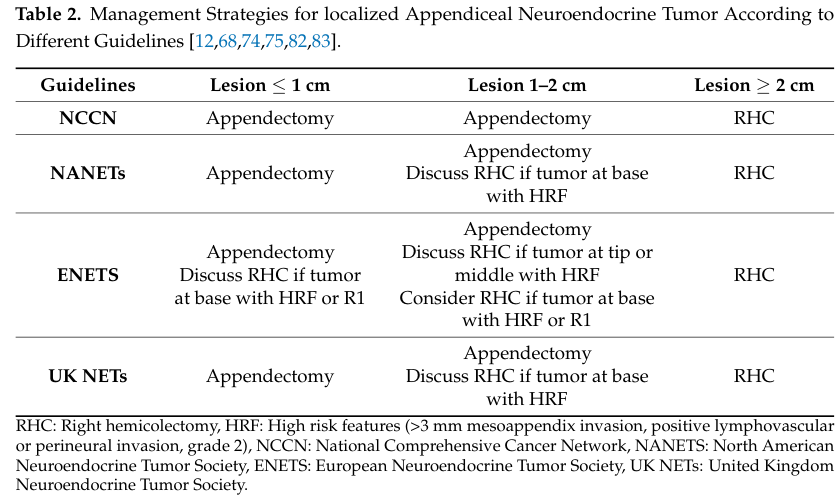
| Surgery threshold: appendectomy | Consensus summarized by guidelines supports appendectomy for tumors <1 cm, and for 1.0–1.9 cm tumors without high-risk features. (mohamed2022managementofappendix pages 4-5) | Mohamed et al., 2022, Cancers | https://doi.org/10.3390/cancers15010295 | Review/guideline synthesis |
| Surgery threshold: right hemicolectomy | Most guidelines recommend right hemicolectomy for tumors >2 cm; high-risk features include deep mesoappendiceal invasion >3 mm, positive/unclear margins, lymphovascular invasion, and higher proliferative rate. (mohamed2022managementofappendix pages 4-5) | Mohamed et al., 2022, Cancers | https://doi.org/10.3390/cancers15010295 | Review/guideline synthesis |
| Intermediate tumors (1–2 cm) | Authors suggest considering right hemicolectomy when tumor size is >15 mm and/or G2 and/or lymphovascular invasion, ideally after multidisciplinary review. (andrini2023anupdateon pages 1-3, andrini2023anupdateon pages 7-9) | Andrini et al., 2023, Current Treatment Options in Oncology | https://doi.org/10.1007/s11864-023-01093-0 | Expert review/opinion |
| Hemicolectomy vs appendectomy outcomes (1–2 cm) | Europe-wide pooled cohort of 278 patients: 163 appendectomy vs 115 hemicolectomy; median follow-up 13.0 years; regional nodal metastases in 22/115 (19.6%); estimated occult nodal disease after appendectomy 12.8% (95% CI 6.5–21.1%); no new metastases during >10 years follow-up; adjusted OS HR 0.88 (95% CI 0.36–2.17; p=0.71), supporting no routine hemicolectomy after complete appendectomy for 1–2 cm aNETs. (nesti2023hemicolectomyversusappendectomy pages 16-21, nesti2023hemicolectomyversusappendectomy pages 5-12, nesti2023hemicolectomyversusappendectomy pages 30-36) | Nesti et al., 2023, The Lancet Oncology | https://doi.org/10.1016/S1470-2045(22)00750-1 | Multicenter pooled retrospective cohort |
| Recent metastasis study | In an institutional series of 124 appendiceal NETs, only 10 had stage IV disease; 8/10 were synchronous, and among 114 early-stage patients none developed distant metastases during follow-up; authors concluded surveillance after resection is unlikely to help and tumors <2 cm should not receive completion hemicolectomy. (altoubah2025doappendicealneuroendocrine pages 1-2, altoubah2025doappendicealneuroendocrine pages 2-3, altoubah2025doappendicealneuroendocrine pages 3-4) | Al-Toubah et al., 2025, JNCCN | https://doi.org/10.6004/jnccn.2024.7069 | Institutional retrospective cohort |
| Recent completion-surgery study | Single-center cohort of 82 patients: lymph-node metastases in 7/82 (8.5%), distant metastases in 3/82 (3.6%); 27/82 (33%) underwent completion hemicolectomy, but only 6/27 (22%) had nodal metastases and none had distant metastases, implying overtreatment in 21/27 (75%); tumor size >2 cm was the only significant predictor of nodal metastasis. (wachter2025retrospectiveanalysisof pages 1-2, wachter2025retrospectiveanalysisof pages 2-4) | Wächter et al., 2025, Langenbeck's Archives of Surgery | https://doi.org/10.1007/s00423-024-03603-6 | Single-center retrospective cohort |
| Imaging recommendations | For NETs >2 cm, incomplete resection, or positive nodes/margins, recommend contrast-enhanced triple-phase CT or MRI; somatostatin-receptor PET with Ga-68 or Cu-64 DOTATATE is preferred and considered the diagnostic/surveillance gold standard for SSTR-positive disease. (mohamed2022managementofappendix pages 4-5) | Mohamed et al., 2022, Cancers | https://doi.org/10.3390/cancers15010295 | Review/guideline synthesis |
| Imaging in high-grade disease | Poorly differentiated/high-grade NECs are better evaluated with 18F-FDG PET plus CT/MRI rather than SSTR-based imaging. (mohamed2022managementofappendix pages 4-5) | Mohamed et al., 2022, Cancers | https://doi.org/10.3390/cancers15010295 | Review/guideline synthesis |
| Biomarkers | Chromogranin A may be elevated but is nonspecific; 5-HIAA (plasma or 24-h urine) is mainly useful in serotonin-producing tumors with carcinoid features or liver metastases. (mohamed2022managementofappendix pages 2-4, mohamed2022managementofappendix pages 4-5) | Mohamed et al., 2022, Cancers | https://doi.org/10.3390/cancers15010295 | Review/guideline synthesis |
| Survival / prognosis | Localized well-differentiated NETs have median OS >20 years; NCDB 5-year survival for ANETs was 86.3% (95% CI 81.4–89.9); 5-year survival by size was 89.9% (≤2 cm), 70.6% (2–4 cm), and 58.2% (>4 cm). (mohamed2022managementofappendix pages 2-4) | Mohamed et al., 2022, Cancers | https://doi.org/10.3390/cancers15010295 | Review of registry data |
| Follow-up / surveillance | Most well-differentiated appendiceal NETs <2 cm with negative margins and mesoappendiceal invasion <3 mm have low recurrence risk and often need no surveillance; postoperative surveillance is unlikely to benefit resected small tumors in recent retrospective data. (mohamed2022managementofappendix pages 4-5, altoubah2025doappendicealneuroendocrine pages 1-2, altoubah2025doappendicealneuroendocrine pages 3-4) | Mohamed et al., 2022, Cancers; Al-Toubah et al., 2025, JNCCN | https://doi.org/10.3390/cancers15010295; https://doi.org/10.6004/jnccn.2024.7069 | Review/guideline synthesis; retrospective cohort |
Table: This table compiles key evidence-backed facts about appendiceal neuroendocrine tumors/neoplasms from the retrieved literature, emphasizing incidence, metastatic risk by tumor size, management thresholds, diagnostics, and recent outcome studies. It is designed as a compact reference for evidence-supported knowledge base population.
1. Disease information
What is the disease?
- Definition / scope: Appendiceal neuroendocrine neoplasms include well-differentiated neuroendocrine tumors (NETs; historically called “carcinoid tumors”), poorly differentiated neuroendocrine carcinomas (NECs), and mixed neuroendocrine–non-neuroendocrine neoplasms (MiNENs) arising in the appendix. (mohamed2022managementofappendix pages 1-2, mohamed2022managementofappendix pages 2-4)
- Most appendiceal NENs are well-differentiated NETs; a 2022 guideline-synthesis review states ~70–75% are well-differentiated NETs. (mohamed2022managementofappendix pages 1-2)
Key identifiers (OMIM, Orphanet, ICD-10/ICD-11, MeSH, MONDO)
- Not recovered from the retrieved documents in this run (no ICD/MeSH/MONDO/Orphanet codes were present in accessible excerpts). (mohamed2022managementofappendix pages 1-2)
Synonyms / alternative names
- Appendiceal neuroendocrine tumor (aNET/ANET)
- Appendiceal neuroendocrine neoplasm (ANEN)
- Appendiceal carcinoid tumor (legacy term for well-differentiated appendiceal NET) (mohamed2022managementofappendix pages 1-2)
Evidence provenance
- The synthesized disease understanding here is derived primarily from aggregated disease-level resources (reviews, guideline syntheses, registry-based cohort studies) plus large pooled/retrospective clinical cohorts. (mohamed2022managementofappendix pages 4-5, nesti2023hemicolectomyversusappendectomy pages 5-12, wachter2025retrospectiveanalysisof pages 1-2)
2. Etiology
Disease causal factors
- ANENs are described as “usually sporadic tumors” in a guideline-synthesis review. (mohamed2022managementofappendix pages 1-2)
Risk factors
- Evidence gap in retrieved sources: The retrieved texts emphasize sporadic presentation and incidental detection but do not provide well-supported, tumor-specific environmental or inherited risk factors for appendiceal NET. (mohamed2022managementofappendix pages 1-2)
Protective factors / gene–environment interactions
- Not identified in the retrieved evidence set. (mohamed2022managementofappendix pages 1-2)
3. Phenotypes (clinical presentation) + suggested HPO terms
Typical presentation
- Incidental diagnosis after appendectomy for suspected appendicitis is the dominant presentation pattern. (mohamed2022managementofappendix pages 1-2)
- Tumors are most often located at the distal tip of the appendix. (mohamed2022managementofappendix pages 1-2)
- Functional syndromes are rare: a 2023 review reports carcinoid syndrome is very rare (<1%), generally occurring only with metastases. (andrini2023anupdateon pages 1-3)
Phenotype characteristics (age of onset, severity, progression)
- Demographics from a 2023 review: peak age reported as ~38–51 years with female predominance (~2:1). (andrini2023anupdateon pages 1-3)
- Clinical course is typically indolent for localized well-differentiated tumors, consistent with high long-term survival in registry/retrospective datasets. (mohamed2022managementofappendix pages 2-4, nesti2023hemicolectomyversusappendectomy pages 5-12)
HPO term suggestions (non-exhaustive)
- Abdominal pain (HPO: Abdominal pain)
- Acute appendicitis-like presentation (HPO: Appendicitis or Abdominal pain with acute onset)
- Incidental finding (HPO: Incidental finding)
- If functional/metastatic:
- Carcinoid syndrome (HPO: Carcinoid syndrome)
- Diarrhea (HPO: Diarrhea)
- Flushing (HPO: Flushing)
Biomarker phenotype links (laboratory abnormalities)
- Chromogranin A may be elevated but is nonspecific (confounded by renal/hepatic disease and medications). (mohamed2022managementofappendix pages 2-4)
- 5-HIAA (plasma or 24-hour urine) is mainly useful when serotonin excess is suspected (carcinoid features or liver metastases). (mohamed2022managementofappendix pages 4-5, mohamed2022managementofappendix pages 2-4)
4. Genetic / molecular information
Causal genes / germline predisposition
- Not identified for appendiceal NET specifically in the retrieved sources. The main high-confidence statements available were that ANENs are typically sporadic. (mohamed2022managementofappendix pages 1-2)
Pathophysiology-linked molecular features (clinically used)
- Proliferation index (Ki-67) and mitotic rate are central to grading well-differentiated NETs and correlate with behavior. (mohamed2022managementofappendix pages 1-2, mohamed2022managementofappendix pages 2-4)
- Somatostatin receptor (SSTR) biology is clinically actionable: SSTR-targeted PET is described as preferred and a “gold standard” approach for SSTR-positive disease evaluation/surveillance in guideline syntheses. (mohamed2022managementofappendix pages 4-5)
Proposed ontology annotations
- Cell types (Cell Ontology; CL) — suggestions:
- Enteroendocrine cell (CL: enteroendocrine cell; as the relevant neuroendocrine lineage of the gut)
- GO biological process — suggestions (non-exhaustive):
- Regulation of cell proliferation
- Neuroendocrine differentiation
- Hormone secretion / regulated exocytosis
5. Environmental information
No appendiceal-NET-specific toxin, lifestyle, or infectious triggers were supported in the retrieved evidence set. (mohamed2022managementofappendix pages 1-2)
6. Mechanism / pathophysiology
Mechanistic chain (clinically grounded)
- Neuroendocrine neoplastic transformation in appendiceal neuroendocrine lineage cells results in a well-differentiated NET in most cases. (mohamed2022managementofappendix pages 1-2)
- Growth and invasion are typically limited in small tumors; however, increasing tumor size and adverse histopathologic features associate with higher probability of regional lymph node metastasis and (rarely) distant spread. (mohamed2022managementofappendix pages 4-5, wachter2025retrospectiveanalysisof pages 1-2)
- Systemic functional symptoms (carcinoid syndrome) are uncommon and generally reflect metastatic disease. (andrini2023anupdateon pages 1-3)
Key pathways and cellular processes
- The retrieved sources did not provide appendiceal-NET-specific pathway alterations (e.g., MAPK/PI3K driver mutations) with primary molecular evidence; thus, pathway-level claims are not made here. (mohamed2022managementofappendix pages 1-2)
7. Anatomical structures affected
Primary organ
- Appendix (UBERON suggestion: vermiform appendix).
Localization
- Most tumors arise at the appendiceal tip/distal appendix. (andrini2023anupdateon pages 1-3, mohamed2022managementofappendix pages 1-2)
Metastatic spread (when present)
- In a large institutional cohort (2008–2023), stage IV disease was rare and, among metastatic cases, common sites included peritoneum and liver, with ovarian involvement noted among females in metastatic subset. (altoubah2025doappendicealneuroendocrine pages 2-3)
8. Temporal development
Onset and course
- Often detected in young to middle-aged adults and diagnosed after acute presentation leading to appendectomy. (andrini2023anupdateon pages 1-3, mohamed2022managementofappendix pages 1-2)
Progression
- For completely resected 1–2 cm tumors, a Europe-wide pooled cohort with median 13 years follow-up reported no metachronous distant metastases and no tumor-related deaths. (nesti2023hemicolectomyversusappendectomy pages 5-12)
9. Inheritance and population
Epidemiology (recent data prioritized)
- Incidence trend (SEER 2000–2017): appendiceal NET incidence increased from 0.03 to 0.90 per 100,000 person-years, with the most pronounced increase in localized disease. (Wang et al., PLOS ONE, published Nov 2023; https://doi.org/10.1371/journal.pone.0294153) (wang2023incidencetrendsand pages 13-14)
- Reported incidence range: a 2023 review reports annual incidence ~0.15–0.6 per 100,000 and that aNETs are found in approximately 3–5 per 1,000 appendectomies. (Andrini et al., Current Treatment Options in Oncology, May 2023; https://doi.org/10.1007/s11864-023-01093-0) (andrini2023anupdateon pages 1-3)
- Stage distribution (historical SEER 1973–2004): 60% localized, 28% regional, 12% distant at diagnosis. (mohamed2022managementofappendix pages 1-2)
Inheritance
- No Mendelian inheritance pattern or specific causal genes were supported by the retrieved appendiceal-NET-focused evidence; tumors are generally described as sporadic. (mohamed2022managementofappendix pages 1-2)
10. Diagnostics
Histopathology / immunohistochemistry
- Diagnostic confirmation typically relies on postoperative pathology with neuroendocrine immunophenotype markers (e.g., synaptophysin, chromogranin A variably, CD56) and Ki-67 assessment for grading. (vasile2025neuroendocrinetumorsof pages 3-4, kim2025appendicealneuroendocrinetumor pages 4-6)
Imaging
Guideline-synthesis evidence indicates imaging choice depends on risk features and differentiation: - For higher-risk localized disease (e.g., >2 cm, incomplete resection, positive nodes/margins), guidelines recommend contrast-enhanced triple-phase CT or MRI. (mohamed2022managementofappendix pages 4-5) - Somatostatin receptor PET (Ga-68 or Cu-64 DOTATATE) is described as preferred, “gold standard” for SSTR-positive lesions; lesions considered SSTR-positive if uptake exceeds liver background in the cited synthesis. (mohamed2022managementofappendix pages 4-5) - For high-grade NEC, FDG-PET is favored. (mohamed2022managementofappendix pages 4-5) - Reported imaging performance in the 2022 synthesis: FDG-PET/CT sensitivity/specificity 61.9%/100%, and 68Ga-DOTATATE PET/CT sensitivity/specificity approximately 100–81% and 90–80% across studies summarized there (with reported false positives 0–38%). (mohamed2022managementofappendix pages 4-5)
Differential diagnosis
- The retrieved evidence set did not provide a structured differential diagnosis list; however, the classification framework distinguishes well-differentiated NET from poorly differentiated NEC and MiNEN, which has major prognostic and therapeutic implications. (mohamed2022managementofappendix pages 1-2, mohamed2022managementofappendix pages 2-4)
Visual evidence (staging/management)
- TNM staging with survival estimates and guideline comparisons for appendectomy vs RHC indications are shown in extracted figures/tables from Mohamed et al. 2022. (mohamed2022managementofappendix media 6bf50e49, mohamed2022managementofappendix media 58ffb4ea, mohamed2022managementofappendix media 5c304756)
11. Outcome / prognosis
Survival and prognostic factors
- Prognosis is strongly related to tumor size, differentiation/grade, margins, and metastatic stage. (mohamed2022managementofappendix pages 2-4)
- A guideline-synthesis review summarizing NCDB data reports:
- 5-year survival for ANETs ~86.3% (95% CI 81.4–89.9). (mohamed2022managementofappendix pages 2-4)
- Size-stratified 5-year survival: 89.9% (≤2 cm), 70.6% (2–4 cm), 58.2% (>4 cm). (mohamed2022managementofappendix pages 2-4)
- Stage IV disease appears extremely uncommon in specialty-center populations: an institutional series identified 10 stage IV cases among 124 appendiceal NET patients, and most were synchronous at diagnosis. (altoubah2025doappendicealneuroendocrine pages 1-2)
Nodal metastases and clinical relevance
- Lymph-node metastasis probability increases with tumor size in registry-based summaries and cohorts. (mohamed2022managementofappendix pages 4-5, wachter2025retrospectiveanalysisof pages 1-2)
- Importantly, long-term outcomes suggest nodal disease in 1–2 cm tumors may be clinically less consequential: in the Europe-wide pooled cohort, there were no metachronous metastases and no tumor-related deaths after complete resection despite ~20% nodal positivity in the hemicolectomy group. (nesti2023hemicolectomyversusappendectomy pages 5-12)
12. Treatment
Surgical management (real-world implementation + recent developments)
Surgery is the mainstay: - <1 cm: appendectomy is generally considered curative when margins are negative. (mohamed2022managementofappendix pages 4-5, andrini2023anupdateon pages 1-3) - ≥2 cm: most guidelines recommend right hemicolectomy with lymphadenectomy due to higher nodal metastasis risk. (mohamed2022managementofappendix pages 4-5, andrini2023anupdateon pages 1-3) - 1–2 cm: management is controversial; recent high-quality evidence supports de-escalation: - Nesti et al., The Lancet Oncology (Feb 2023, DOI: https://doi.org/10.1016/S1470-2045(22)00750-1) pooled 278 patients (1–2 cm aNET): appendectomy vs hemicolectomy showed no OS benefit (adjusted HR 0.88; p=0.71), and “All metastases were diagnosed synchronously with no tumour-related deaths during the follow-up” (quote from study summary evidence). (nesti2023hemicolectomyversusappendectomy pages 5-12) - A single-center ENETS center retrospective analysis (2025) reported that guideline-based completion RHC may lead to substantial overtreatment: 27/82 (33%) had completion surgery but only 6/27 (22%) had nodal metastases and 0 had distant metastases in completion specimens; tumor size >2 cm was the only significant predictor of nodal metastasis. (Wächter et al., Jan 2025; https://doi.org/10.1007/s00423-024-03603-6) (wachter2025retrospectiveanalysisof pages 1-2)
Guideline comparison and algorithm (visual): Table 2 and Figure 2 extracted from Mohamed et al. summarize across NCCN/NANETS/ENETS/UK NET guidance when to recommend appendectomy versus RHC and show a post-appendectomy surgical algorithm. (mohamed2022managementofappendix media 6bf50e49, mohamed2022managementofappendix media 58ffb4ea, mohamed2022managementofappendix media 5c304756)
Systemic therapy (advanced disease)
- For well-differentiated metastatic NENs, the evidence set primarily supports SSTR-based imaging and implies feasibility of SSTR-targeted approaches (SSAs/PRRT) when SSTR-positive; appendiceal-specific systemic trial evidence was not directly retrieved. (mohamed2022managementofappendix pages 4-5)
- For poorly differentiated NECs, platinum–etoposide is noted as a standard approach in the guideline synthesis. (mohamed2022managementofappendix pages 14-16)
Treatment outcomes and surveillance
- The 2022 guideline-synthesis review notes that many well-differentiated appendiceal NETs <2 cm with negative margins and limited mesoappendiceal invasion have low recurrence risk and often do not require surveillance. (mohamed2022managementofappendix pages 4-5)
- A 2025 institutional analysis similarly concluded that for tumors <2 cm, completion hemicolectomy is overtreatment and “postoperative surveillance is unlikely to be of benefit” (quote captured in evidence). (altoubah2025doappendicealneuroendocrine pages 1-2)
MAXO term suggestions (non-exhaustive)
- Appendectomy; right hemicolectomy; lymphadenectomy (surgical)
- Contrast-enhanced CT; MRI; somatostatin receptor PET (diagnostic)
- Somatostatin analogue therapy; peptide receptor radionuclide therapy (PRRT) (advanced disease; where applicable)
13. Prevention
No primary prevention strategies specific to appendiceal NET were supported in the retrieved sources; the dominant theme is incidental detection during appendectomy rather than screening. (mohamed2022managementofappendix pages 1-2)
14. Other species / natural disease
No cross-species naturally occurring appendiceal NET evidence was identified in the retrieved documents. (mohamed2022managementofappendix pages 1-2)
15. Model organisms
No appendiceal-NET-specific animal models, organoids, or cell lines were identified in the retrieved evidence set; any discussion of model systems would require additional targeted searches outside the current corpus. (mohamed2022managementofappendix pages 1-2)
Recent developments (2023–2025 highlights)
- Incidence escalation in the US: SEER-based analysis documents a strong rise in aNET incidence (0.03→0.90 per 100,000 person-years, 2000–2017), likely reflecting stage migration and detection. (Nov 2023; https://doi.org/10.1371/journal.pone.0294153) (wang2023incidencetrendsand pages 13-14)
- Surgical de-escalation evidence for 1–2 cm tumors: large pooled cohort demonstrates no survival benefit to hemicolectomy and no metachronous metastases after complete resection. (Feb 2023; https://doi.org/10.1016/S1470-2045(22)00750-1) (nesti2023hemicolectomyversusappendectomy pages 5-12)
- Reassessment of completion surgery criteria: single-center cohort quantifies potential overtreatment when applying guideline criteria broadly; tumor size >2 cm emerges as the dominant predictor of nodal disease. (Jan 2025; https://doi.org/10.1007/s00423-024-03603-6) (wachter2025retrospectiveanalysisof pages 1-2)
- Metastasis rarity and questionable value of surveillance: institutional series suggests stage IV disease is exceptionally rare and usually synchronous; surveillance benefit after resection of small tumors appears minimal. (Jan 2025; https://doi.org/10.6004/jnccn.2024.7069) (altoubah2025doappendicealneuroendocrine pages 1-2)
Clinical trials and real-world studies (selected; clinicaltrials.gov)
- NCT05919758 (Recruiting): “Value of Right-sided Hemicolectomy for Children With High-risk Neuroendocrine Tumors of the Appendix” (observational; large target enrollment). (clinicaltrials.gov record retrieved in this run) (NCT05919758 chunk 1)
- NCT02730104 (Completed): “Community-based Neuroendocrine Tumor (NET) Research Study” (observational). (NCT02730104 chunk 1)
Notes on evidence limitations for knowledge-base population
- Ontology identifiers (MONDO/Orphanet/MeSH/ICD) were not recoverable from retrieved texts; additional targeted retrieval (e.g., MeSH browser, MONDO, Orphanet, ICD-11 MMS) is required.
- Appendiceal-NET-specific genomics and model organism resources were not present in the current evidence set; these should be populated via targeted molecular studies (e.g., sequencing cohorts) and model-system literature.
Key “direct abstract” quotes captured in this evidence set
- On management controversy and size thresholds (review): “Simple appendectomy is curative for appendiceal NETs (G1–G2) < 1 cm… whereas RHC… is recommended in tumors ≥ 2 cm…” (May 2023) (andrini2023anupdateon pages 1-3)
- On incidence and stage migration (registry study): “the annual incidence of appendiceal neuroendocrine tumors (aNETs) increased significantly, from 0.03 to 0.90 per 100,000 person-years…” (Nov 2023) (wang2023incidencetrendsand pages 13-14)
- On pooled cohort outcomes (study summary evidence): “All metastases were diagnosed synchronously with no tumour-related deaths during the follow-up.” (Feb 2023) (nesti2023hemicolectomyversusappendectomy pages 5-12)
References
-
(andrini2023anupdateon pages 1-3): Elisa Andrini, Giuseppe Lamberti, Laura Alberici, Claudio Ricci, and Davide Campana. An update on appendiceal neuroendocrine tumors. Current Treatment Options in Oncology, 24:742-756, May 2023. URL: https://doi.org/10.1007/s11864-023-01093-0, doi:10.1007/s11864-023-01093-0. This article has 26 citations and is from a peer-reviewed journal.
-
(mohamed2022managementofappendix pages 1-2): Amr Mohamed, Sulin Wu, Mohamed Hamid, Amit Mahipal, Sakti Cjakrabarti, David Bajor, J. Eva Selfridge, and Sylvia L. Asa. Management of appendix neuroendocrine neoplasms: insights on the current guidelines. Cancers, 15:295, Dec 2022. URL: https://doi.org/10.3390/cancers15010295, doi:10.3390/cancers15010295. This article has 55 citations.
-
(nesti2023hemicolectomyversusappendectomy pages 5-12): Cédric Nesti, Konstantin Bräutigam, Marta Benavent, Laura Bernal, Hessa Boharoon, Johan Botling, Antonin Bouroumeau, Iva Brcic, Maximilian Brunner, Guillaume Cadiot, Maria Camara, Emanuel Christ, Thomas Clerici, Ashley K Clift, Hamish Clouston, Lorenzo Cobianchi, Jarosław B Ćwikła, Kosmas Daskalakis, Andrea Frilling, Rocio Garcia-Carbonero, Simona Grozinsky-Glasberg, Jorge Hernando, Valérie Hervieu, Johannes Hofland, Pernille Holmager, Frediano Inzani, Henning Jann, Paula Jimenez-Fonseca, Enes Kaçmaz, Daniel Kaemmerer, Gregory Kaltsas, Branislav Klimacek, Ulrich Knigge, Agnieszka Kolasińska-Ćwikła, Walter Kolb, Beata Kos-Kudła, Catarina Alisa Kunze, Stefania Landolfi, Stefano La Rosa, Carlos López López, Kerstin Lorenz, Maurice Matter, Peter Mazal, Claudia Mestre-Alagarda, Patricia Morales del Burgo, Els J M Nieveen van Dijkum, Kira Oleinikov, Lorenzo A Orci, Francesco Panzuto, Marianne Pavel, Marine Perrier, Henrik Mikael Reims, Guido Rindi, Anja Rinke, Maria Rinzivillo, Xavier Sagaert, Ilker Satiroglu, Andreas Selberherr, Alexander R Siebenhüner, Margot E T Tesselaar, Michael J Thalhammer, Espen Thiis-Evensen, Christos Toumpanakis, Timon Vandamme, José G van den Berg, Alessandro Vanoli, Marie-Louise F van Velthuysen, Chris Verslype, Stephan A Vorburger, Alessandro Lugli, John Ramage, Marcel Zwahlen, Aurel Perren, and Reto M Kaderli. Hemicolectomy versus appendectomy for patients with appendiceal neuroendocrine tumours 1–2 cm in size: a retrospective, europe-wide, pooled cohort study. The Lancet Oncology, 24:187-194, Feb 2023. URL: https://doi.org/10.1016/s1470-2045(22)00750-1, doi:10.1016/s1470-2045(22)00750-1. This article has 90 citations and is from a highest quality peer-reviewed journal.
-
(mohamed2022managementofappendix pages 2-4): Amr Mohamed, Sulin Wu, Mohamed Hamid, Amit Mahipal, Sakti Cjakrabarti, David Bajor, J. Eva Selfridge, and Sylvia L. Asa. Management of appendix neuroendocrine neoplasms: insights on the current guidelines. Cancers, 15:295, Dec 2022. URL: https://doi.org/10.3390/cancers15010295, doi:10.3390/cancers15010295. This article has 55 citations.
-
(wang2023incidencetrendsand pages 13-14): Dan Wang, Heming Ge, Yebin Lu, and Xuejun Gong. Incidence trends and survival analysis of appendiceal tumors in the united states: primarily changes in appendiceal neuroendocrine tumors. PLOS ONE, 18:e0294153, Nov 2023. URL: https://doi.org/10.1371/journal.pone.0294153, doi:10.1371/journal.pone.0294153. This article has 31 citations and is from a peer-reviewed journal.
-
(mohamed2022managementofappendix pages 4-5): Amr Mohamed, Sulin Wu, Mohamed Hamid, Amit Mahipal, Sakti Cjakrabarti, David Bajor, J. Eva Selfridge, and Sylvia L. Asa. Management of appendix neuroendocrine neoplasms: insights on the current guidelines. Cancers, 15:295, Dec 2022. URL: https://doi.org/10.3390/cancers15010295, doi:10.3390/cancers15010295. This article has 55 citations.
-
(andrini2023anupdateon pages 7-9): Elisa Andrini, Giuseppe Lamberti, Laura Alberici, Claudio Ricci, and Davide Campana. An update on appendiceal neuroendocrine tumors. Current Treatment Options in Oncology, 24:742-756, May 2023. URL: https://doi.org/10.1007/s11864-023-01093-0, doi:10.1007/s11864-023-01093-0. This article has 26 citations and is from a peer-reviewed journal.
-
(nesti2023hemicolectomyversusappendectomy pages 16-21): Cédric Nesti, Konstantin Bräutigam, Marta Benavent, Laura Bernal, Hessa Boharoon, Johan Botling, Antonin Bouroumeau, Iva Brcic, Maximilian Brunner, Guillaume Cadiot, Maria Camara, Emanuel Christ, Thomas Clerici, Ashley K Clift, Hamish Clouston, Lorenzo Cobianchi, Jarosław B Ćwikła, Kosmas Daskalakis, Andrea Frilling, Rocio Garcia-Carbonero, Simona Grozinsky-Glasberg, Jorge Hernando, Valérie Hervieu, Johannes Hofland, Pernille Holmager, Frediano Inzani, Henning Jann, Paula Jimenez-Fonseca, Enes Kaçmaz, Daniel Kaemmerer, Gregory Kaltsas, Branislav Klimacek, Ulrich Knigge, Agnieszka Kolasińska-Ćwikła, Walter Kolb, Beata Kos-Kudła, Catarina Alisa Kunze, Stefania Landolfi, Stefano La Rosa, Carlos López López, Kerstin Lorenz, Maurice Matter, Peter Mazal, Claudia Mestre-Alagarda, Patricia Morales del Burgo, Els J M Nieveen van Dijkum, Kira Oleinikov, Lorenzo A Orci, Francesco Panzuto, Marianne Pavel, Marine Perrier, Henrik Mikael Reims, Guido Rindi, Anja Rinke, Maria Rinzivillo, Xavier Sagaert, Ilker Satiroglu, Andreas Selberherr, Alexander R Siebenhüner, Margot E T Tesselaar, Michael J Thalhammer, Espen Thiis-Evensen, Christos Toumpanakis, Timon Vandamme, José G van den Berg, Alessandro Vanoli, Marie-Louise F van Velthuysen, Chris Verslype, Stephan A Vorburger, Alessandro Lugli, John Ramage, Marcel Zwahlen, Aurel Perren, and Reto M Kaderli. Hemicolectomy versus appendectomy for patients with appendiceal neuroendocrine tumours 1–2 cm in size: a retrospective, europe-wide, pooled cohort study. The Lancet Oncology, 24:187-194, Feb 2023. URL: https://doi.org/10.1016/s1470-2045(22)00750-1, doi:10.1016/s1470-2045(22)00750-1. This article has 90 citations and is from a highest quality peer-reviewed journal.
-
(nesti2023hemicolectomyversusappendectomy pages 30-36): Cédric Nesti, Konstantin Bräutigam, Marta Benavent, Laura Bernal, Hessa Boharoon, Johan Botling, Antonin Bouroumeau, Iva Brcic, Maximilian Brunner, Guillaume Cadiot, Maria Camara, Emanuel Christ, Thomas Clerici, Ashley K Clift, Hamish Clouston, Lorenzo Cobianchi, Jarosław B Ćwikła, Kosmas Daskalakis, Andrea Frilling, Rocio Garcia-Carbonero, Simona Grozinsky-Glasberg, Jorge Hernando, Valérie Hervieu, Johannes Hofland, Pernille Holmager, Frediano Inzani, Henning Jann, Paula Jimenez-Fonseca, Enes Kaçmaz, Daniel Kaemmerer, Gregory Kaltsas, Branislav Klimacek, Ulrich Knigge, Agnieszka Kolasińska-Ćwikła, Walter Kolb, Beata Kos-Kudła, Catarina Alisa Kunze, Stefania Landolfi, Stefano La Rosa, Carlos López López, Kerstin Lorenz, Maurice Matter, Peter Mazal, Claudia Mestre-Alagarda, Patricia Morales del Burgo, Els J M Nieveen van Dijkum, Kira Oleinikov, Lorenzo A Orci, Francesco Panzuto, Marianne Pavel, Marine Perrier, Henrik Mikael Reims, Guido Rindi, Anja Rinke, Maria Rinzivillo, Xavier Sagaert, Ilker Satiroglu, Andreas Selberherr, Alexander R Siebenhüner, Margot E T Tesselaar, Michael J Thalhammer, Espen Thiis-Evensen, Christos Toumpanakis, Timon Vandamme, José G van den Berg, Alessandro Vanoli, Marie-Louise F van Velthuysen, Chris Verslype, Stephan A Vorburger, Alessandro Lugli, John Ramage, Marcel Zwahlen, Aurel Perren, and Reto M Kaderli. Hemicolectomy versus appendectomy for patients with appendiceal neuroendocrine tumours 1–2 cm in size: a retrospective, europe-wide, pooled cohort study. The Lancet Oncology, 24:187-194, Feb 2023. URL: https://doi.org/10.1016/s1470-2045(22)00750-1, doi:10.1016/s1470-2045(22)00750-1. This article has 90 citations and is from a highest quality peer-reviewed journal.
-
(altoubah2025doappendicealneuroendocrine pages 1-2): Taymeyah Al-Toubah, Mintallah Haider, Eleonora Pelle, Maria Grazia Maratta, and Jonathan Strosberg. Do appendiceal neuroendocrine tumors metastasize post appendectomy or right hemicolectomy? Jan 2025. URL: https://doi.org/10.6004/jnccn.2024.7069, doi:10.6004/jnccn.2024.7069. This article has 5 citations and is from a domain leading peer-reviewed journal.
-
(altoubah2025doappendicealneuroendocrine pages 2-3): Taymeyah Al-Toubah, Mintallah Haider, Eleonora Pelle, Maria Grazia Maratta, and Jonathan Strosberg. Do appendiceal neuroendocrine tumors metastasize post appendectomy or right hemicolectomy? Jan 2025. URL: https://doi.org/10.6004/jnccn.2024.7069, doi:10.6004/jnccn.2024.7069. This article has 5 citations and is from a domain leading peer-reviewed journal.
-
(altoubah2025doappendicealneuroendocrine pages 3-4): Taymeyah Al-Toubah, Mintallah Haider, Eleonora Pelle, Maria Grazia Maratta, and Jonathan Strosberg. Do appendiceal neuroendocrine tumors metastasize post appendectomy or right hemicolectomy? Jan 2025. URL: https://doi.org/10.6004/jnccn.2024.7069, doi:10.6004/jnccn.2024.7069. This article has 5 citations and is from a domain leading peer-reviewed journal.
-
(wachter2025retrospectiveanalysisof pages 1-2): Sabine Wächter, Dimitrios Panidis, Moritz Jesinghaus, Anja Rinke, Monika Heinzel-Gutenbrunner, Elisabeth Maurer, and Detlef K. Bartsch. Retrospective analysis of criteria for oncological completion surgery of neuroendocrine tumors of the appendix. Langenbeck's Archives of Surgery, Jan 2025. URL: https://doi.org/10.1007/s00423-024-03603-6, doi:10.1007/s00423-024-03603-6. This article has 1 citations.
-
(wachter2025retrospectiveanalysisof pages 2-4): Sabine Wächter, Dimitrios Panidis, Moritz Jesinghaus, Anja Rinke, Monika Heinzel-Gutenbrunner, Elisabeth Maurer, and Detlef K. Bartsch. Retrospective analysis of criteria for oncological completion surgery of neuroendocrine tumors of the appendix. Langenbeck's Archives of Surgery, Jan 2025. URL: https://doi.org/10.1007/s00423-024-03603-6, doi:10.1007/s00423-024-03603-6. This article has 1 citations.
-
(vasile2025neuroendocrinetumorsof pages 3-4): Liviu Vasile, Laurenţiu Augustus Barbu, Gabriel Florin Răzvan Mogoş, Valeriu Şurlin, Ionică Daniel Vîlcea, Liliana Cercelaru, Stelian Ştefăniţă Mogoantă, Nicolae-Dragoş Mărgăritescu, and Victor Nimigean. Neuroendocrine tumors of the appendix: a comprehensive review of the literature and case presentation. Romanian Journal of Morphology and Embryology, 66:269-278, Aug 2025. URL: https://doi.org/10.47162/rjme.66.2.01, doi:10.47162/rjme.66.2.01. This article has 4 citations and is from a peer-reviewed journal.
-
(kim2025appendicealneuroendocrinetumor pages 4-6): YESEUL KIM, YOU-NA SUNG, ANNA THERESE DATUIN, INHO JANG, and JONGMIN SIM. Appendiceal neuroendocrine tumor: clinicopathologic characteristics of six cases and review of the literature. In Vivo, 39:559-565, Dec 2025. URL: https://doi.org/10.21873/invivo.13860, doi:10.21873/invivo.13860. This article has 4 citations and is from a peer-reviewed journal.
-
(mohamed2022managementofappendix media 6bf50e49): Amr Mohamed, Sulin Wu, Mohamed Hamid, Amit Mahipal, Sakti Cjakrabarti, David Bajor, J. Eva Selfridge, and Sylvia L. Asa. Management of appendix neuroendocrine neoplasms: insights on the current guidelines. Cancers, 15:295, Dec 2022. URL: https://doi.org/10.3390/cancers15010295, doi:10.3390/cancers15010295. This article has 55 citations.
-
(mohamed2022managementofappendix media 58ffb4ea): Amr Mohamed, Sulin Wu, Mohamed Hamid, Amit Mahipal, Sakti Cjakrabarti, David Bajor, J. Eva Selfridge, and Sylvia L. Asa. Management of appendix neuroendocrine neoplasms: insights on the current guidelines. Cancers, 15:295, Dec 2022. URL: https://doi.org/10.3390/cancers15010295, doi:10.3390/cancers15010295. This article has 55 citations.
-
(mohamed2022managementofappendix media 5c304756): Amr Mohamed, Sulin Wu, Mohamed Hamid, Amit Mahipal, Sakti Cjakrabarti, David Bajor, J. Eva Selfridge, and Sylvia L. Asa. Management of appendix neuroendocrine neoplasms: insights on the current guidelines. Cancers, 15:295, Dec 2022. URL: https://doi.org/10.3390/cancers15010295, doi:10.3390/cancers15010295. This article has 55 citations.
-
(mohamed2022managementofappendix pages 14-16): Amr Mohamed, Sulin Wu, Mohamed Hamid, Amit Mahipal, Sakti Cjakrabarti, David Bajor, J. Eva Selfridge, and Sylvia L. Asa. Management of appendix neuroendocrine neoplasms: insights on the current guidelines. Cancers, 15:295, Dec 2022. URL: https://doi.org/10.3390/cancers15010295, doi:10.3390/cancers15010295. This article has 55 citations.