Anal Canal Adenocarcinoma
Anal canal adenocarcinoma is a rare, aggressive gland-forming malignancy of the anal canal region. It is biologically heterogeneous: some tumors resemble colorectal-type adenocarcinoma, some arise from anal gland or transitional epithelium, and fistula-associated mucinous tumors can emerge in chronic anorectal inflammatory tracts. The evidence base is dominated by population registry cohorts, retrospective treatment studies, molecular cohort profiling, and case reports rather than randomized disease-specific trials.
Ask OpenScientist
Ask a research question about Anal Canal Adenocarcinoma. OpenScientist will conduct autonomous deep research using the Disorder Mechanisms Knowledge Base and PubMed literature (typically 10-30 minutes).
Do not include personal health information in your question. Questions and results are cached in your browser's local storage.
Definitions
1Show evidence (2 references)
Subtypes
3Show evidence (1 reference)
Show evidence (1 reference)
Show evidence (1 reference)
Pathophysiology
6Show evidence (2 references)
Show evidence (1 reference)
Show evidence (1 reference)
Show evidence (1 reference)
Show evidence (1 reference)
Show evidence (1 reference)
Histopathology
3Show evidence (1 reference)
Show evidence (1 reference)
Show evidence (1 reference)
Pathograph
Phenotypes
3Blood 1
Show evidence (1 reference)
Digestive 1
Show evidence (1 reference)
Constitutional 1
Show evidence (1 reference)
Genetic Associations
3Show evidence (1 reference)
Show evidence (1 reference)
Show evidence (1 reference)
Medical Actions
3Show evidence (1 reference)
Show evidence (2 references)
Show evidence (2 references)
Environmental Factors
2Show evidence (1 reference)
Show evidence (1 reference)
Diagnosis
2Show evidence (2 references)
Show evidence (1 reference)
Progression
3Show evidence (1 reference)
Show evidence (1 reference)
Show evidence (1 reference)
Stages
1Show evidence (1 reference)
Epidemiology
2Show evidence (1 reference)
Show evidence (1 reference)
Clinical Trials
1Show evidence (1 reference)
Source YAML
click to showname: Anal Canal Adenocarcinoma
creation_date: "2026-05-14T18:23:55Z"
synonyms:
- Anal adenocarcinoma
- Adenocarcinoma of the anal canal
- Adenocarcinoma arising in anal mucosa
- Fistula-associated mucinous adenocarcinoma
description: >-
Anal canal adenocarcinoma is a rare, aggressive gland-forming malignancy of
the anal canal region. It is biologically heterogeneous: some tumors resemble
colorectal-type adenocarcinoma, some arise from anal gland or transitional
epithelium, and fistula-associated mucinous tumors can emerge in chronic
anorectal inflammatory tracts. The evidence base is dominated by population
registry cohorts, retrospective treatment studies, molecular cohort profiling,
and case reports rather than randomized disease-specific trials.
categories:
- Gastrointestinal Malignancy
- Adenocarcinoma
- Solid Tumor
- Rare Cancer
parents:
- anus adenocarcinoma
- anal canal carcinoma
- adenocarcinoma
disease_term:
preferred_term: anal canal adenocarcinoma
term:
id: MONDO:0002735
label: anal canal adenocarcinoma
definitions:
- name: Clinicopathologic definition
definition_type: CASE_DEFINITION
description: >-
A primary adenocarcinoma arising in the anal canal mucosa, transitional
zone, anal glands, or anorectal fistula region, diagnosed by biopsy and
gland-forming histopathology with clinical and immunohistochemical exclusion
of a downward-extending distal rectal adenocarcinoma or metastatic
adenocarcinoma from another primary site.
scope: Gastrointestinal oncology and surgical pathology definition
evidence:
- reference: PMID:29700411
reference_title: "A dualistic model of primary anal canal adenocarcinoma with distinct cellular origins, etiologies, inflammatory microenvironments and mutational signatures: implications for personalised medicine."
supports: SUPPORT
evidence_source: HUMAN_CLINICAL
snippet: "Primary adenocarcinoma of the anal canal is a rare and aggressive gastrointestinal disease with unclear pathogenesis."
explanation: >-
This multi-institutional cohort establishes anal canal adenocarcinoma as a
rare aggressive gastrointestinal tumor and motivates subtype-aware
pathologic classification.
- reference: PMID:34244243
reference_title: "Anal adenocarcinoma: case report, literature review and comparative survival analysis."
supports: SUPPORT
evidence_source: HUMAN_CLINICAL
snippet: "A recent classification suggests that anal adenocarcinomas can be subdivided into two types: (1) colorectal from mucosa above the dentate line and (2) extramucosal from anorectal fistulae or anal glands."
explanation: >-
This review supports classifying anal adenocarcinoma by colorectal-type
mucosal origin versus extramucosal fistula or anal-gland origin.
has_subtypes:
- name: Anal Gland/Transitional Type
display_name: Anal gland/transitional-type anal canal adenocarcinoma
classification: histologic and molecular
description: >-
KRT7-positive, KRT20/CDX2-negative tumors interpreted as anal
gland/transitional-type adenocarcinomas. In the Herfs cohort, this subtype
had a subset of HPV16/18-associated tumors and a more prominent
immune-checkpoint microenvironment than colorectal-type tumors.
evidence:
- reference: PMID:29700411
reference_title: "A dualistic model of primary anal canal adenocarcinoma with distinct cellular origins, etiologies, inflammatory microenvironments and mutational signatures: implications for personalised medicine."
supports: SUPPORT
evidence_source: HUMAN_CLINICAL
snippet: "Phenotypic analysis revealed two region-specific subtypes of anal canal adenocarcinoma."
explanation: >-
The 74-tumor molecular pathology cohort supports distinct
region-specific subtypes within primary anal canal adenocarcinoma.
- name: Colorectal Type
display_name: Colorectal-type anal canal adenocarcinoma
classification: histologic and molecular
description: >-
KRT20/CDX2-positive tumors interpreted as colorectal-type anal canal
adenocarcinomas, resembling lower rectal or colorectal mucosal
adenocarcinoma in lineage marker pattern and clinical management.
evidence:
- reference: PMID:34244243
reference_title: "Anal adenocarcinoma: case report, literature review and comparative survival analysis."
supports: SUPPORT
evidence_source: HUMAN_CLINICAL
snippet: "Differentiating between distal rectal adenocarcinoma with local spread and primary anal canal tumours is challenging."
explanation: >-
This review highlights the diagnostic boundary between colorectal-type
anal canal adenocarcinoma and distal rectal adenocarcinoma extending into
the anal canal.
- name: Fistula-Associated Mucinous Type
display_name: Fistula-associated mucinous adenocarcinoma
classification: etiologic and histologic
description: >-
Mucinous adenocarcinoma arising in a chronic anorectal fistula or perianal
abscess/fistula tract, including Crohn disease-associated fistula cancers.
evidence:
- reference: PMID:37695405
reference_title: "A case report of anal fistula-associated mucinous adenocarcinoma developing 3 years after treatment of perianal abscess."
supports: SUPPORT
evidence_source: HUMAN_CLINICAL
snippet: "A biopsy taken from the tumor demonstrated mucinous adenocarcinoma; the tumor was diagnosed as FAMC."
explanation: >-
This case report directly documents fistula-associated mucinous
adenocarcinoma as an anal canal adenocarcinoma-related subtype.
environmental:
- name: Chronic anorectal fistula and perianal abscess history
description: >-
Persistent anorectal fistula or perianal abscess/fistula inflammation can
provide the substrate for fistula-associated mucinous adenocarcinoma.
effect: HARMFUL
evidence:
- reference: PMID:37695405
reference_title: "A case report of anal fistula-associated mucinous adenocarcinoma developing 3 years after treatment of perianal abscess."
supports: SUPPORT
evidence_source: HUMAN_CLINICAL
snippet: "A long-standing (over 10 years) anal fistula is considered a fundamental cause of fistula-associated mucinous adenocarcinoma (FAMC)."
explanation: >-
The abstract identifies long-standing anal fistula as a fundamental cause
of fistula-associated mucinous adenocarcinoma.
- name: Crohn disease-associated anorectal fistula
description: >-
Perianal Crohn disease with anorectal fistula can be complicated by
mucinous anorectal fistula cancer with locally advanced invasion.
effect: HARMFUL
evidence:
- reference: PMID:37962718
reference_title: "Resection of anorectal fistula cancer associated with Crohn's disease after preoperative chemoradiotherapy: a case report."
supports: SUPPORT
evidence_source: HUMAN_CLINICAL
snippet: "We report a case of anorectal fistula cancer with widespread infiltration diagnosed during the course of Crohn's disease, which was curatively resected after preoperative chemoradiotherapy."
explanation: >-
This case report supports Crohn disease-associated anorectal fistula as a
context for locally advanced mucinous adenocarcinoma.
pathophysiology:
- name: Chronic Fistula Inflammation
description: >-
Persistent perianal abscess and anal fistula create a chronic inflammatory
epithelial-tract context implicated in fistula-associated mucinous
adenocarcinoma. The available evidence is case-level and does not establish
how long inflammation must persist before epithelial change occurs.
cell_types:
- preferred_term: fistula tract glandular epithelial cell
term:
id: CL:0000066
label: epithelial cell
locations:
- preferred_term: anal canal
term:
id: UBERON:0000159
label: anal canal
biological_processes:
- preferred_term: inflammatory response in a chronic fistula tract
term:
id: GO:0006954
label: inflammatory response
modifier: INCREASED
evidence:
- reference: PMID:37695405
reference_title: "A case report of anal fistula-associated mucinous adenocarcinoma developing 3 years after treatment of perianal abscess."
supports: SUPPORT
evidence_source: HUMAN_CLINICAL
snippet: "Perianal abscesses and anal fistulas are two sequential phases of the same anorectal infectious process."
explanation: >-
The report identifies abscess and fistula as phases of an anorectal
infectious process, supporting the persistent inflammatory-tract context.
- reference: PMID:37695405
reference_title: "A case report of anal fistula-associated mucinous adenocarcinoma developing 3 years after treatment of perianal abscess."
supports: SUPPORT
evidence_source: HUMAN_CLINICAL
snippet: "A long-standing (over 10 years) anal fistula is considered a fundamental cause of fistula-associated mucinous adenocarcinoma (FAMC)."
explanation: >-
The case-report background identifies a long-standing anal fistula as an
etiologic context for fistula-associated mucinous adenocarcinoma.
downstream:
- target: Fistula-Lining Epithelial Dysplasia
causal_link_type: UNKNOWN
description: >-
Dysplastic epithelial cells can line a fistula in the setting of
fistula-associated mucinous adenocarcinoma, but the case observation does
not determine the directness or timing of the inflammation-to-dysplasia
transition.
evidence:
- reference: PMID:37695405
reference_title: "A case report of anal fistula-associated mucinous adenocarcinoma developing 3 years after treatment of perianal abscess."
supports: SUPPORT
evidence_source: HUMAN_CLINICAL
snippet: "Histopathology showed highly dysplastic cells lining the lumen of the anal fistula and poorly differentiated mucinous adenocarcinoma proliferating in the dermis and epidermis in the distal aspect of the fistula."
explanation: >-
Histopathology documents fistula-lining dysplasia in a
fistula-associated cancer, while leaving the causal transition from
chronic inflammation unresolved.
- name: Fistula-Lining Epithelial Dysplasia
description: >-
Highly dysplastic epithelial cells can line the lumen of an anal fistula
adjacent to fistula-associated mucinous adenocarcinoma. This is a
histopathologic precursor context rather than proof of a clonal precursor
relationship in every tumor.
cell_types:
- preferred_term: dysplastic fistula-lining epithelial cell
term:
id: CL:0000066
label: epithelial cell
locations:
- preferred_term: anal fistula tract
term:
id: UBERON:0000159
label: anal canal
biological_processes:
- preferred_term: dysregulated epithelial cell population proliferation
term:
id: GO:0008283
label: cell population proliferation
modifier: DYSREGULATED
evidence:
- reference: PMID:37695405
reference_title: "A case report of anal fistula-associated mucinous adenocarcinoma developing 3 years after treatment of perianal abscess."
supports: SUPPORT
evidence_source: HUMAN_CLINICAL
snippet: "Histopathology showed highly dysplastic cells lining the lumen of the anal fistula and poorly differentiated mucinous adenocarcinoma proliferating in the dermis and epidermis in the distal aspect of the fistula."
explanation: >-
The resection histopathology directly documents highly dysplastic cells
lining the anal fistula.
downstream:
- target: Fistula-Associated Mucinous Adenocarcinoma Growth
causal_link_type: UNKNOWN
description: >-
Dysplastic fistula lining and proliferating mucinous adenocarcinoma were
observed together along the same tract, but a single case cannot establish
the direct clonal transition.
evidence:
- reference: PMID:37695405
reference_title: "A case report of anal fistula-associated mucinous adenocarcinoma developing 3 years after treatment of perianal abscess."
supports: SUPPORT
evidence_source: HUMAN_CLINICAL
snippet: "Histopathology showed highly dysplastic cells lining the lumen of the anal fistula and poorly differentiated mucinous adenocarcinoma proliferating in the dermis and epidermis in the distal aspect of the fistula."
explanation: >-
The shared histopathologic specimen supports spatial continuity between
dysplasia and mucinous carcinoma growth without proving direct lineage.
- name: Fistula-Associated Mucinous Adenocarcinoma Growth
description: >-
Poorly differentiated mucinous adenocarcinoma can proliferate through the
dermis and epidermis at the distal aspect of an anal fistula. Separate
case-level evidence shows that anorectal fistula cancer can also present
with widespread pelvic infiltration.
cell_types:
- preferred_term: malignant fistula-tract glandular epithelial cell
term:
id: CL:0000066
label: epithelial cell
locations:
- preferred_term: anal fistula tract
term:
id: UBERON:0000159
label: anal canal
biological_processes:
- preferred_term: mucinous adenocarcinoma cell population proliferation
term:
id: GO:0008283
label: cell population proliferation
modifier: INCREASED
evidence:
- reference: PMID:37695405
reference_title: "A case report of anal fistula-associated mucinous adenocarcinoma developing 3 years after treatment of perianal abscess."
supports: SUPPORT
evidence_source: HUMAN_CLINICAL
snippet: "Histopathology showed highly dysplastic cells lining the lumen of the anal fistula and poorly differentiated mucinous adenocarcinoma proliferating in the dermis and epidermis in the distal aspect of the fistula."
explanation: >-
The resection histopathology directly documents proliferating mucinous
adenocarcinoma in the distal fistula tract.
downstream:
- target: Locally Advanced Pelvic Invasion
causal_link_type: UNKNOWN
description: >-
Anorectal fistula cancer can extend into multiple pelvic structures, but
the available case reports do not resolve the mechanistic steps from
local mucinous growth to widespread invasion.
evidence:
- reference: PMID:37962718
reference_title: "Resection of anorectal fistula cancer associated with Crohn's disease after preoperative chemoradiotherapy: a case report."
supports: SUPPORT
evidence_source: HUMAN_CLINICAL
snippet: "Magnetic resonance imaging (MRI) revealed infiltration into the prostate, seminal vesicles, levator ani muscle, and left internal obturator muscle"
explanation: >-
Case-level MRI directly documents extensive pelvic infiltration by an
anorectal fistula cancer.
- target: Anal pain with palpable tumor
causal_link_type: UNKNOWN
description: >-
A fistula-associated mucinous adenocarcinoma case presented with
progressive anal pain and a palpable tumor, although the report does not
isolate the causal contribution of tumor growth to pain.
evidence:
- reference: PMID:37695405
reference_title: "A case report of anal fistula-associated mucinous adenocarcinoma developing 3 years after treatment of perianal abscess."
supports: SUPPORT
evidence_source: HUMAN_CLINICAL
snippet: "A 68-year-old woman was admitted to our hospital because of progressive anal pain and a palpable tumor."
explanation: >-
This supports case-level co-occurrence of tumor, pain, and a palpable
mass without establishing mechanistic directness.
- name: Locally Advanced Pelvic Invasion
description: >-
Locally advanced anorectal fistula cancer can infiltrate the prostate,
seminal vesicles, levator ani, and obturator musculature, producing a large
pelvic tumor burden. This evidence comes from an individual Crohn
disease-associated case.
cell_types:
- preferred_term: invasive mucinous adenocarcinoma epithelial cell
term:
id: CL:0000066
label: epithelial cell
locations:
- preferred_term: anal canal and adjacent pelvic structures
term:
id: UBERON:0000159
label: anal canal
evidence:
- reference: PMID:37962718
reference_title: "Resection of anorectal fistula cancer associated with Crohn's disease after preoperative chemoradiotherapy: a case report."
supports: SUPPORT
evidence_source: HUMAN_CLINICAL
snippet: "Magnetic resonance imaging (MRI) revealed infiltration into the prostate, seminal vesicles, levator ani muscle, and left internal obturator muscle"
explanation: >-
MRI in this case directly documents invasion of multiple adjacent pelvic
structures.
downstream:
- target: Anal stenosis from pelvic mass
causal_link_type: DIRECT
description: >-
Locally advanced anorectal fistula cancer can cause anal stenosis through
a pelvic mass.
evidence:
- reference: PMID:37962718
reference_title: "Resection of anorectal fistula cancer associated with Crohn's disease after preoperative chemoradiotherapy: a case report."
supports: SUPPORT
evidence_source: HUMAN_CLINICAL
snippet: "Computed tomography (CT) showed anal stenosis due to a pelvic mass."
explanation: >-
This Crohn-associated anorectal fistula cancer case documents anal
stenosis secondary to a pelvic mass.
- target: Rectal bleeding or serosanguineous anal discharge
causal_link_type: UNKNOWN
description: >-
Local anal or anorectal tumor burden may be accompanied by rectal bleeding
or serosanguineous discharge. The cited report supports the symptom
association but explicitly cannot exclude a low rectal primary, so this
link is partial and its directness is unresolved.
evidence:
- reference: PMID:34244243
reference_title: "Anal adenocarcinoma: case report, literature review and comparative survival analysis."
supports: SUPPORT
evidence_source: HUMAN_CLINICAL
snippet: "This case highlights the challenges of early diagnosis of anal malignancies and the importance of prompt evaluation of anorectal area by anoscopy and colonoscopy if symptoms of rectal bleeding or serosanguinous anal discharge are reported."
explanation: >-
The report supports bleeding or serosanguineous discharge as symptoms
accompanying an anal or anorectal malignancy, but does not prove a
direct mechanism from pelvic invasion.
- reference: PMID:34244243
reference_title: "Anal adenocarcinoma: case report, literature review and comparative survival analysis."
supports: SUPPORT
evidence_source: HUMAN_CLINICAL
snippet: "The anal malignancy was poorly differentiated and the possibility of low rectal adenocarcinoma with large extension into the perianal skin rather than primary anal adenocarcinoma is not entirely excluded."
explanation: >-
The source documents the diagnostic ambiguity that limits causal
interpretation of bleeding or discharge in this individual case.
- name: Region-Specific Anal Canal Adenocarcinoma Subtype Context
description: >-
A molecular cohort separated primary anal canal adenocarcinoma into two
region-specific entities that differ in HPV status, immune contexture,
checkpoint expression, and mutation profile. This node records subtype
context and association rather than asserting a causal sequence between
those features.
cell_types:
- preferred_term: glandular epithelial cell of anal canal
term:
id: CL:0000066
label: epithelial cell
biological_processes:
- preferred_term: immune response
term:
id: GO:0006955
label: immune response
modifier: DYSREGULATED
evidence:
- reference: PMID:29700411
reference_title: "A dualistic model of primary anal canal adenocarcinoma with distinct cellular origins, etiologies, inflammatory microenvironments and mutational signatures: implications for personalised medicine."
supports: SUPPORT
evidence_source: HUMAN_CLINICAL
snippet: "The significant differences in the HPV status, density of tumour-infiltrating lymphocytes, expression of immune checkpoints and mutational profile of several targetable genes further supported the separation of these latter neoplasms into two distinct entities."
explanation: >-
The molecular cohort supports two region-specific entities
separated by HPV status, immune contexture, checkpoint expression, and
targetable mutation profile.
images:
- Anal_Canal_Adenocarcinoma-deep-research-falcon_artifacts/image-1.png
downstream:
- target: PD-1/PD-L1-enriched immune microenvironment
causal_link_type: UNKNOWN
description: >-
The anal gland/transitional subtype is associated with higher PD-1/PD-L1
expression than the colorectal-type subtype; the cohort does not establish
a causal direction from subtype identity to checkpoint expression.
evidence:
- reference: PMID:29700411
reference_title: "A dualistic model of primary anal canal adenocarcinoma with distinct cellular origins, etiologies, inflammatory microenvironments and mutational signatures: implications for personalised medicine."
supports: SUPPORT
evidence_source: HUMAN_CLINICAL
snippet: "anal gland/transitional-type cancers, which poorly respond to standard treatments, displayed less mutations in downstream effectors of the EGFR signalling pathway (i.e., KRAS and NRAS) and demonstrated a significantly higher expression of the immune inhibitory ligand-receptor pair PD-1/PD-L1 compared to their counterparts arising from the colorectal mucosa."
explanation: >-
The cohort directly supports a subtype association with higher
PD-1/PD-L1 expression while not resolving causal direction.
- name: PD-1/PD-L1-enriched immune microenvironment
description: >-
The anal gland/transitional-type subset has higher PD-1/PD-L1 expression
and a different tumor-infiltrating lymphocyte profile than colorectal-type
tumors, creating a biologic rationale for immune-checkpoint-directed
clinical research while not establishing prospective efficacy for this rare
tumor.
cell_types:
- preferred_term: CD8-positive, alpha-beta T cell
term:
id: CL:0000625
label: CD8-positive, alpha-beta T cell
- preferred_term: regulatory T cell
term:
id: CL:0000815
label: regulatory T cell
biological_processes:
- preferred_term: immune response
term:
id: GO:0006955
label: immune response
modifier: DYSREGULATED
evidence:
- reference: PMID:29700411
reference_title: "A dualistic model of primary anal canal adenocarcinoma with distinct cellular origins, etiologies, inflammatory microenvironments and mutational signatures: implications for personalised medicine."
supports: SUPPORT
evidence_source: HUMAN_CLINICAL
snippet: "anal gland/transitional-type cancers, which poorly respond to standard treatments, displayed less mutations in downstream effectors of the EGFR signalling pathway (i.e., KRAS and NRAS) and demonstrated a significantly higher expression of the immune inhibitory ligand-receptor pair PD-1/PD-L1 compared to their counterparts arising from the colorectal mucosa."
explanation: >-
This supports an immune-checkpoint-enriched microenvironment in the anal
gland/transitional subtype relative to colorectal-type tumors.
phenotypes:
- name: Anal pain with palpable tumor
category: Gastrointestinal
description: >-
Anal or perianal pain with a palpable tumor can be a presenting feature,
especially in fistula-associated mucinous adenocarcinoma.
phenotype_term:
preferred_term: anal pain
term:
id: HP:0500005
label: Anal pain
evidence:
- reference: PMID:37695405
reference_title: "A case report of anal fistula-associated mucinous adenocarcinoma developing 3 years after treatment of perianal abscess."
supports: SUPPORT
evidence_source: HUMAN_CLINICAL
snippet: "A 68-year-old woman was admitted to our hospital because of progressive anal pain and a palpable tumor."
explanation: >-
Case-level evidence directly reports progressive anal pain and palpable
tumor as presenting manifestations.
- name: Rectal bleeding or serosanguineous anal discharge
category: Gastrointestinal
description: >-
Bleeding or serosanguineous drainage may prompt anorectal examination even
when prior colorectal screening was normal.
phenotype_term:
preferred_term: rectal bleeding
term:
id: HP:0002573
label: Hematochezia
evidence:
- reference: PMID:34244243
reference_title: "Anal adenocarcinoma: case report, literature review and comparative survival analysis."
supports: SUPPORT
evidence_source: HUMAN_CLINICAL
snippet: "This case highlights the challenges of early diagnosis of anal malignancies and the importance of prompt evaluation of anorectal area by anoscopy and colonoscopy if symptoms of rectal bleeding or serosanguinous anal discharge are reported."
explanation: >-
The review highlights rectal bleeding and serosanguineous discharge as
symptoms that should trigger prompt anal and rectal evaluation.
- name: Anal stenosis from pelvic mass
category: Gastrointestinal
description: >-
Locally advanced anorectal fistula cancer can present with anal stenosis
caused by a pelvic mass and may be associated with abdominal pain and
diarrhea in Crohn disease.
phenotype_term:
preferred_term: Anal stenosis
term:
id: HP:0002025
label: Anal stenosis
evidence:
- reference: PMID:37962718
reference_title: "Resection of anorectal fistula cancer associated with Crohn's disease after preoperative chemoradiotherapy: a case report."
supports: SUPPORT
evidence_source: HUMAN_CLINICAL
snippet: "Computed tomography (CT) showed anal stenosis due to a pelvic mass."
explanation: >-
This Crohn-associated anorectal fistula cancer case documents anal
stenosis secondary to a pelvic mass.
histopathology:
- name: Primary anal canal adenocarcinoma
finding_term:
preferred_term: Anal Canal Adenocarcinoma
term:
id: NCIT:C7471
label: Anal Canal Adenocarcinoma
description: >-
Primary anal canal adenocarcinoma is a glandular malignancy that requires
histologic and immunophenotypic distinction from squamous carcinoma and
from distal rectal adenocarcinoma extending into the anal canal.
evidence:
- reference: PMID:29700411
reference_title: "A dualistic model of primary anal canal adenocarcinoma with distinct cellular origins, etiologies, inflammatory microenvironments and mutational signatures: implications for personalised medicine."
supports: SUPPORT
evidence_source: HUMAN_CLINICAL
snippet: "The present article aimed at addressing this information gap by in-depth characterising the anal glandular neoplasms at the histologic, immunologic, genomic and epidemiologic levels."
explanation: >-
The Herfs cohort explicitly characterizes primary anal glandular neoplasms
at the histologic level as part of subtype definition.
- name: Mucinous fistula-associated adenocarcinoma
finding_term:
preferred_term: Mucinous adenocarcinoma
term:
id: NCIT:C26712
label: Mucinous Adenocarcinoma
description: >-
Fistula-associated tumors can show mucinous adenocarcinoma with dysplastic
fistula epithelium and dermal or epidermal extension at the distal fistula
tract.
evidence:
- reference: PMID:37695405
reference_title: "A case report of anal fistula-associated mucinous adenocarcinoma developing 3 years after treatment of perianal abscess."
supports: SUPPORT
evidence_source: HUMAN_CLINICAL
snippet: "Histopathology showed highly dysplastic cells lining the lumen of the anal fistula and poorly differentiated mucinous adenocarcinoma proliferating in the dermis and epidermis in the distal aspect of the fistula."
explanation: >-
The case report provides direct histopathologic evidence for mucinous
fistula-associated adenocarcinoma arising along the fistula tract.
- name: CK7-positive and CK20/CDX2-negative immunophenotype
finding_term:
preferred_term: CK7-positive, CK20/CDX2-negative cytokeratin immunophenotype
term:
id: NCIT:C81765
label: Cytokeratin-Positive Neoplastic Cells Present
description: >-
CK7-positive, CK20/CDX2-negative staining supports anal gland/transitional
lineage in some tumors and helps distinguish primary anal adenocarcinoma
from colorectal-type adenocarcinoma.
evidence:
- reference: PMID:34244243
reference_title: "Anal adenocarcinoma: case report, literature review and comparative survival analysis."
supports: SUPPORT
evidence_source: HUMAN_CLINICAL
snippet: "Immunohistological stains were positive for CK7 and negative for CK20, CDX2, SOX-10 consistent with adenocarcinoma."
explanation: >-
The case report documents an immunophenotypic pattern used to support an
anal adenocarcinoma diagnosis.
genetic:
- name: KRAS mutation-profile biomarker
association: Subtype-specific somatic KRAS mutation-profile biomarker
relationship_type: BIOMARKER
variant_origin: SOMATIC
gene_term:
preferred_term: KRAS
term:
id: hgnc:6407
label: KRAS
notes: >-
Herfs et al. profiled clinically relevant gastrointestinal cancer genes and
found fewer KRAS mutations in anal gland/transitional-type tumors than in
colorectal-type counterparts. This is a comparative molecular biomarker
observation, not evidence that KRAS is a causal driver in every tumor.
evidence:
- reference: PMID:29700411
reference_title: "A dualistic model of primary anal canal adenocarcinoma with distinct cellular origins, etiologies, inflammatory microenvironments and mutational signatures: implications for personalised medicine."
supports: SUPPORT
evidence_source: HUMAN_CLINICAL
snippet: "anal gland/transitional-type cancers, which poorly respond to standard treatments, displayed less mutations in downstream effectors of the EGFR signalling pathway (i.e., KRAS and NRAS)"
explanation: >-
The cohort identifies KRAS mutation frequency as part of a
subtype-associated molecular profile without establishing a universal
causal role.
- name: NRAS mutation-profile biomarker
association: Subtype-specific somatic NRAS mutation-profile biomarker
relationship_type: BIOMARKER
variant_origin: SOMATIC
gene_term:
preferred_term: NRAS
term:
id: hgnc:7989
label: NRAS
notes: >-
Herfs et al. found fewer NRAS mutations in anal gland/transitional-type
tumors than in colorectal-type counterparts. This is retained as subtype
biomarker context without a forced causal graph edge.
evidence:
- reference: PMID:29700411
reference_title: "A dualistic model of primary anal canal adenocarcinoma with distinct cellular origins, etiologies, inflammatory microenvironments and mutational signatures: implications for personalised medicine."
supports: SUPPORT
evidence_source: HUMAN_CLINICAL
snippet: "anal gland/transitional-type cancers, which poorly respond to standard treatments, displayed less mutations in downstream effectors of the EGFR signalling pathway (i.e., KRAS and NRAS)"
explanation: >-
The cohort identifies NRAS mutation frequency as part of a
subtype-associated molecular profile without establishing a universal
causal role.
- name: MSI-high biomarker in individual case
association: Rare mismatch-repair-deficient or MSI-high biomarker context
relationship_type: BIOMARKER
variant_origin: SOMATIC
notes: >-
MSI-high status appears uncommon in the Herfs cohort but was reported in a
BMJ Open Gastroenterology case treated with pembrolizumab.
evidence:
- reference: PMID:34244243
reference_title: "Anal adenocarcinoma: case report, literature review and comparative survival analysis."
supports: SUPPORT
evidence_source: HUMAN_CLINICAL
snippet: "Subsequent tumour profiling demonstrated a high microsatellite instability and was KRAS/NRAS/BRAF wild type."
explanation: >-
This case report supports MSI-high as a clinically relevant biomarker in
at least a subset of anal adenocarcinoma patients.
epidemiology:
- name: United States SEER incidence and demographics
description: >-
In SEER data from 1973-2015, anal canal adenocarcinoma was uncommon,
diagnosed at mean age 68.12 years, and showed a modest male predominance.
unit: population registry cases
evidence:
- reference: PMID:32455011
reference_title: "Clinicopathologic Features and Outcome of Adenocarcinoma of the Anal Canal: A Population-Based Study."
supports: SUPPORT
evidence_source: HUMAN_CLINICAL
snippet: "The mean age for diagnosis of AA was 68.12 ± 14.02 years. Males outnumbered females by 54.8 to 45.2%."
explanation: >-
The SEER-based population study gives age and sex distribution for anal
canal adenocarcinoma in the United States.
- name: Anal adenocarcinoma proportion among anal cancers
description: >-
Anal adenocarcinoma represents a minority of anal cancers, substantially
less common than anal squamous cell carcinoma.
unit: percent of anal cancer
evidence:
- reference: PMID:32389595
reference_title: "Survival Outcomes After Initial Treatment for Anal Adenocarcinoma: A Population-Based Cohort Study."
supports: SUPPORT
evidence_source: HUMAN_CLINICAL
snippet: "Anal adenocarcinoma (AA) is reported to represent 5% to 10% of all anal cancer."
explanation: >-
The treatment-outcomes cohort frames AA as a rare minority histology among
anal cancers.
stages:
- name: SEER stage distribution at diagnosis
description: >-
SEER data show that localized disease is the most common presentation, with
substantial regional and distant disease at diagnosis.
evidence:
- reference: PMID:32455011
reference_title: "Clinicopathologic Features and Outcome of Adenocarcinoma of the Anal Canal: A Population-Based Study."
supports: SUPPORT
evidence_source: HUMAN_CLINICAL
snippet: "Tumors were mostly localized on presentation (44.4%) and moderately differentiated (41.1%)."
explanation: >-
This supports localized disease as the most common SEER presentation and
provides tumor grade context.
diagnosis:
- name: Biopsy with histopathology and immunohistochemistry
description: >-
Diagnosis requires tissue confirmation of adenocarcinoma and careful
pathologic distinction from distal rectal adenocarcinoma, including CK7,
CK20, CDX2, and other immunohistochemical markers when clinically needed.
diagnosis_term:
preferred_term: Biopsy Procedure
term:
id: NCIT:C15189
label: Biopsy Procedure
results: Invasive anal canal adenocarcinoma histology and subtype classification.
evidence:
- reference: PMID:34244243
reference_title: "Anal adenocarcinoma: case report, literature review and comparative survival analysis."
supports: SUPPORT
evidence_source: HUMAN_CLINICAL
snippet: "Immunohistological stains were positive for CK7 and negative for CK20, CDX2, SOX-10 consistent with adenocarcinoma."
explanation: >-
The case report illustrates immunohistochemical workup used to support
anal adenocarcinoma diagnosis.
- reference: PMID:29700411
reference_title: "A dualistic model of primary anal canal adenocarcinoma with distinct cellular origins, etiologies, inflammatory microenvironments and mutational signatures: implications for personalised medicine."
supports: SUPPORT
evidence_source: HUMAN_CLINICAL
snippet: "The present article aimed at addressing this information gap by in-depth characterising the anal glandular neoplasms at the histologic, immunologic, genomic and epidemiologic levels."
explanation: >-
Herfs et al. support integrated histologic, immunologic, genomic, and
epidemiologic characterization of anal glandular neoplasms.
- name: Staging imaging for local and metastatic disease
description: >-
Cross-sectional imaging and PET can identify pelvic lymphadenopathy, local
rectal/anal extension, and distant lesions during staging.
diagnosis_term:
preferred_term: Imaging Procedure
term:
id: NCIT:C17369
label: Imaging Procedure
results: Local extent, nodal involvement, and distant metastasis assessment.
evidence:
- reference: PMID:34244243
reference_title: "Anal adenocarcinoma: case report, literature review and comparative survival analysis."
supports: SUPPORT
evidence_source: HUMAN_CLINICAL
snippet: "PET scan revealed hypermetabolic uptake at the rectum extending to the anal verge, gluteal fold, posterior scrotal sac, lymphadenopathy in the abdomen and pelvis from the iliac chain to external femoral nodes, and a hepatic lesion suspicious for metastatic disease."
explanation: >-
This case demonstrates PET-based staging of local extension, nodal
disease, and suspected distant metastasis.
treatments:
- name: Surgery for localized or resectable disease
description: >-
Surgical resection is a major component of treatment for resectable anal
canal adenocarcinoma and is associated with improved survival in SEER
analyses.
action_category: THERAPEUTIC
therapeutic_modality: SURGERY
treatment_term:
preferred_term: surgical procedure
term:
id: NCIT:C15329
label: Surgical Procedure
evidence:
- reference: PMID:32455011
reference_title: "Clinicopathologic Features and Outcome of Adenocarcinoma of the Anal Canal: A Population-Based Study."
supports: SUPPORT
evidence_source: HUMAN_CLINICAL
snippet: "Surgical intervention improved survival significantly as compared to patients who did not (116.7 months vs 42.7 months, p < 0.01)."
explanation: >-
Population-based SEER analysis supports a survival association with
surgery for anal canal adenocarcinoma.
- name: Preoperative chemoradiation with surgical resection
description: >-
For stage I-III anal adenocarcinoma, retrospective SEER data suggest that
preoperative radiation or chemotherapy followed by surgery may maximize
survival, especially for more advanced localized disease.
action_category: THERAPEUTIC
therapeutic_modality: OTHER
treatment_term:
preferred_term: Chemoradiotherapy
term:
id: NCIT:C94626
label: Chemoradiotherapy
evidence:
- reference: PMID:32389595
reference_title: "Survival Outcomes After Initial Treatment for Anal Adenocarcinoma: A Population-Based Cohort Study."
supports: SUPPORT
evidence_source: HUMAN_CLINICAL
snippet: "Preoperative treatment with surgical resection may maximize the survival outcome."
explanation: >-
The SEER stage I-III treatment study concludes that preoperative
treatment with surgery may maximize survival.
- reference: PMID:32389595
reference_title: "Survival Outcomes After Initial Treatment for Anal Adenocarcinoma: A Population-Based Cohort Study."
supports: SUPPORT
evidence_source: HUMAN_CLINICAL
snippet: "Although chemoradiotherapy alone may be sufficient for early stages of disease, patients with advanced disease should be treated with a combination of surgical resection and chemoradiotherapy."
explanation: >-
This supports combined surgery and chemoradiotherapy for advanced
non-metastatic disease, while acknowledging possible sufficiency of
chemoradiotherapy alone in early stages.
- name: Pembrolizumab for MSI-high disease
description: >-
Pembrolizumab was used in one reported MSI-high, KRAS/NRAS/BRAF-wild-type
anal or anorectal adenocarcinoma case. This case-level observation is not
prospective evidence of efficacy for anal canal adenocarcinoma generally.
action_category: THERAPEUTIC
therapeutic_modality: MONOCLONAL_ANTIBODY
treatment_term:
preferred_term: Pharmacotherapy
term:
id: NCIT:C15986
label: Pharmacotherapy
therapeutic_agent:
- preferred_term: pembrolizumab
term:
id: NCIT:C106432
label: Pembrolizumab
evidence:
- reference: PMID:34244243
reference_title: "Anal adenocarcinoma: case report, literature review and comparative survival analysis."
supports: SUPPORT
evidence_source: HUMAN_CLINICAL
snippet: "Subsequent tumour profiling demonstrated a high microsatellite instability and was KRAS/NRAS/BRAF wild type."
explanation: >-
The individual case selected for pembrolizumab had an MSI-high molecular
profile; this supports the biomarker context rather than general efficacy.
- reference: PMID:34244243
reference_title: "Anal adenocarcinoma: case report, literature review and comparative survival analysis."
supports: SUPPORT
evidence_source: HUMAN_CLINICAL
snippet: "Over a year after diagnosis, the patient is alive and managed with pembrolizumab."
explanation: >-
This single MSI-high case provides partial, case-level support for
pembrolizumab in biomarker-selected anal adenocarcinoma.
clinical_trials:
- name: NCT05605873
phase: NOT_APPLICABLE
status: COMPLETED
description: >-
Retrospective French cohort study designed to classify clinical,
histologic, etiologic, and prognostic forms of adenocarcinoma of the anus.
evidence:
- reference: clinicaltrials:NCT05605873
reference_title: "Clinical, Histological and Prognostic Forms of Adenocarcinoma of the Anus"
supports: SUPPORT
evidence_source: HUMAN_CLINICAL
snippet: "Adenocarcinoma of the anus is rare. It concerns less than 10% of anal cancers and its incidence is less than 0.2/100 000 inhabitants."
explanation: >-
The ClinicalTrials.gov summary supports rarity and the rationale for
studying clinical, histologic, and prognostic forms.
progression:
- phase: Poor overall prognosis
notes: >-
Anal adenocarcinoma has worse survival than rectal adenocarcinoma and anal
squamous cell carcinoma in comparative SEER analysis.
evidence:
- reference: PMID:34244243
reference_title: "Anal adenocarcinoma: case report, literature review and comparative survival analysis."
supports: SUPPORT
evidence_source: HUMAN_CLINICAL
snippet: "Survival analysis showed that anal adenocarcinoma is associated with worse outcomes compared with rectal adenocarcinoma and anal squamous cell carcinoma."
explanation: >-
Comparative SEER survival analysis supports worse outcomes for anal
adenocarcinoma than the two major comparator malignancies.
- phase: Stage- and surgery-associated survival differences
notes: >-
Survival is better for localized and well-differentiated tumors and is
improved among surgically treated patients in a SEER population-based study.
evidence:
- reference: PMID:32455011
reference_title: "Clinicopathologic Features and Outcome of Adenocarcinoma of the Anal Canal: A Population-Based Study."
supports: SUPPORT
evidence_source: HUMAN_CLINICAL
snippet: "Patients with localized disease and well-differentiated tumors showed better survival outcomes."
explanation: >-
This population-based analysis supports stage and differentiation as
clinically relevant prognostic factors.
- phase: Bimodal poor survival pattern
notes: >-
SEER analysis reported poor cancer-free survival in younger and older
patient groups, reinforcing that this rare histology has clinically
important prognosis across age strata.
evidence:
- reference: PMID:32455011
reference_title: "Clinicopathologic Features and Outcome of Adenocarcinoma of the Anal Canal: A Population-Based Study."
supports: SUPPORT
evidence_source: HUMAN_CLINICAL
snippet: "Anal canal adenocarcinoma demonstrated a poor bimodal cancer-free survival in both younger and older patient groups."
explanation: >-
The SEER cohort conclusion supports a poor bimodal cancer-free survival
pattern in both younger and older patients.
References & Deep Research
Deep Research
1Deep research results are used as seeds for research; they do not undergo the same validation as the main records and may contain errors. How we use deep research.
1. Disease Information
Overview (definition; current understanding)
Anal canal adenocarcinoma is a rare malignant epithelial tumor with gland-forming histology arising in the anal canal region and/or adjacent transitional zone, with heterogeneous biology and clinical behavior. Registry-based studies emphasize its rarity and historically limited evidence base for guidelines. (gogna2020clinicopathologicfeaturesand pages 1-2, park2020survivaloutcomesafter pages 1-2)
Key identifiers and coding (available from retrieved sources)
SEER-based studies identify anal canal adenocarcinoma using ICD-O-3 site codes for the anal canal region—C21.0 (anus, NOS), C21.1 (anal canal), C21.2 (cloacogenic zone)—and exclude “overlapping lesion of rectum, anus and anal canal” (C21.8) to avoid misclassification with rectal primaries. (gogna2020clinicopathologicfeaturesand pages 2-3)
Synonyms / alternative names (from literature)
- Anal adenocarcinoma (used interchangeably in case series and registry studies) (tsay2021analadenocarcinomacase pages 2-3, park2020survivaloutcomesafter pages 1-2)
- Fistula-associated mucinous adenocarcinoma (subset arising in chronic anorectal fistula tracts) (koizumi2023acasereport pages 1-3, inoue2023resectionofanorectal pages 1-3)
- Extramucosal anal adenocarcinoma (from anal glands or fistulae) vs colorectal-type (above dentate line) (tsay2021analadenocarcinomacase pages 2-3)
Evidence source type
Most available evidence is aggregated (SEER population registry) and case-based/observational literature due to rarity; prospective randomized data are minimal. (gogna2020clinicopathologicfeaturesand pages 1-2, park2020survivaloutcomesafter pages 1-2, NCT05605873 chunk 1)
2. Etiology
Disease causal factors / mechanistic contexts
Anal canal adenocarcinoma is etiologically heterogeneous and can arise through distinct pathways depending on subtype.
Chronic inflammation and fistula-associated carcinogenesis (mucinous subtype) - A 2023 fistula-associated mucinous adenocarcinoma case report states: “Chronic inflammation in organs is one of the causes of cancer development and proliferation.” (Koizumi et al., Surgical Case Reports, published 2023-09; https://doi.org/10.1186/s40792-023-01743-3). (koizumi2023acasereport pages 1-3) - The same report emphasizes that “A long-standing (over 10 years) anal fistula is considered an etiology of fistula-associated mucinous adenocarcinoma (FAMC)” and notes that malignant transformation may occur faster than expected: “FAMC can develop within fewer than 3 years after the development of a perianal abscess and anal fistula.” (koizumi2023acasereport pages 1-3)
Crohn’s disease and anorectal fistula cancer context A 2023 Crohn’s disease-associated case report highlights diagnostic difficulty and late presentation in anorectal fistula cancers, commonly mucinous histology, and reports that symptom changes (mucus discharge, bleeding, stricture) often trigger diagnosis. (Inoue et al., Surgical Case Reports, published 2023-11; https://doi.org/10.1186/s40792-023-01778-6). (inoue2023resectionofanorectal pages 1-3)
Infectious agents (HPV) and current evidence
Evidence for HPV differs by subtype: - A 2021 literature review/case report states that, unlike anal squamous cell carcinoma, “no such association with anal adenocarcinoma has been established” for HPV. (Tsay et al., BMJ Open Gastroenterology, 2021-07; https://doi.org/10.1136/bmjgast-2021-000661). (tsay2021analadenocarcinomacase pages 2-3) - In contrast, molecular profiling of primary anal canal adenocarcinoma supports HPV-dependent and HPV-independent pathways and reports HPV16/18 restricted to an anal gland/transitional-type subset (see Molecular section). (herfs2018adualisticmodel pages 1-2, herfs2018adualisticmodel pages 8-9)
Risk factors (human clinical evidence)
- Immunosuppression, perianal Crohn’s disease, and older age are proposed/recognized risk factors, though “poorly studied” due to small sample sizes. (tsay2021analadenocarcinomacase pages 2-3)
- Chronic anal fistula / perianal abscess → fistula-associated mucinous adenocarcinoma is supported by case-based evidence and recognized as an etiologic substrate in reviews of extramucosal tumors. (koizumi2023acasereport pages 1-3, tsay2021analadenocarcinomacase pages 2-3, inoue2023resectionofanorectal pages 1-3)
Protective factors / gene–environment interactions
No protective factors or gene–environment interaction evidence specific to anal canal adenocarcinoma were retrievable in the current corpus.
3. Phenotypes
Common clinical presentation (symptoms/signs)
Case reports and fistula-associated cancer reports describe symptomatic presentation including: - Anal pain and palpable perianal/anal mass (koizumi2023acasereport pages 1-3) - Mucus discharge, anal bleeding, and stricturing/stenosis in fistula-cancer contexts (inoue2023resectionofanorectal pages 1-3) - Perianal nodules/papules and chronic anal drainage in an anal adenocarcinoma case report (tsay2021analadenocarcinomacase pages 1-1)
Stage at presentation / temporal development
In a SEER population analysis (1973–2015), anal canal adenocarcinoma presented as: - In situ 6.7%, localized 44.4%, regional 25.8%, distant 13.5% (gogna2020clinicopathologicfeaturesand pages 1-2) This distribution supports a substantial proportion diagnosed beyond localized disease, consistent with diagnostic delay in fistula-associated forms. (inoue2023resectionofanorectal pages 1-3)
Phenotype characteristics and frequencies
Beyond SEER stage distributions, robust phenotype frequency estimates (e.g., percent with bleeding/pain) were not available in retrieved texts.
Suggested HPO terms (non-exhaustive)
- Anal pain — HP:0002043 (mapping suggestion; not validated from retrieved text)
- Hematochezia/rectal bleeding — HP:0002240 (mapping suggestion)
- Tenesmus — HP:0031052 (mapping suggestion)
- Anal fistula — HP:0001930 (mapping suggestion)
- Anal mass — could map to HP:0031976 (mass) with anatomic qualifier (mapping suggestion)
Quality of life impact
Crohn’s-related perianal disease and fistulizing disease is described as disabling with significant quality-of-life impairment in contemporary reviews of perianal IBD, but disease-specific QoL quantification for anal adenocarcinoma itself was not retrievable. (inoue2023resectionofanorectal pages 1-3)
4. Genetic / Molecular Information
Molecular subtypes and lineage markers (primary human tumor profiling)
A multi-institutional cohort study (n=74 primary anal canal adenocarcinomas) supports a dualistic model with two region-specific entities: - Anal gland/transitional-type: 26/74 (35.1%), characterized by diffuse Krt7 expression and absence of Krt20/CDX2 (herfs2018adualisticmodel pages 4-5) - Colorectal-type: 48/74 (64.9%), characterized by Krt20/CDX2 positivity and not Krt7 (herfs2018adualisticmodel pages 4-5)
HPV status and p16INK4a
- HPV16/18 infection was detected in an anal gland/transitional subset: 11/26 (42.3%) (herfs2018adualisticmodel pages 8-9)
- Among HPV-infected tumors, 5/11 (45.5%) had patches of p16 negativity and some showed CDKN2A promoter hypermethylation (herfs2018adualisticmodel pages 9-10, herfs2018adualisticmodel pages 8-9)
Mismatch repair deficiency / MSI
Mismatch repair deficiency/MSI-high appears rare in this tumor type: 1/74 (1.4%) MSI-high reported in the dualistic cohort. (herfs2018adualisticmodel pages 8-9)
Immune microenvironment and checkpoints
Anal gland/transitional-type tumors show greater immune infiltration and higher checkpoint expression; the study highlights higher PD-1/PD-L1 expression and T-cell infiltration relative to colorectal-type tumors. Visual summary of immune-marker differences (PD-L1 tumor cell scoring; PD-1+ immune infiltration) is provided in the retrieved figures. (herfs2018adualisticmodel pages 9-10, herfs2018adualisticmodel media 4416b428)
Actionable alterations and pathway context
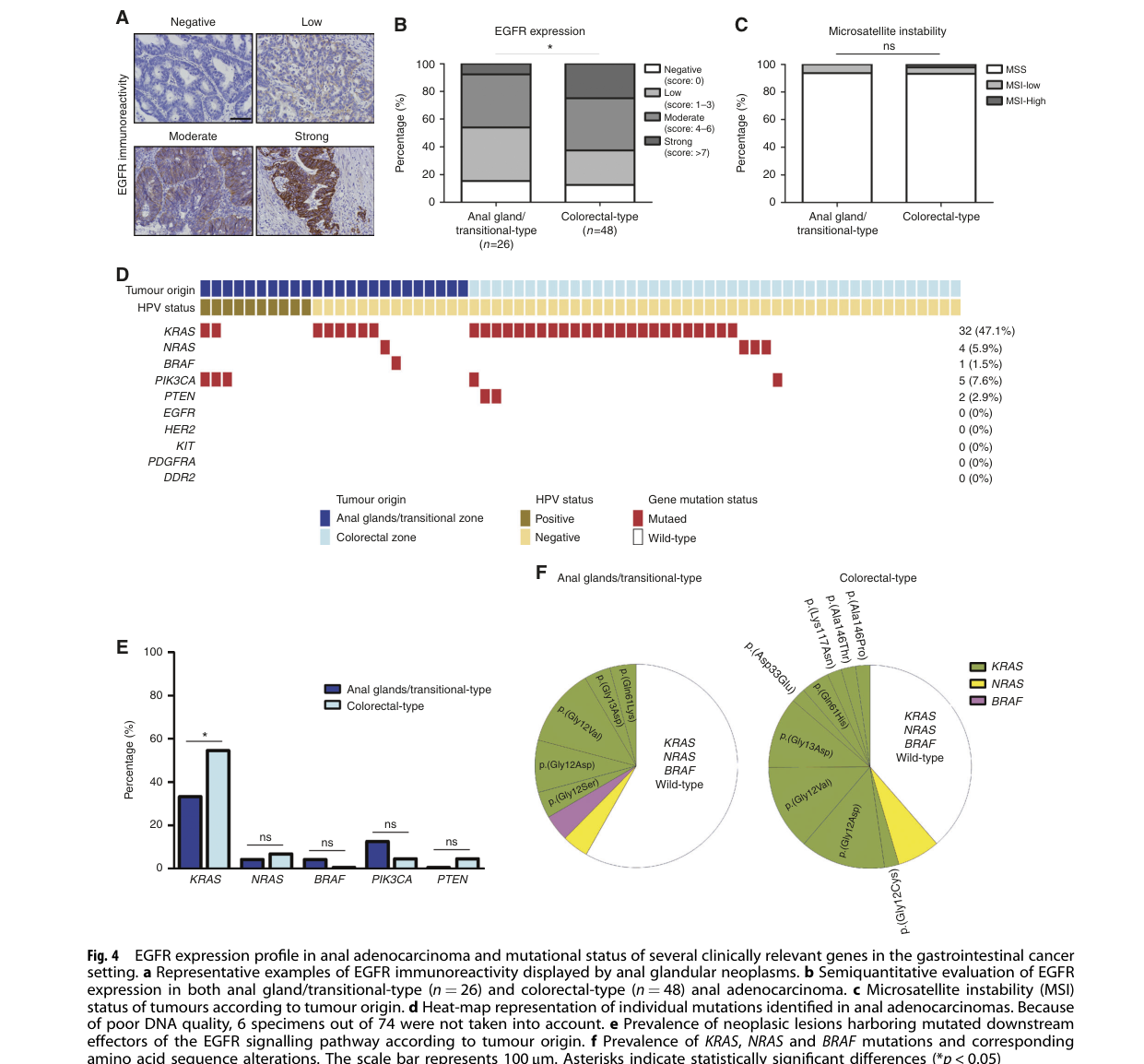
In the 74-case dualistic cohort: - EGFR protein detected by IHC in 64/74 (86.5%) tumors (herfs2018adualisticmodel pages 7-8) - Somatic mutation frequencies included KRAS 47.1%, NRAS 5.9%, PIK3CA 7.6%, PTEN 2.9%, BRAF 1.5%; EGFR, HER2, KIT, PDGFRA, DDR2 mutations were absent in this dataset (herfs2018adualisticmodel pages 7-8) - The subtype comparison and mutation landscape are summarized visually in retrieved figures (heatmap and prevalence plots). (herfs2018adualisticmodel media 502e33fe)
Example case molecular features
A 2021 case report described MSI-high status and KRAS/NRAS/BRAF wild type tumor profiling in an individual patient. (tsay2021analadenocarcinomacase pages 1-2)
Suggested gene/pathway ontologies
- HGNC gene symbols: KRAS, NRAS, PIK3CA, PTEN, BRAF, EGFR, CDKN2A (herfs2018adualisticmodel pages 7-8, herfs2018adualisticmodel pages 8-9)
- Suggested GO biological process terms (mapping suggestions):
- GO:0008285 negative regulation of cell proliferation (cancer hallmark)
- GO:0007169 transmembrane receptor protein tyrosine kinase signaling pathway (EGFR axis)
- GO:0045087 innate immune response / GO:0006955 immune response (immune infiltration/checkpoints)
Suggested CL (cell types) for mechanism annotation (mapping suggestions)
- CD8+ T cell — CL:0000625 (supported conceptually by T-cell infiltration measures) (herfs2018adualisticmodel pages 9-10)
- Regulatory T cell (Foxp3+) — CL:0000815 (herfs2018adualisticmodel pages 9-10)
- Epithelial cell (glandular) — CL:0000066 (tumor origin) (herfs2018adualisticmodel pages 4-5)
5. Environmental Information
Direct environmental toxin/radiation/lifestyle risk factor quantification specific to anal canal adenocarcinoma was not retrievable in the current corpus. The most consistently described non-genetic drivers relate to chronic inflammation (fistula, IBD) rather than classic environmental exposures. (koizumi2023acasereport pages 1-3, inoue2023resectionofanorectal pages 1-3)
6. Mechanism / Pathophysiology
Causal chains (current evidence-supported models)
Pathway A: Chronic fistula/inflammation → mucinous adenocarcinoma Perianal abscess and fistula represent chronic infectious/inflammatory processes; persistent inflammation and epithelial dysplasia within fistula tracts can progress to mucinous adenocarcinoma, often recognized only after symptom change or mass formation. (koizumi2023acasereport pages 1-3, inoue2023resectionofanorectal pages 1-3)
Pathway B: Dualistic anal canal adenocarcinoma model (HPV-dependent vs independent) Primary anal canal adenocarcinoma comprises at least two lineages with distinct etiologies and immune/mutational features. Anal gland/transitional tumors can be HPV16/18-associated and show increased PD-1/PD-L1 and T-cell infiltration, while colorectal-type tumors more closely resemble colorectal mucosal cancers and show different mutation patterns. (herfs2018adualisticmodel pages 1-2, herfs2018adualisticmodel pages 8-9)
Upstream vs downstream processes
- Upstream: chronic inflammation (fistula/IBD), HPV infection in a subset (koizumi2023acasereport pages 1-3, herfs2018adualisticmodel pages 8-9)
- Downstream: oncogenic signaling alterations (KRAS/PI3K axis), immune evasion via PD-1/PD-L1, invasion and metastatic spread (herfs2018adualisticmodel pages 7-8, herfs2018adualisticmodel media 4416b428)
7. Anatomical Structures Affected
Primary site
- Anal canal / cloacogenic/transitional zone region (ICD-O-3 C21.1/C21.2 context; anal canal strict localization in molecular cohort) (gogna2020clinicopathologicfeaturesand pages 2-3, herfs2018adualisticmodel pages 7-8)
Suggested UBERON terms (mapping suggestions)
- Anal canal — UBERON:0001052 (mapping suggestion)
- Anus — UBERON:0001245 (mapping suggestion)
- Rectum (lower rectum interface) — UBERON:0001052? (rectum has separate UBERON ID; mapping suggestion)
Local invasion patterns (case evidence)
Advanced fistula-associated tumors may infiltrate adjacent pelvic structures (e.g., prostate/levator ani/internal obturator described in Crohn’s-associated fistula cancer report). (inoue2023resectionofanorectal pages 1-3)
8. Temporal Development
Typical age of onset
Mean age at diagnosis in a SEER analysis was 68.12 ± 14.02 years. (gogna2020clinicopathologicfeaturesand pages 1-2)
Course/progression patterns
- Fistula-associated cancers can emerge after long-standing disease (>10 years) but may also develop within a few years after perianal abscess/fistula in some cases, emphasizing variable latency. (koizumi2023acasereport pages 1-3)
9. Inheritance and Population
Epidemiology (registry-based)
A SEER population-based study (1973–2015; n=2,090) reports: - Estimated prevalence 0.0011% (gogna2020clinicopathologicfeaturesand pages 1-2) - Incidence trend: +4.03%/year (1973–1985) followed by −0.32%/year (1986–2015) (gogna2020clinicopathologicfeaturesand pages 2-3) - Sex distribution: 54.8% male, 45.2% female (gogna2020clinicopathologicfeaturesand pages 1-2)
No Mendelian inheritance pattern is established; this is primarily a sporadic malignancy with somatic alterations and inflammatory/viral etiologies in subsets. (herfs2018adualisticmodel pages 1-2, herfs2018adualisticmodel pages 7-8)
10. Diagnostics
Clinical and pathology diagnosis
Diagnosis typically relies on anorectal exam, endoscopic evaluation, and biopsy with histopathology and immunohistochemistry to distinguish anal gland/transitional vs colorectal-type tumors.
Histopathology / IHC (subtype assignment) - The dualistic model uses keratin/CDX2 patterns: Krt7 (anal gland/transitional) vs Krt20/CDX2 (colorectal-type). (herfs2018adualisticmodel pages 4-5)
Imaging Case reports use cross-sectional imaging and/or PET for staging and metastatic evaluation. (tsay2021analadenocarcinomacase pages 1-1)
Molecular testing Somatic profiling may include KRAS/NRAS/BRAF testing and MSI/MMR assessment (MSI-high is rare but clinically actionable for immunotherapy in many GI cancers). (tsay2021analadenocarcinomacase pages 1-2, herfs2018adualisticmodel pages 8-9)
Differential diagnosis
A recurring challenge is distinguishing primary anal canal adenocarcinoma from distal rectal adenocarcinoma extending into the anal canal and from fistula-associated extramucosal lesions. (tsay2021analadenocarcinomacase pages 2-3)
11. Outcome / Prognosis
Survival statistics (SEER population data)
In SEER (n=2,090), overall survival at: - 1 year 76.1%, 2 years 63.4%, 3 years 52.6%, 4 years 47.9%, 5 years 39.6% (gogna2020clinicopathologicfeaturesand pages 2-3) Prognosis varies strongly by stage and grade; metastatic disease showed markedly higher mortality (HR ~6). (gogna2020clinicopathologicfeaturesand pages 2-3)
Prognostic factors
- Older age strongly predicts worse survival (e.g., age >81 mean survival 30.14 ± 1.84 months, HR 3.79). (gogna2020clinicopathologicfeaturesand pages 2-3)
- Localized disease is associated with better survival than distant disease. (gogna2020clinicopathologicfeaturesand pages 2-3)
- In the dualistic molecular cohort, anal gland/transitional-type tumors tended toward worse 5-year DFS/OS than colorectal-type tumors (5-year OS 27.8% vs 50.4%). (herfs2018adualisticmodel pages 7-8)
12. Treatment
Current applications / real-world implementations (population-based evidence)
Because of limited disease-specific guidelines, management often extrapolates from rectal adenocarcinoma paradigms and/or multimodality strategies.
Surgery In a SEER analysis, surgery was associated with longer survival (116.7 months vs 42.7 months, p<0.01). (gogna2020clinicopathologicfeaturesand pages 1-2)
Chemoradiation and combined modality In a SEER cohort of stage I–III patients (2010–2016; n=393), 3-year cause-specific survival differed by initial approach: - RT+CTx 63.9% - RT or CTx 35.7% - Surgery alone 77.7% - Preoperative RT/CTx + surgery 80.3% - Postoperative RT/CTx + surgery 65.8% (P<.001). (Park 2020; https://doi.org/10.1016/j.clcc.2020.04.001). (park2020survivaloutcomesafter pages 1-2) Preoperative RT/CTx plus surgery remained associated with improved cause-specific survival (multivariable P=0.024). (park2020survivaloutcomesafter pages 1-2)
Immunotherapy (evidence level: case-based; biomarker-driven) A 2021 case report described pembrolizumab use in an MSI-high anal adenocarcinoma patient with >1-year survival in follow-up narrative. (tsay2021analadenocarcinomacase pages 1-2) For anal adenocarcinoma overall, immune checkpoint relevance is biologically supported by elevated PD-1/PD-L1 in anal gland/transitional tumors, but prospective efficacy data are not established in the retrieved corpus. (herfs2018adualisticmodel pages 9-10, herfs2018adualisticmodel media 4416b428)
Ongoing / recent clinical research (clinicaltrials.gov)
- NCT05605873 (ProCHADA): Retrospective observational cohort (France), enrollment 46; aims to classify forms of anal adenocarcinoma and estimate prognosis; endpoints include 1-year and 5-year mortality; start date 2022-09-16, estimated completion 2023-12-31. (ClinicalTrials.gov record). (NCT05605873 chunk 1)
Suggested MAXO terms (mapping suggestions)
- Abdominoperineal resection — MAXO:0000445 (mapping suggestion)
- Chemoradiotherapy — MAXO:0000602 (mapping suggestion)
- External beam radiotherapy — MAXO:0000014 (mapping suggestion)
- Immune checkpoint inhibitor therapy — MAXO:0001025 (mapping suggestion)
13. Prevention
Evidence specific to adenocarcinoma prevention is limited in retrieved sources. - For fistula-associated cancers, case literature suggests heightened clinical suspicion and early biopsy when chronic fistula symptoms change or masses develop, as delayed diagnosis contributes to advanced presentation. (koizumi2023acasereport pages 1-3, inoue2023resectionofanorectal pages 1-3) - HPV vaccination and anal cancer screening guidelines are largely developed for anal squamous cell carcinoma risk contexts and cannot be directly assumed for adenocarcinoma, especially given mixed HPV evidence by subtype. (tsay2021analadenocarcinomacase pages 2-3, herfs2018adualisticmodel pages 8-9)
14. Other Species / Natural Disease
No directly analogous naturally occurring non-human disease models of anal canal adenocarcinoma were identified in the retrieved evidence. A canine condition, apocrine gland anal sac adenocarcinoma, is anatomically and biologically distinct (anal sac origin) and should not be treated as a direct model for human anal canal adenocarcinoma. (gogna2020clinicopathologicfeaturesand pages 1-2)
15. Model Organisms
No validated, disease-specific model organism systems (mouse, zebrafish, organoid platforms uniquely representing anal canal adenocarcinoma subtypes) were retrieved from the current corpus.
Key quantitative evidence map
The table below compiles the most actionable numeric findings for knowledge-base fields (epidemiology, stage distribution, survival, subtype proportions, HPV/MMR, and mutation frequencies).
| Domain | Key finding (with numbers) | Population/cohort | Study (first author year) | Publication date | URL/DOI | Evidence citation ID |
|---|---|---|---|---|---|---|
| Epidemiology | Estimated prevalence in SEER: 0.0011%; incidence increased 4.03%/year (1973-1985), then declined 0.32%/year (1986-2015) | 2,090 anal canal adenocarcinoma cases from SEER (1973-2015) | Gogna 2020 | 2020-05-13 | https://doi.org/10.1155/2020/5139236 | (gogna2020clinicopathologicfeaturesand pages 1-2, gogna2020clinicopathologicfeaturesand pages 2-3) |
| Epidemiology | Mean age at diagnosis 68.12 ± 14.02 years; 54.8% male; presentation: 44.4% localized, 25.8% regional, 13.5% distant, 6.7% in situ | 2,090 SEER cases | Gogna 2020 | 2020-05-13 | https://doi.org/10.1155/2020/5139236 | (gogna2020clinicopathologicfeaturesand pages 1-2, gogna2020clinicopathologicfeaturesand pages 2-3) |
| Survival | Overall survival rates at 1, 2, 3, 4, 5 years: 76.1%, 63.4%, 52.6%, 47.9%, 39.6% | 2,090 SEER cases | Gogna 2020 | 2020-05-13 | https://doi.org/10.1155/2020/5139236 | (gogna2020clinicopathologicfeaturesand pages 2-3) |
| Survival | Surgery associated with markedly longer survival: 116.7 months vs 42.7 months without surgery (p < 0.01) | 2,090 SEER cases | Gogna 2020 | 2020-05-13 | https://doi.org/10.1155/2020/5139236 | (gogna2020clinicopathologicfeaturesand pages 1-2) |
| Survival | Age >81 years associated with poorer outcome: mean survival 30.14 ± 1.84 months; HR 3.79 (95% CI 2.65-5.41) | 2,090 SEER cases | Gogna 2020 | 2020-05-13 | https://doi.org/10.1155/2020/5139236 | (gogna2020clinicopathologicfeaturesand pages 2-3) |
| Survival | Metastatic disease associated with ~6-fold higher mortality: HR 6.02 (95% CI 4.55-7.99) | 2,090 SEER cases | Gogna 2020 | 2020-05-13 | https://doi.org/10.1155/2020/5139236 | (gogna2020clinicopathologicfeaturesand pages 2-3) |
| Treatment | 3-year cause-specific survival by initial treatment: 63.9% (RT+CTx), 35.7% (RT or CTx), 77.7% (surgery alone), 80.3% (preop RT/CTx + surgery), 65.8% (postop RT/CTx + surgery); P < .001 | 393 stage I-III cases in SEER (2010-2016) | Park 2020 | 2020-09 | https://doi.org/10.1016/j.clcc.2020.04.001 | (park2020survivaloutcomesafter pages 1-2) |
| Treatment | Preoperative RT/CTx plus surgery associated with improved cause-specific survival on multivariable analysis (P = .024) | 393 stage I-III SEER cases | Park 2020 | 2020-09 | https://doi.org/10.1016/j.clcc.2020.04.001 | (park2020survivaloutcomesafter pages 1-2) |
| Molecular subtype | Two subtypes identified: anal gland/transitional-type 26/74 (35.1%) vs colorectal-type 48/74 (64.9%) | 74 primary anal canal adenocarcinomas | Herfs 2018 | 2018 | Not available in retrieved metadata | (herfs2018adualisticmodel pages 4-5) |
| HPV/MMR | HPV16/18 detected only in anal gland/transitional tumors: 11/26 (42.3%); p16 strong/diffuse staining in 12/26 (46.2%) Krt7-positive tumors | 74 tumors; subtype analysis within 26 gland/transitional tumors | Herfs 2018 | 2018 | Not available in retrieved metadata | (herfs2018adualisticmodel pages 8-9, herfs2018adualisticmodel pages 4-5) |
| HPV/MMR | Among HPV-infected tumors, 5/11 (45.5%) showed patches of p16 negativity; MSI-high/MMR-deficient phenotype observed in only 1/74 (1.4%) tumors | 74 tumors | Herfs 2018 | 2018 | Not available in retrieved metadata | (herfs2018adualisticmodel pages 9-10, herfs2018adualisticmodel pages 8-9) |
| Mutations | EGFR protein detected in 64/74 (86.5%) cancers | 74 tumors | Herfs 2018 | 2018 | Not available in retrieved metadata | (herfs2018adualisticmodel pages 9-10, herfs2018adualisticmodel pages 7-8) |
| Mutations | Mutation frequencies: KRAS 47.1%, NRAS 5.9%, PIK3CA 7.6%, PTEN 2.9%, BRAF 1.5%; EGFR, HER2, KIT, PDGFRA, DDR2 mutations absent | 74 tumors | Herfs 2018 | 2018 | Not available in retrieved metadata | (herfs2018adualisticmodel pages 7-8, herfs2018adualisticmodel media 502e33fe) |
| Immune microenvironment | Anal gland/transitional-type tumors showed higher PD-1/PD-L1 expression and more prominent T-cell infiltration than colorectal-type counterparts | 74 tumors | Herfs 2018 | 2018 | Not available in retrieved metadata | (herfs2018adualisticmodel pages 9-10, herfs2018adualisticmodel pages 1-2, herfs2018adualisticmodel media 4416b428) |
| Prognosis by subtype | In survival subset, 65/74 (87.8%) evaluable; 9/74 (12.2%) metastatic at diagnosis; recurrence 10/24 (41.7%) in anal gland/transitional vs 13/41 (31.7%) in colorectal-type; 5-year DFS 33.1% vs 52.6% and 5-year OS 27.8% vs 50.4% | 65 evaluable for OS/DFS within a 74-case cohort | Herfs 2018 | 2018 | Not available in retrieved metadata | (herfs2018adualisticmodel pages 7-8) |
| Comparative prognosis | Anal adenocarcinoma represented 5%-10% of anal canal malignancies and had worse prognosis than rectal adenocarcinoma and anal squamous carcinoma in comparative SEER analysis | SEER comparative cohort; anal adenocarcinoma subset noted as 1,660 in excerpted review | Tsay 2021 | 2021-07 | https://doi.org/10.1136/bmjgast-2021-000661 | (tsay2021analadenocarcinomacase pages 2-3, tsay2021analadenocarcinomacase pages 1-1) |
Table: This table compiles key numeric findings for anal canal adenocarcinoma across epidemiology, survival, molecular subtype, HPV/MMR status, mutations, and treatment outcomes. It is useful as a quick-reference evidence map for populating structured disease knowledge base fields.
Visual evidence (molecular landscape)
Figures from the dualistic model cohort summarize mutation prevalence by subtype and PD-1/PD-L1/T-cell infiltration patterns. - Mutation/subtype overview: (herfs2018adualisticmodel media 502e33fe) - PD-L1 and immune infiltration overview: (herfs2018adualisticmodel media 4416b428)
Expert synthesis and analysis (authoritative interpretation)
- Anal canal adenocarcinoma is not a single entity: evidence supports at least two biologically distinct subtypes (anal gland/transitional vs colorectal-type) with different HPV associations, immune contexture, and mutational landscapes, which implies that “one-size-fits-all” extrapolation from rectal adenocarcinoma or anal squamous carcinoma is likely suboptimal. (herfs2018adualisticmodel pages 1-2, herfs2018adualisticmodel pages 4-5)
- Inflammation-associated disease contexts (Crohn’s/fistula) are clinically important for a subset of tumors (often mucinous), with notable diagnostic delay; surveillance strategies for high-risk fistulizing disease remain an evidence gap requiring prospective evaluation. (koizumi2023acasereport pages 1-3, inoue2023resectionofanorectal pages 1-3)
- Precision oncology opportunities exist but are constrained by KRAS prevalence (~47% in one cohort), which may limit anti-EGFR strategies in many patients; conversely, PD-1/PD-L1–high immune phenotypes in anal gland/transitional tumors provide a biologic rationale for immunotherapy trials, though MSI-high appears rare (~1.4%). (herfs2018adualisticmodel pages 7-8, herfs2018adualisticmodel pages 8-9, herfs2018adualisticmodel media 4416b428)
Limitations of this report (evidence availability)
- Ontology identifiers (MONDO/MeSH/ICD-10/ICD-11/Orphanet) were not retrievable using available tools and texts; only ICD-O-3 site codes used in SEER studies are provided. (gogna2020clinicopathologicfeaturesand pages 2-3)
- Most adenocarcinoma-specific clinical guidance is based on retrospective cohorts and case reports; several potentially relevant 2024 adenocarcinoma studies were listed as unobtainable in tool search results and thus could not be cited.
References
-
(gogna2020clinicopathologicfeaturesand pages 2-3): Shekhar Gogna, Roberto Bergamaschi, Agon Kajmolli, Mahir Gachabayov, Aram Rojas, David Samson, Rifat Latifi, and Xiang Da Dong. Clinicopathologic features and outcome of adenocarcinoma of the anal canal: a population-based study. International Journal of Surgical Oncology, 2020:1-6, May 2020. URL: https://doi.org/10.1155/2020/5139236, doi:10.1155/2020/5139236. This article has 7 citations.
-
(gogna2020clinicopathologicfeaturesand pages 1-2): Shekhar Gogna, Roberto Bergamaschi, Agon Kajmolli, Mahir Gachabayov, Aram Rojas, David Samson, Rifat Latifi, and Xiang Da Dong. Clinicopathologic features and outcome of adenocarcinoma of the anal canal: a population-based study. International Journal of Surgical Oncology, 2020:1-6, May 2020. URL: https://doi.org/10.1155/2020/5139236, doi:10.1155/2020/5139236. This article has 7 citations.
-
(park2020survivaloutcomesafter pages 1-2): Hyojung Park. Survival outcomes after initial treatment for anal adenocarcinoma: a population-based cohort study. Clinical Colorectal Cancer, 19:e75-e82, Sep 2020. URL: https://doi.org/10.1016/j.clcc.2020.04.001, doi:10.1016/j.clcc.2020.04.001. This article has 6 citations and is from a peer-reviewed journal.
-
(tsay2021analadenocarcinomacase pages 2-3): Cynthia J Tsay, Thomas Pointer, Jocelyn B Chandler, Anil B Nagar, and Petr Protiva. Anal adenocarcinoma: case report, literature review and comparative survival analysis. BMJ Open Gastroenterology, 8:e000661, Jul 2021. URL: https://doi.org/10.1136/bmjgast-2021-000661, doi:10.1136/bmjgast-2021-000661. This article has 6 citations and is from a peer-reviewed journal.
-
(koizumi2023acasereport pages 1-3): Michihiro Koizumi, Akihisa Matsuda, Takeshi Yamada, Koji Morimoto, Itaru Kubota, Yawara Kubota, Shuzo Tamura, Kenta Tominaga, Takashi Sakatani, and Hiroshi Yoshida. A case report of anal fistula-associated mucinous adenocarcinoma developing 3 years after treatment of perianal abscess. Surgical Case Reports, Sep 2023. URL: https://doi.org/10.1186/s40792-023-01743-3, doi:10.1186/s40792-023-01743-3. This article has 15 citations.
-
(inoue2023resectionofanorectal pages 1-3): Takuya Inoue, Yuki Sekido, Takayuki Ogino, Tsuyoshi Hata, Norikatsu Miyoshi, Hidekazu Takahashi, Mamoru Uemura, Tsunekazu Mizushima, Yuichiro Doki, and Hidetoshi Eguchi. Resection of anorectal fistula cancer associated with crohn’s disease after preoperative chemoradiotherapy: a case report. Surgical Case Reports, Nov 2023. URL: https://doi.org/10.1186/s40792-023-01778-6, doi:10.1186/s40792-023-01778-6. This article has 10 citations.
-
(NCT05605873 chunk 1): Clinical, Histological and Prognostic Forms of Adenocarcinoma of the Anus. Fondation Hôpital Saint-Joseph. 2022. ClinicalTrials.gov Identifier: NCT05605873
-
(herfs2018adualisticmodel pages 1-2): M Herfs, P Roncarati, B Koopmansch, O Peulen, D Bruyere, A Lebeau, E Hendrick, and P Hubert. A dualistic model of primary anal canal adenocarcinoma with distinct cellular origins, etiologies, inflammatory microenvironments and mutational signatures …. Unknown journal, 2018.
-
(herfs2018adualisticmodel pages 8-9): M Herfs, P Roncarati, B Koopmansch, O Peulen, D Bruyere, A Lebeau, E Hendrick, and P Hubert. A dualistic model of primary anal canal adenocarcinoma with distinct cellular origins, etiologies, inflammatory microenvironments and mutational signatures …. Unknown journal, 2018.
-
(tsay2021analadenocarcinomacase pages 1-1): Cynthia J Tsay, Thomas Pointer, Jocelyn B Chandler, Anil B Nagar, and Petr Protiva. Anal adenocarcinoma: case report, literature review and comparative survival analysis. BMJ Open Gastroenterology, 8:e000661, Jul 2021. URL: https://doi.org/10.1136/bmjgast-2021-000661, doi:10.1136/bmjgast-2021-000661. This article has 6 citations and is from a peer-reviewed journal.
-
(herfs2018adualisticmodel pages 4-5): M Herfs, P Roncarati, B Koopmansch, O Peulen, D Bruyere, A Lebeau, E Hendrick, and P Hubert. A dualistic model of primary anal canal adenocarcinoma with distinct cellular origins, etiologies, inflammatory microenvironments and mutational signatures …. Unknown journal, 2018.
-
(herfs2018adualisticmodel pages 9-10): M Herfs, P Roncarati, B Koopmansch, O Peulen, D Bruyere, A Lebeau, E Hendrick, and P Hubert. A dualistic model of primary anal canal adenocarcinoma with distinct cellular origins, etiologies, inflammatory microenvironments and mutational signatures …. Unknown journal, 2018.
-
(herfs2018adualisticmodel media 4416b428): M Herfs, P Roncarati, B Koopmansch, O Peulen, D Bruyere, A Lebeau, E Hendrick, and P Hubert. A dualistic model of primary anal canal adenocarcinoma with distinct cellular origins, etiologies, inflammatory microenvironments and mutational signatures …. Unknown journal, 2018.
-
(herfs2018adualisticmodel pages 7-8): M Herfs, P Roncarati, B Koopmansch, O Peulen, D Bruyere, A Lebeau, E Hendrick, and P Hubert. A dualistic model of primary anal canal adenocarcinoma with distinct cellular origins, etiologies, inflammatory microenvironments and mutational signatures …. Unknown journal, 2018.
-
(herfs2018adualisticmodel media 502e33fe): M Herfs, P Roncarati, B Koopmansch, O Peulen, D Bruyere, A Lebeau, E Hendrick, and P Hubert. A dualistic model of primary anal canal adenocarcinoma with distinct cellular origins, etiologies, inflammatory microenvironments and mutational signatures …. Unknown journal, 2018.
-
(tsay2021analadenocarcinomacase pages 1-2): Cynthia J Tsay, Thomas Pointer, Jocelyn B Chandler, Anil B Nagar, and Petr Protiva. Anal adenocarcinoma: case report, literature review and comparative survival analysis. BMJ Open Gastroenterology, 8:e000661, Jul 2021. URL: https://doi.org/10.1136/bmjgast-2021-000661, doi:10.1136/bmjgast-2021-000661. This article has 6 citations and is from a peer-reviewed journal.