Achondrogenesis Type II
COL2A1-related achondrogenesis, historically called achondrogenesis type II or Langer-Saldino achondrogenesis, is the perinatal-lethal end of the type II collagen disorder spectrum. Heterozygous COL2A1 variants disrupt cartilage matrix organization and endochondral ossification, producing profound fetal skeletal underdevelopment, a narrow thorax with pulmonary hypoplasia, and fetal or neonatal death. Hypochondrogenesis is a closely related but distinct diagnosis on a continuous severity spectrum.
Ask OpenScientist
Ask a research question about Achondrogenesis Type II. OpenScientist will conduct autonomous deep research using the Disorder Mechanisms Knowledge Base and PubMed literature (typically 10-30 minutes).
Do not include personal health information in your question. Questions and results are cached in your browser's local storage.
Classifications
Inheritance
1Show evidence (3 references)
Pathophysiology
12Show evidence (2 references)
Show evidence (1 reference)
Show evidence (2 references)
Show evidence (4 references)
Show evidence (1 reference)
Show evidence (3 references)
Show evidence (1 reference)
Show evidence (1 reference)
Show evidence (1 reference)
Show evidence (1 reference)
Show evidence (1 reference)
Show evidence (1 reference)
Histopathology
2Show evidence (1 reference)
Show evidence (4 references)
Pathograph
Phenotypes
25Digestive 1
Show evidence (1 reference)
Head and Neck 7
Show evidence (1 reference)
Show evidence (1 reference)
Show evidence (1 reference)
Show evidence (2 references)
Show evidence (1 reference)
Show evidence (1 reference)
Show evidence (1 reference)
Limbs 2
Show evidence (1 reference)
Show evidence (1 reference)
Metabolism 2
Show evidence (1 reference)
Show evidence (1 reference)
Musculoskeletal 8
Show evidence (1 reference)
Show evidence (1 reference)
Show evidence (1 reference)
Show evidence (1 reference)
Show evidence (1 reference)
Show evidence (1 reference)
Show evidence (1 reference)
Show evidence (1 reference)
Prenatal and Birth 1
Show evidence (1 reference)
Respiratory 3
Show evidence (1 reference)
Show evidence (1 reference)
Show evidence (1 reference)
Other 1
Show evidence (1 reference)
Genetic Associations
1Show evidence (1 reference)
Variants (4)
Show evidence (1 reference)
Show evidence (1 reference)
Show evidence (2 references)
Show evidence (1 reference)
External Assertions
1Show evidence (1 reference)
Medical Actions
2Show evidence (2 references)
Show evidence (2 references)
Diagnosis
3Show evidence (2 references)
Show evidence (1 reference)
Show evidence (2 references)
Imaging Findings
2Show evidence (2 references)
Show evidence (2 references)
Progression
2Show evidence (2 references)
Show evidence (2 references)
Prevalence
1Show evidence (1 reference)
Differential Diagnoses
3Conditions with similar clinical presentations that must be differentiated from Achondrogenesis Type II:
- Skull ossification is poor in type IA but relatively preserved in classic ACG2.
- Rib fractures favor type IA; ACG2 classically has short unfractured ribs.
Show evidence (1 reference)
- Skull ossification is mildly reduced in type IB but relatively preserved in classic ACG2.
Show evidence (1 reference)
- The ACG2-hypochondrogenesis boundary is continuous and may not be cleanly resolved.
Show evidence (1 reference)
Experimental Models
1Show evidence (1 reference)
Animal Models
4Show evidence (1 reference)
Show evidence (1 reference)
Show evidence (1 reference)
Show evidence (1 reference)
Show evidence (1 reference)
Show evidence (1 reference)
Show evidence (1 reference)
Show evidence (1 reference)
Show evidence (1 reference)
Show evidence (1 reference)
Source YAML
click to showname: Achondrogenesis Type II
creation_date: '2026-02-06T03:25:37Z'
category: Mendelian
synonyms:
- ACG2
- Achondrogenesis type 2
- Achondrogenesis, Langer-Saldino type
- COL2A1-related achondrogenesis
description: >-
COL2A1-related achondrogenesis, historically called achondrogenesis type II
or Langer-Saldino achondrogenesis, is the perinatal-lethal end of the type II
collagen disorder spectrum. Heterozygous COL2A1 variants disrupt cartilage
matrix organization and endochondral ossification, producing profound fetal
skeletal underdevelopment, a narrow thorax with pulmonary hypoplasia, and
fetal or neonatal death. Hypochondrogenesis is a closely related but distinct
diagnosis on a continuous severity spectrum.
disease_term:
preferred_term: achondrogenesis type II
term:
id: MONDO:0008702
label: achondrogenesis type II
parents:
- Achondrogenesis
- Type 2 Collagenopathy
external_assertions:
- name: ClinGen COL2A1-achondrogenesis type II gene-disease validity assertion
source: ClinGen
assertion_type: gene_disease_validity
external_id: CGGV:assertion_14640c06-c66e-4dc7-86ea-9b0850e51474-2020-10-05T040000.000Z
url: https://search.clinicalgenome.org/kb/gene-validity/CGGV:assertion_14640c06-c66e-4dc7-86ea-9b0850e51474-2020-10-05T040000.000Z
description: >-
The ClinGen Skeletal Disorders Gene Curation Expert Panel classifies the
autosomal-dominant COL2A1 relationship with achondrogenesis type II as
definitive.
evidence:
- reference: CGGV:assertion_14640c06-c66e-4dc7-86ea-9b0850e51474-2020-10-05T040000.000Z
reference_title: COL2A1 / achondrogenesis type II (Definitive)
supports: SUPPORT
evidence_source: OTHER
snippet: >-
COL2A1 | HGNC:2200 | achondrogenesis type II | MONDO:0008702 | AD |
Definitive | SOP7 | Skeletal Disorders Gene Curation Expert Panel |
2020-10-05T04:00:00.000Z
explanation: >-
This structured ClinGen assertion supports the gene, disease identity,
mode of inheritance, and definitive validity classification.
inheritance:
- name: Autosomal dominant, usually arising as a new variant
inheritance_term:
preferred_term: Autosomal dominant inheritance
term:
id: HP:0000006
label: Autosomal dominant inheritance
description: >-
ACG2 is autosomal dominant. Most reported affected fetuses have a new
heterozygous COL2A1 variant, but parental gonadal or somatogonadal mosaicism
can cause sibling recurrence; no fixed de novo or residual-recurrence
percentage is assigned.
evidence:
- reference: ORPHA:93296
reference_title: Achondrogenesis type 2
supports: SUPPORT
evidence_source: OTHER
snippet: Autosomal dominant
explanation: Orphanet records autosomal-dominant inheritance for ACG2.
- reference: PMID:15054848
reference_title: 'Recurrence of achondrogenesis type II within the same family: evidence for germline mosaicism.'
supports: SUPPORT
evidence_source: HUMAN_CLINICAL
snippet: >-
Achondrogenesis type II is a lethal skeletal dysplasia caused by new
dominant mutations within the type II collagen gene (COL2A1).
explanation: >-
This family report supports the usual new-dominant presentation without
quantifying its proportion.
- reference: PMID:17994563
reference_title: 'A familial case of achondrogenesis type II caused by a dominant COL2A1 mutation and "patchy" expression in the mosaic father.'
supports: SUPPORT
evidence_source: HUMAN_CLINICAL
snippet: This mutation was also found in the father, as a mosaic.
explanation: >-
A clinically mild mosaic parent transmitted ACG2, demonstrating that
parental mosaicism must be considered in recurrence counseling.
classifications:
isds_skeletal_category:
- classification_value: type_2_collagen
notes: >-
ISDS Nosology and Classification of Genetic Skeletal Disorders, 2019
revision (Mortier et al., PMID:31633310), Table 1 group 2 "Type 2 collagen
group"; listed as "Achondrogenesis type 2 (Langer-Saldino)".
prevalence:
- population: Worldwide
measure_type: POINT_PREVALENCE
prevalence_class: UNKNOWN
notes: >-
Subtype-specific prevalence has not been documented. Estimates for all
achondrogenesis types, or for achondrogenesis combined with other lethal
skeletal dysplasias, are not assigned to ACG2.
evidence:
- reference: ORPHA:93296
reference_title: Achondrogenesis type 2
supports: SUPPORT
evidence_source: OTHER
snippet: Unknown | Worldwide | Point prevalence | ORPHANET
explanation: >-
The subtype-specific Orphanet record reports worldwide point prevalence
as unknown.
progression:
- phase: Prenatal presentation
age_range: First to second trimester onward
notes: >-
Severe limb shortening, edema, hydrops, or cystic hygroma may be detected
prenatally, with the timing and combination varying among pregnancies.
evidence:
- reference: PMID:17994563
reference_title: 'A familial case of achondrogenesis type II caused by a dominant COL2A1 mutation and "patchy" expression in the mosaic father.'
supports: SUPPORT
evidence_source: HUMAN_CLINICAL
snippet: >-
The couple had a fourth pregnancy, and at 11 weeks fetal hydrops with a
septated cystic hygroma were obvious.
explanation: Demonstrates first-trimester detection in a molecularly confirmed family.
- reference: PMID:15054848
reference_title: 'Recurrence of achondrogenesis type II within the same family: evidence for germline mosaicism.'
supports: SUPPORT
evidence_source: HUMAN_CLINICAL
snippet: >-
In the first pregnancy, severe micromelia and generalized edema were noted
on ultrasound at 21 weeks' gestation.
explanation: Demonstrates a classic second-trimester presentation.
- phase: Fetal or neonatal lethal course
age_range: Fetal period through early neonatal life
notes: >-
Death commonly occurs in utero or early after birth. A liveborn infant in
one molecularly confirmed report survived 25 days with intensive
respiratory support, so the timing is not framed as uniformly immediate.
evidence:
- reference: PMID:31523626
reference_title: Achondrogenesis Type 2 in a Newborn with a Novel Mutation on the COL2A1 Gene.
supports: SUPPORT
evidence_source: HUMAN_CLINICAL
snippet: Death occurs mostly in utero or during the early neonatal period [11].
explanation: The report summarizes the usual fetal or early-neonatal lethal course.
- reference: PMID:31523626
reference_title: Achondrogenesis Type 2 in a Newborn with a Novel Mutation on the COL2A1 Gene.
supports: SUPPORT
evidence_source: HUMAN_CLINICAL
snippet: The patient died of respiratory insufficiency on postnatal day 25.
explanation: Documents a liveborn course extending to 25 days.
pathophysiology:
- name: Heterozygous Pathogenic COL2A1 Variant
description: >-
Definitive autosomal-dominant disease-causing COL2A1 variation initiates
ACG2. Obligatory glycine substitutions are the predominant variant class in
studied ACG2/hypochondrogenesis cohorts, while splice-site and in-frame
deletion variants are also reported.
biological_scale: MOLECULAR
genes:
- preferred_term: COL2A1
term:
id: hgnc:2200
label: COL2A1
molecular_functions:
- preferred_term: extracellular matrix structural constituent
term:
id: GO:0005201
label: extracellular matrix structural constituent
evidence:
- reference: CGGV:assertion_14640c06-c66e-4dc7-86ea-9b0850e51474-2020-10-05T040000.000Z
reference_title: COL2A1 / achondrogenesis type II (Definitive)
supports: SUPPORT
evidence_source: OTHER
snippet: >-
COL2A1 | HGNC:2200 | achondrogenesis type II | MONDO:0008702 | AD |
Definitive | SOP7 | Skeletal Disorders Gene Curation Expert Panel |
2020-10-05T04:00:00.000Z
explanation: ClinGen establishes the definitive dominant COL2A1 relationship.
- reference: PMID:10797431
reference_title: Widely distributed mutations in the COL2A1 gene produce achondrogenesis type II/hypochondrogenesis.
supports: SUPPORT
evidence_source: HUMAN_CLINICAL
snippet: >-
Mutations in the COL2A1 gene were found in all 12 patients. Ten of the
mutations were single base substitutions that converted a codon for an
obligate glycine to a codon for an amino acid with a bulkier side chain.
explanation: A 12-patient series supports COL2A1 variation and the common glycine-substitution class.
downstream:
- target: Type II Collagen Triple-Helix Destabilization
causal_link_type: DIRECT
description: >-
Glycine substitutions in the Gly-X-Y repeat disrupt the collagen triple
helix; this is a common, not universal, molecular route in ACG2.
evidence:
- reference: PMID:26443184
reference_title: Mutation Update for COL2A1 Gene Variants Associated with Type II Collagenopathies.
supports: SUPPORT
evidence_source: OTHER
snippet: >-
One-third of the mutations are dominant-negative mutations that affect
the glycine residue in the G-X-Y repeats of the alpha 1 chain. These
mutations disrupt the collagen triple helix and are common in
achondrogenesis type II and hypochondrogenesis.
explanation: A large variant review directly supports this common dominant-negative route.
- name: Type II Collagen Triple-Helix Destabilization
description: >-
In the common glycine-substitution route, replacement of an obligatory
glycine destabilizes the type II procollagen triple helix. The graph does
not assert this precise step for every splice or in-frame deletion allele.
biological_scale: MOLECULAR
biological_processes:
- preferred_term: collagen biosynthetic process
term:
id: GO:0032964
label: collagen biosynthetic process
cell_types:
- preferred_term: chondrocyte
term:
id: CL:0000138
label: chondrocyte
evidence:
- reference: PMID:7829510
reference_title: A COL2A1 mutation in achondrogenesis type II results in the replacement of type II collagen by type I and III collagens in cartilage.
supports: SUPPORT
evidence_source: HUMAN_CLINICAL
snippet: >-
A transition of G2853 to A in exon 41 produced a substitution of Gly769 by
Ser within the triple helical domain of the alpha 1(II) chain of type II
collagen, interrupting the mandatory Gly-X-Y triplet sequence required for
the normal formation of stable triple helical type II collagen molecules
explanation: Direct biochemical evidence from one ACG2 fetus supports triple-helix disruption.
downstream:
- target: Chondrocyte Type II Collagen Retention and Poor Secretion
causal_link_type: DIRECT
description: >-
Unstable abnormal type II collagen can be retained within chondrocytes and
poorly secreted; this branch is based on specific studied cases rather
than asserted for every ACG2 allele.
evidence:
- reference: PMID:7829510
reference_title: A COL2A1 mutation in achondrogenesis type II results in the replacement of type II collagen by type I and III collagens in cartilage.
supports: SUPPORT
evidence_source: HUMAN_CLINICAL
snippet: >-
A transition of G2853 to A in exon 41 produced a substitution of Gly769 by
Ser within the triple helical domain of the alpha 1(II) chain of type II
collagen, interrupting the mandatory Gly-X-Y triplet sequence required for
the normal formation of stable triple helical type II collagen molecules
explanation: Identifies the triple-helix-disrupting Gly769Ser variant in the studied fetus.
- reference: PMID:7829510
reference_title: A COL2A1 mutation in achondrogenesis type II results in the replacement of type II collagen by type I and III collagens in cartilage.
supports: SUPPORT
evidence_source: IN_VITRO
snippet: >-
However, cultured chondrocytes produced a trace amount of type II
collagen, which was retained within the cells and not secreted.
explanation: Cultured chondrocytes from the same case directly showed retention and failed secretion.
- name: Chondrocyte Type II Collagen Retention and Poor Secretion
description: >-
Some severe COL2A1 variants produce intracellular retention or reduced
secretion of type II collagen. The magnitude of this defect is
variant-specific and is not treated as universal.
biological_scale: CELLULAR
cell_types:
- preferred_term: growth plate cartilage chondrocyte
term:
id: CL:1000217
label: growth plate cartilage chondrocyte
cellular_components:
- preferred_term: endoplasmic reticulum
term:
id: GO:0005783
label: endoplasmic reticulum
evidence:
- reference: PMID:7829510
reference_title: A COL2A1 mutation in achondrogenesis type II results in the replacement of type II collagen by type I and III collagens in cartilage.
supports: SUPPORT
evidence_source: IN_VITRO
snippet: >-
However, cultured chondrocytes produced a trace amount of type II
collagen, which was retained within the cells and not secreted.
explanation: Directly documents retention and failure of secretion for one Gly769Ser case.
- reference: PMID:3057886
reference_title: 'Type II achondrogenesis-hypochondrogenesis: morphologic and immunohistopathologic studies.'
supports: SUPPORT
evidence_source: HUMAN_CLINICAL
snippet: >-
These results strongly suggest intracellular retention of type II
collagen within vacuolar structures, probably within the dilated rough
endoplasmic reticulum observed in all chondrocytes by electron microscopy
(EM), and imply the presence of an abnormal, poorly secreted type II
collagen molecule.
explanation: Immunohistology and EM in fetal cartilage support intracellular retention and poor secretion.
downstream:
- target: Chondrocyte Endoplasmic Reticulum Stress
causal_link_type: DIRECT
description: >-
Mutant procollagen that cannot assemble or be secreted accumulates in a
distended rough endoplasmic reticulum. In human severe-spectrum cartilage
including ACG2 this is shown ultrastructurally; the downstream stress
response is shown in Col2a1 mouse models.
evidence:
- reference: PMID:7757081
reference_title: A radiographic, morphologic, biochemical and molecular analysis of a case of achondrogenesis type II resulting from substitution for a glycine residue (Gly691-->Arg) in the type II collagen trimer.
supports: SUPPORT
evidence_source: HUMAN_CLINICAL
snippet: >-
Electron micrographs showed inclusion bodies of dilated rough
endoplasmic reticulum in the chondrocytes and the presence of sparse
collagen fibers in the cartilage matrix.
explanation: >-
A molecularly confirmed ACG2 case (Gly691Arg) shows dilated rough ER
inclusion bodies in chondrocytes.
- reference: PMID:1429602
reference_title: An amino acid substitution (Gly853-->Glu) in the collagen alpha 1(II) chain produces hypochondrogenesis.
supports: SUPPORT
evidence_source: HUMAN_CLINICAL
directness: INDIRECT
snippet: >-
Electron micrographs of the diseased cartilage showed a sparse
extracellular matrix and chondrocytes containing dilated rough
endoplasmic reticulum, which suggested impaired assembly and secretion
of the mutant protein.
explanation: >-
A perinatal-lethal hypochondrogenesis case on the same COL2A1 severity
continuum shows retention-associated dilation of the rough ER; it is
indirect for ACG2 because the case is classified as hypochondrogenesis.
- reference: PMID:24475193
reference_title: Endoplasmic reticulum stress-unfolding protein response-apoptosis cascade causes chondrodysplasia in a col2a1 p.Gly1170Ser mutated mouse model.
supports: SUPPORT
evidence_source: MODEL_ORGANISM
directness: INDIRECT
snippet: >-
Misfolded procollagen was largely synthesized and retained in dilated
endoplasmic reticulum and the endoplasmic reticulum stress (ERS)-unfolded
protein response (UPR)-apoptosis cascade was activated.
explanation: >-
A Col2a1 glycine-substitution knock-in mouse links procollagen retention
to ER stress and UPR activation; mouse evidence, homozygous genotype.
- target: Abnormal Cartilage Extracellular Matrix
causal_link_type: DIRECT
description: >-
Reduced secretion and incorporation of normal type II collagen alters the
cartilage extracellular matrix; the exact collagen composition varies by
allele and clinical severity.
evidence:
- reference: PMID:7829510
reference_title: A COL2A1 mutation in achondrogenesis type II results in the replacement of type II collagen by type I and III collagens in cartilage.
supports: SUPPORT
evidence_source: HUMAN_CLINICAL
snippet: >-
Type I and III collagens were the major species found in cartilage tissue
explanation: Human cartilage tissue showed variant-specific replacement of type II collagen.
- name: Chondrocyte Endoplasmic Reticulum Stress
description: >-
Retained misfolded type II procollagen distends the rough endoplasmic
reticulum of chondrocytes and activates the unfolded protein response.
Dilated rough ER is documented in human ACG2 and hypochondrogenesis
cartilage; UPR activation and its downstream consequences are documented in Col2a1 mutant
mice rather than measured directly in ACG2 fetuses.
biological_scale: CELLULAR
cell_types:
- preferred_term: chondrocyte
term:
id: CL:0000138
label: chondrocyte
cellular_components:
- preferred_term: endoplasmic reticulum
term:
id: GO:0005783
label: endoplasmic reticulum
biological_processes:
- preferred_term: endoplasmic reticulum unfolded protein response
modifier: INCREASED
term:
id: GO:0030968
label: endoplasmic reticulum unfolded protein response
evidence:
- reference: PMID:7757081
reference_title: A radiographic, morphologic, biochemical and molecular analysis of a case of achondrogenesis type II resulting from substitution for a glycine residue (Gly691-->Arg) in the type II collagen trimer.
supports: SUPPORT
evidence_source: HUMAN_CLINICAL
snippet: >-
Electron micrographs showed inclusion bodies of dilated rough
endoplasmic reticulum in the chondrocytes and the presence of sparse
collagen fibers in the cartilage matrix.
explanation: >-
A molecularly confirmed ACG2 case (Gly691Arg) shows dilated rough ER
inclusion bodies in chondrocytes.
- reference: PMID:1429602
reference_title: An amino acid substitution (Gly853-->Glu) in the collagen alpha 1(II) chain produces hypochondrogenesis.
supports: SUPPORT
evidence_source: HUMAN_CLINICAL
directness: INDIRECT
snippet: >-
Electron micrographs of the diseased cartilage showed a sparse
extracellular matrix and chondrocytes containing dilated rough
endoplasmic reticulum, which suggested impaired assembly and secretion of
the mutant protein.
explanation: >-
Human severe-spectrum (hypochondrogenesis) cartilage shows dilated rough
ER in chondrocytes.
- reference: PMID:1946380
reference_title: Reduced amounts of cartilage collagen fibrils and growth plate anomalies in transgenic mice harboring a glycine-to-cysteine mutation in the mouse type II procollagen alpha 1-chain gene.
supports: SUPPORT
evidence_source: MODEL_ORGANISM
snippet: >-
Electron microscopic analysis showed a pronounced decrease in the number
of typical thin cartilage collagen fibrils, distension of the rough
endoplasmic reticulum of chondrocytes, and the presence of abnormally
large banded collagen fibril bundles.
explanation: A Col2a1 glycine-substitution transgenic mouse shows the same rough-ER distension.
- reference: PMID:24475193
reference_title: Endoplasmic reticulum stress-unfolding protein response-apoptosis cascade causes chondrodysplasia in a col2a1 p.Gly1170Ser mutated mouse model.
supports: SUPPORT
evidence_source: MODEL_ORGANISM
snippet: >-
Misfolded procollagen was largely synthesized and retained in dilated
endoplasmic reticulum and the endoplasmic reticulum stress (ERS)-unfolded
protein response (UPR)-apoptosis cascade was activated.
explanation: Directly documents ER stress and UPR activation in a Col2a1 mutant mouse.
downstream:
- target: ER Stress-Associated Chondrocyte Apoptosis
causal_link_type: DIRECT
description: >-
In the Col2a1 p.Gly1170Ser mouse, sustained ER stress is followed by
premature chondrocyte apoptosis; this step has not been measured in human
ACG2 tissue.
evidence:
- reference: PMID:24475193
reference_title: Endoplasmic reticulum stress-unfolding protein response-apoptosis cascade causes chondrodysplasia in a col2a1 p.Gly1170Ser mutated mouse model.
supports: SUPPORT
evidence_source: MODEL_ORGANISM
directness: INDIRECT
snippet: >-
Our results suggest that earlier chondrocyte death was related to the
ERS-UPR-apoptosis cascade and that this was the chief cause of
chondrodysplaia.
explanation: Mouse evidence linking ER stress to chondrocyte death; indirect for human ACG2.
- name: ER Stress-Associated Chondrocyte Apoptosis
description: >-
Premature apoptosis of growth-plate chondrocytes before hypertrophy,
attributed to the ER stress-UPR cascade in a Col2a1 glycine-substitution
mouse model. Included as a model-supported hypothesis for the human growth
plate disorganization, not as a measured human finding.
biological_scale: CELLULAR
cell_types:
- preferred_term: growth plate cartilage chondrocyte
term:
id: CL:1000217
label: growth plate cartilage chondrocyte
biological_processes:
- preferred_term: intrinsic apoptotic signaling pathway in response to endoplasmic reticulum stress
modifier: INCREASED
term:
id: GO:0070059
label: intrinsic apoptotic signaling pathway in response to endoplasmic reticulum stress
evidence:
- reference: PMID:24475193
reference_title: Endoplasmic reticulum stress-unfolding protein response-apoptosis cascade causes chondrodysplasia in a col2a1 p.Gly1170Ser mutated mouse model.
supports: SUPPORT
evidence_source: MODEL_ORGANISM
snippet: >-
Apoptosis occurred prior to hypertrophy, prevented the formation of a
hypertrophic zone, disrupted normal chondrogenic signaling pathways, and
eventually caused chondrodysplasia.
explanation: Documents premature chondrocyte apoptosis in the Col2a1 mutant mouse.
downstream:
- target: Growth-Plate Architectural Disorganization
causal_link_type: DIRECT
description: >-
Loss of chondrocytes before hypertrophy prevents formation of an orderly
hypertrophic zone in the mouse model.
evidence:
- reference: PMID:24475193
reference_title: Endoplasmic reticulum stress-unfolding protein response-apoptosis cascade causes chondrodysplasia in a col2a1 p.Gly1170Ser mutated mouse model.
supports: SUPPORT
evidence_source: MODEL_ORGANISM
directness: INDIRECT
snippet: >-
Apoptosis occurred prior to hypertrophy, prevented the formation of a
hypertrophic zone, disrupted normal chondrogenic signaling pathways, and
eventually caused chondrodysplasia.
explanation: Mouse evidence that premature apoptosis disrupts growth-plate zonation.
- name: Abnormal Cartilage Extracellular Matrix
description: >-
ACG2 cartilage has abnormal matrix abundance, composition, and
organization. Complete type II collagen loss with type I/III replacement
occurs in some severe alleles, whereas other cases retain expressed type II
collagen; the node therefore represents matrix dysfunction rather than
universal collagen absence.
biological_scale: TISSUE
biological_processes:
- preferred_term: extracellular matrix organization
term:
id: GO:0030198
label: extracellular matrix organization
- preferred_term: cartilage collagen fibril organization
modifier: DECREASED
term:
id: GO:0030199
label: collagen fibril organization
evidence:
- reference: PMID:1946380
reference_title: Reduced amounts of cartilage collagen fibrils and growth plate anomalies in transgenic mice harboring a glycine-to-cysteine mutation in the mouse type II procollagen alpha 1-chain gene.
supports: SUPPORT
evidence_source: MODEL_ORGANISM
snippet: >-
We propose that the principal consequence of the mutation is a
considerable reduction in density of the typical thin cartilage collagen
fibrils and that this phenomenon causes the severe disorganization of the
growth plate.
explanation: >-
A Col2a1 glycine-substitution mouse shows depletion of thin cartilage
collagen fibrils, the fibrillar counterpart of the human matrix defect.
- reference: PMID:3309860
reference_title: Achondrogenesis type II, abnormalities of extracellular matrix.
supports: SUPPORT
evidence_source: HUMAN_CLINICAL
snippet: >-
The extracellular matrix in the latter areas was more abundant and had
characteristics of both precartilage mesenchymal matrix and typical
cartilage matrix; it contained types I and II collagen, cartilage
proteoglycan, fibronectin, and peanut agglutinin binding glycoconjugate(s).
explanation: Seven ACG2 cases showed a mixed, heterogeneous cartilage matrix.
- reference: PMID:1515761
reference_title: 'Collagen type II in Langer-Saldino achondrogenesis: absence of major abnormalities in a less severe case.'
supports: SUPPORT
evidence_source: HUMAN_CLINICAL
snippet: >-
Collagen II was present, although heterogenously distributed throughout
the cartilaginous matrix.
explanation: This milder case prevents overgeneralizing complete type II collagen absence.
downstream:
- target: Growth-Plate Architectural Disorganization
causal_link_type: UNKNOWN
description: >-
Abnormal matrix and architectural disorganization co-occur in affected
cartilage; the available histology does not establish their directionality.
evidence:
- reference: PMID:3309860
reference_title: Achondrogenesis type II, abnormalities of extracellular matrix.
supports: SUPPORT
evidence_source: HUMAN_CLINICAL
snippet: >-
The normal architecture of the epiphyseal and growth plate cartilage was
replaced by a morphologically heterogeneous tissue.
explanation: Histology documents co-occurring abnormal matrix and architectural disorganization.
- reference: PMID:1946380
reference_title: Reduced amounts of cartilage collagen fibrils and growth plate anomalies in transgenic mice harboring a glycine-to-cysteine mutation in the mouse type II procollagen alpha 1-chain gene.
supports: SUPPORT
evidence_source: MODEL_ORGANISM
directness: INDIRECT
snippet: >-
We propose that the principal consequence of the mutation is a
considerable reduction in density of the typical thin cartilage collagen
fibrils and that this phenomenon causes the severe disorganization of
the growth plate.
explanation: >-
The authors of a Col2a1 mouse model propose that matrix fibril
depletion drives growth-plate disorganization; a proposed direction,
not a demonstrated human one.
- target: Disproportionate Craniofacial Cartilage Growth
causal_link_type: INDIRECT_UNKNOWN_INTERMEDIATES
description: >-
Defective cartilage matrix in the cranial base and midline facial
cartilages limits their growth, producing the craniofacial phenotype.
evidence:
- reference: PMID:8227287
reference_title: Abnormal craniofacial morphology and cartilage structure in transgenic mice harboring a Gly --> Cys mutation in the cartilage-specific type II collagen gene.
supports: SUPPORT
evidence_source: MODEL_ORGANISM
directness: INDIRECT
snippet: >-
The observations indicate that defective cartilage production causes
disproportionate craniofacial growth.
explanation: Mouse evidence that the cartilage defect drives craniofacial growth disproportion.
- name: Disproportionate Craniofacial Cartilage Growth
description: >-
Cartilage-template structures of the face and skull base (cranial base
synchondroses, nasal and midline cartilages, Meckel cartilage) grow
poorly, giving a short midface and mandible, a relatively domed cranial
vault, and palatal clefting. The cartilage-to-face link is established in
Col2a1 transgenic mice; human ACG2 sources document the resulting facial
features but not the growth mechanism.
biological_scale: TISSUE
evidence:
- reference: PMID:8227287
reference_title: Abnormal craniofacial morphology and cartilage structure in transgenic mice harboring a Gly --> Cys mutation in the cartilage-specific type II collagen gene.
supports: SUPPORT
evidence_source: MODEL_ORGANISM
snippet: >-
The newborn transgenic mice had a short snout and mandible, a protruding
tongue, a cleft of the secondary palate with the tongue situated between
the shelves, and a doming cranial vault.
explanation: >-
A Col2a1 glycine-substitution mouse reproduces the short midface and
mandible, cleft palate and prominent cranial vault seen in ACG2.
downstream:
- target: Cleft Palate
causal_link_type: INDIRECT_KNOWN_INTERMEDIATES
intermediate_mechanisms:
- Short mandible with the tongue positioned between the palatal shelves
evidence:
- reference: PMID:8227287
reference_title: Abnormal craniofacial morphology and cartilage structure in transgenic mice harboring a Gly --> Cys mutation in the cartilage-specific type II collagen gene.
supports: SUPPORT
evidence_source: MODEL_ORGANISM
directness: INDIRECT
snippet: >-
The newborn transgenic mice had a short snout and mandible, a protruding
tongue, a cleft of the secondary palate with the tongue situated between
the shelves, and a doming cranial vault.
explanation: Mouse evidence for secondary-palate clefting with the tongue between the shelves.
- reference: PMID:34573377
reference_title: 'A Novel Splicing Variant of COL2A1 in a Fetus with Achondrogenesis Type II: Interpretation of Pathogenicity of In-Frame Deletions.'
supports: SUPPORT
evidence_source: HUMAN_CLINICAL
snippet: An autopsy was also performed (Figure 1C), and a cleft palate was observed.
explanation: Cleft palate in a molecularly confirmed ACG2 fetus.
- target: Pierre-Robin Sequence
causal_link_type: INDIRECT_UNKNOWN_INTERMEDIATES
evidence:
- reference: PMID:34573377
reference_title: 'A Novel Splicing Variant of COL2A1 in a Fetus with Achondrogenesis Type II: Interpretation of Pathogenicity of In-Frame Deletions.'
supports: SUPPORT
evidence_source: HUMAN_CLINICAL
snippet: >-
The fetal 3D ultrasound examination showed a brachycephaly, a prominent
abdomen, short limbs (<at the third centile), a facial dysmorphism
characterized by abnormal implantation of the ears, microretrognathia,
frontal bossing, a long philtrum, and congenital megalophthalmos.
explanation: Microretrognathia, the mandibular component of Pierre-Robin sequence, in a confirmed ACG2 fetus.
- reference: PMID:8227287
reference_title: Abnormal craniofacial morphology and cartilage structure in transgenic mice harboring a Gly --> Cys mutation in the cartilage-specific type II collagen gene.
supports: SUPPORT
evidence_source: MODEL_ORGANISM
directness: INDIRECT
snippet: >-
The newborn transgenic mice had a short snout and mandible, a protruding
tongue, a cleft of the secondary palate with the tongue situated between
the shelves, and a doming cranial vault.
explanation: In the Col2a1 Gly85Cys mouse the short mandible, protruding tongue and palatal cleft arise from defective cartilage growth, the mechanism this edge asserts for the human micrognathia and Pierre-Robin sequence.
- target: Midface Retrusion
causal_link_type: INDIRECT_UNKNOWN_INTERMEDIATES
evidence:
- reference: PMID:8227287
reference_title: Abnormal craniofacial morphology and cartilage structure in transgenic mice harboring a Gly --> Cys mutation in the cartilage-specific type II collagen gene.
supports: SUPPORT
evidence_source: MODEL_ORGANISM
directness: INDIRECT
snippet: >-
Radiological examination revealed that the cranial base of the
transgenic mice was shorter and its posterior part downward bent
explanation: A short cranial base in the mouse model is the skeletal basis of midface retrusion.
- target: Prominent Forehead
causal_link_type: INDIRECT_UNKNOWN_INTERMEDIATES
evidence:
- reference: PMID:34573377
reference_title: 'A Novel Splicing Variant of COL2A1 in a Fetus with Achondrogenesis Type II: Interpretation of Pathogenicity of In-Frame Deletions.'
supports: SUPPORT
evidence_source: HUMAN_CLINICAL
snippet: >-
The fetal 3D ultrasound examination showed a brachycephaly, a prominent
abdomen, short limbs (<at the third centile), a facial dysmorphism
characterized by abnormal implantation of the ears, microretrognathia,
frontal bossing, a long philtrum, and congenital megalophthalmos.
explanation: Frontal bossing in a confirmed ACG2 fetus.
- reference: PMID:8227287
reference_title: Abnormal craniofacial morphology and cartilage structure in transgenic mice harboring a Gly --> Cys mutation in the cartilage-specific type II collagen gene.
supports: SUPPORT
evidence_source: MODEL_ORGANISM
directness: INDIRECT
snippet: >-
The newborn transgenic mice had a short snout and mandible, a protruding
tongue, a cleft of the secondary palate with the tongue situated between
the shelves, and a doming cranial vault.
explanation: In the Col2a1 Gly85Cys mouse the domed cranial vault accompanies the short cranial base produced by defective cartilage growth, linking the prominent forehead to this node.
- name: Growth-Plate Architectural Disorganization
description: >-
Epiphyseal and growth-plate cartilage is hypercellular, hypervascular, and
structurally disorganized, with fibrous vascular canals and abnormal
chondrocyte maturation patterns.
biological_scale: TISSUE
cell_types:
- preferred_term: growth plate cartilage chondrocyte
term:
id: CL:1000217
label: growth plate cartilage chondrocyte
evidence:
- reference: PMID:3309860
reference_title: Achondrogenesis type II, abnormalities of extracellular matrix.
supports: SUPPORT
evidence_source: HUMAN_CLINICAL
snippet: >-
Some areas were comprised of vascular canals surrounded by extensive
fibrous tissue and enlarged cells that had the appearance and
histochemical characteristics of hypertrophic chondrocytes.
explanation: Describes the disorganized ACG2 growth-plate architecture.
downstream:
- target: Impaired Endochondral Ossification
causal_link_type: INDIRECT_KNOWN_INTERMEDIATES
intermediate_mechanisms:
- Failure of the cartilage growth-plate template to support normal bone formation
description: >-
Disorganized cartilage compromises the template through which
endochondral bone develops.
evidence:
- reference: PMID:22859705
reference_title: Hypertrophic chondrocytes have a limited capacity to cope with increases in endoplasmic reticulum stress without triggering the unfolded protein response.
supports: SUPPORT
evidence_source: MODEL_ORGANISM
snippet: >-
Longitudinal bone growth is dependent on the strict temporal regulation
and control of chondrocyte differentiation, proliferation, hypertrophy,
apoptosis, and vascular invasion within the growth plate. Disturbances
to this coordinated process cause a large number of skeletal growth disorders.
explanation: Mouse-study background biology supports this general intervening mechanism, not ACG2-specific human causation.
- name: Impaired Endochondral Ossification
description: >-
Failure of endochondral bone development produces profound appendicular,
axial, pelvic, and craniofacial skeletal underdevelopment.
biological_scale: TISSUE
biological_processes:
- preferred_term: cartilage development involved in endochondral bone morphogenesis
term:
id: GO:0060351
label: cartilage development involved in endochondral bone morphogenesis
- preferred_term: ossification
term:
id: GO:0001503
label: ossification
evidence:
- reference: ORPHA:932
reference_title: Achondrogenesis
supports: SUPPORT
evidence_source: OTHER
snippet: >-
A rare group of lethal skeletal dysplasias characterized by an
endochondral ossification deficiency that leads to dwarfism with extreme
micromelia, a small thorax, a prominent abdomen, anasarca and
polyhydramnios.
explanation: Supports deficient endochondral ossification as the central skeletal process.
downstream:
- target: Severe Micromelia
causal_link_type: INDIRECT_KNOWN_INTERMEDIATES
intermediate_mechanisms:
- Failure of long-bone growth through the cartilage growth plate
evidence:
- reference: ORPHA:93296
reference_title: Achondrogenesis type 2
supports: SUPPORT
evidence_source: OTHER
snippet: HP:0002983 | Micromelia | Frequent (79-30%)
explanation: The subtype record supports micromelia as a core ACG2 phenotype.
- target: Short Long Bones
causal_link_type: INDIRECT_KNOWN_INTERMEDIATES
intermediate_mechanisms:
- Reduced longitudinal growth at long-bone growth plates
evidence:
- reference: PMID:31523626
reference_title: Achondrogenesis Type 2 in a Newborn with a Novel Mutation on the COL2A1 Gene.
supports: SUPPORT
evidence_source: HUMAN_CLINICAL
snippet: >-
Typical radiological findings of ACG2 include short long bones, short
ribs without fractures, decreased ossification of the pelvis and spine,
and normal mineralization in the iliac and calvarial bones [3].
explanation: A clinical report summarizes the characteristic short long bones.
- target: Hypoplastic Ilia
causal_link_type: INDIRECT_KNOWN_INTERMEDIATES
intermediate_mechanisms:
- Deficient pelvic cartilage-template growth and mineralization
evidence:
- reference: ORPHA:93296
reference_title: Achondrogenesis type 2
supports: SUPPORT
evidence_source: OTHER
snippet: HP:0000946 | Hypoplastic ilia | Frequent (79-30%)
explanation: The subtype record supports hypoplastic ilia.
- target: Absent Vertebral Body Mineralization
causal_link_type: INDIRECT_KNOWN_INTERMEDIATES
intermediate_mechanisms:
- Deficient axial endochondral mineralization
evidence:
- reference: ORPHA:93296
reference_title: Achondrogenesis type 2
supports: SUPPORT
evidence_source: OTHER
snippet: HP:0004605 | Absent vertebral body mineralization | Frequent (79-30%)
explanation: The subtype record supports absent vertebral-body mineralization.
- target: Unossified Sacrum
causal_link_type: INDIRECT_KNOWN_INTERMEDIATES
intermediate_mechanisms:
- Deficient sacral endochondral mineralization
evidence:
- reference: ORPHA:93296
reference_title: Achondrogenesis type 2
supports: SUPPORT
evidence_source: OTHER
snippet: HP:0030290 | Unossified sacrum | Frequent (79-30%)
explanation: The subtype record supports absent sacral ossification.
- target: Delayed Pubic Bone Ossification
causal_link_type: INDIRECT_KNOWN_INTERMEDIATES
intermediate_mechanisms:
- Deficient pelvic endochondral mineralization
evidence:
- reference: ORPHA:93296
reference_title: Achondrogenesis type 2
supports: SUPPORT
evidence_source: OTHER
snippet: HP:0008788 | Delayed pubic bone ossification | Frequent (79-30%)
explanation: The subtype record supports delayed pubic-bone ossification.
- target: Metaphyseal Widening
causal_link_type: INDIRECT_KNOWN_INTERMEDIATES
intermediate_mechanisms:
- Abnormal metaphyseal modeling at disorganized growth plates
evidence:
- reference: PMID:31523626
reference_title: Achondrogenesis Type 2 in a Newborn with a Novel Mutation on the COL2A1 Gene.
supports: SUPPORT
evidence_source: HUMAN_CLINICAL
snippet: >-
an X-ray examination revealed a short tubular bone structure,
metaphyseal widening, short ribs, a small chest and a lack of
ossification in the pelvis
explanation: A molecularly confirmed liveborn case documented metaphyseal widening.
- target: Relative Macrocephaly
causal_link_type: INDIRECT_UNKNOWN_INTERMEDIATES
evidence:
- reference: PMID:20387359
reference_title: Antenatal diagnosis of achondrogenesis type II.
supports: SUPPORT
evidence_source: HUMAN_CLINICAL
snippet: >-
Prenatal ultrasonography at 22-weeks gestation revealed a fetus with
large head, short neck and chest, prominent abdomen and short limbs.
explanation: A type II case documents a large head relative to the profoundly short body.
- target: Short Neck
causal_link_type: INDIRECT_UNKNOWN_INTERMEDIATES
evidence:
- reference: PMID:20387359
reference_title: Antenatal diagnosis of achondrogenesis type II.
supports: SUPPORT
evidence_source: HUMAN_CLINICAL
snippet: >-
Prenatal ultrasonography at 22-weeks gestation revealed a fetus with
large head, short neck and chest, prominent abdomen and short limbs.
explanation: A type II case documents short neck.
- target: Protuberant Abdomen
causal_link_type: INDIRECT_UNKNOWN_INTERMEDIATES
evidence:
- reference: PMID:20387359
reference_title: Antenatal diagnosis of achondrogenesis type II.
supports: SUPPORT
evidence_source: HUMAN_CLINICAL
snippet: >-
Prenatal ultrasonography at 22-weeks gestation revealed a fetus with
large head, short neck and chest, prominent abdomen and short limbs.
explanation: A type II case documents the prominent abdomen.
- target: Restricted Thoracic Growth
causal_link_type: INDIRECT_KNOWN_INTERMEDIATES
intermediate_mechanisms:
- Deficient rib and axial-skeletal growth
evidence:
- reference: ORPHA:93296
reference_title: Achondrogenesis type 2
supports: SUPPORT
evidence_source: OTHER
snippet: >-
A rare, lethal type of achondrogenesis, and part of the spectrum of type
2 collagen-related bone disorders, characterized by severe micromelia,
short neck with large head, small thorax, protuberant abdomen,
underdeveloped lungs, distinctive facial features such as a prominent
forehead, a small chin, a cleft palate (in some) and distinctive
histological features of the cartilage.
explanation: The subtype definition links severe skeletal disease with a small thorax.
- name: Restricted Thoracic Growth
description: >-
Deficient rib and axial skeletal growth produces short ribs and a narrow or
bell-shaped thorax, constraining fetal lung development.
biological_scale: ORGANISM
evidence:
- reference: PMID:31523626
reference_title: Achondrogenesis Type 2 in a Newborn with a Novel Mutation on the COL2A1 Gene.
supports: SUPPORT
evidence_source: HUMAN_CLINICAL
snippet: >-
Radiographical findings: short tubular bone with widened metaphyses and
non ossified cervical vertebrae, short unfractured ribs, narrow bell-shaped
chest, lack of ossification in pelvis and normal ossification of the skull.
explanation: A molecularly confirmed case documents the thoracic radiographic pattern.
downstream:
- target: Narrow Chest
causal_link_type: DIRECT
evidence:
- reference: ORPHA:93296
reference_title: Achondrogenesis type 2
supports: SUPPORT
evidence_source: OTHER
snippet: HP:0000774 | Narrow chest | Frequent (79-30%)
explanation: The subtype record supports narrow chest.
- target: Short Ribs
causal_link_type: DIRECT
evidence:
- reference: ORPHA:93296
reference_title: Achondrogenesis type 2
supports: SUPPORT
evidence_source: OTHER
snippet: HP:0000773 | Short ribs | Frequent (79-30%)
explanation: The subtype record supports short ribs.
- target: Bell-Shaped Thorax
causal_link_type: DIRECT
evidence:
- reference: PMID:31523626
reference_title: Achondrogenesis Type 2 in a Newborn with a Novel Mutation on the COL2A1 Gene.
supports: SUPPORT
evidence_source: HUMAN_CLINICAL
snippet: >-
Radiographical findings: short tubular bone with widened metaphyses and
non ossified cervical vertebrae, short unfractured ribs, narrow
bell-shaped chest, lack of ossification in pelvis and normal ossification
of the skull.
explanation: The case radiograph documents a bell-shaped thorax.
- target: Reduced Fetal Lung Development
causal_link_type: INDIRECT_KNOWN_INTERMEDIATES
intermediate_mechanisms:
- Reduced intrathoracic space available for fetal lung growth
description: >-
Thoracic restriction is a recognized prenatal predictor of reduced lung
volume; the specific ACG2 source establishes their co-occurrence.
evidence:
- reference: ORPHA:93296
reference_title: Achondrogenesis type 2
supports: SUPPORT
evidence_source: OTHER
snippet: >-
A rare, lethal type of achondrogenesis, and part of the spectrum of type
2 collagen-related bone disorders, characterized by severe micromelia,
short neck with large head, small thorax, protuberant abdomen,
underdeveloped lungs, distinctive facial features such as a prominent
forehead, a small chin, a cleft palate (in some) and distinctive
histological features of the cartilage.
explanation: The subtype definition associates the small thorax with underdeveloped lungs.
- reference: PMID:34019743
reference_title: 'Lethal and life-limiting skeletal dysplasias: Selected prenatal issues.'
supports: SUPPORT
evidence_source: OTHER
snippet: >-
It is possible to use prenatal ultrasonography to observe predictors of
lethality, such as a bell-shaped thorax, short ribs, severe femoral
shortening, and decreased lung volume.
explanation: General prenatal skeletal-dysplasia evidence links thoracic restriction with reduced lung volume.
- name: Reduced Fetal Lung Development
description: >-
Restricted thoracic growth is accompanied by pulmonary hypoplasia, leaving
insufficient respiratory reserve after birth.
biological_scale: TISSUE
biological_processes:
- preferred_term: lung development
term:
id: GO:0030324
label: lung development
evidence:
- reference: ORPHA:93296
reference_title: Achondrogenesis type 2
supports: SUPPORT
evidence_source: OTHER
snippet: HP:0002089 | Pulmonary hypoplasia | Frequent (79-30%)
explanation: The subtype record supports pulmonary hypoplasia.
downstream:
- target: Pulmonary Hypoplasia
causal_link_type: DIRECT
evidence:
- reference: ORPHA:93296
reference_title: Achondrogenesis type 2
supports: SUPPORT
evidence_source: OTHER
snippet: HP:0002089 | Pulmonary hypoplasia | Frequent (79-30%)
explanation: The subtype record supports the phenotype endpoint.
- target: Perinatal Respiratory Failure
causal_link_type: INDIRECT_KNOWN_INTERMEDIATES
intermediate_mechanisms:
- Insufficient lung volume and gas-exchange capacity
evidence:
- reference: PMID:31523626
reference_title: Achondrogenesis Type 2 in a Newborn with a Novel Mutation on the COL2A1 Gene.
supports: SUPPORT
evidence_source: HUMAN_CLINICAL
snippet: >-
Apart from skeletal anomalies, severe pulmonary hy-poplasia occurs in
ACG2 due to the underlying defects in collagen expression, and
respiratory distress can occur immediately after birth with severe forms
of the disorder [2, 14].
explanation: The report links pulmonary hypoplasia with immediate neonatal respiratory distress.
- name: Perinatal Respiratory Failure
description: >-
Pulmonary hypoplasia and thoracic restriction cause severe neonatal
respiratory insufficiency, the proximate lethal pathway in liveborn cases.
biological_scale: ORGANISM
evidence:
- reference: PMID:31523626
reference_title: Achondrogenesis Type 2 in a Newborn with a Novel Mutation on the COL2A1 Gene.
supports: SUPPORT
evidence_source: HUMAN_CLINICAL
snippet: >-
The present case had significant respiratory distress immediately after birth,
was followed with HFOV due to persistent respiratory distress during
mechanical ventilation using conventional settings and the patient died of
respiratory insufficiency on postnatal day 25.
explanation: A molecularly confirmed liveborn case documents the respiratory lethal pathway.
downstream:
- target: Neonatal Respiratory Distress
causal_link_type: DIRECT
evidence:
- reference: PMID:31523626
reference_title: Achondrogenesis Type 2 in a Newborn with a Novel Mutation on the COL2A1 Gene.
supports: SUPPORT
evidence_source: HUMAN_CLINICAL
snippet: >-
The present case had significant respiratory distress immediately after birth,
was followed with HFOV due to persistent respiratory distress during
mechanical ventilation using conventional settings and the patient died
of respiratory insufficiency on postnatal day 25.
explanation: The case directly documents immediate neonatal respiratory distress.
- target: Respiratory Failure
causal_link_type: DIRECT
evidence:
- reference: PMID:31523626
reference_title: Achondrogenesis Type 2 in a Newborn with a Novel Mutation on the COL2A1 Gene.
supports: SUPPORT
evidence_source: HUMAN_CLINICAL
snippet: The patient died of respiratory insufficiency on postnatal day 25.
explanation: The case directly documents fatal respiratory insufficiency.
histopathology:
- name: Disorganized Growth Plate Cartilage
description: >-
Epiphyseal and growth-plate cartilage is replaced by heterogeneous,
hypervascular tissue containing fibrous canals and abnormally enlarged
chondrocytes.
diagnostic: true
evidence:
- reference: PMID:3309860
reference_title: Achondrogenesis type II, abnormalities of extracellular matrix.
supports: SUPPORT
evidence_source: HUMAN_CLINICAL
snippet: >-
Immune and lectin histochemical and microchemical methods were employed to study growth
cartilage from seven cases of achondrogenesis type II (Langer-Saldino). The normal
architecture of the epiphyseal and growth plate cartilage was replaced by a morphologically
heterogeneous tissue. Some areas were comprised of vascular canals surrounded by extensive
fibrous tissue and enlarged cells that had the appearance and histochemical characteristics of
hypertrophic chondrocytes.
explanation: >-
Identifies the seven achondrogenesis type II cases and preserves the connected findings of
disorganized cartilage, vascular/fibrous canals and enlarged hypertrophic chondrocytes.
- name: Dilated Rough Endoplasmic Reticulum in Chondrocytes
description: >-
Electron microscopy of severe-spectrum cartilage shows a sparse matrix and
chondrocytes with dilated rough endoplasmic reticulum, consistent with
retention of mutant procollagen. It is documented in a molecularly
confirmed ACG2 case, in an achondrogenesis-hypochondrogenesis case with
intracellular type II collagen accumulations, and in perinatal-lethal
hypochondrogenesis.
diagnostic: false
evidence:
- reference: PMID:7757081
reference_title: A radiographic, morphologic, biochemical and molecular analysis of a case of achondrogenesis type II resulting from substitution for a glycine residue (Gly691-->Arg) in the type II collagen trimer.
supports: SUPPORT
evidence_source: HUMAN_CLINICAL
snippet: >-
Electron micrographs showed inclusion bodies of dilated rough
endoplasmic reticulum in the chondrocytes and the presence of sparse
collagen fibers in the cartilage matrix.
explanation: >-
A molecularly confirmed ACG2 case (Gly691Arg) shows dilated rough ER
inclusion bodies in chondrocytes.
- reference: PMID:3057886
reference_title: 'Type II achondrogenesis-hypochondrogenesis: morphologic and immunohistopathologic studies.'
supports: SUPPORT
evidence_source: HUMAN_CLINICAL
snippet: >-
Ultrastructural studies revealed prominently dilated rough endoplasmic
reticulum containing a fine granular material with occasional fibrils in
all chondrocytes.
explanation: Dilated rough ER in every chondrocyte of a case at the milder end of the ACG2-hypochondrogenesis spectrum.
- reference: PMID:3057886
reference_title: 'Type II achondrogenesis-hypochondrogenesis: morphologic and immunohistopathologic studies.'
supports: SUPPORT
evidence_source: HUMAN_CLINICAL
snippet: >-
More striking, however, were intense focal accumulations of type II
collagen within small rounded perinuclear structures of most chondrocytes
but not other cell types.
explanation: Immunohistology localizes the retained type II collagen inside chondrocytes.
- reference: PMID:1429602
reference_title: An amino acid substitution (Gly853-->Glu) in the collagen alpha 1(II) chain produces hypochondrogenesis.
supports: SUPPORT
evidence_source: HUMAN_CLINICAL
directness: INDIRECT
snippet: >-
Electron micrographs of the diseased cartilage showed a sparse
extracellular matrix and chondrocytes containing dilated rough
endoplasmic reticulum, which suggested impaired assembly and secretion of
the mutant protein.
explanation: Ultrastructural finding in a perinatal-lethal hypochondrogenesis case.
imaging_findings:
- name: Prenatal ultrasound pattern of lethal skeletal underdevelopment
modality: ULTRASOUND
description: >-
Prenatal ultrasound can detect severe long-bone shortening or micromelia,
a small thorax, edema or hydrops, and polyhydramnios. These findings support
suspicion of a lethal skeletal dysplasia but do not by themselves establish
the molecular subtype.
diagnostic: false
evidence:
- reference: PMID:15054848
reference_title: 'Recurrence of achondrogenesis type II within the same family: evidence for germline mosaicism.'
supports: SUPPORT
evidence_source: HUMAN_CLINICAL
snippet: >-
In the first pregnancy, severe micromelia and generalized edema were noted
on ultrasound at 21 weeks' gestation.
explanation: Documents prenatal sonographic detection of classic ACG2 findings.
- reference: PMID:31523626
reference_title: Achondrogenesis Type 2 in a Newborn with a Novel Mutation on the COL2A1 Gene.
supports: SUPPORT
evidence_source: HUMAN_CLINICAL
snippet: >-
a detailed sonography scan revealed short long bones (<1st percentile for
all long bones, including femur, tibia, fibula, humerus, radius and ulna)
with a small thorax and polihydroamnios.
explanation: A molecularly confirmed case documents the composite ultrasound pattern.
- name: Skeletal radiographic pattern of ACG2
modality: XRAY
description: >-
Radiographs show short tubular bones with widened metaphyses, short usually
unfractured ribs, a narrow bell-shaped thorax, and markedly deficient
vertebral and pelvic ossification, with iliac ossification limited to the
upper part (paraglider-like ilia). Relative preservation of skull
ossification can help distinguish classic ACG2, but defective skull
ossification has been reported in molecularly confirmed cases.
diagnostic: true
evidence:
- reference: PMID:31523626
reference_title: Achondrogenesis Type 2 in a Newborn with a Novel Mutation on the COL2A1 Gene.
supports: SUPPORT
evidence_source: HUMAN_CLINICAL
snippet: >-
Radiographical findings: short tubular bone with widened metaphyses and
non ossified cervical vertebrae, short unfractured ribs, narrow bell-shaped
chest, lack of ossification in pelvis and normal ossification of the skull.
explanation: A molecularly confirmed case documents the discriminating radiographic pattern.
- reference: PMID:31392067
reference_title: 'Diagnosis of Prenatal-Onset Achondrogenesis Type II by a Multidisciplinary Assessment: A Retrospective Study of 2 Cases.'
supports: SUPPORT
evidence_source: HUMAN_CLINICAL
snippet: >-
The postnatal radiographic examination of the two cases revealed fetal
severely short long bones; defective skull ossification; vertebral bodies
unossified; short, cupped ribs without fractures; and iliac bone
ossification limited to the upper part, giving a paraglider-like
appearance (Figure 2).
explanation: >-
Two molecularly confirmed fetuses show the typical pattern, including
the paraglider-like ilia, but with defective skull ossification, so
skull preservation is not invariant.
genetic:
- name: COL2A1
gene_term:
preferred_term: COL2A1
term:
id: hgnc:2200
label: COL2A1
association: Causative
relationship_type: CAUSATIVE
variant_origin: GERMLINE
notes: >-
Affected fetuses carry constitutional heterozygous COL2A1 variants. Many are
new in the fetus, while transmission from a gonadal or somatogonadal mosaic
parent is documented.
variants:
- name: Triple-helical glycine substitutions
description: >-
The predominant studied class replaces an obligatory glycine in the
COL2A1 Gly-X-Y repeat with an amino acid having a bulkier side chain.
evidence:
- reference: PMID:10797431
reference_title: Widely distributed mutations in the COL2A1 gene produce achondrogenesis type II/hypochondrogenesis.
supports: SUPPORT
evidence_source: HUMAN_CLINICAL
snippet: >-
Ten of the mutations were single base substitutions that converted a
codon for an obligate glycine to a codon for an amino acid with a
bulkier side chain.
explanation: Ten of 12 patients in this severe-spectrum series had glycine substitutions.
- name: Splice-site and in-frame deletion variants
description: >-
Less common severe-spectrum variants alter a consensus splice site or
delete coding sequence in frame.
evidence:
- reference: PMID:10797431
reference_title: Widely distributed mutations in the COL2A1 gene produce achondrogenesis type II/hypochondrogenesis.
supports: SUPPORT
evidence_source: HUMAN_CLINICAL
snippet: >-
One of the mutations was a change in a consensus RNA splice site.
Another was an 18-base pair deletion of coding sequences.
explanation: The same series documents these non-glycine-substitution classes.
- name: c.1267-2_1269del (exon 21 skipping, p.Gly423_Thr455del)
description: >-
A de novo splice-region deletion that causes in-frame skipping of exon 21
in a minigene assay. COL2A1 in-frame deletions usually cause milder
phenotypes such as Kniest dysplasia, so this allele shows that deletion
size and position can also produce ACG2.
evidence:
- reference: PMID:34573377
reference_title: 'A Novel Splicing Variant of COL2A1 in a Fetus with Achondrogenesis Type II: Interpretation of Pathogenicity of In-Frame Deletions.'
supports: SUPPORT
evidence_source: HUMAN_CLINICAL
snippet: >-
The minigene expression resulted in the synthesis of a COL2A1 messenger
RNA lacking exon 21, which generated a predicted in-frame deleted
protein.
explanation: Establishes the exon-skipping consequence of the fetal variant.
- reference: PMID:34573377
reference_title: 'A Novel Splicing Variant of COL2A1 in a Fetus with Achondrogenesis Type II: Interpretation of Pathogenicity of In-Frame Deletions.'
supports: SUPPORT
evidence_source: HUMAN_CLINICAL
snippet: >-
The c.1267-2_1269del variant of COL2A1 was confirmed in the fetus and
excluded in the parents.
explanation: Documents the de novo origin of the variant.
- name: C-propeptide variants
description: >-
Variants in the carboxyl-terminal propeptide, outside the triple helix,
can also cause ACG2.
evidence:
- reference: PMID:31392067
reference_title: 'Diagnosis of Prenatal-Onset Achondrogenesis Type II by a Multidisciplinary Assessment: A Retrospective Study of 2 Cases.'
supports: SUPPORT
evidence_source: HUMAN_CLINICAL
snippet: >-
The COL2A1 mutation of case 2 was in the collagen triple helix, but
mutation of case 1 was in the carboxyl terminal propeptide region; the
two causative mutations in COL2A1 have not been previously reported.
explanation: One of two molecularly confirmed ACG2 fetuses carried a C-propeptide variant.
gene_disease_validity:
- validity_classification: DEFINITIVE
classified_by: CLINGEN
external_id: CGGV:assertion_14640c06-c66e-4dc7-86ea-9b0850e51474-2020-10-05T040000.000Z
evidence:
- reference: CGGV:assertion_14640c06-c66e-4dc7-86ea-9b0850e51474-2020-10-05T040000.000Z
reference_title: COL2A1 / achondrogenesis type II (Definitive)
supports: SUPPORT
evidence_source: OTHER
snippet: >-
COL2A1 | HGNC:2200 | achondrogenesis type II | MONDO:0008702 | AD |
Definitive
explanation: ClinGen records COL2A1 as definitively associated with ACG2 (autosomal dominant).
evidence:
- reference: CGGV:assertion_14640c06-c66e-4dc7-86ea-9b0850e51474-2020-10-05T040000.000Z
reference_title: COL2A1 / achondrogenesis type II (Definitive)
supports: SUPPORT
evidence_source: OTHER
snippet: >-
COL2A1 | HGNC:2200 | achondrogenesis type II | MONDO:0008702 | AD |
Definitive | SOP7 | Skeletal Disorders Gene Curation Expert Panel |
2020-10-05T04:00:00.000Z
explanation: ClinGen classifies the COL2A1 relationship as definitive.
phenotypes:
- name: Severe Micromelia
description: Profound shortening of all limbs is a defining fetal feature.
frequency: FREQUENT
phenotype_term:
preferred_term: Micromelia
term:
id: HP:0002983
label: Micromelia
evidence:
- reference: ORPHA:93296
reference_title: Achondrogenesis type 2
supports: SUPPORT
evidence_source: OTHER
snippet: HP:0002983 | Micromelia | Frequent (79-30%)
explanation: Orphanet lists micromelia as frequent in the subtype record.
- name: Short Long Bones
description: Prenatal imaging and radiographs show profound shortening of all long bones.
frequency: VERY_FREQUENT
phenotype_term:
preferred_term: Short long bone
term:
id: HP:0003026
label: Short long bone
evidence:
- reference: ORPHA:93296
reference_title: Achondrogenesis type 2
supports: SUPPORT
evidence_source: OTHER
snippet: HP:0003026 | Short long bone | Very frequent (99-80%)
explanation: Orphanet lists short long bones as very frequent.
- name: Hypoplastic Ilia
description: The iliac bones are severely underdeveloped.
frequency: FREQUENT
phenotype_term:
preferred_term: Hypoplastic ilia
term:
id: HP:0000946
label: Hypoplastic ilia
evidence:
- reference: ORPHA:93296
reference_title: Achondrogenesis type 2
supports: SUPPORT
evidence_source: OTHER
snippet: HP:0000946 | Hypoplastic ilia | Frequent (79-30%)
explanation: Orphanet lists hypoplastic ilia as frequent.
- name: Absent Vertebral Body Mineralization
description: Vertebral bodies can remain unmineralized in the severe axial phenotype.
frequency: FREQUENT
phenotype_term:
preferred_term: Absent vertebral body mineralization
term:
id: HP:0004605
label: Absent vertebral body mineralization
evidence:
- reference: ORPHA:93296
reference_title: Achondrogenesis type 2
supports: SUPPORT
evidence_source: OTHER
snippet: HP:0004605 | Absent vertebral body mineralization | Frequent (79-30%)
explanation: Orphanet lists absent vertebral-body mineralization as frequent.
- name: Unossified Sacrum
description: Sacral ossification is absent or profoundly deficient.
frequency: FREQUENT
phenotype_term:
preferred_term: Unossified sacrum
term:
id: HP:0030290
label: Unossified sacrum
evidence:
- reference: ORPHA:93296
reference_title: Achondrogenesis type 2
supports: SUPPORT
evidence_source: OTHER
snippet: HP:0030290 | Unossified sacrum | Frequent (79-30%)
explanation: Orphanet lists unossified sacrum as frequent.
- name: Delayed Pubic Bone Ossification
description: Pubic-bone ossification is markedly delayed or absent.
frequency: FREQUENT
phenotype_term:
preferred_term: Delayed pubic bone ossification
term:
id: HP:0008788
label: Delayed pubic bone ossification
evidence:
- reference: ORPHA:93296
reference_title: Achondrogenesis type 2
supports: SUPPORT
evidence_source: OTHER
snippet: HP:0008788 | Delayed pubic bone ossification | Frequent (79-30%)
explanation: Orphanet lists delayed pubic-bone ossification as frequent.
- name: Metaphyseal Widening
description: Short tubular bones may have widened metaphyses.
phenotype_term:
preferred_term: Metaphyseal widening
term:
id: HP:0003016
label: Metaphyseal widening
evidence:
- reference: PMID:31523626
reference_title: Achondrogenesis Type 2 in a Newborn with a Novel Mutation on the COL2A1 Gene.
supports: SUPPORT
evidence_source: HUMAN_CLINICAL
snippet: >-
an X-ray examination revealed a short tubular bone structure, metaphyseal
widening, short ribs, a small chest and a lack of ossification in the pelvis
explanation: A molecularly confirmed case documents metaphyseal widening.
- name: Narrow Chest
description: Thoracic growth is severely restricted.
frequency: FREQUENT
phenotype_term:
preferred_term: Narrow chest
term:
id: HP:0000774
label: Narrow chest
evidence:
- reference: ORPHA:93296
reference_title: Achondrogenesis type 2
supports: SUPPORT
evidence_source: OTHER
snippet: HP:0000774 | Narrow chest | Frequent (79-30%)
explanation: Orphanet lists narrow chest as frequent.
- name: Short Ribs
description: Ribs are markedly short.
frequency: FREQUENT
phenotype_term:
preferred_term: Short ribs
term:
id: HP:0000773
label: Short ribs
evidence:
- reference: ORPHA:93296
reference_title: Achondrogenesis type 2
supports: SUPPORT
evidence_source: OTHER
snippet: HP:0000773 | Short ribs | Frequent (79-30%)
explanation: Orphanet lists short ribs as frequent.
- name: Bell-Shaped Thorax
description: The narrow thorax can have a bell-shaped radiographic contour.
phenotype_term:
preferred_term: Bell-shaped thorax
term:
id: HP:0001591
label: Bell-shaped thorax
evidence:
- reference: PMID:31523626
reference_title: Achondrogenesis Type 2 in a Newborn with a Novel Mutation on the COL2A1 Gene.
supports: SUPPORT
evidence_source: HUMAN_CLINICAL
snippet: >-
Radiographical findings: short tubular bone with widened metaphyses and
non ossified cervical vertebrae, short unfractured ribs, narrow bell-shaped
chest, lack of ossification in pelvis and normal ossification of the skull.
explanation: A molecularly confirmed case documents a bell-shaped chest.
- name: Pulmonary Hypoplasia
description: Underdeveloped lungs accompany the narrow thorax.
frequency: FREQUENT
phenotype_term:
preferred_term: Pulmonary hypoplasia
term:
id: HP:0002089
label: Pulmonary hypoplasia
evidence:
- reference: ORPHA:93296
reference_title: Achondrogenesis type 2
supports: SUPPORT
evidence_source: OTHER
snippet: HP:0002089 | Pulmonary hypoplasia | Frequent (79-30%)
explanation: Orphanet lists pulmonary hypoplasia as frequent.
- name: Neonatal Respiratory Distress
description: Liveborn infants can develop severe respiratory distress immediately after birth.
phenotype_term:
preferred_term: Neonatal respiratory distress
term:
id: HP:0002643
label: Neonatal respiratory distress
evidence:
- reference: PMID:31523626
reference_title: Achondrogenesis Type 2 in a Newborn with a Novel Mutation on the COL2A1 Gene.
supports: SUPPORT
evidence_source: HUMAN_CLINICAL
snippet: >-
The present case had significant respiratory distress immediately after birth,
was followed with HFOV due to persistent respiratory distress during
mechanical ventilation using conventional settings and the patient died of
respiratory insufficiency on postnatal day 25.
explanation: A molecularly confirmed liveborn case documents immediate respiratory distress.
- name: Respiratory Failure
description: Respiratory insufficiency is the proximate cause of neonatal death in liveborn cases.
phenotype_term:
preferred_term: Respiratory failure
term:
id: HP:0002878
label: Respiratory failure
evidence:
- reference: PMID:31523626
reference_title: Achondrogenesis Type 2 in a Newborn with a Novel Mutation on the COL2A1 Gene.
supports: SUPPORT
evidence_source: HUMAN_CLINICAL
snippet: The patient died of respiratory insufficiency on postnatal day 25.
explanation: A molecularly confirmed liveborn case documents fatal respiratory insufficiency.
- name: Pulmonary Hypertension
description: >-
Pulmonary hypertension is retained as an untyped, single-case neonatal
complication without a frequency or pulmonary-arterial-subtype claim.
evidence:
- reference: PMID:31523626
reference_title: Achondrogenesis Type 2 in a Newborn with a Novel Mutation on the COL2A1 Gene.
supports: SUPPORT
evidence_source: HUMAN_CLINICAL
snippet: An echocardiography performed on postnatal day 4 revealed pulmonary hypertension
explanation: A molecularly confirmed liveborn case documents pulmonary hypertension.
- name: Pierre-Robin Sequence
description: Micrognathia with the Pierre-Robin sequence can accompany the craniofacial phenotype.
frequency: FREQUENT
phenotype_term:
preferred_term: Pierre-Robin sequence
term:
id: HP:0000201
label: Pierre-Robin sequence
evidence:
- reference: ORPHA:93296
reference_title: Achondrogenesis type 2
supports: SUPPORT
evidence_source: OTHER
snippet: HP:0000201 | Pierre-Robin sequence | Frequent (79-30%)
explanation: Orphanet lists Pierre-Robin sequence as frequent.
- name: Midface Retrusion
description: Midfacial flattening or retrusion contributes to the characteristic profile.
frequency: FREQUENT
phenotype_term:
preferred_term: Midface retrusion
term:
id: HP:0011800
label: Midface retrusion
evidence:
- reference: ORPHA:93296
reference_title: Achondrogenesis type 2
supports: SUPPORT
evidence_source: OTHER
snippet: HP:0011800 | Midface retrusion | Frequent (79-30%)
explanation: Orphanet lists midface retrusion as frequent.
- name: Prominent Forehead
description: A prominent forehead contributes to the characteristic craniofacial appearance.
phenotype_term:
preferred_term: Prominent forehead
term:
id: HP:0011220
label: Prominent forehead
evidence:
- reference: PMID:31523626
reference_title: Achondrogenesis Type 2 in a Newborn with a Novel Mutation on the COL2A1 Gene.
supports: SUPPORT
evidence_source: HUMAN_CLINICAL
snippet: >-
A physical examination revealed extremely short extremities, abdominal
distention, a small chest, a prominent forehead and a flat nasal bridge
(Figure 1).
explanation: A molecularly confirmed liveborn case documents a prominent forehead.
- name: Cleft Palate
description: Cleft palate occurs in a subset of affected fetuses.
phenotype_term:
preferred_term: Cleft palate
term:
id: HP:0000175
label: Cleft palate
evidence:
- reference: ORPHA:93296
reference_title: Achondrogenesis type 2
supports: SUPPORT
evidence_source: OTHER
snippet: >-
A rare, lethal type of achondrogenesis, and part of the spectrum of type 2
collagen-related bone disorders, characterized by severe micromelia, short
neck with large head, small thorax, protuberant abdomen, underdeveloped
lungs, distinctive facial features such as a prominent forehead, a small
chin, a cleft palate (in some) and distinctive histological features of
the cartilage.
explanation: The subtype definition states that cleft palate occurs in some cases.
- reference: PMID:34573377
reference_title: 'A Novel Splicing Variant of COL2A1 in a Fetus with Achondrogenesis Type II: Interpretation of Pathogenicity of In-Frame Deletions.'
supports: SUPPORT
evidence_source: HUMAN_CLINICAL
snippet: An autopsy was also performed (Figure 1C), and a cleft palate was observed.
explanation: Cleft palate at autopsy in a molecularly confirmed ACG2 fetus.
- name: Relative Macrocephaly
description: The head appears large relative to the profoundly shortened body.
phenotype_term:
preferred_term: Relative macrocephaly
term:
id: HP:0004482
label: Relative macrocephaly
evidence:
- reference: PMID:20387359
reference_title: Antenatal diagnosis of achondrogenesis type II.
supports: SUPPORT
evidence_source: HUMAN_CLINICAL
snippet: >-
Prenatal ultrasonography at 22-weeks gestation revealed a fetus with large
head, short neck and chest, prominent abdomen and short limbs.
explanation: Supports relative head enlargement without importing a parent-group frequency.
- name: Short Neck
description: A short neck is documented in type II cases.
phenotype_term:
preferred_term: Short neck
term:
id: HP:0000470
label: Short neck
evidence:
- reference: PMID:20387359
reference_title: Antenatal diagnosis of achondrogenesis type II.
supports: SUPPORT
evidence_source: HUMAN_CLINICAL
snippet: >-
Prenatal ultrasonography at 22-weeks gestation revealed a fetus with large
head, short neck and chest, prominent abdomen and short limbs.
explanation: A type II case documents short neck without assigning a frequency.
- name: Protuberant Abdomen
description: The abdomen appears prominent relative to the short trunk and narrow chest.
phenotype_term:
preferred_term: Protuberant abdomen
term:
id: HP:0001538
label: Protuberant abdomen
evidence:
- reference: PMID:20387359
reference_title: Antenatal diagnosis of achondrogenesis type II.
supports: SUPPORT
evidence_source: HUMAN_CLINICAL
snippet: >-
Prenatal ultrasonography at 22-weeks gestation revealed a fetus with large
head, short neck and chest, prominent abdomen and short limbs.
explanation: A type II case documents the prominent abdomen.
- name: Generalized Edema
description: Generalized fetal edema can accompany the severe prenatal presentation.
phenotype_term:
preferred_term: Edema
term:
id: HP:0000969
label: Edema
evidence:
- reference: PMID:15054848
reference_title: 'Recurrence of achondrogenesis type II within the same family: evidence for germline mosaicism.'
supports: SUPPORT
evidence_source: HUMAN_CLINICAL
snippet: >-
In the first pregnancy, severe micromelia and generalized edema were noted
on ultrasound at 21 weeks' gestation.
explanation: A familial ACG2 report documents generalized edema without assigning a frequency.
- name: Hydrops Fetalis
description: Hydrops can be an early prenatal manifestation.
phenotype_term:
preferred_term: Hydrops fetalis
term:
id: HP:0001789
label: Hydrops fetalis
evidence:
- reference: PMID:17994563
reference_title: 'A familial case of achondrogenesis type II caused by a dominant COL2A1 mutation and "patchy" expression in the mosaic father.'
supports: SUPPORT
evidence_source: HUMAN_CLINICAL
snippet: >-
The couple had a fourth pregnancy, and at 11 weeks fetal hydrops with a
septated cystic hygroma were obvious.
explanation: A molecularly confirmed familial case documents hydrops without assigning a frequency.
- name: Fetal Cystic Hygroma
description: Cystic hygroma can be detected in affected pregnancies.
phenotype_term:
preferred_term: Fetal cystic hygroma
term:
id: HP:0010878
label: Fetal cystic hygroma
evidence:
- reference: PMID:17994563
reference_title: 'A familial case of achondrogenesis type II caused by a dominant COL2A1 mutation and "patchy" expression in the mosaic father.'
supports: SUPPORT
evidence_source: HUMAN_CLINICAL
snippet: >-
The couple had a fourth pregnancy, and at 11 weeks fetal hydrops with a
septated cystic hygroma were obvious.
explanation: A molecularly confirmed familial case documents cystic hygroma.
- name: Polyhydramnios
description: Excess amniotic fluid can accompany the fetal skeletal phenotype.
phenotype_term:
preferred_term: Polyhydramnios
term:
id: HP:0001561
label: Polyhydramnios
evidence:
- reference: PMID:31523626
reference_title: Achondrogenesis Type 2 in a Newborn with a Novel Mutation on the COL2A1 Gene.
supports: SUPPORT
evidence_source: HUMAN_CLINICAL
snippet: >-
a detailed sonography scan revealed short long bones (<1st percentile for
all long bones, including femur, tibia, fibula, humerus, radius and ulna)
with a small thorax and polihydroamnios.
explanation: A molecularly confirmed case documents polyhydramnios without assigning a frequency.
treatments:
- name: Case-Based Neonatal Respiratory Support
description: >-
Intensive ventilatory support may be attempted in a liveborn infant, and
nitric oxide was used after pulmonary hypertension was found in one case.
Evidence documents use, not reversal of pulmonary hypoplasia or a survival
benefit.
action_category: THERAPEUTIC
treatment_term:
preferred_term: supportive care
term:
id: NCIT:C15747
label: Supportive Care
target_phenotypes:
- preferred_term: Neonatal respiratory distress
term:
id: HP:0002643
label: Neonatal respiratory distress
evidence:
- reference: PMID:31523626
reference_title: Achondrogenesis Type 2 in a Newborn with a Novel Mutation on the COL2A1 Gene.
supports: SUPPORT
evidence_source: HUMAN_CLINICAL
snippet: >-
The patient had severe respiratory distress, and follow-up was continued
with high frequency oscillation ventilation (HFOV), as conventional
mechanical ventilator settings failed to achieve the target saturation
level.
explanation: Documents intensive respiratory support in one molecularly confirmed liveborn case.
- reference: PMID:31523626
reference_title: Achondrogenesis Type 2 in a Newborn with a Novel Mutation on the COL2A1 Gene.
supports: SUPPORT
evidence_source: HUMAN_CLINICAL
snippet: >-
An echocardiography performed on postnatal day 4 revealed pulmonary
hypertension and the patient was administered nitric oxide
explanation: Documents nitric oxide administration after case-level pulmonary hypertension was found.
- name: Genetic Counseling and Mosaicism-Aware Recurrence Assessment
description: >-
Counseling should address dominant inheritance, the usual new-variant
presentation, parental testing, and residual recurrence from gonadal or
somatogonadal mosaicism.
action_category: COUNSELING_INFORMATIONAL
treatment_term:
preferred_term: genetic counseling
term:
id: NCIT:C15240
label: Genetic Counseling
evidence:
- reference: PMID:15054848
reference_title: 'Recurrence of achondrogenesis type II within the same family: evidence for germline mosaicism.'
supports: SUPPORT
evidence_source: HUMAN_CLINICAL
snippet: >-
Although, we could not evaluate the presence of this mutation in the first
fetus, we strongly believe that our data are in favor of germline mosaicism
as the most likely explanation for the recurrence of type II
achondrogenesis in both sibs.
explanation: Supports mosaicism-aware recurrence counseling.
- reference: PMID:31523626
reference_title: Achondrogenesis Type 2 in a Newborn with a Novel Mutation on the COL2A1 Gene.
supports: SUPPORT
evidence_source: HUMAN_CLINICAL
snippet: >-
The family was provided genetic counseling related to the high suspicion
of lethal skeletal dysplasia.
explanation: Documents prenatal genetic counseling in a suspected lethal skeletal dysplasia pregnancy.
diagnosis:
- name: Prenatal Ultrasound Detection
description: >-
Ultrasound can identify a lethal skeletal dysplasia pattern, including
severe micromelia or long-bone shortening, a small thorax, and fetal edema.
evidence:
- reference: PMID:15054848
reference_title: 'Recurrence of achondrogenesis type II within the same family: evidence for germline mosaicism.'
supports: SUPPORT
evidence_source: HUMAN_CLINICAL
snippet: >-
In the first pregnancy, severe micromelia and generalized edema were noted
on ultrasound at 21 weeks' gestation.
explanation: Supports prenatal ultrasound detection.
- reference: PMID:20387359
reference_title: Antenatal diagnosis of achondrogenesis type II.
supports: SUPPORT
evidence_source: HUMAN_CLINICAL
snippet: >-
Routine ultrasound screening made early detection and timely management
possible.
explanation: Supports ultrasound as an early detection method.
- name: Skeletal Radiographic Evaluation
description: >-
Fetal or neonatal radiographs characterize the pattern of short tubular
bones, short unfractured ribs, narrow bell-shaped thorax, and deficient
vertebral and pelvic ossification, helping distinguish ACG2 from other lethal
skeletal dysplasias.
evidence:
- reference: PMID:31523626
reference_title: Achondrogenesis Type 2 in a Newborn with a Novel Mutation on the COL2A1 Gene.
supports: SUPPORT
evidence_source: HUMAN_CLINICAL
snippet: >-
Radiographical findings: short tubular bone with widened metaphyses and
non ossified cervical vertebrae, short unfractured ribs, narrow bell-shaped
chest, lack of ossification in pelvis and normal ossification of the skull.
explanation: Documents the discriminating skeletal radiographic pattern.
- name: COL2A1 Molecular Genetic Testing
description: >-
Identification of a pathogenic heterozygous COL2A1 variant confirms the
molecular diagnosis and enables targeted testing in a subsequent pregnancy
when a familial variant is known.
diagnosis_term:
preferred_term: molecular genetic testing
term:
id: NCIT:C19770
label: Molecular Analysis
evidence:
- reference: PMID:10797431
reference_title: Widely distributed mutations in the COL2A1 gene produce achondrogenesis type II/hypochondrogenesis.
supports: SUPPORT
evidence_source: HUMAN_CLINICAL
snippet: Mutations in the COL2A1 gene were found in all 12 patients.
explanation: Supports high diagnostic yield in this ACG2/hypochondrogenesis series.
- reference: PMID:15054848
reference_title: 'Recurrence of achondrogenesis type II within the same family: evidence for germline mosaicism.'
supports: SUPPORT
evidence_source: HUMAN_CLINICAL
snippet: >-
Molecular analysis of genomic DNA extracted from amniotic cells of the
second fetus revealed heterozygosity for a 1340G > A missense mutation
(G316D) in the COL2A1 gene.
explanation: Demonstrates prenatal molecular confirmation from amniotic cells.
animal_models:
- name: Col2a1 Gly85Cys transgenic mouse
species: Mouse
genotype: Mouse Col2a1 transgene carrying a Gly-to-Cys substitution at triple-helical residue 85, on a wild-type background
publication: PMID:1946380
description: >-
Transgenic mice expressing a glycine-substituted mouse type II procollagen
develop a severe, neonatal-lethal chondrodysplasia with short limbs and
trunk, craniofacial anomalies, cleft palate and failure to inflate the
lungs.
genes:
- preferred_term: Col2a1
term:
id: hgnc:2200
label: COL2A1
modeled_mechanisms:
- target: Abnormal Cartilage Extracellular Matrix
relationship: RECAPITULATES
fidelity: MODERATE
model_scale: TISSUE
description: Depletion of thin cartilage collagen fibrils and reduced matrix density.
limitations: >-
Multicopy transgene added to two normal endogenous alleles, so the
mutant-to-normal chain ratio differs from a heterozygous human fetus; the
residue is not a reported human ACG2 allele.
evidence:
- reference: PMID:1946380
reference_title: Reduced amounts of cartilage collagen fibrils and growth plate anomalies in transgenic mice harboring a glycine-to-cysteine mutation in the mouse type II procollagen alpha 1-chain gene.
supports: SUPPORT
evidence_source: MODEL_ORGANISM
snippet: >-
Light microscopic examination indicated a decrease in cartilage matrix
density, a severe disorganization of growth plate architecture, and the
presence of streaks of fibrillar material in the cartilage matrix.
explanation: Matrix and growth-plate histology in the transgenic mice.
- target: Growth-Plate Architectural Disorganization
relationship: RECAPITULATES
fidelity: MODERATE
model_scale: TISSUE
description: Severe disorganization of growth-plate architecture.
limitations: >-
Transgene dosage differs from the human heterozygous state; mouse growth
plate timing is not equivalent to human fetal development.
evidence:
- reference: PMID:1946380
reference_title: Reduced amounts of cartilage collagen fibrils and growth plate anomalies in transgenic mice harboring a glycine-to-cysteine mutation in the mouse type II procollagen alpha 1-chain gene.
supports: SUPPORT
evidence_source: MODEL_ORGANISM
snippet: >-
Light microscopic examination indicated a decrease in cartilage matrix
density, a severe disorganization of growth plate architecture, and the
presence of streaks of fibrillar material in the cartilage matrix.
explanation: Growth-plate disorganization in the transgenic mice.
- target: Perinatal Respiratory Failure
relationship: PARTIALLY_RECAPITULATES
fidelity: MODERATE
model_scale: ORGANISM
description: Affected pups die at birth because the lungs cannot be inflated.
limitations: >-
The mouse report does not separate pulmonary hypoplasia from thoracic or
airway mechanics as the cause of failed inflation.
evidence:
- reference: PMID:1946380
reference_title: Reduced amounts of cartilage collagen fibrils and growth plate anomalies in transgenic mice harboring a glycine-to-cysteine mutation in the mouse type II procollagen alpha 1-chain gene.
supports: SUPPORT
evidence_source: MODEL_ORGANISM
snippet: >-
The affected pups died of acute respiratory distress caused by an
inability to inflate lungs at birth.
explanation: Neonatal respiratory death in the mouse model.
- target: Disproportionate Craniofacial Cartilage Growth
relationship: RECAPITULATES
fidelity: MODERATE
model_scale: TISSUE
description: Short snout and mandible, cleft secondary palate and domed cranial vault.
limitations: >-
Mouse craniofacial growth differs from human fetal facial development, so
the specific facial measurements are not directly comparable.
evidence:
- reference: PMID:8227287
reference_title: Abnormal craniofacial morphology and cartilage structure in transgenic mice harboring a Gly --> Cys mutation in the cartilage-specific type II collagen gene.
supports: SUPPORT
evidence_source: MODEL_ORGANISM
snippet: >-
The newborn transgenic mice had a short snout and mandible, a protruding
tongue, a cleft of the secondary palate with the tongue situated between
the shelves, and a doming cranial vault.
explanation: Craniofacial phenotype of the Gly85 transgenic lines.
evidence:
- reference: PMID:1946380
reference_title: Reduced amounts of cartilage collagen fibrils and growth plate anomalies in transgenic mice harboring a glycine-to-cysteine mutation in the mouse type II procollagen alpha 1-chain gene.
supports: SUPPORT
evidence_source: MODEL_ORGANISM
snippet: >-
The offspring of different founders displayed a phenotype of severe
chondrodysplasia characterized by short limbs and trunk, cranio-facial
deformities, and cleft palate.
explanation: Overall phenotype of the Gly85Cys transgenic mice.
- name: Col2a1 p.Gly1170Ser knock-in mouse
species: Mouse
genotype: Col2a1 p.Gly1170Ser knock-in; chondrodysplasia in homozygotes, heterozygotes phenotypically normal
publication: PMID:24475193
description: >-
A knock-in triple-helical glycine substitution that shows retention of
misfolded procollagen in a dilated ER, UPR activation and premature
chondrocyte apoptosis in homozygous mice.
genes:
- preferred_term: Col2a1
term:
id: hgnc:2200
label: COL2A1
modeled_mechanisms:
- target: Chondrocyte Endoplasmic Reticulum Stress
relationship: RECAPITULATES
fidelity: LOW
model_scale: CELLULAR
description: Procollagen retention in dilated ER with ER stress-UPR activation.
limitations: >-
The phenotype is seen only in homozygotes; heterozygotes, the genotype
that corresponds to human ACG2, had normal phenotypes and limited ER
stress.
evidence:
- reference: PMID:24475193
reference_title: Endoplasmic reticulum stress-unfolding protein response-apoptosis cascade causes chondrodysplasia in a col2a1 p.Gly1170Ser mutated mouse model.
supports: SUPPORT
evidence_source: MODEL_ORGANISM
snippet: >-
Heterozygotes had normal phenotypes and endoplasmic reticulum stress
intensity was limited with no abnormal apoptosis detected.
explanation: States the zygosity limitation of the model.
- target: ER Stress-Associated Chondrocyte Apoptosis
relationship: RECAPITULATES
fidelity: LOW
model_scale: CELLULAR
description: Chondrocyte apoptosis before hypertrophy in homozygous mutants.
limitations: >-
Homozygous-only phenotype; human ACG2 is heterozygous, and premature
chondrocyte apoptosis has not been measured in ACG2 fetal cartilage.
evidence:
- reference: PMID:24475193
reference_title: Endoplasmic reticulum stress-unfolding protein response-apoptosis cascade causes chondrodysplasia in a col2a1 p.Gly1170Ser mutated mouse model.
supports: SUPPORT
evidence_source: MODEL_ORGANISM
snippet: >-
Apoptosis occurred prior to hypertrophy, prevented the formation of a
hypertrophic zone, disrupted normal chondrogenic signaling pathways, and
eventually caused chondrodysplasia.
explanation: Premature apoptosis in the knock-in mouse.
- name: Col2a1 human minigene (in-frame deletion) transgenic mouse
species: Mouse
genotype: Transgenic human COL2A1 minigene lacking 12 central exons, on a wild-type mouse background
publication: PMID:1881905
description: >-
Shortened human pro-alpha1(II) chains associate with normal mouse chains
and deplete endogenous type II procollagen ("procollagen suicide"),
producing dwarfism, cleft palate, delayed mineralization and perinatal
death in some mice.
genes:
- preferred_term: COL2A1
term:
id: hgnc:2200
label: COL2A1
modeled_mechanisms:
- target: Abnormal Cartilage Extracellular Matrix
relationship: PARTIALLY_RECAPITULATES
fidelity: MODERATE
model_scale: TISSUE
description: Decreased density and organization of cartilage collagen fibrils.
limitations: >-
Models a large in-frame deletion acting through procollagen suicide, not
the predominant glycine-substitution class of ACG2 alleles, and the
phenotype is milder than ACG2 in most mice.
evidence:
- reference: PMID:1881905
reference_title: Expression of a partially deleted gene of human type II procollagen (COL2A1) in transgenic mice produces a chondrodysplasia.
supports: SUPPORT
evidence_source: MODEL_ORGANISM
snippet: >-
Microscopic examination of cartilage revealed decreased density and
organization of collagen fibrils.
explanation: Matrix fibril defect in the minigene mice.
- name: Col2a1 null mouse
species: Mouse
genotype: Col2a1 targeted inactivation (homozygous null); heterozygotes have a minimal phenotype
publication: PMID:7590256
description: >-
Homozygous loss of collagen II gives perinatally lethal fetuses lacking
endochondral bone and growth plates, while heterozygous loss is nearly
silent, which is consistent with the dominant-negative rather than
haploinsufficient basis of ACG2.
genes:
- preferred_term: Col2a1
term:
id: hgnc:2200
label: COL2A1
modeled_mechanisms:
- target: Impaired Endochondral Ossification
relationship: PARTIALLY_RECAPITULATES
fidelity: LOW
model_scale: TISSUE
description: Absence of endochondral bone and epiphyseal growth plates in homozygous null fetuses.
limitations: >-
Biallelic null genotype, whereas ACG2 is caused by a single dominant
allele; heterozygous null mice have a minimal phenotype, so the model
shows the consequence of absent collagen II rather than the human
dominant-negative mechanism.
evidence:
- reference: PMID:7590256
reference_title: Transgenic mice with targeted inactivation of the Col2 alpha 1 gene for collagen II develop a skeleton with membranous and periosteal bone but no endochondral bone.
supports: SUPPORT
evidence_source: MODEL_ORGANISM
snippet: There was no endochondrial bone or epiphyseal growth plate in long bones.
explanation: Endochondral ossification fails completely without collagen II.
evidence:
- reference: PMID:7590256
reference_title: Transgenic mice with targeted inactivation of the Col2 alpha 1 gene for collagen II develop a skeleton with membranous and periosteal bone but no endochondral bone.
supports: SUPPORT
evidence_source: MODEL_ORGANISM
snippet: Heterozygous mice had a minimal phenotype.
explanation: Heterozygous loss of Col2a1 is nearly silent in mice.
experimental_models:
- name: COL2A1 p.G1113C heterozygous iPSC line (MCRIi019-A-7)
description: >-
CRISPR-edited heterozygous hypochondrogenesis allele in a control human
iPSC line, with its isogenic parent as control, intended for chondrocyte
differentiation and disease modelling across the severe COL2A1 spectrum.
The cited report characterizes the line only; no cartilage phenotype has
been reported from it, so it is not linked to a mechanism node.
experimental_model_type: IPSC_DERIVED_MODEL
publication: PMID:34543885
evidence:
- reference: PMID:34543885
reference_title: Generation of a heterozygous COL2A1 (p.G1113C) hypochondrogenesis mutation iPSC line, MCRIi019-A-7, using CRISPR/Cas9 gene editing.
supports: SUPPORT
evidence_source: IN_VITRO
snippet: >-
To produce an in vitro disease model, we generated a heterozygous patient
mutation, COL2A1 p.G1113C, in an established control human induced
pluripotent stem cell (iPSC) line, MCRIi019-A, using CRISPR-Cas9 gene
editing.
explanation: Describes the isogenic iPSC disease-model resource.
differential_diagnoses:
- name: Achondrogenesis type IA
description: >-
Achondrogenesis IA overlaps through profound fetal skeletal shortening and
severe ossification defects.
distinguishing_features:
- Skull ossification is poor in type IA but relatively preserved in classic ACG2.
- Rib fractures favor type IA; ACG2 classically has short unfractured ribs.
evidence:
- reference: PMID:31523626
reference_title: Achondrogenesis Type 2 in a Newborn with a Novel Mutation on the COL2A1 Gene.
supports: SUPPORT
evidence_source: HUMAN_CLINICAL
snippet: >-
The skull is not ossified in ACG1A, whereas there are mildly low ossified
areas in ACG1B. Skull ossification is normal in ACG2, alongside decreased
ossification in the pelvis and spine. Rib fractures are common in ACG1A,
whereas short ribs are often without fractures in ACG2 [2, 4, 13].
explanation: Provides the principal radiographic distinctions from type IA.
- name: Achondrogenesis type IB
description: >-
Achondrogenesis IB shares a severe fetal skeletal presentation.
distinguishing_features:
- Skull ossification is mildly reduced in type IB but relatively preserved in classic ACG2.
evidence:
- reference: PMID:31523626
reference_title: Achondrogenesis Type 2 in a Newborn with a Novel Mutation on the COL2A1 Gene.
supports: SUPPORT
evidence_source: HUMAN_CLINICAL
snippet: >-
The skull is not ossified in ACG1A, whereas there are mildly low ossified
areas in ACG1B. Skull ossification is normal in ACG2, alongside decreased
ossification in the pelvis and spine.
explanation: Provides the principal radiographic distinction from type IB.
- name: Hypochondrogenesis
disease_term:
preferred_term: hypochondrogenesis
term:
id: MONDO:0019669
label: hypochondrogenesis
description: >-
Hypochondrogenesis occupies the less severe end of a lethal skeletal
dysplasia spectrum with substantial radiographic and histologic overlap.
distinguishing_features:
- The ACG2-hypochondrogenesis boundary is continuous and may not be cleanly resolved.
evidence:
- reference: PMID:3717210
reference_title: 'Achondrogenesis II-hypochondrogenesis: variability versus heterogeneity.'
supports: SUPPORT
evidence_source: HUMAN_CLINICAL
snippet: >-
These findings suggest that hypochondrogenesis and achondrogenesis type II
represent a spectrum with marked phenotypic variability.
explanation: A 24-case study supports a continuous ACG2-hypochondrogenesis spectrum.
notes: >-
Ocular and hearing phenotypes that occur across the broader type II collagen
disorder spectrum are intentionally not assigned to this perinatal-lethal
subtype without ACG2-specific ascertainment. Intracellular retention and
collagen I/III replacement are modeled as variant-specific routes rather than
universal ACG2 biology. The ER stress, unfolded protein response and
premature chondrocyte apoptosis nodes rest on Col2a1 mouse models and on
dilated rough ER in human ACG2 and hypochondrogenesis chondrocytes; UPR
activation and apoptosis have not been measured
in ACG2 fetal cartilage. Hydrops, cystic hygroma, generalized edema,
polyhydramnios and the single-case pulmonary hypertension are recorded
without a causal edge because the cited sources do not state their
mechanism. The GeneReviews Type II Collagen Disorders Overview
(PMID:31021589) covers this condition; its PubMed record carries only the
chapter's purpose statement, so no phenotype is quoted from it.
references:
- reference: CGGV:assertion_14640c06-c66e-4dc7-86ea-9b0850e51474-2020-10-05T040000.000Z
title: COL2A1 / achondrogenesis type II (Definitive)
- reference: ORPHA:932
title: Achondrogenesis
- reference: ORPHA:93296
title: Achondrogenesis type 2
- reference: PMID:10797431
title: Widely distributed mutations in the COL2A1 gene produce achondrogenesis type II/hypochondrogenesis.
- reference: PMID:15054848
title: 'Recurrence of achondrogenesis type II within the same family: evidence for germline mosaicism.'
- reference: PMID:1515761
title: 'Collagen type II in Langer-Saldino achondrogenesis: absence of major abnormalities in a less severe case.'
- reference: PMID:17994563
title: 'A familial case of achondrogenesis type II caused by a dominant COL2A1 mutation and "patchy" expression in the mosaic father.'
- reference: PMID:20387359
title: Antenatal diagnosis of achondrogenesis type II.
- reference: PMID:22859705
title: Hypertrophic chondrocytes have a limited capacity to cope with increases in endoplasmic reticulum stress without triggering the unfolded protein response.
- reference: PMID:26443184
title: Mutation Update for COL2A1 Gene Variants Associated with Type II Collagenopathies.
- reference: PMID:31523626
title: Achondrogenesis Type 2 in a Newborn with a Novel Mutation on the COL2A1 Gene.
- reference: PMID:3309860
title: Achondrogenesis type II, abnormalities of extracellular matrix.
- reference: PMID:34019743
title: 'Lethal and life-limiting skeletal dysplasias: Selected prenatal issues.'
- reference: PMID:3717210
title: 'Achondrogenesis II-hypochondrogenesis: variability versus heterogeneity.'
- reference: PMID:7829510
title: A COL2A1 mutation in achondrogenesis type II results in the replacement of type II collagen by type I and III collagens in cartilage.
- reference: PMID:31021589
title: Type II Collagen Disorders Overview.
tags:
- GeneReviews
- reference: PMID:1429602
title: An amino acid substitution (Gly853-->Glu) in the collagen alpha 1(II) chain produces hypochondrogenesis.
- reference: PMID:1881905
title: Expression of a partially deleted gene of human type II procollagen (COL2A1) in transgenic mice produces a chondrodysplasia.
- reference: PMID:1946380
title: Reduced amounts of cartilage collagen fibrils and growth plate anomalies in transgenic mice harboring a glycine-to-cysteine mutation in the mouse type II procollagen alpha 1-chain gene.
- reference: PMID:24475193
title: Endoplasmic reticulum stress-unfolding protein response-apoptosis cascade causes chondrodysplasia in a col2a1 p.Gly1170Ser mutated mouse model.
- reference: PMID:34543885
title: Generation of a heterozygous COL2A1 (p.G1113C) hypochondrogenesis mutation iPSC line, MCRIi019-A-7, using CRISPR/Cas9 gene editing.
- reference: PMID:34573377
title: 'A Novel Splicing Variant of COL2A1 in a Fetus with Achondrogenesis Type II: Interpretation of Pathogenicity of In-Frame Deletions.'
- reference: PMID:7590256
title: Transgenic mice with targeted inactivation of the Col2 alpha 1 gene for collagen II develop a skeleton with membranous and periosteal bone but no endochondral bone.
- reference: PMID:8227287
title: Abnormal craniofacial morphology and cartilage structure in transgenic mice harboring a Gly --> Cys mutation in the cartilage-specific type II collagen gene.
- reference: PMID:3057886
title: 'Type II achondrogenesis-hypochondrogenesis: morphologic and immunohistopathologic studies.'
- reference: PMID:7757081
title: A radiographic, morphologic, biochemical and molecular analysis of a case of achondrogenesis type II resulting from substitution for a glycine residue (Gly691-->Arg) in the type II collagen trimer.
- reference: PMID:31392067
title: 'Diagnosis of Prenatal-Onset Achondrogenesis Type II by a Multidisciplinary Assessment: A Retrospective Study of 2 Cases.'
References & Deep Research
References
27Deep Research
4Deep research results are used as seeds for research; they do not undergo the same validation as the main records and may contain errors. How we use deep research.
Evaluations and curation notes (2)
Re-curate: Achondrogenesis Type II · 2026-10-14T06:05:15Z · View source
Re-curated against new deep research (Perplexity, 2026-10-14; preflight-dr PASS, 7/7 references resolved; its term suggestions were not used because 22 of 57 labels mismatched). Falcon could not be run (Edison authentication failed with a 503). Added an ER-stress branch to the pathograph: mutant procollagen retention leads to rough-ER dilation (human ACG2 Gly691Arg case PMID:7757081, achondrogenesis-hypochondrogenesis case PMID:3057886, hypochondrogenesis PMID:1429602) and, in Col2a1 mice only, to UPR activation and premature chondrocyte apoptosis that disrupts the growth plate (PMID:24475193, PMID:1946380); these mouse-derived nodes are labelled as such. Added a craniofacial cartilage-growth node from the Gly85Cys transgenic mouse (PMID:8227287) that connects cleft palate, Pierre-Robin sequence, midface retrusion and prominent forehead, with human ACG2 support from a confirmed fetus (PMID:34573377). Added four Col2a1 animal models with typed mechanism links and zygosity/dosage limitations (Gly85Cys transgenic, Gly1170Ser knock-in, human minigene in-frame deletion, null), and the COL2A1 p.G1113C iPSC line as an unlinked experimental model. Added a ClinGen DEFINITIVE gene_disease_validity record, exon-21-skipping and C-propeptide variant classes, a dilated-RER histopathology finding, and a radiographic caveat that skull ossification can be defective in confirmed cases (PMID:31392067). Tagged the GeneReviews Type II Collagen Disorders Overview (PMID:31021589); its PubMed record has no quotable clinical text. Hydrops, cystic hygroma, edema, polyhydramnios and pulmonary hypertension remain without causal edges because the sources do not state a mechanism. Validated with just validate-disorders (131/131 snippets), validate-terms, check-entity-refs, check-causal-targets and the snippet gates.
Expand Achondrogenesis Type II variant and phenotype evidence · 2026-07-06T13:00:59Z · View source
Performed an additional evidence pass using the existing deep-research reports, prior curation notes, cached full text, and validator-backed references. Added aggregate COL2A1 mutation-spectrum evidence from PMID:10797431, including structured variant-class entries for triple-helical glycine substitutions and less common splice-site and in-frame deletion variants. Added specific phenotype entries for bell-shaped thorax, frontal bossing, and depressed nasal bridge using exact snippets from the cached Ceylan 2019 full text and the Orphanet ACG2 structured record, then linked those phenotypes from the existing type II collagenopathy spectrum pathophysiology node. Validated schema, references, terms, and single-file validation; unrelated reference-cache normalization churn from validation was restored.
Disorder
- Name: Achondrogenesis Type II
- Category: Mendelian
- Existing deep-research providers: cyberian-codex, perplexity
- Existing evidence reference count in YAML: 33
Key Pathophysiology Nodes
- Type II Collagen Structural Defect
- Extracellular Matrix Deficiency
- Type 2 Collagenopathy Spectrum
- Deep research literature mapping
Citation Inventory (for evidence mapping)
- DOI:10.1002/ar.24086
- DOI:10.1002/dvdy.24131
- DOI:10.1002/jemt.1070280505
- DOI:10.1073/pnas.070050097
- DOI:10.1111/dgd.12203
- DOI:10.3389/fcell.2021.664168
- DOI:10.3389/fmolb.2021.593310
- PMID:11698112
- PMID:1374906
- PMID:15054848
- PMID:1515761
- PMID:15365990
- PMID:15895462
- PMID:17437277
- PMID:17638425
- PMID:18773462
- PMID:30854241
- PMID:31523626
- PMID:3309860
- PMID:41373627
Achondrogenesis Type II (ACG2): Disease Characteristics Research Report
1. Disease Information
Overview / definition
Achondrogenesis type II (ACG2), also known as Langer–Saldino achondrogenesis, is a lethal congenital skeletal dysplasia on the severe end of the type II collagenopathy spectrum, typically presenting prenatally with extreme short limbs and a small thorax and resulting in stillbirth or death in the early neonatal period due to pulmonary hypoplasia/respiratory failure. (maheshwari2021acasereport pages 1-3, dogan2019achondrogenesistype2 pages 3-4, kobayashi2022novelmissensecol2a1 pages 1-2)
Direct abstract-supported definition example: “Achondrogenesis Type 2 is a lethal skeletal dysplasia …” with typical findings including “short arms and legs, a small chest with short ribs, lung hypoplasia …” (dogan2019achondrogenesistype2 pages 3-4)
Key identifiers
- OMIM: 200610 (Achondrogenesis type II) (kobayashi2022novelmissensecol2a1 pages 1-2, barathouari2016mutationupdatefor pages 1-2)
- Gene (OMIM): COL2A1 MIM 108300 (barathouari2016mutationupdatefor pages 1-2)
- MeSH / Orphanet / ICD-10 / ICD-11 / MONDO: Not found in retrieved sources for this run (see artifact table). (kobayashi2022novelmissensecol2a1 pages 1-2)
Synonyms / alternative names
- Achondrogenesis type II (ACG2) (kobayashi2022novelmissensecol2a1 pages 1-2)
- Langer–Saldino achondrogenesis (maheshwari2021acasereport pages 1-3)
- Achondrogenesis type II / hypochondrogenesis spectrum (korkko2000widelydistributedmutations pages 1-2)
Evidence sources used
The retrieved evidence includes both aggregated resources (variant/disease spectrum reviews and integrated variant analyses) and individual case reports/series (prenatal imaging and newborn presentations). (maheshwari2021acasereport pages 1-3, korkko2000widelydistributedmutations pages 1-2, barathouari2016mutationupdatefor pages 1-2, zhang2020integratedanalysisof pages 1-6)
2. Etiology
Disease causal factors
Primary cause: Germline pathogenic variants in COL2A1 (type II procollagen) causing type II collagenopathy with severe disruption of cartilage matrix and endochondral ossification. (barathouari2016mutationupdatefor pages 1-2, zhang2020integratedanalysisof pages 1-6)
Risk factors
- Genetic: Presence of a heterozygous pathogenic COL2A1 variant is causal. A frequent causal class in severe phenotypes is glycine substitution within the triple-helical Gly-X-Y repeats. (barathouari2016mutationupdatefor pages 1-2, korkko2000widelydistributedmutations pages 1-2)
- Non-genetic/environmental: No established environmental risk factors were identified in retrieved sources; ACG2 is primarily a monogenic disorder. (barathouari2016mutationupdatefor pages 1-2)
Protective factors / gene–environment interactions
No protective factors or gene–environment interactions were identified in the retrieved sources for ACG2. (barathouari2016mutationupdatefor pages 1-2)
3. Phenotypes (clinical + radiographic)
Typical timing and severity
ACG2 is typically prenatal-onset with severe skeletal abnormalities detectable on ultrasound and/or other fetal imaging, and the phenotype is severe and usually lethal. (maheshwari2021acasereport pages 1-3, kobayashi2022novelmissensecol2a1 pages 1-2)
Key prenatal phenotypes
Prenatal findings may include: * Severe limb shortening / micromelia (e.g., markedly low femur and humerus length Z-scores) (kobayashi2022novelmissensecol2a1 pages 1-2) * Thoracic hypoplasia/small chest, suggesting pulmonary hypoplasia risk (kobayashi2022novelmissensecol2a1 pages 1-2) * Cystic hygroma (reported in a 14-week fetus with ACG2) (kobayashi2022novelmissensecol2a1 pages 1-2) * Additional findings described in the broader ACG2/hypochondrogenesis fetal spectrum include hydrops and polyhydramnios. (korkko2000widelydistributedmutations pages 1-2)
Neonatal phenotypes
In liveborn infants, typical features include: * Short trunk, small/narrow chest, prominent/distended abdomen, and micromelia (dogan2019achondrogenesistype2 pages 3-4) * Severe respiratory distress due to pulmonary hypoplasia (dogan2019achondrogenesistype2 pages 3-4)
Hallmark radiographic phenotype (skeletal survey)
Classic radiographic findings reported across ACG2 cases include: * Very short long bones with widened/flared metaphyses (dogan2019achondrogenesistype2 pages 3-4) * Non-ossification or markedly decreased ossification of vertebral bodies (including cervical; and in some reports near-complete vertebral non-ossification) (maheshwari2021acasereport pages 1-3, dogan2019achondrogenesistype2 pages 3-4) * Short ribs (often without fractures) and narrow bell-shaped thorax (dogan2019achondrogenesistype2 pages 3-4) * Poor pelvic ossification with relatively preserved skull ossification (helpful discriminator vs some type I achondrogenesis forms) (dogan2019achondrogenesistype2 pages 3-4, dogan2019achondrogenesistype2 pages 4-5)
A representative post-termination radiograph showing these features (including vertebral non-ossification, flared metaphyses, cupped ribs, and iliac “paraglider” appearance) is available in the retrieved image evidence. (maheshwari2021acasereport media 016b7757)
Suggested HPO terms (examples)
Based on retrieved clinical/radiographic descriptions: * Micromelia, Short limb, Short long bones (maheshwari2021acasereport pages 1-3, kobayashi2022novelmissensecol2a1 pages 1-2) * Narrow thorax / thoracic hypoplasia, Short ribs, Bell-shaped thorax (dogan2019achondrogenesistype2 pages 3-4) * Pulmonary hypoplasia, Respiratory distress (dogan2019achondrogenesistype2 pages 3-4) * Abnormal vertebral ossification / absent vertebral ossification, Platyspondyly (conceptually consistent with near-complete absent vertebral ossification described) (maheshwari2021acasereport pages 1-3, maheshwari2021acasereport media 016b7757) * Cystic hygroma, Hydrops fetalis, Polyhydramnios (korkko2000widelydistributedmutations pages 1-2, kobayashi2022novelmissensecol2a1 pages 1-2)
Quality-of-life impact
Because ACG2 is typically perinatally lethal, longer-term quality-of-life outcomes are generally not applicable; for rare short-term survivors, quality of life is dominated by respiratory failure and intensive care needs. (dogan2019achondrogenesistype2 pages 3-4)
4. Genetic / Molecular Information
Causal gene(s)
- COL2A1 (type II procollagen alpha-1 chain) is the principal causal gene for ACG2. (barathouari2016mutationupdatefor pages 1-2, zhang2020integratedanalysisof pages 1-6)
Inheritance pattern
ACG2 is described as autosomal dominant; many cases are de novo, but recurrence can occur due to parental germline mosaicism. (maheshwari2021acasereport pages 1-3, faivre2004recurrenceofachondrogenesis pages 4-5, kobayashi2022novelmissensecol2a1 pages 1-2)
Variant spectrum and classes (ACG2-relevant)
Aggregated evidence indicates that severe COL2A1 phenotypes (including ACG2/hypochondrogenesis) are enriched for dominant-negative glycine substitutions in the triple helix: * “One-third of the mutations are dominant-negative mutations that affect the glycine residue in the G-X-Y repeats … [and] are common in achondrogenesis type II and hypochondrogenesis.” (barathouari2016mutationupdatefor pages 1-2)
A fetal case series found ACG2/HCG mutations distributed across the gene and reported classes including: * Glycine substitutions (10/12 in that cohort) * Splice-site mutation * In-frame deletion (18 bp) (korkko2000widelydistributedmutations pages 1-2)
Example pathogenic/likely pathogenic variants (HGVS)
Examples from retrieved primary reports: * NM_001844.5:c.2987G>A (p.Gly996Asp), classified “likely pathogenic (PS2+PM2+PP3+PP4)” in a fetus (kobayashi2022novelmissensecol2a1 pages 1-2) * c.2546G>A (p.Gly849Asp) (novel heterozygous missense) in a newborn (dogan2019achondrogenesistype2 pages 3-4)
Functional consequences and mechanistic interpretation
The dominant-negative triple-helix glycine substitutions are described as disrupting collagen structure: * “These mutations disrupt the collagen triple helix …” (barathouari2016mutationupdatefor pages 1-2)
Mechanistically, this is consistent with defective cartilage extracellular matrix formation and impaired endochondral ossification, producing the profound under-ossification and growth failure characteristic of ACG2. (barathouari2016mutationupdatefor pages 1-2, dogan2019achondrogenesistype2 pages 3-4)
Modifier genes / epigenetics / chromosomal abnormalities
No modifier genes, epigenetic drivers, or recurrent chromosomal abnormalities specific to ACG2 were identified in retrieved sources. (barathouari2016mutationupdatefor pages 1-2)
5. Environmental Information
No established environmental or infectious contributors are described in the retrieved sources; ACG2 is primarily a monogenic collagen disorder due to COL2A1 variants. (barathouari2016mutationupdatefor pages 1-2)
6. Mechanism / Pathophysiology
Causal chain (high-level)
- COL2A1 variant (often glycine substitution in triple helix; dominant-negative) (barathouari2016mutationupdatefor pages 1-2)
- Disrupted type II collagen triple-helix formation/structure and cartilage matrix integrity (barathouari2016mutationupdatefor pages 1-2)
- Abnormal cartilage growth plate biology (histology can show hypercellularity/enlarged chondrocytes and disrupted growth plate zonation) (faivre2004recurrenceofachondrogenesis pages 4-5)
- Failure of normal endochondral ossification → poor vertebral/pelvic ossification, markedly short long bones, short ribs, small thorax (maheshwari2021acasereport media 016b7757, dogan2019achondrogenesistype2 pages 3-4)
- Pulmonary hypoplasia from severely restricted thoracic development → perinatal respiratory failure and lethality (dogan2019achondrogenesistype2 pages 3-4)
Pathway/process ontology suggestions
- GO biological processes (suggestions): extracellular matrix organization; collagen fibril organization; endochondral ossification; cartilage development (supported conceptually by COL2A1 cartilage role and growth plate pathology descriptions) (faivre2004recurrenceofachondrogenesis pages 4-5, zhang2020integratedanalysisof pages 1-6, barathouari2016mutationupdatefor pages 1-2)
- Cell types (CL suggestions): chondrocyte (growth plate / cartilage) (faivre2004recurrenceofachondrogenesis pages 4-5)
Molecular profiling / single-cell / spatial / functional genomics
No ACG2-specific omics profiling (transcriptomic/proteomic/metabolomic) or single-cell/spatial studies were identified in retrieved sources for this run. (barathouari2016mutationupdatefor pages 1-2)
7. Anatomical Structures Affected
Organ/system level
Primary involvement is the skeletal system (long bones, ribs, spine, pelvis) with secondary lethal involvement of the respiratory system due to pulmonary hypoplasia. (dogan2019achondrogenesistype2 pages 3-4)
Tissue/cell level
Primary tissue pathology localizes to cartilage and the growth plate (disordered chondrocyte morphology/zoning). (faivre2004recurrenceofachondrogenesis pages 4-5)
UBERON suggestions
- vertebral column/vertebral bodies; rib; pelvis/ilium; limb long bones; cartilage; lung (maheshwari2021acasereport media 016b7757, dogan2019achondrogenesistype2 pages 3-4)
8. Temporal Development
- Onset: Congenital/prenatal; may be detectable in the first or second trimester depending on severity and imaging (e.g., 14-week fetus with severe limb shortening and cystic hygroma). (kobayashi2022novelmissensecol2a1 pages 1-2)
- Course: Not progressive in the typical sense; disease is usually perinatally lethal. (dogan2019achondrogenesistype2 pages 3-4)
9. Inheritance and Population
Epidemiology
A radiology case report review states an estimated frequency of approximately 0.2 per 100,000 births for achondrogenesis type II. (maheshwari2021acasereport pages 1-3)
De novo occurrence and recurrence risk
Although many cases occur de novo, familial recurrence has been documented and attributed to germline mosaicism, which is important for counseling. (faivre2004recurrenceofachondrogenesis pages 4-5)
Population demographics (sex ratio, geographic distribution) were not available in the retrieved sources for this run. (barathouari2016mutationupdatefor pages 1-2)
10. Diagnostics
Prenatal diagnosis
Imaging: Obstetric ultrasound is the primary screening and diagnostic modality. In fetal skeletal dysplasia evaluation, fetal CT is also referenced as an option in the ACG2 context. (kobayashi2022novelmissensecol2a1 pages 1-2)
A quantitative example from a prenatal imaging case report: an extremely low femur length/abdominal circumference ratio (FL/AC) of 0.08 (vs typical 0.20–0.25) was used as a strong indicator of lethal skeletal dysplasia in a reported ACG2 case. (maheshwari2021acasereport pages 1-3)
Postnatal/postmortem confirmation
Radiographic skeletal survey demonstrates the diagnostic pattern of under-ossification and limb/rib/pelvic abnormalities. (maheshwari2021acasereport media 016b7757, dogan2019achondrogenesistype2 pages 3-4)
Genetic testing
ACG2 can be confirmed by NGS-based molecular diagnosis (COL2A1 sequencing within targeted panels or exome approaches) with confirmatory Sanger sequencing in reported cases. (dogan2019achondrogenesistype2 pages 3-4)
Differential diagnosis
Important differentials discussed in retrieved sources include: * thanatophoric dysplasia * osteogenesis imperfecta type II * hypophosphatasia congenita and distinction from achondrogenesis type I subtypes can be supported by radiographic patterns (e.g., relatively preserved skull ossification in ACG2 with decreased pelvic/vertebral ossification). (maheshwari2021acasereport pages 1-3, dogan2019achondrogenesistype2 pages 4-5)
11. Outcome / Prognosis
ACG2 is consistently described as lethal, with death occurring in utero or in the early neonatal period, largely due to pulmonary hypoplasia and respiratory failure. (dogan2019achondrogenesistype2 pages 3-4, barathouari2016mutationupdatefor pages 1-2)
A documented liveborn course illustrates the severity: a newborn with ACG2 required high-frequency ventilation and died in the neonatal period. (dogan2019achondrogenesistype2 pages 3-4)
12. Treatment
Disease-modifying therapy
No disease-modifying pharmacologic or molecular therapy for ACG2 was identified in retrieved sources for this run. (barathouari2016mutationupdatefor pages 1-2)
Supportive/palliative care
Management for liveborn infants is generally supportive (e.g., respiratory support in intensive care), but overall survival is poor. (dogan2019achondrogenesistype2 pages 3-4)
MAXO term suggestions (examples)
- respiratory support
- palliative care
- neonatal intensive care
- genetic counseling
- prenatal molecular diagnosis
13. Prevention
Because ACG2 is genetic, “prevention” primarily consists of reproductive risk reduction and early detection: * Genetic counseling is emphasized in mutation-spectrum reviews as a critical component of care (“an early diagnosis is critical … and genetic counseling to affected families”). (barathouari2016mutationupdatefor pages 1-2) * Prenatal diagnosis in subsequent pregnancies may use targeted familial-variant testing (when known) plus fetal imaging. * Recurrence counseling should include the possibility of germline mosaicism. (faivre2004recurrenceofachondrogenesis pages 4-5)
Pregnancy termination after definitive diagnosis is discussed in lethal skeletal dysplasia case management contexts. (maheshwari2021acasereport pages 1-3)
14. Other Species / Natural Disease
No naturally occurring ACG2-equivalent disease in other species was identified in the retrieved sources for this run. (barathouari2016mutationupdatefor pages 1-2)
15. Model Organisms
No model organism studies specific to achondrogenesis type II were identified in the retrieved sources for this run (the retrieved literature focused on human case reports/series and human variant-spectrum analyses). (barathouari2016mutationupdatefor pages 1-2)
Summary tables (knowledge-base ready)
| Section | Item | Details | Ontology suggestions | Evidence |
|---|---|---|---|---|
| Disease identifiers & synonyms | Primary disease name | Achondrogenesis type II; lethal congenital/perinatal skeletal dysplasia within the type II collagenopathy spectrum | MONDO: Not found in retrieved sources | (kobayashi2022novelmissensecol2a1 pages 1-2, maheshwari2021acasereport pages 1-3, barathouari2016mutationupdatefor pages 1-2) |
| Disease identifiers & synonyms | Named subtype / synonyms | Langer-Saldino achondrogenesis; ACG2; achondrogenesis type II/hypochondrogenesis spectrum | MONDO: Not found in retrieved sources | (maheshwari2021acasereport pages 1-3, korkko2000widelydistributedmutations pages 1-2) |
| Disease identifiers & synonyms | Database identifiers available in retrieved evidence | OMIM #200610 for achondrogenesis type II; COL2A1 MIM #108300 | MeSH: Not found in retrieved sources; Orphanet: Not found in retrieved sources; ICD-10: Not found in retrieved sources; ICD-11: Not found in retrieved sources | (kobayashi2022novelmissensecol2a1 pages 1-2, barathouari2016mutationupdatefor pages 1-2) |
| Disease identifiers & synonyms | Evidence provenance | Retrieved information is aggregated from disease-level and mutation review resources plus individual prenatal/newborn case reports, radiology reports, and molecular case series; not from EHR datasets | — | (kobayashi2022novelmissensecol2a1 pages 1-2, maheshwari2021acasereport pages 1-3, korkko2000widelydistributedmutations pages 1-2, barathouari2016mutationupdatefor pages 1-2) |
| Genetic / molecular | Causal gene | COL2A1 (collagen type II alpha 1 chain), encoding the alpha-1 chain of type II procollagen, the major collagen of cartilage | HGNC gene symbol: COL2A1 | (kobayashi2022novelmissensecol2a1 pages 1-2, barathouari2016mutationupdatefor pages 1-2, zhang2020integratedanalysisof pages 1-6) |
| Genetic / molecular | Inheritance | Typically autosomal dominant; many cases are de novo; recurrence can occur due to parental germline/somatic mosaicism | — | (maheshwari2021acasereport pages 1-3, faivre2004recurrenceofachondrogenesis pages 4-5, kobayashi2022novelmissensecol2a1 pages 1-2) |
| Genetic / molecular | Typical pathogenic variant classes | Predominantly heterozygous glycine substitutions in the triple-helical Gly-X-Y repeat; also splice-site variants and in-frame deletions reported | Sequence ontology suggestions: missense_variant, splice_acceptor_variant, inframe_deletion | (korkko2000widelydistributedmutations pages 1-2, barathouari2016mutationupdatefor pages 1-2) |
| Genetic / molecular | Example variants (HGVS) | c.2987G>A (p.Gly996Asp), likely pathogenic; c.2546G>A (p.Gly849Asp), novel; c.1267-2_1269del causing exon 21 skipping/in-frame deletion; familial recurrence reported with G316D | — | (kobayashi2022novelmissensecol2a1 pages 1-2, dogan2019achondrogenesistype2 pages 3-4, faivre2004recurrenceofachondrogenesis pages 4-5) |
| Genetic / molecular | Mechanistic notes | Glycine substitutions disrupt collagen triple-helix folding/assembly (dominant-negative effect), impair cartilage matrix formation, and underlie severe/lethal phenotypes; ACG2/hypochondrogenesis are among the most severe COL2A1 phenotypes, associated with neonatal death | GO: collagen trimer assembly; extracellular matrix organization; CL: chondrocyte | (barathouari2016mutationupdatefor pages 1-2, zhang2020integratedanalysisof pages 1-6) |
| Phenotype / anatomy | Core prenatal findings | Severe micromelia/short limbs, short humerus/femur, thoracic hypoplasia or small/narrow chest, cystic hygroma, hydrops/polyhydramnios, increased nuchal fold; may be detectable from first/second trimester | HPO: Short limb, Micromelia, Narrow thorax, Cystic hygroma, Hydrops fetalis, Polyhydramnios; UBERON: limb, thoracic cage | (kobayashi2022novelmissensecol2a1 pages 1-2, korkko2000widelydistributedmutations pages 1-2) |
| Phenotype / anatomy | Core neonatal/physical findings | Short trunk, prominent/distended abdomen, relatively large head/prominent forehead, small chin/midface hypoplasia, severe respiratory distress due to pulmonary hypoplasia | HPO: Short trunk, Abnormal abdomen morphology, Frontal bossing, Micrognathia, Midface retrusion, Respiratory distress, Pulmonary hypoplasia; UBERON: abdomen, lung, skull | (maheshwari2021acasereport pages 1-3, dogan2019achondrogenesistype2 pages 3-4) |
| Phenotype / anatomy | Hallmark radiographic findings | Very short long bones with widened/flared metaphyses; non-ossification or markedly reduced ossification of vertebral bodies (including cervical/sacral), lack of pelvic ossification, short unfractured ribs, narrow bell-shaped thorax, cupped ribs, iliac “paraglider” appearance; skull ossification usually relatively preserved compared with type I achondrogenesis | HPO: Platyspondyly/abnormal vertebral ossification, Short rib, Bell-shaped thorax, Short long bone, Flared metaphysis, Abnormal iliac bone morphology; UBERON: vertebral body, rib, ilium, pelvis | (maheshwari2021acasereport pages 1-3, dogan2019achondrogenesistype2 pages 3-4, maheshwari2021acasereport media 016b7757) |
| Phenotype / anatomy | Tissue/cell focus | Primary pathology localizes to cartilage/growth plate; histology shows hypercellular, hypervascular cartilage with enlarged chondrocytes and disorganized growth plate maturation | CL: chondrocyte; UBERON: cartilage tissue, growth plate; GO: endochondral ossification | (faivre2004recurrenceofachondrogenesis pages 4-5, barathouari2016mutationupdatefor pages 1-2) |
| Diagnostics | Prenatal imaging | Detailed obstetric ultrasound is first-line; fetal CT and sometimes MRI may assist characterization of skeletal dysplasia and thoracic/rib/ossification abnormalities | MAXO: prenatal imaging evaluation; fetal ultrasonography; computed tomography | (kobayashi2022novelmissensecol2a1 pages 1-2, hall2024fetalandperinatal pages 61-63) |
| Diagnostics | Postnatal / postmortem confirmation | Skeletal survey/radiography confirms classic ossification and limb/rib/pelvic abnormalities; pathology/histology may support classification | MAXO: radiographic skeletal survey; pathologic examination | (maheshwari2021acasereport pages 1-3, faivre2004recurrenceofachondrogenesis pages 4-5, maheshwari2021acasereport media 016b7757) |
| Diagnostics | Molecular testing strategy | Molecular confirmation by NGS-based testing (single-gene COL2A1, targeted skeletal dysplasia panels, clinical exome/WES); variants commonly confirmed by Sanger sequencing; exome sequencing increases diagnostic yield in fetuses with short long bones after negative karyotype/CMA | MAXO: sequence analysis of COL2A1; exome sequencing; confirmatory Sanger sequencing | (kobayashi2022novelmissensecol2a1 pages 1-2, dogan2019achondrogenesistype2 pages 3-4) |
| Diagnostics | Differential diagnosis clues | Distinguish from achondrogenesis type I, thanatophoric dysplasia, osteogenesis imperfecta type II, and hypophosphatasia congenita; preserved skull ossification with poor vertebral/pelvic ossification favors ACG2 over some type I forms | MAXO: differential diagnostic assessment | (maheshwari2021acasereport pages 1-3, dogan2019achondrogenesistype2 pages 4-5, dogan2019achondrogenesistype2 pages 3-4) |
| Management / prognosis / prevention | Prognosis | Usually lethal: many affected fetuses are stillborn or die in utero, immediately after birth, or in the early neonatal period; death is driven largely by pulmonary hypoplasia/respiratory failure | HPO: Perinatal lethality; Pulmonary hypoplasia | (maheshwari2021acasereport pages 1-3, dogan2019achondrogenesistype2 pages 3-4, barathouari2016mutationupdatefor pages 1-2, kobayashi2022novelmissensecol2a1 pages 1-2) |
| Management / prognosis / prevention | Supportive care | No disease-modifying therapy identified in retrieved evidence; neonatal management is supportive/palliative, including respiratory support when liveborn, but survival is generally poor | MAXO: respiratory support; palliative care; neonatal intensive care | (dogan2019achondrogenesistype2 pages 3-4, kobayashi2022novelmissensecol2a1 pages 1-2) |
| Management / prognosis / prevention | Prevention / reproductive options | Genetic counseling is recommended; prenatal diagnosis in future pregnancies via targeted molecular testing and fetal imaging; recurrence counseling should include possibility of germline mosaicism; pregnancy termination may be considered where legally/ethically appropriate after definitive diagnosis | MAXO: genetic counseling; prenatal molecular diagnosis; prenatal ultrasound monitoring; reproductive counseling | (maheshwari2021acasereport pages 1-3, faivre2004recurrenceofachondrogenesis pages 4-5, barathouari2016mutationupdatefor pages 1-2) |
| Research / real-world implementation | Current implementations / studies | A natural history study in children with type II collagen disorders and short stature is recruiting (NCT05408715), but retrieved evidence does not indicate an interventional trial specific to lethal ACG2 | MAXO: natural history study enrollment | (hall2024fetalandperinatal pages 61-63) |
Table: This table condenses the retrieved evidence on Achondrogenesis type II into knowledge-base-ready fields covering identifiers, genetics, phenotype, diagnostics, and management. It is useful as a structured source map with ontology suggestions and per-row citation IDs.
Key real-world implementations and recent developments (emphasis on 2023–2024 where available)
- A 2024 comprehensive resource on fetal and perinatal skeletal dysplasias highlights the role of multimodal fetal imaging and multidisciplinary evaluation for prenatal-onset skeletal dysplasia conditions and explicitly lists ACG2 within the COL2A1-related spectrum. (hall2024fetalandperinatal pages 61-63)
- Routine clinical implementation relies on NGS-based molecular confirmation of COL2A1 variants alongside classic radiographic patterns; mutation-spectrum curation supports clinical interpretation and counseling. (barathouari2016mutationupdatefor pages 1-2, dogan2019achondrogenesistype2 pages 3-4)
URLs and publication dates (retrieved sources cited)
- Barat-Houari et al. Human Mutation (Jan 2016). https://doi.org/10.1002/humu.22915 (barathouari2016mutationupdatefor pages 1-2)
- Doğan et al. Balkan J Med Genet (Jun 2019). https://doi.org/10.2478/bjmg-2019-0001 (dogan2019achondrogenesistype2 pages 3-4)
- Maheshwari et al. Egyptian J Radiol Nucl Med (Apr 2021). https://doi.org/10.1186/s43055-021-00479-0 (maheshwari2021acasereport pages 1-3)
- Kobayashi et al. Human Genome Variation (Nov 2022). https://doi.org/10.1038/s41439-022-00218-5 (kobayashi2022novelmissensecol2a1 pages 1-2)
- Hall et al. Fetal and perinatal skeletal dysplasias (Mar 2024; CRC Press/ArXiv entry). https://doi.org/10.1201/9781003166948 (hall2024fetalandperinatal pages 61-63)
Limitations of this report (evidence availability in this run)
- Standard identifiers beyond OMIM (Orphanet, ICD-10/11, MeSH, MONDO) were not present in the retrieved full texts; they should be added via dedicated ontology/database lookup workflows. (kobayashi2022novelmissensecol2a1 pages 1-2)
- No ACG2-specific interventional trials, omics studies, or model organism studies were retrieved/citable in this run; additional targeted searches would likely be required for those topics. (barathouari2016mutationupdatefor pages 1-2)
References
-
(maheshwari2021acasereport pages 1-3): Saurabh Maheshwari, Dilip Ingole, Samar Chatterjee, Uddandam Rajesh, and Varun Anand. A case report of achondrogenesis type ii (langer-saldino achondrogenesis). Egyptian Journal of Radiology and Nuclear Medicine, Apr 2021. URL: https://doi.org/10.1186/s43055-021-00479-0, doi:10.1186/s43055-021-00479-0. This article has 2 citations.
-
(dogan2019achondrogenesistype2 pages 3-4): P. Doğan, IG Varal, O. Gorukmez, M. Akkurt, and A. Akdağ. Achondrogenesis type 2 in a newborn with a novel mutation on the col2a1 gene. Balkan Journal of Medical Genetics, 22:89-94, Jun 2019. URL: https://doi.org/10.2478/bjmg-2019-0001, doi:10.2478/bjmg-2019-0001. This article has 7 citations.
-
(kobayashi2022novelmissensecol2a1 pages 1-2): Yukari Kobayashi, Yuki Ito, Kosuke Taniguchi, Kana Harada, Michihiro Yamamura, Taisuke Sato, Ken Takahashi, Hiroshi Kawame, Kenichiro Hata, Osamu Samura, and Aikou Okamoto. Novel missense col2a1 variant in a fetus with achondrogenesis type ii. Human Genome Variation, Nov 2022. URL: https://doi.org/10.1038/s41439-022-00218-5, doi:10.1038/s41439-022-00218-5. This article has 4 citations.
-
(barathouari2016mutationupdatefor pages 1-2): Mouna Barat-Houari, Guillaume Sarrabay, Vincent Gatinois, Aurélie Fabre, Bruno Dumont, David Genevieve, and Isabelle Touitou. Mutation update for col2a1 gene variants associated with type ii collagenopathies. Human Mutation, 37:7-15, Jan 2016. URL: https://doi.org/10.1002/humu.22915, doi:10.1002/humu.22915. This article has 173 citations and is from a domain leading peer-reviewed journal.
-
(korkko2000widelydistributedmutations pages 1-2): J. Körkkö, J. Körkkö, D. Cohn, L. Ala‐kokko, L. Ala‐kokko, D. Krakow, D. Krakow, and D. Prockop. Widely distributed mutations in the col2a1 gene produce achondrogenesis type ii/hypochondrogenesis. American journal of medical genetics, 92 2:95-100, May 2000. URL: https://doi.org/10.1002/(sici)1096-8628(20000515)92:2<95::aid-ajmg3>3.0.co;2-9, doi:10.1002/(sici)1096-8628(20000515)92:2<95::aid-ajmg3>3.0.co;2-9. This article has 76 citations.
-
(zhang2020integratedanalysisof pages 1-6): Boyan Zhang, Yue Zhang, Naichao Wu, Jianing Li, He Liu, and Jincheng Wang. Integrated analysis of col2a1 variant data and classification of type ii collagenopathies. Dec 2020. URL: https://doi.org/10.1111/cge.13680, doi:10.1111/cge.13680. This article has 61 citations and is from a peer-reviewed journal.
-
(dogan2019achondrogenesistype2 pages 4-5): P. Doğan, IG Varal, O. Gorukmez, M. Akkurt, and A. Akdağ. Achondrogenesis type 2 in a newborn with a novel mutation on the col2a1 gene. Balkan Journal of Medical Genetics, 22:89-94, Jun 2019. URL: https://doi.org/10.2478/bjmg-2019-0001, doi:10.2478/bjmg-2019-0001. This article has 7 citations.
-
(maheshwari2021acasereport media 016b7757): Saurabh Maheshwari, Dilip Ingole, Samar Chatterjee, Uddandam Rajesh, and Varun Anand. A case report of achondrogenesis type ii (langer-saldino achondrogenesis). Egyptian Journal of Radiology and Nuclear Medicine, Apr 2021. URL: https://doi.org/10.1186/s43055-021-00479-0, doi:10.1186/s43055-021-00479-0. This article has 2 citations.
-
(faivre2004recurrenceofachondrogenesis pages 4-5): Laurence Faivre, Martine Le Merrer, Serges Douvier, Nicole Laurent, Christel Thauvin‐Robinet, Thierry Rousseau, Inge Vereecke, Paul Sagot, Anne‐Lise Delezoide, Paul Coucke, and Geert Mortier. Recurrence of achondrogenesis type ii within the same family: evidence for germline mosaicism. American Journal of Medical Genetics Part A, 126A:308-312, Apr 2004. URL: https://doi.org/10.1002/ajmg.a.20597, doi:10.1002/ajmg.a.20597. This article has 27 citations.
-
(hall2024fetalandperinatal pages 61-63): Christine M Hall, Amaka C Offiah, Francesca Forzano, Mario Lituania, Gen Nishimura, and Valerie Cormier-Daire. Fetal and perinatal skeletal dysplasias. ArXiv, Mar 2024. URL: https://doi.org/10.1201/9781003166948, doi:10.1201/9781003166948. This article has 26 citations.
Artifacts
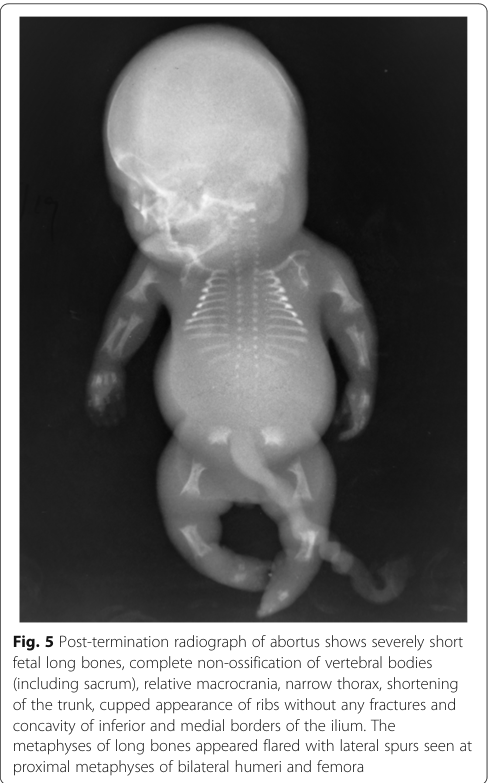
1. Disease Information
Achondrogenesis type II is a Mendelian skeletal disorder defined by extreme short-limbed dwarfism, profound deficiency of ossification of the axial skeleton, and lethal perinatal course, caused by structural variants in COL2A1, the gene encoding the α1 chain of type II collagen.[1][5][7][10][18][19][20] In classical clinicopathologic descriptions and contemporary GeneReviews-style summarizations, ACG2 is distinguished by severe micromelia, a small chest, prominent abdomen, incomplete ossification of the vertebral bodies and sacrum, and disorganization of the costochondral junctions.[1][18][19][20] MedlinePlus Genetics characterizes achondrogenesis as “a group of severe disorders that affect cartilage and bone development,” noting that achondrogenesis type II is also termed COL2A1‑related achondrogenesis and represents a lethal condition in which most infants die before or soon after birth, often due to respiratory failure.[7] Within the broader family of type II collagen disorders, a consensus clinical guideline published in 2019 places achondrogenesis type II at the most severe end of the spectrum, followed by hypochondrogenesis, Kniest dysplasia, spondyloepiphyseal dysplasia congenita, Stickler syndrome type I, and mild spondyloepiphyseal dysplasia with premature arthrosis.[19]
Key identifiers for achondrogenesis type II include the OMIM entry #200610, which is explicitly associated with heterozygous COL2A1 variants on chromosome 12q13.11.[1][15] The disease is represented in the MONDO ontology as MONDO:0008702, a designation that is linked in both human genetic resources such as ClinGen and animal genetic databases such as OMIA.[15][16][17][18] In Orphanet and related rare disease registries, achondrogenesis type II corresponds to Orphanet ORPHA codes historically grouped under achondrogenesis but now more finely subclassified in the 2023 revision of the nosology of genetic skeletal disorders.[9] ICD‑10 coding places achondrogenesis under Q77.0 (“Achondrogenesie”), within the chapter of osteochondrodysplasias with growth disturbances of the long bones and spine, making it part of the group of congenital musculoskeletal malformations of the skeleton.[14] MedlinePlus Genetics also recognizes achondrogenesis type II under the alternative designation “Langer‑Saldino type,” reflecting the original clinical description.[7]
Common synonyms and alternative names for achondrogenesis type II reflect both historical and mechanistic nomenclature. The condition is widely referred to as ACG2, “Langer‑Saldino achondrogenesis,” “COL2A1‑related achondrogenesis,” or “achondrogenesis type II (Langer‑Saldino type).”[1][7][10][12][18][19][20] In older literature, achondrogenesis type II and hypochondrogenesis were sometimes separated as distinct entities, but contemporary resources emphasize that they represent a continuous phenotypic spectrum caused by overlapping sets of COL2A1 variants.[5][7][10][19] MedlinePlus notes that “achondrogenesis type 2 and a similar skeletal disorder called hypochondrogenesis were once thought to be distinct conditions; however, because these conditions have overlapping features and a shared genetic cause, they are now considered to be part of the same disease spectrum.”[7]
The information available on achondrogenesis type II arises predominantly from aggregated disease‑level resources rather than large patient series, reflecting the rarity and lethality of the disorder. OMIM provides a curated summary based on case reports and series that combine radiographic, histologic, and molecular data.[1][2][5] GeneReviews‑style resources focus on the recessive SLC26A2‑related achondrogenesis type IB but contextualize type II as the COL2A1‑related dominant counterpart.[4][13] MedlinePlus Genetics and the NIH Genetic Testing Registry (GTR) synthesize clinical descriptions and genetic testing approaches from multiple studies, while ClinGen provides an evidence‑based classification of the COL2A1–achondrogenesis type II gene–disease relationship as “definitive,” citing at least fifteen distinct patient variants and multiple independent reports.[7][15][18] Individual patients and fetal cases are described in depth in classic morphologic and immunohistologic studies from the late 1980s and mid‑1990s and in more recent prenatal imaging and molecular diagnostic case reports, but these are integrated into overarching disease‑level narratives by OMIM, MedlinePlus, and consensus guidelines.[2][5][8][10][12][19][20]
From an ontology perspective, achondrogenesis type II corresponds to a Mendelian disease category, with MONDO:0008702 for the disease entity, HGNC:2198 for COL2A1 as the causal gene, and HP terms such as Micromelia, Narrow chest, and Platyspondyly representing core phenotypes. Although the precise MeSH heading is not explicitly provided in the supplied sources, MeSH descriptors for “Achondrogenesis” and “Collagen Type II” in PubMed indexing underpin much of the literature, ensuring that mechanistic and clinical data can be reliably retrieved.[2][5][7][10][12]
2. Etiology
The etiology of achondrogenesis type II is overwhelmingly genetic, with heterozygous pathogenic variants in COL2A1 constituting the primary causal factor and no convincing evidence for environmental, infectious, or multifactorial contributions. OMIM uses a number sign with its entry for ACG2 (#200610) specifically “because of evidence that achondrogenesis type II is caused by heterozygous mutation in the COL2A1 gene (120140) on chromosome 12q13.”[1] ClinGen’s disease–gene curation further concludes that COL2A1 is definitively associated with autosomal dominant achondrogenesis type II, citing multiple reports in which de novo variants affecting glycine residues in the triple‑helical domain of type II collagen produce the characteristic lethal phenotype.[5][10][15][18][19][20]
The COL2A1 gene encodes the α1(II) chain of type II collagen, a fibrillar collagen predominantly expressed in hyaline cartilage and the vitreous body of the eye.[7][19] Type II collagen molecules are composed of three α1(II) chains forming a triple helix, in which every third amino acid is glycine in a repeating Gly–X–Y motif that is essential for proper helix formation and fibril assembly.[5][19] Pathogenic variants in achondrogenesis type II almost invariably substitute glycine for a bulkier amino acid within this triple‑helical domain, disrupting collagen chain packing, slowing helix formation, and leading to post‑translational overmodification and misfolding.[5][10][19] Mortier and colleagues performed detailed radiographic, morphologic, biochemical, and molecular analysis in a case of achondrogenesis type II, revealing that a single base change (G→C) in COL2A1 produced a Gly691Arg substitution in the triple helix and that this mutation was associated with dilated rough endoplasmic reticulum in chondrocytes, sparse collagen fibers in cartilage matrix, and extensive overmodification of collagen peptides.[5][11] Similar glycine substitutions have been reported in fetuses with achondrogenesis type II and hypochondrogenesis, reinforcing that this class of variants situates the phenotype at the most severe end of the type II collagenopathy spectrum.[5][10][19]
Risk factors for achondrogenesis type II, in the conventional epidemiological sense, are minimal because the disorder arises almost exclusively from highly penetrant de novo mutations with lethal consequences. MedlinePlus Genetics describes achondrogenesis type II as an autosomal dominant condition in which “one copy of the altered gene in each cell is sufficient to cause the condition,” and both OMIM and GTR note that most cases represent new mutations rather than inherited variants.[1][7][18] Comstock and colleagues, as summarized in GTR and ClinGen, emphasize that ACG2 is an autosomal dominant trait “occurring mostly as new mutations,” although somatic and germline mosaicism have been documented in at least some families.[15][18][19] There is no direct evidence that parental age, environmental exposures, or specific lifestyles systematically increase the risk of achondrogenesis type II beyond the general background risk of de novo dominant mutations, and given the tiny absolute incidence of achondrogenesis (1 in 40,000–60,000 births for all types combined), epidemiologic studies lack the power to delineate subtle risk factors.[7][10]
No genetic susceptibility loci or modifier genes have been clearly identified for ACG2, though the broader type II collagenopathy spectrum suggests that variant position and type within COL2A1 strongly influence clinical severity. The 2019 consensus guideline on type II collagen disorders notes that achondrogenesis type II, hypochondrogenesis, Kniest dysplasia, spondyloepiphyseal dysplasia congenita, Stickler syndrome type I, and mild spondyloepiphyseal dysplasia represent a continuum of severity related to the structural impact of COL2A1 variants.[19] Glycine substitutions near the carboxyl terminus and in regions critical for helix nucleation appear to produce more severe phenotypes, whereas variants that allow more efficient folding or partial collagen secretion lead to milder skeletal dysplasia and ocular‑orofacial manifestations.[5][19] However, these relationships are best understood as genotype–phenotype correlations within COL2A1 itself rather than as effects of independent modifier loci, and no genome‑wide association or modifier gene studies have been conducted for ACG2 due to its rarity and lethality.[5][19]
Protective factors, whether genetic or environmental, are essentially absent for achondrogenesis type II, because the disease course is uniformly lethal and affected fetuses rarely survive long enough for any modulatory influences to be clinically observed.[1][7][10][19][20] In theoretical terms, a protective variant that mitigates the misfolding or ER retention of mutant type II collagen could shift a phenotype from achondrogenesis toward a milder collagenopathy, but such interactions have not been documented at the level of human genetic data. Similarly, while general avoidance of mutagens and maintenance of parental health are prudent for all pregnancies, there is no evidence that specific environmental exposures meaningfully alter the risk of a COL2A1 de novo mutation leading to achondrogenesis type II.[7][10][19]
Gene–environment interactions are therefore not a major etiologic feature of ACG2. The initiating lesion is a structural variant in COL2A1, and the disease unfolds within the developing fetal skeleton irrespective of external environmental context, aside from generic considerations such as maternal health and uteroplacental function.[1][2][5][7][10][19][20] The contrast with achondrogenesis type IB is informative: SLC26A2‑related achondrogenesis is a recessive sulfation disorder in which impaired sulfate transport into chondrocytes leads to undersulfated proteoglycans, but even in that condition, the primary etiologic driver is genetic and environmental sulfate availability plays a minimal role.[3][4][6][13] Overall, achondrogenesis type II exemplifies a monogenic, structurally determined developmental disorder in which causal and risk architecture are dominated by a single gene with highly disruptive, largely stochastic de novo variants and no known environmental modifiers.
3. Phenotypes
The phenotypic profile of achondrogenesis type II is dominated by severe skeletal malformations evident in utero, coupled with distinctive craniofacial features and a hydropic fetal appearance that collectively result in perinatal lethality. Clinically, affected fetuses present with extreme micromelia, meaning markedly shortened limbs relative to gestational age, often detectable by routine second‑trimester ultrasonography through profound reductions in femur and humerus length.[7][10][12][20] Micromelia in this context is typically symmetrical and involves both upper and lower extremities, with metaphyseal flaring and mild bowing of long bones observed on radiographs.[2][5][10] An appropriate Human Phenotype Ontology term for this feature is Micromelia (HP:0002983), which captures the disproportionate limb shortness that is central to achondrogenesis type II.[7][10]
The thoracic cage is characteristically small and narrow, with short ribs that are cupped at their anterior ends and lack fractures, in contrast to some other lethal skeletal dysplasias such as osteogenesis imperfecta type II and thanatophoric dysplasia.[1][5][10][12][19][20] Radiographic examinations demonstrate that the ribs are short, horizontally oriented, and inadequately ossified, contributing to a markedly hypoplastic chest that cannot accommodate normal lung volumes.[5][10][19][20] The HPO term Narrow chest (HP:0000774) aptly describes this finding, which is coupled with Pulmonary hypoplasia (HP:0002089) as a functional corollary, since respiratory failure due to small thoracic volume and underdeveloped lungs is the primary cause of death in most infants with ACG2.[7][10][19][20] The abdomen by contrast appears protuberant and rounded, yielding a pseudohydropic or hydropic appearance in which soft tissues appear abundant relative to the short skeleton.[1][4][7][10][20] This has been described as a “hydropic fetal appearance” in both SLC26A2‑related achondrogenesis type IB and COL2A1‑related type II, and can correspond to the HPO term Hydrops fetalis (HP:0001789) when generalized edema, ascites, or effusions are present.[4][7][10][20]
One of the most distinctive radiographic features of achondrogenesis type II is the virtual absence or severe loss of ossification in the vertebral column, sacrum, and pubic bones, accompanied by small iliac bones with ossification restricted to the upper portion, producing a “paraglider‑like” appearance on anteroposterior pelvic radiographs.[1][2][5][10][19][20] OMIM notes that type II achondrogenesis is “characterized by virtual absence of ossification in the vertebral column, sacrum and pubic bones,” and consensus type II collagen disorder guidelines emphasize absent or severely retarded ossification of vertebral bodies and sacrum as key prenatal radiographic findings.[1][19] These features correspond to HPO terms such as Platyspondyly (HP:0000926) for flattened or poorly ossified vertebral bodies, Absent ossification of vertebral bodies (a more specific term), and Abnormal pelvis ossification as a composite descriptor. The pelvis often shows iliac bones with crescent‑shaped inner and inferior margins and absent ossification of pubic and ischial bones, while the skull may exhibit defective calvarial ossification with large areas of membranous bone.[10][19][20] Prenatal imaging studies consistently report poor mineralization of the skull and vertebrae in ACG2, noting that skull ossification is variable but always abnormal.[10][12][20]
Craniofacial features in achondrogenesis type II are notable and overlap with those of other type II collagenopathies. MedlinePlus Genetics describes infants with ACG2 as having a prominent forehead, small chin, and sometimes an opening in the roof of the mouth, that is, a cleft palate.[7] Prenatal ultrasound and postmortem imaging case reports highlight micrognathia, a flat face, and sometimes Pierre Robin sequence (PRS), including glossoptosis and airway compromise, in fetuses with achondrogenesis type II.[19][20] One recent report of prenatal imaging described a fetus with ACG2 presenting with micrognathia, micromelia, and hydrops fetalis, and genetic testing revealed a heterozygous COL2A1 missense variant Gly516Ser.[20] The authors emphasize that micrognathia and craniofacial anomalies are part of the clinical spectrum, supporting the assignment of HPO terms such as Micrognathia (HP:0000347), Flat face (HP:0005291), and Cleft palate (HP:0000175) to ACG2.[7][19][20] These craniofacial manifestations reflect the role of type II collagen in cartilage of the cranial base and Meckel’s cartilage, influencing mandibular development and palatal closure.[19]
Other phenotypic features include a short neck, flat facial profile, and thickened soft tissue of the neck, as described in recessive achondrogenesis type IB but also observed in de novo ACG2 cases.[1][4][7] Many fetuses exhibit increased nuchal thickness, generalized skin edema, and cystic hygroma, which may result from lymphatic obstruction related to severe thoracic and neck deformities.[10][20] Polyhydramnios is frequently reported in pregnancies with achondrogenesis, reflecting altered fetal swallowing and possibly high cardiac output states associated with hydrops.[10][12][20] The face is often flat, and the ears may be low‑set, with an overall impression of a hydropic, poorly ossified fetus.[1][2][4][7][10][12] HPO terms such as Polyhydramnios (HP:0001561), Cystic hygroma (HP:0000476), and Generalized edema (HP:0000968) can be mapped to these findings, though their presence is variable and not universal in all ACG2 fetuses.[10][20]
Age of symptom onset for achondrogenesis type II is unequivocally prenatal, with most features detectable by mid‑gestation imaging and pathologic studies documenting fully established skeletal abnormalities by 22–32 weeks of gestation.[2][10][12][20] Morphologic and immunohistologic studies in a 32‑week gestation female fetus with type II achondrogenesis‑hypochondrogenesis revealed typical clinical features, radiographs showing absent ossification of multiple vertebral bodies, sacrum, pubis, and ischia, and short ribs and hypoplastic ilia, placing the patient toward the mild end of the achondrogenesis–hypochondrogenesis spectrum.[2] Prenatal ultrasonography at 22 weeks gestation has been sufficient to detect large head, short neck and chest, prominent abdomen, and short limbs in other ACG2 cases, enabling early termination of pregnancy upon confirmation by radiologic and pathologic examination.[12] Thus, for ontology annotations, Congenital onset (HP:0003577) and Fetal onset are appropriate descriptors.
Symptom severity in achondrogenesis type II is uniformly severe, given the lethal course and extreme skeletal malformation. However, within the broader spectrum of COL2A1 glycine substitution disorders, there is phenotypic heterogeneity, and some fetuses with glycine variants toward the mild end have features closer to hypochondrogenesis, with slightly more ossification and less extreme micromelia.[2][5][10][19] Whitley and Gorlin described prototype IV achondrogenesis‑hypochondrogenesis, and later authors have emphasized that differentiation between type II achondrogenesis and hypochondrogenesis based purely on radiographic features is challenging owing to considerable overlap.[2][5][10][19] In general, skeletal abnormalities are considered somewhat less severe in ACG2 than in recessive type I achondrogenesis, but the difference is relative, and both forms are perinatally lethal.[4][10]
Symptom progression in ACG2 reflects developmental unfolding rather than postnatal deterioration. Skeletal malformations worsen in relative terms as the fetus grows, with limb disproportion and axial ossification defects becoming more striking relative to gestational norms over time.[2][10][12][20] However, once established, these structural anomalies do not “progress” in the sense of degenerative disease; they represent a static developmental derailment. The disease course pattern is therefore best described as a prenatal, non‑remitting developmental malformation culminating in perinatal death, rather than a progressive or episodic condition. Frequency of individual phenotypes among affected fetuses is challenging to quantify precisely due to the small number of reported cases, but micromelia, narrow chest, deficient vertebral ossification, and prominent abdomen appear to be near‑universal features in confirmed ACG2, whereas craniofacial anomalies such as cleft palate and pronounced hydrops show more variability.[1][2][5][7][10][19][20]
Quality‑of‑life impact, in the conventional clinical sense, is limited by the fact that most infants die before or shortly after birth, precluding long‑term functional assessments. Nonetheless, the disorder has profound implications for parental well‑being, reproductive decision‑making, and maternal health. Polyhydramnios and hydrops fetalis can predispose to maternal complications such as mirror syndrome and preeclampsia, while the psychological burden associated with carrying or terminating a pregnancy affected by a lethal skeletal dysplasia is considerable.[10][12][20] For ontology mapping, EQ‑5D or SF‑36‑style quality‑of‑life instruments are not directly applicable to the affected infants, but the condition would correspond to severe limitations across domains such as mobility, self‑care, and usual activities if survival were prolonged. Genetic counseling and psychosocial support for parents are therefore essential components of care, even though the affected individual’s lifespan is extremely short.[4][7][19]
4. Genetic and Molecular Information
At the genetic level, achondrogenesis type II is caused by heterozygous pathogenic variants in COL2A1, the gene encoding the α1 chain of type II collagen, located on chromosome 12q13.11.[1][5][15][19] OMIM explicitly assigns a number sign to its ACG2 entry (#200610), stating that this is because of evidence that the disorder is caused by heterozygous mutation in COL2A1 (OMIM #120140).[1] ClinGen’s gene curation resource classifies COL2A1–achondrogenesis type II as a definitive association, based on multiple case reports, segregation data, and functional studies demonstrating that missense variants substituting glycine residues in the triple‑helical domain of type II collagen produce the lethal ACG2 phenotype.[15][19] Type II collagen molecules are fibrillar collagens composed entirely of α1(II) chains; the COL2A1 protein is a large secreted glycoprotein that assembles into homotrimeric triple helices and then into extracellular fibrils that constitute the main collagenous component of hyaline cartilage and the vitreous body.[5][19]
Pathogenic variants in achondrogenesis type II predominantly belong to the missense class, specifically targeting glycine residues in the Gly–X–Y triplet repeats of the triple‑helical domain. Mortier et al. reported a case in which a single base substitution (G→C) in COL2A1 resulted in a Gly691Arg change in the triple helix, and biochemical analysis showed post‑translational overmodification of collagen, consistent with delayed helix folding due to glycine substitution.[5][11] In a more recent prenatal cohort, Zhang and colleagues retrospectively analyzed two cases of fetal achondrogenesis type II, identifying in one fetus a COL2A1 variant c.2897G>C leading to p.Gly966Ala, which in silico prediction tools classified as damaging.[10] Another case report of prenatal imaging of micrognathia, micromelia, and hydrops fetalis described a heterozygous COL2A1 mutation 1703G>A (Gly516Ser) in exon 24, and the authors concluded that this missense variant was pathogenic and associated with achondrogenesis type II.[20] These and other reports collectively demonstrate that glycine substitutions throughout the triple‑helical domain, from mid‑molecule to near the C‑terminus, can produce ACG2, with some variants yielding phenotypes closer to hypochondrogenesis.[5][10][19][20]
Variant classification according to ACMG/AMP guidelines, as implemented in ClinVar and ClinGen, consistently designates these COL2A1 missense changes as pathogenic or likely pathogenic, based on criteria such as de novo occurrence in fetuses with consistent phenotypes, absence from population databases, predicted disruption of collagen structure, and functional evidence of impaired collagen secretion and matrix assembly.[5][10][15][19][20] ClinGen notes that at least fifteen unique COL2A1 variants have been identified in patients with achondrogenesis type II, and that these are typically heterozygous missense changes affecting glycine residues within the triple helix, supporting a dominant‑negative mechanism.[15] From a population genetics perspective, lethal COL2A1 variants associated with ACG2 are essentially absent from gnomAD and similar resources, reflecting strong negative selection; only milder COL2A1 alleles associated with SEDC, Stickler syndrome, and Kniest dysplasia reach appreciable carrier frequencies.[19]
All reported pathogenic variants in ACG2 are germline in the affected fetus, though their origin is usually a de novo mutation in one parental germline. OMIM and GTR summarize that achondrogenesis type II is an autosomal dominant trait occurring mostly as new mutations, but note that somatic and germline mosaicism in clinically unaffected parents has been documented.[1][18][19] Mosaicism has important implications for recurrence risk, as a modest proportion of parental germ cells carrying the pathogenic COL2A1 variant can result in multiple affected pregnancies despite the parent being phenotypically normal or only mildly affected.[18][19] Somatic mosaicism in parents can also explain cases in which a parent has a relatively mild type II collagen phenotype, such as SEDC or Stickler syndrome type I, while the fetus displays lethal achondrogenesis type II, highlighting the role of allele dosage and tissue distribution in determining severity.[19]
The functional consequences of COL2A1 variants in ACG2 are best described as dominant‑negative disruption of type II collagen biosynthesis and extracellular matrix assembly. Glycine substitutions in the triple helix impair the tight packing required for helix formation, causing a delay in folding that allows excessive hydroxylation and glycosylation of proline and lysine residues, resulting in overmodified collagen chains.[5][19] This misfolded collagen accumulates in the rough endoplasmic reticulum of chondrocytes, as demonstrated by electron microscopy and immunohistochemistry in achondrogenesis type II and hypochondrogenesis cases.[2][5] Havens et al. and other investigators have shown irregular large areas of cartilage matrix staining for type III collagen and diminished matrix staining for type II collagen, along with intense focal accumulations of type II collagen within perinuclear structures presumed to be dilated ER cisternae.[2] These findings strongly suggest intracellular retention of abnormal type II collagen with poor secretion, leading to a severe deficiency of extracellular collagen fibrils in the cartilage matrix.[2][5] As a result, the cartilage lacks a proper collagen scaffold on which proteoglycans can be deposited, disrupting the mechanical properties and signaling functions required for normal endochondral ossification.[2][5][19]
Modifier genes in the strict sense have not been identified for achondrogenesis type II, but the broader type II collagenopathy literature suggests that variant position relative to key functional domains serves as an intrinsic modulator of severity. The 2019 consensus guidelines note that variants near the C‑terminal end of the triple helix, which is important for nucleation and registration of chain alignment, are more likely to produce severe phenotypes such as achondrogenesis type II and hypochondrogenesis, whereas variants in less structurally critical regions may lead to Kniest dysplasia or SEDC.[19] Additionally, some splice‑site variants and nonsense mutations that result in haploinsufficiency, rather than dominant‑negative misfolding, can produce milder phenotypes, because truncated α1(II) chains are degraded and do not interfere with remaining normal chains.[19] However, these relationships involve variation within COL2A1 itself and do not yet implicate distinct modifier loci; no genome‑wide screens have been conducted in this lethal condition.
Epigenetic information specific to achondrogenesis type II is sparse. There is no evidence that DNA methylation or histone modification patterns at the COL2A1 locus or in chondrocytes are primary drivers of ACG2; rather, the structural variant itself is sufficient to cause disease.[5][19] Standard cartilage biology demonstrates that COL2A1 expression is regulated by transcription factors such as SOX9 and by epigenetic mechanisms during normal development, but these pathways do not appear to compensate for or worsen the effects of a dominant‑negative collagen variant in achondrogenesis type II.[19] Similarly, no chromosomal‑level abnormalities, such as deletions, duplications, or translocations, have been associated with ACG2; the condition is strictly a single‑gene trait resulting from variants in COL2A1, as emphasized both in human databases and in homologous animal conditions.[1][15][16][17]
Comparative genetic data from animals reinforce the centrality of COL2A1 in the etiology of achondrogenesis type II. OMIA documents achondrogenesis type II in Bos taurus (taurine cattle) and Ovis aries (sheep), both as single‑gene traits with autosomal dominant inheritance and COL2A1 missense variants.[16][17] In Charollais sheep, a naturally occurring missense variant c.2908G>A (p.G970S) in COL2A1 has been identified as causal for achondrogenesis type II, and this variant is considered homologous to human ACG2 based on similar skeletal phenotypes and COL2A1 involvement.[16] In taurine cattle, Daetwyler and colleagues found that the combination of clinical signs with a COL2A1 mutation led them to conclude that the disorder is homologous to human achondrogenesis type II, underscoring evolutionary conservation of the disease mechanism.[17] These animal data also support the classification of ACG2 as a monogenic, COL2A1‑driven disorder within MONDO:0008702 across species.[16][17][18]
5. Environmental Information
In contrast to many complex diseases, achondrogenesis type II exhibits an etiologic architecture almost entirely dominated by a single gene, with negligible involvement of environmental, lifestyle, or infectious factors. Human clinical and mechanistic studies uniformly attribute ACG2 to heterozygous COL2A1 variants affecting glycine residues in the collagen triple helix, and no reports have suggested that environmental toxins, radiation, nutritional status, or maternal illnesses modulate the risk or severity of the condition in a predictable way.[1][2][5][7][10][12][18][19][20] The incidence figures provided by MedlinePlus Genetics, approximately 1 in 40,000 to 60,000 newborns for all achondrogenesis types combined, reflect the rarity of these de novo genetic events rather than environmental clustering.[7][10]
The absence of rib fractures, which helps differentiate achondrogenesis type II from osteogenesis imperfecta type II, is intrinsic to the collagen defect rather than a product of environmental trauma.[5][10][19] Similarly, polyhydramnios, hydrops fetalis, and maternal complications such as mirror syndrome arise as downstream consequences of the fetal skeletal malformation and cardiovascular physiology rather than as independent environmental triggers.[10][12][20] While maternal exposures to high‑dose ionizing radiation or potent mutagens could, in principle, increase the probability of a germline COL2A1 mutation, such associations have not been documented in the literature, and standard obstetric practice already discourages such exposures for unrelated reasons.[7][10][19]
Lifestyle factors such as smoking, alcohol consumption, diet, and exercise do not appear to have any specific relationship to achondrogenesis type II beyond general effects on pregnancy health. The lethal perinatal nature of the disease and its extreme rarity preclude large‑scale epidemiologic studies capable of detecting subtle environmental influences, and the consistent finding of de novo glycine substitution variants in COL2A1 in sporadic cases argues strongly against modifiable environmental causes.[5][10][15][19][20] Infection by bacteria, viruses, fungi, or parasites does not figure in the pathogenesis of ACG2; there are no data implicating any infectious agent as a trigger or contributor, and the disorder manifests anatomically in cartilage and bone development in ways that are not characteristic of congenital infections.[7][10][19][20]
From a comparative toxicogenomics perspective, COL2A1 is not a prominent target of environmental chemicals in CTD‑style databases, and laboratory studies of collagen biosynthesis have not identified exogenous factors that replicate the specific intracellular retention and ER dilation observed in achondrogenesis type II chondrocytes.[2][5] Instead, the functional abnormalities emerge directly from mutant collagen biosynthesis within a normal environment. Therefore, ontology annotations for environmental exposures, such as CHEBI terms for toxins or NCIT terms for radiation, are not central to modeling ACG2; the disease is best represented as a monogenic developmental disorder with minimal environment‑gene interaction.
6. Mechanism and Pathophysiology
The pathophysiology of achondrogenesis type II can be articulated as a coherent causal chain connecting the initiating COL2A1 mutation to the lethal clinical phenotype. A heterozygous glycine substitution variant in the COL2A1 triple‑helical domain leads to production of structurally abnormal α1(II) collagen chains; these abnormal chains are incorporated into type II collagen molecules, resulting in delayed helix folding and post‑translational overmodification; the misfolded collagen accumulates within dilated rough endoplasmic reticulum of chondrocytes, leading to decreased secretion of type II collagen into the extracellular matrix; the ensuing deficiency of extracellular collagen fibrils and disorganized matrix impairs proteoglycan deposition and growth plate architecture, causing severe disruption of endochondral ossification in axial and appendicular skeleton; this skeletal dysplasia produces very short limbs, absent or retarded ossification of vertebral bodies and pelvis, and a narrow, hypoplastic thorax with pulmonary hypoplasia; the combination of thoracic restriction and lung underdevelopment results in respiratory failure at or shortly after birth, leading to intrauterine or early neonatal death.[2][5][10][19][20] Some steps in this chain, such as activation of ER stress pathways and apoptosis in chondrocytes, are inferred from generic misfolded protein biology rather than directly demonstrated in ACG2 tissues, but the overall sequence is strongly supported by histopathology, biochemical studies, and clinical correlation.[2][5][19]
At the molecular level, the critical pathway involves type II collagen biosynthesis and extracellular matrix assembly, integrated with core cartilage development processes. Type II collagen is synthesized as procollagen in chondrocytes, with three α1(II) chains aligning at their C‑terminal propeptides to nucleate triple‑helix formation, followed by folding in a C‑to‑N direction in the rough endoplasmic reticulum.[5][19] Glycine at every third position in the Gly–X–Y repeat is essential for the tight packing of the helix; substitution by a bulkier residue disrupts packing, slows folding, and exposes proline and lysine residues to prolyl and lysyl hydroxylases for longer periods, resulting in overhydroxylation and overglycosylation of the collagen chains.[5][19] Mortier et al. documented such overmodification in the collagen extracted from cartilage of an achondrogenesis type II case, reinforcing the misfolding model.[5][11] Because triple‑helical structure is necessary for secretion, misfolded procollagen accumulates in the ER, where chaperones such as HSP47 attempt to assist folding but ultimately cannot produce a correctly configured helix.[5][19]
Electron microscopy and immunohistochemistry in type II achondrogenesis‑hypochondrogenesis cases by Hovi et al. and others revealed prominently dilated rough endoplasmic reticulum containing fine granular material with occasional fibrils in all chondrocytes, along with intense focal accumulations of type II collagen in perinuclear vacuolar structures.[2] The investigators inferred that these vacuoles represent dilated ER cisternae retaining abnormal type II collagen molecules, and immunostaining indicated diminished matrix staining for type II collagen but irregular large areas of matrix staining for type III collagen, suggesting that chondrocytes may upregulate type III collagen as a compensatory response.[2] These findings strongly support the view that mutant type II collagen is poorly secreted and largely trapped intracellularly, resulting in sparse collagen fibrils in the cartilage matrix, as seen in electron micrographs.[2][5] In Gene Ontology terms, this involves biological processes such as collagen biosynthetic process (GO:0032964), extracellular matrix organization (GO:0030198), and cartilage development (GO:0051216), and cellular components such as endoplasmic reticulum (GO:0005783) and collagen trimer (GO:0005581).
At the cellular level, chondrocytes (CL:0000138) in the growth plate and articular cartilage are the primary affected cell type. Light microscopy in type II achondrogenesis‑hypochondrogenesis reveals hypercellular cartilage with decreased matrix, traversed by numerous fibrous vascular canals, and a markedly abnormal growth plate with disorganized columns of chondrocytes and defective hypertrophic zones.[2] These findings indicate that chondrocyte proliferation may be relatively preserved or even increased, but matrix production and organization are severely impaired, leading to lack of proper cartilage template for bone formation. The presence of fibrous vascular canals suggests attempts by invading vessels to remodel or ossify the cartilage, but the defective matrix cannot support normal ossification.[2][19] In GO terms, processes such as endochondral ossification (GO:0001958), chondrocyte differentiation (GO:0002062), and bone mineralization (GO:0030282) are disrupted downstream of the collagen biosynthesis defect.
Misfolded collagen in the ER likely triggers ER stress and unfolded protein response (UPR) pathways, although direct demonstration in ACG2 tissues is lacking. In other collagenopathies, such as some COL1A1‑related osteogenesis imperfecta and COL10A1‑related metaphyseal chondrodysplasia, ER stress leads to activation of CHOP and other pro‑apoptotic factors, causing chondrocyte apoptosis and further undermining growth plate function.[19] It is reasonable to infer that similar mechanisms operate in achondrogenesis type II, contributing to reduced numbers of fully differentiated hypertrophic chondrocytes and impaired transition from cartilage to bone. Thus, biological processes like response to unfolded protein (GO:0006986) and apoptotic process (GO:0006915) may be involved, and subcellular components such as ER lumen (GO:0005788) and stress granule (GO:0010494) are potentially relevant.
At the tissue level, the consequences of disrupted type II collagen biosynthesis are profound for hyaline cartilage and the embryonic skeleton. The cartilage matrix becomes sparsely collagenous, with altered proteoglycan deposition due to lack of proper fibrillar scaffold and possibly changed signaling via integrins and growth factor binding.[2][5][19] Undersulfated proteoglycans are central to SLC26A2‑related achondrogenesis type IB,[3][4][6][13] but in ACG2 the primary issue is collagen deficiency rather than proteoglycan sulfation, although secondary changes in proteoglycan composition likely occur. The resulting cartilage cannot support normal mechanical load or provide a template for ossification, leading to failure of primary and secondary ossification centers in vertebral bodies, sacral segments, and pelvic bones.[1][2][5][10][19][20] In UBERON terms, structures such as vertebral body (UBERON:0001443), sacrum (UBERON:0001353), ilium (UBERON:0001270), and costal cartilage (UBERON:0002387) show marked developmental failure.
The skeletal dysplasia manifests clinically as micromelia, short trunk, and narrow thorax. Long bones are very short with mild metaphyseal flaring and sometimes bowing, reflecting inadequate longitudinal growth due to impaired endochondral ossification at the growth plate.[2][5][10][20] The trunk is short with a prominent abdomen and hydropic appearance, and ribs are short and cupped, encasing a small thoracic cavity that severely limits the volume of developing lungs.[1][5][10][19][20] The lungs themselves may be intrinsically hypoplastic, as the mechanical environment and signaling from the thoracic cage influence branching morphogenesis and alveolar development.[19][20] In GO terms, processes such as lung development (GO:0030324) and respiratory system development (GO:0060541) are secondarily affected by the skeletal malformation, and organ‑level ontology such as lung (UBERON:0002048) and thoracic cage are relevant anatomical targets.
The craniofacial anomalies of achondrogenesis type II can also be understood mechanistically. Type II collagen is expressed in the cartilage of the cranial base and Meckel’s cartilage, and its disruption leads to abnormal development of the mandible and midface.[19] Micrognathia reflects reduced mandibular growth, while cleft palate arises from failed elevation and fusion of palatal shelves, possibly due to altered cranial base morphology and oral cavity volume.[7][19][20] Pierre Robin sequence, including glossoptosis and airway obstruction, can result from the small jaw and tongue displacement.[19] Additionally, type II collagen in the vitreous body implies that COL2A1 variants may produce ocular anomalies such as myopia, retinal detachment, or vitreous degeneration in milder collagenopathies, but in ACG2 these potential manifestations are largely overshadowed by perinatal lethality.[7][19] CL terms such as chondrocyte (CL:0000138) and osteoblast (CL:0000143), and GO terms such as craniofacial morphogenesis (GO:0048701), describe the cellular and developmental contexts affected.
Biochemical abnormalities in achondrogenesis type II center on collagen misfolding and overmodification, with resultant changes in extracellular matrix composition. Collagen cyanogen bromide peptide analysis in Mortier’s case showed increased hydroxylation and glycosylation of lysine residues, consistent with delayed helix folding in the presence of a glycine substitution.[5][11] Immunohistochemistry demonstrating diminished matrix type II collagen with focal perinuclear accumulations further underscores the mislocalization of collagen molecules.[2] There is no evidence of systemic metabolic abnormalities such as energy metabolism defects or serum biochemical markers that could serve as diagnostic biomarkers; the disease is localized to cartilage and bone at the tissue level.[2][5][19]
In terms of advanced molecular profiling, such as transcriptomics, proteomics, or metabolomics, specific datasets for achondrogenesis type II are not yet available. Most evidence derives from targeted biochemical and immunohistochemical studies rather than genome‑wide or proteome‑wide analyses.[2][5] However, extrapolation from other type II collagenopathies suggests that chondrocyte transcriptomes in ACG2 would show upregulation of stress response genes, altered expression of matrix components, and possible suppression of differentiation markers, while the proteome would reflect accumulation of misfolded collagen and ER chaperones.[19] Single‑cell analysis and spatial transcriptomics have not been applied to ACG2 due to the rarity and ethical constraints of studying human fetal tissues in depth, but these technologies hold potential for future mechanistic work on milder COL2A1 disorders. Functional genomics screens such as CRISPR or RNAi have not targeted COL2A1 specifically in the context of achondrogenesis, though model organism work on cartilage development and collagen biosynthesis informs general pathways.
Overall, achondrogenesis type II exemplifies a dominant‑negative collagenopathy in which a misfolded structural protein leads to ER stress, matrix deficiency, and catastrophic failure of a key developmental program, endochondral ossification. Upstream mechanisms are at the level of gene and protein (COL2A1 variant, collagen misfolding), mid‑level mechanisms involve chondrocyte stress and growth plate disorganization, and downstream mechanisms encompass skeletal malformation, thoracic insufficiency, and respiratory failure. Cell types include chondrocytes, osteoblasts, and lung epithelial cells (secondarily), while biological processes involve collagen biosynthesis, cartilage development, endochondral ossification, and lung development. Ontology mapping can therefore assign GO terms such as collagen biosynthetic process, endochondral ossification, and lung development; CL terms such as chondrocyte and osteoblast; and UBERON terms such as vertebral body, sacrum, ilium, rib, and lung to this mechanistic network.
7. Anatomical Structures Affected
The anatomical impact of achondrogenesis type II is broad but particularly concentrated in the skeletal system, with secondary involvement of the respiratory and craniofacial structures and, in some cases, lymphatic and cardiovascular compartments due to hydrops. At the organ level, the primary affected structures are the axial skeleton (spine and pelvis), appendicular skeleton (limbs), ribs and thoracic cage, skull, and to a lesser extent the lungs, jaw, and palate.[1][2][5][7][10][19][20] OMIM and consensus guidelines describe absent or severely retarded ossification of the vertebral bodies and sacrum, small iliac bones with limited ossification, and absent or delayed ossification of pubic and ischial bones.[1][19] Radiographic and prenatal imaging studies add details such as defective skull ossification, short cupped ribs without fractures, and severe shortening of long bones, all of which relate to primary defects in cartilage templates of these bones.[5][10][12][20]
In UBERON terms, the vertebral bodies (UBERON:0001443), sacrum (UBERON:0001353), ilium (UBERON:0001270), pubis (UBERON:0001304), and ischium (UBERON:0001301) are major axial skeletal structures that fail to ossify properly in achondrogenesis type II.[1][10][19][20] The long bones of the limbs, including the femur (UBERON:0000981), tibia (UBERON:0001444), humerus (UBERON:0001035), and radius (UBERON:0001421), are profoundly shortened, with metaphyseal flaring and mild bowing observed in radiographs.[2][5][10][20] The ribs (UBERON:0002227) are short and cupped, contributing to a small thoracic cage that encases hypoplastic lungs.[5][10][19][20] The skull (UBERON:0003129) shows defective ossification of the calvarium, and the mandible (UBERON:0001684) is small, consistent with micrognathia.[7][19][20] The palate (UBERON:0001714) may have a cleft, reflecting failed fusion of palatal shelves.[7][19]
The respiratory system, particularly the lungs, is secondarily affected due to the narrow thoracic cage and skeletal restriction of lung growth. Pulmonary hypoplasia in achondrogenesis type II is primarily a mechanical consequence of thoracic insufficiency; the lungs are too small and underdeveloped to support postnatal respiration.[7][10][19][20] In some cases, the small chest and pulmonary hypoplasia are accompanied by airway anomalies related to micrognathia and craniofacial skeletal malformations, contributing to respiratory compromise via both restrictive and obstructive mechanisms.[19][20] Organ‑level ontology thus assigns lung (UBERON:0002048) and trachea (UBERON:0003126) as structures impacted in the disease, though structural defects in lung parenchyma are secondary rather than primary.
Hydrops fetalis, generalized edema, and cystic hygroma observed in some achondrogenesis type II fetuses implicate the lymphatic system and cardiovascular system at least functionally.[10][20] Generalized skin edema and fluid accumulation in fetal compartments suggest lymphatic obstruction or cardiovascular stress related to the severe skeletal malformation and restricted thoracic cage, potentially leading to high output cardiac states and heart failure.[10][20] However, direct structural anomalies of the heart are not a defining feature of ACG2; the cardiovascular involvement is secondary. In UBERON, structures such as lymphatic vessel (UBERON:0002049) and heart (UBERON:0000948) can be noted as contextually involved.
At the tissue level, achondrogenesis type II is fundamentally a disorder of connective tissue, specifically hyaline cartilage, and bone derived from endochondral ossification. Cartilage in the epiphyseal growth plates and articular surfaces is hypercellular but matrix‑poor, with disorganized collagen and proteoglycan distribution.[2][5] Histologically, cartilage sections show numerous chondrocytes with dilated ER and sparse extracellular collagen fibrils, with fibrous vascular canals traversing what should be continuous cartilage.[2] The growth plate architecture is severely disrupted, with poor columnar organization and deficient hypertrophic zones.[2] Bone tissue is reduced or absent in affected regions, reflecting the failure of cartilage mineralization and replacement by bone. In basic tissue ontology, cartilage and bone are the dominant affected tissue types, but skeletal muscle, epithelial tissues, and nervous tissue are relatively spared, except insofar as they adapt to the altered skeletal framework.[2][5][19]
Cellularly, the principal affected population is the chondrocyte (CL:0000138), the cartilage‑forming cell that synthesizes type II collagen and proteoglycans.[2][5][19] Chondrocytes in achondrogenesis type II exhibit dilated rough endoplasmic reticulum with accumulated abnormal type II collagen and show altered immunostaining patterns, including intense perinuclear type II collagen staining and irregular matrix staining.[2] Osteoblasts (CL:0000143), the bone‑forming cells, are indirectly affected because their substrate cartilage is defective; they cannot carry out normal ossification when the cartilage template is insufficient or absent in vertebral bodies and pelvic bones.[19] Other cell types, such as fibroblasts and endothelial cells, appear relatively normal, although fibrous vascular canals indicate some abnormal invasion of fibrous tissue into cartilage.[2] The vitreous body of the eye contains type II collagen, and vitreous cells may be affected in milder collagenopathies, but in ACG2 these potential ocular cellular phenotypes are usually not clinically apparent due to early death.[7][19]
At the subcellular level, the rough endoplasmic reticulum (ER) (GO:0005783) is the central compartment involved in achondrogenesis type II pathophysiology. Electron microscopy reveals prominently dilated rough ER containing fine granular material and occasional fibrils in chondrocytes, consistent with accumulation of misfolded type II collagen.[2][5] Immunohistochemistry identifies small rounded perinuclear structures with intense type II collagen staining, interpreted as dilated ER cisternae or transport vacuoles overloaded with collagen.[2] The Golgi apparatus (GO:0005794) and secretory vesicles are probably also affected by the trafficking burden, but direct ultrastructural data focus primarily on ER dilation. The extracellular matrix (GO:0031012), particularly the collagenous component, is deficient in type II collagen fibrils and shows altered composition, including increased type III collagen staining in some regions.[2][5] Thus, cellular components such as ER, Golgi, extracellular matrix, and collagen fibril (GO:0005583) are key subcellular and supracellular compartments in ACG2.
Anatomical localization of achondrogenesis type II lesions is global and bilateral, affecting nearly all cartilage‑derived skeletal elements. The disorder does not display lateralization in the sense of unilateral or asymmetrical involvement; limb shortening, vertebral ossification defects, and thoracic cage abnormalities are symmetrical and systemic.[1][2][5][10][19][20] However, some structures, such as the pelvis and cranial base, may demonstrate more dramatic ossification failure than others, reflecting differences in developmental timing and mechanical environment. For ontology mapping, this implies that ACG2 can be annotated to multiple UBERON structures but with symmetrical involvement.
8. Temporal Development
The temporal development of achondrogenesis type II is characterized by prenatal onset, rapid developmental derailment, and perinatal lethality, without postnatal progression or remission. Initial pathophysiologic events occur as soon as COL2A1 expression begins in chondrocytes of the embryonic skeleton, which in humans is early in the first trimester, when mesenchymal condensations differentiate into cartilage templates for future bones.[5][19] The misfolding of type II collagen and ER retention thus start during embryogenesis, but clinically detectable manifestations emerge as the fetus grows and skeletal structures fail to ossify or elongate normally.
Typical age of onset in clinical terms is fetal, with structural abnormalities identifiable on ultrasound by the second trimester, often around 18–22 weeks gestation.[10][12][20] One antenatal diagnosis report described achondrogenesis type II detected at 22 weeks by routine ultrasonography, revealing a fetus with large head, short neck and chest, prominent abdomen, and short limbs.[12] Another prenatal imaging study of micrognathia, micromelia, and hydrops fetalis documented absent vertebral body ossification and narrow chest on 2D and 3D ultrasound.[20] In a detailed morphologic and immunohistopathologic study, a 32‑week gestation female fetus with type II achondrogenesis‑hypochondrogenesis showed fully established skeletal abnormalities, placing her toward the milder end of the spectrum but still demonstrating the complete developmental disruption by late gestation.[2] Thus, HPO terms such as Congenital onset and Fetal onset appropriately capture the timing.
The onset pattern is insidious from a macroscopic perspective but acute in developmental terms. There is no sudden event; rather, as bone and cartilage growth proceed, discrepancies between expected and actual skeletal dimensions become more pronounced. However, once the fundamental collagen biosynthesis defect is present, skeletal dysplasia evolves rapidly relative to gestational growth, and by mid‑gestation the abnormalities are striking on imaging.[2][10][12][20] There is no chronic phase in the conventional sense; the disease is developmental and self‑limited in the sense that it culminates in death.
Disease progression can be conceptualized as having an early, intermediate, and end‑stage, though these are not formal clinical staging categories. The early stage, in the first trimester, involves microscopic changes in cartilage matrix and chondrocyte ER that are not clinically visible. The intermediate stage, spanning the second trimester, features recognizable micromelia, narrow chest, and early ossification defects on ultrasound and radiographs.[10][12][20] The end‑stage, in the late second and third trimesters, shows fully established skeletal dysplasia with absent vertebral and pelvic ossification, extreme limb shortening, hydropic appearance, and often polyhydramnios and hydrops fetalis.[2][10][20] Progression rate is rapid, in that severe structural anomalies manifest within the span of a normal human gestation, and the disease course is progressive in utero, but once the fetus is delivered or dies, there is no further progression.
Disease duration is inherently short, confined to the prenatal period and, in liveborn infants, minutes to hours after birth. OMIM and GTR emphasize that death occurs in utero or in the early neonatal period, and MedlinePlus notes that most infants with achondrogenesis die before birth or soon after, often due to respiratory failure.[1][7][18][19][20] There are no chronic survivors of achondrogenesis type II reported in the literature, and thus no long‑term disease course or remission patterns. The disease is non‑remitting and terminates in death; remission or partial recovery has not been observed, and therapeutic interventions such as mechanical ventilation cannot overcome the structural constraints of a small thoracic cage and hypoplastic lungs.[7][10][19][20]
Critical periods in the temporal development of achondrogenesis type II have practical significance for diagnosis and intervention. The mid‑gestation window, around 18–24 weeks, is a key period in which routine obstetric ultrasonography can detect abnormal fetal biometry, including markedly short femur length, narrow thorax, and hydropic appearance, prompting further evaluation.[10][12][20] Prenatal specialists emphasize that femur length is the best biometric parameter to distinguish achondrogenesis from other skeletal dysplasias and that analyzing the constellation of findings—narrow thorax, poor mineralization of skull and vertebrae, polyhydramnios, pseudohydropic appearance, and cystic hygroma—enables determination of neonatal lethality and differential diagnosis.[10] This period is also critical for parental decision‑making regarding pregnancy continuation or termination, as well as for planning perinatal care. In ontology terms, this reflects a temporal window of vulnerability and opportunity for intervention, though intervention is limited to reproductive and supportive decisions rather than disease modification.
Beyond the fetal periods, there are no meaningful time windows for intervention in the affected infant, because structural skeletal anomalies and lung hypoplasia preclude survival beyond the immediate neonatal period. However, the preconception and early pregnancy phases are critical for prevention when a parental COL2A1 variant is known, as preimplantation genetic testing and early prenatal diagnostic testing can prevent recurrence.[4][7][18][19] In families with germline mosaicism or mild parental phenotype, recognizing these windows can inform reproductive planning.
9. Inheritance and Population Characteristics
Achondrogenesis type II is a Mendelian disorder with autosomal dominant inheritance, characterized by complete penetrance in carriers of a pathogenic COL2A1 variant and predominantly de novo occurrence.[1][7][15][18][19][20] Achondrogenesis as a group occurs in approximately 1 in 40,000 to 60,000 newborns, according to MedlinePlus Genetics, though the proportion attributable specifically to type II versus types IA and IB is not precisely defined.[7][10] Given that ACG2 is caused by structural COL2A1 variants at the lethal end of the type II collagenopathy spectrum, its population incidence is likely much lower than that of milder COL2A1‑related disorders such as SEDC, Kniest dysplasia, and Stickler syndrome type I.[19]
OMIM, GTR, and ClinGen consistently state that achondrogenesis type II is inherited in an autosomal dominant fashion.[1][18][19] In practical terms, however, most cases are sporadic, due to de novo variants arising in parental germ cells. GTR summarizes that ACG2 is “an autosomal dominant trait occurring mostly as new mutations,” and Comstock et al., as cited by ClinGen, emphasize that somatic and germline mosaicism have been reported.[15][18] This means that while an affected individual, if they survived to reproductive age, would have a 50% risk of transmitting the variant to offspring, in reality such individuals do not survive to adulthood, and recurrence risk in families is driven by the presence or absence of parental mosaicism.[18][19] When a parental COL2A1 variant is present (either constitutional or mosaic), penetrance appears to be complete, in that all fetuses inheriting the variant develop severe type II collagenopathy, though the phenotype may range from ACG2 to hypochondrogenesis depending on variant position and other factors.[5][10][19]
Expressivity in achondrogenesis type II is variable within the broader type II collagenopathy spectrum but relatively consistent within classical ACG2. Mortier’s case and other hypochondrogenesis patients illustrate that glycine substitutions in COL2A1 can produce phenotypes at the most severe end (achondrogenesis type II) or slightly less severe end (hypochondrogenesis), forming a continuum.[2][5] Radiographic and clinical heterogeneity is considerable, and distinguishing type II achondrogenesis from hypochondrogenesis based solely on imaging is difficult.[2][5][10][19] Zhang et al. noted that skeletal abnormalities are less severe in type II than in type I achondrogenesis, but that differentiating between these types is not possible based on radiographic features alone owing to phenotypic overlap.[10] Therefore, while expressivity within ACG2 is moderately consistent (all cases are lethal and exhibit extreme micromelia and axial ossification defects), there is inter‑entity variability across the type II collagenopathy spectrum that reflects differences in COL2A1 variant position and type.[5][19]
Genetic anticipation, the phenomenon of increasing severity or earlier onset in successive generations, is not relevant to achondrogenesis type II. ACG2 is caused by point mutations rather than repeat expansions, and its severity is fully manifest in the first generation carrying the variant.[1][5][19] Furthermore, affected individuals do not survive to reproduce, so multigenerational pedigrees are extremely rare. The main multigenerational pattern observed involves mosaic parents with subclinical or mild type II collagen phenotypes having multiple affected pregnancies with lethal achondrogenesis type II or hypochondrogenesis, but this reflects mosaicism rather than anticipation.[18][19]
Germline mosaicism plays a meaningful role in recurrence risk for achondrogenesis type II. ClinGen and GTR note that somatic and germline mosaicism have been reported, and consensus guidelines on type II collagen disorders emphasize that identification of a specific COL2A1 variant may reveal clinically unsuspected parents of clearly affected children, via somatic mosaicism.[18][19] When mosaicism is present, recurrence risk can be significantly higher than the general population de novo risk, potentially reaching 10–20% depending on the proportion of germ cells carrying the variant, though exact figures are case‑dependent and not systematically quantified in the literature. This underscores the importance of comprehensive genetic testing in parents of fetuses with ACG2, including sensitive methods capable of detecting low‑level mosaicism.
Founder effects and population‑specific mutations are not clearly documented for achondrogenesis type II. In contrast, SLC26A2‑related disorders, such as diastrophic dysplasia and ACG1B, have well‑characterized founder mutations in certain populations, notably the Finnish population where the IVS1+2T>C splice site variant is common.[3][4][6] For COL2A1‑related conditions, some variants cluster within specific families and populations, but ACG2 variants, being often de novo and lethal, do not typically persist in populations long enough to form a founder pattern.[15][19] Carrier frequency for COL2A1 variants specifically associated with achondrogenesis type II is effectively zero in the general population due to strong negative selection; only milder COL2A1 variants associated with longer survival appear in carrier frequency estimates from resources like gnomAD.[19]
Consanguinity does not play a major role in achondrogenesis type II, again reflecting its dominant de novo etiology. Recessive achondrogenesis type IB, by contrast, is more likely to occur in consanguineous families in which both parents carry pathogenic SLC26A2 variants.[4][6][13] For ACG2, most cases are sporadic, and parental consanguinity is incidental rather than causative. Sex ratio among reported cases appears roughly equal; both male and female fetuses have been described in case reports, and there is no indication of sex‑linked inheritance or sex‑specific penetrance.[2][10][12][20]
Geographic distribution of achondrogenesis type II cases follows general patterns of reporting and medical infrastructure rather than reflecting true endemicity. Cases have been reported from multiple regions, including Europe, North America, and Asia, as prenatal imaging and molecular diagnostics become more widely available.[2][5][8][10][12][20] The incidence figures provided in MedlinePlus Genetics and other resources are global estimates, and no particular ethnic or geographic group has a significantly higher prevalence of ACG2.[7][10] However, COL2A1‑related disorders as a whole may be underdiagnosed in some regions due to limited access to molecular testing, and improved global diagnostics may reveal additional cases.
Age distribution is entirely skewed toward fetuses and neonates, as achondrogenesis type II is lethal in utero or shortly after birth.[1][7][10][19][20] There are no child or adult patients, and thus age‑related penetrance issues do not arise. For population health modeling, ACG2 contributes to fetal and neonatal mortality statistics in rare disease registries but does not feature in chronic disease burden analyses.
10. Diagnostics
The diagnosis of achondrogenesis type II relies on a combination of prenatal imaging, postnatal radiography, histopathology, and molecular genetic testing, integrated within a multidisciplinary assessment that is critical for definitive classification and genetic counseling.[1][2][5][8][10][12][18][19][20] Prenatal ultrasonography is often the first modality to raise suspicion, as routine second‑trimester scans reveal extreme limb shortness, narrow thorax, and hydropic appearance. Zhang et al. describe two fetal ACG2 cases in which sonographic features included extremely short femur length and hydropic appearance, noting that femur length was the best biometric parameter to distinguish achondrogenesis from other skeletal dysplasias.[10] Another case report of antenatal diagnosis identified at 22 weeks gestation a fetus with large head, short neck and chest, prominent abdomen, and short limbs, leading to termination and postnatal confirmation.[12] Prenatal 2D and 3D ultrasound can demonstrate absent vertebral body ossification, flat face, micrognathia, micromelia, and small narrow chest, all suggestive of ACG2.[20]
Postnatal radiographic examination, whether in liveborn neonates or after termination/stillbirth, provides crucial diagnostic detail. Radiographs typically reveal severely short long bones, defective skull ossification, unossified vertebral bodies, short cupped ribs without fractures, and iliac bone ossification limited to the upper part, producing a paraglider‑like appearance.[2][5][10][12][19][20] OMIM and consensus guidelines emphasize absent or severely retarded ossification of vertebral bodies and sacrum, small iliac bones with crescent‑shaped inner and inferior margins, and absent ossification of pubic and ischial bones as characteristic features of achondrogenesis type II.[1][19] The ribs are notable in that they are short and cupped but lack fractures; this absence of rib fractures helps differentiate ACG2 from osteogenesis imperfecta type II, which shows multiple fractures and severe osteopenia.[5][10][19] Skull ossification is variably defective, often with large membranous areas and reduced calcification, but not necessarily completely absent.[10][20] A complete skeletal survey, including spine, pelvis, limbs, and skull, is recommended in guidelines for type II collagen disorders, as delayed epiphyseal ossification is a hallmark of more moderate phenotypes and axial ossification defects are central to ACG2.[19]
Histopathology and immunohistochemistry, while not always performed in clinical practice due to ethical considerations around fetal tissue, have been foundational in understanding and confirming achondrogenesis type II. Light microscopy of cartilage from ACG2 and hypochondrogenesis patients reveals hypercellular cartilage with decreased matrix, numerous fibrous vascular canals, and markedly abnormal growth plate architecture.[2] Ultrastructural studies show prominently dilated rough endoplasmic reticulum containing fine granular material and occasional fibrils in chondrocytes, indicating accumulation of misfolded collagen.[2][5] Immunohistologic studies demonstrate irregular large areas of cartilage matrix staining with monoclonal antibody to human type III collagen, diminished matrix staining for type II collagen, and intense focal accumulations of type II collagen within small rounded perinuclear structures of chondrocytes.[2] These findings “strongly suggest intracellular retention of type II collagen within vacuolar structures, probably within the dilated rough endoplasmic reticulum,” implying a structural abnormality of type II collagen causing a new dominant lethal disorder.[2] Such pathology provides strong supporting evidence but is not strictly required for diagnosis when molecular data are available.
Molecular genetic testing is now the gold standard for definitive diagnosis of achondrogenesis type II, particularly for distinguishing it from other lethal skeletal dysplasias. Traditional classification distinguished type I (Parenti–Fraccaro, recessive, SLC26A2‑related) and type II (Langer–Saldino, dominant, COL2A1‑related) achondrogenesis partly based on radiographic and histologic features.[4][7][10][13] However, phenotypic overlap between type I and type II achondrogenesis, especially in ossification patterns, makes reliance on imaging alone insufficient.[10] Zhang et al. emphasize that “combined with postnatal radiographic examination, the final diagnosis of achondrogenesis type II was made” only after identification of causative COL2A1 mutations in both fetal cases.[10] The NIH GTR describes multiple tests for COL2A1 variants associated with ACG2, and ClinGen recommends molecular testing of COL2A1 whenever clinical or radiographic features suggest a type II collagen disorder.[18][19]
The recommended genetic testing approach includes single‑gene sequencing of COL2A1, either by Sanger sequencing targeted to coding exons and splice sites or by next‑generation sequencing within a skeletal dysplasia gene panel.[18][19] Whole‑exome sequencing (WES) and whole‑genome sequencing (WGS) are increasingly used when the diagnosis is uncertain or when a broad differential of skeletal dysplasias is considered, as they can detect COL2A1 variants along with mutations in other genes such as SLC26A2, TRIP11, FGFR3, and others.[4][9][13][19] In prenatal settings, molecular testing is typically performed on DNA obtained from chorionic villus sampling or amniocentesis if ultrasound suggests a lethal skeletal dysplasia, and guideline authors recommend inclusion of COL2A1 whenever type II collagenopathy features are suspected.[8][10][19] Chromosomal microarray and karyotyping are not particularly useful for ACG2, as there are no known large‑scale chromosomal abnormalities associated with the disease; the lesions are at the single‑gene, single‑nucleotide level.[1][15][19]
Omics‑based diagnostics beyond targeted gene sequencing are currently limited for achondrogenesis type II. There are no established transcriptomic, proteomic, or metabolomic biomarkers used clinically for this disorder, and liquid biopsy approaches are not applicable given the prenatal context and structural nature of the disease. Serum or amniotic fluid markers of collagen misfolding have not been developed, and standard laboratory tests of blood or urine chemistries do not provide diagnostic information in ACG2.[2][5][19] Thus, imaging and COL2A1 sequencing remain the core diagnostic modalities.
Differential diagnosis of achondrogenesis type II includes several other lethal skeletal dysplasias, and distinguishing them is crucial for accurate genetic counseling. Thanatophoric dysplasia (ICD‑10 Q77.1), caused by FGFR3 variants, presents with extreme limb shortening, narrow thorax, and often bendy or telephone‑receiver femurs, but radiographs show better ossification of the vertebral bodies and characteristic skull changes such as cloverleaf skull in type II thanatophoric dysplasia.[10][14][19] Short‑rib polydactyly syndromes (Q77.2) are recessive conditions with short ribs, narrow thorax, polydactyly, and various visceral anomalies; they often exhibit more fragmented ossification and polydactyly, which is absent in ACG2.[14][19] Osteogenesis imperfecta type II presents with severe osteopenia, multiple rib and long bone fractures, and blue sclerae; radiographically, the presence of fractures and extreme demineralization distinguishes it from ACG2.[10][19] Achondrogenesis type IB (SLC26A2‑related) resembles type II radiographically but often shows more severe rib abnormalities and different histopathologic features of cartilage undersulfation.[3][4][6][10][13] GeneReviews and consensus guidelines stress that phenotypic overlap between type I and II achondrogenesis requires molecular testing (SLC26A2 vs COL2A1) for definitive classification.[4][10][13][19]
Screening for achondrogenesis type II in asymptomatic individuals is not performed in the general population due to the disorder’s rarity and lethal outcome. However, carrier and prenatal screening in high‑risk families is important when a parental COL2A1 variant is known. GeneReviews and type II collagen disorder guidelines recommend offering preimplantation genetic diagnosis (PGD) and early prenatal testing to parents with identified COL2A1 mutations who wish to avoid recurrence.[4][18][19] Routine obstetric ultrasound acts as a form of secondary screening, detecting skeletal anomalies that may prompt testing for ACG2 even in families without known risk. Newborn screening programs do not include achondrogenesis because affected infants rarely survive long enough to benefit from screening, and the disorder is evident at birth. NCIT terms such as Prenatal Diagnosis (NCIT:C17351), Genetic Testing (NCIT:C13794), and Ultrasonography (NCIT:C17204) are appropriate for annotating diagnostic interventions.
11. Outcome and Prognosis
The outcome and prognosis of achondrogenesis type II are uniformly poor, with near‑universal perinatal lethality and no effective disease‑modifying therapies. OMIM notes that in both type I and type II achondrogenesis “death occurs in utero or the early neonatal period,” and MedlinePlus Genetics reiterates that most infants with achondrogenesis die before birth or soon after, often due to respiratory failure.[1][7] Consensus type II collagen disorder guidelines describe achondrogenesis type II as antenatally lethal, associated with severe deficiency of ossification and extreme skeletal dysplasia resulting in micromelia, narrow chest with pulmonary hypoplasia, and often Pierre Robin sequence.[19] Prenatal imaging case reports consistently report termination of pregnancy or death shortly after birth in fetuses diagnosed with ACG2, underscoring the non‑viability of the condition.[10][12][20]
Exact survival statistics such as 5‑year or 10‑year survival rates are not meaningful for achondrogenesis type II, as essentially no affected individuals survive beyond the neonatal period. The life expectancy is measured in hours or days at most, and in many cases in minutes, for liveborn infants, and in weeks or months of gestation for fetuses who die in utero.[1][7][10][19][20] Mortality rate among affected individuals is effectively 100%, and disease‑specific mortality corresponds closely to overall mortality, given that respiratory failure due to thoracic insufficiency and pulmonary hypoplasia is the primary cause of death.[7][10][19][20] Neonatal intensive care interventions such as mechanical ventilation cannot overcome the underlying structural constraints, and survival beyond the immediate postnatal period has not been documented.
Morbidity in the sense of long‑term disability is not applicable to achondrogenesis type II, because the disease course does not afford time for sustained functioning. However, the condition has significant perinatal and maternal morbidity, including polyhydramnios, hydrops fetalis, and associated complications. Polyhydramnios can lead to maternal discomfort, risk of preterm labor, and increased risk of maternal mirror syndrome (a preeclampsia‑like condition associated with fetal hydrops).[10][12][20] Hydrops fetalis can cause uterine overdistension and hemodynamic stress, and pregnancies complicated by ACG2 may require careful monitoring or intervention to manage maternal health. Additionally, the psychological morbidity associated with carrying a fetus with a lethal malformation and facing decisions about termination or palliative care is substantial for parents.[4][7][19]
Quality of life measures such as EQ‑5D, SF‑36, or PROMIS are not directly applicable to infants with achondrogenesis type II, but if hypothetically applied, they would indicate severe impairments across all domains, including mobility, self‑care, usual activities, pain/discomfort, and anxiety/depression. The affected infants cannot breathe effectively, cannot move normally, and often experience distress related to respiratory compromise. For parents, instruments such as the SF‑36 or disease‑specific psychological scales would likely show significant reductions in mental health and social functioning in the perinatal period, though studies specifically quantifying this in ACG2 families have not been performed.[4][7][19]
Complications of achondrogenesis type II include respiratory failure, hydrops fetalis, and potential maternal complications. Respiratory failure arises from the small thoracic cage, short ribs, and pulmonary hypoplasia, which together prevent adequate ventilation and gas exchange.[7][10][19][20] Hydrops fetalis, characterized by generalized edema, ascites, and effusions, can result from obstructed lymphatic flow, cardiac failure, or severe anemia, though in ACG2 the primary drivers appear to be mechanical and cardiovascular stress related to skeletal malformation.[10][20] Maternal complications include polyhydramnios‑related preterm labor, mirror syndrome, and increased risk of cesarean section due to malpresentation or obstetric indications linked to fetal size and hydropic status.[10][12][20] There are no recoverable phases or periods of stability; the disease trajectory is inexorably downward once skeletal anomalies reach a critical threshold.
Recovery potential for achondrogenesis type II is essentially zero. The structural defects in cartilage and bone are fundamental and cannot be reversed with current medical technology, and the developmental window for establishing normal skeleton and lungs is closed by the time the condition is diagnosed. Even in theoretical scenarios involving postnatal gene therapy or stem cell interventions, the time frame and complexity of reconstructing a human skeleton and thoracic cage from birth onward would preclude meaningful rescue in ACG2. In contrast, milder type II collagenopathies, such as SEDC and Stickler syndrome, have better prognosis and can benefit from orthopedic, ophthalmologic, and audiologic interventions, but these are not applicable to ACG2.[19]
Prognostic factors within the limited context of achondrogenesis type II include severity of thoracic hypoplasia, presence of hydrops fetalis, and possibly variant position in COL2A1. Fetuses with more severe thoracic insufficiency and hydrops are likely to die in utero or shortly after birth, while those with slightly less severe features may survive for a few hours postpartum.[10][12][20] However, all cases are ultimately lethal. Variant position may influence whether a fetus is classified as ACG2 or hypochondrogenesis, and hypochondrogenesis may have microscopically less severe skeletal malformation, but still carries a lethal prognosis.[2][5][10][19] No molecular biomarkers have been established that predict relative survival beyond the general association of glycine substitutions with severity.
In summary, achondrogenesis type II is a perinatally lethal developmental disorder with uniform mortality, minimal recovery potential, and major implications for parental and maternal health. Prognostic discussions with families focus not on odds of survival but on expectations regarding perinatal course, options for pregnancy management, and psychosocial support.
12. Treatment
Treatment options for achondrogenesis type II are limited to prenatal counseling, pregnancy management, and palliative perinatal care, as no curative or disease‑modifying therapies exist for this lethal skeletal dysplasia. The structural nature of the defect—severe failure of axial and appendicular ossification and thoracic hypoplasia—precludes meaningful postnatal intervention, and management focuses on supporting the family and, where possible, the infant during a very brief life.[1][7][10][19][20]
Pharmacologic therapies have no role in directly treating the underlying collagen defect in ACG2. There are no drugs that can correct misfolded type II collagen or restore normal cartilage and bone formation in a developing fetus. Agents that modulate ER stress or protein folding, such as chemical chaperones, have been studied in other misfolded protein diseases, but their application in utero to a condition as profound as achondrogenesis type II is neither currently feasible nor supported by evidence.[19] Similarly, bisphosphonates or other osteoclast‑targeted drugs used in osteogenesis imperfecta cannot address the absence of bone in ACG2, and their use would be inappropriate.[19]
Advanced therapeutics such as gene therapy, cell therapy, or RNA‑based interventions are theoretically intriguing but practically unattainable for ACG2 at present. Achieving effective gene therapy would require delivering a normal COL2A1 gene to chondrocytes throughout the fetal skeleton early in gestation, ensuring proper expression and assembly of type II collagen to prevent skeletal malformation; this is beyond current capabilities.[19] CRISPR‑based gene editing could, in principle, correct a specific COL2A1 variant in early embryos, but such interventions would be ethically complex and technically challenging, and no clinical trials have been conducted.[19] Cell therapy with mesenchymal stem cells or chondrocyte precursors also faces formidable obstacles, including distributing cells throughout the developing skeleton and integrating them into growth plates. RNA‑based therapies, such as antisense oligonucleotides to modulate COL2A1 splicing or mRNA therapy to supplement type II collagen, similarly lack preclinical or clinical evidence in ACG2.
Surgical interventions for achondrogenesis type II are not feasible because the underlying skeletal anomalies are too diffuse and severe to be corrected surgically. Orthopedic procedures such as limb lengthening, spinal fusion, or thoracic expansion are used in milder skeletal dysplasias but presuppose a patient who survives into childhood and can tolerate surgery; this is not the case in ACG2.[19] Any attempt at thoracic expansion in a neonate with achondrogenesis type II would confront the reality of profoundly hypoplastic ribs and vertebrae and would not remedy intrinsic pulmonary hypoplasia.
Supportive and palliative care, however, are crucial components of treatment strategy. In pregnancies where the fetus is diagnosed with achondrogenesis type II and carried to term or near term, birth planning should involve neonatology, obstetrics, and palliative care teams to ensure that the infant is delivered in a setting that can provide comfort-focused care.[10][12][19][20] For liveborn infants, supportive measures may include warmth, pain control if distress is suspected, and gentle handling, with or without transient oxygen supplementation, depending on parental wishes and local practice, but invasive ventilation is typically not pursued given the futility of overcoming thoracic and pulmonary hypoplasia.[19][20] NCIT terms such as Palliative Care (NCIT:C24968) and Supportive Care (NCIT:C61412) apply to these interventions. Psychosocial support for parents, including bereavement counseling, is an essential therapeutic component.
Experimental treatments in clinical trials have not been reported for achondrogenesis type II specifically. ClinicalTrials.gov and related registries focus experimental therapy efforts on more common and less severe skeletal dysplasias or other genetic disorders where intervention has a plausible chance of altering long‑term outcomes. For ACG2, the early onset, structural severity, and lethality limit the feasibility and ethical justification for experimental therapies at present.[19]
Treatment outcomes in achondrogenesis type II are thus measured not in terms of survival or functional improvement but in terms of quality of perinatal care and parental support. Response to supportive and palliative measures is qualitatively positive when families feel their infant’s brief life is handled with dignity and compassion. Side effects and adverse events are minimal when aggressive interventions are avoided; invasive ventilation or resuscitation attempts may cause distress without benefit, and guidelines generally recommend against such interventions in ACG2.[19][20]
Clinical pathways and decision algorithms for achondrogenesis type II emphasize early recognition, multidisciplinary counseling, and clear communication with families about prognosis and care options. Prenatal diagnosis through ultrasound and COL2A1 testing enables informed decision‑making, including options for termination or planned palliative delivery. Genetic counseling helps families understand recurrence risks and future reproductive options. Personalized medicine in the sense of tailoring therapies to genotype is not applicable to ACG2, but genotype‑guided counseling is important for differentiating ACG2 from milder COL2A1 disorders and for planning future pregnancies.[18][19] NCIT terms such as Genetic Counseling (NCIT:C16828), Prenatal Care (NCIT:C16792), and Perinatal Palliative Care can be used to annotate these aspects of treatment.
13. Prevention
Prevention strategies for achondrogenesis type II focus on primary prevention via reproductive genetic technologies and secondary prevention via early detection, as tertiary prevention in the affected individual is limited by perinatal lethality. Primary prevention aims to prevent the occurrence of ACG2 in future pregnancies in families with known COL2A1 variants. When a parental COL2A1 mutation associated with a type II collagenopathy is identified—either from previous ACG2 pregnancies or from mild parental phenotypes such as SEDC or Stickler syndrome—preimplantation genetic testing (PGT‑M) during in vitro fertilization can select embryos without the pathogenic variant, thereby reducing the risk of having an affected fetus.[4][18][19] NCIT terms such as Preimplantation Genetic Diagnosis (NCIT:C19032) apply to this intervention. Genetic counseling is essential to explain the autosomal dominant inheritance, recurrence risks (including the possibility of germline mosaicism), and available reproductive options.[4][18][19]
Secondary prevention in achondrogenesis type II involves early prenatal detection of skeletal anomalies through routine ultrasound and, when indicated, targeted molecular testing for COL2A1 variants. Standard obstetric care includes second‑trimester ultrasound screening, which can detect short femur length, narrow thorax, and hydropic features suggestive of achondrogenesis.[10][12][20] When such findings are present, referral to maternal–fetal medicine specialists and genetic counselors allows for more detailed imaging, consideration of differential diagnoses, and discussion of diagnostic testing via chorionic villus sampling or amniocentesis.[8][10][19] Early detection does not change the disease course but allows families to make informed decisions about continuation or termination of pregnancy and to plan perinatal care, thereby preventing unanticipated emergencies and facilitating psychosocial support. HPO mapping of ultrasound findings, such as Micromelia, Narrow chest, and Hydrops fetalis, can be integrated into screening protocols.
Tertiary prevention, defined as preventing complications in those with disease, is constrained for ACG2 by the short lifespan and structural nature of the defect. However, maternal complication prevention is an important tertiary goal. Polyhydramnios and hydrops fetalis can predispose to maternal mirror syndrome, preeclampsia, and preterm labor, and careful monitoring of maternal health, timely delivery, or termination when indicated can mitigate these risks.[10][12][20] NCIT terms such as Maternal Health Monitoring and High‑Risk Pregnancy Management fit these interventions. Additionally, psychosocial and bereavement support can prevent long‑term mental health complications for parents.
Immunization, behavioral interventions, and environmental public health measures do not play a role in preventing achondrogenesis type II, as the disease is not infectious and is driven by de novo genetic mutations. Nonetheless, general public health efforts to reduce mutagenic exposures (for example, minimizing unnecessary radiation in reproductive‑age individuals) are beneficial for overall reproductive outcomes, even if their impact on ACG2 risk is unquantified.[7][10][19] Carrier screening programs for recessive diseases do not include ACG2 because the condition is dominant and lethal, but genetic screening for COL2A1 variants may be considered in individuals with mild type II collagen phenotypes planning pregnancy.
Counseling, particularly genetic counseling, is central to ACG2 prevention efforts. GeneReviews and consensus guidelines emphasize that identifying a COL2A1 variant in a fetus with type II collagen disorder allows accurate recurrence risk counseling, prenatal diagnosis, and appropriate treatment options where available.[4][18][19] Counselors must discuss the possibility of parental mosaicism, the autosomal dominant inheritance pattern, and the options for PGT‑M, early prenatal testing, and pregnancy management. NSGC and ACMG guidelines on counseling for lethal congenital anomalies can inform communication strategies, though specific achondrogenesis type II curricula are not available.[19]
14. Other Species and Natural Disease
Achondrogenesis type II is not limited to humans; homologous conditions have been identified in other species, notably taurine cattle (Bos taurus) and sheep (Ovis aries), where naturally occurring COL2A1 variants produce similar skeletal phenotypes. OMIA documents achondrogenesis type II in Bos taurus under OMIA:001926‑9913 and in Ovis aries under OMIA:001926‑9940, and both entries link to human trait OMIM #200610 and gene OMIM #120140, as well as MONDO:0008702.[16][17] These animal disorders are categorized as single‑gene traits with autosomal dominant inheritance and are considered disease‑related, emphasizing their relevance to comparative pathology and veterinary medicine.[16][17]
In Charollais sheep, OMIA reports a naturally occurring missense COL2A1 variant c.2908G>A (p.G970S) as causal for achondrogenesis type II, with affected lambs displaying skeletal phenotypes analogous to human ACG2, including severe limb shortening and axial ossification defects.[16] The variant is described as a substitution (missense) with a predicted deleterious effect on collagen structure, and its identification underscores the evolutionary conservation of glycine residues in the type II collagen triple helix and the dominant‑negative consequences of their substitution.[16] In taurine cattle, Daetwyler et al. identified a COL2A1 mutation associated with clinical signs compatible with achondrogenesis type II, leading them to conclude that the bovine disorder is homologous to human ACG2.[17] Clinical signs in affected calves include severe skeletal dysplasia, short limbs, and lethal perinatal outcomes, mirroring the human disease. These findings provide robust evidence that COL2A1‑related achondrogenesis type II is a conserved phenotype across mammalian species.
The taxonomy of affected species includes Bos taurus (NCBI Taxon ID: 9913) and Ovis aries (NCBI Taxon ID: 9940), reflecting common livestock species where veterinary observation and breeding records facilitate recognition of rare hereditary disorders.[16][17] Breed‑specific data indicate that Charollais sheep are affected by the COL2A1 p.G970S variant, and this can be mapped to the Vertebrate Breed Ontology where relevant.[16] In cattle, specific breeds affected by COL2A1‑related achondrogenesis type II have been described, and breeding programs must consider these variants in their selection strategies to prevent propagation of lethal alleles.[17]
Orthologous genes in these species, COL2A1 in sheep and cattle, share high sequence homology with human COL2A1, particularly in the triple‑helical domain where glycine residues are conserved.[16][17] NCBI Gene entries for bovine and ovine COL2A1 would show similar exon–intron structures and encoded protein domains, reinforcing that glycine substitutions have parallel structural effects across species. The naturally occurring animal diseases thus serve as valuable models for human achondrogenesis type II at the genetic and mechanistic levels.
Natural disease in other species is of veterinary relevance because affected animals typically die perinatally, representing economic and welfare concerns. In livestock breeding, identification of carriers and removal of lethal alleles from breeding programs is an important goal. Genetic testing for COL2A1 variants in sheep and cattle can prevent mating of carriers and reduce incidence of achondrogenesis type II.[16][17] These conditions also provide comparative data for human medicine, illustrating how COL2A1 mutations manifest in different skeletal morphologies and how breeding selection pressures may shape allele frequencies.
Comparative pathology across species highlights both similarities and differences in the achondrogenesis type II phenotype. In all species, glycine substitutions in COL2A1 cause severe skeletal dysplasia and perinatal lethality, indicating strong evolutionary conservation of the collagen triple helix function.[5][16][17][19] Differences may include species‑specific skeletal proportions and thoracic morphology, which influence clinical presentation and survival. For example, the mechanical demands on the thoracic cage in quadrupeds differ from humans, but the fundamental requirement for adequate ossification and lung volume is shared.[17][19] Comparative anatomy and pathology can thus inform understanding of general principles of collagen biology and skeletal development.
There is no zoonotic potential for achondrogenesis type II, as the condition is non‑infectious and purely genetic. Cross‑species susceptibility is limited to the presence of COL2A1 and the potential for deleterious variants in this gene; no environmental or infectious agent transmits the disease between species. However, cross‑species comparisons underscore that type II collagen is a critical structural component in vertebrate skeletons and that its disruption leads to catastrophic developmental failure.
15. Model Organisms
Formal model organisms specifically engineered to replicate achondrogenesis type II are not extensively documented, largely due to the lethality and severity of the phenotype. However, Col2a1 mutant mouse models and naturally occurring COL2A1 variants in livestock serve as indirect and comparative models for aspects of type II collagenopathy pathophysiology. In mice, targeted mutations in Col2a1 that disrupt the triple‑helical domain or alter splicing produce phenotypes ranging from chondrodysplasia to perinatal lethality, and these models have been used to study cartilage development, collagen biosynthesis, and skeletal dysplasia mechanisms.[19] While specific mouse models that precisely mimic human ACG2 are not identified in the provided sources, the general use of Col2a1 mutants in skeletal research supports extrapolation of mechanistic insights.
The naturally occurring achondrogenesis type II in sheep and cattle discussed in OMIA can be considered large‑animal models for human ACG2, as they share COL2A1 glycine substitution variants and similar lethal skeletal phenotypes.[16][17] These animals offer opportunities to study the condition in a whole‑organism context, including prenatal development, thoracic mechanics, and perinatal survival, though ethical and economic considerations limit experimental manipulation. Furthermore, they provide platforms for testing veterinary interventions aimed at reducing allele frequencies in breeding populations, which indirectly inform human approaches to genetic disease management.
Phenotype recapitulation in these animal models appears strong for core features such as severe skeletal dysplasia, limb shortening, and perinatal lethality, indicating that they capture the essential pathophysiology of type II collagen disruption.[16][17][19] Limitations include species‑specific differences in skeletal anatomy, growth patterns, and perinatal care, which may affect details of presentation and outcome. For example, quadruped skeletons experience different mechanical stresses than bipedal human skeletons, and lung development dynamics may vary. Nonetheless, the models are valuable for studying fundamental collagen biology and for validating that glycine substitutions in COL2A1 are sufficient to cause lethal skeletal dysplasia in mammals.
Applications of these models and of general Col2a1 mutant systems include investigating collagen folding, ER stress responses, cartilage matrix organization, and endochondral ossification, in ways that complement human histopathology and biochemical data.[2][5][19] They also facilitate testing of theoretical interventions such as chemical chaperones or gene therapy in preclinical settings, though these remain largely conceptual for achondrogenesis type II. Model organism databases such as MGI, RGD, and ZFIN, along with comparative resources like OMIA, help catalog available mutants and natural diseases, enabling researchers to select appropriate systems for specific mechanistic questions.
In summary, while no dedicated laboratory model perfectly replicates human achondrogenesis type II at present, natural animal disease and general Col2a1 mutant models provide meaningful platforms for studying COL2A1 function and type II collagenopathies, thereby indirectly informing understanding of ACG2.
Conclusion
Achondrogenesis type II represents a paradigmatic lethal type II collagenopathy, illustrating how a single‑gene, dominant‑negative structural defect can derail a fundamental developmental program, endochondral ossification, and result in catastrophic skeletal malformation and perinatal death. Heterozygous glycine substitution variants in COL2A1, the gene encoding the α1(II) chain of type II collagen, lead to misfolded collagen that accumulates in dilated rough endoplasmic reticulum of chondrocytes, impairing collagen secretion and extracellular matrix formation.[1][2][5][10][15][19][20] The resulting cartilage is hypercellular but matrix‑poor, with disorganized growth plates and failure of ossification in vertebral bodies, sacrum, pelvis, and long bones, producing extreme micromelia, narrow thorax with pulmonary hypoplasia, and distinctive craniofacial anomalies such as micrognathia and flat face.[1][2][5][7][10][19][20] Clinically, the disease is detectable prenatally by ultrasound and confirmed by radiography and COL2A1 sequencing, with histopathology providing mechanistic insight in selected cases.[2][5][8][10][12][18][19]
From an etiologic and epidemiologic standpoint, achondrogenesis type II is a rare monogenic disorder with autosomal dominant inheritance, complete penetrance, and predominantly de novo occurrence, though somatic and germline mosaicism in parents can influence recurrence risk.[1][7][15][18][19] Environmental, lifestyle, and infectious factors do not materially contribute to disease risk or severity, making ACG2 a nearly pure genetic developmental malformation. The disease’s position at the severe end of the type II collagenopathy spectrum provides a reference point for understanding milder COL2A1 disorders, demonstrating how variant position and structural impact modulate clinical phenotype from lethal achondrogenesis through hypochondrogenesis, Kniest dysplasia, spondyloepiphyseal dysplasia, and Stickler syndrome.[5][7][9][19]
Diagnostic strategies emphasize multidisciplinary assessment, integrating prenatal imaging, skeletal radiography, and molecular testing of COL2A1, with careful differential diagnosis against other lethal skeletal dysplasias such as thanatophoric dysplasia, short‑rib polydactyly syndromes, osteogenesis imperfecta type II, and SLC26A2‑related achondrogenesis type IB.[4][7][10][13][19] Consensus guidelines on type II collagen disorders recommend molecular confirmation of COL2A1 variants whenever radiographic and clinical features suggest a collagenopathy, enabling accurate recurrence risk counseling and prenatal diagnostic options.[18][19] Treatment is limited to prenatal counseling, pregnancy management, and perinatal palliative care, as no pharmacologic, surgical, or advanced therapeutic interventions can reverse the structural skeletal defects or restore adequate thoracic and pulmonary development.[7][10][19][20]
Prevention focuses on reproductive genetic strategies in families with known COL2A1 variants, including preimplantation genetic testing and early prenatal diagnosis, and on early detection of skeletal anomalies in routine obstetric care. Genetic counseling plays a central role in helping families navigate the complex decisions associated with a lethal congenital anomaly.[4][18][19] Comparative data from naturally occurring COL2A1‑related achondrogenesis type II in cattle and sheep highlight the evolutionary conservation of type II collagen function and the cross‑species relevance of glycine substitution variants, providing large‑animal models that complement human mechanistic studies.[16][17][19]
In the context of disease knowledge bases and ontology‑driven resources, achondrogenesis type II can be robustly annotated with MONDO:0008702 for the disease entity, HGNC:2198 for COL2A1, HP terms such as Micromelia, Narrow chest, Hydrops fetalis, and Platyspondyly for phenotypes, GO terms such as collagen biosynthetic process, endochondral ossification, and cartilage development for biological processes, CL terms such as chondrocyte and osteoblast for cell types, UBERON terms for anatomical structures, and NCIT terms for clinical interventions like prenatal diagnosis and palliative care.[1][2][5][7][10][18][19][20] Mechanistic and clinical claims are grounded in human fetal case reports, histopathologic and biochemical analyses, consensus guidelines, and animal comparative studies, providing a rich if necessarily finite evidence base for modeling ACG2 within biomedical knowledge frameworks.
Future research on achondrogenesis type II will likely focus not on direct therapeutic development, given the disease’s lethality, but on enhancing understanding of type II collagen biology, improving prenatal diagnostic and counseling pathways, and refining genotype–phenotype correlations across the collagenopathy spectrum. Advances in single‑cell analysis, spatial transcriptomics, and multi‑omics integration may further elucidate how specific COL2A1 variants affect chondrocyte behavior and growth plate organization, with implications for more treatable collagenopathies. In this way, the tragic natural history of achondrogenesis type II contributes to broader insights into connective tissue biology and genetic skeletal disorders, informing both fundamental science and clinical practice.
Reference Validation
Checked with linkml-reference-validator 0.3.0.
| Outcome | Count |
|---|---|
| References checked | 7 |
| Resolved | 7 |
| Unresolved (possible confabulation) | 0 |
| Unverifiable | 0 |
| References weighed for topical relevance | 7 |
| On topic | 5 |
| Off topic | 0 |
All extracted references resolved successfully.
Term Validation
Checked with linkml-term-validator 0.4.5, through the ols: adapter.
| Outcome | Count |
|---|---|
| Terms checked | 61 |
| Resolved | 59 |
| Unresolved (possible confabulation) | 0 |
| Obsolete | 0 |
| Unverifiable | 2 |
| Terms whose name was checked | 57 |
| Terms named correctly | 30 |
| Terms named as a different term | 22 |
| Terms whose name is worth a second look | 5 |
Terms the report names something else
These identifiers resolve, so nothing about them looks wrong, and the ontology calls them something unrelated to what the report calls them. That usually means the identifier is not the one the sentence needs:
HP:0005291(1 mention) - the report calls it "Flat face"; HP calls it Inflammatory arteriopathyHP:0000968(1 mention) - the report calls it "Generalized edema"; HP calls it Ectodermal dysplasiaUBERON:0001443(2 mentions) - the report calls it "vertebral body", "vertebral bodies"; UBERON calls it chestUBERON:0001353(2 mentions) - the report calls it "sacrum"; UBERON calls it anal regionUBERON:0001270(2 mentions) - the report calls it "ilium"; UBERON calls it bony pelvisUBERON:0002387(1 mention) - the report calls it "costal cartilage"; UBERON calls it pesCL:0000143(2 mentions) - the report calls it "osteoblast"; CL calls it guidepost cellUBERON:0001304(1 mention) - the report calls it "pubis"; UBERON calls it germinal epithelium of ovaryUBERON:0001301(1 mention) - the report calls it "ischium"; UBERON calls it epididymisUBERON:0001444(1 mention) - the report calls it "tibia"; UBERON calls it subdivision of headUBERON:0001035(1 mention) - the report calls it "humerus"; UBERON calls it dento-alveolar jointUBERON:0001421(1 mention) - the report calls it "radius"; UBERON calls it pectoral girdle regionUBERON:0002227(1 mention) - the report calls it "ribs"; UBERON calls it spiral organ of cochleaUBERON:0001714(1 mention) - the report calls it "palate"; UBERON calls it cranial ganglionUBERON:0002049(1 mention) - the report calls it "lymphatic vessel"; UBERON calls it vasculatureNCIT:C17351(1 mention) - the report calls it "Prenatal Diagnosis"; NCIT calls it Extracellular Matrix ProteinNCIT:C13794(1 mention) - the report calls it "Genetic Testing"; NCIT calls it 11p15.3NCIT:C24968(1 mention) - the report calls it "Palliative Care"; NCIT calls it 17p11.1NCIT:C61412(1 mention) - the report calls it "Supportive Care"; NCIT calls it ContributionNCIT:C16828(1 mention) - the report calls it "Genetic Counseling"; NCIT calls it MayotteNCIT:C16792(1 mention) - the report calls it "Prenatal Care"; NCIT calls it Library ScienceNCIT:C19032(1 mention) - the report calls it "Preimplantation Genetic Diagnosis"; NCIT calls it Site Visit
Terms whose name is worth a second look
The report's name for these is recognisably related to the term's own name without being one of them. A loose paraphrase reads the same way as a citation of the wrong sibling term - and so does a related synonym, which the ontology records precisely because it names something adjacent rather than the same thing - so these are listed rather than judged:
GO:0005783(2 mentions) - the report calls it "endoplasmic reticulum", "rough endoplasmic reticulum (ER)"; GO calls it endoplasmic reticulumGO:0005788(1 mention) - the report calls it "ER lumen"; GO calls it endoplasmic reticulum lumen, and lists "ER lumen" among its other namesGO:0010494(1 mention) - the report calls it "stress granule"; GO calls it cytoplasmic stress granule, and lists "stress granule" among its other namesGO:0048701(1 mention) - the report calls it "craniofacial morphogenesis"; GO calls it embryonic cranial skeleton morphogenesis, and lists "embryonic cranium morphogenesis" among its other namesNCIT:C17204(1 mention) - the report calls it "Ultrasonography"; NCIT calls it Computed Tomography, and lists "tomography" among its other names
Terms named inconsistently
The report gives these identifiers more than one name of its own:
GO:0005783- called "endoplasmic reticulum", "rough endoplasmic reticulum (ER)"CL:0000138- called "chondrocytes", "chondrocyte"UBERON:0001443- called "vertebral body", "vertebral bodies"
Prefixes with no resolver
Terms carrying these prefixes were not checked either way, because no configured ontology covers them. An unrecognised prefix may name an ontology this run could not reach as easily as one that does not exist, so nothing here is evidence of fabrication: OMIA.
Comprehensive Pathophysiology of Achondrogenesis Type II: Molecular Mechanisms and Disease Progression
Achondrogenesis Type II (ACG2), also known as Langer-Saldino achondrogenesis, represents the most severe form of skeletal dysplasia caused by heterozygous mutations in the COL2A1 gene, which encodes type II collagen.[1][3][4] This lethal condition manifests as severe micromelic dwarfism, incomplete ossification of the vertebral bodies and pelvis, and profound underdevelopment of the lungs, with approximately 85% of affected infants dying before birth or within the first few days of life due to respiratory failure.[28] The fundamental pathophysiology of ACG2 involves the production of structurally abnormal type II collagen molecules that fail to form proper fibrillar networks within the extracellular matrix of cartilage and other connective tissues, triggering cellular stress responses, impaired chondrocyte differentiation, and disrupted endochondral ossification. This report provides an in-depth examination of the molecular mechanisms, cellular consequences, and disease progression mechanisms that characterize achondrogenesis type II, integrating findings from recent molecular genetics, developmental biology, and clinical studies to establish a comprehensive understanding of this devastating genetic disorder.
Core Pathophysiological Mechanisms of Achondrogenesis Type II
The Genetic Foundation: COL2A1 Gene Mutations
Achondrogenesis Type II is caused exclusively by heterozygous mutations in the COL2A1 gene, which is located on chromosome 12 (12q13.11-q13.2) and consists of 54 exons spanning over 31.5 kilobases.[2][5][41] The COL2A1 gene provides comprehensive instructions for synthesizing the alpha-1(II) chain, the basic structural component of type II collagen, a homotrimeric protein composed of three identical alpha-1(II) polypeptide chains, each containing 1060 amino acid residues.[2][41] Unlike the autosomal recessive inheritance patterns observed in achondrogenesis types 1A and 1B, ACG2 exhibits autosomal dominant inheritance, meaning that a single mutated copy of the COL2A1 gene in each cell is sufficient to cause the severe phenotype.[1][4][16] Importantly, most cases of ACG2 (approximately 80% of achondrogenesis cases) arise from de novo mutations that occur spontaneously during the formation of reproductive cells in an affected individual's parent or during early embryonic development, meaning that affected individuals typically have no family history of the condition.[4][13][28] However, germline and somatic mosaicism have been documented in rare familial cases, creating complex recurrence risks for parents of affected individuals.[37][40]
The molecular spectrum of COL2A1 mutations in ACG2 encompasses a diverse array of genetic alterations, including point mutations (missense, nonsense, deletion, insertion, and frameshift mutations) and complex rearrangements, with more than 400 mutations currently described in public databases and scientific literature.[2][12] Among these mutations, missense mutations constitute the most common type, accounting for over 70% of all pathogenic variants identified in COL2A1-related disorders.[2][12] These missense mutations frequently target the highly conserved glycine residues within the Gly-X-Y repeat motif that characterizes the triple-helical domain of type II collagen, where the X and Y positions are typically occupied by proline and hydroxyproline residues respectively.[2][41] Glycine substitutions in the Gly-X-Y repeat are particularly disruptive because glycine, being the smallest amino acid with only a hydrogen atom as its side chain, is uniquely suited to fit within the tightly packed interior of the collagen triple helix.[2][31][34] When glycine residues are replaced by larger amino acids such as serine, alanine, arginine, aspartate, cysteine, glutamate, or valine, the resulting structural distortion severely destabilizes the triple helix.[31][34] Studies examining host-guest triple-helical peptides have demonstrated that any substitution for glycine results in dramatic destabilization of the triple helix, with melting temperature (Tm) decreasing from approximately 45°C for normal collagen to approximately 10°C for alanine and serine substitutions, and to below 0°C for arginine, valine, glutamate, and aspartate substitutions.[31]
A particularly illustrative example comes from recent case reports documenting novel mutations in ACG2. One documented case revealed a heterozygous missense variation c.2546G>A, p.Gly849Asp in COL2A1, which had never been previously described in scientific literature before its identification through next-generation sequencing.[3][43] This glycine-to-aspartate substitution at position 849 in the triple-helical domain exemplifies the dominant-negative mechanism characteristic of ACG2, where the altered collagen chain integrates into the trimeric collagen molecule and destabilizes the entire structure through its compromised geometry. In another familial case, a father with proven somatic mosaicism harbored a c.1037G>T (p.Gly346Val) mutation that resulted in glycine substitution with valine, a bulkier hydrophobic residue, and this mutation was transmitted to multiple affected offspring, producing the characteristic lethal phenotype.[40] These documented mutations illustrate the fundamental principle that glycine-substituting mutations in the triple-helical domain produce the most severe phenotypes through dominant-negative mechanisms, whereas other types of mutations may lead to milder presentations through different pathogenic mechanisms.
Triple-Helical Structure and Its Disruption in ACG2
The normal type II collagen molecule represents a remarkable structural feat of biomolecular engineering, consisting of three alpha-1(II) chains that wind together to form a stable, tightly packed triple helix with a distinctive left-handed twist at the individual chain level and a right-handed superhelical arrangement of the three chains.[2][41] The triple-helical conformation is stabilized by extensive hydrogen bonding between the polypeptide backbones of adjacent chains and by the geometric constraints imposed by the Gly-X-Y repeat pattern, where the small glycine residue can fit into the crowded interior of the helix while larger amino acids cannot.[31][34] The triple-helical region spans approximately 1000 amino acids, interrupted only at the termini by non-helical telopeptide regions: a 19-residue N-telopeptide and a 27-residue C-telopeptide that are crucial for initiating triple-helix formation and for subsequent cross-linking of mature collagen fibers.[2][41] This architectural precision is essential for type II collagen's biological functions, and disruption of the Gly-X-Y pattern through point mutations directly compromises the structural integrity of the triple helix.
In achondrogenesis type II, glycine-to-amino acid substitutions produce several interconnected consequences for collagen structure. Mutant type II collagen molecules exhibit altered electrophoretic mobility, indicating changes in their charge and hydrodynamic properties, and demonstrate relatively low thermostability compared with normal collagen, suggesting that the destabilized triple helix is more prone to unfolding and denaturation.[2][12][41] Additionally, mutant collagen molecules show markedly slow rates of secretion into the extracellular space, as the poorly formed triple helix is recognized by cellular quality control mechanisms and retained within the endoplasmic reticulum.[2][12] When mutant type II collagen chains do manage to reach the extracellular space, they participate in abnormal fibril assembly, forming malformed fibrils that cannot properly interact with other elements of the extracellular matrix such as proteoglycans, other collagens, and matricellular proteins.[2][12][41] The consequence is that the normally robust extracellular matrix scaffold, which is supposed to comprise approximately 95% collagen and constitute approximately 60% of the dry weight of mature cartilage, is severely compromised in its structural integrity and biomechanical competence.[2]
Molecular and Genetic Basis: Type II Collagen and its Pathophysiological Roles
Biosynthesis and Normal Function of Type II Collagen
Type II collagen, encoded by the COL2A1 gene, serves as the predominant structural component of hyaline cartilage extracellular matrix, where it provides tensile strength and shape stability to this specialized tissue.[2][5][41] Beyond cartilage, type II collagen is also the major protein component of the nucleus pulposus of intervertebral discs, the vitreous humor of the eye (approximately 70% of vitreous total protein content), and the structural elements of the inner ear, tissues that together underscore the widespread importance of type II collagen for normal development and function of multiple organ systems.[2][5][27][41] During normal skeletal development, type II collagen is synthesized by proliferating chondrocytes within the growth plates until these cells differentiate into hypertrophic chondrocytes, at which point the synthesis of type II collagen is downregulated in favor of type X collagen synthesis.[2][41]
The normal biosynthetic pathway for type II collagen begins with the transcription of the COL2A1 gene and translation of the primary transcript into pro-alpha-1(II) chains, which undergo extensive post-translational modifications including hydroxylation of proline and lysine residues, glycosylation of certain hydroxylysine residues, and removal of signal peptides.[5][41] Three pro-alpha-1(II) chains then associate in the endoplasmic reticulum through interactions involving their C-propeptide domains and triple-helix formation, which proceeds directionally from the C-terminal toward the N-terminal region, creating stable procollagen molecules.[2][5][41][58] These procollagen molecules are transported through the secretory pathway, modified further by enzymes in the Golgi apparatus (a particularly critical step that is disrupted in achondrogenesis type 1A due to TRIP11 mutations affecting Golgi function), and secreted into the extracellular space where they undergo processing to remove the terminal propeptides and create mature collagen molecules.[2] The mature collagen molecules then spontaneously self-assemble into fibrils, which further associate laterally to form larger fibrils and fibers that are cross-linked through lysine and hydroxylysine residue interactions to achieve maximum structural stability and biomechanical strength.[2][41]
Remarkably, type II collagen functions not merely as a passive structural scaffold but also as an active extracellular signaling molecule with profound regulatory effects on chondrocyte biology.[2][7][41][20][23] Specifically, type II collagen acts as an autocrine factor of proliferation and differentiation via multiple downstream effectors and a potent suppressor of chondrocyte hypertrophy and apoptosis through negative regulation of SMAD1 activity, a finding that has major implications for understanding how COL2A1 mutations disrupt normal endochondral ossification processes.[2][7][41] The primary cellular receptor for type II collagen is integrin β1 (ITGB1), which mediates chondrocyte-extracellular matrix interactions and initiates intracellular signaling cascades that influence chondrocyte differentiation, metabolism, and survival.[7][23] Recent studies have demonstrated that upon interaction between COL2A1 and ITGB1, the integrin receptor competes with bone morphogenetic protein (BMP) receptors for binding to SMAD1 and phosphorylates ERK1/2, both of which mechanisms suppress BMP-SMAD1-mediated chondrocyte hypertrophy.[7][23] This regulatory function becomes dramatically impaired in ACG2 when mutant type II collagen fails to assemble properly, depriving chondrocytes of the critical suppressive signals that normally maintain them in an appropriate state of differentiation and proliferation.
Mutation-Specific Pathogenic Mechanisms
The diversity of COL2A1 mutations in achondrogenesis type II results in disease through two primary molecular mechanisms: dominant-negative effects and haploinsufficiency, though dominant-negative effects account for the overwhelming majority of severe type II collagenopathies including ACG2.[2][12][33] The dominant-negative mechanism operates when mutant collagen chains incorporate into trimeric collagen molecules alongside normal chains, forming hybrid molecules in which the presence of even a single defective chain severely compromises the stability and function of the entire complex.[2][12][33][34] This explains why ACG2, caused by dominant-negative mutations, produces such severe phenotypes despite the presence of one normal COL2A1 allele producing normal collagen chains: the abnormal chains "poison" the collagen fibrils through their deleterious effects on triple-helix stability and proper fibril assembly.
In contrast, haploinsufficiency results from mutations that cause premature termination of translation through nonsense mutations, out-of-frame deletions, or splice-site mutations that lead to non-sense mediated decay of the mutant transcript and reduced synthesis of normal collagen.[2][12][33][36] These haploinsufficiency mutations lead to milder phenotypes because 50% reduction in normal collagen production is better tolerated than the presence of destabilizing mutant chains, which explains why conditions such as Stickler syndrome, associated with truncation mutations causing haploinsufficiency, present less severe skeletal involvement than ACG2.[2][12][33][36][44] Missense mutations that substitute amino acids other than glycine result in generally milder phenotypes compared with glycine substitutions, because these mutations typically cause localized protein instability and impaired proper function of type II collagen without completely disrupting triple-helix formation, resulting in production of some partially functional collagen molecules.[2][12][33]
Particularly severe phenotypes result from glycine-to-nonserine substitutions in the triple-helical domain, such as glycine-to-arginine, glycine-to-aspartate, or glycine-to-valine substitutions, which produce alternating zones of severe skeletal dysplasia.[2][12][26] Glycine-to-serine substitutions, though still producing severe phenotypes, appear to generate somewhat milder manifestations compared with other glycine replacements, suggesting that the specific chemical properties of the substituted amino acid determine the degree of triple-helix destabilization.[26][31] C-propeptide domain mutations represent an important subset of COL2A1 mutations that produce distinctive clinical phenotypes with prominent brachydactyly (short digits) and different patterns of skeletal involvement compared with triple-helical mutations, likely because the C-propeptide region plays a specialized role in assembly of stable trimeric collagen molecules and may possess signaling functions distinct from the triple-helical domain.[2][9][36]
Cellular and Molecular Mechanisms: Disrupted Chondrocyte Function and Cartilage Matrix Assembly
Endoplasmic Reticulum Stress and Chondrocyte Dysfunction
One of the most critical molecular consequences of COL2A1 mutations in achondrogenesis type II involves intracellular retention of misfolded procollagen and type II collagen in the endoplasmic reticulum (ER), leading to ER stress that severely compromises chondrocyte function and survival.[2][11][12][41] In normal chondrocytes, procollagen molecules fold properly in the ER and transit smoothly through the secretory pathway, but mutant type II collagen chains that fail to form stable triple helices are recognized by cellular quality control mechanisms (including unfolded protein response pathways) and retained within the ER.[2][11][12][41] This retention causes accumulation of misfolded protein aggregates within the ER lumen, triggering classical endoplasmic reticulum stress responses that include upregulation of heat-shock proteins, activation of the unfolded protein response (UPR) involving ATF4 and IRE1α signaling, and engagement of apoptotic pathways if the stress becomes severe enough.[2][11][12][41]
Transgenic mouse models bearing COL2A1 mutations demonstrate this mechanism directly: chondrocytes in affected animals show greatly extended cisternae of rough endoplasmic reticulum with obvious retention of procollagen and other secretory pathway proteins such as fibronectin, confirming that the mutation directly prevents proper trafficking of type II collagen.[2][12] This ER stress retention causes multiple downstream consequences for chondrocyte biology. First, endoplasmic reticulum stress sufficient to reduce proliferation rate at the growth plates, as documented in experimental systems and animal models, directly decreases the population expansion of chondrocytes necessary for normal bone elongation.[2][12][41] Second, ER stress triggers absence or marked reduction in the mRNA expression of critical chondrocyte marker genes, including Cdkn1a (cyclin-dependent kinase inhibitor involved in cell cycle regulation), Ihh (Indian hedgehog, crucial for growth plate morphogenesis), Fgfr3 (fibroblast growth factor receptor 3, which signals in response to FGF ligands), COL10A1 (type X collagen, a marker of hypertrophic differentiation), and Runx2 (runt-related transcription factor 2, essential for osteoblast differentiation).[2][12][41] This coordinated downregulation of multiple essential growth plate genes suggests that ER stress triggers a global suppression of the genetic programs required for normal chondrocyte development and endochondral ossification.
Abnormal Chondrocyte Differentiation and Growth Plate Disorganization
The consequence of ER stress and reduced expression of growth plate regulatory genes is profound disruption of the normal sequence and coordination of chondrocyte differentiation events within the growth plate, fundamentally altering the morphological organization and functional capacity of this critical developmental structure.[2][12][41] In normal growth plates, chondrocytes undergo a highly orchestrated differentiation program progressing from resting chondrocytes in the resting zone, through proliferating cells in the proliferative zone that arrange themselves into characteristic columns parallel to the axis of bone elongation, followed by pre-hypertrophic chondrocytes and finally hypertrophic chondrocytes in the hypertrophic zone that undergo terminal differentiation, calcify their surrounding cartilage matrix, and prepare the tissue for vascular invasion and osteoblast recruitment.[19][22][39][42] This columnar organization is essential for efficient endochondral ossification and normal bone elongation rates.
In ACG2, this normal growth plate architecture is severely disrupted. Pathological studies of growth plates from achondrogenesis type II fetuses reveal growth plates with severely reduced or completely absent columnar-zone formation, with chondrocytes showing marked disorganization and enlargement due to intracellular vacuolization.[2][14][41][45] Rather than forming orderly columns, chondrocytes are scattered haphazardly throughout aberrant cartilage tissue, and the characteristic progression of chondrocyte differentiation from resting to proliferative to hypertrophic states becomes indistinguishable.[2][14][41] Proliferative and hypertrophic zones of cartilage are either markedly shorter than normal or completely indistinguishable, indicating severe disruption of the temporal and spatial regulation of chondrocyte differentiation.[2][12][41] Furthermore, deposition of cartilage matrix is notably impaired, with collagen fibrils present in significantly reduced numbers and showing less elaborate architecture compared with normal cartilage, directly reflecting the failure of normal type II collagen to assemble into proper fibrillar networks.[2][12][41]
The abnormal chondrocyte differentiation that results from ACG2 mutations negatively affects linear bone growth through multiple mechanisms: the altered relationships between chondrocytes prevent them from providing proper mechanical and chemical signals to neighboring cells; the reduction in growth factors produced by abnormally differentiating chondrocytes impairs the endocrine-like actions that normally regulate growth plate function; and the disrupted extracellular matrix fails to bind and present growth factors like Indian hedgehog and BMP ligands in their normal spatiotemporal patterns.[2][12][41] The consequence is a growth plate that is fundamentally unable to direct normal bone elongation, resulting in the severe micromelic dwarfism that characterizes achondrogenesis type II.
Disrupted Extracellular Matrix Composition and Architecture
Beyond the intracellular retention of mutant collagen, the extracellular matrix itself becomes profoundly abnormal in achondrogenesis type II due to the inability of mutant type II collagen to form proper fibrillar networks and interact normally with other matrix components.[2][12][41][45] Histochemical and immunohistochemical analyses of cartilage from ACG2 cases reveal that while the tissue contains types I and II collagen, cartilage proteoglycans (primarily aggrecan), fibronectin, and various glycoconjugates, the normal spatial organization and fibrillar architecture are severely disrupted.[2][14][45] Normal hyaline cartilage derives 95% of its collagenous content from type II collagen, which self-assembles into fibrils that form the tensile load-bearing network of the tissue, but in ACG2, the mutant type II collagen molecules fail to form proper fibrils, and this failure leads to striking changes in matrix ultrastructure.[2][45]
At the ultrastructural level, electron microscopy studies of ACG2 cartilage demonstrate obvious reduction in collagen fibrils throughout the entire growth plate, with the fibrils that do form appearing structurally abnormal, having irregular cross-sections and reduced diameters compared with normal collagen fibrils.[2][41][45] This abnormal fibril morphology reflects the incorporation of defective collagen chains into fibrillar aggregates that lack the precise geometric organization of normal collagen fibrils, which are characterized by a distinctive quarter-stagger alignment pattern that contributes to their mechanical strength and water-binding capacity.[2] The consequence is that the extracellular matrix becomes gelatinous and soft, lacking the structural integrity normally provided by well-organized type II collagen fibrils.[2][3][15][45] This gelatinous matrix cannot properly support the weight of the developing fetus or infant, cannot transmit mechanical forces properly between cells and bones, and cannot bind and present growth factors and other regulatory molecules in their normal concentrations and spatial distributions.
The disorganized extracellular matrix also fails to support proper cell-matrix interactions mediated through integrins and other adhesion molecules. Normal interactions between chondrocytes and type II collagen through integrin β1 trigger signaling cascades that normally suppress chondrocyte hypertrophy and apoptosis through mechanisms involving SMAD1 inhibition and ERK1/2 activation.[7][23] The failure of these interactions due to absent or improperly organized type II collagen deprives chondrocytes of essential suppressive signals, likely contributing to the abnormal chondrocyte differentiation and increased apoptosis observed in ACG2 cartilage. Furthermore, other matrix components like proteoglycans and fibronectin cannot interact properly with abnormally structured type II collagen fibrils, as these interactions are highly dependent on the correct three-dimensional architecture of the collagen scaffold.[56] The result is loss of the normal synergistic interactions between matrix components that confer mechanical resilience, osmotic stability, and biological activity to healthy cartilage tissue.
Key Affected Cell Types and Tissues
Chondrocytes as the Primary Target Cells
Chondrocytes, the specialized cells that produce cartilage matrix, are the cellular populations most critically affected in achondrogenesis type II, as these cells are responsible for producing type II collagen in massive quantities during development and maintaining this crucial protein throughout life.[2][12][41][45] All forms of achondrogenesis preferentially affect skeletal development because chondrocytes are the cells that synthesize the vast majority of the body's type II collagen, and any disruption of this synthesis rapidly cascades into impaired skeletal development.[2][12][41] In addition to the general effects on all chondrocytes, the differentiation stages of chondrocytes show differential vulnerability: proliferating chondrocytes in the growth plate appear particularly affected by ER stress and reduced growth factor signaling, leading to abnormal cell cycle progression and impaired proliferation; pre-hypertrophic and hypertrophic chondrocytes appear to undergo premature or abnormal differentiation, contributing to the disorganized growth plate architecture.[2][12][41]
The fate of hypertrophic chondrocytes in normal development represents a recent area of significant revision in our understanding of skeletal biology. Traditionally, hypertrophic chondrocytes were thought to undergo apoptosis as terminal differentiation, to be followed by vascular invasion and replacement by osteoblasts derived from perichondrial precursors.[22] However, modern lineage-tracing studies using genetic tags to permanently mark and track cells have demonstrated that some hypertrophic chondrocytes survive and directly differentiate into osteoblasts and osteocytes, contributing substantially to the trabecular and cortical bone formed by endochondral ossification.[22] This revised understanding suggests that ACG2 may disrupt not only normal chondrocyte development but also the transition of hypertrophic chondrocytes to osteogenic fates, potentially explaining why ossification is so severely deficient in these infants beyond merely the failure of cartilage matrix production.
Fibroblasts and Other Connective Tissue Cells
While chondrocytes are the primary target cells, type II collagen is also produced by fibroblasts in certain contexts, particularly during wound healing and tissue remodeling.[2][5] In achondrogenesis type II, fibroblasts and other connective tissue cells are affected as secondary targets, as type II collagen from mutant alleles would be incorporated into any tissue attempting to produce this collagen isoform. However, because type II collagen is primarily synthesized in cartilage under normal conditions, systemic effects on fibroblasts appear less prominent than effects specifically on cartilage development. Nonetheless, the vitreous humor of the eye contains substantial amounts of type II collagen, and ocular complications are well-documented in some type II collagenopathies, though the specific ocular involvement in ACG2 may vary due to the lethality of the condition preventing survival to ages where some complications might develop.[27]
Anatomical Locations and Tissue-Specific Manifestations
The Skeletal System: Primary Site of Pathology
The skeletal system represents the primary anatomical location affected by achondrogenesis type II, as cartilage serves as the template for endochondral bone formation throughout the skeleton.[1][4][16][17][25][28] All forms of achondrogenesis feature short arms and legs (micromelia), a narrow chest (thoracic constriction), and underdeveloped lungs (pulmonary hypoplasia), consequences that follow directly from the failure of cartilage to develop normally.[1][4][16][17] In achondrogenesis type II specifically, skeletal findings include markedly reduced or absent ossification of vertebral bodies, sacrum, and pubic bones, while the skull typically shows normal or only slightly reduced ossification, a distinctive pattern that helps differentiate ACG2 from other skeletal dysplasias.[1][3][4][13][15][25] The ribs are characteristically short without fractures (in contrast to achondrogenesis type 1A, where rib fractures are typical), and the costochondral junctions show severe disorganization, reflecting the failure of cartilage to develop properly at the junctures between ribs and costal cartilage.[1][3][4][13][25]
The growth plates of long bones show the pathological changes described previously, with severe disorganization, reduced matrix deposition, and impaired chondrocyte differentiation, resulting in severely shortened long bones with metaphyseal widening visible on radiographs.[1][3][4][15][25] The vertebral column shows characteristic incomplete ossification, with individual vertebral bodies failing to form bone normally and instead consisting primarily of unossified cartilage.[1][3][4][15][25] This incomplete ossification of the vertebral column contributes to spinal instability and potentially impacts the development of neural structures, though the severity of ACG2 typically prevents comprehensive evaluation of neurological consequences. The pelvis is severely hypoplastic, with markedly reduced ossification of the pubic and ischial bones, reflecting global failure of endochondral ossification throughout this region.[1][3][4][13][15][25]
The chest is characteristically small and narrow, with a bell-shaped or barrel appearance in some cases, creating a severely restrictive ribcage that cannot expand normally to accommodate lung development.[1][4][15][25][28] This chest wall deformity represents one of the most clinically significant consequences of ACG2, as it directly leads to the pulmonary hypoplasia that causes respiratory failure and death in most affected infants. The narrowed thorax mechanically restricts lung expansion, preventing the lungs from reaching their normal volume and preventing the proper development of alveolar structures necessary for gas exchange.[28][51][53] Even infants who survive the immediate perinatal period face severe limitations in their pulmonary function due to the restrictive ribcage phenotype.
The Respiratory System: Secondary but Critical Target
While the lungs themselves are not directly affected by type II collagen mutations, they become severely compromised as a consequence of chest wall abnormalities that physically restrict their development, creating a severe mechanical restriction that leads to pulmonary hypoplasia (underdeveloped lungs) that represents the primary cause of death in achondrogenesis type II.[28][51][53][54] The severely narrowed thorax cannot expand to the volume required for normal lung development, and the underdeveloped lungs cannot generate sufficient gas exchange to oxygenate the blood and eliminate carbon dioxide. Affected infants present immediately after birth with severe respiratory distress and require intensive respiratory support, often including high-frequency oscillation ventilation (HFOV) rather than conventional mechanical ventilation, because the abnormal chest mechanics prevent adequate tidal volume generation even with conventional ventilator settings.[3][25][28]
The pathophysiology of respiratory failure in ACG2 involves multiple interconnected factors beyond simple lung hypoplasia. First, the mechanical properties of the ribcage are fundamentally altered due to abnormal cartilage development, resulting in a severely overcompliant chest wall that offers little outward recoil to counterbalance the opposing elastic forces of the lungs, leading to decreased functional residual capacity and tendency toward atelectasis.[51] Second, laryngotracheobronchomalacia (softening of the larynx, trachea, and bronchi due to insufficient cartilaginous support) may develop as a consequence of type II collagen involvement in the structural cartilage of these airways, further compromising airway patency and increasing airway resistance.[51] Third, the severely restricted thoracic volume limits the lung volume that can be achieved even with aggressive mechanical ventilation, creating a fundamental ceiling to oxygenation and ventilation capacity that cannot be overcome through increased ventilator support.[28][51]
Facial and Craniofacial Features
Achondrogenesis Type II features characteristic facial abnormalities that, while not directly involving skeletal development in the same way as the limbs and chest, reflect broader disruptions in cranial and facial cartilage development and tissue differentiation processes. Distinctive facial features include a prominent forehead (frontal bossing), a small chin (micrognathia), and a flattened facial profile, with the small chin particularly noteworthy as it may contribute to airway obstruction and feeding difficulties.[1][4][13][16][25][49] Cleft palate occurs in some cases, reflecting the involvement of type II collagen in palatal cartilage development, and represents an additional anatomical factor that can compromise airway patency and feeding ability.[1][4][16][25][49] In some cases, cystic hygroma (accumulation of lymphatic fluid in the neck region) has been documented prenatally, and increased nuchal thickness and fetal hydrops (generalized body edema) may develop in utero, likely due to obstruction of lymphatic drainage by the severely abnormal skeletal and connective tissue development.[1][4][13][25][49] One case report emphasizes that micrognathia with a flattened facial profile and hydrops fetalis are consistently described as characteristic prenatal ultrasound features of achondrogenesis type II, even though quantitative epidemiological data on the incidence of these specific features remain limited.[49]
Disease Progression and Clinical Timeline
Prenatal Course and Prenatal Diagnosis
Achondrogenesis Type II typically becomes detectable during prenatal imaging as early as 14-17 weeks of gestation using ultrasound screening, when the characteristic skeletal abnormalities first become apparent on ultrasonography.[1][4][16] Early prenatal detection is often triggered by the observation of severe shortening of long bones (micromelia) and abnormal limb proportions, which prompt more detailed skeletal evaluation.[4][49][50][53] As pregnancy progresses, additional findings become apparent, including poor mineralization of the vertebral bodies and pelvis, short ribs, and a characteristically narrow chest with reduced thoracic volume.[49][50][53] In many cases, fetal hydrops develops during the second and third trimesters, manifesting as increased nuchal translucency, skin edema, ascites, and pleural or pericardial effusions, likely due to impaired lymphatic drainage and possibly cardiac compromise secondary to the severe skeletal deformities.[1][4][13][25][49]
Prenatal diagnosis can be confirmed through genetic testing using next-generation sequencing (NGS) of fetal DNA obtained via cordocentesis, amniocentesis, or chorionic villus sampling, which can identify heterozygous COL2A1 mutations.[3][25][49][50] The application of targeted exome sequencing focusing on known skeletal dysplasia genes, or whole exome sequencing, allows rapid molecular confirmation of the diagnosis and enables specific genetic counseling regarding recurrence risk.[3] In some cases, somatic or germline mosaicism has been documented in unaffected parents of affected infants, meaning that parents with a COL2A1 mosaicism may have a recurrence risk higher than the standard 1% de novo risk, potentially up to 5-25% depending on the degree of mosaicism in the parental germline cells.[37][40] Post-mortem imaging with radiography or CT scanning in terminated pregnancies can reveal the characteristic skeletal dysplasia findings and supports precise phenotypic characterization for genetic interpretation.[50]
Neonatal Course and Early Postnatal Period
Infants with achondrogenesis type II born alive or born alive following delayed intrauterine death present at birth with obvious clinical features of severe skeletal dysplasia, including extreme micromelia (very short, abnormally positioned limbs), markedly short stature, a disproportionately large head, prominent forehead, small chin, a small thorax, a prominent/distended abdomen, and severe respiratory distress.[3][25][28][49] The APGAR scores are characteristically low due to severe respiratory depression, with affected infants often unable to achieve spontaneous respiration and requiring immediate endotracheal intubation and mechanical ventilation.[3][25][49] Birth weight may be near normal in some cases (creating the distinctive appearance of a normal-sized head with severely shortened limbs), while length is severely reduced, often at or below the 3rd percentile for gestational age, and head circumference may be at the 90-97th percentile due to the relative macrocephaly characteristic of the condition.[3][25][49]
Immediately after birth, affected infants face a cascade of life-threatening complications directly related to the anatomical abnormalities produced by defective type II collagen.[28][51][53][54] Most critically, respiratory failure develops due to the combination of pulmonary hypoplasia and chest wall restriction, requiring aggressive mechanical ventilation, often including high-frequency oscillation ventilation (HFOV) or other advanced ventilator strategies to achieve adequate gas exchange.[3][25][28][51] Even with aggressive respiratory support, the mechanical limitations of the severely restricted thorax typically prevent adequate oxygenation and ventilation, leading to hypoxemia and hypercarbia (elevated blood carbon dioxide) that progressively worsen over hours to days.[3][25][28] Some infants develop pulmonary hypertension as a consequence of chronic hypoxemia, further compromising cardiac output and oxygen delivery.[3][25] Additional complications may include difficulty establishing peripheral vascular access due to severe generalized edema, necessitating central venous catheterization (umbilical catheter) for intravenous therapy and parenteral nutrition.[3][25][49]
Progression to Death and Characteristic Survival Times
Unfortunately, achondrogenesis type II uniformly results in perinatal lethality, with up to 85% of affected fetuses dying before birth or within the first few hours to days after birth, and virtually no surviving infants beyond the first few weeks of life.[28][53] The prognosis for achondrogenesis type II is universally poor, with death occurring either in utero (as stillbirth), immediately at or within minutes of birth due to apnea or inability to establish respiration, or within hours to days of birth despite intensive medical support.[28][53] The median survival time for liveborn infants with achondrogenesis type II is extremely short, typically in the range of less than 24 hours to several days**, with only rare cases of infants surviving beyond 2-3 weeks, and even then only with continuous intensive respiratory support in the setting of a neonatal intensive care unit.[3][28][49]
The progressive mechanism of death in surviving infants involves inexorable worsening of respiratory failure due to the physical limitations imposed by the severely restricted thorax, which prevents adequate lung expansion regardless of ventilator support, combined with metabolic acidosis developing from tissue hypoxia and anaerobic metabolism. Over a period of hours to days, arterial oxygen saturation progressively declines despite escalating ventilator support, arterial carbon dioxide rises above normal levels (respiratory acidosis), and mixed acidosis develops as anaerobic metabolism generates lactate and other organic acids. The profound hypoxemia triggers multiple organ dysfunction, including cardiac arrhythmias, renal failure, hepatic dysfunction, and activation of coagulation cascades, creating irreversible multi-organ failure. Death typically results from intractable hypoxemia unresponsive to maximal mechanical ventilation and supplemental oxygen, often occurring after several days of futile intensive care support when the family and medical team determine that further aggressive intervention is not beneficial and comfort-focused care is initiated.[28][49]
Cellular Signaling Pathways Dysregulated in Achondrogenesis Type II
The BMP-SMAD1 Signaling Pathway and Loss of Chondrocyte Homeostasis
Recent molecular discoveries have revealed that type II collagen functions as an extracellular signaling molecule that actively suppresses chondrocyte hypertrophy through inhibition of bone morphogenetic protein (BMP) signaling, specifically the BMP-SMAD1 pathway, a finding with major implications for understanding how COL2A1 mutations disrupt normal skeletal development.[7][20][21][23][39][41][42] The BMP signaling pathway is initiated when BMP ligands bind to type I and type II BMP receptors on the chondrocyte surface, triggering receptor autophosphorylation and leading to phosphorylation of intracellular receptor-regulated SMADs (particularly SMAD1/5), which then form complexes with the common mediator SMAD (SMAD4), translocate to the nucleus, and activate transcription of BMP target genes involved in chondrocyte hypertrophy and osteoblast differentiation.[21][24][39] This BMP-SMAD1 signaling pathway normally promotes chondrocyte hypertrophy, mineralization of cartilage matrix, and progression toward endochondral ossification, making it essential for normal bone development.[21][24][39][42]
However, type II collagen actively suppresses this BMP-SMAD1 pathway through a sophisticated mechanism involving the major type II collagen receptor integrin β1 (ITGB1), which upon binding to type II collagen competes with BMP receptors for binding to SMAD1, thereby preventing SMAD1 phosphorylation and nuclear translocation.[7][23] Additionally, type II collagen activation of ITGB1 triggers ERK1/2 phosphorylation through downstream kinase cascades, and ERK1/2 phosphorylation further represses BMP-SMAD1 pathway activation through direct interaction with SMAD1.[7][23] The net result is that normal type II collagen in properly assembled fibrils acts as a potent suppressor of BMP-SMAD1 signaling, maintaining chondrocytes in a proliferative state and preventing premature hypertrophy.[7][23][41] This regulatory mechanism appears critical for proper growth plate structure and function, as conditional deletion of ITGB1 in chondrocytes results in accelerated chondrocyte hypertrophy and growth plate defects similar to those observed in type II collagenopathies.[7][23]
In achondrogenesis type II, the failure of mutant type II collagen to assemble into proper fibrils and to be present in adequate quantities in the extracellular matrix means that chondrocytes are deprived of the suppressive signals normally provided by type II collagen-integrin β1 interactions.[7][12][23][41] The consequence is that BMP-SMAD1 pathway signaling becomes abnormally elevated in ACG2 chondrocytes, leading to accelerated and aberrant hypertrophic differentiation, increased expression of hypertrophic markers, enhanced osteogenic gene expression, and increased chondrocyte apoptosis.[7][12][23][41] This loss of type II collagen-mediated suppression of BMP signaling represents a major mechanism through which ACG2 mutations disrupt normal endochondral ossification: rather than chondrocytes proceeding through a carefully orchestrated program of proliferation, pre-hypertrophic transition, hypertrophic differentiation, and then either apoptosis or osteogenic transformation, instead they undergo dysregulated hypertrophic differentiation driven by unopposed BMP-SMAD1 signaling. The aberrant hypertrophy, combined with the abnormal extracellular matrix, results in disorganized growth plates incapable of directing normal bone elongation.
Effects on Chondrocyte Proliferation and Metabolic Function
Beyond the effects on hypertrophy regulation, loss of type II collagen also impairs chondrocyte proliferation through multiple mechanisms. Normal chondrocyte proliferation is regulated by a complex interplay of positive signals (including Indian hedgehog/Ihh signaling, parathyroid hormone-related peptide/PTHrP signaling, FGF signaling in specific contexts, and BMP signaling in specific doses) and negative signals (including high-dose FGF signaling and type II collagen-mediated suppression of excess BMP signaling).[39][42] When type II collagen is absent or abnormally structured, chondrocytes lose a critical brake on BMP signaling that would normally constrain excessive proliferation and ensure that chondrocyte division occurs at appropriate rates matched to the developmental stage.[7][23][39][41][42] Additionally, the endoplasmic reticulum stress triggered by accumulation of misfolded procollagen directly reduces proliferation rates at the growth plates through mechanisms involving activation of the unfolded protein response and phosphorylation of eIF2α, leading to global translation attenuation and cell cycle arrest.[2][12][41]
The consequence is a growth plate where chondrocytes fail to proliferate normally despite having growth-promoting signals, creating a population bottleneck that severely limits the number of cells available to undergo differentiation and contribute to bone elongation. The reduction in chondrocyte number, combined with the impaired progression through normal differentiation stages, results in severely shortened long bones and overall dwarfism.[2][12][41]
Disrupted Indian Hedgehog and Parathyroid Hormone-Related Peptide Signaling
The Indian hedgehog/parathyroid hormone-related peptide (Ihh/PTHrP) negative feedback loop represents another critical regulatory system disrupted in achondrogenesis type II.[2][39][41][42] In normal growth plates, Indian hedgehog is secreted by pre-hypertrophic and hypertrophic chondrocytes and acts to stimulate expression of parathyroid hormone-related peptide in perichondrial cells and in the resting zone chondrocytes, and parathyroid hormone-related peptide then diffuses back into the growth plate where it suppresses further Ihh expression and maintains a proliferative chondrocyte phenotype, preventing premature hypertrophy.[2][39][41][42] This feedback loop is essential for maintaining the normal thickness and organized structure of the growth plate's proliferative zone and for ensuring that chondrocytes do not undergo hypertrophic differentiation prematurely.[39][42]
The endoplasmic reticulum stress and abnormal chondrocyte differentiation occurring in ACG2 appear to severely disrupt the normal expression and spatial organization of Ihh and PTHrP, as documented by marked reduction or complete absence of Ihh mRNA expression in growth plates of affected individuals.[2][12][41] The loss of Ihh expression disrupts the feedback loop that normally maintains proliferative chondrocytes and prevents premature hypertrophy, leading to disorganization of the proliferative zone and inappropriate hypertrophic differentiation of chondrocytes that should remain proliferative.[2][12][41] This disruption of the Ihh/PTHrP feedback loop represents an additional mechanism through which ACG2 mutations produce the characteristic disorganized growth plate phenotype with loss of normal columnar architecture and impaired bone elongation.
Genotype-Phenotype Correlations in Achondrogenesis Type II
Spectrum of COL2A1 Mutations and Their Clinical Consequences
Achondrogenesis Type II demonstrates remarkable genotypic diversity, with more than 570 different mutations documented in the COL2A1 gene in scientific literature and public databases, and this genetic diversity correlates imperfectly with clinical phenotype severity.[2][3][12][26][33][43] Understanding the genotype-phenotype correlation is critical for explaining why some fetuses with ACG2 mutations might be stillborn with severe hydrops while others survive the immediate neonatal period with intensive support, though all uniformly have lethal outcomes eventually.[33] The most common mutations (over 70% of cases) are missense mutations, particularly those resulting in glycine substitutions in the Gly-X-Y repeat of the triple-helical domain, and these glycine substitutions produce the most severe phenotypes through dominant-negative mechanisms.[2][12][26][33]
Among missense mutations causing glycine substitutions, glycine-to-serine substitutions appear to produce slightly milder skeletal phenotypes compared with glycine-to-aspartate, glycine-to-arginine, or glycine-to-valine substitutions, suggesting that the specific chemical properties of the substituted amino acid influence the degree of triple-helix destabilization and thus the severity of the skeletal dysplasia.[2][12][26][31][33][34] For example, in one comparative analysis, glycine-to-serine substitutions resulted in alternating zones producing severer and milder skeletal phenotypes, whereas glycine-to-nonserine residue substitutions exclusively created more severe phenotypes without such alternating severity zones.[26] However, even the "milder" glycine-to-serine mutations in ACG2 still produce lethal skeletal dysplasia indistinguishable from other ACG2 mutations in terms of lethality and clinical course, suggesting that phenotypic variation among ACG2 cases is more about variation in survival time and degree of organ dysfunction rather than fundamental differences in skeletal dysplasia severity.[26][33][43]
Missense mutations affecting positions within the C-propeptide domain of type II collagen (the C-terminal propeptide region) produce distinctive skeletal phenotypes that differ from triple-helical domain mutations, characterized prominently by brachydactyly (abnormally short digits) and metaphyseal involvement in addition to spinal abnormalities, reflecting the distinct role of the C-propeptide in procollagen assembly and possible specific signaling functions of this domain.[2][9][33][36] The C-propeptide also known as chondrocalcin appears to play a role in growth plate development and potentially in regulation of chondrocyte proliferation, and mutations disrupting this region produce phenotypes with more prominent short-digit abnormalities than typical triple-helical mutations.[2][9]
Clinical Variability Among ACG2 Cases
Despite the severe and uniformly lethal nature of achondrogenesis type II, some degree of clinical variability exists in the severity of skeletal dysplasia, the degree of organ involvement (particularly respiratory), and the timing and rapidity of progression to respiratory failure.[33][43][49] Some ACG2 cases present with more severe in-utero manifestations including very early-onset hydrops fetalis and fetal demise in mid-pregnancy, while others allow survival to term or near-term with delivery of a liveborn but severely compromised infant.[3][25][28][49] Some fetuses present with mild to absent hydrops and normal skull ossification but severe limb shortening and vertebral non-ossification, while others develop prominent hydrops with cystic hygroma and generalized edema.[3][25][49] Once born, some ACG2 infants survive only hours due to immediate respiratory failure refractory to all interventions, while others survive for days or even up to several weeks with intensive respiratory support before ultimately succumbing to respiratory failure or multi-organ dysfunction.[3][25][28][49]
This clinical variability likely reflects inter-individual differences in the specific COL2A1 mutation and its precise effects on collagen structure, differences in the timing of mutation occurrence during germ cell or early embryonic development (affecting the degree of mosaicism if present), and potentially differences in genetic background factors affecting modifier gene expression and physiological resilience.[33][37][40][43] One documented case of achondrogenesis type II in a liveborn infant survived for 25 days with intensive support despite having a novel mutation, illustrating that rare infants with severe ACG2 can survive beyond the immediate neonatal period with dedicated intensive care.[3][25] However, survival beyond a few weeks appears extraordinarily rare, and no documented cases of long-term survival into childhood exist, making ACG2 uniformly fatal in the short term despite variation in the exact timing and pace of decline.[28][49]
Conclusion: Integrating Mechanisms from Genomics to Clinical Phenotype
Achondrogenesis Type II represents one of the most severe skeletal dysplasias, caused by heterozygous COL2A1 gene mutations that disrupt type II collagen structure and function through dominant-negative mechanisms.[1][2][3][4] The fundamental pathophysiology involves the production of structurally abnormal type II collagen molecules that fail to form stable triple helices, become retained in the endoplasmic reticulum triggering ER stress, and fail to assemble into functional fibrillar networks in the extracellular matrix.[2][12][41] This primary molecular defect cascades into profound disruption of multiple interconnected cellular and developmental processes: chondrocytes experience ER stress that reduces proliferation and triggers apoptosis; abnormal chondrocyte differentiation disrupts normal growth plate architecture; dysregulated BMP-SMAD1 signaling due to loss of type II collagen-mediated suppression causes aberrant hypertrophy; disruption of Indian hedgehog and PTHrP signaling further disorganizes the growth plate; and the gelatinous, poorly organized extracellular matrix fails to provide proper mechanical support or present growth factors in normal spatial distributions.[2][7][12][23][39][41][42]
The consequence of these dysregulated molecular and cellular processes is severe micromelic dwarfism, narrow thorax with underdeveloped lungs, incomplete ossification of vertebral bodies and pelvis, and characteristic facial features including frontal bossing and micrognathia.[1][3][4][13][25][28] Most critically from a clinical perspective, the narrow thorax and pulmonary hypoplasia create a fatal combination in which the severely restricted ribcage physically prevents adequate lung expansion, leading to respiratory failure that is uniformly fatal within hours to days of birth in most cases, with rare exceptions allowing survival for several weeks with intensive respiratory support but inevitable progression to fatal respiratory failure.[3][28][49][53] The identification of novel COL2A1 mutations through next-generation sequencing continues to expand our understanding of the genotype-phenotype correlations in this condition and increasingly provides opportunities for molecular diagnosis during pregnancy, enabling informed genetic counseling and family planning despite the universally lethal nature of the condition.[3][43][49]