2q37 Microdeletion Syndrome
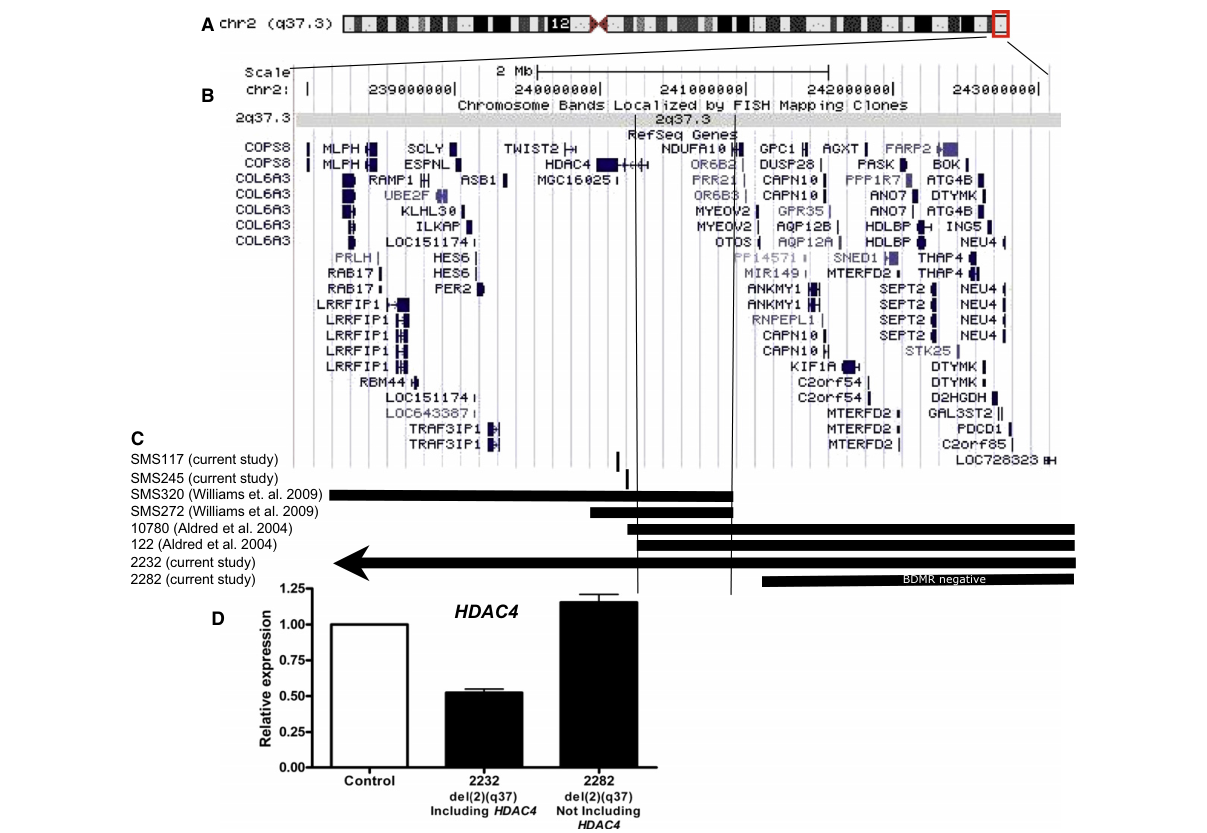
2q37 microdeletion syndrome is a variably expressed chromosomal disorder caused by a terminal or interstitial deletion of chromosome region 2q37. The deleted interval and gene content differ among affected individuals. Common findings include developmental or cognitive-behavioral differences, dysmorphic craniofacial features, type E brachydactyly, short stature, and obesity, with variable neurologic and congenital anomalies. HDAC4 haploinsufficiency may contribute to the skeletal phenotype when that gene is deleted, but its neurobehavioral contribution remains uncertain; it does not explain the full multigene deletion syndrome and has incomplete penetrance.
Ask OpenScientist
Ask a research question about 2q37 Microdeletion Syndrome. OpenScientist will conduct autonomous deep research using the Disorder Mechanisms Knowledge Base and PubMed literature (typically 10-30 minutes).
Do not include personal health information in your question. Questions and results are cached in your browser's local storage.
Classifications
Inheritance
1Show evidence (2 references)
Discussions and Knowledge Gaps
2Show evidence (2 references)
Show evidence (2 references)
Pathophysiology
6Show evidence (2 references)
Show evidence (3 references)
Show evidence (1 reference)
Show evidence (2 references)
Show evidence (1 reference)
Show evidence (1 reference)
Pathograph
Phenotypes
17Cardiovascular 1
Show evidence (1 reference)
Digestive 1
Show evidence (1 reference)
Genitourinary 2
Show evidence (1 reference)
Show evidence (1 reference)
Head and Neck 1
Show evidence (1 reference)
Limbs 1
Show evidence (1 reference)
Musculoskeletal 3
Show evidence (1 reference)
Show evidence (1 reference)
Show evidence (1 reference)
Nervous System 6
Show evidence (1 reference)
Show evidence (1 reference)
Show evidence (2 references)
Show evidence (1 reference)
Show evidence (1 reference)
Show evidence (1 reference)
Growth 2
Show evidence (1 reference)
Show evidence (1 reference)
Genetic Associations
2Show evidence (2 references)
Show evidence (2 references)
Medical Actions
5Show evidence (1 reference)
Show evidence (1 reference)
Show evidence (1 reference)
Show evidence (2 references)
Show evidence (1 reference)
Diagnosis
2Show evidence (2 references)
Show evidence (2 references)
Differential Diagnoses
4Conditions with similar clinical presentations that must be differentiated from 2q37 Microdeletion Syndrome:
- A de novo HDAC4 missense variant affecting the conserved 14-3-3-binding regulatory site supports this diagnosis.
- The reported phenotype is distinct from the brachydactyly-intellectual disability spectrum.
Show evidence (1 reference)
- GNAS molecular findings and the absence of a 2q37 deletion support pseudopseudohypoparathyroidism.
- A 17p11.2 deletion or pathogenic RAI1 variant supports Smith-Magenis syndrome.
- A chromosome 2q37 deletion supports 2q37 microdeletion syndrome.
Show evidence (1 reference)
Source YAML
click to showname: 2q37 Microdeletion Syndrome
creation_date: "2026-04-15T23:46:24Z"
synonyms:
- 2q37 deletion syndrome
- Brachydactyly-intellectual disability syndrome
- Albright hereditary osteodystrophy-like syndrome
description: >-
2q37 microdeletion syndrome is a variably expressed chromosomal disorder
caused by a terminal or interstitial deletion of chromosome region 2q37.
The deleted interval and gene content differ among affected individuals.
Common findings include developmental or cognitive-behavioral differences,
dysmorphic craniofacial features, type E brachydactyly, short stature, and
obesity, with variable neurologic and congenital anomalies. HDAC4
haploinsufficiency may contribute to the skeletal phenotype when that gene is
deleted, but its neurobehavioral contribution remains uncertain; it does not
explain the full multigene deletion syndrome and has incomplete penetrance.
category: Genetic
parents:
- chromosomal disorder
disease_term:
preferred_term: 2q37 microdeletion syndrome
term:
id: MONDO:0010886
label: 2q37 microdeletion syndrome
classifications:
isds_skeletal_category:
- classification_value: brachydactyly_with_extraskeletal_manifestations
notes: >-
ISDS Nosology of Genetic Skeletal Disorders, 2023 revision (Unger et al.,
PMID:36779427), group 19 "Brachydactylies as part of syndromes", which
lists brachydactyly-mental retardation syndrome (HDAC4; OMIM 600430) — the
same entity as 2q37 microdeletion syndrome, whose type E brachydactyly is
attributed to HDAC4 haploinsufficiency when that gene falls inside the
deleted interval. The 2019 revision (PMID:31633310) placed it in group 38
"Brachydactylies (with extraskeletal manifestations)". Note that the
radiographically similar hand of Albright hereditary osteodystrophy is
placed in group 17 (acromelic dysplasias), not here. Per-row
re-verification against the 2023 Table 1 is tracked in
monarch-initiative/dismech#7867.
inheritance:
- name: Predominantly de novo autosomal deletion
description: >-
Most reported 2q37 deletions are de novo. Rare inherited interstitial
deletions and deletions arising from a parental balanced chromosome
rearrangement have been reported, so recurrence assessment depends on the
chromosome findings in the family rather than on a universal recurrence
percentage.
inheritance_term:
preferred_term: autosomal dominant inheritance
term:
id: HP:0000006
label: Autosomal dominant inheritance
evidence:
- reference: PMID:20301337
reference_title: "2q37 Microdeletion Syndrome – RETIRED CHAPTER, FOR HISTORICAL REFERENCE ONLY."
supports: SUPPORT
evidence_source: HUMAN_CLINICAL
snippet: >-
Most individuals with the 2q37 microdeletion syndrome have a de novo
chromosome deletion and their parents have normal karyotypes. In
approximately 5% of published cases, probands have inherited the deletion
from a parent who is a balanced translocation carrier.
explanation: >-
The retired GeneReviews chapter provides historical evidence for the
predominantly de novo pattern and rare recurrence through a parental
rearrangement.
- reference: PMID:23188045
reference_title: Phenotypic variant of Brachydactyly-mental retardation syndrome in a family with an inherited interstitial 2q37.3 microdeletion including HDAC4.
supports: SUPPORT
evidence_source: HUMAN_CLINICAL
snippet: >-
We report here on the first three generation familial case of BDMR
syndrome with inheritance of an interstitial microdeletion of chromosome
2q37.3.
explanation: >-
This family demonstrates that a 2q37.3 deletion can be transmitted across
generations.
progression: []
pathophysiology:
- name: Variable breakpoint-dependent 2q37 deletion
description: >-
Terminal and interstitial 2q37 deletions remove variable gene content and
produce a contiguous-gene dosage disorder. Clinical expressivity is
incomplete and depends on the specific chromosome anomaly; the available
evidence does not support a simple rule that larger deletions always cause
more severe disease.
evidence:
- reference: PMID:30848064
reference_title: Genotype and phenotype correlation in 103 individuals with 2q37 deletion syndrome reveals incomplete penetrance and supports HDAC4 as the primary genetic contributor.
supports: SUPPORT
evidence_source: HUMAN_CLINICAL
snippet: >-
These features overlap with other neurodevelopmental conditions,
including Smith-Magenis syndrome (SMS), and may be incompletely penetrant
or demonstrate variable expressivity, depending on the specific
chromosomal anomaly.
explanation: >-
The 103-person literature review supports incomplete penetrance and
chromosome-anomaly-dependent expressivity.
- reference: PMID:33537682
reference_title: Missense substitutions at a conserved 14-3-3 binding site in HDAC4 cause a novel intellectual disability syndrome.
supports: SUPPORT
evidence_source: HUMAN_CLINICAL
snippet: >-
loss of HDAC4 function usually occurs as part of larger deletions of
chromosome 2q37; BDMR is also known as chromosome 2q37 deletion syndrome,
and the precise role of HDAC4 within the phenotype remains uncertain.
explanation: >-
The authors explicitly place HDAC4 loss in the larger deletion context and
identify uncertainty about its phenotype-specific contribution.
downstream:
- target: Partial contribution of HDAC4 haploinsufficiency
causal_link_type: DIRECT
description: >-
A deletion that includes HDAC4 directly reduces its dosage, but not every
2q37 deletion includes HDAC4 and HDAC4 loss is not sufficient to explain
the full phenotype.
- target: Variable neurodevelopmental and congenital effects
causal_link_type: INDIRECT_UNKNOWN_INTERMEDIATES
intermediate_mechanisms:
- breakpoint-dependent loss of multiple 2q37 genes
description: >-
Variable deleted gene content produces incompletely penetrant
neurodevelopmental, growth, and organ-development findings.
- target: Altered inter-chromosomal architecture
causal_link_type: DIRECT
description: >-
One patient-derived cellular study found altered chromosome-territory
interactions associated with an inherited 2q37 deletion.
- target: Candidate 2q37.1 Wilms tumor susceptibility
causal_link_type: INDIRECT_UNKNOWN_INTERMEDIATES
intermediate_mechanisms:
- possible loss of a 2q37.1 tumor-suppressor locus
description: >-
When the deletion extends into 2q37.1, a possible breakpoint-specific
Wilms-tumor association has been reported.
- name: Partial contribution of HDAC4 haploinsufficiency
description: >-
HDAC4 loss of function is associated particularly with type E
brachydactyly; its contribution to neurobehavioral findings remains
uncertain. Human data show incomplete penetrance, normal intelligence in
some individuals with HDAC4 haploinsufficiency, and skeletal or cognitive
findings in some 2q37 deletions that do not include HDAC4. HDAC4 is
therefore modeled as a partial contributor, not the sole initiating
mechanism for the deletion syndrome.
genes:
- preferred_term: HDAC4
term:
id: hgnc:14063
label: HDAC4
evidence:
- reference: PMID:20691407
reference_title: Haploinsufficiency of HDAC4 causes brachydactyly mental retardation syndrome, with brachydactyly type E, developmental delays, and behavioral problems.
supports: SUPPORT
evidence_source: HUMAN_CLINICAL
snippet: >-
sequencing of HDAC4 identified de novo mutations, including one
intragenic deletion probably disrupting normal splicing and one
intragenic insertion that results in a frameshift and premature stop
codon.
explanation: >-
Deletion-negative individuals with truncating HDAC4 variants support a
gene-level contribution to an overlapping phenotype.
- reference: PMID:24715439
reference_title: Haploinsufficiency of HDAC4 does not cause intellectual disability in all affected individuals.
supports: SUPPORT
evidence_source: HUMAN_CLINICAL
snippet: >-
Presented here are three individuals with haploinsufficiency of HDAC4 who
have brachydactyly type E, non-dysmorphic facial features, and normal
intelligence.
explanation: >-
These individuals show that HDAC4 haploinsufficiency is not sufficient to
produce intellectual disability or the full craniofacial phenotype.
- reference: PMID:31990478
reference_title: "The clinical and molecular features of three Turkish patients with a rare genetic disorder: 2q37 deletion syndrome."
supports: SUPPORT
evidence_source: HUMAN_CLINICAL
snippet: >-
Although two patients had some skeletal findings, the deletion region did
not contain HDAC4 gene in one of the patients.
explanation: >-
Skeletal findings in a deletion not containing HDAC4 argue against
attributing every skeletal manifestation to that gene.
downstream:
- target: Skeletal developmental dysregulation
causal_link_type: INDIRECT_KNOWN_INTERMEDIATES
intermediate_mechanisms:
- altered timing of ossification
description: >-
HDAC4 dosage loss may alter skeletal development and contribute to type E
brachydactyly.
- name: Skeletal developmental dysregulation
description: >-
Altered skeletal development is associated with type E brachydactyly and
short stature. Hdac4-null mouse evidence suggests premature ossification,
but a homozygous-null animal is not a dosage-equivalent model of the human
heterozygous deletion.
evidence:
- reference: PMID:20691407
reference_title: Haploinsufficiency of HDAC4 causes brachydactyly mental retardation syndrome, with brachydactyly type E, developmental delays, and behavioral problems.
supports: SUPPORT
evidence_source: MODEL_ORGANISM
snippet: >-
Reportedly, Hdac4(-/-) mice have severe bone malformations resulting from
premature ossification of developing bones.
explanation: >-
The mouse model supports an ossification mechanism but differs from the
heterozygous human dosage state.
downstream:
- target: Type E brachydactyly
causal_link_type: INDIRECT_KNOWN_INTERMEDIATES
intermediate_mechanisms:
- abnormal ossification and metacarpal or metatarsal development
description: Altered skeletal development produces the characteristic type E brachydactyly.
- target: Short stature
causal_link_type: INDIRECT_UNKNOWN_INTERMEDIATES
intermediate_mechanisms:
- abnormal skeletal growth
description: Skeletal and broader growth effects may contribute to short stature.
- name: Variable neurodevelopmental and congenital effects
description: >-
Breakpoint-dependent multigene dosage loss is associated with variable
developmental delay, intellectual disability, autistic or other behavioral
features, hypotonia, seizures, growth differences, and congenital organ
anomalies. Specific gene-to-phenotype routes remain unresolved.
evidence:
- reference: PMID:30848064
reference_title: Genotype and phenotype correlation in 103 individuals with 2q37 deletion syndrome reveals incomplete penetrance and supports HDAC4 as the primary genetic contributor.
supports: SUPPORT
evidence_source: HUMAN_CLINICAL
snippet: >-
there is a high degree of variability in the presence of some of the
features that are considered the most characteristic of the syndrome
explanation: >-
This supports a variably expressed clinical branch rather than a
deterministic phenotype chain.
- reference: PMID:20301337
reference_title: "2q37 Microdeletion Syndrome – RETIRED CHAPTER, FOR HISTORICAL REFERENCE ONLY."
supports: SUPPORT
evidence_source: HUMAN_CLINICAL
snippet: >-
Other findings include seizures (20%-35%), congenital heart disease, CNS
abnormalities (hydrocephalus, dilated ventricles), umbilical/inguinal
hernia, tracheomalacia, situs abnormalities, gastrointestinal
abnormalities, and renal malformations.
explanation: >-
The retired chapter provides historical clinical evidence for the broad
congenital and neurologic spectrum; current frequencies are not inferred
from it except where explicitly stated.
downstream:
- target: Abnormality of mental function
causal_link_type: INDIRECT_UNKNOWN_INTERMEDIATES
intermediate_mechanisms:
- breakpoint-dependent cognitive and behavioral effects
description: >-
The deletion is associated with a composite of cognitive and behavioral
findings, without a resolved gene-specific route.
- target: Global developmental delay
causal_link_type: INDIRECT_UNKNOWN_INTERMEDIATES
intermediate_mechanisms:
- breakpoint-dependent neurodevelopmental effects
description: Variable dosage loss can impair early development.
- target: Intellectual disability
causal_link_type: INDIRECT_UNKNOWN_INTERMEDIATES
intermediate_mechanisms:
- breakpoint-dependent neurodevelopmental effects
description: Variable dosage loss can produce intellectual disability.
- target: Autistic behavior
causal_link_type: INDIRECT_UNKNOWN_INTERMEDIATES
intermediate_mechanisms:
- breakpoint-dependent neurodevelopmental effects
description: Autism-spectrum features occur in a subset of affected individuals.
- target: Hypotonia
causal_link_type: INDIRECT_UNKNOWN_INTERMEDIATES
intermediate_mechanisms:
- central or neuromuscular developmental effects
description: Hypotonia contributes to early motor delay in some individuals.
- target: Seizure
causal_link_type: INDIRECT_UNKNOWN_INTERMEDIATES
intermediate_mechanisms:
- altered neurodevelopmental excitability
description: Seizures occur in a subset of affected individuals.
- target: Congenital heart disease
causal_link_type: INDIRECT_UNKNOWN_INTERMEDIATES
intermediate_mechanisms:
- breakpoint-dependent organogenesis effects
description: Congenital heart malformations are variably associated with the deletion.
- target: CNS structural anomalies
causal_link_type: INDIRECT_UNKNOWN_INTERMEDIATES
intermediate_mechanisms:
- breakpoint-dependent brain-development effects
description: Hydrocephalus or ventricular abnormalities have been reported.
- target: Renal malformation
causal_link_type: INDIRECT_UNKNOWN_INTERMEDIATES
intermediate_mechanisms:
- breakpoint-dependent renal-development effects
description: Renal and genitourinary anomalies have been reported.
- target: Gastrointestinal anomalies
causal_link_type: INDIRECT_UNKNOWN_INTERMEDIATES
intermediate_mechanisms:
- breakpoint-dependent organogenesis effects
description: Gastrointestinal or abdominal-wall anomalies have been reported.
- target: Abnormal facial shape
causal_link_type: INDIRECT_UNKNOWN_INTERMEDIATES
intermediate_mechanisms:
- variable craniofacial development
description: Variable craniofacial development produces a recurrent dysmorphic appearance.
- target: Increased body weight
causal_link_type: INDIRECT_UNKNOWN_INTERMEDIATES
intermediate_mechanisms:
- unresolved growth and metabolic effects
description: The deleted interval is associated with incompletely penetrant overweight or obesity.
- name: Altered inter-chromosomal architecture
description: >-
Mesenchymal stem cells and derived cells from members of one family with an
inherited 2q37 deletion showed altered positions and interactions of
chromosome territories. This is a patient-derived cellular observation;
its contribution to particular clinical features is unknown.
evidence:
- reference: PMID:29921581
reference_title: Reorganization of inter-chromosomal interactions in the 2q37-deletion syndrome.
supports: SUPPORT
evidence_source: IN_VITRO
snippet: >-
the disease-related HDAC4 deletion resulted in displaced inter-chromosomal
arrangements and altered interactions between the deletion-affected
chromosome 2 and chromosome 12 and/or 17
explanation: >-
This directly supports altered nuclear architecture in the studied
patient-derived cells without establishing a phenotype-level causal edge.
- name: Candidate 2q37.1 Wilms tumor susceptibility
description: >-
A small number of constitutional 2q37 deletion and Wilms-tumor
co-occurrences, together with tumor loss-of-heterozygosity data, suggest a
possible susceptibility locus in 2q37.1. The magnitude of constitutional
risk and the value of surveillance are not established.
evidence:
- reference: PMID:19789318
reference_title: "Loss of heterozygosity at 2q37 in sporadic Wilms' tumor: putative role for miR-562."
supports: SUPPORT
evidence_source: HUMAN_CLINICAL
snippet: >-
any increased risk for developing Wilms' tumor likely correlates with
deletions encompassing 2q37.1.
explanation: >-
The study supports a cautious, breakpoint-specific association rather
than a syndrome-wide tumor-risk estimate.
downstream:
- target: Nephroblastoma
causal_link_type: INDIRECT_UNKNOWN_INTERMEDIATES
intermediate_mechanisms:
- possible loss of a 2q37.1 tumor-suppressor locus
description: >-
A deletion encompassing 2q37.1 may increase susceptibility, but penetrance
and the causal locus remain uncertain.
phenotypes:
- name: Abnormal facial shape
frequency: VERY_FREQUENT
description: >-
Dysmorphic craniofacial features were reported in 86% of the 103
literature-review cases, although the specific gestalt is variable.
phenotype_term:
preferred_term: Abnormal facial shape
term:
id: HP:0001999
label: Abnormal facial shape
evidence:
- reference: PMID:30848064
reference_title: Genotype and phenotype correlation in 103 individuals with 2q37 deletion syndrome reveals incomplete penetrance and supports HDAC4 as the primary genetic contributor.
supports: SUPPORT
evidence_source: HUMAN_CLINICAL
snippet: >-
overweight and obesity (34%), cognitive-behavioral issues (79%),
dysmorphic craniofacial features (86%), and type E brachydactyly (48%).
explanation: The 86% estimate supports the VERY_FREQUENT band.
- name: Abnormality of mental function
frequency: FREQUENT
description: >-
A combined category of cognitive and behavioral findings was present in
79% of the 103 literature-review cases. This composite does not establish
separate frequencies for intellectual disability, developmental delay,
autism, or any individual behavioral diagnosis.
phenotype_term:
preferred_term: Abnormality of mental function
term:
id: HP:0011446
label: Abnormality of mental function
evidence:
- reference: PMID:30848064
reference_title: Genotype and phenotype correlation in 103 individuals with 2q37 deletion syndrome reveals incomplete penetrance and supports HDAC4 as the primary genetic contributor.
supports: SUPPORT
evidence_source: HUMAN_CLINICAL
snippet: >-
overweight and obesity (34%), cognitive-behavioral issues (79%),
dysmorphic craniofacial features (86%), and type E brachydactyly (48%).
explanation: The composite 79% estimate supports the FREQUENT band.
- name: Type E brachydactyly
frequency: FREQUENT
description: >-
Type E brachydactyly is characteristic but incompletely penetrant; it was
reported in 48% of the 103 literature-review cases.
phenotype_term:
preferred_term: Type E brachydactyly
term:
id: HP:0005863
label: Type E brachydactyly
evidence:
- reference: PMID:30848064
reference_title: Genotype and phenotype correlation in 103 individuals with 2q37 deletion syndrome reveals incomplete penetrance and supports HDAC4 as the primary genetic contributor.
supports: SUPPORT
evidence_source: HUMAN_CLINICAL
snippet: >-
overweight and obesity (34%), cognitive-behavioral issues (79%),
dysmorphic craniofacial features (86%), and type E brachydactyly (48%).
explanation: The 48% estimate supports the FREQUENT band.
- name: Increased body weight
frequency: FREQUENT
description: >-
Overweight or obesity was reported in 34% of the 103 literature-review
cases and is incompletely penetrant.
phenotype_term:
preferred_term: Increased body weight
term:
id: HP:0004324
label: Increased body weight
evidence:
- reference: PMID:30848064
reference_title: Genotype and phenotype correlation in 103 individuals with 2q37 deletion syndrome reveals incomplete penetrance and supports HDAC4 as the primary genetic contributor.
supports: SUPPORT
evidence_source: HUMAN_CLINICAL
snippet: >-
overweight and obesity (34%), cognitive-behavioral issues (79%),
dysmorphic craniofacial features (86%), and type E brachydactyly (48%).
explanation: The 34% estimate supports the FREQUENT band.
- name: Global developmental delay
description: >-
Developmental delay is a recurrent feature, but the available composite
estimates do not support a separate frequency band.
phenotype_term:
preferred_term: Global developmental delay
term:
id: HP:0001263
label: Global developmental delay
evidence:
- reference: PMID:20301337
reference_title: "2q37 Microdeletion Syndrome – RETIRED CHAPTER, FOR HISTORICAL REFERENCE ONLY."
supports: SUPPORT
evidence_source: HUMAN_CLINICAL
snippet: >-
2q37 microdeletion syndrome is characterized by mild-moderate
developmental delay/intellectual disability
explanation: >-
The historical source supports the association but not a current,
phenotype-specific frequency.
- name: Intellectual disability
description: >-
Intellectual disability is variable, and normal intelligence has been
reported in some individuals with HDAC4 haploinsufficiency.
phenotype_term:
preferred_term: Intellectual disability
term:
id: HP:0001249
label: Intellectual disability
evidence:
- reference: PMID:31990478
reference_title: "The clinical and molecular features of three Turkish patients with a rare genetic disorder: 2q37 deletion syndrome."
supports: SUPPORT
evidence_source: HUMAN_CLINICAL
snippet: >-
However, all of the patients had intellectual disability, especially with
a cheerful mood.
explanation: >-
The three-person series supports intellectual disability as an associated
phenotype but is too small for a syndrome-wide frequency.
- reference: PMID:24715439
reference_title: Haploinsufficiency of HDAC4 does not cause intellectual disability in all affected individuals.
supports: SUPPORT
evidence_source: HUMAN_CLINICAL
snippet: >-
Presented here are three individuals with haploinsufficiency of HDAC4 who
have brachydactyly type E, non-dysmorphic facial features, and normal
intelligence.
explanation: This limiting evidence supports variable expression.
- name: Short stature
description: Short stature is a recurrent but not quantitatively established feature.
phenotype_term:
preferred_term: Short stature
term:
id: HP:0004322
label: Short stature
evidence:
- reference: PMID:31990478
reference_title: "The clinical and molecular features of three Turkish patients with a rare genetic disorder: 2q37 deletion syndrome."
supports: SUPPORT
evidence_source: HUMAN_CLINICAL
snippet: >-
Chromosome 2q37 deletion syndrome is a rare chromosomal disorder which is
characterized by mild-moderate intellectual disability,
brachymetaphalangy of digits 3-5, short stature, obesity, hypotonia and
characteristic facial appearance.
explanation: The clinical paper identifies short stature as part of the spectrum.
- name: Autistic behavior
description: Autism-spectrum features occur in a subset of affected individuals.
phenotype_term:
preferred_term: Autistic behavior
term:
id: HP:0000729
label: Autistic behavior
evidence:
- reference: PMID:30848064
reference_title: Genotype and phenotype correlation in 103 individuals with 2q37 deletion syndrome reveals incomplete penetrance and supports HDAC4 as the primary genetic contributor.
supports: SUPPORT
evidence_source: HUMAN_CLINICAL
snippet: >-
the most commonly described hallmark features of the 2q37 deletion
syndrome include brachydactyly type E, developmental delay, obesity,
autistic features, and craniofacial or skeletal dysmorphism
explanation: >-
This supports the association but does not supply a separate autism
frequency.
- name: Hypotonia
description: Hypotonia is part of the reported clinical spectrum.
phenotype_term:
preferred_term: Hypotonia
term:
id: HP:0001252
label: Hypotonia
evidence:
- reference: PMID:31990478
reference_title: "The clinical and molecular features of three Turkish patients with a rare genetic disorder: 2q37 deletion syndrome."
supports: SUPPORT
evidence_source: HUMAN_CLINICAL
snippet: >-
Chromosome 2q37 deletion syndrome is a rare chromosomal disorder which is
characterized by mild-moderate intellectual disability,
brachymetaphalangy of digits 3-5, short stature, obesity, hypotonia and
characteristic facial appearance.
explanation: This supports hypotonia without establishing a frequency.
- name: Joint hypermobility
description: Joint hypermobility or dislocation has been reported.
phenotype_term:
preferred_term: Joint hypermobility
term:
id: HP:0001382
label: Joint hypermobility
evidence:
- reference: PMID:20301337
reference_title: "2q37 Microdeletion Syndrome – RETIRED CHAPTER, FOR HISTORICAL REFERENCE ONLY."
supports: SUPPORT
evidence_source: HUMAN_CLINICAL
snippet: >-
joint hypermobility/dislocation, and scoliosis.
explanation: The historical source supports association without a frequency estimate.
- name: Scoliosis
description: Scoliosis has been reported as part of the skeletal spectrum.
phenotype_term:
preferred_term: Scoliosis
term:
id: HP:0002650
label: Scoliosis
evidence:
- reference: PMID:20301337
reference_title: "2q37 Microdeletion Syndrome – RETIRED CHAPTER, FOR HISTORICAL REFERENCE ONLY."
supports: SUPPORT
evidence_source: HUMAN_CLINICAL
snippet: >-
joint hypermobility/dislocation, and scoliosis.
explanation: The historical source supports association without a frequency estimate.
- name: Seizure
description: >-
Seizures occur in a subset. The historical 20%-35% range crosses repository
frequency-band boundaries, so no categorical frequency is assigned.
phenotype_term:
preferred_term: Seizure
term:
id: HP:0001250
label: Seizure
evidence:
- reference: PMID:20301337
reference_title: "2q37 Microdeletion Syndrome – RETIRED CHAPTER, FOR HISTORICAL REFERENCE ONLY."
supports: SUPPORT
evidence_source: HUMAN_CLINICAL
snippet: Other findings include seizures (20%-35%), congenital heart disease
explanation: >-
The historical range supports occurrence but not one repository frequency
band.
- name: Congenital heart disease
description: Congenital heart malformations are variably reported.
phenotype_term:
preferred_term: Abnormal heart morphology
term:
id: HP:0001627
label: Abnormal heart morphology
evidence:
- reference: PMID:20301337
reference_title: "2q37 Microdeletion Syndrome – RETIRED CHAPTER, FOR HISTORICAL REFERENCE ONLY."
supports: SUPPORT
evidence_source: HUMAN_CLINICAL
snippet: Other findings include seizures (20%-35%), congenital heart disease
explanation: The historical source supports association without a frequency.
- name: CNS structural anomalies
description: Hydrocephalus or ventricular enlargement has been reported.
phenotype_term:
preferred_term: Ventriculomegaly
term:
id: HP:0002119
label: Ventriculomegaly
evidence:
- reference: PMID:20301337
reference_title: "2q37 Microdeletion Syndrome – RETIRED CHAPTER, FOR HISTORICAL REFERENCE ONLY."
supports: SUPPORT
evidence_source: HUMAN_CLINICAL
snippet: >-
CNS abnormalities (hydrocephalus, dilated ventricles)
explanation: The historical source supports the reported CNS structural spectrum.
- name: Renal malformation
description: Renal and other genitourinary malformations are variably reported.
phenotype_term:
preferred_term: Abnormality of the kidney
term:
id: HP:0000077
label: Abnormality of the kidney
coarse_binding_basis: SOURCE_UNSPECIFIED
evidence:
- reference: PMID:20301337
reference_title: "2q37 Microdeletion Syndrome – RETIRED CHAPTER, FOR HISTORICAL REFERENCE ONLY."
supports: SUPPORT
evidence_source: HUMAN_CLINICAL
snippet: >-
gastrointestinal abnormalities, and renal malformations.
explanation: The historical source supports renal malformations without a frequency.
- name: Gastrointestinal anomalies
description: Gastrointestinal and abdominal-wall anomalies are variably reported.
phenotype_term:
preferred_term: Abnormality of the gastrointestinal tract
term:
id: HP:0011024
label: Abnormality of the gastrointestinal tract
coarse_binding_basis: SOURCE_UNSPECIFIED
evidence:
- reference: PMID:20301337
reference_title: "2q37 Microdeletion Syndrome – RETIRED CHAPTER, FOR HISTORICAL REFERENCE ONLY."
supports: SUPPORT
evidence_source: HUMAN_CLINICAL
snippet: >-
umbilical/inguinal hernia, tracheomalacia, situs abnormalities,
gastrointestinal abnormalities, and renal malformations.
explanation: The historical source supports the reported gastrointestinal spectrum.
- name: Nephroblastoma
description: >-
Wilms tumor has co-occurred with constitutional 2q37 deletion, especially
when 2q37.1 is included, but syndrome-wide penetrance is unknown.
phenotype_term:
preferred_term: Nephroblastoma
term:
id: HP:0002667
label: Nephroblastoma
evidence:
- reference: PMID:19789318
reference_title: "Loss of heterozygosity at 2q37 in sporadic Wilms' tumor: putative role for miR-562."
supports: SUPPORT
evidence_source: HUMAN_CLINICAL
snippet: >-
Cooccurrence of Wilms' tumor with 2q37 deletion syndrome, an uncommon
constitutional chromosome abnormality, has been reported previously in
three children.
explanation: >-
This documents rare co-occurrence but does not establish penetrance or a
categorical frequency.
biochemical: []
genetic:
- name: 2q37 deletion
association: Causal chromosomal deletion
notes: >-
The defining event is a terminal or interstitial deletion involving 2q37.
Breakpoint and gene-content interpretation should remain explicit because
the clinical phenotype is variably expressed.
evidence:
- reference: PMID:20301337
reference_title: "2q37 Microdeletion Syndrome – RETIRED CHAPTER, FOR HISTORICAL REFERENCE ONLY."
supports: SUPPORT
evidence_source: HUMAN_CLINICAL
snippet: >-
Chromosome analysis confirms the diagnosis of 2q37 deletion syndrome in
80%-85% of affected individuals.
explanation: >-
The historical source supports the defining chromosomal lesion while
reflecting older testing technology.
- reference: PMID:30848064
reference_title: Genotype and phenotype correlation in 103 individuals with 2q37 deletion syndrome reveals incomplete penetrance and supports HDAC4 as the primary genetic contributor.
supports: SUPPORT
evidence_source: HUMAN_CLINICAL
snippet: >-
more detailed molecular diagnoses are possible than in years past,
enabling refined characterization of the genotype-phenotype correlation
for subjects with 2q37 deletions.
explanation: This supports breakpoint-aware interpretation of the deletion.
- name: HDAC4
association: Candidate contributor within HDAC4-containing 2q37 deletions
gene_term:
preferred_term: HDAC4
term:
id: hgnc:14063
label: HDAC4
notes: >-
HDAC4 loss is associated with an overlapping brachydactyly phenotype, but
incomplete penetrance and findings outside HDAC4-containing intervals make
it insufficient as a complete explanation of 2q37 microdeletion syndrome.
evidence:
- reference: PMID:20691407
reference_title: Haploinsufficiency of HDAC4 causes brachydactyly mental retardation syndrome, with brachydactyly type E, developmental delays, and behavioral problems.
supports: SUPPORT
evidence_source: HUMAN_CLINICAL
snippet: >-
sequencing of HDAC4 identified de novo mutations, including one
intragenic deletion probably disrupting normal splicing and one
intragenic insertion that results in a frameshift and premature stop
codon.
explanation: This supports a gene-level contribution to an overlapping phenotype.
- reference: PMID:24715439
reference_title: Haploinsufficiency of HDAC4 does not cause intellectual disability in all affected individuals.
supports: SUPPORT
evidence_source: HUMAN_CLINICAL
snippet: >-
Presented here are three individuals with haploinsufficiency of HDAC4 who
have brachydactyly type E, non-dysmorphic facial features, and normal
intelligence.
explanation: This establishes incomplete penetrance for nonskeletal features.
environmental: []
treatments:
- name: Multidisciplinary supportive care
description: >-
Management is feature-directed and coordinated across developmental,
neurologic, cardiac, gastrointestinal, nutritional, vision, hearing, and
genetics services according to the individual's findings. The cited
syndrome-specific management source is retired and is retained as
historical guidance rather than current evidence for fixed protocols.
treatment_term:
preferred_term: Supportive Care
term:
id: NCIT:C15747
label: Supportive Care
evidence:
- reference: PMID:20301337
reference_title: "2q37 Microdeletion Syndrome – RETIRED CHAPTER, FOR HISTORICAL REFERENCE ONLY."
supports: SUPPORT
evidence_source: HUMAN_CLINICAL
snippet: >-
Multidisciplinary care by specialists in the following fields is often
required: clinical genetics, speech pathology, occupational and physical
therapy, child development, neurology, cardiology, gastroenterology,
nutrition/feeding, ophthalmology, and audiology.
explanation: >-
The retired chapter supports multidisciplinary, feature-directed care but
not contemporary syndrome-specific efficacy claims.
- name: Early intervention and educational support
description: >-
Early developmental services and individualized educational support can be
used for developmental, communication, motor, and learning needs.
treatment_term:
preferred_term: early intervention services
term:
id: NCIT:C159524
label: Early Intervention
evidence:
- reference: PMID:20301337
reference_title: "2q37 Microdeletion Syndrome – RETIRED CHAPTER, FOR HISTORICAL REFERENCE ONLY."
supports: SUPPORT
evidence_source: HUMAN_CLINICAL
snippet: >-
Infants benefit from enrollment in an early-intervention program; most
school-age children benefit from an individualized educational program
(IEP).
explanation: >-
This provides historical syndrome-specific support for developmental and
educational services.
- name: Genetic counseling
description: >-
Genetic counseling integrates the proband's deletion boundaries and
parental chromosome results when estimating recurrence risk.
treatment_term:
preferred_term: Genetic Counseling
term:
id: NCIT:C15240
label: Genetic Counseling
evidence:
- reference: PMID:20301337
reference_title: "2q37 Microdeletion Syndrome – RETIRED CHAPTER, FOR HISTORICAL REFERENCE ONLY."
supports: SUPPORT
evidence_source: HUMAN_CLINICAL
snippet: >-
The risk to sibs of a proband depends on the chromosome findings in the
parents
explanation: This supports family-specific recurrence counseling.
- name: Individualized discussion of Wilms tumor surveillance
description: >-
For a young child whose deletion encompasses 2q37.1, clinical genetics and
pediatric oncology input can be used to decide whether renal ultrasound
surveillance is appropriate. Available evidence is breakpoint-specific and
does not establish a universal schedule or syndrome-wide recommendation.
treatment_term:
preferred_term: cancer screening
term:
id: NCIT:C15406
label: Cancer Screening
evidence:
- reference: PMID:19789318
reference_title: "Loss of heterozygosity at 2q37 in sporadic Wilms' tumor: putative role for miR-562."
supports: SUPPORT
evidence_source: HUMAN_CLINICAL
snippet: >-
any increased risk for developing Wilms' tumor likely correlates with
deletions encompassing 2q37.1.
explanation: >-
The association is limited to a possible 2q37.1-containing subgroup and
does not define a screening protocol.
- reference: PMID:20301337
reference_title: "2q37 Microdeletion Syndrome – RETIRED CHAPTER, FOR HISTORICAL REFERENCE ONLY."
supports: SUPPORT
evidence_source: HUMAN_CLINICAL
snippet: >-
For young children with a deletion that includes 2q37.1, screening for
Wilms tumor can be considered.
explanation: >-
The retired source supports consideration, not a universal
recommendation; current expert guidance remains needed.
- name: Individualized long-term dental care
description: >-
Dental assessment, preventive care, and orthodontic planning can be
individualized. Evidence is limited to a single long-term case and does not
establish a syndrome-wide dental protocol.
treatment_term:
preferred_term: supportive dental care
term:
id: NCIT:C15747
label: Supportive Care
evidence:
- reference: PMID:41692450
reference_title: Long-term Oral Management for 2q37 Deletion Syndrome Patient.
supports: SUPPORT
evidence_source: HUMAN_CLINICAL
snippet: >-
No new carious lesions have developed during this period and notable
improvement in anterior alignment has been achieved.
explanation: >-
This single case supports feasibility of individualized long-term dental
and orthodontic care, not general efficacy.
diagnosis:
- name: Chromosomal microarray
description: >-
Chromosomal microarray is the primary cytogenetic test for detecting and
defining a 2q37 deletion, including its boundaries and gene content.
diagnosis_term:
preferred_term: genetic testing
term:
id: NCIT:C15709
label: Genetic Testing
evidence:
- reference: PMID:20466091
reference_title: "Consensus statement: chromosomal microarray is a first-tier clinical diagnostic test for individuals with developmental disabilities or congenital anomalies."
supports: SUPPORT
evidence_source: HUMAN_CLINICAL
snippet: >-
Available evidence strongly supports the use of CMA in place of G-banded
karyotyping as the first-tier cytogenetic diagnostic test
explanation: >-
The consensus statement supports CMA as first-tier testing in the
developmental-disability and congenital-anomaly presentation typical of
this syndrome.
- reference: PMID:30848064
reference_title: Genotype and phenotype correlation in 103 individuals with 2q37 deletion syndrome reveals incomplete penetrance and supports HDAC4 as the primary genetic contributor.
supports: SUPPORT
evidence_source: HUMAN_CLINICAL
snippet: >-
more detailed molecular diagnoses are possible than in years past,
enabling refined characterization of the genotype-phenotype correlation
for subjects with 2q37 deletions.
explanation: This supports defining deletion boundaries for interpretation.
- name: Complementary karyotype and parental chromosome studies
description: >-
Karyotyping is complementary when a visible or familial chromosome
rearrangement is suspected, because arrays do not detect truly balanced
rearrangements reliably. Parental chromosome studies can then inform
recurrence counseling.
diagnosis_term:
preferred_term: karyotyping
term:
id: NCIT:C15709
label: Genetic Testing
evidence:
- reference: PMID:20466091
reference_title: "Consensus statement: chromosomal microarray is a first-tier clinical diagnostic test for individuals with developmental disabilities or congenital anomalies."
supports: SUPPORT
evidence_source: HUMAN_CLINICAL
snippet: >-
G-banded karyotype analysis should be reserved for patients with obvious
chromosomal syndromes (e.g., Down syndrome), a family history of
chromosomal rearrangement, or a history of multiple miscarriages.
explanation: >-
This supports complementary rather than routine first-line karyotyping.
- reference: PMID:20301337
reference_title: "2q37 Microdeletion Syndrome – RETIRED CHAPTER, FOR HISTORICAL REFERENCE ONLY."
supports: SUPPORT
evidence_source: HUMAN_CLINICAL
snippet: >-
In some individuals, 2q37 microdeletion syndrome results from chromosome
rearrangements involving 2q37 (e.g., chromosome 2 inversion, ring
chromosome 2, or translocation between chromosome 2 and another
chromosome).
explanation: >-
Historical syndrome-specific evidence supports evaluating structural
chromosome context when indicated.
differential_diagnoses:
- name: HDAC4-related haploinsufficiency syndrome
description: >-
Intragenic HDAC4 loss-of-function variants can cause an overlapping
brachydactyly phenotype without a chromosome 2q37 deletion. This is a
separate MONDO disorder and should not be represented as a subtype of the
multigene deletion syndrome.
distinguishing_features:
- A pathogenic intragenic HDAC4 loss-of-function variant without a 2q37 deletion supports this diagnosis.
- The absence of other deleted 2q37 genes changes both mechanism and recurrence interpretation.
notes: >-
MONDO:1060110 is the current ontology identity for this differential, but
the repository's generated DiseaseTerm enum does not yet include it.
evidence:
- reference: PMID:20691407
reference_title: Haploinsufficiency of HDAC4 causes brachydactyly mental retardation syndrome, with brachydactyly type E, developmental delays, and behavioral problems.
supports: SUPPORT
evidence_source: HUMAN_CLINICAL
snippet: >-
sequencing of HDAC4 identified de novo mutations, including one
intragenic deletion probably disrupting normal splicing and one
intragenic insertion that results in a frameshift and premature stop
codon.
explanation: This supports a deletion-negative HDAC4 loss-of-function differential.
- name: Neurodevelopmental disorder with central hypotonia and dysmorphic facies
description: >-
De novo missense variants affecting the regulatory 14-3-3-binding region of
HDAC4 cause a mechanistically distinct neurodevelopmental disorder. These
variants should not be grouped with HDAC4 loss of function or 2q37 deletion.
distinguishing_features:
- A de novo HDAC4 missense variant affecting the conserved 14-3-3-binding regulatory site supports this diagnosis.
- The reported phenotype is distinct from the brachydactyly-intellectual disability spectrum.
notes: >-
MONDO:0859232 is the current ontology identity for this differential, but
the repository's generated DiseaseTerm enum does not yet include it.
evidence:
- reference: PMID:33537682
reference_title: Missense substitutions at a conserved 14-3-3 binding site in HDAC4 cause a novel intellectual disability syndrome.
supports: SUPPORT
evidence_source: HUMAN_CLINICAL
snippet: >-
Here, we report seven unrelated individuals with a phenotype distinct
from that of BDMR, all of whom have heterozygous de novo missense variants
explanation: This establishes the missense mechanism as a distinct differential.
- name: Pseudopseudohypoparathyroidism
description: >-
Pseudopseudohypoparathyroidism can share an Albright hereditary
osteodystrophy-like appearance, including brachydactyly and short stature,
but is a GNAS-related disorder rather than a 2q37 deletion syndrome.
distinguishing_features:
- GNAS molecular findings and the absence of a 2q37 deletion support pseudopseudohypoparathyroidism.
disease_term:
preferred_term: pseudopseudohypoparathyroidism
term:
id: MONDO:0012912
label: pseudopseudohypoparathyroidism
- name: Smith-Magenis syndrome
description: >-
Smith-Magenis syndrome can overlap in cognitive-behavioral, craniofacial,
and skeletal features but is defined by a 17p11.2 deletion or pathogenic
RAI1 variant rather than a 2q37 deletion.
distinguishing_features:
- A 17p11.2 deletion or pathogenic RAI1 variant supports Smith-Magenis syndrome.
- A chromosome 2q37 deletion supports 2q37 microdeletion syndrome.
disease_term:
preferred_term: Smith-Magenis syndrome
term:
id: MONDO:0008434
label: Smith-Magenis syndrome
evidence:
- reference: PMID:30848064
reference_title: Genotype and phenotype correlation in 103 individuals with 2q37 deletion syndrome reveals incomplete penetrance and supports HDAC4 as the primary genetic contributor.
supports: SUPPORT
evidence_source: HUMAN_CLINICAL
snippet: >-
These features overlap with other neurodevelopmental conditions,
including Smith-Magenis syndrome (SMS)
explanation: This directly supports Smith-Magenis syndrome as an overlapping differential.
clinical_trials: []
datasets: []
discussions:
- discussion_id: gap_2q37_hdac4_phenotype_attribution
prompt: >-
Which components of the constitutional 2q37 deletion phenotype are caused
specifically by HDAC4 haploinsufficiency, which require other deleted genes
or breakpoint effects, and which associations remain insufficiently
resolved for a gene-specific causal edge?
kind: KNOWLEDGE_GAP
status: OPEN
attaches_to:
- pathophysiology#Partial contribution of HDAC4 haploinsufficiency
- genetic#HDAC4
rationale: >-
Early reports concluded that HDAC4 haploinsufficiency was sufficient for
the brachydactyly-intellectual disability phenotype, but later individuals
with HDAC4 haploinsufficiency had normal intelligence, and some 2q37
deletions lacking HDAC4 had intellectual or skeletal findings. Current
ontology separately identifies HDAC4-related haploinsufficiency syndrome,
so this record already treats deletion-negative disease as a differential.
Expert resolution is still needed to determine how much gene-specific
causal detail belongs in this multigene deletion record.
evidence:
- reference: PMID:24715439
reference_title: Haploinsufficiency of HDAC4 does not cause intellectual disability in all affected individuals.
supports: SUPPORT
evidence_source: HUMAN_CLINICAL
snippet: >-
This is in contradistinction to previous reports that haploinsufficiency
of HDAC4 is sufficient to cause BDMR.
explanation: This directly identifies the disputed sufficiency claim.
- reference: PMID:31990478
reference_title: "The clinical and molecular features of three Turkish patients with a rare genetic disorder: 2q37 deletion syndrome."
supports: SUPPORT
evidence_source: HUMAN_CLINICAL
snippet: >-
Although two patients had some skeletal findings, the deletion region did
not contain HDAC4 gene in one of the patients.
explanation: This supports a phenotype contribution beyond HDAC4.
- discussion_id: gap_2q37_1_wilms_risk_and_surveillance
prompt: >-
What is the absolute Wilms-tumor risk for children with constitutional
deletions encompassing 2q37.1, which precise interval confers risk, and
does that risk justify renal ultrasound surveillance with a defined age and
interval?
kind: KNOWLEDGE_GAP
status: OPEN
attaches_to:
- pathophysiology#Candidate 2q37.1 Wilms tumor susceptibility
- phenotypes#Nephroblastoma
- treatments#Individualized discussion of Wilms tumor surveillance
rationale: >-
A small constitutional co-occurrence series and tumor loss-of-heterozygosity
data suggest a 2q37.1 locus, while the retired GeneReviews chapter only said
that screening could be considered. The available generated caches do not
expose a current 2q37-specific consensus recommendation, penetrance
estimate, interval, or stopping age. Expert review is therefore required
before modeling a universal protocol.
evidence:
- reference: PMID:19789318
reference_title: "Loss of heterozygosity at 2q37 in sporadic Wilms' tumor: putative role for miR-562."
supports: SUPPORT
evidence_source: HUMAN_CLINICAL
snippet: >-
any increased risk for developing Wilms' tumor likely correlates with
deletions encompassing 2q37.1.
explanation: This supports the breakpoint-specific hypothesis but not risk magnitude.
- reference: PMID:20301337
reference_title: "2q37 Microdeletion Syndrome – RETIRED CHAPTER, FOR HISTORICAL REFERENCE ONLY."
supports: SUPPORT
evidence_source: HUMAN_CLINICAL
snippet: >-
For young children with a deletion that includes 2q37.1, screening for
Wilms tumor can be considered.
explanation: The historical wording is permissive and does not define a protocol.
references:
- reference: PMID:20301337
title: "2q37 Microdeletion Syndrome – RETIRED CHAPTER, FOR HISTORICAL REFERENCE ONLY."
tags:
- GeneReviews
findings: []
- reference: PMID:19789318
title: "Loss of heterozygosity at 2q37 in sporadic Wilms' tumor: putative role for miR-562."
findings: []
- reference: PMID:20466091
title: "Consensus statement: chromosomal microarray is a first-tier clinical diagnostic test for individuals with developmental disabilities or congenital anomalies."
findings: []
- reference: PMID:20691407
title: Haploinsufficiency of HDAC4 causes brachydactyly mental retardation syndrome, with brachydactyly type E, developmental delays, and behavioral problems.
findings: []
- reference: PMID:23188045
title: Phenotypic variant of Brachydactyly-mental retardation syndrome in a family with an inherited interstitial 2q37.3 microdeletion including HDAC4.
findings: []
- reference: PMID:24715439
title: Haploinsufficiency of HDAC4 does not cause intellectual disability in all affected individuals.
findings: []
- reference: PMID:29921581
title: Reorganization of inter-chromosomal interactions in the 2q37-deletion syndrome.
findings: []
- reference: PMID:30848064
title: Genotype and phenotype correlation in 103 individuals with 2q37 deletion syndrome reveals incomplete penetrance and supports HDAC4 as the primary genetic contributor.
findings: []
- reference: PMID:31990478
title: "The clinical and molecular features of three Turkish patients with a rare genetic disorder: 2q37 deletion syndrome."
findings: []
- reference: PMID:33537682
title: Missense substitutions at a conserved 14-3-3 binding site in HDAC4 cause a novel intellectual disability syndrome.
findings: []
- reference: PMID:41692450
title: Long-term Oral Management for 2q37 Deletion Syndrome Patient.
findings: []
References & Deep Research
References
11Deep Research
2Deep research results are used as seeds for research; they do not undergo the same validation as the main records and may contain errors. How we use deep research.
Evaluations and curation notes (1)
Review: 2q37 Microdeletion Syndrome (Changes required) · 2026-05-30T05:06:39Z · View source
GitHub review issue: https://github.com/monarch-initiative/dismech/issues/3479 Issue state: OPEN Issue created: 2026-05-30T05:06:39Z Issue updated: 2026-05-30T05:11:17Z Issue closed: not closed Review decision: Changes required Labels: curation, medium_effort, review ## Completed curation review - Disease: **2q37 Microdeletion Syndrome** - Entry: `kb/disorders/2q37_Microdeletion_Syndrome.yaml` - Selection basis: #87 of the least-recently edited Mendelian entries - Review decision: **Changes required** - Validation stance: assumes schema/term/reference validation passes; this is a biological and clinical-content review. ## Findings 1. **GeneReviews exists and is already referenced but needs fuller consumption.** 2q37 microdeletion syndrome GeneReviews should drive phenotype and management completeness. Source: https://www.ncbi.nlm.nih.gov/books/NBK1158/ 2. **Management is too narrow.** Supportive care, speech therapy, and PT are present. Add behavioral/autism supports, obesity/metabolic monitoring, orthopedic/spine/joint care, seizure management if present, cardiac/renal screening when indicated, and genetic counseling. 3. **Diagnosis should include deletion testing and HDAC4 sequencing distinction.** Chromosome analysis, molecular testing, and HDAC4 sequencing are present; add chromosomal microarray/FISH/karyotype context, deletion size interpretation, parental testing, and HDAC4 single-gene differential. 4. **Phenotype coverage is broad but should include congenital anomalies and behavior detail.** Developmental delay, ID, brachydactyly, obesity, autism, hypotonia, joint hypermobility, scoliosis, and behavioral abnormality are present; check seizures, cardiac/renal/genital anomalies, facial gestalt, and sleep/feeding details. 5. **Pathophysiology should not reduce the syndrome entirely to HDAC4.** HDAC4 is central to brachydactyly/ID, but larger deletions can include additional genes and phenotypes. ## Research-artifact cross-check Matching artifacts: `research/2q37_Microdeletion_Syndrome-deep-research-asta.md` and `.citations.md`. The YAML already includes GeneReviews PMID but under-consumes management and deletion-size nuance. ## Content-completeness summary - **Phenotypes:** broad; compare against GeneReviews. - **Subtype/lumping:** distinguish deletion syndrome versus HDAC4-only variants. - **Pathophysiology:** add deletion-size/multigene nuance. - **Management/diagnosis:** expand surveillance/support. ## Sources used - GeneReviews, 2q37 Microdeletion Syndrome: https://www.ncbi.nlm.nih.gov/books/NBK1158/ No YAML files or `references_cache/*.md` files were edited.
Asta Literature Retrieval: Pathophysiology and clinical mechanisms of 2q37 Microdeletion Syndrome. Core disease mechanisms, molecular and cellul...
This report is retrieval-only and is generated directly from Asta results.
- Papers retrieved: 19
- Snippets retrieved: 20
Relevant Papers
[1] A Rare Case of Concurrent 2q34q36 Duplication and 2q37 Deletion in a Neonate with Syndromic Features
- Authors: F. N. Riviello, Alessia Daponte, Emanuela Ponzi, R. Ficarella, Paola Orsini et al.
- Year: 2023
- Venue: Genes
- URL: https://www.semanticscholar.org/paper/c3e3702d27e0e18be3de627ebca4ca14e443936c
- DOI: 10.3390/genes14122194
- PMID: 38137016
- PMCID: 10742419
- Citations: 1
- Summary: An extensive molecular analysis of a 15-day-old newborn referred for syndromic features reveals an 8.5 Mb microdeletion at 2q37.1, which extends to the telomere, in conjunction with an 8.6 Mb interstitial microduplication at 2q34q36.1.
- Evidence snippets:
- Snippet 1 (score: 0.590) > Large-scale genomic structural variations can have significant clinical implications, depending on the specific altered genomic region. Briefly, 2q37 microdeletion syndrome is a prevalent subtelomeric deletion disorder characterized by variable-sized deletions. Affected patients exhibit a wide range of clinical manifestations, including short stature, facial dysmorphism, and features of autism spectrum disorder, among others. Conversely, isolated duplications of proximal chromosome 2q are rare and lack a distinct phenotype. In this report, we provide an extensive molecular analysis of a 15-day-old newborn referred for syndromic features. Our analysis reveals an 8.5 Mb microdeletion at 2q37.1, which extends to the telomere, in conjunction with an 8.6 Mb interstitial microduplication at 2q34q36.1. Our findings underscore the prominence of 2q37 terminal deletions as commonly reported genomic anomalies. We compare our patient’s phenotype with previously reported cases in the literature to contribute to a more refined classification of 2q37 microdeletion syndrome and assess the potential impact of 2q34q36.1 microduplication. We also investigate multiple hypotheses to clarify the genetic mechanisms responsible for the observed genomic rearrangement.
- Snippet 2 (score: 0.531) > Structural chromosomal rearrangements involving large regions of one-to severalmegabase pairs arise through a variety of mechanisms often associated with particular features of genomic architecture, which can trigger genetic instability [1]. Chromosome abnormalities can have significant implications, particularly when they affect the balance of genes that can lead to the development of various diseases. > Chromosome imbalances affecting the long arm of chromosome 2 result in a variety of distinct clinical conditions. For example, 2q37 microdeletion syndrome, alternatively known as Albright hereditary osteodystrophy-like syndrome or brachydactyly-intellectual disability syndrome, is a rare genetic disorder resulting from a variable-sized deletion in the long (q) arm of chromosome 2 [2][3][4]. The syndrome is characterized by a broad spectrum of clinical findings: the most common phenotypic features include mild to moderate developmental delay/intellectual disability (ID), brachymetaphalangy of digits 3-5 (brachydactyly type E), short stature, obesity, hypotonia in infancy, abnormal behavior with autism spectrum disorder, joint hypermobility, and scoliosis. Most individuals with 2q37 deletion syndrome have a typical dysmorphic face: broad or rounded facies; frontal bossing; midface hypoplasia; thin, arched eyebrows with deep-set eyes; upslanting palpebral fissures; prominent columella; and minor ear defects. In 20-30% of cases, visceral Genes 2023, 14, 2194 2 of 10 malformations are also present: congenital heart disease (mostly septal defects), gastrointestinal or genitourinary anomalies, central nervous system malformations, renal anomalies, and Wilms tumors. Rarely, patients may have associated seizures and hyperactivity with attention deficit disorder [3]. > On the other hand, duplications of proximal chromosome 2q are rare, and no specific associated syndrome has been identified. The majority of trisomy 2q cases arise from parental rearrangements, often accompanied by a deletion of another chromosomal segment, which hampers phenotypic delineation.
[2] 7p22.3 microdeletion: a case study of a patient with congenital heart defect, neurodevelopmental delay and epilepsy
- Authors: L. Skvortsova, A. Perfilyeva, K. Bespalova, Y. Kuzovleva, Nailya Kabysheva et al.
- Year: 2024
- Venue: Orphanet Journal of Rare Diseases
- URL: https://www.semanticscholar.org/paper/408a30b232114d5edfca1ebdf0bc63e4382f59bb
- DOI: 10.1186/s13023-024-03321-8
- PMID: 39152504
- PMCID: 11330011
- Citations: 2
- Summary: Through detailed genetic analyses, the clinical description of the rare 7p22.3 microdeletion in a patient with congenital heart defect and neurological abnormalities - epilepsy, combined with moderate mental and motor developmental delay is improved, creating a basis for future genetic counseling and research into targeted therapies.
- Evidence snippets:
- Snippet 1 (score: 0.482) > Complex disease phenotypes affecting different organ systems are the result of an individual's complex genetic landscape. Analysis of the literature data shows that there is a certain variability of phenotypes even in Mendelian diseases. Symptoms may vary in the presence/absence and severity from patient to patient. These individual phenotypes are the most noticeable in microdeletion syndromes when multiple genes are affected. One of these syndromes is Williams syndrome, which is caused by a heterozygous deletion 7q11.23 [11,12]. There are specific symptoms and features with a high frequency of occurrence (core symptoms, > 90% of cases) and less specific features with a frequency of < 90% (Morris 2023). The last ones are highly variable from patient to patient. This emphasizes that microdeletion syndromes are not a uniform disease but a group of etiologically heterogeneous conditions whose pathophysiology reflect an individual genetic profile. The functional activity of affected proteins and their involvement in cellular processes as well as the presence of additional structural changes in single-copy genes modulate a pathological phenotype. > In the present case, the patient A had most of the symptoms typical for Williams syndrome and was referred for a genetic counseling (to be confirmed by genetic testing). CMA revealed the absence of the specific microdeletion in the long arm of chromosome 7 (7q11.23) but the presence of another microdeletion in the short arm of chromosome 7 (7p22.3). The identified deletion is less common than the Williams syndrome deletion and some cases have been published. Deletion 7p22.3 phenotype is associated with various clinical symptoms including neurodevelopmental delay, congenital skeletal and heart abnormalities, hypotonia, craniofacial dysmorphism and other less common features [3]. To date, epilepsy has not been reported for this 7p22.3 deletion but it was observed in a patient with a combination of 7p22.3-p22.1 deletion and 8q24.23-q24.3 duplication.
[3] Pathway-based classification of genetic diseases
- Authors: I. Iourov, S. Vorsanova, Y. Yurov
- Year: 2019
- Venue: Molecular Cytogenetics
- URL: https://www.semanticscholar.org/paper/27a727e2b33eb986916fbd2dcb42b02e082b914d
- DOI: 10.1186/s13039-019-0418-4
- PMID: 30766616
- PMCID: 6362588
- Citations: 38
- Summary: This work proposes an extension to the common disease classification based on the underlying genetic defects, which focuses on disease-specific molecular pathways, and follows the tradition of using ancient Greek words and prefixes to create the terms for the pathway-based classification of genetic diseases.
- Evidence snippets:
- Snippet 1 (score: 0.442) > Since etiology comprises the multilateral evaluation of how a disease can be classified, defined, and discovered [14], current classification of genetic diseases appears to require an update. > Although (cyto)genomic analysis is the permanent starting point for uncovering the mechanism and etiology of a disease, an indication of gene amount and a speculation about possible genetic-environmental interaction is certainly not enough for the disease designation at the present stage of development in the fields of (cyto)genomics and molecular (systems) medicine. The knowledge of the nature of genetic defects alone poorly defines the etiology of a disease. More precisely, mechanisms of phenotypic outcomes and molecular/cellular pathways to disease remain obscure without a presentation of additional etiologic aspects. Particularly, addressing numerical and structural abnormalities of chromosomes using "gene-centric" concepts is usually confined to the determination of amount of affected genes. However, it is possible that a limited number of genes within the rearranged chromosomal region are intrinsically involved in the clinical outcome. CNV or mutations in different genes attributed to the same pathway may have clinical outcomes similar to chromosome rearrangements or vice versa [7,13,15]. For instance, our previous studies of mutation-negative cases of a monogenic disease (Rett syndrome) have shown that the disease can be caused by subchromosome rearrangements (microdeletions), as well [16]. Even though it is the same disease from a clinical point of view, one has to differ between "monogenic" and "chromosomal" Rett syndrome. Single gene mutations are able to produce chromosomal/genomic instability, which is the underlying cause of the clinical outcome [17,18]. Genome/chromosome instability syndromes (monogenic syndromes) usually exhibit severe manifestations inasmuch as numerous molecular and cellular pathways are altered due to a mutation in a regulatory gene. Thus, it is quite strange that diseases associated with a single pathway defect (e.g. single enzymatic defect) are attributed to the same category as diseases associated with an extensive cascade of abnormal molecular and cellular events.
[4] Profile of DHX37 gene defects in human genetic diseases: 46,XY disorders of sex development
- Authors: Huifang Peng, Wenyuan Peng, Jiali Chen, Keyan Hu, Yingyu Zhang et al.
- Year: 2025
- Venue: Frontiers in Endocrinology
- URL: https://www.semanticscholar.org/paper/ff11ed0f8a3776fc0ef16b1d0673cc0735fc84a2
- DOI: 10.3389/fendo.2025.1507749
- PMID: 40026690
- PMCID: 11867910
- Citations: 1
- Summary: Although the molecular mechanism of DHX37 mutation related 46,XY DSD is unclear, ribosome synthesis, cell cycle regulation, and the NF-κB and Wnt pathways may be affected.
- Evidence snippets:
- Snippet 1 (score: 0.441) > The RNA helicase DHX37 gene is involved in ribosomal biological processes, and linked to human genetic diseases associated with 46,XY disorders of sex development (46,XY DSD) or neurodevelopment. Recently, relevant reports have primarily focused on 46,XY DSD. However, there is still a lack of overall understanding of the genetic characteristics, phenotype, etc. of the DHX37 gene in human genetic diseases, and its molecular mechanism is not fully understood. We searched literature databases and summarized and analyzed all the literature related to DHX37 to date, including case reports, cohort studies, and molecular mechanism studies, to comprehensively demonstrate the role of DHX37 in human genetic diseases. Sixty patients were reported to have DHX37-related 46,XY DSD, with p.R308Q, p.R674W variants being the two most common mutation hotspots, accounting for 36.67% and 11.67% of cases respectively. In DSD cohorts, DHX37 gene mutations have different detection frequencies (0.77%–45.45%), whereas in testicular regression syndrome and 46,XY gonadal dysgenesis cohorts, they have a high detection rate. The gonadal development and fertility of female (46,XX) carriers with DHX37 gene mutations are not affected; however, incomplete penetrance may be observed in males (46,XY). The treatments are primarily surgical intervention and hormone replacement therapy administered at appropriate times; however, the long-term prognosis remains unknown. Although the molecular mechanism of DHX37 mutation related 46,XY DSD is unclear, ribosome synthesis, cell cycle regulation, and the NF-κB and Wnt pathways may be affected. This review summarizes the profile of DHX37 defects in human genetic diseases.
[5] Genetic/epigenetic effects in NF1 microdeletion syndrome: beyond the haploinsufficiency, looking at the contribution of not deleted genes
- Authors: V. Tritto, P. Bettinaglio, E. Mangano, C. Cesaretti, Federica Marasca et al.
- Year: 2024
- Venue: Human Genetics
- URL: https://www.semanticscholar.org/paper/bd7d04a66e132d76fee09c3a0fa1d90e535fba9c
- DOI: 10.1007/s00439-024-02683-0
- PMID: 38874808
- PMCID: 11186880
- Citations: 3
- Summary: This study investigates an altered expression of deletion flanking genes by qPCR in patients with type-1 NF1 deletion, and suggests a novel pathomechanism that contributes to the expression phenotype in addition to haploinsufficiency of genes located within the deletion.
- Evidence snippets:
- Snippet 1 (score: 0.423) > This mechanism is underestimated at constitutional level, because the presence of microdeletion mainly addresses the identification of somatic mutations of onco-suppressor genes.Moreover, NF1 is a dominant RAS pathway disorder and a variant in a second gene, encoding an interacting partner or an effector of the same pathway, can worsen the clinical phenotype, contributing to interintra-familial variable expressivity (Ferrari et al. 2020;Tritto et al. 2023a).Variants with modifier significance and subclinical effect are generally classified as polymorphisms for their presence in the normal population because they are not subjected to genetic constraint.They can be detected by NGS, even if they are generally not selected by the pipelines commonly applied for identification of pathogenic variants (Deltas 2018).Some glomerulopathies, cystic fibrosis and thalassemias are well studied examples of diseases in which the contribution of secondary functional DNA variants leads to a configuration of the final phenotype (Gallati 2014;Deltas 2018;Mettananda and Higgs 2018). > Given the highest prevalence of type-I NF1 microdeletion, among the NF1 microdeletion patients, we enrolled 22 patients, studied their clinical phenotype, and evaluated the effect of their microdeletion dissecting the role of position effect, pseudo-dominance and modifier gene variants to provide new insights into identifying the pathogenesis of NF1 microdeletion syndrome.This is a paradigmatic study aimed at increasing knowledge on the etiology of microdeletions syndromes.These results provide new insights to address genotype-phenotype correlation with a positive impact on patient's management and future development of druggable targets and the effective pharmacological therapies.
[6] Epigenetic Insights into Tuberous Sclerosis Complex, Von Hippel–Lindau Syndrome, and Ataxia–Telangiectasia
- Authors: Gavriel Hadjigavriel, Christina Stylianides, Evangelos Axarloglou, M. Manthou, E. Vakirlis et al.
- Year: 2025
- Venue: Epigenomes
- URL: https://www.semanticscholar.org/paper/5643fde916e6d150423d2be7a32508e11fb6b6f8
- DOI: 10.3390/epigenomes9020020
- PMID: 40558831
- PMCID: 12191455
- Citations: 1
- Summary: Current evidence on the epigenetic landscape of these syndromes is consolidated, elucidating how modifications may influence disease behavior and contribute to incomplete genotype–phenotype correlations by integrating epigenetic insights with known molecular pathways.
- Evidence snippets:
- Snippet 1 (score: 0.421) > Neurocutaneous syndromes represent a clinically and genetically heterogeneous group of disorders, with tuberous sclerosis complex (TSC), von Hippel–Lindau syndrome (VHL), and ataxia–telangiectasia (A-T) exemplifying some of the most complex entities within this category. These syndromes have traditionally been considered monogenic disorders, caused by germline mutations in tumor suppressor or regulatory genes. However, they exhibit a striking degree of phenotypic variability and divergent clinical trajectories that cannot be fully explained by their underlying genetic alterations alone. Increasingly, epigenetic regulatory mechanisms, such as DNA methylation, histone modifications, chromatin remodeling, and non-coding RNA (ncRNA) activity, are recognized as key modulators of gene expression, cellular differentiation, and tissue-specific function. Disruption of these mechanisms has been implicated in disease pathogenesis, tumorigenesis, and neurodegeneration associated with TSC, VHL, and A-T. Aberrant epigenetic profiles may underlie the observed variability in clinical outcomes, even among individuals with identical mutations. This review consolidates current evidence on the epigenetic landscape of these syndromes, elucidating how these modifications may influence disease behavior and contribute to incomplete genotype–phenotype correlations. By integrating epigenetic insights with known molecular pathways, a more nuanced understanding of disease biology emerges, with potential implications for diagnostic stratification, prognostic assessment, and therapeutic innovation.
[7] Disorders of the genome architecture: a review
- Authors: Dhavendra Kumar
- Year: 2008
- Venue: Genomic Medicine
- URL: https://www.semanticscholar.org/paper/df00164481646356263fd7a235e072cde2e723e1
- DOI: 10.1007/s11568-009-9028-2
- PMID: 19277903
- Citations: 35
- Influential citations: 3
- Summary: Widespread application of high-resolution genome analyses may offer to detect more sporadic phenotypes resulting from genomic rearrangements involving de novo copy number variation.
- Evidence snippets:
- Snippet 1 (score: 0.419) > Genetic diseases are recognized to be one of the major categories of human disease. Traditionally genetic diseases are subdivided into chromosomal (numerical or structural aberrations), monogenic or Mendelian diseases, multifactorial/polygenic complex diseases and mitochondrial genetic disorders. A large proportion of these conditions occur sporadically. With the advent of newer molecular techniques, a number of new disorders and dysmorphic syndromes are delineated in detail. Some of these conditions do not conform to the conventional inheritance patterns and mechanisms are often complex and unique. Examples include submicroscopic microdeletions or microduplications, trinucleotide repeat disorders, epigenetic disorders due to genomic imprinting, defective transcription or translation due to abnormal RNA patterning and pathogenic association with single nucleotide polymorphisms and copy number variations. Among these several apparently monogenic disorders result from non-allelic homologous recombination associated with the presence of low copy number repeats on either side of the critical locus or gene cluster. The term ‘disorders of genome architecture’ is alternatively used to highlight these disorders, for example Charcot-Marie-Tooth type IA, Smith-Magenis syndrome, Neurofibromatosis type 1 and many more with an assigned OMIM number. Many of these so called genomic disorders occur sporadically resulting from largely non-recurrent de novo genomic rearrangements. Locus-specific mutation rates for genomic rearrangements appear to be two to four times greater than nucleotide-specific rates for base substitutions. Recent studies on several disease-associated recombination hotspots in male-germ cells indicate an excess of genomic rearrangements resulting in microduplications that are clinically underdiagnosed compared to microdeletion syndromes. Widespread application of high-resolution genome analyses may offer to detect more sporadic phenotypes resulting from genomic rearrangements involving de novo copy number variation.
[8] 2q37 Deletion syndrome confirmed by high-resolution cytogenetic analysis
- Authors: Eun Kyung Cho, Jinsup Kim, A. Yang, S. Cho, D. Jin
- Year: 2017
- Venue: Annals of Pediatric Endocrinology & Metabolism
- URL: https://www.semanticscholar.org/paper/a98b78d1ef24b4fc17db2b2be6ad4a12ac87741c
- DOI: 10.6065/apem.2017.22.2.129
- PMID: 28690993
- PMCID: 5495980
- Citations: 9
- Summary: Chromosome 2q37 deletion syndrome should be considered in the differential diagnosis of patients presenting with AHO features, especially in the presence of facial dysmorphism, and high-resolution cytogenetic analysis is recommended.
- Evidence snippets:
- Snippet 1 (score: 0.410) > We report a Korean patient with deletion of 2q37. In the case of 2q subtelomeric deletions, significant variability in clinical presentation is apparent, but almost all patients have some degree of mental retardation and facial dysmorphism 6) . Our patient had the following features similar to the reported phenotype of 2q37 deletion: characteristic facial features, ear abnormalities, ptosis, brachydactyly, mild mental retardation, developmental delay, and short stature. Another congenital defect found in our patient was peripheral nerve palsy, but it is nonspecific for the 2q37 deletion phenotype. > Unusually, our patient suffered from DCMP without any congenital structural defects. Congenital heart malformations have been noted in up to 20% of patients with 2q37 deletions 3) . Septal defects are most common, and aortic coarctation has been described 3) . However, DCMP has not been reported in 2q37 deletion patients, and the relationship between DCMP and 2q37 deletion is not clear. Our patient presented with short stature and was diagnosed as having partial GH deficiency. To date, there have been only 3 reports of GH deficiency in patients with 2q37 deletions 6,8,9) . Two cases were confirmed as 2q37 deletions 6,9) , and 1 case was confirmed as a distal 2p duplication and 2q deletion with severe short stature and pituitary hypoplasia 8) . All 3 reports noted a significant increase in growth rate after substitutive GH therapy, as shown in our patient. > Chromosome analysis confirms the diagnosis of 2q37 microdeletion syndrome in 80%-85% of affected individuals 10) . The largest telomeric deletion is about 10 Mb, while the smallest is around 3 to 4 Mb in the 2q37 chromosomal region. size does not appear to correlate well with phenotype 11) . The size of the 2q37 deletion was 8.3 Mb in our patient. The genes involved with 2q37.1q37.3
[9] Neurodevelopmental Disorders Associated with Abnormal Gene Dosage: Smith–Magenis and Potocki–Lupski Syndromes
- Authors: Juanita Neira-Fresneda, L. Potocki
- Year: 2015
- Venue: Journal of Pediatric Genetics
- URL: https://www.semanticscholar.org/paper/ae2f935107027507a7fda71a609b1a42c7e12981
- DOI: 10.1055/s-0035-1564443
- PMID: 27617127
- PMCID: 4918721
- Citations: 51
- Influential citations: 1
- Summary: The neurobehavioral phenotypes of SMS and PTLS patients during different life phases are described as well as clinical guidelines for diagnosis and a multidisciplinary approach once diagnosis is confirmed by array comparative genomic hybridization or RAI1 gene sequencing.
- Evidence snippets:
- Snippet 1 (score: 0.409) > The proximal short arm of chromosome 17 is a genomic region that is prone to rearrangements which have been extensively characterized elsewhere. 1,2 Several distinct genomic disorders map to this region including the autosomal dominant peripheral neuropathies such as Charcot-Marie-Tooth disease type 1A (CMT1A, MIM#118220) and hereditary neuropathy with liability to pressure palsies (HNPP, MIM#162500), the chromosomal microduplication/microdeletion syndromes, Potocki-Lupski syndrome (PTLS, MIM#610883), and Smith-Magenis syndrome (SMS, MIM#182290), as well as the newly described PMP22-RAI1 duplication syndrome (Yuan et al, unpublished data, 2015). > Although haploinsufficiency of the single retinoic acidinduced gene (RAI1) is responsible for much of the phenotype in SMS, 3,4 both SMS and PTLS are examples of contiguous gene syndromes (CGS), as the clinical features of each are due to abnormal dosage and variation of physically contiguous yet functionally unrelated genes in the 17p11.2 genomic region. 5 The mechanism leading to genomic rearrangements in common microdeletion syndromes was first elucidated in SMS. 6 Interestingly, the clinical syndrome associated with duplication 17p11.2 (now known as PTLS) was initially defined based on the shared molecular structure among patients, the duplication representing the mechanistically predicted homologous recombination reciprocal of the SMS microdeletion. 7 Keywords ► congenital heart disease ► autism ► intellectual disability ► mirror traits ► gene dosage Abstract Smith-Magenis syndrome (SMS) and Potocki-Lupski syndrome (PTLS) are reciprocal contiguous gene syndromes within the well-characterized 17p11.2 region. Approximately 3.6 Mb microduplication of 17p11.2, known as PTLS, represents the mechanistically predicted homologous recombination reciprocal of the SMS microdeletion, both resulting in multiple congenital anomalies. Mouse model studies have revealed that the retinoic acid-inducible
[10] Spatiotemporal 7q11.23 Protein Network Implicates the GTF2I-PRKDC-DDR Pathway During Early-Fetal Brain Development in Psychiatric Diseases
- Authors: G. Lin, Liang Chen, Weidi Wang, Wenxiang Cai, Weichen Song et al.
- Year: 2020
- Venue: Unknown venue
- URL: https://www.semanticscholar.org/paper/6a2df6310ac4d8f7f3f76da6f21f8a221ebf1cce
- DOI: 10.21203/rs.3.rs-93461/v1
- Summary: Striatum, hippocampus, and amygdala are crucial regions for establishing connectivity between 7q11.23 proteins and their partners in early and late fetal periods, and the results suggested that GTF2I-PRKDC-DDR and GTF 2I-BRCA1-dDR pathway is crucial for the 7q 11.23 CNV genes to contribute to the pathogenesis of psychiatric diseases.
- Evidence snippets:
- Snippet 1 (score: 0.409) > A different approach of addressing this issue is based on creating animal or cell models to help identify the related molecular and cellular mechanisms. For instance, mice with a heterozygous deletion of GTF2I or GTF2IRD1 show defects in skeletal and craniofacial. [14]. In addition, the embryos of these mice present with a small head; this is consistent with the clinical phenotype of patients carrying a 7q11. 23 deletion. Nevertheless, the signaling pathways affected by this CNV remain unknown. > Replication factor C subunit 2 (RFC2), another 7q11.23 gene, encodes a subunit of the replication factor C (RFC) complex [15] and is known to play a role in ATR signaling [16,17]. Haploinsufficiency for RFC2 leaded to G2/M checkpoint arrest after DNA damage [18]. However, little is known about how genes with the 7q11.23 deletion/duplication may affect the occurrence of neurodevelopmental disorders because these genes are involved not only in multiple developmental stages but also within different tissues. Hence, genes exhibiting 7q11.23 deletion/duplication play different roles in different developmental stages and different anatomic structures. > CNVs have been reported to modulate gene expression, which, ultimately, might affect disease predisposition or clinical phenotypes [19,20]. Several researches have investigated CNV pathogenesis in psychiatric disorders by constructing a static topological network based on a single developmental stage [21]. Within different developmental periods, protein expression can change, as can protein-protein interactions (PPIs) [22]. Nevertheless, protein expression is a dynamic process that can occur in a different manner across different anatomical areas [23,24]. Analyses of molecular networks can reveal biological modularity and complex signaling pathways [25,26]. Previous studies discovered the pathogenesis of CNVs by constructing dynamic protein-protein interaction (PPI) networks according to alterations of protein expression in different anatomical areas and during different developmental periods [27,28]. > In addition, multiple studies mentioned above focused only on one or two genes and were unable to demonstrate how the 7q11.23 CNV is involved in brain development.
[11] Exploring pathway interactions to detect molecular mechanisms of disease: 22q11.2 deletion syndrome
- Authors: Woosub Shin, M. Kutmon, Eleni Mina, Therese van Amelsvoort, C. Evelo et al.
- Year: 2023
- Venue: Orphanet Journal of Rare Diseases
- URL: https://www.semanticscholar.org/paper/e7f38266ecbaf1d1da3e525e1969a29f36c1cddc
- DOI: 10.1186/s13023-023-02953-6
- PMID: 37872602
- PMCID: 10594698
- Citations: 3
- Summary: The pathway interaction method was able to detect a molecular network that could possibly explain the development of neuropsychiatric diseases among the 22q11DS patients, and could be used for similar contexts, where complex genetic mechanisms need to be identified to explain the resulting phenotypic plasticity.
- Evidence snippets:
- Snippet 1 (score: 0.407) > Background 22q11.2 Deletion Syndrome (22q11DS) is a genetic disorder characterized by the deletion of adjacent genes at a location specified as q11.2 of chromosome 22, resulting in an array of clinical phenotypes including autistic spectrum disorder, schizophrenia, congenital heart defects, and immune deficiency. Many characteristics of the disorder are known, such as the phenotypic variability of the disease and the biological processes associated with it; however, the exact and systemic molecular mechanisms between the deleted area and its resulting clinical phenotypic expression, for example that of neuropsychiatric diseases, are not yet fully understood. Results Using previously published transcriptomics data (GEO:GSE59216), we constructed two datasets: one set compares 22q11DS patients experiencing neuropsychiatric diseases versus healthy controls, and the other set 22q11DS patients without neuropsychiatric diseases versus healthy controls. We modified and applied the pathway interaction method, originally proposed by Kelder et al. (2011), on a network created using the WikiPathways pathway repository and the STRING protein-protein interaction database. We identified genes and biological processes that were exclusively associated with the development of neuropsychiatric diseases among the 22q11DS patients. Compared with the 22q11DS patients without neuropsychiatric diseases, patients experiencing neuropsychiatric diseases showed significant overrepresentation of regulated genes involving the natural killer cell function and the PI3K/Akt signalling pathway, with affected genes being closely associated with downregulation of CRK like proto-oncogene adaptor protein. Both the pathway interaction and the pathway overrepresentation analysis observed the disruption of the same biological processes, even though the exact lists of genes collected by the two methods were different. Conclusions Using the pathway interaction method, we were able to detect a molecular network that could possibly explain the development of neuropsychiatric diseases among the 22q11DS patients. This way, our method was able to complement the pathway overrepresentation analysis, by filling the knowledge gaps on how the affected pathways are linked to the original deletion on chromosome 22. We expect our pathway interaction method could be used for problems with similar contexts, where complex genetic mechanisms need to be identified to explain the
[12] Bifocal germinoma in a patient with 16p11.2 microdeletion syndrome
- Authors: Mara Ventura, L. Gomes, J. Rosmaninho‐Salgado, L. Barros, I. Paiva et al.
- Year: 2019
- Venue: Endocrinology, Diabetes & Metabolism Case Reports
- URL: https://www.semanticscholar.org/paper/bb345cd394bfd3134b3e99373b4cbda425b4392c
- DOI: 10.1530/EDM-18-0149
- PMID: 30738016
- PMCID: 6373620
- Citations: 10
- Summary: The first germinoma is described in a patient with a 16p11.2 deletion syndrome, raising the question about the impact of this genetic alteration on tumorigenesis and highlighting the need of molecular analysis of germ cell tumors as only little is known about their genetic background.
- Evidence snippets:
- Snippet 1 (score: 0.406) > microdeletion has a population prevalence of approximately 1/2000 (7) and is associated with variable clinical features that include learning difficulties/intellectual disability, social impairment, autism, delayed language, obesity/overweight and minor dysmorphic facial features (8). A variety of rare clinical features have been associated with this deletion and tumors as seminoma, cholesteatoma, desmoid tumor, leiomyoma and Wilms tumor have been described in a few patients, suggesting either fortuitous associations or low penetrance through unmasking of recessive mutations (7,9). The scarcity of ICGTs and the lack of an in-depth characterization of their genotype make it difficult to understand the true mechanisms beyond these associations. To the best of our knowledge, there are currently no studies reporting an association between 16p11.2 deletion and germ cell tumors. Therefore, we may hypothesize that this deletion may be involved in promoting cell proliferation, contributing to tumorigenesis. In fact, some of the genes within the deleted area (Table 2) are associated with cell cycle proliferation and cellular replication, namely mitogenactivated protein kinase 3 (MAPK3) (10). > The limited available data and the phenotypic heterogeneity of the syndrome are important pitfalls that need to be overcome to get a clear picture on this relationship. Future studies should evaluate the influence of additional genetic and environmental factors in shaping the phenotype of this syndrome. A comprehensive knowledge of the molecular mechanisms involved may have a relevant impact on patient's diagnosis, treatment and follow-up and may help in the management of endocrine insufficiencies, with the potential to reduce the undesirable effects of current therapeutic approaches.
[13] Novel variants in KAT6B spectrum of disorders expand our knowledge of clinical manifestations and molecular mechanisms
- Authors: M. Yabumoto, Jessica Kianmahd, Meghna Singh, Maria F. Palafox, Angela Wei et al.
- Year: 2021
- Venue: Molecular Genetics & Genomic Medicine
- URL: https://www.semanticscholar.org/paper/3a47a1b1208ba7420900b090d3d7d712ed391719
- DOI: 10.1002/mgg3.1809
- PMID: 34519438
- PMCID: 8580094
- Citations: 12
- Influential citations: 2
- Summary: A range of features previously described for KAT6B‐related syndromes are identified, including concern for keratoconus, sensitivity to light or noise, recurring infections, and fractures in greater numbers than previously reported.
- Evidence snippets:
- Snippet 1 (score: 0.403) > Finally, as gene-centric models of disease have started to take hold, understanding the underlying functional mechanisms that are affected can help us elucidate the effect on molecular and cellular phenotypes that are regulated by KAT6B (Klein et al., 2019;Sheikh et al., 2012). We developed a model of KAT6B truncating variants in a human cell line to explore how these variants result in differential regulation of key transcripts. These types of approaches have been performed in a high throughput manner for tumor suppressor genes like BRCA1 (Findlay et al., 2018) and TP53 (Kotler et al., 2018) and can help identify key pathways that are dysregulated by KAT6B-related disorders and could be future targets for translational research. > Here, we analyze 20 clinical cases representing a KAT6B-related clinical spectrum across three domains: their genotype, phenotype, and experience with genetic counseling resources. Furthermore, we developed an in vitro model of KAT6B mutations using CRISPR technology to explore the effect of protein truncation on global transcriptional regulation. Here we demonstrate that the genes that drive core clinical phenotypes are enriched in our in vitro model system. Together, we show that our clinical observations parallel the transcriptional processes in our cell model systems which allow for a further understanding of the mechanisms underlying the KAT6Brelated clinical spectrum.
[14] Retinoic Acid Induced 1, RAI1: A Dosage Sensitive Gene Related to Neurobehavioral Alterations Including Autistic Behavior
- Authors: P. Carmona-Mora, K. Walz
- Year: 2010
- Venue: Current Genomics
- URL: https://www.semanticscholar.org/paper/fd71900e9fb4ef4a9ae5290a08e485137368bdd1
- DOI: 10.2174/138920210793360952
- PMID: 21629438
- PMCID: 3078685
- Citations: 54
- Influential citations: 5
- Summary: The evidence of RAI1 as a dosage sensitive gene, its relationship with different neuro behavioral traits, gene structure and mutations, and what is known about its molecular and cellular function are discussed, as a first step in the elucidation of the mechanisms that relate dosage sensitive genes with abnormal neurobehavioral outcomes.
- Evidence snippets:
- Snippet 1 (score: 0.403) > Genomic structural changes, such as gene Copy Number Variations (CNVs) are extremely abundant in the human genome. An enormous effort is currently ongoing to recognize and catalogue human CNVs and their associations with abnormal phenotypic outcomes. Recently, several reports related neuropsychiatric diseases (i.e. autism spectrum disorders, schizophrenia, mental retardation, behavioral problems, epilepsy) with specific CNV. Moreover, for some conditions, both the deletion and duplication of the same genomic segment are related to the phenotype. Syndromes associated with CNVs (microdeletion and microduplication) have long been known to display specific neurobehavioral traits. It is important to note that not every gene is susceptible to gene dosage changes and there are only a few dosage sensitive genes. Smith-Magenis (SMS) and Potocki-Lupski (PTLS) syndromes are associated with a reciprocal microdeletion and microduplication within chromosome 17p11.2. in humans. The dosage sensitive gene responsible for most phenotypes in SMS has been identified: the Retinoic Acid Induced 1 (RAI1). Studies on mouse models and humans suggest that RAI1 is likely the dosage sensitive gene responsible for clinical features in PTLS. In addition, the human RAI1 gene has been implicated in several neurobehavioral traits as spinocerebellar ataxia (SCA2), schizophrenia and non syndromic autism. In this review we discuss the evidence of RAI1 as a dosage sensitive gene, its relationship with different neurobehavioral traits, gene structure and mutations, and what is known about its molecular and cellular function, as a first step in the elucidation of the mechanisms that relate dosage sensitive genes with abnormal neurobehavioral outcomes.
[15] A rare case of 2q37 deletion syndrome presented with patent foramen ovale
- Authors: Ahmed Zaki, Nour Shaheen, Mohamed Hosny, Abdelraouf Ramadan, A. Nashwan
- Year: 2023
- Venue: Clinical Case Reports
- URL: https://www.semanticscholar.org/paper/b207cce700c23aed157616a1ca76cb5b79cb7b21
- DOI: 10.1002/ccr3.6970
- PMID: 38028106
- PMCID: 10658514
- Citations: 1
- Summary: This case report presents a 3‐year‐old female child diagnosed with 2q37 deletion syndrome and patent foramen ovale, and the improvement in hypotonia and gross motor delay after 1 year of physical therapy. This case highlights the importance of thorough examination and diagnostic testing in identifying underlying causes of developmental delays.
- Evidence snippets:
- Snippet 1 (score: 0.402) > 2q37 deletion syndrome is a genetic disorder characterized by the loss of a small portion of genetic material located on chromosome 2. The specific deletion occurs within the 2q37 region, which is located on the long q arm of chromosome 2 and is divided into three cytogenic areas containing a total of 179 genes. However, only 11 of these genes have been identified as being related to the 2q37 deletion syndrome. The amount of genetic material lost in this disorder can vary from individual to individual, and it is missing in one of the patient's two copies of chromosome 2. 1 The majority of individuals diagnosed with 2q37 microdeletion syndrome are considered to be isolated cases, meaning that they do not have a familial history of the disorder. Additionally, patients with this disorder typically exhibit a normal parental phenotype karyotype, meaning that there are no observable chromosomal abnormalities in their parents. 2 Patients diagnosed with 2q37 microdeletion syndrome may experience a range of developmental effects, which can vary greatly from individual to individual. Common symptoms in infants may include low muscle tone and feeding difficulties. Developmental delay, learning disabilities, and physical abnormalities such as brachycephaly, obesity, and digit abnormalities are also commonly observed. Some patients may also experience respiratory issues such as asthma, ear and chest infections, seizures, and autism. Facial characteristics can also vary among patients, but may include a prominent forehead, sparse flared medial eyebrows, depressed nasal bridge, Vshaped nasal tip, high-arched palate, alopecia totalis, boxy skull with prominent forehead, and up-slanting palpebrae. 3,4 In addition to the aforementioned clinical features, the 2q37 deletion syndrome has been reported to be associated with various other anomalies. Gastrointestinal anomalies such as pyloric stenosis as reported in reference, 5 and central nervous system (CNS) anomalies such as holoprosencephaly 6 have been observed in patients with this deletion syndrome.
[16] Molecular Systems Biology of Neurodevelopmental Disorders, Rett Syndrome as an Archetype
- Authors: V. Faundez, Meghan E. Wynne, A. Crocker, D. Tarquinio
- Year: 2019
- Venue: Frontiers in Integrative Neuroscience
- URL: https://www.semanticscholar.org/paper/2360989d80e21136f1bc3eb3c5c196d5a6a5a6be
- DOI: 10.3389/fnint.2019.00030
- PMID: 31379529
- PMCID: 6650571
- Citations: 16
- Summary: It is proposed that an approach to testing the potential of systems biology to identify mechanisms and biomarkers of disease in the example of Rett syndrome can not only aid in monitoring clinical disease severity but also provide a measure of target engagement in clinical trials.
- Evidence snippets:
- Snippet 1 (score: 0.400) > the role of MECP2 as a transcriptional regulator, to mesoscale processes affected by the mutation, like cell and tissue mechanisms, to macroscale phenotypes at the level of circuit or anatomical brain dysfunction. 5. Animal and cellular models of disease should genetically and phenotypically reproduce disease features (Katz et al., 2012). These animal models are essential because they offer unlimited experimental access to all tissues, developmental stages, and levels of biological complexity along a pathogenesis continuum. 6. Cell and tissue analysis should not be constrained to neurons and brain tissue, even if the most salient pathology and clinical features point to the brain. This assertion is founded on the observation that most brain genes are expressed in diverse tissues (Uhlén et al., 2015). We would like to emphasize that in addition to searching for common mechanisms of disease shared among tissues, the advantage of conceptualizing disease as a systemic/multiorgan disorder is the immediate translational implication that biomarkers of disease could be explored in accessible tissues. For example, we could sample biomarkers in patient tissues, such as muscle, or fluids more accessible than the brain. Take for example genes involved in lipid and cholesterol metabolism, whose expression is controlled by MECP2 in brain cortex and liver (Buchovecky et al., 2013a;Kyle et al., 2016). The concept that organ-specific diseases express molecular phenotypes in multiple tissues other than the affected organ has been tested comprehensively in mouse models of organ-specific pathologies (Kozawa et al., 2018). > Rett syndrome fulfills some of these criteria for the search of biomarkers. However, we still know little about mesoscale cell and tissue mechanisms disrupted by MECP2 genetic defects (Katz et al., 2012). Despite this, we have a plethora of information about the most mutation-proximal mechanisms of MECP2 loss-of-function as a transcriptional regulator and the circuit consequences of MECP2 mutations (Na et al., 2013). The most proximal mechanisms to the mutation stem from the molecular function of MECP2 as a transcriptional regulator/repressor capable of inducing up-or down-regulation of gene transcription (Lyst and Bird, 2015;Chole
[17] Genomic, Clinical, and Behavioral Characterization of 15q11.2 BP1-BP2 Deletion (Burnside-Butler) Syndrome in Five Families
- Authors: Isaac Baldwin, Robin L. Shafer, W. Hossain, S. Gunewardena, Olivia J. Veatch et al.
- Year: 2021
- Venue: International Journal of Molecular Sciences
- URL: https://www.semanticscholar.org/paper/a1552a76ef4e9aafb4a890aa484ede27b8d0346c
- DOI: 10.3390/ijms22041660
- PMID: 33562221
- PMCID: 7914695
- Citations: 13
- Summary: Results from this study are expected to inform future research into the genetic factors influencing diverse symptoms in patients with Burnside-Butler syndrome, an emerging disorder with a neurodevelopmental behavioral phenotype.
- Evidence snippets:
- Snippet 1 (score: 0.400) > For example, dysfunctional variation in the NIPA1 and NIPA2 genes could impair the function of magnesium transport as both genes encode magnesium transporters [24,25]. Their biological processes and molecular functions could regulate axonogenesis and axon extension via relationships with bone morphogenetic protein (BMP) and signaling pathways, regulations of cellular and developmental growth, and interaction with the FMR1 gene causing fragile X syndrome [13]; all pertinent and relevant to the reported variable clinical phenotypes seen in this microdeletion syndrome. We used whole-exome sequence data to identify other genes outside of the deleted region with possibly damaging variants to help detect genetic effects underlying expression of symptoms in the affected child bringing the family to medical attention. Detailed physical examinations and family pedigrees were performed, for the first time, by an experienced clinical geneticist trained as a dysmorphologist to characterize the phenotype and review of systems on each subject. In addition, cognitive and behavior testing, including motor assessments for ataxia or balance disturbances of each family member, were performed using various validated techniques and tests by experts in the field. These studies were the major outcome measures for comparison with the genomic data and analysis for similarities among our families with the 15q11.2 BP1-BP2 deletion.
[18] Cytogenomic Abnormalities and Underlying Mechanisms for Intellectual and Developmental Disabilities
- Authors: Peining Li
- Year: 2013
- Venue: Journal of Molecular and Genetic Medicine
- URL: https://www.semanticscholar.org/paper/2578c174427082f0beff180c57c6414783a4601b
- DOI: 10.4172/1747-0862.1000073
- Citations: 1
- Summary: Functional analyses using in vitro cellular phenotyping and in vivo animal modeling have been developed for clinically detected pCNVs and there is urgent demand for rapid transition from diagnostic discovery to study of disease-causing mechanisms and exploration of therapeutic approaches.
- Evidence snippets:
- Snippet 1 (score: 0.400) > For many newly detected pCNVs, little is known about the dosagesensitive genes and their cellular and developmental functions. The limited availability and accessibility of live brain and neuron tissues is the major obstacle in the study of disease-causing mechanisms in human mental development. Recent progress in stem cell technologies has made possible the modeling of human mental diseases using patient derived stem cells. In 2010, Marchetto et al. developed a culture system using induced pluripotent stem cells (iPSCs) from Rett syndrome patients' fibroblasts [8]. These Rett syndrome iPSCs were able to undergo X-inactivation and generate functional neurons. Neurons derived from these iPSCs had fewer synapses, reduced spine density, smaller soma size, altered calcium signaling and electrophysiological defects when compared to controls. This cellular model provided critical evidence of an unexplored developmental window before disease onset and enable direct testing of drug effect in rescuing synaptic defects. > The microdeletion and microduplication at the same genomic locus offer an opportunity to study dosage-sensitive genes, especially for the opposite phenotypes of haploinsufficient and triple-sensitive genes. However, clinical evaluation could be complicated by overlapped phenotypes, variable expressivity, reduced penetrance and lack of longitudinal study of late-onset phenotypes for many genomic disorders. Recent studies observed opposite phenotypes in a few genomic disorders. For example, the microdeletion syndrome at 16p11.2 (OMIM#611913) and the reciprocal microduplication syndrome (OMIM#614671) were initially associated with ASD but a subsequent study revealed mirror body mass index phenotypes. Microdeletion at 16p11.2 is often associated with obesity, macrocephaly and ASD, while the reciprocal microduplication is associated with underweight, microcephaly and schizophrenia [9]. Mouse models of 16p11.2 microdeletion and microduplication detected in vivo brain anomalies and behavior disorders [10]. Overexpression and transcript suppression of the 29 candidate genes from this 16p11.2
[19] Role of Transcriptomics in Precision Oncology
- Authors: Ruby Srivastava
- Year: 2024
- Venue: Reports of Radiotherapy and Oncology
- URL: https://www.semanticscholar.org/paper/0bd862558bbb7286336111d9dfd232b5f905d3d9
- DOI: 10.5812/rro-142195
- Citations: 4
- Summary: : Transcriptome profiling is one of the most widely used approaches in the field of multiomics research. It plays a crucial role in the prognostic, diagnostic, and predictive treatment of cancer patients. Novel next-generation sequencing (NGS) technologies permit the identification of cancer biomarkers, gene signatures, and their abnormal expression, affecting oncogenic and molecular targets and novel biomarkers for cancer therapies. Multiomics studies have changed the overall understanding o...
- Evidence snippets:
- Snippet 1 (score: 0.399) > : Transcriptome profiling is one of the most widely used approaches in the field of multiomics research. It plays a crucial role in the prognostic, diagnostic, and predictive treatment of cancer patients. Novel next-generation sequencing (NGS) technologies permit the identification of cancer biomarkers, gene signatures, and their abnormal expression, affecting oncogenic and molecular targets and novel biomarkers for cancer therapies. Multiomics studies have changed the overall understanding of cancer and opened a precise perspective for tumor diagnostics and therapy. The use of these approaches has strengthened our understanding of disease pathophysiology and classifications at the molecular level, including specific interference with drug mechanisms of action. Still, it has limited added value in the clinical setting. The omics data on precision medicine include the application of data from genes, transcripts, and proteins for diagnosis, monitoring of diseases, risk factor determination, counseling, and development of novel therapeutics. Bioinformatics applications have expanded statistics-based analysis toward deriving molecular pathways and process models for characterizing phenotypes and drug action mechanisms. In this review, we will discuss transcriptomics and interference analysis that allows the identification of predictive biomarkers at the molecular level to test drug response and analyze the molecular process interface of disease progression-relevant pathophysiology and mechanism of action to propose predictive biomarkers.
Notes
- This provider combines
search_papers_by_relevancewithsnippet_search. - No synthesis or second-stage model call is performed.
1. Disease Information
1.1 Definition / overview
2q37 microdeletion/deletion syndrome is a rare subtelomeric deletion disorder caused by heterozygous deletion of the distal long arm of chromosome 2 (2q37), with variable deletion size and gene content. Clinically, it is characterized by developmental delay/intellectual disability (DD/ID), behavioral abnormalities (including autism spectrum disorder), characteristic facial dysmorphism, and skeletal anomalies—particularly brachydactyly type E/brachymetaphalangy. (gavril2023genotype–phenotypecorrelationsin pages 1-2, williams2010haploinsufficiencyofhdac4 pages 1-2)
A major current understanding (supported by deletion mapping and intragenic variants) is that haploinsufficiency of HDAC4 is the principal driver of the “core” brachydactyly–neurodevelopmental phenotype, with additional genes in larger deletions contributing to variable expressivity. (williams2010haploinsufficiencyofhdac4 pages 1-2, williams2010haploinsufficiencyofhdac4 pages 3-4)
1.2 Key identifiers
- OMIM/MIM disease ID: 600430 (brachydactyly-mental retardation syndrome; BDMR) (villavicenciolorini2013phenotypicvariantof pages 1-2, takeyari2023afamilywith pages 1-7)
- Orphanet (ORPHA): 1001 (explicitly stated for “2q37.3 deletion syndrome”) (massoniUnknownyearsíndromedadeleção pages 1-5)
1.3 Common synonyms / alternative names
- 2q37 deletion syndrome / 2q37 microdeletion syndrome / 2q37-deletion syndrome (gavril2023genotype–phenotypecorrelationsin pages 1-2, falk2007chromosome2q37deletion pages 1-2)
- 2q37.3 deletion syndrome / monosomy 2q37.3 (falk2007chromosome2q37deletion pages 1-2, gavril2023genotype–phenotypecorrelationsin pages 14-14)
- Brachydactyly-mental retardation syndrome (BDMR) (villavicenciolorini2013phenotypicvariantof pages 1-2, takeyari2023afamilywith pages 1-7)
- “Albright hereditary osteodystrophy-like syndrome/phenotype” (AHO-like) (villavicenciolorini2013phenotypicvariantof pages 1-2, falk2007chromosome2q37deletion pages 1-2)
1.4 Evidence source types
- Aggregated disease-level resources/reviews and cohorts: 2007 clinical review; 2010 causal gene mapping paper; 2013 cohort update; 2023 cohort/review. (falk2007chromosome2q37deletion pages 1-2, williams2010haploinsufficiencyofhdac4 pages 1-2, leroy2013the2q37deletionsyndrome pages 5-7, gavril2023genotype–phenotypecorrelationsin pages 1-2)
- Individual/family case reports: familial HDAC4 missense variant (2023); three-generation familial interstitial deletion (2013); oral management report (2026). (takeyari2023afamilywith pages 1-7, villavicenciolorini2013phenotypicvariantof pages 3-5, homma2026longtermoralmanagement pages 7-8)
- Observational research registry: Simons Searchlight (NCT01238250). (NCT01238250 chunk 1)
2. Etiology
2.1 Disease causal factors
Primary cause: germline heterozygous deletions affecting 2q37 (terminal or interstitial), including the HDAC4 locus; complex unbalanced rearrangements can also produce the effective 2q37 monosomy. (gavril2023genotype–phenotypecorrelationsin pages 1-2, gavril2023genotype–phenotypecorrelationsin pages 4-7)
Causal gene-level mechanism: HDAC4 haploinsufficiency. Williams et al. delineated the critical region to HDAC4 and identified de novo intragenic HDAC4 mutations in individuals with a BDMR phenotype but without a 2q37 deletion, supporting causality. (williams2010haploinsufficiencyofhdac4 pages 1-2, williams2010haploinsufficiencyofhdac4 pages 3-4)
2.2 Risk factors
Because this is a genomic deletion/variant syndrome, “risk factors” are primarily genetic: - De novo CNVs: most cases are reported as de novo, with a minority inherited. (villavicenciolorini2013phenotypicvariantof pages 3-5) - Parental balanced rearrangements can increase recurrence risk in a family (unbalanced translocations leading to 2q37 monosomy). (morris2012dosedependentexpression pages 1-2, falk2007chromosome2q37deletion pages 1-2)
Environmental risk factors are not established in the retrieved evidence (not applicable as primary etiology).
2.3 Protective factors / gene–environment interactions
No validated protective factors or gene–environment interactions specific to 2q37 deletion syndrome were identified in the retrieved evidence.
3. Phenotypes (with HPO suggestions)
A structured phenotype-to-HPO mapping with frequencies is provided below.
| Phenotype | HPO term(s) | Reported frequency/quantitative data | Key source citation IDs |
|---|---|---|---|
| Developmental delay / intellectual disability | HP:0001263 Global developmental delay; HP:0001249 Intellectual disability | 8/9 in the 2023 cohort had global developmental delay/ID; literature review cited DD/ID in ~79% of affected individuals; severity often mild-to-moderate but variable | (gavril2023genotype–phenotypecorrelationsin pages 4-7, gavril2023genotype–phenotypecorrelationsin pages 10-11, takeyari2023afamilywith pages 7-11, williams2010haploinsufficiencyofhdac4 pages 1-2) |
| Infantile hypotonia | HP:0001252 Hypotonia; HP:0008947 Infantile muscular hypotonia | 4/9 in one extracted cohort; another 2023 abstract reported 6/9; broader literature frequency cited as 27%; typically infancy/early childhood onset | (gavril2023genotype–phenotypecorrelationsin pages 4-7, gavril2023genotype–phenotypecorrelationsin pages 1-2, gavril2023genotype–phenotypecorrelationsin pages 11-12) |
| Autism spectrum disorder / behavioral abnormalities | HP:0000729 Autism; HP:0007018 Attention deficit hyperactivity disorder; HP:0000734 Repetitive behavior; HP:0000718 Aggressive behavior; HP:0000752 Hyperactivity | Behavior abnormalities ~79% in literature summary; autism ~30%; repetitive behavior 24%; hyperactivity 15%; aggression 12%; delayed social skills 10%; ADD 9%; in 2023 cohort 5/9 had behavior disorders and 1/9 had autism | (gavril2023genotype–phenotypecorrelationsin pages 10-11, gavril2023genotype–phenotypecorrelationsin pages 4-7, gavril2023genotype–phenotypecorrelationsin pages 1-2) |
| Brachydactyly type E / brachymetaphalangy | HP:0005863 Brachydactyly syndrome, type E; HP:0006058 Brachymetaphalangy | 8/9 had skeletal anomalies especially brachydactyly type E in one 2023 cohort; literature cited brachydactyly in ~50–62%; 103-patient review cited BDE in 48% | (gavril2023genotype–phenotypecorrelationsin pages 4-7, gavril2023genotype–phenotypecorrelationsin pages 10-11, takeyari2023afamilywith pages 7-11, williams2010haploinsufficiencyofhdac4 pages 1-2) |
| Short stature | HP:0004322 Short stature | 7/9 in one 2023 cohort; another 2023 series emphasized unexpectedly frequent short stature 5/9 versus literature ~22%; 103-patient review cited 22% | (gavril2023genotype–phenotypecorrelationsin pages 4-7, gavril2023genotype–phenotypecorrelationsin pages 10-11, takeyari2023afamilywith pages 7-11) |
| Obesity / overweight | HP:0001513 Obesity; HP:0025502 Overweight | 2/9 obese in one 2023 cohort; overweight/obesity is a recognized syndrome feature; 103-patient review cited obesity in affected individuals and early literature described obesity with age | (gavril2023genotype–phenotypecorrelationsin pages 4-7, gavril2023genotype–phenotypecorrelationsin pages 1-2, takeyari2023afamilywith pages 7-11, morris2012dosedependentexpression pages 1-2, leroy2013the2q37deletionsyndrome pages 5-7) |
| Seizures | HP:0001250 Seizure | Literature frequency cited as 16%; also listed among core syndrome manifestations in HDAC4-related BDMR descriptions; variable presence | (gavril2023genotype–phenotypecorrelationsin pages 11-12, takeyari2023afamilywith pages 1-7, williams2010haploinsufficiencyofhdac4 pages 1-2) |
| Congenital heart defects / septal defects | HP:0001627 Abnormality of the cardiovascular system; HP:0011675 Congenital heart defect; HP:0001629 Ventricular septal defect; HP:0001631 Atrial septal defect | 4/9 in 2023 cohort had heart defects, especially septal defects; broader literature frequency ~16–20%; family with HDAC4 missense variant had mild cardiac anomalies in 3/4 affected individuals | (gavril2023genotype–phenotypecorrelationsin pages 8-10, gavril2023genotype–phenotypecorrelationsin pages 11-12, takeyari2023afamilywith pages 7-11, gavril2023genotype–phenotypecorrelationsin pages 1-2, williams2010haploinsufficiencyofhdac4 pages 1-2) |
| Craniosynostosis | HP:0001363 Craniosynostosis | Rare; reported in 1/9 in the 2023 cohort and noted as phenotype expansion in syndromic craniosynostosis work | (gavril2023genotype–phenotypecorrelationsin pages 1-2, gavril2023genotype–phenotypecorrelationsin pages 10-11) |
| Renal anomalies | HP:0012210 Abnormal renal morphology; HP:0000077 Abnormality of the kidney | Two cases with renal abnormalities reported in the extracted 2023 series; specific lesion types not fully quantified in available excerpts | (gavril2023genotype–phenotypecorrelationsin pages 8-10) |
| Gastrointestinal anomalies | HP:0000008 Abnormality of the abdomen; HP:0001537 Umbilical hernia; HP:0000023 Inguinal hernia; HP:0002586 Intestinal malrotation; HP:0002247 Duodenal stenosis; HP:0002023 Anorectal malformation | Reported spectrum in 2023 cohort included umbilical/inguinal hernia, intestinal malrotation, duodenal stenosis, and anorectal malformation; frequency not fully resolved in excerpted data | (gavril2023genotype–phenotypecorrelationsin pages 8-10) |
| Facial dysmorphism: broad/round face | HP:0011220 Broad face; HP:0000311 Round face | Broad/round face reported in 40–41% of reviewed cases; facial dysmorphism present in 9/9 in one 2023 cohort and ~86% in literature summaries | (gavril2023genotype–phenotypecorrelationsin pages 1-2, gavril2023genotype–phenotypecorrelationsin pages 10-11, takeyari2023afamilywith pages 7-11) |
| Facial dysmorphism: frontal bossing | HP:0002007 Frontal bossing | ~33–35% in literature summaries/reviews | (gavril2023genotype–phenotypecorrelationsin pages 1-2, takeyari2023afamilywith pages 7-11) |
| Facial dysmorphism: arched/bushy eyebrows | HP:0002553 Highly arched eyebrow; HP:0000574 Thick eyebrow | Characteristic facial feature; bushy eyebrows highlighted in 2023 series as notable/common, though exact cohort-wide percentage not given in excerpt | (gavril2023genotype–phenotypecorrelationsin pages 10-11) |
| Facial dysmorphism: short nose / V-shaped nasal tip | HP:0003196 Short nose; HP:0011800 Broad nasal tip / HP:0000455 Broad nose (approximate); HP:0011831 Anteverted nares (if present) | Short nose reported in 17% of reviewed cases; V-shaped nasal tip highlighted in 2013 spectrum update | (takeyari2023afamilywith pages 7-11, leroy2013the2q37deletionsyndrome pages 5-7) |
| Facial dysmorphism: smooth philtrum / thin upper lip | HP:0000319 Smooth philtrum; HP:0000219 Thin upper lip vermilion | Recognized recurrent facial gestalt; percentages not consistently provided in extracted excerpts | (leroy2013the2q37deletionsyndrome pages 5-7) |
| Telangiectasia / translucent skin | HP:0001009 Telangiectasia; HP:0000963 Abnormality of skin transparency | 6/9 in the 2023 cohort had translucent skin and telangiectasias; presented as relatively novel/underreported features | (gavril2023genotype–phenotypecorrelationsin pages 1-2, gavril2023genotype–phenotypecorrelationsin pages 11-12) |
| Fat pad / hump of upper thorax | HP:0033759 Increased subcutaneous truncal adipose tissue (approximate); HP:0001511 Thoracic kyphosis not appropriate; descriptive phenotype only | 5/9 in the 2023 cohort had a “hump of fat on the upper thorax”; appears novel/underreported and no exact standard HPO term matches perfectly | (gavril2023genotype–phenotypecorrelationsin pages 1-2, gavril2023genotype–phenotypecorrelationsin pages 11-12) |
| Hypothyroidism | HP:0000821 Hypothyroidism | In the 2023 HDAC4 missense family, 2/4 affected individuals had hypothyroidism; literature review of 103 BDMR patients cited 5% | (takeyari2023afamilywith pages 7-11, takeyari2023afamilywith pages 1-7) |
| High-arched palate | HP:0000218 High palate | Oral/dental review noted high-arched palate in ~20% | (homma2026longtermoralmanagement pages 7-8) |
| Tooth agenesis | HP:0009804 Tooth agenesis | Reported in dental/oral case literature for 2q37 deletion syndrome; no robust syndrome-wide frequency available in extracted sources | (homma2026longtermoralmanagement pages 7-8) |
| Enamel hypomineralization | HP:0011064 Enamel hypoplasia / hypomineralization (approximate) | Reported among dental findings in oral management literature; prevalence not established | (homma2026longtermoralmanagement pages 7-8) |
Table: This table maps major clinical findings reported for 2q37 deletion syndrome/BDMR to suggested HPO terms and summarizes available frequencies or quantitative notes from the extracted literature. It is useful for phenotype annotation and knowledge-base curation.
Phenotype characteristics (onset, severity, course)
- Onset: typically congenital/early childhood neurodevelopmental delay and hypotonia; skeletal findings are congenital/developmental. (gavril2023genotype–phenotypecorrelationsin pages 1-2, falk2007chromosome2q37deletion pages 11-13)
- Severity/expressivity: variable; deletion size does not reliably correlate with severity in a 2023 cohort (“the size of the deletion cannot be correlated with the severity of the abnormal phenotype”). (gavril2023genotype–phenotypecorrelationsin pages 8-10)
- Progression: developmental disability is generally lifelong; obesity may become more prominent with age in some patients. (morris2012dosedependentexpression pages 1-2)
Quality of life impact
The retrieved evidence supports substantial impacts through global DD/ID, behavioral dysregulation/autism traits, hypotonia, and multisystem malformations requiring surveillance and intervention, motivating multidisciplinary care pathways. (falk2007chromosome2q37deletion pages 11-13)
4. Genetic / Molecular Information
A structured summary of genetics and diagnostics is provided here.
| Item | Details | Key supporting citation IDs | URL |
|---|---|---|---|
| Causal mechanism | 2q37 deletion syndrome / BDMR is primarily a contiguous-gene deletion disorder in which HDAC4 haploinsufficiency is the main established driver of core features, especially brachydactyly type E, developmental delay/intellectual disability, and behavioral abnormalities. Williams et al. refined the BDMR critical region to HDAC4 and identified de novo intragenic HDAC4 defects in non-deletion cases. (williams2010haploinsufficiencyofhdac4 pages 1-2, williams2010haploinsufficiencyofhdac4 pages 3-4) | (williams2010haploinsufficiencyofhdac4 pages 1-2, williams2010haploinsufficiencyofhdac4 pages 3-4) | https://doi.org/10.1016/j.ajhg.2010.07.011 |
| Key gene | HDAC4 (2q37.3), a class IIa histone deacetylase and transcriptional corepressor interacting with factors including MEF2C and RUNX2; dosage sensitivity is central to the syndrome. Additional genes in larger deletions may modify expressivity, but HDAC4 has the strongest causal support. (williams2010haploinsufficiencyofhdac4 pages 1-2, wakeling2021missensesubstitutionsat pages 1-6) | (williams2010haploinsufficiencyofhdac4 pages 1-2, wakeling2021missensesubstitutionsat pages 1-6) | https://doi.org/10.1016/j.ajhg.2010.07.011 |
| CNV size range in recent cohort | In the 2023 nine-patient series, MLPA first detected the 2q37 deletion and array-CGH then defined deletion sizes ranging from 1.84 Mb to 8.14 Mb. Four patients had pure 2q37 deletions; five had deletion/duplication rearrangements. (gavril2023genotype–phenotypecorrelationsin pages 4-7) | (gavril2023genotype–phenotypecorrelationsin pages 4-7) | https://doi.org/10.3390/genes14020465 |
| Variant types | Pathogenic lesion classes include terminal or interstitial heterozygous deletions, complex unbalanced rearrangements, intragenic deletions/insertions disrupting HDAC4, and rare HDAC4 missense variants associated either with classical BDMR-like disease or distinct HDAC4-related neurodevelopmental syndromes. (williams2010haploinsufficiencyofhdac4 pages 1-2, takeyari2023afamilywith pages 1-7, wakeling2021missensesubstitutionsat pages 6-9) | (williams2010haploinsufficiencyofhdac4 pages 1-2, takeyari2023afamilywith pages 1-7, wakeling2021missensesubstitutionsat pages 6-9) | https://doi.org/10.1016/j.ajhg.2010.07.011 |
| Familial interstitial deletion evidence | A three-generation familial interstitial 2q37.3 deletion was reported with coordinates arr 2q37.3q37.3(239,395,957-240,154,599)x1 (approx. 800 kb), including HDAC4, FLJ43879, and TWIST2, confirmed by array CGH and FISH. This supports inherited disease in a minority of families. (villavicenciolorini2013phenotypicvariantof pages 3-5) | (villavicenciolorini2013phenotypicvariantof pages 3-5) | https://doi.org/10.1038/ejhg.2012.240 |
| Inheritance pattern | The disorder is generally considered autosomal dominant at the molecular level because a single heterozygous pathogenic deletion or HDAC4 defect is sufficient; however, most 2q37.3 deletions are de novo, with only a minority familial. Variable expressivity is documented in inherited cases. (villavicenciolorini2013phenotypicvariantof pages 3-5, morris2012dosedependentexpression pages 1-2, takeyari2023afamilywith pages 1-7) | (villavicenciolorini2013phenotypicvariantof pages 3-5, morris2012dosedependentexpression pages 1-2, takeyari2023afamilywith pages 1-7) | https://doi.org/10.1038/ejhg.2012.240 |
| Recommended first-line test | Chromosomal microarray (array-CGH/CMA) is the practical first-line molecular test for suspected 2q37 deletion syndrome because it detects pathogenic terminal/interstitial CNVs and defines size/content. The 2023 review states array-CGH is the gold standard for diagnosis. (gavril2023genotype–phenotypecorrelationsin pages 11-12) | (gavril2023genotype–phenotypecorrelationsin pages 11-12) | https://doi.org/10.3390/genes14020465 |
| Screening workflow used in 2023 study | The 2023 cohort used MLPA subtelomeric screening (P036/P070 and P264 kits) as an initial low-cost screen, followed by CGH-array confirmation for deletion size/location and detection of additional CNVs. This is a pragmatic workflow where subtelomeric deletion is suspected clinically. (gavril2023genotype–phenotypecorrelationsin pages 4-7, gavril2023genotype–phenotypecorrelationsin pages 11-12) | (gavril2023genotype–phenotypecorrelationsin pages 4-7, gavril2023genotype–phenotypecorrelationsin pages 11-12) | https://doi.org/10.3390/genes14020465 |
| Confirmatory / complementary tests | Complementary testing may include karyotype for visible rearrangements, FISH for confirming interstitial/terminal deletions, and WES when a BDMR phenotype is present but CNV testing is negative or equivocal, particularly to detect intragenic HDAC4 variants. (gavril2023genotype–phenotypecorrelationsin pages 4-7, villavicenciolorini2013phenotypicvariantof pages 3-5, takeyari2023afamilywith pages 1-7) | (gavril2023genotype–phenotypecorrelationsin pages 4-7, villavicenciolorini2013phenotypicvariantof pages 3-5, takeyari2023afamilywith pages 1-7) | https://doi.org/10.1297/cpe.2022-0076 |
| Breakpoint mapping evidence | Breakpoint/deletion mapping in AJHG 2010 showed the BDMR critical interval overlaps HDAC4, and expression studies demonstrated ~50% reduction of HDAC4 expression in deletion carriers involving HDAC4, supporting haploinsufficiency. A figure-based mapping summary specifically localizes the critical region to HDAC4. (williams2010haploinsufficiencyofhdac4 pages 3-4, williams2010haploinsufficiencyofhdac4 media ef4f19fc) | (williams2010haploinsufficiencyofhdac4 pages 3-4, williams2010haploinsufficiencyofhdac4 media ef4f19fc) | https://doi.org/10.1016/j.ajhg.2010.07.011 |
| HDAC4 missense example | A 2023 family report identified HDAC4 NM_001378414.1:c.2204G>A (p.Arg735Gln) by whole-exome sequencing, confirmed by Sanger sequencing. The variant was absent from major population databases, predicted damaging, and classified as likely pathogenic; affected relatives had mild ID, short stature, mild cardiac anomalies, and some hypothyroidism. (takeyari2023afamilywith pages 7-11, takeyari2023afamilywith pages 1-7) | (takeyari2023afamilywith pages 7-11, takeyari2023afamilywith pages 1-7) | https://doi.org/10.1297/cpe.2022-0076 |
| Tumor surveillance note | A 2024 AACR surveillance update lists 2p24 duplication/2q37 deletion with undefined Wilms tumor risk; hepatoblastoma risk is not specified for this entry. The Wilms tumor surveillance recommendation is “Shared decision”, and the table notes that neuroblastoma concern/screening discussion should occur with families. This does not establish a routine evidence-based Wilms screening protocol specific to isolated 2q37 deletion syndrome. (kalish2024updateonsurveillance pages 19-20) | (kalish2024updateonsurveillance pages 19-20) | https://doi.org/10.1158/1078-0432.CCR-24-2100 |
Table: This table summarizes the key molecular etiology and diagnostic evidence for 2q37 deletion syndrome/BDMR, emphasizing HDAC4 haploinsufficiency, typical CNV findings, inheritance patterns, and current testing strategies. It also includes a recent tumor-surveillance note relevant to counseling and follow-up.
4.1 Causal genes and key molecular lesion classes
- Causal/major gene: HDAC4 (class IIa histone deacetylase). (williams2010haploinsufficiencyofhdac4 pages 1-2, wakeling2021missensesubstitutionsat pages 1-6)
- Structural variants: terminal/interstitial 2q37 deletions and complex rearrangements; 2023 cohort range 1.84–8.14 Mb with both pure deletions and deletion/duplication rearrangements. (gavril2023genotype–phenotypecorrelationsin pages 4-7)
- Intragenic HDAC4 variants:
- De novo intragenic disruptions (intragenic deletion affecting splicing; frameshift insertion) in the AJHG 2010 study support direct gene causality. (williams2010haploinsufficiencyofhdac4 pages 1-2)
- A familial likely pathogenic missense variant HDAC4 NM_001378414.1:c.2204G>A (p.Arg735Gln) was identified by WES in a family with BDMR features. (takeyari2023afamilywith pages 1-7)
4.2 Inheritance
At the “molecular” level, a single heterozygous pathogenic deletion or HDAC4 LoF is sufficient (autosomal dominant mechanism), but most cases are de novo; familial transmission occurs (including a three-generation interstitial deletion including HDAC4). (villavicenciolorini2013phenotypicvariantof pages 3-5, morris2012dosedependentexpression pages 1-2)
4.3 Epigenetic information
The syndrome is often discussed within “chromatinopathy” frameworks because HDAC4 is an epigenetic regulator; however, syndrome-specific DNA methylation signatures were not provided in the retrieved evidence.
5. Mechanism / Pathophysiology
5.1 Key molecular pathways and causal chain (current understanding)
Upstream trigger: heterozygous deletion/disruption of 2q37 including HDAC4, reducing HDAC4 dosage or altering protein function/localization. (williams2010haploinsufficiencyofhdac4 pages 1-2, williams2010haploinsufficiencyofhdac4 pages 3-4)
Core downstream mechanisms (evidence-supported): 1) Skeletal development (chondrocyte maturation/ossification): HDAC4 acts as a transcriptional corepressor and (with HDAC9/HDAC3) inhibits transcription factors including RUNX2 and MEF2C, which are critical for chondrocyte hypertrophy and skeletal development. Hdac4−/− mice show premature ossification and severe bone malformations, supporting a direct mechanistic link to brachydactyly type E. (williams2010haploinsufficiencyofhdac4 pages 7-8, williams2010haploinsufficiencyofhdac4 pages 1-2)
2) Neurodevelopment (HDAC4 nucleocytoplasmic shuttling; MEF2 dependence): HDAC4 shuttles between nucleus and cytoplasm in a phosphorylation/14-3-3–dependent manner; MEF2 binding promotes nuclear entry. In Drosophila neuronal morphogenesis models, forced nuclear or cytoplasmic sequestration disrupts axon morphogenesis in mushroom body neurons, and effects depend on the MEF2-binding region. This supports the plausibility that altered HDAC4 dosage/localization perturbs neuronal development and synaptic programs contributing to DD/ID and behavioral phenotypes. (tan2024decipheringtheroles pages 1-2, tan2024decipheringtheroles pages 2-4)
3) Nuclear architecture and long-range gene regulation: In patient-derived mesenchymal stem cells (MSCs) and derived skeletal lineages, a 2q37 deletion including HDAC4 altered inter-chromosomal arrangements and interactions between chromosome 2 and chromosomes 12/17; Hi-C and DNA-FISH support a “direct link between a structural chromosomal aberration and altered interphase architecture.” This provides an additional pathophysiologic layer—beyond “single-gene dosage”—where chromosome territory organization and nuclear higher-order contacts may affect gene expression relevant to chondrogenesis (e.g., loci near PTHLH/NOG mentioned in the mechanistic synthesis). (maass2018reorganizationofinter‐chromosomal pages 1-2, maass2018reorganizationofinter‐chromosomal pages 2-3)
5.2 Cell types (CL terms) and anatomical contexts
- Mesenchymal stem cells (CL:0000134) and derived skeletal lineages (chondrocytes/osteocytes) studied in Maass et al. as a mechanistic system. (maass2018reorganizationofinter‐chromosomal pages 1-2)
- Neurons (CL:0000540), including Drosophila mushroom body circuits as a neurodevelopmental model. (tan2024decipheringtheroles pages 1-2)
- Chondrocytes (CL:0000138) and skeletal development contexts inferred from Hdac4 mouse data. (williams2010haploinsufficiencyofhdac4 pages 7-8)
5.3 GO biological process term suggestions (non-exhaustive)
Based on the mechanistic evidence above: - Chondrocyte hypertrophy / endochondral ossification; regulation of ossification; skeletal system development (supported by Hdac4-null premature ossification phenotype and RUNX2/MEF2C repression). (williams2010haploinsufficiencyofhdac4 pages 7-8) - Regulation of transcription by RNA polymerase II; chromatin organization; histone deacetylation–related regulation (HDAC4 core function). (williams2010haploinsufficiencyofhdac4 pages 1-2) - Neuron projection development / axon morphogenesis; regulation of synaptic plasticity programs (supported by Drosophila morphogenesis dependencies on HDAC4 localization and MEF2 interaction). (tan2024decipheringtheroles pages 1-2)
5.4 Distinguishing LoF/haploinsufficiency vs gain-of-function (expert analysis)
A key nuance in current expert interpretation is that not all HDAC4 variants phenocopy classical BDMR. Missense variants in the conserved 14-3-3 binding motif can reduce 14-3-3 binding and increase nuclear HDAC4 activity, producing a distinct intellectual disability syndrome that differs mechanistically from haploinsufficiency-driven BDMR. This distinction is important for variant interpretation in clinical genomics. (wakeling2021missensesubstitutionsat pages 1-6, wakeling2021missensesubstitutionsat pages 9-12)
6. Diagnostics
6.1 Genetic testing approach (real-world implementation)
- Chromosomal microarray (CMA/array-CGH) is described as the practical “gold standard” for defining 2q37 deletions (size and gene content). (gavril2023genotype–phenotypecorrelationsin pages 11-12)
- A cost-effective workflow used in a 2023 cohort: subtelomeric MLPA screening followed by CGH-array to confirm size/location and detect additional CNVs. (gavril2023genotype–phenotypecorrelationsin pages 4-7, gavril2023genotype–phenotypecorrelationsin pages 11-12)
- Karyotype/FISH can clarify rearrangements and confirm deletions in familial or complex cases. (villavicenciolorini2013phenotypicvariantof pages 3-5, falk2007chromosome2q37deletion pages 11-13)
- WES is useful when a BDMR phenotype is present but no deletion is detected, enabling identification of intragenic HDAC4 variants (e.g., p.Arg735Gln). (takeyari2023afamilywith pages 1-7)
6.2 Differential diagnosis (syndromic considerations)
Retrieved evidence emphasizes overlap with AHO-like phenotypes and other neurodevelopmental/chromatin disorders, and that brachydactyly type E has a broad differential. (villavicenciolorini2013phenotypicvariantof pages 1-2, leroy2013the2q37deletionsyndrome pages 5-7)
7. Inheritance and Population
7.1 Epidemiology (statistics from studies)
Epidemiology estimates depend strongly on ascertainment (learning disability referral vs population screening): - Subtelomeric deletions associated with developmental delays account for ~2.5% of the aetiology of learning disabilities (in the context of subtelomeric testing paradigms). (leroy2013the2q37deletionsyndrome pages 5-7) - In a large telomere-screening study of 11,688 specimens, seven had a 2q37 deletion (reported as 0.06% overall; 4% of all terminal deletions detected in that study). (falk2007chromosome2q37deletion pages 1-2) - In a selected cohort of 150 syndromic, previously undiagnosed individuals with intellectual disability, 15 (10%) had cryptic subtelomeric rearrangements; 3 had breakpoints at 2q37. (falk2007chromosome2q37deletion pages 1-2) - Case-count statements in older literature are heterogeneous and may include diverse 2q subtelomeric findings; for example, Leroy et al. cite thousands of identified cases in telomeric FISH series/literature, but denominators and pathogenicity classification can be unclear. (leroy2013the2q37deletionsyndrome pages 1-2)
7.2 Inheritance, penetrance, expressivity
- A three-generation familial interstitial deletion including HDAC4 demonstrates familial transmission with variable expressivity. (villavicenciolorini2013phenotypicvariantof pages 3-5)
- Dose-dependent HDAC4 expression differences were reported in an inherited translocation context, supporting variable expressivity linked to effective dosage. (morris2012dosedependentexpression pages 1-2)
8. Treatment / Management / Prevention
8.1 Disease-specific pharmacotherapy
No disease-specific pharmacologic therapy was identified in the retrieved evidence.
8.2 Supportive care and surveillance (current practice patterns)
A detailed management framework is provided in the 2007 clinical review, emphasizing multisystem baseline evaluation and longitudinal surveillance: - At diagnosis: echocardiogram and renal ultrasound; confirm cytogenetic diagnosis with high-resolution methods (FISH/CGH). (falk2007chromosome2q37deletion pages 11-13) - Early/ongoing: address feeding issues/failure to thrive, hypotonia, GERD/hiatal hernia; consider pyloric stenosis if projectile vomiting; baseline ophthalmology and periodic hearing tests; developmental/educational interventions; evaluation and intervention for behavioral/autism concerns; monitor growth/obesity. (falk2007chromosome2q37deletion pages 11-13) - Renal/tumor: Falk et al. propose Wilms tumor surveillance for children with breakpoints at or proximal to 2q37.1 (particularly in first 8 years), and repeat renal sonography at later ages for more distal deletions to screen for renal cysts. (falk2007chromosome2q37deletion pages 11-13)
8.3 Tumor surveillance (updated expert guidance; 2024)
A 2024 AACR Pediatric Cancer Working Group update includes an entry for 2p24 duplication/2q37 deletion with undefined Wilms tumor risk and recommends shared decision making rather than routine surveillance based on a defined risk estimate; hepatoblastoma risk is not indicated for this entry. (kalish2024updateonsurveillance pages 19-20)
8.4 Dental/oral management (real-world implementation)
Long-term dental management in a 2q37 deletion patient emphasized behavior shaping, caregiver engagement, and frequent preventive follow-up (monthly acclimation visits transitioning to 3–4 month recalls); in the presence of congenital heart disease, prophylactic antibiotics before invasive dental procedures may be needed to prevent infective endocarditis. (homma2026longtermoralmanagement pages 7-8)
8.5 Prevention (genetic counseling; secondary prevention)
Primary prevention is not applicable for de novo genomic disorders; key preventive strategies are: - Genetic counseling on recurrence risk (low in de novo cases; higher if a parent carries a balanced rearrangement or the deletion is inherited). (villavicenciolorini2013phenotypicvariantof pages 3-5, falk2007chromosome2q37deletion pages 1-2) - Prenatal diagnosis and family cascade testing when a pathogenic familial rearrangement/deletion is known (implied by familial reports and diagnostic approaches). (villavicenciolorini2013phenotypicvariantof pages 3-5)
8.6 MAXO term suggestions (non-exhaustive)
From evidence-supported management components: - Chromosomal microarray analysis / copy number testing; FISH confirmation; WES (gavril2023genotype–phenotypecorrelationsin pages 4-7, takeyari2023afamilywith pages 1-7, falk2007chromosome2q37deletion pages 11-13) - Echocardiography; renal ultrasonography; Wilms tumor surveillance ultrasound (falk2007chromosome2q37deletion pages 11-13) - Early intervention services; special education; behavioral therapy (falk2007chromosome2q37deletion pages 11-13) - Preventive dental care; orthodontic treatment for malocclusion (homma2026longtermoralmanagement pages 7-8)
9. Other Species / Natural Disease
No naturally occurring veterinary analogue was identified in the retrieved evidence.
10. Model Organisms
10.1 Mouse
Hdac4-null mice show premature ossification and severe bone malformations, supporting skeletal mechanism relevance to brachydactyly type E. (williams2010haploinsufficiencyofhdac4 pages 1-2, williams2010haploinsufficiencyofhdac4 pages 7-8)
10.2 Drosophila
Drosophila models dissected the roles of HDAC4 localization (nuclear/cytoplasmic sequestration), MEF2 binding region, and other motifs in neuronal morphogenesis, demonstrating axon morphogenesis defects and neuronal-subtype-specific dependencies. (tan2024decipheringtheroles pages 1-2, tan2024decipheringtheroles pages 2-4)
10.3 Patient-derived cells
Human mesenchymal stem cells and derived lineages were used to show altered inter-chromosomal interactions in a three-generation family with a 2q37 deletion including HDAC4. (maass2018reorganizationofinter‐chromosomal pages 1-2)
11. Recent Developments (2023–2024 prioritized)
1) Clinical spectrum expansion and genotype–phenotype updates (2023): A 2023 cohort (n=9) confirmed high rates of facial dysmorphism (9/9), DD/ID (8/9), skeletal anomalies (8/9), and reported underrecognized findings such as translucent skin/telangiectasias (6/9) and an upper-thorax fat hump (5/9). (gavril2023genotype–phenotypecorrelationsin pages 1-2, gavril2023genotype–phenotypecorrelationsin pages 11-12)
2) HDAC4 sequence-level etiology beyond deletions (2023): A family with BDMR carried a likely pathogenic HDAC4 missense variant (p.Arg735Gln) found by WES, expanding clinically actionable variant interpretation beyond CNVs. (takeyari2023afamilywith pages 1-7)
3) Mechanistic neurodevelopment advances relevant to HDAC4 (2024): Drosophila studies in 2024 dissected how HDAC4 subcellular localization and MEF2 interaction control neuronal morphogenesis, reinforcing HDAC4 as a neurodevelopmental regulator and highlighting cell-type-specific requirements for different HDAC4 domains. (tan2024decipheringtheroles pages 1-2)
4) Updated tumor surveillance guidance context (2024): AACR surveillance updates explicitly list 2p24 duplication/2q37 deletion with “shared decision” for Wilms tumor surveillance due to undefined risk, reflecting contemporary practice of risk-threshold-driven screening recommendations. (kalish2024updateonsurveillance pages 19-20)
12. Current Applications and Real-World Implementations
- Diagnostics in clinical genetics: CMA/array-CGH as first-tier testing for suspected syndromic DD/ID and dysmorphism; MLPA can be used for subtelomeric screening followed by array confirmation. (gavril2023genotype–phenotypecorrelationsin pages 11-12, gavril2023genotype–phenotypecorrelationsin pages 4-7)
- Family-based longitudinal research participation: Simons Searchlight (NCT01238250) explicitly includes “2Q37 Deletion Syndrome” and “2q37.3 Deletion,” enabling remote enrollment and longitudinal phenotype capture, with de-identified data sharing for qualified researchers. (NCT01238250 chunk 1, NCT01238250 chunk 2)
- Clinical care pathways: multidisciplinary baseline evaluation (cardiac/renal imaging, hearing/vision assessment), neurodevelopmental supports, and targeted management of malformations and behavioral issues as described in clinical guidance. (falk2007chromosome2q37deletion pages 11-13)
13. Visual evidence (critical region mapping)
Williams et al. 2010 includes a deletion-mapping figure delineating the BDMR critical region to HDAC4, supporting gene causality through overlapping deletions. (williams2010haploinsufficiencyofhdac4 media ef4f19fc, williams2010haploinsufficiencyofhdac4 media 88beca26)
Key limitations of this evidence set (transparency)
- ICD-10/ICD-11, MeSH, and MONDO identifiers were not explicitly available in retrieved texts; they are not asserted.
- Some frequency values in the phenotype table rely on secondary reporting of a 103-case review within a 2023 family report; primary extraction of that 103-case cohort paper was not available in this run.
- Tumor risk estimates specific to isolated 2q37 deletion syndrome remain uncertain in retrieved 2024 guideline tables (listed as “undefined”), and older surveillance suggestions differ by breakpoint assumptions and historical evidence. (kalish2024updateonsurveillance pages 19-20, falk2007chromosome2q37deletion pages 11-13)
References
-
(gavril2023genotype–phenotypecorrelationsin pages 1-2): Eva-Cristiana Gavril, Irina Nucă, Monica-Cristina Pânzaru, Anca Viorica Ivanov, Cosmin-Teodor Mihai, Lucian-Mihai Antoci, Cristian-Gabriel Ciobanu, Cristina Rusu, and Roxana Popescu. Genotype–phenotype correlations in 2q37-deletion syndrome: an update of the clinical spectrum and literature review. Genes, 14:465, Feb 2023. URL: https://doi.org/10.3390/genes14020465, doi:10.3390/genes14020465. This article has 16 citations.
-
(williams2010haploinsufficiencyofhdac4 pages 1-2): Stephen R. Williams, Micheala A. Aldred, Vazken M. Der Kaloustian, Fahed Halal, Gordon Gowans, D. Ross McLeod, Sara Zondag, Helga V. Toriello, R. Ellen Magenis, and Sarah H. Elsea. Haploinsufficiency of hdac4 causes brachydactyly mental retardation syndrome, with brachydactyly type e, developmental delays, and behavioral problems. American journal of human genetics, 87 2:219-28, Aug 2010. URL: https://doi.org/10.1016/j.ajhg.2010.07.011, doi:10.1016/j.ajhg.2010.07.011. This article has 363 citations and is from a highest quality peer-reviewed journal.
-
(williams2010haploinsufficiencyofhdac4 pages 3-4): Stephen R. Williams, Micheala A. Aldred, Vazken M. Der Kaloustian, Fahed Halal, Gordon Gowans, D. Ross McLeod, Sara Zondag, Helga V. Toriello, R. Ellen Magenis, and Sarah H. Elsea. Haploinsufficiency of hdac4 causes brachydactyly mental retardation syndrome, with brachydactyly type e, developmental delays, and behavioral problems. American journal of human genetics, 87 2:219-28, Aug 2010. URL: https://doi.org/10.1016/j.ajhg.2010.07.011, doi:10.1016/j.ajhg.2010.07.011. This article has 363 citations and is from a highest quality peer-reviewed journal.
-
(villavicenciolorini2013phenotypicvariantof pages 1-2): Pablo Villavicencio-Lorini, Eva Klopocki, Marc Trimborn, Randi Koll, Stefan Mundlos, and Denise Horn. Phenotypic variant of brachydactyly-mental retardation syndrome in a family with an inherited interstitial 2q37.3 microdeletion including hdac4. European Journal of Human Genetics, 21:743-748, Nov 2013. URL: https://doi.org/10.1038/ejhg.2012.240, doi:10.1038/ejhg.2012.240. This article has 70 citations and is from a domain leading peer-reviewed journal.
-
(takeyari2023afamilywith pages 1-7): Shinji Takeyari, Kenichi Yamamoto, Makoto Fujiwara, Yasuhisa Ohata, Taichi Kitaoka, Takuo Kubota, Miho Nagata, Yasuki Ishihara, Yohei Miyashita, Yoshihiro Asano, and Keiichi Ozono. A family with brachydactyly mental retardation syndrome with a missense variant in hdac4. Clinical Pediatric Endocrinology, 32:105-109, Feb 2023. URL: https://doi.org/10.1297/cpe.2022-0076, doi:10.1297/cpe.2022-0076. This article has 0 citations and is from a peer-reviewed journal.
-
(massoniUnknownyearsíndromedadeleção pages 1-5): VV Massoni. Síndrome da deleção 2q37. 3–a primeira descrição de achados orais, relato de caso. Unknown journal, Unknown year.
-
(falk2007chromosome2q37deletion pages 1-2): Rena E. Falk and Kari A. Casas. Chromosome 2q37 deletion: clinical and molecular aspects. American Journal of Medical Genetics Part C: Seminars in Medical Genetics, 145C:357-371, Nov 2007. URL: https://doi.org/10.1002/ajmg.c.30153, doi:10.1002/ajmg.c.30153. This article has 134 citations.
-
(gavril2023genotype–phenotypecorrelationsin pages 14-14): Eva-Cristiana Gavril, Irina Nucă, Monica-Cristina Pânzaru, Anca Viorica Ivanov, Cosmin-Teodor Mihai, Lucian-Mihai Antoci, Cristian-Gabriel Ciobanu, Cristina Rusu, and Roxana Popescu. Genotype–phenotype correlations in 2q37-deletion syndrome: an update of the clinical spectrum and literature review. Genes, 14:465, Feb 2023. URL: https://doi.org/10.3390/genes14020465, doi:10.3390/genes14020465. This article has 16 citations.
-
(leroy2013the2q37deletionsyndrome pages 5-7): Camille Leroy, Emilie Landais, Sylvain Briault, Albert David, Olivier Tassy, Nicolas Gruchy, Bruno Delobel, Marie-José Grégoire, Bruno Leheup, Laurence Taine, Didier Lacombe, Marie-Ange Delrue, Annick Toutain, Agathe Paubel, Francine Mugneret, Christel Thauvin-Robinet, Stéphanie Arpin, Cedric Le Caignec, Philippe Jonveaux, Mylène Beri, Nathalie Leporrier, Jacques Motte, Caroline Fiquet, Olivier Brichet, Monique Mozelle-Nivoix, Pascal Sabouraud, Nathalie Golovkine, Nathalie Bednarek, Dominique Gaillard, and Martine Doco-Fenzy. The 2q37-deletion syndrome: an update of the clinical spectrum including overweight, brachydactyly and behavioural features in 14 new patients. European Journal of Human Genetics, 21:602-612, Oct 2013. URL: https://doi.org/10.1038/ejhg.2012.230, doi:10.1038/ejhg.2012.230. This article has 113 citations and is from a domain leading peer-reviewed journal.
-
(villavicenciolorini2013phenotypicvariantof pages 3-5): Pablo Villavicencio-Lorini, Eva Klopocki, Marc Trimborn, Randi Koll, Stefan Mundlos, and Denise Horn. Phenotypic variant of brachydactyly-mental retardation syndrome in a family with an inherited interstitial 2q37.3 microdeletion including hdac4. European Journal of Human Genetics, 21:743-748, Nov 2013. URL: https://doi.org/10.1038/ejhg.2012.240, doi:10.1038/ejhg.2012.240. This article has 70 citations and is from a domain leading peer-reviewed journal.
-
(homma2026longtermoralmanagement pages 7-8): Hiromi Homma, Atsuo Sakurai, Dai Ariizumi, Yasushi Nishii, and Seikou Shintani. Long-term oral management for 2q37 deletion syndrome patient. The Bulletin of Tokyo Dental College, Feb 2026. URL: https://doi.org/10.2209/tdcpublication.2025-0022, doi:10.2209/tdcpublication.2025-0022. This article has 0 citations.
-
(NCT01238250 chunk 1): Online Study of People Who Have Genetic Changes and Features of Autism: Simons Searchlight. Simons Searchlight. 2010. ClinicalTrials.gov Identifier: NCT01238250
-
(gavril2023genotype–phenotypecorrelationsin pages 4-7): Eva-Cristiana Gavril, Irina Nucă, Monica-Cristina Pânzaru, Anca Viorica Ivanov, Cosmin-Teodor Mihai, Lucian-Mihai Antoci, Cristian-Gabriel Ciobanu, Cristina Rusu, and Roxana Popescu. Genotype–phenotype correlations in 2q37-deletion syndrome: an update of the clinical spectrum and literature review. Genes, 14:465, Feb 2023. URL: https://doi.org/10.3390/genes14020465, doi:10.3390/genes14020465. This article has 16 citations.
-
(morris2012dosedependentexpression pages 1-2): Benjamin Morris, Cécile Etoubleau, Sylvie Bourthoumieu, Sandrine Reynaud‐Perrine, Cécile Laroche, Aziza Lebbar, Catherine Yardin, and Sarah H. Elsea. Dose dependent expression of hdac4 causes variable expressivity in a novel inherited case of brachydactyly mental retardation syndrome. American Journal of Medical Genetics Part A, 158A:2015-2020, Aug 2012. URL: https://doi.org/10.1002/ajmg.a.35463, doi:10.1002/ajmg.a.35463. This article has 50 citations.
-
(gavril2023genotype–phenotypecorrelationsin pages 10-11): Eva-Cristiana Gavril, Irina Nucă, Monica-Cristina Pânzaru, Anca Viorica Ivanov, Cosmin-Teodor Mihai, Lucian-Mihai Antoci, Cristian-Gabriel Ciobanu, Cristina Rusu, and Roxana Popescu. Genotype–phenotype correlations in 2q37-deletion syndrome: an update of the clinical spectrum and literature review. Genes, 14:465, Feb 2023. URL: https://doi.org/10.3390/genes14020465, doi:10.3390/genes14020465. This article has 16 citations.
-
(takeyari2023afamilywith pages 7-11): Shinji Takeyari, Kenichi Yamamoto, Makoto Fujiwara, Yasuhisa Ohata, Taichi Kitaoka, Takuo Kubota, Miho Nagata, Yasuki Ishihara, Yohei Miyashita, Yoshihiro Asano, and Keiichi Ozono. A family with brachydactyly mental retardation syndrome with a missense variant in hdac4. Clinical Pediatric Endocrinology, 32:105-109, Feb 2023. URL: https://doi.org/10.1297/cpe.2022-0076, doi:10.1297/cpe.2022-0076. This article has 0 citations and is from a peer-reviewed journal.
-
(gavril2023genotype–phenotypecorrelationsin pages 11-12): Eva-Cristiana Gavril, Irina Nucă, Monica-Cristina Pânzaru, Anca Viorica Ivanov, Cosmin-Teodor Mihai, Lucian-Mihai Antoci, Cristian-Gabriel Ciobanu, Cristina Rusu, and Roxana Popescu. Genotype–phenotype correlations in 2q37-deletion syndrome: an update of the clinical spectrum and literature review. Genes, 14:465, Feb 2023. URL: https://doi.org/10.3390/genes14020465, doi:10.3390/genes14020465. This article has 16 citations.
-
(gavril2023genotype–phenotypecorrelationsin pages 8-10): Eva-Cristiana Gavril, Irina Nucă, Monica-Cristina Pânzaru, Anca Viorica Ivanov, Cosmin-Teodor Mihai, Lucian-Mihai Antoci, Cristian-Gabriel Ciobanu, Cristina Rusu, and Roxana Popescu. Genotype–phenotype correlations in 2q37-deletion syndrome: an update of the clinical spectrum and literature review. Genes, 14:465, Feb 2023. URL: https://doi.org/10.3390/genes14020465, doi:10.3390/genes14020465. This article has 16 citations.
-
(falk2007chromosome2q37deletion pages 11-13): Rena E. Falk and Kari A. Casas. Chromosome 2q37 deletion: clinical and molecular aspects. American Journal of Medical Genetics Part C: Seminars in Medical Genetics, 145C:357-371, Nov 2007. URL: https://doi.org/10.1002/ajmg.c.30153, doi:10.1002/ajmg.c.30153. This article has 134 citations.
-
(wakeling2021missensesubstitutionsat pages 1-6): Emma Wakeling, Meriel McEntagart, Michael Bruccoleri, Charles Shaw-Smith, Karen L. Stals, Matthew Wakeling, Angela Barnicoat, Clare Beesley, Andrea K. Hanson-Kahn, Mary Kukolich, David A. Stevenson, Philippe M. Campeau, Sian Ellard, Sarah H. Elsea, Xiang-Jiao Yang, and Richard C. Caswell. Missense substitutions at a conserved 14-3-3 binding site in hdac4 cause a novel intellectual disability syndrome. Human Genetics and Genomics Advances, 2:100015, Jan 2021. URL: https://doi.org/10.1016/j.xhgg.2020.100015, doi:10.1016/j.xhgg.2020.100015. This article has 24 citations and is from a peer-reviewed journal.
-
(wakeling2021missensesubstitutionsat pages 6-9): Emma Wakeling, Meriel McEntagart, Michael Bruccoleri, Charles Shaw-Smith, Karen L. Stals, Matthew Wakeling, Angela Barnicoat, Clare Beesley, Andrea K. Hanson-Kahn, Mary Kukolich, David A. Stevenson, Philippe M. Campeau, Sian Ellard, Sarah H. Elsea, Xiang-Jiao Yang, and Richard C. Caswell. Missense substitutions at a conserved 14-3-3 binding site in hdac4 cause a novel intellectual disability syndrome. Human Genetics and Genomics Advances, 2:100015, Jan 2021. URL: https://doi.org/10.1016/j.xhgg.2020.100015, doi:10.1016/j.xhgg.2020.100015. This article has 24 citations and is from a peer-reviewed journal.
-
(williams2010haploinsufficiencyofhdac4 media ef4f19fc): Stephen R. Williams, Micheala A. Aldred, Vazken M. Der Kaloustian, Fahed Halal, Gordon Gowans, D. Ross McLeod, Sara Zondag, Helga V. Toriello, R. Ellen Magenis, and Sarah H. Elsea. Haploinsufficiency of hdac4 causes brachydactyly mental retardation syndrome, with brachydactyly type e, developmental delays, and behavioral problems. American journal of human genetics, 87 2:219-28, Aug 2010. URL: https://doi.org/10.1016/j.ajhg.2010.07.011, doi:10.1016/j.ajhg.2010.07.011. This article has 363 citations and is from a highest quality peer-reviewed journal.
-
(kalish2024updateonsurveillance pages 19-20): Jennifer M. Kalish, Kerri D. Becktell, Gaëlle Bougeard, Garrett M. Brodeur, Lisa R. Diller, Andrea S. Doria, Jordan R. Hansford, Steven D. Klein, Wendy K. Kohlmann, Christian P. Kratz, Suzanne P. MacFarland, Kristian W. Pajtler, Surya P. Rednam, Jaclyn Schienda, Lisa J. States, Anita Villani, Rosanna Weksberg, Kristin Zelley, Gail E. Tomlinson, and Jack J. Brzezinski. Update on surveillance for wilms tumor and hepatoblastoma in beckwith-wiedemann syndrome and other predisposition syndromes. Clinical cancer research : an official journal of the American Association for Cancer Research, 30:5260-5269, Sep 2024. URL: https://doi.org/10.1158/1078-0432.ccr-24-2100, doi:10.1158/1078-0432.ccr-24-2100. This article has 46 citations.
-
(williams2010haploinsufficiencyofhdac4 pages 7-8): Stephen R. Williams, Micheala A. Aldred, Vazken M. Der Kaloustian, Fahed Halal, Gordon Gowans, D. Ross McLeod, Sara Zondag, Helga V. Toriello, R. Ellen Magenis, and Sarah H. Elsea. Haploinsufficiency of hdac4 causes brachydactyly mental retardation syndrome, with brachydactyly type e, developmental delays, and behavioral problems. American journal of human genetics, 87 2:219-28, Aug 2010. URL: https://doi.org/10.1016/j.ajhg.2010.07.011, doi:10.1016/j.ajhg.2010.07.011. This article has 363 citations and is from a highest quality peer-reviewed journal.
-
(tan2024decipheringtheroles pages 1-2): Wei Jun Tan, Hannah R. Hawley, Sarah J. Wilson, and Helen L. Fitzsimons. Deciphering the roles of subcellular distribution and interactions involving the mef2 binding region, the ankyrin repeat binding motif and the catalytic site of hdac4 in drosophila neuronal morphogenesis. BMC Biology, Jan 2024. URL: https://doi.org/10.1186/s12915-023-01800-1, doi:10.1186/s12915-023-01800-1. This article has 4 citations and is from a domain leading peer-reviewed journal.
-
(tan2024decipheringtheroles pages 2-4): Wei Jun Tan, Hannah R. Hawley, Sarah J. Wilson, and Helen L. Fitzsimons. Deciphering the roles of subcellular distribution and interactions involving the mef2 binding region, the ankyrin repeat binding motif and the catalytic site of hdac4 in drosophila neuronal morphogenesis. BMC Biology, Jan 2024. URL: https://doi.org/10.1186/s12915-023-01800-1, doi:10.1186/s12915-023-01800-1. This article has 4 citations and is from a domain leading peer-reviewed journal.
-
(maass2018reorganizationofinter‐chromosomal pages 1-2): Philipp G Maass, Anja Weise, Katharina Rittscher, Julia Lichtenwald, A Rasim Barutcu, Thomas Liehr, Atakan Aydin, Yvette Wefeld‐Neuenfeld, Laura Pölsler, Sigrid Tinschert, John L Rinn, Friedrich C Luft, and Sylvia Bähring. Reorganization of inter‐chromosomal interactions in the 2q37‐deletion syndrome. The EMBO Journal, Jun 2018. URL: https://doi.org/10.15252/embj.201696257, doi:10.15252/embj.201696257. This article has 22 citations.
-
(maass2018reorganizationofinter‐chromosomal pages 2-3): Philipp G Maass, Anja Weise, Katharina Rittscher, Julia Lichtenwald, A Rasim Barutcu, Thomas Liehr, Atakan Aydin, Yvette Wefeld‐Neuenfeld, Laura Pölsler, Sigrid Tinschert, John L Rinn, Friedrich C Luft, and Sylvia Bähring. Reorganization of inter‐chromosomal interactions in the 2q37‐deletion syndrome. The EMBO Journal, Jun 2018. URL: https://doi.org/10.15252/embj.201696257, doi:10.15252/embj.201696257. This article has 22 citations.
-
(wakeling2021missensesubstitutionsat pages 9-12): Emma Wakeling, Meriel McEntagart, Michael Bruccoleri, Charles Shaw-Smith, Karen L. Stals, Matthew Wakeling, Angela Barnicoat, Clare Beesley, Andrea K. Hanson-Kahn, Mary Kukolich, David A. Stevenson, Philippe M. Campeau, Sian Ellard, Sarah H. Elsea, Xiang-Jiao Yang, and Richard C. Caswell. Missense substitutions at a conserved 14-3-3 binding site in hdac4 cause a novel intellectual disability syndrome. Human Genetics and Genomics Advances, 2:100015, Jan 2021. URL: https://doi.org/10.1016/j.xhgg.2020.100015, doi:10.1016/j.xhgg.2020.100015. This article has 24 citations and is from a peer-reviewed journal.
-
(leroy2013the2q37deletionsyndrome pages 1-2): Camille Leroy, Emilie Landais, Sylvain Briault, Albert David, Olivier Tassy, Nicolas Gruchy, Bruno Delobel, Marie-José Grégoire, Bruno Leheup, Laurence Taine, Didier Lacombe, Marie-Ange Delrue, Annick Toutain, Agathe Paubel, Francine Mugneret, Christel Thauvin-Robinet, Stéphanie Arpin, Cedric Le Caignec, Philippe Jonveaux, Mylène Beri, Nathalie Leporrier, Jacques Motte, Caroline Fiquet, Olivier Brichet, Monique Mozelle-Nivoix, Pascal Sabouraud, Nathalie Golovkine, Nathalie Bednarek, Dominique Gaillard, and Martine Doco-Fenzy. The 2q37-deletion syndrome: an update of the clinical spectrum including overweight, brachydactyly and behavioural features in 14 new patients. European Journal of Human Genetics, 21:602-612, Oct 2013. URL: https://doi.org/10.1038/ejhg.2012.230, doi:10.1038/ejhg.2012.230. This article has 113 citations and is from a domain leading peer-reviewed journal.
-
(NCT01238250 chunk 2): Online Study of People Who Have Genetic Changes and Features of Autism: Simons Searchlight. Simons Searchlight. 2010. ClinicalTrials.gov Identifier: NCT01238250
-
(williams2010haploinsufficiencyofhdac4 media 88beca26): Stephen R. Williams, Micheala A. Aldred, Vazken M. Der Kaloustian, Fahed Halal, Gordon Gowans, D. Ross McLeod, Sara Zondag, Helga V. Toriello, R. Ellen Magenis, and Sarah H. Elsea. Haploinsufficiency of hdac4 causes brachydactyly mental retardation syndrome, with brachydactyly type e, developmental delays, and behavioral problems. American journal of human genetics, 87 2:219-28, Aug 2010. URL: https://doi.org/10.1016/j.ajhg.2010.07.011, doi:10.1016/j.ajhg.2010.07.011. This article has 363 citations and is from a highest quality peer-reviewed journal.